



This article seeks to assess the determinants of external military threat perception on the societal level in ethnically diverse states such as Latvia. Commonly, threat perception is either understudied in political science or studied on the elite level. Threat perception on the societal level can be at odds with threat perception and pattern of alignment on the state level. That can be problematic as the elites need a certain level of support for their policies from the masses in order to be able to successfully implement them. For example, the Latvian government, while emphasizing external threats, has been staunchly pro-NATO and pro-EU since the mid-1990s. At the same time, the public has been divided on these issues predominately along the ethnic lines. This way, this research contributes to the emerging body of research focusing on the importance of mass foundations of international relations (IR) (Hafner-Barton et al. Reference Hafner-Burton, Haggard, Lake and Victor2017; Grillo and Pupcenoks Reference Grillo and Pupcenoks2017; Kertzer Reference Kertzer2017), or research focusing on the behavioral turn in international relations aiming to bridge the gap between mass attitudes and IR.
Threat perception is certainly an important factor in the studies of conflict and foreign policy, as a state’s threat perception can directly affect its diplomatic and military policies. The societal threat perception can also potentially affect the policy-making by the elites. This study suggests that while the public may perceive that certain external security threats exist, it can also simultaneously and somewhat paradoxically convey that it feels safe. Therefore, this article looks not only at threat perception but also at the extent of societal insecurity or the security perception – popular views on whether external threats can be counteracted. Together, these two perceptions provide a more nuanced and more empirically sound assessment of impacts of potential threats.
While future research should look more into nuances of to what extent public perceptions influence public policy, this article aims to make the following three main contributions. First, it demonstrates that threat perceptions differ among Russian-speakers and Latvians. Second, it shows that it is important to differentiate between perceptions of threat and security. Third, it identifies key explanatory and intervening variables that help to explain the formation of those perceptions.
As convincingly argued by Shalom Schwartz (Reference Schwartz2006), for individuals security is one of the most important human values. A sense of insecurity can lead to both economic effects (delayed investments, hesitancy to take loans, unease with making larger purchases, etc.) as well as to social effects (hesitancy to start a family, willingness to move abroad, lack of trust, etc.). It can lead to vengeful passions, outrage, anger, and desire to view certain people or groups as problematic (Crawford and Hutchinson Reference Crawford and Hutchinson2016, 1197). Furthermore, deterioration of the societal security perception could lead to economic decline which, in turn, could affect state’s behavior on the world stage. For example, emigration or protests induced by the feeling of insecurity could prompt the state’s regime to boost own domestic support by initiating militarized conflicts with a neighboring state. Accordingly, both alleviating external threats and ensuring national security and stability are among the key responsibilities of the state. Sometimes states may not succeed in removing external threats, but they can be successful in terms of assuring domestic audiences that they can prevent these threats from materializing. Empirically, the article takes an in-depth look at the case of Latvia, a country where the titular nation – Latvians – makes up just 62% of the population, while Russian-speakers represent a sizeable minority.
To the best of our knowledge, this is the first study that aims to test some of the leading assumptions of IR theories regarding the foundations of threat and security in the Latvian context. In doing so, this manuscript contributes to our understanding of security in Latvia (and likely other ethnically diverse states) as it grounds the Latvia case into broader IR and security studies literature. Furthermore, while multiple researchers have studied the impact of ethnic identification on the likelihood of communal violence, insurgency, or civil war, few have examined how it reflects confidence in the state and its ability to provide security.
Regarding a threat from Russia, extant studies largely suggest that elites perceive that Russia may present a security threat to countries in Europe or Central Asia due to its aggressive foreign policy (e.g., see Kakachia Reference Kakachia, Minesashvili and Kakhishvili2018). Our study suggests that we should problematize such generalized perception of threat from Russia among some of its neighbors.
We find that in addition to ethnicity, threat perception is influenced by a multitude of factors. There is a close connection between perceiving Russia as a threat and viewing ethnic Russians living in Latvia as threatening. Thus, Russophobia (fear of ethnic Russians) is closely linked to perceptions of Russia as a threat. Furthermore, ethnic Latvians see Russia as representing a security threat, yet at the same time also articulate that they feel safe. We conclude that the NATO reassurance and deterrence measures taken since 2014 have alleviated security concerns of ethnic Latvians, although this group still regard Russia’s policies as threatening.
This article offers several findings regarding different factors that influence threat and security perceptions. We find that these two perceptions are largely independent of each other, yet ethnic variables play the most important role in shaping both. Regarding threat perception, we find limited support for hypotheses derived from realism and liberalism. However, an IR constructivism view emphasizing in- and out-group dynamics and the roles of ethic identities provides the best explanation, as the views of titular Latvians and minority Russians are extremely polarized. While this finding or the importance of ethnic identity may not be surprising to keen observers of politics in the region, the role of ethnic variables in IR research on threat perception is often overlooked.
Regarding security perception, we find support for hypotheses based on realism and constructivism. Respondents who believe that Latvia is a strong state and those who have confidence in NATO allies also feel secure. The same is true for those who are economically well-off. Meanwhile, civic and ethnic identity is a major determinant of attitudes here as well: respondents who express pride in and identify themselves with Latvia feel safer, while Latvian Russians do not see Latvia as protected against external threats.
The manuscript proceeds as follows. The first section briefly explains the specifics of Latvia’s ethnic composition, legacies of the past, and resulting implications for this study. Next, the article elaborates on the relationship between public opinion and foreign policy, explains the rationale behind studying threat perceptions on the societal level, derives hypotheses from mainstream IR theories, and provides a brief overview of a few additional relevant theoretical perspectives. Finally, the last part empirically tests our hypotheses while drawing on two nationally representative surveys conducted in 2015 and 2018.
Latvian Russophones and Latvian-Russian Relations
Latvia’s society is still divided along ethnic lines despite regaining independence from the Soviet Union more than three decades ago in 1991. The share of Russian speakers (predominately Russians, Belarussians, and Ukrainians) in Latvia is approximately 37%, compared to 27% in Estonia and 7% in Lithuania. Although Latvia has long been a multicultural society, its ethnic composition has significantly fluctuated over time. While titular Latvians represented some three-quarters of the population before WWII, the war and the ensuing Soviet occupation drastically altered Latvia’s ethnic composition. In 1989, a mere two years before the break-up of the Soviet Union, Latvians were still the largest ethnic group, but the share had decreased dramatically to 52%. Russians were the second largest ethnic group with 34% (Central Statistical Bureau of Latvia 1989). Since then, the proportion of Latvians has increased, and the population census data from 2021 reveal that Latvians constituted 63% of the population. Meanwhile, the share of Russians has decreased to about 25% yet it is estimated that slightly more than one third of all households use Russian language on a daily basis. Russians are unevenly distributed across Latvia as they reside mostly in the biggest cities including Riga, Daugavpils, and Rezekne (the latter two cities are situated in the easternmost part of Latvia in close proximity of Russia and Belarus). The countryside, however, is mostly Latvian (Central Statistical Bureau of Latvia 2021).
Overall, the Latvian government’s attempts at societal integration over the past 30 years have been only partially successful. Although Latvian society has become more integrated in terms of the knowledge of the Latvian language, and some progress has been made towards a unified education system, there has been considerably less progress in other areas. There is little integration in terms of media consumption or political integration, and a number of non-citizens are yet to apply for Latvian citizenship. While there have not been reports of any notable tensions between Latvians and other ethnic groups in recent years, differences between various ethnic groups persist. Not least because the government has had a passive approach to integration. Meanwhile Russia has become much more active in seeking to win the hearts and minds of the Russophones abroad.
The ethnic divide has far-reaching implications for domestic politics, as the ethnic cleavage in Latvian politics has not withered away. The strict citizenship laws that were implemented in the early 1990s were clearly aimed at restricting the political participation of non-Latvians. As a result, part of the ethnic Russian population was left disenfranchised (Kasekamp Reference Kasekamp2010). These laws were later amended under pressure from the international community. Unfortunately, parts of the ethnic Russian community felt discriminated against by the previous citizenship policies (Plakans Reference Plakans2011). Thus, a large proportion of non-citizens did not apply for Latvian citizenship.Footnote 1 While there were 735,000 non-citizens in Latvia in 1995, 29% of the total population, this number decreased to approximately 213,000 (11%) by 2020.
Ethnicity still remains the most important political cleavage in Latvia (Auers Reference Auers2014). The ethnic divide also manifests itself in debates over the complicated history of the Baltic States, with Russian speakers having a different opinion over the events which led to the incorporation of Latvia into the Soviet Union in 1940, and of its long-term effects. The media is also clearly linguistically divided between Latvian and Russian-language outlets. Only a few percent of non-citizens read the major press in Latvian (Golubeva et al. Reference Golubeva2008). The ethnic divide is made worse by the fact that in Latvia ethnic nationalism dominates civic understanding of nationality (Mieriņa and Koroļeva Reference Mieriņa and Korovļeva2015). Finally, there are also religious differences with Russians being predominantly Eastern Orthodox while Latvians belong to various other Christian denominations. Furthermore, a sizeable minority of Latvians are atheists.
The ethnic divide has also affected Latvia’s external relations and has been a constant factor in relations with Russia. Even in the 1990s, Latvian policymakers were concerned that Russia might attempt to mobilize ethnic Russians in support of Russia’s foreign policy interests (Štāmers Reference Štāmers, Lejiņš and Bleiere1996, 186). Not much has changed in that regard, and Latvia remains pessimistic regarding Russia’s long-term foreign policy objectives towards the Baltic States. Interethnic relations have been a constant irritant for the Latvian government in the run-up to the EU and NATO memberships, and Latvia has been regarded by its Western partners as paranoid in its approach to Russia since the latter’s aggression towards Ukraine in 2014 (Bambals Reference Bambals, Kammel and Zyla2018).
Over time Russia has become more interested in preserving its influence in the Russophone community in Latvia. Today, the ethnic divide presents challenges to Latvia’s foreign policy due to the different attitudes that Latvians and Russian speakers have towards foreign policy issues. There are significant differences between Latvians and Russian speakers in terms of evaluation of Latvia’s membership in the EU and NATO, with Russian speakers being less supportive of Latvia’s membership in these two organizations (Berzina et al. Reference Berzina2016). At the same time, a notable convergence about the effectiveness of the state has occurred in opinions of titular and nontitular Latvian residents (Agarin and Nakai Reference Agarin and Nakai2021).
Threat Perception on the Societal Level
Although the connection between public opinion and foreign policy has been studied extensively, there is a dearth of studies on the relationship between public perceptions of threat and government decisions regarding national security. This is largely because it has been assumed that public opinion matters somewhat less when it comes to vital matters of security. At the same time, the relationship between public opinion and foreign policy has become an important research direction within the foreign policy analysis tradition. Normatively speaking, public opinion has to have some influence on foreign policy decisions in democratic countries, where the leaders’ positions should reflect the views of their voters. Nevertheless, the subject has been regarded as somewhat less relevant in IR research, where the focus has been predominately on systemic attributes and their impact on state behavior. Thus, public opinion has been deemed to have only a minor influence on state behavior, not least because of the multitude of other factors at play. At the same time, research over the past few decades has increasingly provided evidence that public opinion is a force to be reckoned with. Although democratic governments occasionally disregard public opinion, few governments can ignore it entirely. In the backdrop of these debates, there is a lack of understanding about how threat perceptions form within society, and how much they should be reckoned with when making foreign policy decisions.
While the extent to which public opinion can influence elite decision-making has been debated, a growing body of research suggests that the public is more knowledgeable about foreign policy matters than previously thought. Literature on foreign policy demonstrates that scholars have come a long way from the initial assessment from the first two decades following World War II – the Almond-Lippmann consensus. This perspective asserts that public opinion is irrelevant in the policy-making process, as public opinion is volatile, incoherent, and the general public tended not to be knowledgeable about foreign policy events. More recent studies have consistently demonstrated that the public is more reasonable and knowledgeable than previously assumed (Holsti Reference Holsti1992; Page and Shapiro Reference Page and Shapiro1992), and that top executive leaders may not necessarily be able to shape public opinion in the ways they would like to (Holsti Reference Holsti2011).
Indeed, studies show that public opinion plays an important role in shaping governmental decisions on foreign policy on both sides of the Atlantic, and that a lack of societal support may lead to an inability to carry out foreign policy priorities. US foreign policy decisions have been influenced by popular opinion (Berinsky Reference Berinsky2007), and American presidents have struggled to maintain their foreign policy initiatives when public opinion turned against them (Baum and Groeling Reference Baum and Groeling2010, 12). Public opinion has influenced decision-making in countries outside of the US as well. Sobel and Shirayev (Reference Sobel and Shirayev2003) show that public opinion at home influenced European countries’ responses to the Kosovo Crisis of 1999.
Furthermore, this research also builds on interdisciplinary security studies scholarship on vernacular and everyday security. Bubandt (Reference Bubandt2005) outlines the importance of looking at perceptions of security and safety on the individual level or vernacular security as he shows that security on the individual level tend to be conceptualized and practiced differently in different contexts. More broadly, under the umbrellas of vernacular and everyday security, researchers have often studied the opinions of the underprivileged or “voiceless” peoples (Lemon Reference Lemon2018, 4); and subjective security perception on the individual level can focus not just on military threats but also on economic, social, and political threats (Ozoliņa, Reinholde and Struberga Reference Ozoliņa, Reinholde and Struberga2021). While this study also aims to analyze views of the ordinary people, our primary goal is not so much giving the voice to the voiceless (Lemon Reference Lemon2018; Shaykhutdinov Reference Shaykhutdinov2018), or providing a richer understanding of how laypeople think about security (Jackson and Hall Reference Jackson and Hall2016), but investigating to what extent the views of the government and the population align.
As indicated earlier, public support for government initiatives and policies is likely to be crucial in leading to their successful execution. For example, Vaughan and Stevens (Reference Vaughan-Williams and Stevens2016) study everyday views on security in the UK and find that some of the respondents are hostile to the policing done through the National Security Strategy (42). Such hostility likely makes the implementation of the given policing strategies more challenging (Vaughan and Stevens Reference Vaughan-Williams and Stevens2016). Similarly, a notable hostility to government security policies has the potential to undermine their execution altogether.
Returning to IR literature, studies on balancing allude to the need to include public perceptions in analyses. While there is extensive literature on how countries balance and form alliances (He Reference He2012), the dynamics of how countries and societies form threat perceptions remain understudied (Gause Reference Gause2003). It is assumed that countries make decisions on their balancing behavior on the basis of a careful analysis of the external security environment. However, prior to balancing, how do states decide which actors represent a threat – and why?
Furthermore, while it is often assumed that states have strong incentives to balance against external threats, the barriers to balancing are formidable. Balancing behavior requires redirecting precious resources from infrastructure, health care, social programs, and education, and putting them towards the military. Decision-makers are likely to struggle to enact these often-costly actions if they do not have public support. Thus, there exist compelling incentives to see the external environment as less threatening than it may be and to adopt policies that would result in underbalancing (Schweller Reference Schweller2008).
Not only are balancing policies costly, they also demand extensive public support and participation in the policies. Successful implementation of balancing policies requires that the domestic society accepts redirection of resources to meet the needs of national security. The involvement of the public extends beyond a tacit acceptance of the government’s policies, as policies aimed at balancing against external threats may require, for example, transitioning from an all-volunteer force to conscription, changing the patterns of economic interaction with the potential adversary, and adjusting civilian infrastructure to military needs. This demonstrates the significance of public support for decisions regarding identification of external threats and the adoption of policies aimed at balancing against those threats. This is especially relevant in cases where there are notable discrepancies between the threat perceptions on the governmental and societal levels. Importantly, we still do not know enough about how threat perceptions form in society or to what extent they are influenced by contextual variables and external influences, as well as individual and socioeconomic factors.
The analysis proceeds by formulating two sets of hypotheses: the first on public perception of external threats, and the second on public views on security. To explain the formation of public threat perceptions, this study takes mainstream IR theories as its starting point. Although realism, liberalism, and constructivism do not place public opinion at the center of their analyses of state behavior, these theories can be used to develop hypotheses about threat perception on the societal level. Overall, among the different explanations for threat perception, the main areas of disagreement lie between realism (asserting that power asymmetries and malign intentions lead to assessments of other states as representing security threats), liberalism (outlining that liberal states are likely to regard authoritarian countries as security threats), and constructivism (focusing on social construction of threats by groups with different identities). Other approaches from sociology, including modernization theory and social identity theory, can also offer useful insights.
Two remarks are in order about how we use IR theories in our framework. First, we primarily use the three main IR theories referenced above to generate hypotheses about threat and security perception. Although we test the hypotheses through survey data, we do not intend to use the results of this study to test theories themselves. The main function of IR theory is to identify key variables and to theorize about relationships between them. For us, mainstream IR theories are a source of inspiration that helps to generate hypotheses that could be tested on the level of society. Second, the formulated hypotheses do not aim to represent the entire continuum of possible hypotheses that could be derived from IR theories. However, we see the hypotheses that are developed in the remaining part of this section as the most pertinent to the study of threat and security perception.
Realism has long asserted that asymmetries of power or status will lead countries to see others as threats, which will in turn lead them to balance or bandwagon (Waltz Reference Waltz1979; Grieco Reference Grieco1988).
Realist theories, however, differ in terms of the extent to which they take public threat perceptions into consideration. Neorealist literature focuses on the impact of systemic factors such as the balance of power (Waltz Reference Waltz1979) and the balance of threat (Walt Reference Walt1987) and sees public opinion of little importance. For example, Walt’s modified version of the balance of power theory places the emphasis on the balance of threat and argues that states use the following four criteria to assess whether another country represents a threat: the overall strength of the potential adversary, geographical proximity, offensive military capabilities, and its perceived intentions (Walt Reference Walt1987).
Neoclassical realism, on the other hand, gives more weight to domestic factors. For neoclassical realism, the pressures of the international system are still important, yet there are a number of domestic intervening factors which either moderate or amplify these external pressures. These factors include perceptions of political leaders and state-society relationship (Rose Reference Rose1998); elite consensus or disagreement about the nature and extent of the threat; elite cohesion or fragmentation; social cohesion or fragmentation; and the degree of regime or governmental vulnerability (Schweller Reference Schweller2008). Later neoclassical realist analyses have identified an even wider range of domestic influences of foreign policy. These include leader images, strategic culture, state society relations, and domestic institutions (Lobell, Ripsman, and Taliaferro Reference Lobell, Ripsman and Taliaferro2009).
Realist literature on threat perception, however, is rather uniform in its emphasis on material power asymmetries and potentially hostile intentions from other countries being the key explanatory factors of threat perception. Overall, following the assumptions of the realist theory about the imbalance of power, we formulate the following hypothesis:
H1a: Respondents who perceive their country to be politically, socially, and military weak are more likely to see a rival neighboring country with a greater military capacity and aggressive foreign policy as threatening.
The explanatory power of constructivism as a mainstream strand of IR theory has been centered on the socially contingent construction of reality and the impact of norms, culture, and identity on actors’ behavior (Wendt Reference Wendt1999). This can lead actors with different identities to view threats differently. Constructivists also emphasize how social interactions (and histories of social interactions) inform threat perception. Meanwhile, non-positivist forms of constructivism (Onuf Reference Onuf, Kubálková, Onuf and Kowert1998) in particular tend not to be state-centric, focusing on people and how different speech acts can lead to a change (Kubálková Reference Kubálková and Akbarzadeh2019; Onuf Reference Onuf, Kubálková, Onuf and Kowert1998). Onuf argues that “people make society, and society makes people” (Onuf Reference Onuf, Kubálková, Onuf and Kowert1998, 59) – and this observation is of a particular value to this study investigating individuals’ opinions on matters of IR.
Constructivists focus on the role of identity and in-group/out-group dynamics when explaining threat perception. They claim that actors and groups with similar identities can reduce or even eliminate perceptions of intergroup threat (Rousseau Reference Rousseau2006). For example, Buzas (Reference Buzas2013) argues that under certain conditions racial considerations influence threat perception and resulting policy choices: racially similar nations are seen as less threatening, while racially different nations are perceived as more threatening. Along the same lines, research into social psychology points to inter-group bias and desire to prefer members of one’s own group and to dislike out-group members (Cikara, Bruneau, and Saxe Reference Cikara, Bruneau and Saxe2011). A number of ethnic conflict scholars claim that shared ethnicity can lead to intra-group cooperation, while differences can lead to contention and ethnic conflict (Horowitz Reference Horowitz1985; Lake and Rothchild Reference Lake and Rothchild1996). Similarly, the existence of security dilemmas, or situations where one group or state increasing its security and military power cause fears in a rival group or state, has been identified as a potential cause of ethnic tensions by some (Posen Reference Posen1993). Overall, this literature suggests that actors with different identities are more likely to see each other as threatening.
Similar arguments can be found in sociological and socio-psychological literature. Ideational argument (Golder Reference Golder2003; Sears and Henry Reference Sears and Henry2003) and the cultural affinity thesis (e.g., Fetzer Reference Fetzer2000; Essen, Jackson, and Armstrong Reference Essen, Jackson and Armstrong1998) imply that the perceived threat to national identity and culture is of utmost importance, and that it increases the more distant in terms of culture the other nation is. For example, if the other nation holds different religious beliefs or cultural values, this may result in a heightened sense of threat to one’s own national identity and culture (Lewin-Epstein and Levanon Reference Lewin-Epstein and Levanon2005). At the same time, it is important not to overstate the importance of such cleavages, as a number of studies show that either actors with different identities can work together to attain common goals, or that actors with similar identities may see each other as threatening. Sometimes strategic considerations take precedence over identity-based deliberations. For example, the democratic United States allied with the communist Soviet Union during World War II, and developed a close working relationship with communist China starting in the late 1970s. On the other hand, during the Cold War there were tensions among communist states of the Soviet Union, China, and Yugoslavia – actors with like identities (Garver Reference Garver2015). Also, ethnic conflict scholarship shows that the same ethnic groups in different countries can be friends or enemies, depending on other contextual factors (Kaufman Reference Kaufman2015; Posner Reference Posner2004).
All in all, the constructivist emphasis on identity and the possibility that different actors can hold different beliefs about the world leads us to hypothesize that there could be significant differences in terms of threat perception between various societal groups with different identities. Racially, ethnically, or ideologically divided societies are unlikely to be able to agree on which external actors are regarded as threatening and why. Considering the constructivist emphasis on the role of different identities in an ethnically diverse setting, we hypothesize that:
H2a: In ethnically diverse states, respondents from the titular ethnic group will perceive a rival neighboring country as more threatening than respondents from an ethnic group(s) that are ethnically similar to the rival country.
Although mainstream international relations theories are suitable for identifying variables that might affect public threat perceptions, there could be other factors in play. For example, a common explanation for how Latvian and Estonian Russian-speakers maintain their separateness points to the impact of the media (Kaprāns and Juzefovičs Reference Kaprāns, Juzefovičs, Wijermars and Lehtisaari2019). Research shows that in 2021 more than half (59%) of the Latvian population consumed media content in Russian on a daily basis, including 94% of the representatives of ethnic minorities. Among the most popular information sources among ethnic minorities were PBK Latvia TV channel (52% used it on a daily basis before the channel’s license was annulled in October 2021), NTV (Rossija, 39%), Rossija 24 (35%), NTV Mir Baltic (35%), and RTR Rossija (34%). At the same time, 60% of them consume media content in Latvian, including 55% – the most popular Latvian TV channel “Latvijas Televīzija” (Nulle Reference Nulle2022). For years, Russia has also been propagating the discourse about discrimination against Russian-speakers, about NATO as a threat, etc., which may also increase alienation and insecurity. Besides Latvia, similar accusations have been levied against a number of other Former Soviet Republics (e.g., see Pupcenoks and Seltzer Reference Pupcenoks and Seltzer2021). Access to Russian media was reduced considerably since Russia’s military invasion in Ukraine in February 2022.
Furthermore, exposure to biased or ideologically slanted media can shape opinions toward foreign countries (Nisbet et at. Reference Nisbet2004). For example, Nisbet et al. (Reference Nisbet2004) find that those respondents who were exposed to transnational Arab television were more likely to hold anti-American sentiment. Regionally, the Kremlin media presents Russia as a benign neighbor, a very powerful international player, and a great military power. The Kremlin media consistently express pro-Russian attitudes and are known to frame Latvia and other Baltic States as incapable entities and “failed states” (Berzina Reference Berzina2018; Kaprāns and Mieriņa Reference Kaprāns and Mieriņa2019). Casting doubts on a state’s viability may provoke existential anxiety and exacerbate fears that the given country may indeed be a failed state or will become on in the near future. Peisakhin and Rozenas (Reference Peisakhin and Rozenas2018) show that while biased news from Russian-government linked media is generally not persuasive to the Russophones in the contested areas of Ukraine, exposure to Russia media can increase the intensity with which those who are predisposed to display pro-Russian views do so in the future. We hypothesize that consumption of media will shape opinions differently depending on whether individuals are predominantly exposed to the media from the rival state or domestic media and that:
H3a: Respondents consuming media sources from a rival country will perceive it as less threatening than respondents consuming domestic media sources.
Finally, studies grounded in liberalism commonly argue that ideological differences affect threat perception (Doyle Reference Doyle1986; Owen Reference Owen1994). The differences in terms of political regimes can either heighten or dampen threat perception (Haas Reference Haas2005). The democratic peace theory asserts that democracies do not fear and do not fight other democracies, and perceive authoritarian states as relatively more threatening (Risse-Kappen Reference Risse-Kappen1995; Owen Reference Owen1994). In his analysis of alliance choices made by Saudi Arabia, Jordan, and Syria regarding conflicts in the Persian Gulf from 1971–91, Gause (Reference Gause2003) finds that these states overwhelmingly identified ideological and political threats emanating from abroad, “as more salient than threats based upon aggregate power, geographic proximity and offensive capabilities” (273–74). As a whole, these studies suggest that ideological and political threats, not asymmetries of power, are the key factors driving threat perception.
Thus, drawing on the key assertions in liberalism about how ideological differences shape threat perception, we hypothesize that:
H4a: In democratic states, respondents valuing authoritarianism over democracy will be less likely to perceive an authoritarian rival country as a threat.
The first set of four hypotheses so far mainly deals with the competing threat perception explanations. A key aim of this article, however, is to go beyond threat perceptions. This article establishes the distinction between perceiving a threat and responding to it. An actor or a phenomenon can be perceived as a threat, but if adequate countermeasures are taken, the threat can be neutralized to some extent. Another country can be perceived in adversarial terms as harboring malign intentions, but measures to counter the threat can be taken individually or collectively to alleviate that threat. Although such measures are bound to fall short of achieving absolute certainty that other sovereign actors are deterred from initiating hostilities, decision-makers and societies may conclude that while threats exist, they are unlikely to materialize because of the deterrent measures taken.
Therefore, in addition to testing these first four hypotheses about threat perception, we will also be evaluating if key assumptions from realism, constructivism, and the impact of media consumption can also be used to explain perception of security. The second set of hypotheses largely mirrors the first, except for the fact that we have excluded the hypothesis based on liberalism. While liberalism explains why states that represent a different political regime may seem more threatening, it is less clear regarding possible explanations for why this may be the case.
To avoid repetition of the theoretical arguments discussed in the first part of this section, we will only provide a brief reasoning behind each of the hypotheses focusing on security perception. With regards to realism, based on our reading of the literatures previously reviewed, we hypothesize that strong states (both internally and externally) can deal with external threats better than weak states. Thus, respondents who view their country as strong and unified are also likely to feel secure in face of external threats. Also, presence of powerful allies can assure the public that the adversary can be deterred. The constructivist hypothesis assumes that threat perceptions of various groups are likely to be different in ethnically or otherwise divided societies. Previously, we hypothesized that in ethnically diverse states members of the different ethnic groups may hold different views on security matters. Additionally, we presume that the members of the titular group are more likely to feel safe than minorities. This presumption is grounded in social identity theory which is related to constructivism and stresses national identity as an important source of pride and self-esteem (Tajfel and Turner Reference Tajfel, Turner, Austin and Worchel1979). The titular ethnic group is more likely to identify with their country of residence and have confidence in its defensive capabilities. Finally, we expect that media consumption can impact not only public threat perception, but security perception as well. As the rival state’s media will likely portray itself in a more positive light, we hypothesize that those respondents consuming the rival state’s media will unlikely see it as a threat and, therefore, will be more likely to feel safe.
H1b: Respondents who perceive their country to be politically, socially, and military weak are more likely to feel less secure.
H2b: In ethnically diverse states, respondents from the titular ethnic group will feel more secure than respondents from an ethnic group(s) that are ethnically similar to the rival country.
H3b: Respondents consuming media sources from a rival country will feel more secure than respondents consuming domestic media sources.
In addition to these hypotheses, this article addresses several other potential influences on threat and safety perceptions. Another potential explanation for varying views of threat perception is grounded in modernization theory (Minkenberg Reference Minkenberg2000; Rydgren Reference Rydgren2005), which posits that individuals who feel less well-off (lower incomes) may feel more disaffected and critical of the governmental institutions. This disaffection, in turn, may make them more inclined to fear threats from rival states and to feel less safe. Those individuals struggling to adopt to the rapid changes associated with post-industrialization and globalization that are represented by the West (Kaprāns and Mieriņa Reference Kaprāns and Mieriņa2019) may instead prefer proximity to more traditional Russia and, consequently, not see it as a threat. This article also looks at the impact of common socio-economic measures such as age, gender, education, occupation, and employment.
Additionally, this research expands on recent experimental studies focusing on the dynamics of threat perception on the individual level. The results of these studies have brought some support for both realist accounts focusing on the role of asymmetries of power and for constructivist approaches emphasizing the role of identity. Rousseau and Garcia-Retamero (Reference Rousseau and Garcia-Retamero2007) find that 1) a weak position in terms of military power increases threat perception, as realists would predict; 2) shared identity decreases threat perception, as constructivists would predict; and 3) shared identity increases cooperation in economic policy areas. In a later study, Garcia-Retamero et al. (Reference Garcia-Retamero, Muller and Rosseau2012) similarly find that both power asymmetries and perceived value similarity play an important role in threat perception. This study found that the participants’ perception of the outgroup (another country) as a military threat decreased both with value similarity and a favorable balance of power. Economic threat perception also increased when countries did not share similar values, but it was not affected by the power of outgroup’s country (Garcia-Retamero et. al. Reference Garcia-Retamero, Muller and Rosseau2012, 188). The researchers conclude that this implies that shared values can increase cooperation in both security and economic issues areas. Such experimental studies suggest that there may be support for both assertions from realist and constructivist scholarship. This study shows that findings from prior experimental research have external validity in real-life situations as well as some of the variables identified are also important in our work. It also contributes to the broader IR scholarship by developing and testing hypotheses grounded in IR theory – such research still remains scarce when it comes to developments in the post-Soviet areas.
Methodology
This study uses two nationally representative public opinion surveys which were carried out in Latvia in 2015 and 2018. Latvia was selected as the case study due to its strategically important location in the Northeastern Europe. Following the escalation of conflicts in Ukraine in 2014, much attention has been paid to NATO’s so-called frontline states, and concerns have been voiced that the Baltic states could become the victims of Russia’s military aggression. Additionally, only a handful of studies focusing on everyday views of ordinary individuals on security in the post-Soviet space have been conducted (e.g., see Lemon Reference Lemon2018), and not enough research has been done with regards to applying and testing theoretically driven frameworks on developments in the post-Soviet space.
Both surveys were commissioned by the Center for Security and Strategic Research, a think tank at the National Defence Academy of Latvia. The 2015 public opinion survey was carried out in February-March by the market and social research company Factum, and the 2018 survey was conducted in December 2018 by the market and social research company SKDS. The 2015 survey was based on face-to-face interviews with 1025 respondents aged 18–74, and the 2018 survey had face-to-face interviews with 1017 respondents aged 18–75. Both Factum and SKDS have over 20 years of experience with public opinion surveys. Both surveys include questions about the main threats to Latvia; the origins of the conflict in Ukraine; Latvia’s relations with Russia; Latvia’s NATO membership and the military presence of allied forces in Latvia; media consumption patterns; perceptions of quality of life in Latvia and in Russia; confidence in political institutions; and expectations regarding the willingness of NATO allies to provide military help to Latvia if there would be such a need.
To test our hypotheses, we use regression analysis. In the case of threat perception, we use a linear regression (maximum likelihood estimate), whereas for studying security perceptions we utilize ordinal logistic regression due to a failed test of distribution normality. Due to missing cases in some of the variables, the number of respondents included in the regression analysis was 461 and 486 respectively, or approximately half of the original sample. Goodness-of-fit measures and the Omnibus test confirm the adequacy and explanatory power of the specified models (see Appendix A for a succinct overview of our hypotheses and findings).
Analysis & Discussion
Threat Perception in Latvia
Descriptive analysis of the survey data shows that roughly half of our respondents perceive Russia as a threat, and that Latvians and non-Latvians hold diametrically opposite views. Overall, only 45% of respondents in 2018 viewed that Russian foreign policy constitutes a security threat – approximately the same as in 2015 (47.3%). At the same time, there is a stark difference when comparing the opinions of ethnic Latvians to those of Russophones. In fact, the difference is extreme: 62% of Latvians, 20% of Russians, and also 16% of the members of other ethnic groups in Latvia either strongly or mostly agree that Russia’s policies represent a threat (please see figure 1 below; for more, also see Appendix B). At the same time, 29% of Latvians, 71% of Russians, and 78% of respondents from other ethnic groups either strongly or mostly agree that Russia’s policies do not represent a threat.
Russia’s policies as a perceived threat among the Latvian population*.
*Note: Question wording “Currently, which of these do you think are the biggest threats to people living in Latvia? Please rate each of them.” 2018 survey data.

Thus, almost two-thirds of Latvians perceive Russia to represent a threat, while more than two-thirds of non-Latvians perceive Russia not to be a threat. Moreover, compared to 2015, the divergence between the views of Latvians and other ethnic groups has grown. How do we account for such notably differing views among respondents from the same country?
Dependent Variables
First, our dependent variables focus on measuring threat perception as well as security perception. In order to increase construct and content validity, survey methodologists recommend measuring of latent constructs such as “threat perception” or “security perception” by several survey items (a multiple-indicator approach) as opposed to relying on single measures (Widaman et al. Reference Widaman, Ferrer and Conger2010). This approach is particularly fitting in cross-national and longitudinal surveys, or surveys that are conducted in more than one language – as in the case of our survey. To create both composite dependent variables, we focused on the survey items that aimed to capture societal threat perception, security perception, and used factor analysis as an exploratory tool to reduce a large number of variables into fewer reliable latent factors.
In the 2018 survey respondents were asked: “Currently, which of these do you think are the biggest threats to people living in Latvia?” Answers were provided on a four-point Likert scale from “definitely yes” to “definitely no,” in addition to “difficult to say” (excluded from further analysis). Out of 15 listed threats, the exploratory factor analysis suggested that three responses form one type of threat (constitute one factor), and they were combined into one composite variable that we denote as “external threat perception”:
-
1. Policies implemented by Russia;
-
2. Relations between Latvians and ethnic minorities in Latvia; and
-
3. The proportion of non-Latvians in Latvian society.
In our composite variable, the first question measures the perceived threat from Russia followed by two questions about inter-ethnic relations. The items are moderately but significantly correlated (0.36 – 0.46), and PCA confirms that they form a single factor explaining 60% of the variance. The Cronbach alpha of 0.66 indicates an acceptable level of reliability and internal consistency of the new factor.
To measure security perception, we looked at measures of how safe people feel in terms of being protected against military threats through collaborations with NATO. While some may argue that questions focusing on NATO may assess trust in international institutions or the West more broadly, this perspective overlooks the situation in the Baltic States where both the elites and public perceive that without NATO’s involvement Latvia would not be able to protect itself against military threats. In other words, in the Baltics perceptions of NATO are predominately about national security. The Baltic States have relatively small militaries and are overwhelmingly dependent on NATO for their own security (Beehner and Collins Reference Beehner and Collins2019). Furthermore, military imbalance in Northeastern Europe is overwhelmingly in Russia’s favor and only with military support from other NATO member states would Latvia be able to counteract a potential military action from Russia (Hodges, Lawrence, Wojcik Reference Hodges, Lawrence and Wojcik2020). Thus, Latvia’ s security to a great extent depends upon NATO’s ability to deter Russia and Russia’s relative lack of interest in initiating a military conflict—and this view is also widely shared by the inhabitants of Latvia. Therefore, by measuring the views toward NATO, we are also evaluating views on security.
To test the views on the ability of Latvia and NATO to prevent military hostilities with Russia, we used a composite measure combining responses to the following question in the 2018 survey: “I will read you a number of statements, but would you please rate each one, do you fully agree, tend to agree, neither agree nor disagree, tend to disagree, or fully disagree?” Options were as follows:
-
1. Latvia, in cooperation with its NATO allies, is capable of taking sufficient steps to deter Russia from military aggression against Latvia;
-
2. NATO’s military presence in Latvia enhances national security; and
-
3. The presence of NATO forces in Latvia is sufficient to ensure Latvia’s independence.
The responses were measured on a five-point Likert scale. Spearman correlation between the three items was high – 0.62 to 0.68. PCA confirmed that the items form one factor explaining 77% of the variation in the initial data, and Cronbach alpha of 0.85 indicates a very good internal consistency and reliability of the new scale. The factor scores are calculated as mean values of the items it consists of.
The correlation between this and the first factor is weak (<0.3) which confirms, importantly, that perceptions of a threat and security represent two different dimensions. Indeed, a key finding of this research is that these two measures are not significantly linked to each other – and that each of them can be influenced by different factors. Therefore, under certain conditions, one can see a threat and still feel safe, or not see a threat and still have doubts about how protected the country is.
Independent Variables
First, we test the plausibility of the hypothesis grounded in realism seeking to explain threat perceptions by existing imbalances in power and weaknesses of Latvian institutions. We measure confidence in state institutions with questions focusing on the overall perception of the Latvian state (composite measure of three items “Latvia is a successful country” and “Latvia has good development opportunities in the future”), trust in the Latvian government (a composite measure of trust in the government, parliament, and political parties), confidence in the military (the Latvian armed forces and NATO), and confidence in police and courts. Next, to evaluate perceived economic strength, we look at perceptions of economic progress of Latvia (a combined measure of three items measuring pride in the social security system, perceptions of whether there is a fair attitude towards all groups of society, and assessment of economic achievements). Furthermore, we measure Latvia’s perceived strength (a combined measure of two items measuring pride in Latvia’s history and military), and societal disillusionment with the state (a combined measure consisting of the following items: “Latvian public administration is a system that cannot be influenced,” “I feel powerless and vulnerable when I have to deal with Latvian state institutions,” “Participation in political processes in Latvia is meaningless, because it is impossible to influence them,” “The Latvian public administration acts in the interests of individuals and narrow groups,” and “In Latvia, there is a gap between public administration and society”). Finally, we also assess the views on Russia’s developmental prospects in the future.
In line with the hypothesis based on liberalism, focusing on differences of regime types, we look at the respondents’ views on the Soviet period, democracy, and the West. We include among our independent variables a question regarding nostalgia for the Soviet period (“Life in Latvia is now better than in the USSR”). We also look at whether respondents selected any of the following when asked what three values are the most important and should be built on when thinking about Latvia’s future: authoritarianism, traditional values, and democracy. Responses to the statements, “The Western world is morally degraded” and “It is important to me that traditional values are preserved in Latvia – family, morality, spirituality” are also included in our analysis.
To test hypotheses grounded in constructivism, we include questions about the ethnicities of respondents in our analysis. In line with social identity theory, which is aligned with constructivism, we also account for patriotism, identification with Latvia (a factor consisting of pride for being an inhabitant of Latvia and expressing a sense of belonging to the Latvian society), and being a Latvian citizen. Furthermore, we test the impact of media consumption: trust and use of Russian media (TV, radio, online, and social media), Latvian media, Western media, as well as general interest in political processes in Latvia.
Furthermore, we test a number of independent variables that may affect threat and security perceptions. The modernization thesis leads us to include a question about the perceived development of the Latvian economy and whether Latvia is developing in the right or wrong direction. With regard to the regional dimension, we presume that those living in proximity to Russia, and thus having more contacts with people and information from Russia, will have a different perception of threat and security. We base this assertion on the contact thesis (Fetzer Reference Fetzer2000) which holds that prejudices and hostility towards other groups diminish if people have more contact and communication with the members of these groups (Essen, Jackson, and Armstrong Reference Essen, Jackson and Armstrong1998). We expect that respondents from Latvia’s easternmost region (Latgale), where Russophones constitute the majority of residents, are less likely to perceive Russia as a threat than respondents from other regions (Vidzeme, Kurzeme, and Zemgale) or the capital city Riga. Additionally, we look at a general sense of anxiety (a sum of risks to the inhabitants of Latvia that the respondent sees, from none to 15), and the respondent’s socio-economic standing (income, position in the labor market). We also control for a number of socio-demographic markers such as age, gender, education, citizenship, income, occupation, and sector of employment.
All independent variables reflecting respondents’ attitudes and opinions (and the factors they form) are expressed on a five-point scale with the exception of measurements including confidence in institutions, pride in the country’s economy, pride in the country’s social achievements, the country’s strength (expressed on a four-point scale), and identity (calculated as a factor score due to differences in the original scales of the two questions it is based on). In order to reduce the number of missing values, in the five-point Likert scale, the response “Difficult to say” was recoded into the middle category with “neither …, nor …,” as these answer options can be assumed to be functionally equivalent. All newly formed factors used as predictor variables were tested in terms of their reliability and validity by using the same procedure as the dependent variables.
Linking External & Internal Threats from Russia & Russians
The fact that perception of Russia as a threat to Latvia is closely linked to seeing Russians and poor ethnic relations in Latvia as a threat is an important finding in itself. It indicates that these variables are perceived as likely facilitators of each other: in other words, the fact that the proportion of Russians in Latvia is high, and that inter-ethnic relations can sometimes be strenuous, can make Russia more likely to appear as a threat. Overall, we find a close connection between a dislike and fear of Russia and Russians (Russophobia). This finding is also important because even though there is growing literature arguing that Baltic Russians have carved out a distinct identity different from the ethnic majority but also from Russians in Russia (Kaprāns and Mieriņa Reference Kaprāns and Mieriņa2019), this distinction is not evident to the ethnic majority when assessing threats. This study provides evidence that the notion that Russophones represent security threats and may represent a fifth column (e.g., see Mylonas and Radnitz Reference Mylonas and Radnitz2022) is still present in Latvia.
Fifth columns are “domestic actors who work to undermine the national interest, in cooperation with external rivals of the state” (Radnitz and Mylonas Reference Radnitz, Mylonas, Mylonas and Radnitz2022, 10). Under certain circumstances, members of ethnic minority groups are particularly likely to be targeted and branded as potential fifth columns. It is likely that some of our respondents perceive Latvian Russophones as marginalized and hostile inhabitants of Latvia who may either turn to Russia for support and/or damage the national interest from within (Radnitz and Mylonas Reference Radnitz, Mylonas, Mylonas and Radnitz2022, 16).
This finding also relates to past instances when host states feared and targeted minorities perceived to be associated with hostile countries. During World War II, the US placed Japanese-Americans in internment camps due to fears that they would sympathize with Japan, and Iranian students in the US were targeted following the 1979 Iranian Hostage Crisis (Bakalian and Bozorgmehr Reference Bakalian and Bozorgmehr2009). Similarly, Mylonas (Reference Mylonas2012) argues that host states perceive internal non-core groups as threatening if the said groups have an external patron that is a rival of the host state. The Latvian case fits this profile, as Russia has been the external patron of Latvian Russophones, and Latvian-Russian relations have remained tense ever since the fall of the Soviet Union. Our finding suggests that, on the societal level, we observe similar dynamics that Mylonas (Reference Mylonas2012) finds on the state-group dyad level.
Finally, it is important how society perceives threats and security in relation to interethnic relations and minority integration, arguably one of the greatest political challenges faced by Latvia since it regained independence in 1991. For decades since then, subsequent governments have seen notable political costs associated with promoting minority rights of Russian-speakers (Schimmelfennig and Sedelmeier Reference Schimmelfennig and Sedelmeier2020). If elites pursue policies that are in opposition to the views of Russian-speakers, that could result in further alienation of that minority, which could have important security implications, given concerns about the ability of Russia to co-opt Russian-speakers abroad.
Formation of Threat Perception
Regarding the perception that Russia (and Russophones) represent a threat, our analysis lends only limited support for hypotheses grounded in realism. From the realist point of view, since there exist vast differences in terms of material power between Latvia and Russia, the general public in Latvia could be expected to regard Russia as threatening if they perceive that there is a notable power asymmetry between the two countries and Russia’s foreign policy in the region has become increasingly assertive and hostile.
We find somewhat limited support for the realist hypothesis. In line with the realist argumentation (table 1 below), we find that those who evaluate the condition of the Latvian economy as very good and are also proud of the country’s social achievements are less worried about Russia and Russophones as a threat (Sig. <0.05 and Sig. <0.01, respectively). Accordingly, Russia is seen as less threatening to an economically and socially successful Latvia. At the same time and counterintuitively, threat perception is facilitated by a negative view, rather than the perceived strength, of Russia’s future development prospects. It is possible that a weak Russia is perceived as more unpredictable and dangerous. However, this finding warrants further research. In short, it seems that threat perception is not about the imbalance of power, but rather is about interpretations of perceived strength and weakness of the home country and its potential adversary.
Regression of threat perception and safety perception on predictor variables

*** Sig.≤0.001
** Sig. ≤0.01
* Sig. ≤0.05, ~Sig. ≤0.1
Note: Only the predictors that were significant in at least one model are reflected in the table.
As elaborated in H1a, threat perception is less prevalent among those who have confidence in the country’s internal power structures (police and courts). Perhaps, those institutions are expected to deal with any internal tensions, provocations, or disruptions. Paradoxically, threat perception is also more pronounced among those who have confidence in the military (Latvian army and NATO). One can assume that the “confidence” question in our case captures more general attitudes towards these institutions, rather than just opinions about their professional capabilities and ability to serve as deterrents for potential Russian belligerence. On the other hand, those who do not see Russia and Russophones as a threat are likely to be more skeptical towards NATO and the Latvian army in general.
We also find limited support for the liberalism hypothesis (H4a). There is ample evidence that Russia has grown more authoritarian over the past two decades. As a result, the “democratic” gap between Russia and Latvia has progressively widened. According to Freedom House, Russia was rated as “not free” in 2019 (with a score of 20/100), while Latvia was rated as “free” (89/100) (Freedom House 2019). Thus, the public in Latvia could regard Russia as threatening precisely because of the illiberal character of the Vladimir Putin’s regime.
This article finds that those who think that life in Latvia is better now than under the USSR, that Latvia is not a failed state, and that the Latvian economy is improving while Russia’s development prospects are poor, are more concerned about Russia and Russophones as a threat. Most importantly, however, the belief in democracy as an important value does not play a significant role. This could be explained with the fact that Latvian citizens are generally skeptical about how democracy works in their own country (Rozenvalds Reference Rozenvalds2015). At the same time, those respondents who state that life in Latvia is better now than in the USSR are also more likely to perceive Russia and Russophones as representing threats. This is particularly the case among those who are better-off and more economically secure (i.e., employed), as posited by the modernization thesis. At the same time, while we find that those who have confidence in Latvian political and economic systems tend to view Russia as representing a threat, we do not find support for the assertion that those respondents who value democracy highly would be more likely to fear authoritarian Russia.
More importantly, we find strong support for the constructivist view. Much of threat perception among the masses can be explained by in-group/out-group dynamics, in our case with respect to ethnic identities. In line with H2a, we find that, controlled for other covariates, Latvians feel significantly more threatened by Russia and Russians in Latvia than other domestic ethnic groups including Russians (Sig. <0.05). The sense of threat is also heightened among those who emphasize the importance of patriotism (love of homeland, and selfless and active work for the benefit of the state). Overall, our research findings show that the ideational argument and cultural affinity are as relevant for understanding perceived threat from a nation as they are for explaining perceived threats from the individuals from that nation.
In addition, while controlling for ethnicity, we also looked at the role of the media and found that media consumption also shapes views on threats. In support of H3a, respondents who consume and trust Russian media (Sig. <0.05) also perceive Russia and Russians to represent less of a security concern. This is particularly evident among those who consume information from Russia-based online news portals or news portals in Russian. This is hardly surprising as Russian media tends to downplay the Baltic countries’ concerns about Russia as a geo-political and military threat as a paranoia in a highly nationalistic context. It is important to keep in mind that the aforementioned effect is independent of ethnicity, and that consumption of Russian media is not limited to Russians only. For example, 20% of those who identify as Latvians watch Russian TV (compared to 74% of Russians), 7% read Russian or Russia-based news portals (compared to 49% among Russians), and 16% trust Russian media (compared to 57% of Russians). Furthermore, threat perception is the lowest among respondents who live in the eastern region of Latgale, where ethnic Russians constitute the majority of residents, and the highest in Kurzeme and Zemgale regions, where the proportion of Russians is the lowest. Moreover, the differences are large – up to a 0.5-point difference between Latgale and Zemgale on a four-point scale. These findings align with the contact thesis as they suggest that individuals living in areas where they have less opportunities to interact with ethnic Russians are more likely to perceive Russia and Russians as threatening. Of course, this does not eliminate the possibility that other differences may exist between the regions and are not accounted for by our control variables.Footnote 2
In order to check if the effect of ethnicity differs in different regions considering their different ethnic composition and closeness to Russia, we also ran regression models with interactions between ethnicity and regions. While the effect of ethnicity may be reduced in the Latgale region (i.e., in Latgale the population feels more secure), and the difference between the views of Latvians and Russians is smaller in Latgale, the effect of interactions was not statistically significant in any of the models.
Interestingly, one of the strongest predictors of threat perception in Latvia is a general sense of anxiety among the population (Sig. <0.001). Respondents who perceive that there are many different risks including ecological risks, terrorism and refugee flows, low wages, problems due to declining population, risk of separatism, and a variety of other risks, also tend to worry about potential risks represented by Russia’s policies and Russophones living in Latvia.
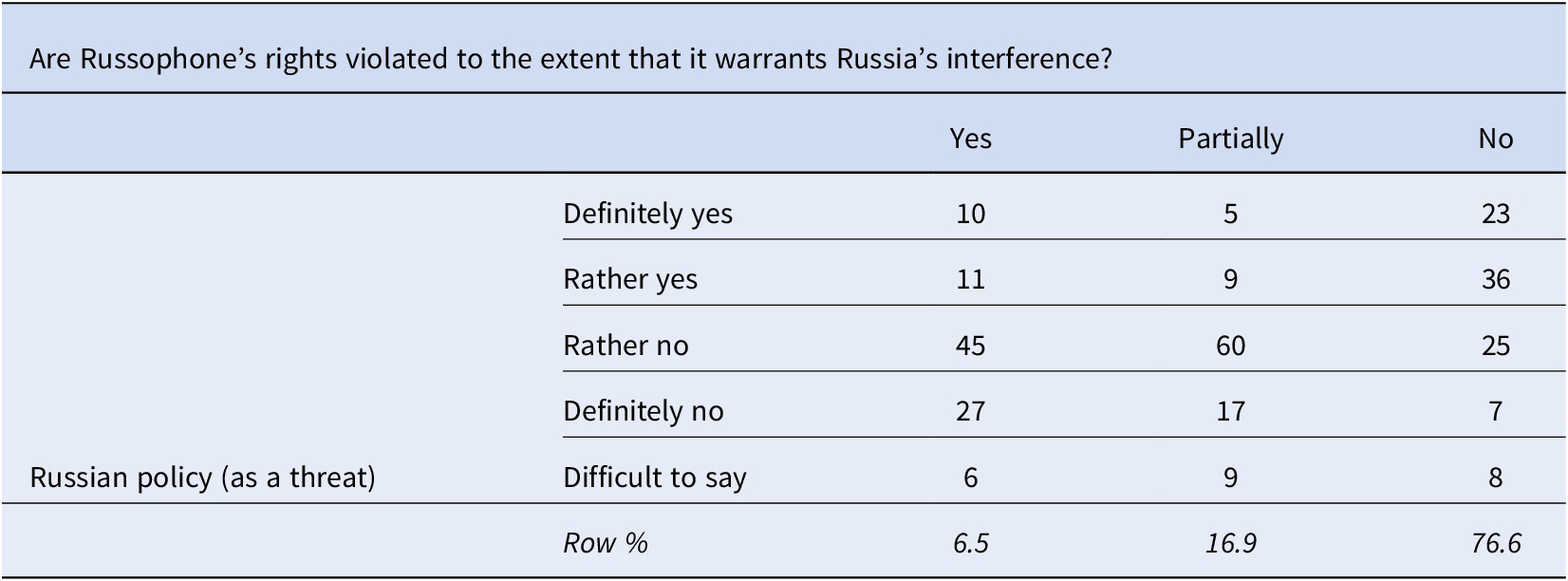
Finally, as it could be questioned whether fear of Russia and Russians could also be facilitated by the perceived existence of discrimination of ethnic minorities in Latvia (which, in turn, could potentially be seen as a factor contributing to a more assertive Russian policy towards Latvia). While we have no measures of perceived discrimination in the 2018 data, some insights can be gained from the 2015 survey (table 2 below). In that survey, a question was asked about whether the interests and rights of Russophones in Latvia are violated to the extent that it would warrant and justify Russia’s interference. Table 2 reveals that answers to this question do not correlate to threat perception as expected. Those 6.5% of respondents who see Russophones’ rights as significantly violated are, in fact, least likely to see Russia’s policies as a threat. The opposite is true for the majority (76.6%) who do not agree that such discrimination is taking place. This points to rather complex roots of threat perception, which perhaps can be much better explained by ideational and in-group/out-group factors rather than objective assessment of the situation.
Perception of Russian policy as a threat in relation to the perceived discrimination of Russophones in Latvia (%).
Source: 2015 survey data
Formation of Security Perception
Meanwhile, the perception of security is best explained by realism which focuses on imbalance of power between nations. As expected (H1b), we find that those who have high confidence in the military (Latvian army and NATO) and other people in Latvia, who take pride in the country’s armed forces and history, and who think that Latvia is developing in the right direction, are more likely to see Latvia as well protected. Those who see Latvia as a failed state with an unclear economic future, and perceive Russia’s development prospects as good, are convinced of the opposite. Interestingly, confidence in the government does not significantly impact the perception of being safe, whereas confidence in local police and courts seems to have the opposite effect.
We also find support for constructivist views. Key studies in critical security find that public perception of insecurity varies by identity, location, class, gender, religion, age, and—especially—ethnicity (Jarvis and Lister Reference Jarvis and Lister2013, Reference Jarvis and Lister2016). Similarly, we find that the perceptions among various ethnic groups of Latvia’s ability to defend itself greatly differ. More than other groups including Latvians, Russians do not see Latvia as well equipped to defend itself, supporting H2b (Sig. <0.05). Simultaneously, when controlling for ethnicity, both national pride and identification with Latvia lower the perception of Russia and Russophones being a threat. At the same time, titular Latvians are more likely to identify with Latvia and have confidence in the country’s ability to protect oneself. These findings provide support for H2b about the importance of ethnic identification as a source of confidence in one’s country’s ability to defend itself.
Interestingly, media consumption has little impact on security perception, which leads us to reject H3b. This finding is contrary to studies showing that ideologically slanted media can shape opinions (see Nisbet et al. Reference Nisbet2004). Perhaps, this is because our respondents are consuming a variety of media and the impact of one single kind of media source (e.g., Latvian mainstream media) is therefore not that significant. Still, those who use Facebook feel safer and more protected than those who do not (a change of 0.4 on a five-point scale). Nevertheless, we do not find that respondents who do not consume Russian media (which tends to portray Russia as a constructive neighbor, not an aggressor) would feel more secure than others. The effect is fully absorbed by ethnicity.
Finally, significant regional differences are observed. Surprisingly, controlled for the main socio-economic and attitudinal parameters, respondents in Latvia’s easternmost region Latgale not only perceive Russia as less threatening, but they also feel more secure than those in the capital city of Riga or in the Riga region. As noted before, the contact thesis could explain at least some of these differences. Closer connection to Russia and Russians seems to mitigate the expected heightened threat perceptions that – according to literature and our own data – should have come with both poorer economic conditions in this region and with geographical proximity to a potential aggressor.
Without controls (figure 2 above), the sense of security is highest in Kurzeme and Vidzeme (Sig.<0.05) where there is the highest proportion of Latvians, whereas in the Latgale region the sense of security is among the lowest. The regression model helps to explain some of the reasons for such discrepancy in findings due to the impact of variables including lower income, lack of confidence in the county’s military and its strength, perception of Latvia as a failed state (a common narrative in the Russian media), and belief that Russia is a great power making a comeback on the world stage.
Threat/Security Perceptions & Proportion of Russians in Latvian Regions.

Conclusion
This study provides several important insights for the study of ethnically diverse states and IR by bringing attention to the microfoundations of attitudes about threat and security. While much of IR scholarship takes it for granted that actors are quite good at identifying external threats – and engaging in balancing behavior accordingly – our research shows that threat perception on the societal level is influenced by a number of variables, many of them deeply subjective. As outlined in critical security studies research on vernacular and everyday security, different individuals perceive and respond to security threats differently.
Most importantly, the factors that influence threat perception are not necessarily the same than those that shape attitudes about security. In fact, our study brings a new perspective on an old dynamic: determinants of threat and security are not the same, and both states and people can perceive that threats exist while simultaneously feeling secure. For example, for years Russia itself has perceived the West and NATO as threats yet has also simultaneously signaled that it is able to protect itself and is thus secure (see Tsygankov Reference Tsygankov2018).
Moreover, we find a close connection between perceiving Russia as a threat and perceiving Russophones living in Latvia as threatening and potential fifth-columnists. This is important for two main reasons: 1) fears of Russia may be linked to fear of ethnic Russians at home, and 2) some respondents may link potential foreign threats (Russia) with perceived domestic threats (Russophones). Interestingly, our findings also indicate that Russia is feared for its potential weakness, not strength.
Most importantly, we find support for hypotheses grounded in realism and constructivism. Respondents who regarded their country as weak were more likely to perceive threats from Russia and feel less secure. Threat perception in Latvia – and likely in other ethnically diverse societies as well – to a significant extent can be explained by looking at impacts of different ethnic identities and in/out-group dynamics. For example, ethnic Latvians simultaneously see Russia as a threat yet also tend to feel secure. While such observation would not come as a surprise to a keen observer of ethnic politics, this is an important finding in the framework of IR theory where such ethnic differences are commonly overlooked as unimportant. Importantly, we find very limited support for liberalism, as those respondents who value democracy are not more likely to fear authoritarian Russia. At the same time, nostalgia (or lack of nostalgia) for the Soviet period and perceptions of Latvia as a “failed state” (or as an economically improving country) help with explaining views on threats.
Our findings about the media consumption are important even though they are inconclusive. Our data suggests that media consumption affects threat yet not security perception. This is important and warrants further research, as the impact of media on public opinion and foreign policy is frequently ignored in IR. Finally, respondents living in areas closer to Russia feel more secure and less threatened than those living further away.
Security debates too often concentrate on identifying threats to national security without looking at public perceptions of whether the threats to security can be successfully countered or neutralized. Sometimes societies may acknowledge the existence of threats while remaining optimistic about their ability to cope with them. On other occasions, however, societies may become convinced that threats are so dangerous and pervasive that they cannot be countered successfully. This is likely to have far-reaching consequences ranging from personal choices to public policies. After all, security is such a fundamental value and the lack of security has the potential of seriously weakening societies from within.
Further research should assess the relative weight that each of these security perceptions holds towards influencing decision-making by the governments and explore potential interactive effects between two or more of the identified factors. What is the interplay between societal perceptions of what constitutes threat and security, how does the society decide on arming/ deterrence vs. appeasementFootnote 3 as a strategy that is most likely to lead to peace and safety, and how do elites frame their policies to obtain support? It would also be important to investigate to what extent, if at all, regional powers such as Russia can use their kin abroad subversively.
In some extreme cases, such as East Ukraine since 2014, polarized opinions of the population can play an important role in an eruption of an internal conflict and serve as a pretext for military intervention for external actors. Power imbalances and aggressive Russian foreign policy also had led to a heightened threat perception in Ukraine for years. To some extent, threat and security perceptions generally differed for Ukrainian- and Russian-speakers in Ukraine back in 2014, even though these divisions have somewhat lessened since 2014 following initiatives aimed at developing a civic Ukrainian identity (Mankoff Reference Mankoff2022). Furthermore, Ukraine’s ability to stand its ground following the Russian invasion in early 2022 was somewhat surprising. Russia was not able to exploit the existing cleavages in Ukrainian society despite the considerable resources that were allocated for this purpose.
Additionally, the 2022 Russian invasion of Ukraine poses questions about threat and security perception in countries neighboring Russia. Perceptions of security in the region may have increased in the short term from the Baltic perspective as following the invasion Russia is unlikely to have the necessary resources and capacity to open another front in the Baltics for the foreseeable future. In addition, NATO has taken steps to bolster security of its frontline allies in response to Russia’s aggression. The case of Latvia demonstrates that parts of societies can feel secure in the face of external threats.
It remains to be seen, however, whether that this will still be the case in the years following Russia’s war in Ukraine. On the one hand, Russia unleashed a major war in Europe, and that may result in societies feeling less secure. On the other hand, Russia’s military did not perform particularly well, despite inflicting immense destruction and suffering. Thus, further research is needed to examine threat and security perception in ethnically diverse societies under changing circumstances. Additionally, future research should look into security and threat perceptions in ethnically homogeneous societies where differences in perceptions of security are likely to be found as well.
Acknowledgements
The authors would like to thank Jennie Schulze, Harris Mylonas, Svetluša Surova, Timofey Agarin and the outstanding Nationalities Papers reviewers for their feedback on this project. Matthew Pintea provided invaluable editorial assistance.
Financial Support
Inta Mieriņa’s work on this article was supported by the Latvian National Research Programme “Towards sustainable development and inclusive society in Latvia: response to demographic and migration challenges” (Nr. VPP-IZM-2018/1-0015). Juris Pupcenoks’ work on this article was partly funded by the Ministry of Education and Science of Latvia, project “Innovative and inclusive governance for the promotion of social involvement, trust, and communication” (Nr. VPP-LETONIKA-2021/3-0004).
Disclosures
None.
Appendix A. Theories, Hypotheses & Findings
Threat Perception
H1a (realism): Respondents who perceive their country to be politically, socially and military weak are more likely to see a rival neighboring country with a greater military capacity and aggressive foreign policy as threatening.
-
• Limited support.
H2a (constructivism): In ethnically diverse states, respondents from the titular ethnic group will perceive a rival neighboring country as more threatening than respondents from an ethnic group(s) that are ethnically similar to the rival country.
-
• Supported.
H3a (media impact): Respondents consuming media sources from a rival country will perceive it as less threatening than respondents consuming domestic media sources.
-
• Supported.
H4a (liberalism): In democratic states, respondents valuing authoritarianism over democracy will be less likely to perceive an authoritarian rival country as a threat.
-
• Limited support.
Security Perception
H1b (realism): Respondents who perceive their country to be politically, socially and military weak are more likely to feel less secure.
-
• Supported.
H2 (constructivism): In ethnically diverse states, respondents from the titular ethnic group will feel more secure than respondents from an ethnic group(s) that are ethnically similar to the rival country.
-
• Supported.
H3b (media impact): Respondents consuming media sources from a rival country will feel more secure than respondents consuming domestic media sources.
-
• Rejected.
Appendix B. Breakdown of Views on Security and Safety of Different Ethnic Groups in Latvia (%)

Note: All measures, except for the last one, come from the 2018 survey



