In any organization, staff capacity building is one of the major issues to consider so that staff members are able to fulfill their development goals while also enhancing capabilities that will allow them to achieve measurable and sustainable results.
According to the International Network of Agencies for Health Technology Assessment (INAHTA) definition of health technology assessment (HTA):
“HTA is the systematic evaluation of the properties and effects of a health technology, addressing the intended and the unintended consequences, and aimed mainly at informing decision making regarding health technologies. HTA is conducted by interdisciplinary groups that use explicit analytical frameworks drawing on a variety of methods” (1;Reference Glossary2).
When considering the properties and the effects (intended and unintended) of health technologies identified in INAHTA's definition, it is necessary to first address the domains that are commonly assessed during the HTA process: medical (safety, efficacy, and effectiveness), social (including the cultural characteristics of the population and the context to implement the technology), ethical, legal, organizational, and economic (3–Reference Banta5). These domains and the interdisciplinary or transdisciplinary character of this work, infuses this policy research area with a complexity that demands certain skills and competencies that professionals working in this field of knowledge require for success.
Different organizations have tried to analyze the professional requirements of HTA initiatives, units or agencies. Two main analysis should be cited: the work conducted by the European Network for Health Technology Assessment (EUnetHTA) on capacity building (Reference Atanasijevic, Brodsky and Cerbo6) and the work done by INAHTA's Education and Training Workgroup that has currently been included in a brand new Value Network (http://www.inahta.org/about-inahta/). Both initiatives have one feature in common: they have been promoted and supported by a network of HTA agencies. In the case of the EUnetHTA's initiative, they surveyed an international group of HTA organizations (Reference Moharra, Estrada, Parada, Cortés and Espallargues7): the participants responded that the recruitment of appropriate human resources was a critical issue when trying to establish HTA initiatives and “gathering trained staff was the most frequently experienced barrier in both establishment and daily work” (Reference Atanasijevic, Brodsky and Cerbo6). In terms of multidisciplinarity or transdisciplinarity of HTA work and skills to be considered, the following were identified: clinical epidemiology, evidence-based medicine, clinical trials, health services research, meta-analysis, economic analysis, priority setting, legal, social, and ethical aspects.
However, not all the above-mentioned skills were defined in a competencies format as would be the case if it had been a survey specific to educational issues alone. In addition, some of the skills could be re-categorized under broader topics, such as epidemiology, economics, health planning, etc. Nonetheless, according to these initiatives, an HTA professional or specialist should be able to: (i) perform literature searches; (ii) perform critical appraisal of the retrieved literature; (iii) synthesize the evidence; (iv) tailor the evidence to the context in which it will be applied (this includes economic, ethical, social, cultural, and organizational analysis); and (v) prepare and tailor the information according to the needs of the client (publish and diffuse).
Finally, the size of the HTA organization will influence which professional will work on any one specific task and the size of the team assigned to the overall assessment program (Reference Atanasijevic, Brodsky and Cerbo6–8). Three main profiles have been also identified as crucial to establish an HTA initiative: clinical scientists, economists, and information specialists. It is not clear, however, what is comprised under the epigraph of clinical specialist. Organizations might include any of the following under this category: pharmacists, epidemiologists, physicians, nurses, physiotherapists, biomedical engineers, biochemists, etc., depending on their mandate and scope. Furthermore, the size of the organization and the capacity of its members may also require that some of the necessary tasks will be covered in-house or will be subcontracted to experienced professionals. Who, and from which institutions, are issues especially relevant when considering ethical and legal analysis (Reference Hofmann9–Reference Jonsson and Chamova11).
In 2014, INAHTA convened a workshop during the Health Technology Assessment international (HTAi) meeting in Washington on current experiences in capacity building in HTA to establish a basis for a more robust analysis on the competencies required by HTA professionals. The following pages describe current initiatives and discuss their commonalities and differences.
METHODS
A preconference workshop was conducted at the 2014 HTAi Annual Meeting. The objective of this workshop was to conduct an exploratory discussion with participants of the skills required within an effective HTA team. The findings of this exploratory workshop will be then used as a basis for a more rigorous scientific study being conducted by the authors in 2015/16. The participants were self-selecting, choosing voluntarily to register in the workshop. The authors also invited senior officials to participate, and as a result over half of participants were CEOs or held senior positions in their organizations. There was also a wide range of representatives of industry, academic institutions, international organizations, international and national scientific institutions, international networks, national, regional, and hospital-based HTA units including high-income and low- and middle-income countries. (See Supplementary Table 1). Additionally, we have tried to collect clinicians’ and managers’ opinions on the subject.
The workshop included presentations from selected HTA agencies (CMeRC, OSTEBA, IECS) and HTA networks (EuroScan, EUnetHTA, RedETSA, HTAsiaLink, INAHTA) on HTA education and training programs they offer and their experiences delivering these programs. Further presentations were provided by selected HTA Masters Programs (the Ulysses International Master's Program in HTA & Management and the ScHARR survey of training needs in postgraduate HTA education) on their training offerings and experiences. The second part of the workshop involved two group discussions about HTA capacity building. The people were randomly divided into two groups and each was to consider the following set of questions from one perspective either that of an HTA producer or of an HTA user:
-
• What are your views on the areas of expertise or subject matter that are required for HTA producers/users?
-
• What mix of expertise/subject matter do you believe is essential to create an efficient and effective multi-disciplinary assessment team?
-
• What specific courses or training would you like education programs to provide? Would these be best delivered by an in-person program, online training, internship, or other means?
Rapporteurs (D.M., T.S., and I.G.I.) recorded minutes and each sub-group reported key points of their discussion back to the entire group, which was followed by a plenary discussion. The perspectives provided were from the individuals and did not represent or it could not be considered as an official position of their organizations. The minutes were circulated to workshop participants for one round of validation. These validated minutes were analyzed by the authors as part of the preparation of the findings and conclusions of this study. The summary of points raised in the breakout group discussions were used, and as such frequency of mention data for each point was not collected. Nevertheless, the data collected satisfies the objectives of this exploratory study and will inform the next phase that comprises a more robust scientific study by the authors.
FINDINGS
Perspective from Agencies, Networks, Industry, and Masters’ Programs.
CMeRC
Continuing education programs are an essential element of capacity building for staff and health professionals in general; one of the objectives of the HTA unit of the Charlotte Maxeke Medical Research Cluster (CMeRC) is thus to offer multi-disciplinary training programs. To implement and establish quality skill-building programs, a survey was conducted by CMeRC among the different stakeholders; the analysis provided an insight to the specific requirement of skills and competencies for health professionals. The findings led to the conclusion that even though various programs existed in industrialized countries (either institutionalized or were demand based), the training programs offered in African countries is quite low or virtually nonexistent. To reduce the skills gap, workshops and short courses are offered; nevertheless, South Africa and other African countries have to deal with financial and resource constraints. So, spreading awareness and knowledge of the benefits of using HTA is a continuous priority in these countries.
IECS
IECS is an academic, nonprofit organization based in Argentina. It is one of the main HTA agencies in Latin America, and has been an INAHTA member since 2005 and a WHO Collaborating Centre in HTA. In 2008, with growing interest in HTA across Latin America, but with scarce training materials available in Spanish, we developed a first HTA distance-learning course with a research grant from the Global Health Research Initiative. Later, also following the evolution of the needs of the region, this first course (HTA Diploma, 9 months duration oriented to doers) was accompanied by another course specifically aimed at decision makers (3 months duration oriented to users), and three other courses aimed at conducting systematic reviews and economic evaluations (introductory and advanced). Until now these courses were taken by almost 500 people from fifteen different countries.
Customization of these programs has also proceeded where needed, usually for training government staff in countries such as Brazil, México, and Colombia where the addition of a face to face component was necessary. In the development of these activities since 2008, the lessons learned have been: students need protected time from their institutions to devote to the education programs—it is difficult to keep pace with the course if an institution does not recognize the time required to complete the training. Second, not all goals can be achieved by distance-learning alone. The opportunity to include a face-to-face component of the training can be expensive, but is a crucial factor to the success of the training program. Finally, we observed differences between Saxon and Latin cultures in the way that students take the courses that needs to be taken into account and have a great influence in the success of distance learning activities.
OSTEBA and the Perspective of a Regional HTA Unit
When analyzing the requirements of capacity building of an HTA unit, we should consider two main issues: the healthcare system in which the unit develops its work and the client or clients to whom the reports and recommendations will be directed. Osteba, the Basque Office for HTA established its work in 1992, and it is accountable to the Ministry for Health of the Basque Country and serves the Basque Health Service. We have distinguished between two main target populations: HTA doers and HTA users when defining our learning and teaching activities. Among the HTA doers we included Osteba's staff, clinicians that help us with evaluations and other HTA professionals in the Spanish Healthcare system that help us in coordinated or joint actions. In the case of users, we included all the possible readers of our reports. Then, there is a need for a careful and detailed analysis of the required staff and the competencies they need to develop.
We identified some areas in which our activities should improve: health economics, bioethics, edition and diffusion, project management, horizon scanning, and grading recommendations. At that point, we divided the activities depending on their characteristics in: academic courses, self-organized training activities on specific areas of HTA work and learning from doing activities. The last ones were especially useful when we monitored the commissioned research projects. Finally, we organized training courses directed to clinicians and managers (HTA doers) to raise awareness on what is expected from an HTA report.
INAHTA
In a survey conducted a few years ago, it was noted that the HTA education and training needs of the members of INAHTA are wide and varied. Staff in new and emerging agencies need quite a different sort of training in comparison to those who are employed in established agencies. Under the new strategic plan, INAHTA envisions to offer skills enhancement programs and also a comprehensive list of education programs that are offered worldwide. Meanwhile, a mentorship program is already available for new and emerging agencies.
The mentorship program started as a collaborative initiative called upon by WHO and developed by INAHTA's Education and Training Working group; to date, the program has been endorsed by Euroscan and HTAi.
The program runs in the following manner: A requestor (Mentee) applies for a mentor by filling in the “Request for mentorship” form which is available on Web site of INAHTA and its partners. The form asks for information on the agency, type of mentor/mentorship, duration and the financial back-up. The prospective Mentor then completes the “Mentorship proposal” form, which seeks information on requirement details, offers of their mentorship capabilities and additionally includes references and CV of the mentor. The INAHTA secretariat collects all responder forms and sends them to the requestor, who thereupon selects an appropriate mentor.
HTAsiaLink
HTA in Asia is a new concept introduced less than a decade ago. The few HTA agencies in the region formed a regional network, called HTAsiaLink. From the start of HTAsiaLink in 2011, capacity building through networking was its most important goal. Two important means of capacity building in HTAsiaLink are the annual conference and collaborative projects. The HTAsiaLink annual conference has a unique format which is designed to enhance the capacity of junior staff in the member agencies. The conference is composed of 40 or more podium sessions, which typically have five or fewer presentations by junior staff and a couple of commentators who are invited HTA experts to provide feedback to the presenters. The plenary sessions are also designed to provide lecture or educational panel discussions on current issues in HTA.
The collaborative projects among the HTAsiaLink members are designed to meet the needs of member agencies, recognizing that these nascent HTA agencies may not yet have sufficient capacity to complete all aspects of a review on its own. By sharing the expertise of member agencies through collaborative projects, member agencies can learn from each other and can acquire useful components of an HTA review, such as cost-effectiveness thresholds or bolt-on domain of utility measures.
RedETSA
The Health Technology Assessment Network of the Americas (RedETSA in its Spanish acronym) is made up of fourteen countries and twenty-six institutions throughout the Americas, with PAHO acting as its Secretariat. As one of its first activities RedETSA performed a mapping of HTA capacity in the region and opportunities for further development of human resources in HTA. One of the conclusions of this mapping was that there are very different needs among the members of the network. There are countries with more years of experience in HTA that require training in more specific areas (e.g., systematic reviews, economic evaluations, or network meta-analysis) while other countries are at earlier levels of HTA development and still need introductory training in HTA methods and awareness activities aimed at decision makers to promote HTA.
With regard to training tools, countries value the opportunities offered by distance learning programs, but consider that the role of face to face activities remains critical. PAHO also launched a virtual introductory course in HTA which aroused much interest, and in its first version had 352 applicants and finally forty-seven students from eighteen countries, where priority was given to participants from lower-income countries with fewer training options. Additionally, RedETSA holds annual meetings which have been organized to provide training activities on topics prioritized by the members.
Ulysses International Master's Program
The Ulysses International Master's Program is a nonresidential master's program that combines face-to-face intensive training with distance learning. It responds to the growing need for human resources trained in HTA. The ideal candidates are full-time healthcare professionals. Job opportunities include HTA agencies, pharmaceutical companies, Ministries of Health, regional health authorities, and hospitals.
During the intensive Modules in four different cities (Montreal, Toronto, Rome, and Barcelona) students acquire competences to plan, realize, and present HTA reports and HTA-based policy documents. The international faculty gives the students exposure to other approaches during on-site interactive lessons and team works. The final thesis and a 4-month long internship allow students to apply HTA methods to a real life context. The Ulysses Program counts on a flexible format to adapt to a rapidly evolving healthcare environment.
Currently, the 7th edition of the Ulysses Master's Program is ongoing. With a background in medicine, engineering and health sciences, and social sciences and policy, 158 students have been enrolled so far. Two-thirds of the students are over 30 years old, and 30 percent are women. Students come from eighteen different countries. The alumni association supports long-term contact which helps to create an international network of professionals.
ScHARR
Before launching their online MSc program in International HTA, the University of Sheffield conducted a Web-based survey in partnership with HTAi to evaluate the training needs of potential students. The survey was administered in November 2012 – May 2013 to the HTAi membership, and it included nine questions focusing on training needs, preferred length of program, mode of study, and preferred designation acquired through the program. Fifty responses were received from respondents in industry, government, HTA agencies, academia, and other public sector organizations.
Key training needs identified include: ability to critique HTA; application of HTA to decision making, designing and performing HTA. The top training needs specifically identified included: cost effectiveness research; clinician effectiveness research; disinvestment; designing technology assessments and patient reported outcomes. Other needs identified included: implementation and impact; priority setting; transferability. The majority of respondents expressed clear preferences for part-time, online distance learning programs. The University of Sheffield used the results of this survey to inform the development of their online HTA program, which is available as a full MSc, diploma, certificate or single module formats.
PERSPECTIVES FROM PRODUCERS AND USERS OF HTA REPORTS
Views of Producers of HTA Reports on:
Areas of Expertise or Subject Matter That Are Required for HTA Producers: According to the participants, people with a clinical background, be it a medical doctor, nurse, physiotherapist, health economist, biomedical engineering, etc., have an advantage when it comes to scoping HTA topics, choosing a comparator, writing a report, conducting literature searches, and finally appraising results. In cases where a team of producers do not have expertise in this area, it is then advisable to have a clinician as an advisor to the team. It was also noted that the difficulty lies in writing a report; summarizing from various articles and, writings can be challenging and so is the capability to write a report in such a way as to be understandable by the commissioner and user of a report, for example, a policy maker. Specialists in bioethics or ethics or epidemiology were also recognized as professions that need to be included in a team.
Consequently, the group's view was that the following skills are “must-haves” when one is involved in producing a report: capability to search information/literature, appraise the relevant literature, synthesize and write a report. Additionally, members should have project management and team management skills; the capability to incorporate different viewpoints from team members and other stakeholders and also know how to build consensus by using a clear and a proven methodology. Many of those present had experienced difficulty in communicating with different stakeholders involved in a project: Not only do team members come from diverse backgrounds and professions, but also the users for whom the reports are written are people who come from mostly nonclinical backgrounds.
Furthermore, one participant commented that “HTA professionals require a significant amount of experience and skills, including: (i) knowledge of the pharmaceutical and medical device development processes; (ii) an understanding of the potential, timing, methodologies and development of health economic research; (iii) knowledge of the therapeutic area and current medical practice in one's country (standard of care, assessment of unmet need, treatment guidelines; (iv) knowledge of best practice treatment processes (e.g., in other countries versus one's own). Understanding of budgets/budget flows, in order to assess healthcare practices, knowledge of where and how the healthcare budgets are spent would be necessary.”
Mix of Expertise/Subject Matter Knowledge Felt to Be Essential to Create a Multi-disciplinary Team: Project management skills (together with group or team management), “soft skills” (interpersonal and negotiation skills, team management, consensus building, report writing, etc.), along with the “hard skills” (scientific and clinical skills, literature searching, critical appraisal) are all considered significant and necessary skills to either possess or acquire to create a high-functioning, multi-disciplinary team. The ability to scope for HTA topics was also recognized as a necessary skill for the production of useful HTA reviews. The participants pointed out that access to local databases specific to healthcare systems can sometimes be challenging.
Data analytic skills were also identified: facility in managing data sets that were not necessarily created for the specific purpose at hand, that is, data mining skills were found to be necessary. Another essential skill identified was the ability to read and determine the quality of written reports, including sections contributed by various team members. For a multidisciplinary team to be effective, it was stated that the team members should not only have high level of skills but also be aware of the skills of fellow experts.
Specific Courses or Training Areas HTA Education and Training Programs Should Cover: Many of the participants voiced the need for workshops, practical exercises, problem solving skills, and opportunities to present real case studies to be skilled in writing HTA reports. It was also mentioned that internship/mentorship programs are suitable in this case as the student then works on a real life project and at the end produces a report. This report may not necessarily be of use, for example when participants of a program only have access to abstracts, but they can still do some kind of hands-on exercise with these materials that will build their experience, even if the end result will not be needed.
Considering different ways to teach students to overcome barriers in obtaining data was found to be important criteria for a course. The producers of HTA need functional expertise in basic HTA, literature searching, critical appraisal, report writing, ability to understand effective protocols for studies, group management, and project management. Also one of the participants mentioned that going through previous HTA reports is a great way to follow and learn about a product from start to finish.
Additionally, a representative from the industry expressed the following views on expertise necessary to produce HTA reports.
The pharmaceutical and medical device industries are important players in HTA. Their role varies according to the national approach to HTA in the jurisdiction in which they operate. Internationally, they have a critical role in the design and conduct of clinical trials to generate evidence to be applied in HTA. There has been considerable development in regard to recognizing the need for clinical trials to generate data for both regulatory purposes and to support the value proposition for a new technology. This has meant an increased focus on patient-relevant health outcomes, resource use and health-related quality of life, leading to product development teams engaged in phase 2–3 clinical trials requiring multi-faceted capabilities. These cross-functional teams include health outcomes research and patient-reported outcomes specialists in addition to the usual clinical research and statistical experts. Where appropriate, health economic models may be developed centrally, for further adaptation at a local level.
At the country level, the skills and capabilities will vary more according to the nature of the HTA processes and systems. Systems that rely on a manufacturer submission may use guidelines and HTA agency-led training to raise the quality of submissions. Again, cross-functional teams are the norm. Strong capabilities in literature searching and review, high quality report writing and understanding of economic models are all key skills. The relative importance varies from system to system. For complex economic modeling, it is common to use expert consultants. However, a key skill is the ability to synthesize complex information and present it in easily understood forms required by agencies dealing with many submissions simultaneously. Project management skills need to underpin this complexity.
Capacity building within companies is often a combination of centrally and regionally delivered in-house training, supplemented by educational workshops delivered by recognized providers, such as those offered regionally by International Society of Pharmacoeconomics and Outcomes Research (ISPOR) and HTAi at their respective scientific meetings.
Views of Users of HTA Reports on:
Areas of Expertise or Subject Matter That Are Required for HTA Users: The primary interests of different users of reports, for example, marketing directors, hospital managers, decision-maker reviewers, lie in clinical and cost effectiveness. In addition to promoting the multi-disciplinary nature and, broad scope of HTAs, it is also necessary to recognize that this field is more and more user-driven, which includes patient as users. HTA users are a heterogeneous group and require expertise in different areas which should also include skills in management and organization of a project. According to the participants, the users should also familiarize themselves with concrete cases and case studies incorporating real life decisions to gain first-hand knowledge in this field.
Mix of Expertise/Subject Matter Knowledge Believed to Be Essential to Create a Multi-disciplinary Team: The mix of expertise in an HTA team depends upon the level at which a report is being used. For example, a health economist must focus on different aspects of an assessment if he or she is catering to the needs of policy maker versus a hospital manager.
Ethical issues and expectations of patients (rights) in the system vary across countries, as do the rights. These may make it imperative to have certain types of people/experts in the multidisciplinary team, for example, in some countries industry supports patient associations to take certain matters to court.
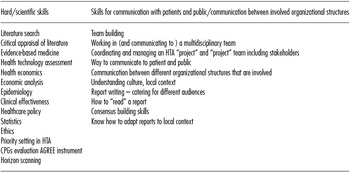
Specific Courses or Training Areas HTA Education and Training Programs Should Cover: The participants found that face-to-face sessions are often unrealistic and e-learning is a more feasible alternative which can be also mixed with face-to-face sessions. The group suggested the following approach: a course should offer concrete cases with real decisions to showcase results of such decisions. It should include areas on clinical outcomes, economic effects, and organization and management skills, if needed. The patients usually have different goals and would like to learn for example, how prices are established, priorities are set, values are defined, etc. There should be different strategies in a course to match to the background and priorities of different users and commissioners, for example, policy makers, ministers, managers, patients, clinicians. We would like to point out that we were unable to collect clinicians’ and managers’ views on the matter at this time. Table 1 summarizes the hard and soft skills as identified by the participants of the workshop.
“Soft” and “Hard’” Skills Identified by Users and Producers

HTA, health technology assessment; CPG, Clinical Practice Guideline; AGREE, Appraisal of Guidelines for Research and Evaluation.
DISCUSSION
The previous sections have addressed the three main questions pertaining to this workshop. It can be seen that there are some open questions which were raised during the workshop and need to be addressed. The two groups had identified several competencies that would be essential for those who produce, commission, and use HTA reports. These skills can be divided into two main parts: (i) soft skills, for example, management, writing, interaction with team members, understanding of the local culture and context, consensus building, etc. (ii) hard or scientific skills, for example, literature search, critical appraisal of literature, statistics, elaboration of recommendations, ethics, organizational, legal, and social analysis, etc. In attempting to specify different competencies, the participants and writers acknowledged that users and producers of reports need to develop certain distinctive but different skills to be successful in their respective areas of work. In this context, it can also be argued that these so called “soft” and “hard” skills can be further differentiated into “core” and “secondary” competencies as described by others (Reference Skirton, Lewis, Kent and Coviello12;Reference Salinas-Miranda, Nash, Salemi, Mbah and Salihu13).
The secondary competencies can be understood as “nice to have” and core competencies as “must-haves” (Reference Patterson, Ferguson and Thomas14). Although clients or users of HTA assessments can be different and so the context to implement those assessments for the decision-making process, it is clear from this workshop's conclusions that “core” competencies should be covered in any HTA process. One of the main issues, at this stage, is whether existing capacity building programs and courses cover them all. Another fact to be determined is whether current HTA organizations and their staff are successfully achieving these competencies and whether currently developed programs are enough to cover HTA organizations’ staff requirements (Reference Atanasijevic, Brodsky and Cerbo6). Especially in newly created HTA agencies, the INAHTA agencies assessed on current levels of multidisciplinarity claim that there is a need for further capacity-building and mentorship programs. This assertion indicates that these aspects are at least partially covered (Reference Jonsson and Chamova11). Obviously, these final statements need further, well-conducted research; nevertheless, the findings of this workshop pointed out where to put the focus. In fact, the agencies' member representatives could have included some statements around the ideal HTA team and capacity; however, this was not under the scope of this study and was not specifically explored.
Nevertheless, this has been a matter of discussion in other published researches and analysis from the perspective of HTA organizations (Reference Atanasijevic, Brodsky and Cerbo6). Furthermore, in an exploratory paper around motives, enablers, and barriers for the implementation of HTA initiatives, it was observed that there were no differences among countries’ level when defining the requirements on minimum competences and staff requirements (Reference Rajan, Gutierrez-Ibarluzea and Moharra15).
Finally, we need to stress that, although we have tried to collect clinicians and managers’ opinions, we have failed to receive any answer and this could be a possible limitation of the study. So further insights should be made to make a much more profound analysis of these groups’ opinions regarding competencies that should be achieved by doers and users (clinicians and patients), especially referred to the interaction with them, considered as stakeholders (Reference Lopes, Carter and Street16–Reference Kleme, Pohjanoksa-Mantyla and Airaksinen19).
CONCLUSION
In attempting to cover the broad range of skills pertinent to composing and using an HTA report, the workshop raised further questions, but also provided certain answers. As discussed, the group recognized that the possession of certain competencies or acquiring the same gradually can help a person working with HTA. However, it would be useful for both those seeking work in this area or those hiring professionals to have a checklist of essential and optional skills. If such a checklist of skills were created, it would require the necessary educational and legal framework to define those skills and capabilities. Also, is it required to professionalize HTA, in such a manner that certain skills, the core skills could differentiate an HTA professional? On the other hand, these views and opinions are from a handful of people who had participated in the workshop. In view of this fact, further scientific investigation is being currently carried out to efficiently and effectively establish the necessary education requirements and training programs. This as well requires an active engagement of the various stakeholders to shed light on the above-mentioned queries, including listing and defining basic core competencies and also gaining further knowledge on secondary competencies, potentially along a path toward the professionalization of HTA.
SUPPLEMENTARY MATERIAL
Supplementary Table 1: http://dx.doi.org/10.1017/S0266462316000490
CONFLICTS OF INTEREST
The authors have no conflicts of interest to report.