INTRODUCTION
The genus Barbus represents a highly diversified group within the Cyprinidae, a fish family of ancient origin, widely distributed in Africa, Asia and Europe (Machodrom and Doadrio, Reference Machodrom and Doadrio2001a). Following a recent study of the evolutionary history of this cyprinid genus, phylogenetic analyses suggested that the genus Barbus should be divided into 5 lineages based on mitochondrial DNA sequence data (Machordom and Doadrio, Reference Machodrom and Doadrio2001b). The different theories explaining the present distribution of Barbus species have been considered, and several dispersion mechanisms proposed for Barbus lineages (Almaça, Reference Almaça1988; Doadrio, Reference Doadrio1990; Machodrom and Doadrio, Reference Machodrom and Doadrio2001a).
The European Barbus are represented by 2 lineages, the subgenera Barbus and Luciobarbus. The first group includes the closely related European species (endemic but also widely distributed), and the second group includes the highly endemic species from the Iberian and Greek Peninsulas, closely related to those in North Africa and Caucasia (Machodrom et al. Reference Machodrom, Doadrio and Berrebi1995; Zardoya and Doadrio, Reference Zardoya and Doadrio1999; Machordom and Doadrio, Reference Machodrom and Doadrio2001a, Reference Machodrom and Doadriob; Doadrio et al. Reference Doadrio, Carmona and Machordom2002).
Concerning members within Barbus, molecular phylogenetic analyses have suggested taxonomic inconsistencies for several European species, such as B. barbus, B. petenyi and B. cyclolepis; and the taxonomic status of some of them is still controversial or has been addressed only recently (Machodrom and Doadrio, Reference Machodrom and Doadrio2001a, Reference Machodrom and Doadriob; Kotlík and Berrebi, Reference Kotlík and Berrebi2002; Kotlík et al. Reference Kotlík, Tsigenopoulos, Rab and Berrebi2002). Four species within Barbus considered in the present study differ by their biogeographical distribution. Barbus barbus is a species widely distributed in Europe, replaced by the local subspecies in Euromediterranean peninsulas (Froese and Pauly, Reference Froese and Pauly2006). Moreover, the phylogenetic analyses of cytochrome b sequence data indicate the presence of a different haplotype in French and Spanish populations compared to populations from the Danube (Kotlík and Berrebi, Reference Kotlík and Berrebi2001). Barbus meridionalis represents a species with Euromediterranean distribution, its occurrence is limited to the North of Spain. Barbus balcanicus (previously considered as B. petenyi) is distributed in the tributaries of the Danube River on the Balkan Peninsula (Kotlík et al. Reference Kotlík, Tsigenopoulos, Rab and Berrebi2002) and the distribution of B. cyclolepis includes Bulgaria, Romania, Turkey, Moldova and the Ukraine (Froese and Pauly, Reference Froese and Pauly2006).
Species of Dactylogyrus (Dactylogyridae, Monogenea) are ectoparasites living on the gills of mainly cyprinid fish. These parasites are highly host specific, i.e., many species are restricted to one host species. However, different levels of host specificity have been recognized previously for Dactylogyrus species parasitizing Central European fish species, ranging from strict specificity through to all intermediate states of host specificity, to generalists (Šimková et al. Reference Šimková, Verneau, Gelnar and Morand2006). Concerning Dactylogyrus parasitizing Barbus species, the predominant investigations of representatives of this parasite genus were in large Barbus species from West Africa (Guégan and Lambert, Reference Guégan and Lambert1990) and those from North Africa (El Gharbi et al. Reference El Gharbi, Birgi and Lambert1994). However, a limited number of studies has been devoted to investigating Barbus species in the Euromediterranean region. El Gharbi et al. (Reference El Gharbi, Renaud and Lambert1992) described the Dactylogyrus species on 8 Barbus species of the Iberian Peninsula (7 of them being endemic representatives of the Luciobarbus subgenus) and suggested that endemism of these species corresponded to the endemism of the host. Three specific Dactylogyrus species were described on the endemic Barbus prespensis from Greece (Dupont and Lambert, Reference Dupont and Lambert1986). However, several Dactylogyrus species can occur on more than 1 host species within the genus Barbus, but they have never been observed on any other genus of cyprinid fish (except Labeobarbus, which is closely related to Barbus in North Africa). Therefore, some Dactylogyrus species parasitizing Barbus could be considered ‘genus specialists’ (see Šimková et al. Reference Šimková, Verneau, Gelnar and Morand2006). For instance, Dactylogyrus species from North Africa were observed to parasitize from 1 to 4 Barbus species. Also, the majority of Dactylogyrus species parasitizing the endemic Barbus from the Iberian Peninsula occurs mainly on 2 or 3 host species. Nevertheless, a few Dactylogyrus species are recorded on Barbus species belonging to different lineages. For instance, D. dyki was shown to be a parasite of 4 endemic Barbus species from Greece (including both the representatives of Barbus and Luciobarbus subgenera), and this parasite was also found on B. meridionalis, hybrids of B. meridionalis and B. haasi from Spain, and on the widely distributed B. barbus found across Europe (Gusev, Reference Gusev and Bauer1985; El Gharbi et al. Reference El Gharbi, Renaud and Lambert1992; Crivelli et al. Reference Crivelli, Malakou, Catsadorakis and Rosecchi1996; Šimková et al. Reference Šimková, Morand, Jobet, Gelnar and Verneau2004).
Molecular phylogenetic analyses of Dactylogyrus species demonstrated intrahost speciation as an important process of Dactylogyrus diversification in Central European fish species (Šimková et al. Reference Šimková, Morand, Jobet, Gelnar and Verneau2004). However, the speciation process of those parasites in congeneric hosts (particularly in a highly diversified genus such as Barbus) inferred from phylogenetic analyses based on molecular markers has not been investigated until now. A comparison of phylogenies of congeneric cyprinid hosts (genus Labeo) and their Dactylogyrus species was performed using morphological characters for parasites (Guégan and Agnèse, Reference Guégan and Agnèse1991). However, only cospeciation and host switching were inferred as speciation events. The aims of this study were (1) to investigate Dactylogyrus occurrence on selected Barbus species in Europe, (2) to compare the morphometric traits of the sclerotized parts of attachment apparatus and reproductive organs and sequence variability in nuclear ribosomal DNA (rDNA) markers for Dactylogyrus species living on congeneric host species, and (3) to perform molecular phylogenetic analyses in order to investigate the process of speciation in Dactylogyrus species parasitizing congeneric fish species living in geographically isolated areas.
MATERIALS AND METHODS
Parasite sampling
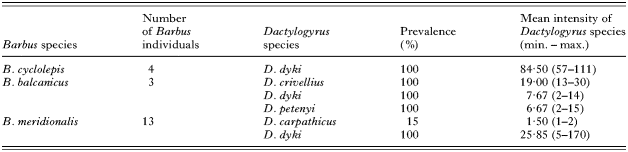
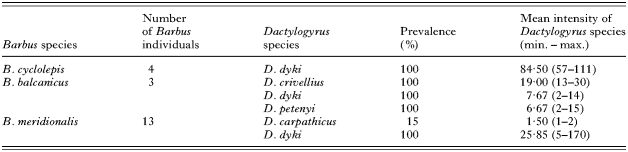
Barbus cyclolepis Heckel, 1837 and B. balcanicus Kotlík, Tsigenopoulos, Ráb and Berrebi, 2002 were investigated during a field study in Bulgaria in July 2005. Barbus cyclolepis (18·25±2·87 cm in length; mean±s.d.) from the Struma River basin (near the town of Kjustendil, Aegean Sea drainage area (42°18′45″ N, 22°45′44″ E) and Barbus balcanicus (17·03±1·35 cm) from the Vidbol River (near the town of Dunavci, Danube basin, Black Sea drainage area (43°55′28″ N, 22°48′50″ E) were collected. Barbus meridionalis Risso, 1827 (14·43±3·92 cm) was sampled during a field study in Spain in August 2006 from the rivers Tenes (41°42′37″ N, 2°11′26″ E) (Riells del Fai village) and Congost (41°44′07″ N, 2°16′06″ E) (Santa Eugènia del Congost village) in the Besòs basin (Barcelona Province, Mediterranean Sea drainage) and Brugent River (42°00′40″ N, 2°36′15″ E) (Amer village) in the Ter basin (Girona Province, Mediterranean Sea drainage). Numbers of investigated individuals for each Barbus species are shown in Table 1.
Epidemiological characteristics of the infection of Dactylogyrus species
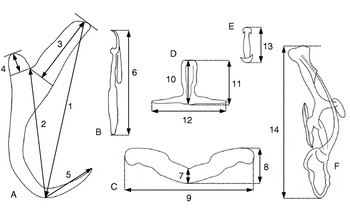
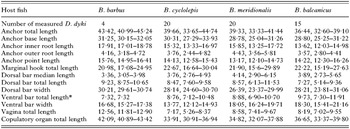
Monogeneans were removed from the gills of freshly killed fish, placed in a drop of water on the slide, covered with a cover-slip, and identified using a light microscope equipped with phase contrast. The hard structures (haptoral attachment components, vaginal armament and copulatory organ) were used for parasite identification according to Gusev (Reference Gusev and Bauer1985) and Dupont and Lambert (Reference Dupont and Lambert1986). Specimens of Dactylogyrus used for molecular analyses were preserved in 95% ethanol. Several specimens of each Dactylogyrus species were fixed in a mixture of 100% glycerine and ammonium picrate (GAP), following the protocol of Malmberg (Reference Malmberg1957), and used for morphometric study. Drawings were made with the aid of a drawing attachment and phase-contrast optics. Measurements, all in micrometers, were taken using digital image analysis (MicroImage 4.0 for Windows, Olympus Optical Co., Hamburg, Germany); means are followed by min-max values in the text and in Table 2. The scheme of measurement for the sclerotized structures is denoted in Fig. 1. For parasite individuals, 7 marginal hooks, each from 7 different pairs of marginal hooks, were measured. The intensity of infection and prevalence were calculated for each Dactylogyrus species following Bush et al. (Reference Bush, Lafferty, Lotz and Shostack1997).
Scheme of measurement for sclerotized structures of haptor and reproductive organs (modified according to Gusev, Reference Gusev and Bauer1985). (A) Anchor: 1=total length, 2=base length, 3=inner root length, 4=outer root length, 5=point length; (B) marginal hook: 6=total length; (C) dorsal bar: 7=median length, 8=total length, 9=width; (D) ventral bar: 10=median length, 11=total length, 12=width; (E) vagina: 13=total length; (F) copulatory organ: 14=total length.

Measurements of attachment apparatus and reproductive organs of Dactylogyrus dyki from Barbus barbus, B. cyclolepis, B. meridionalis and B. balcanicus
(Mean, min.–max.; all measurements are given in μm.)

* Note: the measurements of median length and total length of ventral connective bar are identical in this species due to the shape of the ventral bar.
Morphometric analyses of the sclerotized parts of attachment and reproductive organs of Dactylogyrus dyki from different host species
Due to their normal distribution the morphological traits of D. dyki populations were analysed by parametric statistical methods. Only D. dyki collected from B. meridionalis, B. cyclolepis and B. balcanicus were included in the analyses. The D. dyki individuals from B. barbus were not included in the morphometric analyses (even though the measurements are shown in Table 2), as the fixed individuals provided by the helminthological collection of the Institute of Parasitology ASCR, České Budějovice, Czech Republic were mounted in Canada balsam which prevented a comparison with the D. dyki individuals fixed in GAP in this study. The total length of 7 individual marginal hooks was averaged for each individual D. dyki, and the mean total length of marginal hooks was used for other analyses. A one-way analysis of variation (ANOVA) was used to test the difference of morphological traits among D. dyki samples, and Levene's test was applied to ascertain homogeneity among samples. In addition, the phenotypic variability of D. dyki from different host species was estimated based on all morphometric traits with the aid of a principal component analysis (PCA). The first 2 axes with the highest account on total variability of D. dyki attachment apparatus and reproductive organs were used for ANOVA analysis of differences among samples, and were followed by Fisher's LSD post hoc test. The correlations between the characters of attachment apparatus and reproductive organs with the first 2 factorial axes were analysed using Pearson's correlation.
Molecular analyses
Individual parasites were removed from ethanol, and genomic DNA was extracted using the Dneasy™ Tissue Kit (Qiagen). The polymerase chain reaction (PCR) was used to amplify two nuclear rDNA regions together. A part of the small subunit (18S) of rRNA gene and the first internal transcribed spacer (ITS-1) were amplified from ∼30 ng of genomic DNA in a volume of 30 μl containing 1X buffer with 1·5 mm MgCl2, 200 μm dNTPs, 1·5 U of Platinum Taq DNA Polymerase (Invitrogen) and 0·8 μm of each primer (forward S1 and reverse IR8), as described by Šimková et al. (Reference Šimková, Plaisance, Matejusová, Morand and Verneau2003). The PCR was conducted in a thermocycler (Mastercycler ep gradient S, Eppendorf) using an initial denaturation at 95°C for 4 min; 35 cycles of 95°C for 1 min, 55°C for 1 min and 72°C for 1 min 30 sec; and a final extension at 72°C for 10 min.
For fish, the genomic DNA was extracted (Dneasy™ Tissue Kit, Qiagen) from ethanol-preserved fins. A region in the cytochrome b gene was PCR-amplified from ∼30 ng of genomic DNA in a 30 μl volume containing 1X buffer with 1·5 mm MgCl2, 200 μm dNTPs, 0·75 unit of Taq DNA Polymerase (Fermentas) and 0·5 μm of each of the primers forward-LACB (5′- GTGACTTGAAAAACCACCGTTG-3′; modified from Schmidt and Gold, Reference Schmidt and Gold1993) and reverse-HBCB (5′- CCTCGTTGTTTTGAGGTGTGTA-3′; Dowling et al. Reference Dowling, Tibbets, Minckley and Smith2002). The cycling conditions were: initial denaturation at 94°C for 2 min; 35 cycles of 94°C for 1 min, 53°C for 1 min and 72°C for 2 min; and a final extension at 72°C for 10 min. Amplicons were resolved in a 1·5% agarose gel, purified using minicolumns (Wizard® SV Gel or PCR Clean-Up System, Promega) and sequenced using the same primers (separately) as for the PCR. For each Dactylogyrus species, at least 3 individuals were sequenced. The sequences for Dactylogyrus species were deposited in GenBank under the Accession numbers EF582617 to EF582622.
Phylogenetic analyses
DNA sequences were examined using Sequencher software (Gene Codes Corp.) and aligned using Clustal W multiple alignment running in BioEdit version 7.0.5.3 (Hall, Reference Hall1999). Phylogenetic analyses using the 18S and ITS-1 sequence data were performed for the Dactylogyrus species. Following the phylogenetic reconstruction of Dactylogyrus (Šimková et al. Reference Šimková, Morand, Jobet, Gelnar and Verneau2004), Dactylogyrus vistulae from Leuciscus cephalus (Accession number AJ564161 available in GenBank) was selected as outgroup; this species was shown to be in a well-supported clade separated from the clade including species parasitizing European Barbus barbus. Three Dactylogyrus species of Barbus barbus, collected from the Czech Republic, were also included in the analyses. The Accession numbers are available in GenBank (D. carpathicus: AJ564115, D. dyki AJ564127 and D. malleus: AJ564142). The phylogenetic analyses were performed using the program PAUP* 4b10 (Swofford, Reference Swofford2002). Maximum likelihood (ML) analysis, employing the most appropriate model selected by ModelTest program (Posada and Crandall, Reference Posada and Crandall1998), was performed using a branch-swapping algorithm (TBR, tree bisection reconnection). Distance trees were generated using the neighbour-joining algorithm (NJ) based on the distances fitted to the most appropriate model selected by ModelTest. Maximum parsimony (MP) analysis was performed using branch and bound search with as-is addition of sequences, running on unweighted informative characters. Bootstrap support values for internal nodes were estimated after 1000 replicates for NJ and MP as well as 1000 replicates calculated for ML using the TBR branch-swapping algorithm. Bayesian inference analyses (BI) were conducted using the program MrBayes 3.1.2 (Ronquist and Huelsenbeck, Reference Ronquist and Huelsenbeck2003). For the data set analysed (parasite data or host data), the model specified was selected using the previously determined model of nucleotide evolution by the hierarchical likelihood ratio tests using ModelTest. Four Monte Carlo Markov chains were run for 100 000 (parasite data) or 10 000 (fish data) generations, trees being sampled every 100 generations. Log likelihoods of the saved trees were viewed graphically, and all trees before stationary were discarded as ‘burn-in’. Two replicates were conducted for the Bayesian runs. The posterior probabilities (PP) of the phylogeny and its branches were determined for all trees left in the plateau phase with the best ML scores.
Phylogenetic analyses were also performed for Barbus host species using the sequences of cytochrome b. The sequences of B. balcanicus, B. cyclolepis and B. meridionalis were identical with the sequences published in GenBank under the following Accession numbers: AF248717, AF090784 and AF334102, respectively. The same phylogenetic methods were applied as employed for Dactylogyrus species. Barbus graellsii (Accession number AF334089), a representative of subgenus Luciobarbus was used as the outgroup, as it is considered a sister taxon to the species examined herein (Machodrom and Doadrio, Reference Machodrom and Doadrio2001b). In addition, the program TreeMap 1.0 (Page, Reference Page1994) was used to represent host-parasite associations using the Dactylogyrus tree inferred from the analysis of combined data and the Barbus tree.
RESULTS
Dactylogyrus species of investigated Barbus species
Dactylogyrus dyki, D. crivellius and D. petenyi were found on B. balcanicus from Bulgaria at different intensities of infection (see Table 1). The presence of all 3 Dactylogyrus species on each fish individual studied was recorded. Only D. dyki was found on B. cyclolepis from Bulgaria. This species reached its highest values of intensity of infection when the infections of all Dactylogyrus species investigated on Barbus species in our study were compared. Dactylogyrus dyki and D. carpathicus were found on B. meridionalis from Spain. Dactylogyrus dyki was found on all individuals of B. meridionalis investigated, with the high intensities of infection, whilst D. carpathicus was rare and with low prevalence and intensity of infection.
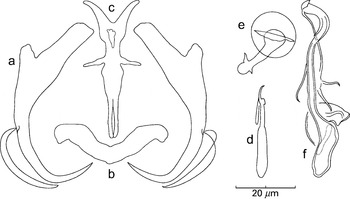
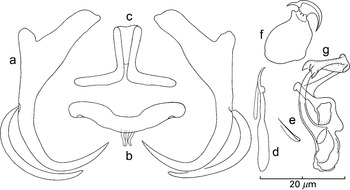
Dactylogyrus crivellius Dupont and Lambert, 1986 (Fig. 2)
Host species and locality of the present record: Barbus balcanicus (Vidbol River, Bulgaria).
Dactylogyrus crivellius: (a) anchor, (b) dorsal bar, (c) ventral bar, (d) marginal hook, (e) vagina (dorsal view), (f) copulatory organ (dorsal view).

Other previous records: Barbus cyclolepis prespensis, Lake Mikri, Greece (Dupont and Lambert, Reference Dupont and Lambert1986).
Material of description: measurements are based on 20 individuals.
Measurements: Anchor – total length: 53·02 (48·50–55·76), base: 42·98 (40·27–45·60), inner root: 18·08 (14·77–19·79), outer root: 4·84 (3·81–7·09), point: 14·92 (12·89–16·97); Marginal hook – total length: 28·12 (23·72–32·06); Dorsal bar – median length: 6·38 (4·67–8·23), total length: 13·44 (11·43–15·68), width: 36·08 (32·68–39·03); Ventral bar – median length: 39·39 (35·67–42·88), total length: 47·08 (42·83–51·51), width: 22·24 (18·83–25·30); Vagina: 12·56 (11·14–13·55); Copulatory organ: 59·33 (53·81–64·06).
Remarks: This Dactylogyrus species was described from B. cyclolepis prespensis, a species endemic in Greece.
Dactylogyrus dyki Ergens and Lucky, 1959 (Fig. 3)
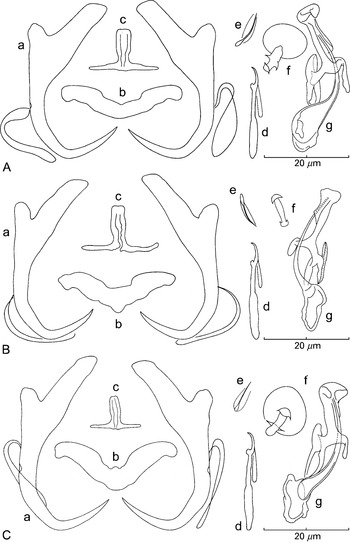
Dactylogyrus dyki from the different host species: (A) Barbus balcanicus, (B) B. meridionalis, (C) B. cyclolepis. (a) anchor, (b) dorsal bar, (c) ventral bar, (d) marginal hook, (e) needle, (f) vagina (dorsal view in A and C, ventral view in B), (g) copulatory organ (dorsal view in A and C, ventral view in B).

Host species and the localities of the present record: Barbus balcanicus (Vidbol River, Bulgaria), Barbus meridionalis (Tenes, Congost, Brugent Rivers, Spain), Barbus cyclolepis (Struma River, Bulgaria).
Other previous records: Barbus barbus, Hungary (Molnar, Reference Molnar1964), Hron River, Czechoslovakia (Žitňan, Reference Žitňan1965), Balkans system, Bulgaria (Kakacheva-Avramova, Reference Kakacheva-Avramova1968), Barbus cyclolepis prespensis, Mikri Lake, Greece (Dupont and Lambert, Reference Dupont and Lambert1986), Morava River, Czech Republic (Šimková et al. Reference Šimková, Morand, Jobet, Gelnar and Verneau2004), Barbus meridionalis petenyi (Gusev, Reference Gusev and Bauer1985). Barbus meridionalis, hybrids B. meridionalis x B. haasi, Iberian Peninsula (El Gharbi et al. Reference El Gharbi, Renaud and Lambert1992), B. peloponnesius, B. albanicus, B. cyclolepis, Greek lakes (Crivelli et al. Reference Crivelli, Malakou, Catsadorakis and Rosecchi1996) Measurements: all measurements for D. dyki are shown in Table 2 and D. dyki from the different host species is shown in Fig. 3A–C.
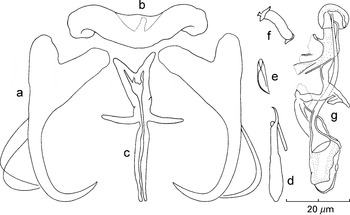
Dactylogyrus petenyi Kaštak, 1957 (Fig. 4)
Host species and locality of the present record: Barbus balcanicus (Vidbol River, Bulgaria).
Dactylogyrus petenyi: (a) anchor, (b) dorsal bar, (c) ventral bar, (d) marginal hook, (e) needle, (f) vagina (dorsal view), (g) copulatory organ (dorsal view).

Other previous records: Barbus meridionalis petenyi and Barbus brachycephalus, Danube basin and the adjacent rivers of the Aral and Caspian Seas (Gusev, Reference Gusev and Bauer1985).
Material of description: the measurements are based on 13 individuals.
Measurements: Anchor – total length: 37·76 (34·69–41·03), base: 29·94 (28·13–32·69), inner root: 14·02 (13·11–15·55), outer root: 4·37 (3·74–5·06), point: 12·94 (11·07–14·68); Marginal hook – total length: 24·38 (19·81–28·57); Dorsal bar – median length: 3·53 (2·82–4·29), total length: 6·44 (5·55–7·26), width: 26·05 (23·56–28·05); Ventral bar – median length: 12·82 (10·30–14·22), total length: 14·13 (11·92–16·04), width: 23·55 (21·44–26·01); Vagina poorly defined; Copulatory organ: 28·37 (26·17–31·23).
Dactylogyrus carpathicus Zachvatkin, 1951 (Fig. 5)
Host species and locality of the present record: Barbus meridionalis (Spain).
Dactylogyrus carpathicus: (a) anchor, (b) dorsal bar, (c) ventral bar, (d) marginal hook, (e) needle, (f) vagina (ventral view), (g) copulatory organ (ventral view).

Other previous records: Barbus barbus, Ukraine rivers (Markevitch, Reference Markevitch1951), Tisa River, Hungary, (Ivasik, Reference Ivasik1963), Hron River, Czechoslovakia (Žitňan, Reference Žitňan1965), Balkan rivers, Bulgaria (Kakacheva-Avramova, Reference Kakacheva-Avramova1968), Rhone River, France (Lambert, Reference Lambert1977), Morava River, Czech Republic (Šimková et al. Reference Šimková, Morand, Jobet, Gelnar and Verneau2004); B. meridionalis petenyi, Czechoslovakia (Žitňan, Reference Žitňan1965), Poland (Prost, Reference Prost1988), Danube basin and rivers of the Crimea (Gusev, Reference Gusev and Bauer1985), B. meridionalis, Iberian Peninsula (El Gharbi et al. Reference El Gharbi, Renaud and Lambert1992), B. tauricus, rivers of the Crimea (Gusev, Reference Gusev and Bauer1985), B. plebejus escherichi, Dogansi Dam Lake, Turkey (Aydogdu et al. Reference Aydogdu, Altunel and Yildirimhan2002).
Material of description: the measurements are based on 3 individuals.
Measurements: Anchor – total length: 50·78 (49·81–52·68), base: 44·77 (42·47–47·29), inner root: 13·88 (12·45–15·58), outer root: 9·58 (8·59–10·29), point: 13·41 (12·55–14·16); Marginal hook – total length: 28·44 (26·41–30·90); Dorsal bar – median length: 6·84 (6·82–6·86), total length: 11·74 (10·05–13·54), width: 42·28 (41·37–44·04); Ventral bar – median length: 39·68 (36·34–41·87), total length: 44·03 (41·16–46·29), width: 27·45 (26·61–28·83); Vagina: 14·00 (13·74–14·40); Copulatory organ: 61·39 (60·41–63·19).
Morphometric analyses of the sclerotized parts of attachment and reproductive organs of D. dyki from different host species
Table 2 shows the mean, min. and max. values of all the measured traits for D. dyki from 4 host species, B. barbus, B. cyclolepis, B. meridionalis and B. balcanicus. The median length and total length of the ventral connective bar are identical for this parasite species due to the shape of this bar (see Fig. 3). Measurements of D. dyki from B. barbus were excluded from the following analyses (see Materials and Methods section). With the exception of the median length of the dorsal and ventral bars and the mean total length of marginal hooks, all parameters measured differed significantly among D. dyki from different host species (one-way ANOVA; all tests, P<0·015). However, the total length of the dorsal bar and width of the ventral bar could not be analysed by ANOVA, because of heterogeneity of variance of these characteristics (Levene's test of homogeneity, P<0·01).
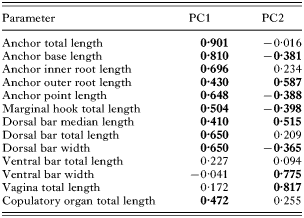
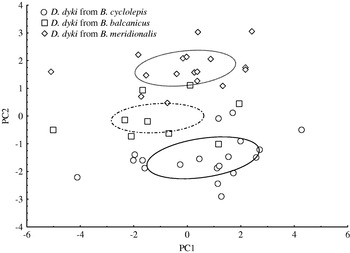
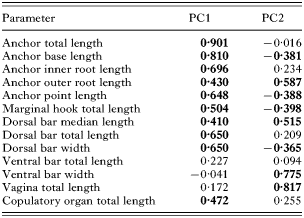
In addition, measurements of morphological characters were analysed together using conventional Principal Component Analysis (PCA). The first axis (PC1) explained 31·8% of the variation in the data set, the second axis (PC2) explained 20·3%. The correlations between morphometric characteristics and PC1 or PC2 are shown in Table 3. The coordinates of PC1 and PC2 from individual D. dyki from different host species were tested for differences by ANOVA. For PC1, significant differences were found among D. dyki from B. cyclolepis and B. balcanicus (P=0·038); for PC2, differences were found between all D. dyki populations parasitizing the different host species (P<0·001) (Fisher's LSD post hoc test for ANOVA).
Pearson's correlation coefficients calculated comparing the morphometric parameters to the first two factorial axes generated via PCA
(Those parameters for which the correlation coefficients, between original parameters and factorial axes, were statistically significant are given in bold.)
When D. dyki individuals from different host species were plotted in factorial space (PC1 and PC2) (Fig. 6), D. dyki parasitizing B. balcanicus lies between D. dyki from B. meridionalis and from B. cyclolepis.
Comparison of Dactylogyrus dyki from different host species by their morphological space.

Molecular intra- and interspecies differences
For all species of Dactylogyrus, the sequences were 478 bp (18S rDNA) and 483 to 489 bp (ITS-1) in length. No nucleotide variability was found between the individuals of the same Dactylogyrus species from the same host species, whereas differences were detected when Dactylogyrus individuals of the same species from different host species were compared. For the combined 18S rDNA and the ITS-1 sequences, pairwise comparisons showed a within-species sequence divergence of 1·7% between the individuals of Dactylogyrus carpathicus from B. barbus and those from B. meridionalis. However, no divergence was detected for the separated 18S region. Using the combined 18S rDNA and ITS-1 sequences, pairwise comparisons revealed the following sequence divergences in the 18S rDNA and ITS-1 between individuals of D. dyki from different Barbus species: 2·6% between B. barbus and B. meridionalis, 3·3% B. barbus and B. cyclolepis, 1·0% B. barbus and B. balcanicus, 3·5% B. meridionalis and B. cyclolepis, 2·5% B. meridionalis and B. balcanicus, 3·4% B. cyclolepis and B. balcanicus. On the other hand, interspecies divergences of 1·2% between D. petenyi from B. balcanicus and D. dyki from B. barbus and 1·0% between D. petenyi and D. dyki both from B. balcanicus were detected. The interspecific divergence between D. crivellius and D. carpathicus from B. barbus and B. meridionalis was 2·8% and 3·6%, respectively.
Phylogenetic analyses
Dactylogyrus phylogeny
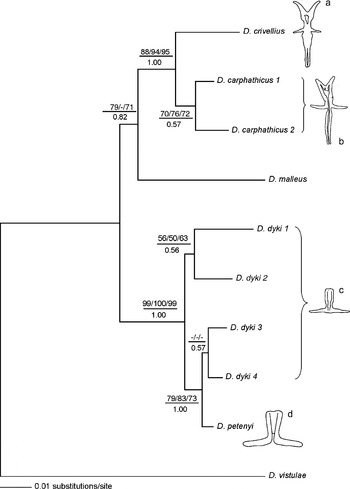
The partition homogeneity test as implemented in PAUP* 4b10 (Swofford, Reference Swofford2002) was used to test the congruence of the 2 data sets (18S rDNA and ITS-1). No significant difference was found (P=0·942); thereafter, the analyses were performed using combined 18S and ITS-1 sequences. The alignment of the sequences comprised 992 unambiguously alignable positions, of which 186 were variable, and 68 of the variable characters were parsimony informative. Phylogenetic analyses were performed for Dactylogyrus species of the Barbus species investigated and D. vistulae from Leuciscus cephalus was included as the outgroup. The TrNef+G model was selected as the best evolutionary model by ModelTest with the following parameters: substitution rate matrix A–C=1·0000, A–G=2·9148, A–T=1·0000, C–G=1·0000, C–T 4·8822, G–T=1·0000 and rate heterogeneity approximated by a gamma distribution, α=0·2507. The ML analysis was performed using the parameters of the selected model, and the tree is reported in Fig. 7 (including BP for ML, MP and NJ analyses). The MP analysis was performed, and one parsimonious tree with 247 steps was retained (CI=0·830, RI=0·714). The NJ analysis was performed on the TrNef distances, including gamma distribution selected by ModelTest. The consensus tree was obtained using the BI method (not shown) and the Bayesian posterior probabilities are included in Fig. 7. All phylogenetic reconstructions displayed a similar topology (no statistically significant differences among ML, MP, NJ and BI and trees were found by Shimodaira-Hasegawa test implemented in PAUP* 4b10, P>0·05).
Maximum-likelihood tree based on the model TrNef+G inferred from analysis of 18S rDNA and ITS-1 sequence data. Numbers along branches under lines indicate bootstrap proportions resulting from the following analyses: ML/MP/NJ and numbers over lines indicate posterior proportions from BI analysis. Values smaller than 50 are indicated with dashes. The different shape of the ventral bar of haptor is shown (a, b, c, d).

Two monophyletic groups were recognized. The first one was well supported by BP and PP, and includes D. crivellius from B. balcanicus and a clade including D. carpathicus from B. barbus and D. carpathicus from B. meridionalis (reported as D. carpathicus1 and D. carpathicus2 respectively in Figs 7 and 8). The specific morphological features of those parasites are large body size and anchor size when compared with other Dactylogyrus species included (see Figs 2 and 5). The typical feature of the attachment organ of these species is the similarly shaped ventral connective bar (Fig. 7) i.e., a connective bar with 6 marginal extremities (for the morphology of attachment organs of Dactylogyrus species; see Šimková et al. Reference Šimková, Verneau, Gelnar and Morand2006). D. malleus from B. barbus is the most basal species, but its position is only weakly or moderately supported. The second group well supported by all phylogenetic analyses included 2 clades. The first clade, although only weakly supported, comprised D. dyki1 from B. cyclolepis and D. dyki2 from B. meridionalis; the second clade, which was moderately or well supported, comprised D. dyki4 and D. petenyi from B. balcanicus and D. dyki3 from B. barbus.
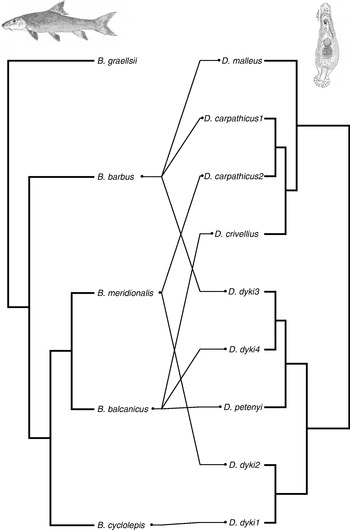
Tanglegram of Dactylogyrus species and Barbus species deduced from comparison of the parasite tree topology resulting from the phylogenetic analyses of combined data (18S rDNA and ITS1 sequence data) with the fish tree topology resulting from the phylogenetic analyses of cytochrome b sequence data. The fish phylogeny is rooted by Barbus graellsii.

Barbus phylogeny
The cytochrome b sequences were compared with published data. The identity of our sequences with the haplotype of B. balcanicus, following the recent study on redescription of B. petenyi (Kotlík et al. Reference Kotlík, Tsigenopoulos, Rab and Berrebi2002), was confirmed. The alignment of cytochrome b sequences of Barbus species used in our study revealed 829 alignable positions, of which 151 were variable, and 37 of the variable characters were parsimony informative. The phylogenetic trees were polarized using B. graellsi (belonging to the subgenus Luciobarbus). The HKY+G model was chosen as the best evolutionary model selected by ModelTest with the following parameters: substitution model Ti/Tv ratio=9·7951 and rate heterogeneity approximated by a gamma distribution with α=0·2045.
The phylogenetic tree of the Barbus species investigated in this study was included in a Tanglegram (Fig. 8). The ML, MP, NJ and BI analyses of cytochrome b data revealed trees of the same topology. Using MP analyses one parsimonious tree was retained with 181 steps (CI=0·873, RI=0·378). No statistically significant differences among NJ, MP, ML and BI trees were found (Shimodaira-Hasegawa test implemented in PAUP* 4b10, P>0·05). Two species, B. balcanicus and B. meridionalis, formed a weakly or moderately supported monophyletic group in ML with BP=71%, NJ with BP=88% and BI with PP=0·79. This clade clustered together with B. cyclolepis with high BP (⩾85%) for ML and NJ and with PP=0·90 for BI analyses. B. barbus took a basal position.
Comparison of host and parasite phylogenies
The Tanglegram (Fig. 8) revealed the incongruence between Dactylogyrus and Barbus phylogenies. Dactylogyrus species coexisting on the same host did not appear to evolve by intrahost speciation. Although a few cospeciations could be determined from the Tanglegram (the mean number of cospeciations estimated by randomization of parasite and host phylogenies was 2·41), host switching with consequent speciation could explain the incongruent phylogenies.
DISCUSSION
The occurrence of Dactylogyrus species on Barbus fishes
In the present study, D. crivellius and D. petenyi was found on a single Barbus species investigated from the same geographical area, whilst D. carpathicus and D. dyki were recorded on Barbus species collected from different areas. Previously, D. crivellius was described and then considered as an endemic parasite species for B. prespensis, a fish species endemic to the Greek lakes (Dupont and Lambert, Reference Dupont and Lambert1986). The present study found D. crivelllius on B. balcanicus, a fish species distributed on the Balkan Peninsula with a distribution that does not overlap with B. prespensis (see Crivelli et al. Reference Crivelli, Malakou, Catsadorakis and Rosecchi1996). Concerning D. petenyi, this species was listed as a parasite living specifically on B. meridionalis petenyi from the Danube basin and B. brachycephalus, a fish living in the basins of the Aral and Caspian seas (Gusev, Reference Gusev and Bauer1985). It should be highlighted that the previous records of Dactylogyrus species parasitizing B. meridionalis from the Danube should be considered carefully, due to the recent taxonomic revision of Barbus species. Nevertheless, this study represents the first record of D. petenyi in the Balkan Peninsula.
The present study represents the first investigation of Dactylogyrus species in B. cyclolepis, a fish species distributed in Bulgaria, Romania, Turkey, Moldova and the Ukraine (Froese and Pauly, Reference Froese and Pauly2006). Only one Dactylogyrus species, D. dyki, was found in very high abundance on this fish. When considering all previous records of D. dyki (see Results section), these findings suggest a wide distribution of this parasite on Barbus hosts. Concerning the host range of D. dyki observed in the study, the area of distribution of fish species investigated included B. barbus from Central Europe as well as B. cyclolepis and B. balcanicus from the Balkan Peninsula and B. meridionalis from the Iberian Peninsula. Barbus barbus is a widely distributed European species, but it is believed that this fish is not present on the Italian, Greek and Iberian peninsulas, having been replaced by local subspecies (Froese and Pauly, Reference Froese and Pauly2006; see also Kotlík and Berrebi, Reference Kotlík and Berrebi2001). In the area of our investigation (South Czech Republic), only Barbus barbus is present. Barbus meridionalis, investigated in the present study, was in sympatry with 2 other species, B. graellsii and B. haasi in the North–East of Spain (see El Gharbi et al. Reference El Gharbi, Renaud and Lambert1992), but this species forms sympatric populations and even hybridizes naturally with B. barbus in southern France (Le Brun et al. Reference Le Brun, Renaud, Berrebi and Lambert1992). Concerning our sampling of Balkan species, Barbus balcanicus is limited to the mountain and submountain brooks and rivers, tributaries of the Danube River on the Balkan Peninsula (Kotlík et al. Reference Kotlík, Tsigenopoulos, Rab and Berrebi2002); the populations used in the present study are allopatric with the populations of B. cyclolepis in Bulgaria (cfVassilev and Pehlivanov, Reference Vassilev and Pehlivanov2005).
The present study showed that Southwestern European B. meridionalis shared 2 Dactylogyrus species i.e., D. carpathicus and D. dyki, with B. barbus collected from Central Europe. Dactylogyrus carpathicus was recognized as a common parasite of Barbus barbus. According to the present investigation, D. carpathicus seems to be a rare parasite on B. meridionalis. El Gharbi et al. (Reference El Gharbi, Renaud and Lambert1992) suggested that D. carpathicus and D. dyki display the same geographical distribution (i.e., they are typically European species), often living on the same Barbus species. The occurrence of both parasite species is limited to the northeastern part of the Iberian Peninsula, associated with the distribution of Barbus meridionalis in this area. However, D. dyki has been shown previously to be widely distributed in Barbus species living in the lakes of North and South Greece (Crivelli et al. Reference Crivelli, Malakou, Catsadorakis and Rosecchi1996).
Morphology and morphometry of the attachment and reproductive organs in Dactylogyrus species
The morphological characters of the sclerotized parts of the attachment organ (i.e., haptor) as well as the characters of reproductive organs (i.e., copulatory organ and vagina) are considered important for the identification of monogeneans. However, as demonstrated in this study, even individuals nearly identical in morphology, and thus considered as the same species, showed high morphometric variability for taxonomically important characters. This was evident particularly between individuals of D. dyki found on different hosts collected in different geographical areas. Although measurements for the majority of characters overlapped, the populations of D. dyki from the different Barbus species were well separated in factorial space using principal component analyses. This information suggests the need for a morphological reevaluation of the status of this species. Dupont and Lambert (Reference Dupont and Lambert1986) described D. balkanicus from B. prespensis, which is morphologically similar to D. dyki. Unfortunately, no type material is preserved (Lambert, personal communication); therefore, a comparison of D. dyki specimens from the present study with the different individuals of D. balkanicus was not possible. However, the morphometric comparison of our individuals determined as D. dyki revealed that the length of inner and outer roots of the anchors did not overlap with the measurements recorded for D. balkanicus. Similarly, important morphometric differences for the length of the ventral connective bar and size of copulatory organ were observed for several populations of D. dyki on the Barbus investigated in this study.
Dactylogyrus petenyi was clearly distinguished from D. dyki based on morphology and morphometric characters of attachment and reproductive organs even though the measured values were smaller than those published by Gusev (Reference Gusev and Bauer1985). The morphology and morphometric measures distinguish this species from all populations of D. dyki recorded in the present study. The morphometry of Dactylogyrus carpathicus (attachment and reproductive organs) from B. meridionalis was similar to that published for D. carpathicus from B. meridionalis (El Gharbi et al. Reference El Gharbi, Renaud and Lambert1992) or with the compiled measurements for this species from B. barbus and B. meridionalis petenyi from the Danube basin and rivers of the Crimea and South France (Gusev, Reference Gusev and Bauer1985). However, following the recent taxonomic and phylogenetic studies of Barbus species based on morphological and molecular markers (Kotlík and Berrebi, Reference Kotlík and Berrebi2002; Kotlík et al. Reference Kotlík, Tsigenopoulos, Rab and Berrebi2002), the study by Gusev (Reference Gusev and Bauer1985) probably included D. carpathicus from 3 different Barbus species. To date, no comparative study of the morphometric characters of attachment and reproductive organs using populations of D. carpathicus collected from different host species has been performed.
Molecular variability in nuclear ribosomal DNA sequences
Pairwise comparisons revealed identical nucleotide sequences (using the combined 18S and ITS-1 sequences) in Dactylogyrus individuals identified as the same species and collected from the same host species. However, when comparing individuals identified previously as the same Dactylogyrus species but parasitizing different Barbus species, there was variability in nucleotide sequences. The variability observed for D. carpathicus collected from B. meridionalis and B. barbus was in the ITS-1 region but not in the 18S region. The 18S rDNA represents a well-conserved gene that evolves relatively slowly (Hillis and Dixon, Reference Hillis and Dixon1991) and is widely used for the study of plathyhelminth relationships (Littlewood and Olson, Reference Littlewood, Olson, Littlewood and Bray2001; Olson and Littlewood, Reference Olson and Littlewood2002; Olson and Tkach, Reference Olson and Tkach2005). On the other hand, more rapidly evolving sequences, such as the ITS-1 region, can provide useful phylogenetic information for resolving relationships within groups of recent origin (e.g. Booton et al. Reference Booton, Kaufman, Chandler, Oguto-Ohwayo, Duand and Fuerst1999) and this region is applied in the phylogenetic analyses of the Platyhelminths (Nolan and Cribb, Reference Nolan and Cribb2005). Concerning the molecular divergence investigated in the ‘generalist’ Dactylogyrus species, intraspecies differences from 0 to 1·2% were reported between individuals parasitizing different hosts (mostly non-congeners but living in sympatric conditions) by Šimková et al. (Reference Šimková, Morand, Jobet, Gelnar and Verneau2004). However, in the present study, the nucleotide divergence between individuals determined as D. dyki from different Barbus species living in geographically isolated localities ranged from 1·0 to 3·52%. The intraspecific variability is thus similar to, or even higher than, the interspecific variability shown between D. dyki and D. petenyi (1·0–3·39%) or D. crivellius and D. carpathicus (2·8–3·6%). These findings, together with morphometric differences, suggest that either (1) the recently considered D. dyki, a parasite of a wide range of Barbus species, represents a species complex, including representatives of several Dactylogyrus species, or (2) there is a high morphometric and molecular diversity among populations linked to the geographical isolation of host species. For future studies, we propose a deep morphological re-evaluation, including morphometric analyses of taxonomically important characters as well as a molecular comparison of D. dyki and D. carpathicus from different Barbus species or subspecies in both sympatric and allopatric zones, which could address this issue.
Molecular phylogenetic analyses
The molecular phylogenetic analyses showed that Dactylogyrus from different Barbus species clustered together, but that the species in the same cluster showed similar features in the morphology of their attachment organs (i.e., sclerotized parts of the haptor). A previous molecular phylogenetic study of Dactylogyrus species parasitizing Central European cyprinid fish (Šimková et al. Reference Šimková, Verneau, Gelnar and Morand2006) showed that similar morphological features of attachment organs can occur in phylogenetically related Dactylogyrus species, i.e. situated predominantly at the terminal positions of molecular phylogenetic trees. The shape of the ventral connective bar represents a typical morphological feature which is very different for the two major clades recognized in the present molecular phylogeny. The shape of the ventral connective bar recognized for the first clade (including D. carpathicus and D. crivellius) is a widely observed morphological feature in Dactylogyrus parasitizing Barbus species with a Euro-Asian distribution (Gusev, Reference Gusev and Bauer1985). Thus, the morphological evolution of the attachment organ may be associated with parasite phylogeny.
The host and parasite phylogenies were not concordant in the present study. Moreover, the results from the phylogenetic analyses did not indicate that Dactylogyrus species coexisting on the same host evolve by intrahost speciation, which was inferred to be an important process of Dactylogyrus diversification in cyprinid fish species (Šimková et al. Reference Šimková, Morand, Jobet, Gelnar and Verneau2004). Although a few cospeciation events could be proposed based on the comparison of host and parasite phylogenetic reconstruction, host switching could explain the presence of the ‘same’ Dactylogyrus species on different host species i.e., the presence of D. carpathicus on B. barbus and B. meridionalis and the presence of D. dyki on Barbus species from the North Iberian Peninsula, Balkan Peninsula and Central Europe. However, for the latter, clearly, a taxonomic revision is required.
For the future molecular phylogenetic study, we propose including a larger number of Dactylogyrus species parasitizing endemic Euromediterranean Barbus (including representatives of 2 monophyletic groups of Palearctic tetraploid Barbus i.e., subgenera Barbus and Luciobarbus) to explore speciation processes in Dactylogyrus. The study of El Gharbi et al. (Reference El Gharbi, Renaud and Lambert1992) demonstrated that Dactylogyrus assemblages of the Iberian Peninsula parasitizing subgenus Luciobarbus are different from those recorded for representatives of the subgenus Barbus in other regions of South and Central Europe. However, a few Dactylogyrus species are shared between Luciobarbus species and endemic Barbus species from the Iberian Peninsula (El Gharbi et al. Reference El Gharbi, Renaud and Lambert1992). The analysis of Dactylogyrus morphogroups in African Barbus has demonstrated that several morphogroups are shared between Africa and South Europe (Guégan and Lambert, Reference Guégan and Lambert1990). Therefore, we suggest that Dactylogyrus species could be used as a suitable model to test biogeographical hypotheses relating to the Euromediterranean Barbus species; for instance, whether they originate from European stock or represent the result of colonization from North Africa (Almaça, Reference Almaça1988; Doadrio, Reference Doadrio1990).
This study (including all preparation and analyses) was funded by the by Research Project of the Masaryk University, Brno, Project No.: MSM 0021 622 416. The field study was supported by the Ichthyoparasitology, Centre of Excellence, Project no. LC 522, funded by Ministry of Education, Youth and Sports of the Czech Republic. We would like to thank the group from the Department of Fish Ecology, IVB ASCR and Teodora Trichkova and Milen Vassilev from the Institute of Zoology, Bulgarian Academy of Sciences, for help with fish sampling in Bulgaria, Alexis Ribas Salvador from the Laboratory of Parasitology, University of Barcelona for help with electrofishing in Spain, and to Antoni Arrizabalaga, responsible for the Museu de Granollers Ciències Naturals “La Tela”, who allowed us to use his laboratory. We also thank Nad'a Musilová, Radim Sonnek, Jaroslav Červenka, Monika Pátková and Amálie Zehnalová, the Laboratory of Parasitology, Faculty of Science, Masaryk University, for assistance with fish dissection. We are very grateful to Carey O. Cunningham from the FRS Marine Laboratory, Aberdeen, Scotland, for the correction of English and Serge Morand from Institut des Sciences de l'Evolution, Université Montpellier, France for helpful comments.