Introduction
The flow of time is a physical property that is difficult to conceptualize. Geological or cosmic time scales remain totally abstract for all of us. We humans also tend to consider the world, the biosphere and particularly, the position of our own species as fairly constant and stable, mostly because our life time (and collective memory) is short, and because we cannot directly observe the slow but ever-continuing alteration processes.
Time lines are often used to visualize historical time scales. These work well for relatively short time spans, or for events that are fairly equally separated. However, if we want to portray the major events of the whole history of the Earth, or even of the whole Universe, a quite long or large-scale background-line is needed to include all relevant information, and to separate events and eras that have hugely different time scales. Suitable formats for this have been obtained for instance by scaling down the history of the Earth to one year, where the Earth is formed in the first moment of the year, the life starts on the tenth of February, the first primitive animals appear in mid-November, the first land plants appear on December 10th, and the dinosaurs go extinct on the evening of December 26. History of the Homo sapiens species starts in Africa at about 20 minutes to midnight, and the western civilization is initiated with agricultural settlements, about 1 minute to midnight on the last day of the year. The last glaciation in Northern Europe also ends at this moment (Teerikorpi et al. Reference Teerikorpi, Valtonen, Lehto, Lehto, Byrd and Chernin2009). Now, if we wish to add the history of the Universe to this scale, we need to append two more years to the imaginary time line to precede the formation of the Earth.
This imaginary time line has its value, but it can still be difficult to perceive the actual scales of the geological or cosmic times and processes. It is too small to include much of the information of the historic events, e.g. of the very rapid (in geological terms) but interesting process of the appearances and extinctions of species in the post-Cambrian eras, and it is also difficult for a person to compare seconds with months. Therefore, we came up with the idea to set up a time line that would be to scale, concrete and visual, and adequately long to allow the separation of the major evolutionary events, and the long geological and cosmic processes. Thus, the aim was to construct a physical portrait, or a time line, for the whole metahistory of the world.
To visualize the time scales of the cosmic, geological and evolutionary processes, we have set up a nature and hiking trail called ‘Time Trek’. The 13.7 km length of the trail corresponds to the age of the Universe, and introduces its history including events important for Earth and life. One kilometre corresponds to a billion years and one metre to a million years in time. The trek portrays the astronomical, physical, geological and biological time lines side by side, and aims to present a holistic view of the history of the world. It helps people to comprehend the continuum of events, and mutual influences between various factors. The aim of this paper is to describe the concepts of the Time Trek, how the idea emerged and was carried through. We further show how the Time Trek today serves in disseminating scientific knowledge to the community.
The process of constructing the Time Trek
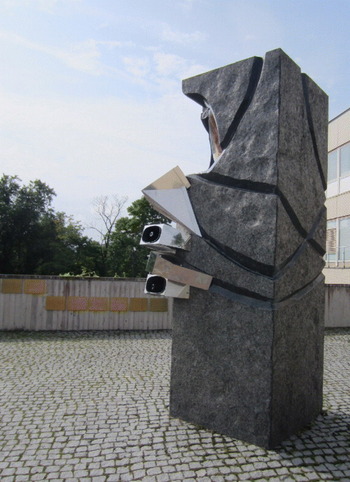
The trail begins with Big Bang at the Tuorla Observatory of the University of Turku, located in the outskirts of the city of Kaarina, Finland. From there it leads through the terrain and cliffs that have been formed during and after the Svecofennian orogeny between 1900 and 1835 million years ago, and ends at the University of Turku campus, at the statue ‘Big Bang Echo’ by Marcus Copper which, with a radio antenna, receives and amplifies microwave radiation, 1% of which originates from the cosmic background radiation. The history of the Homo sapiens species in our 13.7 km long trail is contained within the last 20 cm, and the whole history of the civilized cultures within the last centimetre.
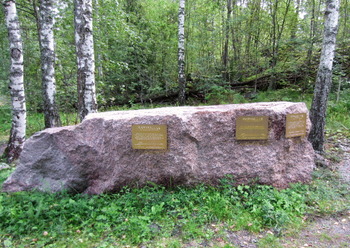
Important time points representing major evolutionary events along the trail are marked with rapakivi granite boulders, with brass plates attached summarizing the important events for each time point (Fig. 1). In total, the brass plates number about 80. Larger stones and several brass plates have been placed to indicate major events, e.g. the Big Bang, formation of the Solar System and the Earth, beginning of life and more recent processes such as the history and effects of the human civilization (Fig. 2). A map-based flyer and a glossary are available for the trail. A more detailed ‘Time Book’ has been produced to provide further information about the eras described on the trek, and about the causes and effects of different phenomena. Further information of the project is provided on web page www.timetrek.fi.
The stone marking the start of the trail, and the Big Bang, close to the Tuorla observatory.

The statue “Big Bang Echo”, at the end of the trail at University of Turku campus.

An essential prerequisite for starting and materializing of this project was the existence of a group of collaborating scientists (the authors of this article, from the University of Turku and Åbo Academy), who were interested in popularizing scientific views of the world, and were specialists each in their own section of the meta-history of the world, i.e. in astronomy and cosmology, geology, biology (evolution of the biosphere) and biochemistry (origin of the life). These experts provided their contributions as volunteers. The project fund-ing covered only the salary of one expert, for one year, for the designing and production of the lay-outs of the printed materials, and to develop and set up the project web page (www.timetrek.fi). Some of the funding was also used for short-term editorial assistance, for development of the programs and materials for the school activities, and to cover the materials for the plates and the printing expenses.
Funding for the project was received from the Regional Council of South-West Finland and from some smaller local funding agencies, which considered it as a potential project to promote travel and science in the region. Essential material contribution for the practical implementation was provided by the local quarry, i.e. the Palin Granit Oy, which donated the rapakivi granite boulders to mark the path, and the cities of Kaarina and Turku, which supported the project by transporting the boulders to their positions.
One important step in the process of setting up the trail was the search for the optimal path for the trail such that its full length was fitted exactly to the 13.7 km. The route was aimed at following the existing walk ways or quiet streets, and after exploration of the terrain, a suitable route was discovered that required establishment of a minimal stretch of a new path only. The route goes mostly through fields and forests. The brass plates are placed at their accurate time line positions. Very suitably, the spot for the formation of the Solar System and the Earth falls just on the side of a major cliff, and the origin of life falls into a small cherry garden, next to a stream and an artistic gate way. The most recent histories of 1 million years, and particularly, the latest 500 years, have been opened and expanded longer than their real lengths of 1 m and 0.5 mm, respectively, to contain the highlights of these recent time periods.
The information texts to be posted along the route were aimed at describing in brief the events and processes that have most strongly affected the evolution of the Universe, the Earth and the biosphere. In addition to these ‘major events’ we have included some ‘development in process’ plates, particularly in the stretches portraying the first 9 billion years of the universe, just to keep the trekkers aware that something is slowly happening. Special emphasis has been given to describe local geological events and structures to help the trekkers to associate with these events, by realizing that they have really happened ‘here’, or close by.
Future use and maintenance of the trail
The trail is aimed at promoting public interest for science, and it will also be used as a teaching tool for astrobiology. A ‘Time Trek’ course, with guided trekking and additional reading of the ‘Time book’ will be offered annually as part of the astrobiology curriculum at the University of Turku, and it could be readily made available also for international students. We anticipate that this expanded timeline concept should be useful for teaching the continuum of all (i.e. cosmic, geological and biological) evolutionary processes, and it can be seen as a framework where any past event or process can be placed into its historic context, and zoomed into at any chosen magnification level, just by filling in more additional data. Thus, it provides a tool for development of a metahistoric view of all natural processes, particularly suitable to be included in astrobiology education. Its active use in the teaching will also significantly help towards its further development, and to keep up and upgrade its information with the continuous progress of our knowledge.
Schools have been encouraged to have outings along the trail, and a special workbook accompanying the trail has been made available to the students. Different tailored guided tours, covering suitable sections of the trek, e.g. the cosmic history (13.7 km), the history of the planet Earth (4.7 km), the history of the multi-cellulars (1500 m), or the history of the biosphere, since the Cambrian explosion (500 m) will be gradually developed for the schools.
The trail will also provide a ‘scientific scene’ for recreation or sporting events of the university staff, as well as a suitable route for running the 1/3, 2/3 or 3/3 ‘length of the Universe’ marathon. It also provides new activities for the coffee houses and guesthouses along the trail.
The events that are presented on the Time Trek brass plates, with the era indicated in million years
13720, z (red shift) = large: The Big Bang. The first particles are formed. During the first millisecond, protons, the nuclei of hydrogen atoms are formed. The nuclei of helium atoms, alpha-particles are formed when the universe's age is 100–1000 seconds.
13720, z = 3233: The amount of energy stored in matter becomes larger than the amount of energy in radiation. The age of matter begins.
13719.6, z = 1100: Neutrally charged hydrogen and helium atoms form. The continuous scattering of light ends. Photons of light escape freely into space, creating the cosmic microwave background. The temperature of the background radiation is 3000 K, or 2700 °C.
13530, z = 20: The dark ages. Stars or galaxies have not been born yet. The cosmic microwave background has cooled to 55 K or −218 °C.
13440, z = 15: The first stars are born (Population III). They are large, massive, bright and short-lived. They only contain hydrogen, helium and some lithium. Other heavier elements are born in the fusion reactions inside the stars. Depending on their mass, they explode as supernovae or hypernovae.
13200, z = 10: The second generation (Population II) star, HE 1523-0901, is born. The amount of iron in this star is only one-thousandth of the amount of iron in the Sun. This means that it cannot form planets around it. The formation of galaxies starts. The sparse interstellar material begins to re-ionize into plasma.
13060, z = 8: Globular clusters, the oldest structures in our Milky Way, start to form. Many of these are still in existence today. The light from the Galaxy, HUFD.YD3, begins its journey towards the Earth. Due to the expansion of the Universe, this Galaxy is currently 30 billion light years away from us.
12610, z = 5: Large first and second generation stars are gradually forming the elements of life: carbon and oxygen, the necessary ingredient for water. The smaller second generation stars develop much slower and can still be found in our cosmic neighbourhood. The sparse intergalactic material has been ionized into plasma.
11500, z = 3: The largest structures in the Universe, Galaxy clusters, begin to form. The local group of Galaxies consists of the Milky Way and the Andromeda Galaxy as well as 50 smaller Galaxies. The closest Galaxy cluster is the Virgo cluster, with M87 as the dominant Galaxy. The Virgo cluster has about 2000 known Galaxies.
11010, z = 2.5: The Universe is full of active Galaxies, quasars. Quasars are the brightest objects in the Universe.
10330, z = 2: Star formation is at its strongest in starburst Galaxies. Starburst Galaxies can have a hundred stars forming each year. In the Milky Way, only one star forms per year, on the average.
8650, z = 1.25: The disk of the Milky Way is born. The first third generation stars (Population I) form. These stars can have Earth-like planets around them. It is still 4 billion years to the formation of the Solar System.
7700, z = 1: Galactic superclusters start to form. The local supercluster comprises the Virgo cluster and about ten other smaller Galaxy clusters and Galaxy groups.
6860, z = 0.8: The age of the Universe is half of its present age. 216 300 000 000 000 000 seconds have passed since the Big Bang. Light travels around 65 000 000 000 000 000 000 000 km during this time.
6660, z = 0.76: The expansion of the Universe accelerates due to dark energy.
6000, z = 0.65: The star, 51 Peg, is born. In 1994, it was the first star discovered to have a planet around it. The discovered planet is half as massive as Jupiter and orbits around the star in just over 4 days. The star is located in the middle of the right side of the large square in the constellation of Pegasus.
5300, z = 0.54: A nearby star, 61 Virginis, is born. The star is Sun-like and has been found to host several planets. Two of the planets are around the size of Neptune and one of them is five times as massive as the Earth.
5100, z = 0.51: The binary star η Cas is born. The star does not set below the horizon in Finland, and can thus be seen throughout the year. η Cas can be found in the middle-right of the W-shaped constellation of Cassiopeia.
4568, z = 0.44: Part of an interstellar gas cloud collapses into a spinning disk of gas. The gas and dust in the disk settle into a thin layer. During a few 10 million years it forms into planets. The Sun ignites (this is known to have an accuracy of about 5 million years). The Earth begins to form from silicates and iron. The material of the accretion disc forming the Earth is so hot that water and other volatile substances have evaporated. Water and nitrogen in the Earth's atmosphere are accreted later from impacting asteroids and comets. Oxygen forms much later, once life has started on Earth.
4530: The Moon is formed, most likely by a Mars-sized object, Theia, colliding with proto-Earth. In Greek mythology Theia is the mother of Selene, the Moon. The Moon is accreted from material ejected by the collision.
4500: The core, mantle and crust of the Earth differentiate. The heavier elements sink to form the core, while lighter elements either rise or stay in place.
4400: The Earth reaches its current size. The formation and differentiation of the core are complete. The oldest known zircon crystals are formed. These have been found in the Yilgarn Craton at Jack Hills, Western Australia.
4280: The oldest rocks form. These can be found in the Hudson Bay area in Canada. The anti-gravity of dark energy starts to dominate over the gravity of matter.
4000: The Earth is bombarded by meteorites. The orbits of Jupiter and Saturn synchronize, causing Uranus and Neptune to change orbits. The inner Solar System is swarming with comets. Massive numbers of objects hit the Earth demolishing most of its surface. The large craters on the Moon are formed.
Somewhere, in a watery anoxic environment, the building blocks of life form. Nucleotides for the RNA and DNA, amino acids for proteins, and lipids for the membranes are formed. This could have happened, for example, inside undersea hydrothermal vents, such as black or white smokers. Some of the building blocks also arrive to Earth in meteorites. Small organic molecules spontaneously chain into longer strands. Some of the strands can replicate into their mirror image, and back again into the original form. These ribbons are formed of nucleotides. The RNA world, a very primitive form of life, is born.
The replicating RNA strands grow more diverse and complex. An interacting complex network of molecules is formed. The network can combine amino acids to form proteins, by using the instructions contained in the RNA strands. The RNA-protein world has emerged.
Replicating and protein-producing RNA-strands pack inside membranes. Slowly the membrane structures begin to replicate by dividing. Cellular life is born. Cellular life evolves and produces new protein enzymes and new methods, for example, for copying DNA and producing new kinds of membrane molecules. These inventions lead to the separation of bacterial and archean lineages from the common parental population, or the Last Universal Common Ancestor (LUCA).
3900: Life is present in the oceans. Dead cells sediment onto the ocean floor. Some of their remains are preserved in the oldest sedimentary rocks. These rocks are now found in Isua, Greenland.
3500: The trondhjemite gneiss of Siurua, Pudasjärvi, the oldest base rock in Europe, is formed. Multi-species microbial growths are found in the seas as well as in rocks underground. Their fossils can be found in South Africa and Australia. Some of the species can produce energy from sunlight. This reaction does not produce oxygen yet.
2900: A large part of the bedrock in northern and eastern Finland is formed. The continents collide to form the Vaalbara supercontinent. Vaalbara breaks up 2800 million years ago. Oxygen-forming photosynthesis is starting, but the oxygen binds to minerals and the sea-water instead of being released into the atmosphere.
2700: Plate tectonics move continents together, forming the Kenorland supercontinent. Kenorland breaks up 2500 million years ago.
2300: The climate is very cold and the Earth is totally covered by ice. Iron deposits onto the ocean floors in alternate layers of unoxidized and oxidized forms. This shows that the amount of oxygen in the oceans fluctuates over time.
2200: The first oxidation event takes place. The oxygen produced by cyanobacteria is released into the atmosphere. Cyanobacteria form the stromatolites of Tervola's Peuranpalo in Peräpohja. Oxygen breathing bacteria live symbiotically inside eukaryotic cells. These evolve later to become mitochondria.
1900: Southern Finland has active volcanic island arcs, with activity similar to the current volcanism in the Philippines. The signs made by the volcanic activity can be seen in the amphibolites of the Finnish bedrock.
The coal sacks of Aitolahti (Corycium enigmaticum, or ‘mysterious little sack’) are formed. These were once considered to be the oldest fossils in the World. They are now known to be microfossils that resemble cyanobacteria.
1880: Micro-continents and island arcs collide in Finland. The collision is called the Fennian orogeny, and it forms the mountain chain of Karelides.
1860: The motion of lithosphere plates changes directions causing a stretching motion that forms large sedimentary basins in Finland. One example of these basins is the old sandstone of Tiirismaa in Hollola.
1834: The Saramantia continent from the south and the Amazonian continent from the west collide with the main Karelides area. This causes the formation of mountain chains in Finland (the Nordic orogeny in the west and Svekobaltic orogeny in the south). In southern Finland, the present ground level is at a depth of 18 km, an environment where the temperature was 800 °C. The rocky material found in the southern Finland melts, forming migmatite, a rock now containing melted rock (granite) mixed with old sediments and volcanic rocks. The dark red mineral garnet and the dark blue mineral cordierite, found in southern Finland, were formed in these temperature and pressure conditions.
1800–1500: The continents gather together and form the Columbia supercontinent.
1800: There is a rapid local rise of the Earth's crust in the Fennoscandian shield. Shear- and fault zones are formed when the crust becomes brittle and breaks up. They show up now in south-west Finland as the deep bays, Halikonlahti and Mynälahti, as Kihti in the Finnish archipelago and as some of the lake basins in Finland.
1600: Large magmatic rapakivi granite intrudes extensive parts of the upper crust in the Fennoscandian area. The marker stones of the Time Trek are equigranular rapakivi granite from Taivassalo.
1500: Multi-cellular filamentous red algae evolve. Multicellularity enables cells to specialize for different tasks. Later, the differentiation of cells makes possible the formation of large plants and animals. The Columbia supercontinent breaks up around 1500–1300 million years ago.
1275: The olivine diabase found in the Satakunta province is formed from the Earth's mantle and represents the eruption vents of ancient volcanoes. Olivine diabase is an excellent stone for sauna stoves.
900: The continents merge, due to plate tectonics, to form the Rodinia supercontinent. Oxygen-producing photosynthesis binds carbon dioxide. Volcanic activity is low. There is only a small amount of greenhouse gases in the atmosphere. The Earth cools into a Snowball Earth, which causes a strong extinction of the existing life forms, and an evolutionary bottleneck.
660: Most of the Earth is covered by glaciers, even close to the equator. There is a substantial amount of sea ice. The vacated ecological niches are filled with new species during the warmer periods. Early forms of sponges evolve.
625: The open clusters in the constellation of Hyades and Cancer are born.
575: Southern Finland is partially covered by sea. The diverse Ediacara biota, in the expanding shallow seas, diversifies strongly. The Ediacara biota is the progenitor for modern sponges, polyps, medusae and corals.
542: South-western Finland is covered by a shallow sea. Sea life diversifies rapidly. Many groups of animals, such as trilobites, evolve a hard shell, which causes their fossils to remain intact. Most of the major groups of animals, such as chordates, emerge.
488: The Rodinia supercontinent breaks up. The surface of the oceans is at its highest. The first vertebrates evolve. Corals, moss animals, brachiopods, trilobites and the first chordates form limestone sediments in the Baltic Sea region.
470: Due to a collision of asteroids, the Earth is subjected to a powerful meteorite shower. It does not cause large-scale extinction, but accelerates the evolution of new species in the Baltic and other seas. The first arthropods crawl from the sea on to the dry land.
445: The continents freeze while moving through the southern polar region. The forming glaciers bind water and the sea level drops. Eighty-five per cent of the organisms in shallow seas go extinct.
416: The European and American continents collide, forming the Caledonian mountain chain and lowering the sea level. Placodermi, or armored fish, are the first vertebrates with jaws. The first cartilaginous fishes, the progenitors of sharks and rays, live in the seas.
416–360: The Caledonian mountain chain, as high as the Himalayas, starts to erode. Thick fluvial deposits cover southern Finland. The Scandinavian Mountains, Scottish highlands and the Appalachian Mountains are remnants of the Caledonian mountain chain. Amphibians and insects appear in the fauna. Fish and land flora diversify.
318–299: The PanGaian (or Pangean) supercontinent is at its most extended state. Finland is in the tropics. Constant glaciation in southern polar region causes large fluctuations in sea level. Forests of ferns, tens of metres tall, are prevalent. They form the majority of the Earth's present coal deposits. The first flowering plants evolve. Most of the current insect groups have developed. The Meganeura dragonfly with a wingspan of over 75 cm lives during this time.
251: 90% of all species go extinct. There are many possible reasons for this, for example the Basalt eruption of Siberia or a collision with an asteroid. Shallow seas dry up and form sediments of rock salts. The oldest ocean bottoms are of this age, thus older signs of life or asteroid collisions cannot be found in the oceans.
230: The PanGaian supercontinent breaks up. The surfaces of the oceans rise and the climate gets warmer. Reptiles evolve into turtles, the first dinosaurs and mammals. There are large forests of Cycas, or cone palms. Erosion has removed evidence of these sediments in Finland. The Solar System is in the same part of the Milky Way as it is now.
199: The climate changes related to changes in sea level, asteroid collisions or volcanic activity cause about half of all species to go extinct. The first crocodiles evolve.
199–145: Continents separate and the Atlantic Ocean expands. The oceans have plenty of Ammonites. Single-celled calcified haptophytes become common. The climate is hot and dry. Dinosaurs and Pterosaurs diversify. For example, large Sauropods are common. Birds evolve. The Earth is covered by coniferous trees, Cycas and ferns.
100: The Pleiades, an open cluster, is born. The gas and dust similar to the original cloud can still be seen in photographs. The mid-oceanic ridges are volcanically active and the carbon-dioxide content of the atmosphere increases. The climate is warm and marsupials evolve.
73: An asteroid, with a diameter of about 500 m, hits Lappajärvi at about 50 km per second. The impact is equivalent to a million Hiroshima atomic bombs, but without the radioactive radiation. The explosion kills everything within a few hundred kilometres.
70–65.5: The oceans are at their maximum height. Except for Scandinavia, most of Europe is covered by a shallow sea. Many chalk deposits, such as the Cliffs of Dover, are formed from the sediments of Ammonites. Due to volcanic activity, the atmosphere's carbon-dioxide content is about four times the present level. The average temperature is about 5 °C higher. Flowering plants become common. Plenty of dinosaurs exist, such as Ceratopsidae, duck-billed dinosaurs and Tyrannosaurus rex in North America.
65.5: An asteroid, with a diameter of about 10 km, hits the Yucatan peninsula. The centre of the crater is near the city of Chicxulub. There is a massive basaltic eruption in current India, forming the Deccan Trap. There is a lot of dust and ash in the atmosphere.
65.5: Catastrophically rapid changes happen in the atmosphere: the temperature plummets, the ozone layer is destroyed and acid rains become common. Most of the dinosaurs and many sea creatures, such as Ammonites and Belemnites, go extinct.
60: Marsupials and Eutheria, placental mammals, diversify. The first insectivores, primates and rodents evolve.
45: The ocean levels are still high. The Baltics and Finland are intermittently under a shallow sea. Baltic amber forms. A lot of new mammals evolve, such as hoofed animals.
40: The Alps rise as Africa collides with Europe. The main groups of mammals and over half of the current orders of birds exist. Pakicetus, a wolf-like progenitor of whales, lives in Asia.
35: The isthmus that connects South America and Antarctica breaks. The cold ocean-current circling Antarctica starts. Antarctica starts to cool down and glaciate.
25: The climate cools. There are plenty of sabre-toothed carnivores around. Flowering plants evolve and speciate.
10: The Great Orion Nebula is formed. It would have been first seen as a large black splotch on the sky. Nowadays the nebula is lit up by the young stars in front of it. Stars are still forming in the dark interiors of the cloud. The climate continues to cool. The first deer and elephants evolve.
6: The rise of the bedrock at the Strait of Gibraltar and the fluctuations of the sea-level isolate Mediterranean. As an inland sea it dries multiple times into a salt desert. Eastern Africa dries up and the ape man moves to the savannah. The largest known bird, Argentavis, with a wing-span of over 7 m, flies in the skies of South America searching for carrion.
4:Ardipithecus ramidus wanders on two feet in Africa. North America has horned rodents that resemble ground hogs.
3: The Isthmus of Panama rises and the thermal exchange between the Atlantic and Pacific Oceans ceases. The waters in the Atlantic cool and the latest ice-age begins in Scandinavia. Hominids make the first tools. South America has rodents that weigh as much as a tonne.
1: The Solar System wanders, with respect to the neighbouring stars, about 65 light years in a million years. The night time sky looks completely different from what it is now. The glaciations in northern Europe are more wide-spread and last longer. The large islands of the Mediterranean have small elephants.
0.200000: The change in the inclination of the Earth's axis and the changing shape of the Earth's orbit causes climate to vary in 40 000–100 000 year cycles. The glaciation accelerates the evolutionary process. Modern man, Homo sapiens, evolves in Africa.
0.060000: The glaciers grow and bind a lot of water. Ocean levels drop and the Red Sea dries up. Modern man moves from Africa to Europe. The constellations in the sky are recognizable.
0.030000: Southern Finland is a productive steppe with wandering mammoths. Europe has cave lions, woolly rhinoceri and giant goats. Many human species are still alive. Our nearest relative, the Neanderthal man, goes extinct. Modern man makes the cave paintings of Europe.
0.023000: Due to the spinning precession of the Earth's axis, the celestial poles move in 25 700 year cycles. The current North Star, Polaris, was the North Star for the previous time.
0.020000: The Scandinavian glacier covers all of Finland. The southern edge is as far as northern Germany. South-western Finland's bedrock sinks 2 km under the weight of the ice.
0.012000: Agriculture and the socio-cultural evolution of man begin in the Middle East.
0.011700: The climate heats up 5–10 °C during a few decades. The glacier melts and the edge retreats quickly in south-western Finland. The edge of the glacier is in water, 100 m deep, with icebergs floating in it, just like modern Greenland.
0.010000: A large amount of ice age mammals go extinct.
0.005000: The first civilizations are established in Mesopotamia, Egypt and China. Writing is invented. Indicators of civilization are: advanced agriculture, city-dwelling, specialized professions, advanced governance and writing. The motions of the celestial bodies are used for calendars.
0.000400: The telescope and the microscope are invented. Galileo Galilei sees the mountains on the Moon, the four moons of Jupiter and, using the phases of Venus, shows that the Earth rotates around the Sun. Robert Hooke discovers the cells in a cork bark using a microscope.
0.000150: Charles Darwin's ‘On the Origin of Species’ is published in 1859. The theory of evolution refutes the ancient claim that species do not change.
0.000050: The structure of DNA and the genetic code is deciphered. Manned space flights begin, and within 10 years man sets foot on another celestial body, the Moon. Humankind influences strongly the environment causing major extinctions.
0.000000: The genome of organisms can be changed in a controlled way. Humankind is not any more necessarily a target for natural selection. Planets are found around numerous other stars. Even Earth-like planets are discovered in habitable zones around their host stars.
Acknowledgements
Regional Council of South-West Finland, Turku 2011 foundation for the cultural capital of Europe 2011, K.H. Renlund foundation, cities of Turku and Kaarina, and Palin Granit Oy are thanked for their support for this project.