The high percentage of women in Rwanda's parliament is well known. At 64%, it scores far above the world average of about 22% (IPU 2013). Rather than an anomaly, Rwanda is representative of many postconflict developing countries that feature women's political representation at above-average levels. A frequently identified correlate of this heightened representation has been the presence of electoral quotas for women (Bush Reference Bush2011; Fallon, Swiss, and Viterna Reference Fallon, Swiss and Viterna2012; Paxton, Hughes, and Painter Reference Paxton, Hughes and Painter2010). More generally, the role of societal rupture and transitions from conflict to peace or from authoritarianism to democracy have been a focus of gender and politics research in recent years (Fallon, Swiss, and Viterna Reference Fallon, Swiss and Viterna2012; Hughes Reference Hughes2007; Reference Hughes2009; Hughes and Paxton Reference Hughes and Paxton2007; Viterna and Fallon Reference Viterna and Fallon2008). Within such transitions, the role of women's participation has been identified as a key determinant of more beneficial posttransition outcomes for women (Viterna and Fallon Reference Viterna and Fallon2008). Peace processes and the accords that they yield represent a mechanism through which transition and women's rights become linked and theoretically hold the potential to shape postconflict societies. However, the link between women's involvement in peace processes and the subsequent adoption of electoral quotas has not been explored. In this article, we seek to answer the question: What is the relationship between postconflict transition, peace processes, and quota adoption? To this end, we examine the role played by peace accords and, more specifically, accords with a focus on women's rights in leading countries to adopt electoral quotas for women.
To investigate the role played by these accords in developing country adoption of electoral quotas, we draw upon three bodies of literature that address the issue of postconflict transition and women's representation. The first literature, focused on levels of women's representation, identifies several key determinants of women's political representation generally and points to the significant role played by electoral quotas for women in many countries. On the one hand, it has identified a positive correlation between conflict and political transitions and, on the other, has increased women's political representation. It has not adequately theorized, however, the mechanisms that link these two phenomena. Likewise, the literature on electoral quotas for women has identified several factors that may contribute to their adoption. Two such factors include the influence of women's movement groups and international actors. Regarding postconflict states specifically, this body of literature has identified postconflict peacekeeping operations and the influence of foreign aid as linked to the postconflict adoption of women's electoral quotas (Bush Reference Bush2011). This focus on international influences, as opposed to domestic peace processes and accords, leads us to consider a third body of research on women's rights in peace agreements.
This third body of literature is focused on women in armed conflict and peace processes. It posits that societal upheaval caused by conflict disrupts gender roles and that peace processes offer political opportunities for women. A subset of this literature includes a number of case studies detailing women's struggles for inclusion in peace processes. This literature asserts that a gender-inclusive peace process will result in better conditions for women in the postconflict state. It is this hypothesis that we seek to test through our focus on women's rights in peace accords and their effect on electoral quota adoption.
Setting up our inquiry at the nexus of these three literatures, we explore whether there is an association between a gender-inclusive peace process, as indicated by a gender-inclusive peace agreement, and the subsequent adoption of a women's electoral quota. We employ cross-national statistical models to analyze a sample of 115 developing countries between 1990 and 2006. Using event-history analysis, we explore the rate of quota adoption for three categories of states: those without a peace agreement, those with a peace agreement that does not include references to women, and those with a gender-inclusive peace agreement. Our results show that countries where any peace accord is present more rapidly adopt electoral quotas for women than those without a peace accord. Further, those countries that experience a peace accord with specific women's rights provisions are likely to adopt quotas even more rapidly. To contextualize these cross-national results we then examine two examples (Burundi and Guatemala), both of which feature gender-inclusive peace processes and postconflict quota adoption.
BACKGROUND
The role of postconflict and postauthoritarian transition in shaping political outcomes for women has garnered recent attention in the literature on women's political representation in the developing world (Fallon, Swiss, and Viterna Reference Fallon, Swiss and Viterna2012; Viterna and Fallon Reference Viterna and Fallon2008). Given the ongoing prevalence of both intrastate conflict and democratization in many countries in the developing world, the effects of these transitions will continue to shape women's political participation in many societies in the years to come. Add to this the fact that electoral quotas appear to be playing a more significant role in promoting women's political representation globally and, in particular, in the developing world, and the importance of the question we address in this paper becomes clearer. With more than 40 countries adopting some form of legislative or constitutional quota, and 50 more adopting some form of political party-based quota, the role played by quota mechanisms merits the significant attention it has been paid in recent years in the gender and politics literature. Understanding the intersection of postconflict peace processes and quota adoption is thus a key piece to the puzzle of how transitions can work to reshape women's political representation in developing societies. Our paper draws on three streams of research to examine this important question related to the role of peace accords in promoting quota adoption: research on women's political representation, research on electoral quotas, and research on peace processes.
Women's Political Representation
Women's political representation and empowerment has steadily increased in recent decades in most regions of the world. One of the most commonly examined measures of this representation is the percentage of women in parliaments. In January 1997, the Inter-Parliamentary Union calculated a global average of 12% of seats in lower/single houses of parliament were held by women. This global figure increased to almost 14% by the end of 2000. By the end of 2011, the IPU calculated a global average of almost 20% of seats held by women. This ranged from a regional high in the Nordic countries of 42% to a low of 11.3% in the Arab states (IPU 2012).
Social scientists have grappled with explaining these increases and have identified a wide array of factors that contribute to increased women's political representation. Determinants of women's representation identified in the scholarly literature on the topic have included electoral systems, engagement with the international women's movement, the timing of key international conferences, local cultural and religious traditions, political ideology, and the influence of democracy and democratization (Fallon, Swiss, and Viterna Reference Fallon, Swiss and Viterna2012; Hughes Reference Hughes2007; Hughes and Paxton Reference Hughes and Paxton2007; Kenworthy and Malami Reference Kenworthy and Malami1999; Paxton Reference Paxton1997; Paxton, Hughes, and Green Reference Paxton, Hughes and Green2006; Paxton and Kunovich Reference Paxton and Kunovich2003). No clear consensus has emerged on the most critical factors associated with women's representation, but a frequently cited cause of increased representations—unsurprisingly—is the advent of electoral quotas for women at various levels of political representation (Bush Reference Bush2011; Fallon, Swiss, and Viterna Reference Fallon, Swiss and Viterna2012; Krook Reference Krook2004; Reference Krook2006; Tripp and Kang Reference Tripp and Kang2008; Waylen Reference Waylen2006).
Many cross-national studies of women's representation examine global samples of countries to look for common factors contributing to women's representation (Fallon, Swiss, and Viterna Reference Fallon, Swiss and Viterna2012; Kenworthy and Malami Reference Kenworthy and Malami1999; Tripp and Kang Reference Tripp and Kang2008). More recently, however, some studies have argued for treating the high-income industrialized democracies separately from countries of the developing world, contending that different processes appear to account for women's political representation in these areas (Fallon, Swiss, and Viterna Reference Fallon, Swiss and Viterna2012; Hughes Reference Hughes2009; Viterna and Fallon Reference Viterna and Fallon2008). Three key factors that would appear to differentiate the developing world from the high income democracies include more recent or ongoing experiences of democratization, weaker standards of protection of women's rights, and the influence of transition from conflict and insecurity on political processes.
This final factor, transition from insecurity and conflict, has received only limited attention in the research literature on women's representation. Postconflict and democratic transitions do not necessarily overlap, as there are frequently transitions out of conflict that do not result in democratization. Still, we can consider some of the lessons from democratic transition to guide our investigation of transition from conflict and insecurity. Though not focusing exclusively on conflict, Viterna and Fallon (Reference Viterna and Fallon2008) offer a framework for the analysis of the nature of democratic transitions and the sorts of gender equitable outcomes they yield. Where women are more actively mobilized before the transition process, more actively involved in transition, and where transitions offer a clearer break with the past, they argue we can expect to see more gender-equitable states emerge. Similarly, Hughes (Reference Hughes2009) identifies the important effects of internal conflict on increasing women's representation in the developing world, suggesting that countries which experienced conflicts contesting the nature of government within the country have on average nearly 7% more women in parliament after the period of conflict than they do prior. Likewise, Hughes (Reference Hughes2007) identifies the effects of legislative interruptions—the suspension of parliaments or government—for reasons like internal conflict can also play a role in increasing women's representation. Recent research also demonstrates how countries transitioning to democracy from civil strife and enacting electoral quotas for women benefit to a greater extent from those quotas than do democracies that transition from other contexts like communism or authoritarianism (Fallon, Swiss, and Viterna Reference Fallon, Swiss and Viterna2012). This important role played by internal conflict and transition from it has not been explored sufficiently in the literature. In particular, the extent to which postconflict transitions are linked to the adoption of electoral quotas is something that merits further attention. First, however, we will review the extant literature on electoral quotas.
Electoral Quotas for Women
The critical role played by electoral quotas in increasing women's representation has spurred significant recent attention in them by social scientists. Research on quotas has focused primarily on the effect of quotas on women's representation globally (Chen Reference Chen2010; Franceschet, Krook, and Piscopo Reference Franceschet, Krook and Piscopo2012; Hughes Reference Hughes2011; Jacob, Scherpereel, and Adams Reference Jacob, Scherpereel and Adams2013; Krook Reference Krook2009; Tripp and Kang Reference Tripp and Kang2008) and in the developing world (Waylen Reference Waylen2006). Indeed, recent research suggests that the presence of quotas, though likely to increase representation, does not guarantee that women's representation will match or exceed the threshold established in the quota itself (Paxton, Hughes, and Painter Reference Paxton, Hughes and Painter2010). Other research has undertaken focused regional and country-level case studies on electoral quotas and questioned how effectively quotas are implemented in many cases where they exist (Bauer Reference Bauer2008; Dahlerup Reference Dahlerup2006). Varying levels of effectiveness have been accredited to the different types of quotas that exist, suggesting that reserved seat constitutional and legislated quotas appear to be more effective at placing women in parliaments than are voluntary party candidate quotas (Matland Reference Matland and Dahlerup2006). More recently, however, research has suggested that party quotas can have a significant effect on women's representation (Chen Reference Chen2010; Hughes Reference Hughes2011). Overall, despite varying perspectives on the effectiveness of certain quota types, the literature on quotas suggests they play an important part in incorporating larger numbers of women into political power.
A corollary of much of the literature on the effects of quotas has been questions of the processes involved in quota adoption. Country-level case studies have pointed to the influence of women's movement groups, international actors, and postconflict transformations as being key contributors to quota adoption (Ballington and Dahlerup Reference Ballington, Dahlerup and Dahlerup2006; Bauer and Britton Reference Bauer and Britton2006; Krook, O'Brien, and Swip Reference Krook, O'Brien and Swip2010). This question of what drives countries to adopt electoral quotas has been focused on less frequently at the cross-national level. Recent research has examined this question by examining the process of quota adoption among countries in the developing world from 1970 to 2006 (Bush Reference Bush2011). Bush offers a two-fold explanation of international incentives on the adoption of electoral quotas, specifying the importance of postconflict UN peacekeeping operations promoting democracy and the influence of foreign aid dependence/American democracy and governance aid to increasing the likelihood of the quota adoption in countries over time. Still, limitations of this research raise questions about the important function of domestic peace processes, the extent to which they reflect women's rights provisions and involve local women's movement groups. It is for this reason that we focus our analysis on the role played by peace accord processes and, more specifically, on those accords that enshrine various women's rights provisions as major contributors to the adoption of electoral quotas for countries in the developing world.
Women's Rights and Peace Processes
Armed conflicts and political transitions are often credited with disrupting gender roles and, in so doing, creating opportunities for women to take on new roles in the public and private spheres (Fuest Reference Fuest2008; Jaquette Reference Jaquette1989; Pankhurst Reference Pankhurst2002; Tripp et al. Reference Tripp, Casimiro, Kwesiga and Mungwa2009; Waylen Reference Waylen2007). These changed roles are evidenced by the marked increase in women's formal political representation following conflicts and transitions (Bauer and Britton Reference Bauer and Britton2006; Tripp et al. Reference Tripp, Casimiro, Kwesiga and Mungwa2009). For example, postconflict African states have an average of 24% women in legislative seats as compared to 13% in states that did not emerge from a conflict (Tripp et al. Reference Tripp, Casimiro, Kwesiga and Mungwa2009).
A host of reasons are given for the changes in the status of women in postconflict/transition states. During and after armed conflict, women often take on new roles, such as running businesses, taking over household finances, learning to drive, and playing new roles in public life (Tripp et al. Reference Tripp, Casimiro, Kwesiga and Mungwa2009) because men are “fighting, in prison or dead” (Pankhurst Reference Pankhurst2002, 123). As well as being introduced to new roles in civilian life, women also fight alongside men in combat, exposing them to roles they would not have experienced otherwise (Bauer and Britton Reference Bauer and Britton2006; Pankhurst Reference Pankhurst2002). Population displacement means that many women live in exile during conflicts to return in the postconflict period, having been exposed to more liberal conceptions of women's roles and rights (Bauer and Britton Reference Bauer and Britton2006). Women involved with peace advocacy may attend UN conferences, becoming part of the global women's movement and increasing their awareness of international women's rights norms (Bauer and Britton Reference Bauer and Britton2006). In some cases, conflicts end with the coming to power of governments that have a commitment to gender equality (Bauer and Britton Reference Bauer and Britton2006). For example, the Rwandan Patriotic Front had a stated commitment to advancing women's rights when it came to power following the genocide (Burnet Reference Burnet2012). Conflicts, then, may be conducive to changing gender roles.
More concretely, conflicts are often followed by the creation of new constitutions and institutions that are not already occupied by men, which offer opportunities to political outsiders, such as women, to compete for the new positions (Tripp et al. Reference Tripp, Casimiro, Kwesiga and Mungwa2009). The experience gained by women due to societal disruption may equip them with the necessary capabilities to play a more active role in formal politics. Women seize transitions with the view to exploit them for the advancement of women's interests (Hassim Reference Hassim2006; Tripp et al. Reference Tripp, Casimiro, Kwesiga and Mungwa2009; Waylen Reference Waylen2007). This is evidenced by the increasing prevalence of women's rights in peace agreements.
Since 1990, women's provisions have begun to feature in peace agreements. In fact, between 1989 and 2005 about 40% of peace processes have produced agreements that include references to women (Anderson Reference Anderson2010; Reference Anderson, Bartoli, Nan and Mampilly2011). These references go beyond addressing issues of the conflict, such as refugee return, demobilization, and redress for wartime gender-based violence. The clauses more ambitiously seek to remake women's role in the state. They include, for example, provisions for changes to legislation on marriage and sexual harassment; stipulations for equality in education for boys and girls; and, most pertinent to our discussion here, calls for the improved political representation for women and, in some cases, explicit clauses regarding the adoption of gender quotas.
The literature indicates that, as opposed to an internationally driven process, local women's groups—often linked to transnational feminist advocacy networks—are largely responsible for lobbying for a seat at the peace table and then for inserting women's rights provisions into peace agreements (Anderlini Reference Anderlini, Lamptey and Sidhu2000; Reference Anderlini2007; Anderson Reference Anderson2010; Burke, Klot, and Bunting Reference Burke, Klot and Bunting2001; Fearon Reference Fearon1999; Rehn and Johnson Sirleaf Reference Rehn and Sirleaf2002). As noted, a number of these references call for greater participation of women in formal politics. However, little research has been done to determine whether such references, or the gender-inclusive processes that produce them, lead to the adoption of gender quotas.
Although the specific “gendering” of peace agreements is due to, in large part, domestic women's groups, the issue of women's involvement in peace processes and in postconflict reconstruction has become a prominent issue internationally. Perhaps Security Council Resolution 1325 is the most well-known of a series of international documents calling for women's participation in all stages of peace building and for gender mainstreaming in peace accords themselves. Such calls have been echoed by a host of international governmental organizations, nongovernmental organizations, and by national governments, making the issue truly one of global relevance.Footnote 1
The literature on women's participation in peace processes is primarily descriptive and normative. The descriptive literature offers narratives of local women's mobilizing, organizing, and participating in peace negotiations (Anderlini Reference Anderlini, Lamptey and Sidhu2000; Reference Anderlini2007; Burke, Klot, and Bunting Reference Burke, Klot and Bunting2001; Fearon Reference Fearon1999; Rehn and Johnson Sirleaf Reference Rehn and Sirleaf2002; Tripp et al. Reference Tripp, Casimiro, Kwesiga and Mungwa2009). The normative literature offers a series of arguments for gender-inclusive peace processes. It posits that women have a right to be present at negotiations since they suffer disproportionately during war (Chinkin Reference Chinkin2003), constitute half of the population (Anderlini Reference Anderlini2007), and have a stake in the outcome of peace settlements (Anderlini Reference Anderlini, Lamptey and Sidhu2000). The literature on women and peace processes also makes two instrumental arguments for women's participation at peace talks. The first is that women's presence is conducive to reaching an agreement (e.g., Hunt and Posa Reference Hunt and Posa2001). The argument made is that women generally work more collaboratively than do men and therefore are more likely to work across party lines. Also, since they have been less involved in the armed conflict, they are seen as less threatening to the opposing side. The second is that women's inclusion at peace talks increases the likelihood that women's concerns will be realized in the aftermath of conflict (Anderlini Reference Anderlini, Lamptey and Sidhu2000; Chinkin Reference Chinkin2003). To date, however, few scholars have tackled the issue as to whether women's status changes for better or worse in the aftermath of conflict. More specifically, little empirical work has been done to assess if there is a link between the presence of women's rights in peace agreements and an improved role and status for women in the aftermath of conflict. It is the proposition that there may be such a correlation that this paper seeks to test. In particular, it examines a single area of women's empowerment—the enhancement of women's formal political participation through electoral quotas—in postconflict states.
METHODOLOGY
Data and Method
Our sample includes 115 developing countries over the period from 1990 through 2006.Footnote 2 The sample is composed of countries with a GDP per capita of less than $12,000 Purchasing Power Parity (PPP, constant 2005 dollars) in 1990 and with a population greater than 500,000.Footnote 3 Countries that became independent after 1990 are incorporated into the dataset in their year of independence. Small islands and microstates are excluded from the sample because data availability for this group is limited.
We employ event history analysis models to examine the process of electoral quota adoption. This technique has been used widely in the social sciences to examine the risk of an event occurring or the time expected to elapse before the occurrence of an event (Blossfeld and Rohwer Reference Blossfeld and Rohwer2002; Cleves, Gould, and Gutierrez Reference Cleves, Gould and Gutierrez2002). In this case, we adopt the latter approach and examine the time experienced by countries before the adoption of electoral quotas. To achieve this, we use an accelerated failure time (AFT) exponential or constant model that predicts the time to quota adoption as a result of the combined effects of a vector of covariates. This model specification assumes a constant hazard rate independent of time, meaning that the assumed rate of quota adoption will be conditioned only on the variables in the model. This form of event history analysis has been used previously with success to model a variety of processes of policy and norm adoption in the global community, including issues of women's rights (Ramirez, Soysal, and Shanahan Reference Ramirez, Soysal and Shanahan1997; Swiss Reference Swiss2009; Wotipka and Ramirez Reference Wotipka, Ramirez, Simmons, Dobbin and Garrett2008), environmental regulations (Hironaka Reference Hironaka2002), and foreign aid policy (Swiss Reference Swiss2012). Event history modeling has also been used to examine the issue of quota adoption (Bush Reference Bush2011) but has focused on the influence of international factors rather than the influence of domestic or transnational processes, like peace accords, on the adoption of quotas.
Event history modeling techniques rely on the creation of a “risk set” of observations entering into the analysis at a common starting point and exiting the analysis either through the occurrence of the event or by reaching the end of the analysis without experiencing the event. In our analysis, countries enter into the risk set either in the year 1990 or in the year of independence for those countries newly independent after that point. Countries continue in the analysis until they adopt an electoral quota for women or reach the end point of our analysis period in 2006 without adopting any quotas. With our 115 country sample, we see 1,395 country year observations in our models as a result.
Coefficients predicted by the AFT model take the form of logged changes in survival time. By exponentiating each coefficient, we arrive at multiplicative time ratios for each factor, allowing for the prediction of changes in total time at risk and rates of transition to quota adoption. This modeling approach allows us to compare and predict the amount of time between the entry of a country into our period of analysis and the adoption of electoral quotas for women depending on the different covariates in our model.
Variables
Quota Adoption
Our data on electoral quota adoption is drawn from the Global Database of Quotas for Women, a joint project of the International Institute for Democracy and Electoral Assistance (International IDEA), Stockholm University, and the Inter-Parliamentary Union. The database identifies three types of national level electoral quotas: constitutional, legislated, and party quotas. We code the year of adoption of different quota types for each country in our sample. Using these dates of quota adoption we then create a measure that identifies the earliest year in which any type of quota is adopted. If multiple types of quotas are adopted by a single country, the earliest year in which either a constitutional or legislated quota is adopted is given priority over party-level quotas. This prioritization of constitutional and legislated quotas reflects our belief that institutionalization of those quota types signify a more momentous institutional reform than the adoption of voluntary quotas by a single political party. Of the 115 countries in our sample, 45 adopt some form of electoral quota in the period between 1990 and 2006. Countries adopting a quota prior to 1990 are left-censored and excluded from the sample while countries adopting a quota after 2006 are right-censored because they have yet to adopt a quota by the end of our study period.
Peace Accords
For each country we code annually for the presence of a peace accord using data from the Uppsala Conflict Peace Agreement Dataset (Harbom, Högbladh, and Wallensteen Reference Harbom, Högbladh and Wallensteen2006). Three criteria are required for inclusion in the dataset as a peace agreement. First, at least some of the warring parties must be signatories to it (i.e., agreements imposed by third parties do not qualify). Second, the peace accord is related to an armed conflict.Footnote 4 Third, its contents address the perceived cause of the conflict. This distinguishes it from “ceasefire agreement[s] which only regulate the behaviour of the warring parties” (Harbom, Högbladh, and Wallensteen Reference Harbom, Högbladh and Wallensteen2006). Each peace agreement is coded for the presence of women's rights provisions, defined as including a mention of any of the following terms: bride/s, daughter/s, female/s, girl/s, gender/s, her, mother/s, sex/es, she, sister/s, widow/s, wife/wives, woman/women—or a citation of documents specifically related to women's and/or girls' rights such as the 1957 Convention on the Nationality of Married Women or the 1979 Convention on the Elimination of Discrimination Against Women (Anderson Reference Anderson, Bartoli, Nan and Mampilly2011).
Based on this coding, we develop a peace accord measure that breaks our sample of countries into three separate categories: no peace accords present, a peace accord without women's rights provisions present, and a peace accord with women's rights provisions. In this three-category variable the reference category is those countries with no accords in a given year. If a country experiences multiple accords in a single year in our dataset, we prioritize an accord with women's rights provisions over all others. In our study period, 26 of the 115 countries in our sample experience a peace accord. Some countries, in fact, experience multiple accords in this time, for a total of 56 accords. Of these accords, 13 (for a total of 8 countries) have women's rights provisions. We lag our peace accords measure one year in the model to insert some sense of causal priority and to account for the fact that countries' governments would need time to implement the content of these accords in terms of electoral reforms and other women's rights provisions.
Socio-Economic Factors
Past research on quota adoption has shown that a country's level of economic development and its receipt of aid from the global community are linked to quota adoption (Bush Reference Bush2011). We include two measures of a country's socioeconomic status in our models: aid per capita and GDP per capita (PPP). Both measures are represented in 2005 constant dollar terms to account for inflation. Aid figures are from the World Development Indicators 2010 dataset, while the GDP figures are from the Penn World Table (Heston, Summers, and Aten Reference Heston, Summers and Aten2011; World Bank Reference Bank2010). The GDP measure is logged before inclusion in our models to account for skewness. Likewise, we take the square root of the aid per capita figure to combat skewness in that measure. Although alternate measures of social development could be considered (under-five mortality, life expectancy, Human Development Index measures), we opt to use only aid and GDP for the sake of sample size.
Women's Status
The second set of factors we include in our models relates to women's status in society. We employ three measures to account for this status: the rate of female labor force participation, whether a country has ratified the Convention on the Elimination of all forms of Discrimination Against Women (CEDAW), and the women's political representation in terms of the percentage of seats held in parliaments. Past research suggests that societies where women enjoy fuller participation in the public sphere, economically and politically, as well as those societies where women's rights are accorded greater protection, are more likely to lead to increased levels of women's political empowerment (Fallon, Swiss, and Viterna Reference Fallon, Swiss and Viterna2012; Viterna and Fallon Reference Viterna and Fallon2008).
Female labor force participation rate is the percentage of females aged 15 and over estimated to be economically active (World Bank Reference Bank2010). In our sample, the median level of labor force participation is 51.6%.
CEDAW ratification is included as a dummy variable in our models. No ratification is the reference category. We code countries as having ratified CEDAW in the year of ratification and all subsequent years they remain in the dataset. Following Fallon, Swiss, and Viterna (Reference Fallon, Swiss and Viterna2012), we code countries that have ratified CEDAW but that have registered reservations that go against the intent of the Convention as not having ratified CEDAW. We incorporate a measure of women's political representation via the percentage of seats held in a country's parliament at the end of the calendar year in each year of observation. We use a three-year lagged measure to account for the possible influence of past levels of women's representation. Data are drawn from the Inter-Parliamentary Union database on women's parliamentary representation (IPU 1995; 2012). In our sample, median women's representation increases from 6.7% in 1990 to 9.2% in 2006, indicating the significant gains made by women representatives in the developing world over that time.
Finally, past research points to an association between a country's engagement with the international women's movement and the level of commitment to women's political representation (Fallon, Swiss, and Viterna Reference Fallon, Swiss and Viterna2012; Paxton, Hughes, and Green Reference Paxton, Hughes and Green2006). To account for the influence of women's movement organizations, we include a measure of country-level memberships in a sample of Women's International Non-Governmental Organizations (WINGOs) developed by Paxton, Hughes, and Green (Reference Paxton, Hughes and Green2006).Footnote 5 In our sample, the count of WINGO memberships ranges from 0 to 23 over the 1990 to 2006 time period, with a median value of 8 memberships per country. Because we rely on an estimated annual version of this measure to fill in gaps in the original data, we chose to recode the measure into a dummy variable indicating above average WINGO memberships—all countries with median or higher membership levels were coded one, while the reference category is lower than average WINGO ties. We expect higher levels of WINGO memberships to encourage the adoption of electoral quotas. Of the 115 countries in our sample, 76 experience an above-average level of WINGO memberships at some point in our period of analysis.
Democratic Factors
Research on women's political representation indicates that the nature, quality, and length of experience with democratic institutions are critical predictors of women's representation and political empowerment (Fallon, Swiss, and Viterna Reference Fallon, Swiss and Viterna2012; Kenworthy and Malami Reference Kenworthy and Malami1999; Paxton Reference Paxton1997; Paxton, Hughes, and Green Reference Paxton, Hughes and Green2006; Viterna and Fallon Reference Viterna and Fallon2008). We include five measures of democracy and the political system in our models: electoral system, whether a country has transitioned to democracy, level of democracy, the frequency of elections, and the timing of universal suffrage. Fallon, Swiss, and Viterna (Reference Fallon, Swiss and Viterna2012) create a measure of democratic transition that tracked the timing of transition post-1975. We include this transition dummy variable in our models to account for whether a country has previously transitioned to democracy. In our sample, 43 countries experience a post-1975 democratic transition to democracy. Countries are coded with a zero when no transition has occurred and with a one in all years following a democratic transition.
Based on the International Institute for Democracy and Electoral Assistance (IDEA) Electoral System Design database, we code three types of electoral systems: plurality/majoritarian systems, proportional representation systems, and systems that are a mix of the two (IDEA 2005). The reference category is plurality/majority systems. In our sample of 115 countries, 43 countries have a mixed form of electoral system, 36 use a proportional representation system, and the remaining 36 are in the reference category.
There are many different quantitative measures of the degree or level of democracy employed by social scientists to facilitate cross-national and longitudinal comparison.Footnote 6 We opt to use the Polity IV index of democracy/autocracy to measure the quality of democracy over time in our sample countries (Marshall, Jaggers, and Gurr Reference Marshall, Jaggers and Gurr2009). Our sample countries span the entire range of Polity scores from −10 to 10. The median score for the sample in 1990 is zero, increasing to five in 2006, indicating the relative democratization of countries over that time.
To account for the possible role of elections and their frequency, we include a count of all free elections held by a country since 1972. This measure was derived from the IDEA Voter Turnout database, which tracks parliamentary elections and includes Freedom House data on civil rights and political freedoms, enabling us to code which elections were held under conditions identified by Freedom House as “free” (IDEA 2012). This measure ranges from zero to eight in our time period.Footnote 7
Finally, we account for the timing of women's suffrage by including a count of the years since universal female suffrage in that state.
Conflict Controls
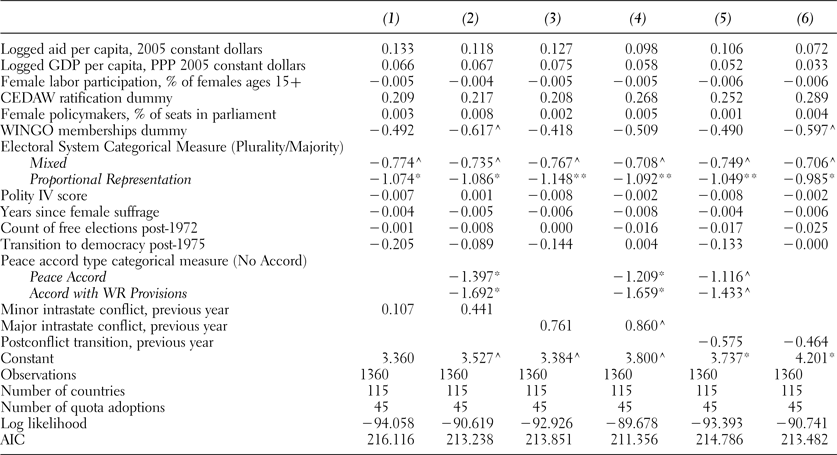
To ensure we are not simply capturing the effects of conflict or postconflict transitions with the peace accord variables, we include several conflict and postconflict measures in a sensitivity table (see Table 2). The three conflict measures are derived from version four of the UCDP/PRIO Armed Conflict Dataset (Gleditsch et al. Reference Gleditsch, Wallensteen, Eriksson, Sollenberg and Strand2002; Themnér and Wallensteen Reference Themnér and Wallensteen2011). We code three separate dummy variable measures with a one-year lag: the presence of minor intrastate conflict (25+ battle deaths); the presence of major intrastate conflict (1000+ battle deaths); and the presence of a transition from conflict to peace.Footnote 8
RESULTS
We present our results in two parts. Table 1 summarizes our main findings related to the relationship between different peace accord types and the rate of quota adoption. Table 2 includes alternate specifications of the full model from Table 1, inclusive of additional controls for conflict status and the transition out of conflict.
Event history models of the effects of peace accords on electoral quota adoption in 115 countries, 1990–2006

Notes: ^p < 0.1; *p < 0.05; **p < 0.01; ***p < 0.001, (two-tailed tests). Exponential Accelerated Failure Time models, coefficients shown. Reference category in brackets.
Model sensitivity to alternate specifications of conflict, 115 developing countries, 1990–2006
Notes: ^p < 0.1; *p < 0.05; ** p < 0.01; ***p < 0.001, (two-tailed tests). Exponential Accelerated Failure Time models, coefficients shown. Reference category in brackets
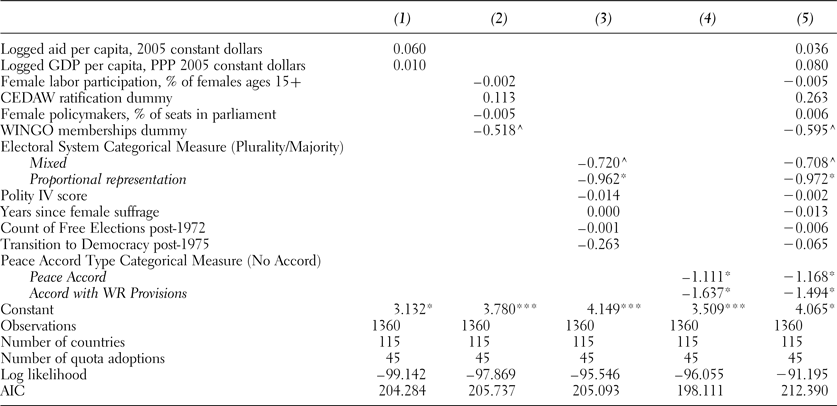
In Table 1 we present the AFT model coefficients in a set of nested models that present the three sets of factors we control for in our models, along with our peace accords measure. Models 1 through 3 show the effects of our socioeconomic, women's status, and democratic factors. The coefficients for all of these measures fail to achieve commonly accepted levels of statistical significance, except for countries with proportional representation electoral systems, which is significant at the p < 0.05 level in Model 3. The negative coefficient for proportional representation indicates that countries with this form of electoral system will adopt quotas over 2.6 times more quickly than those with a plurality/majority system, all else equal.Footnote 9
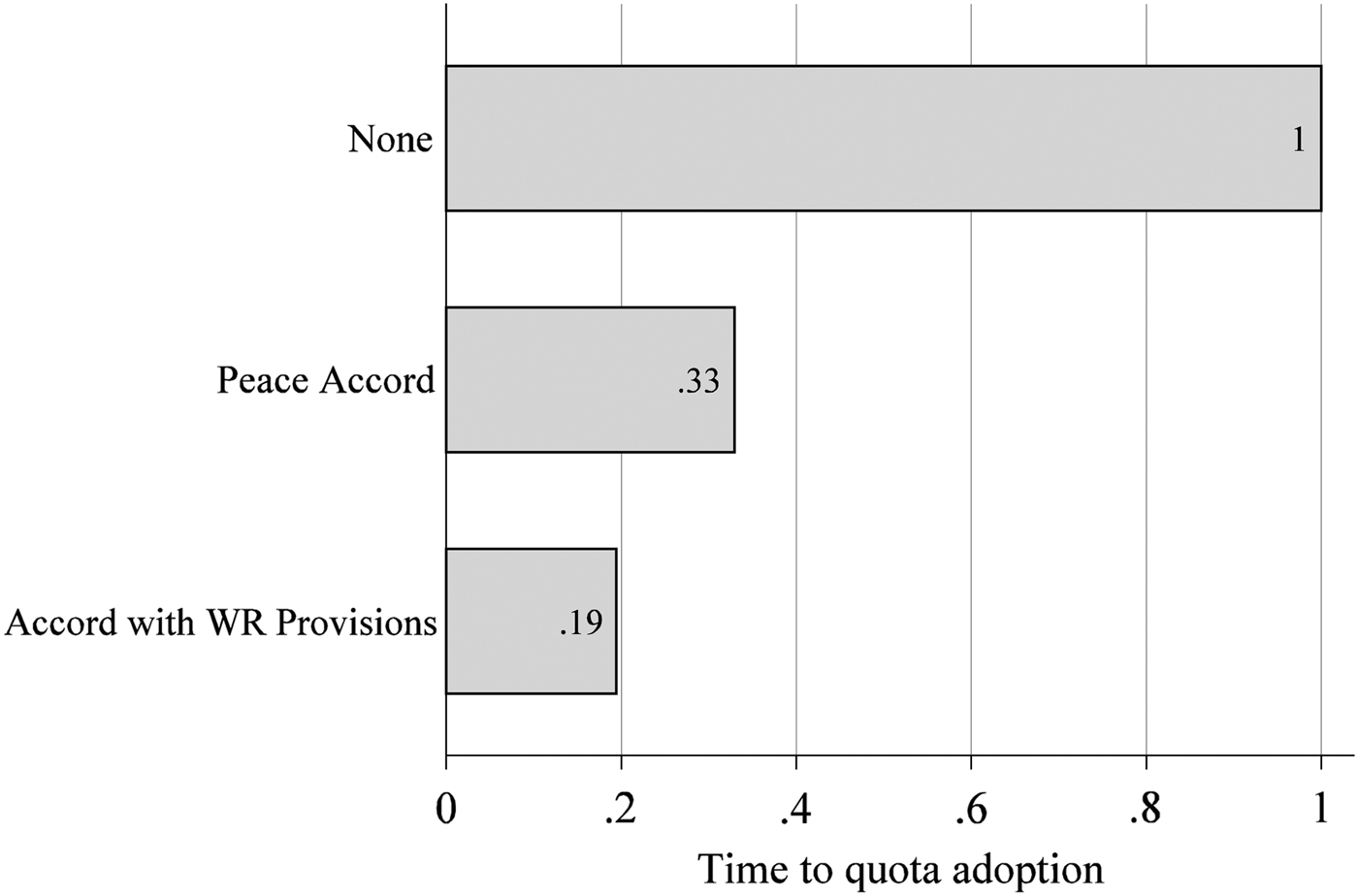
Model 4 includes only the peace accord measure. In contrast to the reference category of no peace accords, the presence of an accord either with or without women's rights (WR) provisions is predicted to speed the adoption of electoral quotas. Those countries that experience a peace accord without WR provisions are predicted to adopt a quota in 33% the time of the reference category, approximately 3.04 times faster. Those countries with accords that account for women's rights are predicted to adopt quotas in just over 19% the time of the reference category, a rate nearly 5.14 times faster. Figure 1 depicts these proportional times predicted to quota adoption for each of the three categories of countries, showing how for every year of time to quota adoption predicted for the reference category, countries with peace accords, and particularly those peace accords including WR provisions, are expected to have a much shorter time to adoption.
Proportional times to quota adoption by Peace Accord Category (Table 1, Model 4).
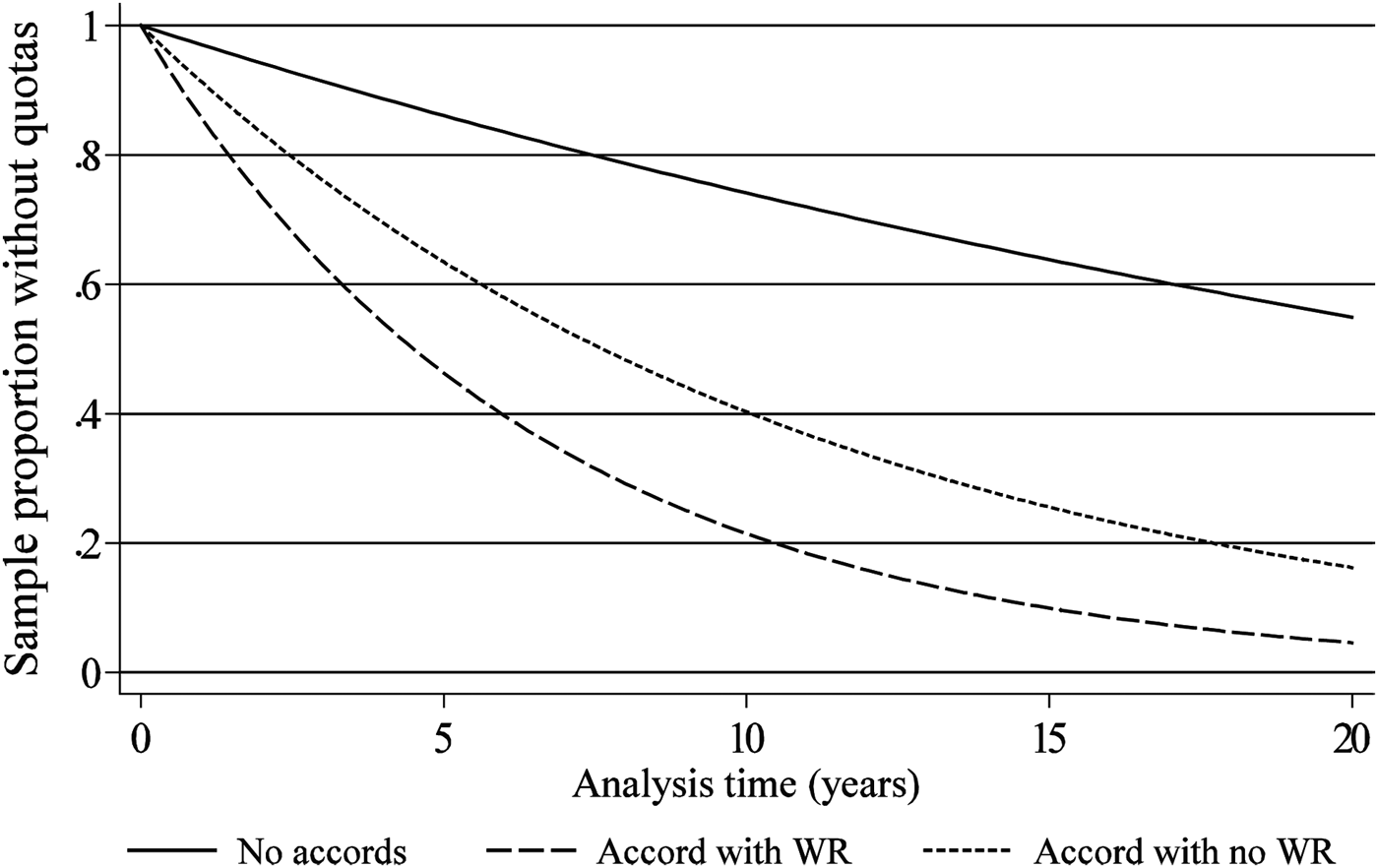
These divergent rates of quota adoption are also reflected in Figure 2. This survival curve illustrates the difference in time to quota adoption by peace accord category. We see that the proportion of the sample countries with gendered peace accords adopt quotas rapidly with more than 50% of those countries adopting quotas before five years of time in the analysis. Nearly 80% of those countries are predicted to adopt quotas by year 10 of the analysis. Approximately 60% of countries in the non-WR peace accord category adopt quotas by year 10 of analysis. In contrast, the reference category shows a much slower rate of adoption, with less than 40% of the sample even adopting quotas in the first 15 years of analysis.
Proportion of sample adopting quota over time by accord status (Table 1, Model 4).
In Model 5 we include the full model incorporating all of the control factors along with the peace accord measure. Results show continued support for our hypothesis regarding peace accords with WR provisions. The only covariates that attain significance in Model 5 are the two peace accord measures and countries with proportional representation. The effects of the WR peace accord category is reduced in absolute magnitude, suggesting that once we control for all other factors in our model, the gap in time between this category and the reference category narrows slightly. The time ratio of the WR peace accord category is now 0.22, a small increase over the 0.19 reported in Model 4.
Table 2 replicates Model 5 from Table 1 with the addition of our three conflict controls to test the sensitivity of our results and ensure that we are not merely capturing some effect of a country's postconflict status through our peace accord measures. In Models 1, 3, and 5, the three separate conflict dummy variables do not achieve statistical significance. The direction and significance of both our peace accord measures hold in Models 2 and 4, suggesting that we are not simply capturing a postconflict effect of minor or major intrastate conflict in our models. In Model 6, our peace accord measures attain marginal statistical significance at the p < 0.1 level. The change in significance suggests some possible collinearity with the conflict transition dummy; however, it does not point to our peace accord measures proxying postconflict transitions, as the transition dummy in both Models 5 and 6 never approaches even marginal statistical significance. Overall, in Table 2, our models prove robust to different specifications of conflict, suggesting the association we find between peace accords with women's rights provisions and the timing of quota adoption strongly support our hypothesis.
In addition to the evidence supporting our primary claims, it is worth noting that our results show little support for any of the plausible alternative explanations of quota adoption that have been offered in the literature. In none of the models are either the socioeconomic (GDP or aid) or women's status (labor force participation, political representation, or CEDAW ratification) factors statistically significant. Indeed, only proportional representation electoral systems are indicated as being a contributing factor to the increased rate of quota adoption. The fact that these competing explanations fail to account for the more rapid adoption of quotas in certain countries while our peace accord measures indicate a significant and substantial effect reinforces the support for our hypothesis regarding the influence of women's rights provisions in peace accords. We explore the nature of this relationship in greater depth in the next section by contextualizing our model results in historical examples drawn from the implementation of specific peace accords that account for various features of women's rights.
DISCUSSION
A preliminary examination of several cases indicates that the women who mobilize to demand access to negotiations continue to work to achieve their objectives after the agreement has been signed. Women activists appear to be the driving force behind the inclusion of women's rights in peace agreements and may, in fact, be causal agents in the adoption of gender quotas in the aftermath of conflict.
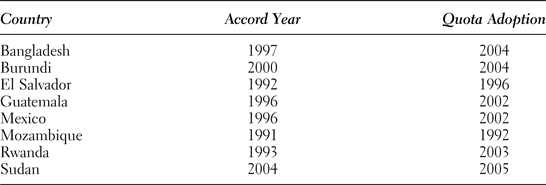
The data suggest a strong correlation between gender-inclusive peace agreements and the accelerated adoption of gender quotas. Table 3 shows the eight countries in our analysis for which the presence of a gender-inclusive accord is followed shortly thereafter by a quota adoption. The presence of a peace accord (without women's rights provisions) also accelerates the rate at which a quota is adopted but at a slower rate than if an agreement contained women's rights. This suggests that what we are seeing is not the correlation between societal rupture and quota adoption (that scholars have noted previously). If that were the case, we would expect that post-peace agreement quota rates would not differ between types that are gender inclusive and those that are not gender inclusive. Rather, the findings suggest that factors associated with the gender-inclusive agreement specifically, as opposed to the opportunities presented by the peace process generally, are linked to a hastened quota adoption. This is corroborated by the fact that the coefficient for democratic transition in our models never approaches statistical significance.Footnote 10 Preliminary observation of two illustrative examples, Burundi and Guatemala, suggests that women who participate in the peace talks also drive the quota-adoption process. This implies that women have gained political capabilities through their participation in the peace talks and that the period following the peace agreement is conducive to an increased role for women in formal politics.
Timing of peace accords with WR provisions and quota adoption
The literature, coupled with the examples below, suggests that mobilization and socialization of women's groups occur as a result of the conflict and the subsequent peace process. In a number of cases, women organize across ethno-political lines to demand an end to the conflict. The mobilization structures created through such activity persist in postconflict societies. This is illustrated by the following two examples.
Burundi's peace process featured an active women's movement, resulting in more women's references in Arusha Peace and Reconciliation Agreement for Burundi in 2000 than any other peace agreement signed between 1989 and 2005.Footnote 11 Women's political organizing for peace was spurred by the outbreak of hostilities in 1993 (Pascasie n.d.), evidenced by the formation of women's nongovernmental organizations and their organizing public meetings and demonstrations (Burke, Klot, and Bunting Reference Burke, Klot and Bunting2001; Mabobori Reference Mabobori and Aderinwale2001). Once formed, these women's organizations sought to participate in the formal peace talks between 1996 and 2000 but were consistently denied entry by the negotiating parties. However, seven of the women succeeded in becoming official observers in February 2000 (Burke, Klot, and Bunting Reference Burke, Klot and Bunting2001). Finally, with the assistance of UNIFEM New York, the official parties to the peace talks agreed to convene an all-women's peace conference where the women participants generated a list of demands for incorporation into the final peace agreement.Footnote 12 The key demand not included in the final agreement was a 30% gender electoral quota (All-Party Burundi Women's Peace Conference Reference Burke, Klot and Bunting2001). Nonetheless, the peace agreement did include a provision stipulating that political parties would run at least 20% female candidates for the election of the 30-month transitional National Assembly (Arusha Peace and Reconciliation Agreement for Burundi 2000, Protocol II, Chapter II, Article 20.8). Despite being unable to secure the 30% electoral quota in the peace agreement, the quota does appear in the 2004 interim constitution where it includes a 30% quota for women in the National Assembly, the government, and for all ministerial positions (Interim Constitution Post-Transition of the Republic of Burundi 2004). The quota has been implemented with the 2010 election producing a lower house of 30.5% women and 46.3% women in the senate (IPU 2012). The women actively involved in the peace process remained active in public affairs after the peace agreement had been signed, lobbying for the 30% electoral quota to be included in the interim constitution.Footnote 13 It seems that women recognized the potential political opportunities that had been created through their involvement in the peace process. For example, one of the women participants at the All-Women's Peace Conference called on others to “exploit the Arusha Accord … and find ways to utilize [the] Accord to [their] advantage … We have to ask: how can we utilize the results of the negotiations to benefit women?” (Burke, Klot, and Bunting Reference Burke, Klot and Bunting2001, 52).
Guatemala's peace process, between 1990 and 1996, featured the participation of women, who, like in the case of Burundi, succeeded in including women's rights in the peace accords. As in the Burundian case, women's organizations arose in response to the conflict, in this case to support the “disappeared” (e.g., Mutual Support Group [GAM]) and to promote the resolution of conflict through negotiations (e.g., National Coordinating Committee of Guatemalan Widows [CONAVIGUA]) (Carrillo and Stoltz Chinchilla Reference Carrillo, Chinchilla, Maier and Lebon2010). The peace process comprised formal (Track 1) and informal (Track 2) forums, and women participated in both. At the formal peace talks there were only two female participants (Jessen Reference Jessen2009). The most prominent of these was Luz Mendez, who participated as a member of the Guatemalan National Revolutionary Unity (URNG) as the only woman at the peace table for a number of years (Noma and Taylor 2004) and was the only female representative of the URNG from 1991 to 1996 (Hunt Alternatives Fund 2012). Mendez lobbied for the incorporation of gender equality commitments into the peace accords (Noma and Taylor 2004). The resulting peace agreements contain extensive provisions pertaining to women.Footnote 14 At present, two parties in Guatemala's Congress have adopted voluntary quotas. The URNG—the party for which Luz Mendez was a member—adopted a 30% gender quota in 2002 (López Robles Reference López Robles, Llanos and Sample2008). This was followed by the adoption of a 40% women's quota by the National Unity for Hope Party in 2007 (López Robles Reference López Robles, Llanos and Sample2008). Both examples suggest continuity between the women's activism during the peace process and postconflict quota adoption.
These cases suggest that the societal rupture caused by conflict motivated women to organize politically. This is in accordance with the literature on transitions and conflicts that posits such events offer opportunities for women to move into the public sphere. Peace negotiations, specifically, offer platforms for women to transition into formal politics with their gains reverberating into the postconflict period. Further research is required to unearth in greater detail the links between gender-inclusive peace agreements and the subsequent adoption of quotas. The preliminary research presented here lends support to the extant literature, suggesting that societal rupture and political transitions are fertile ground for women to acquire new roles in the public sphere. To date, the literature has not specified the peace table as a vehicle for improved political representation. The cross-national data and the preliminary examination of two cases suggest that gender-inclusive peace agreements facilitate the hastened adoption of gender quotas.
CONCLUSION
In an effort to shed more light on the role played by postconflict transition in shaping women's political representation in the developing world, we analyzed whether gender-inclusive peace processes accelerated the adoption of women's electoral quotas. Both our cross-national data analysis and our brief examples suggest that there is a clear link between these two factors. The cases point to the possible role for an engaged women's movement that remains active after the peace agreement has been signed as helping to foster this connection.
Future research should more closely examine this role played by domestic women's movements in the process of electoral quota adoption following peace accords. Regrettably, the absence of comparable cross-national data on local women's movement groups precluded the inclusion of this factor in our present analysis. Our measure of country-level WINGO memberships acts only as a crude proxy for the ties local citizens have to international women's groups and fails to nuance the nature of the women's movement in this respect. Our findings also raise two questions meriting attention in future research. First, do our findings hold if we extend the dataset both backward and forward in time? At present, the available data coding the gender-inclusiveness of peace accords preclude such analysis. Second, do gender-inclusive peace processes result in the adoption of certain types of quotas rather than others? For instance, are peace agreements more likely to contribute to constitutional quotas rather than party quotas? This question could be examined more readily once a larger sample of peace accord data becomes available.
Our findings offer significant contributions to the literatures that prompted our inquiry. We have provided a more nuanced understanding of one mechanism through which postconflict transition can translate into increased women's political representation through the adoption of quotas. We identify peace processes as key to the link between postconflict transitions and the increased political representation of women. Furthermore, in contrast to earlier work that focused on the international incentives offered by UN peacekeeping operation and foreign aid, we contend that it is largely peace accord processes that result in the postconflict adoption of quotas. And finally, to the literature on women's rights in peace processes, we provide empirical evidence that inclusive peace processes result in the accelerated adoption of electoral gender quotas, helping to move beyond the normative literature that women should be involved in peace processes by showing one of the tangible outcomes of their actual involvement.