Resolving linguistic ambiguities can reveal tendencies in the use of provided information, or biases toward one of the possible interpretations, that can be easily overlooked otherwise. In this paper we use temporarily ambiguous sentences to examine whether gender markings may function as cues moderating the assignment of thematic roles in complex relative clause constructions. The processing of sentence (1) may appear as difficult as that of sentence (2), as they both contain object-extracted relative clauses (ORC). Sentences (3) and (4) contain subject-extracted relative clauses (SRC), and therefore (3) may seem equally difficult to comprehend as (4).
-
(1) The beautician, whom both designers recognized, is experienced.
-
(2) The artist, whom both designers recognized, is experienced.
-
(3) The beautician, who recognized both designers, is experienced.
-
(4) The artist, who recognized both designers, is experienced.
However, there is evidence that certain features shared by nouns or noun phrases (e.g., animacy) facilitate the assignment of specific thematic roles, such as when agent roles are assigned more easily to animate and patient roles to inanimate nouns (e.g., Bornkessel-Schlesewsky & Schlesewsky, Reference Bornkessel-Schlesewsky and Schlesewsky2009; MacDonald, Reference MacDonald1994; Trueswell, Tanenhaus, & Kello, Reference Trueswell, Tanenhaus and Kello1993). While claims about animate nouns as better agents (Gennari & MacDonald, Reference Gennari and MacDonald2008) and inanimate nouns as poorer agents (Clifton et al., Reference Clifton, Traxler, Mohamed, Williams, Morris and Rayner2003; Just & Carpenter, Reference Just and Carpenter1992) have already been supported by empirical evidence, the claim about gender cues as predictors of good or poor agents has not yet been demonstrated experimentally. At the same time, similarly to animacy when described as a “supralinguistic” concept (Yamamoto, Reference Yamamoto1991) affecting linguistic phenomena (e.g., word order), gender can be regarded as a fundamental semantic dimension expressed on biological and social levels (Ridgeway, Reference Ridgeway2001) with various linguistic representations (e.g., grammaticalFootnote 1 [der Musiker/die Musikerin “the musicianmasculine/feminine” in German], natural [woman/man], definitional [mother/father], and stereotypical [nurse/surgeon] gender). Based on psycholinguistic and sociocognitive research on gender that will be discussed in more detail below, this study attempts to clarify whether gender, along with animacy, may affect the identification of thematic roles. Previous research has reported gender-related observations, such as case syncretism of feminines in German (Krifka, Reference Krifka, Steinkrüger and Krifka2009) and the strong link between agency and masculinity (Koenig, Mitchell, Eagly, & Ristikari, Reference Koenig, Mitchell, Eagly and Ristikari2011), suggesting that entities possessing female characteristics may be less agentive and therefore more likely to serve as thematic patients. If this is the case, then stereotypically female beautician may be perceived as a better patient compared to neutral artist (i.e., receiving an action) in the ORC sentences, making the comprehension of (1) easier than (2). Similarly, neutral artist may be perceived as a better agent compared to stereotypically female beautician (i.e., producing an action) in the SRC sentences, making (4) easier than (3). The experiments reported in the present paper use relative clause structures in German as a tool to address this issue.
THEMATIC STRUCTURE AND PROMINENCE HIERARCHIES
A number of studies invoked thematic structure to explain biases that influence the interpretation of complex linguistic constructions, such as relative clauses (e.g., Boland, Tanenhaus, Garnsey, & Carlson, Reference Boland, Tanenhaus, Garnsey and Carlson1995; Pickering & Traxler, Reference Pickering and Traxler1998; Pickering, Traxler, & Crocker, Reference Pickering, Traxler and Crocker2000; Traxler, Morris, & Seely, Reference Traxler, Morris and Seely2002). Evaluating the role of various factors in the comprehension of relative clauses, previous research has repeatedly shown that ORCs are more difficult to process than SRCs (Gordon, Hendrick, & Johnson, Reference Gordon, Hendrick and Johnson2001; Staub, Reference Staub2010; Traxler, Williams, Blozis, & Morris, Reference Traxler, Williams, Blozis and Morris2005). However, Mak, Vonk, and Schriefers (Reference Mak, Vonk and Schriefers2002, Reference Mak, Vonk and Schriefers2006) and Traxler et al. (Reference Traxler, Morris and Seely2002) demonstrated that ORCs with inanimate heads, such as The movie that the director watched received the prize, were almost as easy to comprehend as SRCs of the type The director that watched the movie received a prize. Thus, the feature of animacy has been shown to modulate the difficulty in the interpretation of relative clauses, showing that linguistic characteristics are a significant factor modulating the likelihood of the assignment of an agent role to one of the two nouns in a sentence.
The expectations readers have about entities possessing certain characteristics to occupy syntactically prominent positions in a sentence can be seen within the framework of the thematic hierarchy hypothesis (e.g., Grimshaw, Reference Grimshaw1990; Jackendoff, Reference Jackendoff1987). This hypothesis lists the ordering of thematic roles by prominence, with the agent role ranking the highest on the hierarchy of semantic features. At the same time, prominence can be assessed along several dimensions other than thematic agency, such as animacy, definiteness, or person, with animate entities ranking over inanimate, definite over indefinite, and first and second person over third (Lamers & de Swart, Reference Lamers, de Swart, Lamers and de Swart2012). The tripartite animacy hierarchy proposed by Croft (Reference Croft1990) offers a similar ordering by person (first and second over third), NP-type (pronouns over common nouns), and animacy itself (human over nonhuman, animate over inanimate). The definition of the agentive case, given by Fillmore as “the typically animate perceived instigator of the action identified by the verb” (Reference Fillmore, Bach and Harms1968, p. 24), indicates the relatedness of the two concepts: agency and animacy. In line with this definition, Yamamoto (Reference Yamamoto1991) suggests that agency presupposes animacy, considering that previous research had named such conceptual properties of agency as intentionality (Davidson, Reference Davidson, Binkley, Bronaugh and Marras1971), dynamicity, and control (Dik, Reference Dik1989). These properties are not purely linguistic, which contributes to Yamamoto's understanding of animacy as an “extra-” or “supralinguistic” concept, which nevertheless relates to such linguistic phenomena as case marking, word order, subject selection, and gender.
Even though the interaction of different prominence dimensions remains a subject of debate (e.g., Klein, Guntsetseg, & von Heusinger, Reference Klein, Guntsetseg, von Heusinger, Lamers and Swart2012; Primus, Reference Primus, Lamers and de Swart2012), the principle of harmonic alignment suggests that hierarchies within separate dimensions map onto one another, so that the hierarchy within the dimension of animacy, for instance, correlates with that of thematic roles (Lamers, Reference Lamers, Lamers and de Swart2012). The processing is facilitated when rankings on different hierarchies point to the same argument in a sentence as being more prominent (Bornkessel-Schlesewsky & Schlesewsky, Reference Bornkessel-Schlesewsky and Schlesewsky2008). As a result of such alignment, animacy information can be used in the assignment of thematic roles during language comprehension. Thus, readers seem to have expectations about high-ranked animate entities to produce actions represented by the verb (i.e., serve as agents that are high ranked on a thematic role hierarchy), while low-ranked inanimate entities are expected to rather receive those actions (i.e., serve as patients that are low ranked on a thematic role hierarchy). This tendency can be regarded as a bias moderating difficulties in the interpretation of syntactically complex sentences.
GENDER PROCESSING AND AGENCY
The present investigation extends the current knowledge about biases in linguistic structures by examining the role of grammatical and stereotypical gender in the resolution of relative clauses. In the literature on reference resolution, the integration of grammatical and stereotypical gender cues is widely discussed in terms of mismatch effects that are reflected in longer processing times when stereotypically male (e.g., electrician) or female (e.g., beautician) role nouns corefer with mismatching information, such as gender suffixes, gender-specific pronouns, or noun phrases (e.g., Cacciari, Corradini, Padovani, & Carreiras, Reference Cacciari, Corradini, Padovani and Carreiras2011; Esaulova, Reali, & von Stockhausen, Reference Esaulova, Reali and von Stockhausen2014; Irmen, Reference Irmen2007; Kreiner, Sturt, & Garrod, Reference Kreiner, Sturt and Garrod2008; Reali, Esaulova, & von Stockhausen, in press). Grammatical and stereotypical gender cues have been shown to affect readers’ interpretation of role nouns in highly automatized ways and to strongly influence the comprehension of sentences (e.g., Banaji & Hardin, Reference Banaji and Hardin1996; Cacciari & Padovani, Reference Cacciari and Padovani2007; Carreiras, Garn- ham, Oakhill, & Cain, Reference Carreiras, Garnham, Oakhill and Cain1996; Esaulova et al., Reference Esaulova, Reali and von Stockhausen2014; Irmen, Holt, & Weisbrod, Reference Irmen, Holt and Weisbrod2010).
In the literature mentioned above, the effects of both grammatical features and stereotype-based connotations of roles and contexts are analyzed. On the one hand, this research clearly points at the fact that both gender representations affect reference resolution, and on the other hand, it relates the linguistic and the social psychological understanding of the term gender on a conceptual level. This is in line with social cognition research (e.g., Stahlberg, Braun, Irmen, & Sczesny, Reference Stahlberg, Braun, Irmen, Sczesny and Fiedler2007), which indicates the association between conceptual and formal gender representations, where the former are expressed through gender stereotypes and the latter through grammatical features, such as gender suffixes. However, neither research on thematic structures (e.g., Clifton et al., Reference Clifton, Traxler, Mohamed, Williams, Morris and Rayner2003; Trueswell & Tanenhaus, Reference Trueswell, Tanenhaus, Clifton, Frazier and Rayner1994) nor research on gender processing (e.g., Cacciari & Padovani, Reference Cacciari and Padovani2007; Carreiras et al., Reference Carreiras, Garnham, Oakhill and Cain1996; Esaulova et al., Reference Esaulova, Reali and von Stockhausen2014; Irmen, Reference Irmen2007) and social cognition (Stahlberg et al., Reference Stahlberg, Braun, Irmen, Sczesny and Fiedler2007) have ever supposed the link between gender and agency or considered gender a relevant factor in the assignment of thematic roles. At the same time, some approaches in historical linguistics indicate such a link arguing that an initial two-way distinction in gender in Germanic languages may have been based on animacy, agentivity, or the capability of subject marking (Kürschner & Nübling, Reference Kürschner and Nübling2011; Meier-Brügger, Reference Meier-Brügger2002). Bringing the research from these different areas together, we supposed that gender characteristics of nouns should be examined as constituting another dimension along which the prominence of thematic role nouns can be assessed. This perspective draws largely on McRae, Hare, Elman, and Ferretti's (Reference McRae, Hare, Elman and Ferretti2005) account of thematic roles, which views them as concepts formed through everyday experience rather than simply lexical information. This account, in turn, is based on the situation model theories (Sanford & Garrod, Reference Sanford and Garrod1981), which emphasize the role of long-term memory in the representation of a linguistically described event. Following Yamamoto, we suggest that, similar to agency, gender presupposes animacy, most certainly in those cases when it points at the sex of the referent. The evidence of animacy-based role assignments (Wang, Schlesewsky, Philipp, & Bornkessel-Schlesewsky, Reference Wang, Schlesewsky, Philipp, Bornkessel-Schlesewsky, Lamers and de Swart2012) encourages the assumption that gender cues may influence readers’ implicit beliefs about good or poor agents in a similar way. This should be reflected through readers’ expectations about nouns of certain gender to produce or receive actions represented by the verb in a sentence. In social psychology, male roles are associated with higher status and power and are described as more agentive and less communal than female ones (e.g., Koenig et al., Reference Koenig, Mitchell, Eagly and Ristikari2011). Agency and communion are fundamental dimensions of social categorization (e.g., Fiske, Cuddy, & Glick, Reference Fiske, Cuddy and Glick2007), in which the former comprises such characteristics as assertion, competence, and independence, while the latter is associated with cooperation, warmth, and empathy. An extensive body of research in this field indicates a possible association between agency and gender representations (e.g., masculine and feminine sex roles, see Bem, Reference Bem1981; sex-role socialization, see Cross & Madson, Reference Cross and Madson1997; Helgeson, Reference Helgeson1994; masculinity, see Koenig et al., Reference Koenig, Mitchell, Eagly and Ristikari2011; Spence & Buckner, Reference Spence and Buckner2000).
HYPOTHESES
In this study we examine gender represented through grammatical and conceptual characteristics, since research on language-based representation of women and men points at the commonalities in their processing. If gender constitutes an important factor in the assessment of agency, as we would like to argue, we should be able to observe its influences on agency when it is expressed through both gender-marking suffixes and through gender stereotypes, such as in typically male (/neutral)/female occupational role nouns. The hypotheses below specify this general proposition by making specific predictions about each of these two types of gender representations. These predictions are tested in experimental designs that manipulate the morphological marking of gender in role nouns and the stereotypical gender of role nouns independently in order to provide converging evidence about the relationship between gender processing and the identification of thematic roles.
The phenomenon of differential object marking described in functional/typo- logical literature (e.g., Aissen, Reference Aissen2003; Stiebels, Reference Stiebels, Stiebels and Wunderlich2000) offers a theoretical frame for considering grammatical gender in relation to agency. Differential object marking defines the likelihood of an object to be overtly case-marked as a function of prominence ranking. Thus, Aissen (Reference Aissen2003) describes preferred case marking patterns relating them to prominence hierarchies and shows that aligned agent > patient and animate > inanimate hierarchies lead to unmarked animate agents and inanimate patients, whereas the violation of this alignment leads to the overt case marking of entities. Krifka (Reference Krifka, Steinkrüger and Krifka2009) further considers the phenomenon of differential object marking in relation to the gender and case system in Germanic languages in order to explain syncretism of nominatives and accusatives observed for feminines in German. In German, the case marking of singular masculine determiners is expressed overtly for nominative and accusative (der Nominative; den Accusative), while feminine determiners lack any morphological distinction in these cases (die Nominative/Accusative). Similar syncretism for the neuter has been explained by the fact that the distinction between nominative and accusative is functionally important for animates, as neuter is, originally, a class of inanimates. Since there is no reason why the masculine and the feminine should be unequal in terms of animacy, Krifka (Reference Krifka, Steinkrüger and Krifka2009) evaluates alternative explanations (e.g., Becker, Reference Becker and Köpcke1994; Bittner, Reference Bittner2003) suggesting that this asymmetry may result from the evolution of language within the speech community where feminine NPs occur less frequently in the agent role than masculine ones. According to the concept of harmonic alignment, the hierarchy of thematic roles corresponds to the underlying mapping of prominence hierarchies, which would indicate that masculine entities should be more prominent, since they are more likely to align with agent roles than feminine entities. This prediction is expressed in Hypothesis 1, which concerns grammatical gender: if grammatical gender constitutes a prominence dimension and feminine is ranked lower on the hierarchy than masculine, then readers should have expectations about grammatically feminine role nouns to rather function as patients than agents (to receive rather than produce actions) compared to masculine role nouns, which would be reflected in longer processing times for feminine agents than masculine ones.
Social cognition research indicates theoretical grounds to relate agency and stereotypical gender. If the association between agency and masculinity (e.g., Koenig et al., Reference Koenig, Mitchell, Eagly and Ristikari2011) described above can be carried over to linguistic terms, then stereotypically male (/neutral) nouns should be good agents and poor patients compared to stereotypically female nouns. Hypothesis 2 is based on these considerations and regards stereotypical gender: if stereotypical gender constitutes a prominence dimension and female entities are ranked lower on the hierarchy than neutral, then readers should have expectations about stereotypically female role nouns to function as patients rather than agents compared to neutral role nouns, which would become evident through longer processing times for female agents than neutral ones.
In terms of eye-tracking measures, both hypotheses translate into the prediction that longer fixation times and more regressions should occur in sentences where feminine or female role nouns are agents and shorter fixations and fewer regressions in sentences where masculine or neutral role nouns are agents.
OVERVIEW OF THE PRESENT RESEARCH
The influence of thematic role characteristics on the production and comprehension of particular syntactic structures (e.g., SRCs and ORCs) does not seem to be restricted to a particular language (e.g., English, see McDonald, Bock, & Kelly, Reference McDonald, Bock and Kelly1993; Spanish, see Prat-Sala, Reference Prat-Sala1997; German, see Van Nice & Dietrich, Reference Van Nice and Dietrich2003). The standard finding that ORCs are interpreted with greater difficulty than SRCs mentioned above also extends to the case of German (e.g., Friederici, Steinhauer, Mecklinger, & Meyer, Reference Friederici, Steinhauer, Mecklinger and Meyer1998).
Since German is one of the languages in which the verb often appears in clause-final position, the integration of information to predict the temporarily unavailable or ambiguous input must be critical to efficiently interpret the sentence. Previous studies have shown that both syntactic and semantic information is used to predict the subsequent input (e.g., Kamide, Altmann, & Haywood, Reference Kamide, Altmann and Haywood2003). According to McRae et al.’s (Reference McRae, Hare, Elman and Ferretti2005) account on thematic roles, conceptual/world knowledge information from thematic role characteristics is computed and used immediately in online language processing. Our research question consisted of clarifying whether gender cues are relevant indicators of prominence in readers’ expectations about thematic agents and patients, which contribute to the rapid integration of information in a sentence. In German, certain combinations of gender and number in nouns of the main and the relative clause make it possible to construct sentences where ORCs and SRCs can only be identified as such by the form of the auxiliary verb at the end of the relative clause but are otherwise identical in structure, as in the following Examples (5) and (6):
-
(5)

-
(6)


Such temporary ambiguity in the thematic structure allowed us to vary grammatical and stereotypical gender of role nouns in German sentences containing ORCs and SRCs to test whether gender information is used in the assignment of thematic agent and patient roles. Previous research has shown that the analysis of subject–object ambiguity is influenced by the relative ranking of the arguments on prominence hierarchies (Haupt, Reference Haupt2008). If gender information constitutes a relevant dimension that contributes to the prominence of thematic roles in a sentence, then it should be reflected in the processing of syntactically ambiguous structures, such as in the German sentences containing SRCs and ORCs mentioned above.
In both experiments reported in this paper, we examined the empirical validity of our theoretical assumptions about gender as a dimension of prominence. The hypotheses were tested in two experiments designed using temporarily ambiguous sentences containing SRC and ORC structures, as provided in Examples (5) and (6). The identification of role nouns as agents and patients in these sentences was not possible until the auxiliary verb of relative clauses had been reached. Experiment 1 examined the effects of grammatical gender by varying grammatical cues (masculine and feminine) in role nouns that were neutral with regard to stereotypical gender. Experiment 2 extended the focus to stereotypical gender influences and included the variation of grammatical (masculine and feminine) and stereotypical (neutral and female) gender cues of involved role nouns.Footnote 2
EXPERIMENT 1
In Experiment 1, we investigated to what extent grammatical gender functions as a cue to agency and affects the resolution of temporarily ambiguous relative clauses.
Method
Participants
Thirty-two students at the University of Duisburg-Essen (15 male, 17 female, mean age 26.3 years, SD = 4.7) were paid to participate. All of them were native speakers of German who did not report to be highly proficient in other languages and had normal or corrected to normal vision.
Materials
EXPERIMENTAL STIMULI
Twenty-four experimental sentences consisted of a main and a relative clause connected by the relative pronoun die “who/whomfeminine sg/masculine or feminine plural” that can be interpreted either as feminine singular or as masculine or feminine plural. Main clauses contained plural forms of 24 role nouns (RN1), which varied in grammatical gender (feminine and masculine, feminine marked by the feminine plural suffix –innen Footnote 3 ) but were neutral with regard to stereotypical gender (e.g., Student-en/-innen “studentsNeutral+masculine/feminine”). Relative clauses contained singular forms of 24 role nouns (RN2), all of which were grammatically feminine and neutral with regard to stereotypical gender (according to the previously published normsFootnote 4 ). The verb in the relative clause was an action verb and necessarily involved two arguments, while the verb of the main clause was a state verb (see Appendix A for experimental stimuli with masculine RN1). Both main and relative clauses of each sentence were presented simultaneously in one line. In sentences with SRCs, such as (7), RN1 served as agents and RN2 served as patients. According to Hypothesis 1, masculine RN1 agents were expected to facilitate comprehension compared to feminine ones. In sentences with ORCs, such as (8), RN2 served as agents and RN1 served as patients. Therefore feminine RN1 patients were expected to facilitate comprehension compared to masculine ones.
-
(7)
-
(8)


All of the sentences had the following fixed structure: determiner + RN1 + relative pronoun + determiner + RN2 + action verb + auxiliary verb + main clause verb + adjective. The identification of a relative clause as subject-extracted (die = “who”) or object-extracted (die = “whom”) was not possible until its last word (the auxiliary verb hat “has” or haben “have”) had been reached.
VERB AND ADJECTIVE PRETESTS
To exclude potential confounding effects resulting from the context, a series of pretests was conducted to ensure that verbs and adjectives used in experimental items did not contain any gender information. The verb pretest consisted of 24 transitive verbs requiring a two-argument structure (e.g., erkennen “to recognize”), while 16 verbs reflecting stereotypically female and male characteristics (8 verbs like kochen “to cook” and 8 verbs like boxen “to box”), as well as 8 verbs allowing a different number of arguments (e.g., versprechen “to promise”), served as pretest fillers. The adjective pretest consisted of 82 items that were structurally similar to the main clause in the experimental items, except that role nouns were replaced with X (e.g., X ist aufmerksam “X is thoughtful”). Adjectives that reflected stereotypically male and stereotypically female characteristics (22 adjectives like wetteifernd “competitive” and 21 adjectives like liebevoll “affectionate”) were used as pretest fillers. A total of 37 participants were asked to rate pretest items (i.e., verbs and adjectives) for gender stereotypicality on a scale from 1 (stereotypically male) to 7 (stereotypically female). All verbs and adjectives around the scale midpoint, that is, with ratings from 3.5 to 4.5, were considered neutral with regard to gender stereotypicality and used in the study. In addition, the selected RN pairs were controlled for hierarchical relations, so that RNs that differed in status (e.g., professor/student) were not used in the same sentence.
FILLERS
To prevent participants from developing reading strategies based on the gender characteristics of role nouns and on temporarily ambiguous relative clause structures of experimental items, 24 filler items were constructed. Filler sentences consisted of a main clause and a relative clause connected by the relative pronoun die, which was followed by an unambiguous nominative or accusative masculine determiner der/den (each occurring in 50% of all fillers). All fillers had a fixed structure that imitated the experimental sentences. Plural forms of 24 neutral role nouns served as RN1 in main clauses; they were either grammatically masculine or nominalized participles, which do not express grammatical gender. The singular forms for another 24 neutral role nouns served as RN2 in relative clauses.
Design
The experimental design included two factors: grammatical gender of RN1 (masculine vs. feminine; within subjects and within items), and type of relative clause (SRC vs. ORC; within subjects and within items). Four randomized lists presented each item in one of the four conditions: masculine RN1 + SRC; masculine RN1 + ORC; feminine RN1 + SRC; and feminine RN1 + ORC. Across lists, each item occurred equally often in each condition. Participants were presented with one of the lists (24 experimental items); that is, they received 6 items in each of the four conditions and encountered each item only once. A quarter of the sentences (including fillers) were followed by a yes/no comprehension question to ensure that participants read materials carefully enough and understood their content.
Procedure
Eye movements were recorded using an Eyelink 1000 eye-tracker with a sampling rate of 1000 Hz and angular resolution of 10–30 min of arc (about 0.15° to 0.5°). Participants were seated 70 cm from the computer screen, at which distance three characters subtended 1° of visual arc. All sentences in the experiment were presented in 22-point Lucida Console font and displayed on a single line. Viewing was binocular, but only the dominant eye was recorded. A chin rest was used to minimize head movements.
Participants were tested individually. Before the experiment began, they were instructed to read for comprehension in their normal reading speed, pressing corresponding buttons on a response pad to move on to the next sentence, and to answer questions. Then a calibration procedure with a 9-point grid was performed. Each trial started with the presentation of a fixation point located at the beginning of the sentence to be triggered. Whenever the experimenter judged fixation on the point as inaccurate, recalibration was carried out. The first four sentences with two questions served as practice trials. The eye-tracking session lasted approximately 20 min.
Results
Data analysis
For the analysis of the eye movement data, the experimental sentences were divided into the following regions (marked with angle brackets in the example below and in italics in the following text): Die Student-en/-innen, <die die> <Fahrradfahrerin> <übersehen> <hat/haben,> <sind verletzt> “The studentsNeutral+masculine/feminine, whom the cyclistNeutral+feminine has overlooked / who have overlooked the cyclistNeutral+feminine, are hurt.” We refer to the analyzed regions of the relative clause as relative pronoun (the relative pronoun with the following determiner), RN2, action verb, and auxiliary verb.Footnote 5
For each region, five reading time measures were computed: first fixation duration (the duration of the very first eye fixation on a region entered from the left), first-pass reading time (the sum of fixation times from first entering a region from the left until leaving it either to the right or to the left), regression path (the sum of fixation times from first entering a region from the left until leaving it to the right, including the time spent regressing to the left of the region), total fixation time (the sum of all fixation times on a region), and regressions into a region (the number of times the region was entered from the right; see Staub & Rayner, Reference Staub, Rayner and Gaskell2007).
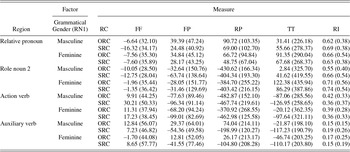
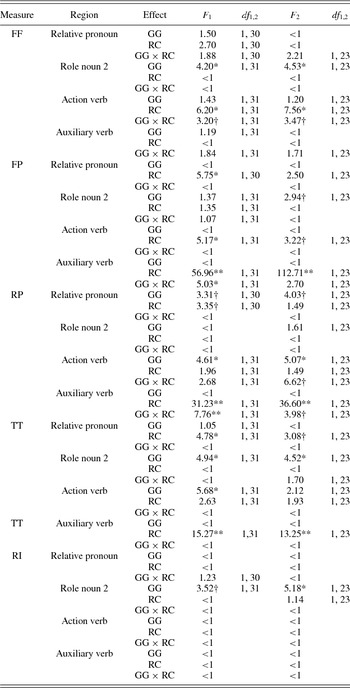
The initial stages of data analysis consisted of merging fixations shorter than 70 ms with neighboring fixations within one character and removing fixations below 70 ms and above 600 ms (2.13% of the data), for previous research on reading had shown that such fixations are not representative of normal acquisition of information (Breen & Clifton, Reference Breen and Clifton2011; Rayner, Sereno, Morris, Schmauder, & Clifton, Reference Rayner, Sereno, Morris, Schmauder and Clifton1989). Trials that exceeded the reading time range of the total reading time mean plus 3 SD were considered outliers (1.30% of all trials) and were excluded from the analyses.Footnote 6 The data were subjected to repeated measures analyses of variance (ANOVAs) with the RN1 grammatical gender (masculine vs. feminine) and the relative clause type (SRC vs. ORC) treated as within-subjects and within-items factors. Computations based on the data averaged across participants and across items are referred to as F 1 and F 2 analyses, respectively. The analyses were based on residual fixation times after region-length correction (Trueswell, Tanenhaus, & Garnsey, Reference Trueswell, Tanenhaus and Garnsey1994).Footnote 7 Table 1 provides means and standard deviations of residual fixation times for all measures and regions and probabilities of regressions, and Table 2 presents the results of ANOVAs.
Means (standard deviations) of residual fixation times and probabilities of regressions for Experiment 1

Note: RC, relative clause; FF, first fixation durations; FP, first-pass reading time; RP, regression path; TT, total fixation time; RI, regressions into the region; ORC, object-extracted relative clauses; SRC, subject-extracted relative clauses.
Results of analyses of variance for all regions of interest for Experiment 1

Note: FF, first fixation durations; GG, RN1 grammatical gender; RC, relative clause type; FP, first-pass reading time; RP, regression path; TT, total fixation time; RI, regressions into the region.
†p ≤ .1. *p ≤ .05. **p ≤ .01.
Pairwise contrast analyses were performed based on F 1 only in cases when patterns of mean differences were similar and significant in either both F 1 and F 2, or in one (p ≤ .05) and marginally significant (p ≤ .1) in the other analysis. Corresponding t test results are reported and interpreted below region by region (left to right), starting from measures reflecting earlier processing to those reflecting later processing.Footnote 8 Note that it is the interaction term between the RN1 grammatical gender and the relative clause type that is of critical interest to our Hypothesis 1.
First fixation durations
The ANOVA revealed a main effect of the RN1 grammatical gender on the RN2 region with shorter fixations after masculine than feminine RN1, M masc = −11.40; M fem = −1.66, t (31) = −2.05, SEM = 4.76, p = .049, r = .35.
Regression path
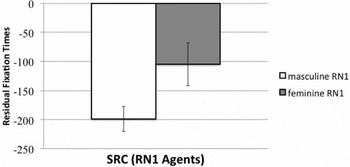
A main effect of grammatical gender emerged on the action verb with shorter fixations after masculine than feminine RN1, M masc = −475.30; M fem = −416.95, t (31) = −2.15, SEM = 27.18, p = .040, r = .36. The ANOVA also revealed an interaction between the RN1 grammatical gender and the relative clause type on the auxiliary verb. A t test showed shorter fixations of the auxiliary verb in SRCs after masculine compared to feminine RN1 agents, M mascSRC = −198.99; MfemSRC = −104.80, t (31) = −3.00, SEM = 31.45, p = .005, r = .47 (see Figure 1).
Regression path residuals on the auxiliary verb region after grammatically masculine and feminine plural role noun agents in subject-extracted relative clauses. Error bars indicate standard errors (Experiment 1).

Total fixation time
A main effect of grammatical gender occurred on the RN2 showing shorter fixations after masculine than feminine RN1, M masc = 22.23; M fem = 104.34, t (31) = −2.22, SEM = 36.96, p = .034, r = .37.
Regression into a region
A main effect of grammatical gender showed a tendency for fewer regressions into the RN2 after masculine than feminine RN1, M masc = 0.60; M fem = 0.72, t (31) = −1.88, SEM = 0.06, p = .070, r = .32.
Response accuracy
The average accuracy in answering comprehension questions during the experiment was 81.25%.
Discussion
As expected, the grammatical gender of RN1 affected the resolution of temporarily ambiguous relative clauses in Experiment 1, which was represented by the interaction between the grammatical gender and the relative clause type. In SRCs, feminine RN1 agents caused more difficulties in processing than masculine. This finding suggests that grammatical gender may function as a cue to agency in that masculine role nouns are more expected to serve as agents in relative clauses than feminine role nouns. However, the extent to which this result can be generalized remains limited at this point since no such pattern was observed in ORCs and, despite a reliable effect in regression path residuals, the effect in SRCs did not reach significance across measures. One plausible reason for why the pattern observed in SRCs was absent in ORCs may be the greater difficulty of ORCs compared to SRCs requiring higher processing costs that could have washed out rather subtle effects of gender. In addition, it should be noted that the agent role is more central for comprehension than the patient role (e.g., Cohn & Paczynski, Reference Cohn and Paczynski2013), which could be another explanation of the effect of grammatical gender, which was observed for agents (in SRCs) and not for patients (in ORCs). These possibilities will be considered in more detail in the General Discussion.
As to the main effect of grammatical gender, most of the examined measures reliably showed that feminine RN1 caused more difficulties in processing compared to masculine RN1. Since agents are more likely to precede patients (e.g., Bornkessel, Zysset, Friederici, Von Cramon, & Schlesewsky, 2005), this may indicate a general tendency in readers to expect masculine rather than feminine agents to be mentioned in a sentence first.
EXPERIMENT 2
In Experiment 2 we extended the research question to the stereotypical gender of role nouns. Based on our previous reasoning, not only grammatical but also stereotypical gender of role nouns should contribute to thematic role assignment as gender typicality has repeatedly been shown to prompt the representation of gender congruent referents. Theoretically this can be explained by the situation model approach (Sanford & Garrod, Reference Sanford and Garrod1981, Reference Sanford and Garrod1998), which claims that updating the representation of an event that is being described from long-term memory is a constant process running in parallel to the unfolding of linguistic input. Stereotypical gender information represented linguistically through role nouns likely affects the upgrading process, in which it is mapped onto the world knowledge about typical gender roles. Research on gender processing has shown that both stereotypical and grammatical gender information is relevant for the interpretation of sentences, which manifests itself through mismatch effects when gender cues are incongruent (e.g., Carreiras et al., Reference Carreiras, Garnham, Oakhill and Cain1996; Esaulova et al., Reference Esaulova, Reali and von Stockhausen2014). Furthermore, gender effects are even stronger when gender cues are made more salient such as through gender markings and/or through varying both grammatical and stereotypical gender (e.g., Irmen, Reference Irmen2007). Making gender information more salient through the use of grammatical and stereotypical gender in Experiment 2 should result in both functioning as cues to agency, as predicted in Hypotheses 1 and 2.
Therefore, in Experiment 2 we examined to which extent both grammatical gender and stereotypical gender function as cues to agency and affect the resolution of temporarily ambiguous relative clauses. For this purpose, we varied the stereotypical gender of RN1 and the grammatical gender of RN2.
Method
Participants
Forty students at the University of Duisburg–Essen (15 male, 25 female, mean age = 25.2 years, SD = 3.6) were paid to participate. All of them were native speakers of German who did not report to be highly proficient in other languages and had normal or corrected to normal vision.
Materials and procedure
The preparation of materials and procedural details in Experiment 2 were similar to those of Experiment 1; details in which they differed are described below.
EXPERIMENTAL STIMULI
Twenty-four experimental sentences consisted of a main and a relative clause connected by the relative pronoun die “who/whomfeminine sg/masculine or feminine plural.” Main clauses contained singular forms of 12 stereotypically female and 12 neutral role nouns (RN1), all grammatically feminine (see Examples (9)–(12)). Relative clauses contained the plural forms of 24 neutral role nouns (RN2) that varied in grammatical gender (feminine and masculine, feminine marked by the feminine plural suffix –innen; see Appendix A for experimental stimuli with grammatically masculine RN2).
-
(9)
-
(10)
-
(11)
-
(12)


In sentences with SRCs, such as (9) and (10), RN1 served as agents and RN2 served as patients. In sentences with ORCs, such as (11) and (12), RN2 served as agents and RN1 served as patients. Hypothesis 1 concerned stereotypically neutral RN2 and predicted grammatically feminine patients and grammatically masculine agents to facilitate comprehension compared to masculine patients and feminine agents. Hypothesis 2 concerned RN1 (which grammatical gender was held constant) and predicted longer processing of stereotypically female than neutral agents and after neutral than stereotypically female patients.
All of the sentences had the following fixed structure: determiner + RN1 + relative pronoun + quantifierFootnote 9 + RN2 + action verb + auxiliary verb + main clause verb + adjective. As in Experiment 1, the identification of a relative clause as subject-extracted (die = “who”) or object-extracted (die = “whom”) was not possible until the last word of the relative clause had been reached.
FILLERS
Fillers consisted of a main clause and an unambiguous relative clause connected by relative pronouns der/den “who/whommasculine” (each occurring in 50% of all fillers). The singular forms of 24 slightly male (rating score: 2.5 to 3.4 on a 7-point scale from 1 = stereotypically male to 7 = stereotypically female) and grammatically masculine role nouns served as RN1 in main clauses. The plural forms of 12 nominalized participles and 12 neutral role nouns (6 grammatically feminine and 6 grammatically masculine) appeared as RN2 in relative clauses.
Design
The experimental design included the following three factors: RN1 stereotypical gender (neutral vs. female; within-subjects and between-items), RN2 grammatical gender (masculine vs. feminine; within-subjects and within-items), and relative clause type (SRC vs. ORC; within subjects and within items). Four randomized lists presented each item in one of the 8 conditions that consisted of either stereotypically female or neutral RN1 and one of the four combinations: masculine RN2 in SRC; masculine RN2 in ORC; feminine RN2 in SRC; and feminine RN2 in ORC. Each participant was presented with one list (consisting of 24 experimental items and 24 fillers), where a quarter of the sentences were followed by a yes/no question to ensure an adequate reading comprehension.
Results
Data analysis
Details of data analysis and reporting of results were similar to those in Experiment 1; differences are described below. Experimental sentences of Experiment 2 were divided into similar regions as in Experiment 1 (marked with angle brackets in the example below and in italics in the following text): Die Flugbegleiterin, <die viele> <Tourist-en/-innen> <beobachtet> <hat/haben,> <ist aufmerksam.> “The flight attendantFemale+feminine, who has observed many touristsNeutral+ masculine /feminine / whom many touristsNeutral+ masculine/feminine have observed, is attentive.” We refer to the analyzed regions of the relative clause as relative pronoun (the relative pronoun with the following quantifier), RN2, action verb, auxiliary verb, and to the last two words of the main clause as spillover.
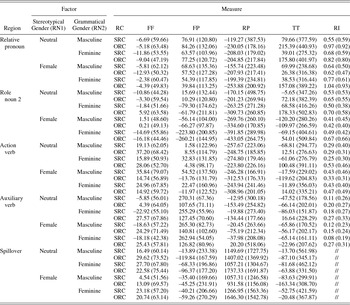
Initial stages of data analysis consisted in merging fixations shorter than 70 ms with neighboring fixations within one character and removing fixations below 70 ms and above 600 ms (1.98% of the data). Trials that exceeded the total reading time mean plus 3 SD were considered outliers (1.25% of all trials) and were excluded from the analyses (see Note 5). The data were subjected to repeated-measures ANOVA with RN1 stereotypical gender (neutral vs. female) treated as a within-subjects and between-items factor and with RN2 grammatical gender (masculine vs. feminine) and relative clause type (SRC vs. ORC) treated as within-subjects and within-items factors. Means and standard deviations of residual fixation times for all measures and regions and probabilities of regressions are given in Table 3, and the results of the ANOVAs are shown in Table 4.
Means (standard deviations) of residual fixation times and probabilities of regressions for Experiment 2

Note: RC, relative clause; FF, first fixation durations; FP, first-pass reading time; RP, regression path; TT, total fixation time; RI, regressions into the region; SRC, subject-extracted relative clauses; ORC, object-extracted relative clauses.
Results of Analyses of Variance for All Regions of Interest (Experiment 2)

Note: FF, first fixation durations; SG, RN1 stereotypical gender; GG, RN2 grammatical gender; RC, relative clause type; FP, first-pass reading time; RP, regression path; TT, total fixation time; RI, regressions into the region.
†p ≤ .1. *p ≤ .05. **p ≤ .01
Note again that it is the interaction term between the RN2 grammatical gender and the relative clause type that is of critical interest to our Hypothesis 2, while the interaction term between the RN1 stereotypical gender and the relative clause type is critical for Hypothesis 2.
First fixation durations
Footnote 10 The ANOVA revealed an interaction on the action verb between the RN1 stereotypical gender and the relative clause type. It showed shorter fixations in ORCs preceded by stereotypically female compared to neutral RN1 patients, M FemaleORC = 14.83, M NeutralORC = 32.63, t (38) = 2.44, SEM = 7.31, p = .020, r = .37.
First-pass reading time
A main effect of the RN1 stereotypical gender occurred on the RN2 with the consistent pattern of shorter fixations after stereotypically female than neutral RN1 in the first pass, M Female = −151.60, M Neutral = −28.78, t (38) = 10.46, SEM = 11.75, p < .001, r = .86. A main effect of the RN2 grammatical gender also observed on the RN2 showed shorter fixations on feminine compared to masculine RN2, M masc = −24.11, M fem = −156.28, t (38) = 6.71, SEM = 19.70, p < .001, r = .74.
Regression path
As before, the main effects of the RN1 stereotypical gender on the RN2 resulted in shorter fixations after stereotypically female compared to neutral RN1, M Female = −357.32, M Neutral = −236.09, t (38) = −4.52, SEM = 26.81, p < .001, r = .59. A main effect of the RN2 grammatical gender was also observed on the RN2, with shorter fixations on feminine than masculine RN2, M masc = −243.94, Mf em = −349.47, t (38) = 3.75, SEM = 28.17, p = .001, r = .52.
An interaction between the RN1 stereotypical gender and the relative clause type on the action verb showed shorter fixations after female compared to neutral RN1 patients, M NeutralORC = −236.28, M FemaleORC = −310.74, t (38) = 2.77, SEM = 26.85, p = .009, r = .41.
A main effect of RN2 grammatical gender occurred again on the spillover region, with shorter fixations after masculine than feminine RN2, M masc = 1136.40, M fem = 1426.97, t (38) = −2.80, SEM = 103.82, p = .008, r = .41. An interaction between the RN2 grammatical gender and the relative clause type occurred on the spillover, with shorter fixations after masculine than feminine RN2 agents, M mascORC = 1169.30, M femORC = 1691.81, t (38) = −3.62, SEM = 144.29, p = .001, r = .51.
Total fixation time
Consistent with earlier occurrences, the main effect of the RN1 stereotypical gender on the RN2 showed shorter fixations after stereotypically female than neutral RN1, M Female = −61.33, M Neutral = 78.36, t (38) = 5.75, SEM = 24.30, p < .001, r = .68. The main effect of the RN2 grammatical gender also occurred on the RN2 with shorter fixations on masculine compared to feminine RN2, Mm asc = −40.91, M fem = 57.94, t (38) = −2.64, SEM = 37.43, p = .012, r = .39.
The ANOVA revealed an interaction between the RN1 stereotypical gender and the relative clause type on the action verb region. In SRCs, there were shorter fixations after neutral than stereotypically female RN1 agents, M NeutralSRC = −52.13, M FemaleSRC = 2.15, t (39) = −2.16, SEM = 25.18, p = .037, r = .33. In ORCs, there were shorter fixations after female than neutral RN1 patients, M NeutralORC = 56.50, M FemaleORC = −52.80, t (38) = 3.37, SEM = 32.40, p = .002, r = .48.
The ANOVA revealed another interaction between the RN2 grammatical gender and the relative clause type showing the same pattern of shorter fixations after masculine than feminine RN2 agents in ORCs on the action verb, M mascORC = −53.56, M femORC = 57.25, t (38) = −3.32, SEM = 33.34, p = .002, r = .47; and on the auxiliary verb, M mascORC = −61.15, M femORC = −3.16, t (38) = −2.58, SEM = 22.49, p = .014, r = .39.
Regressions into regions
The ANOVA revealed a three-way interaction on the relative pronoun between the RN1 stereotypical gender, the grammatical gender of RN2, and the relative clause type. Follow-up comparisons showed fewer regressions into the region after typically female RN1 followed by masculine than feminine RN2 agents in sentences with ORCs, M Female/mascORC = 0.63, M Female/femORC = 1.02, t (39) = −3.14, SEM = 0.12, p = .003, r = .45.
A main effect of the RN2 grammatical gender occurred on the action verb resulting in fewer regressions after masculine than feminine RN2, M masc = 0.33, M fem = 0.42, t (38) = −2.58, SEM = 0.03, p = .014, r = .39.
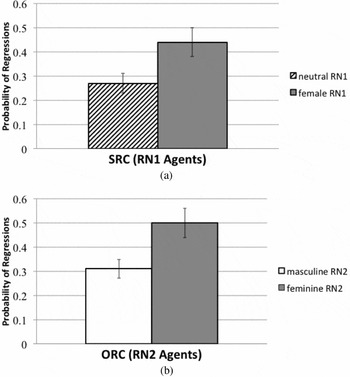
An interaction between the RN1 stereotypical gender and the relative clause type showed fewer regressions into the action verb in SRCs after neutral than typically female RN1 agents, M NeutralSRC = 0.27, M FemaleSRC = 0.44, t (39) = −3.66, SEM = 0.05, p = .001, r = .51. An interaction between the RN2 grammatical gender and the relative clause type also emerged in regressions into the action verb region and showed fewer regressions into the region in ORCs after masculine compared to feminine RN2 agents, M mascORC = 0.31, M femORC = 0.50, t (38) = −4.30, SEM = 0.04, p < .001, r = .57 (see Figure 2).
(a) Probabilities of regressions into the action verb (a) after stereotypically female and neutral plural role noun agents in subject-extracted relative clauses with error bars indicating standard errors (Experiment 2) and (b) after grammatically masculine and feminine singular role noun agents in object-extracted relative clauses (Experiment 2). Error bars indicate standard errors.

Response accuracy
The average accuracy in answering the comprehension questions during the experiment was 82.85%.
Discussion
Several interactions between gender cues and the relative clause type revealed the relevance of gender information in the assignment of agent and patient roles to role nouns when resolving temporarily ambiguous SRCs and ORCs. The interaction between the RN1 stereotypical gender and the relative clause type showed more difficulties after stereotypically female RN1 agents compared to neutral ones in the processing of SRCs. Similarly, it also showed more difficulties after neutral RN1 patients than stereotypically female ones in the processing of ORCs. These findings indicate that stereotypical gender information functions as a cue to agency in that it reflects readers’ expectations about neutral role nouns to serve as agents and stereotypically female role nouns as patients. Stereotypical gender affects the processing of thematic roles starting at the earliest stage of the first fixations and is followed by grammatical gender influences later on. The interaction between the RN2 grammatical gender and the relative clause type consistently showed more difficulties after feminine RN2 agents than masculine ones in the processing of ORCs. These findings suggest that grammatical gender information also functions as a cue to agency and reflects the readers’ expectations about masculine rather than feminine role nouns to serve as agents.
Furthermore, the results revealed characteristic patterns in the processing of gender cues in Experiment 2. The processing of grammatical gender differed from earlier to later stages. During earlier stages (regression path on the RN2), feminine RN2 were processed faster than masculine ones, while later stages showed more difficulties in the processing of feminine than masculine RN2. This may be due to the fact that having seen a feminine suffix in RN1 made it easier for participants to recognize it when encountered again in RN2. Since word recognition only takes place at a relatively early stage, the pattern change observed in later measures is likely to reflect later processing, such as the integration of lexical information with semantic knowledge (e.g., Esaulova et al., Reference Esaulova, Reali and von Stockhausen2014; Garrod & Terras, Reference Garrod and Terras2000). As to the main effect of stereotypical gender, female RN1 required less processing time than neutral RN1. Keeping in mind that the RN1 grammatical gender was always feminine, this may reflect the congruency between stereotypical and grammatical gender cues, which might be higher in the case of female than neutral RN1 (for similar findings see Esaulova et al., Reference Esaulova, Reali and von Stockhausen2014).
GENERAL DISCUSSION
Taken together, the results of both experiments provide consistent evidence that confirms our hypotheses concerning the relationship between gender markings and the readers’ expectations about thematic roles in temporarily ambiguous relative clauses. More specifically, the results show that our predictions hold for both types of gender representations (i.e., morphological markings and stereotypical gender of role nouns), thus providing converging evidence about the relationship between the processing of gender and thematic roles. The results of both Experiments 1 and 2 partially support Hypothesis 1 about grammatical gender influences demonstrating that grammatically masculine rather than feminine role nouns are expected to refer to agents, while the processing of patient roles does not seem to be affected directly by grammatical gender cues (see discussion below). Experiment 2 confirms Hypothesis 2 about stereotypical gender influences showing that stereotypically female rather than neutral role nouns are expected to serve as patients, while neutral rather than female role nouns are expected to serve as agents. These results are interesting in different ways.
These findings indicate that gender, along with animacy and definiteness (Silverstein, Reference Silverstein and Dixon1976), can be regarded as another relevant dimension in the assessment of prominence of arguments in a sentence. Like other dimensions of prominence, gender cues can be ordered in terms of a hierarchy (Lamers, Reference Lamers, Lamers and de Swart2012), with masculine/neutral entities ranking higher than feminine/female ones. Following the principle of harmonic alignment, grammatically masculine references to persons are expected to serve as more thematically prominent roles (i.e., agents) in (temporarily) ambiguous sentences than grammatically feminine ones. In terms of stereotypical gender, stereotypically female references seem to be associated with less prominent thematic roles (i.e., patients) and neutral ones with more prominent roles (i.e., agents). These findings can be related to research demonstrating influences of other prominence hierarchies on reading (e.g., animacy, Mak et al., Reference Mak, Vonk and Schriefers2006; definiteness/specificity, Kretzschmar, Bornkessel-Schlesewsky, Staub, Roehm, & Schlesewsky, Reference Kretzschmar, Bornkessel-Schlesewsky, Staub, Roehm, Schlesewsky, Lamers and de Swart2012) and research on ambiguity resolution (e.g., Gennari & MacDonald, Reference Gennari and MacDonald2008; Reali & Christiansen, Reference Reali and Christiansen2007). This research is relevant from a theoretical perspective, because it provides support for constraint-based accounts that view comprehension difficulties as a function of probabilistic constraints provided by certain types of linguistic information. A number of findings demonstrate that noun animacy, voice (active vs. passive), the use of highly frequent pronominal subjects, and certain kinds of verbs are constraints modulating the comprehension difficulty of relative clauses (e.g., Bornkessel-Schlesewsky & Schlesewsky, Reference Bornkessel-Schlesewsky and Schlesewsky2008, Reference Bornkessel-Schlesewsky and Schlesewsky2009; Primus, Reference Primus2011, Reference Primus, Lamers and de Swart2012). The results of our study suggest that grammatical and stereotypical gender can also be considered as such constraints affecting readers’ expectations that role nouns will function as agents or patients.
It is worth noting that stereotypical gender appears to affect the comprehension of thematic roles at the very early stages, which adds to the body of literature reporting the immediate effects of role typicality in sentence processing (e.g., Carreiras et al., Reference Carreiras, Garnham, Oakhill and Cain1996; Irmen, Reference Irmen2007; Irmen & Schumann, Reference Irmen and Schumann2011). At the same time, stereotypical gender influences occurred earlier than grammatical gender ones, which is in contrast to some previous findings (e.g., Esaulova et al., Reference Esaulova, Reali and von Stockhausen2014). While all of these studies used references in sentences, Esaulova et al. (Reference Esaulova, Reali and von Stockhausen2014) argue that the recruitment of stereotypical gender for the anaphor resolution and its timing may depend on the exact materials, resulting in earlier effects for noun phrase than pronominal anaphors, for instance. Moreover, grammatical gender influences in previous research mostly referred to gender agreement required by the anaphor resolution. However, in the current study grammatical gender was irrelevant for the crucial number agreement in the relative clause and yet influenced its processing, even though it did so during later stages compared to stereotypical gender. This suggests that readers may rely more readily on the semantic information available through stereotypical gender to identify thematic roles than grammatical gender cues, which are not directly required for the interpretation of the sentence. It is interesting that the influence of gender information on sentence processing is more apparent in Experiment 2 compared to Experiment 1, because the interaction effects between gender cues and relative clause types are only documented in sentences with SRCs but not ORCs in Experiment 1. There is some evidence that singular personal references facilitate comprehension compared to plural ones (e.g., Müsseler, Hielscher, & Rickheit, Reference Müsseler, Hielscher, Rickheit, Rickheit and Habel1995). This facilitation may have reduced differences between masculine and feminine RN2 in Experiment 1 but not Experiment 2 due to the differences in the design. In contrast, situation model theories propose that people use both linguistic cues and background knowledge, mapping one onto another, when comprehending a text (Sanford & Garrod, Reference Sanford and Garrod1998; Zwaan & Radvansky, Reference Zwaan and Radvansky1998). In particular, Sanford and Garrod (Reference Sanford and Garrod1981) suggest that representations of situations stored in long-term memory (background knowledge) are activated as soon as there is enough information provided through linguistic input. Applying this perspective on the present study, gender information (grammatical and stereotypical) represented linguistically may have activated corresponding representations of situations from long-term memory. However, since stereotypical gender information was only varied in Experiment 2, the linguistic input containing gender information was reduced in Experiment 1. Thus, in Experiment 1, compared to Experiment 2, the provided linguistic gender information was not sufficient for ascribing agency in ORCs but only affected the resolution of SRCs.
An alternative interpretation of this difference between Experiments 1 and 2 supposes that the relevance of gender information for comprehension appears to be modulated by its salience in the sentence. Earlier research has shown that a person's sex is often made salient (marked or noted) especially when her or his role is inconsistent with the stereotypical one, thus indirectly reinforcing stereotypes (Romaine, Reference Romaine, Hellinger and Bussmann2001; Stahlberg et al., Reference Stahlberg, Braun, Irmen, Sczesny and Fiedler2007). The salience of gender cues in Experiment 2 could have made readers more attentive to contrasts in gender information (i.e., masculine vs. feminine, neutral vs. female), and therefore gender appeared more relevant for the resolution of relative clauses than in Experiment 1. Our results demonstrate that the number of gender cues present in a sentence and their variety (grammatical only vs. both grammatical and stereotypical) increase the effect of gender biases during comprehension.
It must be noted that although grammatical gender effects appear in SRCs in Experiment 1 and in ORCs in Experiment 2, they concern agent and not patient thematic roles in both types of temporarily ambiguous sentences. One may argue that the effects of prominence may have disappeared in ORCs in Experiment 1 and SRCs in Experiment 2 because feminine plural forms may be less frequent and thus more difficult per se than their masculine counterparts. However, masculine RNs should then be easier than feminine across all relative clauses in both experiments, thereby ruling out all prominence effects, which is not the case. The observed asymmetry should not be surprising considering the central role of the agent role for comprehension and its prominence compared to other thematic roles (e.g., Cohn & Paczynski, Reference Cohn and Paczynski2013). A closer look at the results reveals that the effects observed for agents always occurred when patients were feminine, while the design of both experiments allowed for both masculine and feminine patients. This indicates that specific agent–patient combinations were particularly prone to the effect, namely, masculine rather than feminine role nouns were expected to be agents when patients were feminine and not masculine.
As an alternative or complementary explanation to the one based on gender roles, research on the role of working memory in the interpretation of complex sentences demonstrated that two NPs of a different type are processed faster than two similar NPs due to the similarity-based interference (Gordon et al., Reference Gordon, Hendrick and Johnson2001). One important question that the similarity-based interference model leaves open concerns critical dimensions that define similarity. If we consider gender such a dimension, similarity-based interference could account for longer processing times that we observed for grammatically feminine compared to masculine agents when patients were also grammatically feminine. However, role nouns that we have studied had a number of commonalities (e.g., animacy and person) and differences (e.g., number and stereotypical gender), and it cannot be determined based on our experiments which of these dimensions constitute possible sources of interference. Furthermore, this approach does not hold for the observed stereotypical gender effects, where neutral RN1 were found to take shorter in agent and longer in patient roles than female RN1 while RN2 were always neutral.
Even though the similarity-based interference approach cannot be applied to all of our results, it points at the possible interaction between the two NPs mentioned in a sentence. This interaction may be important in predicting the thematic role of NPs, which is highly relevant for our study. Kamide et al. (Reference Kamide, Altmann and Haywood2003) argue that the goodness of fit between a NP and a thematic role may depend on the other arguments in addition to the constraints afforded by the verb. In their eye-tracking experiments using a “visual-world” paradigm, on hearing the girl will ride or the man will ride participants looked more often at a picture of a carousel or a motorbike, respectively. Since the verb (ride) afforded the same constraints for both agents (the girl and the man), the most likely NP to be selected as a patient varied as a function of the agent. As opposed to our study, the interpretation of NP agents in Kamide et al.’s experiments was unambiguous and allowed the prediction of another argument as a patient. Whichever thematic role possibly predicted the other could not be determined in our study, since both thematic roles remained ambiguous until the auxiliary verb. Nevertheless, the observed effects suggest an interaction in which feminine patients were more likely to enter into a dependency with grammatically masculine rather than feminine agents.
Our findings suggest that in order to better understand cognitive mechanisms underlying gender processing, it is crucial to consider not only gender representations on the word level (i.e., conceptual through gender stereotypes or formal through morphological markings) but also the way they appear within larger linguistic units (e.g., as thematic roles). The observation that the processing of gender information goes beyond the interpretation of individual words and also guides inferences about thematic roles reveals implicit gender influences that can be viewed as linguistic biases. The research on linguistic biases shows that it is not only the type of information (e.g., gender) but also the very way the information is conveyed (e.g., via thematic roles) that may implicitly signal it as either expected (i.e., conforming to stereotypes or typical representations of a described event) or unexpected. Based on the linguistic category model by Semin and Fiedler (Reference Semin and Fiedler1988), who distinguished different levels of abstraction that may be used to describe the same behavior, research on the linguistic intergroup bias (Maass, Salvi, Arcuri, & Semin, Reference Maass, Salvi, Arcuri and Semin1989) and the expectancy bias (Wigboldus, Semin, & Spears, Reference Wigboldus, Semin and Spears2000) demonstrated that expected behaviors were encoded at higher levels of abstraction (using adjectives that are detached from specific behaviors, e.g., emotional and aggressive) compared to unexpected information, which was encoded at a more concrete level (e.g., via descriptive action verbs that referred to a specific observable event, e.g., cry and hit). Similarly, the negation bias implies that the use of negations (e.g., not stupid, rather than smart) is more likely in stereotype-inconsistent compared to stereotype-consistent descriptions (Beukeboom, Finkenauer, & Wigboldus, Reference Beukeboom, Finkenauer and Wigboldus2010; de Villiers & Flusberg, Reference de Villiers and Flusberg1975). In this context, the gender bias revealed in our study can be defined as the tendency to assign thematic agent roles to masculine/neutral rather than feminine/female role nouns.
Finally, these findings demonstrate that the assignment of thematic roles is associated with gender cues in the context of reading comprehension in a similar way as the concept of agency/communion is associated with gender differences as described in social psychology (e.g., Koenig et al., Reference Koenig, Mitchell, Eagly and Ristikari2011). While in social psychology masculinity and femininity are considered attributes of agency and communion, respectively, linguistic cues marking grammatical and stereotypical gender reveal the readers’ tendencies to assign agent roles to masculine/neutral rather than feminine/female role nouns and patient roles to female rather than neutral role nouns. This finding is again consistent with constraint-based accounts that view thematic roles as concepts based on world knowledge from everyday experiences rather than syntactic slots void of conceptual content (McRae et al., Reference McRae, Hare, Elman and Ferretti2005). Even though grammatical gender may correspond to the biological sex of the referent in case of role nouns used in the present studiesFootnote 11 while stereotypical gender refers to the probability of the distribution of men and women in given occupations, both gender cues influence the assignment of thematic agents/patients during reading.
Conclusions
Our study extends the existing knowledge on gender processing relating it, on the one hand, to research on thematic roles (e.g., McRae et al., Reference McRae, Hare, Elman and Ferretti2005; Primus, Reference Primus, Bornkessel, Schlesewsk and Comrie2006) and, on the other hand, to research on linguistic biases (e.g., Maass et al., Reference Maass, Salvi, Arcuri and Semin1989; Wigboldus et al., Reference Wigboldus, Semin and Spears2000). The interpretation of masculine/neutral rather than feminine/female role nouns as instigators of an action is the first evidence of a subtle gender bias surfacing in temporarily ambiguous relative clause constructions through gender-based role assignments. The results of both eye-tracking experiments encourage one to consider interactions between gender and agency in a broader context, which relates linguistic and social psychological aspects of both concepts. We propose that gender be considered another dimension that can be used when the prominence of thematic roles is assessed to determine their hierarchy. Constraint-based models (e.g., MacDonald, Pearlmutter, & Seidenberg, Reference MacDonald, Pearlmutter and Seidenberg1994) can be applied to account for the readers’ expectation about agents and patients associated with specific gender cues. Implications of grammatical and stereotypical gender processing described in the framework of situation model theories (e.g., Sanford & Garrod, Reference Sanford and Garrod1981) can, for example, be relevant in the context of guidelines for gender-fair language that are widely discussed today. Since the relevance of prominence dimensions differs across languages (Aissen, Reference Aissen2003), further directions of the current research aim at establishing the extent of gender-based role assignment across languages.
APPENDIX A
Following are the experimental stimuli with masculine RN1 (Experiment 1):
-
Die Nachbarn, die die Spaziergängerin beobachtet hat/haben, sind träge.
-
“The neighbors, whom the rambler observed/who observed the rambler, are sluggish.”
-
Die Psychiater, die die Kinderärztin befragt hat/haben, sind alarmiert.
-
“The psychiatrists, whom the pediatrician questioned/who questioned the pediatrician, are alarmed.”
-
Die Designer, die die Kollegin gewürdigt hat/haben, sind extravagant.
-
“The designers, whom the colleague appreciated/who appreciated the colleague, are extravagant.”
-
Die Schwimmer, die die Athletin gelobt hat/haben, sind motiviert.
-
“The swimmers, whom the athlete praised/who praised the athlete, are motivated.”
-
Die Patienten, die die Masseurin benachrichtigt hat/haben, sind besorgt.
-
“The patients, whom the masseuse notified/who notified the masseuse, are worried.”
-
Die Künstler, die die Astrologin beauftragt hat/haben, sind dankbar.
-
“The artists, whom the astrologer instructed/who instructed the astrologer, are thankful.”
-
Die Praktikanten, die die Kunstmalerin beeindruckt hat/haben, sind engagiert.
-
“The interns, whom the painter impressed/who impressed the painter, are dedicated.”
-
Die Skifahrer, die die Joggerin getroffen hat/haben, sind müde.
-
“The skiers, whom the jogger met/who met the jogger, are tired.”
-
Die Passagiere, die die Barkeeperin eingeladen hat/haben, sind erfreut.
-
“The passengers, whom the barkeeper invited/who invited the barkeeper, are pleased.”
-
Die Tennisspieler, die die Partnerin ermutigt hat/haben, sind sympathisch.
-
“The tennis players, whom the partner encouraged/who encouraged the partner, are pleasant.”
-
Die Dozenten, die die Forscherin unterstützt hat/haben, sind beunruhigt.
-
“The lecturers, whom the researcher supported/who supported the researcher, are concerned.”
-
Die Sportler, die die Schulanfängerin angeschaut hat/haben, sind aufmerksam.
-
“The sportsmen, whom the first-grader looked at/who looked at the first-grader, are attentive.”
-
Die Camper, die die Kleingärtnerin beschuldigt hat/haben, sind gereizt.
-
“The campers, whom the allotmentier blamed/who blamed the allotmentier, are irritated.”
-
Die Zuschauer, die die Poetin begeistert hat/haben, sind raffiniert.
-
“The spectators, whom the poetess inspired/who inspired the poetess, are refined.”
-
Die Gynäkologen, die die Freundin informiert hat/haben, sind gesellig.
-
“The gynecologists, whom the friend informed/who informed the friend, are sociable.”
-
Die Touristen, die die Autofahrerin aufgeheitert hat/haben, sind zufrieden.
-
“The tourists, whom the car driver cheered/who cheered the car driver, are content.”
-
Die Geiger, die die Zuhörerin erschreckt hat/haben, sind empört.
-
“The violinists, whom the listeners frightened/who frightened the listeners, are resentful.”
-
Die Sänger, die die Autorin gelangweilt hat/haben, sind vulgär.
-
“The singers, whom the author bored/who bored the author, are coarse.”
-
Die Musiker, die die Gastgeberin begrüßt hat/haben, sind talentiert.
-
“The musicians, whom the hostess greeted/who greeted the hostess, are talented.”
-
Die Apotheker, die die Ärztin empfohlen hat/haben, sind ehrgeizig.
-
“The pharmacists, whom the doctor recommended/who recommended the doctor, are ambitious.”
-
Die Schriftsteller, die die Archivarin angeschrieben hat/haben, sind interessiert.
-
“The writers, whom the archivist wrote to/who wrote to the archivist, are interested.”
-
Die Schauspieler, die die Theaterbesucherin irritiert hat/haben, sind exzentrisch.
-
“The actors, whom the theatergoer irritated/who irritated the theatergoer, are eccentric.”
-
Die Rentner, die die Mieterin ignoriert hat/haben, sind arrogant.
-
“The retirees, whom the tenant ignored/who ignored the tenant, are arrogant.”
-
Die Studenten, die die Fahrradfahrerin übersehen hat/haben, sind verletzt.
-
“The students, whom the cyclist overlooked/who overlooked the cyclist, are hurt.”
Following are the experimental stimuli with grammatically masculine RN2 (Experi- ment 2):
-
Female RN1
-
Die Arzthelferin, die beide Patienten angerufen hat/haben, ist beschäftigt.
-
“The doctor's assistant, who called both patients/whom both patients called, is busy.”
-
Die Babysitterin, die viele Spaziergänger angeschaut hat/haben, ist müde.
-
“The babysitter, who looked at many ramplers/whom many ramblers looked at, is tired.”
-
Die Diätberaterin, die beide Tennisspieler beschuldigt hat/haben, ist unerbittlich.
-
“The nutritionist, who blamed both tennis players/whom both tennis players blamed, is relentless.”
-
Die Erzieherin, die einige Schulanfänger aufgeheitert hat/haben, ist humorvoll.
-
“The educator, who cheered some first-graders/whom some first-graders cheered, is witty.”
-
Die Floristin, die einige Kleingärtner beraten hat/haben, ist zufrieden.
-
“The florist, who counseled some allotmentiers/whom some allotmentiers counseled, is content.”
-
Die Flugbegleiterin, die viele Touristen beobachtet hat/haben, ist aufmerksam.
-
“The flight attendant, who observed many tourists/whom many tourists observed, is attentive.”
-
Die Fußpflegerin, die beide Masseure informiert hat/haben, ist alarmiert.
-
“The chiropodist, who informed both massagers/whom both massagers informed, is alarmed.”
-
Die Geburtshelferin, die viele Nachbarn geschätzt hat/haben, ist beunruhigt.
-
“The obstetrician, who valued many neighbors/whom many neighbors valued, is worried.”
-
Die Grundschullehrerin, die zwei Kinderärzte befragt hat/haben, ist warmherzig.
-
“The elementary teacher, who questioned two pediatricians/whom two pediatricians questioned, is caring.”
-
Die Kindergärtnerin, die viele Freunde eingeladen hat/haben, ist beliebt.
-
“The kindergartener, who invited many friends/whom many friends invited, is popular.”
-
Die Kosmetikerin, die beide Designer erkannt hat/haben, ist erfahren.
-
“The beautician, who recognized both designers/whom both designers recognized, is experienced.”
-
Die Wahrsagerin, die einige Astrologen begeistert hat/haben, ist fasziniert.
-
“The fortuneteller, who inspired some astrologers/whom some astrologers inspired, is fascinated.”
-
Neutral RN1
-
Die Skifahrerin, die zwei Jogger ermutigt hat/haben, ist sympathisch.
-
“The skier, who encouraged two joggers/whom two joggers encouraged, is pleasant.”
-
Die Praktikantin, die einige Kunstmaler überrascht hat/haben, ist engagiert.
-
“The intern, who surprised some painters/whom some painters surprised, is dedicated.”
-
Die Geigerin, die viele Kollegen gewürdigt hat/haben, ist extravagant.
-
“The violinist, who appreciated many colleagues/whom many colleagues appreciated, is extravagant.”
-
Die Künstlerin, die einige Autoren gelangweilt hat/haben, ist mittelmäßig.
-
“The artist, who bored some authors/whom some authors bored, is mediocre.”
-
Die Musikerin, die einige Zuhörer erschreckt hat/haben, ist eigensinnig.
-
“The musician, who startled some listeners/whom some listeners startled, is stubborn.”
-
Die Schwimmerin, die einige Athleten provoziert hat/haben, ist ärgerlich.
-
“The swimmer, who provoked some athletes/whom some athletes provoked, is angry.”
-
Die Sängerin, die beide Gastgeber belästigt hat/haben, ist rücksichtslos.
-
“The singer, who annoyed both hosts/whom both hosts annoyed, is reckless.”
-
Die Apothekerin, die viele Ärzte kontaktiert hat/haben, ist ungeschickt.
-
“The pharmacist, who contacted many doctors/whom many doctors contacted, is clumsy.”
-
Die Schriftstellerin, die einige Archivare inspiriert hat/haben, ist ordentlich.
-
“The writer, who inspired many archivists/whom many archivists inspired, is orderly.”
-
Die Schauspielerin, die einige Theaterbesucher irritiert hat/haben, ist egozentrisch.
-
“The actress, who irritated some theatergoers/whom some theatergoers irritated, is egocentric.”
-
Die Rentnerin, die viele Mieter ignoriert hat/haben, ist einsam.
-
“The retiree, who ignored many tenants/whom many tenants ignored, is lonely.”
-
Die Studentin, die zwei Fahrradfahrer übersehen hat/haben, ist verletzt.
-
“The student, who overlooked two cyclists/whom two cyclists overlooked, is hurt.”
ACKNOWLEDGMENTS
This research was supported by the European Community's Seventh Framework Programme (FP7/2007-2013) under Grant 237907. Various portions of this study were presented at the 11th International Symposium of Psycholinguistics (2013, Tenerife, Spain); at the Final Conference of the Initial Training Network on Language, Cognition and Gender (2013, Bern, Switzerland); and at the 23rd Annual Meeting of the Society for Text and Discourse (2013, Valencia, Spain). We thank the audience of these conferences for their constructive feedback and Phillip Thomas for his valuable comments on the latest versions of the manuscript.