

One of the persistent challenges facing Brazil’s universal public health system (Sistema Único de Saúde, henceforth SUS) is to expand service provision away from its disproportionate clustering in large urban centers (Paim et al. Reference Paim, Travassos, Almeida, Bahia and Macinko2011). This concentration has been more acute in state capitals, which typically amass population (27 percent of a state’s population on average), as well as economic and political power.Footnote 1 Despite the predicaments stemming from urban concentration and intracity inequalities, citizens in large capital cities therefore have had a relative advantage, compared to their counterparts in other municipalities, in accessing most medium- and high-complexity services, such as ambulatory care and diagnostics, and medical specialties requiring greater technological density (Pessôa et al. Reference Pessôa, Santos, Machado, Martins and Lima2016).
But a concurrent goal of public health systems is to shift state expenditure and practices toward the more effective and cost-efficient primary care, which encompasses services such as preventive care, palliative care, and family and child health. In Brazil’s federally organized public health system, primary care is primarily the responsibility of municipal governments. Though significant advances have been made in this regard, prioritizing primary care is difficult because it confronts historical legacies of hospital-centered capacity, entrenched interests of public bureaucrats and private service providers, and patient perceptions and practices (Mendes and Marques Reference Mendes and Marques2014).
One could assume that citizens of capital cities would also be more likely to access those services, considering that they are easier and cheaper for local governments to provide and that capital cities have easier access to healthcare capacity and personnel. This is not the case, however. In fact, in the sample for this study of 11 capital cities with populations greater than 1 million, primary care service provision lagged 20 percent behind noncapital municipalities, on average, between 2000 and 2017.Footnote 2 Citizens in capital cities pay a “capital tax,” in the form of fewer public primary services, which might, in turn, negatively affect their health status and lead to greater need for higher-complexity and emergency services in the future.
Capital city underperformance confounds many existing explanations for what drives social service provision. Past research has stressed the importance of institutional features, such as local and intergovernmental management and participatory mechanisms (Avritzer Reference Avritzer2009; Viana and Lima Reference Viana and de Lima2011; Wampler Reference Wampler2015; Touchton et al. Reference Touchton, Sugiyama and Wampler2017); electoral factors, such as partisanship, especially left rule (Pribble Reference Pribble2013; Sugiyama Reference Sugiyama2012; Touchton and Wampler Reference Touchton and Wampler2014); partisan alignment between levels of government (Brollo and Nannicini Reference Brollo and Nannicini2012; Niedzwiecki Reference Niedzwiecki2015; González Reference González2016); and the nature of political competition (Alves Reference Alves2015). Furthermore, research has also highlighted the strength of civil society and programmatic policy networks (Arretche Reference Arretche2004; Paim Reference Paim2008; Falleti Reference Falleti2010). While these factors help us understand and predict differences across capitals fairly well, they are less instructive about capital underperformance compared to noncapitals, since these factors are more likely to occur in large cities. This emphasizes the need for further empirically based theory building regarding how other features might intermediate between these variables and primary care expansion.
This article pursues a nested mixed-method strategy combining large-N analysis of capital and noncapital cities in 11 Brazilian states with case studies of two large capital cities: Belo Horizonte (capital of Minas Gerais) and Salvador (Bahia). Belo Horizonte exhibits high service provision in comparison both to Brazilian capitals and to other municipalities in its state. In contrast, Salvador consistently underperforms in both absolute and relative terms. While Belo Horizonte and Salvador are not representative of the average state capital, the strategy of deliberately picking case studies that are “off the line” is justified in that it allows us to examine other causes of variation, the process through which theoretically relevant variables interact, as well as the mechanisms through which they do so (Lieberman Reference Lieberman2005). This approach therefore allows us to contribute to building better theories of service expansion in nested political spheres (Giraudy et al. forthcoming).
This article argues that left rule, intergovernmental and participatory institutions, and the appointment of public health activists to positions within the executive increase the probability that primary care will become a policy priority. However, at least when it comes to capital cities, the ability to affect health policy is mediated by the relationship between the two nested levels of government (municipal and state) coexisting in their geographical space. When the two levels cooperate, states can facilitate primary care expansion in municipalities by granting them managerial independence, transferring capacity, providing financial incentives, and focusing on higher-complexity care. But when the relationship is adversarial, the state level often hoards managerial responsibilities, capacity, and resources while competing with the municipal government for service provision in the capital. The nature of the relationship is, in turn, the product of historical legacies of interaction between bureaucracies and the political and electoral contexts.
The State of Primary Care in Brazil’s Large Capital Cities
Introduced in Brazil’s 1988 Constitution, the universal public health system (SUS) was a significant and unlikely divergence from the country’s historical pattern. Before the SUS, Brazil had an established corporatist system, which provided segmented care through an expensive and inefficient network of state-subsidized private providers and left a large portion of the population without care (Arretche Reference Arretche2004; Falleti Reference Falleti2010).
Recognizing health as a right of citizenship, the SUS sought to ensure universal access through a public system managed primarily at the local level, integrated over levels of government, and rooted in participatory oversight (Paim et al. Reference Paim, Travassos, Almeida, Bahia and Macinko2011). Its aspirations, however, immediately confronted significant operational and contextual impediments. Institutional legacies, including concentration of installed capacity in a few urban centers and in the country’s more affluent regions and an early emphasis on local governance despite uneven managerial and professional capacity, hindered early operational advances (Arretche Reference Arretche2004). The public system also had to coexist and interface with a large network of private providers and a parallel private health insurance system covering about a quarter of the population, subsidized indirectly through usage fees and foregone taxation (Bahia Reference Bahia2008; Garcia et al. Reference Garcia, Ocké-Reis, de Magalhães, Sant’Anna and de Freitas2015; Bahia et al. Reference Bahia, Scheffer, dal Poz and Travassos2016).
Development of the public system was severely affected by the context of economic and fiscal crises, followed by neoliberal austerity in the 1990s and in recent years (Mendes and Marques Reference Mendes and Marques2014; Machado et al. Reference Machado, de Lima and Baptista2017). As a result, the system has been chronically underfunded when compared to other universal-type systems.Footnote 3 Nevertheless, the SUS is credited with significantly expanding access to care in Brazil, with positive impact on health outcomes (McGuire Reference McGuire2010; Paim et al. Reference Paim, Travassos, Almeida, Bahia and Macinko2011; Coelho and Dias Reference Coelho and Dias2015).
To further the understanding of the SUS’s impact, this study examines municipal delivery of primary services. Specifically, we build an indicator that captures the number of primary public health services delivered to the population that relies solely on the public system for care in each municipality per year, which we call the ratio of primary services per SUS dependent, or PSSD.Footnote 4 The numerator is the number of publicly funded primary care (atenção básica) services—including doctor visits, basic diagnostics, and interventions—provided in each municipality. While providers and sources of funding vary, the lion’s share of primary services is managed by municipal governments.
Target Population: SUS-Dependents
The denominator of our ratio is the proportion of the population with no alternative access to public healthcare and is therefore considered dependent on SUS for care (SUS-dependents) (Bahia Reference Bahia2008). It is calculated by netting the portion of the population that is “not dependent,” due to access to private health coverage. The proportion of SUS-dependents is the inverse of the private coverage statistic and is a measure commonly used by public health practitioners and scholars to ascertain access to health service provision (Bahia Reference Bahia2008).
Netting nondependents concentrates the service figures over a smaller denominator the broader the reach of private insurance coverage.Footnote 5 Unsurprisingly, SUS-dependency is inversely correlated with affluence, at both the individual and aggregate levels. Families’ likelihood to use private health insurance, and the share of this expenditure as part of family income, are positively correlated with income level (Garcia et al. Reference Garcia, Ocké-Reis, de Magalhães, Sant’Anna and de Freitas2015). Municipalities and states with higher gross domestic products, in southern Brazil, for example, have significantly lower proportions of SUS-dependents than those in the North and Northeast.
While it varies considerably among states, SUS-dependency exhibits a few general trends. Despite chronic underfinancing and a recent push toward the expansion of low-cost private health insurance (Bahia et al. Reference Bahia, Scheffer, dal Poz and Travassos2016), 77 percent of Brazilians—over 160 million people—did not have a reliable alternative source of healthcare in 2017. Broken down by municipality, SUS-dependency is much higher—93.5 percent, on average (sd 10.4). Municipalities in the country’s North and Northeast regions have an average SUS-dependency of 98 percent (sd 3.6), while those in the South and Southeast have lower dependency (88 percent and 92 percent, respectively) with greater variability (sd 12 and 9). Greater dependency on public health services is also correlated with municipal size. For the 88 percent of municipalities with small populations (less than fifty thousand), average SUS-dependency is 96 percent (sd 7.6).Footnote 6 SUS-dependency falls steadily as municipal size increases: from 87 percent for populations between fifty thousand and one hundred thousand to 64 percent for cities over 1 million. SUS-dependents are the majority of the population in every state and all large capitals except São Paulo.Footnote 7
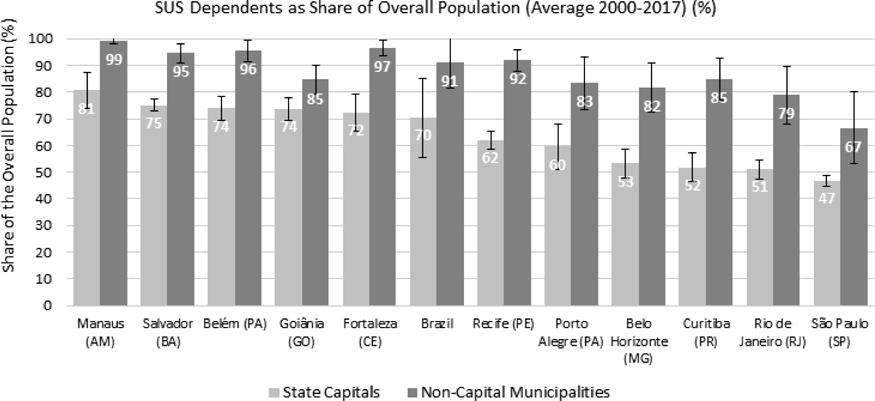
State capitals generally exhibit a smaller share of SUS-dependents than noncapital municipalities. For the 11 capitals in our sample (figure 1), the mean SUS-dependency is 63.7 percent (sd 12.5) and 92 percent for noncapitals (sd 10.3) (t = 38.8, p = 0). Differences within the sample remained, even though SUS-dependency steadily decreased between 2000 and 2014, before rising again to 61 percent for capitals and 91.5 percent for noncapitals in 2017. This means that even while SUS-dependency is generally lower now than in the past, noncapital municipalities have, on average, an additional third of the population with the public sector as their main healthcare provider.
SUS-Dependents as Share of Overall Population, 18-Year Averages (2000–2017) for 11 Capital Cities vs. Other Municipalities in Their States
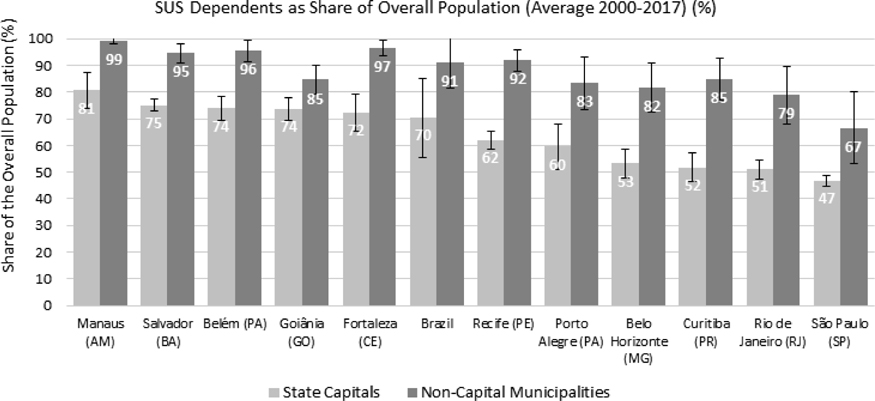
These trends have a series of important implications for the provision of public health services. For one, it would be reasonable to expect that municipalities other than the capital should struggle to provide similar service levels, given scant financial and human resources, smaller economies of scale in service delivery, and a higher proportion of the population that relies solely on public healthcare services. Furthermore, the number of SUS-dependents has recently increased at a higher rate in noncapitals. Based on the target population trends alone, we would expect that capital cities should have an easier time providing services to SUS-dependents than their increasingly burdened counterparts.Footnote 8
Service Delivery: PSSD
This expectation does not pan out. The average noncapital municipality in our sample offered 9.4 primary care services per SUS-dependent (PSSD) in 2017 (sd 4.8), a significant improvement over the 2000 average of 7.3 (sd 3.6). Service provision peaked in noncapital municipalities in 2015 at 10.9 PSSD per year, a 49 percent increase over 2000. By 2017, severe economic and political crises dampened federal transfers and took their toll on public health: noncapital municipalities offered 8.9 PSSD, 18 percent less than two years earlier. Nevertheless, average provision was still markedly above 2000 numbers: 63 percent of municipalities offered more services by the end of the period, and there were overall increases in all states but Pernambuco. The gap between the highest- and lowest-performing states closed somewhat, from roughly a factor of 3 in 2000 to 2 in 2017. However, the standard deviation among noncapital municipalities increased from 3.6 in 2000 to 5.2 in 2017, indicating that the expansion in primary care occurred unevenly across municipalities.
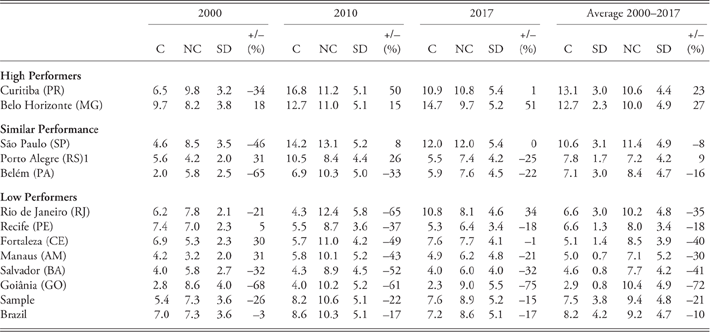
Capitals also expanded primary care provision from 5.4 PSSD in 2000 to 7.6 in 2017 on average, a 41 percent increase (table 1). The range between capital cities is considerable: the highest average PSSD (Curitiba, 13.1) provides 4.5 times the amount of services per capita than the lowest (Goiânia, 2.9). Service provision also peaked for capital cities in 2015 at 8.9 PSSD, followed by a 15 percent decrease by 2017. Though the decline was smaller in capital cities than in noncapitals, three cities provided fewer PSSD in 2017 than 2000: Porto Alegre (1 percent decline), Goiânia (–19 percent), and Recife (–28 percent). The gap between highest and lowest performer in 2017 was virtually unchanged from 2000.
Ratio of Primary Services to SUS-Dependents (PSSD) in Large Capitals and States, 2000–2017

C = Capital city, NC = Noncapital municipalities, SD = Standard deviation
Source: Authors’ calculation based on SIA/SUS 2018; ANS 2018; and IBGE 2018.
It is important to note the absolute cross-state differences in provision. High-performing states and capitals tend to continue as such: Minas Gerais and Paraná rank high for both capitals and noncapitals throughout the period for which we have data. Noncapital municipalities in São Paulo and Goiás look strong in comparison to other states throughout the period as well. With one exception, Rio Grande do Sul, less-affluent states in the Northeast and North regions tend to provide fewer services than their Southeast and South counterparts in more recent years, despite no geographic pattern in 2000.
Comparing relative levels of primary service provision in table 1 reveals that most capitals provide considerably fewer primary services than the average municipality in their state.Footnote 9 In 2000, 6 of 11 capitals underperformed municipalities in their states, and 3 did so by more than 50 percent. These 6 capital cities all ranked in the bottom 25th percentile of their states, and 3 placed in the bottom 10th percentile (São Paulo, Belém, Goiânia). By 2015—the last year of broad service expansion—5 capitals ranked in the bottom quartile of their states. By 2017, there were 7 laggard capitals trailing their state averages by an average of 28 percent.
An interesting relationship appears when we look at period averages: High-performing capital cities are in high-performing states, as Curitiba and Belo Horizonte. These two cities rank high in their states throughout the period (69th percentile for Curitiba, 72nd for Belo Horizonte). As we move to the lower-performing capitals, we see that the states’ average provision of services becomes increasingly detached from the capital’s performance. If anything, the lower the average provision of capital cities, the higher the relative gap between the capitals and the remainder of municipalities in their states.
In sum, save for a few exceptions, Brazil’s 11 largest capital cities underperform the stock of municipalities in their states in primary care delivery. This underprovision has much to do with the overwhelming burden of scale that each capital faces in serving hundreds of thousands, if not millions, of SUS-dependents—even if the comparative prosperity of capitals compared to municipalities in their states reflects smaller proportions of SUS-dependents to their respective populations. The gap in service provision between capitals and their states peaked in 2011 at 25 percent, before closing to 15 percent in 2017, largely due to the contraction in service provision following economic crisis.
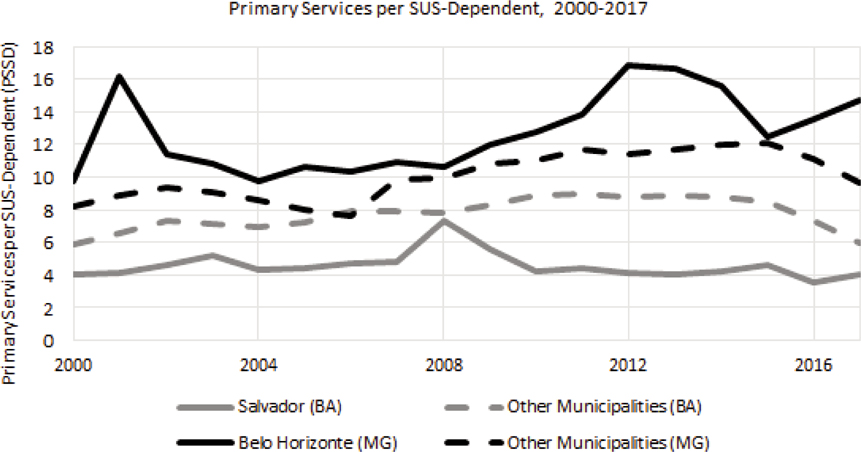
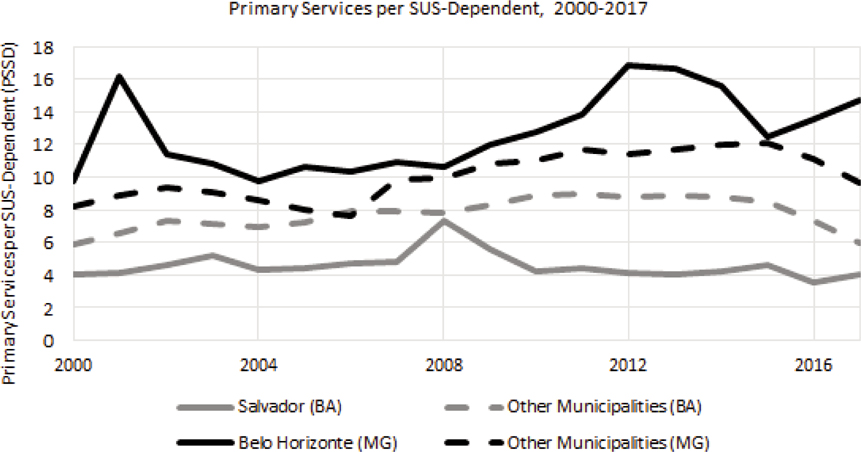
Understanding why this occurs requires more in-depth analysis than summary statistics allow. Therefore, we selected two cases in order to probe potential drivers of primary service provision: Belo Horizonte and Salvador. Figure 2 illustrates important differences in the evolution of service provision between the two cases. Belo Horizonte, capital of the state of Minas Gerais, is one of a few capitals in which service provision is relatively high, and expanded over the period under investigation. Belo Horizonte and Minas Gerais provide some of the highest rates of PSSD in our sample, and the gap between capital city and surrounding municipalities is small. In contrast, Salvador, capital of the state of Bahia, is a low-performing capital in a relatively low-performing state. Salvador’s performance lags significantly behind other municipalities in Bahia, though the gap has closed as noncapitals have struggled in recent years. Examining these cases will allow us to explore the potential causes for capital under- and overperformance. But we first set up the discussion by reviewing existing potential explanations.
Ratio of Primary Services per SUS-Dependent (PSSD), 2000–2017, Capital Cities vs. Municipalities in Their States
Explaining Differences in Social Policy Performance
Recent scholarship (Touchton et al. Reference Touchton, Sugiyama and Wampler2017) suggests that democracy can drive human development, including advances in health status, by potentially improving three main conduits: social policies, citizen participation, and local state capacity. However, democracy’s potential to expand social policies is mediated and conditioned through a series of institutional, socioeconomic, and political contexts.
Although we seek to understand the expansion of primary care delivery, other policies were important drivers of primary care expansion, accounting for some of the gap between capital cities and noncapital municipalities. Bertholini et al. (Reference Bertholini, Pereira and Renno2018), for example, show how even porkbarrel legislative amendments have a positive short-term effect on infant mortality. With regard to social policies, scholarship has highlighted the role of Brazil’s conditional cash transfer program, Bolsa Família, in public health improvements by incentivizing health service demand and the development of local managerial capacities (Rasella et al. Reference Rasella, Aquino, Santos, Paes-Sousa and Barreto2013, Reference Rasella, Harhay, Pamponet, Aquino and Barreto2014; Touchton et al. Reference Touchton, Sugiyama and Wampler2017), but these studies also identified that Bolsa Família’s impact on health status is contingent on an effective system of primary care delivery.Footnote 10
The adoption and rapid expansion of the community-based Family Health Strategy (Estratégia Saúde da Família) expanded primary care supply during this period. Family Health directly expands primary care service provision because team members regularly visit their target populations in their homes and, when necessary, refer them to clinics for follow-up procedures. A combination of federal financial incentives and the low-cost–high-return nature of the investment led to the rapid proliferation of Family Health coverage across Brazil, from 4 percent of the population in 1998 to over 60 percent of the population in 2014, with over 95 percent of municipalities enrolled (Mendes and Marques Reference Mendes and Marques2014).
Scholarship has since shown that expansion of Family Health has had beneficial impacts, such as a decline in ambulatory care–sensitive hospitalizations and child mortality (Macinko et al. Reference Macinko, Oliveira, Turci, Guanais, Bonolo and Lima-Costa2011; Rasella et al. Reference Rasella, Harhay, Pamponet, Aquino and Barreto2014; Guanais Reference Guanais2015; Touchton et al. Reference Touchton, Sugiyama and Wampler2017). However, early targeting of smaller and rural municipalities with lower health status indicators (Mendes and Marques Reference Mendes and Marques2014) and difficulties in implementation linked to policy legacies and entrenched bureaucratic and private interests in larger cities (Giovanella et al. Reference Giovanella2010) mean that large urban municipalities, on average, have far lower Family Health coverage (24 percent average) than their smaller counterparts (62 percent) (MS/DAB 2018).
Even in the presence of federal incentives, the adoption of equity-enhancing social policies varies significantly across local contexts. An important literature links the local ability and willingness to embrace expansive social policies to governance institutions. In fact, Brazil’s current democratic experience is unique in its development of a dense web consisting of a variety of models of participatory institutions (Avritzer Reference Avritzer2009; Wampler Reference Wampler2015). These institutions are a venue through which the poor and civil society groups potentially build social capacities and coax local governments into providing social services. In healthcare, much attention has been called to local-level health councils, which empower local stakeholders—half of whom must hail from civil society—to be the formal, if not always the enacted, authority to ratify proposed annual healthcare budgets, review reports on prior years’ health spending, and co-author multiyear strategic plans for the sector (e.g. Coelho Reference Coelho2006).
But the SUS also includes other important participatory mechanisms that receive less attention outside of public health scholar-practitioners in Brazil. This applies especially to the joint management commissions (Comissões Intergestores Bipartites, CIBs), through which state and local public health managers negotiate (and sometimes cooperatively plan) health policies and resource allocation (see, e.g., Viana and Lima Reference Viana and de Lima2011). While CIBs have parchment authority over which services and locations can access federal funding, their robustness varies depending on the willingness of state-level health agencies to share responsibilities and on how local political competition seeps in through appointed health managers (Alves Reference Alves2015).
The effectiveness of these institutions reflects and mediates the strength and ability of civil society groups and social movements to shape health policy. In Brazil, the expansion of public health is inextricably tied to the Sanitary Movement (Movimento Sanitário) (Arretche Reference Arretche2004; Paim Reference Paim2008; McGuire Reference McGuire2010). Sanitaristas successfully advocated progressive national health reform proposals through a combination of popular mobilization, lobbying, and holding high-level positions in the federal bureaucracy (Falleti Reference Falleti2010). Recent work has also highlighted the importance of sanitarista infiltration at the local level (Gibson Reference Gibson2017). So the likelihood of adopting primary care policies should be higher the more sanitaristas are appointed to decisionmaking cabinet positions. Yet the ubiquity of sanitarista networks in the public health bureaucracies of major Brazilian cities limits the ability to emphasize their presence alone. At times, sanitaristas have also dampened their impact by feuding among themselves and with other social sectors, while in others, their ideas (e.g., Family Health) have been adopted much more widely than their presence in power.
The political science literature has also examined a series of political and electoral conditions that favor social policy expansion. One strand highlights leftist partisanship and its affinity for programmatic and equity-enhancing policies (Pribble Reference Pribble2013; Sugiyama Reference Sugiyama2012; Touchton and Wampler Reference Touchton and Wampler2014). While persuasive in a comparative perspective, leftist rule loses some of its explanatory power when applied to the Brazilian health sector.Footnote 11 Thirteen years of leftist rule at the national level failed to move healthcare reform off the proverbial back burner (Machado et al. Reference Machado, de Lima and Baptista2017, S152), yielding only incremental advances. Recent studies have also highlighted how, once in power, subnational leftist incumbents normalized their behavior in terms of governing strategies and policy priorities (e.g., Johannessen Reference Johannessen2016). The significant variation in public health expansion despite leftist rule suggests that other factors condition the impact of the left on public healthcare.
Some scholars of federal democracies downplay the actual party in power, highlighting partisan alignment across tiers of government as a condition of service expansion (Brollo and Nannicini Reference Brollo and Nannicini2012; Niedzwiecki Reference Niedzwiecki2015; González Reference González2016; Moscovich and Brusco Reference Moscovich and Brusco2018). Executives at higher levels of government strategically target copartisans, as well as coalition partners, in order to garner legislative support and affect elections. In these instances, service provision could potentially result from a greater channeling of resources by allies across levels. Meanwhile, subnational governments run by opposition parties are more likely to resist implementing a policy if it is easily attributable to the national incumbent (Niedzwiecki Reference Niedzwiecki2015).
While the alignment argument has merit, it falls short in at least one important aspect: it does not always consider that intraparty and intracoalition relationships also involve competition and, at times, domination. Governors are sometimes so powerful regionally that they polarize politics in ways that transcend and negate partisanship.Footnote 12 Incumbents at upper levels might also channel resources through programmatic or discretionary means in order to sidestep subnational allies who are also potential challengers (Dickovick and Eaton Reference Dickovick and Eaton2013; González Reference González2016; Moscovich and Brusco Reference Moscovich and Brusco2018). Likewise, alignment says little about governing styles and strategies pursued by specific politicians or parties. Collaborative or adversarial strategies of such matches therefore constitute a promising, if largely unexplored, hypothesis of social and primary public health service delivery.
In sum, it appears that the expansion of progressive social policies such as primary healthcare is facilitated by the existence of other social policies and formal institutions that empower civil society groups and social movements. Policy preferences and participatory institutions are, in turn, conditioned by the political environment: left parties in power, boosted by copartisans or allies in the state or federal government. However, we propose that in the case of state capitals, these effects are mediated through the relationship between state and municipal governments.
State capitals are unique spaces because they are concurrently the center of nested local and regional power. Institutional and policy choices therefore depend on the relationship between elites and bureaucrats. Both executives have administrative bureaucracies in the capital and, in the case of healthcare, installed capacity as well. This creates opportunities for increased interaction, as well as potential conflict in everyday administration and especially in securing funding for services.
Furthermore, governors and mayors are political agents with distinct, though overlapping, constituencies and potentially rival power projects. When the relationship is cooperative, the state-level office can aid and shepherd health provision in the capital in meaningful ways. Strategically, it can yield a state-level focus on higher-complexity services, thus freeing up municipal resources for primary care. It can also foster a favorable attitude in healthcare institutions that authorize, empower, and mentor municipal governments to take ownership over healthcare responsibilities, and it can provide additional sources of financing. Cooperative relations are more likely to occur when there is capacity at both state and municipal levels (especially through movement of bureaucrats across levels of government), but especially where the political relationship between state and municipal elites is not oppositional.
Adversarial relations hinder the capital government’s ability to provide healthcare in significant ways. Where a significant imbalance in bureaucratic capacity exists, state-level officials might prevent the municipalization of capacity and resources, competing with local governments for service delivery while keeping municipal governments under tutelage. Politically, state officials might also exclude the capital from decisionmaking or from accessing health resources and even punish the capital’s population by channeling resources disproportionately to the rest of the state. Politically adversarial relations seek to displace the opposition from local office, and could potentially substitute for cooperation once copartisans take over local government. But where the source of power is concentrated in state elites, it often transitions into a relationship of domination, in which local governments take a back seat to their allies in the state government. The case studies examine how these relationships may subsidize or hinder primary care expansion.
Belo Horizonte: How a Capital Charges Ahead
Since redemocratization, Minas Gerais’s capital city, Belo Horizonte, has been one of the most effective primary health service providers in urban Brazil. The city’s PSSD was highest among capitals in 2000 (9.7) and 2017 (14.7). It also ranked high among all municipalities in the state of Minas Gerais in 2017 (82nd percentile) and on average (72nd percentile, 2000–2017), even though Minas’s municipalities have high PSSD.
Family Health played an important role in primary care expansion across Minas Gerais, but its impact on Belo Horizonte’s provision is inconclusive. The capital aggressively promoted the program from its adoption, in 2002, when it enrolled 58 percent of the population, to 83 percent coverage in 2017. Its average population coverage is highest among large capitals (74 percent, versus a sample average of 32 percent) (MS/DAB 2018). Municipalities across Minas also embraced Family Health, increasing coverage from about 10 percent of the state’s population in 2000 to 75 percent in 2017 (47 percent period average). Yet although Belo Horizonte pursued the program with a unique emphasis among large capitals, Family Health cannot explain the city’s high-level service provision on its own. As table 1 shows, the capital’s high PSSD predates the introduction of Family Health, and higher coverage did not lead to an immediate or consistent spike in service production. As we will see, adopting the program might have been, instead, a way to reallocate primary service delivery for greater cost-effectiveness.
Left rule has played a role in Belo Horizonte’s commitment to Family Health and primary care more broadly. The PT and the center-left PSB alternated governing the city between 1994 and 2016. Despite electoral commitments to make public health a priority, both parties oversaw periods of expansion and stagnation during these 24 years. The PT administered an eightfold expansion in PSSD under the Patrus Ananias administration (1993–96), but later a 7 percent decrease with Fernando Pimentel (2002–8)—even as Family Health expanded. The PSB governed over periods of inertia (Célio de Castro administration, 1997–2001) and a 28 percent increase, in Marcio Lacerda’s tenure (2009–17), suggesting the importance of other contextual and intra-administration factors.
The expansion of primary services across Minas’s municipalities also questions the isolated importance of left rule. There is no discernible difference in PSSD between municipalities ruled by the left and all other parties between 2000 and 2017 (9.98 PSSD for left administrations versus 10.02; t = –0.38, p = 0.69), even as the number of municipalities governed by the left increased from 9 percent in 2000 to 23 percent at its peak in 2013. Primary service provision in municipalities also benefited from significant financial incentives from the state government under the center-right.
Another potential contextual factor that might have affected the left’s ability to expand primary care services, political alignment across levels of government, is also inconclusive in the case of Belo Horizonte. The early expansion in provision during the 1990s occurred when the PT was in opposition to the center-right Brazilian Social Democracy Party (PSDB), which occupied the national presidency (Fernando Henrique Cardoso) and governorship of Minas Gerais (Eduardo Azeredo). In fact, the city government was in opposition to the governor of Minas Gerais between 1994 and 2015. Pimentel’s tenure as mayor did benefit from six years of national-local party overlap with the Lula presidency (2003–8). This might help explain the qualitative reallocation of primary health resources toward Family Health, but it did not translate into a higher level of service provision. Expansion under the Lacerda administration probably points to the importance of political alliances more than to partisanship, as the mayor’s election resulted from an atypical informal coalition between the country’s two main rivals, the PT (strong locally in the capital) and the PSDB (strong at the state level).
In this political context, public health specialists (sanitaristas) had an almost unparalleled long run heading the municipal health office in Belo Horizonte (ten years between 2000 and 2018). The capital’s first PSSD push occurred during the Ananias administration (1993–96), when the mayor entrusted the health bureaucracy to prominent sanitaristas led by Dr. Lidia Tonón. Strapped for resources, Tonón sought the transfer of preexisting health capacity in the city that had been owned and operated by the state and federal governments (Tonón Reference Tonón2010). Her team then reallocated health professionals from hospitals and clinics in the relatively affluent city center to facilities in the peripheral regions with lower socioeconomic indicators and higher health risks. There, they were reassigned to deliver pre- and neonatal services, which contributed to a 41 percent reduction in infant mortality between 1993 and 1998, outpacing reductions across the state (–18 percent) and Brazil (–25 percent) during the same period (DATASUS 2013).
Mayor Pimentel also tapped a prominent sanitarista with PT ties, Helvécio Magalhães, to lead public health during his tenure. Without new sources of funding for the first few years, Magalhães focused on shifting the method of provision to Family Health, targeting the deployment of personnel using disaggregated health status information on a scale unparalleled in urban Brazil. Facing favorable conditions in Pimentel’s later years, Magalhães oversaw the hiring of three thousand new public health personnel, a 19 percent expansion (SMS-BH 2001, 2010; Magalhães Reference Magalhães2010). But the Lacerda administration shows that primary service expansion also occurs without a sanitarista at the helm. As part of the power-sharing negotiation that delivered Lacerda broad support, Magalhães was moved to another cabinet position and the health office was run by Marcelo Gouvêa Teixeira, a public administrator with ties to the state government and the center-right. Primary service expansion then followed a pragmatic strategy of sidestepping personnel caps by hiring new health workers through public-private partnerships—a policy that directly contradicted the interests of healthcare unions and left positions. State-level promotion of primary care also occurred whether sanitaristas were in the top position or merely advisory roles.
Perhaps top-appointed sanitaristas were no longer a necessary condition because they succeeded in institutionalizing a commitment to primary care in Minas. Evidence is accumulating that participatory institutions in Belo Horizonte—an early mover in this regard—have made a positive impact in guiding public sector investments and public health interventions (Avritzer Reference Avritzer2009; Wampler Reference Wampler2015). However, a review of Municipal Health Council minutes, participant observation, and field interviews conducted by the authors indicates that while councilors have consistently approved municipal health budgets and spending reports during this period, they have been less successful in influencing the content of proposed budgets or demanding the inclusion of medium-term goals in health planning (CMS-BH 2009–10).
Most telling is the fact that despite many misgivings, councilors have never exercised their power to veto the budget and stop the flow of funds to the city, due to concerns that such stoppages would harm SUS users and workers (CMS-BH 2009–10). Furthermore, while participation has steered portions of the capital budget toward public health, it has not significantly expanded the health operational budget. Ultimately, participants in these institutions lack the power to authorize hiring and funding for additional health workers, which leaves key dimensions of public health expenditure in the purview of elected officials and their appointees.
At the same time, Minas Gerais has some of the most technically robust, cooperative, and participatory intergovernmental health governance institutions in Brazil (Viana and Lima Reference Viana and de Lima2011). Municipal and state managers and bureaucrats have a highly developed ongoing negotiation platform in the state’s joint management commission (CIB), with extensive information sharing and collective bargaining, which has generated a virtuous cycle of development of management capacity. The CIB has driven the consensus policy in Minas that the state government would not compete with municipalities in primary care delivery, freeing up state resources to cofinance municipal efforts (Alves Reference Alves2015). This funding, distributed by consensus through the CIB, coaxed municipal spending away from expensive medium- and high-complexity service investments. Sanitarista managers have also used these meetings to educate and recruit other municipal managers into their ranks to push jointly for greater resources. This partly helps to explain the improvements in primary service provision not only in Belo Horizonte, but also in Minas Gerais’s stock of municipalities more widely.
Examined jointly, it becomes clear that Belo Horizonte’s local actors promoted primary care in institutionalized settings but that they were also enabled by a long and generally harmonious history of cooperation between municipal and state-level officials. The initial jump in PSSD was made possible by the municipal takeover of preexisting physical and human health capacity that had been built and managed by the state-level health office. This matched the state office’s agenda of aggressively shedding primary care capacity (and personnel) to municipalities, due to programmatic but also pragmatic cost-saving purposes. The state health office also supported the capital whenever it sought greater independence, including signing off on certifications that led to a large transfer of primary care facilities and resources from the state to the municipality (Malachias Reference Malachias2010). This level of cooperation is virtually unparalleled in other Brazilian state-capital relations, and is due to an established legacy of collaboration, partly a product of embedded sanitarista consensus in the ranks but also the broader political environment in which politics was not dominated by any political group powerful enough to attempt to exclude others at the local level (Alves Reference Alves2015).
Our case study of Belo Horizonte’s expansion of primary care may appear overdetermined, but in fact it highlights the numerous conditions that, when aligned, expand public health in Brazil. The city has a long history of ideologically committed public health specialists controlling the public health sector. This control has been granted by parties on the left, which governed the capital for almost the entire period of our sample. These governments also embraced organized civil society and were willing to negotiate with other relevant stakeholders in sturdy participatory institutions.
But it is important to highlight both the variation in the expansion of primary care and the methods through which it took place. Sometimes the left expanded primary services; sometimes it was happy to maintain the status quo while it focused on other policy priorities. When sanitaristas were effective, they were empowered by politicians across the political spectrum and enabled by cooperative relations between state and municipal actors, despite lack of party alignment. Conditioned by broader political and institutional channels, Belo Horizonte’s public health professionals have been able to build cooperative bridges between local and state governments that allowed for the dissemination of the sanitarista project of universal and primary public health in a way that ultimately allowed the city to charge ahead of the rest of the state in primary care.
Salvador: How a Capital Falls Behind
In contrast, Salvador has had one of the most underwhelming responses to the SUS public health mandate among major Brazilian cities. Its average primary service provision (4.6 PSSD, sd 0.8) was the second lowest in our sample, improving only 1 percent between 2000 and 2017. While Salvador has a high proportion of SUS-dependents among large capitals, the ratio of services to this population remained low despite a four-point decrease in SUS-dependents between 2000 and 2017. The capital’s record also compares poorly to other municipalities in Bahia (7.7 PSSD, sd 4.2). Salvador ranked in the bottom 21 percent of Bahia’s municipalities between 2000 and 2017 and in the bottom third in 2017, even as noncapitals experienced a 30 percent retrenchment since 2015.
Salvador’s rejection of Family Health is one of the reasons for its paltry primary care record. Its average coverage of 15 percent—almost half the average of large capitals—is also the lowest. While it has caught up recently, its 2017 coverage of 30 percent is still second to last. Bahia’s other municipalities were also initially slow to adopt Family Health but have embraced the program since 2006, expanding coverage from 32 percent to 71 percent of the population in 2017. Family Health coverage is positively correlated with a moderate increase in PSSD for Bahia’s noncapital municipalities (.7), but has not led to any noticeable service expansion in the capital.
An apparent “perfect storm” of conditions has led to substandard public health provision in Salvador. The city has elected mayors mostly from the centrist Brazilian Democratic Movement Party (PMDB) (four terms) and the right (Party of the Liberal Front, PFL, three terms).Footnote 13 In particular, the eight years under Antonio Imbassahy (PFL, 1997–2004) saw ideological as well as partisan resistance to the SUS’s expansive mandate, as the mayor’s party solidified itself as the main defender of neoliberalism in Brazil (Power n.d.). During this period, Salvador refused federal incentives to expand programs, such as the Community Health Agents or Family Health, and embraced a broader strategy of rationalization and cost control, outsourcing primary care to private nonprofits. The center-right’s dominance over Bahia’s politics included the state government and stretched across noncapital municipalities, where parties in the PFL alliance governed 74 percent of municipalities between 1997 and 2008. As the number of municipalities governed by the left has increased since 2009, primary services have also moderately expanded.Footnote 14
The more relevant political constraint in Salvador is that the city consistently opts for mayors in opposition to the state governor (six out of nine terms since redemocratization). Between 1982 and 2006, this meant opposing the state machine of Antônio Carlos Magalhães (ACM), who led a broad alliance of pragmatic local elites that held the state executive throughout the period (save for one term in the mid1980s) while controlling dominant shares of Bahia’s mayors and legislators (Dantas Neto Reference Dantas Neto2006; Alves and Hunter Reference Alves and Hunter2017). The Carlista repertoire included political centralization, highly discretionary and targeted distribution of pork, and low prioritization of social spending (Souza Reference Souza1997; Dantas Neto Reference Dantas Neto2006). This meant that regardless of partisanship, opposition to the state government was punished with financial and bureaucratic restrictions in access to state and federal support. As an example, the state health bureaucracy repeatedly delayed and denied the Da Mata administration’s attempts to take over healthcare facilities in the city, despite favorable technical decisions from state health bureaucrats and consensus in participatory institutions (CES-BA 2008–10; CIB-BA 2008–9). This kept the share of federal funds for Salvador’s population under state-level management, stunting the city government’s ability to deliver healthcare to its citizens.
While we would expect left-leaning sanitaristas to be cut off from the bureaucracy in this environment, this was not entirely the case. One component of ACM’s approach was that although social services received low priority and were ultimately kept as sources of discretionary favors, he still prized technocratic excellence in the central bureaucracy. He openly hired technocrats from the left and gave them good working conditions, to the point that a group was established in the public sector calling itself the Carlist left (esquerda carlista) (Souza Reference Souza1997). But technocrat sanitaristas were seldom given decisionmaking authority to override political calculations. The appointed positions heading state and municipal offices were reserved for political agents or bureaucrats with private or nonprofit health management experience. The few opportunities when sanitaristas led Salvador’s health office were cut short by the alliance’s political needs.
Because of these strategies, institutions that formalize citizen participation and oversight and standardize managerial decisions have generally been underdeveloped in Salvador and Bahia. Legally mandated participatory institutions, such as municipal and state health councils, have a history of weakness and co-optation (Reiter Reference Reiter2008; Avritzer Reference Avritzer2009). Other explanations have also emphasized that this is due partly to the low levels of civil society mobilization in the capital (Avritzer Reference Avritzer2009; Baiocchi and Corrado Reference Baiocchi and Corrado2010). But the development of these institutions was also actively resisted during PFL rule—partly due to their political association with the left, but also because they would serve to limit discretion in the health and social service sectors. SUS intergovernmental institutions (the CIB, municipal and state health councils, and their ancillary subcommittees) are also relatively weak and underdeveloped, due to political meddling, selective recruitment of allied municipal representatives, and lack of resources (Guimarães Reference Guimarães2003; Coelho and Paim Reference Coelho and Paim2005; Viana and Lima Reference Viana and de Lima2011). This greatly limited the ability of sanitaristas in the health bureaucracy to demand the expansion of primary care and other equitable health policies in Salvador and in the state more broadly.
These adverse conditions, however, are intermediary products of underlying political causes, specifically a relationship of either isolation or domination of the municipal government by the state. During the six terms in which state-level incumbents were defeated in Salvador, the state government proceeded to isolate the city government from the everyday management of the health network and cut it off from state support. But in the two instances when political conditions aligned so that municipal, state, and federal incumbents were either copartisans or part of the same coalition—1987–90 under the PMDB and 1997–2004 under the PFL—resulting policies and actions led to a type of public health expansion that strengthened the state government’s presence and capacity in the capital, to the detriment of municipal autonomy.
In the 1980s, alignment under the PMDB led to the prominence of state-level sanitaristas, who seized the decentralization of healthcare capacity from the federal social security network (INAMPS) for the state government. These decentralized resources expanded the state’s existing hospital network by 25 percent and, by paying higher salaries, attracted top medical personnel (Paim Reference Paim1989). Sanitaristas in Bahia’s health office saw no counterparts at the municipal level and therefore seized health capacity in order to ensure some advancement for public health. Unlike Belo Horizonte, where the municipality secured this network from the state, Salvador’s health office did not challenge its allies in the state office in meaningful ways.
The alignment under the PFL in the late 1990s—the height of ACM’s hegemony in Bahia—also did not benefit Salvador’s SUS-dependents. Mayor Imbassahy, a Carlista technocrat-turned-politician, lacked an independent constituency or political power. He therefore did not pursue social policies that would conflict with the main Carlista preferences (Dantas Neto Reference Dantas Neto2006). Salvador’s health policy during this period was effectively to defer for direction to the state-level office, which continued to control most service capacity in the city. Furthermore, municipal health managers withdrew the previous administrations’ applications to municipalize healthcare responsibilities (Imbassahy Reference Imbassahy2009). The municipal health office contracted out health services to private providers through clientelistic and corrupt practices, including sidestepping public bid legislation in the selection of nonprofits, which led to the indictment of Imbassahy’s health manager for corruption (A Tarde 2005a, b).
As the PT took power in Bahia in 2006, sanitaristas connected to the left attempted to jumpstart many of the policies and institutions that had been stunted. This led to a pragmatic approach to expanding the Family Health model, circumventing personnel restrictions through the creation of a parastatal public foundation that could hire personnel at market rates and contract out services to municipal governments (Andrade Reference Andrade2009). This led to a rapid expansion of Family Health and a moderate increase in PSSD across municipalities outside the capital.
Though the sanitaristas nominally attempted greater institutionalization and a more programmatic relationship with the capital, in practice, the relationship of domination or isolation remained. After a brief period of cooperation (2007–8), the PT’s heterogeneous coalition in Bahia fractured ahead of the 2010 gubernatorial elections. Salvador’s mayor abandoned the governor’s coalition and returned to the opposition. The relationship between health officials in Bahia’s and Salvador’s governments became increasingly combative in the aftermath. The capital’s health manager openly chafed against state-level micromanagement in CIB meetings, and the state office returned to its default approach to governing its health network in the capital, disdaining municipal wishes. This further delayed the municipal office’s efforts to catch up to the rest of the state’s municipalities that aligned with the PT government (CIB-BA 2008–9).
Salvador’s public health record is therefore troubling. The city generally undersupplies its population, compared to municipalities across the state that are poorer, have lower state and health service capacity, and bear a larger population burden of SUS-dependents. Salvador fell behind nevertheless because it lacks sufficient independence to make health decisions. Some of this dependence stems from political competition. However, it is also the result of a historical legacy in which the scant supply of public hospital beds and clinics in its territory is disproportionately in the hands of the private sector and the state government, which owns a greater proportion of clinics, and even primary health centers, compared to the rest of the state.Footnote 15
The case of Salvador therefore suggests that partisan and allied status might not always funnel resources as assumed. Instead, it can also be used to dominate and subsidize the main political project of the group in power. In the case of Bahia, that meant the state level to the detriment of the local service. Patients in Salvador, by virtue of location, have easier access than those in other municipalities to higher-complexity services, in that they are less likely to be turned away at the door in a state-run emergency room. But for the majority of their interactions with the public health sector—those in primary care—they are left to their own luck, punished not only when they oppose but also when they reward state-level incumbents.
Conclusions
This article has used a nested strategy to determine that large capital cities underperform other municipalities in their states when it comes to delivering primary health services in Brazil—despite a relatively lighter load of citizens who depend on the public system for care—and then has examined the experiences in two capitals to explore why this situation might be. Building on existing explanations for social service expansion, this article has argued that in the case of Brazil’s large capital cities, the impact of programmatic policy networks tied to the public health (sanitarista) movement, left rule, and institutionalized channels for citizen participation and intergovernmental management are conditioned by the relationship between the two overlapping levels of executive power that reside in them.
State governments can cooperatively facilitate municipal development of primary care services by ceding them managerial independence, transferring capacity, and generating financial incentives while focusing on higher-complexity service provision. But they can also be adversarial and dominant, hoarding capacity, resources, and legal responsibility, cutting out municipal actors from the management of their own health systems while prioritizing other municipalities at the expense of the capital. Cooperative or adversarial relations, in turn, depend on partisan alignment and governing strategies, but also on the legacies of the long-term relationship between state and local bureaucracies, which either increase the capacity of local governments or leave them feeble compared to their state-level counterparts.
While our research strategy allows us to develop rather than test these claims, the finding that the majority of capitals underperform their states suggests that the conditions in most state capitals more closely resemble those of Salvador rather than Belo Horizonte, and that capital city residents pay a “capital tax” in the form of fewer primary care services.
These insights are relevant beyond the primary health sector to the broader study of factors that condition the expansion of social policies and potentially close the gap in access to social services. Despite the greater need for such policies in large federal systems with significant inequalities, their realization is complicated by overlapping mandates, shortages of capacity, and difficulty in clearly claiming ownership of policy success. These conditions are common throughout Latin America and the Global South. Equity-enhancing policies may be more likely to be adopted across uneven settings by building institutions that “bias” the outcome—including citizen participation and oversight and facilitating cooperation across levels of government by normalizing interaction and increasing transparency to citizens and public officials at other levels.Footnote 16 But as the case of Salvador suggests, it might be hazardous to expect governance institutions to promote such ends in highly combative subnational settings.
Supporting Information
Additional supporting materials may be found with the online version of this article at the publisher’s website: Online Appendix.