In February 2020, the British Society for the History of Science hosted its first entirely digital conference via Twitter, with the dual goals of improving outreach and engagement with international historians of science, and exploring methods of reducing the carbon footprint of academic activities. In this article we discuss how we planned and organized this conference, and provide a summary of our experience of the conference itself. We also describe in greater detail the motivations behind its organization, and explore the good and bad dimensions of this relatively new kind of conferencing. As the climate crisis becomes more acute and, in turn, the pressure to reduce the carbon footprint of academic activities increases, we argue that digital conferences of this style will necessarily become more central to how academia operates. By sharing our own experiences of running such a conference, we seek to contribute to a rapidly growing body of knowledge on the subject that might be drawn on to improve our practices going forward. We also share some of our own ideas about how best to approach digital conference organization which helped us to make the most of this particular event.
Over the past year, the British Society for the History of Science (BSHS) has made multiple forays into the facilitation of academic research sharing through digital media. The most recent of these was the highly successful Global Digital History of Science Festival that took place in July 2020. This online festival replaced the society's annual conference, which could not be held in person due to the COVID-19 outbreak. However, the society's efforts to move at least some of its conference activities online considerably pre-date the pandemic. As a society, we have been eager both to engage more with the international HSTM community, and to respond effectively to the climate emergency: making more use of digital spaces seemed to be one way to address these. As a result, our first attempt at an online conference took place on Twitter, on 12 February 2020. This BSHS Twitter conference was our first attempt at re-creating – or, in reality, experimenting with – an academic conference on a digital platform.
While Twitter has often been used as a communications ‘backchannel’ at standard in-person conferences, the BSHS decided instead to use the social media platform as the primary conference medium. Connected through the hashtag #BSHSGlobalHist, the speakers presented their papers in the novel format of six to twelve 280-character ‘tweets’, the unique format for this social media platform. All of the papers have since been archived on the BSHS website and a ‘how-to’ guide to hosting a Twitter conference has already been published as a result of this conference in the BSHS magazine Viewpoint.Footnote 1 However, this piece aims to be a more reflective analysis of why the BSHS carried out the digital conference, why Twitter was selected as the platform, how the day went and lessons learnt through the process. It will also begin to consider the question posed by Pat Lockley and Natalie Lafferty of ‘how does Twitter function when it is not a backchannel but the only channel?’Footnote 2 In doing so we will demonstrate that, although alternative formats such as these will not entirely replace in-person conferencing, they do provide a valuable and creative alternative to engaging with the academic community on an international scale – particularly in the wake of growing concerns surrounding air travel.
Why digital conferencing?
This particular conference was devised in response to three questions the BSHS council posed to itself.
• In response to the climate emergency, could more of our work – especially conferences, which carry a particularly heavy carbon footprint – be done digitally?
• In line with the society's mission to promote understanding of the history of science, technology and medicine in a wide range of contexts, could public, digital platforms be a viable way to share research and build relationships?
• In response to the uncertainties precipitated by the UK's decision to leave the European Union, how can we strengthen our ties to the international history-of-science community?
#BSHSGlobalHist was a pilot project operating at the intersection of these three problems. The goals of the Twitter conference were therefore threefold: to explore a low-carbon conferencing alternative, to make history-of-science research accessible in a public forum, and to promote a strong international spirit.
Tackling the climate emergency
In 2019, the UK and hundreds of other governments around the world symbolically acknowledged the severity and urgency of the ongoing climate crisis by declaring ‘climate emergencies’.Footnote 3 The year 2019 was the second-hottest year on record, and also concluded the five hottest years on record, which were themselves the latter half of the ten hottest years on record.Footnote 4 The climate crisis is happening now, and it can no longer be ignored by any organization, sector or industry. We must therefore do our utmost to publicly acknowledge this crisis in all our actions, and to do whatever we can to mitigate our carbon footprints as much as possible. Academia can and must be a part of this change. The BSHS has adopted a climate policy that recognizes the seriousness of this challenge and sets ambitious goals for ourselves as an organization.Footnote 5
We do not believe it is necessary to recount the arguments and evidence for a massive and urgent reduction in global greenhouse gas emissions here; to do so would imply that there could still be any doubt about this fact. The climate emergency has compelled us all to consider how we can, through our own actions, work to reduce carbon emissions. As a result, academic conferences, in particular international conferences, have come under increasing scrutiny with regard to their carbon footprints. For these events air travel is, by some margin, the most significant associated source of carbon emissions. Calculations by UC Santa Barbara estimate that fully one-third of the entire university's carbon emissions were accounted for by flights taken by faculty and staff to attend conferences, talks and meetings.Footnote 6 The total CO2 released by this activity was equivalent to that of a city of 27,500 people in the Philippines. One climate scientist, Peter Kalmus, calculated that flying, primarily to conferences and meetings, accounted for more than two-thirds of his total annual carbon emissions. ‘Hour for hour’, he observed, ‘there's no better way to warm the planet than to fly a plane’.Footnote 7 In response to his findings he was able to drastically reduce his carbon footprint by stopping flying wherever possible.
A growing awareness of the significant environmental impact of air travel and in turn the need to minimize it wherever possible has posed a new question for those seeking to organize academic conferences: is the physical co-presence of attendees worth the potentially significant collective carbon footprint such attendance will generate? This calculation is not a simple one. Sam Desiere, in analysing the carbon footprint of the fourteenth European Association of Agricultural Economists (EAAE) conference in Ljubljana in 2014, found that just 10 per cent of the conference's 646 participants accounted for nearly 50 per cent of total travel-related emissions.Footnote 8 These were participants travelling from substantially further away – in the most extreme case from Australia, a flight of some 16,000 kilometres. To minimize the carbon footprint of academic conferences Desiere proposes a number of potential steps, including encouraging the use of public transport and restricting the number of long-distance attendees. Clearly, then, the most important step we can take to reduce the carbon emissions associated with academic conferences is to reduce their associated air miles. The need for change is thus most acute for international conferences, which, by virtue of their greater associated air miles, typically have far greater carbon footprints than national conferences.Footnote 9
Air miles do not, of course, represent the whole picture when considering carbon emissions. Every aspect of any kind of academic conference has an associated carbon footprint, and these should not be ignored. We might consider, for example, the relative power consumption of overhead projectors typically used during physical conference presentations and that of the electronic devices used to engage with virtual conferences. Catering is another area where associated carbon emissions might be easily reduced, primarily by reducing the associated meat consumption – something the BSHS has already taken action on by introducing vegetarian catering as standard. However, these other potential sources of carbon emissions appear negligible when compared to the emissions produced by even the shortest of flights. Reducing air travel wherever possible is, therefore, by far the most significant way academic organizations can work to reduce their associated carbon footprint. To this end, academic conference organizers must engage in a very serious assessment of the value of the physical co-presence of attendees where that co-presence would be at the cost of any amount of air travel.
Physical co-presence is evidently not something to which a value can be straightforwardly attached. For conferences held in locations easily accessible by public transport, and where attendees are drawn from within reasonable non-flying travel distance, the value of physical co-presence may be weighed more favourably against the carbon footprint of a conference. Where associated air miles are higher, however, this equation becomes harder to balance: to say that physical co-presence is worth the carbon emissions associated with a domestic train journey is one thing, but to suggest it is worth the emissions produced by a multi-thousand-kilometre round trip by aeroplane is another entirely.
To this problem of the increasingly unjustifiable carbon footprints of physical academic conferences, virtual conferences of various forms present themselves as the obvious solution. Using digital technologies to host and organize conferences, while by no means totally carbon-neutral, is substantially better than even the smallest and most localized of physical conferences at which a large number of digital devices would likely be used anyway. Certainly nothing can replace face-to-face interaction, a fact our collective experience of social isolation during the coronavirus pandemic has made us perhaps more acutely aware of than ever before, but we believe that digital conferencing has great potential that deserves further exploration.
Thinking about digital conferencing
While we consider the primary benefit of digital conferencing to be negatively defined (i.e. by the carbon emissions they do not incur compared to physical conferences), we believe that digital conferencing should not be viewed in purely negative terms (i.e. by what they are not, which is to say physical conferences). While we may feel regret at the loss of those elements of physical conferences which digital conferencing cannot replicate, we must come to terms with the fact that the carbon emissions associated with physical conferences are, in a time of acute climate crisis, no longer ethically justifiable. To head off this negative framing which would threaten to sap the morale of any attempts at organization, we instead argue that digital conferencing should be framed positively, in terms of the exciting opportunities and new kinds of interaction it opens up, and embraced as a chance to explore and experiment. This optimism should, however, also be accompanied by a reasoned assessment of the risks and potential problems associated with this new way of doing things.
An exploration of the opportunities and risks of digital conferencing must first begin with an assessment of the particularities of digital conferencing itself, its history, and the particular tools available for it. Here we can make comparisons to physical conferences to understand the similarities and differences between the two formats. This, in turn, will allow us to assess the opportunities and risks that digital conferencing represents.
Online forums are complex and often contradictory spaces. They can offer safe spaces where like-minded people can form communities and share their experiences in a secure environment. At the same time, they can open people up to unprecedented levels of vitriolic abuse and aggression. Here the particularities of a platform must be considered. Whilst we did not encounter any issues with Twitter ‘trolls’ (a colloquial term for individuals who intentionally start quarrels on social media) during the BSHS Twitter conference, we were nonetheless aware that this could have been a problem. As an open platform, any organized activity on Twitter entails the possibility of unwanted attention from unpleasant individuals or groups of individuals seeking to disrupt and offend. Twitter has proven itself to be slow and often unwilling to deal with abusive users on its platform, and offers a limited number of ways (besides blocking, muting and reporting) for users to deal with harassment. The systematic harassment of women on Twitter and the company's failure to properly address it even drew condemnation from Amnesty International in 2018, with the organization accusing the platform of ‘failing to respect women's rights online’.Footnote 10 The openness of Twitter is at once its greatest strength and biggest downside when considering hosting an academic conference on it: any interested user on the platform could join in and engage productively with the conference; just as easily as a random troll could stumble upon it and attempt to disrupt it with offensive and abusive posts. Needless to say, the larger and higher-profile the conference itself the more these both good and bad dimensions of Twitter's openness are likely to come into play.
We would acknowledge here that physical conferences are not themselves without problems, either. The extent of sexual harassment at academic conferences has only recently begun to be acknowledged and discussed openly, for example, as have both explicit and implicit forms of racism and other prejudice.Footnote 11 Digital conferencing does promise to provide the means to mitigate, prevent and circumvent some of these issues, but should not be treated as a panacea either. These problems can and will re-create themselves in a new format, and can only properly be addressed by cultural shifts within academic organizations and academia as a whole. To take one example, digital conferences overcome the problem that travelling to physical conferences can be prohibitively expensive for many prospective attendees. While digital conferences solve this problem by being available to anyone with a digital device and Internet connectivity, they also create new issues – accessibility becomes instead dependent on the quality and reliability of the digital devices and Internet connections available to attendees. Similarly, in terms of accessibility, while digital conferences may be far easier to attend for those with, for instance, mobility difficulties, the format can create new problems for others. A text-based conference, for example, will be harder to interact with for those with impaired vision.
One area where digital conferencing does provide undeniable benefits is in international reach. The global reach of most digital platforms means that conferences hosted on them can involve a far more diverse and international group of attendees. This in turn means that the content of presentations and subjects of discussion becomes more diverse and international, a key goal for contemporary conference programmes. As discussed above, however, new problems also arise when involving a diversity of international attendees. While digital conferencing removes many barriers to attendance, it can create new temporal barriers and general complications for organizers. As attendees can be spread across multiple time zones, the window in which these overlap at reasonable times of the day becomes smaller and smaller the further away attendees are from the conference organizers. Likewise, including a more geographically diverse array of attendees means language must be taken into greater consideration. The countries in which attendees are situated can also have significant implications for the digital platform being used: many platforms are subject to censorship and state restrictions in various countries, and this situation can change quite rapidly. This is something which should be closely considered when choosing how to host a digital conference.
The Twittersphere
The use of Twitter for hosting the #BSHSGlobalHist conference was hardly a novel application of the platform. Much scholarly commentary has already noted the use of this social media outlet as a so-called ‘conference backchannel’.Footnote 12 Twitter has predominantly been described as a microblogging service – that is, a variant on blogging that enables brief updates of up to 280 characters per post (referred to as a ‘tweet’).Footnote 13 This microblogging format, as Aqdas Malik, Cassandra Heyman-Schrum and Aditya Johri state in their reflection on the educational uses of Twitter, facilitates a combination of information sharing and self-expression.Footnote 14 Through hashtags (a mechanism that enables tweets to be classified together through a keyword preceded by the # symbol), mentions/tagging (referencing another user and linking them to the message through their username, which always starts with the @ symbol), and replies (a function that enables another user to respond to a tweet), Twitter can further be employed to form a dialog and network.Footnote 15
In the context of standard academic conferencing, these functions provide a secondary means to connect, network and start a dialog with other conference delegates also using the platform. The additional benefit of the online medium is that it enables outside participation in discussions and engagement beyond conference attendees. Whilst not all delegates may be engaging with the platform, it has become the norm for conferences to have a Twitter hashtag to facilitate discussions, knowledge sharing and networking external to – but also in relation to – the conference. Though the hashtag may be engaged with by the conference organizers, the impetus for this form of engagement is largely left to the attendees’ discretion and the discussions are generally unmoderated. Hence the Twittersphere forms a backchannel in which networking and discussions can take place amongst individuals both internal and external to the conference.
The use of Twitter as the primary mode of conferencing, rather than simply a backchannel, provides a complicated – an in many ways an unique – set of benefits and challenges. There is much literature that explores the negative dimensions to academic twitter use. Malik, Heyman-Schrum and Johri, for example, summarized some of these as inappropriate usage, reputational risk, issues associated with content, and personal privacy.Footnote 16 Being an open and public platform, unless an account is private (where an individual's tweets can only be viewed by their followers and cannot be shared by another user), anybody can view and engage with tweets. Thus there is an element of risk both to an academic's reputation and to personal privacy depending on what is shared on the social media platform. Furthermore, not everyone who views the tweets necessarily engages with the messages. It is possible on Twitter for individuals to ‘lurk’; that is, to view tweets without replying, liking or retweeting (which reposts the tweet in its entirety on the individual's own timeline).Footnote 17 Consequently, it is impossible for the tweet's author to be fully aware of who is viewing their posts since users only provide an identifiable presence upon active engagement. The content of the tweets themselves can also provide issues if, for example, images used are under copyright, or the short character limit results in the message being misconstrued or possibly misrepresented if retweeted or in comments – and, as noted, the problem of potential trolling is ever-present.
The complications of academic Twitter use are further compounded by what Rosie Jones and Emily Shields refer to as ‘overlapping social contexts’.Footnote 18 Scholarly use of Twitter varies between formal and informal applications, with use of the medium being employed in both professional and personal capacities. In fact, in their review of the literature surrounding conference backchannels, Royce Kimmons and George Veletsianos state that large-scale surveys indicate that the most prevalent mode of Twitter use was a combination of both.Footnote 19 Whilst this in and of itself is not detrimental to the use of Twitter for conferencing, it is an important facet of the medium's use that must be taken into account. Clearly, the potenial presence of family and friends might affect how those participating would engage on a purely digital platform.
So, while a Twitter conference may be beneficial in relation to strengthening international ties and reducing air travel, it presents its own set of issues that must be considered and – where possible – mitigated. That said, we still believe that Twitter does provide the opportunity to network and share research in an alternative format to the standard conference.
How did it work?
Embracing the novelty of using Twitter to host a conference, we decided to extend the tweet format to the abstract-submission process as well as the day itself. Instead of the standard abstract, submissions were in the form of a tweet with a maximum length of 280 characters and an optional accompanying image. Whilst the short abstract length made it more difficult to assess the submissions, it provided two useful benchmarks. First, it provided those applying with an opportunity to try and condense their research for this new format ahead of the conference itself. Second, it gave a means to determine how successful they were in this endeavour.
The format of the papers themselves then consisted of six to twelve tweets, each numbered and containing the conference hashtag #BSHSGlobalHist, that were connected as ‘threads’ (replying to oneself on Twitter creates a ‘thread’ or series of linked tweets that can be read together by the viewer). Speakers were allowed to use any Twitter-compatible visual elements alongside their body tweets – such as GIFs, photographs and videos – providing they were accessible to those who are colour-blind or visually impaired. Any tweet using visual elements, therefore, utilized image descriptions (for which twitter allows a maximum of 420 characters), audio transcripts and well-contrasted colours for images conveying information through colour.
On a practical level the conference programme was determined not by thematic content, but rather the time zone of each speaker. This was a conference that in essence could be attended from home, and its digital nature meant that speakers fit the conference around their daily work, family and social commitments rather than taking time out specifically for the event. Unlike a normal conference, in which speakers would travel and for the most part be committing to attend the entire conference period, participants could ‘opt in and out’ around their own commitments. Consideration for timings took into account not only geographic location but teaching commitments, childcare and other factors. Formulating a programme that took this into account, therefore, required substantial dialogue between the organizational committee and the speakers in order to find a suitable programme that worked for all those involved.
Due to the scale of the conference, we deemed it easier to tweet the papers from the official BSHS account (@BSHSNews) rather than requesting that speakers tweet their own papers at set times and the BSHS retweeting. Consequently, the papers were collated prior to the conference to enable them to be tweeted live on the day. There are sites available that enable the scheduling of individual tweets beforehand, including Tweetdeck and Hootsuite. However, there is no free service that allows the scheduling of ‘threads’ of tweets. Therefore we tweeted the papers for the BSHS Twitter conference live on the day.
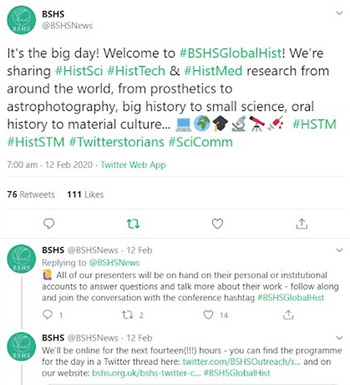
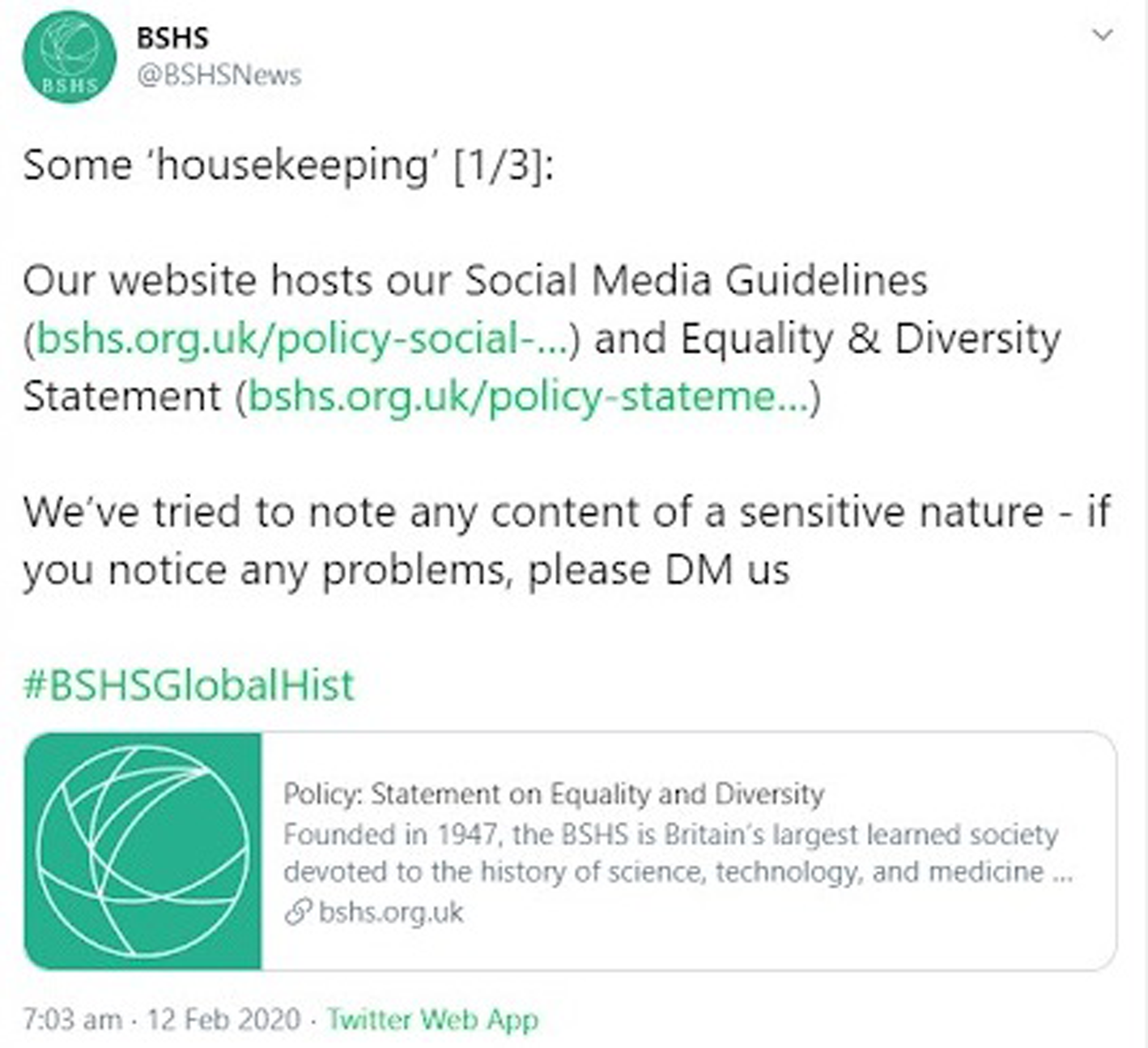
The day itself began with ‘housekeeping’ tweets from the official BSHS Twitter account, which linked to relevant policies and information – in particular the social media guidelines and the equality and diversity statement of the BSHS (Figures 1 and 2). From then on, each paper was tweeted at fifteen-minute intervals, with the intervening time being for questions. However, the benefit of using twitter meant that questions were not limited to the window allocated for them. Speakers were linked to their papers through mentions, and as a result were able to see the questions and comments relating to their tweets on their personal accounts. This meant that, as Harriet Palfreyman commented in one tweet, there was ‘more time to digest fascinating work like this than traditional (rushed) conference Q & As’.Footnote 20 Consequently, once a paper had been tweeted, questions could continue to be asked throughout the rest of the day and possibly even after the conference had ended.
Opening tweet from the BSHS account launching the BSHS Twitter conference.

‘Housekeeping’ tweet from the BSHS account sharing links to appropriate guidelines for those participating in the conference.

The conference ran for fourteen hours continuously and the organizing committee worked in shifts during the conference itself. We were split into two teams, the first being responsible for the live tweeting of speakers’ papers and the second acting as moderators. Since any Twitter user could engage with conference content, it was important to keep an eye on the discussions and report any ‘trolling’ (aggressive behaviour) in order to keep the conference an open and friendly space. Participants could follow the conference either from the BSHS Twitter account directly or via the conference hashtag, asking questions through the ‘reply’ function of Twitter. Since the speakers were tagged into their corresponding threads, notifications of these replies would be received by both the committee and the speakers. The benefit of the notifications meant that any questions not asked in the fifteen-minute window provided following the tweeting of the papers could still be answered at a later time.
How did it go?
The #BSHSGlobalHist conference was far from the first attempt to provide a purely digital conference. Utilizing the thread function of Twitter had previously been exploited for a novel and engaging research-sharing format. In January 2018, for instance, the Underpinnings Museum held a successful conference through Twitter.Footnote 21 The BSHS conference, however, aimed to build on these smaller conferences with a larger, international-scale version that engaged with multiple time zones and scholars from around the world.
In this goal, the society's first ever digital conference did have contributions from around the world. From the call for abstracts, submissions were received from twelve different countries. Unsurprisingly given the UK base of the BSHS, the UK accounted for just under half of all those who presented at the conference. However, submissions were aso received from a range of countries, including – but not limited to – the USA, Australia, Qatar, Turkey, Estonia, the Netherlands and Portugal.
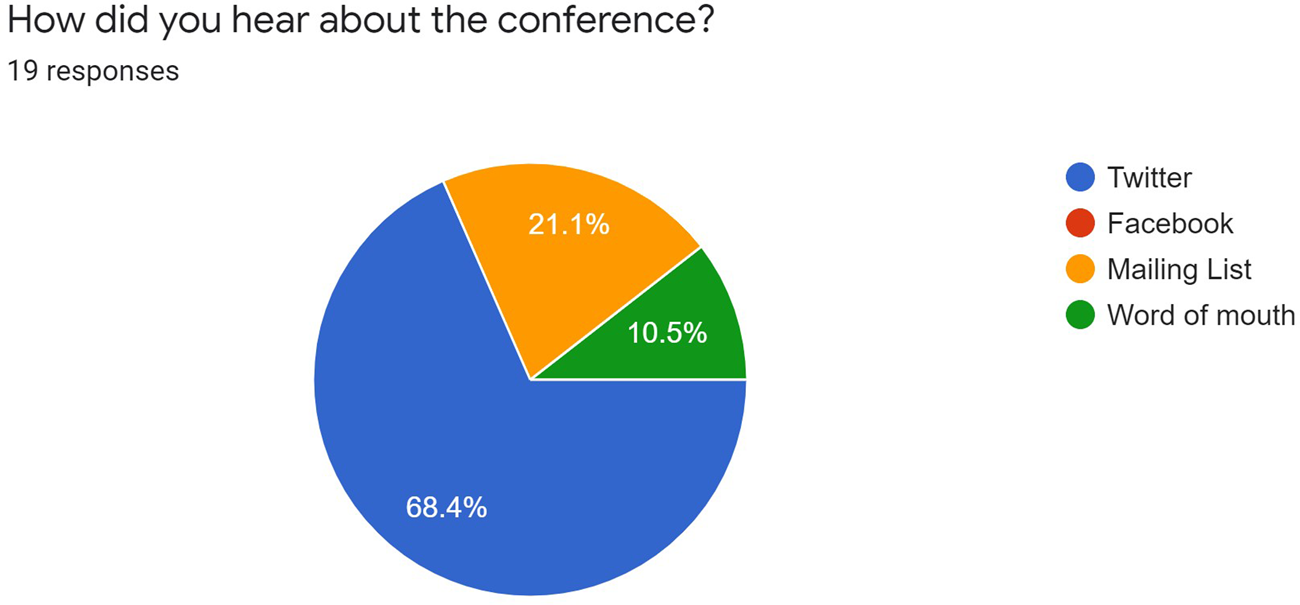
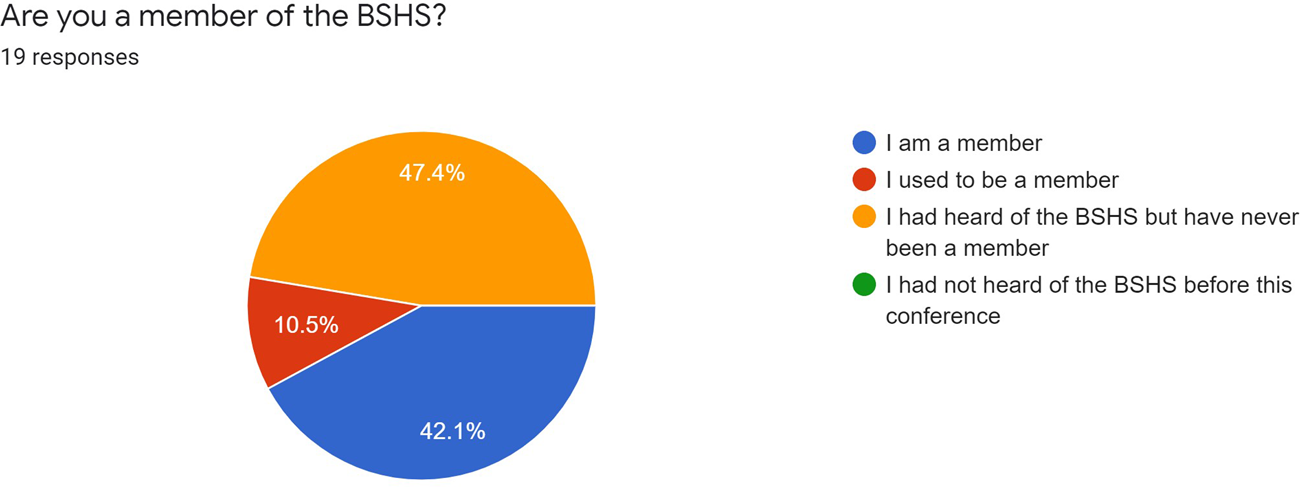
The conference was advertised using the same vehicles used to promote standard BSHS conferences in the past: mailing lists to members of the society; the BSHS website; specialist mailing lists in the history of science, medicine and technology; and social media platforms, such as Twitter and Facebook. In an attempt to reach a more international demographic, the society's ambassadors (PGR representatives in universities around the world) and international advisers were also asked to promote the event to their respective institutions. In the feedback from speakers – of which nineteen responded out of the thirty-three who participated – 68.4 per cent discovered the call for abstracts on the very platform on which the conference itself would take place (Figure 3). Additionally, by promoting the event through the same channels as a standard conference, the speakers were still all at least aware of the society, if not a member or former member (Figure 4). Some 36.8 per cent of respondents had previously presented at a BSHS conference, and a further 21.1 per cent had attended a conference organized by the society before. When asked why they decided to take part in the conference, the majority of respondents echoed sentiments similar to the initial motivation behind this new approach: the novelty, the apparently low carbon footprint and the international nature of Twitter.
Feedback from BSHS Twitter conference speakers regarding how they heard about the conference initially.

Response from the feedback questionnaire to speakers about whether they were a member of the BSHS. Some 42.1 per cent of respondents were members of the BSHS, 10.5 per cent were former members and 47.4 per cent had heard of the society but had never been a member.

Although the call for abstracts asked what languages the speakers wished to tweet their papers in, the call itself was only in English and the reach in an international sphere was likely hindered by not sharing more through international channels. Despite this, the BSHS Twitter conference was still the first that the authors are aware of to attempt such a conference on an international scale and still had contributions from eight time zones (ranging from GMT–8 to GMT+11). In order to factor in these timings, the conference itself ran continuously for fourteen hours from 07:00 GMT.
The day itself garnered much engagement on Twitter. According to the platform's own metrics, the reach (or ‘impressions’ as referred to by Twitter) on the day of the conference from the BSHS accounts tweeting the event was over 309,000. There were also a total of 601 retweets, 4,000 likes and 700 replies. These figures only relate to engagement with tweets from the BSHS and exclude those from other accounts using the conference hashtag to participate in the conference but not replying to the BSHS tweets directly.
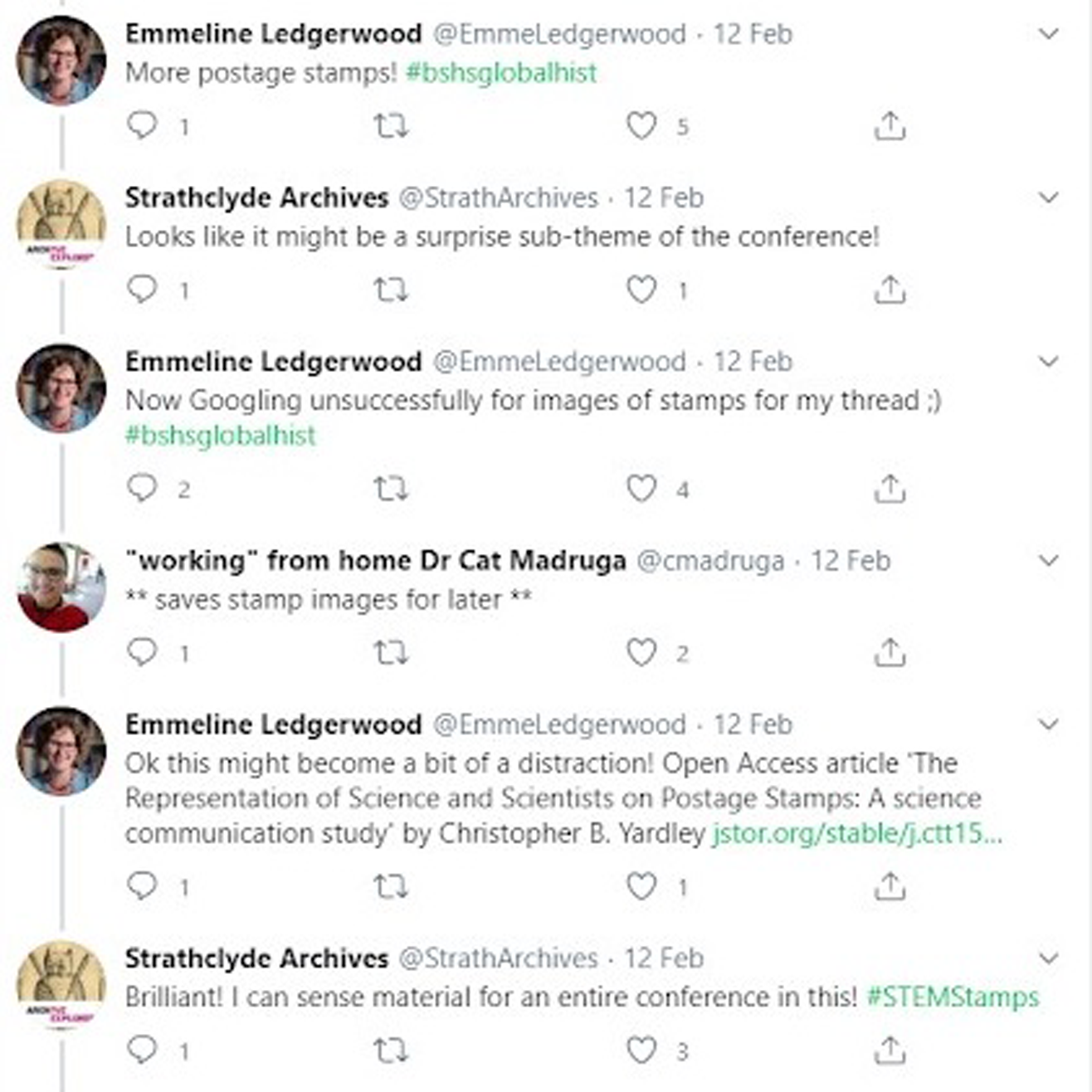
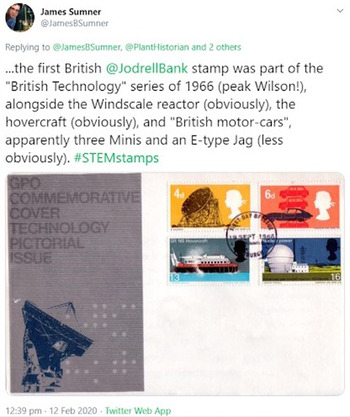
When Twitter becomes the official channel rather than a backchannel, this does not prevent a second backchannel developing on the same platform. Unlike standard conferencing where the conference has a hashtag for unofficial backchannelling, the Twitter conference only had the primary hashtag. However, discussions through the reply function and unofficial hashtags developed organically alongside the main questions-and-answers functionality. One of the unexpected conference-adjacent discussions that arose was on the topic of science-, technology-, engineering- and medicine-themed postage stamps (under the hashtag #STEMstamps) (Figures 5 and 6).
Example of one of the conference-adjacent discussions that took place.

Example of one of the science, technology, engineering and medicine stamps (or #STEMstamps) shared in the discussions of the conference.

Lessons learnt
The utilization of Twitter as the main mode of conferencing, rather than simply a backchannel, presented a number of unexpected challenges and considerations. Four main lessons can be learnt from this experience.
Most importantly, the BSHS Twitter account was suddenly ‘shadow banned’ by Twitter itself around 14:00 GMT on the day of the conference. This probably happened because an unexpectedly large number of tweets suddenly coming at regular intervals from the same account triggered Twitter's spam filters. But since Twitter does not inform the user when it does this, this meant that while everything appeared to be working from the perspective of those of us using the @BSHSNews account, no other user could see the threads that had been tweeted.Footnote 22 Once we realized what had happened, we were able to tweet the remainder of the conference from the BSHS Outreach and Engagement Committee account (@BSHSOutreach), and the threads did become accessible once the ban was reversed – again automatically – the following day. However, this was a serious inconvenience that impacted the engagement with the papers on the day (particularly those tweeted around the instigation of the ban). Unfortunately, avoiding this problem for any future similar conferences will be challenging unless Twitter itself provides clearer guidance on what triggers a ‘shadow ban’ – though having multiple accounts available for similarly large-scale events will mitigate it to some extent. A second option to avoid a shadow ban would be to have speakers tweet from their personal accounts and retweet on the official conference Twitter account.
This brings us to the second major lesson we learnt. Deciding whether it is more ideal for a particular conference to tweet from a single account or retweet personal accounts is a decision that must be taken early in the process. Speakers tweeting the papers from their personal accounts does reduce the amount of work for organizers and gives researchers greater control. From the perspective of the organizers, however, it makes it harder to troubleshoot any technical issues with uploading tweets. On the other hand, tweeting from a single organizational account enables greater control and oversight for organizers. It may also provide more of a level playing field for early-career researchers: all tweets initially appear from the same official account with the same primary audience and little explicit indication of career stage, specialism or experience. Tweeting from an official account would therefore democratize the papers to some extent and enable greater reach for those tweeting from personal accounts with small numbers of followers. But using a single account imposes a major burden on the organizers, who must do all the live tweeting (as well as raising the issue of shadow banning). One way to alleviate this burden would be to create a standard form on which participants could submit their tweets ahead of the conference. We made the mistake of asking simply that tweets should be numbered and contain the conference hashtag. We did not consider that there are multiple different ways of numbering tweets, and as a result spent considerable time editing submissions to ensure consistent numbering and format.
Our third lesson also relates to the administrative burden borne by the organizers. We decided that the papers for our conference should be tweeted continuously throughout the single-day conference, thereby maximizing the number of ‘speakers’ we could include in a time frame already extended to accommodate multiple time zones. However, in hindsight, it would have been better to include breaks, as is standard in physical-presence conferences. We had assumed that our audiences would ‘dip’ in and out around their own commitments and that they would fit breaks in to suit themselves. A shift rota was used for the organizers, so that individuals could take breaks while maintaining live tweets and technical support from the committee as a whole. However, the reality of participant engagement exceeded our expectations as many people stayed active for the duration. Consequently, it is advisable for future conferences of this style to include breaks for those wishing to remain online for the full conference.
Finally, our intent was to adopt a global perspective – hence our efforts to encompass multiple time zones and to offer the option of tweeting in languages other than English. However, no one took up this latter option. More work is therefore needed to provide a firm foundation for international online conferencing. To increase accessibility and reach wider audiences in future, a starting point would be to share the call for abstracts in multiple languages as well as promotion through more international channels.
Reflections on #BSHSGlobalHist
In comparison to a traditional conference, the BSHS Twitter conference was of a much smaller scope. Given the way in which tweets are posted, parallel sessions are not practical as it would make it confusing to follow. Consequently, the amount of content that can be included is less for the same span of time. Additionally, a big part of standard conferences is the networking opportunities it provides. Whilst tweeting and discussing in replies could be construed as a form of networking, it is far more limited than what can be attained through face-to-face socializing.
That said, the use of an online platform meant that our papers were much more open to the incorporation of digital elements (oral-history interviews, for example) than a standard conference could support. It also opened up new ways to communicate, allowing participants to provide direct links to resources as part of discussions rather than simply referring to them. One speaker even had their paper tweeted whilst they were teaching a seminar so their students could engage with the conference, which would otherwise not be possible with in-person formats. The period for asking questions or having discussions was also not as time-limited, as people could go back and reread things or dedicate more time to digesting the information before asking questions as the period of engagement extended beyond the paper's allocated conference slot.
Additionally, the use of Twitter meant that a different kind of etiquette was needed, in comparison to in-person events. While communicating using social media platforms like Twitter has its drawbacks, it also enabled and encouraged a more informal style of interaction, even between individuals who had not met before. The lack of face-to-face interaction created a sphere in which it is the acceptable norm to communicate directly through replies and including Twitter handles with relative strangers in a casual manner. For instance, GIFs, memes and emojis were used frequently throughout the conference between participants.
Employing digital media further allowed the BSHS to interact with individuals who would not normally attend the annual conference. Some 52.6 per cent of speakers who replied to our follow-up questionnaire had never taken part in any of the society's activities prior to the event (including applying for funding or publishing in the BJHS or Viewpoint). Thus by employing an online platform for events, the society expanded their remit of engagement with audiences who would not have otherwise participated in a BSHS conference.
Nevertheless, when deciding to organize a conference on an online platform rather than in person, we were forced to reflect on some fundamental questions: what is a traditional conference? Why do we do them? What do we get out of them? What opportunities do they afford? What inequalities and harms might they reinforce? In embracing online platforms as a medium for conferencing and other forms of academic interaction, it has become increasingly important to consider questions of these sorts. Only by doing so can we determine whether and how digital platforms like Twitter can be utilized to serve the academic community.
In terms of reducing carbon footprint, the conference was undeniably tremendously successful. Compared to a physical conference, the carbon emissions associated with the #BSHSGlobalHist conference were negligible. The small scale of associated carbon emissions is all the more impressive when the diversity of attendees is considered. The open, online nature of the conference meant that we could accept attendees from all over the world, from Australia to Qatar to Canada. The fact that the conference was free to attend reduced barriers to involvement tremendously, though national restrictions on access to Twitter did limit the pool of possible attendees (perhaps most significantly possible attendees from China). At the same time, our acceptance of global attendees still had an imperceptible impact on the carbon emissions associated with the conference – contrast this with the tremendous carbon footprint made by an in-person conference that included attendees from all over the world.
In terms of the kinds and quality of interaction the conference itself involved, we believe that they could be considered neither superior nor inferior to a physical conference. They were simply different. We would consider video conferencing to be more directly comparable with physical conferences, while Twitter conferencing is so different in its structure and the interactions it involves that comparison is a pointless endeavour. In our experience, we found many aspects of how Twitter shaped interactions to be very positive: the asynchronicity of communications allowed conversations to break out, flow and sprawl across vastly different time spans. We also felt that the textual nature of communications had a significant levelling effect, erasing or at least backgrounding many markers of difference that could otherwise inhibit open and conducive discussion. We found everyone to be very open and amicable, with numerous productive discussions breaking out from each presentation that were able to continue uninterrupted by any time constraints. The number of time zones across which participants were spread meant that some were unable to practically engage in real time with some presentations, but, again, the asynchronous nature of communications on Twitter meant they could pick up a conversation with a presenter just as easily the following day.
Conclusion: not a conference, but something else …
There exists a vast and still largely unexplored potential for digital conferencing. In our own experiences hosting #BSHSGlobalHist we explored only some of the ways that a conference can be organized on just one platform. We learnt a great deal, both about what works and about what does not, and encountered much that was unexpected, both good and bad. In this article, we have provided readers with some insight into our own experiences, from which they might extract useful lessons, and find inspiration. We believe that in sharing our knowledge and experiences in this way, we can work collectively to make our digital conferences better. At the same time, we do not want these lessons to become dogma: to restrict or inhibit experimentation. Just as digital conferencing should not be beholden to the traditions of physical conferences, so too should future approaches to digital conferencing not be inhibited by the experiences of the past. To this end, we would question whether it might be useful to reject the term ‘conference’ itself as overly restrictive, and instead embrace a heterogeneity of approaches with more descriptive names that signal this variance and innovation. An abandonment of any pretensions of mimicking physical conferences would, we believe, also signal to those involved that the objective is to develop new approaches, to play and innovate, and so encourage them to engage with this process. One description proposed for our event was a ‘research share’, and we feel this provides a more accurate description than ‘conference’ ever could.
While we argue for viewing digital conferences as different, rather than judging them as inferior or superior to physical conferences, we want to emphasize that there are two closely related areas where digital conferences do have very substantial advantages. The first is in their associated carbon emissions. While there is no perfect zero-carbon method of organizing conferences, the elimination of all kinds of associated travel, especially air travel, means that digital conferences have drastically reduced carbon footprints. The second is their capacity for international involvement. By removing the requirement of physical travel for attendance, the pool of potential attendees for a digital conference is effectively global. This allows digital conferences to be far more international in their make-up than physical conferences, therefore inviting a greater diversity of contributors. By reducing the cost of attendance for those with the necessary equipment and service/infrastructure to effectively nothing, digital conferences also open themselves up to people who would otherwise have been unable to personally afford or secure funding to attend.
The climate crisis has prompted us all to consider the carbon footprints associated with the various activities that are taken for granted as essential elements of how academia functions. In compelling us to reappraise these practices in light of their climate impact, it has in turn led us to ask more fundamental questions about these practices as well. The need to minimize carbon-intensive air travel in academic activity has led us to reconsider the value of physical conferences. Consequently, we have been compelled to ask questions about the practice of conferencing itself: what is its purpose? What is the real value of physical co-presence?
Afterword: COVID-19
We conceived and executed this conference before coronavirus, and thus in a very different world where we made no considerations for how a viral pandemic might impact academia and conferencing more broadly. Since then digitally mediated communications have become more important than ever before in our lives, and digital conferencing has become a daily experience for many teachers and researchers. We decided not to address COVID-19 in the body of this article as we wanted to present our thinking as it had been at the time, when none of us were even considering what turned out to be right round the corner. Nonetheless, we believe that all of our original arguments in favour of digital conferencing still stand – the need to minimize the risk of contagion is just another added reason.