In his recent discussion of the procurement and supply of army horses during the first English civil war, Gavin Robinson has drawn attention to several of the most important and overlooked aspects of parliamentarian military organization during the 1642–5 period. As he rightly points out, our understanding of change and continuity in parliament's military affairs during this period has suffered from the lack of any systematic research on the army under the direct command of the earl of Essex.Footnote 1 Even more recently, Aaron Graham's work on the subject has done much to illuminate previously unknown aspects of this army's early structure, nature, and composition.Footnote 2 He argues that Essex's army was unable to fulfil its strategic objectives in 1642 largely because it was financially dependent on a centralized system of voluntary contributions that rapidly fell apart in the face of provincial resistance. This resistance, Graham suggests, was the product of the army's centralized administrative structure and the failure to provide the provinces with ‘military representation’. Unfortunately, such a view fails to appreciate the amount of centrally managed money that was available to Essex and the parliament's forces in the autumn of 1642.
Here the financial machinery that supported the infantry regiments of Essex's army during the Edgehill campaign will be described and analysed in detail. This will be done by calculating the hypothetical cost of the foot soldiers, and then comparing this total to the amounts actually paid to them during the first three months of the army's existence. This will demonstrate that Essex and his infantry officers were able to rely comfortably on the Long Parliament's centralized bureaucracy for the pay of themselves and their men during the autumn of 1642. Specifically, it will be shown that the army's treasury, which was formally established in London on 10 August,Footnote 3 successfully provided for Essex's men because it harnessed the enormous monetary resources that were at the immediate disposal of another treasury – the one set up to manage the so-called Propositions in June.Footnote 4 The surviving financial records pertaining to the Long Parliament's war effort are numerous, fragmentary, and opaque. Consequently, much of the scholarship dealing with them has been necessarily based on information derived from fragments and samples.Footnote 5 However, using an approach pioneered by Robinson,Footnote 6 it is possible to reconstruct the relevant aspects of the army's finances during the autumn of 1642.
Any serious attempt to deal with the parliamentary war effort during the first civil war requires some degree of familiarity with the huge number of pay and supply warrants found in the many volumes of the Commonwealth Exchequer Papers.Footnote 7 All of these warrants were generated by one of two distinct issuing authorities. One set was produced by the Committee of Safety sitting in London, the rest by Essex's staff officers in the field, but all were addressed to the party from whom the requisite resources would come. These warrants were issued for a variety of reasons, and not only to pay the soldiers. Yet regardless of the reason for their issue, all followed similar bureaucratic pathways. Once written, they were given to the group or individual who was to take immediate possession of the resources in question. Once these resources were delivered, the warrants themselves were collected by the relevant treasury official as proof of receipt, bearing both the issue and receipt dates and the amount of money or material received. However, when it comes to an analysis of specific military units, such as individual infantry regiments or the companies that comprised them, the utility of these sources would ordinarily be limited by the generally unknown volume of missing warrants. Fortunately, however, there are two reliable ways of dealing with this problem.
In the first instance, many of the warrants issued to cover the salary of the infantry's constituent formations explicitly state the pay period. Therefore, if the whole of a given unit's lifetime is mapped out in these salary warrants, we can be reasonably certain that that unit's paperwork is complete. Secondly, and more crucially, certain administrative peculiarities distinguish the two groups of surviving warrants. While the vast majority of the warrants issued by the Committee of Safety were sent to William Jessop (one of Gerrard's deputies), virtually all of those composed by Essex and his staff went directly to Captain Francis Vernon, the treasury's agent in the field. Specific units tended to receive payment from just one of these sources, but it was certainly possible for an individual commander to receive money from both. Although there is apparently no way of knowing how many of the Committee's warrants were either lost or destroyed by Jessop, the total volume of warrants which passed through Vernon's hands is evidenced in his own highly detailed account book, with all warrants paid by Vernon listed by date.Footnote 8 The corresponding warrant preserved in the early volumes of SP28 can therefore be easily identified by examining the amount of money in question, the officer to whom it went, and the date of the transaction. Using this method it is possible not only to identify the total percentage of Essex's field warrants that have survived, but to make some rudimentary calculations using information from the missing warrants that were paid by Vernon.
While this approach neatly demonstrates the untapped potential of the materials found in the Commonwealth Exchequer Papers, there are limitations to the utility of this collection. Aside from listing a few of the raw totals provided by Vernon, Gerrard, and others, the origins of the cash flowing through their treasury and into the hands of the army's officers cannot be identified. Similarly, it is not possible to track the flow of money from the officers who received it to the ordinary soldiers it was often intended to pay. Nevertheless, as Graham implies, it is clear that virtually all of the money in question came immediately from the treasury previously set up to manage the horses, capital, and plate coming in on the so-called Propositions.Footnote 9 Again, it would seem that there are no complete, systematic records describing the collection of this money. Ben Coates, however, believes that most of it was probably collected in London, pointing to a very important document which outlines the total amount of money the Proposition treasury distributed during the first part of the war.Footnote 10 While quite cursory, this document does itemize all of the Proposition treasurers' expenditures. Significantly, most of their early expenditures were military in nature – with the majority of the early entries describing payments made directly to Essex's cavalry captains for ‘mounting’ or ‘advance’ money.
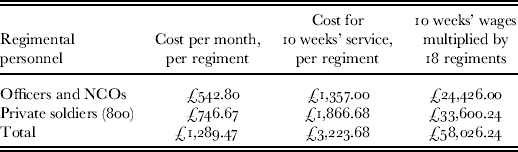
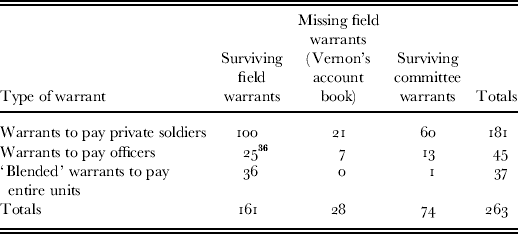
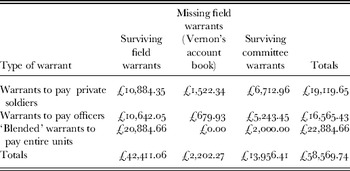
For the purpose of gauging the relative completeness of the army's surviving warrants, however, the documents issued to the army's treasurers on behalf of infantry commanders provide the best and most detailed block of sources. Again, this is because they frequently mention both the period of service to be covered by the warrant itself, and the current strength of the companies or regiments in question. In all, the Committee of Safety and the lord general issued hundreds of warrants – both surviving and lost – on behalf of the foot soldiers and/or their officers during the period in question. Graham reminds us that a great many of these documents deal with the various costs associated with levying a standing army.Footnote 11 In the end, only 263 of these warrants deal explicitly with the remuneration of combat personnel in Essex's infantry regiments before the end of October 1642.Footnote 12 Roughly 69 per cent were issued on behalf of private soldiers only; the rest were issued either to cover the pay of a unit's officers, or for the combined payment of both its officers and men.Footnote 13 The total value of these 263 ‘salary’ warrants was £58,569.74, all of which was unquestionably paid within days of the warrants' issue. Since we have unambiguous records indicating that no fewer than nineteen of Essex's slated list of twenty foot regiments came into existence as a fighting force,Footnote 14 and since it is clear that all of these except one consistently received their pay via the treasury's central apparatus,Footnote 15 some rough calculations can be made regarding the total hypothetical cost of eighteen regiments for the entire period in question. In all, fourteen of the forty-five warrants issued to the treasurers on behalf of the infantry's officers dealt with their ‘standard’ monthly payment of £542.80 per regiment.Footnote 16 Furthermore, although the declared strength of the existent units varied considerably, if it is assumed that the average strength of these regiments stood at the revised target of 800 ordinary soldiers throughout the campaign, then the monthly cost of a regiment's private soldiers was approximately £746.67.Footnote 17 Although it is difficult to argue for the absolute accuracy of specific company returns due to the possibility of systemic embezzlement, one thing seems certain: the number of soldiers mentioned on the warrants certainly reflect the ceiling of unit troop strengths. This is because it would have been impossible for an officer to profit by under-reporting the number of soldiers in his unit. Since this is the case, all that remains is to calculate the approximate start date for our hypothetical cost model and compare the resulting total to the actual spending figure presented above.
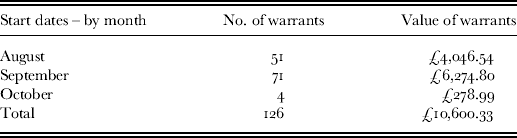
Although the first of the warrants issued to Essex's army was written on 2 August 1642,Footnote 18 it is clear that most of Essex's infantry formations did not actually come into existence until late August. There were two phases of recruitment. First, there was raised a cluster of three regiments, first paid in early August by the Proposition treasurers directly, which predated the formation of Sir Gilbert Gerrard's own treasury. At least some of these soldiers were raised as part of an expedition organized in early August to counter Lord Brooke's royalist opponents in Warwickshire. Secondly, there were those units which were first levied by their regimental colonels, but whose private soldiers often received their salary money via warrants issued to their company captains. Although some troops first paid directly by the Proposition treasurers in early August were eventually paid by the army treasury in this fashion, other units appear for the first time in such warrants. Of the 181 private-soldier pay warrants described in Appendixes A and B, only 126 clearly indicate the start date of the pay period in question.Footnote 19 Significantly, all but four of these warrants authorized the payment of a full month's pay for the soldiers involved. A systematic examination of these documents is suggestive.
Of these documents 69 per cent – some 87 warrants – dealt with pay periods beginning between 18 August and 10 September, and none have start dates that predate this. In practice, some of these 126 warrants authorized the payment of companies or groups of companies which were already on foot, but here it is the flurry of activity in late August and early September that is important. First of all, it is possible to calculate the average number of days that passed between the beginning of the month-long pay periods in question, and the full and final receipt of the soldiers' pay. When the four aberrant warrants are removed, this average equals 8.42 days. In other words, an average payment to these men was made in full three weeks before the pay period in question came to an end. Secondly, and more importantly, it should be noted that this practice of paying the men for future service had the effect of creating periods of administrative calm during which all men already on foot were paid in full, a situation that largely explains the relatively low number of infantry warrants issued by Essex in mid-September. This finding demonstrates the essential problem with Graham's interpretation of the army's financial situation in September 1642. The paucity of warrants issued that month does not mean that no money was available.Footnote 20 Nevertheless, this analysis is complicated by the fact that not all enlisted infantrymen were paid separately from their officers. As we know, they sometimes received payment via ‘blended’ warrants which authorized the payment of everybody in their unit. Therefore these and a few other pieces of apparently contradictory evidence must be considered.
Sgt Nehemiah Wharton's famous letter of 7 September describes a pay revolt in certain regiments. Although it is unclear which units Wharton was referring to, he himself served in Colonel Denzil Holles's regiment, one of the units brought into being before Gerrard's treasury was formally established.Footnote 21 As Graham argues, this document would seem to indicate that the soldiers were beginning to suffer from the state's inability to provide for them.Footnote 22 However, the pay warrants clearly indicate that every member of Holles's regiment of over 1,000 men was fully paid between the first week of August and the end of October on ‘blended’ warrants.Footnote 23 This apparent inconsistency is resolved when we examine the pay warrant issued to Vernon for the pay of the entire regiment for a half-month on 12 September.Footnote 24 Although the final portion of the money warranted by this document was received the day the warrant was issued, Sgt Maj. Quarles reported receiving £600 of this money from Vernon at Northampton one week before the warrant itself was issued. Before then, Holles's men had been part of Lord Brooke's expedition to Warwickshire, and their wages had been covered by the full month's pay they received directly from the Proposition treasurers on 4 August. After consulting SP28, it would seem that none of the units raised from the host of London volunteers at the end of July and sent to Warwickshire under Brooke received their ten-shilling bounty.Footnote 25 Consequently, the £600 received on 5 September by Quarles was initially seen by the men of Holles's regiment as the ‘5s. a man … promised them monthly by the Committee [of Safety]’ – a reference, it would seem, to their unpaid levy money, not their wages.Footnote 26 These soldiers doubtlessly knew that their newly raised comrades in other units had received a half-month's pay on top of the otherwise regularly supplied advance salary payments, and the Wharton letter might indicate that someone, at some point, promised the soldiers who had signed up toward the beginning of August their share of this money in two equal monthly payments. Holles's men were evidently outraged because they were inexplicably excluded from the more recently adopted policy of providing large amounts of additional cash to private soldiers just for signing up. Why Parliament was unwilling to provide this money in the face of the soldiers' understandable indignation is not known, but Graham is wrong to put it down to a paucity of money at the strategic level.
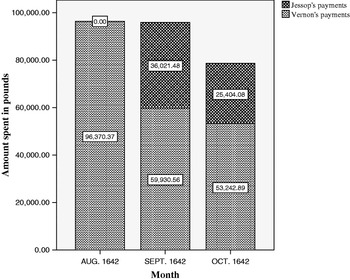
Graham also reminds us that just days after Sgt Wharton commented on his comrades' discontent at Northampton, the lord general wrote to the lord mayor of London asking for vast sums of money.Footnote 27 Graham argues that this and other pieces of incidental evidence support the idea that Essex's paymasters were having a hard time staying on top of the payroll in September. But a full examination of Vernon's own receipts, in conjunction with a general survey of all military spending during the period, shows otherwise. On the first few pages of his account, before the tabulation of outgoing warrants begins, Vernon listed the various sums of money he received during the first twenty months of the war. Throughout the month of August and during the first half of September Vernon reported receiving no less than £146,575, the vast bulk of which came from the Proposition treasurers.Footnote 28 This was 68 per cent of his receipts up to 1 November 1642.Footnote 29 It is crucial to note, however, that Vernon's own records clearly indicate a total expenditure of just £144,845 up to and including 10 September – a sum which includes all salary and non-salary spending in every branch of the army during this period.Footnote 30 Ultimately, this extraordinarily high volume of spending during the first six weeks of the war effort is understandable when we recall the huge amount of overhead involved in creating an army from nothing. Additionally, it is important to remember the infantry's multifaceted history of unit creation, and the aforementioned policy of providing some advance salary for the infantrymen at the time of their first muster. Furthermore, while the overall number of warrants issued by Essex to Vernon dropped appreciably during mid-September, Figure 1 demonstrates the essential insignificance of this point by laying out the total amount of money flowing out of Gerrard's army treasury on warrants issued by Essex and the Committee of Safety during the first three months of the war.Footnote 31 Again, it must be noted that this graph includes money spent on all parliamentary forces, not just those attached to the lord general's field army.
Amounts paid by Gerrard's deputies on centrally issued warrants.

Regardless of the many interesting questions this graph raises, the most important point here is that a positive discrepancy existed between Vernon's total income and his total expenditure during the first six weeks of the war. The sums trading hands in the field were astronomically high, but at no point during this time did Vernon lose control of the situation there, and at no point did the treasury as a whole stop making payments. There was, categorically, no ‘financial crisis’ in Essex's army before Edgehill, least of all at the time of Essex's letter to London. Consequently, the letter must therefore be understood as a sober reminder of the army's actual operational demands, rather than a reaction to some kind of failure on the part of the treasury or the Propositions that fuelled it.
In any case, since the above analysis clearly indicates that no individual company commander in the infantry reported that he actually had men under arms before the second half of August, when it comes to the hypothetical cost model it is safe to assume a salaried pay period of no more than ten weeks for the infantry before the end of October 1642.Footnote 32 When applied to the sums and figures dealing with the estimated monthly cost of Essex's footmen presented above, this assumption leads to a final hypothetical cost of £58,026.24 for the entirety of the infantry during the first phase of the army's existence; a total just beneath the amount of salary money paid to the foot soldiers and their officers by the army's own treasury during the period in question. When it comes to measuring the relative completeness of the army's financial records the preceding analysis is therefore suggestive; but because there is no way of verifying the total number of lost warrants issued by the Committee of Safety and/or paid by Jessop, it is impossible to establish certainly the total volume of documents issued to the army in this period. It is possible that the infantry received more money than this.Footnote 33
Finally, it must be reiterated that a portion of the infantry's early salary payments came directly from the Proposition treasurers. In all, three regiments in Essex's army received a portion of their pay from the Proposition treasury during the Edgehill campaign. There were three of these payments, one to each regiment, all of which were received on 4 August, and they all assumed that the units in question mustered the full complement of 1,200 soldiers at that time. Two of the colonels, Sir John Merrick and Sir Henry Cholmley, received only enough money to pay for their entire units for a half-month, while the third, Denzil Holles, got enough for an entire month. The total amount involved was a substantial £3,318 – a sum not included in Figure 1 or the calculations performed above because this money did not pass through the army's own treasury, and because as members of Brooke's Warwickshire-bound army, these men were clearly on foot and in service before the average late August start date. Additionally, as per the trend found in a sample of the army treasury's own pay warrants (outlined above) it is again interesting to note that these three Proposition treasury payments all came in advance of the pay period in question. Although there is no additional hard, financial evidence to confirm the assertion that these units mustered the full 1,200 men implied by the document in SP28/170, the fact that they appear to have done so would suggest that Essex and his subordinates were successful in mobilizing, without levy money, the throngs of London volunteers which were being reported at the time.Footnote 34 Significantly, this is a conclusion in line with the disproportionate strength of Cholmley's and Holles's regiments later in the autumn.Footnote 35 It is therefore clear that the Proposition treasurers' account has the ability to answer crucial questions about the state of parliament's nascent military organization in the period before Gerrard's army treasury was up and running, although again, for obvious reasons, these payments must be excluded from both the pay warrant tabulations, and the hypothetical cost model created here.
APPENDIX A
The number of all known pay warrants paid to the infantry's combat personnel during the Edgehill Campaign
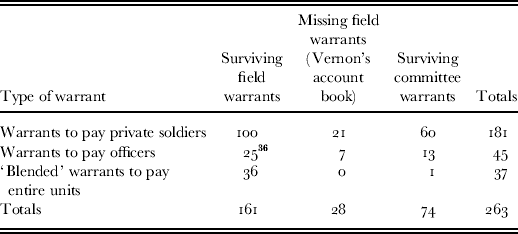
Note: Warrants authorizing levy money and payments to support personnel (such as regimental chaplains and surgeons) are excluded from these totals.
APPENDIX B
The value of all known pay warrants paid to the infantry's combat personnel during August, September, and October 1642

Note: Warrants authorizing levy money and payments to support personnel (such as regimental chaplains and surgeons) are excluded from these totals.
APPENDIX C
The number and value of the 126 private soldiers' pay warrants used in the advance pay calculation, broken down by pay period start dates
APPENDIX D
The hypothetical cost of Essex's infantry formations; based on an assumed average regimental strength of 800 enlisted soldiers. Note: the above analysis suggests that our model should begin in the third week of August at the earliest. Therefore the calculations are based on a ten-week term of service, excluding surgeons, chaplains, etc. (i.e. – this covers pay for combat personnel to the end of October)