In Mediterranean countries, lactating ewes show a drop in milk yield and a deterioration in milk composition during the summer season when THI reaches 80 (Sevi et al. Reference Sevi, Annicchiarico, Albenzio, Taibi, Muscio and Dell'Aquila2001); the reduction of mobilisation of body reserve for milk synthesis is induced both by the rise in ambient temperatures and by the advancement of lactation. During heat stress sheep responded with a decrease of feed intake, changes in the metabolism of water, protein, energy, and mineral balance, enzymatic reactions and hormonal secretion in the attempt to dissipate body heat (Marai et al. Reference Marai, El-Darawany, Fadiel and Abdel-Hafez2007). It has been observed that exposure to direct solar radiation adversely influences fat composition of ewe milk, with a reduction of long and unsaturated FA, and in particular of C18 : 1 trans-11 (VA), C18 : 2 cis-9, trans-11 (RA), and total CLA content, and a concomitant increase of SFA (Sevi et al. Reference Sevi, Rotunno, Di Caterina and Muscio2002).
The administration of an appropriate dietary fat supplement can be effective in increasing the content of unsaturated FA of ewe milk especially in summer, when lactating ewes are in their late lactation and in improving the yield and quality of milk (Sitzia et al. Reference Sitzia, Bonanno, Todaro, Cannas, Atzori, Francesconi and Trabalza-Marinucci2015), in terms of better coagulation properties caused by increased milk casein and fat content (Caroprese et al. Reference Caroprese, Albenzio, Bruno, Fedele, Santillo and Sevi2011; Mughetti et al. Reference Mughetti, Senesio, Acuti, Antonini, Moneta, Peparaio and Trabalza-Marinucci2012). In particular, flaxseed supplementation in sheep resulted in enhanced FA profile of milk, as demonstrated by the increase in PUFA, VA, RA, total CLA, and n-3 PUFA, and the reduction in saturated, short-, and medium-chain FA (Caroprese et al. Reference Caroprese, Albenzio, Bruno, Fedele, Santillo and Sevi2011).
Recently, there is an increased interest in studying the effects of marine algae supplementation on sheep health and production (Bichi et al. Reference Bichi, Frutos, Toral, Keisler, Hervás and Loor2013; Caroprese et al. Reference Caroprese, Ciliberti, Annicchiarico, Albenzio, Muscio and Sevi2014; Novoa-Garrido et al. Reference Novoa-Garrido, Aanensen, Lind, Larsen, Jensen, Govasmark and Steinshamn2014; Ciliberti et al. Reference Ciliberti, Albenzio, Annicchiarico, Marino, Santillo, Sevi and Caroprese2016). The supplementation in the diet of goats and cows of micro-algae, such as Spirulina platensis and Chlorella kessleri, resulted in an enrichment of nutraucetical fatty acids of milk with health benefit for consumers (Póti et al. Reference Póti, Pajor, Bodnár, Penksza and Köles2015).The effects of marine algae supplementation depend on basal diet composition and level of algae used in the diet (Reynolds et al. Reference Reynolds, Cannon and Loerch2006). In dairy cow, marine algae supplementation resulted in milk fat depression (Boeckaert et al. Reference Boeckaert, Vlaeminck, Dijkstra, Issa-Zachari, Van Nespen, Van Strealen and Fievez2008). Toral et al. (Reference Toral, Hervás, Gómez-Cortés, Frutos, Juárez and de la Fuente2010) found that the combination of marine algae with sunflower oil reduced ewe milk fat yield and content, and increased C18 : 1 trans-10, a potential inhibitor of milk fat synthesis (Griinari et al. Reference Griinari, Dwyer, Mc Guire, Bauman, Palquist and Nurmela1998). Nevertheless, an increase in the output of long-chain FA such as, RA, VA, and docosapentaenoic acid (DHA) was registered in ewe milk (Toral et al. Reference Toral, Hervás, Gómez-Cortés, Frutos, Juárez and de la Fuente2010).
Based on the previous observations, we hypothesised that the administration of the seaweed Ascophyllum nodosum in the diet of dairy ewes during summer alone or in combination with flaxseed, could contribute to improve milk production and FA profile. No previous study investigated the effects of Ascophyllum nodosum supplementation on milk production and nutritional quality in dairy ewes.
The aim of the present study was to assess milk production, composition and FA profile of dairy sheep during summer supplemented with flaxseed, Ascophyllum nodosum and a combination of flaxseed and Ascophyllum nodosum.
Materials and methods
Animals and experimental design
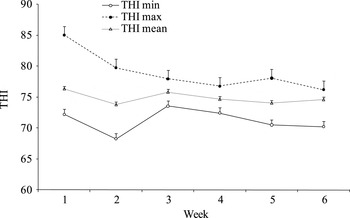
The experiment lasted 6 weeks, and was conducted during the summer (July–August) of 2012 at Segezia research station of the Council for Research and Experimentation in Agriculture. Thirty-two late-lactation Comisana ewes (d 202·1 ± 5·3 of lactation, mean ± sd) were divided into 4 groups of 8 each, balanced for milk yield, BW, and BCS. Groups were separately reared in outdoor pens of 5 × 12 m bounded with mesh-fence. The trough and the crib were located in the external areas. During the trial, ambient temperature and relative humidity in indoor and outdoor areas were monitored with thermo-hygrographs (LSI, I-20090 Settala Premenugo-Milano, Italy) placed at 1·5 m from the floor. The average temperature-humidity index (THI) was calculated using the Kelly & Bond's (Reference Kelly and Bond1971) formula. Results of weekly meteorological data are reported in Fig. 1.
Means ± sd of weekly Temperature–Humidity Index (THI) detected during the experiment.

The ewes in each group were individually fed twice daily and received 1·8 kg/d of oat hay. The control group (CON) also received 1 kg/d of pelleted concentrate (Mangimificio Molino Gallo, Potenza, Italy), whereas ewes in the experimental groups were supplemented with whole flaxseed (Lin Tech, Tecnozoo srl, Torreselle di Piombino Dese, Italy), or Ascophyllum nodosum (Tasco®, Acadian Seaplants, Canada), or their combination. Namely, each ewe in the FS group received 750 g/d of pelleted concentrate, and 250 g/d of whole flaxseed; each ewe in the AG group received 1 kg/d of pelleted concentrate and were supplemented with 25 g/d of Ascophyllum nodosum; each ewe in the FS + AG group was supplemented with both flaxseed (250 g/d) and pelleted concentrate (750 g/d), with a supplementation of 25 g/d of Ascophyllum nodosum. Dry matter intake was determined for each experimental group by weighing the refusals of each ewe at 08·00, 12·00, 16·00, and 20·00. Water was available ad libitum for all groups from automatic drinking troughs.
All procedures were conducted according to the guidelines of the EU Directive 2010/63/EU (2010) on the protection of animals used for experimental and other scientific purposes. Ewes were healthy and their conditions were carefully examined by veterinarians throughout the trial to exclude the presence of signs of diseases.
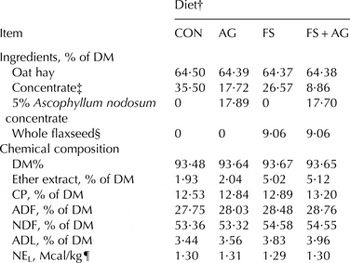
The chemical composition of diets was carried out by standard procedures according to AOAC (2000). Ingredients and chemical composition of diets are reported in Table 1.
Ingredients and chemical composition of the diets (DM basis)

† Diets: AG = 1 kg/d of pelleted concentrate supplemented with 25 g/d of Ascophyllum nodosum, FS = 750 g/d of concentrate plus 250 g/d of whole flaxseed; FS + AG = 250 g/d of whole flaxseed plus 750 g/d of pelleted concentrate supplemented with 25 g/d of Ascophyllum nodosum
‡ Contained: Corn Meal, Soybean Meal, Wheat Germ Meal, Wheat Meal, Roasted Soybean Seeds, Barley Meal, Wheat Fine Bran, Corn Cracked, Sugarcane Molasses, Partially Debarked Sunflower meal, Bentonite, Dried Pulp, Calcium Carbonate, Sodium Bicarbonate, Sodium Chloride, Magnesium Oxide, 8·3 IU/g vitamin A, 8·2 IU/g vitamin D3, 99 mg/kg vitamin E, 0·07 mg/kg vitamin B1, 255 mg/kg vitamin PP, 488 mg/kg Cl, 293 mg/kg Fe, 1·26 mg/kg Co, 1 mg/kg Cu, 0·4% Na
§ Lin Tech (Tecnozoo srl, Torrreselle di Piombino Dese, Italy)
¶ Calculated according to NRC (2001)
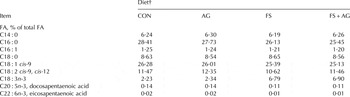
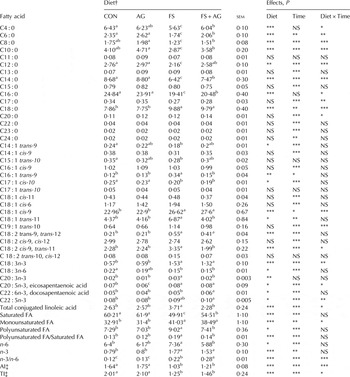
The determination of FA of the diet ingredients was described in details in Caroprese et al. (Reference Caroprese, Ciliberti, Annicchiarico, Albenzio, Muscio and Sevi2014). Table 2 showed the FA profile of the experimental diets.
FA profile of the experimental diets

† Diets: AG = 1 kg/d of pelleted concentrate supplemented with 25 g/d of Ascophyllum nodosum, FS = 750 g/d of concentrate plus 250 g/d of whole flaxseed; FS + AG = 250 g/d of whole flaxseed plus 750 g/d of pelleted concentrate supplemented with 25 g/d of Ascophyllum nodosum
Sampling and chemical analyses of milk
Ewes were milked twice daily (07·00 and 14·00) in a parlour using a pipeline milking machine (Alfa Laval Agri, SE-147 21 Tumbas, Sweden). Milk samples from each ewe were collected at morning and afternoon milking once per week throughout the experiment, and analysed for their chemical composition and FA profile. One aliquot was collected at the beginning of the experiment and on week 2, 4 and 6 and stored at −20 °C for analysis of FA. Fresh samples were used for the following chemical analysis: fat, total protein, casein, and lactose content using an infrared spectrophotometer (MilkoScan™ FT120, Foss Electric, DK-3400 Hillerød, Denmark) according to the International Dairy Federation standard (International Dairy Federation, 1990).
Milk fatty acid analysis
Fatty acid extraction was performed according to Luna et al. (Reference Luna, Juárez and de la Fuente2005) method, and the transesterification of FA according to ISO-IDF (2002) procedures, as reported in Caroprese et al. (Reference Caroprese, Marzano, Marino, Gliatta, Muscio and Sevi2010).
The fatty acid composition of the FAME was determined by capillary GC on a HP-88, 100 m × 0·25 mm × 0·20 µm capillary column (Agilent Technologies Inc., Santa Clara, CA) installed on a Agilent Technologies 6890N gas chromatograph equipped with a FID, and split injection. The initial oven temperature was 70 °C, held for 4 min, and subsequently increased to 175 °C at a rate of 13 °C/min. After 27 min, the oven temperature increased to 215 °C at a rate of 4 °C/min, and held for 45 min. Helium was used as the carrier gas and the column head pressure was 175 kPa. Both the injector and the detector were set at 250 °C. The split ratio was 20 : 1. Concentrations of FAME were analysed utilising a calibration curve with a mixture of standards of 50 fatty acid (GLC Reference standard 674, Nu-Check Prep, Inc. Elysian MN 56028, USA) with added CLA standards (GLC Reference standard UC-59 M, Nu-Check Prep, Inc. Elysian MN 56028, USA). FA were reported as g/100 g of FA. The content of SFA, MUFA, and PUFA were calculated. Atherogenic (AI) and trombogenic (TI) indexes were calculated according to Ulbricht & Southgate (Reference Ulbricht and Southgate1991) formulas:
 $$AI = \displaystyle{{C12:0 + 4xC14:0 + C16:0} \over {\sum MUFA + \sum PUFA(n - 6)\, {\rm and}\, (n - 3)}}$$
 $$TI = \displaystyle{{C14:0 + C16:0 + C18:0} \over {0 \cdot 5 \times \sum MUFA + 0 \cdot 5 \times \sum PUFA(n - 6) + 3x\sum PUFA(n - 3) + (n - 3)/(n - 6)}}.$$
Body weight and BCS
Body weights and BCS (six-point scale 0 = thin, 5 = fat) of the ewes were recorded at the beginning of the experiment and then weekly throughout the trial. Body weight was measured in the morning after the milking and before feeding time and measured by an electronic scale (METTLER MultiRange ID5, KC120/KC240).
Statistical analysis
Data were processed using ANOVA with the REPEATED statement in PROC MIXED with CV (variance components) as covariance structure of SAS (SAS, 2013). Diet, time of sampling, and their interaction were Fixed factors. Animal was a Random factor nested in the treatment. When significant effects were found (P < 0·05), Fisher's Least Significant Difference test was used to determine significant differences between means.
Results
Meteorological data and milk composition
In the present experiment maximum THI started from 85 during the first week of the experiment, and never dropped below 76 ± 1·4 until the end of the trial. Minimum THI reached 73 ± 0·9 at week 3 of the trial; weekly mean THI varied between 74 and 76 ± 0·5 (Fig. 1).
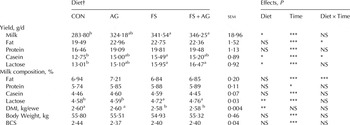
Milk yield was increased for ewes fed FS and FS + AG compared to CON (P < 0·05). Milk casein and lactose yield was increased for ewes fed FS compared to CON (P < 0·05); only lactose yield was increased for ewes fed FS + AG compared to CON (P < 0·05). Lactose content registered on average an increase in FS and FS + AG groups compared to CON group (P < 0·01, Table 3).
Milk yield and composition in ewes fed control diet (CON) or supplemented during summer

a,bMeans within a row with different superscripts differ (P < 0·05)
***P < 0·001; **P < 0·01; *P < 0·05; NS P > 0·05
† Diets: AG = 1 kg/d of pelleted concentrate supplemented with 25 g/d of Ascophyllum nodosum, FS = 750 g/d of concentrate plus 250 g/d of whole flaxseed; FS + AG = 250 g/d of whole flaxseed plus 750 g/d of pelleted concentrate supplemented with 25 g/d of Ascophyllum nodosum
Dry matter intake, body weight and BCS
Daily DMI are reported in Table 3; ewes in AG and C groups almost entirely consumed their ration, whereas ewes in FS and FS + AG groups displayed slightly lower DMI (P < 0·01).
Milk fatty acid composition
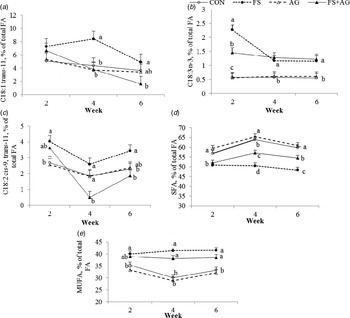
Fatty acid composition of milk is reported in Table 4. A decrease of FA from C4 : 0 to C14 : 0 (P < 0·001) emerged in milk from ewes fed FS. Flaxseed supplementation led to a reduction also of C16 : 0 (P < 0·001), whereas C18 : 0 increased significantly in FS and FS + AG group (P < 0·001). Dietary supplementation affected the content of MUFA; C16 : 1 trans-9 increased in FS group (P < 0·01), and C18 : 1 cis-9 increased in FS and FS + AG milk compared to AG and CON milk (P < 0·001). As expected, VA increased in FS milk by 57% compared to CON, by 65% compared to AG and by 71% compared to FS + AG group starting from week 4 of the experiment (P < 0·05, Fig. 2a). The content of C18 : 2 trans-9, trans-12, ALA and EPA increased in ewes fed FS and FS + AG compared to ewes fed CON and AG (P < 0·05). In particular, ALA was increased in ewes fed FS by 168% compared to CON group, and by 159% compared to ewes fed AG. The increase of ALA, both in FS and FS + AG, started from week 2 of the experiment; at week 2 FS milk showed the highest level of ALA (Fig. 2b). Subsequently, ALA content of FS milk was the same as that of FS + AG milk, being higher than C and AG milk. Flaxseed supplementation increased CLA isomers compared with the others fat supplements in the diet of ewes; the total CLA content was higher in FS milk than in AG, CON, and FS + AG milk. Notably, FS + AG displayed the lowest RA level at week 4 of the experiment (Fig. 2c). The total content of SFA in milk was the lowest in FS group (P < 0·05, Table 3), followed by FS + AG group. In particular, at week 4 and 6 FS and FS + AG showed lower SFA content than CON and AG (Fig. 2d). MUFA increased, both in FS and in FS + AG group, starting from week 4 of the experiment (P < 0·001, Fig. 2e). PUFA, PUFA/SFA and total n-6 FA increased in FS group (P < 0·05, P < 0·001, and P < 0·05, respectively, Table 3); the total n-3 FA was found to be higher in FS and FS + AG than AG and CON (P < 0·001). FS + AG milk resulted in the highest n-3/n-6 ratio (P < 0·001) caused by the reduction in n-6 FA compared to FS milk (P < 0·05). Flaxseed supplementation, also in combination with Ascophyllum nodosum, caused a decrease of AI and TI indexes of milk (P < 0·001).
Temporal changes in: (a) C18 : 1 trans-11(VA), (b) C18 : 3 n-3 (ALA), (c) C18 : 2 cis-9, trans-11 (RA), (d) saturated FA (SFA), (e) monounsaturated FA (MUFA) content in milk from ewes fed control diet (○), Ascophyllum nodosum diet (●), flaxseed diet (△), and a combination of flaxseed and Ascophyllum nodosum diet (▲) during summer. Differences between the groups at each time point are represented by letters a,b,c (P < 0·05).

Fatty acid profile of milk in ewes fed control diet (CON) or supplemented during summer

a–cMeans within a row with different superscripts differ (P < 0·05)
***P < 0·001; **P < 0·01; *P < 0·05; NS P > 0·05
† Diets: AG = 1 kg/d of pelleted concentrate supplemented with 25 g/d of Ascophyllum nodosum, FS = 750 g/d of concentrate plus 250 g/d of whole flaxseed; FS + AG = 250 g/d of whole flaxseed plus 750 g/d of pelleted concentrate supplemented with 25 g/d of Ascophyllum nodosum
‡ Atherogenic (AI) and Trombogenic (TI) indexes were calculated using Ulbricht & Southgate (Reference Ulbricht and Southgate1991) formulas:
 $$AI = \displaystyle{{C12:0 + 4xC14:0 + C16:0} \over {\sum MUFA + \sum PUFA(n - 6)\,\,{\rm and}\,\, (n - 3)}}$$
 $$TI = \displaystyle{{C14:0 + C16:0 + C18:0} \over {0\!\cdot\!5x\sum MUFA + 0\!\cdot\!5x\sum PUFA(n - 6) + 3x\sum PUFA(n - 3) + (n - 3)/(n - 6)}}.$$
Discussion
Sheep are considered ruminants accustomed to high ambient temperatures; nevertheless, during summer, in the Mediterranean area lactating sheep are characterised by a reduction in milk yield. Comisana ewes showed a reduction by 20% in milk yield after exposure to THI of about 80 (Sevi et al. Reference Sevi, Annicchiarico, Albenzio, Taibi, Muscio and Dell'Aquila2001). However, Silanikove (Reference Silanikove2000) reported that even THI values of 75–78 can be considered stressful for animals, and that values higher than 78 are extremely stressful and negatively affect the ability of animals to cope with heat load. Sheep in the present experiment, considering the THI registered, could be considered under heat stress. Nevertheless, the administration of Ascophyllum nodosum in combination with flaxseed to dairy ewes during summer increased milk yield by 22%, confirming previous results on flaxseed administration (Caroprese et al. Reference Caroprese, Albenzio, Bruno, Fedele, Santillo and Sevi2011). The increase in milk yield observed both in FS and FS + AG was in relation to an increase in lactose content, suggesting a role of flaxseed supplementation in glucose metabolism. In Caroprese et al. (Reference Caroprese, Ciliberti, Annicchiarico, Albenzio, Muscio and Sevi2014) an increase in plasma cortisol levels in flaxseed supplemented ewes under heat stress was found. It is well known that cortisol has a role in inducing hyperglycaemia (Matteri et al. Reference Matteri, Carroll, Dyer, Sejrsen, Hvelplund and Nielsen2000). Flaxseed supplementation during summer season increased plasma glucose levels (Caroprese et al. Reference Caroprese, Albenzio, Bruno, Annichiarico, Marino and Sevi2012), and this may be claimed to justify the increase in lactose content of FS and FS + AG milk, and the consequent increase in milk production. Glucose uptake by the mammary gland is considered a limiting step in milk production by controlling the rate of lactose synthesis that is responsible for the control of milk volume (Zhao, Reference Zhao2014). In addition, increased energy from fat supplementation during heat stress can increase availability of plasma glucose in sheep, as demonstrated by Caroprese et al. (Reference Caroprese, Albenzio, Bruno, Annichiarico, Marino and Sevi2012) thus allowing for increased lactose synthesis and milk yield.
Previous studies found that marine algae supplementation to sheep induced depression of milk fat during earlier stages of the feeding period by transcriptional control mechanisms regulating fat synthesis in mammary secretory tissue (Toral et al. Reference Toral, Hervás, Gómez-Cortés, Frutos, Juárez and de la Fuente2010; Bichi et al. Reference Bichi, Frutos, Toral, Keisler, Hervás and Loor2013). In the present study, however, no fat reduction was observed for AG and FS + AG milk suggesting that Ascophyllum nodosum administration to dairy sheep during summer has not detrimental effects on milk and fat production.
Flaxseed supplementation administrated as whole flaxseed or extruded flaxseed have been studied to improve fatty acid profile of ewe milk and cheese (Caroprese et al. Reference Caroprese, Albenzio, Bruno, Fedele, Santillo and Sevi2011; Mughetti et al. Reference Mughetti, Senesio, Acuti, Antonini, Moneta, Peparaio and Trabalza-Marinucci2012). The combination of flaxseed and Ascophyllum nodosum reduced SFA content of milk by about 10% and increased the MUFA content by 17% compared to CON. In particular, in the present study the decrease in C14 : 0 and C16 : 0 content in milk from sheep supplemented with the combination of flaxseed and Ascophyllum nodosum may be a positive goal from a human health perspective, being high levels of C14 : 0 and C16 : 0 associated with human cardiovascular diseases (Noakes et al.Reference Noakes, Nestel and Clifton1996).
At the beginning of the experiment the combination of PUFA from flaxseed and Ascophyllum nodosum, led to a production of VA and RA in milk similar to that observed when flaxseed was supplemented alone. Subsequently, the combined supplementation resulted in a considerable reduction of VA and RA in milk. It may be argued that these changes are the result of altered biohydrogenation of the unsaturated FA contained in the diet by rumen bacteria, as suggested in Toral et al. (Reference Toral, Hervás, Gómez-Cortés, Frutos, Juárez and de la Fuente2010) after administration of marine algae and sunflower oil to dairy sheep. Furthermore, Bichi et al. (Reference Bichi, Frutos, Toral, Keisler, Hervás and Loor2013) in ewes supplemented with marine algae did not found alteration in the mRNA expression of transcription regulators and target genes involved in lipogenesis both in the mammary gland and adipose tissue. Recent findings also suggested that supplementation of Ascophyllum nodosum to dairy cows at low doses (≤70 g/d) can stimulate the growth of ruminal cellulolytic bacteria (Antaya et al. Reference Antaya, Soder, Kraft, Whitehouse, Guindin, Erickson, Conroy and Brito2015). In addition, it is well known the role of inhibition exerted by PUFA on ruminal bacteria both on those in the Butyrivibrio group, which are responsible for production of VA, and on those comprising the cellulolytic flora and fungi (Maia et al. Reference Maia, Chaudhary, Figueres and Wallace2007). Previous findings suggested that time-dependent alterations in the VA and RA levels in milk from FS + AG are possibly the results of a shift in ruminal biohydrogenation starting from C18 : 3 n-3 at the expense of VA. The reduction in VA and RA resulted in a reduction by 25% of total n-6 FA in milk from FS + AG if compared with FS milk. Conversely, the increase by 131% in C18 : 3 n-3 in milk from sheep receiving the combination of PUFA from flaxseed and Ascophyllum nodosum resulted in an increase by 94% in milk from FS + AG of total n-3 FA compared with CON milk. The increase in C18 : 3 n-3 observed started after two weeks of dietary treatment according to a previous experiment (Caroprese et al. Reference Caroprese, Albenzio, Bruno, Fedele, Santillo and Sevi2011). Such an increase in milk from FS + AG led to a change of n-3/n-6 FA ratio, passing from 1 : 8 in CON milk to 1 : 4; this was due to the concomitant enhancement in C18 : 3 n-3 compared with CON milk, and reduction in n-6 PUFA compared with FS milk. The n-3/n-6 ratio measured in milk from FS + AG is the highest measured in milk from the experimental groups, in line with the current recommendations for human nutrition which advice to decrease the n-6 FA while increasing the n-3 FA intakes in the prevention and management of chronic diseases. Furthermore, the balance of n-6 and n-3 FA is very important for homoeostasis and normal development and the suggested balance is of about 1 : 4 (Simopoulos, Reference Simopoulos2004). Ewe milk has been criticised over the last forty years for its content of SFA, responsible for increasing the risks of cardiovascular diseases. As a consequence, a number of studies have been performed in order to reduce SFA content of milk by the use of proper dietary supplementation. The results obtained in the present experiment showed the possibility to reduce the SFA content, and enhance the healthy FA feeding ewes with flaxseed and a combination of flaxseed and Ascophyllum nodosum. These results can be even more important if considering that a worsening of sheep milk from a human health perspective during the summer season was observed (Sevi et al. Reference Sevi, Rotunno, Di Caterina and Muscio2002). The improvement obtained was emphasised also by the reduction of AI and TI indexes in milk of ewes supplemented with flaxseed and Ascophyllum nodosum. Data from the present study confirmed previous results (Caroprese et al. Reference Caroprese, Albenzio, Bruno, Fedele, Santillo and Sevi2011) and sustain the hypothesis that the combination of flaxseed and Ascophyllum nodosum can be considered an appropriate supplement to enhance milk yield and ameliorate fatty acid profile of ewe milk during summer season. Moreover, the use of the combination of flaxseed and Ascophyllum nodosum in the diet of dairy sheep succeeded in increasing the content of the total n-3 FA and simultaneously decreasing the content of the total n-6 FA. This innovative finding add information on the role of this combination in realise a desirable milk FA profile as compared with previous findings related to flaxseed administration.
Ascophyllum nodosum supplementation alone did not cause variations in FA profile compared with CON milk. In a previous experiment on cow milk, fish oil supplementation enhanced n-3 PUFA, EPA and DHA contents of milk, and resulted in increased levels of VA, even though a proportional increase in RA did not emerge (Caroprese et al. Reference Caroprese, Marzano, Marino, Gliatta, Muscio and Sevi2010). In sheep, a depression of milk fat was found by the introduction of incremental levels of marine algae in combination with sunflower oil in the diet (Toral et al. Reference Toral, Hervás, Gómez-Cortés, Frutos, Juárez and de la Fuente2010). In the present experiment, though being the seaweed supplementation similar to those reported in Toral et al. (Reference Toral, Hervás, Gómez-Cortés, Frutos, Juárez and de la Fuente2010), no reduction in milk fat was observed. Discrepancies with previous experiments could be attributed to different origins of marine algae supplementation and to the administration of the combination of marine algae with sunflower in the Toral et al. (Reference Toral, Hervás, Gómez-Cortés, Frutos, Juárez and de la Fuente2010)'s study. Furthermore, it could not be excluded that the absence of evident changes in milk production, nutritional properties and FA profile in AG milk could be ascribed to the amount of Ascophyllum nodosum supplemented in the diet, suggesting that further studies are required to verifying the effects of the administration of increased amounts of Ascophyllum nodosum.
In conclusion, this is the first study in which macroalgae Ascophyllum nodosum was used as dietary supplement, alone or in combination with flaxseed, for sustaining milk yield and enriching the fatty acid profile of ewe milk. The supplementation with macroalgae Ascophyllum nodosum did not result in any improvement of milk fatty acid profile or milk composition. The supplementation of PUFA from the combination of Ascophyllum nodosum and flaxseed during hot season can be considered a proper strategy to increase milk production by increasing the rate of lactose synthesis by the mammary gland, and to ameliorate fatty acid profile of ewe milk.