Many of the extant Old English (OE) prose texts, especially those of the early period (pre-950), are translations from original Latin texts, and thus any study of OE syntax must take the possibility of contact effects into account. Much previous work in this area has focussed on particular constructions, notably the dative absolute (see Timofeeva, forthcoming, for a recent treatment and references therein) and the accusative and infinitive construction with verbs of declaring, thinking, and knowing, whose origin as native OE or borrowed from/influenced by Latin has long been in dispute (see Fischer, Reference Fischer1988, Reference Fischer, Gerritson and Stein1992, Reference Fischer, Swan, Mørck and Westvik1994; D. Miller, Reference Miller2002; Mitchell, Reference Mitchell1985 among others). Both these cases focus on constructions whose status as native is dubious at best and which flourish briefly in certain contexts, but do not appear to enter the vernacular language during the OE period. Less often addressed is the effect that contact might have on indisputably native constructions. In these cases, no borrowing is involved; rather, the effect would be statistical, resulting in higher or lower frequencies of certain syntactic variants in translations versus original English texts. For the nonvariationist, such fluctuations may be irrelevant, and they certainly would have little or no effect on synchronic models of syntactic structure. However, when addressing synchronic variation or change over time, in which changes in frequencies are an integral part of the evidence base, the possible effect of contact must at least be considered. In this article, I report on a small pilot study set up to investigate whether systematic statistical translation effects of Latin on OE can be detected and, if so, what form they take. As a small study of one quite simple case, it is not clear that the positive results reported here can be generalized to all or any other cases; this is an empirical question. The results are sufficiently interesting, however, to suggest that further investigation into this question will be worthwhile.
In this article, I focus on two ways in which transference from the source to the target language might manifest itself during the translation process, one direct and one indirect. The direct effect is the case where the translator, when faced with a particular structure in the original, reproduces a matching structure in the translation. The extreme version of direct translation is glossing, since glosses are essentially a direct translation of an entire text. This extreme version of direct translation often produces structures ungrammatical in the target language, something which competent translators not involved in glossing generally avoid. In cases in which direct translation does not lead to ungrammaticality, however, there is no reason for a translator to avoid it. If the source and target languages invariantly use the same structure (e.g., verb-final clauses, head-initial NPs) the translator has no choice but to use direct translation. The interesting cases, and those in which direct translation may have an effect on our analyses of the target language, are particularly those in which the target exhibits variability (e.g., verb-final and verb-medial clauses, head-initial and head-final NPs) and only one of these possible structures matches the structure in the source language. In this case, the translator must choose whether to follow the source or to use one of the other structures possible in the target language. A direct translation effect, therefore, is one in which the translator uses a higher than usual frequency of a particular variant in direct response to a matching structure in the source.
Translators do not always slavishly follow the structure of the text before them. They may recast ideas, add their own comments, and generally produce a text which cannot be matched structure for structure with the source. As a result, there are often structures in the target which are not present in the original and, thus, have no direct source. However, the effect of translation may also be present in these cases in an indirect form, a kind of priming, in which the translator, under the influence of the invariable structure of the source, produces a higher frequency of a particular variant in the target, regardless of whether there is a matching structure in the source. The existence of syntactic priming, that is, the higher likelihood of using a certain syntactic structure when it has recently been used, is a process well documented in the experimental psycholinguistic literature (see Bock, Reference Bock1986, for a classic early study of priming in speech production, as well Hartsuiker & Westenberg, Reference Hartsuiker and Westenberg2000, and Pickering & Branigan, Reference Pickering and Branigan1998, which use written tasks). Corpus-based studies, such as Estival (Reference Estival1985), Gries (Reference Gries2005), and Szmrecsanyi (Reference Szmrecsanyi2006), show that the effect is detectable in naturally occurring speech/writing as well as under experimental conditions, and finally, cross-language effects, as in the case under consideration here, have also been demonstrated under experimental conditions (Hartsuiker et al., Reference Hartsuiker, Pickering and Veltkamp2004, for Spanish/English; Loebell & Bock, Reference Loebell and Bock2003, for German/English; and Salamoura & Williams, Reference Salamoura and Williams2006, for Dutch/English). This is what I call the indirect effect.
In this article, I investigate direct and indirect translation effects in OE using prepositional phrases with pronominal complements as a test case. This structure has the property of being basically invariant in Latin (head-initial) but variable in OE (head-initial, head-final, or separated), and there is thus potential for both direct and indirect translation effects. Interestingly, the bare frequencies show little evidence of any type of effect. However, once a number of linguistic factors that influence the position of the pronominal complement in OE are taken into account using multivariate analysis and the effect of translation is isolated, a very clear pattern emerges in which some texts (nonbiblical translations) show only direct translation effects, while others (biblical translations) show both direct and indirect effects. I relate these differences in translation effect, direct or indirect, to the translation strategies of the OE writers, who approach the translation of biblical texts, as the word of God, in quite a different fashion from nonbiblical texts.
DATA AND METHODS
The structure I investigate in this article is prepositional phrases (PPs) with pronominal complements. In OE, such PPs may have the pronoun to the right of the preposition, as in (1), or to the left of the preposition, either immediately as in (2a), or even further to the left, separated from the head by other material, as in (2b). Pronouns are never separated from their preposition in head-initial order. There is no meaning difference between the orders (Mitchell, Reference Mitchell1978:242–243, agreeing with Wende, Reference Wende1915); they result rather from the scrambling of the pronoun, a common process in OE (and Germanic in general) which moves light elements to the left and which affects pronominal objects as well. By contrast, OE PPs with nominal, as opposed to pronominal, complements are largely head-initial in OE. Cases with the complement to the left, or separated from the preposition, exist but are extremely infrequent.Footnote 1
(1) head-initial PP, pronoun to the right
Sum man wæs asend fram Gode sylfum to us,
A man was sent from God himself to us
“A man was sent from God himself to us”
(coaelhom, + AHom_1:37.21)Footnote 2
(2) pronoun to the left,
a. immediately
Þa cwæþ se Hælend him to, Aris hal of ðam bedde,
then said the Saviour him to, Arise whole from the bed
“Then the Saviour said to him, ‘Arise whole from the bed’”
(coaelhom, + AHom_2:38.259)
b. separated
He genimð him þonne to seofan oðre gastas wyrsan þonne he sylf sy,
He takes him then to seven other spirits worse than he himself is
“He then takes to himself seven other spirits worse than he is himself”
(coaelhom, + AHom_4:47.545)
In this study, I consider the two structures with the pronoun to the left of the head as variants of the same type and treat them together as one category. Practically, this decision rests on the fact that the crux of the investigation is to determine whether and how the OE matches or does not match the Latin source, and both of the non-head-initial types fall into the second category. However, this is also a sound position theoretically. Early analyses of the pronominal complements of prepositions (Koopman, Reference Koopman1997; Pintzuk, Reference Pintzuk1999; van Kemenade, Reference van Kemenade1987) have concluded that these pronouns are clitics (like other OE pronouns) and that in addition to their base-generated position they may appear in special clitic positions. One of these positions is at the left edge of the PP, while the others are initial in the verb phrase (VP) and either preceding or following the topic. Thus, both the structures with the pronoun to the left of the head are clitic structures; they simply differ in which clitic position is involved. More recently, Harris (Reference Harris2006) has provided some evidence that OE pronouns are not clitics but weak pronouns, and the position immediately to the left of the preposition is not in fact within the PP at all (i.e., that there is no clitic position at the left edge of the PP), but has scrambled into the verbal domain, just like the separated type. Under this view, the adjacency between the pronoun and the preposition in the head-final cases is accidental. Regardless of which analysis is right, neither distinguishes in any meaningful way between the two structures where the pronoun precedes the preposition. Finally, the quantitative evidence also supports this approach as a multivariate analysis of each variant separately produces very similar results, showing that the factors affecting both are the same.
In Latin, on the other hand, with the exception of the cliticized forms in -cum (mecum “with me” tecum “with you,” etc.) and a handful of fossilized phrases, all PPs with pronominal complements are head-initial, that is, with the pronoun to the right of the preposition, as in (3).
(3) a. Dixitque Dominus ad eum
said-and Lord-NOM to him-ACC
“And the Lord said to him” (Genesis 7.1)
b. atque in te benedicentur universae cognationes terrae
and in you-ABL will-be-blessed all-NOM nations-NOM earth-GEN
“and all the nations of the earth will be blessed in you” (Genesis 12.3)
Thus while OE and Latin share one prepositional phrase structure, head-initial, OE also has the possibility, not generally present in Latin, of placing the pronoun somewhere to the left of the preposition. The data thus fall into four groups:Footnote 3
1. The Latin source has a PP, and there is a matching head-initial PP (labeled P-PRO in the examples) in the OE, as in (4).
2. The Latin source has a PP, and there is a non-head-initial PP in the OE, either with the complement immediately to the left (PRO-P), as in (5), or separated (PRO … P), as in (6).
3. The Latin source does not have a PP, and there is a head-initial PP in the OE, as in (7).
4. The Latin source does not have a PP, and there is a non-head-initial PP in the OE, either with the pronoun immediately to the left, as in (8), or separated, as in (9).
(4) PP in Latin, P-PRO in OE
Ecce universa terra coram te est
behold all-NOM earth-NOM before you-ABL is
“Behold all the earth is before you” (Genesis 13.9)
Efne nu eall seo eorðe lið ætforanðe:
even now all the earth lies before you
“Even now all the earth lies before you”
(cootest, Gen:13.9.506)
(5) PP in Latin, PRO-P in OE
Cumque comedissent, dixerunt ad eum:
when-and they-had-eaten, they-said to him-ACC
“And when they had eaten, they said to him” (Genesis 18.9)
Mid þam ðe hi æton, þa cwædon hi him to:
When they had-eaten, then said they him to
“When they had eaten, then they said to him”
(cootest, Gen:18.9.697)
(6) PP in Latin, PRO … P in OE
Dixitque ad eum Deus:
said-and to him-ACC God-NOM
“and God said to him” (Genesis 20.6)
& Drihten him cwæð to:
and God him said to
“and God said to him”
(cootest, Gen:20.6.834)
(7) no PP in Latin, P-PRO in OE
Quid vidisti, ut hoc faceres
what-ACC you-have-seen that this-ACC you-would-do
“What have you seen, that you would do this?” (Genesis 20.10)
Hwæt gesawe ðu mid us, þæt ðu swa don woldest.
what saw you among us that you so do would
“What did you see among us, that you would do so?”
(cootest, Gen:20.10.846)
(8) no PP in Latin, PRO-P in OE
et dixit: Surgite,
and he-said Arise
“and he said ‘Arise’” (Genesis 19.14)
& cwæð him to: Arisað
and said them to Arise
“and said to them ‘Arise’”
(cootest, Gen:19.14.769)
(9) no PP in Latin, PRO … P in OE
Respondit Abraham:
answered Abraham-NOM
“Abraham answered” (Genesis 20.11)
Abraham him cwæð to:
Abraham him said to
“Abraham said to him”
(cootest, Gen:20.11.847)
The OE data used in this study have been extracted from the York-Toronto-Helsinki Parsed Corpus of Old English Prose (YCOE) (Taylor et al., Reference Taylor, Warner, Pintzuk and Beths2003), a 1.5 million word syntactically annotated corpus, using CorpusSearch 1.1.Footnote 4 The texts used are listed in Appendix A. For English originals, all cases of prepositional phrases with pronominal complements are included. For the translations, shorter texts include all cases, while for longer ones, samples are used as indicated. The Latin source for each token in the translated texts was located. Each OE token was classified either as having as a direct source with a matching Latin PP or as having no source. The latter category includes both cases in which there is a Latin source but it does not include a matching PP and cases in which there is no source, that is, where the translation includes material not in the source. Thus, there are three major categories of data: (i) original English PPs, (ii) translated PPs with a source in the Latin, and (iii) translated PPs without a source in the Latin. More details about the cases included in the study are given in Appendix B.
RESULTS
The preposition to
To is the most common preposition in the OE data, making up approximately 40% of all cases (1642/4574). Unfortunately, to also behaves differently from other prepositions in a number of ways, in particular, with respect to time. If we divide the texts into two time periods, early (pre-950) and late (post-950), for prepositions other than to, there is a slight increase in head-initial PP order within the OE period, as shown in Table 1. This is in line with the expected direction of change, since the head-final orders are eventually lost (in Middle English), leaving the invariant Present Day English (PDE) order. It also accords with the decrease in the rate of leftward scrambling of object pronouns (generally thought to be a related phenomenon), which shows a fairly substantial decrease during this period (Harris, Reference Harris2006:31–32). The separated order for PPs (PRO … P, which in this study has been collapsed with the PRO-P order) also decreases slightly (from 16% to 11%, according to Harris).
The frequency of head-initial PP order with prepositions other than to in early and late texts (χ2 = 5.55, p ≤ .025)

For to, however, there is actually a fairly substantial decrease in head-initial order between the two periods, as shown in Table 2.Footnote 5 Clearly, whatever this difference represents, it is not “change over time” in the ordinary sense. The bulk of the late nontranslated texts are the work of a single author, Ælfric of Eynsham, whose frequency for head-initial PPs headed by to is only 46%. Thus, we might hypothesize that this is an idiosyncratic stylistic feature of a particular author. This view is perhaps strengthened by the fact that Ælfric also translated most of the Old Testament book of Genesis (chapters 1–24), which shows a lower rate of P-PRO order with to than Exodus, which is not translated by Ælfric (77% versus 99%). On the other hand, four out of five of the late translated texts, none of which have any association with Ælfric, also have low rates of P-PRO order with to (between 40% and 50%), which argues against any simple form of the Ælfric hypothesis. Clearly, the cause of the aberrant behavior of to with respect to the other prepositions is an interesting question, but pursuing it here would go well beyond the scope of the study at this stage. I thus exclude to from the main part of this article, but include a full report for comparison in Appendix C.
The frequency of head-initial PP order with the preposition to in early and late texts (χ2 = 31.1, p ≤ .001)

Head-initial order in translations versus nontranslations
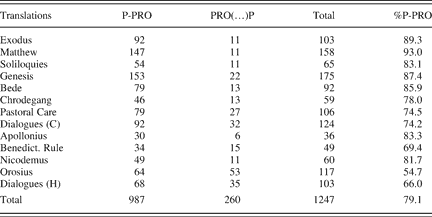
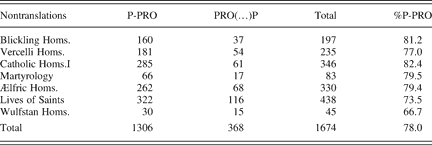
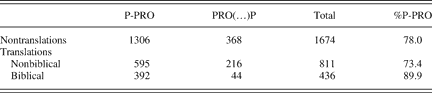
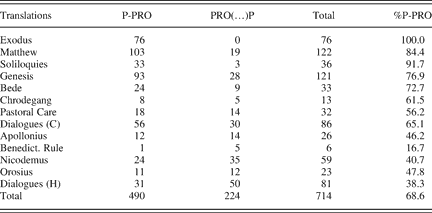
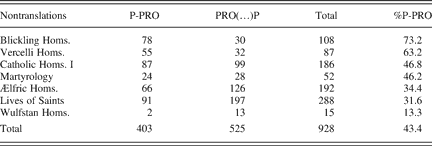
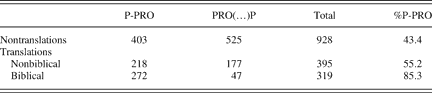
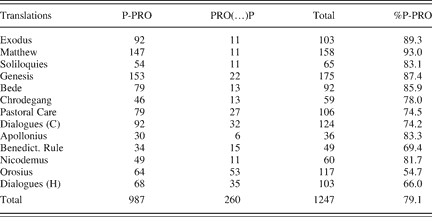
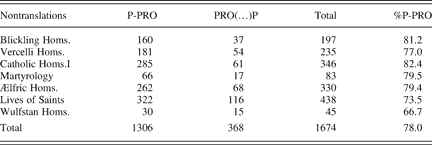
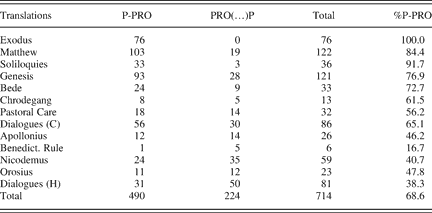
Tables 3 and 4 give the overall rate of head-initial and non-head-initial PPs, labeled P-PRO and PRO(…)P, respectively. Table 3 includes the translated texts and Table 4 the nontranslations. All PPs are included in these tables, whether they have a source PP in the Latin or not. Surprisingly, there appears to be no effect of translation at all; overall, the difference in the frequency of P-PRO order between the translated and nontranslated texts is only one percentage point. However, the frequency of P-PRO order for translated texts is heavily affected by three large biblical texts, Genesis and Exodus from the Heptateuch, and Matthew from the West-Saxon Gospels. Separating those texts, we get the results in Table 5.
Percentage head-initial PP order by translated text
Percentage head-initial PP order by nontranslated text
A comparison of the frequency of head-initial PP order in biblical and nonbiblical translations
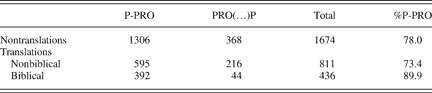
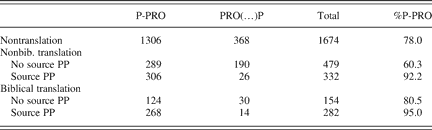
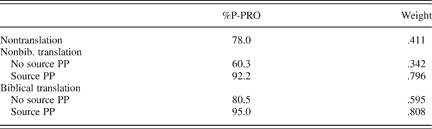
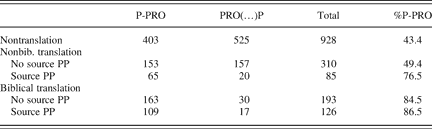
Table 5 shows that the percentage of head-initial order in PPs in the biblical texts is much higher than in the nonbiblical ones. It also appears to show that the frequency in the nonbiblical translations is actually lower than in the nontranslations and that for these texts there is no translation effect at all. However, a more detailed examination of the data shows this to be false. If we divide the tokens from the translated texts into those that have no source PP in the Latin and those that do, and then compare the frequency of head-initial order in these categories to that in the nontranslated texts, we see a different picture. Since we have already seen that the biblical texts act somewhat differently from the other translated texts, these are separated out as well. The results are given in Table 6.Footnote 6
A comparison of the frequency of head-initial PP order with and without a Latin source PP

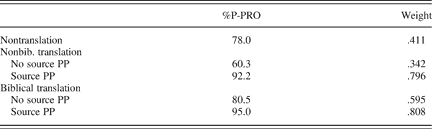
Table 6 shows that for both biblical and nonbiblical translations, the frequency of head-initial PPs is higher when there is a source PP (95.0% and 92.2%, respectively) than it is in nontranslations (78.0%), a clear translation effect. The cases with no source PP, however, differ from those in the nontranslations in an interesting way. In the biblical texts, the percentage of head-initial cases (80.5%) is very slightly higher than in nontranslated texts; for nonbiblical translations, however, against expectation, the percentage of head-initial cases (60.3%) is significantly lower than in nontranslations.
Linguistic factors affecting PP order
Certainly, translation is not the only factor affecting the placement of pronominal complements of prepositions in OE. To get a better picture of the variation, we need to look at linguistic factors that affect order in the OE PP. It should be said at the outset that the aim of this article is not to give a precise account of pronoun scrambling out of PPs in OE (a proper study of this topic would have to include pronominal objects of verbs as well) but rather to try to detect translation effects. As far as contributing factors go, therefore, I have simply included the most likely candidates, without particularly addressing here any of the (admittedly interesting) deeper questions of what the results might indicate about the syntax of OE. Because the factors affecting PP order overlap, that is, for the most part, all are present in each case, it is not possible to get an accurate picture of the effect of each of these factors separately by looking at percentages alone. I, therefore, carried out a multivariate analysis using Goldvarb X.Footnote 7 In the following tables (7–13), I give the percentages and factor weights for six linguistic factors that I tested for their effect on PP order: the (i) number, (ii) case, and (iii) reflexivity of the pronoun, (iv) the preposition, (v) the verb, and (vi) the clause type. For the most part, the percentages reflect the factor weights in strength, that is, higher percentages have higher weights, although there are a few exceptions.
The first three factors concern the pronoun. The oblique (nonnominative) forms of the OE pronoun system, that is, those that appear as complements of prepositions, are given in (10).
(10) OE personal pronouns


The pronouns are inflected for person, number, and case, but, as (10) shows, there is a lot of syncretism, making it difficult to differentiate all the forms. For the first and second persons, case is ambiguous while number is distinct; for the third person, on the other hand, case is distinct but number is often ambiguous. Because third person pronouns are much more common than first and second, and case can be decided in at least some ambiguous cases on the basis of the preposition, in the coding I have focused on case and sacrificed number.Footnote 9 While some prepositions take only one case in OE (usually dative), many take more than one, usually dative or accusative, the very two cases which have the same form in the first and second person. To avoid this difficulty, I have distinguished three categories for case: (i) dative, (ii) accusative, and (iii) ambiguous dative/accusative. Third person pronouns are coded as dative or accusative according to their form, while first and second person are coded according to the preposition they occur with. All first and second person pronouns with prepositions that can take dative or accusative are coded as ambiguous.Footnote 10 Genitive pronoun complements are very rare in my data (11 cases) and show no variability.Footnote 11 Since there are so few cases, and they do not vary, they have been omitted from the study. Table 7 compares frequency and weight for head-initial order by person of the pronoun, showing that first and second person pronouns favor P-PRO order, while third person pronouns disfavor it. Table 8 shows that accusative case highly favors P-PRO order while dative disfavors it; the ambiguous class, which contains both datives and accusatives, naturally falls in the middle.
Percentages and factor weights for head-initial PP order by person of the pronoun

Percentages and factor weights for head-initial PP order by case of the pronoun

The final pronoun feature included is whether the pronoun is reflexive, as in (11a) or not, as in (11b). Note that, unlike in PDE, reflexivity is not indicated by the form of the pronoun in OE, but only by context.
(11) a. and þa gelangode he him to his ercediacon,
and then called-for he him(self)-DAT to his archdeacon
“and then he called to himself his archdeacon”
(coaelive, +ALS_[Martin]:1385.6882)
b. ealle gelyfdon þurh hine.
all believed through him-ACC
“all believed through him”
(coaelhom, +AHom_1:39.23)
Despite a large difference in the frequency of P-PRO order with reflexive and nonreflexive pronouns, the effect of this factor is not significant, as shown in Table 9.
Percentages and factor weights for head-initial PP order by reflexivity of the pronoun

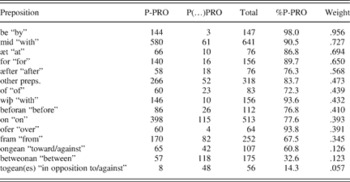
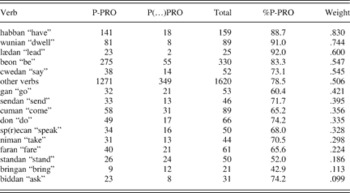
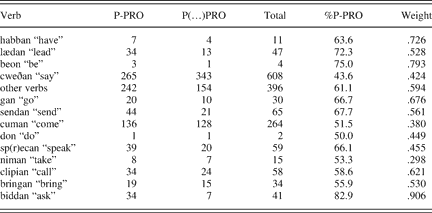
Tables 10 and 11 include the prepositions and verbs that occur more than 50 times in the data (14 prepositions and 15 verbs).Footnote 12 All other prepositions and verbs are grouped together. Prepositional phrases not dependent on a verb (e.g., complements of nouns, adjectives) and those in a clause lacking a verb (generally due to elision) are omitted from Table 11. The results show that there is a lexical effect of both the verb and the preposition, with some highly favoring P-PRO order and some highly disfavoring it.
Percentages and factor weights for head-initial PP order by preposition

Percentages and factor weights for head-initial PP order by verb

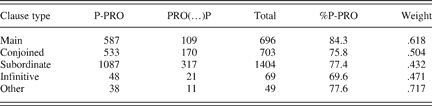
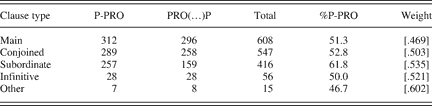
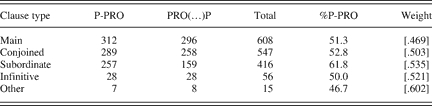
The final linguistic factor is clause type, shown in Table 12. Clauses are divided into main, conjoined main, subordinate, infinitive, and, finally, other, which includes participial clauses and small clauses. The latter are combined because of small numbers and similar weights, rather than for any linguistic reason. The division of clauses into main and conjoined main is conventional in the historical literature, as conjoined clauses have often been noted to act sometimes like main and sometimes like subordinate clauses. In the frequent clause types, main, conjoined main, and subordinate, we see a pattern familiar from other studies of OE syntax; main clauses favor the innovative feature (in this case P-PRO order), while subordinate clauses disfavor it, and conjoined clauses fall in the middle (see, for example, Pintzuk and Taylor, Reference Pintzuk, Taylor, van Kemenade and Los2006).Footnote 13
Percentages and factor weights for head-initial PP order by clause type
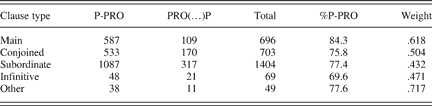
In general, the order and approximate magnitude of the weights assigned for the factors when both translations and nontranslations are included in the data set is reproduced when translations and nontranslations are considered separately. This is true for all the pronominal factors, and for clause type with the exception of infinitives, which have a lower probability of P-PRO order in nontranslations (.399) when compared to translations (.607), but the numbers are very small (69 examples in total). The effect of the verb is also fairly stable with the major exception of cweðan “to say,” which has a high probability of P-PRO order in nontranslations (.810) and a low probability in translations (.382). This is because the two most common prepositions that occur with cweðan (apart from to) are be “by,” which heavily favors P-PRO order, and betweonan/betwux “between,” which heavily disfavors it. In translations, only 25% of PPs with cweðan are headed by be, while in nontranslations, 85% are, thus leading to a high probability for P-PRO order in nontranslations as compared to translations.
The weights for the prepositions are less comparable between translations and nontranslations than the other factor groups. The prepositions with the highest and lowest probabilities of P-PRO order are the same, and few of the group in the middle differ by more than .2. The biggest difference lies in the category “other,” that is, prepositions not treated individually because the number of cases is less than 50. Here the probability for translations is .720, while for nontranslations, it is .394. A likely cause of this disparity is an imbalance in the frequency of datives with “other” prepositions in translations and nontranslations. In the former, approximately 40% of the PPs take a dative, while in the latter, the frequency is about 60%. Since datives disfavor P-PRO order, the lower frequency of datives in translations will lead to a higher probability for P-PRO order, while in nontranslations, which have more datives with “other” prepositions, the probability of P-PRO order will be lower.
Non-linguistic factors
Period
In our earlier discussion of head-initial order, we saw that for prepositions other than to there is a slight increase in the frequency of P-PRO order between period 1 and period 2. This effect is not significant, however, when other factors are taken into account, as shown in Table 13. For the results for to, for which period is significant, see Appendix C, Table 9.
The effect of translation
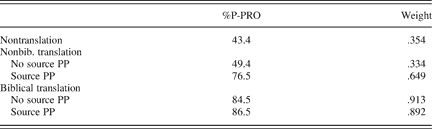
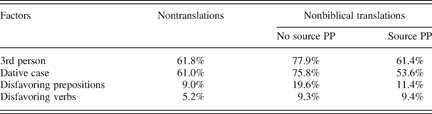
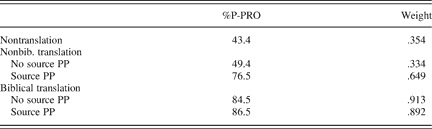
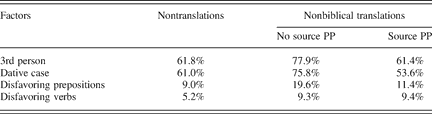
Let us turn now to the effects of translation. Table 14 gives the factor weights for the effect of nontranslated text versus the two categories of translation, with and without a source PP. We can see that there is a strong and approximately equal effect of translation for both biblical and nonbiblical translations when there is a source PP. When there is no source PP, however, nonbiblical and biblical texts differ. Recall that in the previous head-initial order discussion (Table 6), we saw that while the frequency of head-initial PP order for biblical translations as well as for nonbiblical translations with a source PP was higher than for nontranslations, as expected, the frequency for nonbiblical translations without a source PP was lower than that of nontranslations, an unexpected result. The factor weights given in Table 14 show that when other factors which affect PP order (Tables 7–13) are taken into account by the multivariate analysis, the difference between nontranslations and nonbiblical translations without a source PP is greatly reduced, and, in fact, the difference between the two weights is not significant.Footnote 14 The disparity between the frequencies and weights arises because it happens that there is a concentration of factors that disfavor P-PRO order in the nonbiblical translations without a source PP, as opposed to the nontranslations. Table 15 shows that dative case, third person pronouns, and to a lesser extent, a handful of prepositions (ongean, betweonan, and togeanes) and verbs (niman, standan, biddan, faran, and bringan) that disfavor P-PRO order (the prepositions and verbs have weights less than .3) make up a higher proportion of this type of translation data than the nontranslation data. By contrast, the nonbiblical translations with a source PP have a distribution of data closer to that of the nontranslations, and where it differs it is not always in the same direction.
Percentages and factor weights for head-initial PP order by period

The frequency and weight for head-initial PPs with and without a source PP comparing nontranslations and two kinds of translation
The proportion of cases in nontranslations and nonbiblical translations made up of disfavoring factors
The results in Table 14 confirm and clarify the results in Table 6. Translators of both biblical and nonbiblical texts show a direct translation effect, producing more head-initial PPs in direct response to a source PP in the Latin. In the parts of the translation where there is no source, however, the probability of head-initial order for nonbiblical texts is about the same as in nontranslated texts. Biblical translators, on the other hand, in addition to the direct effect also show an indirect effect, producing a higher rate of head-initial PPs than is found in nontranslations, even when there is no source.
CONCLUSIONS
In this article, I have shown that translation from Latin has a statistical effect on at least one OE structure, PPs with pronominal complements. In the nonbiblical translations, the frequency of head-initial order is higher than in nontranslated texts only when there is a matching PP in the Latin source of the token, making a direct connection between the source and target. In the biblical texts, on the other hand, the frequency of head-initial order is not only higher than expected in comparison to nontranslated texts when there is a source PP, but also, to a lesser extent, when there is not. This indirect influence appears to be a kind of priming effect, where the high incidence of head-initial order in the Latin leads the translator to produce a higher rate of head-initial orders in general. While further work is necessary to validate this difference in translation effects across more structures, the difference in effect found here is matched by a difference in the translation strategies adopted by OE translators for biblical and nonbiblical texts. Following Jerome, who expressed his goal in translating to be non verbum e verbo, sed sensum exprimere de sensu “to render not word for word, but sense for sense” except in biblical texts where et verborum ordo mysterium est “even the order of the words is a [sacred] mystery” (Letter 22.30 in Labourt, 1953:1:145, quoted in Stanton, Reference Stanton2002:110), OE writers generally felt free to paraphrase rather than give a literal translation of texts, except when it came to the Bible. In his Latin preface to the first book of gospel homilies, Ælfric writes that he does not translate word for word, but sense for sense: Nec ubique transtulimus verbum ex verbo, sed sensum ex sensu (Thorpe, 1843–44: I:I, quoted in Nichols, Reference Nichols1964:10); however, in the English preface to Genesis, he says & we ne durron na mare awritan on Englisc þonne ðæt Leden hæfð, ne ða endebyrdnysse awendan “and we do not dare to write any more in English than the Latin has, nor change the order” (Crawford, Reference Crawford1922:79, quoted in Nichols, Reference Nichols1964:10), going on to explain that the order can only be changed when the Latin syntax is not grammatical in English. Ælfric is, therefore, not advocating glossing or ungrammatical English; but rather that biblical works should not contain interpretation or free paraphrase of the type found in many OE translations. Although the English writers (or Jerome, for that matter) do not always follow exactly in practice the translation theory they espouse, their attitude towards biblical and nonbiblical translation is clearly different, with the biblical type requiring a much closer, less free translation. In this context of paying very close attention, it is not surprising that the linguistic structures of the source text have a greater influence on the output of the translator.
Whether this effect is general, that is, the same pattern will reoccur with other constructions where Latin differs in the relevant way from OE, is an empirical question. Hints in the literature suggest that it is not. Nunnally (Reference Nunnally, Rissanen, Ihalainen, Nevalainen and Taavitsainen1992), for instance, in a study of the Gospel of Matthew, finds that the order of an adnominal genitive and head noun in nominal phrases is simply not affected by the order in the Latin, and Kytö and Rissanen (Reference Kÿto, Rissanen, Rissanen, Kÿto and Palander-Collin1993) point out that while the so-called DET POSS construction (i.e., this my book) is more common in translations, it does not necessarily correlate with a DET POSS construction in the Latin. They thus conclude that it is an aspect of a high or Latinate style rather than a translation effect.Footnote 15 As neither of these studies takes into account other contributing factors, and Nunnally's, at least, is quite limited in its scope, it is not clear at this point that the last word has been said here; however, these results do appear to suggest a scenario in which different constructions are differentially affected by translation, raising the question of what the range of this variation might be, and how it is related to other linguistic and extralinguistic factors. Further investigation is clearly needed.
APPENDIX A
The following texts are included in the database. The whole text is used unless otherwise indicated.
Translations
Gregory's Pastoral Care, chapters 1–39 (Sweet, Reference Sweet1958; Migne, Reference Migne1862)
Augustine's Soliloquies (Endter, Reference Endter1922)
Orosius, books 2 and 3 (Bately, Reference Bately1980; Sweet, Reference Sweet1959)
Gregory's Dialogues (Ms. C), books 1 and 2 (Hecht, Reference Hecht1965; de Lubac & Daniélou, Reference de Lubac and Daniélou1979)
Bede's Ecclesiastical History, preface, headings, books 1 and 2 (T. Miller, Reference Miller1959–63, Colgrave & Mynors, Reference Colgrave and Mynors1969)
Apollonius of Tyre (Goolden, Reference Goolden1958)
The Benedictine Rule (Schröer, Reference Schröer1964)
Chrodegang's Rule (Napier, Reference Napier1971)
The Gospel of Nicodemus (Ms. A) (Cross, Reference Cross1996)
Gregory's Dialogues (Ms. H) (Hecht, Reference Hecht1965; de Lubac & Daniélou, Reference de Lubac and Daniélou1979)
The Heptateuch, Genesis and Exodus (Crawford, Reference Crawford1922; Weber, Reference Weber1975)
The West-Saxon Gospels, Matthew (Skeat, Reference Skeat1970; Weber, Reference Weber1975)
Nontranslations
Ælfric's Supplemental Homilies (Pope, Reference Pope1968)
Ælfric's Lives of Saints (Skeat, Reference Skeat1966)
Ælfric's Catholic Homilies I (Clemoes, Reference Clemoes1997)
The Old English Martyrology (Herzfeld, Reference Herzfeld1973; Kotzor, Reference Kotzor1981)
The Blickling Homilies (Morris, Reference Morris1967)
The Vercelli Homilies (Scragg, Reference Scragg1992)
The Homilies of Wulfstan (Bethurum, Reference Bethurum1957)
APPENDIX B
The data set is made up of all PPs in the OE with a personal pronoun complement. The self forms (e.g., him self) are not included as they only occur in head-initial structures. A “match” was sought in the Latin for each PP. While Latin PPs with nominal complements referring to the same entity as the English pronoun were not counted as matches, in general the requirements on the category of the complement were looser than in the OE. Demonstratives of all types except iste “that (of yours)” (i.e., is “this/that,” hic “this,” ille “that,” ipse “self”) are included since they are commonly used as third person pronouns (Latin having only a reflexive third person personal pronoun), as in (B1). I have also counted PPs with wh- complements in the Latin as matches, because these are commonly used in Latin with pronominal force, as in (B2).
(B1) Mid þy heo oft & geornlice from him monode wæron,
When they often and earnestly by him admonished were
(cobede, Bede_2:5.112.19.1059)
Cumque diligenter ac saepe ab illo essent admoniti
When-and diligently and often by him were warned
(Colgrave & Mynors, Reference Colgrave and Mynors1969:152)
“When they were earnestly and often warned by him”
(B2) þa cwæð seo modor to him: Sunu min, sy seo wyrignys ofer me:
then said the mother to him son mine be the curse over me
(cootest, Gen:27.13.1058)
Ad quem mater: In me sit, ait, ista maledictio, fili mi
to whom/him mother: in me be said this curse my son
(Genesis 27.13)
“His mother said to him ‘My son, let the curse be on me’”
In addition, a small number of Latin phrases that are not technically prepositional, but that are commonly translated by prepositional phrases in OE have been included as matches. The only common case is adversus/adversum “opposite” + accusative, which is generally translated by forms of ongean “opposite” or wiþ “opposite” (20 times), as in (B3). The other less common cases are in medio “middle” + genitive (5 times), as in (B4), obviam “in the way of” + dative (once) and quam “than” (once).
(B3) þæt ðin broðor hæfð ænig þing agen ðe.
that your brother has any thing against you
(cowsgosp, Mt_[WSCp]:5.23.240)
quia frater tuus habet aliquid adversum te
that brother your has anything against you
(Gospel of Matthew 5.23)
“that your brother has anything against you”
(B4) and tomyddes heom sæt on Oliuetis munte
and amidst them sat on Oliveti mount
“and [he] sat amidst them on the mount of Oliveti”
(conicodA, Nic_[A]:14.1.4.267)
et sedentem in medio eorum in montem Oliueti
and sitting in middle them in mount Oliveti
“and sitting in the middle of them on the mount of Oliveti”
(Cross, Reference Cross1996:178)
I have also included the cases in which the Latin has a PP with cliticized cum “with,” the only Latin prepositional structure that is not head-initial. With personal pronouns only, cum appears finally cliticized to the prepositions: mecum, tecum, secum etc. “with me, with you, with him(self),” etc. With nonpersonal pronouns (i.e., demonstratives used pronominally), on the other hand, cum is always initial cum eo “with him,” cum eis “with them.” Therefore, cum is always initial or final depending on the category of the pronoun, and there is no variation within categories. I have included the cliticized cum cases in the study despite their head-final nature because the OE translators are clearly not influenced by this inversion and only produce a head-final PP in response to cliticized cum 1.92% of the time (2/104 cases). Noncliticized cum leads to a head-initial PP in 87.8% of the cases (36/41 cases). Omitting the cliticized cum cases has no significant effect on the outcome.
APPENDIX C
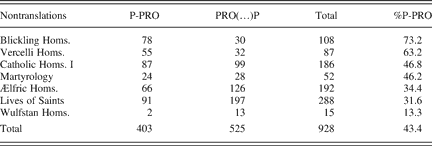
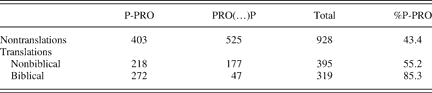
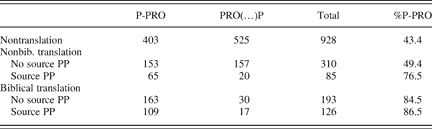
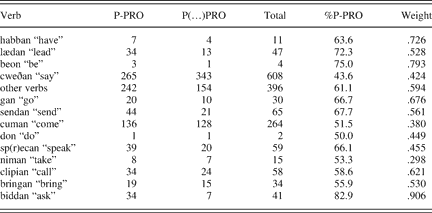
The preposition to differs from the other prepositions as follows. As noted in the body of the text, the major effect is the large and unexpected drop in the probability of P-PRO order in later texts, contrary to the behavior of the other prepositions. The only other preposition which shows a similar effect is fram, and here the difference is not significant (see note 5). The only other difference in the significance of factor groups is for clause type, which is not a significant factor for to, while it is for other prepositions. As far as the effect of the source is concerned (Table C10), the pattern for to is broadly similar to that of the other prepositions, but differs in showing higher weights for PPs with no source PP in both kinds of translations, albeit rather more strongly for biblical Latin. It is left to the interested reader to compare the frequencies and weights for individual factors given in Tables 1–10. There is no table for the case of the pronoun because to always takes the dative case. Verbs missing from Table C7 do not occur with to or are not variable with to in my data.
Percentage head-initial PP order with preposition to by translated text
Percentage head-initial PP order with preposition to by nontranslated text
A comparison of the frequency of head-initial PP order with preposition to in biblical and nonbiblical translations
A comparison of the frequency of head-initial PP order with preposition to with and without a Latin source PP
Percentages and factor weights for head-initial PP order with preposition to by person of the pronoun

Percentages and factor weights for head-initial PP order with preposition to by reflexivity of the pronoun

Percentages and factor weights for head-initial PP order with preposition to by verb
Percentages and factor weights for head-initial PP order with preposition to by clause type
Percentages and factor weights for head-initial PP order with preposition to by period

The frequency and weight for head-initial PPs with preposition to with and without a source PP comparing nontranslations and two kinds of translation