The nature and composition of diets given to ruminants influence milk production and composition. Generally, fresh forage in the diet increases the nutritional value of raw milk (Morand-Fehr et al. Reference Morand-Fehr, Fedele, Decandia and Frileux2007). However, pasture is not uniformly available during all seasons. In the Mediterranean area, the irregularity of rainfall and the hot weather during late spring and summer markedly reduce pasture availability (Boyazoglu & Morand-Fehr, Reference Boyazoglu and Morand-Fehr2001). In this zone it is necessary to apply animal husbandry practices that maximize the use of forage resources in order to reduce operating costs. Short grazing time is a common practice for dairy goats and sheep in Mediterranean countries (Avondo et al. Reference Avondo, Biondi, Pagano, Bonanno, Lutri, Cannas and Pulina2007). This system consists of taking the animals to pasture for 4–8 h/d, between milkings; a variable quantity of concentrate is provided during milkings, or after grazing, in order to improve the animals' diet.
Taking into account that the concentration of water-soluble carbohydrates (WSC) in temperate forages tends to increase over the day owing to photosynthetic activity within the plant (Smith, Reference Smith, Butler and Bailey1973), the hypothesis that shifting grazing time from morning to afternoon could improve lactation performances with reduced use of concentrate has been previously investigated with positive results (Avondo et al. Reference Avondo, Bonanno, Pagano, Valenti, Di Grigoli, Alicata, Galofaro and Pennisi2008). Considering that legumes are naturally rich in protein, the shift of the grazing time to the afternoon could be advantageous. Therefore, the aim of this study was to evaluate the effect of feeding fresh Berseem clover (Trifolium alexandrinum L.) harvested either in the morning or afternoon on feed intake, milk yield and milk composition in Girgentana goats.
Material and Methods
Animals and experimental design
Twenty pluriparous Girgentana goats with 85±12 days in milk were equally divided into two groups (AM and PM), which were balanced for milk yield (1515±235 g/d) and body weight (42·2±3·6 kg). Goats were housed in individual wooden pens equipped with trough and bucket and were offered 500 g/d of a pelleted concentrate mixture (19% crude protein in the dry matter). Mean daily temperature at the experimental site was 20°C; mean maximum value was 25 °C with peaks close to 30°C; mean relative humidity was 45%. Goats were hand-milked twice daily at 7.00 and 15.00.
The experiment began on 26 April after a 10-d pre-experimental period during which the goats received Berseem clover hay ad libitum and 500 g of concentrate mixture daily. The trial lasted 5 weeks and variables were recorded during 25 d. Fresh herbage was harvested daily from a sward of Berseem clover (Trifolium alexandrinum L.) at the early- to mid-bloom stage. Forage was mown twice daily, at 5 cm above ground level, along two adjacent strips (one for each time of day) of about 1 m×50 m: a total of 100 kg of forage at 9.00 and 100 kg of forage at 16.00 was collected daily. After each mowing, forage was thoroughly mixed and immediately supplied to the goats.
Each goat received 10 kg of fresh forage cut either at 9.00 or 16.00. Concentrate was given to both groups once a day before the forage.
Sample collection and analysis
Individual feed intakes were measured daily, on the basis of residuals left by each goat in its trough. Milk production and milk samples were individually collected and weighed, summing the morning and evening milking, every five days. Body weight was recorded at the start and end of the trial.
Five herbage samples for each cutting time (AM and PM) were collected on the same days as the milk collection (50 samples total). Samples of individual residuals were collected on those same days.
Forage and residual samples were analysed for dry matter (DM), crude protein (CP), fat (AOAC, 1990), structural carbohydrates (Van Soest et al. Reference Van Soest, Robertson and Lewis1991) and water-soluble carbohydrates (WSC) by a modified anthrone method (Deriaz, Reference Deriaz1961). Fatty acid content was determined on freeze-dried samples ground to pass a 1-mm screen. Lipid extraction and esterification were performed as described by Palmquist & Jenkins (Reference Palmquist and Jenkins2003). Nonadecanoic acid (19:0) was added as internal standard. Fatty acid methyl esters were analysed on a Trace Thermo Finnigan GC equipped with a flame ionization detector, on a 60 m×0·25 mm i.d. fused-silica capillary column (SP-2340, Supelco, Inc., Bellefonte PA, USA). The temperatures of injector and detector were maintained at 220°C and 250°C, respectively. The oven temperature was initially set at 160°C for 1 min, then increased at a rate of 3 deg/min to 210°C for 3 min. Helium was the carrier gas. Split flow was 20 ml/min. Injected volume was 1 μl, split ratio, 17.
Individual chemical composition of the forage selected by goats was calculated on the basis of individual residual weights and chemical composition, as follows (the calculation example is reported for crude protein):


where
CPI=crude protein intake (g/d)
ACP=crude protein provided by forage (g/d)
RCP=crude protein in the residual left in the trough (g/d)
SCP=Crude protein content of selected diet (% DM)
Milk samples, consisting of proportional volumes of morning and evening milk yield, were analysed for lactose, fat, protein, casein, urea and SCC, by an automated Fourier transform infrared absorption spectrophotometric analyzer (Combi-foss 6000, Foss Electric, Hillerød, Denmark).
N efficiency was calculated as follows: (g/d−1 of milk N yield/g d−1 N intake)/100; (Moharrery, Reference Moharrery2004).
Statistical analysis
Individual data for feed intake, chemical composition of forage and selected diet, milk production and composition were analysed using the GLM procedure for repeated measures of SPSS (SPSS for Windows, SPSS Inc., Chicago IL, USA). Pre-experimental data of milk production and composition and dry matter intake (DMI) were used as covariates, respectively, for milk production and composition and for DMI analysis. When covariantes were not significant (P>0·05) they were dropped from the statistical model.
Results
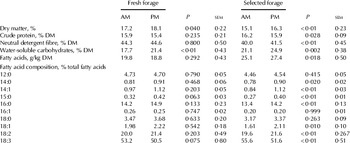
Concentrate was entirely consumed by each goat throughout the study. Table 1 shows the chemical composition and fatty acid profile of forage harvested either in the morning or afternoon and forage selected by the goats. Forage harvested at 16.00 had higher (P<0·05) DM and WSC content, compared with morning-cut forage (9.00). No differences were detected in fatty acid profile for forage harvested in the morning or afternoon. For forage selected by goats, CP was lower, whereas DM, neutral detergent fibre (NDF), WSC and total fatty acids were higher in the PM group. Fatty acid composition of the selected forage was partially influenced by treatment: 14:0, 14:1, 15:0, 16:0, 18:1, 18:2 were higher in the PM group, whereas 18:3 was lower, compared with the AM group. No differences were found in percentages of 12:0, 16:1 and 18:0 in forage selected by goats from that cut in the morning or afternoon.
Chemical composition of fresh Berseem clover forage cut either in the morning (9.00; AM group) or afternoon (16.00; PM group), and forage selected by Girgentana goats

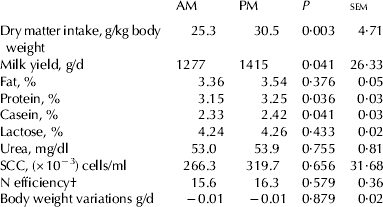
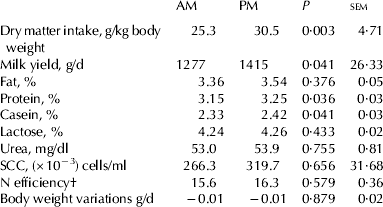
A significant increase (P<0·05) in feed intake was observed in the PM group (Table 2). Daily milk production, protein and casein content were significantly higher in the PM group, whereas no differences were found for fat, lactose or urea levels in milk and N efficiency. Body weight slightly decreased from the start to the end of the experiment, with no statistical differences between groups (Table 2).
Dry matter intake, milk yield and composition, N efficiency and body weight variations in Girgentana goats offered Berseem clover (Trifolium alexandrinum L.) cut either in the morning (9.00) or afternoon (16.00)
† (Milk N yield/N intake)*100
Discussion
Herbage composition, diet selection and intake
The level of WSC in the Berseem clover in the present study was extremely high (mean value 20% of DM). Values for clover are typically 5–10% of DM (Orr et al. Reference Orr, Penning, Harvey and Champion1997; Winters et al. Reference Winters, Minchin, Davies, Kingston-Smith, Theodorou, Griffith and Merry2004; Pelletier et al. Reference Pelletier, Tremblay, Bélanger, Bertrand, Castonguay, Pageau and Drapeau2010). However, marked variability occurs between varieties, phenological stages and years, depending on environmental conditions. Turner & Pollock (Reference Turner and Pollock1998) report mean values for sucrose and reducing sugars, respectively, of 12% and 4% for white clover stolons; however, a total sugars peak (sucrose + reducing sugars) of 25% was observed in winter. It seems that WSC may increase with a combination of factors leading to reduced growth (Longland & Byrd, Reference Longland and Byrd2006). Such factors as drought, and a strong solar radiation were present in the current experiment. Moreover in France, it was found that clover, during summer, reached a total free sugar concentration of 19% (Jarrige, 1954 cited by Bailey, Reference Bailey1958).
The main response of herbage to different cutting time, as expected, was an important increase in WSC content. The tendency of sugars to increase late in the day is in line with other studies with legumes (Owens et al. Reference Owens, Albrecht, Muck and Duke1999, Reference Owens, Albrecht and Muck2002; Fisher et al. Reference Fisher, Burns and Mayland2002; Burritt et al. Reference Burritt, Mayland, Provenza, Miller and Burn2005). Under our experimental conditions, WSC increased by, on average, 3·7 percentage points compared with AM-harvested forage. In legumes, Owens (Reference Owens, Albrecht, Muck and Duke1999) found an increase of 2·5 percentage points in WSC. Also, forage DMI was higher, as observed by Owens et al. (Reference Owens, Albrecht, Muck and Duke1999) in red clover and alfalfa fresh forage. Total fatty acid content of cut forage and selected herbage by goats in the present study was higher than data reported by Dalmannsdottir et al. (Reference Dalmnnsdottir, Helgadottir and Gudleifsson2001) but our values are in line with those reported by Lee et al. (Reference Lee, Connelly, Tweed, Dewhurst, Merry and Scollan2006), Wyss & Collomb (Reference Wyss, Collomb, Schnyder, Isselstein, Taube, Auerswald, Schellber, Wachendorf, Herrmann, Gierus, Wrage and Hopkins2010) and lower than those of Vanhatalo et al. (Reference Vanhatalo, Kuoppala, Toivonen and Shingfield2007).
Dry matter intake levels are in line with results for Mediterranean goats fed herbage (Bonanno et al. Reference Bonanno, Di Grigoli, Stringi, Di Miceli, Giambalvo, Tornambè, Vargetto and Alicata2007). The higher DMI observed in the PM group could be a behavioural response to a ‘sweeter’ forage. A similar effect of PM grazing or cutting on increased intake, compared with AM forage, has been reported for goats grazing a ryegrass sward (Avondo et al. Reference Avondo, Bonanno, Pagano, Valenti, Di Grigoli, Alicata, Galofaro and Pennisi2008), fed Switchgrass hay (Fisher et al. Reference Fisher, Burns and Mayland2005) or alfalfa hay (Burns et al. Reference Burns, Mayland and Fisher2005).
Indeed, each animal was able to choose a diet different in nutrient content, compared with the offered herbage (Table 1). On average, DM and NDF levels were lower and WSC, CP and fatty acids were higher in the forage selected by goats, compared with the herbage supplied to them. These differences can be associated with the choice activity that all the animals showed for green leaves and the more tender stems, as demonstrated by the morphological composition of the individual orts, predominately composed of dead material and the harder portions of stems. The ability of small ruminants to choose parts of plants with higher levels of protein and lower levels of structural carbohydrates is well known in grazing animals (Avondo & Lutri, Reference Avondo, Lutri and Pulina2004) but it is evident also in stall-fed animals (Forbes, Reference Forbes1995). This selection activity, associated with higher feed intakes, led goats of the PM group to consume more WSC, CP, NDF and fatty acids than goats offered the AM-harvested forage. Indeed, the selection activity showed by goats determined a different fatty acid composition of the ingested herbage: PM goats selected a diet significantly richer in all fatty acids, except for lauric, palmitoleic and stearic acids, which were not affected by treatments, and linolenic acid which, on the contrary, was lower in the PM selected herbage. Similar trends of the diet selected at pasture has been found previously for 14:0, 16:0, 18:1, 18:2 and 18:3 in ryegrass (Avondo et al. Reference Avondo, Bonanno, Pagano, Valenti, Di Grigoli, Alicata, Galofaro and Pennisi2008).
Milk yield and composition
Differences in chemical composition between the forage harvested in the morning or afternoon caused substantial differences in milk yield and composition between groups. A marked increase (P<0·05) in daily milk production was obtained in goats fed the PM forage. The different WSC levels of forages apparently improved diet utilization. In fact, a diet with a higher ratio between non-structural carbohydrates and CP is generally more efficient in terms of microbial protein synthesis, taking into account the high degradability of protein in fresh herbage (Avondo et al. Reference Avondo, Bonanno, Pagano, Valenti, Di Grigoli, Alicata, Galofaro and Pennisi2008). Miller et al. (Reference Miller, Moorby, Davies, Humphreys, Scollan, MacRae and Theodorou2001), feeding dairy cows with two ryegrass varieties with different WSC levels, found an increase in digestible DM intake in cows consuming the variety richer in WSC, which led to higher milk production, increased efficiency of nutrient utilization in the rumen, and a more efficient use of feed N for milk production. Higher milk production as a consequence of WSC accumulation in forages due to cutting or grazing time has been reported for cows (Trevaskis et al. Reference Trevaskis, Fulkerson and Nandra2004; Brito et al. Reference Brito, Tremblay, Bertrand, Castonguay, Bélanger, Michaud, Lapierre, Benchaar, Petit, Ouellet and Berthiaume2008). Contrasting with literature (Godden et al. Reference Godden, Lissemore, Kelton, Leslie, Walton and Lumsden2001; Moharrery, Reference Moharrery2004) the increased WSC/CP ratio obtained in our experimental conditions by shifting cutting time from morning to afternoon did not affect nitrogen efficiency. Indeed, urea, which is a good indicator of the balance between protein and non-structural carbohydrate sources (Bonanno et al. Reference Bonanno, Todaro, Di Grigoli, Scatassa, Tornambè and Alicata2008; Cannas, Reference Cannas and Pulina2004) did not change with cutting time, which is contrary to previous results, which indicate a reduction in milk urea levels when animals were fed with forage higher in non-structural carbohydrates (Avondo et al. Reference Avondo, Bonanno, Pagano, Valenti, Di Grigoli, Alicata, Galofaro and Pennisi2008). Nonetheless, the hypothesized improvement of N utilization efficiency seems to be demonstrated, apart from the increased milk yield, by higher protein and casein levels in milk from goats given the PM-cut clover, compared with the AM-harvested clover.
Conclusions
This study reaffirms that cutting Berseem forage in the afternoon instead of morning hours, substantially improves WSC levels. This increase in the availability of sugars due to the accumulation of these carbohydrates over the day, apparently led to a more palatable forage which brought about higher feed intake and, as a consequence, higher daily milk yield with higher protein and casein percentages.
The authors are grateful to the Associazione Regionale Allevatori della Sicilia, and in particular to Dr Imbrò, for the infrared analysis of milk samples.