Introduction
CHARGE syndrome is a multisystem disorder that manifests as coloboma, heart defects, atresia of the choanae, growth retardation and genital and ear anomalies. CHD7 variants account for most of the molecularly confirmed casesReference Song, Hwang, Koh, Moon and Cho1, Reference Aragón-Ramos, Pedrero-Escalas, Gavilán, Pérez-Mora, Herrán-Martin and Lassaletta2 and underlie the aberrant embryologic patterning of the otic capsule, cranial nerves and airway structures.Reference Ricci, Trabalzini, Faralli, D’Ascanio, Cristi and Molini3, Reference Amin, Sethukumar, Pai, Rajput and Nash4 Hearing loss (severe-to-profound) is common and is frequently accompanied by temporal bone dysplasia and cochlear nerve deficiency.Reference Wick, Moore, Killeen and Isaacson5, Reference Hsieh, Sun, Lin, Gotamco, Hsu and Wu6 When hearing aids provide insufficient access to sound, cochlear implantation (CI) becomes the primary restorative option; however, outcomes vary widely, reflecting heterogeneity in the inner ear anatomy, nerve integrity, neurodevelopment and co-morbidity burden.Reference Lin, Ren, Fan, Li, Ding and Qiu7–Reference Dettman, Dowell, Choo, Arnott, Abrahams and Davis10
Surgery is technically demanding because of facial nerve aberrancy, narrow facial recess, incomplete partitions or hypoplastic cochleae, stenotic internal auditory canals (IACs), semicircular canal aplasia and electrode trajectory.Reference Amin, Sethukumar, Pai, Rajput and Nash4–Reference Hsieh, Sun, Lin, Gotamco, Hsu and Wu6, Reference Young, Tournis, Sandy, Hoff and Ryan11, Reference Holcomb, Rumboldt and White12 Moreover, airway abnormalities (choanal atresia, tracheo/laryngomalacia and subglottic stenosis) increase the risk of anesthesia and post-operative respiratory needs.Reference Ricci, Trabalzini, Faralli, D’Ascanio, Cristi and Molini3, Reference Peng, Kuan, Hagan, Wilkinson and Miller13, Reference Szleper, Lachowska, Wojciechowski and Pronicka-Iwanicka14 Previous reports have described successful CI using tailored approaches, including transcanal/modified Ramo techniques, when the mastoid-facial recess route is hazardous or inadequate.Reference Young, Tournis, Sandy, Hoff and Ryan11, Reference Holcomb, Rumboldt and White12, Reference Morimoto, Wiggins, Hudgins, Hedlund, Hamilton and Mukherji15 The prognosis depends on the presence and caliber of the cochlear nerve on magnetic resonance imaging (MRI), realistic counselling about speech-language trajectories and rehabilitation demands.Reference Amin, Sethukumar, Pai, Rajput and Nash4, Reference Hsieh, Sun, Lin, Gotamco, Hsu and Wu6–Reference Blake, Davenport, Hall, Hefner, Pagon and Williams8, Reference Dettman, Dowell, Choo, Arnott, Abrahams and Davis10
Herein, we present a decade of institutional experience with CI in CHARGE syndrome, emphasising peri-operative and anatomic considerations and situating our outcomes within a focused literature review. This study addresses the limited long-term institutional data and underreported peri-operative airway management, offering one of the few decade-long single-centre experiences.
Methods
Study design and patients
This retrospective case series was conducted at a single tertiary centre that reviewed the data of consecutive paediatric patients with CHARGE syndrome who underwent CI between January 2014 and December 2024. Diagnosis was based on clinical criteria and/or confirmed CHD7 genetic variants. The inclusion criteria were as follows: (1) diagnosis of CHARGE syndrome, (2) severe-to-profound sensorineural hearing loss with limited benefit from hearing aids and (3) at least 12 months of post-operative follow-up for outcome analyses. Patients with shorter follow-up periods were included descriptively for the surgical and anatomical data. All patients who met the inclusion criteria during the study period were consecutively included, ensuring transparency and minimising selection bias. No patients were excluded, as complete datasets were available for all cases. This study was approved by the Ethics Committee of Tokyo Medical University (approval number: T2020-0364). Written informed consent was obtained from the parents of the patients for the use of personal information, privacy protection and publication.
Pre-operative assessment
All patients underwent a comprehensive pre-operative evaluation, including detailed history and physical examination; multidisciplinary consultation involving otolaryngology, paediatric anesthesia and cardiology as indicated; high-resolution computed tomography (CT) and MRI of the temporal bones to assess the cochlear morphology, semicircular canal development, IAC dimensions and cochlear nerve status; auditory brainstem response (ABR) and behavioural audiometry when feasible; and airway evaluation using flexible laryngoscopy and/or bronchoscopy based on clinical symptoms and disease history.
Surgical strategy
The surgical approach was tailored to each patient’s individual anatomy. A posterior tympanotomy via the facial recess was preferred, when feasible. The transcanal or combined transmastoid–transcanal approaches were selected for patients with narrow recesses, aberrant facial nerve courses or limited round-window access. The choice of electrode was based on cochlear duct length and malformation type. Routine intra-operative facial nerve monitoring was performed.
Post-operative care and outcomes
Patients with a significant airway risk were post-operatively admitted to the paediatric intensive care unit for planned monitoring. Device activation and mapping were performed according to the standard paediatric protocols. Outcomes were assessed at the last follow-up and included aided sound-field thresholds, age-appropriate speech perception (closed- and open-set) and caregiver-reported functional listening.
Post-operative quality-of-life assessment
The quality of life of the children after CI was assessed using the Nijmegen Cochlear Implant Questionnaire (NCIQ). Before computing the six subdomains of the NCIQ, the scores for the 27 items of the questionnaire phrased in opposite forms were recoded (score of 6). Next, the answer categories (1–5) for all items were transformed as follows: 1 = 0, 2 = 25, 3 = 50, 4 = 75 and 5 = 100. Subdomain scores were computed by combining the 10-item scores of each subdomain and dividing them by the number of completed items. Due to the small sample size, formal statistical analyses were not performed. Continuous variables are presented as means and ranges, and categorical variables as counts and percentages. No missing data were present.
The NCIQ was selected because it is a widely used and validated instrument to assess health-related quality of life in CI recipients, and it has also been applied in paediatric populations in previous reports. In this study, the standard version was used without modification, as the children were of sufficient age to complete the questionnaire with parental support when required. All questionnaires were fully completed, and no missing data were present.
Ethical standards and informed consent
All procedures contributing to this work comply with the ethical standards of the relevant national and institutional guidelines on human experimentation and with the Helsinki Declaration of 1975, as revised in 2008. This study was approved by the Ethics Committee of the Tokyo Medical University (receipt number: T2020-0364). Written informed consent was obtained from parents of patients for the use of personal information, privacy protection and publication.
Results
Cohort
Overall, six children (four boys) underwent nine CI surgeries. The median age at CI was 3.8 years (range, 1.5–8.2). All patients had either CHD7 variants or classic CHARGE features. Additionally, four patients (67 per cent) had congenital heart disease, two (33 per cent) had choanal atresia and five (83 per cent) had airway anomalies (laryngomalacia, n = 3; tracheomalacia, n = 2; subglottic stenosis, n = 1). Three patients underwent prior tracheostomies (Table 1).
Airway characteristics and peri-op events

Five patients (83%) had airway anomalies (laryngomalacia, n = 3; tracheomalacia, n = 2; subglottic stenosis, n = 1). Three patients (x%) had prior tracheostomy. Two patients (33%) required planned ICU monitoring for airway stability; no unplanned reintubations occurred. Abbreviations: ICU, intensive care unit; OSA, obstructive sleep apnea; Peri-op, peri-operative; Post-op, post-operative
Imaging and inner ear/canal anatomy
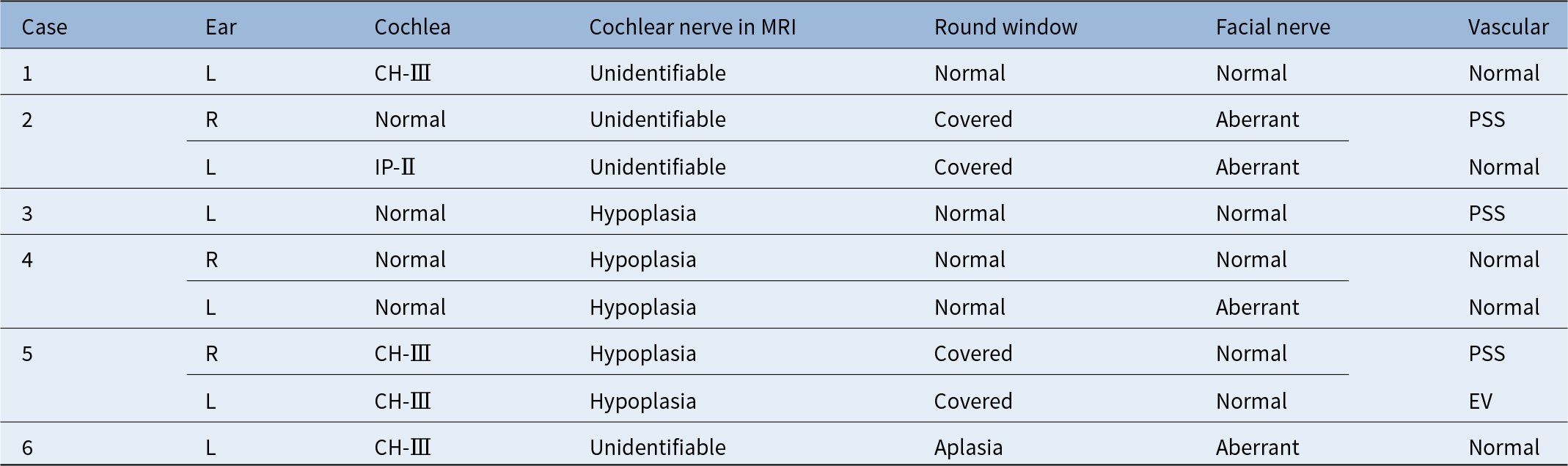
Temporal bone anomalies were observed in seven of nine ears (78 per cent). The cochlear malformations included incomplete partition type II (IP-II) (n = 1) and cochlear hypoplasia (n = 4). Semicircular canal aplasia/dysplasia was frequently observed in the affected ear. Notably, the cochlear nerve was hypoplastic in all ears; one ear showed MRI evidence of aplasia with a severely narrowed IAC (Table 2).
MRI, CT, and surgical findings

The cochlear nerve was hypoplastic in all ears; one ear showed MRI evidence of aplasia with a severely narrowed internal auditory canal. Abbreviations: L, left; R, right; PSS, petrosquamosal sinus; EV, enlarged vestibule; MRI, magnetic resonance imaging; CT, computed tomography.
Operative course
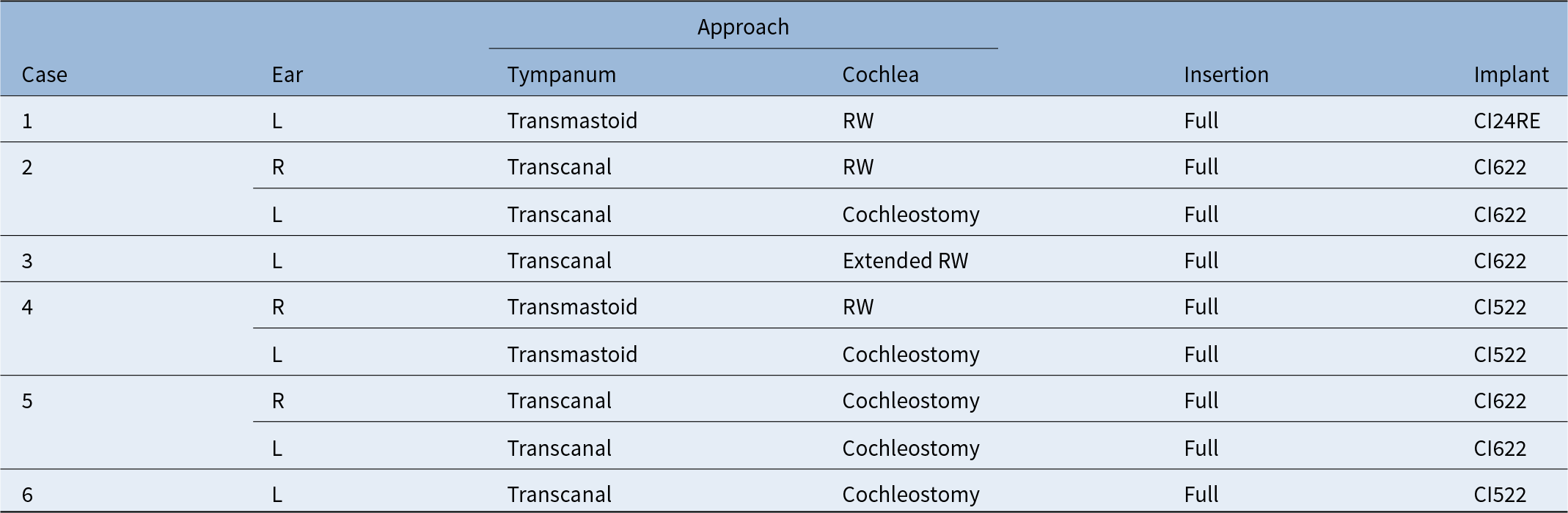
Posterior tympanotomy was feasible in three ears (33 per cent). In six ears (67 per cent), transcanal or combined approaches were chosen because of a narrow facial recess or aberrant nerve course. Cochleostomy (n = 5) and posterior tympanotomy were feasible in three (33per cen) ears. Cochleostomy and round window (RW) approaches were performed in five and four ears, respectively. Aberrant facial nerve courses, vascular anomalies and hypoplastic or obscured RWs were frequently encountered, necessitating careful modification of the surgical corridor. Straight cochlear electrodes were used in all cases, and full-electrode insertion was achieved without major intra-operative complications. The choice of approach and electrode stylet supported stable placement of the scala tympani, despite the malformed anatomy (Table 3).
Implantation approaches

Full electrode insertion was achieved in all ears; there were no major intraoperative complications. Abbreviations: L, left; R, right; RW, round window
Post-operative course and audiologic outcomes
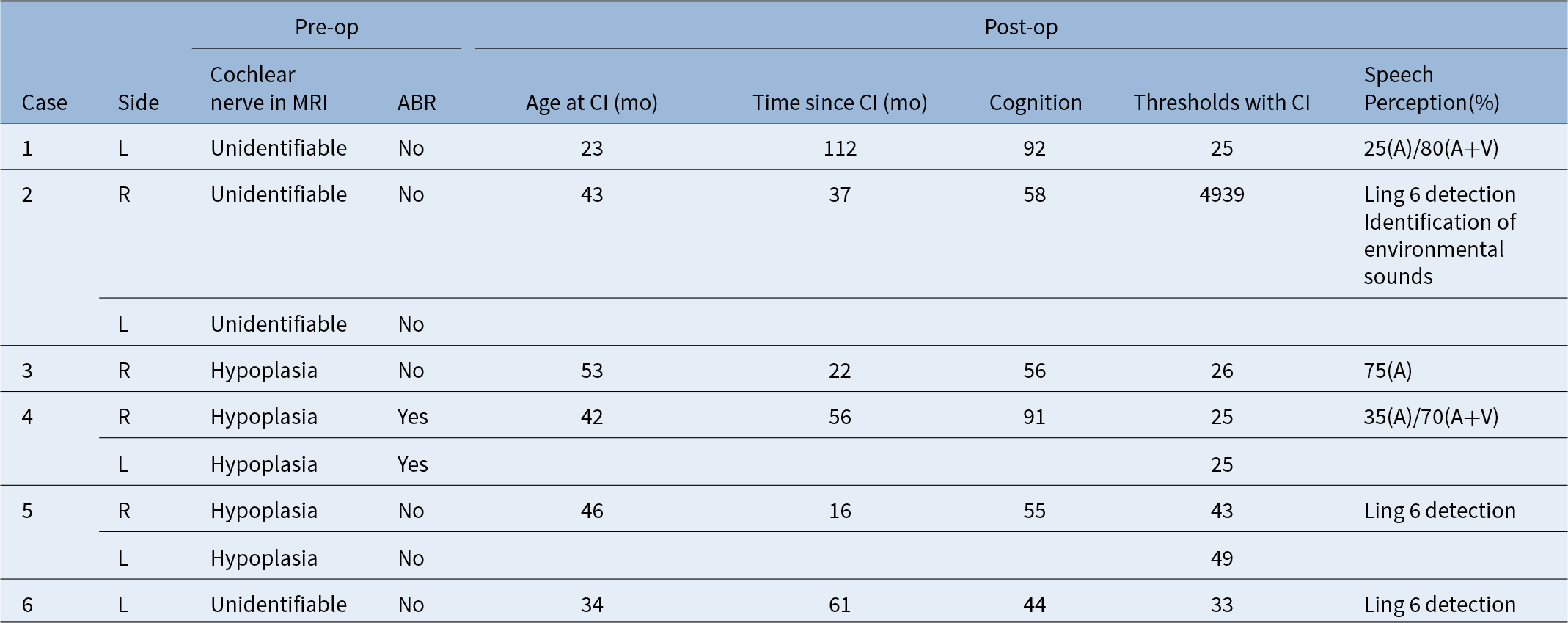
Two patients (33 per cent) required planned intensive care unit (ICU) monitoring for airway stability, and no unplanned reintubation occurred (Table 1). At a median follow-up of 3.4 years, the aided thresholds were 25–50 dB hearing loss (HL). Three children achieved an open-set speech perception of greater than 70 per cent, two achieved reliable closed-set recognition with limited open-set ability and one child, who had cochlear nerve aplasia, primarily demonstrated environmental sound awareness. No device failures or explanations were observed (Table 4).
Auditory performance and communication outcomes

Aided thresholds were 25–50 dB HL. A positive result in at least one of MRI, ABR, and subjective audiometry, some auditory benefit can be expected after cochlear implantation.
Abbreviations: L, left; R, right; MRI, magnetic resonance imaging; ABR, auditory brainstem response; CI, cochlear implantation
Auditory performance and communication mode
The cochlear nerve was either unidentifiable or hypoplastic on MRI in all ears. In our series, CI was performed in ears with absent ABR and unidentifiable nerves on MRI only when consistent behavioural or hearing-aid responses were observed. This reflected that functional evidence can complement imaging and electrophysiological findings in decision-making. All patients had hearing thresholds between 25 and 50 dB following CI. Additionally, speech perception tests were performed in three patients, and the results were better than 70 per cent under the combined visual conditions. In four ears in three children, there were no responses with the ABR/ASSR and no confirmation of the cochlear nerve on MRI, which did not allow us to rule out aplasia of the cochlear nerve; however, we observed reliable responses while using hearing aids. The decision to conduct CI was based on the subjective audiometric responses of these patients, as they showed auditory profit ranging from the identification of environmental sounds to speech perception scores of 80 per cent. Notably, MRI findings of the cochlear nerve do not always correlate with the ABR results or the auditory benefits of CI. We believe that, if a positive result is observed in at least one patient, some auditory benefits can be expected after CI (Table 4).
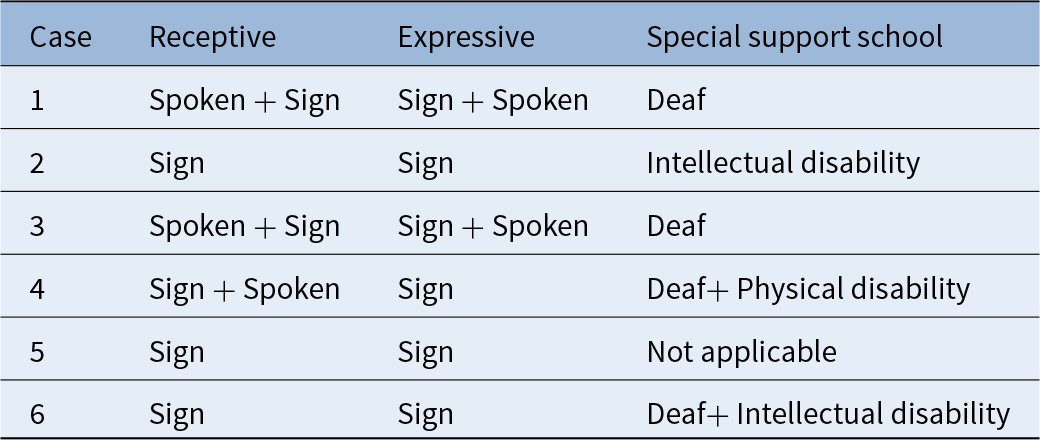
Receptive communication is the process of receiving and understanding messages from another person; this can be considered the input. Expressive communication is a message sent to another person; this can be considered the output. Receptive and expressive communication may differ among children with hearing impairments.
All six children used sign language or simpler gestures as their primary modes of communication. Among these, three also attained some spoken language as a receptive language, and two of them could use spoken language at the level of simple daily conversation as an expressive language. All five school-aged children were enrolled in special support schools (Table 5).
Communication modes

All six children used sign language, or simpler gestures, as their main mode of communication.
Quality of life after CI
The maximum achievable NCIQ score was 300, and the average total score in this study was 125.5 (range, 81–169). After converting each answer to a point out of 100, the average scores in each subdomain were 23.0 (range, 7.5–32.5) for basic sound perception, 30.8 (range, 5–60) for advanced sound perception, 17.8 (range, 12.5–30) for speech production, 65.4 (range, 50–77.5) for self-esteem, 58.1 (range, 25–85) for activity limitation and 54.1 (range, 32.5–72.5) for social interaction. In the sound perception and speech production domains, the absolute scores were low. However, in all domains, the scores were higher than zero for all patients in the study group (Figure 1). Some parents added positive comments to the questionnaire regarding the changes they observed in their children after the implantation.
Quality of life after cochlear implantation: 6 domains of the NCIQ.

Discussion
Principal findings
Our series demonstrated that following CI, meaningful auditory access and, in many cases, functional speech perception is attainable for children with CHARGE, provided that (1) cochlear nerve integrity is confirmed or reasonably inferred on MRI/ABR,Reference Amin, Sethukumar, Pai, Rajput and Nash4, Reference Hsieh, Sun, Lin, Gotamco, Hsu and Wu6, Reference Dettman, Dowell, Choo, Arnott, Abrahams and Davis10 (2) approach selection accommodates facial recess constraints and malformed cochleae (often via transcanal or combined routes)Reference Young, Tournis, Sandy, Hoff and Ryan11, Reference Holcomb, Rumboldt and White12, Reference Morimoto, Wiggins, Hudgins, Hedlund, Hamilton and Mukherji15 and (3) airway risks are proactively managed with paediatric anesthesia and ICU planning.Reference Ricci, Trabalzini, Faralli, D’Ascanio, Cristi and Molini3, Reference Peng, Kuan, Hagan, Wilkinson and Miller13, Reference Szleper, Lachowska, Wojciechowski and Pronicka-Iwanicka14 These findings align with multicentre experiences and systematic reviews reporting substantive gains in auditory skills among CHARGE CI recipients.Reference Lin, Ren, Fan, Li, Ding and Qiu7, Reference Blake, Davenport, Hall, Hefner, Pagon and Williams8, Reference Young, Tournis, Sandy, Hoff and Ryan11, Reference D’Arco, Sanverdi, O’Brien, Taranath, Talenti and Blaser16, Reference Williams, Taylor, Ling, Candido-Ferreira, Fountain and Mayes17
Anatomic complexity and surgical approach
A systematic review of RW approaches underscores the importance of individualised surgical planning for malformed cochleae.Reference da Costa Monsanto, Knoll, de Oliveira Penido, Song, Santos and Paparella18 Temporal bone malformations are the rule rather than the exception in CHARGE syndrome. Incomplete partitions, cochlear hypoplasia, dysplastic or absent semicircular canals and aberrant facial nerve trajectories complicate the standard posterior tympanotomy corridor.Reference Amin, Sethukumar, Pai, Rajput and Nash4–Reference Lin, Ren, Fan, Li, Ding and Qiu7, Reference Holcomb, Rumboldt and White12, 19 Our reliance on transcanal or combined approaches in two-thirds of ears mirrors the strategy shifts described in technique papers and case series, wherein modified Rambo or canal-wall manoeuvers expand access to the RW and basal turn while minimising facial nerve risk.Reference Young, Tournis, Sandy, Hoff and Ryan11, Reference Holcomb, Rumboldt and White12, Reference Morimoto, Wiggins, Hudgins, Hedlund, Hamilton and Mukherji15 The high rate of full-electrode insertions in our cohort underscores the value of pre-operative CT/MRI-based planning, intra-operative facial nerve monitoring and malformation-aware surgical mindsets.Reference Legendre, Abadie, Attié-Bitach, Philip, Busa and Bonneau20
Cochlear nerve deficiency: prognostic spine of decision-making
Among the determinants of CI outcomes in the CHARGE trial, the presence and caliber of the cochlear nerve are essential.Reference Amin, Sethukumar, Pai, Rajput and Nash4, Reference Hsieh, Sun, Lin, Gotamco, Hsu and Wu6, Reference Dettman, Dowell, Choo, Arnott, Abrahams and Davis10 The patient with the poorest auditory outcomes exhibited features of nerve aplasia on MRI, which is consistently associated with limited speech perception and environmental sound awareness at best.Reference Dettman, Dowell, Choo, Arnott, Abrahams and Davis10 Conversely, hypoplastic nerves can sustain robust outcomes with consistent mapping and therapy as observed in our open-set performers.Reference Lin, Ren, Fan, Li, Ding and Qiu7, 9, Reference D’Arco, Sanverdi, O’Brien, Taranath, Talenti and Blaser16 Pre-operatively, families should be counselled with MRI-informed expectations, outlining a spectrum from environmental awareness to open-set speech and the potential consideration of auditory brainstem implantation (ABI) when the cochlear nerve is absent or severely hypoplastic.Reference Amin, Sethukumar, Pai, Rajput and Nash4, Reference Hsieh, Sun, Lin, Gotamco, Hsu and Wu6–Reference Blake, Davenport, Hall, Hefner, Pagon and Williams8
Peri-operative airway risks and ICU planning
Airway anomalies, including choanal atresia, laryngomalacia, tracheomalacia and subglottic stenosis, are prevalent in patients with CHARGE syndrome. Rather than otologic complications, airway events often determine the peri-operative risk.Reference Ricci, Trabalzini, Faralli, D’Ascanio, Cristi and Molini3, Reference Peng, Kuan, Hagan, Wilkinson and Miller13, Reference Szleper, Lachowska, Wojciechowski and Pronicka-Iwanicka14 In our study, one-third of our patients required planned post-operative ICU care, consistent with the peri-operative CHARGE CI management series that emphasises pre-operative airway assessment, use of smaller endotracheal tubes, smooth emergence and low thresholds for ICU monitoring.Reference Ricci, Trabalzini, Faralli, D’Ascanio, Cristi and Molini3, Reference Peng, Kuan, Hagan, Wilkinson and Miller13 Team briefings with paediatric anesthesiologists and ICU staff, along with checklist-based planning, can mitigate desaturation and prolonged ventilation risks without delaying implant activation.
Outcomes and rehabilitation
Long-term follow-up studies have also affirmed that syndromic cases, including those with CHARGE syndrome, can attain significant speech and language milestones after CI.Reference Dhanasingh, Nielsen, Beal, Schilp, Hessler and Jolly21
Our aided thresholds (25–50 dB HL) and open-set speech perception in half of the patients align with the results of recent paediatric CHARGE CI publications and neuro-otology series reporting meaningful speech perception in a substantial subset, whereas others demonstrate closed-set gains or environmental awareness depending on nerve integrity and neurodevelopment.Reference Lin, Ren, Fan, Li, Ding and Qiu7, Reference Blake, Davenport, Hall, Hefner, Pagon and Williams8, Reference Dettman, Dowell, Choo, Arnott, Abrahams and Davis10, Reference Young, Tournis, Sandy, Hoff and Ryan11, Reference D’Arco, Sanverdi, O’Brien, Taranath, Talenti and Blaser16, Reference Williams, Taylor, Ling, Candido-Ferreira, Fountain and Mayes17 Expectations should include developmental co-morbidities, visual impairment due to colobomas and vestibular dysfunction, all of which can delay language acquisition and motor milestones.9, Reference Williams, Taylor, Ling, Candido-Ferreira, Fountain and Mayes17, Reference Aljazeeri, Alturaiki, Abdelsamad, Alzhrani and Hagr22 Additionally, early intensive auditory–verbal therapy, visual support and tailored educational plans are essential.Reference Williams, Taylor, Ling, Candido-Ferreira, Fountain and Mayes17 Meanwhile, the family’s rehabilitation capacity and coordinated habilitation often explain inter-individual variability as much as anatomy does.9, Reference Williams, Taylor, Ling, Candido-Ferreira, Fountain and Mayes17 Furthermore, a quality-of-life assessment using the NCIQ demonstrated positive changes across multiple domains, particularly in self-esteem, activity and social interaction, suggesting that the benefits of CI in patients with CHARGE syndrome extend beyond auditory performance. This finding is also consistent with the original validation of the NCIQ as a reliable tool for assessing health-related quality-of-life outcomes after CI.Reference Hinderink, Krabbe and Van Den Broek23 These findings are clinically relevant because they inform candidacy assessment, guide realistic family counselling regarding expected outcomes and underscore the importance of integrating tailored rehabilitation strategies.
Previous paediatric cohort studies on CHARGE syndrome have similarly demonstrated variable but meaningful outcomes post-CI.Reference Sokolov, Raveh, Yaniv, Reuven, Ulanovski and Barkan24 Our anatomic findings, including IP-II, cochlear hypoplasia and semicircular canal dysplasia, are consistent with the high prevalence of these conditions reported in other histopathological and imaging studies of CHARGE syndrome.Reference Amin, Sethukumar, Pai, Rajput and Nash4–Reference Lin, Ren, Fan, Li, Ding and Qiu7, Reference Holcomb, Rumboldt and White12, 19 The proportion of ears requiring non-standard approaches parallels reports advocating transcanal or modified Ramo techniques when the facial recess is inadequate or unsafe.Reference Young, Tournis, Sandy, Hoff and Ryan11, Reference Holcomb, Rumboldt and White12, Reference Morimoto, Wiggins, Hudgins, Hedlund, Hamilton and Mukherji15 Outcome heterogeneity maps closely with nerve status and global developmental burden, as highlighted by paediatric neurotology and multicentre cohorts.Reference Lin, Ren, Fan, Li, Ding and Qiu7, Reference Blake, Davenport, Hall, Hefner, Pagon and Williams8, Reference Dettman, Dowell, Choo, Arnott, Abrahams and Davis10, Reference Young, Tournis, Sandy, Hoff and Ryan11, Reference D’Arco, Sanverdi, O’Brien, Taranath, Talenti and Blaser16, Reference Williams, Taylor, Ling, Candido-Ferreira, Fountain and Mayes17 Contemporary consensus statements and peri-operative series reinforce our emphasis on early multidisciplinary planning, airway-first safety culture and realistic MRI-informed counselling.Reference Ricci, Trabalzini, Faralli, D’Ascanio, Cristi and Molini3, Reference Peng, Kuan, Hagan, Wilkinson and Miller13, Reference Szleper, Lachowska, Wojciechowski and Pronicka-Iwanicka14 Support from organisations, such as the CHARGE Syndrome Foundation, has enabled ongoing advancements in understanding and treating this complex condition.25
This study had some limitations. This was a small, single-centre, retrospective series reflecting the rarity of CHARGE syndrome and the complexity of CI candidacy. Selection bias is possible, as children with frank cochlear nerve aplasia may have been counselled away from CI or toward ABI.Reference Dettman, Dowell, Choo, Arnott, Abrahams and Davis10 Additionally, measures of language and cognition were not uniformly available across the age groups. Nevertheless, our data add granularity to the approach selection and outcome expectations and align with the results of multi-institutional evidence.Reference Lin, Ren, Fan, Li, Ding and Qiu7, Reference Blake, Davenport, Hall, Hefner, Pagon and Williams8, Reference Young, Tournis, Sandy, Hoff and Ryan11, Reference D’Arco, Sanverdi, O’Brien, Taranath, Talenti and Blaser16, Reference Williams, Taylor, Ling, Candido-Ferreira, Fountain and Mayes17 Future studies should include multicentre cohorts with standardised speech, cognition and quality-of-life measures to validate these findings and investigate the comparative efficacy of CI versus ABI in patients with severe cochlear nerve hypoplasia or aplasia.
Practical recommendations
MRI should be performed in all patients with CHARGE syndrome who are candidates for CI to determine the cochlear nerve status. Additionally, families should be counselled using examples of the IAC and nerve caliber, with explanation of the anticipated auditory outcomes following intervention.Reference Amin, Sethukumar, Pai, Rajput and Nash4, Reference Hsieh, Sun, Lin, Gotamco, Hsu and Wu6, Reference Dettman, Dowell, Choo, Arnott, Abrahams and Davis10 The surgical corridor (posterior tympanotomy vs. transcanal/combined) should be planned based on imaging findings while anticipating aberrant facial nerves and narrow recesses.Reference Young, Tournis, Sandy, Hoff and Ryan11, Reference Holcomb, Rumboldt and White12, Reference Morimoto, Wiggins, Hudgins, Hedlund, Hamilton and Mukherji15 Standardised airway protocols include pre-operative airway endoscopy (if indicated), use of smaller cuffed tubes, smooth emergence and ICU planning for high-risk patients.Reference Ricci, Trabalzini, Faralli, D’Ascanio, Cristi and Molini3, Reference Peng, Kuan, Hagan, Wilkinson and Miller13, Reference Szleper, Lachowska, Wojciechowski and Pronicka-Iwanicka14 Expectations should be managed realistically; outcomes may range from environmental awareness to open-set speech recognition. ABI candidacy should be discussed if the cochlear nerve is absent.Reference Lin, Ren, Fan, Li, Ding and Qiu7, Reference Blake, Davenport, Hall, Hefner, Pagon and Williams8, Reference Dettman, Dowell, Choo, Arnott, Abrahams and Davis10 Rehabilitation should be reinforced to initiate early auditory–verbal therapy, provide visual support and coordinate school integration.9, Reference Williams, Taylor, Ling, Candido-Ferreira, Fountain and Mayes17 Lanson et al. reported one of the earliest clinical series of CI in children with CHARGE syndrome, emphasising variable outcomes and the importance of individualised management.Reference Lanson, Green, Roland, Lalwani and Waltzman26
In conclusion, CI in patients with CHARGE syndrome provides reliable access to sound and functional speech perception in a substantial proportion of carefully selected children. A successful outcome depends on nerve-centric candidacy, malformation-aware surgical strategies (often requiring transcanal or combined approaches) and airway-focused peri-operative planning. Our outcomes and operative choices reflect contemporary literature and consensus and offer a practical framework for centres managing these uniquely complex patients. To further strengthen clinical decision-making and validate these findings, future research should include multicentre collaborations, standardised outcome measures and long-term quality-of-life assessments.
• What is already known on this subject:
• CHARGE syndrome is a multisystem disorder frequently associated with ear malformations, cochlear nerve deficiency and severe-to-profound hearing loss
• Cochlear implantation can provide auditory access and enable functional speech perception in children with CHARGE syndrome, although outcomes vary depending on inner ear anatomy, nerve integrity and neurodevelopmental co-morbidities
• What this paper adds:
• A 10-year single-centre experience demonstrates that cochlear implantation provides meaningful auditory benefit in carefully selected children with CHARGE syndrome
• Pre-operative cochlear nerve imaging, malformation-aware surgical strategies (including transcanal or combined approaches) and coordinated peri-operative airway management are critical to achieving successful outcomes
• Practical guidance is provided for surgical planning, peri-operative management and realistic counselling of families regarding expected auditory performance
Conclusion
Cochlear implantation can provide meaningful auditory benefit in selected children with CHARGE syndrome. Pre-operative cochlear nerve imaging, flexible surgical planning and coordinated peri-operative airway management are essential.
Funding
This research did not receive any specific grant from funding agencies in the public, commercial or not-for-profit sectors.
Competing interests
The authors declare no competing interests.
Authors’ contributions
Nanoka Sugamo: Investigation, Writing - Original Draft. Ryota Tomioka: Formal Analysis, Visualisation. Kyoko Shirai: Conceptualisation, Resources, Supervision. Nobuhiro Nishiyama: Resources. Keitaro Miyake: Resources. Teruhisa Yano: Resources. Sayaka Arai: Resources. Kiyoaki Tsukahara: Project administration.
Acknowledgements
The authors thank Editage (www.editage.com) for English language editing.