1. Introduction
Studies of children who acquire two languages simultaneously have shown that these children have two independent linguistic systems from the outset (see Paradis, Reference Paradis, Auer and Wei2007, for review). While these bilingual children are capable of differentiating their two languages from early on, the appearance of systematic influence of one language on another has been reported at different linguistic levels such as syntax (Hulk, Reference Hulk1997; Döpke, Reference Döpke1998, Reference Döpke2000; Müller, Reference Müller1998; Hulk and Müller, Reference Hulk and Müller2000; Yip and Mathews, Reference Yip and Matthews2000; Müller and Hulk, Reference Müller and Hulk2001; Paradis and Navarro, Reference Paradis and Navarro2003; Serratrice, Sorace and Paoli, Reference Serratrice, Sorace and Paoli2004; Hacohen and Schaeffer, Reference Hacohen and Schaeffer2007; Kupisch, Reference Kupisch2007a, Reference Kupisch, Chan, Jacob and Kapiab), phonology (Paradis, Reference Paradis2001; Kehoe, Lleó and Rakow, Reference Kehoe, Lleó and Rakow2004) and derivational morphology (Nicoladis, Reference Nicoladis2002, Reference Nicoladis2003a, Reference Nicoladisb). Following these observations, considerable attention has been directed towards identifying factors that are responsible for the crosslinguistic influence of one language on another.
One of the factors that have been proposed as a source of crosslinguistic transfer is structural overlap (Müller, Reference Müller1998; Hulk and Müller, Reference Hulk and Müller2000; Müller and Hulk, Reference Müller and Hulk2001). Structural overlap can be defined as follows: if language A allows more than one option for a structure, and language B overlaps with one of those options, crosslinguistic influence may occur. In this case, the language B-type option in language A is favored over the option not overlapping with language B, which could result in the bilingual child producing utterances in language A with the language B-type option for the target structure more often than monolinguals. More broadly, it is possible that the presence of one option in language B creates some ambiguity about the appropriate underlying structure in language A, and perhaps even delay in the convergence on the appropriate structure. On this account, crosslinguistic influence is predicted to occur in a unidirectional way, from language B to language A.Footnote 1
Furthermore, crosslinguistic influence can take the form of transfer of a pattern, like word order, from one language to another, and it can also take the form of deceleration or acceleration of the rate of acquisition of a target structure, for example, the prolongation of a developmental stage in acquisition, such as, direct object omissions in Romance languages (cf. Paradis and Genesee, Reference Paradis and Genesee1996; Müller and Hulk, Reference Müller and Hulk2001).
Evidence has been found to support the presence of transfer of patterns, or crosslinguistic structures, in bilingual acquisition where conditions of structural overlap, as described by Müller and Hulk, are met. Döpke (Reference Döpke1998) reported transfer from English verb–complement word order to German verb–complement word order, but not from German to English, in bilingual children. English has a fixed position for the main verb, and the main verb always precedes its complement. In contrast, German allows complements to be on the left or right side of the main verb. Consistent with the prediction of the overlap hypothesis, the interference occurred in a unidirectional way where the variable verb position in German (language A) was influenced by the unambiguous verb position in English (language B). Other evidence comes from Müller (Reference Müller1998) with regard to word order in subordinate clauses in German, English, French and Italian. In German, various word orders are used in main clauses and only the verb-final pattern appears in subordinate clauses. In contrast, verbs in the final position of subordinate clauses are not permitted in English, French and Italian. As a result, bilingual children had more trouble with German, and transfer was observed from their other language to German but not from German to their other language. Paradis and Navarro (Reference Paradis and Navarro2003) examined the use of overt subjects in Spanish by a Spanish–English bilingual child, and three Spanish monolingual children. English requires the use of overt grammatical subjects, but in Spanish, grammatical subjects can be omitted if the referent can be retrieved from discourse; thus, both null and overt subjects appear in the Spanish input children hear. Paradis and Navarro (Reference Paradis and Navarro2003) found that the bilingual child produced more redundant (overt) subjects in her Spanish than her monolingual peers, possibly due to the influence of English (see also Serratrice et al., Reference Serratrice, Sorace and Paoli2004, for Italian–English, and Hacohen and Schaeffer, Reference Hacohen and Schaeffer2007, for Hebrew–English). All these studies indicate that transfer can occur under the condition where the language permitting only one structural option directs children towards that particular option in the language allowing more than one structural option. In addition, Paradis and Genesee (Reference Paradis and Genesee1996) and Hulk and Müller (Reference Hulk and Müller2000) did not find evidence for crosslinguistic influence in the acquisition of obligatory finiteness in bilingual children; this outcome could be because in Romance–Germanic language pairs, the conditions of structural overlap are not met for this linguistic domain.
Despite the weight of evidence supporting the explanatory role of structural overlap in transfer, in a few cases, no evidence of transfer in the presence of structural overlap has been found. For example, despite the structural overlap between French and English in noun–adjective order, that is, both have pre-nominal adjectives, but French allows post-nominal adjectives as well, the French–English bilingual child studied in Nicoladis (Reference Nicoladis1999) was quite accurate in his placement of adjectives. Furthermore, in some other cases, the effect of transfer has been reported in the absence of structural overlap. For example, the child in Nicoladis’ (Reference Nicoladis1999) study showed inaccuracies in the ordering of compounds in both English and French, whose noun–noun compounds are rigidly right- and left-headed, respectively. In another study with a group of French–English bilinguals, Nicoladis (Reference Nicoladis2002) also found evidence of compound reversals, in both directions, in children's French and English. According to the structural overlap hypothesis, no transfer should be taking place.
Another factor that has been proposed as a source for crosslinguistic transfer is language dominance. This suggests that the language the child speaks with greater proficiency is responsible for the patterns or structures that the child favors. For example, Yip and Matthews (Reference Yip and Matthews2000) argued that language dominance was the major factor for transfer in their Cantonese–English bilingual child. This child, who had greater fluency in Cantonese, showed influence of Cantonese patterns in his English wh-interrogatives and relative clauses. These structures are syntactically quite different in both languages, and thus, this transfer occurred even though there was no structural overlap. For example, Cantonese has pre-nominal, head-final relative clauses, while English has post-nominal head-initial relative clauses. The Cantonese–English boy they studied produced sentences like Where's the Santa Claus give me the gun? “Where's the gun Santa Claus gave me” (Yip and Matthews, Reference Yip and Matthews2000, p. 204). Yip and Matthews (Reference Yip and Matthews2007) offer more extensive discussion of dominance and transfer in Cantonese–English bilingual children. Paradis (Reference Paradis2001) also offered differential proficiency as a post-hoc explanation for some patterns in French-dominant children's prosodic structures in English, although the study as a whole supported the structural overlap hypothesis. With respect to rate, rather than patterns, of acquisition, Kupisch (Reference Kupisch2007a, Reference Kupisch, Chan, Jacob and Kapiab) has argued that the crosslinguistic influence of a bilingual child's languages can take the form of acceleration of the acquisition of a target structure, as compared with monolinguals. She found influence of the stronger language on the weaker language in the rate of article acquisition in German–Italian and German–English bilinguals. In the case of German–Italian children, the article systems in the two languages met the conditions for structural overlap as defined by Müller and Hulk, and thus, transfer could be expected. But, Kupisch (Reference Kupisch2007a) also found evidence for transfer from the dominant to the non-dominant language, when transfer was “beneficial”. In the case of German–English bilinguals, Kupisch (Reference Kupisch, Chan, Jacob and Kapia2007b) argued that acceleration occurred in the determiner development of three German–English bilinguals, where structural overlap conditions were not met, and dominance was the primary explanatory factor.
The role of dominance as an explanatory factor in the presence of crosslinguistic patterns in bilingual children's speech has not received unanimous support. Döpke (Reference Döpke1998, Reference Döpke2000) did not consider the role of dominance a priori, and suggested post-hoc that it might only have an effect on how often crosslinguistic structures appear in children's speech. Hulk and Müller (Reference Hulk and Müller2000) and Müller and Hulk (Reference Müller and Hulk2001) argued that the language dominance of the three bilingual children they studied could not explain the crosslinguistic influence they observed. Nicoladis (Reference Nicoladis1999, Reference Nicoladis2002) did not find any correlation between the number of reversals in French and English noun–noun compounds and children's proficiency in each language; however, Nicoladis (Reference Nicoladis2003b) did find a correlation between lexicon size in each language and children's production of deverbal compounds in French and English.
In sum, both structural overlap and language dominance have been proposed as two factors responsible for crosslinguistic influence. On one hand, there is a body of evidence supporting the role of structural overlap and language dominance in crosslinguistic transfer. On the other hand, some of the available findings can not be explained by these factors. This invites further investigation into the role of both these factors in determining crosslinguistic influence in bilingual acquisition.
In the majority of existing studies on preschool children, the effects of crosslinguistic influence were argued for based on a small number of bilingual children, and often only one of their languages was examined in detail (Hulk, Reference Hulk1997; Döpke, Reference Döpke1998; Müller, Reference Müller1998; Döpke, Reference Döpke2000; Hulk and Müller, Reference Hulk and Müller2000; Yip and Mathews, Reference Yip and Matthews2000; Müller and Hulk, Reference Müller and Hulk2001; Paradis, Reference Paradis2001; Paradis and Navarro, Reference Paradis and Navarro2003; Serratrice et al., Reference Serratrice, Sorace and Paoli2004; Kehoe et al., Reference Kehoe, Lleó and Rakow2004; Hacohen and Schaeffer, Reference Hacohen and Schaeffer2007; Kupisch, Reference Kupisch2007a, Reference Kupisch, Chan, Jacob and Kapiab; except Nicoladis, Reference Nicoladis2002, Reference Nicoladis2003a, Reference Nicoladisb). Establishing stronger claims, or resolving the conflicting findings, requires research with a larger number of subjects, and with both languages being examined. This is particularly important since claims of bilingual and monolingual differences have been mainly based on quantitative, rather than qualitative, trends in errors. Furthermore, it is difficult to find unequivocal support for a claim of unidirectionality in crosslinguistic influence if only one language is examined.
Nicoladis (Reference Nicoladis2002) found evidence of crosslinguistic transfer in the production of noun–noun compounds by a group of French–English bilinguals compared with a group of English monolinguals. However, the source of the transfer could not be attributed to structural overlap or dominance. Furthermore, no comparison was made with French monolinguals, only with English monolinguals, so the extent to which the bilingual children's performance on the French task differed from their monolingual peers could not be gauged. It would be informative to further examine the acquisition of nominal compounds, using the same methodology as Nicoladis (Reference Nicoladis2002), in order to test competing hypotheses concerning the source of crosslinguistic influence in derivational morphology.
Accordingly, the current study examined data from 52 children: Persian–English bilingual, Persian monolingual, and English monolingual children's production of compounds. In contrast to French and English, Persian and English is a language pair where structural overlap is apparent for compound nouns, as discussed in the next section. Our goal was to test both the structural overlap and language dominance hypotheses for crosslinguistic influence together in one study.
2. The structure of compounds in Persian and English
Endocentric compounds in general lie on a continuum from being left-headed to right-headed cross-linguistically. Vietnamese favors left-headedness, where the leftmost constituent holds the core meaning of the words (Fabb, Reference Fabb, Spencer and Zwicky1998). English favors right-headedness, so the rightmost constituent holds the core meaning of the words. There are languages such as French and Persian that lie between these two extremes and have variable head positions in compound structures (not for noun–noun compounds in French) (Libben and Jarema, Reference Libben and Jarema2006 for French; Kalbasi Reference Kalbasi1997, Shariat, Reference Shariat2005, inter alia, for Persian). Examples (1) and (2) show instances of Persian left-headed noun–noun and noun–adjective compounds where a modifier of the category of noun or adjective follows the head.
(1)

(2)

Persian nominal compounds can be right-headed too, and examples are given in (3) and (4). These types of compounds are called ezafeye maghloobi “reversed modifee” and, as the name indicates, are formed by reversing the canonical position of the noun and the modifier. They are numerous in the language, but are considered as exceptions to the more typical left-headed compound structure. Therefore, despite the optionality in the position of a head in compounds, left-headedness can be considered the default in Persian. The principal basis for this assumption is that the order of the constituents in left-headed compounds is identical to the canonical order in noun phrasesFootnote 2 (Kalbasi, Reference Kalbasi1997; Shariat, Reference Shariat2005; Ahmadi-Givi and Anvari, Reference Armadi-Givi and Anvari2006, Anvari and Ahmadi-Givi, Reference Anvari and Armadi-Givi2006; Arjang, Reference Arjang2006; Mahoozi, Reference Mahoozi2006; Vahidian-Kamyar and Omrani, Reference Vahidian-Kamyar and Omrani2006).
(3)
(4)
The presence of reversed modifee compounds in Persian constitutes the area of structural overlap between Persian and English, since in English, noun–noun compound heads are the right-hand side constituents, as shown in (5).
(5)
The compound examples (1a) and (3a) show that the same words (e.g., ab sib [water apple] “apple juice” and gol ab [flower water] “flower juice”) can appear in different head positions. Thus, the position of the head cannot be predicted by any surface-string order formula, such as [head + modifier]N, or on a lexical basis, i.e., when certain words act as heads they are only in the leftmost position, and for other words, they act as heads only when they are in the rightmost position. Semantics has been proposed as a criterion to determine the headedness of Persian nominal compounds (Tehranisa, Reference Tehranisa1987). More specifically, identification of the head should result in a plausible relationship between X and Y in an X + Y compound. This kind of relationship is fairly obvious in adjective–noun compounds such as loobia sabz [bean green] “green bean” or pir mard [old man] “old man”. (In fact, loobia sabz can be a green-type of beans and pir mard can be an old-type of men.) For noun–noun compounds the head–modifier relationship is sometimes obvious, for example, dam pezeshk [animal doctor] “veterinarian” or tokhme morgh [egg chicken] “egg”. However, for some noun–noun compounds this relationship could be ambiguous. For example, the compound sofre mahi [tablecloth fish] can be interpreted as “stingray” (“fish” = head) or “table cloth-with-pictures-of-fish-on-it” (“table cloth” = head). For these types of compounds the speaker needs the context to resolve the semantic ambiguity.
Besides semantics, there are other cues that contribute to the understanding and interpretation of compounds in Persian. These cues are the distribution of the compound components in existing compound families in the language.
2.1 Heads with a fixed position
There are some compounds that have to have a fixed position for the head such as those that reflect kinship relations. The consequence of reversing the head position results in a change in meaning. Examples are in (6) and (7).
(6)
(7)
2.2 Heads with a preferred position
Some heads are preferably used in left or right position. The large family size of these compound words most likely biases speakers towards a particular head position for the noun in question. Examples are given in (8) for ab [water] “juice” and in (9) for dard “ache”.
(8) ab [water] “juice” (left-headed preferred)
a. ab sib [water apple] “apple juice”
b. ab porteghal [water] orange “orange juice”
c. ab angur [water grape] “grape juice”
(9) dard “ache” (right-headed preferred)
a. pa dard [leg ache] “a sore leg”
b. sar dard [head ache] “headache”
c. kamar dard [back ache] “backache”
2.3 Heads with a flexible position
Some heads are flexible enough to be in either position and it is the speaker who decides where to locate the head.
(10) mahi “fish”
a. mahisefid “white fish”, mahihalva “halva fish”,
mahiton “tuna”, mahi ghermez “gold fish”,
mahighobad “ghobad fish”
b. mar mahi “eel”, koose mahi “shark”,
sofre mahi “stingray”, gorbe mahi “catfish”,
arre mahi “knifefish”
It should be emphasized that besides semantics and the cues, context often plays a significant role in the interpretation of Persian compounds.
Regarding left-headed compounds, with adjectives in particular, and noun phrases, there are two criteria that illustrate how these constructions can be distinguished: (i) a short vowel /e/ that is called Ezafe in Persian, and (ii) the plural marker ha.
In phrasal structures, Ezafe (glossed ez in example sentences) links nouns to their modifiers and is phonologically attached to the head of the noun phrase (example (11a)). This element, however, cannot appear between the constituents in compounds (examples (11c, e)):
(11)
The plural marker ha appears in different positions in nominal compounds and noun phrases. In noun phrases, it appears after the head noun, as is shown in (12), whereas, it can occur only in final position in compounds, as in (13). Because the compound constituents cannot be separated by the plural marker ha, this indicates that these words are considered as a single unit in Persian.
(12)
(13)
In summary, nominal compounds in Persian and English constitute a crosslinguistic overlap structure for bilingual children, according to Müller and Hulk's (Reference Müller and Hulk2001) conditions. English compound nouns are always right-headed such as door bell, but in Persian, the head in compounds can appear either to the left or to the right of the modifier, although left-headed has been argued to be the preferred structure in the language.
3. The current study
We conducted a comparative investigation of novel compound elicitation by Persian– English bilingual children, as well as by monolingual child speakers of these languages. This study was designed to address the following research questions:
(i) Is there any crosslinguistic influence in Persian–English bilinguals’ compounds?
We expected our Persian monolinguals to follow the phrasal order in the language as a cue and mainly produce left-headed novel compounds over right-headed ones. In contrast, our English monolinguals were expected to coin more right-headed than left-headed compounds. The reason for not predicting exclusively right-headed compounds was the lack of exclusive right-headedness in English monolingual children's novel compounds as reported in prior work, e.g., Nicoladis (Reference Nicoladis2002). If any crosslinguistic influence were taking place, we would find more right-headed compounds in Persian from the bilinguals than the monolinguals, more left-headed compounds in English from the bilinguals than the monolinguals, or both.
(ii) Can structural overlap explain the crosslinguistic influence, if any?
Both left- and right-headed compounds are well-formed in Persian, but only right-headed compounds are well-formed in English. If crosslinguistic influence were apparent, and if structural overlap were the only source, then we would expect unidirectional transfer from English (the language with only one option) to Persian (the language with two options) and not from Persian to English. Therefore, bilingual children would be expected to behave differently from Persian monolinguals in their production of novel Persian compounds, but similarly to English monolinguals in their production of novel English compounds.
(iii) Can language dominance explain the crosslinguistic influence, if any?
If language dominance were the only factor playing a role in transferring the structures from one language to another, we would expect to see unidirectional transfer from the dominant language to the non-dominant language. Persian-dominant bilinguals would be expected to perform more like Persian monolinguals than English-dominant bilinguals in Persian, and English-dominant bilinguals would be expected to perform more like English monolinguals than Persian-dominant bilinguals in English. More specifically, Persian-dominant bilinguals would be expected to produce more left-headed compounds in Persian, and the English-dominant bilinguals would be expected to produce more right-headed compounds in English. Notice that this prediction contrasts with our prediction based on structural overlap in that influence of Persian could be apparent in English.Footnote 4
4. Method
4.1 Participants
The participants were three groups of preschool children, categorized on the basis of their language background: Persian–English bilinguals, Persian monolinguals and English monolinguals. The bilingual and English monolingual children were living in either Edmonton or Toronto, Canada, and the Persian monolinguals were living in Shiraz, Iran. Based on a parental questionnaire (described below), children's responses on a receptive vocabulary test, and the experimenter's interaction with the children, one child who was originally identified as a bilingual was excluded from the Persian–English bilingual group because she had a very slim knowledge of Persian. Another bilingual and two Persian monolinguals were also excluded because their ages did not match with those of other children in their groups. The final analyses were based on 16 bilingual children, 19 Persian monolingual, and 17 English monolingual children.
Both monolingual groups were matched in mean age with the bilingual children as closely as possible. The average age for the bilingual children was 4;2 years (52.3 months, SD = 8.03, range = 40–70 months), for the Persian monolingual group, 4;7 years (56.8 months, SD = 7.35, range = 44–68 months), and for the English monolingual group, 4;5 years (53.9 months, SD = 8.34, range = 38–66 months). A one-way between-groups ANOVA showed no significant difference among the ages of the bilingual, Persian monolingual, and English monolingual groups.
The group of bilingual children consisted of simultaneous and very early sequential bilinguals, i.e., children who had had continual and substantial exposure to both languages from birth or within the first three years of life and who were spontaneous in both languages at the time of testing. All children had a similar background in terms of context of exposure. Both parents were Persian speakers and these children had exposure to Persian and English at home. How much English at home varied depending on the family. Their native-speaker English input was mainly received from daycares. English was clearly acquired after Persian by some of the children (early sequential bilinguals), but a group of them were consistently exposed to both languages before the age of 1;0 (simultaneous bilinguals) (McLaughlin, Reference McLaughlin1978; De Houwer, Reference De Houwer, Fletcher and MacWhinney1995; also see Paradis, Reference Paradis, Auer and Wei2007).
It is common for young bilingual children to be dominant in one language in their early development (Paradis, Reference Paradis, Auer and Wei2007). We categorized these bilingual children as Persian-dominant or English-dominant, since dominance was intended to be a factor in data analysis (the process used to determine dominance is described below).Footnote 5 Of the 16 bilingual children, eight were Persian-dominant and eight were English-dominant. It is important to note that the Persian-dominant bilinguals were not necessarily the early L2 learners of English. In other words, simultaneous and sequential bilinguals were in both the Persian-dominant and the English-dominant group.
4.2 Stimuli and materials
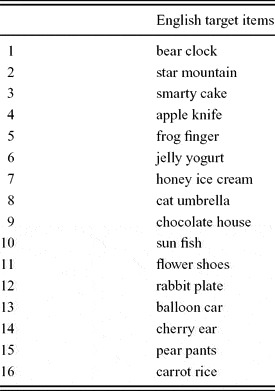
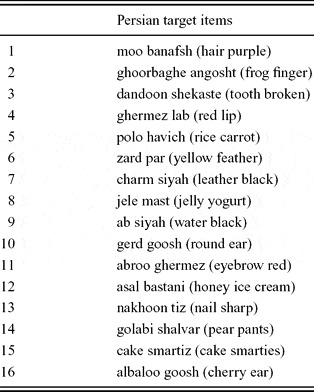
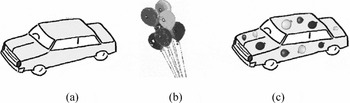
Four tasks were used in this study: (i) an English receptive vocabulary test, PPVT (Peabody Picture Vocabulary Test, Dunn and Dunn, Reference Dunn and Dunn1997), (ii) a Persian translation of the PPVT, (iii) an English novel compound production task, and (iv) a Persian novel compound production task. Bilingual children performed all four tasks whereas monolingual children performed the compound task (iii or iv) in their languages. The PPVT is a standardized test used to measure children's vocabulary size, and version B of this test and the translated Persian version were administered to the bilingual children to determine relative vocabulary size in each language for the purposes of inclusion in the study and the classification of language dominance. For the English test, both raw and standard scores were calculated (see Table 3 below), but only raw scores were available for the Persian test, as it was a translation. For the compound production task, the materials consisted of pictures of 16 target novel compounds composed of 48 color pictures being equal in size and likely to be known to children in this age range. Every attempt was made to choose novel items that were unlikely to be used in conversation, and thus, truly novel. The list of the target novel compounds appears in Table 1 and Table 2 for English and Persian, respectively. We attempted to bias participants with the picture stimuli to choose a particular head and modifier. The compounds were noun–noun in English and were roughly balanced between noun–noun (N = 7) and adjective–noun (N = 9) in Persian. In this task, the children were asked to look at a picture of one object, then a picture of another object or a property of an object and finally to make a new name for a third picture which was the combination of the two former pictures. The third picture placed the object(s) and the property of the object(s) in a modifier–modified relationship which could be labeled with a compound word. For example, the target item “balloon car” was a car with balloons on it and not a balloon in the shape of a car (see Figure 1 below). The format of the task was derived from the task used in Nicoladis (Reference Nicoladis2002). The validity of the target items for labeling with a compound word was assessed through pilot-testing on Persian- and English-speaking adults. The adults always created compounds to name the picture that was the combination of two objects, and produced compounds with the head constituent according to the bias presented in the picture. Several practice items were used to ensure that children understood what type of structure was expected. The items were presented in a random order to prevent any order effects. In other words, the order of the head and modifier pictures was randomized before the combined third picture.
List of target items in English.

List of target items in Persian.

Examples of a target items in the compound production task.

A parental questionnaire was also administered in order to collect information on the child's language background. The questions concerned the child's duration of residency in Canada, the language(s) that the child learned first, the child's language of communication with the parents, the parents’ language of communication with the child, and parents’ ratings of the child's fluency in each language compared with monolinguals who speak each language. Its purpose was to assist in determining language dominance.
4.3 Procedure and coding
The bilingual children were visited in their homes and tested by an experimenter in two separate sessions, one in Persian and the other in English, usually within one week. The order of the languages was counterbalanced, so as to control the effects of familiarity with the procedure. The bilingual children were tested in Persian by a native speaker of Persian and in English by a native speaker of English or a fluent speaker of English. The monolingual children were tested once in daycares by native speakers of each language. Each session lasted approximately 30–40 minutes for bilingual children and 20 minutes for monolingual children. Data collection took place over a period of five months. Before starting the test, the interviewer administered the language background questionnaire to the parents of bilinguals.
The bilingual children were administered two tasks in each language, in the following order: PPVT test/Persian translation and then compound production. This order was preserved for all children because observing a reasonable level of vocabulary comprehension was the prerequisite for continuing with the compound production task. The PPVT test and Persian translation were given as described in the experimenter's manual (Dunn and Dunn, Reference Dunn and Dunn1997). In this test, children were asked to point to a picture in a group of four pictures that was named by the experimenter. After the vocabulary test, a warm-up compound production task and training was implemented with each participant. This task was introduced by saying something like this to the child: “I am going to show you some funny pictures and I want you to make new names for them. First, there will be a picture of one object and then a picture of another object or a picture that shows a property of an object and finally a picture of both things together. I will ask you what we could call the last thing. In order to learn how to do it, I will give you some examples first”. Then, the practice items that were all real compounds were given to the child. For example, for the item dog house, the pictures were of a dog, a house, a dog next to a house. Then the experimenter said: “This is a dog. This is a house. We could call this a dog house”. Similarly, for the noun–noun target (novel) items on the task, the experimenter named the two objects and asked what the combination of those two objects could be called: “Here is a/are some _____. Here is a/are some _____. What do you think we could call this one?”. So the target item balloon car (Figure 1) was introduced as: “Here is a car (Figure 1a). Here are some balloons (Figure 1b). What do you think we could call this one (Figure 1c)?” For the noun–adjective/adjective–noun target items, the experimenter named the object and the property of the object and then asked what the combination of those two things could be called. For the target item lab ghermez lip red “red lip”, she said (in Persian): “This is lip. This color is red (The color was shown in a plain rectangle). What do you think we could call this one?”. The same task and procedure was used to test the monolingual children, except that they only dealt with the compound production task in one language.
The participants’ responses were allocated to one of four categories: Modifier–Noun Compound (right-headed), Noun–Modifier Compound (left-headed), Other (if an adjective or prepositional phrase, or an unrelated word was produced), and No Answer (when no utterance was made). The “head” constituent was determined on the basis of what was presented in the pictures as the semantic head, e.g., the car in Figure 1c, regardless of language. So, a child who produced car balloon in English as a response to Figure 1, would have been coded as producing a left-headed compound. Thus, there were no right or wrong answers per se, just right- and left-headed compound answers, with “head” assigned on the basis of the stimuli. Only responses that bore the characteristics and structures of compounds were considered for analysis. For example, for the item frog + finger, only the compound words frog finger or finger frog were accepted as possible answers. If a child produced a non-compound word (e.g., frog finger named as frogs on fingers) the experimenter asked whether s/he could think of another name. If s/he still was not able to make a compound, the experimenter returned back to the practice items and explained how the “rules of the game” worked. If the compound response was not identical to but close to the target it was accepted as well. For example, for the target item frog finger, if the first answer of a child was frogs on fingers and the second answer was frog hand, the second answer that was a compound and close to the target (frog finger) was considered for analysis. The percentage of left- or right-headed compounds was calculated by dividing the total number of left- or right-headed compounds by the total number of compound responses and not all responses (Appendix gives the average number of each response type per group). The reason for this was that non-compound responses were not considered scorable, or relevant for, a compound production task.
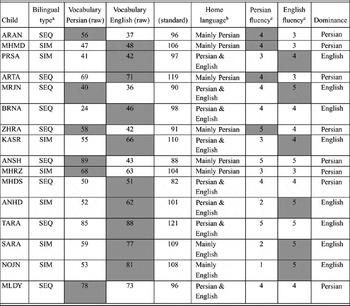
Our research questions and predictions (given in section 3 above) require children to be assigned a dominant language for the purposes of the analyses to be performed. Dominance was determined using information from the parental questionnaire and from the receptive vocabulary task in each language. Each child's vocabulary scores (raw scores in both languages, standard scores for English), interaction language in the home, and fluency ratings are presented in Table 3. The procedure used to determine dominance was as follows. First, we examined whether children had a higher vocabulary score and higher fluency rating in one language, and the same language for both measures, and thus, assigned that language as the child's dominant language. This procedure worked for seven children: ARAN, PRSA, ZHRA, KASR, ANHD, SARA, and NOJN. Second, for the children who had a higher vocabulary score in one language, but equal fluency ratings in both, we used the interaction language of the home to decide if dominance should be assigned on the basis of the vocabulary scores. In other words, if the language of interaction did not contradict the higher vocabulary score, then dominance was assigned on the basis of the vocabulary score. By “not contradict”, we mean that “Mainly Persian” or “Persian & English” would be compatible with Persian as the dominant language, or “Mainly English” and “Persian & English” would be compatible with English as the dominant language. A contradiction would be a case where “Mainly Persian” was the language of interaction in the home, but English vocabulary scores were higher, and fluency was rated equal. This second procedure was used to assign dominance to five children: BRNA, ANSH, MHRZ, TARA, and MLDY. The remaining four children had to have dominance assigned on a case-by-case basis, with some experimenter's judgment used in one case. For MHMD and ARTA, vocabulary scores were higher in English (very slightly), but the language of interaction and fluency ratings clearly favored Persian, so these children were considered Persian-dominant. For MRJN, the vocabulary scores were slightly higher in Persian, but the other measures favored English, and thus, this child was assigned English as the dominant language. MHDS was the most difficult case because the vocabulary scores had one point difference between them, fluency was rated as equal, and the parents reported using both languages fairly equally in interactions with her. For this child, we relied on the judgment of the first author, who had the opportunity to interact with her in both languages and to witness the use of languages among family members in her home.
Children's bilingualism type (sequential or simultaneous), vocabulary size scores in each language, predominant household language, parental ratings of fluency in each language, and dominance group.
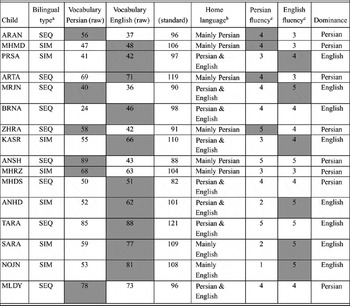
Cells in grey indicate which language had the highest vocabulary score or the highest fluency rating, if applicable.
aSIM = Simultaneous = both languages introduced before 1;0; SEQ = Sequential = Persian first, English second.
bHome language = language used most often for interactions with parents at the time the questionnaire was given.
cFluency in each language = parental rating on a scale of 0–5, where 0 = no fluency and 5 = very fluent.
5. Results
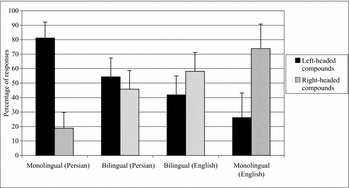
The children's mean percentages of right- and left-headed compound responses (LH and RH, respectively) are shown in Figure 2. The Persian monolingual children showed a preference for left-headed compounds (LH: 81.14% vs. RH: 18.85%), and the English monolinguals showed the opposite preference, for right-headed compounds (LH: 26.17% vs. RH: 73.83%). Turning to the bilinguals, the children displayed different patterns in each language in terms of their absolute scores. They slightly preferred left-headed compounds in Persian (LH: 54.30% vs. RH: 45.73%) and right-headed compounds in English (LH: 41.89% vs. RH: 58.13%). However, the discrepancies between the scores within each language were smaller than those of the monolingual groups.
Average percentage responses to compound production task.

In order to determine if crosslinguistic influence had been taking place, we compared the percent left-headed compound responses in Persian and right-headed compounds in English between the bilinguals and monolinguals using independent sample t-tests. We predicted that if between-groups differences were found, this would be evidence of crosslinguistic influence, and if differences were found in Persian but not in English, this would be evidence for structural overlap as a likely source of the influence. The comparison between the bilinguals and the Persian monolinguals yielded a significant difference in left-headed compounds in Persian between the two groups, with the preference for left-headedness stronger in the monolinguals ([by subjects] 54.30% vs. 81.14%, t(33) = −6.671, p = .000; [by items] 53.75% vs. 80.56%, t(30) = 3.425, p = .002). The comparison in English showed that the bilinguals produced significantly fewer right-headed compounds than their monolinguals peers ([by subjects] 58.14% vs. 73.83%, t(31) = −2.995, p = .005; [by items] 41.44% vs. 74.81%, t(30) = 5.123, p = .000). Thus, crosslinguistic influence appeared in both languages, not just in Persian.
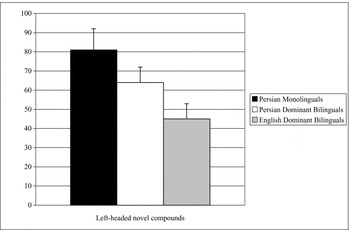
To see if there was any influence of language dominance in the bilingual children's ordering of the head and the modifier, we divided up the bilingual children into Persian-dominant and English-dominant groups for further analyses. Figures 3 and 4 display the percentage of left- and right-headed compounds produced by each dominance group in Persian and English, respectively. Monolingual data are re-entered here for ease of comparison. The presence of group differences in Persian was determined through a one-way between-groups ANOVA with Persian monolinguals, Persian-dominant bilinguals and English-dominant bilinguals as the three groups, and percent left-headed compounds in Persian as the dependent variable. The ANOVA was significant (F(2, 32) = 37.78, p = .000) and post-hoc pairwise comparisons revealed the following: The English-dominant and Persian-dominant groups showed a significant difference in the rate of left-headed compounds (44.91% vs. 63.64%), t(14) = −4.43, p = .001. There were also significant differences between the Persian-dominant children and the Persian monolinguals (63.64% vs. 81.14%), t(25) = −3.95, p = .001, and between the English-dominant children's compounds and the Persian monolingual children's compounds (44.91% vs. 81.14%), t(25) = −8.20, p = .00. Thus, a stepwise pattern emerged from the Persian task where English-dominant bilinguals < Persian-dominant bilinguals < Persian monolinguals, for the preferred left-headed compounds.
Average percentage responses on Persian production task by Persian monolinguals, Persian-dominant and English-dominant bilinguals.

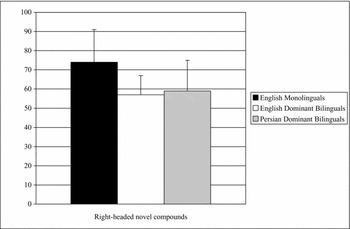
Average percentage responses on English production task by English monolinguals, English-dominant and Persian-dominant bilinguals.

The presence of group differences in English was determined through a one-way between-groups ANOVA with English monolinguals, Persian-dominant bilinguals and English-dominant bilinguals as the three groups, and percent right-headed compounds in English as the dependent variable. The ANOVA was significant (F(2, 30) = 4.412, p = .021) and post-hoc pairwise comparisons showed that both the Persian-dominant and English-dominant groups had lower right-headed compound percent scores than the monolingual group (59.40%, 56.87% vs. 73.83%), but the two bilingual groups did not differ from each other t(14) = −.38, p = .70. Thus, this analysis of dominance groups yielded different results for Persian and English.
6. Discussion
A growing body of research suggests that bilingual children's two languages interact in development such that crosslinguistic structures can appear in their speech. Two hypotheses have been put forward to explain when crosslinguistic structures can be expected. First, the structural overlap hypothesis (Müller, Reference Müller1998; Hulk and Müller, Reference Hulk and Müller2000; Müller and Hulk, Reference Müller and Hulk2001) suggests that influence of language B on language A could occur if language A has two options for a target structure, but language B has only one option. The result is that language B would influence language A, and not the other way around. Second, the dominance hypothesis suggests that influence of the dominant on the non-dominant language would occur, but not the other way around. Nicoladis (Reference Nicoladis2002) found that French–English bilingual children showed crosslinguistic effects in their production of novel noun–noun compounds. However, French and English do not meet the conditions for structural overlap as outlined by Müller and Hulk, and thus, this language pair is not the optimal test of this hypothesis. In contrast, nominal compounds in Persian and English do meet the conditions of structural overlap. Accordingly, we studied novel nominal compound production in Persian–English bilingual children, in order to test these competing hypotheses for the source of crosslinguistic influence. We predicted that if crosslingusitic influence took place at all, differences in the head ordering in compound responses would emerge between bilinguals and monolinguals. If structural overlap were the best explanation for crosslingusitic effects (if any), there would be transfer from English to Persian, but not from Persian to English. If dominance were the best explanation for crosslinguistic effects (if any), there would be transfer from the dominant to the non-dominant language such that in their dominant language, bilinguals would perform closely to their monolingual peers.
In order to address our first research question concerning the presence of crosslinguistic effects, we compared the bilinguals’ production of right- and left-headed compounds with those of monolinguals in each language. First, we observed differences between the monolingual groups. The Persian monolingual children coined more left-headed than right-headed compounds, whereas, the English monolingual children produced more right-headed compounds the majority of the time. It should be noted that monolingual children deviated from the default head position in Persian and the only target-correct head position in English. This finding is explainable for Persian monolinguals because Persian gives optionality to the speaker to create either of these two forms, and at least, the tendency towards left-headedness was in evidence. In English, however, all left-headed compounds are target-deviant in the adult language. Compound reversals in English monolingual children were also reported in Nicoladis (Reference Nicoladis2002) (except see Clark, Gelman and Lane, Reference Clark, Gelman and Lane1985). Moreover, in Clark and Barron's study (Reference Clark and Barron1988), English monolingual children did not perform at ceiling, but instead repaired ungrammatical compounds only 70% of the time. They found that repairs increased with age (64% for the youngest and 89% for the oldest). This highlights the possibility that young English-speaking children might not yet have mastered the word ordering in compounds; that strict ordering in English compounds is acquired older than the preschool years. (We develop this idea further in our interpretation below.) Whatever reason there is for the reversals, it is important to see that monolingual children attended to the default direction of the head in Persian and to the correct order in English to some extent. Our interpretation of crosslinguistic effects in the bilingual data was through comparisons with monolinguals for tendencies, rather than absolute levels of performance, in any case. Comparisons between bilinguals and monolinguals in each language revealed that bilinguals used the default/correct word ordering for compounds less than their monolingual peers. Therefore, our data show evidence of crosslinguistic influence.
Compared to Persian monolinguals, the bilingual children had more right-headed compounds. The higher rate of right-headed compounds in Persian indicates influence of English, which is predicted by the structural overlap hypothesis. However, there were equally signs of influence of Persian on English, as the bilingual children produced a significantly higher number of left-headed compounds in English compared with monolinguals. This result is not in line with the prediction of the structural overlap hypothesis since it shows bidirectional transfer from the rigid to the optional language, and from the optional language to the rigid language.
If crosslinguistic influence is due to language dominance, the bilingual children should look more like monolinguals in their language of greater proficiency. This prediction was borne out for Persian, where we found a three-way difference between the monolinguals, the Persian-dominant bilinguals, and the English-dominant bilinguals. An analysis of individual patterns also showed that Persian-dominant children clearly followed this pattern. Eight out of eight Persian-dominant children produced more left-headed compounds, while only one out of eight English-dominant children produced more left-headed compounds. However, the results from the English task cannot be accounted for by language dominance. The English-dominant bilinguals did not show greater inclination for right-headedness than the Persian-dominant bilinguals in English. An analysis of individual scores also supports the group data. Four out of eight English-dominant and five out of eight Persian-dominant children produced more right-headed compounds.
In sum, our results show partial evidence for the structural overlap hypothesis, and partial evidence for the dominance hypothesis. This makes our data different from those of Döpke (Reference Döpke1998, Reference Döpke2000), Müller (Reference Müller1998), Hulk and Müller (Reference Hulk and Müller2000), and Müller and Hulk (Reference Müller and Hulk2001), who argued that crosslinguistic influence was unidirectional, and dominance played no role in the presence of crosslinguistic influence. It is important to note that unlike the present study, these other researchers did not use systematic means for assessing dominance, had very few bilingual participants, and did not probe for potential bidirectionality by looking at both languages and comparing both languages of the bilinguals to monolingual children. Other studies whose purpose was to examine the structural overlap hypothesis also have one or more of these limitations (e.g., Paradis and Navarro, Reference Paradis and Navarro2003; Serratrice et al., Reference Serratrice, Sorace and Paoli2004). Regarding other studies of derivational morphology, Nicoladis (Reference Nicoladis2002) found no effect of superior lexicon size on the children's performance, but Nicoladis (Reference Nicoladis2003a) did find positive and significant correlations between children's lexical size in each language, and their performance on the compound tasks in production. Therefore, dominance effects have not been found consistently in bilingual children's performance in this linguistic domain. Because our results are not explainable by either the structural overlap or dominance hypotheses alone, we consider several alternative explanations for the patterns in our data, beginning with the structural overlap hypothesis.
6.1 Methodological differences
A factor that might have played a role in the bidirectionality of transfer is the different methodology that we used in this study compared to most previous studies. The majority of results that reflected unidirectional transfer in the presence of structural overlap were based on naturalistic speech samples (Döpke, Reference Döpke1998, Reference Döpke2000; Müller, Reference Müller1998; Hulk and Müller, Reference Hulk and Müller2000; Müller and Hulk, Reference Müller and Hulk2001, inter alia). In contrast, we asked the children to produce novel words. It is possible that novel word formation tasks tap into crosslingusitic effects in linguistic processing, rather than crosslingusitic effects that are systemic and representational (Paradis and Genesee, Reference Paradis and Genesee1996; see also Hulk, Reference Hulk and Müller2000). Furthermore, Nicoladis (Reference Nicoladis2002) found that compound reversals were more prominent in bilingual children's performance on a production than a comprehension task. We acknowledge the possibility that an increase in crosslinguistic influence would emerge under certain conditions, perhaps like this kind of task. However, we do not think that crosslinguistic influence could be entirely an artifact of this kind of task. First, Paradis (Reference Paradis2001) also employed an elicitation task in her study and found no difference in bilinguals and monolinguals in their sensitivity to canonical target language prosodic patterns, but only found bilingual–monolingual differences for the targets for which there was overlap in prosodic patterns between the languages. If interference were rampant under elicitation task conditions in young bilingual children, this systematic pattern would not have occurred. Second, it is important to note that reversals in compounds are not limited to this task. Nicoladis (Reference Nicoladis1999) documented reversals in a bilingual child's spontaneous speech. Anecdotally, the second author has also noted instances of compound reversals in her two French–English bilingual children's spontaneous speech. Because nominal compounds are not as frequent in children's spontaneous speech as syntactic properties such as grammatical subjects or objects, examining bilingual children's use of compounding is best undertaken through an elicitation task.
6.2 Input-based differences
Another source of bidirectionality, or more specifically, unexpected influence of Persian on English, could be non-native-speaker English input. Paradis and Navarro (Reference Paradis and Navarro2003) examined overt and null subjects in the input received by a Spanish–English bilingual child and a monolingual Spanish-speaking child. They found that the bilingual child's mother who was a non-native Spanish speaker used more pragmatically redundant, overt subjects in her Spanish than her monolingual Spanish-speaking counterpart. They argued that this finding suggested that the crosslinguistic influence they found in the bilingual child's output might have been psycholinguistic and internal to the child's developing linguistic system, but could also have been the result of the contact-variety input she heard. We do not believe that non-native-speaker input would have greatly influenced the results of the present study, however. In comparison with overt and null sentential subjects, nominal compounds would not have been as frequent in the parents’ English, and these children had native-speaker models for their English as well. Furthermore, even if some of the parents had produced reversed compounds, this would have varied across families, and as such, would not be a prominent source of group trends. Finally, we would like to point out that some of the parents who spoke English to their children at home were very proficient, even near-native, speakers of English. Nevertheless, we concede that it is possible that reversed English compounds in some of the parents’ speech might have occurred, and in turn, this might have influenced some of the children's word-formation rules in English. We cannot test this possibility because we did not collect data on the parents’ spontaneous speech in English to the children.
6.3 Syntax versus the lexicon (derivational morphology)
In previous studies where the presence of unidirectional transfer has been reported, the focus was mainly on syntax. This study, which found bidirectional transfer, looked at the domain of compounding morphology. Similar bidirectionality in children's compound productions was reported in Nicoladis (Reference Nicoladis1999, Reference Nicoladis2002, Reference Nicoladis2003b). Therefore, it might be the case that the sources of crosslinguistic influence differ depending on the domain of language. To explore why this might be the case, let us look more technically at the differences between the phenomenon of object omissions as documented by Müller and Hulk (Reference Müller and Hulk2001) and the compound rules we examined. The object omissions in Romance versus Germanic were argued to be a case of surface overlap in syntax between the two language groups, with ambiguity in underlying representation. More specifically, null objects in canonical position have a different underlying source in Romance and Germanic languages. In V2 Germanic languages, direct objects can be dropped entirely when they are topics in the conversation, and thus, their referents can be retrieved from the discourse-pragmatics. In Romance languages, direct objects can be dropped from the canonical argument position when they are topics, or at least, shared knowledge between speaker and hearer, but their referents are retrievable by a preverbal clitic. In essence, object drop is not possible in Romance languages because the preverbal clitic is obligatory, and therefore, the Romance languages are the non-optional languages, while the V2 Germanic languages permit optional object omissions. However, in terms of the surface string, direct objects can be absent from their canonical position in both language types. In compounding, no such surface equality with underlying inequality can be assumed because compounds are based on relatively straightforward word-formation rules, presumably part of the lexicon, in both Persian and English. There is no reason to presuppose that compounds in one of these languages have a very different underlying structure than compounds in the other. Therefore, the ambiguity in the input to the Persian–English bilingual child for compounds is the optional versus obligatory nature of the head direction, and not highly different underlying representations for a structure that appears similar on the surface.
If we accept that overlap in the lexicon, in derivational morphology, is not the same domain as that described by Müller (Reference Müller1998), Hulk and Müller (Reference Hulk and Müller2000), and Müller and Hulk (Reference Müller and Hulk2001), then we could propose that different conditions apply to crosslinguistic influence in this domain. For example, it is possible that crosslinguistic influence in word formation rules could occur if either of the following two conditions apply: (i) no overlap, e.g., opposite ordering in the target structure (French and English) or (ii) overlap in the target structure, e.g., language A has two optional orders, language B has one order, and language B is a subset of language A (Persian and English). This is a more powerful proposal than the one offered by Müller and Hulk, and thus, is problematic for the development of parsimonious explanations of patterns in bilingual acquisition. The only condition where crosslinguistic transfer of patterns would not be expected to occur is one where two languages overlap totally, e.g., two languages where compound ordering is rigidly right-headed. In this case, crosslinguistic influence could result in accelerated acquisition rates in both, or at least, the dominant language (cf. Kupisch, Reference Kupisch, Chan, Jacob and Kapia2007b), but the presence of crosslinguistic structures in production would be impossible. Kupisch (Reference Kupisch2007a) raised similar concerns about parsimony and the broadening of the domain of structural overlap in syntactic crosslingusitic influence, and therefore, offered an interactive account of the role of structural overlap and dominance to explain the crosslinguistic influence she examined with respect to rates of acquisition. While this un-parsimonious proposal may indeed be the correct one (cf. Yip and Matthews, Reference Yip and Matthews2000), let us pursue another explanation of our findings that yields a more parsimonious proposal.
6.4 Reconsidering optionality in English
Even though English is rigidly right-headed in the adult language, there is evidence from this study and Nicoladis’ work that child English might differ from adult English in this regard. Monolingual English-speaking children will form left-headed compounds some of the time. Nicoladis (Reference Nicoladis2003b) argued that the developmental stage in a child's grammar, rather than the adult stage, is a logical source of transfer in bilingual acquisition. For example, deverbal compounds in French have verb–object word ordering while English employs an object–verb+er construction, e.g., taille-crayon [sharp-pencil] “pencil sharpener”. However, English-speaking children pass through a stage where they make errors like saying “sharp pencil” for pencil sharpener, and thus at this developmental point, the presence of VO and OV-er constructions in their grammar meets the condition of structural overlap with French. Similarly, Müller and Hulk (Reference Müller and Hulk2001) hinged their analysis of object omissions in Romance-Germanic bilinguals on a developmental stage in Romance. Adult Romance languages do not have object-/topic-drop like V2 Germanic languages, but even monolingual children acquiring a Romance language go through a developmental stage where they omit objects (unlike children acquiring English), possibly because the preverbal placement of the direct object pronominal clitic renders this structure difficult to acquire. Therefore, the crosslinguistic influence of the Germanic on the Romance language these researchers observed in the bilingual children was, in effect, the prolongation of a typical developmental stage in their French/Italian, and not the creation of unique error forms by these children. It is possible that both child English and child Persian are best characterized as having optional headedness with differences in preferences, e.g., right-headed for English and left-headed for Persian. If so, then the structural overlap conditions are different from those of the adult languages. Accordingly, bidirectional transfer would be expected under conditions where optionality exists in both (child) languages, but with opposite preferences in the two languages. Note that the bilinguals in English preferred to coin right-headed compounds (although less so than the monolinguals), but they did not show a head direction preference in Persian. This distinction suggests that bilingual children this age are in the process of converging on the English system, but still have a fully optional system for Persian.
6.5 Integrating structural overlap with dominance
Let us assume that Müller and Hulk are correct in claiming that structural overlap can invite crosslinguistic influence, regardless of dominance. We can then add to this assumption that the extent of crosslinguistic influence is modulated by dominance (cf. Döpke, Reference Döpke1998, Reference Döpke2000). That is, if transfer is expected from language B to language A, transfer will be more prominent, i.e., crosslinguistic structures more frequent, if language B is the dominant language. This assumption could explain our data for Persian. The bilinguals, as a group, produced fewer left-headed compounds than the monolinguals, but this effect was more pronounced in the English-dominant than the Persian-dominant group. However, we did not find this three-way effect in English: English-dominant bilingual children did not show a greater preference for right-headed compounds in English. We think that the explanation for this asymmetry in the effect of dominance lies in the learning context of these children. The children in this study were not one-parent–one-language simultaneous bilinguals like most other children in the prior research. Their parents were Persian native speakers, who used Persian, and to varying degrees, English (their non-native language) at home. We have already speculated that compound reversals in the parents’ English might have been transmitted to the children, although we believe this explanation to be unlikely. The more likely impact of the learning context, in our view, is that these families were immigrants residing in an English majority setting. Regardless of whether they were simultaneous or very early sequential bilinguals, for these four-year-old children, English was the majority language and Persian the minority language, a distinction that could have an effect on language use, acquisition rates, and outcomes (Genesee, Paradis and Crago, Reference Genesee, Paradis and Crago2004; Paradis and Nicoladis, Reference Paradis and Nicoladis2007). Thus, English was an ascending language for all the children, but Persian might not have been. It is possible that some of the children were in the process of losing their Persian, or at least, experiencing some stagnation in their acquisition of that language. We propose that since English was the majority and ascending language for all children, regardless of dominance, dominance effects were not clearly apparent in the children's performance in that language. Thus, to compare with Yip and Matthews (Reference Yip and Matthews2000), the crosslinguistic influence they documented of Cantonese on English in relative clause structure could have, in principle, occurred the other way around in Cantonese if the child had been English-dominant, since the child was being raised in a one-parent–one-language setting, with both languages having high status in the surrounding community. But, in the case of bilinguals whose two parents are immigrants and minority language speakers, the equal probability of dominance playing a role in either the majority or minority language might not be expected.
7. Conclusions
This study found crosslinguistic influence in Persian–English bilinguals’ compound production. This crosslinguistic influence occurred in the presence of structural overlap between two languages (e.g., Müller and Hulk, Reference Müller and Hulk2001), but language dominance also played a role (e.g., Yip and Matthews, Reference Yip and Matthews2000). Thus, both factors can be sources of crosslinguistic influence in the same group of children, and need not be viewed as mutually exclusive. We propose the following refinements to the probable, or “prime”, conditions for crosslinguistic influence in bilingual acquisition. First, in determining the presence or absence of structural overlap, developmental stages of the language may be more informative than the adult language, if these differ substantively. Second, the conditions for structural overlap can be broadened to include two cases: (i) where one language permits only one option and the other language permits two, and (ii) where both languages permit two options, but the preferred options diverge between them. In this second case, it is predicted that bilingual children might choose the non-preferred option more than their monolingual peers in both languages whereas, in the first case, unidirectionality in transfer would be more expected. Third, the extent of crosslinguistic influence could be modulated by dominance, although the impact of dominance might be different depending on the majority–minority status of the languages. This last point about language status is the most speculative, and needs to be developed and understood better through future research.
Appendix. Children's average rate of responses in the production task