Introduction
Bereavement, the experience of losing a loved one, is probably one of the most painful experiences in the course of human life. Various mental and physical problems, such as depression, physical comorbidities, and reduced quality of life (QOL), are known to occur in response to bereavement (Li et al. Reference Li, Precht and Mortensen2003; Stroebe et al. Reference Stroebe, Schut and Stroebe2007; Zisook and Shear Reference Zisook and Shear2009). Many of the grief reactions after bereavement are interpreted as normal reactions and usually peak at about 6 months after the loss and then alleviate (Boelen and Prigerson Reference Boelen and Prigerson2007). However, when the degree and/or duration of the grief responses exceed such a “normal” range, it has been called complicated grief (or historically, it has also been called pathological grief, prolonged grief, or persistent complex bereavement disorder) and has recently been established as a formal diagnostic entity of prolonged grief disorder (Prigerson et al. Reference Prigerson, Boelen and Xu2021). The prevalence of complicated grief is reportedly 6.8–14.0% (Lundorff et al. Reference Lundorff, Holmgren and Zachariae2017). In Japanese studies, the reported prevalence ranges widely between 2.3 and 33% (Ando et al. Reference Ando, Ninosaka and Okamura2015; Fujisawa et al. Reference Fujisawa, Miyashita and Nakajima2010; Nakajima Reference Nakajima2012;). Complicated grief does not usually resolve spontaneously and is accompanied by decreased QOL (Boelen and Prigerson Reference Boelen and Prigerson2007; Ott Reference Ott2003) and long-term physical and mental health risks (Otani et al. Reference Otani, Yoshida and Mori2017; Prigerson et al. Reference Prigerson, Bierhals and Kasl1997), including major depressive disorder (Aoyama et al. Reference Aoyama, Sakaguchi and Morita2018; Simon et al. Reference Simon, Shear and Thompson2007), insomnia, alcohol abuse (Aoyama et al. Reference Aoyama, Sakaguchi and Fujisawa2020), and suicide (Boelen and Prigerson Reference Boelen and Prigerson2007; Ott Reference Ott2003).
Various psychotherapeutic techniques have been developed and have been evaluated for their effectiveness in treating complicated grief, such as cognitive behavioral therapy, interpersonal therapy, and complicated grief therapy (Johannsen et al. Reference Johannsen, Damholdt and Zachariae2019). However, many of these therapies require typically 12–16 sessions, and the participants’ attrition rates are not negligible, leaving room for developing other treatment approaches.
Symptoms of complicated grief include challenges to one’s sense of identity and feeling that life is empty or meaningless following the loss (Lichtenthal et al. Reference Lichtenthal, Catarozoli and Masterson2019). Therefore, inculcating a sense of meaning in life has been suggested as a possible method to reduce grief (Neimeyer Reference Neimeyer2000, Reference Neimeyer2001). One of the leading treatments to address a sense of meaning in life is the meaning-centered psychotherapy (MCP) (Breitbart and Poppito Reference Breitbart and Poppito2014). MCP is a structured intervention to enhance a sense of meaning in advanced cancer patients by incorporating the principles of Viktor Frankl’s logotherapy (Frankl Reference Frankl1959/1992). MCP is reportedly effective in improving the psychological status of patients with advanced cancer (Brietbart et al. Reference Brietbart, Rosenfeld and Gibson2010, Reference Brietbart, Poppito and Rosenfeld2012, Reference Brietbart, Rosenfeld and Pessin2015, Reference Brietbart, Pessin and Rosenfeld2018) and their caregivers (Applebaum Reference Applebaum, Kulikowski and Brietbart2015).
The authors conceived of applying MCP to Japanese bereaved families who lost their loved ones to cancer. There is currently an established intervention called the Meaning-Centered Grief Therapy (MCGP) as a treatment option for alleviating grief in people who lost their loved ones (Lichtenthal et al. Reference Lichtenthal, Catarozoli and Masterson2019); however, at the time when the current study was conceived, the evidence of MCGP had yet been published widely and its treatment manual was not available in Japan. Therefore, we intended to adapt the original MCP to fit with the Japanese bereaved family.
In a comparative cultural study by Yamamoto et al. (Reference Yamamoto, Okonogi and Iwasaki1969), grieving of Japanese people is characterized by implicit and restrained emotional expression. At the same time, emotional openness (i.e., not forcibly suppressing feelings that have arisen) has been reported to have a positive effect on their mental health (Sakaguchi et al. Reference Sakaguchi, Kashiwagi and Tsunefuzi2002). Many Japanese are not accustomed to receiving counseling for mental health issues. Many of them, especially the elderly, are resistant to communicating their mental health issues to health professionals, thinking that “Talking about emotions are meaningless” and “It will bother them if I talk about such feelings.”
The current study aimed to adapt the MCP to treat post-bereavement grief and examine its feasibility in a Japanese sample. Further, we explored how the intervention was perceived by the recipients through a qualitative analysis of the sessions in conjunction with quantitative analyses.
Methods
Study design
We first developed a modified version of MCP with cultural consideration for Japanese bereaved families, then we preliminarily evaluated its effectiveness through a mixed-method study in a sample of Japanese bereaved families who lost their loved ones to cancer.
Development of intervention
Through the discussion among the researchers, the original protocol of the MCP (Brietbart et al. Reference Brietbart, Rosenfeld and Gibson2010) was modified so that the intervention would be more acceptable to Japanese bereaved families. The structure of the program was made less intense than the original MCP: the number of sessions was shortened from original seven 60-minute sessions to five 60-minute sessions (with an additional pre-intervention session to explain the concept of meaning and to build rapport with the participants) and the frequency of the sessions was set at monthly basis, which were weekly basis in the original MCP. This was done because the supposed care recipients were elderly who were unfamiliar with talking about their emotions and who may feel burdened to attend intense psychotherapy sessions. Only one homework (after the third session) was assigned, although, at the end of each session, the participants were reminded of the theme of the following session and were gently invited to think about that theme.
The concepts of the intervention were substantially unchanged from the original MCP, while some sessions were merged to fit with the shortened structure of the intervention. The contents that are relatively familiar to the Japanese were emphasized. The structure of the sessions was designed to allow the participants to speak freely. At the beginning of the program, the themes of all sessions were explained, and the purpose and structure of the session were shared with the participants as “This is a place to talk about your feelings surrounding bereavement and the meaning of life.” The themes of some sessions were reframed in the context of caring for and loss of their loved one, rather than the experience of cancer as in the original MCP. Since the concept of “legacy” is unfamiliar in Japanese culture, it was paraphrased as accomplishments, values, and responsibilities when addressing the historical meaning of life.
The overview of the intervention is shown in Table 1. In the first session (“Concept of the meaning of life”), the participants were invited to talk about their experience of caring for their loved ones. They were also asked about their experiences in life that they felt meaningful. In the second session (“Rediscovering their role”), the participants were asked about the roles they had been taking and were prompted to think about the issues that changed and remained unchanged after caring for their loved ones. In the third session (“Lessons learned in life”), the participants were asked about the accomplishments in life that they were most proud of. By discussing this, the participants were encouraged to talk about their core values in life. In the fourth session (“Meaning of caring for their loved one with cancer”), the meaning of caring and fighting against the illness was inquired. Further, the participants were encouraged to talk about the limitations, losses, and barriers in their lives and how they overcame them. In the last session, the participants’ goals and hopes for the future were discussed, with the intention of re-establishing their life goals and recognizing continuity before and after the loss of their loved ones.
Overview of the intervention

Note: Five sessions in the short version of the intervention were tailored for the Japanese population. A strict homework is assigned only between third and fourth sessions.
Participants
Individuals aged ≥18 years who had lost their loved ones due to cancer at least 6 months before, and who had severe or persistent grief, with a score of ≥ 26 on the Inventory of Complicated Grief (ICG-19) were eligible for the study. Those who were receiving psychiatric medication or suspected of having dementia were excluded.
Recruitment procedure
The participants were recruited through a referral from the medical staff of palliative care wards and home palliative care clinics and through announcements at support groups for the families of cancer patients and bereaved families in Shizuoka prefecture, Japan.
Intervention
A modified version of MCP, which is described above, was provided to the participants. The intervention was conducted by a psychiatrist (RK) who had attended an MCP workshop conducted by the founder of MCP (Bill Breitbart), under the supervision of another psychiatrist (DF), who translated the original MCP book into Japanese and had served as an MCP workshop facilitator.
Evaluations
Quantitative evaluations
The following rating scales were administered before and after the intervention.
1. Inventory of Complicated Grief (ICG): It is a 19-item self-administered rating scale to evaluate the severity of grief symptoms (Prigerson et al. Reference Prigerson, Maciejewski and Raynolds1995). Higher scores indicate a more severe level of grief. A score of ≥26 points suggests the presence of complicated grief. The Japanese version of the scale was validated by Nakajima et al. (Reference Nakajima, Ito and Ishimaru2010).
2. Center for Epidemiologic Studies Depression Scale (CES-D): It is a 20-item self-administered rating scale for depression, with higher scores indicating higher levels of depression. A cutoff score of 16 is considered (Radloff Reference Radloff1977). The Japanese version of the CES-D was validated by Shima et al. (Reference Shima, Shikano and Kitamura1985).
3. General Health Questionnaire (GHQ-12): It is a 12-item self-administered rating scale to measure mental health status, with lower scores indicating higher levels of mental health. (Goldberg et al. Reference Goldberg, Gater and Sartorius1997) The Japanese version of the GHQ-12 was validated by Fukunishi (Reference Fukunishi1990).
4. Short-version (PTGI-SF): It is a 10-item self-administered rating scale that measures the level of post-traumatic growth, with higher scores indicating higher levels of post-traumatic growth (Cann et al. Reference Cann, Calhoun and Tedeschi2010). The Japanese version of the PTGI-SF was validated by Taku et al. (under review).
5. Post-intervention questionnaire: An 11-item questionnaire inquiring about the participants’ experience with the intervention was administered. Helpfulness, distress, length, and relevance of the intervention were scored on a 6-point Likert scale. This questionnaire was developed based on a survey by Rosenfeld et al. (Reference Rosenfeld, Saracino and Tobias2017).
Qualitative evaluations
The sessions of the intervention were recorded, transcribed verbatim, and analyzed using the modified grounded theory approach (M-GTA) with “grief and its reduction” as the analysis theme for exploring the participants’ experience of grief before, during, and after the intervention, thereby identifying the factors that contributed to the relief of grief. M-GTA is a modified version of the Grounded Theory Approach, which was originally developed by Glaser and Strauss (Glaser and Strauss Reference Glaser and Strauss1967; Kinoshita Reference Kinoshita2016). Two psychologists generated and defined concepts, which were then categorized through discussion.
Statistical analysis
The scores on the rating scales before and after the intervention were analyzed using a Wilcoxon’s rank-sum test with p values of 0.05. Statistical analyses were conducted using IBM SPSS Statistics for Windows, Version 27.0.
Ethical considerations
This study was approved by the Research Ethics Committee of Shizuoka University (approval number: 19-4). All the participants provided written informed consent.
Results
Characteristics of the participants
Five individuals (2 males and 3 females) who lost their family members due to cancer from among more than 30 bereaved persons to whom the program was announced participated. The participants’ characteristics are presented in Table 2. The mean age of the participants was 67.4 years. The mean duration of bereavement was 10.8 months. The mean duration of the deceased individuals’ cancer trajectories was 26.4 months. Four patients received hospice care at home during the end-of-life period.
Characteristics of the participants

Note: Five participants had a mean age of 67.5 years and a mean duration of 10.8 months after the death of a family member. The average duration of the illness of the bereaved family members was 26.4 months.
Quantitative evaluations
All the participants attended all 5 sessions and completed the intervention. The changes in the ICG-19, CES-D, GHQ-12, and PTGI-SF scores before and after the intervention are shown in Table 3. The mean ICG-19 score at baseline was 33.8, indicating a high level of grief. After the completion of the intervention, it decreased to 25.8 points, which is close to the cutoff score. The mean CES-D score was 30.0 at baseline, which was higher than the cutoff for clinical depression, significantly decreased to 16.6 after the intervention, which falls within the normal range. The PTGI-SF scores also showed significant improvement after the program. There was no significant change in the mean GHQ-12 score.
Evaluation of scores before and after administering the short version of MCGP (Wilcoxon rank sum test)

Note: CES-D, Center for Epidemiologic Studies Depression Scale; GHQ-12, General Health Questionnaire; MCGP, meaning-centered psychotherapy; PTGI, Post-traumatic Growth Inventory.
a Before administering the short version of MCGP, the participant’s ICG-19 mean score was 33.8 points, which showed a strong state of grief. After the intervention, the mean ICG-19 score decreased significantly to 25.8 points, which was below the cutoff. The mean CES-D and PTG scores also improved significantly after the implementation of the short version of the MCGP. Meanwhile, the GHQ-12 indicated no significant improvement.
The post-intervention questionnaire demonstrated that the participants found the intervention favorable (Table 4). The length of each session was appropriate. The participants tended to perceive the sessions as more helpful in the latter half than in the first half of the sessions. The second session “Rediscovering your role” received the end-of-life lowest score, while the fourth session, “Meaning of caring for their loved one with cancer” received the highest score.
Post-implementation questionnaire results

Note: 1, not applicable and 6, applicable.
The results of the post-implementation questionnaire showed that most participants found the MCGP more helpful than painful. Few participants felt that the number of sessions was too long or too short, and many responded that the length of the session was reasonable. Of the 5 sessions, the fourth session, “meaning of the fight against cancer,” was the most useful for majority of the participants.
Qualitative analysis
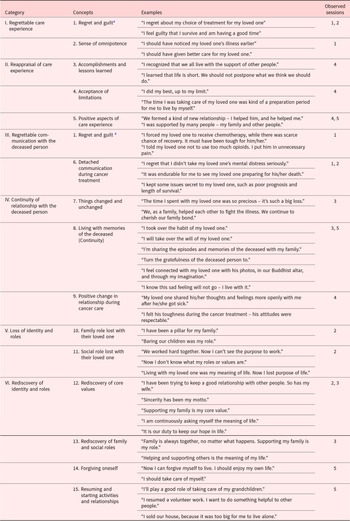
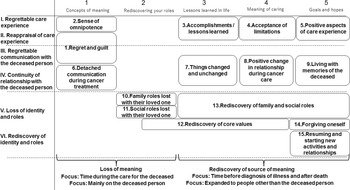
The analysis of the narratives of the participants using the M-GTA yielded 15 themes that relate to grief and its reduction under 6 category groups “Regrettable care experience,” “Reappraisal of care experience,” “Regrettable communication with the deceased person,” “Continuity of relationship with the deceased person,” “Loss of identity and roles,” and “Rediscovery of identity and roles” (Table 5). The themes were mapped according to the sessions where they emerged (Figure 1).
Participants’ narratives during the intervention

Note: In general, the narratives presented in the first 2 sessions represent loss of meaning and the narratives in the last 3 sessions represent rediscovery of meaning of life in various domains.
a The theme “Regret and guilt” overarches 2 categories of “I. Regrettable care experience” and “III. Regrettable communication with the deceased person.”
Conceptual diagram of changes in the participants.

In the initial session, the participants’ narratives regarding their experience of care were dominated by “regret and guilt” and a “sense of omnipotence” (the participants considered that they should have detected their loved one’s illness earlier and should have done more to their love ones, which were quite unrealistic). In later sessions, the participants reappraised their caring experience in more realistic ways, recognizing their limitations and focusing on accomplishments and lessons learned during their caring experience, which lead to the rediscovery of meaning.
The participants’ relationship with the deceased person changed in the course of the intervention. In the early sessions, the participants primarily focused on communication and interaction during cancer treatment, but they gradually extended their focus to the interactions before the diagnosis of cancer of their loved one, and finally recognize the continuity of the relationship (such as living with the memories of the deceased person).
In the second session (“Rediscovering your role”), the participants talked about their family and social roles that they had been sharing with the deceased person and talked that they were lost with the death of their loved one. However, inquiring about changed and unchanged things before and after the experience of caring for and the loss of their loved one helped the participants to recall their roles and recognize that such roles are continued.
In general, the narratives presented in the first 2 sessions represent the loss of meaning and the narratives in the last 3 sessions represent the rediscovery of the meaning of life in various domains. The 2 distinct issues that seem to contribute to the rediscovery of the meaning of life are (1) awareness of the fundamental continuity of the relationship with the deceased and (2) continuity of core values and roles of the participants’ life. As they reappraised their life experiences and reaffirmed the meaning of life, the participants’ interpersonal relationships re-broadened, from limited relationships with the deceased to a wider range of relationships including the people with whom the participant had a close relationship in the past (such as other family members, friends, and community members) and new relationships. In addition, the participants’ perspectives, regarding timeframe, fight with the illness, and bereavement, widened to include past experiences (before the illness), present life, and future prospects. As the program progressed, the participants regained their motivation to resume their personal and social activities, such as volunteering in the community, selling their houses that were too large for them to live by themselves, and disposing of the deceased’s belongings that the participants had been carrying for a long time.
Discussion
In the present study, a modified version of MCP was administered to 5 individuals who lost their loved ones to cancer and suffered from symptoms of prolonged grief. All participants completed the intervention with improved psychological status, which suggested that the program was feasible.
The results of quantitative evaluations suggest the clinical utility of the program. The participants’ mean ICG-19 score was 33.8 at baseline, indicating severe grief, and it significantly decreased to 25.8, which is close to the cutoff score. Our intervention can have the potential to alleviate the grief symptoms of the bereaved, although this should be verified further in a controlled study. Significant improvement in the level of depression from the severe to the borderline level was observed. The PTGI-SF scores significantly improved after the completion of the program, suggesting that the program can reinforce positive aspects and bring about growth in the recipients. There was no significant change in the mean GHQ scores, probably due to low GHQ scores at baseline, leading to the floor effect.
The favorable results of the post-implementation questionnaire suggested that the program was well accepted by the participants, even though the participants mostly comprised elderly who were not familiar with counseling or even with sharing their emotions with other people. Some participants felt confused in the initial sessions; however, as the sessions progressed, they adapted themselves to the program and were able to express themselves better. The participants found the fourth session to be most helpful. This session, “Meaning of caring for their loved one with cancer,” helped the participants to find meaning in the struggle and agony they went through in the course of caring for the deceased person.
The qualitative analyses elucidated the process of change in the participants’ perception of meaning and grief-related symptoms. The first session introduced the concept of the meaning of life and provided the opportunity to talk about grief. This session served as the first step toward exposing the participants’ feelings of grief, which may have been suppressed until then. The second session prompted participants to rediscover their roles. At the beginning of the session, many participants responded with remarks such as “I don’t have much of a role” and “I am not such a big figure,” showing the typical humbleness of the Japanese elderly. The therapist explained that the roles need not be exemplary ones and that their subtle daily effort is sufficient. With gentle but repetitive encouragement, most participants eventually found their roles and the uniqueness of their lives. This session reminded the participants of their identity that they had lost sight of while they braved the illness and death of their loved ones. This worked as a segue for the participants to be aware of the continuity of life before and after their beloved one’s illness. The third session, “lessons learned in life,” broadened the perspective on the events that occurred before the illness of their loved ones, leading to the reaffirmation of the values of the participants. In the fourth session, the participants were asked to think about the meaning of the deceased person’s illness to the participant. It brought insights into the limitations in life and how they face them, which is one of the core sources of meaning in life. Their sense of guilt toward the deceased person was alleviated as the participants became aware that how they face the limitation is more meaningful than the limitations themselves. The fifth session (“goals and hopes for the future”) addresses the issues on how to embody meaning of life, which they (re)discovered in the prior sessions.
The therapeutic elements described above are consistent with the reported components for improving grief, such as “exposure to avoided grief emotions and cognitive reconstruction” (Bryant et al. Reference Bryant, Kenny and Joscelyne2014; Litz et al. Reference Litz, Schorr and Delaney2014; Rosner et al. Reference Rosner, Pfoh and Kotoucova2011), “reconceptualizing a sense of meaning in life” (Lichtenthal et al. Reference Lichtenthal, Catarozoli and Masterson2019; MacKinnon et al. Reference MacKinnon, Smith and Henry2015; Neimeyer Reference Neimeyer2000), and “reconstructing a new relationship with the deceased” (Barrera et al. Reference Barrera, O’Connor and D’Agostino2009; Lichtenthal et al. Reference Lichtenthal, Catarozoli and Masterson2019).
There are different aspects and expressions of grief depending on each region, culture, religion, and historical background. The traditional Japanese conception of death is characterized by ambiguous boundaries between the world of the living and the dead (Sakaguchi Reference Sakaguchi2020). For example, traditional Japanese houses have a “butsudan,” or a Buddhist altar, where people greet the deceased every morning and evening, serve daily meals for the deceased, and talk to the deceased. At certain times of the year, there is a custom of welcoming the deceased who are supposed to temporarily return to this world from the “other world.” Japanese people continue their relationship with the deceased, creating a place in their hearts for the deceased and building a relationship with them as if they were together. Japanese people “foster a new relationship with the deceased rather than separate with them” (Hashimoto Reference Hashimoto2008). Klass et al. (Reference Klass, Silverman and Nickman1996) introduced the concept of “Continuing Bonds,” as post-bereavement response in the Japanese cultural context. Sakaguchi et al. (Reference Sakaguchi, Kashiwagi and Tsunefuzi2001) identified “maintaining bonds with the deceased” as one of the characteristics of Japanese people’s coping patterns for grief after bereavement and stated that trying to cope with life with the deceased is related to better mental health.
At the beginning of the program, the participants of the current study were in a state of fixation on their relationship with the deceased before their death, represented as repetitive reflection on their past experiences with the deceased. Through the MCP sessions, the rediscovery of the meaning of life and the reconstruction of the perception of its continuity were achieved, which led to the reconstruction of the relationship with the deceased.
The structure and content of the modified version of MCP, founded on a supportive and solid therapist–patient relationship, alleviated the participants’ grief through the rediscovery of the meaning of life and awareness of its continuity.
A clear presentation of the structure and the purpose of the program helped increase the participants’ commitment to the therapy. The content of the program touches multiple issues related to grief while not addressing them straightforwardly. The semi-structured interview format of the program allowed the participants to talk about their feelings related to grief at their own pace and within the psychologically secure ranges.
There are several limitations in the current study. First, the study was an open-label, observational design. The improvement in the participants’ psychological status may be due to nonspecific effects of the involvement of the therapist rather than the effectiveness of the intervention itself. Second, we did not take a rigid cross-cultural adaptation procedure. Third, the intervention was provided to a limited number of participants by a single practitioner in a single facility, which limits its generalizability.
Despite these limitations, the high completion rate and significant improvement in grief and depressive symptoms, which do not usually happen spontaneously in people with prolonged grief disorder, are compelling. To the best of our knowledge, this is the first report on the possible efficacy of MCP-inspired intervention in alleviating grief in a Japanese bereaved population. Further efficacy trials, with randomized controlled design and large sample size, are warranted.
Conflicts of interest
None declared.