



1. Introduction
In recent years, there has been growing interest in realizing the collection of Langlands parameters in various settings as a moduli space with a geometric structure. In particular, in the p-adic Langlands program for
 $\mathrm{Gal}(\overline{K}/K)$
, where K is a finite extension of
 ${\mathbf{Q}}_{p}$
, this space should come in two different forms corresponding to the two different flavours of the p-adic Langlands correspondence. In the so-called ‘Banach’ case, this space has been constructed and studied by Emerton and Gee in their manuscript [Reference Emerton and GeeEG19]. For
 $d\geq1$
, it is the moduli stack
 $\mathcal{X}_{d}$
whose value on a
 $\mathbf{Z}/p^{a}$
-finite-type scheme
 $\mathrm{Spec}\,A$
is the groupoid of d-dimensional projective étale
 $(\varphi,\Gamma)$
-modules over the ring
 $\mathrm{{\mathbf A}}_{K,A}$
. In the ‘analytic’ case, this space has been defined by Emerton, Gee and Hellmann in [Reference Emerton, Gee and HellmannEGH22]. For
 $d\geq1$
, it is the rigid analytic stack
 $\mathfrak{X}_{d}$
whose value on an affinoid space
 $\mathrm{Sp}\,A$
is the groupoid of d-dimensional projective
 $(\varphi,\Gamma)$
-modules over the Robba ring
 $\mathcal{R}_{K,A}$
.
These two cases are believed to be related. In [Reference Emerton, Gee and HellmannEGH22], the authors express the following expectation: there should exist a map
 \[\pi_{d}:\mathcal{X}_{d}^{\mathrm{rig}}\rightarrow\mathfrak{X}_{d}\]
obtained by forgetting the étale lattice. Unfortunately, the existence of
 $\pi_{d}$
is not immediate from the definitions. Indeed, if A is a p-adically complete, topologically of finite type
 $\mathbf{Z}_{p}$
-algebra, there is no natural map from
 $\mathrm{{\mathbf A}}_{K,A}$
to
 $\mathcal{R}_{K,A}$
. Rather, there is a ring
 $\mathrm{{\mathbf A}}_{K,A}^{\dagger}$
of overconvergent periods which is naturally contained in both of
 $\mathrm{{\mathbf A}}_{K,A}$
and
 $\mathcal{R}_{K,A}$
, and it is through this subring that we obtain the link between the two types of
 $(\varphi,\Gamma)$
-modules. In light of this, Emerton, Gee and Hellmann made the following conjecture [Reference Emerton, Gee and HellmannEGH22].
Conjecture Every étale
 $(\varphi,\Gamma)$
-module over
 $\mathrm{{\mathbf A}}_{K,A}$
canonically descends to an étale
 $(\varphi,\Gamma)$
-module over
 $\mathrm{{\mathbf A}}_{K,A}^{\dagger}$
. Consequently, the map
 $\pi_{d}$
exists.
The main result of this article confirms this expectation.
Theorem The conjecture is true.
More precisely, the functor
 $M^{\dagger}\mapsto M:=\mathrm{{\mathbf A}}_{K,A}\otimes_{\mathrm{{\mathbf A}}_{K,A}^{\dagger}}M^{\dagger}$
induces an equivalence of categories from the category of projective étale
 $(\varphi,\Gamma)$
-modules over
 $\mathrm{{\mathbf A}}_{K,A}^{\dagger}$
to the category of projective étale
 $(\varphi,\Gamma)$
-modules over
 $\mathrm{{\mathbf A}}_{K,A}$
.
1.1 Previous results
The main result of this article is already known in some cases. The first result of overconvergence, proved by Cherbonnier and Colmez in [Reference Cherbonnier and ColmezCC98], can be thought of as the case
 $A=\mathbf{Z}_{p}$
of the conjecture. Later, Berger and Colmez in [Reference Berger and ColmezBC08] extended these ideas. Though the current setting is a little different, Berger and Colmez [Reference Berger and ColmezBC08] made it clear that overconvergence of free étale
 $(\varphi,\Gamma)$
-modules would hold whenever the family comes from a family of Galois representations, at least in the case A is p-torsionfree. Two other works worth mentioning are those of Gao [Reference GaoGao19], which establishes overconvergence in the case
 $A=\mathbf{Z}_{p}$
without appealing to Galois representations; and Bellovin’s article [Reference BellovinBel20], which proves overconvergence of families of étale
 $(\varphi,\Gamma)$
-modules coming from Galois representations in the pseudorigid setting. One novel feature of the latter two works is that they prove overconvergence in settings where A could have p-torsion.
1.2 Idea of the proof
The difficult part of the theorem is the essential surjectivity of the functor. The scheme of the proof is to introduce two additional perfect rings of periods
 $\widetilde{\mathrm{{\mathbf A}}}_{K,A},\widetilde{\mathrm{{\mathbf A}}}_{K,A}^{\dagger}$
, with inclusions
 \[\mathrm{{\mathbf A}}_{K,A}\subset\widetilde{\mathrm{{\mathbf A}}}_{K,A}\supset\widetilde{\mathrm{{\mathbf A}}}_{K,A}^{\dagger}\supset\mathrm{{\mathbf A}}_{K,A}^{\dagger}.\]
Then, starting with a projective étale
 $(\varphi,\Gamma)$
-module over
 $\mathrm{{\mathbf A}}_{K,A}$
, we extend it to
 $\widetilde{\mathrm{{\mathbf A}}}_{K,A}$
, and then descend in two steps, first from
 $\widetilde{\mathrm{{\mathbf A}}}_{K,A}$
to
 $\widetilde{\mathrm{{\mathbf A}}}_{K,A}^{\dagger}$
and then from
 $\widetilde{\mathrm{{\mathbf A}}}_{K,A}^{\dagger}$
to
 $\mathrm{{\mathbf A}}_{K,A}^{\dagger}$
.
Let us emphasize that when a family of étale
 $(\varphi,\Gamma)$
-modules comes from a family of Galois representations, the first descent step from
 $\widetilde{\mathrm{{\mathbf A}}}_{K,A}$
to
 $\widetilde{\mathrm{{\mathbf A}}}_{K,A}^{\dagger}$
can be avoided completely. Therefore, in previous work, the entire focus was on the second step. However, outside of the case where A is a finite-type
 $\mathbf{Z}_{p}$
-algebra, families of étale
 $(\varphi,\Gamma)$
-modules over
 $\mathrm{{\mathbf A}}_{K,A}$
do not in general come from Galois representations [Reference ChenevierChe09, Reference Kedlaya and LiuKL11], so we want to avoid using them.
Thus, a method for descending from
 $\widetilde{\mathrm{{\mathbf A}}}_{K,A}$
to
 $\widetilde{\mathrm{{\mathbf A}}}_{K,A}^{\dagger}$
is required. Fortunately, this was worked out in the case
 $A=\mathbf{Z}_{p}$
in the article of de Shalit and the present author in [Reference de Shalit and PoratdSP19], based on the current author’s master thesis, by using the contracting properties of Frobenius. The first key idea of this article is to generalize these results to the setting of families; since the method of [Reference de Shalit and PoratdSP19] is relatively elementary, this does not cause too many technical difficulties.
Next, for the descent step from
 $\widetilde{\mathrm{{\mathbf A}}}_{K,A}^{\dagger}$
to
 $\mathrm{{\mathbf A}}_{K,A}^{\dagger}$
, we use ideas based on the Tate–Sen method of [Reference Berger and ColmezBC08]. However, to apply the descent results of [Reference Berger and ColmezBC08], one needs the existence of an open subgroup for which the matrices of the group action are congruent to 1 mod some power of p, which is arranged there by restricting attention to étale
 $(\varphi,\Gamma)$
-modules coming from Galois representations, and using the lattice of such a representation. This causes two technical problems for us: first, we want to avoid using Galois representations; and, second, we work in a setting where one cannot expect such a congruence to occur in general. The second key idea of this article is to develop a variant of the Tate–Sen method for Tate rings which replaces the role of p by a pseudouniformizer f. Here, we were inspired by the article [Reference BellovinBel20] which showed how the role of p can be replaced by that of a pseudouniformizer (though still in the context of Galois representations). This idea ends up solving both of the aforementioned problems at the same time. In fact, in terms of applications, our method turns out to be flexible enough to also reprove results of both [Reference Berger and ColmezBC08] and [Reference BellovinBel20].
1.3 Structure of the article
In § 2, we give the definitions and recall the basic setup. In § 3 we prove the descent from
 $\widetilde{\mathrm{{\mathbf A}}}_{K,A}$
to
 $\widetilde{\mathrm{{\mathbf A}}}_{K,A}^{\dagger}$
. In § 4, we develop the variant of the Tate–Sen method to be used in § 5. This might be of independent interest for future applications. In § 5, we prove the descent from
 $\widetilde{\mathrm{{\mathbf A}}}_{K,A}^{\dagger}$
to
 $\mathrm{{\mathbf A}}_{K,A}^{\dagger}$
. Finally, § 6 is a short section putting everything together for the proof of the main theorem. In Appendix A we verify properties of the coefficients rings we use that are not covered by the existing literature.
1.4 Notation and conventions
The field K denotes a finite extension of
 ${\mathbf{Q}}_{p}$
. The group
 $G_{K}=\mathrm{Gal}(\overline{K}/K)$
denotes the absolute Galois group of K. We write
 $K_{\infty}=K(\mu_{p^{\infty}})$
for the cyclotomic extension. Its absolute Galois group is
 $H_{K}=\mathrm{Gal}(\overline{K}/K_{\infty})$
, and the cyclotomic character identifies the quotient
 $\Gamma_{K}=G_{K}/H_{K}\cong\mathrm{Gal}(K_{\infty}/K)$
with an open subgroup of
 $\mathbf{Z}_{p}^{\times}$
.
We write
 ${\mathbf{C}}$
for the p-adic completion of an algebraic closure of
 ${\mathbf{Q}}_{p}$
, and
 $\widehat{K}_{\infty}$
for the p-adic completion of
 $K_{\infty}$
. Both of these are perfectoid fields. We choose a compatible system of roots of unity
 $\zeta_{p},\zeta_{p^{2}},\ldots$
and let
 $\varepsilon=(\zeta_{p},\zeta_{p^{2}},\ldots)$
. We let
 $\varpi=\varepsilon-1$
; it is a pseudouniformizer of both
 $\widehat{K}_{\infty}^{\flat}$
and
 ${\mathbf{C}}^{\flat}$
, and has valuation
 $p/p-1$
.
By a valuation on a ring R, we mean a map
 $\mathrm{val}_{R}:R\rightarrow(-\infty,\infty]$
satisfying the following properties for
 $x,y\in R$
:
-
(1)
 $\mathrm{val}_{R}(x)=\infty$
if and only if
$x=0$
(i.e. R is separated);
-
(2)
$\mathrm{val}_{R}(xy)\geq\mathrm{val}_{R}(x)+\mathrm{val}_{R}(y)$
; -
(3)
$\mathrm{val}_{R}(x+y)\geq\min(\mathrm{val}_{R}(x),\mathrm{val}_{R}(y))$
.




Occasionally, we also allow
 $\mathrm{val}_{R}(x)=-\infty$
; we shall point out when this is the case. Given a matrix M with coefficients in R, we let
 $\mathrm{val}_{R}(M)$
be the minimum of the valuation of its entries.
Whenever we introduce a module or a ring as an inverse limit (respectively, direct limit or localization) of topological modules or rings, we always endow it with the inverse limit topology (respectively, direct limit topologyFootnote 1 ) unless otherwise stated.
If R is a topological ring endowed with continuous, commuting
 $(\varphi,\Gamma_{K})$
-actions, then:
-
– an étale
$\varphi$
-module M over R is a finitely generated R-module together with a
$\varphi$
-semilinear continuous map
$\varphi:M\rightarrow M$
, such the linearized morphism
$\varphi^{*}M\rightarrow M$
is an isomorphism; -
– an étale
$(\varphi,\Gamma_{K})$
-module M over R is an étale
$\varphi$
-module together with a continuous semilinear action of
$\Gamma_{K}$
such that the actions of
$\varphi$
and
$\Gamma_{K}$
commute.


2. Basic setup
In this section we introduce the rings of coefficients which play a role in this article and recall some of their properties. These rings are a little different to most of those appearing in the literature on overconvergence of
 $(\varphi,\Gamma)$
-modules, so details about them do not seem to exist in this generality (outside of [Reference Emerton and GeeEG19]). To keep the article readable, we have moved all proofs of this claims made in this section to Appendix A.
2.1 The rings
We introduce the following objects.
-
– Let A be a p-adically complete
$\mathbf{Z}_{p}$
-algebra which is topologically of finite type. -
– Set
$\widetilde{{\mathbf A}}^{+}=\mathrm{{\mathbf A}}_{\mathrm{inf}}:=W(\mathcal{O}_{{\mathbf{C}}}^{\flat})$
and
$\widetilde{{\mathbf {{\mathbf A}}}}:=W({\mathbf{C}}^{\flat})$
. We endow
$\widetilde{\mathrm{{\mathbf A}}}^{+}$
with its
$(p,[\varpi])$
-topology. We endow
$\widetilde{{\mathbf {{\mathbf A}}}}=\varprojlim_{i}\widetilde{{\mathbf {{\mathbf A}}}}/p^{i}$
with the inverse limit topology, where the topology on
$\widetilde{{\mathbf {{\mathbf A}}}}/p^{i}=(\widetilde{{\mathbf {{\mathbf A}}}}^{+}/p^{i})[1/[\varpi]]$
is characterized by having
$\widetilde{{\mathbf {A}}}^{+}/p^{i}$
as an open subring. -
– For
$1/r\in\mathbf{Z}[1/p]_{>0}$
we write According to [Reference Cherbonnier and ColmezCC98, Remark II.1.3], this ring may be equivalently defined as
\[\widetilde{\mathrm{{\mathbf A}}}^{(0,r],\circ}:=\bigg\{\sum_{k\geq0}p^{k}[x_{k}]\in\widetilde{\mathrm{{\mathbf A}}}:0\leq\mathrm{val}_{{\mathbf{C}}^{\flat}}(x_{k})+\bigg(\frac{pr}{p-1}\bigg)k\rightarrow\infty\bigg\}.\]
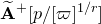
$\widetilde{\mathrm{{\mathbf A}}}^{+}\langle p/[\varpi]^{1/r}\rangle$
, the p-adic completion of
$\widetilde{\mathrm{{\mathbf A}}}^{+}[p/[\varpi]^{1/r}]$
. We endow the ring
$\widetilde{\mathrm{{\mathbf A}}}^{(0,r],\circ}$
with its
$[\varpi]$
-adic topology, or what is the same, the topology defined by the valuation One checks that
\[\mathrm{val}^{(0,r]}(x):=\bigg(\frac{p}{p-1}\bigg)\mathrm{sup}\{t\in\mathbf{Z}[1/p]:x\in[\varpi]^{t}\widetilde{\mathrm{{\mathbf A}}}^{(0,r],\circ}\} .\]
\[\mathrm{val}^{(0,r]}\bigg(\sum_{k\geq0}p^{k}[x_{k}]\bigg)=\mathrm{inf}_{k}\bigg[\mathrm{val}_{{\mathbf{C}}^{\flat}}(x_{k})+\bigg(\frac{pr}{p-1}\bigg)k\bigg].\]
-
– For
$1/r\in\mathbf{Z}[1/p]_{>0}$
we set Equivalently,
\[\widetilde{\mathrm{{\mathbf A}}}^{(0,r]}:=\bigg\{x=\sum_{k\gg-\infty}p^{k}[x_{k}]\in\widetilde{\mathrm{{\mathbf A}}}:\mathrm{val}_{{\mathbf{C}}^{\flat}}(x_{k})+\bigg(\frac{pr}{p-1}\bigg)k\rightarrow\infty\bigg\}.\]
$\widetilde{\mathrm{{\mathbf A}}}^{(0,r]}=\widetilde{\mathrm{{\mathbf A}}}^{(0,r],\circ}[1/[\varpi]]$
. We endow
$\widetilde{\mathrm{{\mathbf A}}}^{(0,r]}$
with the topology which makes
$\widetilde{\mathrm{{\mathbf A}}}^{(0,r],\circ}$
into an open subring. This topology is the same as that defined by the valuation
\[\mathrm{val}^{(0,r]}(x):=\bigg(\frac{p}{p-1}\bigg)\mathrm{sup}\{t\in\mathbf{Z}[1/p]:x\in[\varpi]^{t}\widetilde{\mathrm{{\mathbf A}}}^{(0,r],\circ}\} .\]
-
– For
$r=\infty$
we set
$\widetilde{\mathrm{{\mathbf A}}}^{(0,\infty),\circ}=\widetilde{\mathrm{{\mathbf A}}}^{+}$
with its
$(p,[\varpi])$
-topology and
$\widetilde{\mathrm{{\mathbf A}}}^{(0,\infty)}=\widetilde{\mathrm{{\mathbf A}}}^{+}[1/[\varpi]]$
with its p-adic topology.




For each of the rings introduced above, there are versions with coefficients in A, which we introduce next. We have the following.
-
– For
$1/r\in\mathbf{Z}[1/p]_{>0}$
, and
\[\widetilde{\mathrm{{\mathbf A}}}_{A}^{(0,r],\circ}=\widetilde{\mathrm{{\mathbf A}}}^{(0,r],\circ}\widehat{\otimes}_{\mathbf{Z}_{p}}A:=\varprojlim_{i}(\widetilde{\mathrm{{\mathbf A}}}^{(0,r],\circ}\otimes_{\mathbf{Z}_{p}}A)/[\varpi^{i}]\]
$\widetilde{\mathrm{{\mathbf A}}}_{A}^{(0,r]}=\widetilde{\mathrm{{\mathbf A}}}_{A}^{(0,r],\circ}[1/[\varpi]]$
.
-
– The image of
$\widetilde{\mathrm{{\mathbf A}}}_{A}^{(0,r],\circ}$
in
$\widetilde{\mathrm{{\mathbf A}}}_{A}^{(0,r]}$
, endowed with its subspace topology, is
$\widetilde{\mathrm{{\mathbf A}}}_{A}^{(0,r],+}$
. (The map
$\widetilde{\mathrm{{\mathbf A}}}_{A}^{(0,r],\circ}\rightarrow\widetilde{\mathrm{{\mathbf A}}}_{A}^{(0,r]}$
may not be injective if A has p-torsion.) -
– For
$a\geq1$
the a-typical Witt vectors
$W_{a}(\mathcal{O}_{{\mathbf{C}}}^{\flat})=W(\mathcal{O}_{{\mathbf{C}}}^{\flat})/p^{a}$
, with the
$[\varpi]$
-adic topology. -
– For
$a\geq1$
,
\[W_{a}(\mathcal{O}_{{\mathbf{C}}}^{\flat})_{A}=W_{a}(\mathcal{O}_{{\mathbf{C}}}^{\flat})\widehat{\otimes}_{\mathbf{Z}_{p}}A:=\varprojlim_{i}(W_{a}(\mathcal{O}_{{\mathbf{C}}}^{\flat})\otimes_{\mathbf{Z}_{p}}A)/[\varpi^{i}].\]
-
– For
$r=\infty$
,
$\widetilde{\mathrm{{\mathbf A}}}_{A}^{+}=\widetilde{\mathrm{{\mathbf A}}}_{A}^{(0,\infty),+}=\widetilde{\mathrm{{\mathbf A}}}_{A}^{(0,\infty),\circ}:=W(\mathcal{O}_{{\mathbf{C}}}^{\flat})_{A}=\varprojlim_{a}W_{a}(\mathcal{O}_{{\mathbf{C}}}^{\flat})_{A}$
and
$\widetilde{\mathrm{{\mathbf A}}}_{A}^{(0,\infty)}=W(\mathcal{O}_{{\mathbf{C}}}^{\flat})_{A}[1/[\varpi]]$
. -
– We have
$\widetilde{\mathrm{{\mathbf A}}}_{A}=W({\mathbf{C}}^{\flat})_{A}:=\varprojlim_{a}W_{a}(\mathcal{O}_{{\mathbf{C}}}^{\flat})_{A}[1/[\varpi]]$
. -
– We have
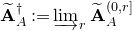
$\widetilde{\mathrm{{\mathbf A}}}_{A}^{\dagger}:=\varinjlim_{r}\widetilde{\mathrm{{\mathbf A}}}_{A}^{(0,r]}$
.


For each
 $R_{A}\in\{\widetilde{\mathrm{{\mathbf A}}}_{A}^{+},\widetilde{\mathrm{{\mathbf A}}}_{A},\widetilde{\mathrm{{\mathbf A}}}_{A}^{(0,r]},\widetilde{\mathrm{{\mathbf A}}}_{A}^{(0,\infty]},\widetilde{\mathrm{{\mathbf A}}}_{A}^{\dagger}\}$
we introduce versions relative to K, by setting
 $R_{K,A}:=(R_{A})^{H_{K}}$
. The following lemma shows that each of these can be defined in terms of
 $\widehat{K}_{\infty}$
. Define
 $W(\mathcal{O}_{\widehat{K}_{\infty}}^{\flat})_{A}$
and
 $W(\widehat{K}_{\infty}^{\flat})_{A}$
in a similar way to the definition of
 $W(\mathcal{O}_{{\mathbf{C}}}^{\flat})_{A}$
and
 $W({\mathbf{C}}^{\flat})_{A}$
, respectively.
Lemma 2.1 (Lemma 7.1). We have natural isomorphisms:
-
(i)
$\widetilde{\mathrm{{\mathbf A}}}_{K,A}^{+}\cong W(\mathcal{O}_{\widehat{K}_{\infty}}^{\flat})_{A}$
; -
(ii)
$\widetilde{\mathrm{{\mathbf A}}}_{K,A}\cong W(\widehat{K}_{\infty}^{\flat})_{A}$
; -
(iii)
$\widetilde{\mathrm{{\mathbf A}}}_{K,A}^{(0,r]}\cong(\widetilde{\mathrm{{\mathbf A}}}_{K}^{+}\langle p/[\varpi]^{1/r}\rangle \,\widehat{\otimes}\,A)[1/[\varpi]]$
; -
(iv)
$\widetilde{\mathrm{{\mathbf A}}}_{K,A}^{(0,\infty)}\cong W(\mathcal{O}_{\widehat{K}_{\infty}}^{\flat})_{A}[1/[\varpi]]$
; -
(v)
$\widetilde{\mathrm{{\mathbf A}}}_{K,A}^{\dagger}=\varinjlim_{r}(\widetilde{\mathrm{{\mathbf A}}}_{K}^{+}\langle p/[\varpi]^{1/r}\rangle \,\widehat{\otimes}\,A)[1/[\varpi]]$
.


Here, in parts (iii) and (v), the tensor products are completed with respect to the
 $[\varpi]$
-adic topology.
Finally, we have imperfect versions of the rings relative to K as above. They are defined as follows.
-
– We have standard rings
$\mathrm{{\mathbf A}}_{K}^{+}$
and
$\mathrm{{\mathbf A}}_{K}$
, which are defined in § 2.1 of [Reference Emerton and GeeEG19] (where they are denoted by
$(\mathrm{{\mathbf A}}_{K}^{\prime})^{+}$
and
$\mathbf{\mathrm{{\mathbf A}}}_{K}^{\prime}$
). We have a certain element
$T\in\mathrm{{\mathbf A}}_{K}^{+}$
lifting
$\varpi$
. Note that by the theory of the field of norms, we have canonical embeddings
$\mathrm{{\mathbf A}}_{K}^{+}\hookrightarrow\widetilde{\mathrm{{\mathbf A}}}$
and
$\mathrm{{\mathbf A}}_{K}\hookrightarrow\widetilde{\mathrm{{\mathbf A}}}$
which map T to
$[\varepsilon]-1$
. -
– We setFootnote 2
endowed with the inverse limit topology, and
\[\mathrm{{\mathbf A}}_{K,A}^{+}=\mathrm{{\mathbf A}}_{K}^{+}\widehat{\otimes}_{\mathbf{Z}_{p}}A:=\varprojlim_{m}\bigg(\varprojlim_{n}\mathrm{{\mathbf A}}_{K}^{+}/(p^{m},T^{n})\otimes_{\mathbf{Z}_{p}}A\bigg),\]
\[\mathrm{{\mathbf A}}_{K,A}=\mathrm{{\mathbf A}}_{K}\widehat{\otimes}_{\mathbf{Z}_{p}}A:=\varprojlim_{m}\bigg(\varprojlim_{n}(\mathrm{{\mathbf A}}_{K}^{+}/(p^{m},T^{n})\otimes_{\mathbf{Z}_{p}}A)[1/T]\bigg).\]
-
– We let
$\mathrm{{\mathbf A}}_{K}^{(0,r],\circ}=\mathrm{{\mathbf A}}_{K}\cap\widetilde{\mathrm{{\mathbf A}}}^{(0,r],\circ}$
and
\[\mathrm{{\mathbf A}}_{K,A}^{(0,r],\circ}=\varprojlim_{i}\big(\mathrm{{\mathbf A}}_{K}^{(0,r],\circ}\otimes_{\mathbf{Z}_{p}}A\big)/T^{i}.\]
-
– Let
$\mathrm{{\mathbf A}}_{K,A}^{(0,r]}:=\mathrm{{\mathbf A}}_{K,A}^{(0,r],\circ}[1/T]$
and write
$\mathrm{{\mathbf A}}_{K,A}^{(0,r],+}$
for the image of
$\mathrm{{\mathbf A}}_{K,A}^{(0,r],\circ}$
in
$\mathrm{{\mathbf A}}_{K,A}^{(0,r]}$
. -
– Finally, let
$\mathrm{{\mathbf A}}_{K,A}^{\dagger}:=\varinjlim_{r}\mathrm{{\mathbf A}}_{K,A}^{(0,r]}$
.


We have natural maps
 $\widetilde{\mathrm{{\mathbf A}}}_{A}^{(0,r]}\rightarrow\widetilde{\mathrm{{\mathbf A}}}_{A}$
,
 $\mathrm{{\mathbf A}}_{K,A}\rightarrow\widetilde{\mathrm{{\mathbf A}}}_{A}$
,
 $\widetilde{\mathrm{{\mathbf A}}}_{A}^{(0,s]}\rightarrow\widetilde{\mathrm{{\mathbf A}}}_{A}^{(0,r]}$
and
 $\mathrm{{\mathbf A}}_{K,A}^{(0,s]}\rightarrow\mathrm{{\mathbf A}}_{K,A}^{(0,r]}$
for
 $s>r$
. One can show they are all injective (this claim is not trivial: it is the main content of Appendix A; cf. Theorem A.9 and what follows). This implies that in the definition of
 $\widetilde{\mathrm{{\mathbf A}}}_{A}^{\dagger}$
, the colimit is, in fact, a union. Similar comments apply to
 $\widetilde{\mathrm{{\mathbf A}}}_{K,A}^{\dagger}$
and
 $\mathrm{{\mathbf A}}_{K,A}^{\dagger}$
.
We shall need the following fact on compatibility with reduction.
Proposition 2.2 (Proposition 7.17). For
 $N\in\mathbf{Z}_{\geq1}$
and
 $1/r\in\mathbf{Z}[1/p]_{>0}$
we have natural isomorphisms
 \[\widetilde{\mathrm{{\mathbf A}}}_{K,A}/p^{N}\widetilde{\mathrm{{\mathbf A}}}_{K,A}\cong\widetilde{\mathrm{{\mathbf A}}}_{K,A/p^{N}}\cong\widetilde{\mathrm{{\mathbf A}}}_{K,A/p^{N}}^{(0,r]}\cong\widetilde{\mathrm{{\mathbf A}}}_{K,A/p^{N}}^{(0,\infty)}.\]
The following result is used later in § 5.
Proposition 2.3 (Corollary 7.4). For
 $1/r\in\mathbf{Z}[1/p]_{>0}$
the topology on
 $\widetilde{\mathrm{{\mathbf A}}}_{A}^{(0,r]}$
is defined by the valuation given by
 \[\mathrm{val}^{(0,r]}(x)=(p/p-1)\,\mathrm{sup}\{t\in\mathbf{Z}[1/p]:x\in[\varpi]^{t}\widetilde{\mathrm{{\mathbf A}}}_{A}^{(0,r],+}\}.\]
Finally, there are continuous
 $(\varphi,G_{K})$
-actions on
 $\widetilde{\mathrm{{\mathbf A}}}_{A}$
by [Reference Emerton and GeeEG19, Lemma 2.2.18]. This gives rise to continuous
 $(\varphi,\Gamma_{K})$
-actions on all of the rings introduced here.
Namely, given
 $r\in{\mathbf{R}}_{>0}\cup\{\infty\}$
we have a continuous map
 \[\varphi:\widetilde{\mathrm{{\mathbf A}}}_{A}^{(0,r]}\rightarrow\widetilde{\mathrm{{\mathbf A}}}_{A}^{(0,r/p]}\]
induced by extending the action of
 $\varphi$
on
 $\mathrm{{\mathbf A}}_{\mathrm{inf}}$
. It is continuous since
 $\varphi([\varpi])=[\varpi]^{p}$
and the topology is
 $[\varpi]$
-adic on both the source and the target.
Similarly, we have a continuous inverse
 \[\varphi^{-1}:\widetilde{\mathrm{{\mathbf A}}}_{A}^{(0,r/p]}\rightarrow\widetilde{\mathrm{{\mathbf A}}}_{A}^{(0,r]}.\]
This immediately extends to give continuous
 $\varphi$
and
 $\varphi^{-1}$
actions on
 $\widetilde{\mathrm{{\mathbf A}}}_{A}^{\dagger}$
. The
 $(\varphi^{\pm1},G_{K})$
-actions (respectively,
 $(\varphi^{\pm1},\Gamma_{K})$
-actions, respectively,
 $(\varphi,\Gamma_{K})$
-actions) on
 $\widetilde{\mathrm{{\mathbf A}}}_{A}^{\dagger}$
and
 $\widetilde{\mathrm{{\mathbf A}}}_{A}$
(respectively,
 $\widetilde{\mathrm{{\mathbf A}}}_{K,A}^{\dagger}$
and
 $\widetilde{\mathrm{{\mathbf A}}}_{K,A}$
, respectively,
 $\mathrm{{\mathbf A}}_{K,A}^{\dagger}$
and
 $\mathrm{{\mathbf A}}_{K,A}$
) are continuous.
3. Overconvergence for perfect coefficients
The purpose of this section is to prove the following result.
Theorem 3.1. The functor
 $\widetilde{M}^{\dagger}\mapsto\widetilde{M}:=\widetilde{M}^{\dagger}\otimes_{\widetilde{\mathrm{{\mathbf A}}}_{K,A}^{\dagger}}\widetilde{\mathrm{{\mathbf A}}}_{K,A}$
induces an equivalence of categories from the category of projective étale
 $(\varphi,\Gamma_{K})$
-modules over
 $\widetilde{\mathrm{{\mathbf A}}}_{K,A}^{\dagger}$
to the category of projective étale
 $(\varphi,\Gamma_{K})$
-modules over
 $\widetilde{\mathrm{{\mathbf A}}}_{K,A}$
.
Our proof follows § 4 of [Reference de Shalit and PoratdSP19] with appropriate modifications. The idea will be to first establish the equivalence for étale
 $\varphi$
-modules and then deduce it for étale
 $(\varphi,\Gamma_{K})$
-modules.
3.1 Descent of
$\varphi$
-modules

The topology on
 $\widetilde{\mathrm{{\mathbf A}}}_{K,A}^{(0,r]}$
is defined by a valuation
 $\mathrm{val}^{(0,r]}$
 \[\mathrm{val}_{A}^{(0,r]}(x):=\bigg(\frac{p}{p-1}\bigg)\mathrm{sup}\{t\in\mathbf{Z}[1/p]:x\in[\varpi]^{t}\widetilde{\mathrm{{\mathbf A}}}_{K,A}^{(0,r],+}\}.\]
We also define, for
 $x\in\widetilde{\mathrm{{\mathbf A}}}_{K,A}^{(0,\infty)}$
,
 \[\mathrm{val}_{A}^{(0,\infty)}(x):=\bigg(\frac{p}{p-1}\bigg)\mathrm{sup}\{t\in\mathbf{Z}[1/p]:x\in[\varpi]^{t}\widetilde{\mathrm{{\mathbf A}}}_{K,A}^{(0,\infty),+}\}.\]
We extend
 $\mathrm{val}_{A}^{(0,r]}$
and
 $\mathrm{val}_{A}^{(0,\infty)}$
to all of
 $\widetilde{\mathrm{{\mathbf A}}}_{K,A}$
, by allowing the value
 $-\infty$
, so that
 $\widetilde{\mathrm{{\mathbf A}}}_{K,A}^{(0,r]}$
(respectively,
 $\widetilde{\mathrm{{\mathbf A}}}_{K,A}^{(0,\infty)}$
) is the subset of elements
 $x\in\widetilde{\mathrm{{\mathbf A}}}_{K,A}$
with
 $\mathrm{val}_{A}^{(0,r]}(x)>-\infty$
(respectively,
 $\mathrm{val}_{A}^{(0,\infty)}(x)>-\infty$
). The following lemma serves as a generalization of the usual Teichmüller digits. Recall from Proposition 2.2 that
 \[\widetilde{\mathrm{{\mathbf A}}}_{K,A}/p^{N}\cong\widetilde{\mathrm{{\mathbf A}}}_{K,A/p^{N}}\cong\widetilde{\mathrm{{\mathbf A}}}_{K,A/p^{N}}^{(0,\infty)}\cong\widetilde{\mathrm{{\mathbf A}}}_{K,A/p^{N}}^{(0,r]}.\]
Lemma 3.2 There exists a (non-canonical) map
 $[\bullet]:\widetilde{\mathrm{{\mathbf A}}}_{K,A}/p\rightarrow\widetilde{\mathrm{{\mathbf A}}}_{K,A}$
such that:
-
(1) for every
$x\in\widetilde{\mathrm{{\mathbf A}}}_{K,A}/p$
we have
$[x]\equiv x$
mod p; -
(2) the map
$[\bullet]$
commutes with
$\varphi$
; -
(3) for every
$x\in\widetilde{\mathrm{{\mathbf A}}}_{K,A}/p$
, we have
$\mathrm{val}_{A}^{(0,\infty)}([x])\geq\mathrm{val}_{A/p}^{(0,\infty)}(x)$
; -
(4) for every
$n\in\mathbf{Z}_{\geq0}$
and every
$x\in\widetilde{\mathrm{{\mathbf A}}}_{K,A}/p$
, we have
$\mathrm{val}_{A}^{(0,r]}(p^{n}[x])\geq\mathrm{val}_{A/p^{n+1}A}^{(0,r]}(p^{n}[x]\mod p^{n+1})$
.


Proof. Multiplication by p induces surjections
 \[A/p\twoheadrightarrow pA/p^{2}\twoheadrightarrow p^{2}A/p^{3}\twoheadrightarrow\cdots\]
of
 ${\mathbf{F}}_{p}$
-vector spaces. Let
 $W_{n}$
be the kernel of
 $\pi_{n}:A/p\twoheadrightarrow p^{n}A/p^{n+1}$
, so that the
 $W_{n}$
are increasing with n. Choose a complement U to the union of the
 $W_{n}$
so that
 \[A/p=U\oplus\bigcup_{n\geq0}W_{n}.\]
For U choose an
 ${\mathbf{F}}_{p}$
-basis
 $\{e_{i}\}_{i\in I_{U}}$
and choose, as we may, compatible bases
 $\{e_{i}\}_{i\in I_{n}}$
for
 $W_{n}$
so that
 $\{e_{i}\}_{i\in I_{n}}\subset\{e_{i}\}_{i\in I_{n+1}}$
, and set
 $I=\bigcup_{n\geq0}I_{n}$
. With this being given, we set
 $J_{n}=I_{U}\cup(I\backslash I_{n})$
for
 $n\geq0$
. We claim that
 $\{\pi_{n}(e_{i})\}_{i\in J_{n}}$
gives an
 ${\mathbf{F}}_{p}$
-basis of
 $p^{n}A/p^{n+1}$
. Indeed, by construction, the map
 $\pi_{n}:A/p\twoheadrightarrow p^{n}A/p^{n+1}$
gives a decomposition
 \[A/p=\mathrm{span}\{e_{i}\}_{i\in I_{U}\cup I}=W_{n}\oplus\mathrm{span}\{e_{i}\}_{i\in J_{n}},\]
so that applying
 $\pi_{n}$
to the
 $e_{i}$
for
 $i\in J_{n}$
gives an
 ${\mathbf{F}}_{p}$
-basis of
 $p^{n}A/p^{n+1}$
. With this choice of
 $\{e_{i}\}_{i\in I\cup I_{U}}$
, choose an arbitrary lifting of them to A, which we denote by
 $\widetilde{e}_{i}$
.
Now each
 $x\in\mathcal{O}_{\widehat{K}_{\infty}}^{\flat}\otimes_{{\mathbf{F}}_{p}}A/p$
can be written uniquely as a finite sum of the form
 $x=\sum x_{i}\otimes e_{i}$
with
 $x_{i}\in\mathcal{O}_{\widehat{K}_{\infty}}^{\flat}$
. Let
 \[[x]:=\sum[x_{i}]\otimes\widetilde{e_{i}}\in W(\mathcal{O}_{\widehat{K}_{\infty}}^{\flat})\otimes_{\mathbf{Z}_{p}}A,\]
where
 $[x_{i}]$
is the usual Teichmüller lift. This defines a map
 \[[\bullet]:\mathcal{O}_{\widehat{K}_{\infty}}^{\flat}\otimes_{{\mathbf{F}}_{p}}A/p\rightarrow W(\mathcal{O}_{\widehat{K}_{\infty}}^{\flat})\otimes_{\mathbf{Z}_{p}}A.\]
It follows from the definition that
 \[[\bullet](\varpi^{t}\mathcal{O}_{\widehat{K}_{\infty}}^{\flat}\otimes_{{\mathbf{F}}_{p}}A/p)\subset[\varpi]^{t}W(\mathcal{O}_{\widehat{K}_{\infty}}^{\flat})\otimes_{\mathbf{Z}_{p}}A;\]
hence, it is continuous for the
 $[\varpi]$
-topology on the source and the
 $(p,[\varpi])$
-topology on the target. It therefore extends to a map
 \[[\bullet]:(\mathcal{O}_{\widehat{K}_{\infty}}^{\flat})_{A/p}\rightarrow W(\mathcal{O}_{\widehat{K}_{\infty}}^{\flat})_{A},\]
which we can extend further to a continuous map
 \[[\bullet]:\widetilde{\mathrm{{\mathbf A}}}_{K,A/p}=(\mathcal{O}_{\widehat{K}_{\infty}}^{\flat})_{A/p}[1/\varpi]\rightarrow W(\widehat{K}_{\infty}^{\flat})_{A}=\widetilde{\mathrm{{\mathbf A}}}_{K,A}.\]
Clearly properties 1 and 2 are satisfied.
To show that property 3 holds, we need to check that
 $\varpi^{-t}x\in(\mathcal{O}_{\widehat{K}_{\infty}}^{\flat})_{A/p}$
implies
 $[\varpi]^{-t}[x]\in W(\mathcal{O}_{\widehat{K}_{\infty}}^{\flat})_{A}$
. Replacing x with
 $\varpi^{-t}x$
, we reduce to the case
 $t=0$
. Using the continuity of
 $[\bullet]$
, we may assume
 $x=\sum x_{i}\otimes e_{i}\in\mathcal{O}_{\widehat{K}_{\infty}}^{\flat}\otimes_{{\mathbf{F}}_{p}}A/p$
. But then it is clear that
 $[x]=\sum[x_{i}]\otimes e_{i}$
lies in
 $W(\mathcal{O}_{\widehat{K}_{\infty}}^{\flat})\otimes_{\mathbf{Z}_{p}}A\subset W(\mathcal{O}_{\widehat{K}_{\infty}}^{\flat})_{A}$
.
To show that property 4 holds, we may again twist, so it suffices to show that
 $p^{n}[x]\text{mod }p^{n+1}\in\widetilde{\mathrm{{\mathbf A}}}_{K,A/p^{n}}^{(0,r],+}$
implies
 $p^{n}[x]\in\widetilde{\mathrm{{\mathbf A}}}_{K,A}^{(0,r],+}$
. Again using the continuity of
 $[\bullet]$
, we may assume
 $x\in\widehat{K}_{\infty}^{\flat}\otimes_{\mathbf{Z}_{p}}A$
. Hence, [x], and consequently
 $p^{n}[x]$
, belongs to the image of
 $\widetilde{\mathrm{{\mathbf A}}}_{K}^{(0,r]}\otimes_{\mathbf{Z}_{p}}A$
, in
 $\widetilde{\mathrm{{\mathbf A}}}_{K,A}^{(0,r]}$
. Explicitly, writing
 $x=\sum x_{i}\otimes e_{i}$
with
 $x_{i}\in\widehat{K}_{\infty}^{\flat}$
, the sum being finite, we have that
 $p^{n}[x]$
is the image under the map
 $\widetilde{\mathrm{{\mathbf A}}}_{K}^{(0,r]}\otimes_{\mathbf{Z}_{p}}A\rightarrow\widetilde{\mathrm{{\mathbf A}}}_{K,A}^{(0,r]}$
of
 $\sum[x_{i}]\otimes p^{n}\widetilde{e}_{i}$
. Taking this modulo
 $p^{n+1}$
, we obtain that
 $p^{n}[x]$
mod
 $p^{n+1}$
is the image of
 $\sum[x_{i}]\otimes\pi_{n}(p^{n}\widetilde{e}_{i})$
under the map
 $\widetilde{\mathrm{{\mathbf A}}}_{K}^{(0,r]}\otimes_{\mathbf{Z}_{p}}p^{n}A/p^{n+1}\rightarrow\widetilde{\mathrm{{\mathbf A}}}_{K,A/p^{n+1}}^{(0,r]}$
. On the other hand, by assumption
 $p^{n}[x]$
mod
 $p^{n+1}\in\widetilde{\mathrm{{\mathbf A}}}_{K,A/p^{n}}^{(0,r],+}$
. Since the
 $\pi_{n}(p^{n}\widetilde{e}_{i})$
are linearly independent, the assumption
 $p^{n}[x]\text{ mod }p^{n+1}\in\widetilde{\mathrm{{\mathbf A}}}_{K,A/p^{n}}^{(0,r],+}$
implies that each
 $[x_{i}]$
lies in the image of
 $\widetilde{\mathrm{{\mathbf A}}}_{K}^{(0,r],\circ}$
. Hence,
 $p^{n}[x]$
, which is the image of
 $\sum[x_{i}]\otimes p^{n}\widetilde{e_{i}}$
under
 $\widetilde{\mathrm{{\mathbf A}}}_{K}^{(0,r]}\otimes_{\mathbf{Z}_{p}}A\rightarrow\widetilde{\mathrm{{\mathbf A}}}_{K,A}^{(0,r]}$
, has to lie in
 $\widetilde{\mathrm{{\mathbf A}}}_{K,A}^{(0,r],+}$
. This concludes the proof.
The next key lemma is essentially the same as [Reference de Shalit and PoratdSP19, Lemma 1.3], but we include the proof for completeness. Let R be a commutative ring endowed with a nonarchimedean valuation, where we allow
 $\mathrm{val}=-\infty$
. Suppose there exists
 $p\in\mathbf{Z}_{\geq2}$
and an invertible morphism
 $\varphi:R\rightarrow R$
such that
 $p\,\mathrm{val}(x)=\mathrm{val}(\varphi(x))$
. Recall our notation for valuation of matrices from § 1.4.
Lemma 3.3 Let
 $X\in\mathrm{GL}_{d}(R)$
. Then for any
 $c<(1/p-1)[\mathrm{val}(X)+\mathrm{val}(X^{-1})]$
and for any
 $Y\in\mathrm{M}_{d}(R)$
there exist
 $U,V\in\mathrm{M}_{d}(R)$
such that
 $\mathrm{val}(V)\geq c$
and
 \[X^{-1}\varphi(U)X-U=Y-V.\]
Proof. Let
 \[U=\sum_{i=1}^{N}\varphi^{-1}(X)\varphi^{-2}(X)\cdots\varphi^{-i}(X)\cdot\varphi^{-i}(Y)\cdot\varphi^{-i}(X)^{-1}\cdots\varphi^{-2}(X)^{-1}\varphi^{-1}(X)^{-1}\]
and
 \[V=\varphi^{-1}(X)\varphi^{-2}(X)\cdots\varphi^{-N}(X)\cdot\varphi^{-N}(Y)\cdot\varphi^{-N}(X)^{-1}\cdots\varphi^{-2}(X)^{-1}\varphi^{-1}(X)^{-1}.\]
Then
 \[X^{-1}\varphi(U)X-U=Y-V.\]
If
 $Y=0$
, then choose
 $V=0$
. Otherwise, by selecting N large enough, we can make
 $\mathrm{val}(\varphi^{-N}(Y))$
as close as we want to 0. In addition,
 \[\mathrm{val}(\varphi^{-1}(X)\varphi^{-2}(X)\cdots\varphi^{-N}(X))\geq(p^{-1}+\cdots+p^{-N})\,\mathrm{val}(X)\]
and
 \[\mathrm{val}(\varphi^{-N}(X)^{-1}\cdots\varphi^{-2}(X)^{-1}\varphi^{-1}(X)^{-1})\geq(p^{-1}+\cdots+p^{-N})\,\mathrm{val}(X^{-1}),\]
so by taking N sufficiently large we have
 $\mathrm{val}(V)\geq c$
.
Proposition 3.4 Let
 $\widetilde{M}$
be a free étale
 $\varphi$
-module over
 $\widetilde{\mathrm{{\mathbf A}}}_{K,A}$
. Then there exists a free étale
 $\varphi$
-module
 $\widetilde{M}^{\dagger}$
over
 $\widetilde{\mathrm{{\mathbf A}}}_{K,A}^{\dagger}$
, contained in
 $\widetilde{M}$
, such that the natural map
 \[\widetilde{\mathrm{{\mathbf A}}}_{K,A}\otimes_{\widetilde{\mathrm{{\mathbf A}}}_{K,A}^{\dagger}}\widetilde{M}^{\dagger}\rightarrow\widetilde{M}\]
is an isomorphism.
Proof. Choose a basis of
 $\widetilde{M}$
and let
 $X=\mathrm{Mat}(\varphi)\in\mathrm{GL}_{d}(\widetilde{\mathrm{{\mathbf A}}}_{K,A})$
be the matrix of
 $\varphi$
in this basis. We need to show there exists a matrix
 $U\in\mathrm{GL}_{d}(\widetilde{\mathrm{{\mathbf A}}}_{K,A})$
such that
 $C=U^{-1}X\varphi(U)\in\mathrm{GL}_{d}(\widetilde{\mathrm{{\mathbf A}}}_{K,A}^{\dagger})$
. In fact, we shall find U so that
 $C\in\mathrm{GL}_{d}(\widetilde{\mathrm{{\mathbf A}}}_{K,A}^{(0,\infty)})$
.
To do this, write
 $X=\sum_{n\geq0}p^{n}[X_{n}]$
with
 \[X_{n}\in\mathrm{M}_{d}(\widetilde{\mathrm{{\mathbf A}}}_{K,A}/p)=\mathrm{M}_{d}(\widetilde{\mathrm{{\mathbf A}}}_{K,A/p})=\mathrm{M}_{d}(\widetilde{\mathrm{{\mathbf A}}}_{K,A/p}^{(0,\infty)})\]
and
 \[\mathrm{val}_{A}^{(0,\infty)}(p^{k}[X_{n}])=\mathrm{val}_{p^{k}A/p^{k+1}}^{(0,\infty)}(p^{k}[X_{n}]\text{mod }p^{k+1})\]
as we may according to Lemma 3.2. We shall construct
 $U=\sum_{n\geq0}p^{n}[U_{n}]$
with
 $U_{n}\in\mathrm{M}_{d}(\widetilde{\mathrm{{\mathbf A}}}_{K,A}/p)$
and
 $\mathrm{val}_{A}^{(0,\infty)}([U_{n}])=\mathrm{val}_{A/p}^{(0,\infty)}(U_{n})$
by constructing
 $U_{n}$
inductively.
or
 $n=0$
take
 $U_{0}=\mathrm{Id}$
. Now suppose
 $U_{0},\ldots,U_{n-1}$
have been defined. Let
 $U'=\sum_{i=0}^{n-1}p^{i}[U_{i}]$
. We shall also suppose we have chosen matrices
 $C_{0}=X_{0},C_{1},\ldots,C_{n-1}\in\mathrm{M}_{d}(\widetilde{\mathrm{{\mathbf A}}}_{K,A}/p)$
inductively such that
 \[U^{\prime-1}X\varphi(U^{\prime})\equiv\sum_{i=0}^{n-1}p^{i}[C_{i}]\text{ mod}p^{n}\mathrm{M}_{d}(\widetilde{\mathrm{{\mathbf A}}}_{K,A}).\]
Write
 \[U^{\prime-1}X\varphi(U^{\prime})-\sum_{i=0}^{n-1}p^{i}[C_{i}]=p^{n}Y\]
with
 $Y\in\mathrm{M}_{d}(\widetilde{\mathrm{{\mathbf A}}}_{K,A})$
. Now look for
 $U_{n}\in\mathrm{M}_{d}(\widetilde{\mathrm{{\mathbf A}}}_{K,A}/p)$
such that
 \[(U^{\prime}+p^{n}[U_{n}])^{-1}X\varphi(U^{\prime}+p^{n}[U_{n}])\equiv\sum_{i=0}^{n}p^{i}[C_{i}]\text{mod }p^{n+1}\]
with
 $\mathrm{val}_{A/p}^{(0,\infty)}(C_{n})$
bounded below. Noting that
 $(U^{\prime}+p^{n}[U_{n}])^{-1}=U^{\prime-1}-p^{n}[U_{n}]$
mod
 $p^{n+1}$
, and letting
 $\overline{Y}$
denote the reduction of Y mod
 $p\mathrm{M}_{d}(\widetilde{\mathrm{{\mathbf A}}}_{K,A})$
, it suffices to solve the mod p equation
 \[U_{n}-X_{0}\varphi(U_{n})X_{0}^{-1}=\overline{Y}X_{0}^{-1}-C_{n}X_{0}^{-1}\]
in
 $\widetilde{\mathrm{{\mathbf A}}}_{K,A/p}$
.
By Lemma 3.3, this equation can be solved for both
 $U_{n}$
and
 $C_{n}$
, with
 $C_{n}$
, hence also
 $p^{n}[C_{n}]$
, with
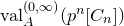 $\mathrm{val}_{A}^{(0,\infty)}(p^{n}[C_{n}])$
bounded independently of n. More precisely, we can solve for
 $U_{n}$
and
 $C_{n}$
with
 \[\mathrm{val}_{A/p}^{(0,\infty)}(C_{n}X_{0}^{-1})\geq c\]
for any
 $c<(\frac{1}{p-1})[\mathrm{val}(X_{0})+\mathrm{val}(X_{0}^{-1})]$
. Then we may and do choose the
 $C_{n}$
in a way such that for
 $n\geq1$
we have
 \[\mathrm{val}_{A}^{(0,\infty)}(p^{n}[C_{n}])\geq\mathrm{val}_{A}^{(0,\infty)}([C_{n}])\geq\mathrm{val}_{A/p}^{(0,\infty)}(C_{n})\geq\mathrm{val}_{A/p}^{(0,\infty)}(X_{0})+c.\]
In particular, this bound is independent of n, the bound, in fact, depending only on
 $X_{0}$
. With these choices of the
 $C_{n}$
, letting
 $C=\sum_{n\geq0}[C_{n}]p^{n}$
and
 $U=\sum_{n\geq0}[U_{n}]p^{n}$
we therefore have
 $C=U^{-1}X\varphi(U),$
where
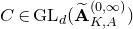 $C\in\mathrm{GL}_{d}(\widetilde{\mathrm{{\mathbf A}}}_{K,A}^{(0,\infty)})$
because
 $\mathrm{val}_{A}^{(0,\infty)}(C)\geq c>-\infty$
.
3.2 Descending
$\varphi$
-module morphisms

We need to regularize the action of
 $\varphi$
.
Proposition 3.5 Let
 $1/r\in\mathbf{Z}[1/p]_{>0}\cup\{\infty\}$
, and let
 $X\in\mathrm{M}_{d}(\widetilde{\mathrm{{\mathbf A}}}_{K,A}^{(0,r]}),Y\in\mathrm{M}_{e}(\widetilde{\mathrm{{\mathbf A}}}_{K,A}^{(0,r]})$
and
 $U\in\mathrm{M}_{d\times e}(\widetilde{\mathrm{{\mathbf A}}}_{K,A})$
satisfy
 \[\varphi(U)=XUY.\]
Then
 $U\in\mathrm{M}_{d\times e}(\widetilde{\mathrm{{\mathbf A}}}_{K,A}^{(0,r]})$
.
In particular, if
 $X\in\mathrm{M}_{d}(\widetilde{\mathrm{{\mathbf A}}}_{K,A}^{\dagger}),Y\in\mathrm{M}_{e}(\widetilde{\mathrm{{\mathbf A}}}_{K,A}^{\dagger})$
and
 $U\in\mathrm{M}_{d\times e}(\widetilde{\mathrm{{\mathbf A}}}_{K,A})$
, then
 $U\in\mathrm{M}_{d\times e}(\widetilde{\mathrm{{\mathbf A}}}_{K,A}^{\dagger})$
.
Proof. Write
 $X=[\varpi]^{t}X'$
with
 $\mathrm{val}_{A}^{(0,r]}(X')\geq0$
, then we see
 \[\mathrm{val}_{A}^{(0,r]}(\varphi^{-1}(X)\varphi^{-2}(X)\cdots\varphi^{-N}(X))\geq t(p^{-1}+\cdots+p^{-N})\]
is bounded independently of N. (This also happens with another bound if
 $r=\infty$
.) A similar analysis applies to
 $\varphi^{-N}(Y)\cdots\varphi^{-2}(Y)\varphi^{-1}(Y)$
.
From the equation
 $U=\varphi^{-1}(X)\varphi^{-1}(U)\varphi^{-1}(Y)$
we get by iteration
 \[U=\varphi^{-1}(X)\varphi^{-2}(X)\cdots\varphi^{-N}(X)\cdot\varphi^{-N}(U)\cdot\varphi^{-N}(Y)\cdots\varphi^{-2}(Y)\varphi^{-1}(Y),\]
which we write as
 $U=X_{N}\varphi^{-N}(U)Y_{N}$
, with
 $\mathrm{val}_{A}^{(0,r]}(X_{N})$
and
 $\mathrm{val}_{A}^{(0,r]}(Y_{N})$
bounded independently of N.
Now write
 $U=\sum_{n\geq0}[U_{n}]p^{n}$
, where
 $[\bullet]$
denotes the generalized Teichmüller digit of Lemma 3.2, applied successively to the entries of the reduction of U mod
 $p^{n}$
. Let
 $U^{(k)}$
be the kth truncation of U, i.e.
 $U^{(k)}=\sum_{n=0}^{k-1}[U_{n}]p^{n}$
. We then have
 \[U^{(k)}=X_{N}\varphi^{-N}(U^{(k)})Y_{N}\mod p^{k}.\]
Fixing k and choosing N large we can make
 $\mathrm{val}_{A}^{(0,r]}(X_{N}\varphi^{-N}(U^{(k)})Y_{N})\geq c$
where c is a constant depending only on X and Y, because
 $\mathrm{val}_{A}^{(0,r]}(\varphi^{-N}(U^{(k)}))=p^{-N}\,\mathrm{val}_{A}^{(0,r]}(U^{(k)})$
.
We then get that
 \[\mathrm{val}_{A/p^{k}}^{(0,r]}(U^{(k)}\text{ mod }p^{k})\geq\mathrm{val}_{A}^{(0,r]}(U^{(k)})\]
is bounded below by c.
We shall now prove by induction that
 $\mathrm{val}_{A}^{(0,r]}([U_{k-1}]p^{k-1})\geq c$
. By possibly making c smaller, we may assume this is true for
 $k=1$
. Arguing by induction on k, using
 $U^{(k)}=[U_{k-1}]p^{k-1}+U^{(k-1)}$
, we deduce that
 \[\mathrm{val}_{A/p^{k}}^{(0,r]}([U_{k-1}]p^{k-1}\text{ mod }p^{k})\geq c\]
is bounded below by c. But by Lemma 3.2, this implies that
 $\mathrm{val}_{A}^{(0,r]}([U_{k-1}]p^{k-1})\geq c$
.
Hence, for each k, we have
 $\mathrm{val}_{A}^{(0,r]}(U^{(k)})\geq c$
and, consequently,
 $\mathrm{val}_{A}^{(0,r]}(U)\geq c$
. This proves that
 $U\in\mathrm{M}_{d\times e}(\widetilde{\mathrm{{\mathbf A}}}_{A}^{(0,r]})$
, as required.
Corollary 3.6 Let
 $\widetilde{M}$
be a free étale
 $\varphi$
-module over
 $\widetilde{\mathrm{{\mathbf A}}}_{K,A}$
. Then there exists a unique free étale
 $\varphi$
-module
 $\widetilde{M}^{\dagger}$
over
 $\widetilde{\mathrm{{\mathbf A}}}_{K,A}^{\dagger}$
, contained in
 $\widetilde{M}$
, such that the natural map
 \[\widetilde{M}^{\dagger}\otimes_{\widetilde{\mathrm{{\mathbf A}}}_{K,A}^{\dagger}}\widetilde{\mathrm{{\mathbf A}}}_{K,A}\rightarrow\widetilde{M}\]
is an isomorphism.
Proof. The existence was established in Proposition 3.4, and the uniqueness follows from Proposition 3.5.
Corollary 3.7 Let
 $\widetilde{M}$
be a free étale
 $\varphi$
-module over
 $\widetilde{\mathrm{{\mathbf A}}}_{A}$
, and let
 $\widetilde{M}^{\dagger}$
be the unique free étale
 $\varphi$
-module over
 $\widetilde{\mathrm{{\mathbf A}}}_{A}^{\dagger}$
with
 $\widetilde{M}^{\dagger}\otimes_{\widetilde{\mathrm{{\mathbf A}}}_{A}^{\dagger}}\widetilde{\mathrm{{\mathbf A}}}_{A}\xrightarrow{\sim}\widetilde{M}$
as in Corollary 3.6. Then
 \[(\widetilde{M}^{\dagger})^{\varphi=1}=\widetilde{M}^{\varphi=1}.\]
Proof. Let
 $e_{1},\ldots,e_{d}$
be a basis of
 $\widetilde{M}^{\dagger}$
and let
 $X=\mathrm{Mat}(\varphi)\in\mathrm{GL}_{d}(\widetilde{\mathrm{{\mathbf A}}}_{K,A}^{\dagger})$
be the matrix of
 $\varphi$
with respect to this basis. If
 $m\in\widetilde{M}^{\varphi=1}$
and
 $m=\sum a_{i}e_{i}$
with
 $a_{i}\in\widetilde{\mathrm{{\mathbf A}}}_{K,A}$
, the vector
 $a=(a_{i})$
satisfies the equation
 \[\varphi(a)=X^{-1}a,\]
so by Proposition 3.5 we conclude that the
 $a_{i}$
belong to
 $\widetilde{\mathrm{{\mathbf A}}}_{K,A}^{\dagger}$
.
Remark 3.8 Using Proposition 3.5, one can show that
 $\widetilde{M}^{\dagger}$
admits the following characterization: it is the subset of all elements m of
 $\widetilde{M}$
such that
 $\{\varphi^{i}(m)\}_{i\geq0}$
spans a finitely generated
 $\widetilde{\mathrm{{\mathbf A}}}_{K,A}^{\dagger}$
-submodule.
3.3 The equivalence of categories
The following lemma will allow us to reduce from the projective case to the free case.
Lemma 3.9 Let M be a projective étale
 $\varphi$
-module over a ring R. Then there exists a free étale
 $\varphi$
-module F over R such that M is a direct summand of F.
Proof. This argument of [Reference Emerton and GeeEG21, Lemma 5.2.14] carries over.
Lemma 3.10 If M,N are projective étale
 $\varphi$
-modules over a ring R, then
 $M^{\vee}\otimes_{R}N$
is also a projective étale
 $\varphi$
-module, and we have a natural identification
 \[\mathbb{\mathrm{Hom}}_{R,\varphi}(M,N)\xrightarrow{\sim}(M^{\vee}\otimes_{R}N)^{\varphi=1}.\]
Proof. This is [Reference Emerton and GeeEG19, Lemma 2.5.4].
Proposition 3.11 Let
 $\widetilde{M}^{\dagger},\widetilde{N}^{\dagger}$
be projective étale
 $\varphi$
-modules over
 $\widetilde{\mathrm{{\mathbf A}}}_{K,A}^{\dagger}$
, and let
 $\widetilde{M}=\widetilde{M}^{\dagger}\otimes_{\widetilde{\mathrm{{\mathbf A}}}_{K,A}^{\dagger}}\widetilde{\mathrm{{\mathbf A}}}_{K,A}$
,
 $\widetilde{N}=\widetilde{N}^{\dagger}\otimes_{\widetilde{\mathrm{{\mathbf A}}}_{K,A}^{\dagger}}\widetilde{\mathrm{{\mathbf A}}}_{K,A}$
. Then
 \[\mathbb{\mathrm{Hom}}_{\widetilde{\mathrm{{\mathbf A}}}_{K,A}^{\dagger},\varphi}(\widetilde{M}^{\dagger},\widetilde{N}^{\dagger})\xrightarrow{\sim}\mathbb{\mathrm{Hom}}_{\widetilde{\mathrm{{\mathbf A}}}_{K,A},\varphi}(\widetilde{M},\widetilde{N}).\]
Proof. We argue as in [Reference Emerton and GeeEG19, Proposition 2.6.6], i.e. let
 $\widetilde{P}^{\dagger}=(\widetilde{M}^{\dagger})^{\vee}\otimes\widetilde{N}^{\dagger}$
, then
 $\widetilde{P}^{\dagger}$
is a projective étale
 $\varphi$
-module over
 $\widetilde{\mathrm{{\mathbf A}}}_{K,A}^{\dagger}$
. By Lemma 3.10, we need to check that
 $(\widetilde{P}^{\dagger})^{\varphi=1}=\widetilde{P}^{\varphi=1}$
, where
 $\widetilde{P}=\widetilde{P}^{\dagger}\otimes_{\widetilde{\mathrm{{\mathbf A}}}_{A}^{\dagger}}\widetilde{\mathrm{{\mathbf A}}}_{A}$
. Since the formation of
 $\varphi$
-invariants is compatible with direct sums we reduce by Lemma 3.9 to the case that
 $\widetilde{P}^{\dagger}$
and
 $\widetilde{P}$
are free. But in this case the equality is known by Corollary 3.7.
Proposition 3.12 Let
 $\widetilde{M}$
be a projective étale
 $\varphi$
-module over
 $\widetilde{\mathrm{{\mathbf A}}}_{K,A}$
. Then there exists a projective étale
 $\varphi$
-module
 $\widetilde{M}^{\dagger}$
over
 $\widetilde{\mathrm{{\mathbf A}}}_{K,A}^{\dagger}$
and an isomorphism
 $\widetilde{M}^{\dagger}\otimes_{\widetilde{\mathrm{{\mathbf A}}}_{K,A}^{\dagger}}\widetilde{\mathrm{{\mathbf A}}}_{K,A}\xrightarrow{\sim}\widetilde{M}$
.
Proof. By Lemma 3.9, we may write
 $\widetilde{M}$
as a direct summand of a free étale
 $\varphi$
-module
 $\widetilde{F}$
over
 $\widetilde{\mathrm{{\mathbf A}}}_{K,A}$
. By Proposition 3.4, there exists a free étale
 $\varphi$
-module
 $\widetilde{F}^{\dagger}$
over
 $\widetilde{\mathrm{{\mathbf A}}}_{K,A}^{\dagger}$
and an isomorphism
 $\widetilde{F}^{\dagger}\otimes_{\widetilde{\mathrm{{\mathbf A}}}_{K,A}^{\dagger}}\widetilde{\mathrm{{\mathbf A}}}_{K,A}\xrightarrow{\sim}\widetilde{F}$
. By Proposition 3.11, the idempotent in
 $\mathrm{End}(\widetilde{F})$
corresponding to
 $\widetilde{M}$
(the projector onto
 $\widetilde{M}$
) comes from an idempotent in
 $\mathrm{End}(\widetilde{F}^{\dagger})$
, and we may take
 $\widetilde{M}^{\dagger}$
to be the étale
 $\varphi$
-module corresponding to this idempotent.
Combining Propositions 3.11 and 3.12 we get a full descent result for projective étale
 $\varphi$
-modules.
Theorem 3.13 The functor
 $\widetilde{M}^{\dagger}\mapsto\widetilde{M}$
induces an equivalence of categories from the category of projective étale
 $\varphi$
-modules over
 $\widetilde{\mathrm{{\mathbf A}}}_{K,A}^{\dagger}$
to the category of projective étale
 $\varphi$
-modules over
 $\widetilde{\mathrm{{\mathbf A}}}_{K,A}$
.
Finally, to prove the descent result for
 $(\varphi,\Gamma_{K})$
-modules, we only need to descend
 $\Gamma_{K}$
along the equivalence.
Proof of Theorem 3.1. For full faithfulness, take
 $\Gamma_{K}$
-invariants of both sides in the isomorphism of Proposition 3.11.
For essential surjectivity, suppose
 $\widetilde{M}$
is a projective étale
 $(\varphi,\Gamma_{K})$
-module over
 $\widetilde{\mathrm{{\mathbf A}}}_{K,A}$
, and let
 $\widetilde{M}^{\dagger}$
be the unique étale projective
 $\varphi$
-module over
 $\widetilde{\mathrm{{\mathbf A}}}_{K,A}^{\dagger}$
associated to it in Proposition 3.12. Then by uniqueness,
 $\widetilde{M}^{\dagger}$
is stable under the action of
 $\Gamma_{K}$
, hence is actually a
 $(\varphi,\Gamma_{K})$
-module over
 $\widetilde{\mathrm{{\mathbf A}}}_{K,A}^{\dagger}$
. This concludes the proof.
4. The Tate–Sen method for Tate rings
In this section, we present a variant of the Tate–Sen method of [Reference Berger and ColmezBC08] which will later allow us to avoid the use of Galois representations when decompleting
 $(\varphi,\Gamma)$
-modules. Furthermore, it will apply in the case the coefficients have nonzero p-torsion. The idea, inspired by [Reference BellovinBel20], is to replace the role of p in the original Tate–Sen method by that of a pseudouniformizer. Technically speaking, the results presented here are neither a special case nor a generalization of the setting in [Reference Berger and ColmezBC08], because of the difference in assumptions. However, we are not aware of any applications of [Reference Berger and ColmezBC08] where the method of this section would not apply also.
We work in the following general setting. Let
 $G_{0}$
be a profinite group endowed with a continuous character
 $\chi:G_{0}\rightarrow\mathbf{Z}_{p}^{\times}$
with open image and let
 $H_{0}=\ker\chi$
. If
 $g\in G_{0}$
, let
 $n(g)=\mathrm{val}_{p}(\chi(g)-1)\in\mathbf{Z}$
. For G an open subgroup of
 $G_{0}$
, set
 $H=G\cap H_{0}$
. Let
 $G_{H}$
be the normalizer of H in
 $G_{0}$
. Note
 $G_{H}$
is open in
 $G_{0}$
since
 $G\subset G_{H}$
. Finally, let
 $\widetilde{\Gamma}_{H}=G_{H}/H$
and write
 $C_{H}$
for the center of
 $\widetilde{\Gamma}_{H}$
. By [Reference Berger and ColmezBC08, Lem. 3.1.1] the group
 $C_{H}$
is open in
 $\widetilde{\Gamma}_{H}$
. Let
 $n_{1}(H)$
be the smallest positive integer such that
 $\chi(C_{H})$
contains
 $1+p^{n}\mathbf{Z}_{p}$
.
Let
 $(\widetilde{\Lambda},\widetilde{\Lambda}^{+})$
be a pair of topological rings with
 $\widetilde{\Lambda}^{+}\subset\widetilde{\Lambda}$
, and f an element of
 $\widetilde{\Lambda}^{+}$
. We shall make the following assumptions:
-
(i)
$\widetilde{\Lambda}$
is a Tate ring, with
$\widetilde{\Lambda}^{+}$
a ring of definition, and f a pseudouniformizer; -
(ii)
$\widetilde{\Lambda}^{+}$
is f-adically complete; -
(iii) there exists a valuation
$\mathrm{val}_{\Lambda}:\widetilde{\Lambda}\rightarrow(-\infty,\infty]$
defining the topology on
$\widetilde{\Lambda}$
such that
$\mathrm{val}_{\Lambda}(fx)=\mathrm{val}_{\Lambda}(f)+\mathrm{val}_{\Lambda}(x)$
for
$x\in\widetilde{\Lambda}$
, and such that
$\widetilde{\Lambda}^{+}=\widetilde{\Lambda}^{\mathrm{val}_{\Lambda}\geq0}$
; -
(iv) the group
$G_{0}$
acts on
$\widetilde{\Lambda}$
, and this action is unitary for the valuation
$\mathrm{val}_{\Lambda}$
.


Lemma 4.1 If
 $U\in\mathrm{M}_{d}(\widetilde{\Lambda})$
has
 $\mathrm{val}_{\Lambda}(U-1)>0$
, then
 $U\in\mathrm{GL}_{d}(\widetilde{\Lambda})$
with inverse
 $\sum_{n=0}^{\infty}(1-U)^{n}$
.
4.1 The Tate–Sen axioms
With the previous setting, we define them to be the following.Footnote 3
-
(TS1) There exists
$c_{1}>0$
such that for each pair
$H_{1}\subset H_{2}$
of open subgroups of
$H_{0}$
there exists
$\alpha\in\widetilde{\Lambda}^{H_{1}}$
such that
$\mathrm{val}_{\Lambda}(\alpha)>-c_{1}$
and
$\sum_{\tau\in H_{2}/H_{1}}\tau(\alpha)=1$
. -
(TS2) There exists
$c_{2}>0$
and for each open subgroup H of
$H_{0}$
an integer n(H), as well as an increasing sequence
$(\Lambda_{H,n})_{n\geq n(H)}$
of closed subalgebras of
$\widetilde{\Lambda}^{H}$
, each containing
$f^{\pm1}$
, and
$\Lambda_{H,n}$
-linear maps such that:
\[\mathbb{\mathrm{R}}_{H,n}:\widetilde{\Lambda}^{H}\rightarrow\Lambda_{H,n}\]
-
(1) if
$H_{1}\subset H_{2}$
, then
$\Lambda_{H_{2},n}\subset\Lambda_{H_{1},n}$
and
$\mathbb{\mathrm{R}}_{H_{1},n}|_{\widetilde{\Lambda}^{H_{2}}}=\mathbb{\mathrm{R}}_{H_{2},n}$
; -
(2)
$\mathbb{\mathrm{R}}_{H,n}(x)=x$
if
$x\in\Lambda_{H,n}$
; -
(3)
$g(\Lambda_{H,n})=\Lambda_{gHg^{-1},n}$
and
$g(\mathbb{\mathrm{R}}_{H,n}(x))=\mathbb{\mathrm{R}}_{gHg^{-1}}(gx)$
if
$g\in G_{0}$
; -
(4) if
$n\geq n(H)$
and if
$x\in\widetilde{\Lambda}^{H}$
, then
$\mathrm{val}_{\Lambda}(\mathbb{\mathrm{R}}_{H,n}(x))\geq\mathrm{val}_{\Lambda}(x)-c_{2}$
; -
(5) if
$x\in\widetilde{\Lambda}^{H}$
, then
$\lim_{n\rightarrow\infty}\mathbb{\mathrm{R}}_{H,n}(x)=x$
.
-
-
(TS3) There exists
$c_{3}>0$
and, for each open subgroup G of
$G_{0}$
an integer
$n(G)\geq n_{1}(H)$
where
$H=G\cap H_{0}$
, such that if
$n(\gamma)\leq n\leq n(G)$
for
$\gamma\in\widetilde{\Gamma}_{H}$
then
$\gamma-1$
is invertible on
$X_{H,n}=(1-\mathbb{\mathrm{R}}_{H,n})(\widetilde{\Lambda}^{H})$
and
$\mathrm{val}_{\Lambda}((\gamma-1)^{-1}(x))\geq\mathrm{val}_{\Lambda}(x)-c_{3}$
.








For the rest of the section we shall assume (TS1), (TS2) and (TS3) are satisfied.
Remark 4.2 If
 $H_{0}$
is trivial, then the conditions simplify, and, in particular, (TS1) is automatically satisfied for any
 $c_{1}>0$
. This will be the setting in § 5; however, we produce here a more general framework for ease of future applications.
4.2 Descent to H-invariants
Lemma 4.3 Let H be an open subgroup of
 $H_{0}$
,
 $a>c_{1}$
. Suppose
 $\tau\mapsto U_{\tau}$
is a continuous 1-cocycle of H valued in
 $\mathrm{GL}_{d}(\widetilde{\Lambda})$
which verifies and
 $\mathrm{val}(U_{\tau}-1)\geq a$
for each
 $\tau\in H$
. Then there exists a matrix
 $M\in\mathrm{GL}_{d}(\widetilde{\Lambda})$
with
 $\mathrm{val}_{\Lambda}(M-1)\geq a-c_{1}$
such that the cocycle
 $\tau\mapsto M^{-1}U_{\tau}\tau(M)$
verifies
 $\mathrm{val}_{\Lambda}(M^{-1}U_{\tau}\tau(M)-1)\geq a+1$
.
Proof. This is proven in the same way as [Reference Berger and ColmezBC08, Lemma 3.2.1]. (The analogue of the condition
 $M-1\in p^{k}\mathrm{M}_{d}(\widetilde{\Lambda})$
, which appears in [Reference Berger and ColmezBC08, Lemma 3.2.1], is
 $M-1\inf^{k}\mathrm{M}_{d}(\widetilde{\Lambda})$
. It is vacuous because with our assumptions f is invertible in
 $\widetilde{\Lambda}$
.)
Corollary 4.1 Let H be an open subgroup of
 $H_{0}$
,
 $a>c_{1}$
and
 $\tau\mapsto U_{\tau}$
a continuous 1-cocycle of H valued in
 $\mathrm{GL}_{d}(\widetilde{\Lambda})$
. Suppose
 $\mathrm{val}(U_{\tau}-1)\geq a$
for each
 $\tau\in H$
. Then there exists
 $M\in\mathrm{GL}_{d}(\widetilde{\Lambda})$
such that
 $\mathrm{val}_{\Lambda}(M-1)\geq a-c_{1}$
such that the cocycle
 $\tau\mapsto M^{-1}U_{\tau}\tau(M)$
is trivial.
Proof. This is proven in the same way as [Reference Berger and ColmezBC08, Corollary 3.2.2].
4.3 Decompletion
The following lemma needs to be modified slightly compared with the treatment of [Reference Berger and ColmezBC08].
Lemma 4.5 Let
 $\delta>0$
and let
 $a,b\in{\mathbf{R}}$
such that
 $a\geq c_{2}+c_{3}+\delta$
and
 $b\ge\mathrm{sup}(a+c_{2},2c_{2}+2c_{3}+\delta$
). Let H be an open subgroup of
 $H_{0}$
,
 $n\geq n(H)$
and
 $\gamma\in\widetilde{\Gamma}_{H}$
such that
 $n(\gamma)\leq n$
. Finally, let
 \[U=1+f^{k}U_{1}+f^{k}U_{2}\]
such that
 \[\begin{array}{l}U_{1}\in\mathrm{M}_{d}(\Lambda_{H,n}),\mathrm{val}_{\Lambda}(U_{1})\geq a-\mathrm{val}_{\Lambda}(f^{k}),\\U_{2}\in\mathrm{M}_{d}(\widetilde{\Lambda}^{H}),\mathrm{val}_{\Lambda}(U_{2})\geq b-\mathrm{val}_{\Lambda}(f^{k}).\end{array}\]
Then there exists
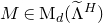 $M\in\mathrm{M}_{d}(\widetilde{\Lambda}^{H})$
with
 $\mathrm{val}(M-1)\geq b-c_{2}-c_{3}$
such that
 $M^{-1}U\gamma(M)=1+f^{k}V_{1}+f^{k}V_{2}$
such that
 \[\begin{array}{l}V_{1}\in\mathrm{M}_{d}(\Lambda_{H,n}),\mathrm{val}_{\Lambda}(V_{1})\geq a-\mathrm{val}_{\Lambda}(f^{k}),\\V_{2}\in\mathrm{M}_{d}(\widetilde{\Lambda}^{H}),\mathrm{val}_{\Lambda}(V_{2})\geq b-\mathrm{val}_{\Lambda}(f^{k})+\delta.\end{array}\]
Proof. This again just follows the proof of [Reference Berger and ColmezBC08, Lemma 3.2.3], but there are a few small modifications required, so we give more details. One setsFootnote 4
 \[\begin{array}{l}V=f^{-k}(1-\gamma)^{-1}(1-\mathbb{\mathrm{R}}_{H,n})(f^{k}U_{2}),\\V_{1}=U_{1}+\mathbb{\mathrm{R}}_{H,n}(U_{2}),\\V_{2}=f^{-k}[(1+f^{k}V)^{-1}U\gamma(1+f^{k}V)-(1+f^{k}U_{1}+f^{k}\mathbb{\mathrm{R}}_{H,n}(U_{2}))],\\M=1+f^{k}V.\end{array}\]
By explicit calculations, one checks using (TS2), (TS3), the
 $\Lambda_{H,n}$
-linearity of
 $\mathbb{\mathrm{R}}_{H,n}$
and the expansion
 \[(1+f^{k}V)^{-1}=1-f^{k}V+f^{2k}V^{2}-\cdots\]
that all the terms are well defined and that the conditions are satisfied. (Here we have implicitly used the assumption
 $f\in\Lambda_{H,n}$
in use of the
 $\Lambda_{H,n}$
-linearity of
 $\mathbb{\mathrm{R}}_{H,n}$
.)
Corollary 4.6 Let
 $\delta>0$
,
 $b\geq2c_{2}+2c_{3}+\delta$
and
 $n\geq n(H)$
. If
 $U\in\mathrm{M}_{d}(\widetilde{\Lambda}^{H})$
has
 $\mathrm{val}_{\Lambda}(U-1)\geq b$
, then there exists
 $M\in\mathrm{M}_{d}(\widetilde{\Lambda}^{H})$
with
 $\mathrm{val}_{\Lambda}(M-1)\geq b-c_{2}-c_{3}$
such that
 $M^{-1}U\gamma(M)\in M_{d}(\Lambda_{H,n})$
.
Proof. This is the same proof as that of [Reference Berger and ColmezBC08, Corollary 3.2.4].
Lemma 4.7 Let H be an open subgroup of
 $H_{0}$
and let
 $n\geq n(H)$
,
 $\gamma\in\Gamma_{H}$
such that
 $n(\gamma)\leq n$
and
 $B\in\mathrm{M}_{l\times d}(\widetilde{\Lambda}^{H})$
be a matrix. Suppose there are
 $V_{1}\in\mathrm{GL}_{l}(\Lambda_{H,n}),V_{2}\in\mathrm{GL}_{d}(\Lambda_{H,n})$
such that
 $\mathrm{val}(V_{1}-1),\mathrm{val}(V_{2}-1)>c_{3}$
and
 $\gamma(B)=V_{1}BV_{2}$
. Then
 $B\in\mathrm{M}_{l\times d}(\Lambda_{H,n})$
.
Proof. The proof is exactly the same as that of [Reference Berger and ColmezBC08, Lemma 3.2.5]. The only difference between that lemma and the statement appearing here is that there one further assumes
 $l=d$
and
 $B\in\mathrm{GL}_{d}(\Lambda_{H,n})$
, but these assumptions are not used in the proof.
4.4 Descent
Proposition 4.8 Let
 $\sigma\mapsto U_{\sigma}$
be a continuous 1-cocycle of
 $G_{0}$
valued in
 $\mathrm{GL}_{d}(\widetilde{\Lambda})$
. If G is an open subgroup of
 $G_{0}$
such that
 $\mathrm{val}(U_{\sigma}-1)>c_{1}+2c_{2}+2c_{3}$
when
 $\sigma\in G$
, and if
 $H=G\cap H_{0}$
, then there exists
 $M\in\mathrm{M}_{d}(\widetilde{\Lambda})$
with
 $\mathrm{val}(M-1)>c_{2}+c_{3}$
such that the 1-cocycle of
 $G_{0}$
given by
 $\sigma\mapsto V_{\sigma}=M^{-1}U_{\sigma}\sigma(M)$
is trivial on H and valued in
 $\mathrm{GL}_{d}(\Lambda_{H,n(G)})$
.
Proof. The proof is the same as that of [Reference Berger and ColmezBC08, Proposition 3.2.6].
Let
 $M^{+}$
be a finite free
 $\widetilde{\Lambda}^{+}$
-semilinear representation of
 $G_{0}$
and for
 $H\subset H_{0}$
open let
 $\Lambda_{H,n}^{+}=\widetilde{\Lambda}^{+}\cap\Lambda_{H,n}$
.
Proposition 4.9 Suppose that G is an open subgroup of
 $G_{0}$
and that
 $M^{+}$
has a basis such that
 $\mathrm{val}(\mathrm{Mat}(g)-1)>c_{1}+2c_{2}+2c_{3}$
for
 $g\in G$
. Let
 $H=G\cap H_{0}$
.
Then for
 $n\geq n(G)$
there exists a unique free
 $\Lambda_{H,n}^{+}$
-submodule
 $\mathrm{\mathbf{D}}_{H,n}^{+}(M^{+})$
of
 $M^{+}$
such that:
-
(1)
$\mathrm{\mathbf{D}}_{H,n}^{+}(M^{+})$
is fixed by H and stable by
$G_{0}$
; -
(2) the natural map
$\widetilde{\Lambda}^{+}\otimes_{\Lambda_{H,n}^{+}}\mathrm{\mathbf{D}}_{H,n}^{+}(M^{+})\rightarrow M^{+}$
is an isomorphism; in particular,
$\mathrm{\mathbf{D}}_{H,n}^{+}(M^{+})$
is free of rank =
$\mathrm{rank} M^{+}$
; -
(3)
$\mathrm{\mathbf{D}}_{H,n}^{+}(M^{+})$
has a basis which is
$c_{3}$
-fixed by
$G/H$
, meaning that for
$\gamma\in G/H$
we have
$\mathrm{val}(\mathrm{Mat}(\gamma)-1)>c_{3}$
.



Proof. We follow the proof of [Reference Berger and ColmezBC08, Proposition 3.3.1], which is closely related.
Let
 $v_{1},\ldots,v_{d}$
be a basis of
 $M^{+}$
over
 $\widetilde{\Lambda}^{+}$
. We get a cocycle U in
 $\mathrm{H}^{1}(G_{0},\mathrm{GL}_{d}(\widetilde{\Lambda}^{+}))$
. By assumption
 $\mathrm{val}(U_{\sigma}-1)>c_{1}+2c_{2}+2c_{3}$
if
 $\sigma\in G$
. By Proposition 4.8 there exists
 $M\in\mathrm{M}_{d}(\widetilde{\Lambda})$
such that
 $\mathrm{val}(M-1)>c_{2}+c_{3}$
and the cocycle
 $\sigma\mapsto V_{\sigma}=M^{-1}U_{\sigma}\sigma(M)$
is trivial on H and is valued in
 $\mathrm{GL}_{d}(\Lambda_{H,n(G)})$
. Now
 $\mathrm{val}(M-1)>c_{2}+c_{3}>0$
so
 $M\in\mathrm{GL}_{d}(\widetilde{\Lambda}^{+})$
. It follows that V is valued in
 $\mathrm{GL}_{d}(\Lambda_{H,n(G)})\cap\mathrm{GL}_{d}(\widetilde{\Lambda}^{+})=\mathrm{GL}_{d}(\Lambda_{H,n(G)}^{+})$
.
Now let
 $M=(m_{ij})$
and
 $U_{\sigma}=(u_{ij})$
. If we write
 $e_{i}=Mv_{i}$
for
 $i=1,\ldots,d$
, then
 \[\sigma(e_{k})=\sum_{j}\sigma(m_{jk})\sigma(v_{j})=\sum_{i}\sum_{j}u_{ij}\sigma(m_{ij})v_{i}=e_{k}\]
for
 $\sigma\in H$
. Thus,
 $e_{1},\ldots,e_{d}$
is a basis of
 $M^{+}$
fixed by H, and if we write
 $\mathrm{\mathbf{D}}_{H,n}^{+}(M^{+})=\bigoplus\Lambda_{H,n}^{+}e_{i}$
, then the natural map
 $\widetilde{\Lambda}^{+}\otimes_{\Lambda_{H,n}^{+}}\mathrm{\mathbf{D}}_{H,n}^{+}(M^{+})\rightarrow M^{+}$
is an isomorphism.
Furthermore, if
 $\gamma\in G/H$
, then
 $W=\mathrm{Mat}(\gamma)$
in the basis
 $e_{1},\ldots,e_{d}$
is of the form
 $M^{-1}U_{\sigma}\sigma(M)$
where
 $\sigma\in G$
is a lift of
 $\gamma$
. Using the identity
 \[W-1=M^{-1}U_{\sigma}\sigma(M)-1=(M^{-1}-1)U_{\sigma}\sigma(M)+(U_{\sigma}-1)\sigma(M)+\sigma(M)-1,\]
it follows that
 $\mathrm{val}(W-1)>c_{2}+c_{3}>c_{3}$
. This implies that the basis
 $\{e_{1},\ldots,e_{d}\}$
is
 $c_{3}$
-fixed.
Finally, we show that
 $\mathrm{\mathbf{D}}_{H,n}^{+}(M^{+})$
is unique. Choose
 $\gamma\in C_{H}$
with
 $n(\gamma)=n$
and let
 $e_{1}',\ldots,e_{d}'$
be another basis. Then
 $\mathrm{Mat}_{\{e_{i}\}}(\gamma)=W$
and
 $\mathrm{Mat}_{\{e_{i}'\}}(\gamma)=W'$
are both in
 $\mathrm{GL}_{d}(\Lambda_{H,n(G)}^{+})$
with
 $n\geq n(G)$
and
 $\mathrm{val}(W-1),\mathrm{val}(W'-1)>c_{3}$
. Let
 $B\in\mathrm{GL}_{d}(\widetilde{\Lambda}^{+})$
be the matrix expressing
 $e_{i}'$
in terms of
 $e_{i}$
. Then B is H-invariant and
 $W'=B^{-1}W\gamma(B)$
. According to Lemma 4.7 we have
 $B\in\mathrm{GL}_{d}(\Lambda_{H,n})$
, so
 $B\in\mathrm{GL}_{d}(\widetilde{\Lambda}^{+})\cap\mathrm{GL}_{d}(\Lambda_{H,n})=\mathrm{GL}_{d}(\Lambda_{H,n}^{+})$
. It follows that
 $e_{i}'$
and
 $e_{i}$
generate the same submodule.
Proposition 4.10 With the notation of the previous proposition, the module
 $\mathrm{\mathbf{D}}_{H,n}^{+}(M^{+})$
admits the following characterization: it is the union of all finitely generated
 $\Lambda_{H,n}^{+}$
-submodules of
 $M^{+}$
which are stable by
 $G_{0}$
, fixed by H and which are generated by a
 $c_{3}$
-fixed set of generators.
Proof. Indeed, if we have a submodule generated by
 $c_{3}$
-fixed elements
 $f_{1},\ldots,f_{l}$
and if
 $e_{1},\ldots,e_{d}$
is a
 $c_{3}$
-fixed basis, let
 $B\in\mathrm{M}_{l\times d}(\widetilde{\Lambda}^{H,+})$
be a matrix expressing the
 $f_{i}$
in terms of the
 $e_{i}$
. We have
 \[\mathrm{Mat}_{\{f_{i}\}}(\gamma)B=\gamma(B)\,\mathrm{Mat}_{\{e_{i}\}}(\gamma).\]
(Here
 $\mathrm{Mat}_{\{f_{i}\}}(\gamma)$
is not necessarily a uniquely determined matrix, since the submodule generated by the
 $f_{i}$
may not be free, but this does not matter.) We have
 $\mathrm{val}(\mathrm{Mat}_{\{f_{i}\}}(\gamma)-1)>c_{3}$
, and this implies that
 $\mathrm{Mat}_{\{f_{i}\}}(\gamma)$
is invertible. Thus, by Lemma 4.7,
 \[B\in\mathrm{M}_{l\times d}(\Lambda_{H,n})\cap\mathrm{M}_{l\times d}(\widetilde{\Lambda}^{H,+})=\mathrm{M}_{l\times d}(\Lambda_{H,n}^{+}),\]
which means the submodule generated by
 $f_{i}$
is contained in
 $\mathrm{\mathbf{D}}_{H,n}^{+}(M^{+})$
.
We introduce two additive,
 $\otimes$
-categories:
-
–
$\mathrm{Mod}_{\widetilde{\Lambda}^{+}}^{G_{0}}(G)$
, the category of finite free
$\widetilde{\Lambda}^{+}$
-semilinear representations of
$G_{0}$
such that for some basis
$\mathrm{val}(\mathrm{Mat}(g)-1)>c_{1}+2c_{2}+2c_{3}$
for
$g\in G$
; -
–
$\mathrm{Mod}_{\Lambda_{H,n}^{+}}^{G_{0}}(G)$
, the category of finite free
$\Lambda_{H,n}^{+}$
-semilinear representations of
$G_{0}$
that are fixed by
$H=G\cap H_{0}$
and which have
$c_{3}$
-fixed basis.





For
 $n\geq n(G)$
, Propositions 4.9 and 4.10 give us a functor
 $M^{+}\mapsto\mathrm{\mathbf{D}}_{H,n}^{+}(M^{+})$
from
 $\mathrm{Mod}_{\widetilde{\Lambda}^{+}}(G)$
to
 $\mathrm{Mod}_{\Lambda_{H,n}^{+}}(G)$
. We also have a functor
 $N^{+}\mapsto\widetilde{\Lambda}^{+}\otimes_{\Lambda_{H,n}^{+}}N^{+}$
from
 $\mathrm{Mod}_{\Lambda_{H,n}^{+}}(G)$
to
 $\mathrm{Mod}_{\widetilde{\Lambda}^{+}}(G)$
. We can then express Proposition 4.9 in the following way.
Theorem 4.11 The functor
 $M^{+}\mapsto\mathrm{\mathbf{D}}_{H,n}^{+}(M^{+})$
gives an equivalence of categories between
 $\mathrm{Mod}_{\widetilde{\Lambda}^{+}}^{G_{0}}(G)$
and
 $\mathrm{Mod}_{\Lambda_{H,n}^{+}}^{G_{0}}(G)$
for
 $n\geq n(G)$
.
5. Deperfection
In this section we explain how to descend
 $(\varphi,\Gamma_{K})$
-modules from
 $\widetilde{\mathrm{{\mathbf A}}}_{K,A}^{\dagger}$
to
 $\mathrm{{\mathbf A}}_{K,A}^{\dagger}$
.
5.1 Verifying the Tate–Sen axioms
We take
 $G_{0}=\Gamma_{K}$
, and
 $\chi:G_{0}\rightarrow\mathbf{Z}_{p}^{\times}$
is the cyclotomic character, so that
 $H_{0}=1$
.
Let
 $\widetilde{\Lambda}=\widetilde{\mathrm{{\mathbf A}}}_{K,A}^{(0,r]}$
for
 $1/r\in\mathbf{Z}[1/p]_{>0}$
with
 $r<1$
and
 $\widetilde{\Lambda}^{+}=\widetilde{\mathrm{{\mathbf A}}}_{K,A}^{(0,r],+}$
. Then:
-
(i)
$\widetilde{\Lambda}$
is a Tate ring, with ring of definition
$\widetilde{\Lambda}^{+}$
, with a pseudouniformizer f taken to be T, the element introduced in § 2.1; note that T was introduced as an element of
$\mathrm{{\mathbf A}}_{K,A}^{+}$
, but it can be thought of as an element of
$\mathrm{{\mathbf A}}_{K,A}^{(0,r]}$
, the latter being a subring of
$\widetilde{\Lambda}$
; -
(ii)
$\widetilde{\Lambda}^{+}$
is T-adically complete, by Proposition 2.3; -
(iii) by § 6 of [Reference ColmezCo08],
$T/[\varpi]$
is a unit in
$\widetilde{\mathrm{{\mathbf A}}}^{(0,r],\circ}$
if
$r<1$
, hence also in
$\widetilde{\mathrm{{\mathbf A}}}_{K,A}^{(0,r],+}$
; we endow
$\widetilde{\mathrm{{\mathbf A}}}_{K,A}^{(0,r]}$
with the valuation
$\mathrm{val}^{(0,r]}$
, note that
\[\mathrm{val}^{(0,r]}(a)=(p/p-1)\,\mathrm{sup}\{x\in\mathbf{Z}[1/p]:a\in[\varpi]^{x}\widetilde{\mathrm{{\mathbf A}}}_{K,A}^{(0,r],+}\};\]
$[\varpi]^{x}\widetilde{\mathrm{{\mathbf A}}}_{A}^{(0,r],+}=T^{x}\widetilde{\mathrm{{\mathbf A}}}_{A}^{(0,r],+}$
whenever
$T^{x}$
makes sense; it therefore induces the T-adic topology;
-
(iv) the group
$G_{0}$
acts continuously on
$\widetilde{\mathrm{{\mathbf A}}}_{K,A}^{(0,r]}$
, and is unitary for the valuation
$\mathrm{val}^{(0,r]}$
.


As explained in Remark 4.2, the condition (TS1) is automatic in this setting since
 $H_{0}=1$
.
5.1.1 The axiom (TS2).
We shall check this axiom holds in the following setting. Recalling
 $H_{0}=1$
, we set
 \[\Lambda_{n}=\Lambda_{H_{0},n}:=\varphi^{-n}\big(\mathrm{{\mathbf A}}_{K,A}^{(0,rp^{-n}]}\big),\]
which is a closed subalgebra of
 $\widetilde{\mathrm{{\mathbf A}}}_{K,A}^{(0,r]}$
, and
 \[\mathbb{\mathrm{R}}_{n}:=\mathbb{\mathrm{R}}_{H_{0},n}:\widetilde{\mathrm{{\mathbf A}}}_{K,A}^{(0,r]}\rightarrow\varphi^{-n}\big(\mathrm{{\mathbf A}}_{K,A}^{(0,rp^{-n}]}\big)\]
is the continuous extension of the map
 $(\widetilde{\mathrm{{\mathbf A}}}_{K}^{(0,r]})\rightarrow\varphi^{-n}(\mathrm{{\mathbf A}}_{K}^{(0,rp^{-n}]})$
constructed in § 8 of [Reference ColmezCo08] for the case
 $A=\mathbf{Z}_{p}$
. This extension exists because this original map is T-adically continuous.
We shall now verify (TS2) holds. The only thing which is not immediate is condition (4), i.e. we need to check that there exists
 $c_{2}>0$
such that
 $\mathrm{val}_{\Lambda}(R_{n}(x))\geq\mathrm{val}_{\Lambda}(x)-c_{2}$
. To do this, choose
 $c_{2}>0$
which works in the case
 $A=\mathbf{Z}_{p}$
, which is known to exist by [Reference Berger and ColmezBC08, Prop. 4.2.1].
Suppose
 $x\in\widetilde{\mathrm{{\mathbf A}}}_{K,A}^{(0,r]}$
. If
 $\mathrm{val}_{\Lambda}(x)\geq(p/p-1)t$
for
 $t\in\mathbf{Z}[1/p]$
, then
 $x\in[\varpi]^{t}\widetilde{\mathrm{{\mathbf A}}}_{K,A}^{(0,r],+}$
. We may write x as the image of a (possibly infinite) sum
 \[\sum x_{i}\otimes a_{i}\]
with
 \[x_{i}\in[\varpi]^{t}\widetilde{\mathrm{{\mathbf A}}}_{K}^{(0,r],\circ},\quad a_{i}\in A,\]
so that
 $\mathrm{val}^{(0,r]}(x_{i})\geq(p/p-1)t$
.
Now
 $\mathbb{\mathrm{R}}_{n}(x)=\sum\mathbb{\mathrm{R}}_{n}(x_{i})\otimes a_{i},$
and we have from the case
 $A=\mathbf{Z}_{p}$
that
 \[\mathrm{val}^{(0,r]}(\mathbb{\mathrm{R}}_{n}(x_{i}))\geq(p/p-1)t-c_{2}.\]
Hence,
 \[\mathbb{\mathrm{R}}_{n}(x_{i})\in([\varpi]^{t-(\frac{p-1}{p})c_{2}}\widetilde{\mathrm{{\mathbf A}}}_{K}^{(0,r],\circ})\,\widehat{\otimes}\,A\]
for each i, which shows that
 \[\mathbb{\mathrm{R}}_{n}(x)\in[\varpi]^{t-(\frac{p-1}{p})c_{2}}\widetilde{\mathrm{{\mathbf A}}}_{K,A}^{(0,r],+},\]
so that
 $\mathrm{val}_{\Lambda}(\mathbb{\mathrm{R}}_{n}(x))\geq(\frac{p}{p-1})t-c_{2}$
. Hence, (TS2) holds with the same
 $c_{2}$
.
5.1.2 The axiom (TS3).
We need to show that there exists
 $c_{3}>0$
and, for each open subgroup G of
 $G_{0}$
, an integer n(G) such that if
 $n\geq n(G)$
and if
 $n(\gamma)\leq n$
, then
 $\gamma-1$
is invertible on
 $X_{n}=(1-\mathbb{\mathrm{R}}_{n})(\widetilde{\Lambda})$
and
 $\mathrm{val}_{\Lambda}((\gamma-1)^{-1}(x))\geq\mathrm{val}_{\Lambda}(x)-c_{3}$
.
We shall show that if
 $c_{2}=c_{2}(\mathbf{Z}_{p})$
and
 $c_{3}=c_{3}(\mathbf{Z}_{p})$
work for the case
 $A=\mathbf{Z}_{p}$
as in [Reference Berger and ColmezBC08, Proposition 4.2.1], then any
 $c_{3}'>c_{2}(\mathbf{Z}_{p})+c_{3}(\mathbf{Z}_{p})$
works for general A.
Let
 $x\in X_{n}=(1-\mathbb{\mathrm{R}}_{n})(\widetilde{\Lambda})$
. Let
 $y\in\widetilde{\Lambda}\cong\widetilde{\mathrm{{\mathbf A}}}_{K,A}^{(0,r]}$
. We may write y as the image of
 \[\sum y_{i}\otimes a_{i}\]
in
 $\widetilde{\mathrm{{\mathbf A}}}_{K,A}^{(0,r]}$
, with
 $y_{i}\in\widetilde{\mathrm{{\mathbf A}}}_{K}^{(0,r]}$
(the sum possibly infinite). If
 $\mathrm{val}^{(0,r]}(y)\geq(p/p-1)t$
for
 $t\in\mathbf{Z}[1/p]$
, then
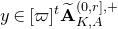 $y\in[\varpi]^{t}\widetilde{\mathrm{{\mathbf A}}}_{K,A}^{(0,r],+}$
, which is the image of
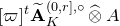 $[\varpi]^{t}\widetilde{\mathrm{{\mathbf A}}}_{K}^{(0,r],\circ}\,\widehat{\otimes}\,A$
, so one can choose
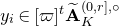 $y_{i}\in[\varpi]^{t}\widetilde{\mathrm{{\mathbf A}}}_{K}^{(0,r],\circ}$
. This shows that we may assume
 $\mathrm{val}^{(0,r]}(y_{i})\geq\mathrm{val}^{(0,r]}(y)$
for every i.
We let
 $x=(1-\mathbb{\mathrm{R}}_{n})(y)$
, so that x is the image of
 $\sum(1-\mathbb{\mathrm{R}}_{n})(y_{i})\otimes a_{i}$
. Writing
 $x_{i}=(1-\mathbb{\mathrm{R}}_{n})(y_{i})$
we have
 \[\mathrm{val}_{\Lambda}((\gamma-1)^{-1}(x_{i}))\geq\mathrm{val}_{\Lambda}(x_{i})-c_{3}\geq\mathrm{val}^{(0,r]}(y_{i})-c_{3},\]
which approaches zero. The sum
 $\sum((\gamma-1)^{-1}(x_{i}))\otimes a_{i}$
therefore converges in
 $\widetilde{\mathrm{{\mathbf A}}}_{K,A}^{(0,r]}$
. This shows that
 $\gamma-1$
is invertible on
 $X_{n}$
.
Finally, suppose
 $x\in X_{n}$
with
 $\mathrm{val}^{(0,r]}(x)\geq(p/p-1)t$
, we shall show that
 \[\mathrm{val}^{(0,r]}((\gamma-1)^{-1}(x))\geq\frac{p}{p-1}t-c_{2}-c_{3}.\]
By assumption,
 $x\in[\varpi]^{t}\widetilde{\mathrm{{\mathbf A}}}_{K,A}^{(0,r],+}$
, so we may write
 $x=\sum x_{i}\otimes a_{i}$
(the sum possibly infinite) with
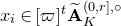 $x_{i}\in[\varpi]^{t}\widetilde{\mathrm{{\mathbf A}}}_{K}^{(0,r],\circ}$
. Then since
 $(1-\mathbb{\mathrm{R}}_{n})$
is idempotent we have
 $x=\sum(1-\mathbb{\mathrm{R}}_{n})(x_{i})\otimes a_{i}$
. Letting
 $y_{i}=(1-\mathbb{\mathrm{R}}_{n})(x_{i})$
we have
 $y_{i}\in[\varpi]^{t-(\frac{p-1}{p})c_{2}}\widetilde{\mathrm{{\mathbf A}}}_{K}^{(0,r],\circ}$
and so
 $(\gamma-1)^{-1}(x)=\sum(\gamma-1)^{-1}(y_{i})\otimes a_{i}$
. Then
 \[(\gamma-1)^{-1}(y_{i})\in[\varpi]^{t-(\frac{p-1}{p})c_{2}-(\frac{p-1}{p})c_{3}}\widetilde{\mathrm{{\mathbf A}}}_{K}^{(0,r],\circ},\]
which shows
 \[\mathrm{val}_{\Lambda}((\gamma-1)^{-1}(x))\geq\mathrm{val}_{\Lambda}(x)-c_{2}-c_{3},\]
which shows we can take
 $c_{3}'=c_{2}-c_{3}$
, as required.
Remark 5.1.
-
(i) With a little more work, once can prove that
$\widetilde{\mathrm{{\mathbf A}}}_{A}^{(0,r]}$
also satisfies the Tate–Sen axioms. This recovers overconvergence results appearing in § 4.2 of [Reference Berger and ColmezBC08]. -
(ii) The following was pointed out to us by Rebecca Bellovin: if A is the ring of definition of a pseudoaffinoid algebra with pseudouniformizer u, the rings
$\widetilde{\mathrm{{\mathbf A}}}_{A/u}^{(0,r]}$
are consistent with the reduction mod u of the rings
$\widetilde{\Lambda}_{A,(0,r]}$
of [Reference BellovinBel20]. By taking u-adic limits, one should be able to recover the main result of [Reference BellovinBel20] from the results of § 4. -
(iii) More generally, one could probably phrase the results of this section as some sort of stability of our version of the Tate–Sen axioms under base change, but we have not attempted to do so.


5.2 Descent
The following proposition is a variant of [Reference BergerBer08, Thm. I.3.3].
Proposition 5.2. If
 $\widetilde{M}^{\dagger}$
is a projective étale
 $\varphi$
-module over
 $\widetilde{\mathrm{{\mathbf A}}}_{K,A}^{\dagger}$
, then for every
 $1/r\in\mathbf{Z}[1/p]_{>0}$
there exists a unique projective
 $\widetilde{\mathrm{{\mathbf A}}}_{K,A}^{(0,r]}$
-submodule
 $\widetilde{M}^{(0,r]}\subset\widetilde{M}^{\dagger}$
such that:
-
(i) the natural map
$\widetilde{\mathrm{{\mathbf A}}}_{K,A}^{\dagger}\otimes_{\widetilde{\mathrm{{\mathbf A}}}_{K,A}^{(0,r]}}\widetilde{M}^{(0,r]}\rightarrow\widetilde{M}^{\dagger}$
is an isomorphism; -
(ii)
$\varphi$
sends
$\widetilde{M}^{(0,r]}$
into
$\widetilde{\mathrm{{\mathbf A}}}_{K,A}^{(0,r/p]}\otimes_{\widetilde{\mathrm{{\mathbf A}}}_{K,A}^{(0,r]}}\widetilde{M}^{(0,r]}$
, and the induced map
\[\widetilde{\mathrm{{\mathbf A}}}_{K,A}^{(0,r/p]}\otimes_{\widetilde{\mathrm{{\mathbf A}}}_{K,A}^{(0,r]}}^{\varphi}\widetilde{M}^{(0,r]}=\varphi^{*}\widetilde{M}^{(0,r]}\rightarrow\widetilde{\mathrm{{\mathbf A}}}_{K,A}^{(0,r/p]}\otimes_{\widetilde{\mathrm{{\mathbf A}}}_{K,A}^{(0,r]}}\widetilde{M}^{(0,r]}\]


is an isomorphism.
In particular:
-
(1)
$\widetilde{\mathrm{{\mathbf A}}}_{K,A}^{(0,s]}\otimes_{\widetilde{\mathrm{{\mathbf A}}}_{K,A}^{(0,r]}}\widetilde{M}^{(0,r]}=\widetilde{M}^{(0,s]}$
for
$s<r$
; -
(2)
$\varphi$
induces an isomorphism
$\varphi^{*}\widetilde{M}^{(0,r]}\xrightarrow{\sim}\widetilde{M}^{(0,r/p]}$
; -
(3) If
$\widetilde{M}^{\dagger}$
is a
$(\varphi,\Gamma_{K})$
-module, then each
$\widetilde{M}^{(0,r]}$
is
$\Gamma_{K}$
-stable.


Furthermore, if
 $\widetilde{M}^{\dagger}$
is free, then so is
 $\widetilde{M}^{(0,r]}$
.
Proof. We start by proving the statement in the case where
 $\widetilde{M}^{\dagger}$
is free.
To prove existence, choose any basis
 $e_{1},\ldots,e_{d}$
of
 $\widetilde{M}^{\dagger}$
over
 $\widetilde{\mathrm{{\mathbf A}}}_{K,A}^{\dagger}$
. Then
 $\mathrm{Mat}(\varphi)\in\mathrm{GL}_{d}(\widetilde{\mathrm{{\mathbf A}}}_{K,A}^{\dagger})$
, and so for some
 $r_{0}$
and all
 $r\leq r_{0}$
we have
 $\mathrm{Mat}(\varphi),\mathrm{Mat}(\varphi^{-1})\in\mathrm{GL}_{d}(\widetilde{\mathrm{{\mathbf A}}}_{K,A}^{(0,r_{0}]})$
. We take
 $\widetilde{M}^{(0,r]}=\bigoplus\widetilde{\mathrm{{\mathbf A}}}_{K,A}^{(0,r]}e_{i}$
, so that conditions (i) and (ii) are satisfied. For
 $r>r_{0}$
we may recursively define
 $\widetilde{M}^{(0,r]}:=(\varphi^{-1})^{*}(\widetilde{M}^{(0,r/p]})$
using the isomorphism
 $(\varphi^{-1})^{*}\widetilde{M}^{\dagger}\xrightarrow{\sim}\widetilde{M}^{\dagger}$
.
For uniqueness, suppose that
 $\widetilde{M}^{(0,r],(1)}$
and
 $\widetilde{M}^{(0,r],(2)}$
are two submodules satisfying conditions (i) and (ii). Let
 $X\in\mathrm{GL}_{d}(\widetilde{\mathrm{{\mathbf A}}}_{K,A}^{\dagger})$
be the transition matrix between the two bases of
 $\widetilde{M}^{(0,r],(1)}$
and
 $\widetilde{M}^{(0,r],(2)}$
and let
 $P_{1}$
and
 $P_{2}$
be the matrices in
 $\mathrm{GL}_{d}(\widetilde{\mathrm{{\mathbf A}}}_{K,A}^{(0,r/p]})$
of
 $\varphi$
in these bases. Then we have the equation
 \[X=P_{1}^{-1}\varphi(X)P_{2},\]
which implies by Proposition 3.5 that
 $X\in\mathrm{GL}_{d}(\widetilde{\mathrm{{\mathbf A}}}_{K,A}^{(0,r/p]})$
. Hence,
 \[\widetilde{\mathrm{{\mathbf A}}}_{K,A}^{(0,r/p]}\otimes_{\widetilde{\mathrm{{\mathbf A}}}_{K,A}^{(0,r]}}\widetilde{M}^{(0,r],(1)}=\widetilde{\mathrm{{\mathbf A}}}_{K,A}^{(0,r/p]}\otimes_{\widetilde{\mathrm{{\mathbf A}}}_{K,A}^{(0,r]}}\widetilde{M}^{(0,r],(2)},\]
and it follows from condition (ii) that
 $\varphi^{*}\widetilde{M}^{(0,r],(1)}=\varphi^{*}\widetilde{M}^{(0,r],(2)}$
. Since
 $\varphi:\widetilde{\mathrm{{\mathbf A}}}_{K,A}^{(0,r]}\rightarrow\widetilde{\mathrm{{\mathbf A}}}_{K,A}^{(0,r/p]}$
is an isomorphism, this gives
 $\widetilde{M}^{(0,r],(1)}=\widetilde{M}^{(0,r],(2)}$
.
We now prove existence and uniqueness when
 $\widetilde{M}^{\dagger}$
is only assumed projective. To show existence, given
 $\widetilde{M}^{\dagger}$
, embed it as a direct summand of a free étale
 $\varphi$
-module
 $\widetilde{F}^{\dagger}$
, as we may according to Lemma 3.9 and set
 $\widetilde{M}^{(0,r]}=\widetilde{M}^{\dagger}\cap\widetilde{F}^{(0,r]}$
. Let
 $\pi:\widetilde{F}^{\dagger}\rightarrow\widetilde{M}^{\dagger}$
be the projection.
Claim If
 $x\in\widetilde{F}^{(0,r]}$
, then also
 $\pi(x)\in\widetilde{F}^{(0,r]}$
.
To see this, choose a basis
 $e_{1},\ldots,e_{d}$
of
 $\widetilde{F}^{(0,r]}$
. Let
 $\mathrm{Mat}(\varphi)$
be the matrix of
 $\varphi$
with respect to this basis. As the proof of the existence in the free case has shown, if r is taken to be sufficiently small, we can actually arrange that
 $\mathrm{Mat}(\varphi)\in\mathrm{GL}_{d}(\widetilde{\mathrm{{\mathbf A}}}_{K,A}^{(0,r]})$
(and not just
 $\mathrm{Mat}(\varphi)\in\mathrm{GL}_{d}(\widetilde{\mathrm{{\mathbf A}}}_{K,A}^{(0,r/p]})$
). The relation
 $\pi\circ\varphi=\varphi\circ\pi$
shows that if the claim is true for sufficiently small r it holds for any r, so we may restrict to the case where
 $\mathrm{Mat}(\varphi)\in\mathrm{GL}_{d}(\widetilde{\mathrm{{\mathbf A}}}_{K,A}^{(0,r]})$
. Now since
 $\widetilde{\mathrm{{\mathbf A}}}_{K,A}^{\dagger}\otimes_{\widetilde{\mathrm{{\mathbf A}}}_{K,A}^{(0,r]}}\widetilde{F}^{(0,r]}\xrightarrow{\sim}\widetilde{F}^{\dagger}$
, there is a matrix
 $\mathrm{Mat}(\pi)\in\mathrm{M}_{d}(\widetilde{\mathrm{{\mathbf A}}}_{K,A}^{\dagger})$
representing
 $\pi$
with respect to the basis
 $e_{i}$
. We need to show that
 $\mathrm{Mat}(\pi)\in\mathrm{M}_{d}(\widetilde{\mathrm{{\mathbf A}}}_{K,A}^{(0,r]})$
. But again using the relation
 $\pi\circ\varphi=\varphi\circ\pi$
we deduce
 \[\mathrm{Mat}(\varphi)\varphi(\mathrm{Mat}(\pi))=\mathrm{Mat}(\pi)\,\mathrm{Mat}(\varphi),\]
which implies once more by Proposition 3.5 that
 $\mathrm{Mat}(\pi)\in\mathrm{M}_{d}(\widetilde{\mathrm{{\mathbf A}}}_{K,A}^{(0,r]})$
, as required.
Now write
 $\widetilde{P}^{\dagger}$
for the étale
 $\varphi$
-module which is the complement of
 $\widetilde{M}^{\dagger}$
in
 $\widetilde{F}^{\dagger}$
. Letting
 $\widetilde{P}^{(0,r]}=\widetilde{P}^{\dagger}\cap\widetilde{F}^{(0,r]},$
the claim implies there is a direct decomposition
 \[\widetilde{F}^{(0,r]}=\widetilde{M}^{(0,r]}\oplus\widetilde{P}^{(0,r]},\]
which respects the
 $\varphi$
-action. With this given, the fact that conditions (i) and (ii) hold for
 $\widetilde{F}^{(0,r]}$
implies that they also hold for
 $\widetilde{M}^{(0,r]}$
. The existence of this decomposition also shows that
 $\widetilde{M}^{(0,r]}$
is projective. This finishes the proof of existence of
 $\widetilde{M}^{(0,r]}$
in general.
To prove uniqueness, it suffices to show that if
 $\widetilde{M}^{(0,r],\prime}$
satisfies conditions (i) and (ii), and if
 $\widetilde{F}^{(0,r]}$
is constructed as above, and if
 $\widetilde{M}^{(0,r]}=\widetilde{F}^{(0,r]}\cap\widetilde{M}^{\dagger}$
, then
 $\widetilde{M}^{(0,r],\prime}=\widetilde{M}^{(0,r]}$
.
But this follows from the uniqueness proved in the free case, because
 \[\widetilde{M}^{(0,r],\prime}\oplus\widetilde{P}^{(0,r]}=\widetilde{F}^{(0,r]}=\widetilde{M}^{(0,r]}\oplus\widetilde{P}^{(0,r]}.\]
Applying the projection
 $\pi:\widetilde{F}^{\dagger}\rightarrow\widetilde{M}^{\dagger}$
we obtain
 $\widetilde{M}^{(0,r]}=\widetilde{M}^{(0,r],\prime}$
. This concludes the proof.
Proposition 5.3 Let
 $\widetilde{M}^{(0,r]}$
be a finite free
 $\widetilde{\mathrm{{\mathbf A}}}_{K,A}^{(0,r]}$
semilinear representation of
 $\Gamma_{K}$
.
There exists an open normal subgroup
 $\Gamma_{L}=\mathrm{Gal}(K_{\infty}/L)$
of
 $\Gamma_{K}$
such that the following hold.
-
(1) There exists at most one free
$\varphi^{-n}(\mathrm{{\mathbf A}}_{K,A}^{(0,r/p^{n}]})$
-submodule
$M_{n}^{(0,r]}$
of
$\widetilde{M}^{(0,r]}$
such that:-
(i) the natural map
$\widetilde{\mathrm{{\mathbf A}}}_{K,A}^{(0,r]}\otimes_{\varphi^{-n}(\mathrm{{\mathbf A}}_{K,A}^{(0,r/p^{n}]})}M_{n}^{(0,r]}\rightarrow\widetilde{M}^{(0,r]}$
is an isomorphism; -
(ii)
$M_{n}^{(0,r]}$
is
$\Gamma_{K}$
-stable; -
(iii)
$M_{n}^{(0,r]}$
has a
$c_{3}$
-fixed basis for the
$\Gamma_{L}$
-action.
-
-
(2) If
$n\geq n(\Gamma_{L},\widetilde{M}^{(0,r]})$
, then
$M_{n}^{(0,r]}$
exists.


Proof. We start by proving part (2). Choose a basis of
 $\widetilde{M}^{(0,r]}$
. Then since
 $\widetilde{\mathrm{{\mathbf A}}}_{K,A}^{(0,r],+}$
is open in
 $\widetilde{\mathrm{{\mathbf A}}}_{K,A}^{(0,r]}$
, there exists an open subgroup
 $\Gamma_{L}$
of
 $\Gamma_{K}$
such that
 $\mathrm{Mat}(g)\in\mathrm{GL}_{d}(\widetilde{\mathrm{{\mathbf A}}}_{K,A}^{(0,r],+})$
for
 $g\in\Gamma_{L}$
. By possibly shrinking
 $\Gamma_{L}$
, we may assume it to be normal, and we may further assume for
 $g\in\Gamma_{L}$
we have
 $\mathrm{val}(\mathrm{Mat}(g)-1)>c_{3}$
. Let
 $\widetilde{M}^{(0,r],+}$
be the
 $\widetilde{\mathrm{{\mathbf A}}}_{K,A}^{(0,r],+}$
-span of this basis. It is a free
 $\widetilde{\mathrm{{\mathbf A}}}_{K,A}^{(0,r],+}=\widetilde{\mathrm{{\mathbf A}}}_{L,A}^{(0,r],+}$
-semilinearFootnote
5
representation of
 $\Gamma_{L}$
, which satisfies the assumptions in Theorem 4.11. Hence, there exists a unique finite free
 $\varphi^{-n}(\mathrm{{\mathbf A}}_{K,A}^{(0,r/p^{n}],+})$
-submodule
 $M_{n}^{(0,r],+}:=\mathrm{\mathbf{D}}_{n}^{+}(\widetilde{M}^{(0,r],+})$
of
 $M^{(0,r],+}$
, satisfying that the natural map
 \[\widetilde{\mathrm{{\mathbf A}}}_{K,A}^{(0,r],+}\otimes_{\varphi^{-n}(\mathrm{{\mathbf A}}_{K,A}^{(0,r/p^{n}],+})}M_{n}^{(0,r],+}\rightarrow\widetilde{M}^{(0,r],+}\]
is an isomorphism, that
 $M_{n}^{(0,r],+}$
is
 $\Gamma_{L}$
-stable, and which has a
 $\varphi^{-n}(\mathrm{{\mathbf A}}_{K,A}^{(0,r/p^{n}],+})$
-basis which is
 $c_{3}$
-fixed for the action of
 $\Gamma_{L}$
.
Set
 $M_{n}^{(0,r]}=M_{n}^{(0,r],+}[1/T]$
. In order to finish the proof of existence of
 $M_{n}^{(0,r]}$
, the only part which is not yet clear is the following.
Claim By possibly enlarging n, depending on
 $\widetilde{M}^{(0,r]}$
, we can arrange
 $M_{n}^{(0,r]}$
to be
 $\Gamma_{K}$
-stable.
Indeed, choose coset representatives
 $\{g_{i}\}_{i\in I}$
for
 $\Gamma_{K}/\Gamma_{L}$
. For each such
 $g=g_{i}$
, consider
 $g(M_{n}^{(0,r],+})$
. If
 $e_{1},\ldots,e_{d}$
is the
 $c_{3}$
-fixed basis of
 $M_{n}^{(0,r],+}$
, then
 $g(e_{1}),\ldots,g(e_{d})$
is a basis of
 $g(M_{n}^{(0,r],+})$
. It may not be
 $c_{3}$
-fixed, however. By continuity, we may find a nontrivial
 $\gamma\in\Gamma_{L}$
, with
 $\mathrm{val}(\mathrm{Mat}_{\{g(e_{i})\}}(\gamma)-1))>c_{3}$
, and by taking n larger we can arrange that
 $n\geq n(\gamma)$
. Lemma 4.7 then implies that
 $g(M_{n}^{(0,r],+})=\mathrm{\mathbf{D}}_{n}^{+}(g(\widetilde{M}^{(0,r],+}))$
. Choosing n large enough for all the
 $g_{i}$
simultaneously, we may arrange that
 $g(M_{n}^{(0,r],+})=\mathrm{\mathbf{D}}_{n}^{+}(g(\widetilde{M}^{(0,r],+}))$
for every
 $g\in\Gamma_{K}$
.
With this in mind, let
 $g\in\Gamma_{K}$
. Then for some
 $t\in\mathbf{Z}$
, we have by continuity
 \[g(\widetilde{M}^{(0,r],+})\subset T^{-t}\widetilde{M}^{(0,r],+},\]
so that
 \[g(M_{n}^{(0,r],+})=\mathrm{\mathbf{D}}_{n}^{+}(g(\widetilde{M}^{(0,r],+}))\subset\mathrm{\mathbf{D}}_{n}^{+}(T^{-t}\widetilde{M}^{(0,r],+})=T^{-t}M_{n}^{(0,r],+}.\]
Every element of
 $M_{n}^{(0,r]}$
can be written in the form
 $T^{t}m$
with
 $m\in M_{n}^{(0,r],+}$
, and since
 \[g(T^{t}m)=[g(T^{t})/T^{t}]T^{t}g(m)\in M_{n}^{(0,r]},\]
we see that
 $M_{n}^{(0,r]}$
is
 $\Gamma_{K}$
-stable. This proves the claim.
Finally, we show uniqueness. Suppose
 $M_{n}^{(0,r],(1)}$
and
 $M_{n}^{(0,r],(2)}$
are two submodules satisfying these properties. Let
 $M_{n}^{(0,r],(1),+}$
be the
 $\varphi^{-n}(\mathrm{{\mathbf A}}_{K,A}^{(0,r/p^{n}],+})$
-span of a
 $c_{3}$
-fixed basis in
 $M_{n}^{(0,r],(1)}$
. Let
 $\widetilde{M}^{(0,r],(1),+}$
be the image of
 $\widetilde{\mathrm{{\mathbf A}}}_{K,A}^{(0,r],+}\otimes_{\varphi^{-n}(\mathrm{{\mathbf A}}_{K,A}^{(0,r/p^{n}],+})}M_{n}^{(0,r],(1)}$
in
 $\widetilde{M}^{(0,r]}$
. Define
 $M_{n}^{(0,r],(2),+}$
and
 $\widetilde{M}^{(0,r],(2),+}$
similarly. Then we have for some sufficiently large t the inclusions
 \[T^{t}\widetilde{M}^{(0,r],(2),+}\subset\widetilde{M}^{(0,r],(1),+}\subset T^{-t}\widetilde{M}^{(0,r],(2),+},\]
which implies upon applying
 $\mathrm{\mathbf{D}}_{n}^{+}$
that
 \[T^{t}M_{n}^{(0,r],(2),+}\subset M_{n}^{(0,r],(1),+}\subset T^{-t}M_{n}^{(0,r],(2),+}.\]
Hence,
 $M_{n}^{(0,r],(1)}=M_{n}^{(0,r],(2)}$
.
5.3 The equivalence of categories
The following is an analogue of Lemma 3.9, with the action of
 $\varphi$
replaced by the
 $\Gamma_{K}$
action.
Lemma 5.4 Let R be a topological ring with a continuous action of
 $\Gamma_{K}$
. Let M be a projective R-semilinear representation of
 $\Gamma_{K}$
. Then there exists a finite free R-semilinear representation of
 $\Gamma_{K}$
which contains M as a direct summand.
Proof. Choose a topological generator
 $\gamma$
of
 $\Gamma_{K}$
. Then by the same argument proving Lemma 3.9, we may find a finite free R-module F endowed with an isomorphism
 $\gamma^{*}F\cong F$
and which contains M as a direct summand as a semilinear representation of
 $\gamma^{\mathbf{Z}}$
. Namely, to construct F, choose first a free R-module G and a projective R-module P together with an R-module isomorphism
 $M\oplus P\cong G$
. Choose a basis
 $e_{1},\ldots,e_{d}$
of G, and give G the structure of a semilinear representation of
 $\gamma^{\mathbf{Z}}$
by setting
 $\gamma(\sum r_{i}e_{i})=\sum\gamma(r_{i})e_{i}$
. Then
 $G\oplus P$
also admits such a structure, by taking the composite
 \[\begin{aligned}\gamma^{*}(G\oplus P)&\cong\gamma^{*}G\oplus\gamma^{*}P\cong G\oplus\gamma^{*}P\\&=M\oplus P\oplus\gamma^{*}P\cong\gamma^{*}M\oplus P\oplus\gamma^{*}P\cong\gamma^{*}G\oplus P\cong G\oplus P.\end{aligned}\]
We then take
 $F:=(G\oplus P)\oplus M$
. This is a free R-semilinear representation of
 $\gamma^{\mathbf{Z}}$
, with M being a direct summand.
It remains to explain how to extend the action on
 $G\oplus P$
to all of
 $\Gamma_{K}$
. Let
 $\pi_{M}:G\rightarrow M,\pi_{P}:G\rightarrow P$
be the projections and given
 $\gamma^{k}\in\gamma^{\mathbf{Z}}$
let
 $\gamma_{\{e_{i}\}}^{k}:G\rightarrow G$
be the action obtained by fixing the basis
 $e_{1},\ldots,e_{d}$
. Unraveling the definitions, one checks that the action of
 $\gamma^{k}$
on elements
 $(\sum x_{i}e_{i},p)\in G\oplus P$
is given by
 \[\gamma^{k}\Big(\Big(\sum x_{i}e_{i},p\Big)\Big)=\Big(\gamma_{\{e_{i}\}}^{k}\Big(\pi_{M}\Big(\sum\gamma^{k}(x_{i})e_{i}\Big)+p\Big),\pi_{P}\Big(\sum\gamma^{k}(x_{i})e_{i}\Big)\Big).\]
Clearly, this formula can be extended to all elements of
 $\Gamma_{K}$
, as required.
Theorem 5.5 The functor
 $M^{\dagger}\mapsto\widetilde{M}^{\dagger}$
induces an equivalence of categories from the category of projective étale
 $(\varphi,\Gamma_{K})$
-modules over
 $\mathrm{{\mathbf A}}_{K,A}^{\dagger}$
to the category of projective étale
 $(\varphi,\Gamma_{K})$
-modules over
 $\widetilde{\mathrm{{\mathbf A}}}_{K,A}^{\dagger}$
.
Proof. We start by proving full faithfulness. As usual, we reduce to proving that if
 $M^{\dagger}$
is a projective étale
 $(\varphi,\Gamma_{K})$
-module over
 $\widetilde{\mathrm{{\mathbf A}}}_{K,A}^{\dagger}$
, then
 $(M^{\dagger})^{\varphi,\Gamma_{K}}=(\widetilde{M}^{\dagger})^{\varphi,\Gamma_{K}}$
.
The injectivity of
 $(M^{\dagger})^{\varphi,\Gamma_{K}}\rightarrow(\widetilde{M}^{\dagger})^{\varphi,\Gamma_{K}}$
is easy, the reason being that we already know that
 $\mathrm{{\mathbf A}}_{K,A}^{\dagger}\rightarrow\widetilde{\mathrm{{\mathbf A}}}_{K,A}^{\dagger}$
is injective, so it remains injective after tensoring with the projective, hence flat,
 $\mathrm{{\mathbf A}}_{K,A}^{\dagger}$
-module
 $M^{\dagger}$
. It then still remains injective after taking fixed points.
For the surjectivity we argue as follows. Let
 $x\in(\widetilde{M}^{\dagger})^{\varphi,\Gamma_{K}}$
. Then
 $x\in(\widetilde{M}^{(0,r]})^{\varphi,\Gamma_{K}}$
for some
 $r>0$
. Take a finite free
 $\mathrm{{\mathbf A}}_{K,A}^{\dagger}$
-semilinear
 $\Gamma_{K}$
-representation
 $F^{\dagger}$
which contains
 $M^{\dagger}$
as a direct summand as we may according to Lemma 5.4. Choose a basis
 $e_{1},\ldots,e_{d}$
of
 $F^{\dagger}$
. We can write
 $\sum a_{i}e_{i}=x$
with
 $a_{i}\in\widetilde{\mathrm{{\mathbf A}}}_{K,A}^{(0,r]}$
. Choose a nontorsion
 $\gamma\in\Gamma_{K}$
. By possibly making r smaller, we can arrange that
 $\mathrm{Mat}_{\{e_{i}\}}(\gamma)$
also has coefficients in
 $\widetilde{\mathrm{{\mathbf A}}}_{K,A}^{(0,r]}$
. Since x is fixed by
 $\gamma$
, we obtain the equation of
 $\widetilde{\mathrm{{\mathbf A}}}_{K,A}^{(0,r]}$
-valued matrices
 \[\mathrm{Mat}_{\{e_{i}\}}(\gamma)\gamma(a)=a,\]
where a is the vector of the
 $a_{i}$
. Replacing
 $\gamma$
by
 $\gamma^{p^{k}}$
for
 $k\gg0$
we may arrange, in addition, that
 $\mathrm{val}(\mathrm{Mat}_{\{e_{i}\}}(\gamma)-1)>c_{3}$
. Thus, by Lemma 4.7 we know that for
 $n\gg0$
, we have
 $a_{i}\in\varphi^{-n}(\mathrm{{\mathbf A}}_{K,A}^{(0,r/p^{-n}]})$
, which is contained in
 $\varphi^{-n}(\mathrm{{\mathbf A}}_{K,A}^{\dagger})$
. Hence,
 $x\in\varphi^{-n}(\mathrm{{\mathbf A}}_{K,A}^{\dagger})\otimes_{\mathrm{{\mathbf A}}_{K,A}^{\dagger}}M^{\dagger}$
, and since x is fixed by
 $\varphi$
, we see after n successive applications of
 $\varphi$
that
 $x\in M^{\dagger}$
. This shows that
 $x\in M^{\dagger}\cap(\widetilde{M}^{\dagger})^{\varphi,\Gamma_{K}}=(M^{\dagger})^{\varphi,\Gamma_{K}}$
, as required.
Next, we prove essential surjectivity. Let
 $\widetilde{M}^{\dagger}$
be a projective étale
 $\varphi$
-module over
 $\widetilde{\mathrm{{\mathbf A}}}_{K,A}^{\dagger}$
. Let
 $\widetilde{M}^{(0,r]}$
be as in Proposition 5.2. Then
 $\widetilde{M}^{(0,r]}$
is a projective
 $\widetilde{\mathrm{{\mathbf A}}}_{K,A}^{(0,r]}$
-semilinear representation of
 $\Gamma_{K}$
, so by Lemma 5.4, we may find a free
 $\widetilde{\mathrm{{\mathbf A}}}_{K,A}^{(0,r]}$
-semilinear
 $\Gamma_{K}$
-representation
 $\widetilde{F}^{(0,r]}$
and a projective
 $\widetilde{\mathrm{{\mathbf A}}}_{K,A}^{(0,r]}$
-semilinear
 $\Gamma_{K}$
-representation
 $\widetilde{P}^{(0,r]}$
such that
 $\widetilde{M}^{(0,r]}\oplus\widetilde{P}^{(0,r]}=\widetilde{F}^{(0,r]}$
. By Proposition 5.3, we can find for
 $n\gg0$
a free
 $\varphi^{-n}(\mathrm{{\mathbf A}}_{K,A}^{(0,r/p^{n}]})$
-submodule
 $F_{n}^{(0,r]}\subset\widetilde{F}^{(0,r]}$
which is
 $\Gamma_{K}$
-stable.
Claim Let
 $\pi:\widetilde{F}^{(0,r]}\rightarrow\widetilde{M}^{(0,r]}$
denote the projection. If
 $x\in F_{n}^{(0,r]}$
, then
 $\pi(x)\in F_{n}^{(0,r]}$
.
To see this, choose a basis
 $e_{1},\ldots,e_{d}$
of
 $F_{n}^{(0,r]}$
. Choose
 $\gamma\in\Gamma_{K}$
nontorsion and let
 $\mathrm{Mat}(\gamma)$
be the matrix of
 $\gamma$
with respect to this basis. Since
 $F_{n}^{(0,r]}$
spans
 $\widetilde{F}^{(0,r]}$
as an
 $\widetilde{\mathrm{{\mathbf A}}}_{K,A}^{(0,r]}$
-module, there is a matrix
 $\mathrm{Mat}(\pi)\in\mathrm{M}_{d}(\widetilde{\mathrm{{\mathbf A}}}_{K,A}^{(0,r]})$
representing
 $\pi$
with respect to the basis
 $e_{i}$
. The relation
 $\pi\circ\gamma=\gamma\circ\pi$
gives
 \[\mathrm{Mat}(\gamma)\gamma(\mathrm{Mat}(\pi))=\mathrm{Mat}(\pi)\,\mathrm{Mat}(\gamma),\]
and after replacing
 $\gamma$
by
 $\gamma^{p^{k}}$
for
 $k\gg0$
we may assume
 $\mathrm{val}(\mathrm{Mat}(\gamma)-1)>c_{3}$
. This implies by Lemma 4.7 that
 $\mathrm{Mat}(\pi)\in\mathrm{M}_{d}(\varphi^{-n}(\mathrm{{\mathbf A}}_{K,A}^{(0,r/p^{n}]}))$
, as required.
Set
 $M_{n}^{(0,r]}=F_{n}^{(0,r]}\cap\widetilde{M}^{(0,r]}$
and
 $P_{n}^{(0,r]}=F_{n}^{(0,r]}\cap\widetilde{P}^{(0,r]}$
. Then the claim shows that
 $M_{n}^{(0,r]}\oplus P_{n}^{(0,r]}=F_{n}^{(0,r]}$
. The isomorphism
 $\widetilde{\mathrm{{\mathbf A}}}_{K,A}^{(0,r]}\otimes_{\varphi^{-n}(\mathrm{{\mathbf A}}_{K,A}^{(0,r/p^{n}]})}F_{n}^{(0,r]}\xrightarrow{\sim}\widetilde{F}^{(0,r]}$
implies that
 $\widetilde{\mathrm{{\mathbf A}}}_{K,A}^{(0,r]}\otimes_{\varphi^{-n}(\mathrm{{\mathbf A}}_{K,A}^{(0,r/p^{n}]})}M_{n}^{(0,r]}\xrightarrow{\sim}\widetilde{M}^{(0,r]}$
and, hence, also
 \[\widetilde{\mathrm{{\mathbf A}}}_{K,A}^{\dagger}\otimes_{\varphi^{-n}(\mathrm{{\mathbf A}}_{K,A}^{(0,r/p^{n}]})}M_{n}^{(0,r]}\xrightarrow{\sim}\widetilde{M}^{\dagger}.\]
It is also clear that
 $M_{n}^{(0,r]}$
is
 $\Gamma_{K}$
-stable. We set
 \[M^{\dagger}:=\mathrm{{\mathbf A}}_{K,A}^{\dagger}\otimes_{\mathrm{{\mathbf A}}_{K,A}^{(0,r/p^{n}]}}\varphi^{n}(M_{n}^{(0,r]}),\]
then
 $M^{\dagger}$
is a
 $\Gamma_{K}$
-stable, projective
 $\mathrm{{\mathbf A}}_{K,A}^{\dagger}$
-submodule of
 $\widetilde{M}^{\dagger}$
, and the natural map
 $\widetilde{\mathrm{{\mathbf A}}}_{K,A}^{\dagger}\otimes_{\mathrm{{\mathbf A}}_{K,A}^{\dagger}}M^{\dagger}\xrightarrow{\sim}\widetilde{M}^{\dagger}$
is an isomorphism. It remains to show that
 $M^{\dagger}$
is
 $\varphi$
-stable and an étale
 $\varphi$
-module. To do this, simply note that the uniqueness of
 $F_{n}^{(0,r]}$
implies the uniqueness of
 $M_{n}^{(0,r]}$
, and so if n is sufficiently large so that
 $M_{n-1}^{(0,r/p]}$
and
 $M_{n}^{(0,r]}$
are both defined, we get
 \[\varphi(M_{n}^{(0,r]})=M_{n-1}^{(0,r/p]}=\varphi^{-(n-1)}\big(\mathrm{{\mathbf A}}_{K,A}^{(0,r/p^{n-1}]}\big)\otimes_{\varphi^{-n}(\mathrm{{\mathbf A}}_{K,A}^{(0,r/p^{n}]})}M_{n}^{(0,r]},\]
which implies both that
 $M^{\dagger}$
is
 $\varphi$
-stable and that the action of
 $\varphi$
is invertible. This finishes the proof.
6. The main theorem
In this section, we conclude with the proof of overconvergence of
 $(\varphi,\Gamma_{K})$
-modules over
 $\mathrm{{\mathbf A}}_{K,A}$
.
Lemma 6.1 The functor
 $M\mapsto\widetilde{M}:=\widetilde{\mathrm{{\mathbf A}}}_{K,A}\otimes_{\mathrm{{\mathbf A}}_{K,A}}M$
from projective étale
 $(\varphi,\Gamma_{K})$
-modules over
 $\mathrm{{\mathbf A}}_{K,A}$
to projective étale
 $(\varphi,\Gamma_{K})$
-modules over
 $\widetilde{\mathrm{{\mathbf A}}}_{K,A}$
is fully faithful.
Proof. As usual, using Lemma 3.10 we can reduce to checking that the natural map
 $M^{\varphi=1}\xrightarrow{\sim}\widetilde{M}^{\varphi=1}$
is an isomorphism. Since
 $\mathrm{{\mathbf A}}_{K,A}$
and
 $\widetilde{\mathrm{{\mathbf A}}}_{K,A}$
are p-adically complete, and since M is free, we have compatible isomorphisms
 $M\cong\varprojlim_{a}M\otimes_{\mathrm{{\mathbf A}}_{K,A}}\mathrm{{\mathbf A}}_{K,A/p^{a}}$
and
 $\widetilde{M}\cong\varprojlim_{n}\widetilde{M}\otimes_{\widetilde{\mathrm{{\mathbf A}}}_{K,A}}\widetilde{\mathrm{{\mathbf A}}}_{K,A/p^{a}}$
. Since
 $\varphi$
-invariants are compatible with inverse limits, we are reduced to the case where
 $p^{a}A=0$
. But in this case the statement is known, by [Reference Emerton and GeeEG19, Proposition 2.6.6].
Finally, we can prove the main theorem.
Theorem 6.2 The functor
 $M^{\dagger}\mapsto M:=\mathrm{{\mathbf A}}_{K,A}\otimes_{\mathrm{{\mathbf A}}_{K,A}^{\dagger}}M^{\dagger}$
induces an equivalence of categories from the category of projective étale
 $(\varphi,\Gamma_{K})$
-modules over
 $\mathrm{{\mathbf A}}_{K,A}^{\dagger}$
to the category of projective étale
 $(\varphi,\Gamma_{K})$
-modules over
 $\mathrm{{\mathbf A}}_{K,A}$
.
Proof. This follows by combining Theorems 3.13 and 5.5 and Lemma 6.1.
Appendix A. Coefficient rings
In this appendix we establish the properties of the coefficient rings claimed in § 2 without proof (recall § 2.1 for the definitions of the rings). The most difficult part is proving the injectivity and continuity of maps into
 $\widetilde{\mathrm{{\mathbf A}}}_{A}$
(Theorem A.9 and its consequences). This is because of nonflatness combined with torsion at p and
 $[\varpi]$
, as well as the rings involved being non-noetherian.
A.1 Compatibility with H-invariants
Proposition 7.1 We have natural isomorphisms:
-
(i)
$\widetilde{\mathrm{{\mathbf A}}}_{K,A}^{+}\cong W(\mathcal{O}_{\widehat{K}_{\infty}}^{\flat})_{A}$
; -
(ii)
$\widetilde{\mathrm{{\mathbf A}}}_{K,A}\cong W(\widehat{K}_{\infty}^{\flat})_{A}$
; -
(iii)
$\widetilde{\mathrm{{\mathbf A}}}_{K,A}^{(0,r]}\cong(\widetilde{\mathrm{{\mathbf A}}}_{K}^{+}\langle p/[\varpi]^{1/r}\rangle \,\widehat{\otimes}\,A)[1/[\varpi]]$
; -
(iv)
$\widetilde{\mathrm{{\mathbf A}}}_{K,A}^{(0,\infty)}\cong W(\mathcal{O}_{\widehat{K}_{\infty}}^{\flat})_{A}[1/[\varpi]]$
; -
(v)
$\widetilde{\mathrm{{\mathbf A}}}_{K,A}^{\dagger}=\varinjlim_{r}(\widetilde{\mathrm{{\mathbf A}}}_{K}^{+}\langle p/[\varpi]^{1/r}\rangle \,\widehat{\otimes}\,A)[1/[\varpi]]$
.


Here, in parts (iii) and (v), the tensor products are completed with respect to the
 $[\varpi]$
-adic topology.
Proof. It is clear that
 $W(\mathcal{O}_{\widehat{K}_{\infty}}^{\flat})=W(\mathcal{O}_{{\mathbf{C}}}^{\flat})^{H_{K}}$
and that
 $[\varpi]$
is fixed by
 $H_{K}$
. Taking fixed points commutes with inverse limits so this proves parts (i) and (ii). In addition, part (i) implies part (iv) and part (iii) implies part (v). It remains to prove part (iii). For ease of notation, we write H for
 $H_{K}$
. We prove this by showing two claims.
Claim A.1 The natural map
 $\widetilde{\mathrm{{\mathbf A}}}^{(0,r],\circ,H}\,\widehat{\otimes}\,A:=(\widetilde{\mathrm{{\mathbf A}}}^{(0,r],\circ,H}\otimes A)_{[\varpi]}^{\wedge}\rightarrow(\widetilde{\mathrm{{\mathbf A}}}_{A}^{(0,r],\circ})^{H}$
is injective.
To prove this, we argue in steps.
Step 1. The natural maps
 $\widetilde{\mathrm{{\mathbf A}}}^{(0,r],\circ,H}/p\rightarrow\widetilde{\mathrm{{\mathbf A}}}^{(0,r],\circ}/p$
and
 $\mathcal{O}_{{\mathbf{C}}}^{\flat,H}[X]/X\varpi^{1/r}\rightarrow\mathcal{O}_{{\mathbf{C}}}^{\flat}[X]/X\varpi^{1/r}$
are injective.
Indeed, the cokernel of
 $\widetilde{\mathrm{{\mathbf A}}}^{(0,r],\circ,H}\rightarrow\widetilde{\mathrm{{\mathbf A}}}^{(0,r],\circ}$
(respectively, of
 $\mathcal{O}_{{\mathbf{C}}}^{\flat,H}[X]\rightarrow\mathcal{O}_{{\mathbf{C}}}^{\flat}[X]$
) is p-torsionfree (respectively, is
 $X\varpi^{1/r}$
-torsionfree).
Step 2. The natural isomorphism
 $\widetilde{\mathrm{{\mathbf A}}}^{(0,r],\circ}/p\xrightarrow{\sim}\mathcal{O}_{{\mathbf{C}}}^{\flat}[X]/X\varpi^{1/r}$
induces a natural isomorphism
 $\widetilde{\mathrm{{\mathbf A}}}^{(0,r],\circ,H}/p\xrightarrow{\sim}\mathcal{O}_{{\mathbf{C}}}^{\flat,H}[X]/X\varpi^{1/r}$
.
For this, consider the following commutative diagram.

The bottom horizontal map is an isomorphism, hence injective. The two vertical maps are also injective, by step 1. Hence,
 $\widetilde{\mathrm{{\mathbf A}}}^{(0,r],\circ,H}/p\rightarrow\mathcal{O}_{{\mathbf{C}}}^{\flat,H}[X]/X\varpi^{1/r}$
is injective. For surjectivity, it suffices to show that
 $\mathrm{{\mathbf A}}_{\mathrm{inf}}^{H}\rightarrow\mathcal{O}_{{\mathbf{C}}}^{\flat,H}$
is surjective, which is clear, for example because the Teichmuller map gives a section.
Step 3. Set  . Then S is p-torsionfree.
Step 4. If A is killed by p, we claim that the
 $\varpi^{\infty}$
-torsion in
 $K\otimes A$
is
 $\varpi^{1/r}$
-torsion.
Indeed, choose an isomorphism
 $A\cong\bigoplus_{i\in I}{\mathbf{F}}_{p}$
. By step 3, we have an exact sequence
 \[0\rightarrow\widetilde{\mathrm{{\mathbf A}}}^{(0,r],\circ,H}\otimes A\rightarrow\widetilde{\mathrm{{\mathbf A}}}^{(0,r],\circ}\otimes A\rightarrow S\otimes A\rightarrow0,\]
which by step 2 is isomorphic to
 \[0\rightarrow\bigoplus_{i\in I}\mathcal{O}_{{\mathbf{C}}}^{\flat,H}[X]/X\varpi^{1/r}\rightarrow\bigoplus_{i\in I}\mathcal{O}_{{\mathbf{C}}}^{\flat}[X]/X\varpi^{1/r}\rightarrow\bigoplus_{i\in I}\mathcal{O}_{{\mathbf{C}}}^{\flat}[X]/(\mathcal{O}_{{\mathbf{C}}}^{\flat,H}[X],X\varpi^{1/r})\rightarrow0,\]
so this is clear.
Step 5. If A is killed by
 $p^{N}$
, we claim that the
 $[\varpi]^{\infty}$
-torsion in
 $K\otimes A$
is killed by
 $[\varpi]^{N/r}$
.
To see this, use step 3 to obtain an exact sequence
 \[0\rightarrow S\otimes pA\rightarrow S\otimes A\rightarrow S\otimes A/p\rightarrow0\]
which implies the statement by an obvious devissage, using step 4.
Step 6. If A is p-torsionfree, we claim that
 $S\otimes A$
is
 $[\varpi]$
-torsionfree.
This follows from flat base change, because
 \[\mathrm{Tor}_{1}^{\mathrm{{\mathbf A}}_{\mathrm{inf}}}(\mathrm{{\mathbf A}}_{\mathrm{inf}}/[\varpi],K)\cong\mathrm{Tor}_{1}^{\mathrm{{\mathbf A}}_{\mathrm{inf}}\otimes A}((\mathrm{{\mathbf A}}_{\mathrm{inf}}\otimes A)/[\varpi],S\otimes A).\]
As
 $[\varpi]$
is a nonzero divisor in
 $\mathrm{{\mathbf A}}_{\mathrm{inf}}\otimes A$
and S is
 $[\varpi]$
-torsionfree, the claim follows.
Step 7. Since A is noetherian, we have
 $A[p^{\infty}]=A[p^{N}]$
for
 $N\gg0$
. Since
 $A/A[p^{N}]$
is p-torsionfree, we have an exact sequence
 \[0\rightarrow S\otimes A[p^{N}]\rightarrow S\otimes A\rightarrow S\otimes A/A[p^{N}]\rightarrow0,\]
which, combining steps 5 and 6, shows that
 $S\otimes A$
is bounded
 $[\varpi]$
-torsion.
Step 8. Finally, we have an exact sequence
 \[0\rightarrow\widetilde{\mathrm{{\mathbf A}}}^{(0,r],\circ,H}\otimes A\rightarrow\widetilde{\mathrm{{\mathbf A}}}^{(0,r],\circ}\otimes A\rightarrow S\otimes A\rightarrow0.\]
Since
 $K\otimes A$
has bounded
 $[\varpi]$
-torsion, it follows from Lemma A.2 that the sequence remains exact after
 $[\varpi]$
-adic completion. Hence, the map
 $\widetilde{\mathrm{{\mathbf A}}}^{(0,r],\circ,H}\,\widehat{\otimes}\,A\rightarrow\widetilde{\mathrm{{\mathbf A}}}_{A}^{(0,r],\circ}$
is injective, which concludes the proof of claim 1.
Claim A.2 The map
 $\widetilde{\mathrm{{\mathbf A}}}^{(0,r],\circ,H}\,\widehat{\otimes}\,A\rightarrow(\widetilde{\mathrm{{\mathbf A}}}_{A}^{(0,r],\circ})^{H}$
is almost surjective.
Since both sides are
 $[\varpi]$
-adically complete, is enough to prove almost surjectivity mod
 $[\varpi]^{1/r}$
. We have a natural isomorphism
 \[\widetilde{\mathrm{{\mathbf A}}}_{A}^{(0,r],\circ}/[\varpi]^{1/r}\cong\mathcal{O}_{{\mathbf{C}}}^{\flat}/\varpi^{1/r}[X]\otimes_{{\mathbf{F}}_{p}}A/p.\]
Since
 $A/p$
is an
 ${\mathbf{F}}_{p}$
-vector space, it is free over
 ${\mathbf{F}}_{p}$
, and so
 \[(\widetilde{\mathrm{{\mathbf A}}}_{A}^{(0,r],\circ}/[\varpi]^{1/r})^{H}=(\mathcal{O}_{{\mathbf{C}}}^{\flat}/\varpi^{1/r}[X])^{H}\otimes_{{\mathbf{F}}_{p}}A/p.\]
As
 $\widetilde{\mathrm{{\mathbf A}}}^{(0,r],\circ,H}\,\widehat{\otimes}\,A$
surjects onto
 $\mathcal{O}_{{\mathbf{C}}}^{\flat,H}/\varpi^{1/r}[X]\otimes_{{\mathbf{F}}_{p}}A/p$
(as follows from step 2 in the proof of the previous claim), it suffices to prove that
 $\mathcal{O}_{{\mathbf{C}}}^{\flat,H}/\varpi^{1/r}$
almost surjects onto
 $(\mathcal{O}_{{\mathbf{C}}}^{\flat}/\varpi^{1/r})^{H}$
. This follows from
 $\mathrm{H}^{1}(H,\varpi\mathcal{O}_{{\mathbf{C}}}^{\flat})$
being almost zero, which is [Reference ColmezCol98, Lemma IV.2.3].
Combining both of the claims, we deduce that there is a natural isomorphism
 $(\widetilde{\mathrm{{\mathbf A}}}_{A}^{(0,r]})^{H}\cong\widetilde{\mathrm{{\mathbf A}}}^{(0,r],H}\,\widehat{\otimes}\,A$
. This is simply different notation for
 $\widetilde{\mathrm{{\mathbf A}}}_{K,A}^{(0,r]}\cong(\widetilde{\mathrm{{\mathbf A}}}_{K}^{+}\langle p/[\varpi]^{1/r}\rangle\,\widehat{\otimes}\,A)[1/[\varpi]]$
, and so proves part (iii) of the proposition.
A.2 Torsion and completions
The main goal of this subappendix is to construct a natural continuous map
 $\widetilde{\mathrm{{\mathbf A}}}_{A}^{(0,r]}\rightarrow\widetilde{\mathrm{{\mathbf A}}}_{A}$
and to prove it is injective. This will allow us to prove that the direct limits defining
 $\widetilde{\mathrm{{\mathbf A}}}_{K,A}^{\dagger}$
and
 $\mathrm{{\mathbf A}}_{K,A}^{\dagger}$
have injective transition maps.
To establish basic properties of the modules and rings introduced above, it will be necessary to prove that certain completion operations are well behaved. Our rings will usually be non-noetherian, so such results are not automatic in our setting. However, it will turn out that in the situations we consider here the torsion appearing is bounded. Fortunately, this weaker finiteness condition will suffice for controlling the completions appearing in this article by virtue of the following simple lemma.
Lemma A.2 Let R be a ring, x a nonzero divisor of R, and
 $0\rightarrow M\rightarrow N\rightarrow P\rightarrow0$
a short exact sequence of R-modules.
If P has bounded x-torsion, then the x-adic completion
 $0\rightarrow M_{x}^{\wedge}\rightarrow N_{x}^{\wedge}\rightarrow P_{x}^{\wedge}\rightarrow0$
is exact.
Proof. The exactness on the right is automatic by Nakayama’s lemma.Footnote 6
We now turn to explain the exactness elsewhere. First, we note that since x is a nonzero divisor,
 $x^{n}$
is also a nonzero divisor. Replacing x by its own power, we may and do assume
 $P[x]=P[x^{\infty}]$
. Next, we observe that
 $\mathrm{Tor}_{1}(R/x^{n},P)=P[x^{n}]$
, and the map
 $\mathrm{Tor}_{1}(R/x^{n},P)\rightarrow\mathrm{Tor}_{1}(R/x^{n-1},P)$
induced from
 $R/x^{n}\rightarrow R/x^{n-1}$
corresponds to the map
 $P[x^{n}]\xrightarrow{x}P[x^{n-1}]$
.
With this given, we have exact sequences
 \[P[x^{n}]\rightarrow M/x^{n}\rightarrow N/x^{n}\rightarrow P/x^{n}\rightarrow0.\]
Let
 $K_{n}$
be the image of
 $P[x^{n}]$
in
 $M/x^{n}$
. Then we have short exact sequences
 \[0\rightarrow(M/x^{n})/K_{n}\rightarrow N/x^{n}\rightarrow P/x^{n}\rightarrow0,\]
and taking the inverse limit we obtain an exact sequence
 \[0\rightarrow\varprojlim_{n}(M/x^{n})/K_{n}\rightarrow N_{x}^{\wedge}\rightarrow P_{x}^{\wedge}.\]
It remains to show that
 $\varprojlim_{n}(M/x^{n})\rightarrow\varprojlim_{n}(M/x^{n})/K_{n}$
is an isomorphism. To show this, it suffices to show that
 $\varprojlim_{n}K_{n}$
and
 $\mathbb{\mathrm{R}}^{1}\varprojlim_{n}K_{n}$
both vanish. Since
 $P[x^{\infty}]=P[x]$
, the transition maps
 $f_{n+1}:K_{n+1}\rightarrow K_{n}$
, which are induced from the multiplication by x from
 $P[x^{n+1}]$
to
 $P[x^{n}]$
, are all 0. This implies that the complex
 \[\begin{array}{c}\displaystyle\prod_{n\geq1}K_{n}\rightarrow \prod_{n\geq1}K_{n},\\(x_{n})\mapsto (x_{n}-f_{n+1}(x_{n+1})),\end{array}\]
is exact. This complex computes
 $\mathbb{\mathrm{R}}^{i}\varprojlim_{n}K_{n}$
, so we are done.
The next proposition allows us to control torsion.
Proposition A.3 Let v be an element of the maximal ideal of
 $\mathcal{O}_{{\mathbf{C}}}^{\flat}$
. Then:
-
(i) A has bounded p-torsion;
-
(ii)
$\mathrm{{\mathbf A}}_{\mathrm{inf}}/[v]$
is p-torsionfree; -
(iii)
$\mathrm{{\mathbf A}}_{\mathrm{inf}}\otimes_{\mathbf{Z}_{p}}A$
is [v]-torsionfree; -
(iv)
$\widetilde{\mathrm{{\mathbf A}}}^{(0,r],\circ}\otimes_{\mathbf{Z}_{p}}A$
has bounded [v]-torsion; -
(v)
$\widetilde{\mathrm{{\mathbf A}}}_{A}^{(0,r],\circ}$
has bounded [v]-torsion.


Proof.
 $\hphantom{0}$
-
(i) The
$\mathbf{Z}_{p}$
-module A is noetherian, since it is topologically of finite type as a
$\mathbf{Z}_{p}$
-module. It therefore has bounded p-torsion. -
(ii) Let
$x\in\mathrm{{\mathbf A}}_{\mathrm{inf}}$
and suppose that
$px\in[v]\mathrm{{\mathbf A}}_{\mathrm{inf}}$
. If we write
$x=\sum_{i\geq0}[x_{i}]p^{i}$
for the Teichmuller expansion then
$px=\sum_{i\geq0}[x_{i}]p^{i+1}\in[v]\mathrm{{\mathbf A}}_{\mathrm{inf}}$
, which implies by uniqueness of the expansion that
$x_{i}\in v\mathcal{O}_{{\mathbf{C}}}^{\flat}$
, hence x itself is divisible by [v]. -
(iii) The ring
$\mathrm{{\mathbf A}}_{\mathrm{inf}}$
is [v]-torsionfree and
$\mathbf{Z}_{p}$
-flat. Tensoring the exact sequence with A, we see that the [v]-torsion in
\[0\rightarrow\mathrm{{\mathbf A}}_{\mathrm{inf}}\xrightarrow{[v]}\mathrm{{\mathbf A}}_{\mathrm{inf}}\rightarrow\mathrm{{\mathbf A}}_{\mathrm{inf}}/[v]\rightarrow0\]
$\mathrm{{\mathbf A}}_{\mathrm{inf}}\otimes_{\mathbf{Z}_{p}}A$
is isomorphic to
$\mathrm{Tor}_{1}^{\mathbf{Z}_{p}}(A,\mathrm{{\mathbf A}}_{\mathrm{inf}}/[v])$
. This vanishes by part (ii).
-
(iv) The ring
$\widetilde{\mathrm{{\mathbf A}}}^{(0,r],\circ}$
has no p or [v]-torsion. This is because it is a subring of
$\widetilde{\mathrm{{\mathbf A}}}=W({\mathbf{C}}^{\flat})$
, which has these properties. Tensoring the exact sequence with A shows that there is a natural isomorphism between the [v]-torsion in
\[0\rightarrow\widetilde{\mathrm{{\mathbf A}}}^{(0,r],\circ}\xrightarrow{[v]}\widetilde{\mathrm{{\mathbf A}}}^{(0,r],\circ}\rightarrow\widetilde{\mathrm{{\mathbf A}}}^{(0,r],\circ}/[v]\rightarrow0\]
$\widetilde{\mathrm{{\mathbf A}}}^{(0,r],\circ}\otimes_{\mathbf{Z}_{p}}A$
and
$\mathrm{Tor}_{1}^{\mathbf{Z}_{p}}(\widetilde{\mathrm{{\mathbf A}}}^{(0,r],\circ}/[v],A)$
. Then for
$N\gg0$
we have so we deduce that the [v]-torsion in
\[\mathrm{Tor}_{1}^{\mathbf{Z}_{p}}(\widetilde{\mathrm{{\mathbf A}}}^{(0,r],\circ}/[v],A)\cong\mathrm{Tor}_{1}^{\mathbf{Z}_{p}}(\widetilde{\mathrm{{\mathbf A}}}^{(0,r],\circ}/[v],A[p^{\infty}])=\mathrm{Tor}_{1}^{\mathbf{Z}_{p}}(\widetilde{\mathrm{{\mathbf A}}}^{(0,r],\circ}/[v],A[p^{N}]),\]
$\widetilde{\mathrm{{\mathbf A}}}^{(0,r],\circ}\otimes_{\mathbf{Z}_{p}}A$
is isomorphic to the [v]-torsion in
$\widetilde{\mathrm{{\mathbf A}}}^{(0,r],\circ}\otimes_{\mathbf{Z}_{p}}A[p^{N}]$
.
Replacing A by
$A[p^{N}]$
, we may assume
$p^{N}A=0$
. We now prove the [v]-torsion is bounded by induction on N. We may assume
$v=\varpi$
. When
$N=1$
, we have
$pA=0$
, so A is an
${\mathbf{F}}_{p}$
-vector space. Upon choosing a basis and using the isomorphism we see that the
\[\widetilde{\mathrm{{\mathbf A}}}^{(0,r],\circ}/p\cong\mathcal{O}_{{\mathbf{C}}}^{\flat}[X]/(X\varpi^{1/r}),\]
$\varpi^{\infty}$
-torsion in
$\widetilde{\mathrm{{\mathbf A}}}^{(0,r],\circ}\otimes_{\mathbf{Z}_{p}}A$
is killed by
$\varpi^{1/r}$
.
For general N, we see that the
$\varpi^{\infty}$
-torsion in
$\widetilde{\mathrm{{\mathbf A}}}^{(0,r],\circ}\otimes_{\mathbf{Z}_{p}}A$
is killed by
$\varpi^{N/r}$
by devissage through use of the exact sequence
\[0\rightarrow(\widetilde{\mathrm{{\mathbf A}}}^{(0,r],\circ}\otimes_{\mathbf{Z}_{p}}A[p])\rightarrow(\widetilde{\mathrm{{\mathbf A}}}^{(0,r],\circ}\otimes_{\mathbf{Z}_{p}}A)\xrightarrow{p}(\widetilde{\mathrm{{\mathbf A}}}^{(0,r],\circ}\otimes_{\mathbf{Z}_{p}}pA)\rightarrow0.\]
-
(v) As in part (iv) there is
$N\gg0$
such that
$A[p^{N}]=A[p^{\infty}]$
, and we may assume that
$v=\varpi$
. Consider
$M\geq N/r$
. We have the following commutative diagram. We claim that the leftmost map is an equality. To see this, note that by the argument proving part (iv), we have natural isomorphismsand, similarly,
\[\mathrm{Tor}_{1}^{\mathbf{Z}_{p}}(\widetilde{\mathrm{{\mathbf A}}}^{(0,r],\circ}/[\varpi]^{N/r},A)\cong\mathrm{Tor}_{1}^{\mathbf{Z}_{p}}(\widetilde{\mathrm{{\mathbf A}}}^{(0,r],\circ}/[\varpi]^{N/r},A[p^{N}])\]
\[\mathrm{Tor}_{1}^{\mathbf{Z}_{p}}(\widetilde{\mathrm{{\mathbf A}}}^{(0,r],\circ}/[\varpi]^{M},A)\cong\mathrm{Tor}_{1}^{\mathbf{Z}_{p}}(\widetilde{\mathrm{{\mathbf A}}}^{(0,r],\circ}/[\varpi]^{M},A[p^{N}])\]
and we know the two respective right-hand sides are equal by what was proven in part (iv).


It follows from the snake lemma that the commutative diagram gives an isomorphism between the two rows. Now again by part (iv), the
 $[\varpi]^{\infty}$
-torsion in
 $\widetilde{\mathrm{{\mathbf A}}}^{(0,r],\circ}\otimes_{\mathbf{Z}_{p}}A$
is bounded. Thus, by Lemma A.2, taking the
 $[\varpi]$
-completion of both rows is exact. In addition, by [Sta18, 05GG], the
 $[\varpi]$
-adic completion of
 $[\varpi]^{k}\widetilde{\mathrm{{\mathbf A}}}^{(0,r],\circ}\otimes_{\mathbf{Z}_{p}}A$
for any k is equal to
 $[\varpi]^{k}\widetilde{\mathrm{{\mathbf A}}}_{A}^{(0,r],\circ}$
. We deduce that the
 $[\varpi]^{N/r}$
-torsion in
 $\widetilde{\mathrm{{\mathbf A}}}_{A}^{(0,r],\circ}$
is equal to the
 $[\varpi]^{M}$
-torsion in
 $\widetilde{\mathrm{{\mathbf A}}}_{A}^{(0,r],\circ}$
for
 $M\geq N/r$
. This proves the
 $[\varpi]^{\infty}$
-torsion is bounded in
 $\widetilde{\mathrm{{\mathbf A}}}_{A}^{(0,r],\circ}$
.
We record the following result that is used in § 5.
Corollary A.4 For
 $1/r\in\mathbf{Z}[1/p]_{>0}$
the topology on
 $\widetilde{\mathrm{{\mathbf A}}}_{A}^{(0,r]}$
is defined by the valuation given by
 \[\mathrm{val}^{(0,r]}(x)=(p/p-1)\,\mathrm{sup}\{t\in\mathbf{Z}[1/p]:x\in[\varpi]^{t}\widetilde{\mathrm{{\mathbf A}}}_{A}^{(0,r],+}\}.\]
Proof. It follows from the definitions that
 $\widetilde{\mathrm{{\mathbf A}}}_{A}^{(0,r]}$
has
 $\widetilde{\mathrm{{\mathbf A}}}_{A}^{(0,r],+}$
as an open subring, for which the topology is
 $[\varpi]$
-adic. The only thing left to check is that
 $\widetilde{\mathrm{{\mathbf A}}}_{A}^{(0,r],+}$
is
 $[\varpi]$
-adically separated, so that
 $\mathrm{val}^{(0,r]}$
defines a valuation. However, for
 $N\gg0$
we have by Proposition A.3(v) that
 $\widetilde{\mathrm{{\mathbf A}}}_{A}^{(0,r],\circ}[[\varpi]^{\infty}]=\widetilde{\mathrm{{\mathbf A}}}_{A}^{(0,r],\circ}[[\varpi]^{N}]$
, so that
 \[\widetilde{\mathrm{{\mathbf A}}}_{A}^{(0,r],+}=\widetilde{\mathrm{{\mathbf A}}}_{A}^{(0,r],\circ}/\widetilde{\mathrm{{\mathbf A}}}_{A}^{(0,r],\circ}[[\varpi]^{N}],\]
with
 $\widetilde{\mathrm{{\mathbf A}}}_{A}^{(0,r],\circ}[[\varpi]^{N}]$
closed. Since
 $\widetilde{\mathrm{{\mathbf A}}}_{A}^{(0,r],\circ}$
is
 $[\varpi]$
-adically separated, the corollary follows.
Next, we define two p-adically completed
 $\mathbf{Z}_{p}$
-modules
 \[\begin{array}{c}\displaystyle\mathrm{{\mathbf A}}_{\mathrm{inf},A}:=\varprojlim_{a}(\mathrm{{\mathbf A}}_{\mathrm{inf}}\otimes_{\mathbf{Z}_{p}}A)/p^{a},\\\displaystyle\mathrm{{\mathbf A}}_{\mathrm{inf},A}\langle p/[\varpi]^{1/r}\rangle:=\varprojlim_{a}(\mathrm{{\mathbf A}}_{\mathrm{inf}}\otimes_{\mathbf{Z}_{p}}A)[p/[\varpi]^{1/r}]/p^{a},\end{array}\]
which are rings if A is. Clearly, there is a map
 $\mathrm{{\mathbf A}}_{\mathrm{inf},A}\rightarrow\mathrm{{\mathbf A}}_{\mathrm{inf},A}\langle p/[\varpi]^{1/r}\rangle $
which is continuous with respect to the p-adic topology.
These two will play an auxiliary role in what follows. We shall need these as it will be easier to construct maps out of them, and then later extend these to maps to the objects we are concerned with. More precisely, note that
 $\mathrm{{\mathbf A}}_{\mathrm{inf},A}$
is quite close to
 $\widetilde{\mathrm{{\mathbf A}}}_{A}^{(0,\infty],\circ}=W(\mathcal{O}_{F}^{\flat})_{A}$
while
 $\mathrm{{\mathbf A}}_{\mathrm{inf},A}\langle p/[\varpi]^{1/r}\rangle $
is close to being equal to
 $\widetilde{\mathrm{{\mathbf A}}}_{A}^{(0,r],\circ}$
, with these latter rings being those of true importance. The subtle differences in the two pairs occur because of the distinction between the
 $[\varpi]$
-adic, p-adic and
 $(p,[\varpi])$
-adic completions.
Lemma A.5 The
 $[\varpi]$
-adic completion induces an isomorphism
 $\mathrm{{\mathbf A}}_{\mathrm{inf},A}\langle p/[\varpi]^{1/r}\rangle _{[\varpi]}^{\wedge}\cong\widetilde{\mathrm{{\mathbf A}}}_{A}^{(0,r],\circ}$
.
Proof. Recall that
 $\widetilde{\mathrm{{\mathbf A}}}_{A}^{(0,r],\circ}$
is defined as the
 $[\varpi]$
-adic completion of
 $\mathrm{{\mathbf A}}_{\mathrm{inf}}\langle p/[\varpi]^{1/r}\rangle \otimes_{\mathbf{Z}_{p}}A$
. We have
 \[\begin{aligned}\mathrm{{\mathbf A}}_{\mathrm{inf},A}\bigg\langle \frac{p}{[\varpi]^{1/r}}\bigg\rangle _{[\varpi]}^{\wedge} &=\bigg[(\mathrm{{\mathbf A}}_{\mathrm{inf}}\otimes_{\mathbf{Z}_{p}}A)\bigg[\frac{p}{[\varpi]^{1/r}}\bigg]_{p}^{\wedge}\bigg]_{[\varpi]}^{\wedge}\\& \cong(\mathrm{{\mathbf A}}_{\mathrm{inf}}\otimes_{\mathbf{Z}_{p}}A)\bigg[\frac{p}{[\varpi]^{1/r}}\bigg]_{[\varpi]}^{\wedge}.\end{aligned}\]
Furthermore,
 \[\begin{aligned}(\mathrm{{\mathbf A}}_{\mathrm{inf}}\otimes_{\mathbf{Z}_{p}}A)\bigg[\frac{p}{[\varpi]^{1/r}}\bigg]/[\varpi]^{a} &\cong(\mathrm{{\mathbf A}}_{\mathrm{inf}}\otimes_{\mathbf{Z}_{p}}A)[X]/(X[\varpi]^{1/r}-p)/[\varpi]^{a}\\& \cong(\mathrm{{\mathbf A}}_{\mathrm{inf}}[X]/(X[\varpi]^{1/r}-p)\otimes_{\mathbf{Z}_{p}}A)/[\varpi]^{a}\\& \cong\bigg(\mathrm{{\mathbf A}}_{\mathrm{inf}}\bigg[\frac{p}{[\varpi]^{1/r}}\bigg]\otimes_{\mathbf{Z}_{p}}A\bigg)/[\varpi]^{a}.\end{aligned}\]
Taking the limit over a we obtain the desired isomorphism.
Lemma A.6 The natural map
 $\mathrm{{\mathbf A}}_{\mathrm{inf},A}\rightarrow\mathrm{{\mathbf A}}_{\mathrm{inf},A}\langle p/[\varpi]^{1/r}\rangle$
is injective.
Proof. We start by showing that
 $\mathrm{{\mathbf A}}_{\mathrm{inf}}\otimes_{\mathbf{Z}_{p}}A\rightarrow(\mathrm{{\mathbf A}}_{\mathrm{inf}}\otimes_{\mathbf{Z}_{p}}A)[p/[\varpi]^{1/r}]$
is injective. It suffices to show that
 \[(\mathrm{{\mathbf A}}_{\mathrm{inf}}\otimes_{\mathbf{Z}_{p}}A)\cap(X[\varpi]^{1/r}-p)(\mathrm{{\mathbf A}}_{\mathrm{inf}}\otimes_{\mathbf{Z}_{p}}A)[X]=0,\]
where the intersection is taken in
 $(\mathrm{{\mathbf A}}_{\mathrm{inf}}\otimes_{\mathbf{Z}_{p}}A)[X]$
. Indeed, suppose
 $f=f(X)$
is in the intersection, then we may write
 \[f(X)=(X[\varpi]^{1/r}-p)g(X)\]
with
 $g(X)=a_{0}+\cdots+a_{d}X^{d}\in(\mathrm{{\mathbf A}}_{\mathrm{inf}}\otimes_{\mathbf{Z}_{p}}A)[X]$
and
 $d\geq0$
, with
 $a_{d}\neq0$
unless
 $g(X)=0$
. Since
 $f\in\mathrm{{\mathbf A}}_{\mathrm{inf}}\otimes_{\mathbf{Z}_{p}}A$
, the coefficient of
 $X^{d+1}$
in f(X) is 0, which gives
 $a_{d}[\varpi]^{1/r}=0$
in
 $\mathrm{{\mathbf A}}_{\mathrm{inf}}\otimes_{\mathbf{Z}_{p}}A$
. By Proposition A.3(iii), the ring
 $\mathrm{{\mathbf A}}_{\mathrm{inf}}\otimes_{\mathbf{Z}_{p}}A$
is
 $[\varpi]^{1/r}$
-torsionfree so we must have
 $a_{d}=0$
which means
 $g(X)=0$
, and hence
 $f(X)=0$
.
Now if
 $p^{a}A=0$
the proposition holds because what we have just shown, since in this case
 $\mathrm{{\mathbf A}}_{\mathrm{inf}}\otimes_{\mathbf{Z}_{p}}A=\mathrm{{\mathbf A}}_{\mathrm{inf},A}$
and
 $(\mathrm{{\mathbf A}}_{\mathrm{inf}}\otimes_{\mathbf{Z}_{p}}A)[p/[\varpi]^{1/r}]=\mathrm{{\mathbf A}}_{\mathrm{inf},A}\langle p/[\varpi]^{1/r}\rangle $
. In general, the map
 $\mathrm{{\mathbf A}}_{\mathrm{inf},A}\rightarrow\mathrm{{\mathbf A}}_{\mathrm{inf},A}\langle p/[\varpi]^{1/r}\rangle $
is obtained by taking the inverse limit over a of the injective maps
 $\mathrm{{\mathbf A}}_{\mathrm{inf},A/p^{a}}\rightarrow\mathrm{{\mathbf A}}_{\mathrm{inf},A/p^{a}}\langle p/[\varpi]^{1/r}\rangle$
, so it is injective. This concludes the proof.
We may now construct a natural map
 $\widetilde{\mathrm{{\mathbf A}}}_{A}^{(0,r]}\rightarrow\widetilde{\mathrm{{\mathbf A}}}_{A}$
as follows. First, we have a natural map
 $\mathrm{{\mathbf A}}_{\mathrm{inf}}\otimes_{\mathbf{Z}_{p}}A\rightarrow W_{a}(\mathcal{O}_{{\mathbf{C}}}^{\flat})_{A}[\frac{1}{[\varpi]}]$
, defined as the composition
 \[\mathrm{{\mathbf A}}_{\mathrm{inf}}\otimes_{\mathbf{Z}_{p}}A=W(\mathcal{O}_{{\mathbf{C}}}^{\flat})\otimes_{\mathbf{Z}_{p}}A\rightarrow W_{a}(\mathcal{O}_{{\mathbf{C}}}^{\flat})\otimes_{\mathbf{Z}_{p}}A\rightarrow W_{a}(\mathcal{O}_{{\mathbf{C}}}^{\flat})_{A}\rightarrow W_{a}(\mathcal{O}_{{\mathbf{C}}}^{\flat})_{A}\bigg[\frac{1}{[\varpi]}\bigg].\]
This induces a map
 \[(\mathrm{{\mathbf A}}_{\mathrm{inf}}\otimes_{\mathbf{Z}_{p}}A)\bigg[\frac{p}{[\varpi]^{1/r}}\bigg]/p^{a}\rightarrow W_{a}(\mathcal{O}_{{\mathbf{C}}}^{\flat})_{A}\bigg[\frac{1}{[\varpi]}\bigg],\]
and taking limits as
 $a\rightarrow\infty$
, we get a map
 $\mathrm{{\mathbf A}}_{\mathrm{inf},A}\langle p/[\varpi]^{1/r}\rangle \rightarrow\widetilde{\mathrm{{\mathbf A}}}_{A}$
, which is by construction continuous for the p-adic topology on
 $\mathrm{{\mathbf A}}_{\mathrm{inf},A}\langle p/[\varpi]^{1/r}\rangle $
and the natural topology on
 $\widetilde{\mathrm{{\mathbf A}}}_{A}$
. Recall this latter topology is the inverse limit topology induced from
 $\widetilde{\mathrm{{\mathbf A}}}_{A}=\varprojlim_{a}W_{a}(\mathcal{O}_{{\mathbf{C}}}^{\flat})_{A}[1/[\varpi]]$
, for which a basis of open neighborhoods of 0 in
 $\widetilde{\mathrm{{\mathbf A}}}_{A}$
is given by
 $\{[\varpi]^{k/r}W(\mathcal{O}_{{\mathbf{C}}}^{\flat})_{A}+p^{k}W({\mathbf{C}}^{\flat})_{A}\}_{k\geq1}$
. The construction of the map
 $\widetilde{\mathrm{{\mathbf A}}}_{A}^{(0,r]}\rightarrow\widetilde{\mathrm{{\mathbf A}}}_{A}$
is concluded by Lemma A.5 and the following lemma.
Lemma A.7 The map
 $\mathrm{{\mathbf A}}_{\mathrm{inf},A}\langle p/[\varpi]^{1/r}\rangle \rightarrow\widetilde{\mathrm{{\mathbf A}}}_{A}$
is continuous for the natural topology on
 $\widetilde{\mathrm{{\mathbf A}}}_{A}$
and the
 $[\varpi]$
-adic topology on
 $\mathrm{{\mathbf A}}_{\mathrm{inf},A}\langle p/[\varpi]^{1/r}\rangle$
.
Proof. A basis of open neighborhoods of 0 in
 $\widetilde{\mathrm{{\mathbf A}}}_{A}$
is given by
 $\{[\varpi]^{k/r}W(\mathcal{O}_{{\mathbf{C}}}^{\flat})_{A}+p^{k}W({\mathbf{C}}^{\flat})_{A}\}_{k\geq1}$
. It suffices to show that
 \[[\varpi]^{2k/r}\mathrm{{\mathbf A}}_{\mathrm{inf},A}\bigg\langle \frac{p}{[\varpi]^{1/r}}\bigg\rangle\subset[\varpi]^{k/r}\mathrm{{\mathbf A}}_{\mathrm{inf},A}+p^{k}\mathrm{{\mathbf A}}_{\mathrm{inf},A}\bigg\langle\frac{p}{[\varpi]^{1/r}}\bigg\rangle\]
inside
 $\mathrm{{\mathbf A}}_{\mathrm{inf},A}\langle p/[\varpi]^{1/r}\rangle $
, because the right-hand side maps to
 $[\varpi]^{k/r}W(\mathcal{O}_{{\mathbf{C}}}^{\flat})_{A}+p^{k}W({\mathbf{C}}^{\flat})_{A}$
. (We are implicitly invoking Lemma A.6 to make sense of this inclusion.)
To show this inclusion, start by observing
 \[[\varpi]^{1/r}\mathrm{{\mathbf A}}_{\mathrm{inf},A}\bigg[\frac{p}{[\varpi]^{1/r}}\bigg]\subset[\varpi]^{1/r}\mathrm{{\mathbf A}}_{\mathrm{inf},A}+p\mathrm{{\mathbf A}}_{\mathrm{inf},A}\bigg[\frac{p}{[\varpi]^{1/r}}\bigg]\subset[\varpi]^{1/r}\mathrm{{\mathbf A}}_{\mathrm{inf},A}+p\mathrm{{\mathbf A}}_{\mathrm{inf},A}\bigg\langle\frac{p}{[\varpi]^{1/r}}\bigg\rangle .\]
Since the right-hand side is p-adically complete, we deduce that
 \[[\varpi]^{1/r}\mathrm{{\mathbf A}}_{\mathrm{inf},A}\bigg\langle \frac{p}{[\varpi]^{1/r}}\bigg\rangle\subset[\varpi]^{1/r}\mathrm{{\mathbf A}}_{\mathrm{inf},A}+p\mathrm{{\mathbf A}}_{\mathrm{inf},A}\bigg\langle\frac{p}{[\varpi]^{1/r}}\bigg\rangle .\]
Arguing inductively, we have

Hence,
 \[[\varpi]^{2k/r}\mathrm{{\mathbf A}}_{\mathrm{inf},A}\bigg\langle \frac{p}{[\varpi]^{1/r}}\bigg\rangle\subset[\varpi]^{k/r}\mathrm{{\mathbf A}}_{\mathrm{inf},A}+p^{k}\mathrm{{\mathbf A}}_{\mathrm{inf},A}\bigg\langle\frac{p}{[\varpi]^{1/r}}\bigg\rangle ,\]
as required.
Thus, we have a natural continuous map
 $\widetilde{\mathrm{{\mathbf A}}}_{A}^{(0,r]}\rightarrow\widetilde{\mathrm{{\mathbf A}}}_{A}$
.
Proposition A.8 We have the following.
-
(i) Let
$a\in\mathbf{Z}_{\geq1}$
. If
$p^{a}A=0$
, then the kernel of
$\widetilde{\mathrm{{\mathbf A}}}_{A}^{(0,r],\circ}\rightarrow\widetilde{\mathrm{{\mathbf A}}}_{A}$
is killed by
$[\varpi]^{a/r}$
. -
(ii) If A is p-torsionfree, the map
$\widetilde{\mathrm{{\mathbf A}}}_{A}^{(0,r],\circ}\rightarrow\widetilde{\mathrm{{\mathbf A}}}_{A}$
is injective.


Proof.
-
(i) Start with the case that
$a=1$
, so that A is an
${\mathbf{F}}_{p}$
-vector space. We may choose an isomorphism
$A\cong\bigoplus_{i\in I}{\mathbf{F}}_{p}$
. The map whose kernel we are considering is given by or, more simply,
\[\bigg(\mathrm{{\mathbf A}}_{\mathrm{inf}}\widehat{\otimes}_{\mathbf{Z}_{p}}\bigg(\bigoplus_{i\in I}{\mathbf{F}}_{p}\bigg)\bigg)[X]/(X[\varpi]^{1/r}-p)\rightarrow\bigg[\widehat{\bigoplus}_{i\in I}\mathcal{O}_{{\mathbf{C}}}^{\flat}\bigg]\bigg[\frac{1}{\varpi}\bigg],\]
which maps X to
\[\bigg[\widehat{\bigoplus}_{i\in I}\mathcal{O}_{{\mathbf{C}}}^{\flat}\bigg][X]/(X\varpi^{1/r})\rightarrow\bigg[\widehat{\bigoplus}_{i\in I}\mathcal{O}_{{\mathbf{C}}}^{\flat}\bigg]\bigg[\frac{1}{\varpi}\bigg],\]
$\frac{p}{\varpi^{1/r}}=0$
. Hence, the kernel is given by
$X\Big[\widehat{\bigoplus}_{i\in I}\mathcal{O}_{{\mathbf{C}}}^{\flat}\Big][X]/(X\varpi^{1/r})$
, which is
$\varpi^{1/r}$
-torsion.
In general, we have the following commutative diagram with exact rows.
Here, the top row is exact because it is given by first tensoring the exact sequence
$0\rightarrow pA\rightarrow A\rightarrow A/p\rightarrow0$
with
$\mathrm{{\mathbf A}}_{\mathrm{inf}}[X]/(X[\varpi]^{1/r}-p)$
and then
$[\varpi]$
-completing. According to Proposition A.3, the
$[\varpi]$
-torsion in
$(\mathrm{{\mathbf A}}_{\mathrm{inf}}\otimes_{\mathbf{Z}_{p}}A/p)[p/[\varpi]^{1/r}]$
is bounded, so by Lemma A.2 this latter operation preserves exactness.
The bottom row is exact because it is given by first tensoring the same exact sequence with the flat
$\mathbf{Z}_{p}$
-module
$W(\mathcal{O}_{{\mathbf{C}}}^{\flat})$
, then completing
$[\varpi]$
-adically, and then inverting
$[\varpi]$
. The second step is exact: this again follows from Lemma A.2, since
$\mathcal{O}_{{\mathbf{C}}}^{\flat}\otimes A/p$
is
$[\varpi]$
-torsionfree.With the exactness properties of the diagram established, we may use the snake lemma, from which part (i) follows by induction on a.
-
(ii) If
$A=\mathbf{Z}_{p}$
, this map is known to be injective. Indeed,
$\widetilde{\mathrm{{\mathbf A}}}^{(0,r],\circ}$
can be defined as a subring of
$\widetilde{\mathrm{{\mathbf A}}}$
.We shall now reduce to the case. Since A is p-torsionfree and p-adically complete, we may write
$A\cong[\bigoplus_{i\in I}\mathbf{Z}_{p}]_{p}^{\wedge}$
as a
$\mathbf{Z}_{p}$
-module. We have
\[\begin{aligned}\widetilde{\mathrm{{\mathbf A}}}_{A}^{(0,r],\circ} &=\varprojlim_{b}(\mathrm{{\mathbf A}}_{\mathrm{inf}}\otimes_{\mathbf{Z}_{p}}A)\bigg[\frac{p}{[\varpi]^{1/r}}\bigg]/[\varpi]^{b}\end{aligned}\]
On the other hand,
\[\begin{aligned}& \cong\varprojlim_{b}\bigg(\mathrm{{\mathbf A}}_{\mathrm{inf}}\otimes_{\mathbf{Z}_{p}}\bigg[\bigoplus_{i\in I}\mathbf{Z}_{p}\bigg]_{p}^{\wedge}\bigg)\bigg[\frac{p}{[\varpi]^{1/r}}\bigg]/[\varpi]^{b}\\[3pt]& =\varprojlim_{b}\bigg(\mathrm{{\mathbf A}}_{\mathrm{inf}}\otimes_{\mathbf{Z}_{p}}\bigoplus_{i\in I}\mathbf{Z}_{p}\bigg)\bigg[\frac{p}{[\varpi]^{1/r}}\bigg]/[\varpi]^{b}\\[3pt]& =\varprojlim_{b}\bigoplus_{i\in I}\mathrm{{\mathbf A}}_{\mathrm{inf}}\bigg[\frac{p}{[\varpi]^{1/r}}\bigg]/[\varpi]^{b}\\[3pt]& \hookrightarrow\varprojlim_{b}\prod_{i\in I}\mathrm{{\mathbf A}}_{\mathrm{inf}}\bigg[\frac{p}{[\varpi]^{1/r}}\bigg]/[\varpi]^{b}\\[3pt]& =\prod_{i\in I}\varprojlim_{b}\mathrm{{\mathbf A}}_{\mathrm{inf}}\bigg[\frac{p}{[\varpi]^{1/r}}\bigg]/[\varpi]^{b}=\prod_{i\in I}\widetilde{\mathrm{{\mathbf A}}}^{(0,r],\circ}.\end{aligned}\]
We therefore have a commutative diagram
\[\begin{aligned}\widetilde{\mathrm{{\mathbf A}}}_{A} & =\varprojlim_{a}W_{a}(\mathcal{O}_{{\mathbf{C}}}^{\flat})_{A}\bigg[\frac{1}{[\varpi]}\bigg]\\[3pt]&=\varprojlim_{a}\bigg[\varprojlim_{b}(W_{a}(\mathcal{O}_{{\mathbf{C}}}^{\flat})\otimes_{\mathbf{Z}_{p}}A)/[\varpi]^{b}\bigg]\bigg[\frac{1}{[\varpi]}\bigg]\\[3pt]& \cong\varprojlim_{a}\bigg[\varprojlim_{b}\bigg(W_{a}(\mathcal{O}_{{\mathbf{C}}}^{\flat})\otimes_{\mathbf{Z}_{p}}\bigg[\bigoplus_{i\in I}\mathbf{Z}_{p}\bigg]_{p}^{\wedge}\bigg)/[\varpi]^{b}\bigg]\bigg[\frac{1}{[\varpi]}\bigg]\\[3pt]& =\varprojlim_{a}\bigg[\varprojlim_{b}\bigg(W_{a}(\mathcal{O}_{{\mathbf{C}}}^{\flat})\otimes_{\mathbf{Z}_{p}}\bigoplus_{i\in I}\mathbf{Z}_{p}\bigg)/[\varpi]^{b}\bigg]\bigg[\frac{1}{[\varpi]}\bigg]\\[3pt]& =\varprojlim_{a}\bigg[\varprojlim_{b}\bigoplus_{i\in I}W_{a}(\mathcal{O}_{{\mathbf{C}}}^{\flat})/[\varpi]^{b}\bigg]\bigg[\frac{1}{[\varpi]}\bigg]\\[3pt]& \hookrightarrow\varprojlim_{a}\bigg[\varprojlim_{b}\prod_{i\in I}W_{a}(\mathcal{O}_{{\mathbf{C}}}^{\flat})/[\varpi]^{b}\bigg]\bigg[\frac{1}{[\varpi]}\bigg]\\[3pt]& =\varprojlim_{a}\bigg[\prod_{i\in I}\varprojlim_{b}W_{a}(\mathcal{O}_{{\mathbf{C}}}^{\flat})/[\varpi]^{b}\bigg]\bigg[\frac{1}{[\varpi]}\bigg]\\[3pt]& =\varprojlim_{a}\bigg[\prod_{i\in I}W_{a}(\mathcal{O}_{{\mathbf{C}}}^{\flat})\bigg]\bigg[\frac{1}{[\varpi]}\bigg]\hookrightarrow\varprojlim_{a}\prod_{i\in I}W_{a}(\mathcal{O}_{{\mathbf{C}}}^{\flat})\bigg[\frac{1}{[\varpi]}\bigg]\\[3pt]& =\prod_{i\in I}\varprojlim_{a}W_{a}(\mathcal{O}_{{\mathbf{C}}}^{\flat})\bigg[\frac{1}{[\varpi]}\bigg]=\prod_{i\in I}\widetilde{\mathrm{{\mathbf A}}}.\end{aligned}\]
where all the maps have been shown to be injective, except possibly the top horizontal map. It follows that it is also injective, concluding the proof.


Finally, we have the following result.
Theorem A.9 There exists a natural, continuous map
 $\widetilde{\mathrm{{\mathbf A}}}_{A}^{(0,r]}\rightarrow\widetilde{\mathrm{{\mathbf A}}}_{A}$
. It is injective.
Proof. It remains to show this map is injective. Recall, by Proposition A.3(i) that
 $A[p^{N}]=A[p^{\infty}]$
for some
 $N\gg0$
. We have the following commutative diagram.

The top row is exact, because it is obtained by tensoring the sequence
 $0\rightarrow A[p^{N}]\rightarrow A\rightarrow A/A[p^{N}]\rightarrow0$
with
 $\mathrm{{\mathbf A}}_{\mathrm{inf}}[p/[\varpi]^{1/r}]$
and then taking
 $[\varpi]$
-adic completion. This last step is exact because of Lemma A.2, since
 $\mathrm{{\mathbf A}}_{\mathrm{inf}}[p/[\varpi]^{1/r}]\otimes A/A[p^{N}]$
has bounded
 $[\varpi]$
-torsion according to Proposition A.3. The bottom row is also exact. To see this, start from the exact sequence
 $0\rightarrow A[p^{N}]\rightarrow A\rightarrow A/A[p^{N}]\rightarrow0$
, tensor it with
 $W_{a}(\mathcal{O}_{{\mathbf{C}}}^{\flat})$
, take
 $[\varpi]$
-adic completion, invert
 $[\varpi]$
, and take inverse limits over a. Here the first step is exact because
 $A/A[p^{N}]$
is p-torsionfree, and the second step is exact because
 $W_{a}(\mathcal{O}_{F})\otimes_{\mathbf{Z}_{p}}A/A[p^{N}]$
is
 $[\varpi]$
-torsionfree by Proposition A.3.
With the exactness established, the snake lemma applies. Using the previous lemma, we learn that the kernel of
 $\widetilde{\mathrm{{\mathbf A}}}_{A}^{(0,r],\circ}\rightarrow\widetilde{\mathrm{{\mathbf A}}}_{A}$
is
 $[\varpi]$
-torsion (even bounded). Since the map
 $\widetilde{\mathrm{{\mathbf A}}}_{A}^{(0,r]}\rightarrow\widetilde{\mathrm{{\mathbf A}}}_{A}$
is induced from inverting
 $[\varpi]$
, the proof is finished.
Corollary A.10 If
 $s>r$
, the natural map
 $\widetilde{\mathrm{{\mathbf A}}}_{A}^{(0,s]}\rightarrow\widetilde{\mathrm{{\mathbf A}}}_{A}^{(0,r]}$
is injective.
This proves that in the definition of
 $\widetilde{\mathrm{{\mathbf A}}}_{A}^{\dagger}$
, the colimit is, in fact, a union, so that
 $\widetilde{\mathrm{{\mathbf A}}}_{A}^{\dagger}=\bigcup_{r>0}\widetilde{\mathrm{{\mathbf A}}}_{A}^{(0,r]}$
, and
 $U\subset\widetilde{\mathrm{{\mathbf A}}}_{A}^{\dagger}$
is open if and only if
 $U\cap\widetilde{\mathrm{{\mathbf A}}}_{A}^{(0,r]}$
is open for every r. By the theorem, there is a natural continuous and injective map
 $\widetilde{\mathrm{{\mathbf A}}}_{A}^{\dagger}\rightarrow\widetilde{\mathrm{{\mathbf A}}}_{A}$
. By taking
 $H_{K}$
-invariants, we immediately deduce that we have a similar statement
 $\widetilde{\mathrm{{\mathbf A}}}_{K,A}^{\dagger}=\bigcup_{r>0}\widetilde{\mathrm{{\mathbf A}}}_{K,A}^{(0,r]}$
relative to K, with a natural continuous and injective map
 $\widetilde{\mathrm{{\mathbf A}}}_{K,A}^{\dagger}\rightarrow\widetilde{\mathrm{{\mathbf A}}}_{K,A}$
.
Remark A.11 The analogue of Theorem A.9 for
 $\mathcal{\widetilde{\mathrm{{\mathbf A}}}}_{A}^{(0,\infty)}$
is also true. Let us explain briefly how this works. The map
 $\widetilde{\mathrm{{\mathbf A}}}_{A}^{(0,\infty),\circ}\rightarrow\widetilde{\mathrm{{\mathbf A}}}_{A}$
is injective according to [Reference Emerton and GeeEG19, Remark 2.2.13]. It therefore suffices to explain why
 $\widetilde{\mathrm{{\mathbf A}}}_{A}^{(0,\infty),\circ}$
is
 $[\varpi]$
-torsionfree. For each
 $N\geq1$
we have exact sequences
 \[0\rightarrow p^{N}W(\mathcal{O}_{{\mathbf{C}}}^{\flat})_{A}\rightarrow p^{N+1}W(\mathcal{O}_{{\mathbf{C}}}^{\flat})_{A}\rightarrow(\mathcal{O}_{{\mathbf{C}}}^{\flat})_{p^{N}A/p^{N+1}A}\rightarrow0.\]
Assume for a moment that
 $(\mathcal{O}_{{\mathbf{C}}}^{\flat})_{p^{N}A/p^{N+1}A}$
is
 $\varpi$
-torsionfree. Then it follows by devissage that the
 $[\varpi]$
-torsion of
 $\widetilde{\mathrm{{\mathbf A}}}_{A}^{(0,\infty),\circ}$
is contained in
 $\bigcap_{n\geq1}p^{n}\widetilde{\mathrm{{\mathbf A}}}_{A}^{(0,\infty),\circ}=0$
.
Renaming
 $p^{N}A/p^{N+1}A$
as A, we reduce to proving that
 $(\mathcal{O}_{{\mathbf{C}}}^{\flat})_{A}$
is
 $\varpi$
-torsionfree. Clearly
 $\mathcal{O}_{{\mathbf{C}}}^{\flat}$
itself is
 $\varpi$
-torsionfree, so we have an exact sequence
 \[0\rightarrow\mathcal{O}_{{\mathbf{C}}}^{\flat}\xrightarrow{\varpi}\mathcal{O}_{{\mathbf{C}}}^{\flat}\rightarrow\mathcal{O}_{{\mathbf{C}}}^{\flat}/\varpi\rightarrow0.\]
Applying
 $\otimes_{\mathbf{Z}_{p}}A$
to
 $\mathcal{O}_{{\mathbf{C}}}^{\flat}$
is the same as applying
 $\otimes_{{\mathbf{F}}_{p}}A/p$
to it. Since
 $A/p$
is free, tensoring with it gives an exact sequence
 \[0\rightarrow\mathcal{O}_{{\mathbf{C}}}^{\flat}\otimes A\xrightarrow{\varpi}\mathcal{O}_{{\mathbf{C}}}^{\flat}\otimes A\rightarrow\mathcal{O}_{{\mathbf{C}}}^{\flat}/\varpi\otimes A\rightarrow0.\]
Now
 $\mathcal{O}_{{\mathbf{C}}}^{\flat}/\varpi\otimes A$
is killed by
 $\varpi$
and, in particular, its
 $\varpi$
-torsion is bounded. Hence, by Lemma A.2, the sequence stays exact after
 $\varpi$
-adic completion:
 \[0\rightarrow(\mathcal{O}_{{\mathbf{C}}}^{\flat})_{A}\xrightarrow{\varpi}(\mathcal{O}_{{\mathbf{C}}}^{\flat})_{A}\rightarrow(\mathcal{O}_{{\mathbf{C}}}^{\flat})_{A}/\varpi\rightarrow0.\]
It follows that
 $(\mathcal{O}_{{\mathbf{C}}}^{\flat})_{A}$
is
 $\varpi$
-torsionfree, as required.
We shall now deduce similar properties for the imperfect rings relative to K.
Proposition A.12 The natural map
 $\mathrm{{\mathbf A}}_{K,A}\rightarrow\widetilde{\mathrm{{\mathbf A}}}_{A}$
is injective.
Proof. This follows from [Reference Emerton and GeeEG21, Remark 2.2.13].
Proposition A.13 The natural map
 $\mathrm{{\mathbf A}}_{K,A}^{(0,r],\circ}\rightarrow\widetilde{\mathrm{{\mathbf A}}}_{A}^{(0,r],\circ}$
is injective.
Proof. We do this in several steps.
Step 1. The statement is true if A is p-torsionfree.
Since
 $\mathrm{{\mathbf A}}_{K}^{(0,r],\circ}=\widetilde{\mathrm{{\mathbf A}}}^{(0,r],\circ}\cap\mathrm{{\mathbf A}}_{K}$
, the intersection taken in
 $\widetilde{\mathrm{{\mathbf A}}}$
, we get an exact sequence
 \[0\rightarrow\mathrm{{\mathbf A}}_{K}^{(0,r],\circ}\rightarrow\widetilde{\mathrm{{\mathbf A}}}^{(0,r],\circ}\oplus\mathrm{{\mathbf A}}_{K}\xrightarrow{(x,y)\mapsto x-y}\widetilde{\mathrm{{\mathbf A}}}.\]
Tensoring with A we get
 \[0\rightarrow\mathrm{{\mathbf A}}_{K}^{(0,r],\circ}\otimes A\rightarrow(\widetilde{\mathrm{{\mathbf A}}}^{(0,r],\circ}\otimes A)\oplus(\mathrm{{\mathbf A}}_{K}\otimes A)\xrightarrow{(x,y)\mapsto x-y}\widetilde{\mathrm{{\mathbf A}}}\otimes A,\]
so that
 $\mathrm{{\mathbf A}}_{K}^{(0,r],\circ}\otimes A=(\widetilde{\mathrm{{\mathbf A}}}^{(0,r],\circ}\otimes A)\cap(\mathrm{{\mathbf A}}_{K}\otimes A)$
, the intersection taken in
 $\widetilde{\mathrm{{\mathbf A}}}\otimes A$
.
Next, we note that
 $(\widetilde{\mathrm{{\mathbf A}}}\otimes A)/(\mathrm{{\mathbf A}}_{K}\otimes A)$
is T-torsionfree. Indeed, T is invertible in
 $\mathrm{{\mathbf A}}_{K}$
and
 $\widetilde{\mathrm{{\mathbf A}}}$
. Hence,
 \[(\widetilde{\mathrm{{\mathbf A}}}^{(0,r],\circ}\otimes A)/(\mathrm{{\mathbf A}}_{K}^{(0,r],\circ}\otimes A)=(\widetilde{\mathrm{{\mathbf A}}}^{(0,r],\circ}\otimes A)/(\widetilde{\mathrm{{\mathbf A}}}^{(0,r],\circ}\otimes A)\cap(\mathrm{{\mathbf A}}_{K}\otimes A),\]
which injects into
 $(\widetilde{\mathrm{{\mathbf A}}}\otimes A)/(\mathrm{{\mathbf A}}_{K}\otimes A)$
, is also T-torsionfree.
Now consider the following commutative diagram.

By the snake lemma, the maps
 $(\mathrm{{\mathbf A}}_{K}^{(0,r],\circ}\otimes A)/T^{a}\rightarrow(\widetilde{\mathrm{{\mathbf A}}}^{(0,r],\circ}\otimes A)/T^{a}$
are injective. Taking the inverse limit
 $a\rightarrow\infty$
, this implies
 $\mathrm{{\mathbf A}}_{K,A}^{(0,r],\circ}\rightarrow\widetilde{\mathrm{{\mathbf A}}}_{A}^{(0,r],\circ}$
is injective.
Step 2. The statement is true if
 $pA=0$
.
First we claim that the quotient
 $\widetilde{\mathrm{{\mathbf A}}}/\mathrm{{\mathbf A}}_{K}$
is p-torsionfree. Indeed, this follows from the fact that
 $\widetilde{\mathrm{{\mathbf A}}}$
is p-torsionfree and the injectivity of
 $\mathrm{{\mathbf A}}_{K}\otimes{\mathbf{F}}_{p}\rightarrow\widetilde{\mathrm{{\mathbf A}}}\otimes{\mathbf{F}}_{p}$
. Now since
 $\widetilde{\mathrm{{\mathbf A}}}^{(0,r],\circ}/\mathrm{{\mathbf A}}_{K}^{(0,r],\circ}=\widetilde{\mathrm{{\mathbf A}}}^{(0,r],\circ}/\widetilde{\mathrm{{\mathbf A}}}^{(0,r],\circ}\cap\mathrm{{\mathbf A}}_{K}$
injects into
 $\widetilde{\mathrm{{\mathbf A}}}/\mathrm{{\mathbf A}}_{K}$
, it is also p-torsionfree. In particular, the natural map from
 $\mathrm{{\mathbf A}}_{K}^{(0,r],\circ}\otimes{\mathbf{F}}_{p}$
into
 $\widetilde{\mathrm{{\mathbf A}}}^{(0,r],\circ}\otimes{\mathbf{F}}_{p}$
is injective.
Next, upon choosing an isomorphism
 $A\cong\bigoplus_{i\in I}{\mathbf{F}}_{p}$
, we have the following commutative diagram.

Here, the vertical maps are injective. Taking the limit over a, we obtain a diagram

where the vertical maps are still injective and the lower horizontal map is injective as we have just explained. It follows that the top horizontal map is injective.
Step 3. If
 $p^{N}A=0$
for some N, the statement is true for A.
The case
 $N=1$
has already been discussed. Now consider the following commutative diagram.

The top row is exact because it is obtained from tensoring
 $0\rightarrow pA\rightarrow A\rightarrow A/p\rightarrow0$
with
 $\mathrm{{\mathbf A}}_{K}^{(0,r],\circ}$
, which is p-torsionfree, and then completing with respect to T, which is right exact by Nakayama’s lemma. The bottom row is exact because of Lemma A.2, since
 $\widetilde{\mathrm{{\mathbf A}}}^{(0,r],\circ}\otimes A/p$
has bounded
 $[\varpi]$
-torsion (Proposition A.3(iv)).
The result now easily follows by devissage using the snake lemma.
Step 4. The statement is true for general A.
This is similar to the proof of step 3. Namely, take N large enough so that
 $A[p^{N}]=A[p^{\infty}]$
. Then one has a commutative diagram

which is exact by the same arguments. We then conclude by using what was proved in steps 1 and 3.
Corollary A.14 The natural map
 $\mathrm{{\mathbf A}}_{K,A}^{(0,r]}\rightarrow\mathrm{{\mathbf A}}_{K,A}$
is injective.
Proof. From the proposition it follows that
 $\mathrm{{\mathbf A}}_{K,A}^{(0,r]}\rightarrow\widetilde{\mathrm{{\mathbf A}}}_{A}^{(0,r]}$
is injective. Use the diagram

in which we already know by Theorem A.9, Propositions A.12 and A.13 that every map other than
 $\mathrm{{\mathbf A}}_{K,A}^{(0,r]}\rightarrow\mathrm{{\mathbf A}}_{K,A}$
is injective.
Corollary A.15 If
 $s>r$
, the natural map
 $\mathrm{{\mathbf A}}_{K,A}^{(0,s]}\rightarrow\mathrm{{\mathbf A}}_{K,A}^{(0,r]}$
is injective.
As in the perfect case, we now know that
 $\mathrm{{\mathbf A}}_{K,A}^{\dagger}=\bigcup_{r>0}\mathrm{{\mathbf A}}_{K,A}^{(0,r]}$
.
A.3 Compatibility with reduction
In this subappendix we establish a result that are used in § 3.
For
 $a\geq1$
we have natural maps
 $\widetilde{\mathrm{{\mathbf A}}}_{K,A/p^{a+1}}\rightarrow\widetilde{\mathrm{{\mathbf A}}}_{K,A/p^{a}}$
, obtained from the surjection
 $A/p^{a+1}\rightarrow A/p^{a}$
by tensoring with
 $W(\mathcal{O}_{\widehat{K}_{\infty}}^{\flat})$
, completing
 $[\varpi]$
-adically, and inverting
 $[\varpi]$
.
Lemma 7.5 Suppose A is p-torsionfree. Then for
 $N\in\mathbf{Z}_{\geq1}$
, the natural map
 \[ p^{N}\widetilde{\mathrm{{\mathbf A}}}_{K,A}\rightarrow\varprojlim_{a}p^{N}\widetilde{\mathrm{{\mathbf A}}}_{K,A/p^{a}}\]
is an isomorphism.
Proof. As A is p-torsionfree, for
 $a\geq N$
we have exact sequences
 \[0\rightarrow p^{a-N}A/p^{a}A\rightarrow A/p^{a}\xrightarrow{p^{N}}A/p^{a}\rightarrow A/p^{N}\rightarrow0.\]
Hence, tensoring with
 $W(\mathcal{O}_{\widehat{K}_{\infty}}^{\flat})$
, for
 $b\geq a$
we have
 \[\begin{aligned}0&\rightarrow W_{b}(\mathcal{O}_{\widehat{K}_{\infty}}^{\flat})\otimes p^{a-N}A/p^{a}A\rightarrow W_{b}(\mathcal{O}_{\widehat{K}_{\infty}}^{\flat})\otimes A/p^{a}\xrightarrow{p^{N}}W_{b}(\mathcal{O}_{\widehat{K}_{\infty}}^{\flat})\otimes A/p^{a}\\&\rightarrow W_{b}(\mathcal{O}_{\widehat{K}_{\infty}}^{\flat})\otimes A/p^{N}\rightarrow0.\end{aligned}\]
Each term appearing in the exact sequence has no
 $[\varpi]$
-torsion, by Proposition A.3. Hence, by Lemma A.2, completing
 $[\varpi]$
-adically is exact. Inverting
 $[\varpi]$
also, we get an exact sequence
 \[0\rightarrow\widetilde{\mathrm{{\mathbf A}}}_{K,p^{a-N}A/p^{a}}\rightarrow\widetilde{\mathrm{{\mathbf A}}}_{K,A/p^{a}}\xrightarrow{p^{N}}p^{N}\widetilde{\mathrm{{\mathbf A}}}_{K,A/p^{a}}\rightarrow0.\]
Taking limits, we have a long exact sequence
 \[0\rightarrow\varprojlim_{a}\widetilde{\mathrm{{\mathbf A}}}_{K,p^{a-N}A/p^{a}}\rightarrow\widetilde{\mathrm{{\mathbf A}}}_{K,A}=\varprojlim_{a}\widetilde{\mathrm{{\mathbf A}}}_{K,A/p^{a}}\xrightarrow{p^{N}}\varprojlim_{a}p^{N}\widetilde{\mathrm{{\mathbf A}}}_{K,A/p^{a}}\rightarrow\mathbb{\mathrm{R}}^{1}\varprojlim_{a}\widetilde{\mathrm{{\mathbf A}}}_{K,p^{a-N}A/p^{a}},\]
but
 $\varprojlim_{a}\widetilde{\mathrm{{\mathbf A}}}_{K,p^{a-N}A/p^{a}}$
and
 $\mathbb{\mathrm{R}}^{1}\varprojlim_{a}\widetilde{\mathrm{{\mathbf A}}}_{K,p^{a-N}A/p^{a}}$
both vanish because the composition of N successive transition maps
 $\widetilde{\mathrm{{\mathbf A}}}_{K,p^{a+1-N}A/p^{a+1}}\rightarrow\widetilde{\mathrm{{\mathbf A}}}_{K,p^{a-N}A/p^{a}}$
is zero. This proves the lemma.
Proposition A.17 For
 $N\in\mathbf{Z}_{\geq1}$
and
 $1/r\in\mathbf{Z}[1/p]_{>0}$
we have natural isomorphisms
 \[\widetilde{\mathrm{{\mathbf A}}}_{K,A}/p^{N}\widetilde{\mathrm{{\mathbf A}}}_{K,A}\cong\widetilde{\mathrm{{\mathbf A}}}_{K,A/p^{N}}\cong\widetilde{\mathrm{{\mathbf A}}}_{K,A/p^{N}}^{(0,r]}\cong\widetilde{\mathrm{{\mathbf A}}}_{K,A/p^{N}}^{(0,\infty)}.\]
Proof. There are a priori natural inclusions
 $\widetilde{\mathrm{{\mathbf A}}}_{K,A/p^{N}}^{(0,\infty)}\subset\widetilde{\mathrm{{\mathbf A}}}_{K,A/p^{N}}^{(0,r]}\subset\widetilde{\mathrm{{\mathbf A}}}_{K,A/p^{N}}$
according to Theorem A.9, Corollary A.10 and Remark A.11. The inclusion of the first term in the last term is an isomorphism by Proposition A.1(ii). Hence, the middle term is also naturally isomorphic to them.
It remains to construct
 $\widetilde{\mathrm{{\mathbf A}}}_{K,A}/p^{N}\widetilde{\mathrm{{\mathbf A}}}_{K,A}\cong\widetilde{\mathrm{{\mathbf A}}}_{K,A/p^{N}}$
. Starting from
 \[0\rightarrow p^{N}(A/p^{a})\rightarrow A/p^{a}\rightarrow A/p^{N}\rightarrow0,\]
for
 $a\geq N$
, tensor with
 $W(\mathcal{O}_{\widehat{K}_{\infty}}^{\flat})$
, complete
 $[\varpi]$
-adically, and invert
 $[\varpi]$
to get
 \[0\rightarrow\widetilde{\mathrm{{\mathbf A}}}_{K,p^{N}(A/p^{a})}\rightarrow\widetilde{\mathrm{{\mathbf A}}}_{K,A/p^{a}}\rightarrow\widetilde{\mathrm{{\mathbf A}}}_{K,A/p^{N}}\rightarrow0.\]
Taking limits, we obtain a surjective map
 \[\widetilde{\mathrm{{\mathbf A}}}_{K,A}\cong\varprojlim_{a}\widetilde{\mathrm{{\mathbf A}}}_{K,A/p^{a}}\rightarrow\widetilde{\mathrm{{\mathbf A}}}_{K,A/p^{N}},\]
which factors through
 $\widetilde{\mathrm{{\mathbf A}}}_{K,A}/p^{N}\widetilde{\mathrm{{\mathbf A}}}_{K,A}$
.
Step 1. The map
 $\widetilde{\mathrm{{\mathbf A}}}_{K,A}\rightarrow\widetilde{\mathrm{{\mathbf A}}}_{K,A/p^{N}}$
is an isomorphism if A is killed by a power of p.
In this case, consider the exact sequence
 \[0\rightarrow A[p^{N}]\rightarrow A\xrightarrow{p^{N}}A\rightarrow A/p^{N}\rightarrow0.\]
Now tensor with
 $W(\mathcal{O}_{\widehat{K}_{\infty}}^{\flat})$
, complete
 $[\varpi]$
-adically (which is exact by Lemma A.2 and Proposition A.3), and invert
 $[\varpi]$
to get
 \[0\rightarrow\widetilde{\mathrm{{\mathbf A}}}_{K,A[p^{N}]}\rightarrow\widetilde{\mathrm{{\mathbf A}}}_{K,A}\xrightarrow{p^{N}}\widetilde{\mathrm{{\mathbf A}}}_{K,A}\rightarrow\widetilde{\mathrm{{\mathbf A}}}_{K,A/p^{N}}\rightarrow0\]
(there is no need to take an inverse limit since all the terms will be the same for
 $a\gg0$
). In particular,
 $\widetilde{\mathrm{{\mathbf A}}}_{K,A}/p^{N}\widetilde{\mathrm{{\mathbf A}}}_{K,A}\cong\widetilde{\mathrm{{\mathbf A}}}_{K,A/p^{N}}$
.
Step 2. The map
 $\widetilde{\mathrm{{\mathbf A}}}_{K,A}/p^{N}\rightarrow\widetilde{\mathrm{{\mathbf A}}}_{K,A/p^{N}}$
is an isomorphism if A is p-torsionfree.
In this case, consider the exact sequence
 \[0\rightarrow p^{a-N}A/p^{a}A\rightarrow A/p^{a}\xrightarrow{p^{N}}A/p^{a}\rightarrow A/p^{N}\rightarrow0.\]
Now tensor with
 $W(\mathcal{O}_{\widehat{K}_{\infty}}^{\flat})$
, complete
 $[\varpi]$
-adically (which is exact by Lemma A.2 and Proposition A.3), and invert
 $[\varpi]$
to get
 \[0\rightarrow\widetilde{\mathrm{{\mathbf A}}}_{K,p^{a-N}A/p^{a}A}\rightarrow\widetilde{\mathrm{{\mathbf A}}}_{K,A/p^{a}}\xrightarrow{p^{N}}\widetilde{\mathrm{{\mathbf A}}}_{K,A/p^{a}}\rightarrow\widetilde{\mathrm{{\mathbf A}}}_{K,A/p^{N}}\rightarrow0.\]
In particular, we have a short exact sequence
 \[0\rightarrow p^{N}\widetilde{\mathrm{{\mathbf A}}}_{K,A/p^{a}}\rightarrow\widetilde{\mathrm{{\mathbf A}}}_{K,A/p^{a}}\rightarrow\widetilde{\mathrm{{\mathbf A}}}_{K,A/p^{N}}\rightarrow0.\]
Taking limits over a, we have
 \[0\rightarrow\varprojlim_{a}p^{N}\widetilde{\mathrm{{\mathbf A}}}_{K,A/p^{a}}\rightarrow\widetilde{\mathrm{{\mathbf A}}}_{K,A}=\varprojlim\widetilde{\mathrm{{\mathbf A}}}_{K,A/p^{a}}\rightarrow\widetilde{\mathrm{{\mathbf A}}}_{K,A/p^{N}}.\]
Hence, the kernel of
 $\widetilde{\mathrm{{\mathbf A}}}_{K,A}\rightarrow\widetilde{\mathrm{{\mathbf A}}}_{K,A/p^{N}}$
is equal to
 $\varprojlim_{a}p^{N}\widetilde{\mathrm{{\mathbf A}}}_{K,A/p^{a}}=p^{N}\widetilde{\mathrm{{\mathbf A}}}_{K,A}$
, by the previous lemma.
Step 3. The map is an isomorphism in general.
Indeed, let
 $A[p^{\infty}]=A[p^{M}]$
for
 $M\gg0$
so that
 $A/A[p^{M}]$
is p-torsionfree and
 $A[p^{M}]$
is killed by
 $p^{M}$
. We have the following commutative diagram.

The top row is exact because it is obtained by starting from
 \[0\rightarrow A[p^{M}]\rightarrow A/p^{a}A\rightarrow A/(A[p^{M}]+p^{a}A)\rightarrow0\]
for
 $a\geq N$
, tensoring with
 $W(\mathcal{O}_{\widehat{K}_{\infty}}^{\flat})$
, completing
 $[\varpi]$
-adically, inverting
 $[\varpi]$
, taking inverse limits over a, and tensoring with
 $\mathbf{Z}/p^{N}$
. All of these operations are exact, including the last two: inverse limits over a because the transition maps
 $\widetilde{\mathrm{{\mathbf A}}}_{K,A[p^{N}]/p^{a+1}}\rightarrow\widetilde{\mathrm{{\mathbf A}}}_{K,A[p^{N}]/p^{a}}$
are just the identity for
 $a\geq N$
, and tensoring over
 ${\mathbf{F}}_{p}$
because
 $\widetilde{\mathrm{{\mathbf A}}}_{K,A/A[p^{M}]}$
is p-torsionfree (as can be seen from the proof of Proposition A.8(ii)). The bottom row is exact, because it is obtained by starting from
 \[0\rightarrow A[p^{M}]\rightarrow A\rightarrow A/A[p^{M}]\rightarrow0,\]
tensoring with
 $W_{N}(\mathcal{O}_{\widehat{K}_{\infty}}^{\flat})$
, completing
 $[\varpi]$
-adically and inverting
 $[\varpi]$
-adically. The second step is exact because
 $A/A[p^{M}]$
is p-torsionfree.
With this given, one now concludes the proof from the snake lemma, using steps 1 and 2.
A.4 The
$(\varphi,G_{K})$
-actions

There are continuous
 $(\varphi,G_{K})$
-actions on
 $\widetilde{\mathrm{{\mathbf A}}}_{A}$
by [Reference Emerton and GeeEG19, Lemma 2.2.18]. We now establish the continuity on all of the rings defined in § 2.1.
Given
 $r\in{\mathbf{R}}_{>0}\cup\{\infty\}$
we have a continuous map
 \[\varphi:\widetilde{\mathrm{{\mathbf A}}}_{A}^{(0,r]}\rightarrow\widetilde{\mathrm{{\mathbf A}}}_{A}^{(0,r/p]}\]
induced by extending the action of
 $\varphi$
on
 $\mathrm{{\mathbf A}}_{\mathrm{inf}}$
. It is continuous since
 $\varphi([\varpi])=[\varpi]^{p}$
and the topology is
 $[\varpi]$
-adic on both the source and the target.
Similarly, we have a continuous inverse
 \[\varphi^{-1}:\widetilde{\mathrm{{\mathbf A}}}_{A}^{(0,r/p]}\rightarrow\widetilde{\mathrm{{\mathbf A}}}_{A}^{(0,r]}.\]
This immediately extends to give continuous
 $\varphi$
and
 $\varphi^{-1}$
actions on
 $\widetilde{\mathrm{{\mathbf A}}}_{A}^{\dagger}$
.
Lemma A.18 Let G be a topological group.
-
(i) If G is profinite and acts continuously on topological spaces
$X_{1}\rightarrow X_{2}\rightarrow\cdots$
, and
$X=\varinjlim_{i}X_{i}$
is endowed with the direct limit topology, then the natural action of G on X is continuous. -
(ii) If G acts continuously on topological spaces
$X_{1}\leftarrow X_{2}\leftarrow X_{3},\ldots,$
then the natural action of G on the limit
$\varprojlim_{i}X_{i}$
is continuous.


Proof.
 $\hphantom{0}$
-
(i) Let
$U\subset X$
and let
$(g,x)\in G\times X$
be such that
$\mathrm{act}:G\times X\rightarrow X$
maps (g,x) into U. Suppose
$x\in X_{n}$
, and let
$i_{n}:X_{n}\rightarrow X$
denote the canonical map. Then since
$\mathrm{act}|_{G\times X_{n}}$
is continuous, there exists
$N\subset G$
open compact such that which implies
\[\mathrm{act}|_{G\times X_{n}}(Ng\times\{x\})\subset i_{n}^{-1}(U),\]
By the tube lemma, there exists an open subset
\[\mathrm{act}|_{G\times X}(Ng\times\{x\})\subset U.\]
$V\subset X$
containing x such that
$\mathrm{act}(Ng\times V)\subset U$
. This proves that the action is continuous.
-
(ii) It is enough to prove the continuity of the action on the product
$\prod X_{i}$
, which is obvious.


Now,
 $G_{K}$
acts continuously on
 $\mathrm{{\mathbf A}}_{\mathrm{inf}}$
, hence on
 $(\mathrm{{\mathbf A}}_{\mathrm{inf}}\otimes_{\mathbf{Z}_{p}}A)[p/[\varpi]^{1/r}]/[\varpi]^{a}$
. As
 $\widetilde{\mathrm{{\mathbf A}}}_{A}^{(0,r]}$
is built out of
 $(\mathrm{{\mathbf A}}_{\mathrm{inf}}\otimes_{\mathbf{Z}_{p}}A)[p/[\varpi]^{1/r}]/[\varpi]^{a}$
by taking direct limits and projective limits, the lemma implies that the action of
 $G_{K}$
on
 $\widetilde{\mathrm{{\mathbf A}}}_{A}^{(0,r]}$
is continuous. Finally,
 $\widetilde{\mathrm{{\mathbf A}}}_{A}^{\dagger}$
is built out of
 $\widetilde{\mathrm{{\mathbf A}}}_{A}^{(0,r]}$
by taking direct limits, so again by the lemma the action of
 $G_{K}$
on it is continuous. Via the topological embeddings
 $\mathrm{{\mathbf A}}_{K,A}^{\dagger}\hookrightarrow\widetilde{\mathrm{{\mathbf A}}}_{K,A}^{\dagger}\hookrightarrow\widetilde{\mathrm{{\mathbf A}}}_{A}^{\dagger}$
and
 $\mathrm{{\mathbf A}}_{K,A}\hookrightarrow\widetilde{\mathrm{{\mathbf A}}}_{K,A}\hookrightarrow\widetilde{\mathrm{{\mathbf A}}}_{A}$
, we conclude this subappendix with the following result.
Proposition A.19 The
 $(\varphi^{\pm1},G_{K})$
-actions (respectively,
 $(\varphi^{\pm1},\Gamma_{K})$
-actions, respectively,
 $(\varphi,\Gamma_{K})$
-actions) on
 $\widetilde{\mathrm{{\mathbf A}}}_{A}^{\dagger}$
and
 $\widetilde{\mathrm{{\mathbf A}}}_{A}$
(respectively,
 $\widetilde{\mathrm{{\mathbf A}}}_{K,A}^{\dagger}$
and
 $\widetilde{\mathrm{{\mathbf A}}}_{K,A}$
, respectively,
 $\mathrm{{\mathbf A}}_{K,A}^{\dagger}$
and
 $\mathrm{{\mathbf A}}_{K,A}$
) are continuous.
I wish to thank Rebecca Bellovin, Matthew Emerton, Toby Gee and Eugen Hellmann for helpful discussions. Thanks also to Rebecca Bellovin and Toby Gee for their helpful comments on the first draft of this article. Next, I want to thank Lie Qian for informing me of the paper [Reference BellovinBel20] during the Arizona winter school of 2022. Special thanks goes to Ehud de Shalit, who advised me when I was a master student, for teaching me tricks you can do with the Frobenius map. The conjecture regarding the existence of a natural map from
 $\mathcal{X}_{d}^{\mathrm{rig}}$
to
 $\mathfrak{X}_{d}$
was presented in a course given by Matthew Emerton, Toby Gee and Eugen Hellmann in the IHES summer school on the Langlands program, in which the author was present. It is during the school that the key ideas of the proof were understood. I would like to thank the organizers of the school for the pleasant event, and the institution for its hospitality.
Conflicts of interest
None.
Journal information
Compositio Mathematica is owned by the Foundation Compositio Mathematica and published by the London Mathematical Society in partnership with Cambridge University Press. All surplus income from the publication of Compositio Mathematica is returned to mathematics and higher education through the charitable activities of the Foundation, the London Mathematical Society and Cambridge University Press.



