A growing body of research shows that adults can learn aspects of syntax in a novel language following incidental exposure to the language (e.g., Rebuschat & Williams, Reference Rebuschat, Williams and Sun2006, Reference Rebuschat and Williams2012; Robinson, Reference Robinson and Schmidt1995a; Williams & Kuribara, Reference Williams and Kuribara2008). In such an incidental condition, subjects are not informed that there will be a test of learning and are not informed that there is a specific structure they are supposed to learn.Footnote 1 Though incidental exposure studies have provided valuable information on the adult capacity to learn aspects of language without recourse to explicit or metalinguistic information, important questions remain.
There is strikingly little research, for example, on the extent to which effects of language learning under incidental exposure apply to more than just word order (e.g., morphological markers) and how they are maintained over time. Researchers in SLA have a long-standing interest in elucidating (a) what cognitive mechanisms are involved in or necessary for learning to take place (e.g., Ellis, Reference Ellis2005; Ellis et al., Reference Ellis, Loewen, Elder, Erlam, Philp and Reinders2009; Leow & Bowles, Reference Leow, Bowles and Sanz2005; Robinson, Reference Robinson1995b, Reference Robinson1996; Robinson & Gilabert, Reference Robinson and Gilabert2007; Schmidt, Reference Schmidt1990, Reference Schmidt1992, Reference Schmidt1995, Reference Schmidt and Robinson2001) and (b) the ways in which externally imposed learning contexts or pedagogical conditions—such as the degree of explicitness—impact learning outcomes (e.g., Ellis, Reference Ellis2010; Morgan-Short, Sanz, Steinhauer, & Ullman, Reference Morgan-Short, Sanz, Steinhauer and Ullman2010; Norris & Ortega, Reference Norris and Ortega2000; Robinson, Reference Robinson1997b; Reference Sanz, Grey and RebuschatSanz & Grey, in press; Sanz & Morgan-Short, Reference Sanz, Morgan-Short and Sanz2005; Spada & Tomita, Reference Spada and Tomita2010; Stafford, Bowden, & Sanz, Reference Stafford, Bowden and Sanz2012; VanPatten, Reference VanPatten2002). Parallel with these theoretical concerns are considerations of how (a) or (b) interact with different aspects of language (e.g., DeKeyser, Reference DeKeyser2005; Doughty & Williams, Reference Doughty and Williams1998; Hulstijn & De Graaff, Reference Hulstijn and De Graaff1994; Spada & Tomita, Reference Spada and Tomita2010) and the passage of time (e.g., Mackey, Reference Mackey1999; Morgan-Short, Finger, Grey, & Ullman, Reference Morgan-Short, Finger, Grey and Ullman2012; Norris & Ortega, Reference Norris and Ortega2000; Spada & Tomita, Reference Spada and Tomita2010). The present study sought to contribute to the body of knowledge on what can (or alternatively cannot) be learned without recourse to preemptive explicit or metalinguistic information (Faretta-Stutenberg & Morgan-Short, Reference Faretta-Stutenberg, Morgan-Short, Granena, Koeth, Lee-Ellis, Lukyanchenko, Prieto Botana and Rhoades2011; Rebuschat & Williams, Reference Rebuschat and Williams2012; Robinson, Reference Robinson and Schmidt1995a, Reference Robinson1997a, Reference Robinson1997b, Reference Robinson and Robinson2002; Sanz & Morgan-Short, Reference Sanz and Morgan-Short2004; Williams, Reference Williams2005; Williams & Kuribara, Reference Williams and Kuribara2008) and to expand the small amount of empirical work done on incidental exposure contexts in SLA.
BACKGROUND
Learning of Second Language Syntax: Incidental Exposure
With respect to what can be learned from an incidental exposure condition, Robinson (Reference Robinson and Schmidt1995a) investigated the acquisition of English second language (L2) syntax under four exposure conditions: implicit, incidental, rule-search, and instructed. In the implicit condition, learners were instructed to focus on the order of words (i.e., focus on form), and in the incidental condition they were given comprehension questions (i.e., focus on meaning). Neither of these groups was informed that they were receiving training or that they would be tested afterward. In the remaining two groups, subjects were either instructed to search for rules (rule-search condition) or provided with the grammar rules and rule-oriented training (instructed condition). Collapsing data on easy and hard rules, the results from this study indicated that the learners to whom rules were provided had the highest accuracy on a grammaticality judgment test, followed by the incidental group, the rule-search group, and finally the implicit group. At the end of the study, nearly all of the learners were able to verbalize the L2 rules as measured by “any attempt at a metalinguistic description of these rules, or the presentation and comment on a relevant exemplar” (p. 318), suggesting that at least some of the knowledge was conscious. This result provides evidence for learning of nonnative syntax in the absence of explicit treatment, at least with regard to the two groups that were not provided with the rules or instructed to search for them.
Subsequent research has included more focal investigations of the capacity to learn syntax under incidental conditions and without making a priori comparisons with a rule-search or rule-instruction group (Leung & Williams, Reference Leung and Williams2011; Rebuschat & Williams, Reference Rebuschat, Williams and Sun2006, Reference Rebuschat and Williams2012; Robinson, Reference Robinson and Robinson2002, Reference Robinson2005b; Williams & Kuribara, Reference Williams and Kuribara2008). This line of research empirically targets the adult L2 user’s capacity to learn from mere exposure to language input during a meaning-focused task and the extent to which the resultant knowledge is consciously accessible (e.g., Hama & Leow, Reference Hama and Leow2010; Leung & Williams, Reference Leung and Williams2011; Rebuschat & Williams, Reference Rebuschat and Williams2012; Williams, Reference Williams2005).
Williams and Kuribara (Reference Williams and Kuribara2008), for example, used a semiartificial language, Japlish, to investigate the acquisition of head-final phrase structure and scrambling in native English speakers exposed under an incidental learning condition. Japlish combines English lexis with Japanese phrase structure and morphological case marking, which allows one to test the learning of target, nonnative structures without giving subjects the additional cognitive task of learning new L2 words. For more detailed information about Japlish, see the Methods section. In this study, subjects were provided with written instructions about the functions of the case markers -ga (subject), -o (direct object), and -ni (indirect object). They were then exposed, both auditorily and visually, to Japlish sentences during a semantic plausibility judgment task. The results on the grammaticality judgment task (GJT) revealed that the exposure group outperformed a no-exposure control group, which indicated that the incidental exposure had resulted in the learning of nonnative syntax.
Rebuschat and Williams (Reference Rebuschat and Williams2012) investigated the extent to which learning of nonnative syntax under an incidental condition is accompanied by the development of implicit (unconscious) knowledge. In two experiments, native English speakers were exposed auditorily to a semiartificial language that combined German word order with English vocabulary.Footnote 2 Subjects were asked to make semantic plausibility judgments during the exposure phase. During the test phase, participants completed an acceptability judgment task (AJT) with confidence and source ratings. The results on this task in Experiment 1 showed that only learners who demonstrated awareness of their acquired knowledge also evidenced learning and that this learning effect was driven by performance on grammatical items. Awareness in this study was assessed using offline verbal reports as well as confidence and source ratings on the AJT. In Experiment 2, which tested fewer rules than in Experiment 1, a clear learning effect was found and was at least partially driven by performance on grammatical items, based on memory for previously encountered structures. For at least some of the subjects, the acquired knowledge remained unconscious—that is, they were unaware of the knowledge they had acquired.
Robinson (Reference Robinson and Robinson2002) also investigated learning from incidental exposure and additionally included delayed measures to test the durability of learning effects. Native speakers of Japanese were trained on a miniature version of Samoan (three morphosyntactic targets: locative marker, ergative marker, and noun incorporation) under an incidental exposure condition. This condition consisted of visually presenting Samoan sentences one at a time on a computer screen, with participants being asked to “try as hard as they could to understand the meaning of each sentence” (p. 233). Following exposure, participants completed immediate, 1-week-delayed and 6-month-delayed written and aural GJTs as well as an awareness questionnaire probing for noticing, searching, and verbalization of rules. The results from this study showed that at immediate testing, learners were accurate in judging old grammatical items for all three targets, but only for the locative marker did they also show a learning effect for new items (i.e., generalized knowledge). These results were largely maintained at both of the delayed testing sessions, and a high percentage of learners were able to verbalize rules for two of the three targets, including at the 6-month-delayed test. Thus, the study provides evidence for differential patterns of learning as a function of linguistic target and suggests that the learning that takes place is durable.
Overall, these studies provide compelling evidence for the learning of aspects of nonnative language under an input condition that exposes learners to language while they are engaged in a meaning-focused task and without explicit instruction. However, in these studies there is only limited evidence for the durability of the learning effects. Each of the studies cited engaged the learners in immediate testing after incidental exposure to novel language and found evidence of learning (Rebuschat & Williams, Reference Rebuschat and Williams2012; Robinson, Reference Robinson and Schmidt1995a, Reference Robinson and Robinson2002; Williams & Kuribara, Reference Williams and Kuribara2008), but only Robinson (Reference Robinson and Robinson2002) also conducted delayed tests to measure the durability of learning effects. To better characterize the nature of learning under an incidental exposure condition, more research on delayed effects is needed. Additionally, most of these studies tested learning of word order, but other domains of grammar must also be tested (such as case marking), so that the full scope of adult language learning from incidental exposure can be articulated. The findings from Robinson (Reference Robinson and Robinson2002) underscore the need for research on a broader set of linguistic domains, given that, in his study, only one morphosyntactic rule (use of the locative marker) showed clear learning effects, which suggests that the learning of more complex morphology under incidental conditions may be less straightforward than the findings for syntax.
Delayed Effects of Exposure
Positive effects of exposure (i.e., learning) following a delay between exposure and testing have been found in both word-learning and grammar-learning studies (recall the delayed test results from Robinson, Reference Robinson and Robinson2002, mentioned previously). In word learning, for example, Clay, Bowers, Davis, & Hanley (Reference Clay, Bowers, Davis and Hanley2007), exposed English-speaking university students to two sets of 12 novel words. During the study phase, which was carried out only once, subjects saw 12 definitions and 12 novel pictures—the new word kosla, for example, was defined as a bitter and spiky fruit. Immediately following the study phase and again 6–10 days later, subjects completed a picture-word interference (PWI) task in which they were instructed to name a picture aloud as quickly and accurately as possible while ignoring the letter string that was simultaneously presented with the picture. Immediately following the study phase, no PWI effects were found, which suggests that the orthographic representations (e.g., kosla) had not yet been associated with semantic content (bitter and spiky fruit). However, the results from the task completed 6–10 days postexposure revealed significant PWI effects. These delayed effects of learning are particularly striking given that subjects had no additional exposure to or practice with the new words during the interim. The authors concluded that these results provide evidence for long-lasting learning following a short study phase and also that consolidation plays a key role in such learning, in which consolidation refers to an offline learning mechanism that integrates new knowledge with existing knowledge and is particularly active during sleep (Diekelmann, Wilhelm, & Born, Reference Diekelmann, Wilhelm and Born2009; Walker, Reference Walker2005).
In another study on novel word learning, Davis, Di Betta, Macdonald, and Gaskell (Reference Davis, Di Betta, Macdonald and Gaskell2008) used both behavioral and neurocognitive (functional magnetic resonance imaging, or fMRI) measures to explore the neural mechanisms underlying learning and consolidation of novel words. In Experiment 1, English-speaking university students completed a phoneme-monitoring task on novel words. Subjects returned 24 hr after the first session, completed the same task on a different set of novel words, and then carried out several lexical competition and recognition tasks. The results from this behavioral portion revealed that only words learned on the previous day engaged in lexical competition, which is assumed to reflect integration of novel words into the lexicon, and showed faster repetition latencies relative to control words. This overnight consolidation effect was examined in a second experiment using fMRI, and results showed that cortical activation was significantly reduced for novel words learned on the previous day compared to words learned the day of scanning and to unfamiliar words, which showed equivalent activation magnitude relative to each other. Overall, their results provide evidence for consolidation and concomitant neural changes in the processing of lexical information following a delay between exposure and subsequent testing.
Several studies have also found the passing of time (i.e., delayed effects) to play a critical role in L2 grammar development. Although it has generally been reported that learners’ performance declines from immediate to delayed testing sessions in SLA studies (Norris & Ortega, Reference Norris and Ortega2000), this is not always the case (Spada & Tomita, Reference Spada and Tomita2010). In a study on input and interaction in language learning, Mackey (Reference Mackey1999) found no evidence for question formation development in English as a second language (ESL) learners from pretest to immediate posttest. However, evidence for development emerged 2 weeks later for one group (the Interactors) and 5 weeks later for another (Interactor Unreadies) group (though the groups may have been exposed to the target between exposure and delayed tests). In a study on the effects of processing instruction and meaning-based output instruction in the learning of Spanish direct object pronouns, Morgan-Short and Bowden (Reference Morgan-Short and Bowden2006) found that performance differences between two experimental groups and a control group at immediate testing were absent at delayed testing 1 week later. At this delayed test, the three groups performed equivalently better than pretest levels, which suggests that development had occurred even for the control (no instructional treatment) group, likely as a function of time and simple exposure to the language (see also Norris & Ortega, Reference Norris and Ortega2000). In a study on the effects of metalinguistic corrective feedback and recasts on the development of English L2 past tense -ed, Ellis, Loewen, and Erlam (Reference Ellis, Loewen and Erlam2006) found no differences among the two experimental groups and a control group at immediate testing but did find effects at 2-week-delayed testing. At this delayed session, the metalinguistic feedback group outperformed the recast group and the control, which did not differ from each other. Finally, Morgan-Short, Finger, et al. (2012) used event-related potentials (ERPs) in a study on language learning under either more explicit (meaningful examples + metalinguistic explanations) or less explicit (meaningful examples only) training conditions, and they tested learners immediately after substantial practice in the language and then 3–5 months later, during which time the learners had no exposure to or practice with the language. In this study, both groups maintained their performance on a GJT, even after a significant delay, and the neural patterns of both groups were found to be more nativelike after the delay than they had been at the original testing session several months before. The results from these studies reinforce the notion that the delayed effects of a particular input condition are not necessarily characterized by decline and, in fact, may evidence improvements in learners’ performance or even neurocognitive processing, which is arguably the most desirable outcome for any given exposure condition.
Time, however, is but one variable that interacts with learning outcomes for a particular input condition. Individual difference (ID) variables are thought to be the most reliable predictors of L2 learning success (Dörnyei, Reference Dörnyei2005), and consideration of the interactions among external (input) and internal variables in SLA is critical to advancing our understanding of the processes and products of adult additional language acquisition (Sanz, Reference Sanz and Sanz2005). Of particular interest in the present study is recent evidence that suggests that the ability to learn under an implicit condition—although long thought to be resistant to individual variation (e.g., Reber, Reference Reber1993; Stanovich, Reference Stanovich, Evans and Frankish2009)—may, in fact, be nontrivially related to individual differences (Kaufman et al., Reference Kaufman, DeYoung, Gray, Jiménez, Brown and Mackintosh2010; Robinson, Reference Robinson1997a, Reference Robinson and Robinson2002, Reference Robinson2005b; Tagarelli, Borges Mota, & Rebuschat, Reference Tagarelli, Borges Mota, Rebuschat, Carlson, Holscher and Shipley2011). This intriguing finding suggests that work on implicit and incidental L2 exposure contexts must consider ID variables as potential sources of variation in the observed learning outcomes (Robinson, Reference Robinson2005a; Tagarelli et al., Reference Tagarelli, Borges Mota, Rebuschat, Carlson, Holscher and Shipley2011).
Prior Language-Learning Experience and Third Language Acquisition
Relevant to the present study is that the ID variable of prior language-learning experience was found to correlate significantly with learning under an implicit condition in the aforementioned study by Kaufman et al. (Reference Kaufman, DeYoung, Gray, Jiménez, Brown and Mackintosh2010). Specifically, implicit learning ability significantly correlated with academic performance on French and German language exams (first language [L1] not specified). This finding is intuitively interesting given that prior language-learning experience in both bilingualism and SLA research has been found to be a significant predictor of success in adult additional language learning (Cenoz, Reference Cenoz2013; Cenoz & Valencia, Reference Cenoz and Valencia1994; Ellis, Reference Ellis2008; Sanz, Reference Sanz2000). These positive effects of prior language-learning experience on additional language (L3, which refers to a third language or beyondFootnote 3) learning have been associated with greater metalinguistic awareness (Dillon, Reference Dillon2009; Jessner, Reference Jessner2008), better use of learning strategies (Bowden, Sanz, & Stafford, Reference Bowden, Sanz, Stafford and Sanz2005; Kemp, Reference Kemp2007), and the availability of a broader linguistic repertoire (Cenoz, Reference Cenoz2013; De Angelis, Reference De Angelis2007). Prior language-learning experience has been found to benefit both early and late L2 learners (e.g., Stafford, Sanz, & Bowden, Reference Stafford, Sanz and Bowden2010) and various subdomains of L3 acquisition, including vocabulary (Keshavarz & Astaneh, Reference Keshavarz and Astaneh2004) and syntax (Klein, Reference Klein1995; Zobl, Reference Zobl1993).
It has been noted, however, that levels of proficiency in the already-learned languages may mediate the emergence of beneficial outcomes on L3 learning (Cenoz, Reference Cenoz2013; Lado, Reference Lado2008), and such benefits may apply differentially depending on the L3 learning stage (Dewaele, Reference Dewaele2010; Peyer, Kayser, & Berthele, Reference Peyer, Kayser and Berthele2010). Additionally, several studies have found that the positive role for prior language-learning experience on L3 outcomes may vary depending on the L3 exposure condition (Lado, Reference Lado2008; Nation & McLaughlin, Reference Nation and McLaughlin1986; Nayak, Hansen, Krueger, & McLaughlin, Reference Nayak, Hansen, Krueger and McLaughlin1990). The results of these studies tentatively suggest that under less explicit conditions, prior language-learning experience is more predictive of L3 learning outcomes. Conversely, under more explicit conditions, prior language-learning experience shows no obvious advantage in terms of L3 outcomes (see also the discussion in Stafford et al., Reference Stafford, Sanz and Bowden2010). Thus, positive effects may not be intrinsic to experience in language learning but instead may be meaningfully sensitive to the input conditions and other variables, such as amount of prior language-learning experience.
The present study sought to combine the extant research on prior language-learning experience in L3 acquisition with research on learning under incidental exposure contexts in L2 acquisition. Specifically, we examined learning of L3 morphosyntax (case marking and word order) under an incidental exposure condition in adults who had previously learned another language in a classroom setting. We tested learning immediately after incidental exposure to the language and following a 2-week no-exposure, no-practice delay. The term incidental as it is used here refers to an exposure condition whereby subjects are not told that there will be a test of learning and are unaware that there is a specific structure that they are supposed to learn, but note that we do not equate this exposure condition with the learning process of the participants; that is, it is not assumed that participants learned incidentally (without intention). Also note that the incidental exposure condition is not considered to be synonymous with either an implicit exposure condition or implicit learning as a process.Footnote 4
METHOD
Participants
The participants in this study were 36 university undergraduates (English L1, M age = 19.4 years) recruited from advanced- and beginning-level Spanish classes. Twenty-one were advanced learners of Spanish (M age = 18.7; 15 females, 6 males), and 15 were beginning learners of Spanish (M age = 20.4; 9 females, 6 males). The advanced learners had an average of 9.7 semesters of Spanish study, and the beginning learners had an average of 3.3 semesters; this was a statistically significant difference, t(34) = 5.51, p < .001. The mean age of first exposure to Spanish was 14 years old (advanced: 11.6 years; beginning: 16 years). Subjects had an average of 13.8 years of education and received extra credit in their current Spanish course in exchange for their participation.
Information from our language background questionnaire (which probed for experience in learning other additional languages) showed that, although subjects were different in terms of their Spanish language-learning experience, nearly all of them were actually quite experienced language learners in languages other than Spanish. In fact, the learners in this study had an average of 10.9 total semesters of foreign language study (advanced: M = 12.6; beginning: M = 8.7; nonsignificant difference, t[34] = 1.78, p = .084). Though this group of participants was different in terms of their Spanish experience, they were, in fact, not different in terms of overall language-learning experience and thus could not be reliably differentiated into distinct groups when considering total prior language-learning experience as a variable. Therefore, analyses are reported primarily in terms of the entire group of 36 learners, though we also report post hoc analyses considering the characteristics of these separate groups. It is important to note that, as assessed by the language background questionnaire, no participants had experience with Japanese, the language whose morphosyntactic features were the target of the study, or a with any similarly structured language (i.e., one with subject-object-verb [SOV] word order and subject/object case marking).
Materials
The Semiartificial Language: Japlish
Japlish, the language used in the current study, was adapted from Williams and Kuribara (Reference Williams and Kuribara2008). It follows the word order and case-marking rules of Japanese but uses English vocabulary. For the current study, a total of eight sentence structures (four simple, four complex) were created that model a subset of those used by Williams and Kuribara. The word order is verb final in both simple and complex sentences, and nouns are case marked for subject (-ga), object (-o), and indirect object (-ni).
Both verb-final word order and case marking were the target L3 structures in the present study. Note that this was not the case in Williams and Kuribara (Reference Williams and Kuribara2008). In their study, subjects were taught the case markings (and their functions) prior to exposure to Japlish and also had an information sheet to which they could refer back during the exposure phase. A novel feature in the present study is that, by not teaching subjects the case markings and their associated functions, we were able to examine learning of not only Japlish syntax (verb-final word order) but also Japlish morphosyntax (case markings). A second difference from the Williams and Kuribara (Reference Williams and Kuribara2008) study concerns the modality of stimulus presentation. In their study, exposure to Japlish was both auditory and visual, but as noted in Rebuschat and Williams (Reference Rebuschat and Williams2012), language learning, at least in the early stages, generally proceeds as a result of exposure to auditory sequences, and more research must investigate whether adult learners can acquire nonnative morphosyntax without visual language input. In the present study, subjects were exposed to Japlish only auditorily. Finally, there are two additional differences between the presentation of Japlish in the present study and that of Williams and Kuribara (Reference Williams and Kuribara2008). Williams and Kuribara (Reference Williams and Kuribara2008) had a staged presentation of the stimuli whereby subjects were presented first with simple, canonical Japlish sentences and then were provided with hints on how to interpret the sentence structure, whereas the present study provided subjects with no hints, and the presentation of Japlish sentences (simple or complex, canonical or noncanonical) was entirely random. Examples of Japlish sentences used in the current study and their English equivalents can be found in (1a)–(8a) and (1b)–(8b), respectively.
(1) Subject-object-verb word order (simple sentence)
a. Stacey-ga that picture-o painted
b. “Stacey painted that picture.”
(2) Object-subject-verb word order (simple sentence)
a. Tune-o Ann-ga sang
b. “Ann sang a tune.”
(3) Subject-indirect object-object-verb word order (simple sentence)
a. Matt-ga boss-ni those reports-o faxed
b. “Matt faxed the boss those reports.”
(4) Object-subject-indirect object-verb word order (simple sentence)
a. Those seeds-o Ann-ga parrot-ni fed
b. “Ann fed the parrot those seeds.”
(5) Subject-[subject-object-verb]-verb word order (complex sentence)
a. Detective-ga suspect-ga that car-o stole that announced
b. “The detective announced that the suspect stole that car.”
(6) Object-subject-[subject-verb]-verb (complex sentence)
a. Vase-o Larry-ga cat-ga broke that assumed
b. “Larry assumed that the cat broke the vase.”
(7) Subject-[subject-indirect object-object-verb]-verb (complex sentence)
a. Lindsey-ga boyfriend-ga blonde-ni number-o gave that suspected
b. “Lindsey suspected that her boyfriend gave the blonde his number.”
(8) Object-subject-[subject-indirect object-verb]-verb (complex sentence)
a. Those books-o Tim-ga instructor-ga student-ni gave that said
b. “Tim said that the instructor gave the student those books.”
The Exposure Task
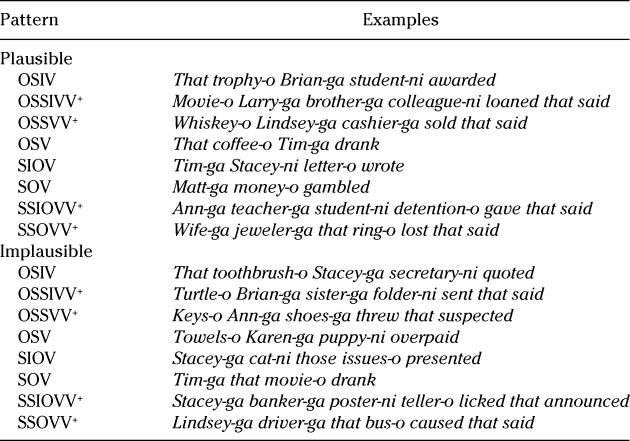
All Japlish sentences used in the study were prerecorded by a female native speaker of American English, and all tasks were designed using SuperLab (version 4.0). The stimuli for the exposure phase consisted of 128 Japlish sentences presented auditorily; no orthographic realizations of the language were provided at any point during the study. In this stimulus set, there were 16 exemplars of each word order listed in Table 1: eight semantically plausible items and eight semantically implausible ones. Participants heard each sentence only once; all sentences were presented randomly.
Sample Japlish items presented during the exposure phase

Note. S = subject, O = object, I = indirect object, and V = verb. Complex sentence structures are marked with +.
For the exposure phase, participants were told that they were going to listen to sentences in a new language that contains English words and were asked to decide if the sentences they heard were semantically plausible or not (indicated with a button press). Participants were provided with one written example of a semantically plausible English sentence and one written example of a semantically implausible English sentence prior to beginning the task. These written examples were provided to participants as a way to demonstrate what was meant by semantically plausible and semantically implausible, as these terms would perhaps not be immediately obvious to individuals without a background in linguistics. Thus, these examples served to eliminate, or at least reduce, potential ambiguity with respect to what participants were being asked to judge during the task. These examples were presented to participants on the computer screen and immediately prior to starting the Japlish task; participants did not have access to them throughout the task.
If the participants’ plausibility judgments during Japlish exposure were incorrect, a brief tone was presented, and the next item automatically began. In this way, participants received information on the correctness of their response, but the amount of exposure was kept equal for all participants. Implausible Japlish sentences were designed such that the nouns in the sentences would not meaningfully combine with the verb. For example, in the sentence Towels-o Karen-ga puppy-ni overpaid neither towels nor puppy can be meaningfully associated with the verb overpaid with respect to the proper noun Karen. The exposure phase lasted approximately 20 min, and participants were not informed that they would be tested afterward.
Assessment Tasks
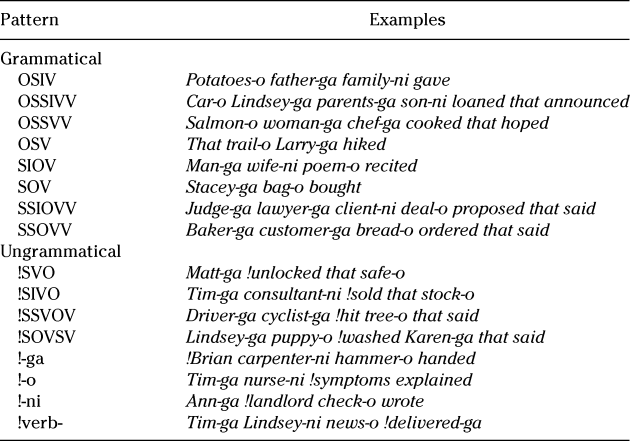
There were two tasks designed to measure learning of Japlish morphosyntax: an AJT and a picture-matching task (PMT). Both tasks were timed. The AJT consisted of 80 Japlish sentences. Of the 80 sentences, 40 were ungrammatical and 40 were grammatical. Ungrammatical items either exhibited illicit word order (N = 20, five of each word-order violation in Table 2) or had correct subject-indirect object-object-verb (SIOV) word order but contained a noun that was missing its case marking or had a case-marked verb (N = 20, five of each violation in Table 2). Subject-indirect object-object-verb word order was chosen for these items because it was a simple sentence structure that had been presented during exposure that also contained all of the requisite nouns for case marking. Grammatical items consisted of new Japlish sentences following the same eight word-order variations presented during exposure (N = 40, five of each of the eight word orders in Table 2). For this portion of the task, participants were asked to indicate (with a button press) if the sentence sounded “good” or “bad.” Participants were given 5 s to respond, after which confidence and source rating prompts appeared (described in the next paragraph). Two versions of this task were designed with different Japlish sentences in each version, and these were counterbalanced within and across participants during immediate and delayed testing. The presentation order was randomized for each participant.
Grammatical and ungrammatical patterns used in the acceptability judgment testing sets
Note. ! indicates ungrammatical word order, case marking, or grammatical constituent.
After making their acceptability judgment, participants were asked to indicate how confident they were in their decision and what the basis of their decision was. Participants were prompted to press 0 for “not confident”, 5 for “somewhat confident”, and 9 for “very confident”. After this rating, subjects were prompted to indicate the source of their judgment and for this were instructed to press g if their judgment was “based on a complete guess,” i if their judgment was “based on intuition,” m if they believed they “relied on memory for previous items,” and r if they believed they “used a rule in making their judgment” (Dienes & Scott, Reference Dienes and Scott2005; Rebuschat & Williams, Reference Rebuschat and Williams2012). After the ratings were entered, the next Japlish sentence was presented. The entire AJT took approximately 15 min to complete. No feedback was provided during this task.
The second assessment, a PMT, was designed to assess whether participants had learned the thematic content of the morphological case markings (i.e., not just that -ga needs to be on a noun, as indexed by responses to items on the AJT, but that -ga marks the subject of the sentence). For this task, 40 pictures (noncopyrighted photos) were gathered from the Internet using the Google search engine. Twenty of the pictures depicted actions containing a subject, object, and indirect object, and 20 were chosen that depicted actions containing a subject and object only. The 40 pictures were independently rated by 10 native English speakers according to the extent to which they accurately described a corresponding English sentence. A picture of a woman riding an elephant, for example, accompanied the sentence The woman rode the elephant, and raters indicated on a Likert scale the degree to which the picture matched that sentence (1 = Does not match the sentence at all; 5 = Very much matches the sentence). Only items with an average rating of 4 or above were included in the final stimulus set. On the basis of this criterion, two pictures were replaced and rerated by four native English speakers, and both pictures scored above 4 after the adjustment.
Four lists were created for the PMT. For each list, the same set of pictures was used. Across the four lists, however, one of four possible variations of a particular Japlish sentence was paired with its picture (Latin square design). Two sample pictures and the four possible sentences that could accompany them are in Table 3. The sentences were distributed across the four lists such that equal numbers of each type of sentence appeared in each list across the set of 40 pictures, though the exact sentence (*Cookies-ga girl-o baked, for example) for a particular picture appeared only once. Each Japlish sentence contained the relevant nouns but with either correct word order and case marking or variations of correct word order paired with incorrect case marking. None of the picture-matching sentences had been presented during exposure or in the AJT, and assignment of participants to lists was semirandom. Specifically, the lists were assigned in sequential order as participants came to participate in the study, but participants completed the reverse-item list at delayed testing. For example, if the list containing variation (1) for the cookie-baking picture in Table 3 was given at immediate testing, the list that contained (3) (for that particular picture) was given at delayed testing. Participants were asked to indicate (by button press) whether the sentence they heard matched the picture displayed on the screen. Each picture was displayed for 500 ms prior to the auditory presentation of a Japlish sentence; all pictures were sized to 800 × 600 pixels and displayed in color in the center of a black computer screen. For each list, 20 pictures were presented with matching sentences, and 20 with mismatching sentences. For each set of 20, 10 items were actions depicting a subject, object, and indirect object, and 10 depicted actions of a subject and object only. Items were presented in random order for each participant, and the task took approximately 10 min to complete. No feedback was provided during this task.
Sample pictures used in the PMT with the four variations of Japlish sentences distributed across the four task versions
Note. ! indicates ungrammatical case marking.
Procedure
The study was conducted over two sessions, and each participant was tested individually during both. Following informed consent during Session 1, participants were taken to a sound-attenuated room, where they completed the exposure task. Following exposure, participants completed the AJT and the PMT. The order in which participants completed these tasks was counterbalanced within subjects and across the two testing sessions. After finishing the two assessment tasks, participants filled out a version of the Big Five personality test (Costa & McCrae, Reference Costa and McCrae1992; McCrae & Costa, Reference McCrae and Costa2003), the Learning Styles Survey (Cohen, Oxford, & Chi, Reference Cohen, Oxford and Chi2008), and a language background questionnaire, and they completed two phonological short-term memory tests. The results from these questionnaires and tests are discussed in Grey, Williams, and Rebuschat (Reference Grey, Williams and Rebuschat2013).
At the delayed testing session, which took place 2 weeks following exposure, subjects returned to the testing room and again completed the AJT and the PMT. At this session, participants also filled out a debriefing questionnaire that probed for rule knowledge of Japlish word order and of Japlish case marking and asked subjects to provide a corresponding sample sentence to demonstrate each rule; the questionnaire also asked them to report any strategies used during the AJT. Note that, during these 2 weeks, participants had no exposure to or practice with Japlish.
RESULTS
Performance on the AJT and PMT served as measures of Japlish L3 learning. Debriefing information, confidence ratings, and source attributions indexed the extent to which subjects were aware of having acquired knowledge and whether the acquired knowledge was conscious (following Rebuschat, Reference Rebuschat2013). Both mean accuracy and d-prime scores were calculated for each participant on the AJT and PMT. Percent accuracy may not capture response biases in the participants’ performance (Stanislaw & Todorov, Reference Stanislaw and Todorov1999; Wickens, Reference Wickens2002), so, where appropriate, d-prime scores are reported. Note that complete inability to discriminate is equivalent to a d-prime score of 0, which is chance-level performance (MacMillan & Creelman, Reference MacMillan and Creelman2005). All analyses were done using SPSS (version 18.0). For the delayed testing, analyses were done on 34 learners (23 females; 11 males); two participants did not return to the study after immediate testing.
Acceptability Judgment Task
Immediate Test
Average accuracy on the immediate AJT was 57.5% (SD = 14.9). The average d-prime score was .244 (SD = .527) and was significantly above chance t(35) = 2.78, p = .009, which indicates that participants were discriminating between good and bad Japlish items beyond what would be expected by chance, as opposed to responding randomly. At immediate testing, the average accuracy rate on grammatical items was 66% (SD = 19.9) and was statistically above chance t(35) = 4.84, p < .001. For ungrammatical items, accuracy was 48.8% (SD = 21.4) and was not statistically above chance, t(35) = −0.312, p = .757. These results indicate that learners’ performance on this task was driven by accuracy on grammatical items as opposed to correct rejections of ungrammatical items. Note that performance on grammatical and ungrammatical items considered separately was not converted to d-prime scores because the d-prime formula takes into account hit (correct yes responses) and false alarm (incorrect yes responses) rates, from which the complementary miss (incorrect no responses) and correct rejection (correct no responses) rates are predictable, and all ungrammatical items are no responses; for more information see Stanislaw & Todorov (Reference Stanislaw and Todorov1999).
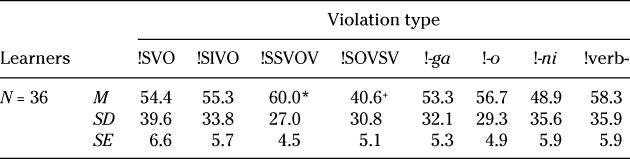
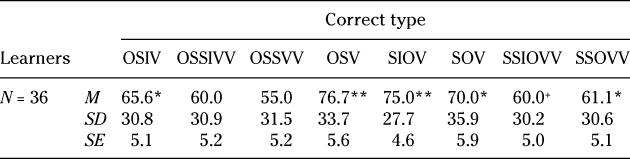
The average endorsement rates for the 16 sentence types (eight grammatical, eight ungrammatical) tested during the AJT can be found in Tables 4 and 5. Endorsement rates indicate the extent to which learners endorsed any given item as being good—the ideal outcome is for ungrammatical items to be endorsed less than grammatical items. On the immediate AJT, the endorsement rate for one ungrammatical structure, *subject-[subject-verb-object]-verb, was statistically above chance, as were the endorsement rates for five of the eight grammatical sentences.
Mean endorsement rates (%), standard deviations, and standard error values for all learners across violation types for the immediate AJT
Note. ! indicates ungrammatical word order, case marking, or grammatical constituent.
+ p < .1.
* p < .05.
Mean endorsement rates (%), standard deviations, and standard error values for all learners across correct items for the immediate AJT
+ p < .1.
* p < .05.
** p < .001.
Delayed Test
Average accuracy on the AJT after a 2-week delay was 59.8% (SD = 15.8); the average d-prime score was .408 (SD = .595) and was significantly above chance, t(33) = 3.99, p < .001. This indicates that Japlish learning under an incidental exposure condition was durable, and response performance was not simply random. Following a 2-week no-exposure, no-practice delay, the average accuracy rate on grammatical items was 66.9% (SD = 13.9) and was statistically significant, t(33) = 7.06, p < .001. For ungrammatical items, accuracy was 53.1% (SD = 23.6) and was not significantly above chance, t(33) = .755, p = .456. There was no statistically significant difference in accuracy from immediate testing to the delayed session for grammatical items, t(33) = −0.148, p = .883, or ungrammatical items, t(33) = −1.37, p = .178. These results indicate that, after a 2-week delay between incidental exposure and subsequent testing, learners’ performance continues to be driven primarily by accuracy on grammatical items as opposed to correct rejection of ungrammatical items.
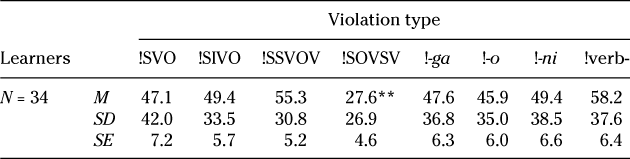
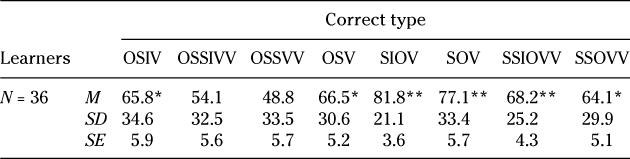
The average endorsement rates for the 16 sentence types tested after a 2-week delay can be found in Tables 6 and 7. On the delayed AJT, the endorsement rate for *subject-[object-verb-subject]-verb (*SOVSV) items is statistically below chance, and six of the eight grammatical structures have endorsement rates that are statistically above chance. There is one statistical difference for endorsement rates from immediate to delayed testing whereby *SOVSV structures were endorsed statistically less at delayed compared to immediate testing, which indicates that learners had become better at correctly not endorsing this structure. However, there is no statistical difference between endorsements from immediate to delayed testing when considering overall grammatical and ungrammatical items, t(33) = −0.148, p = .883, and t(33) = −1.37, p = .178, respectively.
Mean endorsement rates (%), standard deviations, and standard error values for all learners across violation types for the delayed AJT
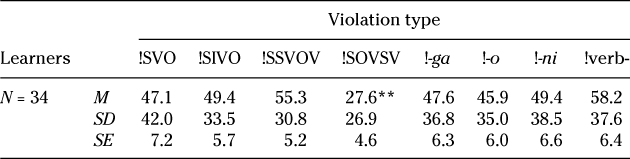
Note. ! indicates ungrammatical word order, case marking, or grammatical constituent.
** p < .001.
Mean endorsement rates (%), standard deviations, and standard error values for all leaners across correct items for the delayed AJT
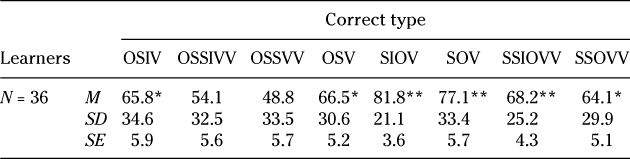
* p < .05.
** p < .001.
Picture-Matching Task
Immediate Test
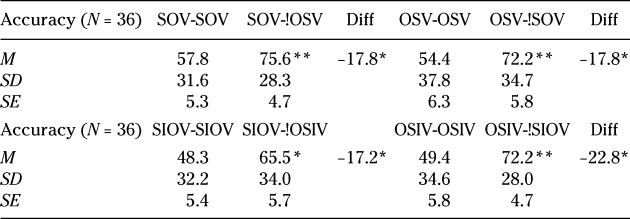
Average accuracy on the PMT at immediate testing was 40.4% (SD = 17.6); the average d-prime was .035 (SD = .381), and this was not different from what would be expected by chance, t(35) = .554, p = .583. This indicates that learners were not discriminating between sentence-picture mismatches and sentence-picture matches. Endorsement rates for the item-type variations of Japlish sentences presented during the PMT can be seen in Table 8. All mismatch items (for which the correct answer is “No, the sentence does not match the picture,” marked with ! in Table 8) have endorsement rates that are (erroneously) statistically above chance. Comparisons were made between the match items and the reverse-item mismatch structures that had correct word order but incorrect case marking. For example, items with SOV word order and SOV case marking (SOV-SOV) were compared with items that had SOV word order but object-subject-verb case marking (SOV-*OSV). These differences provide a direct measure of sensitivity to the association between case markers and grammatical functions regardless of the familiarity of the ordering of each. As Table 8 shows, all four differences, as evaluated by paired-sample t tests, were significant but in the reverse direction from that expected.
Mean endorsement rates (%), standard deviations, and standard error values on the four sentence types (simple and complex) for the immediate PMT
Notes. ! indicates ungrammatical case on the correct word-order item. Diff = the difference between correct and incorrect case-marking versions.
* p < .05. ** p < .001.
Delayed Test
Two weeks after Japlish exposure, average accuracy on the PMT was 56.3% (SD = 19.7), and the average d-prime for the PMT was .304 (SD = .652). This was significantly different from chance, t(33) = 2.71, p = .011, indicating that learners’ responses were now beyond what would be expected for random guessing. Additionally, there was a significant difference in performance between immediate PMT and delayed PMT, t(33) = −2.19, p = .036, which indicates that after a 2-week no-exposure, no-practice delay, the learners significantly improved in their ability to accurately discriminate among these items.
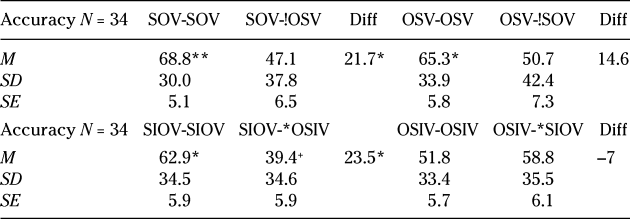
Endorsement rates for the item-type variations of Japlish sentences presented during the delayed PMT can be seen in Table 9. At delayed testing, three of the four match item types had endorsement rates that were statistically above chance, and one mismatch item (SIOV-*OSIV, in which *OSIV represents *object-subject-indirect object-verb order) had an endorsement rate just above the threshold of significant difference from chance (p = .084). Additionally, when comparing the match items with their reverse-item mismatch structure, there were statistically significant differences for two out of four comparisons, this time in the expected direction.
Mean endorsement rates (%), standard deviations, and standard error values on the four sentence types (simple and complex) for the delayed PMT
Note. ! indicates ungrammatical case on the correct word-order item. Diff = difference between correct and incorrect case marking versions.
+p < .1. *p < .05. **p < .001.
Comparisons of the endorsement rates within match and mismatch items across the two testing sessions revealed that three of the four mismatch item types had significantly lower endorsement rates at delayed testing compared to the immediate PMT: SOV-*OSV immediate and SOV-*OSV delayed, t(33) = 4.54, p < .001; OSV-*SOV immediate and OSV-*SOV delayed, t(33) = 2.36, p = .024; SIOV-*OSIV immediate and SIOV-*OSIV delayed, t(33) = 3.59, p = .001; OSIV-*SIOV immediate and OSIV-*SIOV delayed, t(33) = 1.99, p = .055. Also, one of the four match items had endorsement rates that were significantly higher at delayed testing than at immediate testing (SIOV-SIOV), t(33) = −2.20, p = .035. Overall, these results indicate that participants were more sensitive to Japlish case-marking violations following a 2-week no-practice, no-exposure delay than they were at immediate testing. They became better both at correctly endorsing items for which the sentence matched the picture and also at correctly rejecting sentences for which there was no match (where such a mismatch is detectable only via the case marking on the nouns).
Post Hoc Analyses on Prior Language-Learning Experience
No differential effects between advanced and beginning Spanish learners were found for the learning of L3 morphosyntax under an incidental exposure condition (independent-samples t tests, p > .05, on both tasks across both sessions, for grammatical and ungrammatical items on the AJT and item types on the PMT). However, considering work that has found previous language-learning experience to be influential in L3 learning (e.g., Dewaele, Reference Dewaele2010; Klein, Reference Klein1995; Lado, Reference Lado2008), we conducted post hoc analyses on total semesters of language study (TSLS) and our performance measures to determine whether there were any potential effects of this variable on the observed outcomes. Recall that our advanced and beginning learners were not statistically different on TSLS. First, we ran correlation analyses on TSLS and d-prime scores for both tasks at both test sessions, which returned one statistically significant correlation—for TSLS and d-prime scores on the delayed AJT, r = .386, p = .024. No other significant correlations were found: TSLS and immediate AJT, r = .133, p = .455; TSLS and immediate PMT, r = −.058, p = .738; and TSLS and delayed PMT, r = .255, p = .146. Thus, in the present study, there was one significant relationship between L3 Japlish learning and prior language-learning experience, such that a higher total number of semesters of language studied was positively related to performance after a 2-week delay.
Summary of Morphosyntax Learning Measures
The results from immediate and delayed assessments of Japlish learning under an incidental exposure condition indicate the following. First, Japlish word order can be learned after brief (20 min), meaning-oriented exposure to the language that is presented solely auditorily. Second, the learning that takes place is durable, as indexed by continued above-chance performance on the AJT following a 2-week no-exposure delay. Third, performance improves even in the absence of additional exposure to the language, as indexed by significantly improved performance on the PMT. Finally, the learning effects observed here were related to prior language-learning experience in terms of total semesters of foreign language study, such that more semesters of study showed a positive correlation with performance on the delayed AJT.
Measures of Conscious Knowledge
Immediate Acceptability Judgment: Confidence Ratings and Source Attributions
The average accuracy within a given confidence rating and source attribution on the immediate AJT can be found in Tables 10 and 11. Confidence ratings and source attributions are considered in this study to be subjective measures of awareness of the knowledge acquired during the experiment (Dienes & Scott, Reference Dienes and Scott2005; Rebuschat, Reference Rebuschat2013). Within this paradigm, knowledge is considered unconscious if subjects rate themselves as guessing, even when their accuracy is statistically above chance—this is referred to as the guessing criterion (Dienes & Scott, Reference Dienes and Scott2005). Confidence ratings that are statistically unrelated to accuracy are also considered evidence of unconscious knowledge (Dienes & Scott, Reference Dienes and Scott2005; Rebuschat, Reference Rebuschat2013). In the present study, only responses associated with a Very Confident rating were statistically above chance in terms of accuracy, t(35) = 3.70, p = .001. For source attributions, only items for which learners identified the source of their response as being intuition based were statistically above chance in accuracy, t(35) = 2.06, p = .047. No other source attributions were statistically above chance, including those based on rule knowledge, despite the fact that these essentially matched in proportion to the intuition-based responses.
Accuracy and proportions (%) across confidence ratings for the immediate AJT

** p < .001.
Accuracy and proportions (%) across source ratings for the immediate AJT

* p < .05.
Delayed Acceptability Judgment: Confidence Ratings and Source Attributions
The average accuracy within a given confidence rating and source attribution on the delayed AJT can be found in Tables 12 and 13. As can be seen from those tables, accuracy within Somewhat Confident and Very Confident ratings was statistically above chance, t(33) = 3.55, p = .001, and t(33) = 2.77, p = .009, respectively. Again, intuition-based responses were the only source attributions whose responses were statistically above chance, t(33) = 2.11, p = .043.
Accuracy and proportions (%) across confidence ratings for the delayed AJT

* p < .05.
Accuracy and proportions (%) across source ratings for the delayed AJT

* p < .05.
Debriefing and Performance
On the debriefing questionnaire, 23 out of 34 learners (68%) were able to correctly state the word-order rule for simple sentences; 20 (59%) were also able to provide a correct example of the rule. No learners correctly stated a rule for complex sentence structures, and very few even tried. Of the four simple structures used in the current study, three were provided by learners both when stating the rule and when providing an example (OSV, SIOV, or SOV). For case marking, 13 of the 34 learners (38%) correctly stated the case-marking rule for -ga, 13 of 34 did so for -o, and 12 of 34 (35%) for -ni. Eleven of the 34 learners (32%) were able to provide a correct example of the functions of these case markers.
In light of these data on word-order and case-marking rule knowledge, additional analyses were performed to determine the extent to which the performance of subjects who correctly arrived at the rules was related to learning effects for the AJT and PMT. In other words, these analyses were performed to determine whether reported knowledge of the rules was essential for significant learning effects following incidental exposure to the language.
First, analyses were performed for learners who reported a word-order rule (YesWO) and those that did not (NoWO) in regard to performance on the AJT at immediate and delayed testing. For simple sentences at immediate testing, YesWO subjects’ d-prime average was 1.03 (SD = .797) and NoWO subjects’ average was .713 (SD = .399); both of these were statistically above chance—YesWO: t(22) = 6.25, p < .001; NoWO: t(9) = 5.64, p < .001—and there was no significant difference between the groups, t(31) = 1.22, p = .091. For simple sentences at delayed testing, the YesWO d-prime average was .223 (SD = .438), and the NoWO was .899 (SD = .535); both of these are significantly different from chance—YesWO: t(22) = 2.44, p = .023; NoWO: t(9) = 5.31, p < .001—but the groups are not different from each other, t(31) = −3.08, p = .154. These results suggest that developing correct conscious rule knowledge of Japlish word order was not necessary to successfully discriminate between good and bad simple sentence structures.
For complex sentences at immediate testing, the YesWO d-prime average was .965 (SD = .775), and the NoWO was .672 (SD = .452). Both of these were significantly different from chance—YesWO: t(22) = 5.97, p < .001; NoWO: t(9) = 4.69, p = .001—but the groups were not different from each other, t(31) = 1.11, p = .155. At delayed testing, the YesWO average was 1.03 (SD = .478), and the NoWO was .688 (SD = .219), and again both of these were significantly different from chance, YesWO: t(22) = 10.42, p < .001; NoWO: t(9) = 9.89, p < .001. Additionally, there was a significant difference between the two groups, t(31) = 6.83, p = .014, whereby the YesWO group outperformed the NoWO group. Like the results for simple sentences, both groups performed above chance at immediate and delayed testing, which suggests again that knowledge of word order is not necessary to successfully judge these items. However, unlike the results for the simple sentences, there is evidence that rule knowledge is helpful in terms of performance, given the significant difference at delayed testing between the YesWO and NoWO groups.
Analyses on subjects who reported rules for case marking (YesCA) and those who did not (NoCA) were also compared in terms of performance on the PMT at immediate and delayed testing. At immediate testing, the YesCA average d-prime was .148 (SD = .447), and the NoCA was .028 (SD = .329); this was not a significant difference, t(32) = .889, p = .587. At delayed testing on the PMT, the YesCA average was .786 (SD = .731), and the NoCA was .087 (SD = .470); this difference was statistically significant, t(32) = 3.53, p = .025. Additionally, only for the YesCA learners at delayed testing was accuracy on the PMT statistically above chance, t(10) = 5.54, p = .005, suggesting that conscious knowledge of Japlish case-marking rules was crucial in showing a learning effect for this task, particularly after a 2-week delay.
Summary of Conscious Knowledge Measures
The results of these sections indicate that confidence in the response to items played a substantial role in performance. Likewise, intuition was the only source attribution that significantly influenced performance. It is important to note that nearly two thirds of the learners arrived at the correct word-order rule for simple sentences, and just below half of the learners were able to verbalize rules for case marking, which indicates that learners were able to arrive at conscious rule knowledge following incidental exposure. Finally, it appears that this rule knowledge benefited performance on both tasks, though it may not be necessary, given that even learners who did not report knowledge of the underlying rule for the AJT also performed above chance in their discrimination between good and bad exemplars. This final observation comes not from the online source-attribution data, for which rule knowledge responses were not statistically above chance on the AJT, but from the actual reporting of correct Japlish rules for word order and case marking in our debriefing questionnaire.
DISCUSSION
This study provides further evidence that adults can learn aspects of nonnative syntax while processing the language input for meaning and without any instruction to search for or learn a rule (Rebuschat & Williams, Reference Rebuschat and Williams2012; Robinson, Reference Robinson and Schmidt1995a; Williams & Kuribara, Reference Williams and Kuribara2008). It also demonstrates, similarly to Rebuschat and Williams (Reference Rebuschat and Williams2012), that this learning can take place without recourse to visual stimulus presentation. The study indicates that evidence of learning under these conditions is not limited to word order but also extends, although to a lesser degree, to morphological features such as case marking. Furthermore, the results indicate that learners were able to transfer the structural knowledge acquired during exposure to new surface features (new items), suggesting the formation of abstract representations from the surface input. By virtue of its design, the study has shown that the learning that takes place is durable, at least in the short term for this study (2 weeks; see Robinson, Reference Robinson and Robinson2002, for maintained learning for up to 6 months). Additionally, the learning—at least of morphology, and to some extent also word order—shows improvement, even in the absence of additional exposure to or practice in the target language. Such learning and improvement appears to be aided by, but not entirely dependent on, arriving at reportable (and correct) knowledge of the underlying rule, at least for word order.
The observed improvements in performance on the PMT after a delay fit well with the SLA studies cited previously that found improvement either only after a delay (Ellis et al., Reference Ellis, Loewen and Erlam2006; Mackey, Reference Mackey1999; Morgan-Short & Bowden, Reference Morgan-Short and Bowden2006) or in general from immediate to delayed testing (Spada & Tomita, Reference Spada and Tomita2010). They also echo previous findings for novel word learning that speak to the importance of consolidation mechanisms in learning (Clay et al., Reference Clay, Bowers, Davis and Hanley2007; Davis et al., Reference Davis, Di Betta, Macdonald and Gaskell2008; see also Merkx, Rastle, & Davis, Reference Merkx, Rastle and Davis2011, for novel morphology). Such consolidation, which we take to reflect the integration of different types of knowledge—potentially via declarative memory consolidation (e.g., Takashima et al., Reference Takashima, Peterson, Rutters, Tendolkar, Jensen, Zwarts and Fernandez2006)—may have been more obvious for the PMT because this task relied on successful establishment of form-meaning connections. In other words, the integration of form (-ga, -ni, -o) with thematic content (subject, indirect object, direct object, respectively) was required to accurately decide whether the sentences matched the pictures. For the AJT, on which learners essentially demonstrate whether they have learned the sequences of grammatical categories, no such integration of different types of information is necessarily required. However, the exact consolidation mechanisms that may have been at play were not focally investigated in the present study and, thus, are unknown for this group of subjects.
The results on the AJT are similar to those reported in Robinson (Reference Robinson and Robinson2002) for GJT performance on the locative marker, in that both sets of results show maintenance. However, in the present study, we also show evidence for improvement in performance from immediate to delayed testing, which suggests that consolidation mechanisms may also be at play here. In the present study, the difference between the PMT and the AJT regarding the extent to which they rely on form-meaning connections may explain why evidence of learning on the AJT was both quicker (immediate test above chance) and not significantly aided by the passing of time (sustained performance) and why that of the PMT was slower (not evident at immediate testing) and significantly aided by time: The establishment of form-meaning connections, on which the PMT relied, is perhaps a function of consolidation, but the learning of sequences is not (or is to a lesser extent) reliant on such integration.Footnote 5
Regarding rule learning following incidental language exposure, many, but not all, of the learners were able to formulate a rule for Japlish word order. Fewer were able to do so for case marking. This finding diverges from the pattern of results found by Rebuschat and Williams (Reference Rebuschat and Williams2012), whose results indicated that very few subjects showed evidence of rule learning as assessed by debriefing information. However, their study investigated learning of several word-order rules, and the present study targeted only two, in simple and complex structures, which likely made the regularities more salient. Additionally, subjects in the present study were exposed in Session 1 to a total of 188 correct Japlish sentences (exposure + assessment) and in Session 2 to 60 more correct sentences (assessment), for a total of 248 correct exemplars of Japlish. In Rebuschat and Williams (Reference Rebuschat and Williams2012), subjects were exposed during training to 120 sentences and during testing to 30 more correct items, for a total of 150 correct exemplars. Thus, the subjects in the present study received more exposure than those in Rebuschat and Williams (Reference Rebuschat and Williams2012), which also may have contributed to the subjects’ ability to verbalize a rule at the debriefing stage.
The relationship between confidence ratings and accuracy, combined with the debriefing information, leads to the conclusion that many, but not all, of the learners in this study developed some type of explicit knowledge of Japlish grammar in the course of the study. Recall, however, that the debriefing questionnaire was given to participants after the second testing session, and it is thus unclear what effect that 2-week delay, perhaps combined with the additional exposure inherent in the delayed tasks, may have had on the development of this rule knowledge. Additionally, at both immediate and delayed testing, only responses that were attributed to intuition were associated with statistically above-chance accuracy. This suggests that even if learners had explicit knowledge of the grammar, they did not seem to be accurately relying on it to make their acceptability judgments. In an attempt to disentangle the effects of knowledge of rules (debriefing) and reliance on rules (source attribution) in this study of L3 Japlish learning, the performance of learners who verbalized rules and those who did not was examined. This data showed that verbalized rule knowledge played a role in performance on our assessment tasks, at least at delayed testing and especially for the PMT. However, recall that even learners who did not verbalize rules for word order were above chance in their performance for simple and complex structures at both testing sessions for the AJT, so it is perhaps not the case that rule knowledge was necessary, though it may have helped. Also, conscious reliance on such rules during task completion does not appear to benefit performance, whereas reliance on intuition was instead significantly associated with learning outcomes, for both immediate and delayed measures of learning. The present study was not designed to explicitly assess the relationship between rule knowledge and rule reliance, but this would be an interesting avenue for future research on additional language learning in adults.
With respect to prior language-learning experience, either in Spanish or in other additional languages including Spanish, this variable was somewhat related to the learning of L3 Japlish, at least in terms of performance on the delayed AJT. The general lack of more robust results for prior language-learning experience seems surprising given the research that has found such experience to benefit L3 learning (e.g., Klein, Reference Klein1995; Lado, Reference Lado2008). However, recent findings suggest that the beneficial effects of prior language-learning experience may only emerge at certain stages of L3 learning (Dewaele, Reference Dewaele2010; Peyer et al., Reference Peyer, Kayser and Berthele2010). Perhaps the current study was not able to capture a more detailed profile of the benefits of prior language-learning experience due to the stage at which our learners were tested, which was arguably early in the learning process. Additionally, L3 learning research indicates that the level of additional language proficiency may mediate the emergence of benefits on L3 outcomes, with higher levels of additional language proficiency being associated with greater L3 benefits (e.g., Cenoz, Reference Cenoz2013; Lado, Reference Lado2008). Though the learners in the present study had an average of 10 semesters of language study, there is nothing to indicate that they also had high levels of proficiency in the languages they studied. This is likely true even for the advanced Spanish learners. Lado (Reference Lado2008), in fact, tested advanced and near-native Spanish learners and found L3 benefits only for the near-natives in the less explicit condition. Thus, another possible explanation for the rather weak effects found in the current study is that the learners had not yet reached the (high) level of additional language proficiency that facilitates L3 learning. Given that we did not test an experimental group with absolutely no prior language-learning experience, the role of this variable in incidental additional language learning remains largely unclear, and it is unknown whether the outcomes of the present study would also be observed for a group of true novices. Future research on L3 learning will shed light on these issues.
CONCLUSION
From a language-learning perspective, the study provides additional insight into the adult capacity to extract grammar information from a nonnative language environment for which input is incidental in nature, and for which no explicit information has been provided. It also supports previous research that has found evidence for different rates of learning for syntax and its concomitant morphosyntactic features (DeKeyser, Reference DeKeyser2005; Stafford et al., Reference Stafford, Sanz and Bowden2010), which is likely related to potential differences in complexity between syntax and morphosyntax. Though the study provides evidence of a role for rule learning under such a condition, it also suggests that this rule knowledge is only one factor influencing performance and that reliance on more intuitive notions of good versus bad structures leads to better performance. This is true both immediately after exposure and after a period of nonexposure to the language. Though this study did not compare incidental L3 exposure to a more explicit, rule-oriented condition, it would be interesting to examine how such conditions would compare over the two testing sessions and whether rule information provided to learners is subject to more memory decay than whatever type, or types, of knowledge learners develop on their own via incidental exposure.
Methodologically, the study highlights the importance of evaluating language learning under incidental conditions as a function of both linguistic target and time (Robinson, Reference Robinson and Robinson2002). As such, future studies should incorporate into their designs not only syntax but also other subdomains of language, such as morphosyntax, phonology, or semantics. Additionally, future studies should continue to include delayed tests to expand our knowledge of the durability of learning under an incidental condition. The present study leaves unaddressed several important issues that should also be considered for future research. First, the study is limited in having used only receptive measures of performance, and thus any productive capabilities that the learners may (or may not) have developed are unknown. Therefore, future research could incorporate both receptive and production tasks to better define the scope of the learning outcomes under incidental conditions such as the one used in the present study. Second, given that a semiartificial language was used in the present study, it may not be clear the full extent to which the results generalize to natural languages. However, given the respectable number of studies that have also used artificial and semiartificial language paradigms to investigate pertinent issues in adult additional language learning and processing (e.g., DeKeyser, Reference DeKeyser1996, Reference DeKeyser1997; Hama & Leow, Reference Hama and Leow2010; Morgan-Short, Finger, et al., Reference Morgan-Short, Finger, Grey and Ullman2012; Morgan-Short et al., Reference Morgan-Short, Sanz, Steinhauer and Ullman2010; Morgan-Short, Steinhauer, Sanz, & Ullman, Reference Morgan-Short, Finger, Grey and Ullman2012; Rebuschat & Williams, Reference Rebuschat, Williams and Sun2006, Reference Rebuschat and Williams2012; Williams, Reference Williams2005; Williams & Kuribara, Reference Williams and Kuribara2008) and that they have been used extensively in L1 research for decades (see Gomez, Reference Gomez and Gareth Gaskell2007, for a review), it is believed that the present study’s results will indeed prove useful for future studies and research designs on natural language learning under incidental conditions.