Introduction
Protozoan parasites from the Plasmodium genus are responsible for malaria, an infectious disease in humans and primates. Plasmodium falciparum is the main cause of severe malaria in humans that can lead to death (Castelli et al., Reference Castelli, Odolini, Autino, Foca and Russo2010; Deress and Girma, Reference Deress and Girma2019). Although chemotherapy is a current option to fight against malaria, there is growing evidence of drug-resistance in malaria treatment (Antony and Parija, Reference Antony and Parija2016; Menard and Dondorp, Reference Menard and Dondorp2017). Due to the absence of an effective vaccine against malaria, the identification of new vaccine targets is urgent for the control of malaria infection. On the other hand, the recognition of specific diagnostic markers for P. falciparum can accelerate the diagnosis of the parasite in the early stages of the infection. Therefore, the discovery of novel diagnostic markers with a high sensitivity and specificity especially by using proteomic techniques might lead to more appropriate management and might be helpful in better choosing prophylaxis for P. falciparum infection (Mathema and Na-Bangchang, Reference Mathema and Na-Bangchang2015).
Proteomic techniques allow shedding some light on the functions, structures, and post-translation modifications of proteins from different cells including microorganisms. In addition, proteomic data also provide valuable information regarding altered proteins in response to specific cell signals, functional proteins involved in critical pathways, mechanisms of pathogenicity, and immunobiological processes (Siqueira-Batista et al., Reference Siqueira-Batista, Gomes, de Mendonça, Vitorino, de Azevedo, de Barros Freitas, Santana and Goreti de Almeida Oliveira2012; Gebretsadik and Menon, Reference Gebretsadik and Menon2016; Aslam et al., Reference Aslam, Basit, Nisar, Khurshid and Rasool2017; Swearingen and Lindner, Reference Swearingen and Lindner2018).
The collection of data from the pathogen's proteome and the analysis of information from the host's immune responses induced after infection are considered important steps in proteomic studies which are useful in the detection and design of vaccine targets (Galassie and Link, Reference Galassie and Link2015). The identification of the pathogen's proteome using two-dimensional gel electrophoresis technique followed by Western blotting assay is helpful for the achievement of immunoreactive proteins which are able to stimulate the host's immune responses (Gomase et al., Reference Gomase, Kapoor and Ladak2010). As aforementioned, proteomic tools also provide a powerful means that can be used for the discovery of biomarkers for diseases. In recent years, research on the proteome profile of tissues, cells and sera from patients in comparison with healthy individuals, and also the expression of specific proteins in different microorganisms have been used for biomarker discovery in different diseases such as cancers (Gelhaus et al., Reference Gelhaus, Fritsch, Krause and Leippe2005; Koncarevic et al., Reference Koncarevic, Bogumil and Becker2007; Hudler et al., Reference Hudler, Kocevar and Komel2014; Chan et al., Reference Chan, Wasinger and Leong2016; Alharbi, Reference Alharbi2020).
Interestingly, the genome sequencing of P. falciparum has revealed that the parasite harbours more than 5000 genes and has provided information for the discovery of novel vaccine antigens and diagnostic markers for malaria (Gardner et al., Reference Gardner, Hall, Fung, White, Berriman, Hyman, Carlton, Pain, Nelson, Bowman, Paulsen, James, Eisen, Rutherford, Salzberg, Craig, Kyes, Chan, Nene, Shallom, Suh, Peterson, Angiuoli, Pertea, Allen, Selengut, Haft, Mather, Vaidya, Martin, Fairlamb, Fraunholz, Roos, Ralph, McFadden, Cummings, Subramanian, Mungall, Venter, Carucci, Hoffman, Newbold, Davis, Fraser and Barrell2002; Lucchi et al., Reference Lucchi, Oberstaller, Kissinger and Udhayakumar2013; Davies et al., Reference Davies, Duffy, Bodmer, Felgner and Doolan2015). Although genomic investigations have facilitated the understanding of the host's immune responses, further research needs to be performed. In this context, proteomics may allow potential new diagnostic and vaccine antigens to be identified with a higher sensitivity. Accordingly, in parallel with genomic data, proteomic techniques have been proposed as useful and reliable tools for vaccine design and the discovery of diagnostic biomarkers in malaria parasites (Doolan et al., Reference Doolan, Southwood, Freilich, Sidney, Graber, Shatney, Bebris, Florens, Dobano, Witney, Appella, Hoffman, Yates, Carucci and Sette2003; Mathema and Na-Bangchang, Reference Mathema and Na-Bangchang2015; Sam-Yellowe, Reference Sam-Yellowe2015).
The proteome diversity of the life cycle stages of P. falciparum, the altered proteome of P. falciparum-infected human sera and altered proteins in P. falciparum-infected erythrocytes might be related to the pathogenicity of P. falciparum and the induction of infected-host immune responses. Such proteins might provide potential and promising antigens for the design of vaccine and diagnostic targets for P. falciparum. Therefore, the current review highlights and reports on the proteins that have been identified using proteomic approaches.
Possible vaccine and diagnostic markers for P. falciparum infection (P. falciparum-life cycle stages)
The morphology of Plasmodium spp. alters across the different stages of the parasite life cycle. The specific proteome of each stage in different physiological conditions might lead to the induction of diverse immune responses in the host's immune system. On the other hand, the study of the expression of specific proteins in the parasite's life cycle stages is an important strategy for the diagnosis of infection. Therefore, the use of proteomics may be helpful for the discovery of possible vaccine and diagnostic targets for each disease stage (Florens et al., Reference Florens, Washburn, Raine, Anthony, Grainger, Haynes, Moch, Muster, Sacci, Tabb, Witney, Wolters, Wu, Gardner, Holder, Sinden, Yates and Carucci2002; Gelhaus et al., Reference Gelhaus, Fritsch, Krause and Leippe2005; Koncarevic et al., Reference Koncarevic, Bogumil and Becker2007).
Sporozoite
Sporozoite surface antigens are considered as potential stimulants of humoral immune responses and can be suggested as promising candidates for the design of malaria vaccines. The validation of such antigens has shown that the components of the inner membrane complex of live sporozoites are accessible to antibodies and stimulate the host's immune system (Swearingen et al., Reference Swearingen, Lindner, Shi, Shears, Harupa, Hopp, Vaughan, Springer, Moritz, Kappe and Sinnis2016). Accordingly, two glycosylated Plasmodium surface proteins including thrombospondin-related adhesion protein (TRAP) and circumsporozoite protein (CSP) have been suggested as potential vaccine targets against P. falciparum (Swearingen et al., Reference Swearingen, Lindner, Shi, Shears, Harupa, Hopp, Vaughan, Springer, Moritz, Kappe and Sinnis2016). Such targets have been investigated in malaria vaccination clinical trials (Moreno and Joyner, Reference Moreno and Joyner2015). TRAP vaccine was able to induce strong T-cell responses in human volunteers using a heterologous prime-boost immunization regimen (Kimani et al., Reference Kimani, Jagne, Cox, Kimani, Bliss, Gitau, Ogwang, Afolabi, Bowyer, Collins, Edwards, Hodgson, Duncan, Spencer, Knight, Drammeh, Anagnostou, Berrie, Moyle, Gilbert, Soipei, Okebe, Colloca, Cortese, Viebig, Roberts, Lawrie, Nicosia, Imoukhuede, Bejon, Chilengi, Bojang, Flanagan, Hill, Urban and Ewer2014). The results of phase 1 clinical trials for the CSP vaccine revealed that poor antibody responses, moderate induction of IFN-γ and TNF-α secreting CD8T cells were related to vaccine efficacy (Ouédraogo et al., Reference Ouédraogo, Tiono, Kargougou, Yaro, Ouédraogo, Kaboré, Kangoye, Bougouma, Gansane, Henri, Diarra, Sanon, Soulama, Konate, Watson, Brown, Hendriks, Pau, Versteege, Wiesken, Sadoff, Nebie and Sirima2013). Such results suggested that the improvement of effective prime-boost immunization regimens might further coordinate cellular and humoral responses to achieve more effective responses. Overall, the sterile protection obtained using TRAP and CSP vaccines was 13 and 7% in immunized volunteers, respectively (Hodgson et al., Reference Hodgson, Ewer, Bliss, Edwards, Rampling, Anagnostou, de Barra, Havelock, Bowyer, Poulton, de Cassan, Longley, Illingworth, Douglas, Mange, Collins, Roberts, Gerry, Berrie, Moyle, Colloca, Cortese, Sinden, Gilbert, Bejon, Lawrie, Nicosia, Faust and Hill2018).
The blockage of sporozoites, as the initial stage of malaria infection, is another appropriate strategy in the development of malaria vaccines. The identification of the sporozoite proteome provides invaluable information for this aim. Several proteins including hexose transporter, CSP, thrombospondin-related sporozoite protein (TRSP), TRAP, sporozoite conserved orthologous transcript, sugar transporter, apical membrane antigen 1 (AMA1), gamete egress and sporozoite traversal protein (GEST) and conserved Plasmodium membrane protein have been identified as surface-exposed sporozoite proteins in P. falciparum and P. yoelii (Lindner et al., Reference Lindner, Swearingen, Harupa, Vaughan, Sinnis, Moritz and Kappe2013). Both the immunogenicity and safety of AMA1 have been evaluated for the design of malaria vaccines in children in some previous studies (phase 1 randomized controlled trial) (Hu et al., Reference Hu, Chen, Gu, Wan, Shen, Kieny, He, Li, Zhang, Reed, Zhu, Li, Cao, Qu, Cao, Wang, Liu, Pan, Huang, Zhang, Xue and Pan2008; Thera et al., Reference Thera, Doumbo, Coulibaly, Laurens, Kone, Guindo, Traore, Sissoko, Diallo, Diarra, Kouriba, Daou, Dolo, Baby, Sissoko, Sagara, Niangaly, Traore, Olotu, Godeaux, Leach, Dubois, Ballou, Cohen, Thompson, Dube, Soisson, Diggs, Takala, Lyke, House, Lanar, Dutta, Heppner and Plowe2010; Jahangiri et al., Reference Jahangiri, Jalallou and Ebrahimi2019). A good safety profile, very robust antibody responses and acceptable tolerability were observed (Thera et al., Reference Thera, Doumbo, Coulibaly, Laurens, Kone, Guindo, Traore, Sissoko, Diallo, Diarra, Kouriba, Daou, Dolo, Baby, Sissoko, Sagara, Niangaly, Traore, Olotu, Godeaux, Leach, Dubois, Ballou, Cohen, Thompson, Dube, Soisson, Diggs, Takala, Lyke, House, Lanar, Dutta, Heppner and Plowe2010). The administration of the AMA1-based malaria vaccine FMP2.1/AS02A was suggested for assessment in a phase 2 efficacy trial in children aged 1–6 years (Thera et al., Reference Thera, Doumbo, Coulibaly, Laurens, Kone, Guindo, Traore, Sissoko, Diallo, Diarra, Kouriba, Daou, Dolo, Baby, Sissoko, Sagara, Niangaly, Traore, Olotu, Godeaux, Leach, Dubois, Ballou, Cohen, Thompson, Dube, Soisson, Diggs, Takala, Lyke, House, Lanar, Dutta, Heppner and Plowe2010). FMP2.1/AS02A was a recombinant protein (FMP2.1) based on AMA1, formulated in the Adjuvant System AS02A. Current evidence shows that multivalent malaria subunit vaccines containing some of the aforementioned proteins in combination with CSP are able to generate extensive immune responses and strong protection against Plasmodium parasites in infected hosts (Lindner et al., Reference Lindner, Swearingen, Harupa, Vaughan, Sinnis, Moritz and Kappe2013; Moreno and Joyner, Reference Moreno and Joyner2015).
Schizont/merozoite
Through proteomic analyses, merozoite surface protein (MSP)-1, MSP-2, MSP-4, MSP-5, MSP-10, apical sushi protein, rhoptry-associated membrane antigen (RAMA), Pf12, Pf34, Pf38 and Pf92 have been identified as glycosylphosphatidylinositol (GPI)-anchored schizont/merozoite proteins in P. falciparum (Gilson et al., Reference Gilson, Nebl, Vukcevic, Moritz, Sargeant, Speed, Schofield and Crabb2006). Although several studies have suggested MSPs as promising for malaria vaccines, antibody production against MSP-119 and MSP-3 showed the strongest correlation with the lower incidence of malaria and protection (Chauhan et al., Reference Chauhan, Yazdani and Gaur2010). Accordingly, the ICGEB malaria vaccine program developed MSP-Fu24, a fusion protein, containing the conserved regions of MSP-119 and MSP-3. This strategy showed the huge potential of MSP-based malaria vaccines. However, further investigations are required concerning their clinical development (Chauhan et al., Reference Chauhan, Yazdani and Gaur2010). The role of RAMA has been highlighted in the development of specific immune responses in people repeatedly exposed to the P. falciparum parasite (Topolska et al., Reference Topolska, Richie, Nhan and Coppel2004). Given the vital role of rhoptry proteins, especially Pf34, during RBC invasion, such proteins have been recently proposed as promising vaccine candidates (Arévalo-Pinzón et al., Reference Arévalo-Pinzón, Curtidor, Vanegas, Vizcaíno, Patarroyo and Patarroyo2010). Most of the surface proteins of the extracellular forms of human Plasmodium parasites are attached to the plasma membrane through GPI-anchors. Since GPI-anchored proteins are exposed to antibodies, such proteins could well be considered as possible vaccine targets in malaria (Richie and Saul, Reference Richie and Saul2002).
Blood-stages of P. falciparum efficiently induce IgG responses. However, more information is still needed to detect P. falciparum antigens which are targeted by protective and non-protective IgG antibodies (Healer et al., Reference Healer, Chiu and Hansen2018). Using IgG-immunoproteomics, two P. falciparum proteins have been characterized: protein disulphide isomerase 8 (PDI8) and StAR-related lipid transfer (START) protein as immunoreactive proteins which are targeted by IgG antibodies (Azcárate et al., Reference Azcárate, Marin-Garcia, Abad, Perez-Benavente, Paz-Artal, Reche, Fobil, Rubio, Diez, Puyet and Bautista2019). Since even low levels of such antigens are able to stimulate humoral immune responses, they therefore might be proposed as appropriate diagnostic and vaccine candidates, especially in subclinical malaria in children. Similarly, further identification of several immunodominant proteins (targeted by IgG antibodies) containing PDI, elongation factor-1 α (EF-1α), 78 kDa glucose-regulated protein homologue (GRP-78), phosphoglycerate kinase (PGK), rhoptry-associated protein 2 (RAP-2) and RAP-3 confirmed the immunogenicity of PDI in P. falciparum (Costa et al., Reference Costa, Nogueira, de Sousa, Vitorino and Silva2013).
The variant surface antigens (VSAs) including P. falciparum erythrocyte membrane protein 1 (PfEMP1), P. falciparum-encoded repetitive interspersed families of polypeptides (RIFINs), sub-telomeric variable open reading frame (STEVOR) and surface-associated interspersed gene family (SURFIN) have been proposed as possible malaria vaccine targets (Bark et al., Reference Bark, Ahmad, Dantzler, Lukens, De Niz, Szucs, Jin, Cotton, Hoffmann, Bric-Furlong, Oomen, Parrington, Milner, Neafsey, Carr, Wirth and Marti2018). Besides such markers, a recent proteomic assessment identified PfJ23, parasite-infected erythrocyte (PIE) surface protein 2 (PIESP2), gametocyte exported protein 7 (GEXP07), liver stage antigen-3 (LSA-3), and PF3D7 as new vaccine targets in P. falciparum (Table 1) (Bark et al., Reference Bark, Ahmad, Dantzler, Lukens, De Niz, Szucs, Jin, Cotton, Hoffmann, Bric-Furlong, Oomen, Parrington, Milner, Neafsey, Carr, Wirth and Marti2018). Those previously mentioned molecules suggested as immunodominant proteins in P. falciparum have been widely applied to measure antibody responses against malaria infection in humans.
Possible vaccine and diagnostic biomarkers in P. falciparum-life cycle stages

Some of the mechanisms of malaria pathogenesis refer to proteins involved in the surface infection of RBCs. In 2017, an immunoproteomic study based on immunoreactive proteins of P. falciparum-infected RBCs identified chaperones such as heat shock protein 70-1 (HSP70-1) and HSP70-x [as components of the secretion machinery/the putative Plasmodium translocon of exported proteins (PTEX)] as P. falciparum immunodominant proteins (Cabral et al., Reference Cabral, Vianna, Medeiros, Carlos, Martha, Silva, Hildebrando, da Silva, Stabeli and Wunderlich2017). The use of HSPs as malaria DNA vaccines or adjuvants in subunit vaccines had been applied in previous studies (Sanchez et al., Reference Sanchez, Sedegah, Rogers, Jones, Sacci, Witney, Carucci, Kumar and Hoffman2001; Qazi et al., Reference Qazi, Wikman, Vasconcelos, Berzins, Ståhl and Fernández2005).
Gametocytes
Gametocytogenesis is defined as the sexual differentiation of asexual precursors. It occurs during the Plasmodium blood-stage in hosts. Successful malaria transmission takes place through the availability of gametocytes in human peripheral blood during the feeding of Anopheles mosquitoes. Due to the insignificant role of gametocytes in the clinical symptoms of malaria, gametocytes are less commonly used for the design of therapeutic targets in treatment strategies against malaria. The proteome identification of Plasmodium gametocytes might further allow the design of new malaria transmission-blocking vaccines (Table 1) (Frimpong et al., Reference Frimpong, Kusi, Ofori and Ndifon2018).
The specific proteins of male and female gametocytes of P. falciparum are different in structure and function. It seems that such proteins are related to genome replication and flagella. However, specific proteins belonging to female gametocytes were mostly involved in translation, metabolism and organellar functions. In addition, the comparison of gametocyte-specific proteins (male and female) in Plasmodium spp. revealed the important function of such proteins in the cytoskeleton, protein degradation and lipid metabolism (Miao et al., Reference Miao, Chen, Wang, Shrestha, Li, Li and Cui2017). It was also shown that the male gametocyte proteins were mostly involved in the configuration of flagellated gametes, chromatin organization, DNA replication and axoneme formation. In addition, many proteins of female gametocytes were correlated with zygote configuration and important functions after fertilization; lipid, protein and energy metabolism (Lasonder et al., Reference Lasonder, Rijpma, van Schaijk, Hoeijmakers, Kensche, Gresnigt, Italiaander, Vos, Woestenenk, Bousema, Mair, Khan, Janse, Bártfai and Sauerwein2016). Furthermore, a comparative proteomic study demonstrated the high expression of antioxidant proteins in young gametocytes and the upregulation of membrane-associated proteins in mature gametocytes (Thima et al., Reference Thima, Reamtong, Moonsom and Chavalitshewinkoon-Petmitr2017). Altogether, these data might be helpful to better understand the complex biology of malaria parasites and to make advances in the design of appropriate vaccine candidates in the future.
Malaria transmission-blocking vaccines were designed to disrupt parasite transmission between mosquito vectors and humans. It has been shown that several proteins in P. falciparum gametocytes are able to potentially activate host immunological responses (Frimpong et al., Reference Frimpong, Kusi, Ofori and Ndifon2018). ATPase-activity altered in Plasmodium parasites from asexual schizonts to sexual gametocytes suggested the regulatory role of malarial-ATPases and the complex metabolism of malaria parasites in different stages (Ortega et al., Reference Ortega, Frando, Webb-Robertson, Anderson, Fleck, Flannery, Fishbaugher, Murphree, Hansen, Smith, Kappe, Wright and Grundner2018). Therefore, the characterization of specific malarial-ATPases including Pfs48/45, Pfg27 and the plasma membrane-associated protein Pfs230 with gametocytogenesis might provide valuable information regarding the inhibition of malaria transmission (Simon et al., Reference Simon, Kuehn, Williamson and Pradel2016; Ortega et al., Reference Ortega, Frando, Webb-Robertson, Anderson, Fleck, Flannery, Fishbaugher, Murphree, Hansen, Smith, Kappe, Wright and Grundner2018). Pfs48/45 is an important factor in the malaria parasite's adherence to host cells and was interestingly suggested as a possible vaccine candidate for blocking malaria transmission (Singh et al., Reference Singh, Roeffen, Andersen, Bousema, Christiansen, Sauerwein and Theisen2015). In addition to Pfs48/45 and Pfs230, other possible vaccine targets such as LCCL domain-containing protein (CCp) and P47 have been identified in the proteome of P. falciparum stage V gametocyte (Tao et al., Reference Tao, Ubaida-Mohien, Mathias, King, Pastrana-Mena, Tripathi, Goldowitz, Graham, Moss, Marti and Dinglasan2014).
Osmiophilic bodies (OBs) are considered to be electron-dense secretory organelles in the female gametocytes of Plasmodium spp. with a possible role in gamete egress phase of the life cycle of these parasites (Blackman and Bannister, Reference Blackman and Bannister2001; Souza, Reference Souza2006). A recent study has indicated the role of several proteins related to OBs including Pfg377, the orthologue of the OB component of the rodent malaria gametocytes PbGEST, dipeptidyl aminopeptidase 2 (PfDPAP2), subtilisin 2 (PfSUB2) and an unknown 13 kDa protein in gamete egress and oocyst formation in P. falciparum. The aforementioned targets might be suggested as valuable markers in the biology of Plasmodium spp. such as interrupting malaria transmission (designing malaria transmission-blocking vaccines) (Suárez-Cortés et al., Reference Suárez-Cortés, Sharma, Bertuccini, Costa, Bannerman, Sannella, Williamson, Klemba, Levashina, Lasonder and Alano2016).
Plasmodium falciparum-infected human sera
Alteration of the proteome of P. falciparum-infected human sera occurs during malaria pathogenicity. The identification of abnormal markers might enhance our understanding of malaria pathogenicity and boost the discovery of potential diagnostic biomarkers. Moreover, host immune responses could be evaluated by targeting such proteins for vaccine candidate design.
In 2012, the modulation of several important physiological pathways containing cytokine and chemokine signalling, acute phase response signalling, complement cascades and blood coagulation was detected in P. falciparum-infected human sera (Ray et al., Reference Ray, Renu, Srivastava, Gollapalli, Taur, Jhaveri, Dhali, Chennareddy, Potla, Dikshit, Srikanth, Gogtay, Thatte, Patankar and Srivastava2012). That study suggested a panel of modulated proteins such as serum amyloid A, haptoglobin (HAP), apolipoprotein E, hemopexin, apolipoprotein A-I and retinol-binding protein as possible diagnostic markers in P. falciparum-infected human sera (Ray et al., Reference Ray, Renu, Srivastava, Gollapalli, Taur, Jhaveri, Dhali, Chennareddy, Potla, Dikshit, Srikanth, Gogtay, Thatte, Patankar and Srivastava2012). The detection of serum amyloid A and HAP in patients infected with P. vivax supported the selection of these proteins as potential diagnostic biomarkers for malaria (Bahk et al., Reference Bahk, Na, Cho, Kim, Lim and Kim2010).
Systemic inflammation and sequestration of P. falciparum-infected RBCs are considered as major processes in the pathophysiology of severe childhood malaria induced by P. falciparum (Ponsford et al., Reference Ponsford, Medana, Prapansilp, Hien, Lee, Dondorp, Esiri, Day, White and Turner2012). The proteome identification of severe and uncomplicated malaria might lead to a better understanding of the pathogenicity mechanisms and differentiation of severe and uncomplicated forms of childhood malaria. Interestingly, the expression of biomarkers related to oxidative stress was observed in malaria-infected children with anaemia. Moreover, specific markers related to platelet adhesion, muscular damage and endothelial activation were detected in infected children with cerebral malaria (CM) (Bachmann et al., Reference Bachmann, Burté, Pramana, Conte and Brown2014). Other changes were described: generalized vascular inflammation, activation of endothelium, vascular wall modulations and irregular glucose metabolism in patients with severe malaria. The release of a high level of specific muscle markers into plasma led to the induction of microvasculature lesions and severe muscle damage in patients with CM.
It is known that C-reactive protein (CRP), tumour necrosis factor (TNF), lymphocyte cytosolic protein 1 (LCP1), vascular cell adhesion molecule 1 (VCAM1), insulin-like growth factor-binding protein 1 (IGFBP1), integrin subunit α V (ITGAV), matrix metalloproteinase 2 (MMP2), calcitonin-related polypeptide α (CALCA), adenylosuccinate synthase-like 1 (ADSSL1), timeless-interacting protein (TIPIN) and myosin light chain 3 (MYL3) were upregulated proteins in the plasma proteome of patients with acute paediatric malaria (induced by P. falciparum) (Table 2). In contrast, other proteins including osteonectin (anti-adhesive SPARC), apoptotic CTSD and cell migration chemoattractant CCL5 (RANTES) were downregulated in patients in comparison with the control group (Reuterswärd et al., Reference Reuterswärd, Bergström, Orikiiriza, Lindquist, Bergström, Svahn, Ayoglu, Uhlén, Wahlgren, Normark, Ribacke and Nilsson2018). LCP1 and VCAM1 played a role in cell migration and cell adhesion, respectively. Both cellular functions (adhesion and migration) seemed to be associated with IGFBP1 and ITGAV (Reuterswärd et al., Reference Reuterswärd, Bergström, Orikiiriza, Lindquist, Bergström, Svahn, Ayoglu, Uhlén, Wahlgren, Normark, Ribacke and Nilsson2018). Exploration of the plasma/serum proteome in malaria-infected patients reveals more information concerning the pathophysiology of malaria and might lead to more effective treatment, diagnosis and vaccination against the disease. Although the diagnostic and prognostic potential of CRP, TNF and VCAM1 have been evaluated in previous malaria investigations, more studies will be needed to validate the aforementioned diagnostic biomarkers in P. falciparum (Ohnishi and Kimura, Reference Ohnishi and Kimura2001; Perera et al., Reference Perera, Herath, Pathirana, Phone-Kyaw, Alles, Mendis, Premawansa and Handunnetti2013; Sarfo et al., Reference Sarfo, Hahn, Schwarz, Jaeger, Sarpong, Marks, Adu-Sarkodie, Tamminga and May2018).
Possible diagnostic biomarkers in P. falciparum-infected human sera

The identification of common diagnostic proteins in Plasmodium spp. using proteomic approaches might facilitate the design of diagnostic tests that are able to detect mixed malaria infections (Ray et al., Reference Ray, Renu, Srivastava, Gollapalli, Taur, Jhaveri, Dhali, Chennareddy, Potla, Dikshit, Srikanth, Gogtay, Thatte, Patankar and Srivastava2012). Interestingly, the upregulation of CRP and adhesion molecule-4 (CADM4) was observed in pooled sera of patients infected with P. knowlesi, P. falciparum and P. vivax. However, serum levels of HAP were decreased in pooled sera (Mu et al., Reference Mu, Bee, Lau and Chen2014).
The information inferred from the sera-proteome of patients infected with severe and non-severe malaria (caused by P. falciparum) has elucidated the modulation of some critical pathways such as IL-12 signalling and production in macrophages, chemokine and cytokine signalling, blood coagulation, complement cascades and protein ubiquitination pathways (Ray et al., Reference Ray, Kumar, Bhave, Singh, Gogtay, Thatte, Talukdar, Kochar, Patankar and Srivastava2015). The overexpression of muscle and cytoskeletal-related proteins containing the galectin-3-binding protein-(Gal3BP) and titin has been reported in the sera of patients suffering severe malaria. Due to the differential expression of CRP, serum amyloid A, HAP and apolipoprotein E in patients' sera, such proteins might be applied as biomarkers for the determination of the degree of severity of malaria in patients (Ray et al., Reference Ray, Kumar, Bhave, Singh, Gogtay, Thatte, Talukdar, Kochar, Patankar and Srivastava2015).
Since P. falciparum is the causative agent of a severe form of malaria (CM), and based on the similar clinical symptoms of CM in children and other non-malarial encephalopathies, proteome identification of plasma and cerebrospinal fluid (CSF) can provide specific biomarkers for differentiation and treatment of these disorders. The differential expression of spectrin β chain brain 3 (a host protein) has been reported in CSF and plasma of children infected with CM (Gitau et al., Reference Gitau, Kokwaro, Karanja, Newton and Ward2013). This protein was determined as a P. falciparum-binding partner with several possible functions involved in the suppression of parasite invasion, the stability of infected-RBCs, and increasing the ability of RBCs to sequester in the microvasculature. The overexpression of sodium/glucose cotransporter 1 (SGLT1), a host protein involved in metabolic stress, has been also reported in the CSF from patients with CM. Furthermore, different variants of EMP 1 and RIFINs (with functions in host cell interaction and antigenic variation) and HSP40 (involved in host cell modification) were discovered as specific proteins belonging to the parasite P. falciparum (Gitau et al., Reference Gitau, Kokwaro, Karanja, Newton and Ward2013).
It has been shown that a pre-erythrocytic long-lasting sterile protection is induced by immunization with sporozoites under chloroquine chemoprophylaxis (CPS) against homologous controlled human malaria infection (Roestenberg et al., Reference Roestenberg, McCall, Hopman, Wiersma, Luty, van Gemert, van de Vegte-Bolmer, van Schaijk, Teelen, Arens, Spaarman, de Mast, Roeffen, Snounou, Rénia, van der Ven, Hermsen and Sauerwein2009). Three conserved proteins with unknown function (AP2 domain transcription factor, an armadillo repeat protein and NLI-interacting factor-like phosphatase) have been detected in plasma samples of CPS-immunized individuals, as protein biomarkers related to the possible protective humoral immune responses (Obiero et al., Reference Obiero, Campo, Scholzen, Randall, Bijker, Roestenberg, Hermsen, Teng, Jain, Davies, Sauerwein and Felgner2019).
Other possible vaccine and diagnostic biomarkers in P. falciparum
Plasmodium falciparum-infected RBCs
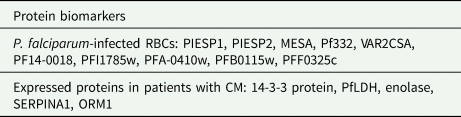
The presence of Plasmodium parasites in related host cells such as erythrocytes can lead to the changes in the host cells' proteome. The expression of new proteins, the exchange of proteins between parasite and the host cell, alteration in immunobiological and physicochemical functions of Plasmodium-host cells, and also upregulation and downregulation of several specific proteins might occur during the aforementioned process (Table 3) (Maier et al., Reference Maier, Rug, O'Neill, Brown, Chakravorty, Szestak, Chesson, Wu, Hughes, Coppel, Newbold, Beeson, Craig, Crabb and Cowman2008; Zhang et al., Reference Zhang, Huang, Kim, Golkaram, Dixon, Tilley, Li, Zhang and Suresh2015).
Other possible vaccine and diagnostic biomarkers in P. falciparum

RBCs, red blood cells; CM, cerebral malaria.
PIESPs are valuable biomarkers for malaria pathogenicity and useful targets for the design of novel vaccine and drugs for the control of malaria (Deitsch and Wellems, Reference Deitsch and Wellems1996). PIESP1 and PIESP2 have been recognized as two new surface markers in P. falciparum-infected RBCs using a shotgun proteomics approach. Unlike other PIESPs such as rifin and PfEMP1, PIESP1 and PIESP2 are highly conserved in Plasmodium ssp., and therefore, might be promising candidates for vaccine design. Interestingly, Florens et al. suggested the unlikely relationship between PIESP1 and PIESP2 and the protrusions on the PIE surface (Florens et al., Reference Florens, Liu, Wang, Yang, Schwartz, Peglar, Carucci, Yates and Wub2004).
Mature parasite-infected erythrocyte surface antigen (MESA) and P. falciparum antigen 332 (Pf332) have been characterized as important proteins expressed on the erythrocyte membrane of patients with CM (Bertin et al., Reference Bertin, Sabbagh, Argy, Salnot, Ezinmegnon, Agbota, Ladipo, Alao, Sagbo, Guillonneau and Deloron2016). Although the antigenic function of MESA remains unclear, MESA and Pf332 were proposed as biomarkers involved in protein trafficking such as export of VSAs. Interestingly, Pf332 is able to be exposed to the immune system. A possible association of such proteins was observed with the pathophysiology of CM (Bertin et al., Reference Bertin, Sabbagh, Argy, Salnot, Ezinmegnon, Agbota, Ladipo, Alao, Sagbo, Guillonneau and Deloron2016).
Plasmodium falciparum can lead to the induction of pregnancy-associated malaria (PAM) in pregnant women. In 2013, VAR2CSA was identified as a biomarker associated with PAM using proteomic techniques. VAR2CSA is considered a member of the PfEMP1 family. This marker and other proteins (PF14-0018, PFI1785w, PFA-0410w, PFB0115w and PFF0325c) might have a possible function in PAM-pathophysiology and might support a vaccine design against PAM (Bertin et al., Reference Bertin, Sabbagh, Guillonneau, Jafari-Guemouri, Ezinmegnon, Federici, Hounkpatin, Fievet and Deloron2013).
Although VAR2CSA was suggested as a vaccine target in PAM and reached the clinical development stage, it seemed that the high variability and large size of this protein might restrict its efficacy for vaccine design (Badaut et al., Reference Badaut, Bertin, Rustico, Fievet, Massougbodji, Gaye and Deloron2010; Hviid, Reference Hviid2010; Fried and Duffy, Reference Fried and Duffy2015). Recently, an interesting study confirmed the upregulation of the PFI1785w protein in PAM. This antigen is highly conserved in comparison with VAR2CSA and can play a major role in the pathogenesis of PAM. Therefore, the use of alternative antigens in combination with VAR2CSA might offer a new perspective on vaccine strategies against PAM (Kamaliddin et al., Reference Kamaliddin, Salnot, Leduc, Ezinmegnon, Broussard, Fievet, Deloron, Guillonneau and Bertin2017).
Expressed proteins in patients with CM
The host responses (proteome of cells, RBCs, issues and immune responses) in patients infected with malaria might be altered due to the presence of Plasmodium parasites in the host (Kumar et al., Reference Kumar, Varun, Dey, Ravikumar, Mahadevan, Shankar and Prasad2018). Recently, 14-3-3 protein, L-lactate dehydrogenase (PfLDH) and enolase have been identified as P. falciparum-specific biomarkers in the brain proteome of patients with CM (Kumar et al., Reference Kumar, Varun, Dey, Ravikumar, Mahadevan, Shankar and Prasad2018). In 2006, LDH was described as a promising protein for rapid malaria diagnosis (Seydel et al., Reference Seydel, Milner, Kamiza, Molyneux and Taylor2006; Hviid, Reference Hviid2010). Enolase is a protein localized on the merozoite cell surface and a potential protective antigen. Furthermore, the detection of anti-enolase antibodies in malaria patients and experimental immunized animal models confirmed the immunostimulant property of this protein (Pal-Bhowmick et al., Reference Pal-Bhowmick, Mehta, Coppens, Sharma and Jarori2007). The α-1-antitrypsin (SERPINA1) (anti-inflammatory molecule) and α-1-acid glycoprotein 1 (ORM1) have been reported as upregulated proteins relevant to the host immune system in patients with CM (Table 3) (Kumar et al., Reference Kumar, Varun, Dey, Ravikumar, Mahadevan, Shankar and Prasad2018). The upregulation of SERPINA3 in serum has been previously reported in malaria patients (Kassa et al., Reference Kassa, Shio, Bellemare, Faye, Ndao and Olivier2012).
Plasmodium falciparum secretions
The importance of proteome identification from protozoa secretions has been highlighted in recent years. Secretions of some parasites as potential activators of the host's immune responses seemed to be potential sources of antigens for the design of diagnostic and vaccine targets (Gour et al., Reference Gour, Kumar, Singh, Bajpai, Pandey and Singh2012; Garg et al., Reference Garg, Singh and Ali2018; Lin et al., Reference Lin, Tsai, Huang, Wu, Chu and Huang2019). However, proteomic investigations regarding secretory antigens of Plasmodium parasites are still urgently needed.
Most pathogens apply secretory molecules to prepare host cells for invasion, to acquire nutrients and to subvert the host's immune responses (Huynh et al., Reference Huynh, Rabenau, Harper, Beatty, Sibley and Carruthers2003; Cezairliyan and Ausubel, Reference Cezairliyan and Ausubel2017; Belachew, Reference Belachew2018). According to a recent investigation, extracellular vesicles (EVs) in P. falciparum mediate the transfer of genetic material between Plasmodium parasites and induce sexual commitment (Sampaio et al., Reference Sampaio, Cheng and Eriksson2017). In P. falciparum, EVs are comprised of proteins that are found within the secretory endomembrane compartments in the apical end of merozoites and exomembrane compartments of infected-RBCs such as Maurer's clefts (Abdi et al., Reference Abdi, Yu, Goulding, Rono, Bejon, Choudhary and Rayner2017). The major role of PfEVs in parasite–host interactions and the pathogenicity of P. falciparum support the idea that these proteins are potentially useful for the design of vaccine and diagnostic targets in malaria parasites.
Conclusion
Despite the important progress made in proteomic techniques, and because some limitations such as the huge cost of equipment and the need for highly trained technicians remain unsolved, the abovementioned methods have not yet been established in clinical practice. However, the success of such techniques in diagnostic biomarker discovery has been underlined in some diseases, especially cancers. Most of the proteins identified were able to activate immune responses in P. falciparum-infected hosts and also played major roles in the life cycle, pathogenicity and the important pathways of this parasite. The validation of novel biomarkers using laboratory techniques including protein recombinant production, enzyme-linked immunosorbent assays, Western blotting and quantitative real-time polymerase chain reactions might increase their usage in clinical fields. Some of the aforementioned proteins in this work including CSP, AMA-1, MSP-1, VAR2CSA, TRAP (vaccine targets) and HDL (diagnostic target) have been previously investigated for malaria vaccination and diagnosis in clinical trials. Although some of the proteins highlighted in this review failed to provide protection in clinical studies, further assessment of these proteins, for vaccine potentiation in combination with new adjuvants, might continue to make them promising targets for vaccination against P. falciparum in the future.
Acknowledgements
PN thanks Obra Social La Caixa (LCF/PR/PR13/11080005), Fundación Caja Navarra, Gobierno de Navarra-Salud (12/2017), Fundación Roviralta, Ubesol, Government of Navarre, Laser Ebro, Inversiones Garcilaso de la Vega and COST Actions CA18217 and CA18218 for their support. We acknowledge Prof Paul Miller (PhD) from the University of Navarra for language editing.
Financial support
This research received no specific grant from any funding agency, commercial or not-for-profit sectors.
Conflict of interest
None.
Ethical standards
Not applicable.