Introduction
Cotard (Reference Cotard1880) first described a case of a “lypemanic” 43-year-old suicidal woman who claimed her internal organs did not exist, for which Cotard later coined the term “délire de négations” (Cotard, Reference Cotard1882). This heterogeneous condition was posthumously termed Cotard's syndrome. Berrios and Luque (Reference Berrios and Luque1995) used factor analysis to identify subtypes of Cotard's syndrome; they identified three clusters: one with psychotic depression only, a non-mood Cotard subtype 1, with marked nihilistic delusions and no depression; and Cotard subtype 2, featuring mixed anxiety, depression and auditory hallucinations. Madani and Sabbe (Reference Madani and Sabbe2007) proposed ECT to be effective in type 1.
Cotard's syndrome has been successfully treated with ECT since the early 1960s. One major concern when treating patients with ECT is memory impairment. However, several patients with cognitive impairment and comorbid conditions for which ECT is indicated, have been treated with ECT and have shown improvement of their condition and their cognition has remained unchanged (Liang et al., Reference Liang, Lam and Ancill1988) or has even improved (Rao and Lyketsos, Reference Rao and Lyketsos2000) after ECT. The rationale for cognitive improvement induced by ECT in patients with dementia may rely on its neurotrophic/neuroplasticity effects (Öngür and Heckers, Reference Öngür and Heckers2004).
We report a case of Cotard's syndrome and associated mild frontotemporal atrophy in a patient who did not respond to antidepressant and antipsychotic drug treatment; he responded to ECT, improving in both Cotard's symptoms and cognitive performance.
Clinical case
A 69-year-old Caucasian man was referred to our service after developing Cotard-like delusions seven months after an intestinal polypectomy and three months after dental implant surgery. At admission, he believed he was dead, and that his stomach, mouth, and dental implant were foul, hence considering food as useless and refusing it. Two weeks prior to admission he developed insomnia and avolition, neglecting his daily needs and loosing weight. He responded poorly to his environment, focusing only on his “death”. He had difficulty concentrating and reported recent memory loss; he was profoundly depressed and anxious, with hypomimia, and psychomotor retardation, but no tremor or suicidal ideation. He had no history of any psychiatric symptoms, including depression. We suspected depression with psychotic features associated with essential initial dementia and carried-out brain imaging, and standard laboratory and psychological tests to clarify the origin of the patient's symptoms. We also increased sertraline from 50 to 100 mg/day, adding 30 mg/day oral mirtazapine to facilitate sleep and increase appetite, 100 mg/day oral amisulpride to increase activation and motivation, and 2.5 mg/day oral lorazepam at bedtime, to ensure sedation.
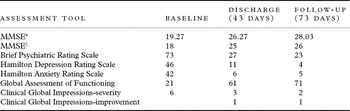
Blood chemistry, echocardiogram, supra-aortic trunk ultrasonography, Holter-electrocardiography, and chest roentgenogram results were all within the normal range, but his psychological state was serious (Table 1). We rated cognition with the Mini-mental State Examination (MMSE), depression with the Hamilton Depression Rating Scale (Ham-D), anxiety with the Hamilton Anxiety Rating Scale (Ham-A), psychiatric status and psychosis with the 18-item Brief Psychiatric Rating Scale, social, occupational and psychological functioning with the Global Assessment of Functioning scale (GAF), and clinical status and treatment response with the Clinical Global Impressions (CGI), severity and improvement versions, respectively. The patient's cognitive performance was poor. On the MMSE, he showed deficits in all areas, but performed worse in repeating lists of words, arithmetic, and basic motor skills. He showed impaired functioning, with severe psychosis, depression, and anxiety.
Clinical assessment of patient's conditions at baseline, at discharge and at two-and-a-half month follow-up

*MMSE scores corrected for age and educational level.
§MMSE raw scores.
MMSE = Mini-mental State Examination.
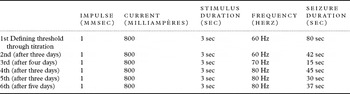
Computerized tomography (CT) seven days after admission showed cortical atrophy with major frontotemporal involvement, mild lateral ventricle enlargement, and basal ganglia calcification. After 18 days of drug treatment, his sleep had improved modestly in quality and duration. However, he developed hypotension, prompting us to switch to 20 mg/day oral olanzapine and 150 mg/day oral extended-release venlafaxine. One week later, he became disoriented and confused for the first time in his life, developing persecutory delusions and reporting visual hallucinations. Hence, we reduced olanzapine to 10 mg/day and decided to treat him with bilateral ECT. Two days after the reduction of olanzapine his cognitive status moderately improved; persecutory delusions and hallucinations subsided, but Cotard's delusion was unchanged. Since there were no contraindications for ECT, he and his wife gave written informed consent to undergo to ECT (Table 2.).
Details of bilateral bitemporal ECT sessions (Mecta spECTrum 5000Q device)

Anaesthetics used: sodium thiopental 120 mg and succinylcholine 50 mg.
Three weeks after the CT scan he underwent brain magnetic resonance imaging (MRI). At this time, he had already received two ECT sessions and was receiving 10 mg/day oral olanzapine and 150 mg/day oral, extended-release venlafaxine. MRI confirmed the existence of mild cortical/subcortical atrophy and ventricular enlargement. T2-weighted scans showed supratentorial soft peritrigonal white matter loss, with some minute chronic ischemic lacunae in the frontal cortex, bilaterally, and in the middle third of the centrum semiovale. Atrophy was worse at left.
During the following 13 days the patient was subjected to a further four ECT sessions and showed steady improvement. After a total of five ECT sessions Cotard's delusion resolved completely, while his clinical conditions had improved dramatically. Mood and cognition were much improved and anxiety had disappeared; he was able to review his past experience critically.
At discharge he was prescribed extended-release oral venlafaxine 150 mg/day, and 10 mg/day oral olanzapine; he satisfied Ham-D criteria for response, but not remission, and Ham-A criteria for remission (his Ham-D scores had dropped more than 50%, i.e. from 46 to 11, while his Ham-A scores had dropped from 42 to 6). His condition further improved after discharge, with psychosis, anxiety and cognitive abilities further improving and depression eventually remitting. At his one-month post-discharge follow-up, his global functioning had further increased. His MMSE had slightly improved (from 25 to 26). He was able to provide free informed consent for the publication of his case and was tested with appropriate assessment instruments that showed his full decisional capacity for participating in research.
Discussion
We described improvement after six ECT sessions in a patient with Cotard's syndrome and frontocortical atrophy who previously had failed to improve on either antidepressants of different classes or atypical antipsychotics. ECT is very effective in relieving symptoms of Cotard's syndrome and does so after six to nine sessions in about two to three weeks. Although there are no controlled studies on this subject, most clinicians agree that this time is appropriate to obtain symptom resolution.
Dementia is not a contraindication for ECT, despite the latter often being associated with cognitive side effects (Sackeim et al., Reference Sackeim, Prudic, Fuller, Keilp, Lavori and Olfson2007). Many people with depression and dementia have been treated with ECT, with ensuing improvement in their depressive symptoms and either no adverse effect on dementia (Liang et al., Reference Liang, Lam and Ancill1988) or even improvement (Rao and Lyketsos, Reference Rao and Lyketsos2000).
It has been claimed that the factorialization by Berrios and Luque (Reference Berrios and Luque1995) may prove to be a guide for treating patients with ECT or with drugs alone (Madani and Sabbe, Reference Madani and Sabbe2007); our patient did not fit any of Berrios and Luque's subtypes, and despite being quite dissimilar to a patient with Cotard subtype 1 who had responded to ECT (Madani and Sabbe, Reference Madani and Sabbe2007), he responded successfully. Most people with Cotard's syndrome undergo several trials with antidepressants and antipsychotics with unsatisfying results before being given ECT, which is provided promptly only in emergency cases. Depression is called refractory or resistant when it does not respond to trials with at least two antidepressants from different classes, each lasting for at least six weeks at clinically effective doses (Nierenberg and Amsterdam, Reference Nierenberg and Amsterdam1990). It follows that it should take about four months to assess a patient's drug-refractoriness. Delay in diagnosing and treating Cotard's syndrome, besides unnecessarily prolonging the patient's suffering, may lead to suicide attempts (Dugas et al., Reference Dugas, Halfon, Badoual, Golse and Huet1985).
Conclusions
Our case illustrates that patients with Cotard's syndrome, who are unresponsive to drugs, may respond to ECT, no matter what their subtyping. Dementia is not a contraindication per se and may actually benefit from ECT. This treatment option should not be deferred until all available treatments fail, because the syndrome may rapidly evolve into more malignant forms and increase suicide risk.
Conflict of interest
None.
Description of authors' roles
G. Fazzari, O. Benzoni, S. Nassini and P. Girardi were responsible for devising the study, analyzing the data and writing the first draft of the report. A. Sangaletti, F. Bonera and L. Mazzarini monitored the patient during the tests and recorded the data. R. Gasparotti was responsible for analyzing the neuroimaging data. I. Pacchiarotti, G. Sani, A. E. Koukopoulos, L. Sanna, P. De Rossi, S. Lazanio and V. Savoja reviewed the scientific literature regarding Cotard's Syndrome and the role of electroconvulsive therapy (ECT) in the treatment of the syndrome itself. They also contributed to the final drafting of the report.