Machining technologies and materials
Materials for machining technologies encompass the broad class of tools used for cutting, drilling, grinding, and other methods for processing materials. The classes of materials used for machining technologies include tool steels, cemented carbides, ceramics, and composites based on superhard materials (SHMs). The main requirements for machining materials include high hardness, strength, fracture and wear resistance, thermal stability, manufacturability, and efficient performance. The use of multilevel hierarchical structures is a promising way to improve performance characteristics of machining materials. New materials with unique characteristics can be produced by forming hierarchical structures in individual components, reinforcing these components, and adding and distributing nano-dispersed components in specific ways. Reference Kim, Randow and Sano1–Reference Morito, Adachi and Ohba3 This article is dedicated to an overview of hierarchically structured tool steels, cemented carbides, ceramics and superhard material tools for the machining industry.
Tool steels with hierarchical structure
High-alloy tool steels are among the most common and best studied cutting/drilling tool materials with a hierarchical structure. They usually contain combinations of alloying elements, including chromium (basic alloying component, up to 20 wt%), vanadium, tungsten, molybdenum, cobalt, and other elements. Reference Wang, Chang, Wang, Wang, Wu, Si, Zhu, Zhang and Hui4,Reference Meng, Sugiyama and Yanagimoto5 This class of steels was developed specifically for high-speed cutting, with significant heating of the work surface of a tool (550–650°C) due to friction. These steels, typically characterized by high hardness, strength, and thermal stability, can be produced by special alloying and thermal treatment.
The structure of high-alloy quenched steels is a good illustration of a hierarchical structure, with four hierarchical levels characterized by constituents with different chemical composition, crystallographic structure, and dimensions, including austenite, complex martensite phases, and carbide or intermetallic phases. Reference Hossein Nedjad, Nili Ahmadabadi and Furuhara6
Martensite, the key structural component of tool steels that ensures high hardness, plastic, and wear resistance, is formed at the quenching stage of the steelmaking process, representing the first hierarchical level. Martensite grains form the next (second) hierarchical level in the structure of tool steels, while a mixture of austenite and martensite mixture forms the highest structural level.
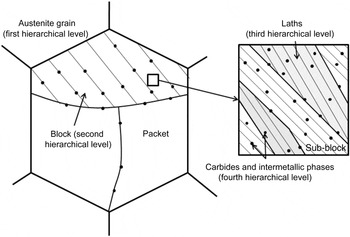
Martensite has a complex structure and is formed (in descending size order) as packets, blocks, sub-blocks, and single-crystal laths at sites occupied by austenite grains prior to quenching ( Figure 1 ). Reference Morito, Adachi and Ohba3 Several packets consisting of parallel blocks are formed in every austenite grain during quenching. In turn, the blocks consist of sub-blocks oriented according to the Kurdjumov–Sachs relationship—so that the most close-packed crystal planes are parallel to the prior austenite grains. Sub-blocks consist of several laths that have similar crystallographic orientation and are 0.2–2 µm in width and 2–20 µm in length. The complex hierarchical structure of lath martensite ensures high hardness, strength, and impact resistance of tool steels.
Scheme of the hierarchical structure of tool steel, including constituents of three hierarchical levels: first, austenite grains prior to quenching (50–100 μm) divided into packets (20–50 μm); second, blocks (5–10 μm) with sub-blocks (1–3 μm) divided by low-angle boundaries; third, laths—elongated grains within sub-blocks with aspect ratio 15:3:1 (0.2–0.5 μm); fourth, carbides or intermetallides (5–20 nm) precipitating within laths or at grain boundaries. Reprinted with permission from Reference Reference Morito, Adachi and Ohba3. © 2009 The Japan Institute of Metals and Materials.

Many carbides precipitate during thermal treatment of quenched tool steels. These carbides contribute to an increase in thermal stability and hardness of the steels, ensuring good mechanical properties, reinforcing the matrix, and stabilizing the structure during heating. Furthermore, intermetallic grains such as (Fe, Co)7W(Mo)6 or Laves phases (up to 5–20 nm in size) that reinforce the material and prevent recrystallization, can be formed in steel by doping with specific elements. Intermetallic compounds have a greater reinforcing effect than carbides. The hardness of dispersion-hardened steels manufactured using intermetallic compounds is higher by 15–25 HRC (Rockwell scale) due to the high dispersion of intermetallic particles. Reference Geller7
Cemented carbides with reinforced binders
Cemented carbides are widely used for processing (cutting or drilling) various materials, in the mining industry, and in machine parts requiring high wear resistance of tools. Cemented carbides are metal–ceramic composites consisting of grains of solid carbides of tungsten, titanium, or tantalum in a plastic matrix (binder) based on cobalt or nickel. The materials demonstrate a unique combination of properties, including high hardness, wear, and impact resistance. Cemented carbides with hierarchical structure have been developed to enhance mechanical, tribological, and performance characteristics.
The structure in cemented carbides has two types, distinguished by realization of the lowest scale level of the hierarchical structure in (1) the carbide grains or (2) in the binder. The structures of the first type (the double-cemented WC-Co alloys) are different from the usual WC-Co structures. The microstructure of carbide grains in these materials is a small-scale copy of the structure of cemented carbide, they consist of carbide grains in a cobalt matrix. Double-cemented WC-Co is prepared using carbide grains mixed with the matrix material in a desired ratio. The conventional manufacturing procedure (pressing and sintering) is then used. Compared to conventional cemented carbides, these materials exhibit higher elastic and wear resistance, which significantly increases the service life of tools. Reference Fang, Griffo, White, Lockwood, Belnap, Hilmas and Bitler8,Reference Carpinteri and Paggi9
The second type of cemented carbides with hierarchical structure features the addition of hard and nondeformable particles distributed throughout the soft matrix, thus ensuring enhanced mechanical properties. The so-called Ө phase (Co2W4C), in the form of 2–5 nm particles, is used as the matrix filler. Reference Konyashin, Schaefer, Cooper, Ries, Mayer and Weirich10,Reference Konyashin, Ries, Lachmann, Cooper, Mazilkin, Straumal, Aretz and Babaev11 The binder is reinforced via the dispersion-hardening mechanism; nanoparticles are oriented coherently with respect to the matrix. The cemented carbide with reinforced matrix is characterized by higher hardness, strength, and impact resistance, as well as higher wear resistance. Reference Konyashin, Ries, Hlawatschek, Zhuk, Mazilkin, Straumal, Dorn and Park12 In addition to dispersion-hardened composite binders, dispersion-reinforced cemented carbides are also used. Addition of SiC nanowhiskers to the binder enhances mechanical properties of WC-Ni, with a 15% increase in fracture toughness and 30% increase in bending strength. Reference Ren, Peng, Peng, Fu, Wang, Qi and Miao13
Ceramic materials
Ceramics for machining technologies are high-performance tool materials (with cutting speeds higher than those of hard metallic alloys by up to twofold) most often based on aluminum, silicon, and titanium oxides, carbides, or nitrides. The high thermal stability of ceramics makes it possible to use them for dry processing (i.e., without using any lubricants or coolants), which significantly reduces the cost of cutting and harmful impact on human health and the environment. Ceramics also ensure a high quality of processing due to the stability of their thermochemical properties and low adhesion to the material being processed. Alumina-based ceramics are the most commonly used. Zirconium oxide, as well as titanium carbide, boride, and nitride are added to the alumina-based ceramic matrix to improve mechanical properties.
Whiskers, nanotubes, or crushed fibers can be added to the ceramic matrix along with one-dimensional reinforcement particles and the fracture resistance and bending strength increase significantly by this addition. Reference Bellosi and De Portu14–Reference Bai, Huang, Wang, Zou and Liu18
In addition to manufacturing a conventional composite structure with a one- or two-dimensional reinforcement phase, the properties of ceramic materials can be improved by double dispersion reinforcement; in other words, an additional level of hierarchical structure is created. Reinforcement of the alumina-based matrix with micro- and nanodispersed titanium carbide powders allows an increase in the wear resistance by up to two times compared to alumina reinforced only with micro-sized titanium carbide. Reference Yin, Huang, Yuan, Zou, Liu and Zhu19
The major drawback of ceramic materials is their low brittle fracture resistance. Fracture resistance of ceramics and service life of the tool can be increased by introducing an additional phase with higher impact resistance (e.g., a metal, such as molybdenum or vanadium). Ceramic materials with dispersion-hardened binders are being designed to improve mechanical properties, for example, composite materials based on the Ti-Zr-C or Ti-Nb-C systems with a Co-Ni-Al-Cr binder, where reinforcing intermetallic phases are precipitated during annealing. Reference Manakova, Kurbatkina and Levashov20 Precipitation of intermetallic phases enhances microhardness, wear resistance, and thermal stability of composite materials. These composite materials are prepared by self-propagating high-temperature synthesis (SHS), which involves the initiation and spread of an exothermic reaction through powdered reactants.
Hierarchical structures can be formed not only in the metal binder, but also in the carbide grains, the so-called SHIMs (synthetic hard instrument materials) manufactured by forced SHS compaction. The SHIM-5 alloy is a novel ceramic material with a three-level hierarchical structure. This alloy exhibits the effect of simultaneous dispersion reinforcement of carbonitride grains due to precipitation of excess molybdenum carbide phase from oversaturated TiMoCN solid solution and reinforcement of the Ni-Al-Mo-Nb-Co-Cr metal binder due to precipitation of the γ′ phase (Ni3Al). SHIM-5 shows excellent cutting properties and is superior to the cemented carbides used in industry (e.g., HG420, HS123, HV10) in terms of cutting stability during steel processing. Reference Levashov, Shtansky, Lobov and Borovinskaya21,Reference Levashov, Shtansky, Lobov and Merzhanov22
SHM tools
Conventional tools based on SHMs are made from composites made of grains of SHMs, such as diamond or cubic boron nitride, and a binder that keeps them in the working layer during operation (Figure 3a,c). SHM grains are responsible for microscratching of the material being processed. Hence, tool performance (cutting productivity, cutting speed, service life) is directly proportional to the mechanical properties of the SHM grains (hardness, strength, and thermal stability). Reference Novikov, Bogatyreva, Bogdanov, Il’nitskaya and Isonkin23
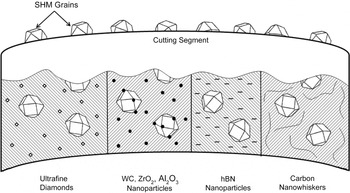
Formation of a multilevel hierarchical structure is a new approach to improving diamond tools that make use of a metal binder material. In operating segments of these tools, the binder is the first-level structural element. The second hierarchical level is represented by grains of SHMs. Large monocrystalline diamonds (300–420 µm in size) are most commonly used in these tools, such as cutoff wheels, drill bits, and cable saws. The structural component of the third hierarchical level consists of nanoparticles of a different nature (e.g., refractory compounds, nano-sized diamonds) that are insoluble in the matrix ( Figure 2 ).
Schematic view of the structure of superhard material (SHM)-based cutting tools showing various forms of binder reinforcement. Note: hBN, hexagonal boron nitride.

An illustrative example of these tools was reported in Reference Reference Sidorenko, Zaitsev, Kirichenko, Kurbatkina, Levashov, Sevast’yanov and Rupasov24. The working layer of the tools in addition to the large diamond particles acting as an abrasive agent also contained uniformly distributed ultrafine and nano-sized diamonds (4–50 nm in size), which reinforced the binder by 100–180 MPa. As a result of adding nanoparticles into the binder, large diamonds are better kept in the binder, following a known correlation between binder strength and diamond retention. Reference Romański25 The wear resistance and service time of the tools increased. Reference Suzuki and Konno26
Ultrafine and nano-sized diamonds are not the only type of particles that can contribute to the formation of hierarchical structure in tools for enhancing mechanical properties of the binder. Hard and stiff nanoparticles of refractory compounds that are either insoluble or poorly soluble in the binder (WC, ZrO2, Al2O3, Si3N4) have also been successfully used for this purpose. Reference Zaitsev, Kurbatkina and Levashov27,Reference Konstanty28
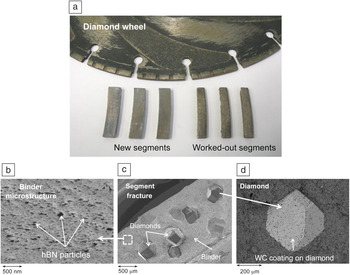
Lamellar particles can also be used as a binder reinforcement. Reference Loginov, Mishnaevsky, Levashov and Petrzhik29 A binder containing uniformly distributed and aligned nanoparticles of disk-shaped hexagonal boron nitride (hBN) ( Figure 3b) was less prone to recrystallization during compaction (hot pressing) and was characterized by its higher bending strength (by 200 MPa) and lower wear. The tool based on this binder showed almost two times higher performance when cutting steel compared to the tool based on the binder of the same composition, but containing no hBN. The reason for this improvement is that hBN acts as a solid lubricant when the tool comes into contact with the material being machined. Reference Mahathanabodee, Palathai, Raadnui, Tongsri and Sombatsompop30
(a) A diamond wheel and (c) a fracture cross section of a segment. High magnification images show (b) a binder reinforced with nanoparticles of hexagonal boron nitride (hBN), Reference Loginov, Mishnaevsky, Levashov and Petrzhik29 and (d) a WC coating on a diamond grain, obtained through the addition of WC nanoparticles to the binder. Reference Sidorenko, Levashov, Loginov, Shvyndina, Skryleva and Yerokhin35

Carbon nanotubes can also be also used as an efficient binder reinforcement. Adding 0.1% of multiwalled carbon nanotubes to a metal binder based on copper and iron reduced the size of binder grains, thus increasing the hardness and Young’s modulus of the material. The plastic properties of the binder also increased significantly (20% increase in flow stress and 60% increase in plastic extension). Comparative tests of diamond drill bits demonstrated that the cutting speed of a tool containing the nanotube-modified binder was 50–70% higher than that of a tool made of material containing no carbon nanotubes. Reference Sidorenko, Mishnaevsky, Levashov, Loginov and Petrzhik31
The introduction of certain nanoparticles made of carbide-forming elements such as Ti, Mo, Cr, and W Reference Lin, Wang, Zhang, Zhu and Zhang32–Reference Chu, Liu, Jia, Chen, Liang, Gao, Tian and Guo34 to the binder makes it possible to grow coatings on a diamond surface. The coatings enhance the adhesion between the diamond grain and the binder, protecting the diamond against graphitization and mechanical damage. The introduction of WC nanoparticles to the binder resulted in spontaneous formation of protective coatings on diamond surface during sintering or hot pressing (Figure 3d). Reference Sidorenko, Levashov, Loginov, Shvyndina, Skryleva and Yerokhin35
Conclusions
Machining materials are exposed to aggressive environments, high temperatures, different types of wear, impact loads, and bending stresses during operation. Compared to conventional machining materials, the development of hierarchically structured tool steels, cemented carbides, ceramics, and SHM-based tools has yielded enhanced mechanical properties, fracture toughness, and wear resistance of the tools, and enhanced the efficiency and quality of machining technologies. For example, hardness of dispersion-hardened steels manufactured using intermetallic compounds is higher by 15–25 HRC. The addition of SiC nanowhiskers to the binder of cemented carbides yielded a 15% increase in fracture toughness and a 30% increase in bending strength. Reinforcement of an alumina-based matrix with micro- and nano-TiC increased wear resistance up to two times. Comparative tests of diamond drill bits demonstrated that the cutting speed of a tool containing the nanotube-modified binder is 50–70% higher than that of a tool made of material containing no nanotubes. Further development and design of hierarchical materials for machining is expected to provide significant economic benefits.
Acknowledgments
The work was carried out with financial support from the Ministry of Education and Science of the Russian Federation within the framework of the Increase Competitiveness Program of NUST “MISIS” (No. K2–2016–002), implemented by a governmental decree dated 16th of March 2013, N 211.