Unlike monolinguals, bilinguals concurrently activate multiple linguistic systems (Marian & Spivey, Reference Marian and Spivey2003), which in turn require extensive control processing to monitor, select, and focus attention in order to resolve conflicts or competition between languages (Green, Reference Green1998). From a neuroplasticity perspective, therefore, bilingualism has been viewed as effective cognitive training that benefits the brain and mind (for a review, see Bialystok, Craik & Luk, Reference Bialystok, Craik and Luk2012). In support of this notion, bilingual advantages have been demonstrated, especially in inhibitory control (for a review, see Kroll & Bialystok, Reference Kroll and Bialystok2013) – the ability to inhibit a prepotent response and enable a more adaptive response – and, more broadly, executive functions (EF), which are the general-purpose control processes that regulate one's thoughts and actions, including inhibition, attentional control, goal setting, planning, problem solving, and abstract reasoning (e.g., Ganesalingam, Yeates, Taylor, Walz, Stancin & Wade, Reference Ganesalingam, Yeates, Taylor, Walz, Stancin and Wade2011; Miyake. Friedman, Emerson, Witzki, Howerter & Wager, Reference Miyake, Friedman, Emerson, Witzki, Howerter and Wager2000).
Recently, however, there has been intense debate as to whether the beneficial effect of bilingualism is genuine and reflects more general cognitive control advantages (e.g., Valian, Reference Valian2015). Specifically, Hilchey and Klein (Reference Hilchey and Klein2011) reviewed a number of empirical studies and challenged the view that bilingualism confers advantages in inhibitory control (see also Paap & Greenberg, Reference Paap and Greenberg2013; Paap, Johnson & Sawi, Reference Paap, Johnson and Sawi2014). In a related vein, several studies failed to offer coherent support for a bilingual advantage in the task-switching aspects of EFs (i.e., switch costs; Hernández, Martin, Barceló & Costa, Reference Hernández, Martin, Barceló and Costa2013; Paap & Sawi, Reference Paap and Sawi2014). Studies of bilingual advantages in complex cognitive control (e.g., working memory) have also revealed this trend, yielding inconsistent findings in the literature.
This apparent discrepancy may be attributable to the numerous differences in study design and methods, including, but not limited to, the different methodological details of tasks employed, various parameters of the task (e.g., verbal vs. nonverbal nature, task difficulty, modality of the stimulus, response-stimulus mapping, memory load); individual variability in general cognitive abilities (e.g., IQ, processing speed) or other enriching experiences (e.g., musical training, video games, multitasking); differences in bilinguals’ linguistic profiles (e.g., proficiency, age of acquisition, frequency of language switching, script variations); and various mismatched demographic characteristics of the sample (e.g., SES, cultural background). Given the subject's complexity, further research on the relationship between bilingualism and general control ability is warranted. To this end, we set out to investigate two key aspects.
Our primary goal was to explore how bilinguals use their working memory capacity under varying cognitive loads. Working memory (WM) is theorized as a multifaceted construct that involves (a) multiple storage components (i.e., visuospatial sketchpad, phonological loop, and episodic buffer) and (b) central executive component which is responsible for controlled processing such as coordination of multiple tasks, shifting between tasks or retrieval strategies, selective attention and inhibition, and temporary activation of long-term memory (Baddeley, Reference Baddeley1986, Reference Baddeley1998; Baddeley, Della Sala, Papagno & Spinnler, Reference Baddeley, Della Sala, Papagno and Spinnler1997; Baddeley, Emslie, Kolodny & Duncan, Reference Baddeley, Emslie, Kolodny and Duncan1998; Baddeley & Hitch, Reference Baddeley, Hitch and Bower1974). Given that various control functions – e.g., maintaining and updating task goals; detecting, monitoring, and resolving conflicts; and adjusting control – are important building blocks for complex WM (e.g., Engle & Kane, Reference Engle, Kane and Ross2004; Unsworth, Redick, Spillers & Brewer, Reference Unsworth, Redick, Spillers and Brewer2012), we use a theoretical framework in which WM, as the general control construct, is comparable to EF and shares an underlying mechanism – i.e., controlled processing – that maintains task goals and resolves interference during complex cognition (e.g., Kane, Conway, Hambrick & Engle, Reference Kane, Conway, Hambrick and Engle2007; McCabe, Roediger III, McDaniel, Balota & Hambrick, Reference McCabe, Roediger III, McDaniel, Balota and Hambrick2010; McVay & Kane, Reference McVay and Kane2009). Despite WM's important role as a general control construct, however, only small studies have examined the impact of bilingualism on WM – mostly by focusing on bilingual children – and their findings have been equivocal. Therefore, by studying to what extent bilingualism influences WM, we sought to gain a more holistic understanding of bilingualism's contribution to general cognitive control abilities.
Our second goal was to understand what leads to bilingual advantages and when and how they occur. Noting that complex WM span tasks typically involve a distractor that interrupts rehearsing the to-be-recalled words, controlled processing – which is the ability to manipulate and process information in the presence of potent distraction – is particularly important in modulating WM capacity (Engle & Kane, Reference Engle, Kane and Ross2004). Relatedly, given that managing attention is central to controlled processing, the literature suggests that individual differences in attention control serve as a major contributor to WM capacity (e.g., Barrett, Tugade & Engle, Reference Barrett, Tugade and Engle2004; Turner & Engle, Reference Turner and Engle1989; Yang, Yang & Isen, Reference Yang, Yang and Isen2013). Similarly, Engle (Reference Engle2002) demonstrated in a series of experiments that greater WM capacity relies on attentional control – i.e., the process that selects and directs attention to specific aspects of a representation while inhibiting irrelevant information (Bialystok & Martin, Reference Bialystok and Martin2004). In light of this, varying demands for controlled processing in WM tasks can be useful in studying the boundary conditions associated with bilingual advantages in WM.
Bilingualism and Working Memory
Given the key role of controlled processing in WM capacity, the question arises as to whether bilingualism, which requires cognitive control, confers advantages in WM capacity. Early studies of bilingual effects on WM have yielded mixed findings. On the one hand, several studies have found that bilinguals do not differ from monolinguals on WM tasks. For instance, Namazi and Thordardottir (Reference Namazi and Thordardottir2010) failed to observe bilingual advantages in either verbal or visual WM tasks among 4- and 5-year-old children. Similarly, Engel de Abreu (2011) tested 6-year-old children and found no evidence for bilingual superiority in the backward digit-span task, in which participants recall items in reverse order, or the counting-recall task, in which participants recall the number of circles counted in a series of pictures in the order they appeared. Bialystok and Feng (Reference Bialystok, Feng, Durgunoglu and Goldenberg2010) found no evidence for bilingual advantages in 7-year-old children on a forward digit-span and sequencing-span tasks, in which participants were asked to recall a string of numbers in an ascending sequence. Lastly, Bonifacci, Giombini, Bellocchi and Contento (Reference Bonifacci, Giombini, Bellocchi and Contento2011) tested both children and youths and found no bilingual advantages in simple WM tasks that required participants to detect the target digit or symbol in a string of digits that had appeared previously.
On the other hand, considerable bilingual advantages have also been documented. For instance, Blom, Küntay, Messer, Verhagen and Leseman (Reference Blom, Küntay, Messer, Verhagen and Leseman2014) reported that bilingual children outperformed their monolingual peers on visuospatial and verbal WM tasks. A recent study by Morales, Calvo and Bialystok (Reference Morales, Calvo and Bialystok2013) demonstrated that bilingual children (aged 5–7 years) outperformed monolingual peers on a Simon-type task with greater demand for WM and conflict resolution (Study 1) and a visuospatial span task with additional executive function requirements (Study 2). Similarly, Bialystok, Craik and Luk (Reference Bialystok, Craik and Luk2008) found bilingual advantages among younger adults but not among older adults, especially in the backward Corsi block span task (Milner, Reference Milner1971) – a visuospatial task in which participants arrange a sequence of 10 blocks in the reverse order (backward span) they were touched by the experimenter – but not in the forward condition, which appears to be less demanding (Thomas, Milner & Haberlandt, Reference Thomas, Milner and Haberlandt2003). Similarly, Luo, Craik, Moreno and Bialystok (Reference Luo, Craik, Moreno and Bialystok2013) observed bilingual advantages, but only on spatial WM tasks and not on verbal WM tasks, which included simple word-span and alpha-span tasks in which participants are asked to recall words in either the original or alphabetical order.
In view of these discrepant findings, it is important to ask whether inconsistencies regarding bilingual effects on WM can be attributed to the complexity of the WM tasks employed in previous studies. We note that the most critical aspect may be that different WM tasks impose different cognitive loads on controlled aspects of WM processing. Specifically, different aspects of WM – i.e., novelty, difficulty, task domain (spatial vs. verbal), and task modality (visual vs. auditory) – can involve different magnitudes of conflicts or interference, resulting in different demands on controlled processing. In a related vein, some studies suggest that bilingual advantages in WM are particularly evident when WM tasks place greater demands on memory (e.g., remembering more items or task rules); response conflict (e.g., Morales et al., Reference Morales, Calvo and Bialystok2013); or unfamiliarity with the spatial domain (Bialystok, Craik & Luk, Reference Bialystok, Craik and Luk2008; Luo et al., Reference Luo, Craik, Moreno and Bialystok2013).
Given that these manipulations likely place greater demands on controlled processing, a WM task that demands greater controlled processing (e.g., attentional control) may be better able to capture bilingual advantages. Conversely, it is likely that bilingual advantages may be subtle or disappear when the WM task requires a lesser degree of controlled processing. In support of this notion, Bialystok (Reference Bialystok2009) argues that bilingual advantages in WM can be captured when high demand for control and inhibition processing is inherent to the given task. Despite this aspect's critical importance, however, there has been little discussion of what might explain these discrepant findings. To close this gap in understanding, therefore, we set out to investigate whether varying demands on controlled processing in WM tasks modulate bilingual advantages in WM.
Measures of working memory
We assessed WM capacity using complex span tasks in which participants are required to keep to-be-recalled items active and quickly retrievable while inhibiting interference from a distractor (e.g., Turner & Engle, Reference Turner and Engle1989). Given that typical complex span tasks consist of (a) a distractor task and (b) a short-term memory task (i.e., encoding the to-be-recalled item), the extent of controlled processing can be manipulated either by (a) increasing the level of suppression or inhibition for a distractor task or (b) making the encoding (and storage) context more demanding – for instance, by dividing attention at the time of encoding.
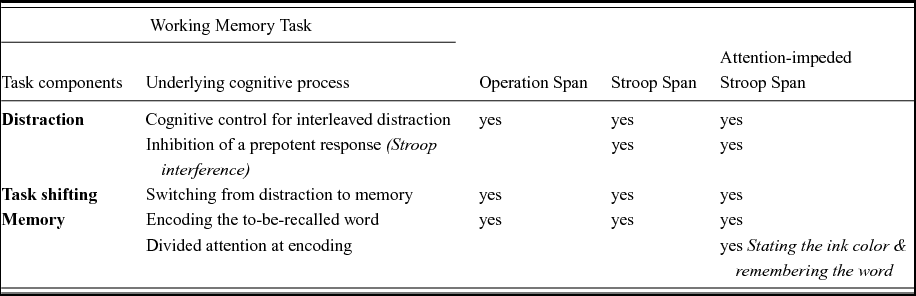
Accordingly, we employed three different complex span tasks that made varying demands for controlled processing (Table 1). Specifically, the operation-span task required the participant to alternate between solving mathematical problems and memorizing the neutral to-be-recalled word for later recall (e.g., Turner & Engle, Reference Turner and Engle1989). Controlled processing in this task is necessary to inhibit the math task as a distractor while simultaneously encoding the target word. We used the operation-span task as a baseline measure to examine between-group differences in WM capacity at the outset of the experiment (e.g., Turner & Engle, Reference Turner and Engle1989).
Task Structure and Cognitive Processes Underlying the Operation-span, Stroop-span, and Attention-impeded Stroop-span Tasks

Note. The three tasks are identical in terms of the structure containing the distracting task and the memory task (the to-be-recalled item). In all WM tasks, participants were required to perform the distraction task first (i.e., math or Stroop), then transit to the memory task to encode the to-be-recalled item.
We employed two different versions of the Stroop-span task.Footnote 1 First, the Stroop-span task is structurally identical to the operation-span task, i.e., a baseline measure, except for the type of a distractor task; the classic Stroop task was used to replace the math task. We assumed that although the type of distractor task differs, monitoring and inhibiting intrusions from the presence of interleaved distractors is approximately similar at a global level. Given this, the Stroop-span task is comparable to the operation-span task, except the Stroop-span task requires additional cognitive control to suppress the Stroop interference, which demands inhibitory control to resist a prepotent response.
Second, the attention-impeded Stroop-span task required the participants to state the ink color of the to-be-recalled word, but was otherwise identical to the Stroop-span task. Note that we assumed that although the specific tasks involved in switching between a distractor and memory item differ – i.e., switching from the Stroop task to either reading the word aloud or stating the ink color of the target item – their demand for switching itself is inherent and approximately similar. Therefore, compared to the Stroop-span task, the attention-impeded Stroop-span task implicates additional control abilities to manage the potential costs of divided attention during encoding, since the participant's attention is divided in order to capture both surface (color) and semantic (meaning) features.
In sum, these WM tasks require controlled processing (e.g., controlled attention) to process the distractor and encode the memory items. Compared to the operation-span task, the Stroop-span task requires additional cognitive control to suppress the Stroop interferences, while the attention-impeded Stroop-span task requires additional cognitive control to manage both the Stroop interferences and the divided attentional control during encoding. Given these differences in the cognitive processes that underlie the WM tasks, we hypothesized that if cognitive demand for controlled processing modulates bilingual advantages in WM, bilingual advantages in WM will be evident in the attention-impeded Stroop-span task, which is regarded as the most demanding, while bilingual advantages would not be apparent in the other tasks, which demand relatively less controlled processing.
Method
Participants
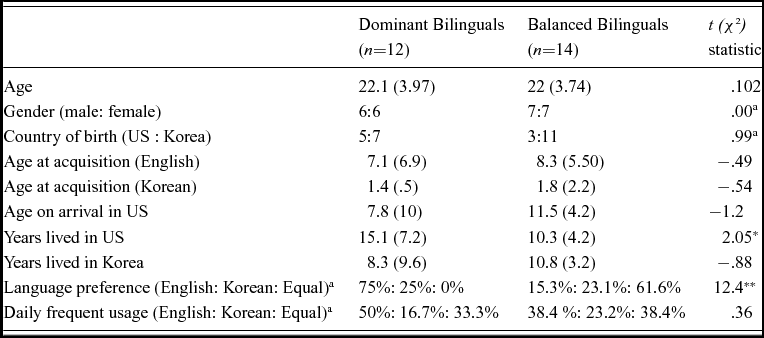
Twenty-six Korean–English bilinguals (M age =22, SD = 5.1) and 25 US-born English-native monolinguals (M age =22.1, SD = 3.7), ranging in age from 18 to 32, were recruited from Cornell University, USA, and paid ($7) for their participation. English monolinguals were recruited through a campus-wide advertisement for a paid psychology study, while Korean–English bilinguals were recruited through an advertisement placed with several Korean–American students’ associations at Cornell. Monolingual participants were screened by a short questionnaire that asked whether (a) English was their mother tongue, (b) they used English exclusively in their everyday lives, and (c) if they had learned a second language(s), they had command of only limited vocabulary and basic grammar skills, and therefore could not converse with a native speaker. If participants responded yes to all items, they were classified as monolinguals. A self-reported language questionnaire for bilinguals asked whether they used both languages in their daily lives, since they were in regular contact with Korean-speaking communities. No participants, either bilingual or monolingual, reported that they were currently enrolled in any courses for foreign languages. Additional information on language background is presented in Table 2.
Demographics and Language Variables as a Function of Bilingual Groups

a Corresponding statistic is based on the chi-square test. p <.07, * p <.05, ** p < .01.
Materials and procedure
Word stimuli
A total of 117 nonarousing and neutral-valence words (including nine words for practice trials) were drawn from Battig and Montague (Reference Battig and Montague1969) and McEvoy and Nelson (Reference McEvoy and Nelson1982) and used as to-be-recalled words in three different WM tasks. Word stimuli were divided into three sets of 36 words each (plus three practice words) and counterbalanced for the three WM span tasks. We ensured that the number of word syllables, noun categories (abstract vs. concrete), and frequency were equal across the three sets.
Working memory tasks
Three WM tasks were administered within participants to measure WM capacity: the operation-span task (Turner & Engle, Reference Turner and Engle1989); the modified Stroop-span task (Hayes, Kelly & Smith, Reference Hayes, Kelly and Smith2013; Yang, Yang, Ceci & Wang, Reference Yang, Yang, Ceci and Wang2005); and the attention-impeded Stroop-span task (Yang et al., Reference Yang, Yang, Ceci and Wang2005). The operation-span task served as a baseline WM measure. In the operation-span task, a math operation appeared on the computer screen with a to-be-recalled word, such as “6/3 + 2 = 4 Yes/No? Garden.” Participants were asked to read the operation aloud at a regular rate, state whether or not it was correct, and read the underlined word for later recall. After this, participant pressed the spacebar to proceed to the next screen. Answers to the math operations were always a single digit, to control for difficulty. A total of 39 operation strings (which included the three practice trials) served as stimuli for the processing component of the operation-span task.
In the two Stroop-span tasks,Footnote 2 participants were presented with a series of Stroop words – i.e., five color words printed in incongruent colors – and the neutral, to-be-recalled target word (e.g., “floor”). Participants were asked to state the ink color in which each color word was printed, read aloud the target word, and pressed the spacebar to the next screen. Because participants read the target word aloud, their attention had to be devoted to capturing the meaning of the target word, which is conducive to encoding.
The attention-impeded Stroop-span task is identical to the Stroop-span task, except for the task required for the target word. Participants state the ink color of five color words printed in incongruent colors, as before, but now they must also state the ink color of the target word. After this, participants pressed the spacebar to proceed to the next screen. Because participants are asked to attend to the ink color – not the meaning – of the target word, encoding the target word is made more challenging because their attentional resources must be divided between two different attributes of the target word. To summarize, the Stroop-span task and the attention-impeded Stroop-span task are different only in terms of attentional demand for the target word.
The operation-span task (i.e., math operation and target word) served as a baseline measure and was always administered before the two Stroop-span tasks. The order of the two Stroop-span tasks was counterbalanced across participants (i.e., either Stroop-span first or attention-impeded Stroop-span first). Set size (i.e., the number of target words to be recalled during each trial) was either 3 or 6, with four trials using each set size. This resulted in 8 trials for each span task, for a total of 24 trials across the three WM tasks.Footnote 3 In all WM tasks, the participant was prompted at the end of each trial to recall and write down the to-be-recalled words in their correct order.
All of the WM tasks were self-paced and conducted on a one-on-one basis. At the start of the study, each participant was told that his or her voice was being recorded to check for speech rate and accuracy. Participants were warned not to peek at the target words while they performed the distractor task, because this would slow their speech rate and hurt overall accuracy – both of which, they were told, were critical for our purposes. A stand-alone microphone was placed at the side of the computer to prompt participants to comply with the directions at all times. During the practice trials, the experimenter demonstrated the task for the participants, adjusted each participant's speech rate to help him or her maintain a regular speed, explained other procedural details, and monitored the study's progression throughout.
Language background
At the end of the study, a language-background survey was administered to bilingual participants only. This was designed to assess several aspects of the individual's language profile, including frequency of daily use of English and Korean; language preference; and self-reported proficiency in both English and Korean in understanding, speaking, reading, and writing using a four-point scale (1=scarcely and 4=perfectly; Weber-Fox & Neville, Reference Weber-Fox and Neville1996).
In addition to the survey administered to bilingual participants, a funnel questionnaire was administered using dichotomous (i.e., yes/no) questions asking about the purpose of the study and the use of any strategies during the memory task. After this, participants were thanked and debriefed. The entire experiment took approximately 45–50 minutes for each participant.
Results
Working memory performance
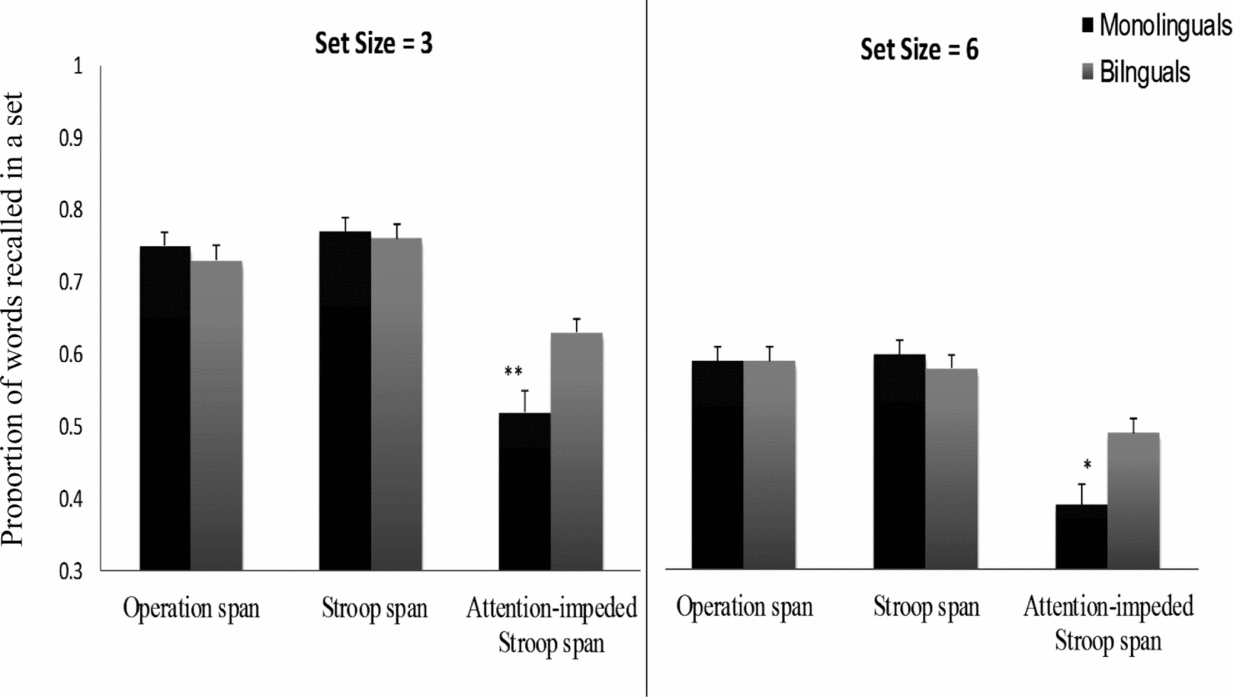
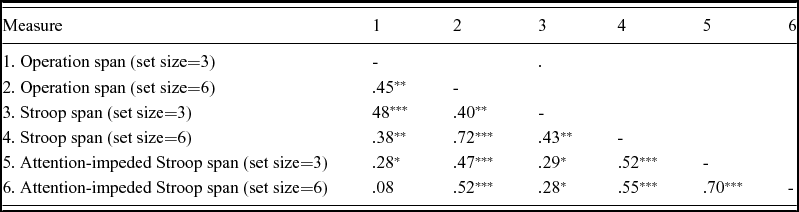
Table 4 shows the correlations between all measures of WM as a function of set size. Notably, all three measures correlate significantly well with each other, suggesting the task's reliability. Correct responses in the operation-span and two Stroop-span tasks were calculated using the partial-credit unit procedure (PCU), by which a participant's score was expressed as the proportion of the total number of words recalled in a set (e.g., Conway, Kane, Bunting, Hambrick, Wilhelm & Engle, Reference Conway, Kane, Bunting, Hambrick, Wilhelm and Engle2005). For example, recalling three items from a set of six words yielded a score of 3/6=.5. Analyses based on the partial-credit load procedure (PCL) – by which a participant's score was represented by the sum of total words recalled – yielded similar results. Therefore, we reported results based on PCU, which is known to demonstrate better psychometric properties than the PCL (e.g., Conway et al., Reference Conway, Kane, Bunting, Hambrick, Wilhelm and Engle2005). Mean proportion of recalled items in a set is presented in Figure 1 as a function of the type of WM task and set size. All analyses were initially conducted with gender as a covariate, but neither the main effect of gender, p=.26, nor its interaction effects were significant, all ps > .53, so gender was not considered in subsequent analyses. The Bonferroni's correction was used in case of multiple comparisons.
Mean proportion of recalled items in a set (PCU) is shown as a function of the type of memory task, set size, and language group. Standard errors of the mean are presented in error bars. p <.05, ** p < .01.

Recall scores based on the PCU method were submitted to a repeated-measures mixed-factor ANCOVA with bilingualism (monolingual, bilingual) and task order (the Stroop-span first or attention-impeded Stroop-span first) as between-participant factors; task type (operation-span, Stroop-span, or attention-impeded Stroop-span) and set size (3 or 6) as within-participant factors; and age as a covariate. We found the main effect of set size, F(1, 46) = 26.7, p <.001, ηp 2=.37. A planned comparison revealed significantly worse performance when the set size was 6 (M=.54) than 3 (M=.84), t(50)=23.2, p<.001, demonstrating that the bigger set size – which imposes greater memory load – had an adverse effect on recall performance. Another main effect, of task order, was found, F(2, 46) = 6.73, p=.01, ηp 2=.13. Planned comparisons showed that overall performance was significantly better when the attention-impeded Stroop-span task was administered prior to the Stroop-span task (i.e., a more difficult task induced a larger practice effect on an easier task than vice versa), t(49)=−2.54, p=.01. In addition, we found a significant effect of age as a covariate, F(1, 46) = 4.19, p =.046, ηp 2=.08, but age did not interact with other variables, ps>.4.
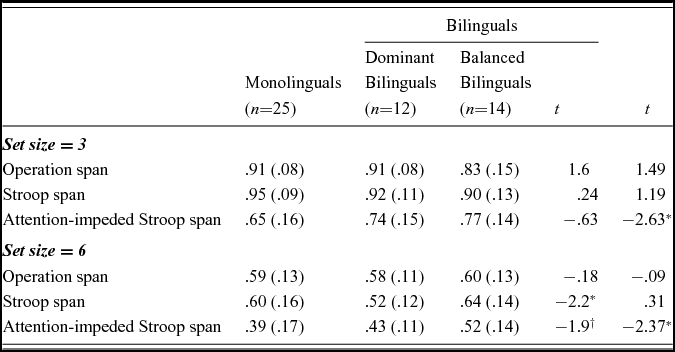
The finding most relevant to our interests was an interaction between task type and bilingualism, F(2, 92)=13.3, p < .001, ηp 2= .23. We followed up on the task type x bilingualism interaction with a series of simple effects analyses for each WM span task. Bilinguals performed significantly better only on the attention-impeded task (M monolinguals=.52, M bilinguals=.63), t(49)=−2.77, p =.008. No group differences were observed, however, in either the operation-span task (M monolinguals=.75, M bilinguals=.73) – which was used as baseline measure of WM capacity – or the Stroop-span task, (M monolinguals=.77, M bilinguals=.75), ps > .43. Given that the attention-impeded task demands greater controlled processing than the operation-span or Stroop-span task, our findings suggest that bilinguals’ recruitment of adaptive controlled attention contributes to their superior performance in overcoming the adverse effects of divided attention during encoding in the attention-impeded Stroop-span task.
Bilingualism and controlled processing
To determine whether the source of bilingual advantages in the attention-impeded Stroop-span task can be attributed to controlled processing, we first performed an omnibus (repeated-measures mixed factor ANCOVA) analysis with task type (Stroop-span vs. attention-impeded Stroop-span) and set size (3 vs. 6) as a within-participant factor; bilingualism (bilinguals vs. monolinguals) as a between-participant factor; and age as a covariate. Given that the attention-impeded Stroop-span task and the Stroop-span task differ only in the extent of controlled processing for encoding the target word, interaction between bilingualism and task type would indicate task-specific effects of bilingualism on WM, at the core of which are heightened demands for controlled attention.
To focus on findings relevant to our interests, we found a significant main effect of the task, F(1, 46)=4.01, p = .05, ηp 2= .08, indicating greater difficulty in the attention-impeded Stroop-span task than the Stroop-span task. We also found a significant interaction between bilingualism and task type, F(1, 46)=21.2, p < .001, ηp 2= .31. Bilinguals outperformed monolinguals, especially in the attention-impeded Stroop-span task, suggesting that bilingual advantages in the attention-impeded task are rooted in controlled processing. Additionally, we performed another omnibus analysis similar to the one used above, with the exception of the task-type factor, which compared the Stroop-span tasks with the operation-span task. We found neither the main effect of task type nor its interaction with bilingualism, ps >.21, suggesting that bilinguals’ use of cognitive control in those two WM tasks may be comparable.
Predicting attention-impeded Stroop-span performance
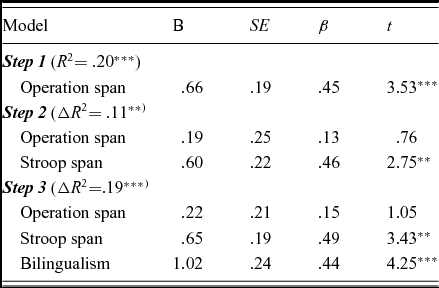
We examined the extent to which bilingualism (monolingual, bilingual) accounts for the unique amount of variance in the attention-impeded WM task, which placed more stringent demands on controlled processing than the Stroop-span task and the operation-span task. We performed a hierarchical regression analysis with performance on the attention-impeded WM task as a dependent variable. Independent variables were entered into the model in a prespecified order – performance on the operation-span task in the first model, the Stroop-span task in the second model, and bilingualism (monolingual, bilingual) in the last model (Table 6). Because our goal was to examine the unique contribution of bilingualism to controlled processing that is tapped by the attention-impeded Stroop-span task, it is theoretically necessary to control for shared variance with the operation-span and Stroop-span tasks, which required controlled processing to inhibit a distractor task and prepotent responses, respectively. We excluded task order, however, because an exploratory simple regression analysis did not show any predicting power of task order on performance in the attention-impeded Stroop-span task.
The first model, with the operation-span task, accounted for 20.3% of total variance, p = .001, while the second model, with the Stroop-span task, accounted for an additional 11% of variance, p =.008. Given the structural and functional similarities among the three WM tasks, it is not surprising that those tasks predicted a substantial amount of variance in the attention-impeded Stroop-span task. More importantly, we found that the third model, with bilingualism (monolingual, bilingual), still significantly predicted an additional 19% of the unique amount of variance on the attention-impeded Stroop-span task, p < .001, even when the effects of the operation-span and Stroop-span tasks were controlled for. This suggests bilingualism's substantial power in predicting performance on the attention-impeded Stroop-span task, which implicates a greater degree of controlled processing.
The impact of balanced bilingualism
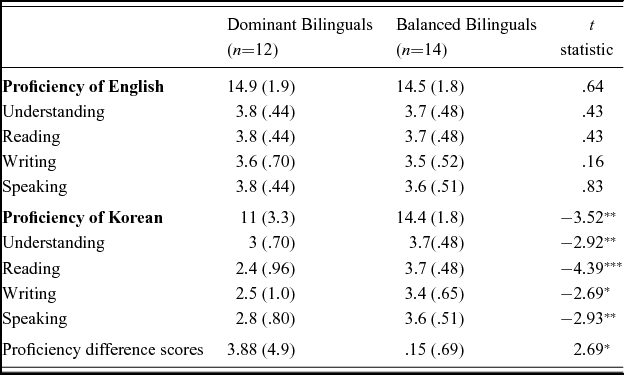
We investigated the influence of balanced bilingualism on the controlled processing aspect of the attention-impeded Stroop-span task. For this analysis, we included only bilingual participants. According to the self-reported English and Korean proficiency scores, which were summed across four domains – understanding, speaking, reading, and writing (Weber-Fox & Neville, Reference Weber-Fox and Neville1996) – we divided bilingual participants into either balanced bilinguals (n=14),Footnote 4 who had equivalent proficiency scores and equal preference for both languages, or dominant bilinguals (n=12), whose proficiency score for one language was greater than that for the other and who felt more comfortable with one language than the other (Table 3). To ensure group differences (balanced vs. dominant), overall language-proficiency scores were submitted to a repeated-measures mixed-factor ANOVA with the corresponding language (English, Korean) as a within-participant factor and bilingual type (balanced vs. dominant bilinguals) as a between-participant factor. We found a significant interaction between language and bilingual type, F(1, 23)=8.48, p = .008, ηp 2=.27. A follow-up analysis indicated that balanced bilinguals reported equivalent levels of proficiency in both English (M=14.5, SD=1.8) and Korean (M=14.4, SD=1.8), t(12)=.81, p = .44, while dominant bilinguals reported greater proficiency in English (M=14.9, SD=1.9) than in Korean (M=11.1, SD=3.1), t(12)=3.1, p = .009.
Language Characteristics for Dominant versus Balanced Bilinguals

Note. SDs are shown in parentheses. * p <.05, ** p < .01.
Correlations between Operation-span, Stroop-span, and Attention-impeded Stroop-span

Note. * p <.05, ** p < .01, *** p < .001.
Means and Standard Deviations for Working Memory tasks as a Function of Bilingual Groups

Note. † p <.07, * p <.05, ** p < .01, *** p <.001.
Summary of Hierarchical Regression Model for Predicting Performance on the Attention-impeded Stroop-span task

Note. ** p <.01, *** p <.001.
We examined the impact of balanced bilingualism by submitting WM performance to a repeated-measures mixed-factor ANOVA with bilingual type (balanced vs. dominant) and task order (Stroop-span task first, attention-impeded Stroop-span task first) as between-participant factors and task type (Stroop-span, attention-impeded Stroop-span) and set size (3, 6) as within-participant factors. Because balanced and dominant bilinguals were equal on the operation-span task, t(24)=.79, p = .44 – which was our baseline measure of WM capacity – we removed it from our analysis and considered the two Stroop-span tasks only. We also removed age and gender as covariates in the analysis, because balanced and dominant bilingual groups did not differ in terms of mean age, t(24)=.10, p = .92, or gender ratio, χ2(1)=1.0, p = 1.0. Moreover, initial analyses with age and gender as covariates did not show any effects or interactions and were not considered in subsequent analyses.
We found significant main effects of task type, F(2, 22)=32.3, p<.001, ηp 2=.60, and set size, F(1, 22) = 162.3 p <.001, ηp 2=.88, and marginally significant effect of task order, F(1, 22) = 3.81, p=.064, ηp 2=.14. Further follow-up analyses revealed poorer performance on the attention-impeded Stroop-span task (M=.62) than on the Stroop-span task (M=.74), p<.001; when the set size was 6 (M=.53) than when it was 3 (M=.83), t(25)=12.7, p<.001; and when the attention-impeded Stroop-span task was administered prior to the Stroop-span task (i.e., a more difficult task inducing a larger practice effect on a subsequent easier task), t(24)=−2.3, p=.03. However, we did not find any difference between balanced bilinguals and dominant bilinguals on either the Stroop-span or attention-impeded Stroop-span task, ps >.15. Additionally, a marginally significant interaction effect was found between bilingual type and set size, F(1, 22) =3.42, p=.07, ηp 2=.13. Planned comparisons revealed that a significant group difference between balanced and dominant bilinguals emerged only when the set size was 6 (M balanced=.59, M dominant=.48), t(24) =−2.34, p =.028, but not when the set size was 3 (M balanced=.84, M dominant=.83), t(24) =−.27, p =.79. Together, these results suggest that different degrees of bilingualism do seem to benefit controlled processing in WM but balanced bilinguals moderately outperform dominant bilinguals only when the task imposes greater memory load.
General Discussion
We investigated bilingual advantages in general control abilities using multiple complex-span WM tasks with varying demands for controlled processing. We found that bilinguals outperformed monolinguals on the attention-impeded Stroop-span task, but on neither the operation-span nor the Stroop-span tasks. WM performance – i.e., recalling information in sequence despite an unrelated distractor task – typically requires the individual to encode, rehearse, and retrieve goal-relevant information while simultaneously inhibiting interference from a distractor. Above all, controlled processing plays a critical role not only in managing attentional interference, but also in facilitating encoding. Therefore, the recruitment of controlled processing is likely to determine WM capacity. Given this, bilingual advantages on the attention-impeded Stroop-span task can be attributed to bilinguals’ better ability to manage their divided attentional resources and regulate attentional interference during encoding. In contrast, the absence of bilingual advantages in the operation-span and Stroop-span tasks can be attributed to a lesser degree of controlled processing, which in turn renders those tasks less sensitive to capture bilingual benefits. Given discrepant findings in the literature, our results suggest that varying demands for controlled processing in WM tasks may modulate bilingual advantages in WM.
Because operation-span and Stroop-span tasks are structurally and functionally similar to the attention-impeded Stroop-span task, it is important to consider why bilingual advantages are absent on the two tasks. In particular, given that the Stroop-span task demands additional controlled processing to inhibit prepotent Stroop interference, the Stroop-span task could have revealed bilingual benefits, which was not the case in our study. In addressing this issue, we argue that the magnitude of controlled processing required to perform the distractor task is not necessarily substantial, especially when the individual allocates relatively fewer resources to the distractor task. Alternatively, as cognitive resources are depleted over time, the distractor task likely engages automatic processing, which does not require controlled monitoring. We believe, however, that increased complexity in the distractor task may change how resources are allocated – and therefore require substantial controlled processing – which in turn will adversely affect WM. Although our goal was not to manipulate cognitive demand for the distractor task, it would be interesting, in future studies, to examine how different levels of distraction influence bilingual advantages in WM.
Given that earlier studies yielding inconsistent findings used different WM tasks, it is important to understand the task-specific nature of various WM tasks and their task-specific demands for controlled processing. Theoretical perspectives on WM (e.g., Baddeley, Reference Baddeley1986) hold that WM tasks implicate both storage and controlled processing. Different WM tasks, however, impose disproportionate weight on controlled aspects of WM processing. If the WM task focuses more on either of these processing types, this will likely modulate the impact of bilingualism and yield different outcomes across different WM tasks.
For instance, the literature describes a wide variety of WM tasks that place relatively high demands on either short-term memory processing (e.g., the digit-span task) or different types of controlled processing, such as simple updating and monitoring (e.g., sequencing-span or alpha-span tasks); coordination or transformation (e.g., backward-span tasks); or inhibition (e.g., complex span tasks). As observed in our study, bilingual advantages may not be apparent across all WM tasks, depending on their demands for controlled processing. Therefore, it is possible that inconsistent findings in the literature can be attributed, to some extent, to different types of controlled processing imposed by the specific WM task. It is important, therefore, that we identify the specific type of cognitive processing required by the task-specific nature of many variants of WM tasks. For this reason, future studies should endeavor to clarify the specific type of controlled processing being assessed by their WM tasks. This specificity of controlled processing in WM, in turn, will help clarify the source of bilingual advantages in WM.
In addition to task-related factors, other linguistic factors deserve further scrutiny since they also have the potential to modulate individual differences in controlled processing. Growing evidence in the bilingualism literature suggests that a number of linguistic factors – such as bilingual proficiency (e.g., Blom et al., Reference Blom, Küntay, Messer, Verhagen and Leseman2014; Bogulski, Rakoczy, Goodman & Bialystok, Reference Bogulski, Rakoczy, Goodman and Bialystok2015; Luk, De Sa & Bialystok, Reference Luk, De Sa and Bialystok2011), type of bilingualism (simultaneous vs. sequential bilinguals or bimodal bilinguals; Blom et al., Reference Blom, Küntay, Messer, Verhagen and Leseman2014), age at L2 acquisition (e.g., Luk et al., Reference Luk, De Sa and Bialystok2011; Tao, Marzecová, Taft, Asanowicz & Wodniecka, Reference Tao, Marzecová, Taft, Asanowicz and Wodniecka2011), language balance (e.g., Green, Reference Green2011; Yow & Li, Reference Yow and Li2015), and language immersion (e.g., Sullivan, Janus, Moreno, Astheimer & Bialystok, Reference Sullivan, Janus, Moreno, Astheimer and Bialystok2014), among others – are closely related to bilingual advantages in controlled processing. However, due to numerous challenges in controlling for these factors, current understanding is limited and controversies still exist. For instance, Blom et al. (Reference Blom, Küntay, Messer, Verhagen and Leseman2014) found that bilingual proficiency significantly predicted bilingual children's WM capacity. Some studies, however, have found that not only proficient bilinguals but also second-language learners and trilinguals – who have not yet achieved proficiency in another language – showed similar cognitive advantages in executive attention (Poarch & van Hell, Reference Poarch and van Hell2012). Although addressing these aspects renders bilingual research more complicated, investigation of various linguistic factors will be vitally important if discrepant findings in the literature are to be resolved.
Our study is not without drawbacks, which should be addressed in future work. First, although we did not assess socioeconomic status (SES), we do not believe that our findings were confounded by SES or represented an artefact. Although there may be differences in the recruitment processes or admission standards used for foreign students and U.S. citizens, the participants all attended the same institution, which is highly selective and charges high tuition fees. Therefore the participants are likely to comprise a relatively homogeneous group from upper- or middle-class families with IQs higher than or similar to the national average. Nevertheless, future studies would benefit by controlling more precisely for SES-related factors. Recent bilingualism studies have assessed SES using a common proxy, such as parents’ education level or household income (e.g., Paap & Greenberg, Reference Paap and Greenberg2013). However, these measures may still be limited in reflecting constructs of SES that affect family-level resources (e.g., parental involvement opportunities or characteristics of the home environment) and determine an individual's cognitive outcome (e.g., Dickinson & Adelson, Reference Dickinson and Adelson2014; Tan, Yang & Yang, Reference Tan, Yang and Yang2014).
Second, bilingualism is closely associated with biculturalism. Therefore, it is important to consider how culture-related factors (e.g., cultural identity or cultural orientation) modulate cognitive consequence of bilingualism. Despite its importance, however, it is unknown whether culture or even biculturalism exert independent effects on higher-order cognitive processing (e.g., Yang, Yang & Lust, Reference Yang, Yang and Lust2011). Culture is indeed an elusive concept to define and measure accurately, as it is so pervasive in multiple aspects of life, thought, beliefs, personality, and behavior. Therefore, investigating bicultural and bilingual impacts are of interest, but this was beyond the scope of our paper. Future studies, therefore, should endeavor to pursue this question, in particular by recruiting different language groups that share and endorse similar cultural values and orientations, or vice versa.
To conclude, our findings demonstrate that bilingualism provides an advantage in controlled processing, an important component of WM and other executive functions. Therefore, the demand placed on attentional control in WM tasks plays a key role in moderating the effects of bilingualism on WM. The important role of WM is widely acknowledged in various models of cognition (e.g., Anderson & Lebiere, Reference Anderson and Lebiere1998; Cowan, Reference Cowan1995). Working memory is also known to influence a wide range of complex cognitive behaviors, such as reading comprehension, reasoning, and problem solving (Engle, Reference Engle2002). Its impact on future academic success has also been highlighted in the educational domain. In view of this, bilingualism seems to make a meaningful contribution to a complex control system.