





Highlights
-
• We examined time course of lexical access to L2 English in reading in L1 Russian
-
• Bilinguals read Russian sentences with parafoveally presented English code-switches
-
• We gradually introduced English language cues to create a bilingual environment
-
• No effect of the global language context found on early or late eye-movement measures
-
• Results don’t fully support proactive gain control hypothesis but align with Multilink
1. Introduction
Ample evidence from the previous research suggests that when bilinguals produce or comprehend the materials in the target language, including when reading a text or a sentence, the relevant lexical candidates from the non-target language are also activated (see Bailey et al., Reference Bailey, Lockary and Higby2023; Lauro & Schwartz, Reference Lauro and Schwartz2017 for a review). In the literature, the account of such simultaneous activation of representations in both bilinguals’ languages is referred to as the non-selective access hypothesis. The all-or-none nature of the non-selectivity access, however, is still debated as there are mixed findings coming from the studies that differ in the bilingual populations recruited, language pairs used in the experiments, methodology, task stimuli (word level versus sentence level) or task demands (e.g., Blumenfeld & Marian, Reference Blumenfeld and Marian2007; Elston-Güttler & Gunter, Reference Elston-Güttler and Gunter2009; Green, Reference Green2011; Hoversten & Traxler, Reference Hoversten and Traxler2016; Lauro & Schwartz, Reference Lauro and Schwartz2017; Marian & Spivey, Reference Marian and Spivey2003; Pivneva et al., Reference Pivneva, Mercier and Titone2014; Titone et al., Reference Titone, Libben, Mercier, Whitford and Pivneva2011). Lauro and Schwartz (Reference Lauro and Schwartz2017), summarizing the findings in their meta-analysis, suggest that researchers should shift the focus from the ‘either/or’ question of language non-selectivity to the question of ‘when’ it is (non)selective. Specifically, the important questions that still need answers are 1) whether the nature of the non-selective access is dynamic rather than static, i.e., whether access changes from language activation to inhibition and vice versa; 2) if yes, what factors influence the degree of the (non)selectivity; and 3) what is the time course of the changes in the (non)selectivity, i.e., at what stages of lexical processing the representations become inhibited or activated and why. The current eye-tracking study aims to contribute to obtaining answers to these questions by investigating the influence of one of these factors, the global language context, on the time course of bilingual lexical access in proficient Russian-English bilinguals reading in Russian, their first and dominant language (L1). We start with an overview of the earlier studies examining how the global language context affects the activation of the second language (L2) lexical candidates. We then describe more recent studies that focused specifically on the time course of such activation using eye-tracking, including the cross-script Russian-English investigations relevant to the research questions of this study.
1.1. Global language context and access to the non-target language representations
A series of experiments provide support for the hypothesis of the general flexibility of language access by reporting that bilingual participants are able to zoom in or zoom out of the target language depending on the global language context, i.e., the language mode of the experiment, including the language of the materials, instruction language and language of the environment. In Elston-Güttler et al. (Reference Elston-Güttler, Gunter and Kotz2005), native German speakers with advanced knowledge of English were presented with English sentences. The final word in these sentences appeared in a lexical-decision task and was either the German-English interlingual homograph prime (e.g., “tag” paired with the target word “day”) or an unrelated prime (e.g., “label” followed by “day”). Crucially, before the task, half of the participants watched a 20-minute movie narrated in either German or English. The study found that only those who watched the German version of the movie showed a semantic priming effect in reaction times and event-related potentials (ERPs) during the first part of the experiment. This suggests that the global language context influenced lexical activation thresholds in the non-target German language, but this effect diminished over time.
Elston-Güttler and Gunter (Reference Elston-Güttler and Gunter2009) conducted 3 experiments with similar materials and procedures as in Elston-Güttler et al. (Reference Elston-Güttler, Gunter and Kotz2005) study with added auditory input manipulations in which they investigated whether the L1 phonology (hearing German words or pseudowords during the reading task) can influence the lexical activation of the non-target language. The results were again consistent with the zooming-in hypothesis: Only those participants who viewed the German movie prior to the lexical-decision task or heard German pseudowords during the task showed a semantic priming effect in the first half of the experiment as assessed through the N400 ERP component. Curiously, low-proficiency participants who heard real German words also showed an N400 priming effect, but during the whole duration of the experiment. Elston-Güttler and Gunter concluded that not only the global language context influenced the activation of the L2 lexical representations, but also the specific type of the context, acoustic information (L1 phonology, regardless of whether it is a real word).
1.2. Bilingual word recognition models and time course: Insights from eye-tracking
One of the most recent (computational) models of bilingual word recognition, Multilink (Dijkstra et al., Reference Dijkstra, Wahl, Buytenhuijs, Van Halem, Al-Jibouri, De Korte and Rekké2019a, Reference Dijkstra, Wahl, Buytenhuijs, Van Halem, Al-Jibouri, De Korte and Rekké2019b) along with its widely-cited predecessor, The Bilingual Interactive Activation Plus (BIA+) model (Dijkstra & van Heuven, Reference Dijkstra, van Heuven, Grainger and Jacobs1998, Reference Dijkstra and van Heuven2002) suggest that the initial access to representations in the bilingual lexicon is driven by the bottom-up input information and that it is predominantly non-selective in nature, allowing lexical candidates that are cross-linguistically similar in semantic, orthographic and/or phonological features to receive activation from the early stages of lexical processing. The activation level is affected by the word frequency, recency of use, L2 proficiency levels, and the input codes: the low-frequency, rarely accessed L2 lexical candidates, and/or low L2 proficiency, as well as the different scripts of language pairs (e.g., Chinese and English), decrease the likelihood of the representations to be activated across languages. A separate task/decision system that operates ‘outside’ the word recognition system evaluates the word identification output and can make dynamic adjustments at the level of response selection. Accordingly, any top-down information (e.g., task demands, previous linguistic input, experimenter native language, non-linguistic cues about language membership, etc.) is not used during the early word recognition stages.
Eye-tracking presents an optimal online method to experimentally investigate the time course of the activation of lexical representations in reading. By focusing on the effects in early (e.g., first and single fixation durations, gaze duration, skipping probability) and late (e.g., total reading time, regression probabilities) eye-movement measures it is possible to estimate the time course of access to words as these measures are traditionally believed to respectively reflect early stages of lexical access (initial activation of word candidates) and later post-lexical processing stages (semantic and syntactic information integration and revision) (Rayner, Reference Rayner1998 but see Vasishth et al., Reference Vasishth, Von der Malsburg and Engelmann2013). Returning now to the Multilink or BIA+ models (Dijkstra et al., Reference Dijkstra, Wahl, Buytenhuijs, Van Halem, Al-Jibouri, De Korte and Rekké2019a; Dijkstra & van Heuven, Reference Dijkstra, van Heuven, Grainger and Jacobs1998, Reference Dijkstra and van Heuven2002), in the eye-tracking studies, the non-selectivity of access should be manifested in early eye-movement measures, resulting in word reading facilitation (i.e., faster reading times in the first-pass reading, more skipping) when bilingual readers are presented with orthographically and semantically overlapping words such as cognates or, conversely, in reading interference for words such as interlingual homographs (i.e., slower reading times, less skipping). The response selection of the target language candidate is made outside the word recognition stage and the impact of this late selection should be observable in the late eye-movement measures.
A series of studies corroborated such predictions. Libben and Titone (Reference Libben and Titone2009) presented French-dominant proficient bilinguals with sentences in English containing either cognate (e.g., piano) or interlingual homographs (e.g., coin). When sentences were not biasing the context toward the target word, the facilitating effects for cognates and interference effects for interlingual homographs were present both in early (first fixation duration, gaze duration, and skipping) and late eye-movement measures (e.g., total reading time), suggesting the parallel activation of both English and French in the early and late stages of lexical access. Interestingly, the effects in highly-constraining sentences were only significant in the early but not the late measures which authors attributed to the inhibition of the non-target language activation at the later stages as cued by the semantically biased context of the sentence. In a follow-up study now focusing on reading in L1 (English) with English–French bilinguals, Titone et al. (Reference Titone, Libben, Mercier, Whitford and Pivneva2011) confirmed the facilitation effects in cognate condition in the early (modulated by L2 age of acquisition) and late eye-movement measures, but the effects were attenuated for the high-constraining sentences in the late measures (Experiment 1). Notably, the addition of 64 filler sentences in French (Experiment 2) resulted in enhanced L2 activation as evident in the robust cognate facilitation in all eye-movement measures, regardless of the sentence constraint (with the exception of the gaze duration measure). In sum, aligning with the predictions of Multilink and BIA+ model (Dijkstra et al., Reference Dijkstra, Wahl, Buytenhuijs, Van Halem, Al-Jibouri, De Korte and Rekké2019a), the results of these two studies (Libben & Titone, Reference Libben and Titone2009; Titone et al. Reference Titone, Libben, Mercier, Whitford and Pivneva2011) suggest that non-selective activation is present from the earliest stages of lexical access both when proficient bilinguals read in their L1 and L2, although the activation is modulated by the sentence context, L2 acquisition age, type of stimuli (i.e., cognate versus interlingual homographs) and, for the later measures, the presence of L2 cues in the global language context.
Hoversten and Traxler (Reference Hoversten and Traxler2016), however, did not find the effects in the early measures in the study using sentences that utilized Spanish-English interlingual homographs presented in the strict monolingual English global language context (i.e., all instructions and materials presented in English). In their study, proficient Spanish-dominant English bilinguals read sentences in English in which the context was manipulated to either bias the English (congruent condition) or Spanish (incongruent condition) meaning of the interlingual homographs (e.g., pie-foot). Counter the predictions of the word recognition models (Dijkstra & van Heuven et al., Reference Dijkstra, van Heuven, Grainger and Jacobs1998, Reference Dijkstra and van Heuven2002; Dijkstra et al., Reference Dijkstra, Wahl, Buytenhuijs, Van Halem, Al-Jibouri, De Korte and Rekké2019a), wherein the non-selective lexical access would predict the interference effects (i.e., longer gaze durations) in the early eye-movement measures, the incongruent condition elicited the implausibility effects both in bilingual and monolingual groups, but the competition between the meanings of homographs was evident only at the late (total reading time) eye-movement measures for the bilingual group.
Building on the results of this prior research, Hoversten and Traxler (Reference Hoversten and Traxler2020) suggested that bilinguals employ the proactive gain control mechanism that can adjust the activation threshold of the lexical candidates in each of the bilingual’s languages dependent on the top-down information provided by the global language context. In their eye-tracking study, Spanish-English bilinguals (Experiment 1) read low-constraining sentences (90 per each language) that contained length-matched critical words in one of the three conditions: non-switches (e.g., hand), code-switches (e.g., mano-hand), or pseudowords (e.g., erva). In the analysis of skipping rates, the measure that is traditionally believed to reflect the earliest stages of word recognition (the readers pre-process the word in the parafoveal vision thus reducing the need to fixate it, Rayner, Reference Rayner2009), Hoversten and Traxler found that participants skipped more words in the critical code-switched condition as the study progressed, suggesting that bilinguals were able to ‘zoom out’ of the target language and gain access to the lexical representations of the non-target language. Thus, with increasing cues about the presence of an alternate language (i.e., increasing exposure to the code-switches), the proactive gain control mechanism adjusted the activation threshold for the non-target language representations, changing the access from being fully selective in the beginning of Experiment 1 (skipping rates did not differ between code-switches and pseudowords suggesting inaccessibility of the non-target language representations) to be partially selective (skipping rates for code-switches were higher than in the pseudoword condition but lower than in the non-switch condition). In Experiment 2, Hoversten and Traxler asked another group of Spanish-English bilinguals to read the experimental sentences, but now to create a strict monolingual global language context, critical words were covertly embedded as previews in the gaze-contingent invisible boundary paradigm and thus the participants were unaware of the alternate language presence (McConkie & Rayner, Reference McConkie and Rayner1975). The results of Experiment 2 showed no difference among conditions in any measures, both early or late (skipping rates, first fixation duration, gaze duration, regression path, or total reading time). Hoversten and Traxler concluded that the findings from both experiments combined speak strongly in favor of the partially selective access: The bilinguals’ proactive gain control mechanism made flexible adjustments due to the changes in the amount of the non-target language input present (both languages in Experiment 1 and monolingual language context in Experiment 2).
1.3. Cross-script lexical activation in reading: Russian-English eye-tracking studies
The Russian and English languages, despite using different writing systems (Cyrillic and Latin), partially overlap orthographically as they share several letters. Accordingly, in line with Multilink/BIA+ models (Dijkstra & van Heuven Reference Dijkstra and van Heuven2002; Dijkstra et al., Reference Dijkstra, Wahl, Buytenhuijs, Van Halem, Al-Jibouri, De Korte and Rekké2019a) parallel activation in reading should be possible, especially in cases when lexical candidates substantially overlap in orthography. Indeed, Jouravlev and Jared (Reference Jouravlev and Jared2018) confirmed that when proficient Russian-English bilinguals read in their L2 English, the English and Russian words that overlap orthographically and phonologically are activated from the earliest stages of lexical processing. The authors employed the gaze-contingent invisible boundary paradigm, in which the English sentence was displayed until the eyes crossed an invisible boundary placed before the Russian preview (e.g., ВЕЛЮР [vʲɪˈlʲʉr]), which was then replaced by the English target (e.g., BERRY). The fixation durations were shorter on the target words in orthographic and phonological overlap conditions compared to the no-overlap control condition, both in early eye-movement measures (single, first fixation durations, gaze duration) and late eye-movement measures (total reading time).
In a more recent study with a similar design, Jouravlev et al. (Reference Jouravlev, McPhedran, Hodgins and Jared2023) investigated whether cross-script parallel activation would also be present for words that share semantic information. This time, the preview-target experimental conditions were of 3 types: cognate translations (CTAPT—START), noncognate translations (CPOK—TERM), or interlingual homograph translations (MOPE—SEA, note that in this condition the homograph preview MOPE is a translation of the English target SEA, but only the Russian reading [ˈmorʲɪ] of the preview fitted into the sentential context). The previews in cognate and interlingual homograph translations conditions but not in noncognate translation conditions facilitated the processing of the target word in all fixation duration measures: first fixation duration, gaze durations, and total reading time (see Altarriba et al. [Reference Altarriba, Kambe, Pollatsek and Rayner2001] for similar results observed in Spanish-English bilinguals, but contrast with Wang et al. [Reference Wang, Yeon, Zhou, Shu and Yan2016] who reported effects of noncognate translations in all measures in a Korean–Chinese cross-script study). Based on this series of studies, the authors suggested that although cross-script parallel activation of the semantically related candidates is possible in the early stages of lexical processing, these candidates have to not only substantially overlap in orthography, but also follow the orthographic constraints of the target language (i.e., have letter combinations that are orthographically legal in the target language).
1.4 Present study
Taken together, the prior studies highlight that the degree of (non)selectivity of bilingual lexical access is influenced by both bottom-up (e.g., the biasing context, the language of the sentences, script differences) and top-down factors (e.g., global language context). Crucially, recent research (Hoversten & Traxler, Reference Hoversten and Traxler2016, Hoversten & Traxler, Reference Hoversten and Traxler2020) showed that contrary to the predictions of the Multilink/BIA+ models (Dijkstra & van Heuven, Reference Dijkstra, van Heuven, Grainger and Jacobs1998, Reference Dijkstra and van Heuven2002’; Dijkstra et al., Reference Dijkstra, Wahl, Buytenhuijs, Van Halem, Al-Jibouri, De Korte and Rekké2019a), the top-down language control can regulate lexical access starting in the earliest stages of word recognition: The strict monolingual mode inhibits the activation of the non-target lexical candidates when there is no orthographic or phonological overlap (Altarriba et al. Reference Altarriba, Kambe, Pollatsek and Rayner2001; Experiment 2 in Hoversten & Traxler, Reference Hoversten and Traxler2020; Hoversten & Traxler, Reference Hoversten and Traxler2016), while the bilingual environment seems to allow the cross-language parallel activation for the non-target language lexical candidates (Experiment 1 in Hoversten & Traxler, Reference Hoversten and Traxler2020; Experiment 2 in Libben & Titone, Reference Libben and Titone2009).
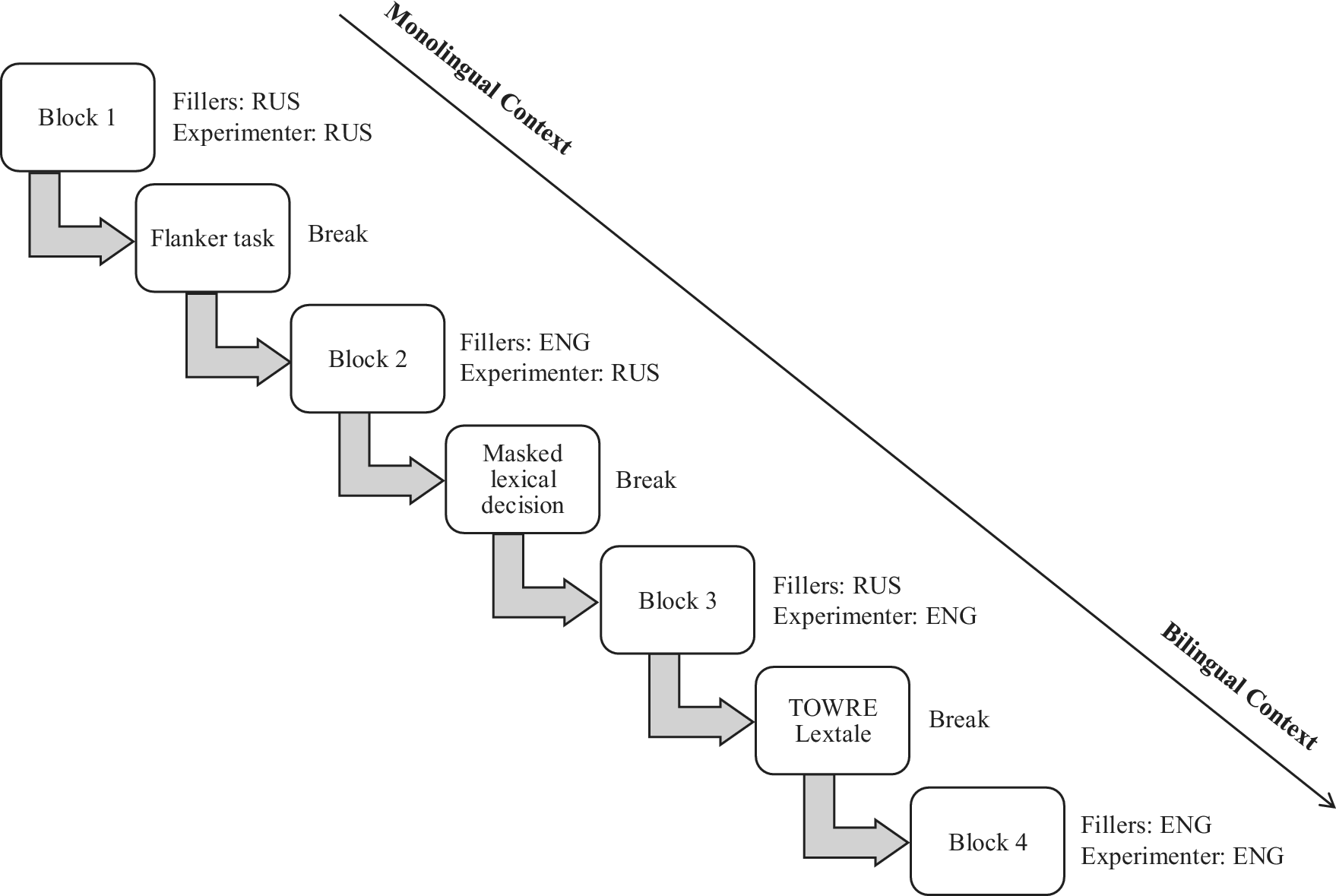
In this eye-tracking study, using the gaze-contingent invisible boundary paradigm, we investigated the flow of lexical activation of the non-target language words (i.e., words in English) in proficient Russian-English bilinguals reading in their native Russian, while we gradually changed the global language context from strictly monolingual to an increasingly bilingual environment. To that end, we implemented two different types of cues that signaled participants about the presence of an alternate language, the native language of the experimenter and the language of the filler sentences. We started the experiment with participants reading the first set of all-Russian experimental and filler sentences, while all the instructions were provided by a Russian-speaking experimenter (Block 1). After that, we added the filler English sentences to the materials, which served as the first explicit cue to the presence of the non-target language (Block 2). During the break, the experimenter changed to a native English speaker and all following interactions proceeded in English, while the fillers were again all-Russian (Block 3). Finally, Block 4 was administered by the English-speaking experimenter and the materials included English fillers (Block 4). Across the four Blocks, experimental sentences included preview-target manipulations in which previews were in one of 4 conditions: 1) identical words, 2) code-switches that are Russian-English translational equivalents, 3) semantically unrelated words, or 4) pseudowords (see the Method section for details).
Based on the findings in the previous studies, as the experiment progressed from Block 1 to Block 4, we expected facilitatory effects of the global language context cues on early (increase in skipping probability, decrease in first and single fixation durations, and gaze duration) and late (decrease in total reading time and regression probability) eye-tracking measures on the target word, but only in the code-switch condition. Specifically, we anticipated:
-
1) no effects on early dependent eye-tracking measures in Block 1 as we established a strict monolingual context and expected the inhibited activation from the script differences as per predictions of the proactive gain control hypothesis [Hoversten & Traxler, Reference Hoversten and Traxler2020]). The Multilink/ BIA+ model [Dijkstra & van Heuven, Reference Dijkstra, van Heuven, Grainger and Jacobs1998, Reference Dijkstra and van Heuven2002, Dijsktra et al., Reference Dijkstra, Wahl, Buytenhuijs, Van Halem, Al-Jibouri, De Korte and Rekké2019a] also argues for the reduced activation levels of the L2 codes due to the script dissimilarities, however, it allows for some degree of activation among candidates with phonological overlap, although this aspect was not controlled in the current study. While the proactive gain control hypothesis predicts no facilitative late effects due to the established monolingual environment, the Multilink/BIA+ models still allow L2 access later in processing when L2 meanings are integrated into the context at the task decision/schema stage.
-
2) facilitative late effects in Block 2 and/or Block 3 due to the initial introduction of the non-target language cues (again, in line with a task schema stage of Multilink/BIA+ model and the proactive gain control mechanism that should initiate adjusting mechanism to take the top-down information into account);
-
3) facilitative early and late effects in Block 4 due to an increasingly bilingual environment that might override the restrictions in cross-language lexical access imposed by the script differences (as per flexibility of the access suggested by the proactive gain control hypothesis, but contrary to the Multilink/BIA+ predictions).
Conversely, if we observed no differences among code-switches, semantically unrelated words, and pseudowords at any point during the study in any of the measures, that would indicate the absence of (or severely reduced) accessibility to the lexical candidates in L2 during L1 reading. The selective access, in this case, could be attributed to script differences, which reduces the access to the other language throughout the lexical and post-lexical processing of the target language words regardless of the amount or type of non-target language cues present.
2. Method
2.1 Participants
Fifty adult Russian-speaking L2 learners of English (42 women, Mage = 22.6, range 18–36) participated in the study. We recruited participants from a large public university in Moscow. The authors assert that all procedures contributing to this work comply with the ethical standards of the relevant national and institutional committees on human experimentation and with the Helsinki Declaration of 1975, as revised in 2008. The study was approved by the Committee on Interuniversity Surveys and Ethical Assessment of Empirical Research at the HSE University, and all participants signed an informed consent. Before the participants were invited to come to the lab for the study, we asked them to complete an online general English Cambridge placement test (cambridgeenglish.org/test-your-english/general-english/) at home and send us the scores via email (typically 4–5 days before the day of the study). We only extended invitations to participants who achieved a score of 75% or above. The data from 3 participants were excluded from the analysis (1 participant reported noticing the English words present in the Russian sentences, 1 participant did not complete the entire study and 1 participant was underage) resulting in the final sample of 50 bilinguals. During the study (see details in the procedure), we also administered the Lextale test in English (Lemhöfer & Broersma, Reference Lemhöfer and Broersma2012) and the Test of Word Reading Efficiency in English (TOWRE, Torgesen et al., Reference Torgesen, Wagner and Rashotte2012) as objective assessments of English proficiency and reading efficiency (see Table 1 for the proficiency assessment information). All participants received scores corresponding to a proficient level of English (C1 or C2) (Lemhöfer & Broersma, Reference Lemhöfer and Broersma2012, Kuperman et al., Reference Kuperman, Siegelman, Schroeder, Acartürk, Alexeeva, Amenta and Usal2023). At the end of the study, participants filled out the language background questionnaire (the translated script and responses are available at the OSF repository), which was administered in Russian. In this questionnaire, the majority of our participants also reported knowledge of other languages (e.g., German, French, RSL, Hebrew), but English was self-reported as the second language in proficiency for all participants. Participants received the equivalent of $7 in rubles as compensation for their participation.
Participant characteristics and average scores for performance on proficiency assessment tests in English

Note. LexTALE is an assessment of English vocabulary knowledge and general English proficiency. The TOWRE test of reading efficiency includes a subtest for word naming (Sight Word Efficiency) and a subtest for pseudoword naming (Phonemic Decoding Efficiency).
2.2. Design and materials
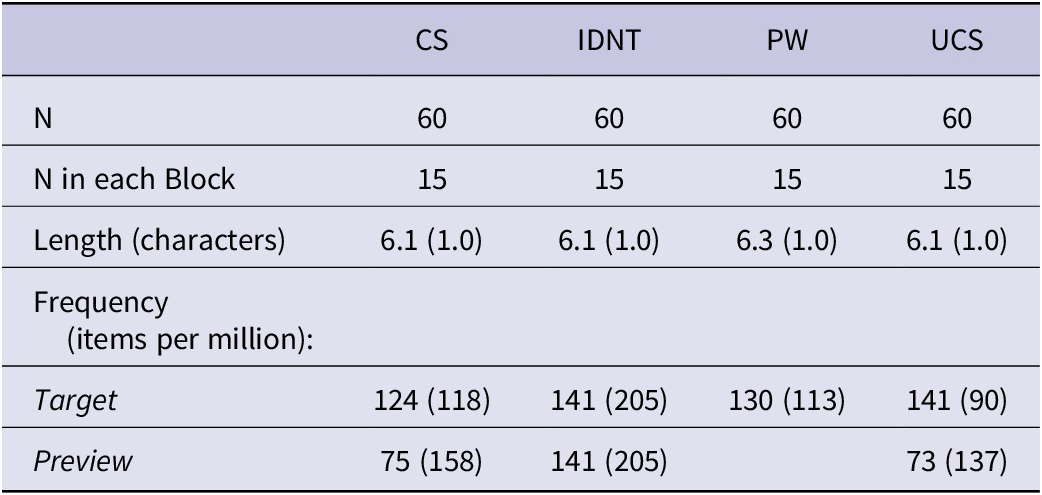
The study implemented a 2 (experimenter: Russian versus English) X 2 (filler sentences: Russian versus English) X 4 (target-preview conditions) within-subject design. First, we selected the set of 60 Russian-English translational equivalents (e.g., МЕСТО-PLACE) for the code-switch (CS) condition with the following criteria: 1) the target and preview words were matched in length (M = 6.1 letters, range 5–8); 2) there was no phonological or orthographical overlap in the first two letters (in order to isolate the effect of the global language context from the cognate facilitation effects); 3) the target words were all high-frequency words (i.e., >50 ipm, Lyashevskaya & Sharov, Reference Lyashevskaya and Sharov2009). As the next step, we selected another 180 Russian target nouns that matched the first set of 60 in frequency and length and divided them into three sets with an equal distribution of words of various lengths. The first set was assigned to the identical (IDNT) condition, in which the target and the preview words were the same (e.g., ВЕТЕР-ВЕТЕР [wind]). Next, using the Wuggy (Serbian Cyrillic-based) software program (Keuleers & Brysbaert, Reference Keuleers and Brysbaert2010), we matched target words of the second set with 60 length-matched and syllabic-matched pseudowords (PW condition) that did not overlap with target words phonologically or orthographically but were phonotactically legal in Russian (e.g., РАЙОН [district] – ВЕЙЮЛ). Finally, we length-matched the final 60 Russian target nouns with semantically, phonologically and orthographically different English nouns (UCS condition, e.g., ЗАКОН [law] – STONE), but these nouns were matched in frequency with the preview words in the CS condition according to the SUBTLEX-US frequency database (New et al., Reference New, Brysbaert, Veronis and Pallier2007). In total, the target-preview 240-word pairs comprised 4 experimental conditions (CS, IDNT, PW, UCS) with 60 pairs in each condition, which were then divided into 4 Blocks, each Block containing 15 pairs per condition (see Table 2). The results of ANOVA confirmed that neither target words across all conditions nor preview words in the CS-UCS conditions differed in frequency (F(1, 118) = .010, p = .922; F(2, 177) = .264, p = .768, respectively).
Lexical characteristics of the target-preview word pairs (SD)

Two hundred and forty low-constraint sentences were then created around the target words in such a way that 1) the target word was always in the Nominative or Accusative case (i.e., no case inflections) and on the 4th to 7th place in the sentence; 2) the sentence length was between 8 to 10 words; 3) the length of the pre-target word was 4 or more letters; and 4) the preview word in the UCS condition was plausible in the context of the sentence.
In a separate cloze-task norming study, we asked 64 adult native speakers of Russian (18 men, M age = 23.5, SD = 5.35, range 15–40) to read the sentences up to the target word and provide the continuation that first comes to mind. The results indicated that target words were not predictable in the sentence context (cloze probability = .03, SD = .08). In addition to the experimental sentences, each Block included 40 filler sentences. Russian filler sentences (Block 1 and Block 3) were taken from the Russian Sentence Corpus (Laurinavichyute et al., Reference Laurinavichyute, Sekerina, Alexeeva, Bagdasaryan and Kliegl2019), we used filler sentences in Jouravlev and Jared (Reference Jouravlev and Jared2018) as our English filler sentences (Block 2 and Block 4). All filler sentences were followed by a multiple-choice comprehension question.
2.3. Procedure
First, to establish a monolingual Russian global language context, participants were met in the lab by a native Russian-speaking experimenter, who provided the consent form in Russian, and explained what participants might expect during the study (participants remained naïve to the global language context manipulation). The experimenter was instructed to only speak Russian and to try to avoid using obvious Russian-English cognates and borrowings (e.g., experiment, эксперимент [ɪkspʲɪrʲɪˈmʲent]) in their speech. This part of the procedure aimed to allow participants to zoom in on the Russian language.
The study consisted of four eye-tracking Blocks, with approximately 5-minute breaks interspersed between each Block. After completing the first Block (Russian filler sentences), as a break participants performed the non-verbal Eriksen Flanker task (Eriksen & Eriksen, Reference Eriksen and Eriksen1974; the data was not analyzed in this study), and then after Block 2 (English filler sentences) - the masked lexical-decision task in Russian (part of another study). After that, we implemented another change in the global language context when the Russian-speaking experimenter introduced her assistant, a native speaker of English who continued with the study. The participants performed Block 3 (Russian filler sentences), followed by the Lextale test in English (Lemhöfer & Broersma, Reference Lemhöfer and Broersma2012) and the TOWRE (Torgesen et al., Reference Torgesen, Wagner and Rashotte2012). The introduction of the tests served two purposes: 1) to add another objective assessment of participants’ proficiency in English, and 2) to give participants more opportunities to zoom out of the base Russian and zoom into the non-target English. Participants completed the study with Block 4 (English filler sentences) (see Figure 1 for the overview of the study procedure). None of the participants said they understood condition manipulations but almost all participants noticed some flickering on the screen, some participants also noticed the English letters in Block 3 or Block 4. In general, the study took approximately 2 hours to complete.
The schematic procedure of the study.

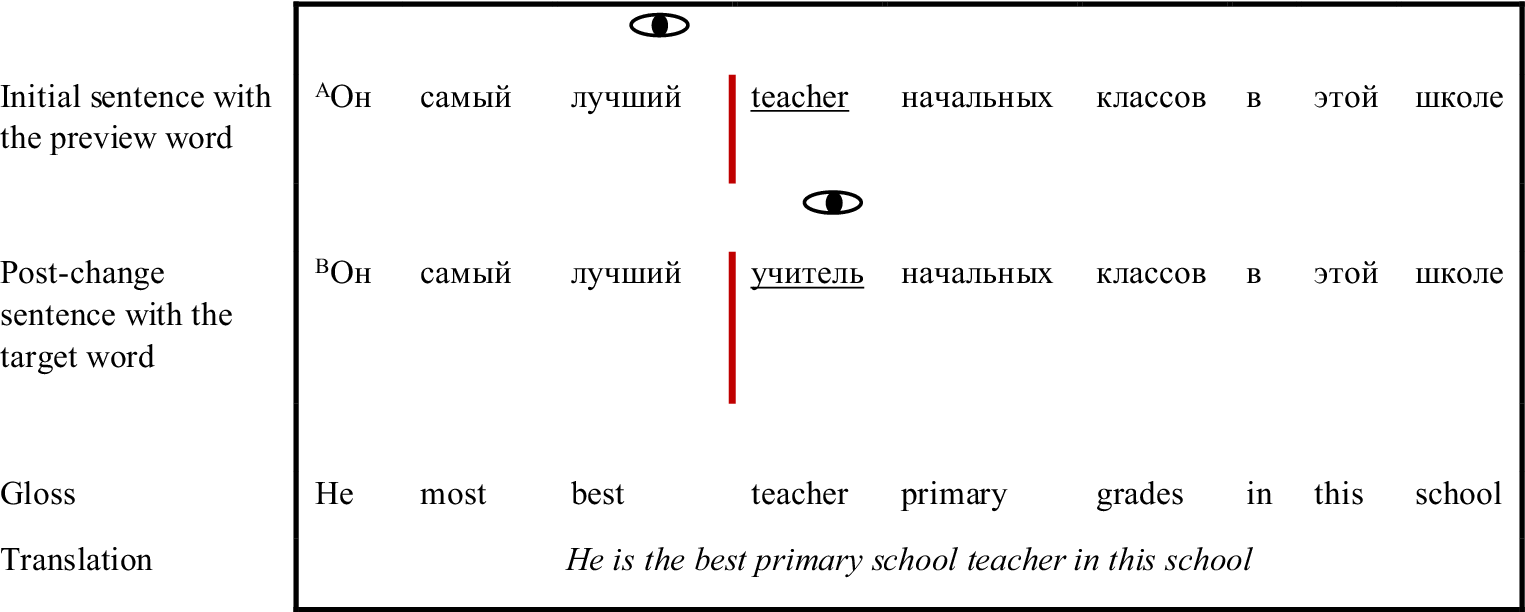
In the eye-tracking reading section, we implemented the gaze-contingent boundary change paradigm (McConkie & Rayner, Reference McConkie and Rayner1975). A Russian sentence was displayed until the eyes reached an invisible boundary located before the preview word, which then was replaced by a Russian target word (Figure 2). The target word stayed on the screen until participants finished reading the experimental sentence.
Example of a sentence (CS condition): The eye represents the fixation of the gaze before (A) and after (B) the sentence change. The red vertical line represents the invisible boundary that triggers a sentence change when eyes cross it. The preview and target words are underlined for display purposes only.

All sentences were presented in the upper-case characters on a 24-in. ASUS VG248QE monitor (resolution: 1,920 × 1,080 pix, response time: 1 ms, frame rate: 144 Hz, font face: 22-point Courier New) controlled by a ThinkStation computer. The eye movements were recorded by the Eyelink 1000+ desktop mount eye-tracker using a chin rest. Participants were seated 92 cm from the monitor. Only the right eye was tracked, at a 1000 Hz rate. The experiment began with a 9-point calibration which was repeated after every 15 sentences or when the eye fixations drifted. Each trial started with the drift correction as a fixation point at the position of the first letter. If the drift correction was successful, the experiment automatically proceeded to the presentation of the sentences; otherwise, calibration was repeated. Each Block started with three practice trials. To indicate that participants finished reading the sentence, they clicked the mouse and the trial proceeded to the comprehension question in the filler trials or the next sentence in the experimental trials. Sentences in each Block appeared in randomized order.
3. Results
Before analysis, all fixations less than 80 ms were excluded (such fixations are traditionally believed to be too short for the visual uptake of information), as well as the trials on which the display change took more than 10 ms into the fixation (68 observations were excluded). We also excluded the trials in which participants did not fixate on the pre-target word. The comprehension accuracy was 93.7% in Russian fillers and 84.9% in English fillers suggesting that participants paid attention while reading. The data and R script are available on the OSF project page https://osf.io/fs3yu/?view_only=6ec2598aa82e4e339dcbd60f1f91e8c2
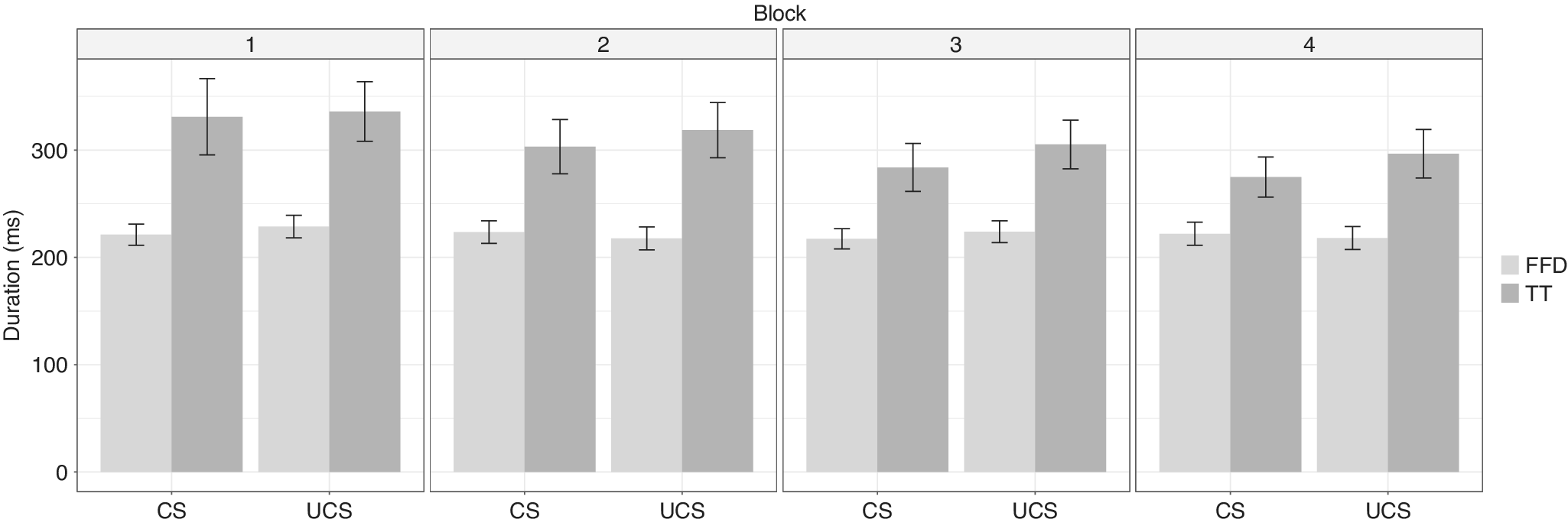
We focused on the early and late eye-tracking measures, which are believed to reflect early (grapheme-phoneme decoding, initial word recognition) and late (semantic and syntactic information integration and revision) stages of lexical or post-lexical access, respectively (Rayner et al., Reference Rayner, Sereno, Morris, Schmauder and Clifton1989). Among early measures, we analyzed first fixation duration (FFD), single fixation duration (SFD, if the word received only one fixation), gaze duration (GD, sum of all fixations during the first-pass reading), and skipping probability. The late measures included total reading time per word (TT), and the regression in probability (Rin, the rate of regressions back to the target word). Table S1 in the Appendix presents means and standard deviations in each condition across 4 Blocks for all measures. Figure 3 provides descriptive statistics for the early FFD and late TT measure in CS and UCS conditions across 4 Blocks as an example of the fixation duration change in increasingly bilingual Blocks.
Means for the early first fixation duration (FFD) and late Total reading time (TT) measures in CS and UCS conditions across 4 Blocks. The bars represent the standard error of the mean.

For each eye-tracking measure, we ran (generalized) linear mixed-effects models using the lme4 package (Bates et al., Reference Bates, Mächler, Bolker and Walker2015) in R statistical software (R Core Team, 2016, version 4.2.1). For generating Cohen’s d values for all significant effects in the models, we used the function lme.dscores in the R package EMAtools (Kleiman, Reference Kleiman2017). All models included fixed predictors of the target frequency (log-transformed), target word length (scaled and centered), pre-target word length (scaled and centered), trial order (scaled and centered), and a three-way interaction among filler language (deviation-coded, ‘1’ for English, ‘-1’ for Russian), target-preview condition (treatment-coded with CS condition as a reference level) and experimenter language (deviation-coded, ‘1’ for English, ‘-1’ for Russian). We intentionally treated experimenter and filler cues as separate predictors (versus collapsed into Blocks) to disentangle the effect of each cue on bilingual lexical access. Random factors were random intercepts for participants and sentences. No random slopes were added to the final models as such additions resulted in model convergence failure. We also removed random intercepts for sentences in the model for the FFD as it resulted in a singular fit. All p-values were adjusted for multiple comparisons for 6 tests using Bonferroni correction at an α-level of .008. Table 3 presents the full output for all models.
Summary of GLMMs for the eye-tracking measures. The cells with estimates in which there is a significant effect (Bonferroni correction applied) are in bold (at α-level .008)

3.1. Was the identical condition different from other conditions?
As can be expected, participants fixated on the target words for shorter times (in SFD, GD, and TT measures) and skipped more words in IDNT condition compared to all other conditions (ps < .02) as assessed via a set of post hoc multiple comparison analyses using the emmeans package (v1.8.3., Lenth, Reference Lenth2021) in R (Bonferroni-corrected for 6 pairwise comparisons, at α = 0.008). In regression in probability, words in the IDNT condition received fewer regressions than in the UCS condition (p = .021) but there were no differences between IDNT and CS or between IDNT and PW conditions (ps = 1.00). There were also no differences among any of the conditions in the FFD measure (all ps = 1.00).
3.2. Were CSs different from unrelated CSs and pseudowords?
Compared to the UCS condition, the target words in the CS condition received shorter fixations in TT measure (b = 0.05; SE = 0.02; 95% CI [0.01, 0.09], p = .024, d = 0.39) and fewer regressions back to the target word (Odds Ratio = 1.35; SE = 0.14; 95% CI [1.11, 1.66]; p = .018, d = 0.41). There were no differences between CS and UCS conditions in any other eye-tracking measures. We also did not observe any differences between CS and PW conditions in any of the measures (all ps = 1.00), however, compared to UCS condition, PWs yielded shorter fixations in TT measure (b = −0.07; SE = 0.02; 95% CI [−0.11, −0.04]; p < .001, d = −0.55) and the difference after Bonferroni correction was marginally significant in the Rin measure with lower probability of regression back to the target word in PW condition (Odds Ratio = 0.765; SE = 0.08; 95% CI [0.626, 0.934]; p = .054, d = −0.37).
3.3. Did the language used by the experimenter or the language of filler items affect eye movements?
When the experimenter’s language of instruction was Russian (versus English), participants made longer fixation durations on the target words in GD (b = −0.021; SE = 0.01; 95% CI [−0.04, −0.00]; p = .048, d = −0.36) and TT (b = −0.05; SE = 0.01; 95% CI [−0.07, −0.02]; p < .001, d = −0.51) measures. In addition, participants skipped significantly fewer target words when the experimenter was Russian-speaking versus English-speaking (Odds Ratio = 1.22; SE = 0.08; 95% CI [1.06, 1.41]; p = .036, d = 0.32). We did not find any effects of the language of the fillers on any of the eye-movement measures. There were also no two- or three-way interactions among target-preview conditions, the experimenter’s language, or the language of the filler’s sentences.
3.4. Was there an overall effect of the increasing bilingual context on the eye movements in the CS versus UCS condition?
While we did not find the expected effects of the experimenter’s language or filler items on the eye-movement measures, we hypothesized that the lack of these effects could be attributed to insufficient statistical power for their detection when analyzed as separate variables. The follow-up question we investigated was whether there was an overall facilitative effect of increasing bilingual environment in the CS condition on the TT and Rin measures (the measures for which the CS condition exhibited statistical differences from the control UCS condition). To that end, we examined the effect of Block on the TT and Rin measures in the CS condition and UCS conditions separately. The models included fixed predictors of the target frequency (log-transformed), target word length (scaled and centered), pre-target word length (scaled and centered), trial order (scaled and centered), and Block (4 levels, treatment-coded). Random effects were random intercepts for participants and sentences.
The models and subsequent set of post hoc multiple comparison analyses indicated that the target words in CS condition were read slower in Block 1 (strict monolingual context) compared to Block 3 (introduction of the English-speaking experimenter: b = −0.13; SE = 0.03; 95% CI [−0.20, −0.07]; p < .001, d = −1.05) and compared to Block 4 (the filler sentences in English and English-speaking Experimenter: b = −0.13; SE = 0.03; 95% CI [−0.20, −0.07]; p < .001, d = −1.06) (Figure 3). After applying Bonferroni correction for the post hoc tests, none of the comparisons in the Rin measure among Blocks reached statistical significance in the CS condition. In the UCS condition, the post hoc comparisons among Blocks indicated that target words received more regressions in Block 2 compared to Block 4 (Odds Ratio = 1.86; SE = 0.42; z = 2.76, p = .034). Table S2 in the Appendix presents the full output for the models.
To summarize, our analysis indicated facilitative effects in the CS condition compared to the UCS condition, specifically observed in the late eye-movement measures (TT and Rin). Although no interaction effects among target-preview conditions, the language of the experimenter, or the language of the filler sentences on the eye-movement measures were observed, participants exhibited shorter fixation durations (TT) on target words in the CS condition as the experiment progressed from Block 1 to Block 4. However, a decrease in regression rates (Rin) for target words in the UCS condition prevents us from attributing the facilitative effects in the CS condition solely to the increasingly bilingual context (see the Discussion section).
4. Discussion
In this eye-tracking reading study, we examined the effect of the changing global language context on the time course of the lexical access to the non-target language candidates during L1 reading in proficient Russian-English bilinguals. We gradually introduced two types of English language cues (the native language of the experimenter and the language of the filler sentences) while participants read Russian sentences. The experimental sentences contained a preview that was in one of the four conditions: a) an identical word to the target word (IDNT), b) a code-switch (CS), c) a semantically unrelated code-switch (UCS), or d) a pseudoword that was phonotactically and orthographically legal in Russian (PW).
The primary objective of this study was to test the predictions of the proactive gain control hypothesis (Hoversten & Traxler, Reference Hoversten and Traxler2020) and Multilink/BIA+ models (Dijkstra & van Heuven, Reference Dijkstra, van Heuven, Grainger and Jacobs1998, Reference Dijkstra and van Heuven2002; Dijkstra et al., Reference Dijkstra, Wahl, Buytenhuijs, Van Halem, Al-Jibouri, De Korte and Rekké2019a) concerning the timing of alternate language activation. The proactive gain control hypothesis suggests that bilingual lexical access is flexible and can dynamically adjust the activation threshold of lexical candidates based on the presence of non-target language cues. Consequently, the latter hypothesis predicts that the strictly monolingual global language context we established at the beginning of the experiment should render non-target language representations initially inaccessible. In this case, we should observe null effects in early eye-tracking measures, such as single fixation, first fixation, gaze durations, and skipping probability. However, as the experiment progresses, the increasingly bilingual context should lead to a gradual shift from selective to non-selective access. This shift should be evident in facilitative effects in late eye-movement measures, such as total reading time and regression probability. In a more ‘extreme’ scenario, the presence of a robust bilingual global context toward the end of our experiment could promote even earlier adoption of non-selective access. In this case, the facilitative effects would be apparent not only in late eye-movement measures but also in early ones. Such a result would imply an even greater degree of precise flexibility in the bilingual language control mechanism than what was initially proposed in Hoversten and Traxler (Reference Hoversten and Traxler2020). The Multilink/BIA+ models (Dijkstra & van Heuven, Reference Dijkstra, van Heuven, Grainger and Jacobs1998, Reference Dijkstra and van Heuven2002; Dijkstra et al., Reference Dijkstra, Wahl, Buytenhuijs, Van Halem, Al-Jibouri, De Korte and Rekké2019a) do not allow for the effects of global language context during the initial stages of word recognition. However, dynamic adjustments to identification criteria can be applied during later stages, specifically at the response level.
The only effect of the target-preview manipulation that we observed throughout the experiment was the difference in late eye-tracking measures (total reading time and regression probability) between CSs and semantically unrelated CSs. There were no interactions with the filler language and/or the experimenter’s language manipulation, indicating that our bilingual readers could access L2 lexical representations regardless of the current global language context, but only during the late stages of lexical processing. This pattern of results is more in line with Multilink/BIA+ model predictions (Dijkstra & van Heuven, Reference Dijkstra, van Heuven, Grainger and Jacobs1998, Reference Dijkstra and van Heuven2002; Dijkstra et al., Reference Dijkstra, Wahl, Buytenhuijs, Van Halem, Al-Jibouri, De Korte and Rekké2019a) than with the proactive gain control hypothesis (Hoversten & Traxler, Reference Hoversten and Traxler2020): We did not observe the adjustment from the monolingual context at the beginning of the experiment to the bilingual environment later in the experiment, but rather stable facilitation effects at the later stages of bilingual word recognition throughout the duration of the experiment. The overall absence of early facilitation effects is likely to stem not only from the Cyrillic–Latin script differences but also due to the direction of the CS we employed in this study with weaker L2 language codes generally receiving less activation than dominant L1 language codes (for review see Bailey et al., Reference Bailey, Lockary and Higby2023).
It is worth noting that our findings only partially align with the results reported in Jouravlev et al. (Reference Jouravlev, McPhedran, Hodgins and Jared2023). In their study, authors observed no effects of CS translations in any of the eye-tracking measures, leading them to conclude that there was insufficient orthographic overlap with the target language to activate non-target representations. Our study, however, provides evidence that while the lack of orthographic similarity indeed seems to be a potential explanation for the absence of bilingual lexical access in the early word recognition stages, participants were able to integrate L2 semantic information from orthographically non-overlapping words in the parafoveal preview during later post-lexical stages. We hope that future studies investigating cross-script Cyrillic-Latin bilingual access during reading will shed more light on these differences in the time course of activation.
The L1 to L2 direction of the CS in our study might also explain the differences observed in the late eye-movement measures between the pseudoword condition and semantically unrelated CSs. Specifically, when the preview was a pseudoword, participants exhibited shorter total reading times for the target words and made fewer regressions back to the target word (marginally significant effect after Bonferroni correction). Recall that in our study the pseudoword previews consisted of orthographically legal combinations of Cyrillic letters that were matched to the target words in length and in syllabic structure. It is likely, therefore, that the orthographic L1 codes, even from non-existing words, were more readily activated than the L2 orthography of non-competing L2 candidates (i.e., semantically unrelated CSs) during the later processing stages. However, pseudowords received the same level of activation as CS previews (i.e., CS=PW < UCS). The activation, of course, is driven by different sources, namely parafoveally processed L1 orthography versus semantic priming. Thus, we suggest that the absence of differences between CSs and pseudowords in the late measures in our study might be indicative not of the inaccessibility of the CSs (cf. Hoversten & Traxler, Reference Hoversten and Traxler2020) but rather of the task demands (i.e., reading in L1) that trigger faster responses to the L1 orthographic codes (or does not impose the cost associated with the cross-script CS).
We also observed that target words were read more slowly (as indicated by GD and total reading time measures) and were skipped less frequently when the experimenter’s language of instruction was Russian, regardless of the condition. We suggest that this somewhat surprising effect is due to the order of the Block presentation in our experiment and likely does not have theoretical implications. Recall that the Russian-speaking experimenter was introduced in Block 1 and Block 2, while the English-speaking experimenter continued the study throughout Blocks 3 and 4. Although we controlled for the trial order in our statistical analysis (statistically significant only in total reading time measure), it is probable that Blocks with a Russian experimenter served as a better ‘collapsed’ predictor as opposed to the trial order. Thus, shorter reading times and higher skipping probability in the Blocks with an English experimenter can be attributed to the practice effect. Even in the follow-up analyses with alternate language cues collapsed into Blocks, we maintain the same cautious approach. The analyses revealed a facilitation effect in the CS condition, with total reading times decreasing from Block 1 to Block 3 and Block 4. While it might be tempting to infer that the increasing bilingual context increased access to the alternate English language, we also observed some facilitation in unrelated CSs in the regression probability from Block 2 to Block 3. The parallel facilitation across conditions likely reflects a general decrease in reading times as the experiment progresses, rather than enhanced access to the lexical representations of the non-target language.
In conclusion, the findings in the current study demonstrate that irrespective of the global language context, lexical access to L2 English remained reduced or inhibited during the early word recognition stage in reading in L1 Russian but the integration of the L2 meanings was implemented during later post-lexical stages. Similar to the conclusions reached by Jouravlev and colleagues (Reference Jouravlev and Jared2018, Reference Jouravlev, McPhedran, Hodgins and Jared2023), it is likely that in our study the differences in the scripts between Cyrillic and English dominated the language selection effects in early word recognition. As predicted by the Multilink and BIA+ model (Dijkstra & van Heuven, Reference Dijkstra, van Heuven, Grainger and Jacobs1998, Reference Dijkstra and van Heuven2002; Dijkstra et al., Reference Dijkstra, Wahl, Buytenhuijs, Van Halem, Al-Jibouri, De Korte and Rekké2019a), the task schema that operates after the early word recognition stage enabled adjustment of the decision criteria, which facilitated reading target words in L1.
Although we did not observe the adjustment of the bilingual language control mechanism (Hoversten & Traxler, Reference Hoversten and Traxler2020) in this study as we manipulated the global language context, we speculate that the reason may be not the absence of such a mechanism per se but rather the result of the differential influence of bottom-up cues on the language selection process. In particular, it is likely that the script differences in alphabetic languages (cf. logographic-alphabetic script study in Wang et al. [Reference Wang, Yeon, Zhou, Shu and Yan2016]) carry more weight as bottom-up cues compared to the influence of the top-down global language context. As a result, the script differences prevent the adjustment mechanism from altering language accessibility even in the explicit and increasing presence of the alternate language. Overall, we suggest that the results of this study should be viewed not as contradictory to the dynamic nature of bilingual language control, but rather as a starting point for understanding the varying weights of bottom-up and top-down cues that influence the operation of the proactive gain control mechanism.
4.1. Limitations and future directions
There are several limitations in this study that should be taken into consideration and possibly addressed in future studies. First, although we took several steps to carefully establish the monolingual context at the beginning of the study, it is still possible that our participants engaged in English-Russian code-switching before coming to the lab, increasing the activation of certain L2 candidates. Future studies should aim to establish stricter control over the global context environment. Second, it would be preferable to include a pseudoword condition that utilizes the Latin script to determine whether such manipulation leads to a difference in reading times between CSs and pseudoword conditions. If such a difference occurs, it would emphasize bilinguals’ ability to extract semantic meaning from the parafovea, rather than just visual activation of L1 orthographic codes. Third, future studies should also examine whether changing the global language context affects the accessibility of L1 when reading in L2. We anticipate that the effects might be more pronounced in this case since L1 codes are generally activated more rapidly (Dijkstra & van Heuven, Reference Dijkstra and van Heuven2002). Similarly, it would be insightful to test other language pairs that also use different scripts, such as Greek versus Polish, Chinese versus Japanese, Georgian versus English. Fourth, a stricter control over the frequencies of preview and target words is necessary. We ensured that the frequencies of the target and preview words were matched across conditions (see Table 2). However, due to the stringent criteria required to create a highly controlled and extensive list of stimuli for preview-target pairs—specifically, matching length, avoiding phonological or orthographic overlap, ensuring high frequency, and maintaining semantic plausibility in the UCS condition—it was not possible to match the frequencies of target and preview words within conditions precisely. The difference in frequencies, however, could have contributed to the absence of any effects in the early eye-movement measures, as word frequency affects the base activation levels in the bilingual lexicon (see the Multilink/BIA+ model assumptions discussion in Dijkstra & van Heuven, Reference Dijkstra and van Heuven2002; Dijkstra et al., Reference Dijkstra, Wahl, Buytenhuijs, Van Halem, Al-Jibouri, De Korte and Rekké2019a).
Finally, from a methodological perspective, a notable limitation of the study is the lack of a power analysis prior to data collection to estimate the number of participants needed to ensure sufficient statistical power. It is possible that the lack of statistically significant effects in this study is due to a relatively small sample size (the data collection was limited due to COVID-19 pandemic restrictions). Addressing these limitations in future studies will provide a more comprehensive understanding of the effects of global language context on bilingual lexical access during reading.
Supplementary material
To view supplementary material for this article, please visit http://doi.org/10.1017/S1366728924000658.
Data availability statement
The data that support the findings of this study are openly available on the Open Science Framework project page https://osf.io/fs3yu/?view_only=6ec2598aa82e4e339dcbd60f1f91e8c2
Acknowledgements
This article is an output of a research project implemented as part of the Basic Research Program at the National Research University Higher School of Economics (HSE University). We are grateful to Ekaterina Krasikova for her assistance with stimuli creation.
Competing interest
The author(s) declare none.



 Open access

