


Serious psychotic illness including schizophrenia and associated conditions are characterised by abnormalities in one or more of the following domains: delusions, hallucinations, disorganised thinking or formal thought disorder, grossly disorganised motor behaviour and negative symptoms. Negative symptoms may be broadly described as diminished emotion expression, avolition, alogia, anhedonia and asociality (Diagnostic and Statistical Manual of Mental Disorders Fifth Edition [DSM-5], 2013). The latter are related to difficulties in functioning and performing activities of daily living (Klingerg et al., Reference Klingberg, Wölwer, Engel, Wittorf, Herrlich, Meisner, Buchkremer and Wiedemann2011). Psychotic illness is associated with impairments in executive functioning affecting thinking, perception, behaviour, emotion and personality (Hassan & Taha, Reference Hassan and Taha2011). Long-term outcome studies support the claim that psychotic illness is heterogeneous and that the illness course varies between individuals with regard to age of onset, acuteness and other prognostic factors (Jobe & Harrow, Reference Jobe and Harrow2005). Impairment can vary from severe, refractory illness to less serious, responsive psychosis to a state of normality (Frese, Stanley, Kress & Vogel-Scibilia, Reference Frese, Stanley, Kress and Vogel-Scibilia2001).
Returning to work or engaging in employment is a visible sign of recovery. Returning to work suggests that symptoms are sufficiently controlled to enable a connection to the social world (Pachoud, Plagnol & Leplege, Reference Pachoud, Plagnol and Leplege2010). In a study of satisfaction with daily occupations in a population of people with severe mental illness, Eklund, Hansson and Alqvist (Reference Eklund, Hansson and Ahlqvist2004) found greater levels of satisfaction in the cohort who were working competitively or who were studying compared to those engaged in community activities or no regular activity.
In their review of predictors of employment outcome for people with schizophrenia, Tsang, Leung, Chung, Bell and Cheung (Reference Tsang, Leung, Chung, Bell and Cheung2010), concluded that more research was required into those factors which are changeable over time, specifically social policy, social cognition and psychological processes. They identified a need to better understand the relationship between psychological processes and vocational outcomes in order to better inform interventions for vocational success. This is further confirmed by levels of unemployment for people with psychotic disorders being as high as 75–78 per cent in Australia (Mental Health Council of Australia [MHCA], 2007). In 2011–12, 62 per cent of working age Australians with a mental illness were employed, compared to 80 per cent of those without a mental illness.
The proportion of disability support pension (DSP) recipients in Australia having a diagnosis of a psychological or psychiatric condition now represent the largest single group who receive a DSP. In 2006 the proportion of new entrants to this payment was 22.6 per cent compared with 31.2 per cent in 2013 (Department of Social Services [DSS], 2013). Subsequently Australian Federal Government has initiated reforms. These reforms focus on the functional impact of a medical condition as assessed against a set of impairment tables instead of focusing on an individual's diagnosis. For people aged 35 years and under who make a claim for DSP and those on DSP who were granted this payment between 2008 and 2011, there is a greater emphasis on participation and working as evidenced by the assessment of work capacity with the requirement to participate in a programme of support (DSS, 2014). Work preparation activities and opportunities for vocational participation may in fact aid the recovery process of people living with psychotic illness, however, the compulsory requirements will need to allow for episodic fluctuations and reflect the non-linear trajectory of recovery (MHCA, 2014).
Rationale and Aims
The need to better understand the psychological processes which predict vocational success for people diagnosed with psychotic illness has been highlighted in the literature (Tsang et al., Reference Tsang, Leung, Chung, Bell and Cheung2010). It is evident that there is a need to identify those factors which enhance vocational engagement. Further, if service providers are to provide effective interventions for people with psychotic illness, then understanding these psychological factors and processes becomes crucial to facilitating vocational success.
The aim of this study was to systematically review the available literature and research to identify those psychological factors that predict successful return to work for people experiencing serious psychotic illness. A further aim of this research was to develop and propose guidelines regarding best practice for workers in the field of vocational rehabilitation assisting people with serious psychotic illness based on the reviewed literature.
Method
Research design
The Preferred Reporting Items for Systematic Reviews and Meta-Analyses (PRISMA) guidelines were adopted for this systematic literature review (Moher, Liberati, Tetzlaff & Altman, Reference Moher, Liberati, Tetzlaff and Altman2009). PRISMA were used because these guidelines can be applied to a variety of systematic literature reviews such as evaluations of interventions. A narrative approach was used to synthesise the data extracted in this systematic literature review. As this study is a systematic literature review, the research was exempt from ethical review by the Human Research Ethics Committee in Tasmania, Australia.
Search procedure
An electronic search of the literature was conducted using the following databases: PsycARTICLES, PsycINFO, PubMed, ProQuest, Cumulative Index of Nursing and Allied Health (CINAHL) and Taylor & Francis Online. The search terms used were ‘psychotic illness’ OR ‘serious mental illness’ AND ‘employment’ OR ‘return to work’. The search was also extended to include psychological predictors including ‘social cognition’ OR ‘negative symptoms’ OR ‘stigma’. Filters included peer review, English language and publication date between January 2002 and September 2013. This period reflects the widespread introduction of outcome-oriented vocational rehabilitation for this population and parallel legislative changes requiring assessment of work capacity. Additional records were identified through searches of citation indices. Titles were visually inspected and duplicate articles excluded; titles reflecting return to work and psychotic illness were retained. Titles and abstracts were then scrutinised using the following inclusion criteria:
1. Adult population of working age: 18–65 years who identified as or were diagnosed as having a serious mental illness.
2. The focus of the articles was broadly vocational rehabilitation, work or employment.
3. The research questions related to a psychological construct as distinct from models of vocational rehabilitation.
At this stage 208 articles remained and the inclusion criteria were further refined and abstracts screened to check for the following:
1. A research sample with a minimum of 50 per cent having a diagnosis of schizophrenia spectrum disorder according to DSM-IV-TR (2000) because the literature reviewed pre-dated the publication of the DSM-V (2013). Articles which focused on the first episode of psychosis (FEP) were also excluded as this was considered to be a discrete population with distinct needs related to younger age and the immediate effects of disruption to work and education trajectories (Rinaldi et al., Reference Rinaldi, Killackey, Smith, Shepherd, Singh and Craig2010). The emphasis of this review was on individuals who have a confirmed diagnosis of psychotic illness.
2. The focus of the articles was on psychological constructs that predict, as distinct from factors that impede or prevent successful return to work. Research focusing on cognition was excluded; it has been the most widely studied deficit of schizophrenia (Choi, Fiszdon & Bell, Reference Choi, Fiszdon and Bell2013) and was not the aim of this current study.
3. For inclusion, interventions had to be directly linked to work outcomes. Return to work for the purpose of this review refers to employment which occurs in integrated settings alongside non-disabled workers and is paid at minimum or above wage rates (Razzano et al., Reference Razzano, Cook, Burke-Miller, Mueser, Pickett-Schenk, Grey and Carey2005).
4. Participants needed to be in a post-acute or stable phase of illness that was generally defined as having no hospitalisations, medication or accommodation changes in the preceding 30 days.
Further, abstracts identified from the search were independently assessed against the inclusion criteria by two of the researchers. One hundred per cent agreement for inclusion was obtained without discussion. The full texts of the articles meeting the inclusion criteria were analysed. Studies including participants presenting with co morbid substance addiction were excluded. Also, studies with participants diagnosed with a co-morbid intellectual disability were excluded.
Data aggregation
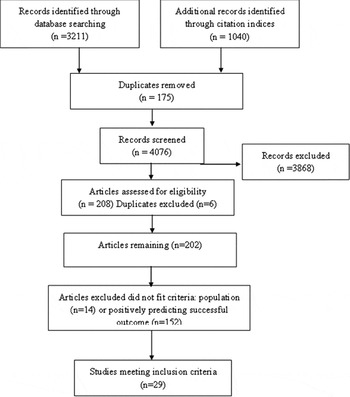
A total of 4,076 journal articles were found. The titles and abstracts of these articles were examined, and any articles that were not relevant to the research topic and did not meet the inclusion criteria were discarded. Any article that did not meet the criteria after analysis was discarded. A total of 29 articles were included for analysis (see Figure 1 for the selection process model).
Selection process for the articles included in this review.

The data retrieved from the systematic review of the literature was synthesised using a narrative approach: Guidance on the Conduct of Narrative Synthesis in Systematic Reviews was used (Popay et al., Reference Popay, Roberts, Sowden, Petticrew, Arai, Rodgers and Duffy2006). This approach to data synthesis was used because narrative approaches are best employed when a range of research evidence is examined and a meta-analytic approach is contraindicated as a result (Popay et al., Reference Popay, Roberts, Sowden, Petticrew, Arai, Rodgers and Duffy2006).
Results and Discussion
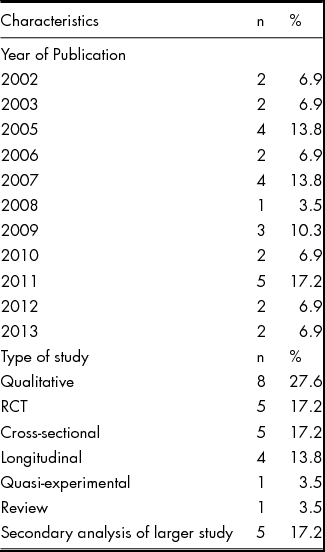
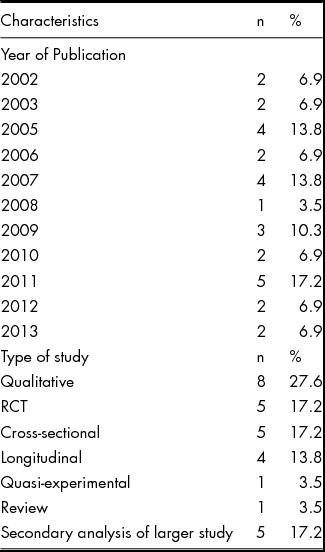
Table 1 describes the characteristics of the reviewed studies and includes the year of publication, study design and recruitment source. This review considered 29 articles that met the inclusion criteria. A summary of each of the included articles is provided in Table 2 which details the purpose, intervention and outcome of the research.
Descriptors of included articles
Summary of reviewed articles

Note: RCT = randomized controlled trial; RTW = return to work; IVIP = Indiana Vocational Individualised Programme; CBT = cognitive behaviour treatment
All studies examined psychological constructs as they applied to return to work. From this review a number of significant predictors emerged from the results of the analysed studies that inform the psychological processes involved in returning to work following illness onset. These will each be discussed next.
Important Factors
Illness v worker identity
Managing the psychological aspects of illness or illness identity and coping with illness in the workplace was a major theme in the literature and found to be predictive of vocational success by nine studies (31.0 per cent).
Gioia (Reference Gioia2005) examined the interacting patterns of career development and illness that influence work recovery. Gioia concluded that the reformulation of a vocational identity was central to vocational success. Gewurtz, Kirsh, Jacobson and Rappolt (Reference Gewurtz, Kirsh, Jacobson and Rappolt2006) found that despite the presence of a fear of relapse having the opportunity to work and access to work related activities, allowed for the development of a worker identity. Dunn et al. (Reference Dunn, Wewiorski and Rogers2010) identified a process whereby people with severe mental illness adapt their working lives to their altered needs. Exploring individual factors that contributed to this, they found that pre-illness confidence to work did not necessarily diminish and may be sustained by both internal and external sources. Similarly Woodside et al. (Reference Woodside, Schell and Allison-Hedges2006) observed that employed participants considered themselves recovered while maintaining regular self-assessment of well-being and medication regimes.
Management of psychiatric symptoms was the most highly rated factor associated with obtaining and retaining work within a group of employed participants surveyed by Wu, et al. (Reference Wu, Su, Lin, Chueh and Su2009). Specifically, they identified medication compliance, controlling hallucinations and delusions, as well as the ability to take the initiative to self-manage symptoms as the three most important factors of vocational success. In her review of the Chinook Clubhouse programme, Dorio et al. (Reference Dorio, Guitar, Solheim, Dvorkin and Marine2002) identified the recognition of early signs of becoming unwell and implementing plans including the First Aid card prompt to manage symptoms. Nithsdale et al. (Reference Nithsdale, Davies and Croucher2008), echoed this finding by showing that coping with mental health issues in the workplace was important when returning to and maintaining employment. Coping specifically related to attitudes and activities that enabled the worker to sustain employment while managing their mental illness. Further, Erickson et al. (Reference Erickson, Jaafari and Lysaker2011) showed that over time improvements in insight were significantly associated with improvements in work behaviour. Considering which self-related variables mediate occupational engagement, Bejerholm and Eklund (Reference Bejerholm and Eklund2007), found that internal locus of control together with levels of negative symptoms, accounted for 47 per cent of the variance in vocational status.
The current review showed that it is important for people with a mental illness to develop an identity as a worker with a mental illness. By combining these identities, making use of internal and external coping resources and taking the initiative to self-manage symptoms in the workplace are related to a successful return to work. The review also showed that the way in which symptoms are managed while in the workplace could influence ongoing employment.
Illness management and job tenure
Five studies (17.2 per cent) considered which psychological processes support job tenure. Becker et al. (Reference Becker, Whiley, Bailey and Drake2007) found that having emotional support in the form of someone who encouraged trying to work and someone to talk to about the stresses of work was predictive of success. How well one managed their illness and developed adaptive coping skills were important indicators of remaining in the workforce. Further, positive change in the perception of illness-related barriers and quality of working life were predictive of longer job tenure (Johannesen et al., Reference Johannesen, McGrew, Griss and Born2009; Lanctôt et al., Reference Lanctôt, Corbière and Durand2012). Once a person with a mental illness feels they can return to work and be supported in their work they may be more likely to remain in their reemployment long enough to develop and practice effective ways to cope in the workplace.
Social cognition
Perceiving oneself as being capable of interacting with others in the workplace is an important predictor of return to work success. In their longitudinal study, Waghorn, Chant and King (Reference Waghorn, Chant and King2007), demonstrated that work-related subjective experiences and work-related self-efficacy were consistently associated with employment status and that both were important aspects of social cognitive learning for career development. Work-related self-efficacy was also related to employment outcome in the review undertaken by Michon et al. (Reference Michon, van Weeghel, Kroon and Schene2005). Kee, Green, Mintz and Brekke (Reference Kee, Green, Mintz and Brekke2003) showed that perception of emotion significantly correlated with work functioning, so that higher baseline levels of emotion perception predicted better work outcomes at 12 months. Targeting social cognition over a two-year period was found to increase the likelihood of being employed (Eack et al., Reference Eack, Hogarty, Greenwald, Hogarty and Keshavan2011). Further, workplaces that gave employees with a mental illness constructive feedback on their work on a regular basis enabled a shift in worker identity, thus enabling a successful return to work (Bell et al., Reference Bell, Bryson, Greig, Fiszdon and Wexler2005). Therefore, believing that one can return to work and stay at work is an important factor in the return to work process.
Motivation
In larger studies of neurocognitive interventions, Choi et al. (Reference Choi, Fiszdon and Bell2013) and Saperstein et al. (Reference Saperstein, Fiszdon and Bell2011) examined the effect of intrinsic motivation on vocational functioning. Choi found that levels of motivation were associated with work performance so that improvements in motivation were associated with better work performance. Saperstein's findings indicated that there is a relationship between negative symptoms and intrinsic motivation so that negative symptom management should impact intrinsic motivation, which is predictive of both work functioning and productivity. Larson (2007) explored the theory that understanding motivation to work and stages of change. Interestingly, Larson found that readiness and motivation to change was not necessarily associated with return to work. However, both employed and unemployed participants identified stress as a cost and benefit of working. In their later study, Larson et al. (Reference Larson, Ryan, Wassel, Kaszynski, Ibara, Glenn and Boyle2011) revealed that having the opportunity to successfully manage work stress could be seen as an incentive to stay in the workplace.
Social Support
Nine of the studies reviewed identified social support and social connectedness in the workplace as important factors in maintaining employment. A number of studies addressed the issue of whether employees with a mental illness felt comfortable disclosing their illness to others in the workplace. Rollins et al. (Reference Rollins, Mueser, Bond and Becker2002) found that employees who disclosed their mental illness to their supervisor were able to access other types of organisational support and worked longer hours compared to those who disclosed their illness to colleagues. Therefore, whether an employee chooses to disclose their illness or not when making use of organisation support appears to be an important factor in remaining in the workforce.
It appears that the factors important to returning to work and maintaining employment with a mental illness include developing an identity as a worker. Believing that work is possible and that symptoms of mental illness can be managed while at work is important. Having support and encouragement to believe this and subsequently achieve this seems vital. Further, learning skills to manage symptoms, taking the initiative to self-manage and having work environments that facilitate adaptive coping also appear essential. Next we will provide some practice recommendations to facilitate successful return to work with clients who have a mental illness.
Proposed practice recommendations
The reviewed literature identified psychological predictors of vocational success for people diagnosed with psychotic illness. Service providers engaging with individuals to facilitate return to work may wish to consider the following guidelines derived from the literature. The focus of these guidelines is the psychological processes that mediate vocational engagement and which, if well understood, may be harnessed to facilitate vocational success.
Working alliance
Research has shown that the working alliance is central to the recovery process (Ashford, Fitzharris & Diggs, Reference Ashford, Fitzharris and Diggs2010). Engaging authentically with individuals diagnosed with psychotic illness requires an understanding that the individual is at some point on the recovery journey; a journey that is rarely linear, thus interventions will need to be flexible (Erickson et al., Reference Erickson, Jaafari and Lysaker2011). Interactions and interventions should reflect the core principle of psychiatric rehabilitation and honour client choice (Bond et al., Reference Bond, Campbell and Becker2013). Encouragement to enter the workforce and providing messages of hope and recovery were commonly identified as important in the return to work process (Rollins et al., Reference Rollins, Bond, Jones, Kukla and Collins2011). Psychotic illness often leaves individuals socially isolated and significant others such as families struggling to reconstruct effective communication. Therefore service providers are in a unique role to interact and intervene in a manner that is sensitive to the individual and reflective of evidence-based practice.
Illness and worker identity
Some service providers caution against returning to work citing workplace stress as a factor in relapse and have discouraged individuals from pursuing vocational opportunities (Larson et al., Reference Larson, Barr, Corrigan, Kuwabara, Boyle and Glenn2007). Being familiar with the stages of change model (Prochaska & Di Clemente, Reference Prochaska and Clemente1982), identifying the individual's level of readiness to return to work and using cognitive restructuring techniques that enhance the belief that returning to work is possible have been shown to strengthen employment commitment (Johannesen et al., Reference Johannesen, McGrew, Griss and Born2009; Larson et al., Reference Larson, Barr, Corrigan, Kuwabara, Boyle and Glenn2007; Larson et al., Reference Larson, Ryan, Wassel, Kaszynski, Ibara, Glenn and Boyle2011). Acknowledging pre-illness career development and also an express desire to work are also important in the return to work process (Gioia, Reference Gioia2005). In the first instance it is the service provider's role to encourage the individual to envisage a future which includes work (Gewurtz et al., Reference Gewurtz, Kirsh, Jacobson and Rappolt2006).
Illness management
How the individual understands the impact of illness on capacity to work needs to be balanced against the desirability of attempting work or work-related activities while experiencing the effects of illness (Nithsdale et al., Reference Nithsdale, Davies and Croucher2008). Managing symptoms at work and having a relapse plan are central to vocational success (Dorio, Reference Dorio2004; Woodside et al., Reference Woodside, Schell and Allison-Hedges2006). Medication adherence is usually pivotal to symptom management. The service provider can assist by liaising with health professionals so that medication dosage and timing is adjusted to maximise wakefulness, alertness and functioning at work (Becker et al., Reference Becker, Whiley, Bailey and Drake2007; Wu et al., Reference Wu, Su, Lin, Chueh and Su2009).
Workplace accommodations
Service providers act as the conduit for workplace accommodations. While the disclosure conundrum continues to rage, it needs to be recognised that individuals with psychotic illness identify specific psychological benefits from making their diagnosis known. Where supervisors and co-workers are aware of illness, individuals report a degree of comfort and encouragement associated with success (Woodside et al., Reference Woodside, Schell and Allison-Hedges2006). Knowing that requests for time off will be agreed to, should the person experience a relapse, provides a degree of confidence in returning to work while managing illness symptoms (Gewurtz et al., Reference Gewurtz, Kirsh, Jacobson and Rappolt2006). Work situations that are moderately and consistently paced provide the best opportunity for vocational success.
Negative symptoms
Evidence suggests that negative symptoms impact on the degree to which an individual succeeds in the workplace. Cognitive behaviour therapy as an adjunct to vocational rehabilitation has been shown to be effective in targeting negative cognitions and anxiety which may give rise to avoidant coping and poor social cognition (Choi et al., Reference Choi, Fiszdon and Bell2013; Lysaker et al., Reference Lysaker, Bond, Davis, Bryson and Bell2005; Lysaker et al., Reference Lysaker, Davis, Bryson and Bell2009; Lysaker et al., Reference Lysaker, Roe, Ringer, Gilmore and Yanos2012). Group work focusing on more adaptive thinking has also been shown to be effective (Davis et al., Reference Davis, Lysaker, Lancaster, Bryson and Bell2005). Targeting negative cognitions may increase intrinsic motivation or feelings of purpose and curiosity, while improving work productivity and work performance (Saperstein et al., Reference Saperstein, Fiszdon and Bell2011). Similarly, targeting social cognition (Eack et al., Reference Eack, Hogarty, Greenwald, Hogarty and Keshavan2011) and providing training in emotion perception may enhance workplace communication and address deficits in interpersonal functioning commonly associated with anhedonia and asociality (Kee et al., Reference Kee, Green, Mintz and Brekke2003).
Occupation matching
Engaging with the individual requires an exploration of competencies and abilities acquired through work, education or other experiences. This enables the provider to highlight the individual strengths and begin working towards a working life adapted to altered needs (Dunn et al., Reference Dunn, Wewiorski and Rogers2010). Evaluating whether the individual is occupationally engaged at a level that can be comfortably managed is an important aspect of stress reduction. Doing this will prevent the negative consequences of both under and over engagement from occurring (Bejerholm & Eklund, Reference Bejerholm and Eklund2007).
Providing opportunities to try out new roles through work experience can assist both the individual and service provider to further refine career direction (Gewurtz et al., Reference Gewurtz, Kirsh, Jacobson and Rappolt2006).
Occupational matching needs to be operationalised to the real world to include location, hours of work and person-environment congruence. The person-job fit should be based on an assessment of individual needs that includes consideration of comfort, pace of work, concerns about meeting deadlines and stamina (Dunn et al., Reference Dunn, Wewiorski and Rogers2010).
Stress management
Service providers should support individuals to develop and maintain a good work/life balance so that stress is minimised and work capacity enhanced. This may include change talk so that individuals feel confident about developing routines and practices that sustain this balance (Woodside et al., Reference Woodside, Schell and Allison-Hedges2006). Tolerance of frustration is often reduced in individuals with psychotic illness so stress management training should address coping with criticism in the workplace and learning strategies for coping with stressful situations (Wu et al., Reference Wu, Su, Lin, Chueh and Su2009).
Vocational self-efficacy
Following the onset of illness, the reconstruction of a worker identity is central to career self-efficacy (Wu et al., Reference Wu, Su, Lin, Chueh and Su2009); seeing oneself as being capable of working and having the confidence to attempt to work (Dunn et al., Reference Dunn, Wewiorski and Rogers2010; Lanctôt et al., Reference Lanctôt, Corbière and Durand2012). Providing access to work experiences that are positive will enhance vocational self-efficacy (Dunn et al., Reference Dunn, Wewiorski and Rogers2010; Waghorn et al., Reference Waghorn, Chant and King2007). As levels of work performance are related to levels of vocational self-efficacy, interventions which increase work performance will enhance vocational self-efficacy (Michon et al., Reference Michon, van Weeghel, Kroon and Schene2005).
Conclusions and Suggestions for Future Research
This review has identified a number of psychological predictors of vocational success for people experiencing enduring psychotic illness. Central to this process is the maintenance of a worker identity while concurrently managing the symptoms of illness. The reviewed literature provides evidence for interventions and understanding which may positively contribute to the reformulation of a working life following illness onset. Future research might closely investigate the proposed guidelines and more comprehensively report on the efficacy of each in promoting vocational recovery.
Acknowledgements
None
Financial Support
This research received no specific grant from any funding agency, commercial or not-for-profit sectors.
Conflict of Interest
None.
Ethical Standards
The authors assert that all procedures contributing to this work comply with the ethical standards of the relevant national and institutional committees on human experimentation and with the Helsinki Declaration of 1975, as revised in 2008.