Hospital-onset (HO) methicillin-resistant Staphylococcus aureus (MRSA) bacteremia 1 is publicly reported and is tied to the Hospital-Acquired Conditions Reduction program. It reflects a surrogate of risk of infection of MRSA invasive disease as a multidrug-resistant organism in the hospital setting, and it is reported as a standardized infection ratio (SIR) that adjusts for community-onset MRSA prevalence and some hospital characteristics. 2 The implementation of this measure was bolstered by findings that the proportion of invasive MRSA in US intensive care units increased from one-third of S. aureus in the 1990s to two-thirds of S. aureus in the 2000s.Reference Klevens, Edwards and Tenover 3 Interestingly, hospital-onset MRSA invasive disease varies widely based on location.Reference Klevens, Morrison and Nadle 4 Nationally, S. aureus tops the organisms reported to the National Healthcare Safety Network (NHSN), with approximately half of these cases being methicillin resistant. Reference Sievert, Ricks and Edwards 5 In this study, we sought to determine whether HO MRSA or HO S. aureus bacteremia would better reflect invasive S. aureus in a large health system, specifically based on hospital size.
METHODS
Using 1 infection prevention surveillance system, we identified all positives blood cultures for S. aureus across 50 acute-care hospitals in 1 multistate health system over an 18-month period, January 1, 2016, through June 30, 2017. Validation was performed by comparing individual site laboratory microbiology data to the surveillance system report. All unique-blood-source laboratory identification (lab-ID) events identified >3 days after admission were included if the patient had no prior event in the previous 14 days. 1 We also identified the SIR for all HO-MRSA bacteremia lab-ID events through the NHSN database for the same period. 1 Using the Mann-Whitney rank-sum test, we then compared the rates for HO S. aureus bacteremia, methicillin-susceptible S. aureus (MSSA) and MRSA bacteremia based on hospital size: small, <100 beds (n=13 hospitals; median, 33 beds); medium-sized, 100–300 beds (n=17 hospitals; median, 181 beds); or large, >300 beds (n=20 hospitals; median, 428 beds). Also, we conducted a correlation analysis for the HO-MRSA and -MSSA bacteremia rates by hospital size, specifically for large and medium-sized hospitals. The Spearman rank correlation coefficient (ρ) was calculated to determine the strength and direction of the relationship. Our institutional review board deemed this study a quality improvement project, and it was therefore exempt from approval.
RESULTS
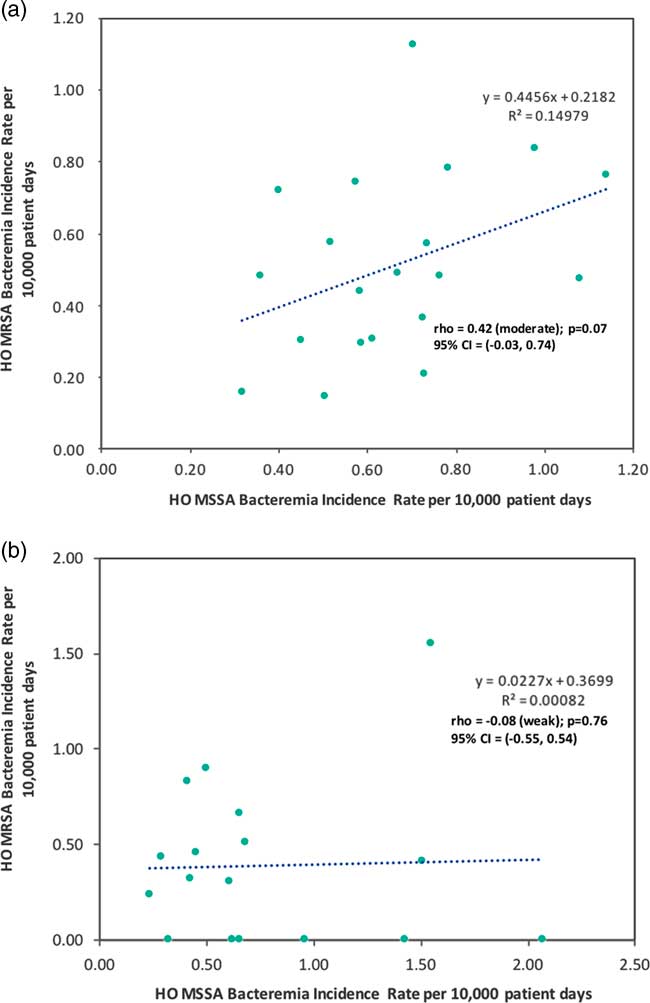
The study involved 4,213,384 patient days (140,034 for small hospitals; 1,005,068 for medium-sized hospitals; and 3,068,282 for large hospitals) over the 18-month study period, with 500 HO S. aureus bacteremia events (1.19 per 10,000 patient days) identified (MSSA, n=289, 58%; MRSA, n=211, 42%). Of 13 small hospitals, 12 did not have any HO-MRSA bacteremia events during the study period. HO-MSSA bacteremia rates were 0.75 and 0.69 per 10,000 patient days for medium-sized and large hospitals, respectively (P=.80). In contrast, HO-MRSA bacteremia rates were 0.45 and 0.54 per 10,000 patient days for medium-sized and large hospitals, respectively (P=.12) (Table 1). There were no significant differences between the mean facility rates of HO S. aureus bacteremia for hospitals of medium size (1.17±0.67) versus large size (1.17±0.39; P=.60). Similarly, there were no significant differences between MRSA bacteremia SIR for hospitals of medium size (0.77±0.77) versus large size (0.80±0.34, P=.57). When evaluating the association between HO-MSSA and -MRSA bacteremia, there was a trend toward significance for large hospitals that was not detected for medium-sized hospitals (Figure 1). Medium-sized hospitals had higher rates of HO-MSSA bacteremia per 10,000 patient days (0.79) compared to HO-MRSA (0.39; P=.02). In addition, a similar trend was detected for large hospitals (MSSA, 0.66; MRSA, 0.51), and it neared significance (P=.05).
Relation between hospital-onset HO-MSSA and HO-MRSA bacteremia based on hospital size. (a) Hospitals with >300 beds. (b) Hospitals with 100–300 beds.

Comparing Hospital-Onset Staphylococcus aureus Bacteremia for Medium-Sized Versus Large Hospitals (Events per 10,000 Patient Days)

NOTE. MSSA, methicillin-susceptible S. aureus; MRSA, methicillin-resistant S. aureus.
a Comparison of mean rates (large vs medium-sized) hospitals.
DISCUSSION
Hospital-onset MRSA bacteremia has been used as a surrogate for MRSA invasive disease acquired in the hospital. Although some risk adjustment is done using the SIR, valuable information about S. aureus bacteremia regardless of methicillin resistance is not captured. We found that small hospitals rarely have any events related to HO S. aureus bacteremia. On the other hand, medium-sized and large hospitals exhibit similar event rates, with HO-MSSA representing ~60% of cases. Historically, MRSA bacteremia has been the focus of research and has been associated with worse outcomes and higher mortalityReference Cosgrove, Sakoulas, Perencevich, Schwaber, Karchmer and Carmeli 6 ; however, MSSA bacteremia may be more prevalent in hospitals.Reference David, Daum and Bayer 7 By measuring only HO-MRSA bacteremia, a significant portion of patients at risk for S. aureus harm may be overlooked.
We found that medium-sized hospitals would most benefit by instituting the evaluation of all HO S. aureus bacteremia. Although medium-sized hospitals had HO-MRSA bacteremia SIRs similar to those of larger hospitals, they exhibited higher HO-MSSA bacteremia rates. This is an important finding because some infections acquired in the hospital are more likely to be associated with MSSA than MRSA. For example, 57% of cases from a recent report on peripheral intravenous catheter–associated S. aureus bacteremia were due to MSSA.Reference Austin, Sullivan, Whittier, Lowy and Uhlemann 8 While more than half of the S. aureus attributed CLABSI and catheter-associated urinary tract infections are ascribed to MRSA, the NHSN data indicate that MSSA is more common in surgical-site infections and ventilator-associated pneumonia cases.Reference Sievert, Ricks and Edwards 5 Moreover, including all S. aureus bacteremia as a measure may benefit other populations with lower prevalence for MRSA, including children.Reference McMullan, Bowen and Blyth 9 With the current efforts to reduce cardiac and orthopedic surgical-site infections and the focus on decolonizing S. aureus carriers,Reference Schweizer, Chiang and Septimus 10 HO S. aureus bacteremia may provide a global measure by which to evaluate invasive S. aureus risk in the hospital setting and could mitigate the MRSA prevalence factor.
Our study has some limitations. We did not control for population risk and length of hospital stay, potential factors that may affect the very low rates of HO S. aureus bacteremia in small hospitals. In addition, prevalence of S. aureus colonization and decolonization efforts may affect the risk for HO bacteremia.
We conclude that by measuring only HO-MRSA bacteremia, a significant portion of patients with invasive S. aureus bacteremia are not identified. Hospital-onset S. aureus bacteremia may provide a better measure by which to evaluate invasive S. aureus risk in the hospital setting and could mitigate the MRSA prevalence factor. These findings are important for policy decisions related to defining a hospital-acquired condition.
ACKNOWLEDGMENTS
Financial support: No financial support was provided relevant to this article.
Potential conflicts of interest: All authors report no conflicts of interest relevant to this article.