INTRODUCTION
The archaeology of Minoan Crete is unique in Europe. Beyond palaces, priestesses and power, it is unique because it only emerged in the twentieth century; that was many decades after archaeological research began in most other areas of Europe. The discoveries in Crete were almost entirely unrelated to existing prehistoric narratives and so, in playing intellectual catch-up, the tale of Minoan Crete was rapidly formulated by a few pioneers who were keen to promote their discovery of the first urban civilisation in Europe (MacGillivray Reference MacGillivray2000). To a greater or lesser extent, the next century of scholarship was framed by the geographies, chronologies, terminologies and, most importantly, the socio-political models formulated in these early years. In the past decade, however, there has been an increased emphasis placed on reconceptualising models of social organisation and power dynamics in prehistoric Crete (e.g. Driessen Reference Driessen, Driessen, Schoep and Laffineur2002; Schoep Reference Schoep, Driessen, Schoep and Laffineur2002; Reference Schoep2006; Hamilakis Reference Hamilakis, Driessen, Schoep and Laffineur2002a; Reference Hamilakis and Hamilakis2002b; Knappett and Schoep Reference Knappett and Schoep2000; Schoep and Knappett Reference Schoep, Knappett, Barrett and Halstead2004; Adams Reference Adams2004a; Whitelaw Reference Whitelaw, Barrett and Halstead2004a; Haggis Reference Haggis2007; Schoep and Tomkins Reference Schoep, Tomkins, Schoep, Tomkins and Driessen2012).
At the same time as these developments in Minoan archaeology, there has been an academic renaissance in the study of prehistoric warfare (various in Carman and Harding Reference Carman, Harding, Carman and Harding1999; Parker Pearson and Thorpe Reference Parker Pearson and Thorpe2005; Otto, Thrane and Vandkilde Reference Otto, Thrane and Vandkilde2006; Molloy Reference Molloy2007a; Moedlinger and Uckelmann Reference Moedlinger and Uckelmann2011). This new research has yet to permeate models of Cretan prehistory and it may be fair to say that, while colleagues would not deny that war or violence occurred, they are not yet considered to be fundamentally important in creating social narratives.
The objective of this paper is to use recent developments in the study of prehistoric warfare to offer a detailed consideration of the role of war, violence and warriors in the societies of Bronze Age Crete. It is considered insufficient to tack an ‘archaeology of warfare’ onto current themes in Cretan research, but rather the study of war needs to be better integrated at a socially systemic level by considering it in social 1) processes, 2) practices, and 3) events. The overarching emphasis on religion as the primary factor in elite control and temporal authority structures will also be tempered by consideration of how power derived from a triadic balance between religion, war and political/economic administration. The materialisation of martial activities will therefore be contextualised and cross-referenced with other social practices, including religion, mortuary practice, settlement design, trade, sport, art and technology.
The so-called ‘palatial periods’ between c.1900 and c.1300 bc are the main focus of this work, though earlier and later periods of the Bronze Age are considered for contextual purposes. The first part of the paper will discuss the archaeological study of war and its relationship to social organisation and the second part will deal with the specific case of Bronze Age Crete. I will begin by assessing how archaeologists conceptualise war and warriors and this will be followed by how we define and identify archaeological data that relate to war. The relationship of social structures to sources and motivations for conflict is next discussed. A brief critique of themes relating to war that have been the focus of debate in Cretan studies, such as the ‘Minoan thalassocracy’ and fortification walls, will precede a more detailed treatment of other evidence including iconography, mortuary practice, ritual activity and weaponry. The final outcome will be to demonstrate that warriorhood was a dominant aspect of male identity from at least Middle Minoan II and perhaps as early as Early Minoan I. It will further be demonstrated that the activities of warriors permeated and influenced religious, technological, political and economic infrastructures in Cretan societies, and thus played a powerful role in (perpetually) shaping the Bronze Age world.
FINDING WARRIORS
When we can define specialised military weaponry in the archaeological record, then we have unmistakable specialisation in military practices and, by extension, practitioners. In prehistory, the practitioners of violence are typically called warriors. The word itself comes from the Old Northern French werreior (a variant of guerrier) meaning ‘one who makes war’, and so we might consider a warrior to be someone enfranchised to make war. This then was a social right, not an occupation or profession.
Unlike later soldiers, a warrior is not construed as an exclusively military specialist but rather an expression of identity contingent upon social strategies peculiar to a society. The material expressions of warrior identity may have been recognisable through physical aesthetics (musculature, posture, possession of weapons, jewellery, hair styles) but also through a lifeway (Treherne Reference Treherne1995, 106–9) that enacted this identity in a social world through bull-leaping, boxing, hunting, sports, combat training and fighting, and so on. The concepts of identity and lifeways are thus not interchangeable, because a warrior identity is materialised through participation in a constructed aesthetic (Treherne Reference Treherne1995), whereas a warrior lifestyle or lifeway is the daily routines and activities that empower symbols of identity with meaning. Lifeways are also the way in which the person learns to become and perform a warrior role, rather than simply represent it. As such, it was ‘a shared process that was consensual among the elite groups as a whole, with the intention of participating in a common experience’ (Harrison Reference Harrison2004, 76).
When assessing what being a warrior meant, we need to consider that as much as people make weapons, weapons make people. In material culture studies, it has long been acknowledged that ‘the lives of persons and objects… [can become] … mutually constituted, not in an organic but in a phenomenological sense’ (Parkin Reference Parkin1999, 314; see also Fowler Reference Fowler2004, 4). This mutual constitution is worth emphasising, because the widespread introduction of combat weaponry could only become socially feasible when people developed the skills to use it. In turn, we can see that the biological bodies of warriors were materially produced by an individual's activities, particularly through repeated use of weapons and other forms of activity/exercise to prepare one for combat (Fowler Reference Fowler2004, 23; see also Knusel Reference Knusel and Fiorato2000 and Stirland Reference Stirland1993 for osteologically visible examples). The cultivated musculature of warriors can be considered a form of body modification achieved through training, because it physically shaped them, and thus made their identity evident to others. A warrior lifeway was thus expressed materially through the body, which was produced through undertaking specialised patterns of action, and these were in turn made possible by the use of specialised material culture (Fowler Reference Fowler2004, 22; Hallam and Hockey Reference Hallam and Hockey2001, 42; Malafouris Reference Malafouris, Robb and Boric2008, 119; Lau Reference Lau2004, 374; Sofaer Reference Sofaer2006; Knappett and Malafouris Reference Knappett, Malafouris, Knappett and Malafouris2008; Bourdieu Reference Bourdieu1977).
The question arises, however, that if most young elite males in any given society engaged in competitive displays of fitness such as boxing, hunting or bull-leaping, and these same men had to fight in wars on occasion, do we really need to call them warriors? The short answer is yes. Such agonistic activities are widely accepted as training grounds for ‘handling of weapons, maintenance of physical fitness, personal bravery, stealth, tactical decisions and the negotiation of rough terrain’ (Morris Reference Morris, Hägg and Nordquist1990, 150). Speaking of the Maya civilisation of Mesoamerica, Webster (Reference Webster2000, 106) considers warriors to have been ‘a core of men who are unusually skilled in war by training and experience, who are commonly called up to take part in conflict, and who derive unusual benefits from it’. He differentiates these from standing armies, which he defines as ‘permanently mobilized military units that are specially trained and equipped, strategically located, possessed of their own command structure, subsidized by the king or polity, and who identify themselves as military specialists’. He goes on to argue that when armies were not maintained and equipped by a central figure or regime, the state itself ‘did not have to underwrite the production of expensive and sophisticated weapons’ (Webster Reference Webster2000, 106), so that warriorhood was status-based and the onus was on the individual to equip themselves and informally gain training (i.e. no state-sponsored military training system). These points have strong resonance for Bronze Age Crete. It is also worth noting that Maya states were until recently believed to have been devoid of war and warriors until the translation of their script revealed the existence of complex martial strategies, and that individual states were often enmeshed in wars virtually every year (Webster Reference Webster, Raaflaub and Rosenstein1999).
A further analogy can be taken from Classical Greece. The words ‘warrior’ and ‘soldier’ are used freely in literature speaking of hoplitesFootnote 1, yet, other than Sparta, no Greek state prior to the fourth century had a specialised training system. Instead, van Wees (Reference Wees2004, 92) notes that ‘the obligation to possess hoplite equipment was regularly linked with an obligation to take regular exercise in the gymnasium’ and this took the form of athletics, boxing, pankration and other physical exercises, and members of this group would also hunt together on occasion. Similarly in twelfth century bc Egypt at Medinet Habu a relief of a wrestler depicts him saying ‘Stand up to me! I'll make you see the hand of a [real] warrior!’ (cf. Poliakoff Reference Poliakoff1987, 96), again showing the intimate relationship often shared between agonistic contests and warriorhood. In Sparta, King Agesilaus, in a desire to keep his men in top condition for fighting, is reputed by Xenophon to have held a competition where prizes were awarded for events such as javelin throwing or archery, but the top prize was reserved for the man judged to have the best body (Xenophon, Hellenica 3.4.16). These same forms of activity and ideology of competitive fitness are depicted in the art of prehistoric Crete being undertaken by young elite males and the same emphasis on the body, or the ‘warrior's beauty’ (Treherne Reference Treherne1995), occurs in art, and is further represented by material culture such as tweezers and razors (see below).
The specialisation in skills using specialist equipment (and locations) may reinforce social stratification by restricting access to the legitimate right to engage in violence on behalf of a community. Access to the elite weapons, but also training, required for hunting large game and interpersonal combat may similarly reflect a degree of circumscription of access to the bounty of the huntFootnote 2 and material wealth through plunder or reward, affording material benefits to warrior status. As in the Classical world, the warriors of the elite group may have been supported by conscripted peasant skirmishers when war escalated.
On the basis of the analysis of the formation of pristine states in the Americas, Europe and west Asia, Otterbein (Reference Otterbein2004, 179) concluded that ‘it is absolutely clear that a centralized political system cannot retain its statehood unless it has a military organization that is militarily sophisticated … the presence of an efficient military organization … [was a] … necessary condition for state formation’ (see also Earle Reference Earle1997; Claessen Reference Claessen and Otto2006; Bossen Reference Bossen and Otto2006a). The ability to field a military force may thus be seen to be contingent upon the existence of men who were considered to be warriors and who had the skill, experience and fitness to wage war effectively. Such a warrior identity may have been age dependent, and even then it need not have been exclusive, so that the same men might also perform religious, commercial, administrative or political duties, as was the case with Classical Greek hoplites. In saying this, however, the requirement of physical fitness and the construction of a specific aesthetic indicates that warriorhood was a significant, even dominant, element in the way such people appeared physically and acted daily.
IDENTIFYING WARFARE IN THE ARCHAEOLOGICAL RECORD
The causes of war can be many, and range from socio-biological instincts such as acquisition of a mate or status, to more base materialist motivations of wealth and resource acquisition (Turney-High Reference Turney-High1949; Robarchek Reference Robarchek and Haas1990; Ferguson Reference Ferguson and Haas1990; Carman Reference Carman1997b; Osgood Reference Osgood1998; Haas Reference Haas, Carman and Harding1999; Guilaine and Zammit Reference Guilaine, Zammit and Hersey2005; Otterbein Reference Otterbein2004; Thorpe Reference Thorpe2003; Reference Thorpe2005; Harding Reference Harding2007). War can unfortunately be difficult to pin down to a specific definition, though here it is defined as the premeditated violent actions that take place between two or more groups of people, sanctioned by leading members of their communities and usually with economic, political or social change as an objective. Variations on this definition exist (e.g. Ferguson Reference Ferguson and Haas1990; Ferrill Reference Ferrill1997; Webster Reference Webster, Raaflaub and Rosenstein1999; Otterbein Reference Otterbein2004; Guilaine and Zammit Reference Guilaine, Zammit and Hersey2005; O'Brien Reference O'Brien2009), but in each case we can see that there is a clear incongruity between the definitions we may like to give for war, and the material evidence for warfare we might hope to find in the archaeological record (Wileman Reference Wileman2009).
This said, for prehistorians (e.g. Carman and Harding Reference Carman, Harding, Carman and Harding1999; Driessen Reference Driessen1999; Parker Pearson Reference Parker Pearson and Pearson2005; Harding Reference Harding2007; Wileman Reference Wileman2009), a generally agreed set of archaeologically visible correlates of ancient warfare would be:
1. Settlement distribution and demographics
2. Defensible sites
3. Burning of sites
4. Osteology
5. Weaponry in corpore
6. Weaponry symbolism (mortuary and religious find contexts)
7. Iconography
8. Texts
These categories are not without their problems of course. Renfrew (Reference Renfrew, Zubrow and Renfrew1994, 47), speaking about the archaeology of religion, has commented that ‘in all attempts to investigate the early past there is the risk that we first conceptualize, setting up a whole series of categories of our own construction, and then order our data (our observations bearing upon the past) in terms of such categories … All that we are seeing is a reflection and an exemplification of our own a priori categories’. Casting together burial rites, architectural features and the metal industry, for example, in common heuristic cause may be considered by some a hermeneutic crime of the highest order! These and the other categories listed above would have had very little intentional cross-referencing in the societies that produced them. We can also note that these are primarily in fact consequences of war, not its building blocks (Harding Reference Harding2007, 178). Of course, assembling such datasets is the nuts and bolts of archaeological practice, particularly when studying a thematic subject like war, but this emphasises the need for contextually sensitive use of each category of evidence. Thus this paper will not explore the undertaking of war in its own right, but will focus on the way social regulation utilised war, violence and warriorhood alongside, and within, other modes of power. In so doing we abandon the problematic niche of ‘prehistoric warfare’ (Parker Pearson Reference Parker Pearson and Pearson2005) research and its attendant concerns of motivation, cause and structure, and move to more archaeologically visible manifestations of war as social practice, process and event.
A PROBLEMATIC NICHE? TRYING TO EXPLAIN WAR IN PREHISTORY
In the case of Crete, for example, various contributors to the major edited volumes, Minoan Society (Krzyszkowska and Nixon Reference Krzyszkowska and Nixon1983), Aegean Prehistory: A Review (Cullen Reference Cullen2001) and The Cambridge Companion to the Aegean Bronze Age (Shelmerdine Reference Shelmerdine2008), along with, for example, Fitton's Minoans (Reference Fitton2002) and Castleden's The Minoans (Reference Castleden1990), chart the rise and fall of Cretan civilisation with hardly a passing mention of violence or warfare as social processes. Until recently we even occasionally could read such radical beliefs as ‘they loved peace and the rule of law, detesting tyranny and warfare’ (Castleden Reference Castleden1990, 160). While such mutations of Evans’ Pax Minoica (Evans Reference Evans1928, 79) have not been accepted in mainstream Cretan archaeology for perhaps 40 years (Hood Reference Hood1971; Starr Reference Starr, Hägg and Marinatos1984; Bintliff Reference Bintliff1984), we yet lack social narratives and, perhaps more importantly, analytical frameworks that incorporate violence and conflict.
Keeley (Reference Keeley1996) can perhaps be credited with (re-)problematising the study of prehistoric warfare in War before Civilisation, though at the same time Carman and colleagues (in Carman Reference Carman1997a) were debating this same topic using more diverse datasets and methodologies. At that time, Carman made a critique of potential pitfalls in the study of prehistoric warfare that is no less apt 15 years later:
Where attempts are made to do more than simply catalogue the material remains of warfare, anthropological theory is usually drawn upon to construct a model of what war … would be like, and the archaeological material is then interpreted in light of that model. … The archaeological evidence is not so much seen against an anthropological backdrop (which is perhaps what is thought to happen) but instead is perceived through the filter of anthropological assumptions. If so, the anthropological perspectives used may mask rather than highlight the [unique] contribution archaeological study may make to human knowledge. (Carman Reference Carman1997c, 221–2)
Archaeological studies of war have usually focused on its origins and causes (Keeley Reference Keeley1996; Ferrill Reference Ferrill1997; Kristiansen Reference Kristiansen, Carman and Harding1999; Otterbein Reference Otterbein2004; Thorpe Reference Thorpe2005; Haas Reference Haas, Carman and Harding1999; Chapman Reference Chapman, Carman and Harding1999), the general manner in which it was conducted (Osgood Reference Osgood1998; Harding Reference Harding2000), depositional patterns of weapons (Bradley Reference Bradley1990; Fontijn Reference Fontijn, Parker Pearson and Thorpe2005; Harding Reference Harding and Otto2006) and direct evidence for destruction of people and things (Bridgford Reference Bridgford1997; Driessen and Macdonald Reference Driessen and Macdonald1997; Knusel Reference Knusel, Parker Pearson and Thorpe2005; Fyllingen Reference Fyllingen and Otto2006). More recently emphasis has been placed on how it was socially constituted or situated (LeBlanc Reference LeBlanc2003; Parker Pearson Reference Parker Pearson and Pearson2005; Bevan Reference Bevan, Parker Pearson and Thorpe2005; Vandkilde Reference Vandkilde and Otto2006; Bossen Reference Bossen and Otto2006b; Harding Reference Harding2007; Molloy Reference Molloy2011) and how combat was enacted (Kristiansen Reference Kristiansen2002; Peatfield Reference Peatfield1999; Molloy Reference Molloy2007b; Reference Molloy2010). These reflect diverse approaches commensurate with the diverse range of sources being brought to bear, and an increasing focus on engaging with social analyses rather than compilation of compendia. Accepting that war ‘happened’ in the past as a starting point forces us to ask more penetrating questions about why the archaeological record resulting from war was constituted in the manner it was, rather than focusing on anthropologically oriented questions of why war occurred or how was it fought. These latter are questions for which archaeology is usually devoid of answers without recourse full-circle back to anthropology or military history. It is preferred in this paper to accept that the lack of evidence for forms of warfare means that it is counter-productive to create models to describe it (Harding Reference Harding2007, 160–9). In saying this, it is also considered essential to move beyond myths of prehistoric warfare being highly ritualised, low-intensity, relatively bloodless, not particularly dangerous and peripheral to the real factors that shaped society (Vandkilde Reference Vandkilde and Otto2006, 59–61).
This raises a final issue: the question of the numbers of combatants in prehistoric battles. Harding (Reference Harding2007, 33) suggests that they numbered in the tens or hundreds, and, while this is difficult to apply diachronically and across all of Europe, a top end of figures in the hundreds, or occasionally very low thousands, appears more probable for Crete on the basis of local population estimates for most of prehistory (Whitelaw Reference Whitelaw, Schoep, Tomkins and Driessen2012, 146–62; 2004b). It remains possible that, at certain times, conflicts could escalate to larger scales and incorporate thousands of combatants, as seen throughout the eastern Mediterranean in the decades around 1200 bc (Sandars Reference Sandars1985; Drews Reference Drews1993). Due to the fact that virtually all instances of extra-urban warfare leave no archaeological trace whatsoever, there must remain very wide latitude for permutations of scale, duration, form and frequency of warfare in any given period of Cretan prehistory.
A TRIADIC BALANCE AND WAR AS PRACTICE, PROCESS AND EVENT IN CRETE
Kristiansen and Larsson (Reference Kristiansen and Larsson2005, 83) exemplify the current state of thinking in Cretan archaeology in their synoptic study The Rise of Bronze Age Society, stating that the power of Cretan elitesFootnote 3 lay in ‘institutionalised practices (economic, political and religious) that constituted palatial power’. Strikingly absent from this consensus view is military power and how it was enmeshed with other manifestations of authority. Hamilakis (Reference Hamilakis, Driessen, Schoep and Laffineur2002a, 184) has argued that ‘in the rare occasions where conflict is emphasised in the discussion of social dynamics in Minoan Crete, it is often to explain a specific event, rather than as an integral process of social dynamics throughout the Bronze Age’. While conflict and competition have recently become more commonplace in the literature, violence and subjugation are absent, and we are still left with peculiarly bloodless social revolutions and circumscription of authority structures so that ‘the entire explanatory trend underplays the violence it so clearly implies’ (Vandkilde Reference Vandkilde and Otto2006, 60). If we take as our starting point that war was integral to worldviews in prehistoric Crete, then this promotes a ‘relational understanding of warriors as a social identity constantly being negotiated with other social identities within society’ and we can begin to see that ‘war and violence are … embedded in a cultural logic’ (Vandkilde Reference Vandkilde and Otto2006, 69). When we thus consider warriors and their roles as part of recognised social institutions, we can begin to see war as standing in defined relations to institutions of civil administration and religion (Ferguson Reference Ferguson, Raaflaub and Rosenstein1999, 400). In current models of societies in Bronze Age Crete, we lack what Ferguson (Reference Ferguson, Raaflaub and Rosenstein1999, 400 citing Scarre and Fagan Reference Scarre and Fagan1997) considers to be ‘three institutional systems [that were] crucial determinants of social formations’; these are civil administration, religion and military systems, what he calls a ‘triadic balance’ (Ferguson Reference Ferguson, Raaflaub and Rosenstein1999, 400; see also Earle Reference Earle1997; Harrison Reference Harrison2004, 70). Societies in Crete thus possessed varying configurations of ‘overlapping networks of power’, and war has the potential to change these configurations when military organisation at times expands onto or subsumes elements of other networks of power (Bossen Reference Bossen and Otto2006b, 96). Thus when we consider power, both internal and external to a polity, the various social institutions that influence or coerce a populace were themselves likely to have been in tension and flux through time.
In seeking to define the role of warriors and warfare in this ‘triadic balance’, it is necessary to move away from military historical or anthropological models for understanding how and why war was undertaken, because they stretch our prehistoric evidence too thin. It is argued here that this evidence is better suited to exploration of how war operated as a social process, a social practice, and a social event. This is partially consistent with Ferguson's characterisation (Reference Ferguson, Raaflaub and Rosenstein1999, 390) of the relationship between war and society running from ‘infrastructure through structure to superstructure’ and broadly follows an Annales (événements, conjonctures, longue durée, and mentalités) logic (Barker Reference Barker and Barker1995, 1–5; Knapp Reference Knapp and Knapp1992; Fletcher Reference Fletcher and Knapp1992). These are intended to be heuristic devices, as opposed to hard and fast categories.
War in social process refers to the long-term preparations that facilitated its undertaking, from the acquisition of raw materials and production of weapons to the building of fortifications. This broadly equates with Ferguson's ‘infrastructure’. War as social practice relates to the lifeways of warriors, including military organisation and commemoration, and is consistent with Ferguson's structure and elements of his superstructure. In Crete war in social practices is manifested through the construction of and participation in warrior lifeways and identities, expressed passively through bodily aesthetics visible in public/social contexts, but also actively by engaging in specialist activities. The final category, war as event, is peculiarly archaeological and is primarily visible in terms of destructions of places, injuries inflicted on individuals and damage on ancient weaponry. It is also visible to a lesser degree (overlapping with process) in terms of rapid changes in settlement patterns.
ELITES AND POWER IN BRONZE AGE CRETE
In the past decade, fresh challenges to the established palace-centric view of ‘Minoan society’ have emphasised diffuse authority structures and heterogeneous social systems that had chronological and geographical differences. Re-evaluations of the structure of elite power dynamics have suggested that heterarchies and factional politics may have existed alongside, within or in the place of hierarchies as traditionally viewed (Hamilakis Reference Hamilakis, Driessen, Schoep and Laffineur2002a; Schoep Reference Schoep, Driessen, Schoep and Laffineur2002; Knappett and Schoep Reference Knappett and Schoep2000; Schoep and Knappett Reference Schoep, Knappett, Barrett and Halstead2004; Adams Reference Adams2004a; Whitelaw Reference Whitelaw, Barrett and Halstead2004a; Wright Reference Wright, Barrett and Halstead2004; Kristiansen and Larsson Reference Kristiansen and Larsson2005; Haggis Reference Haggis2007). Heterarchies have recently been taken to refer to internal/horizontal differentiation of elites through status (e.g. warrior/priest/administrator etc. [Gellner Reference Gellner1983, 9–10]), whereas factions are considered to be defined more by geopolitical factors. This latter form of power relationship in elites usually defines one group over and against another (Adams Reference Adams2004a, 192–3), and polities are thus characterised by tensions/competition within, as well as between, ruling groups.
In Early Minoan Crete the character and influence of elites remain uncertain, though mortuary practice and grave goods testify to social differentiation (Branigan Reference Branigan, Laffineur and Niemeier1995; Legarra Herrero Reference Legarra Herrero2009; Reference Legarra Herrero, Schoep, Tomkins and Driessen2012). Between Middle Minoan I and Late Minoan IIIA any leader(s), be they a queen, high priest or oligarchy, emerged from the elite and were thus of the elite, and their position could only be maintained through the mechanisms of elite power, particularly symmetric exchanges of favour (Barzel Reference Barzel2002, 242), though also coercion and suppression. Whether considering factions or heterarchies, therefore, hierarchies no doubt existed within them and I follow Adams’ view (Reference Adams2004a, 194) that ‘complexes, institutions, individuals and social groups do not “have” power intrinsically; rather it is created, aspired to and negotiated through relationships with others’. Equally, while Knossos may at times have dominated much of Crete or Zakros dominated East Crete in multi-scalar relations, for example, there is a firm difference between dominance and rule that cannot be ignored because power relations that may be negotiated through military practices lie exactly within this difference.
Allowing for decentralised power structures within polities, as defined by Hamilakis (Reference Hamilakis, Driessen, Schoep and Laffineur2002a), we may consider that urban centres increasingly became focuses, rather than permanent seats, of power. As their collective wealth was generated at its base level largely from primary production in lands not adjacent to the centre of power, this may have been a cause of social tensions, particularly when ‘society once subjugated to the interests of the many had been transformed into one driven by the interests of specific groups’ (Schoep and Tomkins Reference Schoep, Tomkins, Schoep, Tomkins and Driessen2012, 13; see also Ferguson Reference Ferguson, Raaflaub and Rosenstein1999). Subjugation and oppression are equally, and often more, useful policies, alongside encouragement (Schoep and Tomkins Reference Schoep, Tomkins, Schoep, Tomkins and Driessen2012, 22), cooperation and common cause when defining group identities, responsibilities and boundaries of each component element within polities (Webster Reference Webster, Raaflaub and Rosenstein1999). When we consider such tensions, then territorial boundaries create the natural flashpoints whereby security, wealth and loyalties were under constant threat, creating triggers for violent actions that could rapidly reconfigure political geographies (Guilaine and Zammit Reference Guilaine, Zammit and Hersey2005, 200; Raaflaub Reference Raaflaub, Raaflaub and Rosenstein1999, 134; Hassig Reference Hassig, Raaflaub and Rosenstein1999, 365; Webster Reference Webster, Raaflaub and Rosenstein1999, Reference Webster2000; LeBlanc Reference LeBlanc2003; Ferguson Reference Ferguson and Haas1990, 40–2).
By Late Minoan IIIA the political landscape was much transformed. Knossos emerged as the most powerful polityFootnote 4 in Crete, with few other sites having clear evidence of complex centralised administrative systems (Dickinson Reference Dickinson1994). There is evidence by this period that a wanax or king ruled Knossos, and perhaps dominated much of Crete, and that the palaceFootnote 5 exercised economic control over the primary producers in its territory (Driessen and Macdonald Reference Driessen and Macdonald1984). It seems probable that the military still played a significant role in Cretan socio-political organisation, though the long-term interaction with mainland warriors in Late Helladic I–II/Late Minoan I may have altered the character of this role in either or both areas. This role for warriors probably changed dramatically in Late Minoan IIIB, when large urban centres virtually disappeared, apart perhaps from Chania. By Late Minoan IIIC, most settlements were little more than villages and they existed almost exclusively in the remote defensible locations previously used only on occasion (Nowicki Reference Nowicki2000; Reference Nowicki2008), and so much of the male population may have been enfranchised as warriors.
THE MINOAN THALASSOCRACY
To begin with the longest-running debate relating to warfare in Crete, we may briefly address the legend of the Minoan thalassocracy. There would be little discussion of this if it were not for Herodotus and Thucydides, because archaeology would independently neither suggest nor deny its existence. Arguments for and against a thalassocracy to date have revolved around distributional analysis of finds of Cretan character in the Cyclades. Whether these were the product of control of the Aegean through colonisation (Hiller Reference Hiller, Hägg and Marinatos1984; Hood Reference Hood, Hägg and Marinatos1984; Wiener Reference Wiener, Hardy, Doumas, Sakellarakis and Warren1990; Reference Wiener1999; Niemeier Reference Niemeier, Hägg and Marinatos1984; Reference Niemeier, Cadogan, Hatzaki and Vasilakis2004; Mountjoy and Ponting Reference Mountjoy and Ponting2000), direct trading practices (Knapp Reference Knapp1993) or ‘unbalanced exchange’ mechanisms/tribute (Ferguson Reference Ferguson and Haas1990, 39), the reality is this evidence all relates to economic, not military, aspects of maritime control. Cretan polities had the manpower and technology to impose a strong influence over their seascapes, and while a militarily imposed thalassocracy is thus plausible and even to be expected, its size, chronology and very existence must remain as speculative as King Minos himself.
FORTIFICATIONS, SETTLEMENT PATTERNS, AND DESTRUCTIONS
Fortification walls have long been central to discussion about warfare in prehistoric Crete (Alexiou Reference Alexiou1979; Starr Reference Starr, Hägg and Marinatos1984; Hiller Reference Hiller, Hägg and Marinatos1984; Chryssoulaki Reference Chryssoulaki1999a; Nowicki Reference Nowicki2000; Alusik Reference Alusik2007). The arguments for their symbolic expression of power have been well rehearsed (Driessen Reference Driessen1999; Alusik Reference Alusik2007), and their role in warfare remains problematic because they are only sporadically present (e.g. Middle Minoan Petras and the coast at Gournia) and do not form a consistent pattern in urban planning. Evely (Reference Evely, Evely, Lemos and Sherratt1996) has noted that this may be in part due to the lack of excavation at the limits to major urban centres and that the historically attested defensive walls of ‘Crete of the hundred cities’ are hardly visible (Callaghan Reference Callaghan, Evely, Hughes-Brock and Momigliano1994). Driessen and Macdonald (Reference Driessen and Macdonald1997) have highlighted defensive changes in urban access routes in Late Minoan IB. Nowicki (Reference Nowicki2000; Reference Nowicki2008) has demonstrated repeated phases of small-scale occupation of defensible settlements throughout the Bronze Age in times of unrest. In all of this, however, it remains clear that fortifications were not fundamental to military strategies or materialisation of power because they were not used to even fortify the central areas of towns, as we find in the case of some citadels of Late Helladic IIIA – Late Helladic IIIB date on the mainland (Iakovides Reference Iakovides1983). While exceptions exist, the rule in Crete was that men, not walls, constituted the defence of a polity and indeed we can observe that fortifications were not part of the wider martial grammar defining elite practices, power and spaces.
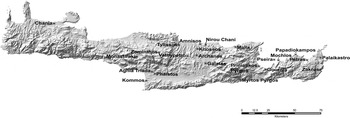
Accepting that urban defensive walls were at best a minor consideration for towns, court buildings or villas, then the argument that the topography of Crete formed natural defensible units becomes increasingly attractive (Fig. 1). Crete is a very rugged island, and even today a single strip of asphalt on the north coast is the only way to expeditiously get from the east to the west by land. Due to the limited avenues available to move an armed force from one polity to another, particularly if chariots were used for transport (Crouwel Reference Crouwel1981; Reference Crouwel1999) or weapons (Drews Reference Drews1993), controlling access routes to a territory was important. In this regard, the 169 known guard houses along Bronze Age roads (Chryssoulaki Reference Chryssoulaki1999a; Alusik Reference Alusik2007) are strong evidence that in Middle Minoan II – Late Minoan I, roads and nodes were controlled by elite authorities. This suggests control of movement, but in so doing implies that some members of society – perhaps warriors – were provided with resources to man these stations. This may be direct evidence for military specialists, if not quite a standing army, being used in regional defence strategies from at least Middle Minoan II. By controlling use of, and access through, the landscape (and perhaps by sea), it may be that the idea of pitched extra-urban battles evolved through exploitation of topography to the advantage of defenders, as facilitated by guard houses as watch stations.
Topographic location map of urban and ‘villa’ settlements occupied variously between Middle Minoan I and Late Minoan I.

The varying fortunes of urban centres (Schoep and Tomkins Reference Schoep, Tomkins, Schoep, Tomkins and Driessen2012), including origin, destruction, renewal, abandonment etc., may variably indicate consolidation and/or fragmentation of groups, as they expanded, subsumed and contracted. Schoep (Reference Schoep2006, 58) envisages a ‘landscape of ever-increasing competition between elites’ by Middle Minoan II, ‘brought to an end by a horizon of destructions’. This pattern is known from many periods and at many sites in Cretan prehistory, though war is only rarely explicitly suggested as a cause (Hood Reference Hood1971; Driessen and Macdonald Reference Driessen and Macdonald1997). Destructions at sites in Crete were frequently followed by abandonment (we might also boldly suggest massacresFootnote 6 or wholesale enslavement as we hear of in Homeric sackings of cities), and many are characterised by extensive fires. Seager's excavations at Mochlos uncovered masses of charred human remains in a Late Minoan IB house, interpreted as the remains of those killed during a sack of the settlement (Seager Reference Seager1909, 301; Driessen Reference Driessen1999, 14). Potential causes of such widespread fires include the actions of attacking forces, or in some cases it may have been a defensive strategy to deny food or shelter if a population had to flee its home. Considering that destructions are peppered spatially and chronologically across the span of Bronze Age Crete, unless we consider Bronze Age Cretans to have been dramatically more clumsy or unlucky than any historical civilisation in that region, we must believe that war was the cause of many urban destructions. This could be closely tied to seismic destructions that caused short-term social stress or exploitation of weakness that was manifested through war. In the wake of such destruction, the pace of recovery of a site is perhaps more indicative of war than the destruction itself; if the site or its hinterland were not reoccupied immediately, then where did the people go? By considering wars as normal, even normative, social processes rather than as isolated instances of instability or turmoil, then these archaeologically visible events can be better integrated into broader social trajectories.
The destruction of sites through the violence of war may nonetheless have been a rare occurrence because most battles would have taken place in extra-urban contexts where there were no buildings to destroy. Destruction may therefore be symptomatic of war, but it is not an indicator of its typical outcome, particularly as victors may often have sought domination and tribute instead of destruction and plunder. Schoep (Reference Schoep, Driessen, Schoep and Laffineur2002) has demonstrated through the case study of the Mesara in Middle Minoan I – Late Minoan I that shifts in power bases occurred over time on a micro-regional scale. The varying fortunes of factions or groups within elites, as well as threat of destruction through war, may also drive nucleation or transformation in settlement patterns during protracted conflict potential or wars of attrition (Ferguson Reference Ferguson, Raaflaub and Rosenstein1999, 394).
In Late Minoan I, elites are visible across the island, whereas in Late Minoan II/IIIA:1 they are a very occasional phenomenon outside of north-central and west Crete (Driessen and Macdonald Reference Driessen and Macdonald1997, 71). Following a brief re-emergence of elite sites across Crete, usually at older urban centres (e.g. Kommos, Aghia Triada) after Late Minoan IIIA:1, elites virtually vanish in most areas in Late Minoan IIIB (Preston Reference Preston2008) to be replaced by a very different settlement pattern and elite social networks in Late Minoan IIIC (Nowicki Reference Nowicki2000). When we consider the contraction of population, as evidenced by settlement size and distribution (Driessen and Macdonald Reference Driessen and Macdonald1997; Kanta Reference Kanta1980; Nowicki Reference Nowicki2000; Hayden et al. Reference Hayden, Dierckx, Harrison, Moody, Postma, Rackham and Stallsmith2004; Reference Hayden, Hahn, Harrison, Moody, Rackham, Risser and Stallsmith2005; Haggis Reference Haggis2005; Watrous Reference Watrous1982; Watrous et al. Reference Watrous, Hatzi-Vallianou, Blitzer and Bennet2004) between Late Minoan IA and Late Minoan IIIC, we must take into account the potential cumulative attrition of protracted periods of war that can decimate a population's ability to effectively reproduce. As noted earlier in this paper, archaeologically visible ‘resultative correlates’ (Wileman Reference Wileman2009) of wars are difficult to pinpoint, but innumerable historical examples demonstrate that population and settlement contraction are often closely related to war and conflict (Haas Reference Haas, Carman and Harding1999; Ferguson Reference Ferguson, Raaflaub and Rosenstein1999). Such wars may occur alongside, or be triggered or exacerbated by, phenomena such as drought (Haas Reference Haas, Carman and Harding1999, 21) or pandemic disease.
ICONOGRAPHIC EVIDENCE FOR WAR AND VIOLENCE
In this section it will be demonstrated that the isolation of ‘scenes of war’ in art is neither possible nor desirable, because most images are multi-referential and even themes apparently relating to one field of activity can be allegories for other fields. For example, hunting scenes can be considered metaphors for sacrifice (Marinatos Reference Marinatos1986; cf. Morris Reference Morris, Hägg and Nordquist1990, 149), but the choice to use violence so graphically can also be taken to cross-reference other blood-letting activities, such as combat. The segregation of art into ‘thematic fields’ is therefore unhelpful, as exemplified by the ‘general tendency of intuiting mysteries of religion in nearly everything Cretans chose to portray’ (Kopcke Reference Kopcke1999, 342; see also Shapland Reference Shapland2009, 112). In each iconographic scene cited, alternative interpretations may be given, but a coarser aggregate reading, based as much on aesthetics as on specific content, reveals hints of a warrior lifeway far more frequently than evidence for ‘war’.
If we conceive of power as emerging from a ‘triadic balance’ of religious, military and economic concerns, then we may well expect the symbolic grammar to pertain to more than one of these fields at once. Looking for specific images of war may also presuppose the existence of a soldier rather than warrior identity, and consequently may predict a corporate expression of war as an explication of state power and prowess. When we consider that ‘states’ in Crete were less explicitly defined than in later times and elites were defined by status-dependent relationships, then we should well expect to find the kind of art we have in Crete. Such art celebrates individual bravery, skill and virtue across multiple fields of activity rather than the corporate group achievements, discipline and drilling of armies. Man the hunter, the master of wild animals, the athlete, the fighter and the divinely sanctioned leader, not man the anonymous citizen soldier, is what we find widely in the art of Bronze Age Crete.
Male-only images are rare in comparison to women-only images in Minoan art, but they are thematically more diverse. Weingarten (Reference Weingarten2005, 356) suggests that women are primarily depicted in religious scenes, whereas males appear in ‘agonistic art’ and religious scenes so that they ‘occupy a greater number of social positions’. Logue (Reference Logue2004, 169) also observes that ‘the iconography … represent[s] the roles that the male members of the Minoan elite felt were particularly important to their status’. Agonistic contexts offer the most diverse range of male activities (hunting, boxing, bull-leaping, battle, marching, processions, archery, posing with weapons). The males engaged in these activities commonly have the same hairstyles, musculature and jewellery, and so we may adduce that they were of similar or the same social group. The depiction of helmets, though perhaps also shields, in hunting scenes is unlikely to represent a defensive necessity against game animals. These are more likely to be devices to reflect identity, and so, whether a hunting scene is intended to be real or metaphorical, the depiction of combat equipment suggests that a warrior identity is being expressed. Accepting the definition of ‘warrior’ provided above, we may consider that participation in a warrior lifeway was a dominant influence on how elite males were represented in art.
Art relating to warriors and war in Bronze Age Crete can be broken up into four broad categories: glyptic art circulating in both social and administrative contexts; stone and ceramic portable art for repeated intimate consumption (dining/processions); coroplastic/bronze figural art for religious activity; and frescoes and relief mouldings fixed in architectural settings. The artificiality of drawing these sources together to discuss war is immediately apparent, because they were not created to engage with each other in the creation of a distinct narrative or forum of interaction in their original roles. They are also chronologically and spatially heterogeneous. A quantitative approach comparing scenes of martial activities to scenes of non-martial activities is not undertaken because I am concerned with how martial themes were mutually constituted with other themes, and not their relative frequency or prominence. Similarly, readings of images provided here are necessarily superficial, as the purpose is to examine cross-references in the physical components of images without delving into their symbolic meanings or possible narrative contexts (e.g. Chryssoulaki Reference Chryssoulaki, Betancourt, Karageorghis, Laffineur and Niemeier1999b).
Seals
Sealstones or rings were often worn on the person, serving as ornaments as well as functional objects, so that the image was transmitted by persons engaging directly and indirectly with the bearer/wearer. Seals as tools, however, were perhaps the most dynamic form of ‘art’ in Crete because, when impressions were made, they were then exported widely across the island, making the image itself highly mobile. Sealings from single specific seals have been found at a variety of sites: for example, Müller and Pini Reference Müller and Pini1999, nos. 43 from Aghia Triada, 161 from Gournia and 259 from Sklavokampos are all the same.
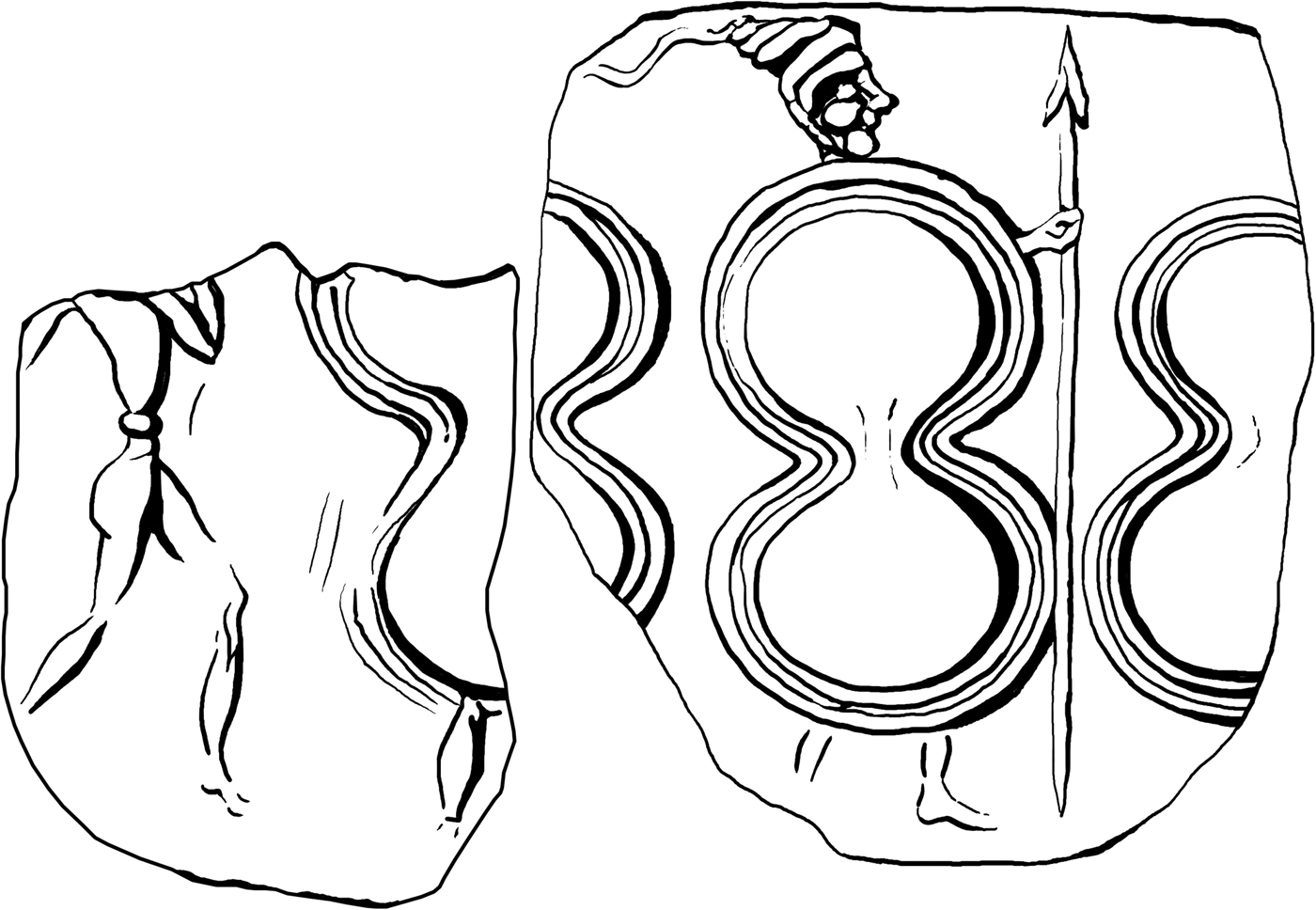
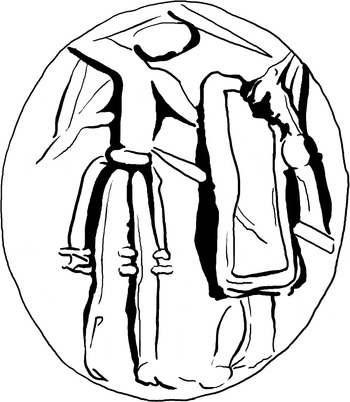
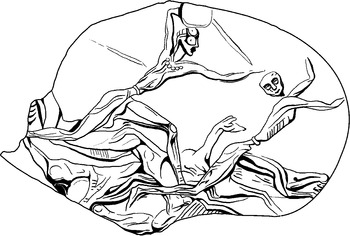
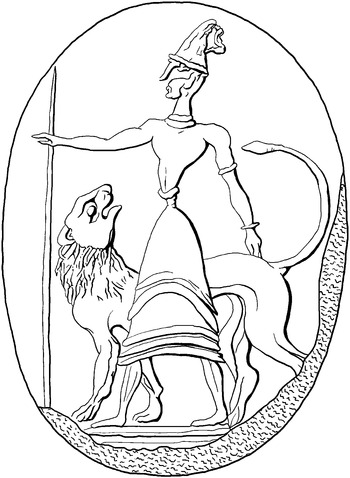
The earliest scene of violence in Crete is a seal showing fighting with daggers (Hatzi-Vallianou Reference Hatzi-Vallianou1979; Wedde Reference Wedde2000; Papadopoulos Reference Papadopoulos2006) dated to Early Minoan III / Middle Minoan I, and a superficial reading of the image tells us that daggers were considered suitable weapons for interpersonal combat. In Middle Minoan II, figural images are still rare but it can be noted that seals such as Platon, Pini and Salies Reference Platon, Pini and Salies1977, no. 309, for example, illustrate a man standing with a spear held vertically in front of him. This scene becomes increasingly popular in Late Minoan I art, and though the spear in some images may be replaced with a staff, there are many examples where this posture with a spear is adopted by warriors bearing shields and helmets (e.g. Gill, Müller and Pini Reference Gill, Müller and Pini2002, no. 276 [Fig. 2]; Platon and Pini Reference Platon and Pini1984, no. 32).Footnote 7 Images with a distinct martial component abound in Late Minoan I and include warriors marching with spears and shields (Gill, Müller and Pini Reference Gill, Müller and Pini2002, nos. 276 [Fig. 2], 277, 278); combat between a swordsman and a spear/shield-bearing warrior (Kenna Reference Kenna1967, nos. 100, 130 [Fig. 3]); swordsmen fighting (Müller and Pini Reference Müller and Pini1999, no. 16); a swordsman pursuing an opponent (Müller and Pini Reference Müller and Pini1999, no. 15 [Fig. 4]); a spearman facing an opponent (Müller and Pini Reference Müller and Pini1999, no. 17); archers (Betts et al. Reference Betts, Gill, Sürenhagen and Waetzoldt1988, no. 26; Müller and Pini Reference Müller and Pini1999, no. 21); a boxer (Gill, Müller and Pini Reference Gill, Müller and Pini2002, no. 280); a swordsman fighting a rearing lion (Pini Reference Pini1992, no. 135); a warrior marching with a (hunting?) dog (Gill, Müller and Pini Reference Gill, Müller and Pini2002, no. 236); a warrior with spear standing with a lion (Gill, Müller and Pini Reference Gill, Müller and Pini2002, no. 237 [Fig. 5] and Müller and Pini Reference Müller and Pini1999, no. 36); and a woman (goddess?) with a sword (Platon and Pini Reference Platon and Pini1984, no. 16). We can see in these themes (particularly Platon and Pini Reference Platon and Pini1984, no. 16; Müller and Pini Reference Müller and Pini1999, no. 15; Gill, Müller and Pini Reference Gill, Müller and Pini2002, no. 236 or Pini Reference Pini1992, no. 135) that scenes with a martial flavour cross-reference with hunting, religious and mythological themes. As Shapland (Reference Shapland2009) has noted, the choice of animals to represent in art was frequently the hunted with the hunter, and while bulls hold a special position, only rarely are other domesticates portrayed.
Image from sealing from Knossos depicting marching warriors with figure-of-eight shields and spear held vertically with arm extended horizontally (drawn by Ella Hassett after Gill, Müller and Pini Reference Gill, Müller and Pini2002, no. 276).
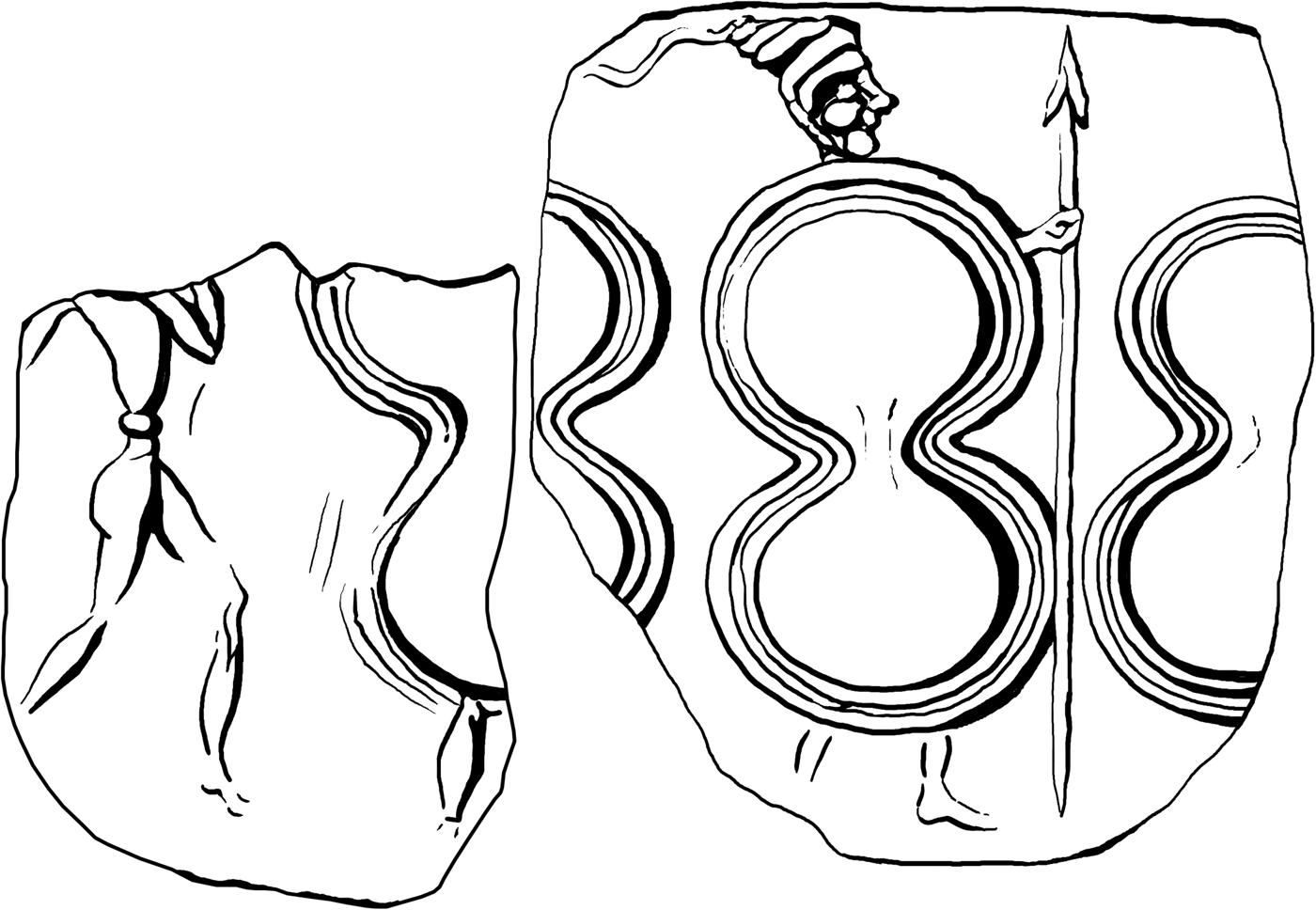
Image from seal of probable Cretan provenance depicting swordsman striking at the neck of an opponent bearing a shield and spear (drawn by Ella Hassett after Kenna Reference Kenna1967, no. 130).

Image from sealings from Aghia Triada and Knossos (respectively) depicting a warrior bearing a sword, and a hound, pursuing an opponent (drawn by Ella Hassett after Müller and Pini Reference Müller and Pini1999, no. 15 and Gill, Müller and Pini Reference Gill, Müller and Pini2002, no. 79).

Image from sealing of warrior holding spear and accompanied by lion, from Knossos (drawn by Ella Hassett after Gill, Müller and Pini Reference Gill, Müller and Pini2002, no. 237).

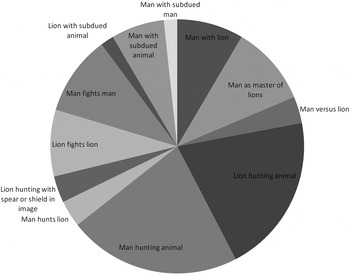
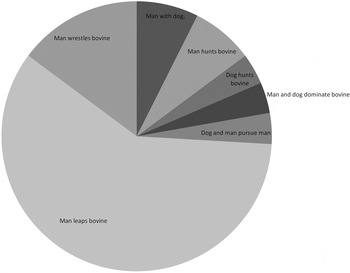
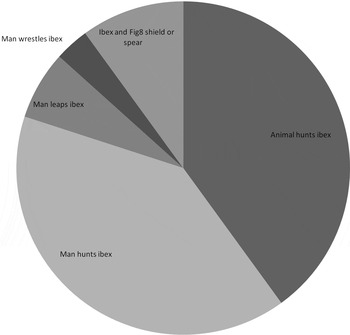
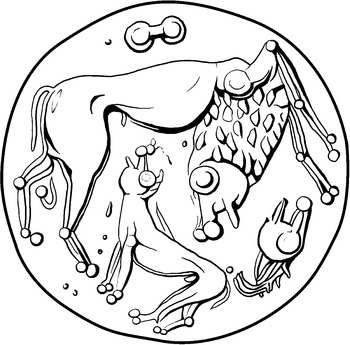
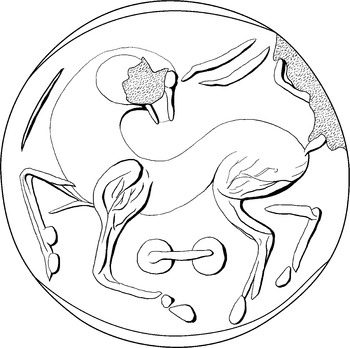
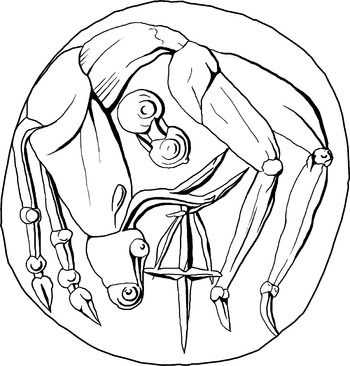
The diversity of these images alone indicates that isolating scenes as being ‘military images’ is methodologically unsound. Cross-referencing of quite different themes becomes apparent when focusing on the basic components used to construct individual scenes. To take the example of lion imagery, we have creatures with obvious traits that allude to killing, violence, bravery and hunting; all of which are traits that we also expect to find celebrating humans who specialise in such activities (Shapland Reference Shapland2010). In rather obvious juxtapositions we find scenes of a man walking alongside a lion or framed heraldically by lions, but we also have slightly less obvious cross-references in scenes of lions hunting animals, man hunting animals, lions enjoying spoils of hunt, man enjoying spoils of hunt, man as master of lions, man hunting lion, man fighting lion, lion fighting lion, man fighting man (Fig. 6; see also Bloedow Reference Bloedow, Laffineur and Crowley1992). Similarly with hound and bull imagery implicating warriors and bravery, we have warrior walking with hunting hound, hound hunting bull, man hunting bull, man wrestling with bull, man leaping (dominating) bull, man and hound hunting man (Fig. 7). A related pattern is apparent with the relationship between man and ibex as a symbolic game animal (Fig. 8). In several seal images one animal attacks another (e.g. Platon and Pini Reference Platon and Pini1984, no. 344 [Fig. 9]) or a lone prey animal is depicted (e.g. Platon and Pini Reference Platon and Pini1984, no. 337), sometimes with a figure-of-eight shield and/or a spear mysteriously floating in the image (Müller and Pini Reference Müller and Pini1999, no. 248 [Fig. 10]). These may be seen to draw allusions between animal and human behaviour or concerns, inferentially or directly. Where warfare, hunting, sacrifice, religion or bravery conflate as power within these cross-referential networks is open to question, but it is clear that this complex iconographic grammar, or ‘representational code’ (Chryssoulaki Reference Chryssoulaki, Betancourt, Karageorghis, Laffineur and Niemeier1999b, 111), cannot be pigeonholed into specific areas of activity or meaning such as ‘war’. This may best be illustrated by the example of Fig. 11 from Psychro cave, which depicts a scene where the lower torso is depicted as a leaping human, the upper torso is that of a bull, while a spearhead/arrow and a figure-of-eight shield are both depicted in the arch of the back separating the bull from the human component. This seal draws together in a single image references to bull-leaping, hunting, and warfare.
Ratios of activities involving men and lions.

Ratios of activities involving man, dog and bull.

Ratios of activities involving men and ibexes.

Image from seal of probable Cretan provenance depicting a hunting lion with figure-of-eight shield in image (drawn by Ella Hassett after Platon and Pini Reference Platon and Pini1984, no. 344).

Image of ibex with floating spear and figure-of-eight shield, from Aghia Triada (drawn by Ella Hassett after Müller and Pini Reference Müller and Pini1999, no. 248).

Image on seal from Psychro cave depicting leaper-bull hybrid with spear/arrowhead and figure-of-eight shield (drawn by Ella Hassett after Hughes-Brock Reference Hughes-Brock2009, no. 298).

We need to also consider that most of the above sorts of scene are concerned with portraying dominance through contest, conquest and control and the symbolic appropriation of power through the natural world (Morgan Reference Morgan and Morris1995, 172). In turn these can relate to any and all forms of power, be they religious, military or governmental. Therefore the isolation of ‘military scenes’ can overlook their religious symbolism, particularly the act of killing making a very direct reference to sacrifice (Morgan Reference Morgan and Morris1995, 177; Peatfield Reference Peatfield1999, 71). Some scenes can convey religious themes using violence, just as we have apparently peaceful scenes of prey animals that may symbolically refer to the violence of the hunt, not blissful nature, through their posture (Shapland pers. comm.; Reference Shapland2010; Loughlin Reference Loughlin and Santillo Frizell2004).
Images of figure-of-eight shields, boar's tusk helmets and double-axesFootnote 8 represented in isolation or in religious scenes are common in the glyptic art of Crete, and they also occur on other artistic media (Morris Reference Morris, Hägg and Nordquist1990; Haysom Reference Haysom2010). While the grammar, syntax and context of these weapons and armour evolved beyond a purely martial character, the origins of these symbols in the military sphere illustrates the adoption of attributes related to martial praxis by religious agents (be they deities or worshippers). Haysom (Reference Haysom2010, 51) argues that ‘the a priori privileging of these [religious] spheres in our examination of networks of contextual association is likely to be unrealistic – just because a symbol is religious in one context does not necessarily mean it is religious in all contexts’. Morris (Reference Morris, Hägg and Nordquist1990, 155) considers the shields and helmets to have operated as multivocal symbols ‘whose interlinked spectrum of referents included both warfare and hunting, the protection of man and his territory, and man's interaction with the natural world’. The double-axe, figure-of-eight shield and boar's tusk helmet may be seen as conflations of martial and religious spheres that were equally relevant to both. A broad comparison may be seen in the use of tools and weapons to characterise some later European deities such as Athena, Artemis, Thor or Lugh, none of whom were considered to be ‘war deities’.
Frescoes
Gates (Reference Gates1999, 277) suggests that warfare may not have been considered a suitable theme for fresco art before Late Minoan IIIA and furthermore that ‘there is no correlation between the practice of warfare and the choice of warfare as a pictorial theme’ (Gates Reference Gates1999, 281). It can also be noted that very few frescoes that depict people interacting directly with each other in identifiable themes have been recovered from Crete before Late Minoan IIIA. The lack of images of war is therefore symptomatic of a general trend that relates as much to the accident of preservation as to past choices in the themes we find in fresco art.
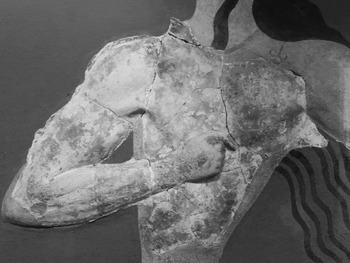
The vast majority of figural frescoes surviving from Crete come from the single site of Knossos and almost exclusively from Late Minoan I and Late Minoan IIIA. Even at the other major urban centres such as Mallia or Phaistos, as well as other ‘elite sites’ throughout the island, we have minimal information on the themes they chose to portray in fresco art of any period, largely due to very poor preservation. Random fragments from Late Minoan IIIA Knossos of men throwing spears or running with them have no narrative context and are therefore of limited value in discussing war, but they do tell us that scenes of war may once have existed at Knossos. From the same site, we have images of bull-leaping (Fig. 12) and we can note that the torso of the iconic ‘Priest-King’ from Knossos (Fig. 13) has been convincingly restored as a boxer based on detailed anatomical analysis (Coulomb Reference Coulomb1979), as per Evans’ original interpretation (Evans 1900–1, 15–18) or as holding a staff or spear (Niemeier Reference Niemeier, French and Wardle1988; see Shaw Reference Shaw and Chapin2004 for a discussion of alternative views). The figure-of-eight shields in frescoes from Knossos are evidence that the accoutrements of warriors were at home in that building in Late Minoan III.
Bull-leaping fresco from Knossos (courtesy of Heraklion Museum – Ministry of Culture and Tourism – Archaeological Receipts Fund).

The ‘Priest-King’ fresco from Knossos, detail of forearm and fist (courtesy of Heraklion Museum – Ministry of Culture and Tourism – Archaeological Receipts Fund).

Stone vessels
Of the 37 relief stone vases discussed by Logue (Reference Logue2004), some 14 fragmentary figural scenes include people, and of these scenes 8 (57%) are considered to display martial imagery. While Logue omits her fig. 13Footnote 9 from the ‘martial’ category, it fits there because it depicts a boar's tusk helmet (probably indicating a warrior on now-missing elements of the scene) and another male above this apparently conducting an acrobatic display with a charging ibex, perhaps related to bull-leaping (as in Gill, Müller and Pini Reference Gill, Müller and Pini2002, no. 235).
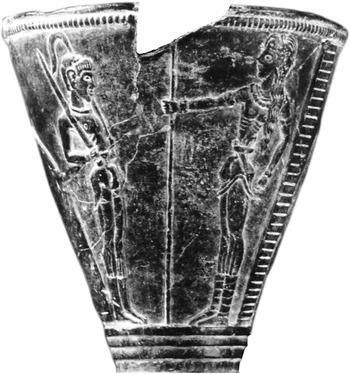
The Chieftain Cup (Fig. 14) from Aghia Triada depicts a tall male holding what is probably a spear facing a shorter male holding a sword aloft, and the latter is followed by three other men carrying what may be bull hides. This object has been the subject of many studies, and here it is noted that the two armed figures are considered to be of elite status. Higgins’ (Reference Higgins1967; see also Koehl Reference Koehl1986; Logue Reference Logue2004) superficial interpretation that it shows the presentation of animal hides to be turned into shields is quite possible, given that the central two characters wield a sword and a spearFootnote 10 respectively. Deeply encoded meanings aside, the scene has as much militaristic character as it does religious, though it is usually considered in terms of the latter (Logue Reference Logue2004, 159). The posture of the larger figure with a probable spear held in outstretched arm finds many parallels, notably the ‘Mother of the Mountains’ sealing (Gill, Müller and Pini Reference Gill, Müller and Pini2002, no. 256) and the ‘Master Impression’ from Chania (Pini Reference Pini1992, no. 142).Footnote 11 We may see in such scenes a cross-fertilisation of military and religious leadership (or divine symbolism of power), though Younger has suggested that the necklace on the ‘Master’ from Chania indicates he, and by extension the ‘Chieftain’, is mortal and not a deity (Younger Reference Younger, Laffineur and Crowley1992, 262). We also find a parallel for the man with the sword crossing the military/sacral threshold, again including (but not restricted to) women/goddesses (Platon and Pini Reference Platon and Pini1984, no. 16; Müller and Pini Reference Müller and Pini1998, no. 16). The implications of these crossovers for gender relations have been discussed by Nikolaidou and Kokkinidou (Reference Nikolaidou and Kokkinidou1997; see also Kopaka Reference Kopaka1999).
The Chieftain Cup from Aghia Triada (courtesy of Heraklion Museum – Ministry of Culture and Tourism – Archaeological Receipts Fund).

For the central characters on the Chieftain Cup to have meaning beyond their possessions, we need to consider them in terms of Treherne's (Reference Treherne1995) ‘warrior's beauty’, whereby warriors cultivated a recognisable aesthetic to assert identity. On the Chieftain Cup, both central figures have clean-shaven faces and elaborate hairstyles, they wear necklaces and bracelets, and they carry weaponry. In glyptic art, we see similar figures engaged in bull-leaping, combat (e.g. Figs. 3 and 4), or posturing with spears and lions (e.g. Fig. 5). Perhaps most important of all, however, is the evidence for body modification through training being specifically highlighted through the use of incision to carefully define the pectoral, abdominal and leg muscles. This idealisation of the male body finds a clear expression in this and related scenes, though we can note that in general males in Middle Minoan III – Late Minoan I art are most often shown topless and exhibiting musculature that is well defined (Preziosi and Hitchcock Reference Preziosi and Hitchcock1999, 117), but not heavy-set, being a physical ideal for combatants reflected in the physique of modern boxers. This emphasis on the male ‘body beautiful’ is at odds with elite iconography in other areas of the Mediterranean in the eighteenth to fifteenth centuries bc. We can also observe that weapons in this scene could only have symbolic value if the images referred to real-world functionality because a sword or spear could only embody power through direct reference to their ability to assert power through violence.
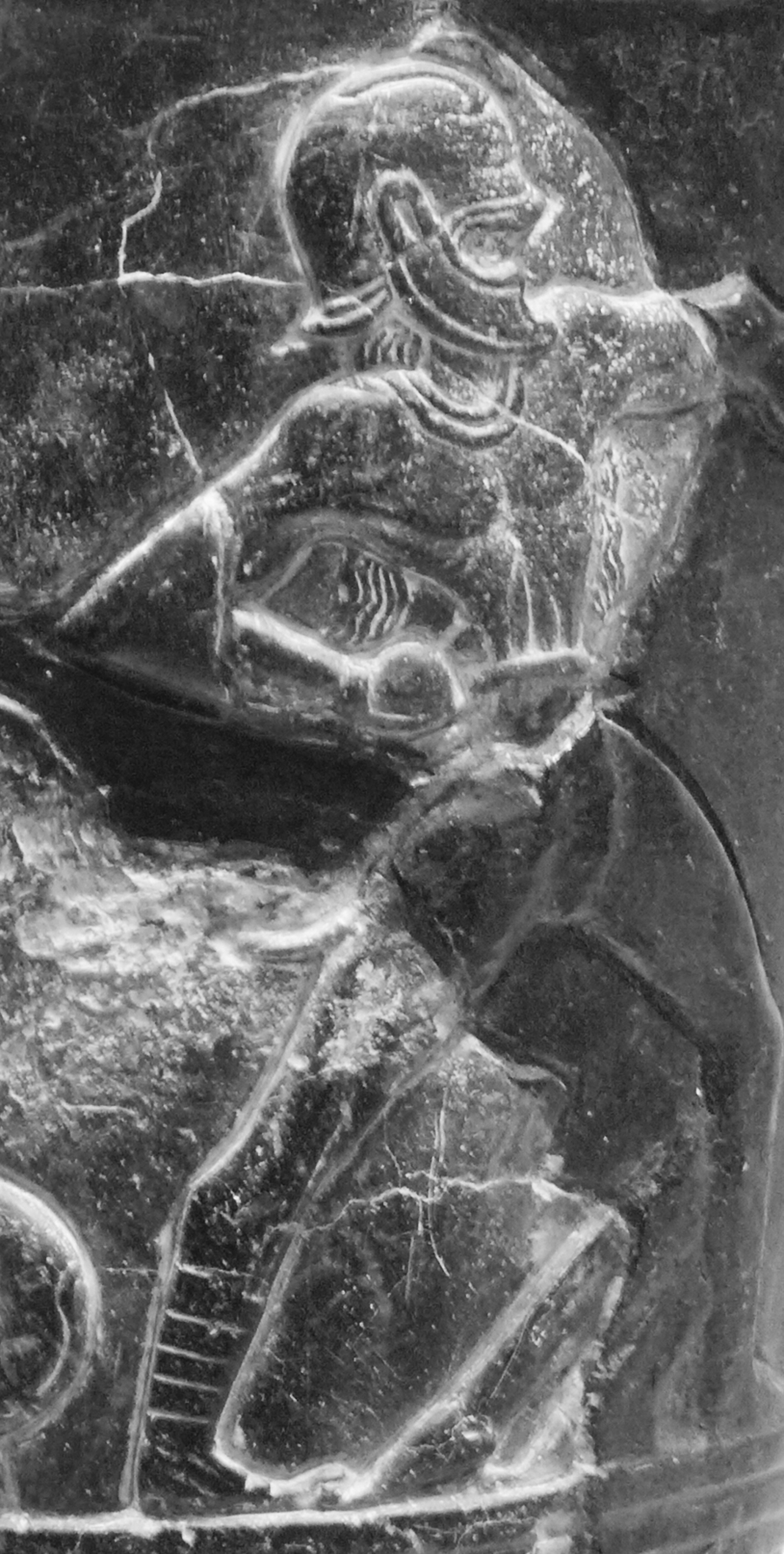
A more explicit vision of the male body as the product of training regimes is on the Boxer Rhyton, also from Aghia Triada. There are four panels with images, three depicting boxing and/or wrestling, one depicting bull-leaping. As with the Chieftain Cup, there is a high degree of detail employed in defining the muscles of the characters, again in the area of the chest and legs, though now also in the arms (Fig. 15). Evely (Reference Evely, Evely, Lemos and Sherratt1996) has drawn attention to the use of helmets in one of the scenes as indicating the potential ferocity of these bouts, and Logue (Reference Logue2004) has suggested that there is an obvious reference in this also to a warrior's equipment. Speaking of the Classical Spartans using boxing as training for war, Philostratos (Gymnastics 9.11.43) stated that ‘boxing gave them practice in parrying blows to the head and training in withstanding the ones that did strike home’. The juxtaposition of bull-leaping and boxing on the Boxer Rhyton indicates a relationship in the symbolic exploitation of both types of event, and may more mundanely indicate a contextual association between the two activities in real life.
Detail from the Boxer Rhyton from Aghia Triada (courtesy of Heraklion Museum – Ministry of Culture and Tourism – Archaeological Receipts Fund).
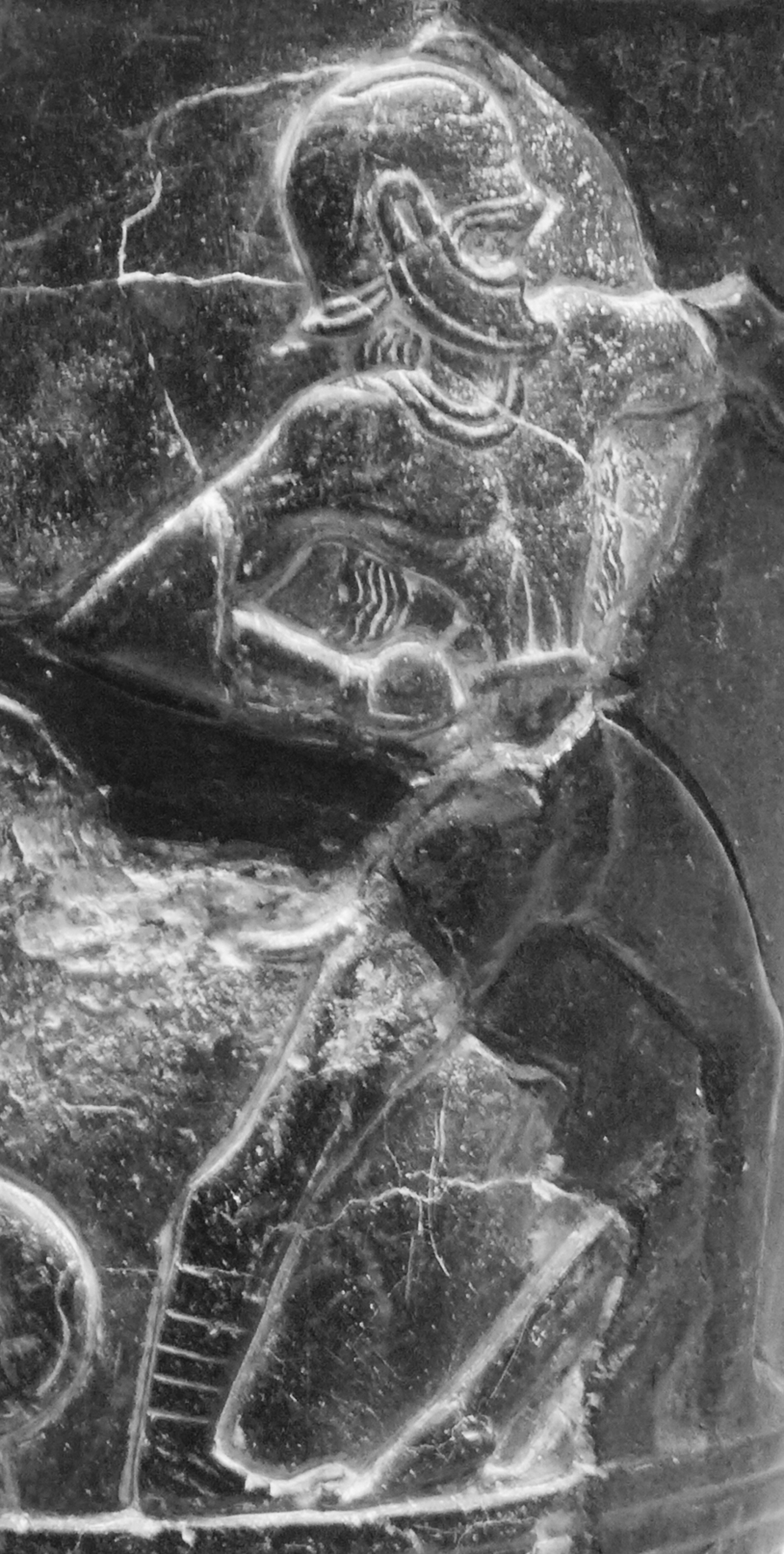
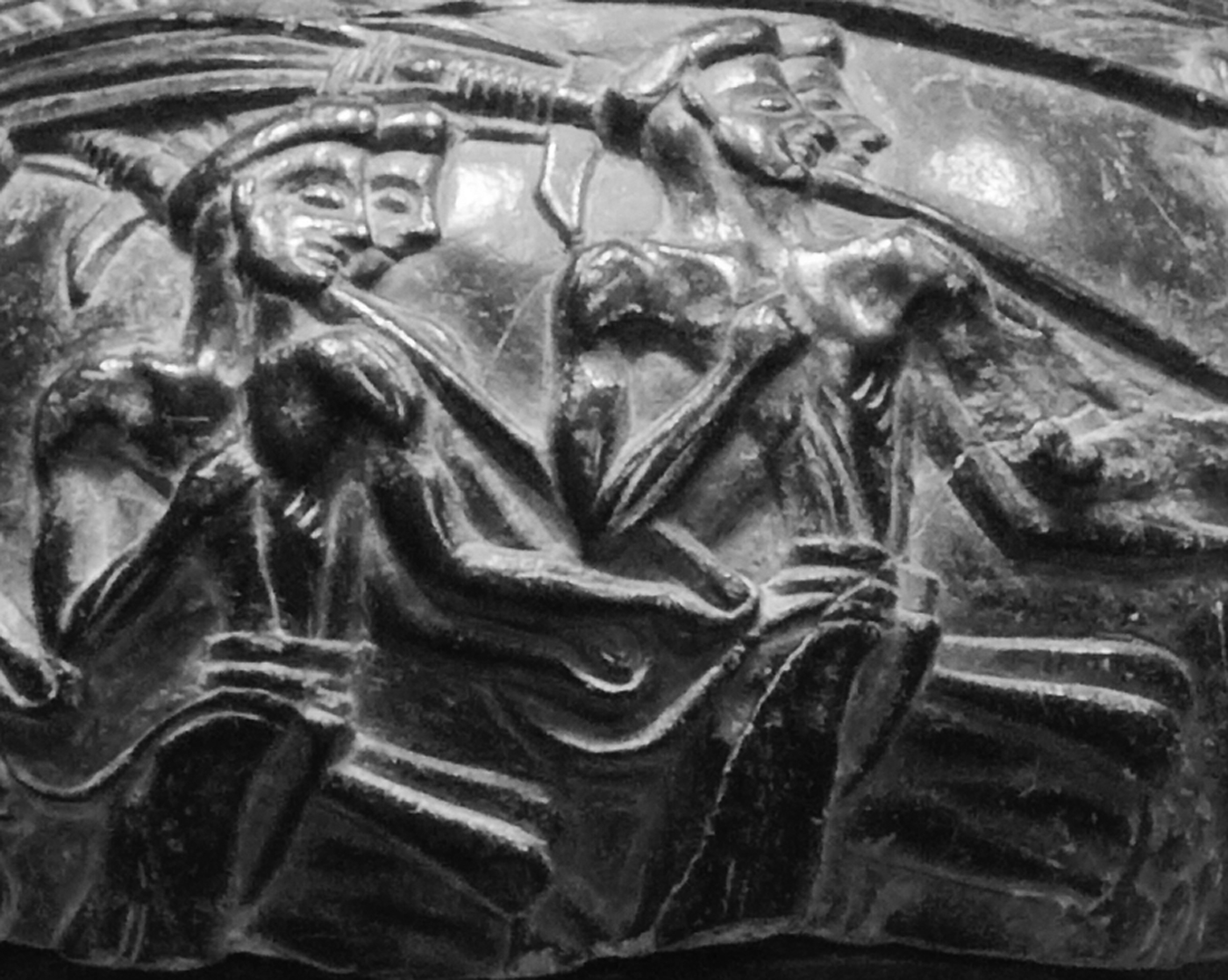
More fragmentary scenes on carved stone vases are discussed in detail by Logue, though here it is noted that they include scenes of boxers from Knossos and a scene of an archer from the same site, typically contextualised as engaged in combat (Logue Reference Logue2004, 160). These fragmentary scenes also hint that the accident of survival of the two quite complete scenes from Aghia Triada should not be taken to suggest that such scenes were unique to that site. Haysom (Reference Haysom2010, 47–8) considers the scaly cloak worn by the leader on the Harvester Vase from this same site to be associated with weapon/warrior imagery on the basis of its contextual association in other images with figure-of-eight shields and double-axes. The possibility of a person characterised by military garb leading a procession of men with well-defined musculature (Fig. 16) carrying agricultural produce is noteworthy when considering the relationship between economic and martial power.
Detail of the Harvester Vase from Aghia Triada (courtesy of Heraklion Museum - Ministry of Culture and Tourism - Archaeological Receipts Fund).

Other images
This paper does not provide an exhaustive catalogue of images of violence or war precisely because its purpose is to move away from the limitations of such parameters. However, some additional material warrants mention. Double-axes appear as decorative motifs on Late Minoan I pottery, and we find figure-of-eight shields on Late Minoan IB ‘Alternating Style’ pottery (Rehak and Younger Reference Rehak, Younger and Cullen2001, 438), reflecting the ubiquity of these images on various media. These shields also occur in miniature form as items of jewellery. Two unprovenanced cast double-axes of probable Late Minoan I – Late Minoan III date depict a further figure-of-eight shield and a helmet respectively (Haysom Reference Haysom2010; Evely Reference Evely1993; Mavriyannaki Reference Mavriyannaki1983). The gold hilt furniture of a Type A sword from Mallia is normally interpreted as a leaping acrobat curled around the central perforation (Chapouthier Reference Chapouthier1938). In such a reading, the association between athletic and warrior aspects of elite identity is cross-referenced on an actual weapon. A different reading of the image would see the character as a captive with rope binding his wrists rather than jewellery adorning them (Haysom, pers. comm.). The decoration on his kilt appears to differ from more common ‘Minoan’ forms and short curly hair could well identify him as a subjugated foreigner or captive slave. In either case, given the comparative dearth of figural art in this period it is interesting to note the aggressive undertones of this image, further emphasised by its location on a sword.
RELIGIOUS CONTEXTS
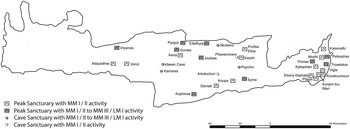
The mixing of religious and martial symbolism was common in the Classical Greek world, with images of mythological battles between beasts, gods and men appearing alongside depictions of historical battles on temples. In mythology, the gods of Greece revelled in wars and fought incessantly amongst themselves, and so the material culture and symbolism of war permeated many aspects of religion, including the determination of objects suited to deposition in some sanctuaries. Most of the Archaic–Classical weapons that survive today were excavated at religious sites such as Olympia and Delphi. These are typically votives of actual weapons made by victorious armies or individuals, but can also be miniaturised weapons (Snodgrass Reference Snodgrass1999). Throughout European pre- and proto-history on the whole, weapons were most often interred in funerary, religious or industrial (hoards) deposits, and they very rarely survive in domestic or primary military settings (armouries). Looking back to Bronze Age Crete, while shrines and sanctuaries were of a very different character to those of Classical Greece, they represent one of the three main types of site where we might expect to find real or votive weapons. Extra-urban cave and peak sanctuary sites were an important focus of religious activity throughout the island (Fig. 17) between Middle Minoan I and Late Minoan I, and most have evidence for cult activity associated with weaponry.Footnote 12
Location map of major shrines in use at various times between Middle Minoan I and Late Minoan I.

Caves
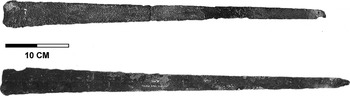
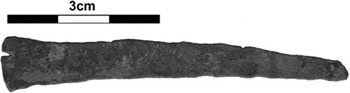
Weapons found in Bronze Age shrines in Crete can be separated into three different categories: functional weapons, cast model weaponsFootnote 13 (Fig. 18) and sheet-metal model weaponsFootnote 14 (Fig. 19). In the case of extra-urban shrines, weapons have been found in most cave shrines: the Idaean cave, the Psychro cave, Arkalochori rock shelter, Phaneromeni cave and at the extra-urban shrine of Kato Syme. Ritual use of the first two cave sites appears to originate in Middle Minoan II and, while it is impossible to separate the chronology of the votive bronze weapons, the evidence from peak sanctuaries would concur with them being Middle Minoan II – Late Minoan I. At Psychro, the deposits include dozens of cast model and sheet-metal model swords,Footnote 15 spearsFootnote 16 and double-axes along with functional daggers and spearheads (Boardman Reference Boardman1961; Rutkowski Reference Rutkowski1986, 57; Jones Reference Jones1999, 10). In the Idaean cave at least 41 sword models were recovered (Watrous Reference Watrous1996, 58; Sakellarakis Reference Sakellarakis1984) and ‘several’ such models are known from Phaneromeni cave (Watrous Reference Watrous1996; Jones Reference Jones1999). From a Middle Minoan III – Late Minoan I context at Arkalochori, at least 9 unfinished Type A swordsFootnote 17 were accompanied by many more cast model swords and sheet-metal models, amounting to more than 50 swords and models (Hazzidakis Reference Hazzidakis1912–13; Rutkowski Reference Rutkowski1986, 58),Footnote 18 and alongside these there were ‘hundreds’ of bronze, 26 gold and 7 silver double-axes (Watrous Reference Watrous1996, 57; Marinatos Reference Marinatos1935). While the exact numbers and chronology (beyond Middle Minoan II – Late Minoan I) are often uncertain, it is clear that the vast majority of metal votives were in the form of weapons or model weapons in cave sanctuaries. With the value attributed to metals in Bronze Age society, it is important to note the relative importance of weapons when metal was used for votive offerings.
Cast model swords from the Psychro cave (Ashmolean Museum; reproduced courtesy of the Keeper and Department of Antiquities).

Sheet-metal model weapon from near Modhi peak sanctuary (on site).

Peak sanctuaries
Many of the peak sanctuaries of Crete were excavated as rescue projects or are part of ongoing research initiatives, so that none as yet have been published with comprehensive catalogues of artefacts (Jones Reference Jones1999). We do know, however, that model weapons have been found widely at peak sanctuary sites, although regional discrepancies do occur; they are definitely absent from Atsipadhes (Peatfield pers. comm.) and Traostalos (Jones Reference Jones1999; Kyriakides Reference Kyriakides2005; Briault Reference Briault2007). However, from Jouktas, 35 sheet-metal model swords are known along with a bronze dagger and double-axes (Watrous Reference Watrous1996, 70–1). Models and a real dagger are also known from Petsophas (Davaras Reference Davaras1972, 652; Watrous Reference Watrous1996, 65; Jones Reference Jones1999, 47). Models come from Modhi, Kophinas and Vrysinas (Jones Reference Jones1999, 47–8), model double-axes come from Plagia Ziros (Faure Reference Faure1965; Reference Faure1967) and a cast blade fragment from Karphi may be related to a Middle Minoan shrine there (Watrous Reference Watrous1996, 64).
Weaponry and religion
With this wealth of martial symbolism in different forms of religious sanctuaries across the island, Kilian-Dirlmeier (Reference Kilian-Dirlmeier and Sherratt2000, 830) has suggested that it may be appropriate to consider the existence of a Minoan deity concerned with ‘the production and use of weaponry’. The argument has much merit to it, though another dimension to this symbolism may relate to the belief that votives at shrines were related more directly to the devotee than to a recipient deity (Morris Reference Morris, Laffineur and Hägg2001; Peatfield Reference Peatfield, Laffineur and Hägg2001). The martial imagery may therefore reflect dedications to a deity/deities with martial attributes, but it may also reflect solicitation of divine intervention in relation to the martial activities of the worshippers themselves (Haysom Reference Haysom2010). The deposition of real weapons, unfinished real weapons, cast model weapons and sheet-metal weapons at sanctuaries could in turn reflect different forms of activity with different intentions. In the depiction of what is thought to be a shrine on a seal from Aghia Triada (Müller and Pini Reference Müller and Pini1999, no. 3), we find four daggers/model weapons standing on an altar with their points facing upwards.Footnote 19 It is clear from the sanctuary evidence that martial and religious symbolism were permeable, and while both had a great many independent manifestations, they also came together through the deposition of weapons in religious or ritual events.
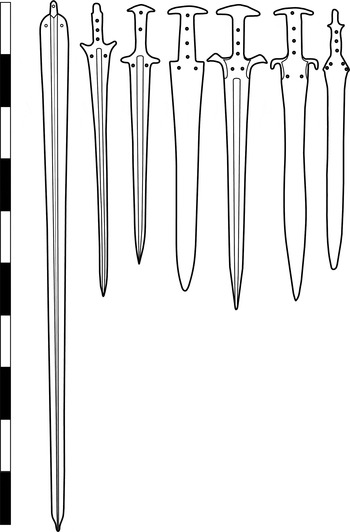
The relationship between the symbolic and functional worlds was clearly complex, and the choice of model weapons more frequently than actual weapons requires consideration. Functional weapons have been found at non-religious sites in Crete (e.g. Knossos, Mallia, Zakros, Mochlos), so it is clear that the models derive their symbolic power from reference to real objects. The process of miniaturisation that characterised ritual assemblages in Cretan religion (Jones Reference Jones1999, 10) appears to be mirrored in the treatment of weapons in the context of cult activities. At peak sanctuaries the models are exclusively miniaturised, but in cave sites both miniature and large-scale models occur. It is noteworthy, however, that it is only the blade of the weapon represented; not only is there no attempt to render model handles, they do not attempt to depict a tang, suggesting that the partial nature of the weapon is being emphasised. Rivet holes occasionally exist, but there is no evidence for hilting on cast models or attempts to make them more representative of functional objects. We can also observe that sheet-metal objects were both easier and cheaper to manufacture (in terms of materials and time). The swords from Arkalochori are an exception as they are true Type A swords, though they were not finished for practical use as they had no hilts. This predominance of model weapons over functional versions indicates that images of weapons were utilised in a structured fashion as part of normal cult practices and that weapons were thus not ad hoc votives of functional possessions made in exceptional circumstances. The rarity of real weapons may relate to their intrinsic value or their unsuitability for the activities surrounding the act of deposition, perhaps supported by the partial nature of models.
Figurines
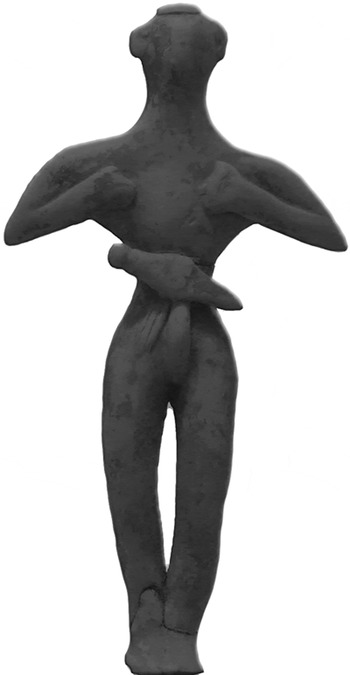
Possibly the best known category of artefact from peak sanctuaries are the bronze and coroplastic figurines. In terms of those with warrior characteristics, we may cite figurines with daggers at their waists and figurines of boxers in Middle Minoan contexts. The choice of daggers instead of swords is noteworthy because this was a time when new martial art forms were replacing traditional systems associated with dagger combat (Molloy Reference Molloy2010, 424). It remains possible that a dagger was chosen instead of spears or swords because swords were as long as a person's leg and spears the height of a man, and hence either would snap if standing proud of the figurine or distort its definition if plastered to their leg or entire body length.
At Kophinas, a recent re-analysis of figurines by Rethemiotakis (Reference Rethemiotakis2001) has demonstrated that the ‘club-like’ representation of hands on some figurines is not poor artistic execution, but rather is intended to depict boxing gloves. This determination is beyond doubt on the Kophinas figurines as they have straps depicted also, and it is not a stretch therefore to suggest that figurines standing in the same posture from other sites with both fists placed to their chest may also be depicting boxers. While we need not assume that they represent persons about to engage in a bout of boxing, their posture may be intended to preferentially reflect selected aspects of a particular male identity – the warrior. Some also possess daggers at their waists, supporting this contention. We may make a comparison also with the finely detailed Palaikastro Kouros, which is considered to have been a cult statue (MacGillivray, Driessen and Sackett Reference MacGillivray, Driessen and Sackett2000). Here again we have a very carefully detailed fist, and while no gloves are depicted, the sculptor went to considerable lengths to depict the fist as being clenched – index finger covered by thumb on ‘front’ side, not illustrated on the palm side because of the thumb location, the ulnar styloid is emphasised, and the hand extensor tendons and forearm musculature are pronounced (Musgrave Reference Musgrave2000). While a glove is not illustrated, the fist is detailed exactly as it would be formed (loosely clenched, thumb folded safely across the second phalange of the index finger) for preparing to make a punch in modern martial arts practice.Footnote 20 This treatment of the thumb and musculature is also evident in the moulding of the fist of the so-called ‘Priest-King’ relief (Fig. 13; Evans 1900–1; 1928, fig. 508; Musgrave Reference Musgrave2000, 97) from Knossos.
Returning to the figurines of boxers at peak sanctuaries, if we consider their morphology in terms of what Morris (Reference Morris, Laffineur and Hägg2001, 247) calls a ‘living gesture’, we can see that fists raised to the chest are effectively held close to a striking position. The fists are not submissively or respectfully held in a passive position at or behind waist level or held joined together. The occasional inclusion of a dagger increases this symbolism of potential violence (Fig. 20). The image created in itself, or if materialised through a living individual, thus resonates potential aggression on a fundamental level, though the gesture need not be related to aggressive or threatening actions.Footnote 21 Taking the real and model weapons along with the dedication of figurines of boxers (some wearing daggers), it is clear that religious locations, and by extension certain religious activities, played a role in the materialisation of warrior identities and practices.
Figurine from Petsophas with fists held to chest and dagger at waist (courtesy of Heraklion Museum - Ministry of Culture and Tourism - Archaeological Receipts Fund).

Human sacrifice or healing cult?
At the shrine of Anemospilia around the transition from Middle Minoan II to Middle Minoan III, an individual was found lying on a low platform and the 300 + g ‘knife’ found with the skeleton was in fact a form of slotted spearhead.Footnote 22 Sakellarakis has interpreted this as a possible human sacrifice on the basis of the location of this person and another male and female found in the shrine (Sakellarakis and Sapouna-Sakellaraki Reference Sakellarakis and Sapouna-Sakellaraki1981; Sakellarakis and Sakellaraki Reference Sakellarakis and Sakellaraki1997). The reason this partial freeze-frame image survives is that the building collapsed through an earthquake. The individual on the ‘altar’ had made no attempt to leave, and so we can presume was unconscious or dead as the excavator suggests. There is no evidence, however, to suggest that such injury or death occurred at the shrine, and it may thus have occurred prior to their being brought there. In such circumstances, if we take the association of the weapon and the male lying down, we could suggest that this was an injured warrior seeking healing or a deceased warrior being prepared for a funerary event following a battle. While as speculative in character as this being a human sacrifice, it may be supported by the foetal position of the young male, as this is a natural reflexive position to enter when a person is alive and experiencing intense pain. An alternative suggested by the excavator was that his posture is because he was trussed for sacrifice. The possibility of this being a warrior on the basis of the spear and mortal injury would have particular resonance at the end of Middle Minoan II, when increased conflict is attested (Schoep Reference Schoep2006, 58).
Religion, war and society
The view that religion was the dominant manifestation of power in Minoan society is widely held (Adams Reference Adams2004b), and, in the case of warriors, Logue (Reference Logue2004, 152; after Earle Reference Earle1997, 106) argues that ‘in order to keep the military loyal, a ruling elite must also be able to bind them with “economic and ideological fetters”. The most secure “ideological fetter” that appears to have been used is control of religion and religious ritual.’ The complication with this otherwise likely scenario is that, when the military are members of the elite, they are amongst those who design control mechanisms. Thus having military behaviour permeating some aspects of religion and vice versa, a co-dependence emerges that can be variably manipulated by different elements of the elite group. This could be as simple as warriors requiring religious sanctioning of their actions or warriors partaking in contests and displays at religious festivals. We should also note that identities need not be exclusive and so warriors may perform religious activities that make no reference to their warriorhood.
We could also ask if religion was an imposed element of superficial control over the military, or whether the military imposed aspects of its needs upon religious practices. It can be noted that aspects of PTSD (post-traumatic stress disorder) can be mitigated by psychological treatment in the modern military system, and the use of religion to rationalise and legitimise violence could have had a similarly powerful effect on alleviating the trauma of killing in the past (Grossman Reference Grossman1996; Molloy and Grossman Reference Molloy and Grossman2007). It is facile to view prehistoric warriors as mindless killing machines, or to think that trauma is inflicted only on victims of violence and not on the perpetrators in the specific context of warfare. The weight of modern research (Bourke Reference Bourke2000; Shephard Reference Shephard2002; Grossman Reference Grossman2004) on the use of training to naturalise the unnatural (killing) demonstrates that, by making people who lack aggressive tendencies effective killers in combat, institutionally recognised cathartic measures are required to alleviate the psychological damage caused to many combatants. The ability to transfer personal responsibility for undertaking often brutal acts to the figures and institutions of authority that sanctioned and solicited those acts in the first place is an important measure in recovering from the experiences of war. We may consider religion as providing such a conduit in prehistory, as it related to both divine and secular moral authority.
WARRIOR BURIALS AND PALAEOPATHOLOGY
Burial practices
Warrior burials are a problem. When they do not exist we may wonder if there were any warriors; when they do exist, we have to ask were they really warriors (Whitley Reference Whitley2002; Smith Reference Smith, Schepartz, Fox and Bourbou2009). The casual introduction by Hood and de Jong (Reference Hood and de Jong1952) of ‘warrior burials’ to mean burials with weapons at Knossos was not intended to be dogmatic, but has nonetheless met with considerable debate (Whitley Reference Whitley2002; Driessen and Schoep Reference Driessen and Schoep1999; Preston Reference Preston2004a; Reference Preston, Cadogan, Hatzaki and Vasilakis2004b; Alberti Reference Alberti, Cadogan, Hatzaki and Vasilakis2004; Smith Reference Smith, Schepartz, Fox and Bourbou2009). The earliest burials with weapons come from Aghia Photia in East Crete (Davaras and Betancourt Reference Davaras and Betancourt2004) and from tholoi in the Mesara (Branigan Reference Branigan1974), and, despite differences in burial practices in the two areas, daggers, axes and/or spears were associated with individuals and deposited in the event of a funeral. The rarity of burials with weapons in Middle Minoan II – Late Minoan IA is a problem because there is a risk of this being correlated with an absence of warriors and hence of warfare, but a dearth of primary burials of any kind for this period needs to be noted (Poursat Reference Poursat1999). Late Minoan II–IIIA ‘warrior burials’ are known from the areas of Knossos (Evans Reference Evans1906; Hood and de Jong Reference Hood and de Jong1952; Hood Reference Hood1956; Popham, Catling and Catling Reference Popham, Catling and Catling1974) and Chania (Vlasaki in Whitley 2002–3) and have been considered as evidence for the arrival of ‘warlike Mycenaeans’ on Crete. In Late Minoan IIIC, burials with weapons occur throughout the island, with a particular concentration of excavated examples in the east (Kilian-Dirlmeier Reference Kilian-Dirlmeier1993).
Whitley (Reference Whitley2002) has comprehensively sought to dispossess the deceased in Cretan graves of a warrior identity in life (see also Smith Reference Smith, Schepartz, Fox and Bourbou2009; Driessen and Schoep Reference Driessen and Schoep1999), and Preston (Reference Preston1999; Reference Preston2004a; Reference Preston, Cadogan, Hatzaki and Vasilakis2004b) has convincingly questioned the unilateral ‘Mycenaean-ness’ of burial practices in general. We can thus make assumptions neither about the identification of persons buried with weapons as being warriors, nor about their being Mycenaean in ethnicity or identity. Taking these as starting points, we must account for weapons being intentionally interred in tombs and consider their function in the construction of identity in death (Whitley Reference Whitley2002). At the most basic level the deposition of weapons may relate to the anticipation of needs in the afterlife (Renfrew Reference Renfrew, Zubrow and Renfrew1994, 52), or to worship of a specific deity associated with weapon production and use (Kilian-Dirlmeier Reference Kilian-Dirlmeier and Sherratt2000, 830).
The symbolic grammar of weapons noted in the iconography of Late Minoan I to Late Minoan IIIA (Krzyszkowska Reference Krzyszkowska2005; Hiller Reference Hiller1999) may in part have been translated to the burial environment to afford meanings through the selection and position of specific weapon types. Weapons were used in the construction of identities that were conflations of military and religious symbolism, variably and perhaps contextually referring to either or both (Haysom Reference Haysom2010). The entire package of mirrors, tweezers, weapons, jewellery, razors, cleavers and seals found in Knossian graves (Evans Reference Evans1906; Hood and de Jong Reference Hood and de Jong1952; Hood Reference Hood1956; Popham, Catling and Catling Reference Popham, Catling and Catling1974) accords with a package of grave goods identified by Treherne (Reference Treherne1995) as occurring widely throughout Europe and reflecting warrior identity. These were related to the concept of the ‘warrior's beauty’ that we also see reflected in Cretan art, such as the Chieftain Cup. Some burials, however, only possessed a single spear and lacked other components of this package, perhaps indicating expressions of different meanings, as we see in the varied treatment of weapons in art. The differential selection of objects may thus relate more to symbolic constructs in the event of burial than to personal wealth or a warrior identity, though manipulation of one to promote the other may blur such boundaries. Furthermore, we cannot consider all burials with weapons from Early Minoan I to Late Minoan IIIC across the island as affording the same meanings.
The lack of ‘warrior burials’ in Middle Minoan II to Late Minoan IA CreteFootnote 23 relates to the lack of desire in mortuary practice for constructing warrior identities and perhaps control of the distribution of bronze, thus relating to religion, economy and technology, not military practice. The separation of weapon and warrior may also have been related in some cases to a deliberate deconstruction of warrior identities in death as part of the passage to the afterlife or even for reasons of superstition (Williams Reference Williams2005, 268). Weapons ‘had a powerful agency to affect and direct the way that memories of the dead were constructed and reproduced’ (Williams Reference Williams2005, 267), and so we cannot assume that violent aspects to a warrior's identity were considered paramount in the processes of commemoration by the living.
Before the end of Late Minoan I the inclusion of combat weaponry in burials occurs in the area of north-central Crete. Two Type A swords (Fig. 21) came from the ‘isolated deposit’ possibly originating from a destroyed tomb at Isopata (Evans Reference Evans1935, 846; Driessen and Macdonald Reference Driessen and Macdonald1997, 71). Burials with fragments of weapons and boar's tusk helmets are known also from Poros (Dimopoulou Reference Dimopoulou, Kilian-Dirlmeier and Egg1999) from Late Minoan I. Burial as a warrior becomes more widespread in Late Minoan II–IIIA, but any suggestion that these persons (or any others) were exclusively warriors from mainland Greece is founded upon the idea of peaceful Minoans relying on bellicose Mycenaeans to fight their battles (e.g. Wright Reference Wright and Shelmerdine2008, 243). This ignores the dominant flow of military ideologies from Crete to the mainland in Middle Minoan III – Late Minoan IB (Molloy [forthcoming a]), marking a Cretan origin to mainland military traditions.
Range of swords in use in Bronze Age Crete. From left to right: Types A, Ci, Dii, Fii, Gi, Gii, Naue ii.

Osteological evidence for ancient violence
Looking to find real warriors beyond warrior burials, Smith (Reference Smith, Schepartz, Fox and Bourbou2009) has demonstrated that weapon-inflicted injuries occur on burials possessing no weapon in the Athenian Agora; this was in a cemetery that did include burials of individuals with weapons who had no identifiable injuries. Weapon trauma on people buried without weapons occurs also in Crete. Two such cases occur at Armenoi, where one individual had been struck repeatedly in the arm with a sword or axe and another still had an arrowhead lodged in their spine (McGeorge Reference McGeorge1984). In this case, the injuries cannot be attributed securely to warfare, as they could equally reflect homicide, execution or torture. The human remains from Aghios Charalambos cave in Lasithi provide the best examples of deliberately inflicted trauma, with a considerable 16 crania exhibiting distinct injuries (Betancourt et al. Reference Betancourt, Davaras, Dierckx, Ferrence, Hickman, Karkanas, McGeorge, Muhly, Reese, Stavropodi, Langford-Verstegen and Chlouveraki2008). These burials are secondary and the disturbed stratigraphic sequences allow broad dating between Final Neolithic and Middle Minoan IIB, though a bias towards the later end of this spectrum is suggested by the excavators. McGeorge (in Betancourt et al. Reference Betancourt, Davaras, Dierckx, Ferrence, Hickman, Karkanas, McGeorge, Muhly, Reese, Stavropodi, Langford-Verstegen and Chlouveraki2008) has identified numerous injuries on the skulls (Fig. 22 and Fig. 23), and suggests that many of these were inflicted during deliberate attacks. Both male and female crania exhibit wounds, supporting the evidence from urban destructions that settlements and their inhabitants were potential targets in war. We can also note that the bias of injuries in this study was towards blunt force trauma to the head. A possible explanation for some of these injuries would be an axe strike to a helmeted head, and double-axes were the primary potential percussive weapon in the Middle Minoan arsenal. It is also possible that these are the result of sling-stone impacts. Sharp/bladed weapon trauma to the head was recorded also at Aghios Charalambos, potentially from spear, dagger or sword attacks. We should note, however, that bladed weapon attacks in the Bronze Age would be preferably targeted to soft tissue areas, thus making them under-represented osteologically (Molloy Reference Molloy2010).
Blunt force injury to skull from Aghios Charalambos (courtesy T. McGeorge).

Injury from pointed object to skull from Aghios Charalambos (courtesy T. McGeorge).

WRITING
In Cretan hieroglyphic script, weaponry is allocated a number of specific signs. Poursat (Reference Poursat1999, 427) points to symbols of bows, arrows, spears and daggers, and he suggests that this relates to the involvement of civil administrations in manufacture and/or distribution of weaponry. We can also consider that these symbols did not relate directly to weapons (as the script is undeciphered), but even in such a case it shows that weapons were part of a structured frame of references in elite concerns and symbolic grammars. The more developed Linear A script is also as yet undeciphered, and so we cannot utilise it effectively in this discussion beyond similar observations to the above.
The contrast noted between the numbers of archaeologically recovered weapons and those required to equip an army of even moderate size is somewhat mitigated by the later Linear B evidence. The tablets refer to the very recent past of when they were made and so they reflect a partial picture of military considerations relating to a year or two at best of the Bronze Age. Those tablets that survive do so because they were accidentally burnt, and this in itself may illustrate violent destruction of Knossos at a time when they were making military (as well as routine economic) inventories. Even in such an incredibly tight chronological window and with limited survival of tablets, the records show alarmingly high numbers of weapons. On tablet Ra 1540 50 swords are listed and on Ra 7498 some 117 receive mention, and a further 20 fragmentary tablets list an uncertain number of swords (Driessen and Macdonald Reference Driessen and Macdonald1984, 64; Chadwick, Killen and Olivier Reference Chadwick, Killen and Olivier1971, 267–9). Ra 1548 records 3 swords fitted with bindings and R 0481 lists 42 spears with bronze points, apparently including the shaft (Ventris and Chadwick Reference Ventris and Chadwick1973, 360–1). If this was the production or allocation quantity of swords in a single year or perhaps two, then it is clear that a minuscule percentage of the weapons once in circulation escaped the melting pot for recycling.
Driessen and Macdonald (Reference Driessen and Macdonald1984, 54) consider men listed in the Linear B tablets from Knossos called E-pi-ko-wo to have been guards or lookouts, and such a role may well reflect the responsibilities/functions of warriors from times past who had manned the network of guard houses. A potential change in the character of the military is also reflected in the identification of other men listed in the tablets called Ke-se-no as being foreign warriors, possibly mercenaries but almost certainly not Cretans (Driessen and Macdonald Reference Driessen and Macdonald1984, 55). This was the beginning of changes that may link to a ‘democratisation’ of warrior status by Late Minoan IIIC, whereby the population appears sufficiently small that a higher proportion of males in society may be expected to fight on behalf of their social group than had occurred in Middle Minoan I – Late Minoan IIIA.
WEAPONRY IN CORPORE
Weapons are often considered to be the most direct evidence for prehistoric warfare (Harding Reference Harding2007), and Crete, as a region, has the highest diachronic concentration of bronze weapons of anywhere in the Greek world (Branigan Reference Branigan1974; Avila Reference Avila1983; Höckmann Reference Höckmann1980; Kilian-Dirlmeier Reference Kilian-Dirlmeier1993).Footnote 24 The metal bronze was itself central to socio-military change (Renfrew Reference Renfrew and Hodder2001, 137) because it facilitated new ways for people to interact, including domination through violence. Weapons and weapon-tools are the most frequently occurring bronze artefacts in the nascent bronze industry of Crete in Early Minoan and earlier Middle Minoan periods (Branigan Reference Branigan1974). As the bronze industry evolved beyond skeuomorphs or functional correlates of lithic technology through the development of new object categories such as swords and lances, potential patterns of action moved beyond themes borrowed from generations past. Weaponry therefore does much more than simply reflect the presence of warfare. It needs to be understood as having played a direct role in constructing and challenging social structures and mores through intentional manipulation by interest groups (Malafouris Reference Malafouris, Robb and Boric2008; Knappett and Malafouris Reference Knappett, Malafouris, Knappett and Malafouris2008, xiii; Ferguson Reference Ferguson and Haas1990; Reference Ferguson, Raaflaub and Rosenstein1999). Specialised military material culture was thus a socially constructed (and materialised) concept to further political ends by facilitating inclusive and exclusive practices, as well as serving as tools to facilitate the occasional events of war.
In this section analysis of martial properties is prioritised over a quantification and distributional analysis of surviving weapons. It is considered more important in this case to privilege the social processes that gave rise to and shaped weaponry, along with the social practices that gave them meaning, over and above the brief events of deposition and the randomness of archaeological recovery. Common sense tells us that if we have Type A swords in a Middle Minoan II context at Mallia, a Middle Minoan III – Late Minoan IA context at Arkalochori and a Late Minoan I context at Zakros, unless technology and design characteristics were passed across this chronological and geographical expanse by word of mouth, weapons were much more widely available than the limited archaeological record provides us with (Molloy Reference Molloy2011).
Early daggers
In socio-military terms, the Cretan dataset of weapons illustrates the transition from the use of the tools of hunting in interpersonal combat (Chapman Reference Chapman, Carman and Harding1999) to formalised military systems using purpose-designed weapons of war – such as the sword, shield and lance. This was a landmark change in the way communities could define themselves both internally and externally through potential aggression (Parker Pearson Reference Parker Pearson and Pearson2005). By Early Minoan II, the first daggers evolved that reveal a distinct bias towards interpersonal combat, and so a social change initiated by weapons technology is apparent. However, Branigan's (Reference Branigan1974) Triangular Daggers were functionally replicating stone technology and, at 7–10 cm in length, they were thus too short and thin for combat (Branigan Reference Branigan1967, 237). Of Branigan's Long Daggers, Types III to XI were well suited to combat in terms of their length and the strength afforded by midribs, and many with blades of >25 cm would have been >33 cm in length with their organic hilt attached. While Branigan (Reference Branigan1999) suggests that the hilting mechanism was too fragile for combat use, experiments carried out by the author with similar grip-plate daggers from Atlantic Europe show that it survived very robust cutting and stabbing tests with no damage (Molloy Reference Molloy2007b). Daggers were dynamic objects so, while many were not suited to combat, others were suited to multiple purposes that included combat (Floyd Reference Floyd1999, 440), and the very longest variants (e.g. Branigan Reference Branigan1974, nos. 292, 284, 377) may be considered specialist combat weapons.
Axes
It can be difficult to differentiate axes that may have been weapons and those that may have been tools, though it might content us to consider many as tool-weapons, serving both purposes. The earliest copper-alloy axes and chisels of the Aegean were virtually unusable for cutting wood, due to the softness of the material and the process of work-hardening of copper alloys when they are thus used. Mathieu and Meyer (Reference Mathieu, Meyer and Mathieu2002) have demonstrated through experimental archaeology that stone axes were significantly superior for woodworking. It seems plausible, therefore, that, used alongside the early daggers in the Aegean, axes and so-called ‘chisels’ were in fact more oriented towards violence than industry. By analogy, we can refer to ‘Ötzi’, the Early Bronze Age man found frozen in Alpine ice, who had a (broadly) similar short axe to those used in the Aegean. DNA from human blood found on his cloak came from several different individuals, and he himself is likely to have died as the result of injuries sustained during a violent skirmish (Harding Reference Harding2007, 49).
Early swords
I have argued elsewhere (Molloy Reference Molloy2010) that the introduction of the sword represented a quantum leap in combat practice, and it cannot be regarded as a simple ‘extending of the dagger’ because it required entirely different skill-sets to use effectively. The earliest Type A swords (Fig. 21) were 70–90 cm in length (or 80–100 cm when hilted) and they would have originally weighed c.500–700 g. These metric variables indicate that, while Type A swords were typologically homogeneous, different swords would have performed quite differently in combat, reflecting the preferences of past warriors. As with earlier daggers, the midrib inhibited the depth of cutting attacks and the weapon was thus designed for slicing, not chopping (Molloy Reference Molloy2010, 416). The limited cutting capacities of these swords may suggest a display element to fighting in certain contexts, whereby bloody but not debilitating injuries might be inflicted (Molloy Reference Molloy2008; Reference Molloy2010). This could leave room for showmanship in fighting commensurate with the agonistic contests we see in art. However, by placing attacks to the neck or groin, for example, Type A swords could also make lethal attacks using the edges and the point. There is a common perception (Peatfield Reference Peatfield1999; Taracha Reference Taracha2007) that these swords were mainly suited to single combat, though their inclusion alongside shields and spears on the Miniature Fresco from Akrotiri (Morgan Reference Morgan1988) reminds us that battlefield functions were equally probable.
Defensive equipment
Boar's tusk helmets and large body-shields were in use for a very long time – from the origins of complex weapon panoplies in Middle Minoan II (or before) to the collapse of state-level society in Crete by Late Minoan IIIB. The use of identifiable animal-derived elements for weapons has led Morris (Reference Morris, Hägg and Nordquist1990, 155) to suggest that through the use of these helmets and shields ‘the relationship between man and animal is consistently expressed’ through symbolism and real life. The helmet represented the boar hunt and the shield represented the ubiquitous bull imagery in Crete, ideologically linking war, hunting and competitive fitness. These weapons were part of the underlying network of cross-references between military, social and religious symbolism and activities. It is noteworthy that swords never took on this symbolic power in Crete, and that spears were typically used to demonstrate power when associated with a person in art.
The dense and tough character of the boar's tusks made them very durable items of armour, and the large shields made of wicker and rawhide were a key element in determining battlefield tactics for centuries (Molloy Reference Molloy2009). We may note that armour and bronze helmets, like the one from Late Minoan II Knossos (Hood and de Jong Reference Hood and de Jong1952), could represent an end to these established relationships between war, hunting and the natural world/religion, as may also be supported by the inclusion of the abovementioned Ke-se-no foreign warriors (Driessen and Macdonald Reference Driessen and Macdonald1984, 55) by Late Minoan IIIA.
Double-axes
The double-axe is a ubiquitous symbol synonymous with ‘Neopalatial Minoan Crete’. Considering the obvious separation between cast and sheet metal that we also see mirrored in swords and daggers, we might consider the cast ones to be functional as weapon-tools. As Haysom (Reference Haysom2010, 42) argues, ‘we cannot assume that just because something is not functional (like the impractically large or thin double-axes) it was not meant to represent a functional object’. Indeed Haysom (Reference Haysom2010, 42) notes that the majority of double-axes are the functional cast forms (cf. Evely Reference Evely1993, 51). Double-axes incised with a figure-of-eight shield and boar's tusk helmet reflect the use of all three devices in a conflation between military and religious symbolism (Morris Reference Morris, Hägg and Nordquist1990; Haysom Reference Haysom2010), perhaps in constructing divine as well as terrestrial identities. As with earlier axes, double-axes had soft alloys, the low tin content of many (Craddock Reference Craddock1976; Northover and Evely Reference Northover and Evely1995, 95) making them poor tools for cutting wood.Footnote 25 In combat, we could consider double-axes as weapon-tools for close-quarters fighting that would have been suited to percussive attacks reaching over shields to the head of an opponent or hooking the tops of shields in seeking to break up a defensive wall.
Archery
Archers were probably present in Crete from the Neolithic, and in the Bronze Age they are seen in Late Helladic I scenes from Mycenae using the same bows in interpersonal combat as are known to have been used in Crete (Hiller Reference Hiller1999). From the Shaft Graves, the Lion Hunt Dagger and Silver Battle Krater appear to use stock imagery of battle groups and along with the Silver Siege Rhyton they suggest that archers fought as skirmishers amongst the infantry, as perhaps did slingers. This indicates that there was a distinct lethal intent to combat and that idealistic visions of ritual combats or limited engagement wars have little foundation in the Cretan Bronze Age.
Spears
Bronze spears in Early Minoan and Middle Minoan Crete were simple designs, typically shoe-socket or slotted forms. They were primarily intended for penetrative attacks, and were suited to both hunting and warfare. Few Late Minoan I spears have been recovered from Crete (Avila Reference Avila1983; Branigan Reference Branigan1974; Höckmann Reference Höckmann1980), though we could expect lances similar to those from the Shaft Graves at Mycenae to have been in use on the basis of parity with other weaponry, and the lances on the Miniature Fresco from nearby Akrotiri (Morgan Reference Morgan1988). By Late Minoan II/Late Minoan IIIA more complex forms of spear are known archaeologically and they are best represented in the graves around Knossos (Evans Reference Evans1906; Hood and de Jong Reference Hood and de Jong1952; Hood Reference Hood1956; Popham, Catling and Catling Reference Popham, Catling and Catling1974). Continuing the long-standing cross-fertilisation of military technology between mainland Greece and Crete, spears of Types E, F and H (Fig. 24) are well known in both areas (Avila Reference Avila1983; Höckmann Reference Höckmann1980). Many of these could have served in the hunt or battle, though it is noteworthy that a deliberate decorative cross-reference was made between many Type D swords and Type F spears in the form of a raised wavy ridge on the handle and socket respectively. Most spears had distinct cutting edges to provide a further means of inflicting injury as well as the point, and the compact and robust cross-section of Types F in particular, but also some Type H examples, suggests they were intended for punching through armour. Type G spears in particular have strong morphological similarities to mediaeval boar-hunting spears, with their wide flaring blades and abrupt shoulders.
Type F and H spears from Crete.

Armour
A stone vase (Hood Reference Hood1971) and Linear B texts from Knossos (Ventris and Chadwick Reference Ventris and Chadwick1973, 375–9) and plates from Phaistos (Hood and de Jong Reference Hood and de Jong1952, 60) indicate that armour broadly similar to the well-known Dendra corslet (Verdelis Reference Verdelis and Aström1977) was in use in Crete, though we are unclear as to its composition (bronze or leather or both). It has variously been regarded as infantry armour (Harding Reference Harding1984, 151, 174; Crouwel Reference Crouwel1981, 127), chariot armour (Drews Reference Drews1993, 175) and duelling armour (Peatfield Reference Peatfield and de Souza2008, 93). Considering the functional strengths of 1 mm+ thick bronze plate (Molloy Reference Molloy2009), its relatively light weight of around 15 kg, and my experience wearing a replica (Molloy Reference Molloy2006; forthcoming b),Footnote 26 I suggest that such armour was highly versatile and perfectly suited to use in any of these contexts.
Later swords and daggers
The Types C and D swords (Fig. 21; Sandars Reference Sandars1963; Kilian-Dirlmeier Reference Kilian-Dirlmeier1993; Molloy Reference Molloy2010) of Late Minoan II did not change as rapidly in functional terms as spearhead designs had, and these swords were poorly suited to attacks against the new plate armour (Molloy Reference Molloy2008). Type C (all variants) and Type Di swords had midribs and the blades were typically long and thin. While lighter than their predecessors the Type A swords, they nonetheless appear to have been used in a broadly similar manner (Molloy Reference Molloy2008; Reference Molloy2010; Peatfield Reference Peatfield1999; Reference Peatfield2007; Taracha Reference Taracha2007). Peatfield (Reference Peatfield and de Souza2008) conflates Late Helladic I and Late Minoan I iconography with Late Minoan IIIA sword forms to suggest that there was a ‘hierarchical perception of combat skills’ in which swords were the ‘dominant weapon’ in Crete across these periods. In both Late Helladic I–II and Late Minoan I art, however, spears occur far more commonly than swords and they occupy a much wider range of symbolic as well as practical roles. We also need to note that there is a complete lack of swords in Late Minoan IIIA art, so there is a marked gap between the images of swords in use and the actual swords Peatfield discusses, making it difficult to substantiate the relative importance of swordsmanship over and against other forms of fighting for either period. In view of this, his suggestion that duelling was common practice (see also Taracha Reference Taracha2007), and more importantly that this was the main context for sword use, remains speculative. Furthermore, because images of combat were ideological expressions and/or narrative excerpts using violent imagery (Hiller Reference Hiller1999), not martial art exposés or manuals, we must remain cautious when using them to suggest modes of conflict resolution or systems of combat in either Late Minoan I or Late Minoan IIIA. The range of potential functions of Type C and D swords (Molloy Reference Molloy2008; Reference Molloy2010; Peatfield Reference Peatfield2007) indicates that they were suited to ‘audience-oriented’ combat with a significant display element, supporting elements of Peatfield's theory, but we need to also observe that they were suitable for use on the battlefield.
Between Late Minoan I and Late Minoan IIIA short swords became increasingly common, and these suggest different modes and contexts of use to the longer thin varieties (Molloy Reference Molloy2010). Later Type Di and Type Dii swords lost their midrib in Late Minoan IIIA:2 and other forms of short sword began to appear around this time. These include Type E daggers, and Type Fi and Fii daggers and swords (Kilian-Dirlmeier Reference Kilian-Dirlmeier1993). The characteristically broad Type E and Fi long daggers find an interesting parallel in (doubtlessly functional) first century ad Roman dagger forms (Fig. 25; Connolly Reference Connolly1998, 232). Alongside these, Type Gi swords evolved that could make deeper and more deadly cuts than their Type C predecessors (Molloy Reference Molloy2006; Reference Molloy2010). The non-midribbed daggers and short swords of Late Minoan II–III were more stocky and robust than their long and thin predecessors and thus capable of making stronger, percussive, cutting attacks. There was, however, significant variation in thickness (from 2.5 to 5 mm), indicating that only some were capable of contending with heavy armour.
Type Eii dagger from Knossos (courtesy of Heraklion Museum – Ministry of Culture and Tourism – Archaeological Receipts Fund) (left), and 1st century ad Roman dagger from southern Bavaria (courtesy of Archäologische Staatsammlung, Munich) (right).

Weapons of Late Minoan IIIB–C
Spears in Late Minoan IIIC were basic leaf shapes with cast sockets, and swords were primarily of Types Fii or Naue ii. The latter entered the Aegean from the north in Late Helladic IIIB, and was transformed in Crete to shorter and lighter proportions (Molloy Reference Molloy2010). Local Type F swords were generally of similar proportions, if slightly shorter. On the basis of shield forms known from other parts of the Aegean, we can assume that shields in Crete were small (covering from chin to groin at best). The votive v-notched shields from the Idaean cave (Coles Reference Coles1962) are metal models of shields known widely from Bronze Age Europe. Such shields entered the Aegean at the same time as Naue ii swords (Molloy Reference Molloy2010), and while the bronze ones in Crete are Late Geometric in date, they may be models of more ancient (and now decayed) organic shields from Late Minoan IIIC, similar to those from Europe (Coles Reference Coles1962; Molloy Reference Molloy2009; Uckelmann [forthcoming]). The v-notch on prehistoric shields occurs where a sword would hit the shield if the user banged it to produce noise for a cheer or taunt, and the myth that shields in the Idaean cave were thus banged by the Kouretes to cover up the cries of the baby Zeus (hiding him from Kronos) may reflect this tradition (Hard Reference Hard2004, 75).
ASPECTS OF A ‘TRIADIC BALANCE’ OF POWER
In consideration of the interplay between economic, religious and military manifestations of power, we may expect permeability so that elements of each are visible in the processes and practices of the others. The rapid economic growth in Middle Minoan I–II, and significant expansion by Late Minoan I, can in part be characterised as elite wealth being founded upon control of the resources created by primary producers as the base level of complex socio-economic systems. Speaking of the Maya, but no less relevant for Crete, Webster states that the ‘most important economic considerations of any elite person or faction were acquiring and maintaining claims to rights of disposal over the labour and products of producers and being able to enforce these claims if challenged’ (Webster Reference Webster, Raaflaub and Rosenstein1999, 347; see also LeBlanc Reference LeBlanc2003, 194). The trade of bronze that is seen as another underlying factor of Bronze Age economics (Pare Reference Pare and Pare2000) only became possible on the back of this control over agriculture and certain crafts, because no exploitable copper or tin sources are known on the island (Muhly Reference Muhly2006). Elites sustained their wealth and power at the expense of the majority of the population (Scarre Reference Scarre2005, 194; Ferguson Reference Ferguson and Haas1990, 49), and it can be no coincidence that military technology and systems grew in complexity commensurately with economic prosperity in Crete. Renfrew (Reference Renfrew1972, 320) highlighted that bronze is more than a means for storing and displaying wealth; it provides the means to control its generation by the manufacture and use of weaponry. In terms of technological development and allocation of raw materials, the manufacture of weapons can be regarded as one of the more important applications of metal technology in Crete since Early Minoan I. Warriors became reliant on the acquisition of copper and tin for weapons, and so reflexively the wealth of a group could only become sustainable power when they had the resources to defend it and its sources. Without trade, war was restricted, and without war metal was less needed and so trade was restricted. This is characteristic of how the infrastructure of war was intrinsically linked with Bronze Age economic strategies, so that force and coercion need to be considered as factors in the formation of new economic, as well as social, models. Ferguson (Reference Ferguson, Raaflaub and Rosenstein1999, 393–4) argues that people as a resource for production were often in shortage, and so war was used to acquire more people, through territorial conquest or slavery, in order to increase the production and economic base of a society.
The character of the relationship between religion and war/warriors is apparent in many contexts, so that we can easily identify elements of each within the other. At shrines, the dedication of both real and model weaponry need not relate to votives by warriors, but the symbolism of violent objects must have been related to beliefs and narratives that drew upon an understanding of martial practices. Depiction of the clenched fist(s) held to the chest occurs from Middle Minoan II to Late Minoan IB (if not Late Minoan IIIA) widely in two- and three-dimensional figural depictions, and is associated with lithely muscled males. It is not necessary to interpret these in all cases as boxers mid-bout, but the latent or potential aggression of the posture suggests that ‘manly virtues’ commensurate with the concept of the ‘warrior's beauty’ are being espoused in objects associated with religious practices. Similarly, the iconographic scenes of violence between men, and between men and animals, draw together different forms of violent action in a framework of complex cross-references. Just as the use of weapons to inflict injury on another person may reflect sacrifice, there is evidence to suggest that some forms of combat had a deliberate aspect of blood-letting that may have had ritual connotations. While swords from Middle Minoan II to Late Minoan IIIA were capable of inflicting fatal injuries, their inability to inflict deep cuts afforded the potential to prolong combats and emphasise the shedding of blood. Whether this was in lieu of a kill or a precursor to it we cannot say.
In order to create an integrated vision of Cretan societies in the Bronze Age, it is necessary to rehabilitate the study of war and move it beyond a ghettoised sub-field if we are to better understand the interplay between different forms of power assertion and control. Each of these fields of activity existed within the other, and understanding of one should be thus be informed by aspects of the others. This may be seen to better reflect the dynamic interplays one would expect in a complex prehistoric society, just as it reflects the subtleties of causation, policies and actions in our modern world.
DISCUSSION AND CONCLUSIONS
This paper set out an agenda for considering war as a social process, a practice and an event using the case of Bronze Age Crete, and to re-socialise evidence related to war beyond compendia testifying to its existence. It has also sought to create an integrated framework for relating military to religious and economic manifestations of power. When we take the evidence together in general terms, there is a staggering amount of violence in the symbolic grammar and material remains from prehistoric Crete. Weapons and warrior culture were materialised variously in sanctuaries, graves, domestic units and hoards, and symbolically on portable media intended for use during social interactions (administration, feasting, personal adornment). There were few spheres of interaction in Crete that did not have a martial component, right down to the symbols used in their written scripts.
While images of interpersonal combat exist, to isolate them as evidence for warfare misses the point. The images comprise elements of a symbolic grammar that allowed the past viewer to understand their contextual meanings when assembled together in a scene and, by extension, to appreciate their relationship to other images. In relation to war and violence, we need to explore this grammar or architecture (Wedde Reference Wedde, Laffineur and Crowley1992) rather than seek to write a connected series of narratives for each ‘warlike’ image or bunch them all together as representing warfare. It is abundantly clear that war was not isolated and commemorated in the iconography of Bronze Age Crete.Footnote 27 The shared elements between agonistic contests, hunting, violence and even sacrifice relate to a celebration of the individual's capacity for dominance and power over others, frequently using violence, rather than displaying overtly militaristic imagery as corporate celebrations of state power.
In considering war as a social process we look to the infrastructural and psychological support mechanisms that facilitated the undertaking of war and the means through which it was embedded in social logic. Working backwards from the warrior on the battlefield, we can observe that he was a product of training and technology. Training presupposes the recognition of a need for warriors and the development of an infrastructure geared towards providing resources to facilitate that training. Such a system need not be centrally controlled or managed, but could be more generally linked to the personal/family wealth of members of the elite being used to provide the means to participate in elite activities characterised by violence. While not a ‘qualification’ for elite inclusivity, it provided a forum for negotiation of status, and both direct and indirect acquisition of wealth. The social infrastructural construct underlying this is the ‘right to fight’, a circumscribed entitlement that was a defining characteristic of elite status. Those conscripted to fight in times of escalated conflicts may not ordinarily have had this right, or the right to accrue similar benefits from war. We need also to consider that the infrastructure of war was intrinsically linked to economic and technological networks because they were mutually dependent, if not exclusively so. The construction of fortifications, guard houses and defensive conceptualisation of landscape features were likewise the product of premeditated long-term social strategies.
In considering war as a social practice, that is the production and enacting of warriorhood, we can recognise that novel forms of weapon initiated new patterns of action and associated behaviour since Early Minoan I. This became socially divisive by Middle Minoan II, when newly emerging martial arts based around swords, spears, axes, archery, and shields represented specialised skill-sets that had few correlates in Early Minoan Crete. These new objects and warriors mutually created and attained meaning through their symbiotic relationship, and together they ensured that warriorhood was ‘a dynamic integral component of the emerging … embodied cognitive system’ (Malafouris Reference Malafouris, Robb and Boric2008, 21). Thus the introduction of lifeways underwritten by skilful violence and competitive fitness transformed the social exploitation of violence in Cretan societies gradually between Early Minoan I and Middle Minoan II. Violent behaviour came to be less socially or temporally marginal and more embedded in the technological, religious, political and perhaps moral logic of society. Warriors became a self-perpetuating social need whereby each polity had to be capable of defending itself from neighbours, what may be termed ‘secondary militarisation’. This had the requirement to resource warriors, who in turn could only justify their status by finding or fomenting contexts in which to employ their skills. When we consider that warriors dedicated many years to training and fighting, it is reasonable to say that they enjoyed their lifestyle and revelled in the status that victories could bring. Warriors and their activities were thus not the unfortunate product of unrest, but were a celebration of social vitality. Specialisation of warrior skills and equipment demonstrated the circumscribed legitimacy of violence as part of an elite mechanism that included other circumscribed activities of cultic and economic natures.
In considering wars as events, we are considering war's most archaeologically visible materialisations, specifically the things damaged through its conduct – buildings, weapons and people. These can relate to large-scale changes such as the sacking of a town and the devastation of its entire populace (even if we use euphemisms of abandonment or depopulation). Battlefields have not been mentioned because their identification is virtually impossible without historical records and because of the typical practice of removing or looting the deceased and their equipment. The evidence on skeletons carries certain biases, particularly as attacks to bony areas that are archaeologically visible were likely to have been less-preferred targets than soft tissue areas that leave no archaeological trace. Damage from use is admittedly rare in the Cretan dataset, though the poor preservation of blade edges hampers analysis and the bias towards weapons found in graves reflects mortuary practices and beliefs more than battlefield conditions.
When we consider war as a normative process that had cross-references and correlates in other social practices, we can begin to see warriors and warriorhood as permeating the social fabric of Cretan societies at a systemic level. The social and institutional components of war impacted on settlement patterns, landscape exploitation, technological and trade networks, religious practices, art, administration and more, so that war was indirectly a constant factor shaping the daily lives of people in prehistoric Crete. Considering the triadic interplay of power in complex societies, understanding the social aspects of war ‘beyond the battle’ is essential if we are to better understand how elites manipulated economics, religion and violence in controlling their worlds. By identifying the material results of warrior lifeways in all of their disparity and disorder, we gain insights into what war meant in ancient Crete, if not its exact character. Rather than carve up selected categories of evidence into headings of war in process, practice and event, this paper has sought to use these themes integrally to move beyond characterisation, and towards socialisation, of the study of war in prehistoric Crete.
ACKNOWLEDGEMENTS
I would like to thank Alan Peatfield for many discussions and sharing of ideas over the past decade on this and related topics. I am also grateful to Kristian Kristiansen, Angelos Papadopoulos, Ioannis Georganas, Catherine Parnell and Stephen O'Brien for discussions on this work over the years. Marina Milić, Jo Day, Loeta Tyree and William Megarry offered thoughts on early drafts of this paper, for which I am grateful. Special thanks are due to the two anonymous referees, one of whom provided extensive insights and critiques that substantially helped to strengthen the paper (though disagreement respectfully remains on some points). I would like also to thank the Editor of the Annual for patience and support in completing this contribution. All errors and ‘misdemeanours’ remain my own doing.