1. Introduction
The link between international politics and public opinion has been an attractive field in international relations. One of the most popular topics is an instantaneous surge in the public approval rating in response to foreign crisis. Scholars describe such a surge as the result of patriotism and call it the rally-’round-the-flag effect or simply, the rally effect (Mueller, Reference Mueller1970). Even though there is no consensus over the evidence, some researchers have confirmed the rally effect in the United States and the United Kingdom (Parker, Reference Parker1995; Edwards III and Swenson, Reference Edwards III and Swenson1997; Nickelsburg and Norpoth, Reference Nickelsburg and Norpoth2000; Lai and Reiter, Reference Lai and Reiter2005).
Only a few studies have investigated the rally effect in the context of Japanese politics. Ohmura and Ohmura (Reference Ohmura and Ohmura2014) show that foreign militarized disputes raised the cabinet approval rating in the period between June 1960 and December 2001. They posit that such an increase in cabinet support can be explained by patriotism (or the rally effect) because Article 9 of the Japanese Constitution prevents leaders from resorting to diversionary tactics. Kagotani and Yanai (Reference Kagotani and Yanai2014) show that foreign threats prompted Okinawans to support the pro-base candidates in the Okinawa gubernatorial elections from 1972 to 2006. They argue that the gubernatorial elections allow Okinawans to indicate their support for, or opposition to, national leaders and security policy because the base issue is strongly tied to national politics. They consider that foreign threats stimulate patriotism in Okinawans’ minds or increase the demand for reinforcing the US−Japan relationship behind an increase in support for the pro-base candidates. However, these studies show only a positive correlation between foreign threats and national leaders. They assume, but do not confirm, the motivations behind political support for leaders. Thus, they do not explain how foreign threats drive the public to enhance their support for leaders.
In the present study, I attempt to fill the gap by examining possible micro-motives, such as patriotism, the rational demand for national defense, and the retrospective policy evaluation, with a focus on the public's reactions, not only to foreign threats, but also to foreign cooperation. This theoretical development allows us to derive distinctive hypotheses from different motivations and directly test them using macro-data (not survey data). Applying this framework to Japanese politics will show that foreign threats stimulate patriotism in the public's mind and enhance political support for national leaders. It will also demonstrate that the Japanese public has no optimistic view of the new prime minister and that the honeymoon effect in previous research may be confounded with the patriotic effect because the new leader is less experienced and is often challenged by foreign countries. Thus, this new framework reveals micro-motives behind Japanese cabinet support. The proposed framework can also be applied to other countries as well and thus improve the understanding of micro-motives behind the macro-data in the context of international politics and public opinion.
Examination of the public's different motivations and reactions to foreign events will be discussed in more detail below, as well as Japan's national security environment using event data, a statistical model to analyze the cabinet approval rating, the effects of foreign threats on patriotism and cabinet support, and the implications for future research.
2. Theory: national security environments and the cabinet support
Scholars have been developing three distinctive theoretical views on the relationships between foreign events and the public's mind. The first view addresses the psychological reaction to foreign threats and explains how patriotism increases public support for national leaders. The second view is based on the rational principle in the classical theory of realism and explores how states react to foreign threats and balance power against power. The third view follows retrospective voting theory and investigates how the public evaluates national leaders from the view of foreign policy outcomes. Most of the studies focus on the public's reaction to foreign threats. However, I address the public's response to both foreign threats and cooperation to derive distinctive hypotheses. This theoretical development allows for the use of macro-data to explore micro-motives behind the relationship between national security environments and Japanese public opinion.
2.1 Patriotism
Scholars in international relations have been studying a surge of political support for national leaders in response to international crises. Patriotism is considered a psychological reaction to external shocks. Foreign threats wave the flag and evoke patriotism in the public's mind. As is often discussed in the in-group/out-group argument, once the members within a society (or an in-group) experience conflicts with another society (or an out-group), they may strengthen bonds with themselves (Levy, Reference Levy and Midlarsky1989). Such an emotional reaction causes an instantaneous increase in the popularity of national leaders, which is called the rally-’round-the-flag effect or simply the rally effect (Mueller, Reference Mueller1970). Furthermore, external threats encourage the public to hold more favorable views of the state of the economy, politics, and society and to support their national leaders (Norpoth, Reference Norpoth, Norpoth, Lewis-Beck and Lafay1991; Parker, Reference Parker1995). In response to international crises, the political opposition is less likely to criticize the incumbent (Brody, Reference Brody1991), and may support national leaders when neighboring countries challenge national interests (Schultz, Reference Schultz2001). This also generates an instantaneous increase in political support for leaders.
In contrast, foreign cooperation does not induce such a psychological reaction. The prospect theory is helpful in explaining this. People tend to accept risks to avoid losses while they are inclined to avoid risks to ensure gains. People are more sensitive to losses than gains (Kahneman and Tversky, Reference Kahneman and Tversky1979). Foreign threats can immediately stimulate losses in national security and evoke patriotism. However, foreign cooperation does not immediately appeal to gains in national security. Nor does it promptly build trust in neighboring countries. Foreign cooperation takes a much longer time to enhance mutual trust between different countries. Thus, foreign cooperation does not affect public social bonds or change cabinet support. The psychological approach provides the following hypotheses on the relationship between foreign policy behavior toward Japan and Japanese cabinet support.
Hypothesis 1(a): If Japan confronts more foreign threats, then the Japanese public is more likely to support the cabinet.
Hypothesis 1(b): Foreign cooperation has no influence on the cabinet approval rating.
2.2 Rational demand for national defense
The theory of realism explains the rational principle of state behavior in response to foreign threats. In realism, the anarchic nature of the world requires states to pursue their survival as a first priority and states attempt to balance power against power because the distribution of power significantly determines international outcomes (Waltz, Reference Waltz1979). Thus, the demand for national defense is considered a rational reaction to foreign threats. There are two types of balancing behavior, military buildup and alliance, often called internal and external balancing, respectively. These help in the understanding of the public's rational calculation.
Internal balancing is a long-term solution for solving the disadvantages in military capability. According to the panel analysis of 165 countries in the period between 1950 and 2000, a country increases military expenditure as the likelihood of interstate conflict rises (Nordhaus et al., Reference Nordhaus, Oneal and Russett2012). During the Cold War, Japan and the US engaged in military expansion in response to the Soviet's military buildup (Okamura, Reference Okamura1991). Public anxiety about national security caused the US to expand military spending (Hartley and Russett, Reference Hartley and Russett1992). Thus, external threats do justify the demand for military buildup in the public's mind. However, Article 9 of the Japanese Constitution prohibits aggressive action, and Japanese military expenditure has been just below 1% of GDP for decades (Samuels, Reference Samuels2007: Chapter 2). For this reason, external balancing is a short-term and practical solution for solving the disadvantages in military capability. In the post-World War II period, the US−Japan security treaty has been essential in securing Japan. As the Japanese public becomes more aware of the risks of war, they are more likely to appreciate the utility of the US−Japan security treaty, and prefer the status quo policy regarding national security.Footnote 1 The incumbent's policy position has been to maintain the US−Japan security treaty. This demonstrates how foreign threats enhance public support for national leaders.
In contrast, foreign cooperation mitigates tensions between Japan and its neighboring countries and reduces the demand for military buildup and the US−Japan security treaty. Realists argue that for national defense, Japan has been back-passing to the US (Lind, Reference Lind2004) and pursuing the defensive realism strategy since defeat in World War II (Midford, Reference Midford2002; Twomey, Reference Twomey2000). To avoid triggering arms races and raising tensions in the East Asian region, Japan has been reluctant to unnecessarily develop its military capabilities and enhance military practices under the US−Japan security treaty. However, there are potential problems with the US−Japan security treaty as well. Active US military practices against neighboring countries such as China and North Korea could potentially entangle Japan in a war, and for this reason the Japanese would prefer to minimize military dependence on the US (Izumikawa, Reference Izumikawa2010). Foreign cooperation reduces the demand for US assistance and discourages the Japanese public from supporting Japan's security policy. Thus, foreign cooperation weakens cabinet support. The rational demand approach provides the following hypotheses regarding the relationship between foreign policy behavior toward Japan and Japanese cabinet support.
Hypothesis 2(a): If Japan confronts more foreign threats, then the Japanese public is more likely to support the cabinet.
Hypothesis 2(b): If Japan receives more foreign cooperation, then the Japanese public is less likely to support the cabinet.
2.3 Retrospective policy evaluation
The idea of retrospective voting prevails in the research on democratic leaders and foreign policy making. On the one hand, scholars of the democratic peace theory argue that the periodic turnover of governments secures accountability, and that failed foreign policy dampens the likelihood of an incumbent's re-election (Russett, Reference Russett1993; Russett and Oneal, Reference Russett and Oneal2001; Schultz, Reference Schultz2001). Such a constraint makes it difficult for leaders to resort to an unnecessary war. On the other hand, scholars of the diversionary theory of war posit that leaders sometimes attempt to divert public attention toward foreign crisis to maintain their popularity (Ostrom and Job, Reference Ostrom and Job1986; James and Oneal, Reference James and Oneal1991; Morgan and Bickers, Reference Morgan and Bickers1992). Although these theories have different views on the behavior of democratic leaders, both agree with the assumption that voters evaluate policy performance and decide whether or not to support the incumbent based on that evaluation.
Marra et al. (Reference Marra, Ostrom and Simon1990) called it the ‘perpetual election,’ as voters continue to evaluate policy outcomes and monitor their leaders through opinion polls. The current level of public approval reflects the public's evaluation of policy outcomes. Voters may recognize more foreign threats as the result of failed foreign policy and reduce their support for leaders. Voters may consider more foreign cooperation as the result of successful foreign policy and increase their support for leaders. Thus, the retrospective policy evaluation approach provides the following hypotheses on the relationship between foreign policy behavior toward Japan and Japanese cabinet support.
Hypothesis 3(a): If Japan confronts more foreign threats, then the Japanese public is less likely to support the cabinet.
Hypothesis 3(b): If Japan receives more foreign cooperation, then the Japanese public is more likely to support the cabinet.
2.4 Summary
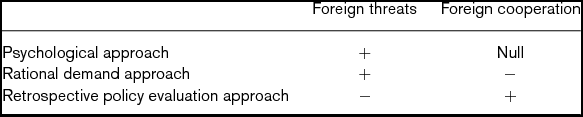
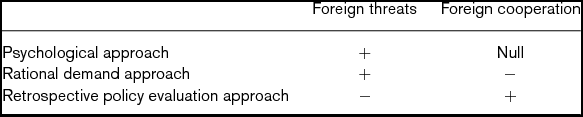
In short, three theoretical arguments highlight the distinctive micro-motives behind the public's reactions to foreign threats and cooperation, and provide the hypothetical links between foreign policy behavior toward Japan and Japanese cabinet support. Table 1 summarizes the hypothetical effects of foreign threats and cooperation on the cabinet approval rating from three theoretical perspectives. In the following sections, the statistical analysis will show which of these three scenarios serves as a plausible explanation for the driving mechanism behind the link between national security environments and Japanese cabinet approval.
Hypothetical effects of foreign threats and cooperation
3. Data: foreign threats and cooperation
To explore the micro-motives behind the relationship between national security environments and Japanese cabinet approval, it is important to explain the data of the independent variables, foreign threats, and cooperation. In international relations, scholars often use two different kinds of data to describe foreign policy behavior. One is the Correlates of War (COW) Militarized Interstate Dispute (MID) data. The MID data provides the directed-dyadic record of conflict behavior, State A's action against State B in a militarized dispute, using a six-point scale of hostility level (Ghosn et al., Reference Ghosn, Palmer and Bremer2004).Footnote 2 The other is a series of event data to describe the directed-dyadic record of both conflict and cooperative behavior. Scholars developed the Conflict and Peace Data Bank (COPDAB) and the World Events Interaction Survey (WEIS) in the 1980s (Azar, Reference Azar1980; McClelland, Reference McClelland1983). Goldstein and others examined the degree of conflict and cooperation and assigned the different weights to each event (Goldstein, Reference Goldstein1992). In the early 2000s, King and Lowe (Reference King and Lowe2003a) developed the Integrated Data for Event Analysis (IDEA) by applying the automated machine coding technique to newspaper articles from Reuters Business Briefing (RBB) newswire.Footnote 3 The MID data capture only interstate conflict, while the IDEA data address interstate conflict and cooperation. The IDEA data more accurately address the concerns and research design of this article than the MID data, and will be used in the empirical analysis.
The IDEA data lend merit to neighboring countries’ behavior toward Japan. The data describe the dyadic events not only at the state level but also at the non-state level. For example, serious anti-Japanese movements in China can be a menace to Japanese companies there, which may be recognized as foreign threats by the Japanese public. The IDEA data also cover 10 million international dyadic events in the post-Cold War period from 1990−2004. Thus, the IDEA data comprehensively describe world events rather than the MID data.Footnote 4
The IDEA data provide the machine-coded information about the event date, the event type, the source of the action, and the target of the action. To measure the degree of foreign hostility toward Japan, each non-cooperative event by Japan's rivals has an assigned value between 0 and 10, and the higher values represent more severe hostile actions.Footnote 5 For instance, the values 3 and 4 are assigned to weakly hostile actions such as a warning and a rejection of a proposal, respectively. The values 7.6 and 10 are assigned to severe hostile actions such as military border violation and military raid, respectively. In the same manner, to measure the degree of foreign cooperative actions toward Japan, each cooperative event by Japan's rivals has an assigned value between 0 and 10, and the higher values represent actions that are more cooperative. For example, an optimistic comment and an apology receive 0.1 and 2.2, respectively, while a substantial agreement gets 6.5 (King and Lowe, Reference King and Lowe2003b: 622– 3). I aggregate the magnitude and the count of foreign non-cooperative and cooperative actions at the monthly level and use them as the measures of foreign policy behavior to check the robustness in the analysis.
I address China, North Korea, Russia, South Korea, and Taiwan as Japan's regional rivals because a series of disputes have been repeated between them.Footnote 6 Some disputes are militarized competitions over territories, such as the Senkaku (Diaoyu) islands and the Liancourt Rocks (known as Takeshima or Dokdo). Others are hostile diplomatic exchanges deriving from the legacy of historical revisionism such as the Yasukuni controversy and the comfort women (sex slaves) issue. Tensions and rivalry continue even though no militarized dispute occurs, and are critical to Japan's national security.
Figures 1 and 2 show a summary of foreign policy behavior toward Japan in the period between 1990 and 2004. As shown in both graphs, Japan received more cooperation than non-cooperation from its rivals. The mean magnitude of foreign threats and that of foreign cooperation are 10.6 and 23.1, respectively. The mean count of foreign threats and that of foreign cooperation are 3.1 and 10.5. Also, Japan's rivals simultaneously make threats against and cooperate with Japan in some months. Foreign threats and cooperation are not correlated with each other.Footnote 7 This leads to the variables of foreign threats and cooperation capturing the different aspects of foreign policy behavior.
Magnitude of foreign policy behavior toward Japan

Count of foreign policy behavior toward Japan
4. The statistical model
The time-series model describes how Japanese public's reactions to national security environments cause instantaneous shocks in the cabinet approval rating. I examine whether the Japanese public immediately changes their opinions about the cabinet in response to foreign threats and cooperation. The unit of analysis is Japan's national security environment and the state of its political economy in month t. The data cover the post-Cold War period between January 1990 and December 2004. The following model explains the determinants of Japanese cabinet support:
 \begin{eqnarray}
&&{\rm Cabinet}_t \;{\rm = }\;\alpha \; + \;\beta _{\rm 1} {\rm Threat }_{t - {\rm 1}} \; + \;\beta _{\rm 2} {\rm Cooperation }_{t - 1} \; + \;\beta _{\rm 3} {\rm Yasukuni }_{t - 1} \; + \;\beta _{\rm 4} {\rm PM }_{t - 1} \nonumber \\
&&\quad+ \,\beta _{\rm 5} {\rm PM }_{t - 2} \; + \;\beta _{\rm 6} {\rm PM }_{t - 3} \; + \;\beta _{\rm 7} {\rm Unemployment}_{\rm t} \; + \;\beta _{\rm 8} {\rm Incumbent}_{\rm t} \; + \;u_t .
\end{eqnarray}
The dependent variable Cabinett is the percentage value of the Japanese public approval rating for the cabinet in the current month. This is provided by Jiji public-opinion poll data.Footnote 8α is the constant term and ut is the stochastic term.
Two independent variables, Threatt− 1 and Cooperationt− 1, represent Japan's national security environment in the previous month and represent foreign threats and cooperation, respectively, by regional rivals such as China, North Korea, Russia, South Korea, and Taiwan. To explore the causal relationship between foreign behavior and Japanese public opinion, it is necessary to take the endogeneity problem into consideration. Foreign threats and cooperation may change Japanese public support for the cabinet, but at the same time, neighboring countries may target an unpopular cabinet because certain Japanese leaders need to cope with domestic turmoil and cannot handle foreign challenges well. Using lagged variables solved the endogeneity problem.
As discussed in the previous section, I use the IDEA data to capture foreign threats and cooperation in two ways. The data provide the event record of the regional rivals’ non-cooperative and cooperative actions toward Japan, and using Goldstein's scale, weight points are assigned to different events to calculate the monthly scores of foreign policy behavior (Goldstein, Reference Goldstein1992: 376−7). I also aggregate the monthly record of these actions and separately include their magnitude and count in the analysis. These variables are used to reveal public motivations behind the relationships between national security environments and cabinet support.
Several control variables are included in the regression model. The variable Yasukunit−1 describes the prime minister's visit to the Yasukuni Shrine in the previous month. The event provoked strong opposition in neighboring countries, but may have appealed to hawkish domestic constituents. This variable helps examine whether such an action generates a surge of support for the cabinet. The variable is equal to 1 if the prime minister visits the Yasukuni Shrine in the previous month, and 0 otherwise. In the period of the analysis, there are five visits: one by Prime Minister Ryutaro Hashimoto (July 1996) and four by Prime Minister Junichiro Koizumi (August 2001, April 2002, January 2003, and January 2004).
The variables PMt− 1, PMt− 2, and PMt− 3 denote leadership changes in the Japanese government. Some previous works show that the honeymoon period exists immediately after leadership changes, wherein the new prime minister enjoys a short-term surge of public support for the cabinet (Nishizawa, Reference Nishizawa1999; Iida, Reference Iida2005). Once the new prime minister comes into office, the Japanese public believes he is promising. However, such an optimistic belief continues only for a few months because the new prime minister cannot initiate an effective policy in such a short term. The leadership change variables control the honeymoon periods. The variables PMt− 1, PMt− 2, and PMt− 3 equal 1 if the new prime minister comes into power in the previous month, two months ago, and three months ago, respectively, and 0 otherwise. The eight prime ministers that came into office in the period of the analysis were: Kiichi Miyazawa (November 1991), Morihiro Hosokawa (August 1993), Tsutomu Hata (April 1994), Tomiichi Murayama (June 1994), Ryutaro Hashimoto (January 1996), Keizo Obuchi (July 1998), Yoshiro Mori (April 2000), and Junichiro Koizumi (April 2001).
The variable Unemploymentt captures the state of the Japanese economy and represents the unemployment rate in the current month. The literature shows mixed results regarding whether a better economy enhances the cabinet approval rating. On the one hand, Nishizawa (Reference Nishizawa1999) and Maeda (Reference Maeda2011) use the Jiji monthly polls to show that the respondents’ subjective evaluations of their economy determine their support for the cabinet. On the other hand, others find no correlation between the state of the Japanese economy and cabinet approval (Iida, Reference Iida2005; Ohmura and Ohmura, Reference Ohmura and Ohmura2014). If the state of the economy affects public evaluations of an incumbent's policy performance, then a higher unemployment rate will decrease the cabinet approval rating.
The variable Incumbentt is the percentage value of the Japanese public approval rating for the incumbent party in the current month.Footnote 9 The value for a coalition government is calculated with the total support for the parties within the government. Some previous research shows the strong influence of party support on cabinet support (Nishizawa, Reference Nishizawa1999; Iida, Reference Iida2005). Since the prime minister nominated by the Diet appoints the cabinet members, the prime minister's stance reflects the preferences of the incumbent party. People who support the incumbent party are more likely to support the cabinet. Higher incumbent party support is expected to increase cabinet support.
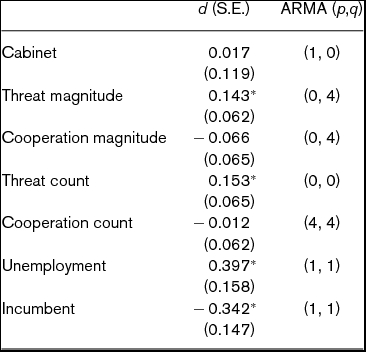
To examine the influence of temporal shocks in the explanatory variables on the temporal shocks in the dependent variable, it is necessary to purge autocorrelation and insure stationarity in the variables. First, it was necessary to run the autoregressive fractionally integrated moving average (ARFIMA) models of the approval rating for the cabinet, foreign threats and cooperation, the unemployment rate, and the approval rating for the incumbent party.Footnote 10 In the ARFIMA (p,d,q) model, p and q denote p autoregressive terms and q moving-average terms to capture the short-run dependence. d is the fractionally differencing parameter to determine the long-run dependence (−0.5 < d < 0.5). Then, it is necessary to calculate the white noise residuals of their respective ARFIMA models that represent only the temporal shocks in those variables. The white noise residuals of those variables are used to estimate equation (1) without the effect of autocorrelation and non-stationarity.
Table 2 shows the ARFIMA model estimates. For each variable, all (p,d,q) models from (0,d,0) to (4,d,4) were estimated and the model with the least Akaike information criterion and the least Bayesian information criterion was chosen as the best one. ARFIMA models purge autocorrelation of the respective variables used in the analysis as much as possible. The use of the white noise residuals reduces the possibility of spurious correlation and allows for conduction of the more difficult test because those white noise residuals have little correlation with each other. The summary statistics of the variables used in the regression model are presented in the appendix.
ARFIMA model estimates
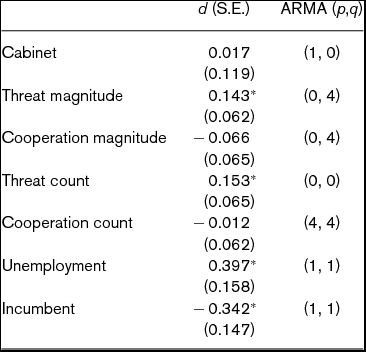
Note: *p < 0.05.
5. Results
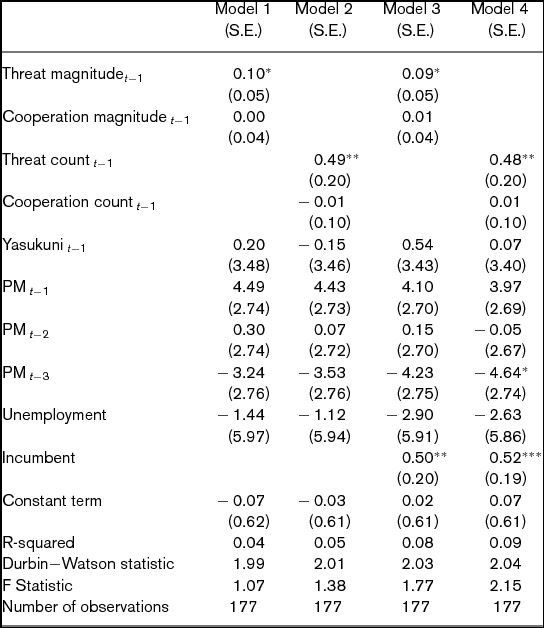
Table 3 shows the estimated results. Equation (1) is estimated using the white noise residuals of the variables, Cabinet, Threat Magnitude, Cooperation Magnitude, Threat Count, Cooperation Count, Unemployment, and Incumbent. Since white noise residuals of the variables have little correlation with each other, the very small coefficient of determination R 2 does not cause sufficient evidence for doubt regarding the plausibility of the results. In Model 1, the magnitude of foreign policy behavior is used to measure foreign threats and cooperation. In Model 2, they are replaced with the count of foreign policy behavior. Then, the approval rating for the incumbent party is added to these models. The re-estimated results are Models 3 and 4, respectively.
OLS model of the Japanese cabinet approval rating
Note: * p < 0.1; ** p < 0.05; *** p < 0.01.
Results are consistent throughout Models 1–4. Only foreign threats have a positive instantaneous effect on the cabinet approval rating. Except for incumbent party support, control variables have no influence on cabinet support. That is, the popularity of the incumbent party helps the approval rating for the cabinet. Note that foreign threats may also affect the approval rating for the incumbent party and cause the colinearity problem. Thus, I focus on the results of Models 1 and 2 and discuss their implications for the Japanese public's motivations behind the relationship between national security environments and cabinet support.
In both models, foreign threats immediately raise the cabinet approval rating. A one point increase in the magnitude of foreign hostile actions generates a 0.10% point increase in public support for the cabinet (Model 1). An increase in the count of foreign hostile actions causes a 0.49 point increase in the cabinet approval rating (Model 2). In contrast, both models show that foreign cooperation has no influence on cabinet support.Footnote 11 The results are consistent with the view of patriotism. Thus, foreign threats stimulate patriotism in the public's mind and encourage the public to support the cabinet.
For further investigation, the actual values of hostile magnitude and count were used to calculate the predicted size of the public's patriotic response to foreign threats. Figure 3 presents instantaneous changes in the cabinet approval rating over time. Two different measures of foreign policy behavior show a similar pattern, which means that the results show the consistency and the validity of these measures. When Japan confronted serious foreign threats, the cabinet approval rating increased by around 4 percentage points only.Footnote 12 This suggests that the size of the patriotic effect is moderate and the Japanese public seems to evaluate the cabinet in a relatively calm manner.
The Japanese public's patriotic responses to foreign threats
In Models 1 and 2, control variables have no influence on the cabinet approval rating. The prime ministers’ visits to the controversial Yasukuni Shrine do not cause an instantaneous surge in cabinet support. The prime ministers’ visits did not appeal to the public and only generated strong opposition from neighboring countries. That is, if the prime ministers attempt to divert public attention, such a tactic hardly works well. This implies that the Japanese public evaluates the cabinet in a relatively calm manner.
Leadership changes in the Japanese government also have no instantaneous effect on cabinet support. Contrary to previous research (Nishizawa, Reference Nishizawa1999; Iida, Reference Iida2005), the new prime ministers have no honeymoon period and the Japanese public has only a neutral view of the new prime ministers, not an optimistic view. Once national security environments are included in the regression model, the honeymoon effect disappears. Since the new prime minister is less experienced and is often targeted by neighboring countries (Kagotani and Iida, Reference Kagotani and Iida2012), the patriotic effect may be confused with the honeymoon effect in previous research. Again, it seems from the data that the Japanese public evaluates the new prime ministers calmly.
Finally, the unemployment rate has no influence on cabinet support. Similar to some previous works (Iida, Reference Iida2005; Ohmura and Ohmura, Reference Ohmura and Ohmura2014), the data show that the Japanese public seems to change the cabinet approval rating without taking the state of the economy into consideration. In other words, there is no correlation between the macroeconomic indicators and cabinet support. However, the public's subjective evaluations of the economy may affect the cabinet approval rating (Nishizawa, Reference Nishizawa1999; Maeda, Reference Maeda2011). Future research is needed to address this gap and explain how the economy influences Japanese public opinion.
In short, only foreign threats generate an instantaneous surge of support for the Japanese cabinet in the post-Cold War period between 1990 and 2004, which supports the psychological hypothesis. In response to foreign threats, patriotism instantaneously increases cabinet support, but its effect is moderate. Leadership changes in the Japanese government also have no instantaneous impact on cabinet support. These findings further understanding of the driving mechanism behind changes in cabinet support.
6. Conclusion
This study explored the micro-motives behind surges in the cabinet approval rating by developing the theoretical framework of the Japanese public's reactions to foreign threats and cooperation. The theoretical development produced three distinctive behavioral hypotheses: psychological reaction, the rational demand for national defense, and retrospective policy evaluation. These allowed for the examination of micro-motives behind Japanese cabinet support using macro-data (not survey data).
The empirical analysis provides two important findings. First, foreign threats generate a short-term surge in the cabinet approval rating, whereas foreign cooperation has no instantaneous impact, which is consistent with the psychological view. This implies that foreign threats invoke patriotism and then immediately increase political support for the cabinet. It also implies that the patriotic effect is short and moderate. Second, leadership changes in the Japanese government have no instantaneous effect on the cabinet approval rating. This implies that the honeymoon effect in previous research may be confounded with the rally effect. This study proposed the theoretical framework applicable to other countries as well as Japan and enhanced understanding of micro-motives behind fluctuations in Japanese cabinet approval.
The results also provide policy implications for foreign leaders. Foreign threats enhance public support for Japan's current security policy position and the US−Japan security treaty, while foreign cooperation generates no preferable shift in Japan's security policy position. Given that Japanese public opinion has a certain influence in foreign policy making (Midford, Reference Midford2011), foreign leaders must take this fact into consideration and refrain from unnecessarily raising tensions against Japan in order to avoid triggering arms races in the East Asian region.
This study focused only on the instantaneous relationships between foreign policy behavior toward Japan and Japanese cabinet support. The results of this study do not denounce the rational demand for national defense or exclude the possibility that retrospective policy evaluation works in the long run. Either of them may cause a persistent effect on changes in political support for the cabinet. The further exploration of the long-run relationship between foreign policy behavior and Japanese public opinion is a promising direction for future research and improves understanding of the link between international politics and public opinion.
About the Author
Koji Kagotani is Lecturer in the Faculty of Economics, Osaka University of Economics. He received his Ph.D. in political science from the University of California, Los Angeles. His research interests broadly cover the linkage between foreign economic policy making and alliance politics, conflict and cooperation in the East Asian region, and the Japanese public's reaction to foreign policy outcomes. His recent works have been published in International Relations of the Asia-Pacific.
Appendix
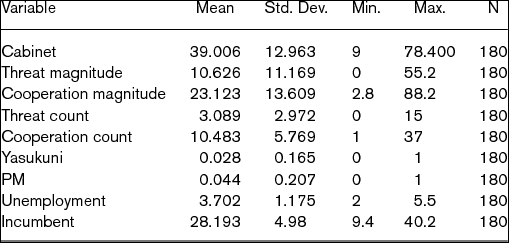
Table 4 presents summary statistics of the variables used in the analysis. The summary is for raw values of the variables. Note that white noise residuals of the ARFIMA models are used in the analysis for the variables: Cabinet, Threat Magnitude, Cooperation Magnitude, Threat Count, Cooperation Count, Unemployment, and Incumbent.
Summary statistics