Credit was a key foundation on which eighteenth-century Britain's economic and geopolitical success was built, and much scholarly effort has been spent in seeking to understand how it operated.Footnote 1 Yet despite this outpouring of interest, the most important of the myriad of eighteenth-century credit relationships—that between the public creditors and the state —has been neglected. We know that the national debt rose significantly over the course of the long eighteenth century, exceeding £800 million by the end of the Napoleonic Wars. We know that the majority of the debt was held by individual Britons. Yet we know little of why those many thousands of public creditors trusted their capital to the eighteenth-century state and how they reached their decisions so to do. This article explores those issues.
The question of trust in personal credit relationships has been addressed in groundbreaking works by Craig Muldrew and Margot Finn. They differ in their chronological focus, emphasis, and sources, but their conclusions are not incompatible. Both emphasize the “persistently social character” of economic relationships, whether they see that sociability embedded in personal and community relations or based on evaluations of the outward signs of personal character.Footnote 2 Systems of credit encouraged individuals to behave in certain ways and marked them out when they did not behave in those ways. There was an acceptance of Daniel Defoe's assertion that even “ill reports” could ruin a tradesman and, once lost, reputation was not easily recovered.Footnote 3
Arguments about the ways in which the need to demonstrate creditworthiness shaped behavior have also been made with regard to the state. In 1723, in the weekly True Briton, the link between reputation and the operation of public credit was explicitly drawn: “There must be an Appearance of Honesty at least, to raise this Credit to any considerable Height, so as to be lasting. The People or Nation that are Ambitious of it, should bear the nicest Reputation in the World; [they must] have every commendable Quality which embellishes Mankind.”Footnote 4 Modern scholars have also been concerned with these questions. Douglass North and Barry Weingast's 1989 article “Constitutions and Commitment” and work that has followed have shown that the need to maintain significant funding streams shaped behavior.Footnote 5 In order to build a reputation as a sound borrower, a state had to offer certain rights to its creditors and thus accept constraints on its own behavior.Footnote 6 It had to maintain a degree of transparency in its financial dealings, allocate revenue streams for the repayment of debts, and, of course, repay those debts on time. In this way, a state built a sound reputation and ultimately reduced the costs of its borrowing.
In the case of the British state, there is evidence to demonstrate that this process was a conscious one. From the turn of the eighteenth century, successive governments sought, when possible, to control and reduce costs, to improve administration, and to pay down the debt.Footnote 7 Even in the midst of the wars against Revolutionary France, Prime Minister William Pitt asserted that while it was necessary to attend to “the vigorous and effectual prosecution of this war,” this should not mean neglect of “what likewise involves in it the permanent interests of ourselves and our posterity”; as such, he pledged that government would continue to set aside funds to honor previous commitments to pay down the existing debt.Footnote 8 Arguably, therefore, the state was behaving like an individual eighteenth-century borrower, albeit on a grander scale, in modifying its actions and nurturing its reputation to ensure that it was able to borrow and to do so on favorable terms.
Yet if we accept that the state modified its behavior to attract lenders, a primary concern of those who study the operation of state finance should be the question of how the public creditor experienced and learned to trust that behavior. Although neglected by economic historians and political scientists, the question is one that has been considered in the work of literary scholars such as Patrick Brantlinger and Natalie Roxburgh. This is hardly surprising, given the outpouring of literature, both satirical and fictional, that accompanied and responded to what P. G. M. Dickson labeled the “Financial Revolution.”Footnote 9 Literary scholars have drawn inspiration from J. G. A. Pocock's 1985 analysis of the Financial Revolution as being rooted in the imaginary. Pocock argued that since government was dependent on debt, and that debt could never be repaid, the state was thus subject to the “investor's imagination concerning a moment which will never exist in reality.”Footnote 10 Patrick Brantlinger similarly identified debt as a step in the “invention” of the nation-state through a “process of fetishistic misrecognition whereby debt, absence, and powerlessness are transubstantiated … into their opposites—into wealth, a plenitude of laws and institutions, and power.”Footnote 11 These ideas about credit and debt would have been understood by eighteenth-century contemporaries. Defoe suggested that credit was “a Consequence, not a Cause; the Effect of a Substance, not a Substance.”Footnote 12 If this analysis is accepted, however, it means that public credit lay “beneath the threshold of representation on its own terms,” and thus it needed to be mediated and understood through social, political, and economic discussion, chiefly in print and most often through fictional and allegorical representations.Footnote 13
Although I agree that fictional and allegorical representations of credit were important in shaping ways of understanding the state's creditworthiness, I explicitly reject the notion that the national debt was an absence, impossible to observe. In this article I offer an alternative view: a view of public credit witnessed, public credit as tangible display, and public credit as public performance. That performance was located at the Bank of England and witnessed by the “citizen creditor.” What follows shows that the Bank of England acted to embody public credit through its architecture, its internal structures, the very visible actions of its clerks and the technologies they used to record ownership and transfer of the national debt, and the accommodation of the financial market within its walls. The Bank, by those means, allowed public creditors to interact with each other and to interrogate the financial stability and reputation of the state in the same ways that they could interrogate the integrity of any potential private borrower.
The “Citizen Creditor” at the Bank
Far too little is known about who owned the national debt during the long eighteenth century. Contemporary analyses were generally polemical and “did not attain great precision.”Footnote 14 Dickson's examination, which remains the only comprehensive attempt to date to define the public creditors, and is confined to the first half of the eighteenth century, found that ownership was concentrated in London and the southeast of England and that the debt was chiefly held by individuals. They came from the church, the army, the civil service, and the professions. Merchants and financiers were significant public creditors and, at the lower end of the ownership scale, artisans, tradesmen, and craftsmen dominated. Women, too, were an important minority of investors in the national debt.Footnote 15 Britain's debts were, therefore in the hands of the “citizen creditor,” a term coined by James Macdonald, who also notes that this phenomenon has disappeared with the rise of the institutional investor. In the twenty-first century, citizens certainly still retain an economic interest in their nation's debt, but financial intermediation dissipates contact between borrower and lender and means that that today's public creditors are “scarcely aware” of their relationship with the state. During the long eighteenth century, what Macdonald calls “the intimate compact between state and citizens” created by debt was obvious and understood.Footnote 16
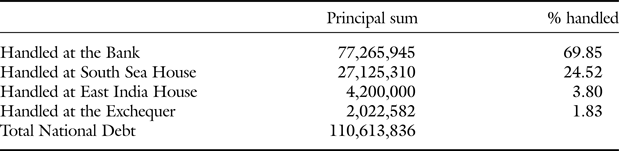
The Bank of England was not the only manager of the national debt; by the end of the Seven Years’ War (1756–63), it was the primary site used by public creditors (table 1). The amount of the debt rose significantly with each subsequent conflict. By 1763, the combined total of the funded and unfunded debt stood at £133 million and, at the end of the war with America, at £245 million. By 1819, following the conclusion of the Revolutionary and Napoleonic Wars, the debt stood at £844,000,000.Footnote 17 The number of public creditors rose in tandem with the outstanding debt. By the mid-eighteenth century, there were around 60,000 public creditors; by 1815, that number had increased to an estimated 250,000.Footnote 18
Agencies Handling the National Debt ca. 1764Footnote 19

Source: J. H. Clapham, The Bank of England: A history (Cambridge, 1966), 103.
Public creditors commonly transacted their business in person. As early as the 1720s, Defoe described the “prodigious Conflux of the Nobility and Gentry from all Parts of England to London, more than ever was known in former Years … [who] find it so absolutely necessary to be at Hand to take the Advantage of buying and selling, as the sudden Rise or Fall of the Price directs.”Footnote 20 It was possible to entrust the purchase and sale of debt and the collection of dividends to another, but as we shall see, the method of recording ownership of debt ensured that using an agent was risky.
The Bank was not just the place where the public went to transact business with the state, although throughout the long eighteenth century, numerous commentators sought to conflate the two. Indeed, long before the Bank had become the primary manager of the national debt, contemporaries sought to enforce its association with the state. A pamphlet published in 1697 set out clearly that any banking operation was required to have a sound foundation, and that the banker himself must be a “careful, cautious and honest Man … [who would not] launch out his money in many Foreign Adventures, or on doubtful Projects, or uncertain Funds.” The writer went on to assert that the only way the Bank of England could acquire such a reputation was through the support of Parliament.Footnote 21 Numerous publications took up the torch and linked the vitality of the Bank to the survival of the national debt and thus of the state. In 1711, in Joseph Addison's Spectator, credit, depicted in feminine form, was observed sitting on a throne at the Bank in a room hung with the documents of the constitution. She was depicted as sickly and assailed by phantoms of Anarchy and the Pretender but thereafter revived by phantoms of Liberty, Moderation, and Prince George.Footnote 22 In this depiction, the Bank and public credit were essentially one, and the strength of the Protestant state was the only thing that could preserve both. By the 1780s, Lord North “could not imagine there was one man living, who, after the long experience of its utility, would deny that it was the duty of parliament to cement and strengthen the connection between the Bank and the public as much as possible.”Footnote 23
Inherent in these discussions was the need to conflate bank and state. Until its nationalization in 1946, the Bank of England was a private company answerable to its shareholders and not a state institution. The contract between bank and state, represented in the Bank's charter, might have been dissolved at a number of points during the long eighteenth century. When the charter was renewed, it was done through a process of negotiation and with both sides seeking to extract favorable terms.Footnote 24 Notably absent from those negotiations was any consideration of the public creditors. Yet as Natalie Roxburgh asserts in her persuasive work on the representations of public credit, the Bank and its continuing management of the national debt did form part of an inferred “contract” between the public creditors and the state. It was a contract that implied “an economy of mutual benefit” and through which the state could be held to account to keep the promises that underpinned public credit.Footnote 25
That the Bank's directors recognized the role attributed to them is clear from in a report produced at the Bank in 1783 by a group of directors in which the authors reminded their colleagues of the its “immense importance,”
not only to the City of London, in points highly essential to the promotion & extension of its Commerce, but to the Nation at large, as the grand Palladium of Public Credit, we cannot but be thoroughly persuaded that an Object so great in itself & so interesting to all Ranks of the Community, must necessarily excite care & solicitude in every breast, for the wise administration of its Affairs, but principally and directly in theirs who are entrusted with the immediate management of them: We deem it therefore superfluous to say a single word to the Court with a view of inculcating a religious Veneration for the glorious fabrick, or of recommending a steady and unremitting attention to its sacred Preservation.Footnote 26
The Bank was therefore the place most persistently associated with public credit and the place at which the majority of public creditors managed their dealings in the national debt. The following sections turn to the question of how the Bank's directors demonstrated the reliability of the trust placed in their institution.
Architectural Messages
In a recent intervention, Tawny Paul has discussed how knowledge of individuals and their worth was used to give substance to lending decisions. In her analysis of North Atlantic trading relationships, Paul emphasizes that creditors who brought debtors to court had a clear sense of their economic worth “from the physical property they owned, to the specie they possessed, to the obligations they were owed, to the wages they derived from their occupations.”Footnote 27 Margot Finn, too, has suggested that creditors sought (not always successfully) “to read a potential debtor's personal worth from their clothing, their marital status, their spending patterns and their perceived social status.”Footnote 28 Equally, the observation and demonstration of creditable behaviors did not always imply face-to-face contact. Indeed, as the economy grew increasingly complex and nationally and internationally integrated, means other than direct observation had to be employed. Paul emphasizes the important shift from an oral to a “written” culture of exchange where, by the mid-eighteenth century, a signature on an agreement or endorsing an instrument of exchange was more trusted than the spoken word.Footnote 29 Pat Hudson has noted the key role that business letters played in establishing reputation at a distance.Footnote 30 In addition to tacit signifiers such as handwriting and orthography, letter writers employed “particular vocabularies” to prove their trustworthiness and help build the communities on which businesses were based.Footnote 31 In all these instances, individuals had to perform their creditworthiness, establishing a reputation through visible displays of probity, careful husbandry, and judicious management of their dealings with others. The Bank engaged in similar forms of performance on its own behalf and on behalf of the state. That performance began with the Bank's footprint on the City's landscape.
The Bank of England began life in 1694 in rented accommodation, first in Mercers’ Hall and, when that proved too small, in Grocers’ Hall. Grocers’ Hall was “a very spacious, commodious place”; it was close to the Royal Exchange, and it served the Bank's purposes well.Footnote 32 It remained there for nearly forty years, only moving to Threadneedle Street in 1734. In doing so it moved away from its rather inconspicuous position in Grocers Alley, a small street off Poultry, to a location that placed it opposite the Royal Exchange, closer to Exchange Alley and on a more or less direct route to the important commercial and financial centers in Cheapside, Cornhill, Leadenhall Street, and Lombard Street.
The Threadneedle Street site was purpose-built and designed by the architect George Sampson. The private space in the interior was larger than the public space, and the pay hall (the commercial public area where London's business community came to make deposits and withdrawals, discount bills of exchange, and exchange specie for the Bank's own notes) was larger than the transfer and stock offices.Footnote 33 In other words, by the 1730s, the Bank of England was still more concerned with its commercial role than its role as part of the fiscal-military state. Nonetheless, there is evidence to suggest that, when designing the new buildings that made up the Bank during the eighteenth century, both its architects and its directors were concerned with the image that its buildings and their adornments presented to the public.
The historian of the Bank's architecture, Daniel M. Abramson, maintains that it was designed along lines that represented corporate virtue, security, and probity and emphasized the institution's connections to the state.Footnote 34 The iconography inside and outside the building underlined those points and particularly the Bank's usefulness to the country and its government. Thus the entrance to the pay hall was topped by a figure of Britannia pouring from her cornucopia the fruits of commerce, while also carrying the shield and spear symbolizing the defense of the nation.Footnote 35 In Pocock's analysis, virtue was assailed by commerce, yet in fact in the image of Britannia, virtue and commerce were inextricably and productively linked.Footnote 36 A set of grand interiors decorated with royal iconography also reassured visitors of the Bank's probity and connections with the state. Royal iconography was notably prominent, especially Henry Cheere's statue of William III depicted as Roman emperor on a pedestal inscribed:
For restoring Efficacy to the Laws,
Authority to the Courts of Justice,
Dignity to the Parliament,
To all his Subjects their Religion and Liberties
And ascertaining them to Posterity,
By the Accession of the illustrious Race of Hanover
To the British Empire;
To that most excellent Prince, William the Third,
The Royal Founder of the Bank.Footnote 37
The scholarly literature that emphasizes the importance of the connections between the public creditors and Parliament asserts that it was the security of a “national” debt under the control of Parliament rather than subject to the whims of the monarch that conferred “credible commitment” that those debts would be repaid.Footnote 38 Nonetheless, the Bank did, and indeed had since its foundation in 1694, emphasized its connections to the royal court as well as to Parliament.
The Bank's buildings were unostentatious, but the Palladian façade was an obvious physical contrast to the high and narrow brick, wood, and stucco buildings that surrounded it.Footnote 39 As such, it attracted attention and was mentioned in tourist guides and travelers’ memoirs.Footnote 40 Thomas Malton found it to be designed to a “tolerable good style, and the parts are simple and bold.”Footnote 41 M. de Colonne, “a foreigner of the first taste,” thought it “with no exception but St Paul's, to be the first architecture in London.”Footnote 42 Although of fashionably classical design, the Bank was an imposing—some might have said intimidating—structure. Because of the need for security, there were no windows facing the street at ground level, so passers-by were presented with an elegant but essentially blank façade. Iain Black labels those windowless walls “exclusionary,” linking them to the Bank's aggressive protection of its privileges and monopoly position.Footnote 43 This view has some merit. The needs of security were relentlessly pursued during the period of expansion the Bank underwent from the 1730s to the end of the eighteenth century. That emphasis is evident in both the design of the new buildings and in the approach to the Bank's neighbors in and around Threadneedle Street. With regard to the latter, the Bank's directors took a number of measures during the mid- to late-eighteenth century to secure the surrounding buildings and land. In doing so, they made much of the need to enlarge the streets and passages around Threadneedle Street, making them more “commodious” for visitors and customers.Footnote 44 But it is clear that risk-management rather than convenience was the priority. When this issue was raised during the 1760s, it was observed that the roads around Threadneedle Street were still too narrow and too close to the Bank, with the risk that, especially in case of a fire, “buildings, papers and property … may be in danger of being destroyed to the irretrievable loss of the publick.”Footnote 45 The effect of the clearance of the streets around the Bank was not only greater security from fire but also a building that stood out in its environment.
Although the building may have been in some ways reminiscent of a fortress, it sent another clear message to those who used its services: capital invested here would be secure. This was certainly a message embedded in images and descriptions of the Bank but it was also a physical and visual experience available to visitors to the institution and its environs. The messages within the Bank's architecture were that it was secure in the sense of being defended and defensible but also secure from the excesses and speculation that were synonymous with finance. The Bank offered an essentially polite façade that tied it to other places of legitimate and necessary commerce, like the Royal Exchange. Commentators certainly linked architecture, especially Palladian architecture, to business integrity. Thus during the 1720s, Robert Morris argued, “So dependent is publick Business in Trading, Merchandize, etc. upon the flourishing Condition of publick Building, that while this is declining, the other must inevitably fall.”Footnote 46 Moreover, the Bank's decision in 1724 to create purpose-built premises was undertaken in the wake of the South Sea Bubble and at the same time that the other great moneyed companies—the East India and South Sea Companies—were doing likewise. In his Tour thro the Whole Island of Great Britain, Defoe described the new South Sea House as “exceeding fine and large” and correspondingly expensive, thus a visible sign that recovery from the crisis of the Bubble was underway.Footnote 47 Equally, as Clare Walcot notes, in contemporary architectural theory the appearance of a building equated to the appearance of an individual “in its potential to reveal character.” Thus Roger North's late seventeenth-century architectural treatise argued, “I can shew you a man's character in his house. If he hath bin given to parsimony or profusion, to judge rightly or superficially, to deal in great matters of small, high or low, his edifices shall be tincted accordingly, and the justness or imperfection of his mind will appear in them.”Footnote 48
While the exterior of the Bank communicated a message of security, the fortress analogy cannot be pushed too far, as its buildings were essentially public spaces. This reality necessitated a careful balance between security and access. The decisions made in the aftermath of the Gordon Riots, which constituted a significant threat to the Bank, are illustrative of this point. From the late autumn of 1780, a military guard was stationed at the Bank during the hours of darkness. The move was resisted by the City's authorities, who complained that it was a violation of its ancient privileges. The directors’ response was curt. The guard, they said, was “highly approved in foreign countries, and there considered as a great security to the property of the Stock-holders … the majority of the Proprietors [shareholders] appeared to be pleased with it.”Footnote 49 The guard, therefore, would stay, and indeed it was not removed until 1973. But when a military engineer told the directors to erect “strong and high” walls topped by “flanking towers sufficiently high to command the roofs,” it was a step too far.Footnote 50 The Bank had to be seen to be accessible to all, during office hours at least. And there is plenty of evidence that despite the attention of numerous doormen and porters, all manner of individuals did enter the Bank. Many sources refer to the crowds and confusion in its public spaces. Thomas Mortimer's advice to visitors to the Bank's transfer offices was to not be “dismayed at the wild uproar, and confused noise which will at first strike your astonished senses.”Footnote 51
Organizational Messages
For visitors, negotiation of the Bank's spaces was complex enough that by the later eighteenth century it was possible to purchase the Vade Mecum, or Sure Guide, which promised information “extremely proper and useful for all persons who have any money matters to transact in the hall of the Bank.”Footnote 52 Porters and doorkeepers were also on hand to assist. They were expected to be “cleanly in their appearance, uniformly respectful and attentive in their Behaviour … [and give] every information to the Public in their Power, and directing them to the different offices.”Footnote 53 Yet, although negotiating the space inside the Bank might have been confusing to first-time visitors, its functions were placed clearly on display. From its early days in Grocers’ Hall, it provided banking in an open forum. Grocers’ Hall, as described by Joseph Addison, allowed the public to see “the Directors, Secretaries, and Clerks, with all other Members of that Wealthy Corporation, ranged in their several stations.” Addison was “not a little pleased” to be able to observe “the Parts they act in that just and regular Oeconomy.”Footnote 54 He was stretching the point, as the Bank's functions, in Grocers’ Hall and later in Threadneedle Street, were spread throughout the buildings and not all open to public view; but certainly here, for the first time, was banking as “public spectacle” in contrast to the more secretive processes of the early goldsmith bankers.Footnote 55
By the later eighteenth century, one of the most obvious of the messages conveyed by the inner workings of the Bank was the scale of the business of managing the national debt. Just seventeen clerks were employed when the Bank opened its doors in 1694. Their numbers had increased to ninety-six in 1734, to more than three hundred during the War of American Independence, and would exceed nine hundred by the early nineteenth century.Footnote 56 This number was more than double that of the white-collar staff of the East India Company, which in 1785 had a staff of 159 clerical workers in London —ten times the numbers employed by the large insurance companies, the Royal Exchange and Sun Assurance companies.Footnote 57 Indeed, the late eighteenth-century Bank of England was undoubtedly the largest private employer of white-collar workers in Britain, if not the world.
By the late eighteenth century, the largest office in the Bank was that which managed business in the 3 percent consols (consolidated annuities), the most ubiquitous and easily transferable of the instruments of the national debt. It is possible to reconstruct its business from the reports of the Committee of Inspection appointed in 1783.Footnote 58 That report shows there were fifty-four clerks at work in the office operating twenty-two ledgers and alphabets, twenty-four dividend books, and forty-eight transfer books.Footnote 59 Their work was specialized, as was the work of their fellows throughout the Bank. It was also coordinated within and between offices to ensure efficient delivery of the service.Footnote 60
Defoe held up the institution as a model of efficiency for those in business to follow, noting that its “business is dispatch'd with such Exactness, and such Expedition and so much of it too … no Confusion, nobody is either denied or delayed Payment … No Accounts in the World are more exactly kept, no Place in the World has so much Business done, with so much ease.”Footnote 61 Lord North in 1781 praised its “prudent management … judicious conduct, wise plans and exact punctuality.”Footnote 62 Punctuality, which equated also to accessibility, was important and noted in numerous publications. Almanacs contained lists of opening hours at the Bank and offices of the other moneyed companies. The Kentish Companion: Or useful Memorandum and Account Book offered in its opening section “An exact Account of the Days and Hours for buying and accepting, or selling and transferring, the several Stocks, or Government Securities.”Footnote 63 The Bank was indeed reliable in this respect. It operated six days a week from 9:00 a.m. to 5:00 p.m. in most offices and was often kept open for business on public holidays, mainly to facilitate commercial customers who wanted to discount bills or exchange or draw notes. It had set hours for the transfers of ownership of stock and for the collection of dividends.Footnote 64 Much effort went into maintaining a prompt service. Clerks in the 3 percent consols office claimed there was “a constant rule in this Office to make no distinctions of persons, but to dispatch every one in the order he comes, as far as they are able to judge.”Footnote 65 Clerks were therefore, outwardly at least, concerned with ensuring that delays were suffered equally, regardless of social status or other distinction.
The Bank's work was also transparent. Its public-facing business took place in open-plan offices that allowed the process of maintaining and recording ownership of the public debt to be observed.Footnote 66 Ledgers were carefully kept and show very few errors or crossings-out, and they could be called upon by customers who wished to observe their account and by notaries and attorneys acting on their clients’ behalf. Indeed, the clerks reporting to the Committee of Inspection emphasized that the notaries who came to inspect the foreign accounts did so daily at around 5:00 p.m. and that they expected to find the records up to date.Footnote 67 As Roxburgh establishes, the positioning of the clerks and their ledgers in the public's view said something about not just the procedures that could be witnessed but also those that were performed behind closed doors.Footnote 68
The Bank was visibly secure not just in its external façade but also in its internal systems. This was particularly necessary because it operated what was known as the “inscribed stock system,” which simply meant that the transfer of any holding out of a stockholder's name was achieved by record in the Bank's books and that the stockholder's title was evidenced only by entries in the Bank's books. No stock certificate was issued, and although receipts were issued, these were only to act as a memorandum for the stockholder. They were in no way legally binding.Footnote 69 The advantages of this system were that it was simple, quick, and straightforward. It fulfilled all the requirements then for the support of a liquid and efficient market. Moreover, no consequence was attached to the loss or theft of a stock receipt, since the Bank held the only legally binding record of ownership.Footnote 70 But it meant that any public creditors entrusting their business to an agent had to be very sure of that agent's good faith. And it meant that the pressure on the Bank to maintain accurate records and to protect those records was tremendous.
Security procedures to eliminate mistakes and prevent the loss of records were thus numerous. Each day, an abstract of all transfers made was taken and put into the mail to be removed from the Bank overnight as a precaution against the loss of the records due to fire or some other accident.Footnote 71 Records that had to remain in the Bank overnight were stored in wheeled trucks that could be easily rolled out of the building in an emergency.Footnote 72 The paper record of the Bank's business, the same paper record that could be observed by the public creditors, was to be protected at all costs. There were certainly gaps in the system, such as the failure to check signatures prior to the transfer of debt, but the majority of procedures were consistent with maintaining the integrity of the record of the public debt while still providing a speedy service to the public. The Committee of Inspection observed that “so many checks [were] established as to render it scarcely possible that an error should be overlooked.”Footnote 73
In order to guard against deliberate manipulation of the records by its clerks, the Bank did its best to create a culture of loyalty. Each clerk at his election was required to swear an oath of fidelity and to commit to keeping the Bank's business private. Technically, clerks were reelected each year and therefore renewed their oaths annually.Footnote 74 But the directors did not rely just on the clerks’ sense of loyalty; each clerk was expected also to provide the Bank with personal security backed by an independent bond guarantor. These bonds started at £500 for junior clerks and rose to a maximum of £5,000, depending on responsibility. The Bank was diligent both in maintaining up-to-date records for guarantors and in pursuing compensation in the event of significant losses resulting from errors or dishonesty.Footnote 75 The directors were also diligent in prosecuting those clerks who committed fraud against the Bank or the public debt. Moreover, the renewal of the Bank's charter in 1742 specifically ensured that any officer or clerk of the Bank who did “secret, imbezil, or run away with any such Note, Bill, Dividend, Warrant, Bond, Deed, Security, Money or Effects … shall suffer Death as a Felon without Benefit of Clergy.”Footnote 76
In every particular discussed above, it is possible to draw parallels between the behavior of the Bank and the expected behavior of individual debtors. In particular, in his Compleat English Tradesman, Defoe dedicated a chapter to the behavior of individuals with regard to the maintenance of accounts, noting, “When I see a tradesman that does not cast up once a year, I conclude that tradesman to be in very bad circumstances, that at least he fears he is so, and by consequence cares not to enquire.”Footnote 77 For Defoe, exacting standards of bookkeeping meant that an individual or business was thriving. He also made the explicit link between diligent bookkeeping and credit, trust, and reputation. It was only those who gave no credit who could afford not to keep records. And those who kept no records could not prove their reputation. Credit depended on strict attention to detail and the recording of title.
The public creditors would have participated in these procedures. They, like the Bank's clerks, were part of the performance of maintaining public credit. But the Bank not only engaged in physical and easily interpreted displays of public credit; for those schooled by Addison's Spectator to look for allegorical representations of creditworthiness, the institution did not disappoint. Britannia became the Bank's symbol at its foundation in 1694, and in addition to being depicted in statuary, her image appeared on all banknotes and on a variety of other documents issued by the Bank and stamped on ledgers, transfer books, and the Bank's gold ingots. The Bank's Britannia would have been seen daily by its clerks, and she was in evidence for those who visited the Bank and those who used its notes, whether or not they visited the institution. Because of the ubiquity of the image of Britannia in other fora, she cemented the Bank's links to both nation and public credit. Her image was used repeatedly from 1688 as an emblem of the Protestant nation and retained a strong connection to monarchy, being associated in particular with Elizabeth I throughout the long eighteenth century.Footnote 78 She was used frequently to depict the state of the nation. Although this association sometimes rendered Britannia vulnerable, the Bank's depictions of her spoke of strength and stability. With her warlike iconography and close associations with trade, industry, and profit, she offered a clear statement of the Bank's aims and their conflation with the goals of the British state during the long eighteenth century. Indeed, Abramson argues that the use of Britannia as the Bank's emblem “might even be read as implying the identity of the Bank of England itself as the nation's protector and provider.”Footnote 79
Britannia's importance as the symbol that most represents the Bank is brought into sharp focus by contrasting her with another dominant female allegory, that of Lady Credit. Britannia remained an exemplary figure and, whether depicted as strong or vulnerable, was always above reproach. Lady Credit, on the other hand, was intensely volatile, one moment your friend and the next turning away from you. Borrowers were warned that you must be “very tender of her for if you overload her, she's a coy mistress—she'll slip from you without any warning, and you'll be undone from that moment.”Footnote 80 Joseph Addison also depicted the “quick Turns and Changes in [Credit's] Constitution” and her tendency to “fall away from the most florid complexion … and wither into a Skeleton.”Footnote 81 Sherman shows that at the fall of a speculative market Lady Credit quickly became depicted as a whore.Footnote 82 This inconstancy was applied not only to the imaginary Lady Credit but to the very real South Sea Company in the wake of the Bubble's bursting in 1720. Thus, one commentator raged, “The Chief Managers of a certain Stock may dress up their Darling Mistress once more, and send her into the World not without a tempting Aspect; but People who have already been Sufferers by their Schemes, will look upon her with a cautious Eye. A fine Lady, who had deceiv'd a Man once, will for the Future be treated as a common Prostitute.”Footnote 83 Another depicted the South Sea Company as having “bewitch'd thousands to fall in Love with her … yet her Lust is not one bit abated; and She runs a whoring after new Lovers every day.”Footnote 84
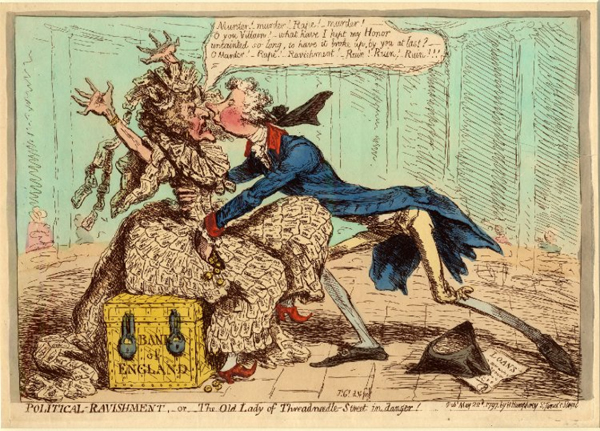
Britannia did not fall in the way that Lady Credit and the Lady of the South Sea fell. Nor did the Bank. In James Milner's Three Letters, Relating to the South Sea Company and the Bank, the great moneyed companies, all written of in feminine form, were assessed with regard to their behavior during the speculative boom of 1720. The Bank, in the final letter, was judged to be run by a “Body of Men not addicted to the Scandalous Tricks of Stock-Jobbing.”Footnote 85 Post–South Sea Bubble, the “Lady Credit as whore” image was used frequently, while the Bank's Britannia matured into the inviolable “Old Lady of Threadneedle Street.” When her image was subverted, as it was in James Gillray's caricature, Political-Ravishment, or the Old Lady of Threadneedle-Street in Danger! (figure 1), the intention was not to condemn but, arguably, to elicit the sympathy and protection of the public. Thus, if public credit was surrounded by and understood through problematic allegories throughout the eighteenth century, here is one, much neglected, that is largely unambiguous: the symbol of Britannia.
James Gillray, Political-Ravishment, or the Old Lady of Threadneedle-Street in Danger!, 22 May 1797 © The Trustees of the British Museum.

The performing of credit at the Bank of England demonstrated to public creditors that their savings were in safe hands—but it does raise the question of how necessary this display was in maintaining confidence. North and Weingast's arguments, in particular, have been powerful in asserting the easy acceptance of public indebtedness, the importance of allocated tax funds in creating “credible commitment,” and the embeddedness of property rights in the eighteenth-century state.Footnote 86 This perspective is misleading. A more careful reading of the relevant scholarship shows that the creditworthiness of the state continued to be contested throughout the eighteenth century. Each successive conflict raised the debate about the nature of the national debt and the likelihood of imminent state bankruptcy.Footnote 87 Tax funds that were supposed to support the debt were often underpaid, even toward the end of the century. In the midst of the War of American Independence, the tax funds allocated to pay the debts incurred stood in arrears to the tune of more than £2 million, and outstanding exchequer bills, issued in anticipation of tax revenues, stood at £4.5 million, while the taxes budgeted to cover these bills were supposed to yield £2.5 million, and it was known that the funds, the land and the malt tax, usually fell short.Footnote 88 Property rights were violated in numerous ways, even if sometimes with the best of intentions. Henry Pelham's conversion of the outstanding debt in 1750, which created the 3 percent consolidated annuities, is a case in point. At that time the interest paid to the public creditors was forcibly lowered and the terms of their loans renegotiated.Footnote 89 The resolution of the South Sea Scheme had required similar sacrifices.Footnote 90 Julian Hoppit has uncovered a number of cases throughout the eighteenth century in which the property rights of British subjects were undermined, noting that “to them there was precious little ‘credible commitment.’”Footnote 91 The integrity of the public funds was therefore at risk and did need to be demonstrated. The Bank of England's role and the transparency, regularity, and efficiency of its management of the debt were therefore very necessary.
Managing the Market
In one part of the Bank, however, the demonstrations of trustworthiness were compromised. Although the habit is of unknown origin, stockbrokers regularly used the transfer offices of the Bank of England, the South Sea Company, and the East India Company as marketplaces.Footnote 92 The Bank of England was the largest of those spaces because it was the primary manager of the state's debt and also because it provided a dedicated space for trading. Robert Taylor's rebuilding of the Bank during the 1760s included the construction of a new set of offices for the transfer of securities and payment of dividends. It also shifted the balance between public and private space. With the new buildings, the amount of public space at the Bank exceeded that of private space. The stock-transfer offices were arranged around a large rotunda, a domed, circular hall, 62 feet high and wide.Footnote 93 The two southern halls served the 3 percent consols, while in the northern halls were registered bank stock transactions and dealings in the 4 percent annuities. The Rotunda quickly became the “Brokers’ Exchange,” a space used by the brokers and jobbers as a marketplace for the buying and selling of the Bank's shares and government securities.
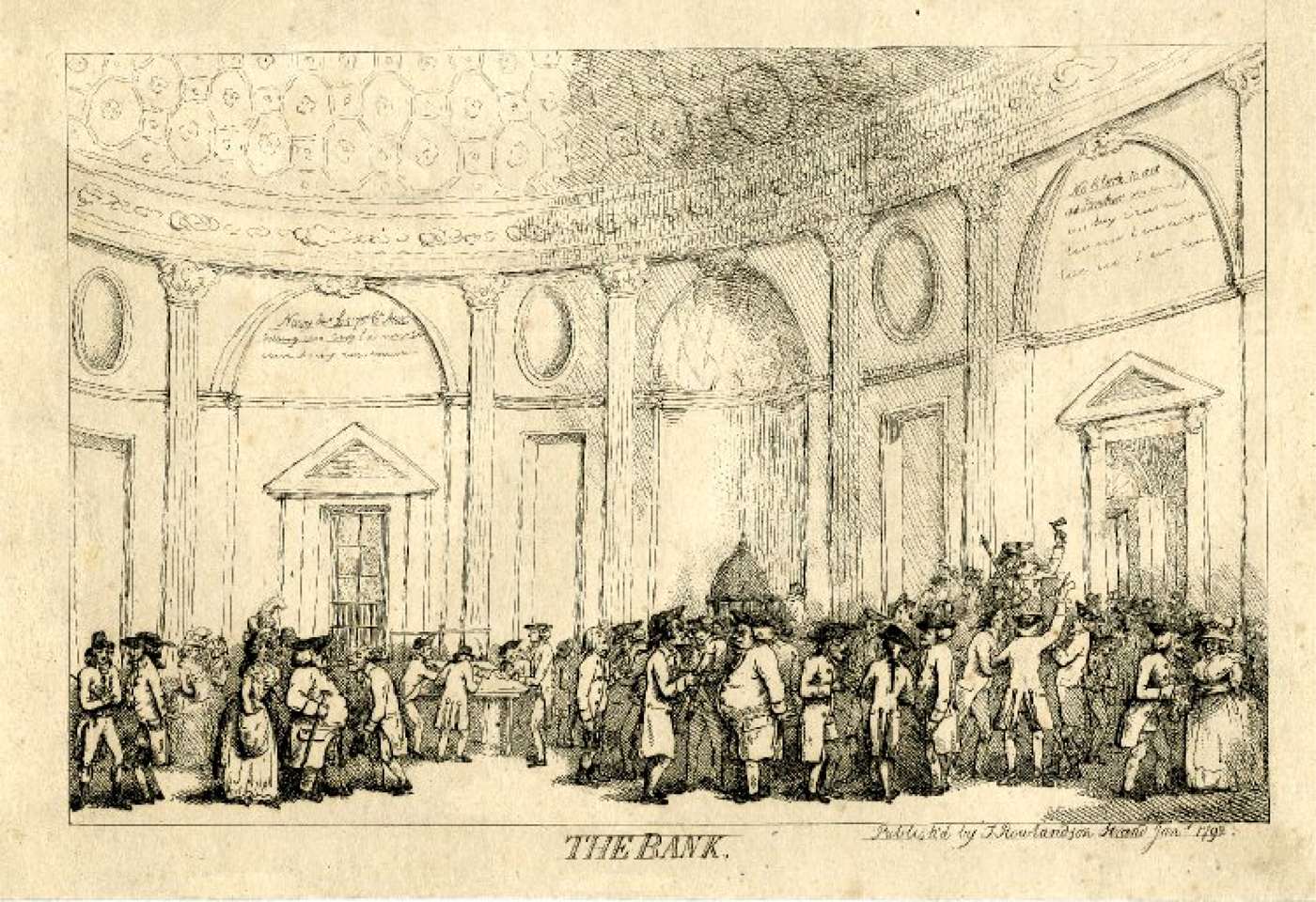
As can be seen in Thomas Rowlandson's 1792 image of the Rotunda (figure 2), The Bank, the new open space contrasted with the chaos of Exchange Alley and its environs in terms of style but much else remained the same: noise and confusion reigned. As one contemporary put it, “A vast crowd of Stock-brokers, Stock-jobbers, and other persons having business in the Funds, daily assemble to make purchases, drive bargains, &c.”Footnote 94 On high-volume days, the business even spilled out into the transfer halls. Rowlandson's image indeed presents a crowded and overwhelming space with pockets of frenetic and undoubtedly noisy behavior. Figures are open-mouthed, suggestive of their calling out their interests. The market is also clearly dangerous to some users, with women often characterized as vulnerable investors, seemingly depicted as alone and assailed by male brokers. The Bank's own records also noted the crowds, the crush, and the cacophonous noise. In the Bank's porters’ written orders, notice was taken of beggars, street sellers, and street entertainers in the Rotunda.Footnote 95 In 1783, Mr. Vickery of the 3 percent consol office recommended the attendance of a number of bank porters to “keep an eye upon persons loitering about.”Footnote 96 Extant sources also contain several mentions of thieves operating in the Rotunda. The minutes of the Committee of Inspection reported the activities of a pickpocket who had robbed a lady of thirty guineas.Footnote 97 The Old Bailey Proceedings offers an account of John Smith, a stockbroker who, while going about his business at the Bank of England at “about twelve o'clock [when] there is generally a very great croud [sic],” was robbed of a silk handkerchief.Footnote 98
Thomas Rowlandson, The Bank (London, 1792), showing a view of the Rotunda. © The Trustees of the British Museum.
Yet if the Rotunda was a place where one might be as likely to lose one's pocketbook as to make a fortune speculating in the stocks, it was nonetheless an exciting and intriguing environment. Indeed, to borrow a phrase from historians studying leisure spaces, it was a place of “social theatre.”Footnote 99 The financial market was a place where brokers, jobbers, speculators, and investors “performed” their roles and could be observed to do so, and where the combination of these performances acted to create what might be described as a theater of public credit, where participants were both actors and audience. This aspect is underlined by the architecture of the Rotunda, which echoed that of places of commercialized leisure such as Ranelagh Gardens, the music room at Vauxhall Gardens, and the domed ballroom at the Oxford Street Pantheon.Footnote 100 It is also reinforced by the fact that the Bank, along with other financial and commercial buildings, was a popular tourist destination. Visitors came to experience one of London's landmarks and view the workings of the financial market. An early nineteenth-century guidebook advised visitors to the Bank, “Here, from the hours of eleven to three, a crowd of eager money-dealers, assemble, and avidity of gain displays itself in variety of shapes, truly ludicrous to the disinterested observer.”Footnote 101 This fascination with the market is also expressed through its presentation in fiction and in the theater. As Inger Leemans suggests, bourses and exchanges provided a rich environment for playwrights, lending them lively, noisy, and fast-paced scenes and many stereotypes to draw on.Footnote 102 Such plays were a popular draw for audiences and performed numerous functions, including informing audiences what speculation was all about, providing explanations of the schemes put forward by speculators, and, of course, furnishing a moral for their audiences when speculations collapsed.
From the Bank's perspective, however, the performance in the Rotunda needed to be managed. The directors were well aware that the financial market was a compromised space, not just a danger to the physical security of its participants but also a danger to the security of the nation because it operated to raise costs during periods of war. Defoe railed, “Whenever any Wickedness is at Hand, any Mischief by the worst of the Nations Enemies upon the Wheel, the Stock Jobbers are naturally made assistant to it, that they become Abettors of Treason, assistant to Rebellion and Invasion.”Footnote 103 Thomas Mortimer later argued that stock-jobbers were responsible for the circulation of false reports and rumors, and he provided long digressions into how unwitting investors could lose money because of the machinations of the rumor-mongers. He warned his readers that it was “impossible for any broker, who is a jobber (and there are but few that are not) to give candid, impartial advice.”Footnote 104
Aware of the apparent dangers of the market, the Bank's directors tried to ensure that its two businesses did not mix. From the Rotunda there was no direct access to the main interior of the Bank and not even to the pay hall. Those wishing to conduct other sorts of business at the Bank—and even its own clerks—had to either enter directly from the street or, if coming from the interior, walk through the Bank's courtyard in order to access the new east wing. The market was kept separate. Nor was anarchy allowed to reign in the Rotunda. The Bank's porters were ordered to suppress any disorderly behavior there “and to preserve peaceable conduct as much as possible.”Footnote 105
Yet the very elements that allowed public credit to be observed at the Bank compromised the institution's distance from the market. The open-plan offices that represented transparency and accountability also allowed brokers who were familiar with the system to go behind the desks and peruse the ledgers whenever they pleased. The clerks protested, but as Mr. Vickery of the 3 percent consols office noted, there were “2 or 3 Gentlemen of the first consideration in Trade who persist in doing so, notwithstanding his [Vickery's] remonstrance against it.”Footnote 106 Most problematic of all, though, was the blurring of the lines between the Bank and the market that flowed from the Bank as the clerks who worked in the transfer offices supplemented their incomes by acting as brokers and jobbers.
Paid involvement in the financial market by its own clerks was banned by the Bank for a number of reasons. It distracted them, led to problems with the jobbers and brokers, and was incompatible with the Bank's attempts to assert its distance from the market. In the 1783 Committee of Inspection's assessment, clerks who did indulge were in danger of having their minds seduced “from regular employment in an easy service, & attaching them to objects inviting though dangerous.”Footnote 107 But they discovered that the rules were commonly flouted. When the committee took testimony from the clerks, Mr. Aldridge confessed that he had now and again acted as a broker but had never jobbed. Mr. Windsor said he had acted as a broker and, although he had not jobbed recently, “he has now & then sold & bought a little stock which he has held for his friends.” Mr. Crockford allowed that “he had made Bargains in Stock for time, both on his own account & on that of his Principals.”Footnote 108
In fact, nearly all the clerks interviewed admitted some involvement in the market. They all also attempted to claim that they did not know of any order against acting as a broker.Footnote 109 This assertion seems disingenuous at best. Samuel Beachcroft's governor's diary, which covered the period from 1775 to 1777, contained a number of references to anonymous informers against clerks acting as jobbers and brokers, suggesting that this kind of activity was brought to the Bank's attention on a regular basis. Footnote 110
The question is whether any of this mattered for the maintenance of public credit, and the answer is that it did but not in the ways that might be imagined. A number of scholars have now argued that the maintenance of public credit depended on the secondary market.Footnote 111 A liquid market facilitated the negotiation of value of the state's offerings, gave the public creditors a forum for expressing their views through the purchase and sale of securities, and kept the state aware of market opinion through price movements. An active secondary market also encouraged a broad range of investors who were willing to make both short-term and long-term investments in the debt. Even during the early eighteenth century, the national debt was used not just by speculators but also for the purposes of creating nest eggs, dowries, and retirement funds and for facilitating intergenerational transfers. This diversity of actors and interests created a market that gave public creditors the assurance that they could liquidate their holdings at will. This was a view clearly understood by contemporary commentators on the national debt, who extolled the virtues of an open market where people could complete their transactions with “ease, readiness and dispatch” and “change their Property without Difficulty, and at a Small Expense.”Footnote 112 That view also offers a stark contradiction to Pocock's argument, discussed in the opening section of this article, that since debt would not be repaid, the nation's debt, and thus the state itself, were subject to the “investor's imagination” of a moment that could never exist in reality.Footnote 113 In fact, it mattered very little for individual investors whether the debt would ever be repaid. Their concerns were simply whether dividends were paid on time and whether their own holdings could be alienated at will. At the Bank, courtesy of its accommodation of an otherwise troublesome financial market, the latter would be realized with ease. In the Rotunda, the “imaginary” that so troubled Pocock became a noisy, aggressive, risky, somewhat unsavory, but remarkably efficient reality.
Conclusion
By 1819 Britain's debts stood at £844,000,000, much of it held by the “citizen creditor.” The relationship between the public and the state was, therefore, the most important credit relationship of this period. Yet the manifest contemporary uses of allegory to describe public credit have led literary scholars—the scholars who have engaged most often with these issues—to characterize public credit as something imagined. Representations of credit certainly mattered. They appeared in many media: novels, the theater, satire, ballads, and poetry. They had impact, especially during times of crisis. They had an educative value, teaching the public how to view credit and introducing ways of understanding the actions of financiers. But we should not neglect the other lessons enacted on the sites where credit was performed, which demonstrated an alternative view of public credit as worthy of the trust and investment of the “citizen creditor.” At the Bank of England, the public could experience, witness, and even be entertained by the operation and performance of public credit. This display told them something about the creditworthiness of the state and, crucially, did so in ways that they were used to trusting when assessing private credit.
At the Bank, the public's gaze was drawn to the crowds symbolizing a body of agreement about the reputation of the borrower. They could observe the physical appearance of the borrower: solid, affluent, but not ostentatious enough to prompt concerns about profligacy; and they could witness the integrity of the borrower, symbolized by the transparency and regularity of the Bank's bookkeeping processes. In some ways this representation was compromised by the presence of the market at the Bank, but in other ways the power of the market reinforced relevant messages. Of course, it was deeds that mattered in the end. The fact that the state continued to pay interest on its debts was the factor that ultimately made its financial promises credible. But the Bank also served as the site where the public creditor and the potential public creditor could witness that in operation. The Bank of England, therefore, in its external and internal architecture, in the iconography that it used, in the way it organized its offices and businesses, and in the perhaps deliberate personification of the Bank as Britannia offered important ways for the public creditors to observe, explore, and test the reputation and creditworthiness of the state.
The institution also offers an important way for scholars of the Financial Revolution to challenge ideas of anxiety around the world of public credit. Read through representations and paper, public credit seems ephemeral and problematic. Read through the Palladian architecture of the Bank and the technologies used by its clerks, public credit is endowed with a permanence and solidity that allows us to appreciate how and why many thousands of public creditors were willing to invest in the British state.