INTRODUCTION
Extreme losses of biodiversity over the last few centuries imply that we have already entered a sixth mass extinction (Ceballos et al. Reference Ceballos, Ehrlich, Barnosky, García, Pringle and Palmer2015). These estimates show just how negatively humans impact other species’ survival. In instances where endangered species are threatened by distinct, well-understood, non-political forces, conservation decisions may be clear (although perhaps still difficult to implement). One example of an uncontested conservation decision was implementing prescribed burns to restore endangered Karner blue butterfly habitats (Lycaeides melissa) (Kwilosz & Knutson Reference Kwilosz and Knutson1999). In other instances, significant controversy exists over fundamental questions regarding how conservation ought to proceed. Controversy over the killing of an iconic African lion in 2015 sparked broader dialogue about conservation among diverse sectors of society and highlighted that the protection of even vulnerable species is not straightforward (Nelson et al. Reference Nelson, Bruskotter, Vucetich and Chapron2016). Ongoing debates in the scientific literature and media document conflict over the extent to which humans and nature should share space and whether we should protect certain species at the expense of others (Miller et al. Reference Miller, Minteer and Malan2011; Soulé Reference Soulé2013). These conflicts may reflect evolving opinions about how people ought to conserve nature and whether or not to intervene when faced with biological invasions or declining populations. Some people emphasize that conservation needs to balance sustainable and effective management with practical, political and financial considerations (Packer et al. Reference Packer, Loveridge, Canney, Caro, Garnett and Pfeifer2013). For some, conservation is a matter of principles that cannot be compromised (Bourdeau Reference Bourdeau2004; McShane et al. Reference McShane, Hirsch, Trung, Songorwa, Kinzig and Monteferri2011). Others argue for considering the moral and financial aspects of biodiversity protection. Serious factions exist within conservation communities over the appropriateness of anthropocentric (i.e., people-centred) versus biocentric (i.e., all life-centred) motivations behind conserving species (Karp et al. Reference Karp, Mendenhall, Callaway, Frishkoff, Kareiva, Ehrlich and Daily2015).
Although debate is often constructive, deep divisions about how to conserve nature can stymy decision making and undermine cooperation (Madden & McQuinn Reference Madden and McQuinn2014). Successful conservation often hinges on political will and public support for policies (e.g., voting, compliance) (Chan et al. Reference Chan, Pringle, Ranganathan, Boggs, Chan and Ehrlich2007; Baruch-Mordo et al. Reference Baruch-Mordo, Breck, Wilson and Broderick2011). If there is significant mismatch between conservation policies and public opinion, decision making and implementation may face serious hurdles in the form of ballot initiatives, litigation or non-compliance (Dickman et al. Reference Dickman, Hazzah, Carbone and Durant2014). Exploring fundamental questions about what to conserve and at what cost has the potential to encourage cooperation among stakeholders with a common pursuit of conservation.
Real-world conservation decisions require many considerations, such as economic evaluations of alternatives and the moral implications of human intervention. Moral considerations concern foundational questions about what, why and how nature might be conserved (Nelson & Vucetich Reference Nelson, Vucetich, Decker, Riley and Siemer2012). Empirically measuring the moral perspectives of people may be a rare endeavour, but is critical for informing policy (Frey Reference Frey, Luetge, usch and Uh2014; Ripple et al. Reference Ripple, Estes, Beschta, Wilmers, Ritchie and Hebblewhite2014). Evidence suggests financial considerations could undermine moral values (Falk & Szech Reference Falk and Szech2013). Other studies measure how valuing species’ existence may encourage willingness to pay for species protection (Kontogianni et al. Reference Kontogianni, Tourkolias, Machleras and Skourtos2012).
One major question at the root of many controversial conservation issues asks whether or not killing animals is justified (Vucetich & Nelson Reference Vucetich and Nelson2007). People have strong opinions about killing wildlife, as evidenced by a recent discourse about whether rhino conservation should be funded by trophy hunting (Conniff Reference Conniff2014). Research has explored attitudes toward hunting, meat consumption and other uses of wildlife (Heberlein & Ericsson Reference Heberlein and Ericsson2005). Individuals can have varying preferences for or against carnivores, rare or exotic species or familiar animals (Kellert et al. Reference Kellert, Black, Rush and Bath1996; Tisdell et al. Reference Tisdell, Wilson and Nantha2005; Kontogianni et al. Reference Kontogianni, Tourkolias, Machleras and Skourtos2012). Preferences can depend on myriad factors such as social identity and experience with and knowledge about species (Kellert Reference Kellert1980; Lute et al. Reference Lute, Bump and Gore2014; Eriksson et al. Reference Eriksson, Sandström and Ericsson2015). For example, while general publics typically supports endangered species conservation, rural residents may view such efforts with suspicion when that species occurs on their land and thus impacts development or other activities (Nie Reference Nie2003). People may accept predators in many contexts, but not when they attack livestock (Browne-Nunez Reference Browne-Nunez2002; Way & Bruskotter Reference Way and Bruskotter2012). Untangling perceptions regarding non-native or invasive species can be particularly complex (Carey et al. Reference Carey, Sanderson, Barnas and Olden2012; Clark Reference Clark2015; Doherty et al. Reference Doherty, Dickman, Nimmo and Ritchie2015). Adding to this body of literature, we explore public opinions about controversial conservation in situations where one animal may be sacrificed to save another.
Empirical inquiry of environmental ethics explores the underlying factors that are relevant to the moral consideration of wild animals (Nelson Reference Nelson2002). These studies have illuminated the factors that are involved in controversy over the lethal control of diverse species (Haider & Jax Reference Haider and Jax2007; Jager et al. Reference Jager, Nelson, Goralnik and Gore2016). Determining whether an individual attributes intrinsic value, or the inherent right of an entity to exist beyond its use to anyone else, to animals can predict their support for conservation (Vucetich et al. Reference Vucetich, Bruskotter and Nelson2015; Lute et al. Reference Lute, Navarrete, Nelson and Gore2016). We explore how participants value not just species, but also individual animals, populations and ecosystems. Decision-makers may benefit from such information in pursuit of agreement on appropriate conservation goals. But differing perspectives do not necessarily mean disagreement; policies recognizing and addressing the plurality of values and interests may enjoy greater public support (Robinson Reference Robinson2011).
In this study, we measure support for conservation strategies in general and related to five case studies that directly pitted one species against another. Our case studies investigated: (1) barred owls (Strix varia) versus spotted owls (Strix occidentalis); (2) salmon (Oncorhynchus spp.) versus California sea lions (Zalophus californianus); (3) caribou (Rangifer tarandus) versus grey wolves (Canis lupus); (4) brown-headed cowbirds (Molothrus ater) versus Kirtland's warblers (Setophaga kirtlandii); and (5) coqui frogs (Eleutherodactylus coqui) versus happy-face spiders (Theridion grallator) (Appendix S1; available online). Each case study reflects a simplified but realistic scenario that is contentious because it pits common, invasive and/or predatory species against endangered, rare and/or economically valued species. When presented with each case study, participants decided whether and how to protect endangered or economically valued species. These case studies are simplified, arguably missing detailed nuances, but reflecting real-world situations where publics have limited information. We chose case studies representing real debates about species management. We included cases where species might be considered similar (e.g., barred and spotted owls) and others where they could be perceived quite differently (e.g., salmon and sea lions). We make no assumptions about comparability between species and seek to understand preferences for certain species and conservation strategies (Robinson Reference Robinson2011; Frey Reference Frey, Luetge, usch and Uh2014). Our objectives are to investigate when and why participants prefer lethal control, habitat protection, both or no action to conserve one species when it faces threats from another. We also explore how various species’ characteristics, decision considerations and socio-demographics may influence policy support. This enhanced understanding can be used to guide decision making and communication strategies in order to engage stakeholders in conservation.
METHODS
Ethics statement
Indiana University's Internal Review Board approved the research, and informed consent was received from all participants. Respondents first read the informed consent statement and, after providing consent, were directed to complete the survey.
Survey
Five case studies were presented in random order to each participant (Appendix S2). Each case study consisted of a vignette in which one species is pitted against another, and the positives and negatives of lethal control and habitat protection were provided. The vignettes mirrored the ways in which publics’ are often first exposed to issues (i.e., media coverage presenting two sides of a debate). Colour photographs of each animal side by side were also presented to help participants visualize the species and increase attention, comprehension and motivation to read the vignettes completely (Brotherstone et al. Reference Brotherstone, Miles, Robb, Atkin and Wardle2006; Houts et al. Reference Houts, Doak, Doak and Loscalzo2006). All photographs were the same size and depicted animals with neutral postures and expressions to minimize bias (Frey Reference Frey, Luetge, usch and Uh2014). The vignettes were designed through an iterative, thorough pretesting process (Appendix S1). After reading the description, participants chose which of the following responses they deemed most appropriate: (1) lethal control of common, invasive or predatory species; (2) habitat protection for endangered, rare or economically valued species; (3) both lethal control and habitat protection; or (4) no action.
Participants then rated how important five different considerations were for their choice: (1) moral: consistency with moral principles; (2) ecosystem: best for the ecosystem; (3) economy: best for the economy, which may include not only financial considerations, but also livelihoods; (4) practical: generally feasible given environmental, financial, political and social limitations; and (5) cost–benefit analysis: maximized benefits and minimized costs. These considerations were not considered mutually exclusive and thus respondents rated each. Then participants agreed or disagreed on a five-point Likert scale with characteristics of each of the two species in sequence, along with an option ‘I don't know’. The characteristics presented were both positive and negative (i.e., attractive, dangerous, endangered, familiar and nuisance). This process was repeated for each of the case studies.
The participants then completed questions assessing their general conservation policy preferences and ascription of intrinsic value. The survey concluded with socio-demographic questions including age, political orientation, gender, education, income and zip code. The complete survey and dataset can be found in the Supplemental Material.
Participants
In May 2015, we recruited 1040 participants via Amazon's Mechanical Turk Internet panel, who completed the survey online. Each participant received a US$1 gift certificate for Amazon.com. Participants were screened by US location and age (≥18 years). The median age was 31 years (compared with 37.2 years across the USA, according to U.S. Census Bureau [2010]), the median level of education was a college degree (35.4% had an associate's degree or higher) and the median family income fell in the US$40 000–80 000 category (compared with US$50 054 across the USA, according to U.S. Census Bureau [2010]). Fifty-six percent of participants were male (compared with 49.2% across the USA, according to U.S. Census Bureau [2010]) and 54% self-identified as liberals, 25% as moderates and 21% as conservatives. These trends may indicate some selection or response bias; like many online surveys, participants tended to be younger and male compared to averages from U.S. Census data (Bell et al. Reference Bell, Huber and Viscusi2011; Ansolabehere & Schaffner Reference Ansolabehere and Schaffner2014).
Statistical methods and analysis
All statistics were conducted in Stata (v.13.1, StataCorp, College Station, TX). Mean composite variables were created for intrinsic value attributions (humans, some animals, all animals, all life and ecosystems), five considerations (moral, economy, ecosystem, practical and cost–benefit analysis) and seven species characteristics (attractive, dangerous, endangered, familiar, nuisance, important to economy and important to ecosystem; ‘I don't know’ responses removed). All composite variables had high reliability (Cronbach's α >0.70).
For each of the seven species characteristics, participants could indicate that they did not know how to evaluate characteristics. A summative index score was created for ‘uncertainty’ about species (i.e., indicating ‘I don't know’ for species characteristics) ranging from 0 to 7, such that 0 indicates the participant never chose ‘I don't know’ for any of the seven characteristics, 1 indicates choosing ‘I don't know’ for one characteristic, and so on.
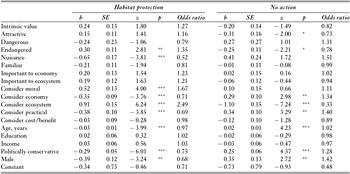
Generalized ordered logistic regressions (GOLRs) were conducted to explore the influence of the intrinsic value attributions, the five considerations and the seven species characteristics (as independent variables using mean composite variables) on habitat protection and no action (separately, as singular dependent variables in each GOLR). To do so, we created summative index scores for agreement with habitat protection policy choices ranging from 0 to 5, such that 0 indicates the participant never chose habitat protection for any case study, 1 indicates choosing habitat protection for one case, and so on. The same process was repeated for no action. Small sample sizes for other response options precluded them from this analysis. All independent variables (the intrinsic value attributions, the five considerations and the seven species characteristics) ranging from 1 to 5 were collapsed to range from 1 to 3 (strongly agree/agree combined, neither agree nor disagree and strongly disagree/disagree combined, respectively) to avoid problems with small n values in some categories (i.e., before collapsing, many in-sample cases had predicted probabilities less than 0) (Williams Reference Williams2006). We used the command gologit2 of Williams (Reference Williams2006). GOLR was used because dependent the variables were categorical (see ‘Results’ section below) and the data violated the parallel lines assumption of ordered logistic models (Williams Reference Williams2006), which states that correlations between variables should not differ based on categories of the dependent variable and that parameter estimates do not vary across cut-off points (Ari & Yildiz Reference Ari and Yildiz2014). GOLR allows assessment of which variables conform to the parallel lines assumption and constrains those accordingly. It also presents multiple models that assign a binomial distribution to the dependent variable: the first model treats the dependent variable as 0 versus 1–5, the second model as 0–1 versus 2–5, and so on. Constrained (i.e., variables forced to meet the parallel lines assumption) and unconstrained models were run and compared with a global test. The final models used the autofit option to estimate the partial proportional odds best fitting the data (i.e., constrained variables that met the parallel lines assumption). Only the model that divides the dependent variable between low agreement with habitat protection (i.e., 0–2) and high agreement (i.e., 3–5) is presented. We performed logistic regressions to explore the factors influencing support for conservation of individuals because Brant tests revealed that data did not violate the parallel lines assumption (Ari & Yildiz Reference Ari and Yildiz2014).
RESULTS
General conservation policy preferences
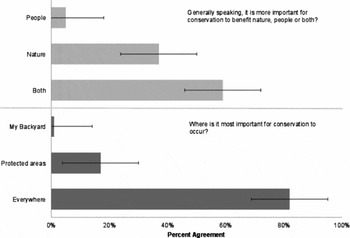
When asked whether it is more important for conservation to benefit nature, people or both, a majority of participants indicated that conservation should benefit both nature and people (Fig. 1). When asked where conservation is most important, a majority supported conservation occurring everywhere and not just in their backyard or natural areas.
Beliefs about general conservation policy (n = 1040). Participants were allowed to choose multiple response options in each category.

A majority supported conservation at all levels (i.e., 72% agreement at local level, 73% intermediate and 81% global). Participants showed high support for conservation policies to protect populations (80%), species (88%) and ecosystems (93%), and moderate support for individuals (57%). A majority attributed intrinsic value to humans (80%), some animals (zoocentric; 91%), all animals (87%), all life (biocentric; 91%) and ecosystems (ecocentric; 83%).
We explored the factors influencing support for the conservation of individual animals. Logistic regression revealed that participants attributing intrinsic value to all entities in nature (b= 0.31; p< 0.05), considered moral principles in conservation decisions (b= 0.33; p< 0.001) and were female (b= –0.28; p< 0.05) were more likely to support the conservation of individuals. The other four considerations (economy, ecosystem, practical and cost–benefit analysis), all seven species characteristics and four socio-demographic characteristics (age, education, income and political orientation) did not relate to support for the conservation of individuals.
Species conservation case studies
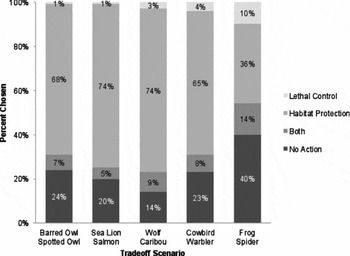
Four of five case studies (barred–spotted owls, sea lion–salmon, wolf–caribou and cowbird–warbler) showed similar patterns of low support for lethal control and high support for habitat protection (Fig. 2; Table S1). The frog–spider case study is a notable exception, with 10% of participants favouring lethal control. For this case alone, participants slightly preferred no action over habitat protection.
Response options for each case study (n = 1040).

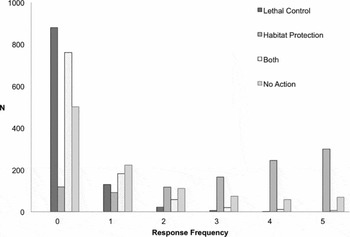
A large majority did not choose ‘lethal control’ (n = 880) or ‘both lethal control and habitat protection’ (n = 761) in any of the five cases (Fig. 3). A relatively high proportion chose habitat protection for all cases (n = 300), and a minority did not choose it for any case (n = 119). Only 70 participants chose no action for all cases, while 502 participants did not choose the ‘no action’ option for any case.
Within-participant preferences for conservation strategy across all of the case studies.

Regardless of case study, participants consistently rated doing what is best for ecosystems as the most important consideration, with moral principles second (Table S2). Practical and economic considerations followed in respective ranks. Participants were consistent in rating species higher in positive characteristics and lower in negative characteristics, regardless of whether the species was the target of protection or lethal control in each case study (Tables S1 and S4).
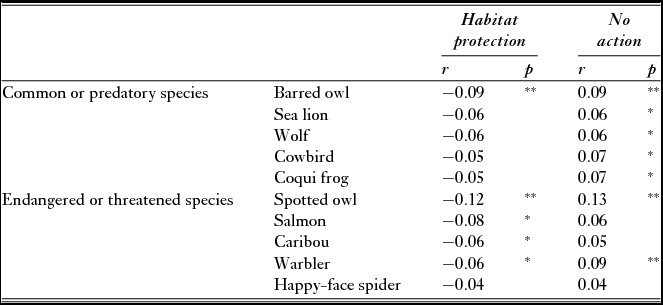
Uncertainty (choosing ‘I don't know’ for any of the seven species characteristics) about the common or predatory species positively related to the choice of no action in every case study (Table 1). Certainty about the endangered species positively related to habitat protection in every case study, except the frog–spider case. Uncertainty across species and cases was positively related to choosing no action (r= 0.09, p< 0.01) and negatively related to habitat protection (r= –0.08, p< 0.01) and other variables (see Supplemental Information).
Pearson's correlations of uncertainty about species and policy choices (n = 1040). Significance levels are indicated: *p < 0.05 and **p < 0.01.

Influence of species characteristics, considerations and socio-demographics on case study policy choices
GOLR revealed that endangered species characteristic, consideration of moral principles and consideration of ecosystems positively predicted agreement with habitat protection (Table 2). Conversely, if participants found the species to be a nuisance, they did not support habitat protection. Economic and practical considerations were also negatively related to habitat protection choice. Older, conservative and male participants were less likely to support habitat protection. Responses of ‘I don't know’ for any species characteristics were not included in the analysis, leading to a smaller sample size for GOLR (n = 1024).
Generalized ordered logistic regression (GOLR) predicting policy choices (n = 1024). GOLR separately tested the influence of intrinsic value attributions, the five considerations and the seven species characteristics (as independent variables using mean composite scores) on (1) habitat protection and (2) no action (as dependent variables in each GOLR using summative index scores ranging from 0 to 5) across all of the cases studied. For all of the variables that were not socio-demographic, the scale ranged from 1 = strongly disagree to 5 = strongly agree, or 1 = not at all important to 5 = very important. Significance levels are indicated: *p < 0.05, **p < 0.01 and ***p < 0.001.

Economic and practical considerations positively predicted ‘no action’ choices (Table 2). Older, conservative and male participants were more likely to support no action. If participants deemed species to be attractive or endangered, they did not choose no action. Ecosystem considerations were also negatively related to no action.
Overall, for both habitat protection and no action, the results show that considering the ecosystem and political conservatism are important factors, as they have large estimates (and small standard errors) relative to other predictors.
DISCUSSION
Among our sample of 1040 participants, we found little acceptance of lethal control of any species, regardless of case study. Older, conservative and male participants emphasized no action over habitat protection, and the majority of participants supported habitat protection over lethal control. Providing an option to both protect habitat and lethally control the common or predatory species did not make lethal control more palatable. The importance of ecosystems and moral principles aligns with participants’ broad and inclusive support for conservation benefiting both people and nature, occurring everywhere and occurring at local to global levels. The results complement studies challenging old assumptions that anthropocentric motivations dominate human–nature relationships (de Groot et al. Reference de Groot, Drenthen and de Groot2011). Participant emphasis on ecosystems aligns with other findings that people, at least among modern industrialized societies, may subscribe to ecocentric worldviews motivated by stewardship, participation or partnership in nature (de Groot et al. Reference de Groot, Drenthen and de Groot2011; Lute & Gore Reference Lute and Gore2014; Lute et al. Reference Lute, Navarrete, Nelson and Gore2016).
Participants consistently rated doing what is best for ecosystems and moral principles as most important in each case study. They also believed that species are important to ecosystems, regardless of whether they are rare or common, predator or prey (i.e., importance to ecosystems was the first or second highest-rated characteristic for all 12 species) (Table S4). Attractiveness across species decreased the likelihood of choosing no action, but did not increase the likelihood of choosing habitat protection. Over half of the participants supported conservation that protected individuals, which was strongly influenced by intrinsic value attributions and moral principles, regardless of species characteristics. These results suggest that concern for individuals was likely linked to moral considerations. Some scholars have argued that shifting traditional conservation narratives from an emphasis on populations to individual animals may garner broader support among diverse publics (Safina Reference Safina2015) – a theme that is consistent with the idea of psychic numbing (Slovic Reference Slovic2007), in which people go to great lengths to save an identifiable victim, but become numb to saving nameless masses.
The case study involving coqui frogs and happy-face spiders provided a notable exception to the pattern of favouring habitat protection. Participants showed higher support for no action (10%) than the other cases (c. 1–4%). This was the only case study involving amphibian and invertebrate species, which are genetically distant from humans compared to the other species in this study. Are preferred management choices different here because people care less about spiders or because eradicating frogs could be considered a ‘lost cause’? The unique attributes of each case study limit our ability to answer this question, but a relevant study suggests that many Hawaiians enjoy the frogs’ presence in their backyards (Kalnicky et al. Reference Kalnicky, Brunson and Beard2014), indicating that perhaps no action is preferred because coqui frogs are considered permanent, albeit alien residents. Given the preferences for no action over habitat control in this case, future research could explore motivations for non-intervention by varying genetic distance from humans (Verbrugge et al. Reference Verbrugge, Van den Born and Lenders2013).
Lethal control of wildlife is not uncommon in response to human–wildlife conflict; as real-world versions of our case studies attest, human intervention often manages certain species or habitats over others. For example, Wildlife Services – the US Department of Agriculture division tasked with addressing damage from wildlife – is reported to have lethally removed >5 million cowbirds from 2006 to 2011 (Levine & Knudson Reference Levine and Knudson2012). Yet diverse publics may rather see no action taken in such cases than lethally removing one species to protect another, even when economic interests are involved. Alternatively, people may want to reap the benefits of such decisions, but prefer not to know about it (an ‘ignorance is bliss’ scenario or cognitive dissonance between ideals and reality) (Thøgersen Reference Thøgersen2004). Thus, generally preferring habitat protection could indicate a public that is averse to entering difficult moral ground and instead prefers less controversial strategies.
The results echo findings related to a common moral dilemma used in moral psychology that asks whether a participant would pull a lever to avert a train and save multiple people but kill one person (e.g., Sacchi et al. Reference Sacchi, Riva, Brambilla and Grasso2014). In this scenario, people are usually utilitarian, optimizing the number of lives saved. But if the scenario is changed, such that they are required to physically push a person onto the tracks to stop the train, people are less likely to kill one person to save many. Although we did not directly ask participants about their willingness to kill an animal, the same aversion to favouring lethal control could be at play. The case studies in this research already have ongoing lethal control programmes; in these and other cases, managers are convinced of the necessity of killing in the name of conservation (Vucetich & Nelson Reference Vucetich and Nelson2007; Mech Reference Mech2010; Dugger et al. Reference Dugger, Anthony and Andrews2011). But moral and ecological issues related to uncertain outcomes, differing worldviews and opposing priorities complicate choices to kill one species for another's sake (Lazenby et al. Reference Lazenby, Mooney and Dickman2014; Bode et al. Reference Bode, Baker and Plein2015; Marlow et al. Reference Marlow, Thomas, Williams, Macmahon, Lawson and Hitchen2015). In some cases, lethal control may be more cost-effective than sweeping habitat protection strategies. Participants indicated that cost–benefit considerations were least important in their policy preferences, but low prioritization could be a luxury of those not in decision-making capacities. A similar study found that interested publics may take idealized approaches to wildlife decision making (Messmer et al. Reference Messmer, Brunson, Reiter and Hewitt1999). Given the similar patterns we found across case studies, participants may rely on default priorities (i.e., ecosystems and moral considerations) and may not be equipped to navigate difficult trade-offs and nuances in specific cases. Research should explore the roles of scientific literacy and familiarity with topics relevant to case study decisions.
This study has several limitations and our results should be interpreted with these in mind. First, we used an Internet sample, which, although diverse, was not representative of the adult US population. Second, the study design was based on participants reacting to vignettes and pictures of five pairs of animal species; thus, the visual appeal of different species may have had an impact on participants’ policy preferences and attitudes. Third, the differences within the paired comparisons include mixing taxa, which may have influenced participants’ preferences towards a specific taxon. Follow-up studies could be designed to tease apart the influences of these limitations on our findings.
CONCLUSIONS
Our study only begins to address the ‘wicked’ problems involved in this area, but it allowed us to investigate preferences for conservation in situations in which publics may not have nuanced knowledge, which may reflect the status quo. It also allowed us to compare preferences across different case studies. In situations with limited information, which conservation strategies do publics support? Our results showed that habitat protection trumps lethal control, yet decision makers currently use lethal control in many real-world cases. These findings suggest the potential for conflict between decision makers and publics in situations that are similar to those presented here. Indeed, we see debate over similar wildlife management policies (e.g., campaigns and advocacy opposing carnivore culls or recreational hunting) (Slagle et al. Reference Slagle, Bruskotter and Wilson2012; Ripple et al. Reference Ripple, Estes, Beschta, Wilmers, Ritchie and Hebblewhite2014; Nelson et al. Reference Nelson, Bruskotter, Vucetich and Chapron2016). In circumstances in which alternatives to lethal control are possible, decisions that reflect public support for habitat protection, avoid lethal control and address moral and ecosystem considerations at multiple levels may be less contested. Further investigation could explore when and why no action is preferred, measure perspectives among decision makers and managers and extrapolate our findings from a convenience sample of Americans to broader populations.
FINANCIAL SUPPORT
Funding was provided by Indiana University's Vincent and Elinor Ostrom Workshop in Political Theory and Policy Analysis and the School of Public and Environmental Affairs.
CONFLICT OF INTEREST
None.
ETHICAL STANDARDS
The authors assert that all procedures contributing to this work comply with the applicable ethical standards of the relevant national and institutional committees on human experimentation and with the Helsinki Declaration of 1975, as revised in 2008.
Supplementary material
To view supplementary material for this article, please visit http://doi.org/10.1017/S037689291600045X