INTRODUCTION
Human alterations to beaches and dunes occur at many temporal and spatial scales, increasing the potential for ecosystem loss on almost every beach on every coastline (Defeo et al. Reference Defeo, McLachlan, Schoeman, Schlacher, Dugan, Jones, Lastra and Scapini2009). Reviews of the changes to landforms and ecosystems on beaches and dunes on developed shores call attention to these losses and illustrate the need to conserve existing natural resources and restore natural processes and habitats (Nordstrom Reference Nordstrom2000; Doody Reference Doody2001; Brown & McLachlan Reference Brown and McLachlan2002; Defeo et al. Reference Defeo, McLachlan, Schoeman, Schlacher, Dugan, Jones, Lastra and Scapini2009). Ways must be found to manage beaches and dunes to allow them to function more naturally and increase the ecological values provided by these natural landforms and habitats.
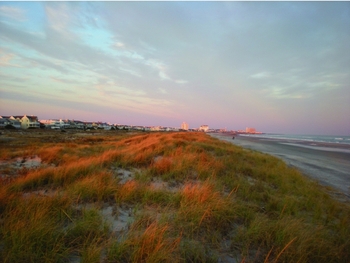
Attempts to conserve or restore beach habitats are often thwarted. Defeo et al. (Reference Defeo, McLachlan, Schoeman, Schlacher, Dugan, Jones, Lastra and Scapini2009) make a convincing case for the need to restrict further development of eroding sandy shores to conserve natural habitats. Our purpose here is to identify ways to overcome impediments to restoring natural features on shores that are already developed, where human-use functions are often the dominant driving forces for managing landforms and habitats. Buyout or abandonment of human infrastructure is not a wide scale option for return to natural conditions under present circumstances (Titus Reference Titus1990; Kriesel et al. Reference Kriesel, Keeler and Landry2004). Our working assumptions are that (1) people will continue to build structures at the shore and modify the beaches and dunes; (2) the major expenditures for public works directly affecting beach and dune resources will be for projects to protect infrastructure and enhance recreation; (3) beach nourishment will continue to be the primary method used for these purposes; and (4) navigation maintenance projects will supply sediment that can, under suitable conditions, be placed on beaches and dunes. We acknowledge the environmental losses that occur in borrow areas, and advocate beach nourishment and beach placement of dredged sediment only if these losses are minimized and environmental benefits in the fill area help compensate for them. The value of nourishment in restoring naturally functioning dunes where natural habitats were completely eliminated has been demonstrated in some locations (Fig. 1). Our purpose is to demonstrate how many of these benefits can be achieved at other developed shores through restoration efforts at a variety of scales.
Dune on the nourished beach at Ocean City (New Jersey, USA) in late November 2009, 16 years after dune building began. The ridge at the far left is the initial protective dune created using sand fences and vegetation plantings. The dune ridge in the foreground is the new foredune created by natural processes. Natural processes were favoured when raking of the nourished backshore was suspended due to piping plover nesting. The new foredune has restricted the width of the backshore and its value for plover nesting, but has resulted in a species-rich secondary dune.

We are examining strategies for implementing, managing, and evaluating restoration projects and research programmes within a time frame of one or two decades. It is assumed that a longer time frame would be unrealistic, given unpredictability in funding year to year, uncertainty about the long-term implications of global change and the time horizon perceived by most stakeholders. A decadal-scale time frame would allow human actions to complement and support natural processes in establishing a natural trajectory for landforms and vegetation to achieve an equilibrium condition. We acknowledge the responsibility of managing for potential global climate changes that will alter sea levels, storm frequency and magnitude, but we recognize the difficulty of specifying the end states of these changes and addressing them in contemporary plans. These changes may make efforts to restore climax landforms and communities moot. Our approach advocates conservation and restoration measures to ensure maintenance of the maximum variety and extent of habitats and species to increase resilience and sustainability in the face of unknown changes.
This article evaluates restoration strategies by (1) identifying how natural features and natural dynamism can be incorporated into designs for shore protection projects; (2) addressing constraints in size or space; (3) minimizing human actions and elements in the landscape; (4) integrating endangered species programmes; (5) overcoming impediments to implementing restoration projects; (6) conducting post-construction evaluations and actions; (7) obtaining public support; and (8) addressing regulatory issues. Examples are provided of locations on the developed east coast of the USA.
INCORPORATING NATURAL FEATURES IN SHORE PROTECTION PROJECTS
The first step in assessing the elements that should go into comprehensive plans for protecting coastal infrastructure and restoring natural habitats is to determine the level of protection required and then to address the environmental enhancements that can be added. Availability of funds and the temporal constraints related to the need to act quickly following storm damage result in variable shore protection responses, which, in turn, determine the potential for new habitat. Basic strategies include: (1) building dunes using earth moving equipment to scrape sand from the beach; (2) minimal beach nourishment for recreational enhancement or emergency protection against storms; and (3) large-scale storm berm and dune profile nourishment (Kana Reference Kana1990). Only the large-scale operations provide the opportunity for enhanced backshore habitat and dune building by aeolian processes. Examples of the types of habitat that can evolve in concert with large-scale projects include incipient dunes, foredunes, backdunes and swales, including moist slacks.
Beach nourishment projects now have increased potential for restoring habitats, given the new guidance for changing the Principles and Guidelines that the US (United States) Army Corps of Engineers (USACE 2000) uses for the formulation of civil works projects. Congress mandated consideration of benefits of beachfill projects beyond storm damage reduction. These benefits include environmental and social impacts and improvements. A further advantage is that new projects now can have both National Economic Development (NED) benefits and National Environmental Restoration (NER) benefits. The NED benefits will be mostly for reduction in storm damage, but increased recreation, decreased public emergency and other monetarily quantifiable benefits are included as well. NER benefits do not have to be monetarily quantifiable, but alternatives are compared using other metrics for ecological outcomes (for example how many acres of a valuable environment are created) and relative cost-effectiveness.
A reasonable working assumption for ocean shores is that the greater the volume of sediment placed between the active shoreline and the seaward-most human infrastructure, the better the protection provided to the infrastructure and the greater the potential for new habitats to form and survive storm wave attack. A near-exponential reduction in cost of storm damages can occur as a result of the greater setback distances of buildings due to beach nourishment (Shows Reference Shows1978; Dean Reference Dean1988, Reference Dean2002). Ideally, the mutual benefits of protection of infrastructure and creation of habitat can be brought forth to make a case for increased funding for larger, more comprehensive nourishment projects that include provisions for periodic renourishment and adaptive management. A dry sand beach and minimum profile volume (Kana Reference Kana, Stauble and Kraus1993) are prerequisites for providing space for a dune to form, space for establishment of species dependent on a backshore location, and a source of sand for dune building.
The significance of a dune has been documented in terms of its value as a barrier to overwash and flooding and as a volume of sediment that can supplement losses from the beach during storms (Kriebel & Dean Reference Kriebel and Dean1985; Thieler & Young Reference Thieler and Young1991). The beach, in turn, is a source of sand for dune rebuilding after storms (Bauer & Davidson-Arnott Reference Bauer and Davidson-Arnott2002; Houser Reference Houser2009). Dry beach width is critical in determining how much sand can be transported from the beach by aeolian processes (Davidson-Arnott et al. Reference Davidson-Arnott, MacQuarrie and Aagaard2005). Determining the balance between sediment in the dune and on the fronting beach and the dimensions of these features in relationship to storm cycles is essential for deciding how shore protection projects incorporating dunes should be designed. If dunes are built by natural aeolian processes, a beach width on the order of tens of meters will be needed (Jackson & Nordstrom Reference Jackson, Nordstrom, Kraus and McDougal1999; Davidson-Arnott et al. Reference Davidson-Arnott, MacQuarrie and Aagaard2005).
Dunes on developed shores can be considerably smaller than dunes on undeveloped shores, but even relatively small dunes can greatly increase storm protection (Nordstrom & Gares Reference Nordstrom and Gares1990). The volume of sand required for a protective dune (for example 25–50 m3 m−1 of shoreline length) is only 5–10% of the volume of a typical beach fill (Nordstrom & Gares Reference Nordstrom and Gares1990; Kana et al. Reference Kana, White, Forman, McKee, Ewing and Wallendorf2002). Dunes built in the nourishment project at Emerald Isle (North Carolina, USA) for example, contained 77 481 m3 out of the 1 412 614 m3 placed by hydraulic dredge (CSE [Coastal Science and Engineering] 2003). Methods of predicting levels of storm protection provided by beaches and dunes exist (Hallermeier Reference Hallermeier and Kraus1987), but many design considerations for providing optimum protection have yet to be worked out (Hanson et al. Reference Hanson, Larson and Kraus2010). Even less is known about how the initial dimensions and subsequent evolution of the designs will affect habitats and how much human action is required to establish and maintain them. For example, moist swales are uncommon in dunes built for shore protection. Criteria are required for creating and maintaining these subenvironments.
Dunes increase environmental benefits of a shore protection project in many ways, but not all of these benefits can be meaningfully quantified and directly built into the benefit-cost ratio. In the USA, the inability to use ecological values in planning, designing and funding federal shore protection projects conducted by the USACE has limited the incorporation of environmental enhancements. The cost of initial stabilizing vegetation can be subsumed within the allocation for shore protection. Only a small amount of sediment is needed to provide protective dunes, and they are easy to construct using sand fences and vegetation plantings. A typical US$ 10 million nourishment project might spend about US$ 100 000 on sand fences and plants (as for example in the project at Isle of Palms, South Carolina, USA; CSE 2008; unpublished project budgets). Planting by volunteers is a low cost effort. If there is no need to build a dune immediately, natural processes will create a substantial dune with no human actions, materials or labour (Fig. 1).
The initial stabilizing vegetation can facilitate recruitment, growth, and fecundity of other species (De Lillis et al. Reference De Lillis, Costanzo, Bianco and Tinelli2005), so this addition will help establish a natural trajectory for subsequent vegetation growth. Diversifying vegetation by planting other native species may be required in some locations. The need to provide habitat for endangered species may make funds available for restoration efforts for specific plants and animals. These species may require customized planting procedures. Developing a convincing case for non-endangered fauna or flora representative of subsequent evolutionary stages or characteristic of subenvironments found landward of protective foredunes (such as shrubs) would require better methods of quantifying the economic benefits or better substantiation of the value of these landforms and species for shore protection.
ACCOMMODATING DYNAMISM IN SHORE PROTECTION DESIGNS
A stable backshore and a linear well-vegetated stable dune was considered the optimum for shore protection in the past, whereas diversity of morphology and surface conditions representing different stages of landscape evolution may be the optimum for sustainability of flora and fauna. Nourishing a beach to a level higher than the natural backshore elevation has been considered a means of protecting landward infrastructure from wave attack, but this practice causes formation of an erosional scarp that restricts movement of fauna between the foreshore and backshore (Jackson et al. Reference Jackson, Nordstrom, Saini and Smith2010). Nourishing the backshore at a lower elevation would allow more natural interaction between waves and the beach but increase the frequency of wave attack of the dune.
The extent to which a landform built for infrastructure protection should be allowed to be dynamic is difficult to address. Protective dunes built where sediment inputs are not restricted can evolve into naturally functioning dune fields with increased levels of protection and increased natural values (Fig. 1; Vestergaard & Hanson Reference Vestergaard, Hansen, Carter, Curtis and Sheehy-Skeffington1992). Protective dunes built where sediment inputs are restricted can experience die back of planted vegetation due to lack of burial (for example Ammophila spp.), creating a bare surface cover (Nordstrom et al. Reference Nordstrom, Gamper, Fontolan, Bezzi and Jackson2009a). Threats to the integrity of the dune as a barrier to overwash and flooding are more critical on eroding shores fronted by narrow beaches, and promoting dynamism in those locations may be undesirable.
On an undeveloped coast, one location may be evolving toward a climax stage, while another location may be undergoing rejuvenation to a condition representative of an earlier stage. Thus, natural environments at all stages may be represented along the coast, albeit at different times and places. This process of substitution does not necessarily occur on a developed coast, where landscape evolution or rejuvenation may be prevented by human desires to maintain a specific condition. Dynamism may have to be restricted to smaller scales that are acceptable to managers and incorporated as enclaves within larger, more stable landscapes.
Design of beaches and dunes for shore protection requires quantitative predictive capability (Hanson et al. Reference Hanson, Larson and Kraus2010), which is rendered more difficult by adding an element of dynamism. Nourishment projects should be designed with berms that match the natural elevations for the area, which requires site-specific information. This would require a dune to provide the backup protection against major storms. Guidelines exist on minimum dune elevations, volumes and cross-shore areas, such as the Federal Emergency Management criterion of 50 m2 above the 100-year storm still water level and seaward of the dune crest (Mauriello Reference Mauriello, Magoon, Converse, Minor, Tobin and Clark1989). Berms then need to be maintained at some minimum width to allow the dunes to survive.
Greater detail must be provided on the cross-shore movement of sediment and its role in the coastal sediment budget than in the past if protective dunes are allowed to be more dynamic. Increases in offshore and onshore aeolian transport can be expected if common stabilizing measures, such as sand fences and vegetation plantings, are not installed to hold sand in place, if vegetation is removed to rejuvenate overstabilized landscapes, and if minor blowouts are allowed to evolve. Practical rules of thumb for estimating changes in dune volume, elevation, morphology and migration rates or location on the cross-shore profile are needed to anticipate the effects of manipulations suggested to improve conditions for biota as well as for protection and recreation.
Dunes can be made morphologically diverse yet still provide acceptable levels of protection if sufficient sediment is added in the appropriate shape during nourishment projects. Surface variability can be built into dune construction by artful bulldozing or by using sand fences and vegetation plantings to create a more undulating topography, with sparsely vegetated or bare patches alternating with well-vegetated stable patches. The moist slacks that develop between dune ridges in natural dune fields are uncommon on dunes maintained as massive single ridges for shore protection. Slacks can be created by careful placement of sand fences. It is not always clear whether restoration of these naturalistic elements should be built into the original designs, added at later stages, or allowed to evolve naturally to achieve a new equilibrium. Another difficulty is predicting whether blowouts in the dune will evolve to the point that they threaten the integrity of the dune crest elevation or create inadequate dune volumes alongshore.
Dunes can be built around an erosion resistant core, such as clay, geotextile fabric or gabions (d'Angremond et al. Reference d'Angremond, van den Berg, de Jager and Edge1992; Dette & Raudkivi Reference Dette, Raudkivi and Edge1994; Headland Reference Headland and Hughes1992; Headland et al. Reference Headland, Alfageme, Smith, Kotulak, Kraus and Rosati2007). These cores serve as backup protection where sediment supply or space is too limited to offer protection during a severe storm or series of storms, but this alternative could also be used to ensure a minimum level of protection for dunes designed with surfaces expected to evolve naturally. The significance of these cores to movement of groundwater, elevation of the water table, development of soil and effect on biota has not been evaluated. Greater knowledge of the role of natural processes in the evolution of these hybrid landforms is required to better manage them for their ecological value.
Differences in beach and dune widths and beach/dune interactions result from longshore differences in beach raking, construction of sand fences and human manipulation of the longshore sediment budget by shore protection structures and selective use of beach fill. These different spatial constraints greatly complicate the application of general models of beach and dune change (Hanson et al. Reference Hanson, Larson and Kraus2010). Increasing recognition of the role of oblique winds in the dune sediment budget (Arens Reference Arens1996; Bauer & Davidson-Arnott Reference Bauer and Davidson-Arnott2002; Ruz & Meur-Ferec Reference Ruz and Meur-Ferec2004) and the increasing fragmentation of developed coasts into discrete management units place new emphasis on the need to evaluate and address alongshore linkages.
ADDRESSING CONSTRAINTS IN SIZE AND SPACE
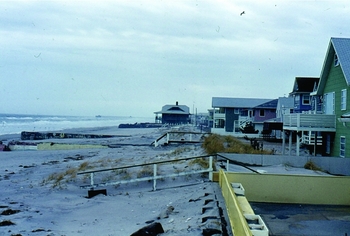
Erosion on the seaward side and reduced capacity of beaches and dunes to migrate landward due to development is considered the major threat to sandy beach ecosystems (Defeo et al. Reference Defeo, McLachlan, Schoeman, Schlacher, Dugan, Jones, Lastra and Scapini2009; Fig. 2). Dune fields that form under natural conditions and lack spatial restrictions are stable on their landward side, favouring growth of stable vegetation communities with diverse species (Ehrenfeld Reference Ehrenfeld1990). Dunes in developed areas are often truncated by human infrastructure and may lack this natural diversity. Landward growth of the dune is often considered undesirable because of the nuisance of wind-blown sand, the threat of inundation of houses, and the consideration that dunes that migrate onto private properties can cause the land to be placed in a more restrictive management zone. Controlling dune migration by employing barriers to sediment movement or removing aeolian deposits from private property often results in a distinct linear boundary between nature and human habitation. Little attention has been devoted to identifying proper ways of managing the landward growth of dunes by demonstrating the value of extending natural habitats into human-occupied areas.
Ocean City (New Jersey, USA) in 1974, showing the narrow backshore, lack of foredune, and vulnerable nature of houses prior to the beach nourishment project (resulting in the beach identified in Fig. 1).

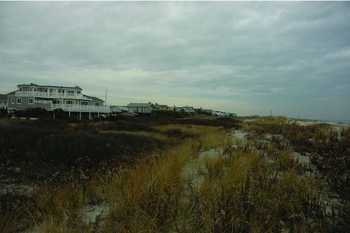
Naturally-evolving beach/dune gradients that are truncated on the landward side may represent only the incipient dune/pioneer plant subenvironment of a fully-developed wider dune field. This kind of truncated gradient would provide habitat for beach-nesting birds, seed sources for backshore species, food for fauna, and manifestations of the cycles of growth and destruction that underscore the dynamic nature of natural coasts. The greater diversity of vegetation found in wider natural dunes could only be represented in these spatially restricted environments if dunes are artificially rebuilt and growing conditions are enhanced by creating a relatively stable surface that is protected from inundation by sand, salt water and salt spray. Artificially building and maintaining a higher protective dune backed by low moist and dry zones using sand fences or bulldozing can create a cross-shore environmental gradient with greater species richness for a given space (Nordstrom Reference Nordstrom2008; Fig. 3). At issue is whether allowing a naturally functioning truncated environment with fewer species to form is preferable to using human efforts to artificially create and maintain a gradient with more of the habitats and species lost through development.
Avalon (New Jersey, USA) in 2006. The dune ridge on the left was created by direct placement of artificial fill. The ridge on the right was created by aeolian accretion at sand fences. The seaward ridge protects the swale and landward ridge from sand inundation and salt spray, contributing to greater species richness in those environments. The site provides residents and visitors a spatially restricted sampler of many of the features that would be found in a wider natural gradient.

Beach nourishment and dune building do not automatically favour habitat creation. Nourished beaches may be built too high to allow natural wave and swash processes to rework the backshore (Jackson et al. Reference Jackson, Nordstrom, Saini and Smith2010). Sometimes dredged material used as an opportunistic source of fill is placed without sufficient regard to elevation and slope. Exotic sediments may be introduced, and they can change the morphology, chemical composition, characteristic species and evolutionary trend of the beach or the dune (Baye Reference Baye and Davidson-Arnott1990; National Research Council 1995; Speybroeck et al. Reference Speybroek, Bonte, Courtens, Gheskiere, Grootaert, Maelfait, Mathys, Provoost, Sabbe, Steinen, van Lancker, Vincx and Degraer2006). Dunes are often built as linear dykes by earth-moving equipment rather than being allowed to grow more slowly by aeolian processes. It can be argued that restoration of beach and dune habitats in locations where they have been lost or truncated is best accomplished by restoring the sediment volume on the beach using grain size characteristics similar to native sediments and then allowing natural processes to re-establish landforms and biota. At issue is whether a dune of sufficient size can form in time to protect against subsequent storms. Accelerating the evolution of the dune by means of vegetation plantings provides some advantages, but better regional and site-specific guidance on what, when, where and how to plant is appropriate. Identification of factors causing dieback of vegetation planted on artificially created dunes through post-construction studies would help anticipate problems with new projects.
Beaches and dunes can be conserved by designating areas where recreational uses are limited to nature appreciation and low-intensity human uses such as walking, swimming and sunbathing, which do not require structures. Many jurisdictions have natural enclaves adjacent to intensively used beaches. These units put nature within easy access by visitors. Free interplay of natural processes in these areas reveals the dynamic nature of coastal landforms, which may give visitors a better appreciation of the hazards of placing human infrastructure on them. There may be a limiting minimum size for conservation success in undeveloped enclaves due to restrictions in inputs of sediment or recruitment of biota from adjacent developed segments or due to incursions by species adapted to humans, such as dogs, feral cats and exotic vegetation. Attention to these edge effects will be necessary to identify spatial limits to success of small restoration and conservation areas and management practices for them.
Some species will fare better than others in spatially restricted natural areas. Competitive interactions among plants may alter species composition and densities. Arrival of new native or exotic species, whether they escape from adjacent private landscapes or result from natural ecological processes, will alter composition. Exotic invasions may be especially problematic because their characteristic rapid and aggressive expansion often leads to local extirpation of native species. Fauna may be more problematic than plants because of their mobility. Increases in predators can be devastating to the survival rate of eggs and chicks of ground nesting birds. Some problems may be overcome through intensive management, such as using predator exclosures (Maslo & Lockwood Reference Maslo and Lockwood2009), but solutions may be costly.
Plant and animal species that prefer overwash areas and low sparsely vegetated dunes may reap limited benefits. Spatially restricted natural areas may be designed with maximum numbers of species as a goal, but these areas may require intensive management to reduce or eliminate the effects of invasive plants and predators. Demonstrating the need for timely beach nourishment for increasing the size of natural habitats and maintaining them would strengthen arguments for action to address hazards to human infrastructure, but the linkage between these two purposes should be better formalized.
Evaluation of landforms and habitats that evolve in natural enclaves that are not targets of specific restoration efforts provides considerable insight to the potential for intentional restoration efforts elsewhere. These opportunistic habitats can be found in locations where former land uses were abandoned or suspended. Many of the effects of previous use will persist, but many locations will evolve along natural trajectories. The resources within these locations indicate what can be achieved without expensive restoration efforts. This information is important because of the difficulty of identifying in advance what, when and how to measure success in small restoration sites in developed areas.
MINIMIZING HUMAN ELEMENTS IN THE LANDSCAPE
Beaches and dunes cannot evolve to subsequent stages in developed areas without establishing controls on detrimental human actions. Some of these actions can be directly destructive, such as raking the beach, driving on the beach, or walking through the dune. Other actions can initially seem more benign but can introduce undesirable side effects. These actions include erecting sand fences and other structures, using exotic vegetation for landscaping on private properties, and altering dunes to obtain views of the sea from shorefront buildings and promenades. The image of a landscape influences attitudes about nature and the acceptability of human actions within it. Visible evidence of human use within natural environments can be interpreted positively or negatively depending on attitudes about the degree to which the uses are compatible with a coastal setting and the degree to which humans and nature should directly interact. Structures such as fences and elevated walkways may not represent best practice in environmental management or communicate good environmental goals if they are unnecessary or placed out of context.
Raking to remove litter is well documented as an environmentally damaging action that eliminates habitat, restricts foraging by fauna and prevents development of incipient dunes (McLachlan Reference McLachlan1985; Nordstrom et al. Reference Nordstrom, Lampe and Vandemark2000; Colombini & Chelazzi Reference Colombini and Chelazzi2003; Dugan et al. Reference Dugan, Hubbard, McCrary and Pierson2003). Beach wrack can provide traps for sediment blown across the shore (Dugan & Hubbard Reference Dugan and Hubbard2010), so the role of wrack in the sediment budget must be understood to make informed decisions about when and where to rake. The demand for removing natural litter is largely an issue of public perception of inconveniences related to insects, smells and aesthetics. Demand for removal of cultural litter may be due to real health issues for humans and wildlife. Alternatives for wrack management include (1) removing the anthropogenic litter manually and leaving the natural litter; (2) leaving some, but not all wrack lines on the backshore; (3) cleaning beaches only during peak tourist use; and (4) leaving some longshore segments unraked to develop as natural enclaves (Nordstrom et al. Reference Nordstrom, Lampe and Vandemark2000). These alternatives have yet to be evaluated.
Limited and carefully-planned raking and grading have been suggested or used as experimental pro-environmental measures to eliminate dense vegetation and return to an earlier evolutionary state (van Boxel et al. Reference van Boxel, Jungerius, Kieffer and Hampele1997; Arens et al. Reference Arens, Slings and de Vries2004; Bocamazo et al. Reference Bocamazo, Grosskopf and Buonuiato2011). Adaptive management strategies like these can create new opportunities for restoring habitat, but the side effects are poorly understood and their application to spatially restricted environments has not been tested.
Vehicles driven on beaches can reduce faunal populations and can pulverize and disperse organic matter in wrack lines, thereby destroying young dune vegetation and losing nutrients (Godfrey & Godfrey Reference Godfrey and Godfrey1981; Moss & McPhee Reference Moss and McPhee2006; Foster-Smith et al. Reference Foster-Smith, Birchenough, Evans and Prince2007). Vehicles driven in and just seaward of dunes can severely damage vegetation (Anders & Leatherman Reference Anders and Leatherman1987; Godfrey & Godfrey Reference Godfrey and Godfrey1981). Only a few vehicle tracks on a beach can create an unnatural landscape image that can undermine attempts to instil an appreciation of the beach as a natural environment. Driving on the beach is unnecessary for access to recreation sites in most developed municipalities because shore-parallel roads are available. Undeveloped enclaves without roads are often so small that vehicle access is not necessary. The biggest challenge in developed areas where use of vehicles for recreation is prohibited may be for controlling use of municipal vehicles for patrolling the beach and removing refuse. Instituting a haul-in/haul-out policy for garbage generated by beach visitors would eliminate the need for refuse receptacles on the beach. Vehicles used for public safety could be confined to emergency operations. Driving on the beach is usually more a luxury than a requirement. Codes of best practices exist for use in regions where recreation sites are far from access roads and vehicle use is necessary (Priskin Reference Priskin2003).
Sand-trapping fences are used to build dunes when insufficient time is available to allow them to form by natural processes alone. The same types of fences may also control pedestrian traffic and demarcate property. Guidelines for use of fences have proliferated on web sites, but recommendations for the most effective fence configurations vary among sites (Miller et al. Reference Miller, Thetford and Yager2001), and considerable differences can occur alongshore in the number and configurations of fences (Grafals-Soto & Nordstrom Reference Grafals-Soto and Nordstrom2009). The degree to which fence placement should be standardized is not clear, especially since configurations that accommodate movement of fauna (by including gaps alongshore) may be incompatible with configurations designed to provide flood protection (by creating a continuous barrier).
Once a foredune has been initiated, placing additional fences on the foreslope or at the dune toe may be unnecessary. The dune becomes the obstacle that traps sand, so adding fences has little shore protection value (Grafals-Soto & Nordstrom Reference Grafals-Soto and Nordstrom2009). Fences placed too far landward will not fill and will remain conspicuous in the landscape. Sand trapping fences are routinely installed and removed in some locations on a seasonal basis (Ruz & Meur-Ferec Reference Ruz and Meur-Ferec2004; Grafals-Soto & Nordstrom Reference Grafals-Soto and Nordstrom2009). Programmes for removal should be extended to locations where fences remain visible well after they become non-functional in their intended use. Controlling pedestrians can be accomplished with symbolic fences or signs that would not interfere with transfers of sediment or biota (Grafals-Soto & Nordstrom Reference Grafals-Soto and Nordstrom2009). Vegetation that discourages traffic, such as green briar, could be planted and signed in lieu of fences.
Elevated walkways and unvegetated surface paths are the two principal means of obtaining access to the beach through the dune. The effects of paths on biota have been well studied (Mather & Ritchie Reference Mather and Ritchie1977; Boorman & Fuller Reference Boorman and Fuller1977; Eastwood & Carter Reference Eastwood and Carter1981; Andersen Reference Andersen1995), but the ecological consequences of raised walkways are poorly known. Raised walkover structures are visually intrusive. Paths on the surface are less conspicuous, and they allow sand to pass and provide a fire break. These other aspects should be considered in decisions about which method of obtaining access should be employed.
Some exotic plant species, such as Asiatic sand sedge (Carex kobomugi), may be promoted as sand stabilizers because of their ability to survive sand inundation, resist diseases and pests, or tolerate trampling (Wooten et al. Reference Wooton, Halsey, Bevaart, McGough, Ondreicka and Patel2005). Others, such as Japanese black pine (Pinus thunbergii), may be selected for aesthetic reasons as landscaping elements on private properties (Mitteager et al. Reference Mitteager, Burke and Nordstrom2006). Many exotic plants require more intensive human action than native plants (including fertilizing, watering or pruning), and they change the nature of habitats and faunal interactions within them. Exotic vegetation initially planted on private properties can invade publicly managed dunes seaward of them. In New Jersey, Japanese black pine now occupies the niche that would be occupied by eastern red cedar (Juniperus virginiana). Homeowners should be encouraged to use native species for landscaping. Many plant nurseries have native species available from the genetic stock of at least regional coastal populations. These species will perform better with less management effort and will reduce or eliminate the need for invasive species control. Removal of invasive species and restoration of native species is often difficult to accomplish and costly (Wiedemann & Pickart Reference Wiedemann and Pickart1996; Wooton et al. Reference Wooton, Halsey, Bevaart, McGough, Ondreicka and Patel2005), so finding ways to prevent planting of exotics on private properties in the first place is desirable.
INTEGRATING ENDANGERED SPECIES PROGRAMMES
Endangered species provide an indication of threats to the health of an ecosystem. Losses in the populations of piping plovers (Charadrius melodus), least terns (Sterna antillarum) and seabeach amaranth (Amaranthus pumilus), for example, reflect a reduction in the number of wide low sparsely-vegetated overwash areas and blowouts in dunes caused by human attempts to stabilize the coast. The most desirable option would be to re-establish the natural areas favoured by these species, including overwash areas, but return to the high levels of dynamism in natural systems is typically considered unacceptable in developed areas. Although some species (such as piping plovers in some parts of their Atlantic Coast breeding range) may nest on newly-nourished backshores (Nordstrom et al. Reference Nordstrom, Lampe and Vandemark2000; Cohen et al. Reference Cohen, Houghton and Fraser2009), these habitats are suboptimal and often suffer low productivity while requiring extensive management to reduce conflicts with human recreation and human-associated predation (Loegering & Fraser Reference Loegering and Fraser1995; USFWS [US Fish and Wildlife Service] 1996; Elias et al. Reference Elias, Fraser and Buckley2000; Cohen et al. Reference Cohen, Houghton and Fraser2009).
Requirements are imposed by resource agencies to promote numbers of a species. Comments at public meetings indicate that these requirements are often viewed as onerous by residents. In the worst case, the requirements may be counterproductive by discouraging local collaboration. Kraus (Reference Kraus2006) documented a situation where the local community halted voluntary funding of predator control for piping plover because of a dispute with a regulatory agency.
Actions taken to protect habitat for target species may create new habitats that can benefit other species (Breton et al. Reference Breton, Esteban and Miralles2000; Nordstrom et al. Reference Nordstrom, Lampe and Vandemark2000). Suspension of raking, bulldozing and driving on the beach during the nesting season can lead to accumulation of litter in wrack lines, colonization by plants and growth of incipient dunes that can evolve into dune fields (Fig. 1). Instituting new nourishment projects and suspending negative human actions can provide an initial impetus to some target species, but further evolution of landforms and vegetation may be detrimental to them. The multiple nourishment projects at Bogue Banks (North Carolina, USA) increased seabeach amaranth plants from about 35 plants along 26 km of coast before nourishment to 1391, 4267 and 5292 plants in the first, second and third years after nourishment, respectively. These numbers declined substantially in following years as perennials took over (CSE 2004).
Landscape changes designed to favour endangered species may have negative effects if the needs of other species are subservient to the endangered ones. Landforms created specifically for target species can depart from natural landforms in size, shape, distance from water and juxtaposition relative to inland habitats. This is equally true of practices that favour stable habitats and practices that favour dynamic habitats. The management dilemma is to find ways to have a mosaic of serial stages interspersed along the shore.
OVERCOMING IMPEDIMENTS TO IMPLEMENTING RESTORATION PROJECTS
Local interests often resist building dunes for shore protection or argue for making the dunes low to facilitate access to the beach or retain views of the sea from residential areas (Mauriello Reference Mauriello, Magoon, Converse, Minor, Tobin and Clark1989; Nordstrom & Mauriello Reference Nordstrom and Mauriello2001). Conversations with managers in municipalities where dunes were created by national and state initiatives indicate that they eventually recognize dunes as an effective and inexpensive means of reducing storm damage and a way of restoring a degree of natural beauty (Nordstrom and Mauriello Reference Nordstrom and Mauriello2001). Finding ways to document the value of the dune as habitat, aesthetic resource and recreational experience would enhance this appreciation, but the dune must be more than a sand dyke in appearance and function. Many visitors to the shore must first traverse a dune to reach the beach. Finding ways to increase their appreciation of the natural values or beauty of the dune would enhance the recreational experience of visitors and the likelihood that they will support more comprehensive dune restoration projects.
The regulatory requirement to address any and all potential adverse impacts can be an impediment to new projects to restore coastal landforms and habitats. Project planning and preparation of environmental impact statements (EIS) in connection with permits can cost more than dune enhancements, such as installation of plants and sand fencing. Demand for paper work can deny or stall projects in a way that prevents them from occurring, especially small projects with limited funding. The review process is important because it can identify inadequacies or unintended consequences, so the solution requires streamlining the process without overlooking serious environmental consequences.
Beach restoration projects conducted by private interest groups can be more innovative than those conducted by national and state agencies because there may be fewer constraints on how funds are used. These projects can provide templates for larger publicly funded projects, but the case must be made for incorporating nature into designs and overcoming the financial burdens involved. In some cases, different municipalities have had to complete an independent EIS for virtually the same projects. Streamlining the EIS process would free private and municipal resources for construction and dune enhancement activities. Key issues identified by resource agencies can involve (1) a few key species, such as turtles (Caretta caretta, Dermochelys coriacea, Lepidochelys kempi), piping plovers and seabeach amaranth in the USA; (2) an optimum time of construction (usually in the winter or the non-breeding season); and (3) a few site-specific issues. Issues that are continually restated in biological opinions by regulatory agencies can be synthesized and replaced by concise wording and simple practical guidelines, such as those provided in USFWS programmatic biological opinions covering all beach nourishment projects in New Jersey (USFWS 2002, 2005) and guidelines for managing recreational activities in piping plover breeding habitats (USFWS 1996). The availability of these guidelines would increase the likelihood that better practices would be incorporated into emergency post-storm operations where managers lack the time to prepare comprehensive impact statements.
Timing of construction of beach nourishment projects is critical to many species, but minimizing biological impacts by conducting projects only in specific seasons can make them costly. If constructing a project in winter rather than in summer is a small percentage of total cost (for example +/‒ 15%), costs can be readily absorbed. If winter dredging is significantly more expensive, it is likely to become politically and financially unfeasible for most communities. At issue is whether it is better to restore a beach, given immediate losses, than leave the backshore degraded and threatened in the long term. It may not be easy to identify reasonable practical tradeoffs related to timing if endangered species are already on site, but if endangered species are not on site and are one of the potential beneficiaries, nourishment outside the winter season may be appropriate.
POST-CONSTRUCTION EVALUATIONS AND ACTIONS
Few locally-based projects with a restoration component have guidelines for monitoring or are actually monitored (Zelo et al. Reference Zelo, Shipman and Brennan2000), and availability of funds for long-term monitoring and adaptive management for projects at any level is uncertain (Shipman Reference Shipman2001). Requirements for monitoring and maintenance should be built into formal design plans for beach nourishment and dune building, especially when non-traditional environmentally-friendly shore protection projects are implemented. Examination of the characteristics of landforms and biota should occur several years after beach nourishment is completed or dune building begins, so managers can appreciate the time required for self-sustaining species-appropriate vegetation to become established and have realistic expectations of restoration outcomes. Standardized guidelines for monitoring and quality control may be impractical to use for site-specific designs, but provision for monitoring key aspects to success should be part of projects (Nordstrom Reference Nordstrom2008). Monitoring adds a considerable cost to a project. Funding constraints and lack of scientific expertise at municipal levels limit the rigour of assessments of success and failure, but documentation of small-scale projects can be rigorous enough to allow managers to learn from past mistakes (Zelo et al. Reference Zelo, Shipman and Brennan2000). Many critical changes, such as the size of overwash or blowout areas and die-back of key vegetation species are readily observable by local managers (Nordstrom Reference Nordstrom2008).
Negative impacts of attempts to restore natural processes or environments can be addressed through adaptive management. De facto adaptive management has been practised for centuries, as human-induced landscape changes of the past have been repaired or improved in subsequent actions. The need for adaptive management should be recognized at the start of project planning. The present concept of adaptive management is that performance standards, rigorous monitoring and evaluation protocols, and specific contingencies for future repairs or modifications are built into the original project. This need will be greater for innovative projects with untested outcomes. Making landforms built primarily for shore protection more dynamic could eventually threaten their integrity as a barrier to overwash. Developing better predictive models for project designs is an important goal, but the lack of templates for projects designed to make protective dunes more dynamic will require more attention after construction.
Perturbations to coastal landscapes due to storms are natural occurrences that can displace beaches and dunes landward where they can reform in locations that are more protected from future storms. Human actions following storms, in contrast, are often taken to re-establish infrastructure and protective landforms at pre-storm locations (Fischer Reference Fischer1989; Bortz Reference Bortz, Magoon, Converse, Tippie, Tobin and Clark1991; FitzGerald Reference FitzGerald1994) where naturally functioning environmental gradients are less likely to evolve. A key issue is whether to replace the dune in its pre-storm position or favour natural dune building further landward and closer to its new equilibrium location, where less human effort would be required to build a dune of adequate size to provide protection during subsequent storms and sea-level rise.
To date, nourishment projects conducted by the USACE have been front-end loaded in terms of planning, design and implementation. In federal shore-protection and erosion-control projects, monitoring is the responsibility of the local sponsor. Follow-up action is included in the design of projects, but largely in the form of specifying conditions for replacing sediment losses. Dredged material placement, not connected with shore protection, may result in low costs for local interests, but planning for future involvement in these projects is less likely to be incorporated into designs. Incorporating provisions for adaptive management of landforms and habitats into projects would promote and formalize continual involvement of the USACE, as a source of national expertise, in how these features evolve after construction. The adaptive management component of a beach nourishment programme may also be a place for introducing new restoration initiatives not envisioned in the original plan.
ADDRESSING REGULATORY ISSUES
Existing environmental regulations may allow uses that are incompatible with restoration goals and discourage new environmentally-friendly actions by municipal managers and private residents. In New Jersey (USA), for example, dunes fall within a regulatory zone under the Coastal Area Facilities Review Act (CAFRA). More detailed regulations (called rules) are developed which provide the specifics for how the law is applied and how permits are issued. When the rules are applied to dunes, the overarching consideration is storm protection. Dune modification for habitat enhancement is not allowed with a general permit, which only allows installing sand fences to build up dunes or reshaping the beach after a storm.
CAFRA regulations prohibit most development or new construction on dunes, but include several exemptions for residential properties such as patios, decks and dune walkover structures, which may be constructed in the dunes without the need for a permit, providing that no grading, excavating or filling occurs. The construction of any structure such as a fence (including sand-trapping types) requires a beach and dune maintenance permit, but many private property owners install sand fencing (with or without a permit) to simply demarcate property boundaries. This situation is too common to be effectively enforced at the state level.
Many municipalities in New Jersey obtain a state-issued CAFRA Beach and Dune Maintenance general permit to maintain their beaches and dunes. Maintenance activities on dunes include placement or repair of sand fences, planting or fertilizing appropriate dune vegetation, maintaining existing beach access pathways, and constructing or repairing dune walkover structures. Once dunes are established, restrictions under the general permit prevent many activities without an individual permit, which can be costly, time-consuming and difficult to obtain. The restrictions include reshaping or relocating dunes by grading or excavating them or removing vegetation, whether these actions are done for flood protection or habitat creation and enhancement. Many municipalities may implement their own special dune ordinance which may be even more restrictive. These restrictions and other government requirements may have an effect that is opposite the desired purpose and restrict return to a more natural system. People see dunes as a negative, due to the increasing regulatory oversight, blockage of views, restrictions to use of the property and the continuing maintenance problem of sweeping sand from roads, sidewalks, boardwalks, decks or patios. Many shorefront property owners do not want dunes or to promote natural dune development.
Other government requirements may restrict return to more natural systems. Obtaining post-storm reconstruction funds from the Federal Emergency Management Agency requires communities in their flood insurance programme to provide evidence that they have maintained the existing profile of the dune and documented it with field surveys (a monitoring programme). This requirement can discourage actions to increase the size of the dune either actively or passively.
Allowing natural migration of a dune onto private properties would increase the size of the dune, provide additional wildlife habitat, enhance the image of a developed coast, influence future landscaping actions taken by residents (Mitteager et al. Reference Mitteager, Burke and Nordstrom2006), and foster a sense of stewardship of the shore. Conversations with property owners in New Jersey reveal a reluctance to allow dune migration to occur because their properties would then fall within a more restrictive regulatory zone. Accords with state regulators may be required before environmentally-friendly action could take place. It seems logical to assume that subsequent landscape options should be permitted if the natural value of the new landscape exceeds the old one. This precedent need not require an institutional change because it could be handled as a permitted exception, but it would require greater flexibility and perhaps an added work load on the part of environmental regulators. The gain in natural habitat and in developing working partnerships with municipalities and residents would be major benefits.
Enhancement activities such as removing invasive undesirable species and reshaping a dune to provide better habitat require an individual permit. We recommend a general state permit for these activities. Each permit would be evaluated on a case by case basis and storm protection would still be the major concern. These types of activities should be allowable where the dune system is wide, the dunes greatly exceed the standard recommended height and volume for minimal protection, and appropriate measures are incorporated to avoid adverse effects to sensitive plants or wildlife. For general permits, only a compliance statement is required, not a full EIS. There is a less onerous reporting requirement and lower fees than for an individual permit, and general permits are generally easier to obtain.
We also recommend that application fees be waived for habitat improvement projects overseen by an appropriate government agency as is done for the current New Jersey State Freshwater Wetlands Rules. There is a coastal rule general permit for habitat enhancement, but it only applies to wetlands and open water habitats, not to dunes. This type of permit should apply to all coastal habitats and to projects conducted by private interest groups with appropriate government oversight.
OBTAINING PUBLIC SUPPORT
Public support and accountability are becoming increasingly important in environmental restoration (Hickman & Cocklin Reference Hickman and Cocklin1992; Higgs Reference Higgs2003; van der Meulen et al. Reference van der Meulen, Bakker, Houston, Martínez and Psuty2004). The difficulty of addressing the interests of so many different kinds of stakeholders is intensified when pronounced differences in practice are suggested. One of the most common criticisms of shore protection projects is the perceived use of public funds to protect a limited number of shorefront residents. Support for beach nourishment and dune building projects can be increased if these projects are presented as an opportunity to restore some of the environmental heritage lost through shorefront development.
Incorporation of diverse stakeholder interests into design, implementation and maintenance phases of nourishment projects will help enhance their acceptability and the likelihood of continued local involvement. Using a format for public involvement after construction that is similar to the pre-construction process used by the USACE would provide a forum for addressing post-construction critiques for beach-fill and dune-building projects and involve the full diversity of stakeholders as participants in adaptive management rather than as critics.
Many factors must be considered when introducing a new thought pattern to the public on matters with which they have little knowledge but have developed a consensus of opinion. Conversations with homeowners and local officials reveal that they think that regulatory departments, such as the Department of Environmental Protection in New Jersey (USA), exist to deny their rights in order to meet agendas designed to return the shore area to birds. New ideas for management and new rules are often seen as another means to prevent actions by residents and municipal managers. Funding for shore protection, beach maintenance and placement of material dredged from a navigation channel are often held up in order to force or encourage homeowners and municipalities to accept conditions for state support (such as requiring that a dune be constructed). These approaches harden communities against the regulators. Overcoming these negative perceptions is necessary to make restored elements of nature acceptable. A focus on beaches and dunes as integral parts of a protection plan makes them more palatable, making the accompanying natural and aesthetic qualities (Fig. 3) a bonus.
The existing one-size-fits-all approach to regulatory programmes in many states and the onus on the local stakeholder to provide convincing evidence that no adverse effects will occur does not favour independent environmental action. Some communities have a background of supporting sound environmental planning and have active, informed and invigorated environmental commissions willing to provide the means to openly review and consider differing opinions on ways to improve the beach experience for residents and tourists. Collaborative work between these municipalities and state and national level government departments and presentations of collaborative plans and concepts at public forums and conferences will help gain confidence among stakeholders.
Instituting change in environmental practice is difficult without a strong education component that will increase stakeholder support for public programmes. Conveying information about the rationale for building higher dunes, retaining wrack on the beach, implementing haul in/haul out programmes for refuse, protecting endangered species, and changing landscaping practices on private lots are all factors contributing to the success of restoration programmes. Unanimous support will be unachievable for some alternatives. Beach visitors who do not presently use conveniently-placed refuse receptacles are not likely to haul out their refuse, and many property owners will refuse to follow natural landscaping guidelines unless required by municipal ordinances. Total reversion of the coastal landscape to a naturally functioning one is not necessary to achieve major environmental gains, so the recognition that there will be some non-participants should not deter education efforts.
A discrepancy often exists between the natural characteristics of beaches that are identified and discussed in existing environmental education programmes and the human-influenced characteristics that are actually seen by visitors in coastal resorts. A better mix of information on the way human-altered shores appeared prior to development, with development and after natural values have been restored may be more useful in generating public support for quality restoration programmes than identifying how beautiful natural beaches may be in places that people will never visit.
The need for education is not confined to beach visitors and shorefront property owners. Local government employees can be relatively uninformed about environmental concerns, causing dunes to be perceived as wastelands or only as shore protection structures (Moreno-Casasola Reference Moreno-Casasola, Martínez and Psuty2004; Grafals-Soto & Nordstrom Reference Grafals-Soto and Nordstrom2009). Education efforts should be targeted toward different perceptions and needs and be conducted via multiple means to reach different user groups. Programmes must be ongoing because the turnover in population can be rapid at the coast. Actions at the municipal level include instruction in public schools, local restoration efforts involving school children, tours at demonstration sites, displays in libraries, presentations at town meetings, mailings of information to property owners and information signs at key field locations. Some shorefront municipalities already have well-developed education programmes (Nordstrom et al. Reference Nordstrom, Jackson, de Butts, Williams and Micallef2009b). A synthesis of the elements in these programmes would help in the development of models for transfer to other municipalities.
MANAGEMENT IMPLICATIONS
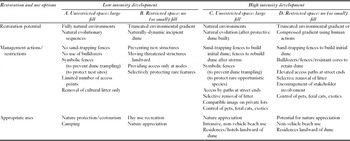
Restoration actions cannot be implemented at the same scale in every coastal segment because of differences in levels of development, availability of space across the shore and availability of funds. We present four categories related to space and levels of development to illustrate some of the differences in approach (Table 1). Low-intensity development in relatively unrestricted spaces (Table 1, category A) occurs in nature reserves or land only initially undergoing development. Landforms and habitats in these locations can evolve naturally to the extent that nature protection, ecotourism and compatible low-intensity non-consumptive uses, such as camping, are the rationale for management and providing that management actions are devoted to control of human impacts, not control of natural processes. Restoration actions may be confined to removal of problematic exotic species and removal of vestiges of past human activities that bear no relationship to present use.
Restoration and use options based on space available and intensities of development.

Low-intensity development in restricted spaces (Table 1, category B) is found in eroding nature reserves on narrow barrier islands or fronting upland in agricultural lands. There appears to be little reason to build new structures or provide access to large numbers of people. Day-use recreation and nature appreciation are appropriate. Beach fill may be a reasonable option to temporarily protect isolated pockets of valued natural resources or cultural artefacts. The cost is likely to be too high to protect low-intensity development in the long term. Some locations of low intensity development in restricted spaces represent sites downdrift of developed areas, where sediment inputs were reduced by past human actions, such as construction of jetties or groin fields. Beach fill could be implemented incrementally in these locations, to retain the narrow beach and dune and eroded landscape and thus the existing resource inventory, or implemented in a large initial fill to create a new wider environmental gradient and variety of habitats similar to the unrestricted low-intensity situation.
The greatest potential for restoration of new natural habitats can occur in areas with high-intensity development (Table 1, category C), where benefit/cost ratios justify large-scale beach nourishment projects (Fig. 1). Once beach fill is placed and an initial protective dune is constructed, the beach and dune environments can be allowed to evolve following natural sequences. Sand trapping fences may be necessary to build the initial dune on the landward side of the fill, but thereafter only symbolic fences should be necessary to prevent trampling of dune vegetation or protect opportunistic rare species that may take advantage of the new habitats. More access paths will be required than in low-intensity use areas. If raking is prevented, the new foredunes will grow seaward, leaving a sheltered backdune environment favouring species diversity. The new backdune environment will eliminate the requirement for restoration actions on private properties landward, but the natural image of the shore will be enhanced and incursions of exotic species into the new environment will be limited if property owners use compatible natural landscaping. Nature appreciation can augment intensive uses of the beach as long as environmentally destructive activities such as driving and raking are prevented and the human imprint on the dune is reduced.
Restricted space on eroding intensively-developed coasts (Table 1, category D) reduces the potential for natural landforms and habitats to survive and evolve. Truncated environmental gradients characterized by dynamic incipient dunes can form naturally in these locations; far greater human effort will be required to maintain compressed gradients that contain the species characteristic of wider natural gradients. Sand fences may be required to build the initial dune. Beach widths will be too narrow to provide protection against dune erosion during moderate-energy storms. Resistant cores buried within dunes may be used as backup protection, and sand fences or bulldozers may be required to make rapid post-storm repairs. The need to protect infrastructure from flooding may require that access paths be over the dunes rather than through them. The lack of space between the water and private lots may mean that backdune species can only evolve on private lands. Homeowner involvement will be essential in allowing dunes to migrate onto private properties, controlling encroachment by exotics and non-endemic coastal fauna, and planting natural species for landscaping. The potential for restoration and appreciation of nature depends on the degree to which stakeholders become involved. In some locations, beaches and dunes may be so small they may have to be maintained largely as protection structures rather than natural features until beach nourishment provides more options. Issues related to space and stakeholder involvement make the high-intensity restricted-space situation the most challenging (Table 1). The challenges will intensify as sea-level rise and increases in the pace of coastal development landward increase the number of these sites while decreasing the space available in each site.
CONCLUSIONS
More can be done to favour the development of natural environments in shore protection projects and other forms of beach nourishment by adopting designs for interactive beach-dune profiles that better reflect the way natural dynamic landforms evolve in response to waves and winds. The likelihood of achieving success in putting new landforms and habitats on the ground will be related to the degree to which planning and design for restoration projects can be integrated with shore protection projects and the degree to which funding for these two components can be combined.
More can be done to increase the amount, quality and usefulness of natural environments in existing landforms and habitats through management at the local level. In most locations, natural elements can be added and environmentally friendly actions can be adopted regardless of the size or intensity of development of the management units. As the restoration potential for a given shoreline reach is demonstrated, more funds and human resources may be devoted to restoration efforts, increasing the likelihood of sustained interest by stakeholders and the likelihood that natural environments will have greater resilience in the future. Convincing stakeholders of the value of natural features is important to achieve success, as is providing greater flexibility in regulatory programmes to allow stakeholders to implement their own projects.
Many of the concepts identified in this paper have already been applied in site-specific cases, so their feasibility has been demonstrated. Some of the concepts have yet to be worked out in detail, and there is opportunity to devise more creative plans for restoring natural environments on developed coasts.
ACKNOWLEDGEMENTS
This review presents majority views of the collective authors. The findings and conclusions in this article do not necessarily represent the views of the authors’ employing agencies or organizations. Many of the ideas in this paper were generated at a workshop held at Avalon, NJ, USA on 6–7 January 2010. We are grateful to the NSF, Research Coordinating Networks Program (RCN), DEB-0741928, for providing funding for the workshop through the Coastal Barrier Island Network (William K. Smith, principal investigator). This publication is also the result of research sponsored by New Jersey Sea Grant with funds from the National Oceanic and Atmospheric Administration (NOAA) Office of Sea Grant, US Department of Commerce, under NOAA grant number NA060AR4170086 and New Jersey Sea Grant Consortium. NJSG-10–786. We thank Katherine Korotky and Brooke Maslo for their help during the workshop. This manuscript benefitted greatly from comments and advice given by Anne Hecht, US Fish and Wildlife Service.