Introduction
A number of studies have shown a relationship between social stratification and body height and BMI (Mascie-Taylor & Boldsen, Reference Mascie-Taylor and Boldsen1985; Lindgren & Cernerud, Reference Lindgren and Cernerud1992; Kaczmarek, Reference Kaczmarek1995; Bielicki et al., Reference Bielicki, Szklarska, Welon and Brajczewski1997, Reference Bielicki, Szklarska, Kozieł and Welon2003, Reference Bielicki, Szklarska, Kozieł and Ulijaszek2005; Kromeyer et al., Reference Kromeyer, Hauspie and Susanne1997; Kozieł et al., Reference Kozieł, Kołodziej and Ulijaszek2000; Komlos & Kriwy, Reference Komlos and Kriwy2002). People living in more favourable conditions are more likely to have a higher level of education, better nourishment, higher quality of health care, better hygiene and distribution of family income, and to be, on average, taller than people of lower socioeconomic status. It is also well known that social differences in stature do not disappear even after the attainment of physical maturity (Bielicki, Reference Bielicki, Faulkner and Tanner1986). In addition, differences in body height and other anthropometric features among young people from different socioeconomic classes tend to reduce (Mascie-Taylor & Lasker, Reference Mascie-Taylor and Lasker2005).
The data used in this paper were based on self-reported height and weight. Studies comparing self-reported with measured values show high correlations of between 0.86 and 0.99 (Stewart et al., Reference Stewart, Jackson, Ford and Beaglehole1987; Zhang et al., Reference Zhang, Feldblum and Fortney1993; Nyström-Peck, Reference Nyström-Peck1994; Korkeila et al., Reference Korkeila, Kaprio, Rissanen, Koskenvuo and Sørensen1998; Nakamura et al., Reference Nakamura, Hoshino, Kodama and Yamamoto1999; Bolton-Smith et al., Reference Bolton-Smith, Woodward, Tunstall-Pedoe and Morrison2000; Goodman et al., Reference Goodman, Inden and Khandelwal2000; Kuczmarski et al., Reference Kuczmarski, Kuczmarski and Najjar2001; Krzyżanowska & Umławska, Reference Krzyżanowska and Umławska2002; Spencer et al., Reference Spencer, Appleby, Davey and Key2002; Brener et al., Reference Brener, McManus, Galuska, Lowry and Wechsler2003; Morrissey et al., Reference Morrissey, Whetstone, Cummings and Owen2006), justifying the reliance in this study on self-reported values.
Previous studies that showed a relationship between socioeconomic status and anthropometric variables were based on general population samples. The present paper used data from a much more socially homogenous group to test whether there was an association between social diversification and body height, weight and BMI among Polish (Wrocław) university students.
Data and Methods
The data, which were collected in 1998, came from 2800 students (1023 men and 1777 women) from the Universities of Wrocław (population 720,000), Poland. The questionnaire included questions about the students themselves as well as their parents. The questionnaire obtained information on the student's age (in years), reported height and weight (which were used to calculate body mass index (BMI): weight (kg)/height (m)2) as well as information on parental education, number of children in the family (family size) and place of residence prior to the commencement of their studies.
Place of residence was categorized as rural, small urban centre with a population under 30,000, medium-size urban centre with a population between 30,000 and 100,000 and large urban centre with a population over 100,000. Parental education level was classified as low-level (primary or vocational school education), mid-level (secondary, post-secondary school or incomplete studies – without obtaining MA degree) and high (completed MA studies, continuation of education after university studies – postgraduate studies, second line of studies, doctoral studies, etc.). Family size was from 1 to 4+.
The statistical methods used to assess the relationship between social variables and height, weight and BMI were chi-squared tests and various forms of multiple regression analysis (Coolidge, Reference Coolidge2000; Stanisz, Reference Stanisz2005).
Results
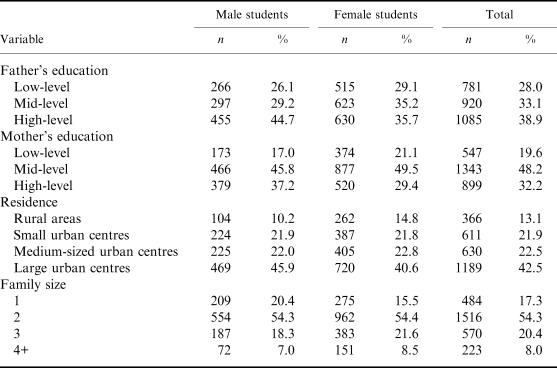
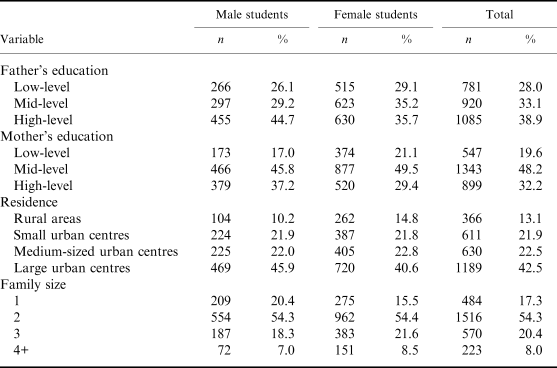
Overall 42.5% of the students came from large urban centres (Table 1) but there was significant heterogeneity between male and female students in residency, with more female students being brought up in rural areas than male students, while males students were more likely to reside in large urban centres (χ2(3)=14.93, p=0.002). There was also significant heterogeneity in family size between male and female students, with males more likely to live in smaller families (χ2(3)=14.38, p=0.004). Males students were more likely to have highly educated parents while female students were more likely to have parents with low or middle education (χ2(3)=22.87, p<0.001 and χ 2(3)=19.90, p<0.001 for fathers and mothers, respectively).
Descriptive statistics of the students
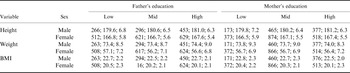
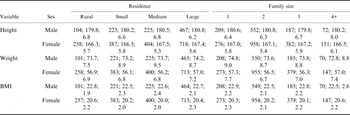
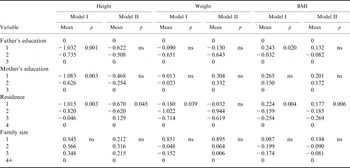
Tables 2 and 3 provide a breakdown of mean differences in height, weight and BMI for males and females students separately by father's and mother's education, residence and family size. Overall male students were 13.49 cm taller, weighed 17.15 kg more and had a higher BMI of 2.33 kg m−2, than female students. Initially sequential regression analyses removed the effects of age and sex before testing for the effect of each socioeconomic variable separately (Model I in Table 4) after having shown that there were no significant sex and socioeconomic variable interactions.
Descriptive statisticsa of height, weight and BMI in relation to parents' education
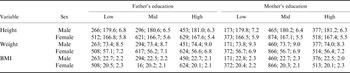
a Descriptive statistics are, respectively, number of observations (N), mean, and standard deviation (SD).
Descriptive statisticsa of height, weight and BMI in relation to place of residence and family size

a Descriptive statistics are, respectively, number of observations (N), mean, and standard deviation (SD).
Multiple regression analysis of height, weight and BMI in relation to socioeconomic variables

For height there was a significant association with father's and mother's education with an upward trend in means from low to high education, with an overall mean difference of just over 1 cm between high and low groups. There were also mean differences in residency with lower mean in rural and higher mean in large urban centres. Weight only showed a significant association with residency, with students from large urban centres having the highest mean. BMI showed a just-significant association with father's education and a stronger association with residency. For father's education the differences in mean BMI were inconsistent across educational levels, while the patterns of means for residency indicated higher BMI on average in rural and large urban centres and lower BMI in small and medium urban centres.
A series of sequential multiple regression analyses were run in which the effects of age, sex and three of the socioeconomic variables were entered into the model before the socioeconomic variable of interest. The results are presented in Model II in Table 4 with higher education, large urban centres and family size 4+ as the reference values (set to zero). Only residency showed a significant association with height and BMI; for residency the main height difference was between those living in rural areas and small urban centres, who had a lower mean than those living in medium or large urban centres, while for BMI those living in small or medium urban areas had lower means than those living in rural or large urban centres.
Discussion
Polish students are, on average, taller than non-students of the same age (Gworys, Reference Gworys1978; Kolasa, Reference Kolasa1980) and similar results have been found in Japan (Ohyama et al., Reference Ohyama, Hisanaga, Inamasu, Yamamoto, Hirata and Ishinishi1987; Takamura et al., Reference Takamura, Ohyama, Yamada and Ishinishi1988). The students surveyed here were also taller than conscript soldiers who came from the upper social echelons of large urban centres (Krzyżanowska, Reference Krzyżanowska2007). The reason for the greater stature of students is presumably the result of an interaction between more favourable environments as well as better genotypes (Malina & Bouchard, Reference Malina and Bouchard1991; Kaczmarek, Reference Kaczmarek1995).
Male student height tended to show greater variation than female height. For example, the mean difference between low and high educational groups is 1.4 cm in males but only 0.8 cm in females. It has been argued that this increased variability is because boys are more sensitive to both negative and positive external stimuli than girls (Billewicz et al., Reference Billewicz, Thomson and Fellows1983; Kaczmarek, Reference Kaczmarek1995; Stinson – quoted in Bogin, Reference Bogin and Bogin1999).
The majority of studies that have examined the relationship between students' height and their place of residence have found higher means in individuals who came from urban centres (Mockus et al., Reference Mockus, Franco, Montoya, Alfonso and Alzate1995; Jopkiewicz & Zabrodzka, Reference Jopkiewicz and Zabrodzka1997; Kolasa, Reference Kolasa1997; Gyenis & Joubert, Reference Gyenis and Joubert2004; Tatarczuk, Reference Tatarczuk2006; Kamińska-Czakłosz, unpublished), as did the current study. However, other surveys have found no significant difference in mean stature between Polish urban and rural areas (Gworys, Reference Gworys1978; Kolasa, Reference Kolasa1980; Wronka & Pawlińska-Chmara, Reference Wronka and Pawlińska-Chmara2007).
The association between education and height is also contentious. Charzewski et al. (Reference Charzewski, Lewandowska, Piechaczek, Syta and Łukaszewska2003) argue that parental educational level, especially of the father, constitutes a social variable that leads to greater food diversity, regularity of meals as well as greater hygiene. A number of Polish authors have found that higher education is associated with greater stature (Kolasa, Reference Kolasa1980; Jopkiewicz & Zabrodzka, Reference Jopkiewicz and Zabrodzka1997). Tatarczuk (Reference Tatarczuk2006) found the highest mean among students whose fathers had higher education and mothers had mid-level education, while the present paper generally found higher mean stature was associated with greater parental education. Gyenis & Joubert (Reference Gyenis and Joubert2004), in a Hungarian survey, found that the height of female students correlated only with their mothers' level of education, which is contrary to the present results and other Polish studies (Kamińska-Czakłosz, unpublished; Wronka & Pawlińska-Chmara, Reference Wronka and Pawlińska-Chmara2007).
Kozieł et al. (Reference Kozieł, Welon, Bielicki, Szklarska and Ulijaszek2004) found that in 1986 conscripts from rural areas had the highest mean BMI, whereas those living in small towns had the lowest value. They argued that increased ‘urbanization’ is leading to less variation in BMI in Poland. However, the present study shows that significant variation in BMI still exists according to place of residence, although the reason for this is unclear.
The students in this sample belonged to a more socially privileged and more homogeneous group than a general population sample (Krzyżanowska, 2007; Krzyżanowska & Borysławski, Reference Krzyżanowska and Borysławski2008), and it might be expected that their height, weight and BMI would show very little or no association with socioeconomic variables. However, contrary to expectation, mean differences in stature still exist in relation to the educational level attained by the parents as well as place of residence.