Introduction
Tribolium castaneum (Herbst), commonly known as the red flour beetle, is a worldwide agricultural storage pest, and is also an important model organism for developmental, physiological, and applied entomological studies of coleopterans (Rosner et al., Reference Rosner, Wellmeyer and Merzendorfer2020). Tribolium castaneum predominantly poses a significant hazard to processed and stored food crops (Golden et al., Reference Golden, Quinn, Shaaya, Kostyukovsky and Poverenov2018; Mangang et al., Reference Mangang, Tiwari, Rajamani and Manickam2020). Secretions from this beetle contain benzoquinone and other harmful substances that cause an irritating and moldy odor and affect the quality of flour as well as endangering human safety (Lis et al., Reference Lis, Bakuła, Baranowski and Czarnewicz2011; Saad et al., Reference Saad, El-Deeb and Abdelgaleil2019). Consequently, T. castaneum causes billions of dollars of economic losses in grain storage every year (Aronstein et al., Reference Aronstein, Oppert, Lorenzen and Grabowski2011; Boyer et al., Reference Boyer, Zhang and Lemperiere2012). Currently, the main methods are used in the world to control grain storage pests, including T. castaneum, are the fumigant phosphine and some contact insecticides such as organophosphate and pyrethroid insecticides (Awan et al., Reference Awan, Saleem, Nadeem and Shakoori2012; Boyer et al., Reference Boyer, Zhang and Lemperiere2012). Nevertheless, the long-term use of such chemicals has resulted in the development of resistance and persistent health effects on humans, the non-target organisms, and environment (Awan et al., Reference Awan, Saleem, Nadeem and Shakoori2012; Dey, Reference Dey2016). Therefore, there is an urgent need to find new natural pesticides that are relatively environmentally friendly (Boukouvala et al., Reference Boukouvala, Kavallieratos, Athanassiou and Hadjiarapoglou2016a, Reference Boukouvala, Kavallieratos, Athanassiou, Losic, Hadjiarapoglou and Elemes2016b).
The essential oils of plants and their active ingredients can have a marked impact on target insects as well as being less polluting to the environment than chemical insecticides (Isman, Reference Isman2006; Benelli, Reference Benelli2015). The oils from many plant species have been reported to be toxic to a wide range of pests as insecticides, ovicides, trophozoites, and food rejectors (Tunç et al., Reference Tunç, Berger, Erler and Dağlı2000; Ogendo et al., Reference Ogendo, Kostyukovsky, Ravid, Matasyoh, Deng, Omolo, Kariuki and Shaaya2008; Islam, Reference Islam2017). Among them, essential oil from Artemisia vulgaris (Levl. et Vant) has excellent thixotropic and fumigant activity against T. castaneum (Zhang et al., Reference Zhang, Gao, Xue, Gu and Zhang2020). Terpinen-4-ol is one of the active components of A. vulgaris essential oil (Song et al., Reference Song, Wen, He, Zhao, Li and Wang2019). Terpineol-4 and its derivatives exhibit significant contact toxicity and inhibit Na+, K+, and ATPase in houseflies (Guo et al., Reference Guo, Ma, Feng and Zhang2008). Furthermore, terpinen-4-ol displays fumigant activity that is highly toxic to T. castaneum (Min et al., Reference Min, Xiao, Zhou, Yang, Wu, Hua, Wang, Cao and Qiu2016; Liao et al., Reference Liao, Yang, Xiao, Huang and Zhou2018), and is repellency active against grain storage pests, including T. castaneum (Suthisut et al., Reference Suthisut, Fields and Chandrapatya2011; Zhang et al., Reference Zhang, Yang, You, Wang, Wang, Wu, Geng, Su, Du and Deng2015). Recent investigations have demonstrated that terpinen-4-ol treatment down-regulates the expression of genes involved in development (RTKTol, Fz4, E78C, etc) and emergency response (Attacin 1 and Defensin 1) of T. castaneum larvae. This shows that terpinen-4-ol stimulation may have an effect on the development and stress response of T. castaneum. Therefore, plant essential oils that contain terpinen-4-ol and terpinen-4-ol derivatives can be used as insecticides, especially for insect pests of stored grains.
Complex biochemical mechanisms have evolved in nature as a result of competition and co-evolution between plants and herbivorous insects (Jander, Reference Jander2014). Plants produce chemicals that are toxic to phytophagous insects, this is common in nature (Heidel-Fischer and Vogel, Reference Heidel-Fischer and Vogel2015). Conversely, insects evolve and strengthen their defense mechanisms against plant toxins (Nishida, Reference Nishida2014; Beran et al., Reference Beran, Köllner, Gershenzon and Tholl2019). Among them, high expression of detoxification enzymes is an important mechanism for insects to resist plant toxins (Heidel-Fischer and Vogel, Reference Heidel-Fischer and Vogel2015; Heckel, Reference Heckel2018). Detoxifying enzymes predominantly include carboxyl/cholinesterases (CCEs), cytochrome P450 monooxygenases (CYPs), glutathione-S-transferases (GST), UDP-glycosyltransferases (UGT), and ATP-binding cassette transporters (ABC transporters) (Ahn et al., Reference Ahn, Vogel and Heckel2012; Nelson et al., Reference Nelson, Goldstone and Stegeman2013; Li et al., Reference Li, Ma, Yuan, Xiao and Liu2017; Tang et al., Reference Tang, Cheng, Li, Li, Ma, Zhou and Lu2020; Gao et al., Reference Gao, Lin, Yang and Liu2021). In most cases, CYPs and CCEs are participating in the first phase of metabolic detoxification of heterologous substances, while the GSTs and UGTs play a primary role in the second phase (Feyereisen, Reference Feyereisen2020). In the first phase, CYPs are essential in the metabolism of heterologous substances (Liu et al., Reference Liu, Li, Gong, Liu and Li2015; Calla, Reference Calla2021).
CYPs are one of the largest and oldest supergene families found in almost all aerobic organisms (Zhu et al., Reference Zhu, Moural, Shah and Palli2013). In insects, CYPs have a significant impact on their adaptation to different survival environments. Some CYPs are participating in the biosynthesis of endogenous compounds in insects (Helvig et al., Reference Helvig, Koener, Unnithan and Feyereisen2004a; Rewitz et al., Reference Rewitz, O'Connor and Gilbert2007), playing a critical role in the chemical communication, behavior, and metabolism of insects (Maïbèche-Coisne et al., Reference Maïbèche-Coisne, Nikonov, Ishida, Jacquin-Joly and Leal2004; Helvig et al., Reference Helvig, Tijet, Feyereisen, Walker and Restifo2004b; Dierick and Greenspan, Reference Dierick and Greenspan2006; Wang et al., Reference Wang, Dankert, Perona and Anderson2008). Other CYPs act as genes that respond to environmental changes (Berenbaum, Reference Berenbaum2002), for example by protecting insects from chemical stress through the degradation of chemical pesticides and plant secondary metabolites (Feyereisen, Reference Feyereisen2011; Gao et al., Reference Gao, Zhang, Wei, Wei, Xiong, Lu, Zhang, Gao and Li2020). Insect P450 genes are divided into four evolutionary branches: the mitochondrial P450 evolutionary branch, the CYP2 evolutionary branch, the CYP3 evolutionary branch, and the CYP4 evolutionary branch (Feyereisen, Reference Feyereisen2006). Of these, the CYP6 gene subfamily of the CYP3 evolutionary branch is unique to insects and is extensively involved in metabolic process of exogenous toxins in Diptera and Lepidoptera (Li et al., Reference Li, Berenbaum and Schuler2001; Sun et al., Reference Sun, Shi, Li, Wang, Xu, Wang, Ran, Song and Zeng2019). For example, CYP6MS1 is involved in the detoxification of tea tree oil and its major component, terpinen-4-ol, by Sitophilus zeamais (Motschulsky) (Huang et al., Reference Huang, Liao, Yang, Shi, Xiao and Cao2020). CYP6DA1, CYP6CY19, and CYP6CY22 in Aphis gossypii (Glover) are resistant to phytochemicals (Li et al., Reference Li, Ma, Chen, Zhou and Gao2019), and CYP6AB60 in the polyphagous insect Spodoptera litura (Fabricius) has a potential role in the response to various toxic plant metabolites (Sun et al., Reference Sun, Shi, Li, Wang, Xu, Wang, Ran, Song and Zeng2019). In summary, CYP6 subfamily genes may be associated with exogenous substance metabolism and pesticide resistance (Feyereisen, Reference Feyereisen2006; Li et al., Reference Li, Schuler and Berenbaum2007).
Our RNA sequencing analysis showed that, a gene in the CYP6 gene subfamily from T. castaneum, CYP6BQ8, was significantly highly expressed during treatment with terpinen-4-ol, which is the main component of A. vulgaris essential oil (Gao et al., Reference Gao, Liu, Liu, Yin, Guo, Zhang, Zhang and Li2022b). The objective of this study was to elucidate the physiological effects of TcCYP6BQ8 on the metabolism of T. castaneum treated with terpinen-4-ol. The CYP6BQ8 gene from T. castaneum was cloned and its function in the catabolism of terpinen-4-ol by T. castaneum was evaluated. Quantitative real-time PCR (qRT-PCR) was used to detect TcCYP6BQ8 expression after treatment with terpinen-4-ol and to obtain a spatiotemporal expression profile. Subsequently, RNA interference (RNAi) was used to downregulate TcCYP6BQ8 expression and explore the effect of TcCYP6BQ8 silencing on the defense of T. castaneum against terpinen-4-ol.
Material and methods
Insect rearing
All experiments were conducted using stock cultures of T. castaneum that have been maintained in the Nanjing Normal University, originated form Kansas State University (Manhattan, KS). The strain of T. castaneum used was Georgia-1(GA-1); (Xie et al., Reference Xie, Hu, Zhai, Yu, Song, Gao, Wu and Li2019). Wheat flour with 5% brewer's yeast was employed for the development of T. castaneum. Incubation is carried out at a temperature of 30°C and a relative humidity of 40% in an incubator with a 14-h day/10-h night cycle (Gao et al., Reference Gao, Zhang, Wei, Wei, Xiong, Lu, Zhang, Gao and Li2020). The study used eight insect periods; Early eggs (1 day old), late eggs (3 days old), early larvae (1 day old), late larvae (20 days old), early pupae (1 day old), late pupae (5 days old), early adults (1 day old), and late adults (10 days old). Samples of T. castaneum individuals were collected directly from the stock cultures, using a sieve. Then three individuals from each developmental stage were randomly selected from the samples, were washed with 1 × PBS solution to remove the remaining flour particles and were dried by using a filter paper. Then, all individuals were put in a clean 1.5 ml centrifuge tube and were placed in a refrigerator at −20°C for RNA extraction.
Insecticidal efficacy assay of terpinen-4-ol
Terpinen-4-ol (99%, CAS: 562-74-3) was purchased from Sigma-Aldrich (Munich, Germany). The insecticidal effect of terpinen-4-ol against T. castaneum late larvae was measured according to the descriptions (Lu et al., Reference Lu, Park, Gao, Zhang, Yao, Pang, Jiang and Zhu2012). The experiment was divided into two groups: experimental group treated with terpinen-4-ol and control group treated with acetone. Exposure toxicity to late-stage larvae (20 days old) was assessed in a fume hood. Primarily, terpinen-4-ol was diluted to acetone. Thirty late-stage larvae in good growth condition were placed in a 1.5-ml tube with 100 μl of LC50 (median lethal concentration) terpinen-4-ol or acetone (Gao et al., Reference Gao, Liu, Liu, Yin, Guo, Zhang, Zhang and Li2022b). After treating last-stage larvae with terpinen-4-ol or acetone for 1 min, dry in a fume hood. The larvae were transferred to petri dishes with a diameter of 6 cm and fed normally in an artificial incubator when they began their activity. Late-stage larvae (20 days old) were treated with terpinen-4-ol at the LC50 and collected at 12, 24, 36, 48, 60, and 72 h post-treatment for subsequent RNA extraction and qRT-PCR. Two technical replicates were carried out, with three biological replicates in each technical replicate.
Cloning of the CYP6BQ8 gene in T. castaneum
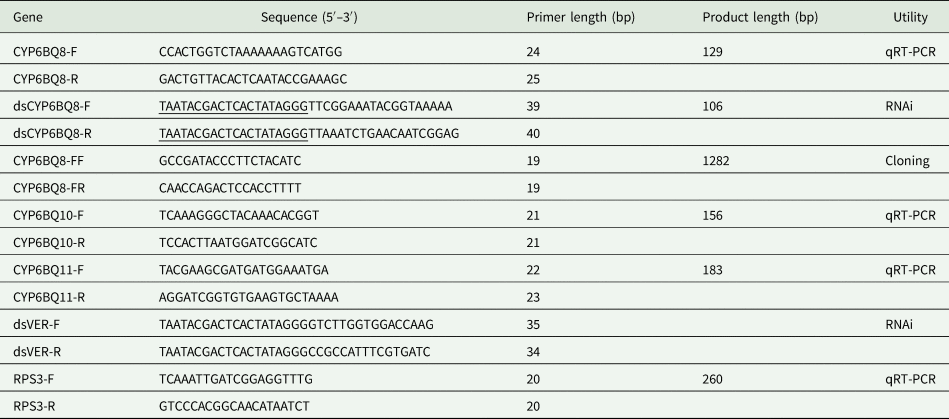
The TcCYP6BQ8 gene's full-length open reading frame (ORF) cDNA sequence was obtained using primers intended to extract it (table 1). Total reagent was used to extract total RNA from T. castaneum (Invitrogen, Carlsbad, CA, USA). Using HiScript reverse transcriptase (Vazyme Biotech, Nanjing, China) in a 50-μl reaction system, 1400 ng RNA was reverse transcribed into cDNA template for TcCYP6BQ8 cloning. For PCR amplification, TransStart FastPfu DNA polymerase (TransGen, Beijing, China) was employed. The pEASY-Blunt Zero Cloning Kit was used to subclone the purified PCR product into the Blunt Zero vector (TransGen, Beijing, China). Blue-white screening confirmed positive clones, and Sangon Biotechnology sequenced them (Beijing, China). DNAMAN was used to generate and visualize the amino acid sequence of TcCYP6BQ8 (LynnonBiosoft, USA).
Primers used for this research

F denotes forward primers and R denotes reverse primers. The underlined sequence is the T7 promoter synthesized by dsRNA.
Gene structure prediction and phylogenetic analysis
TcCYP6BQ8 domains' predicted amino acid sequences were evaluated online using SMART. (http://smart.embl-heidelberg.de) and then further identified with BLASTp (https://blast.ncbi.nlm.nih.gov/Blast.cgi) analysis using the National Center for Biotechnology Information (NCBI) database (https://www.ncbi.nlm.nih.gov/). The NCBI database was utilized to extract protein sequences for the CYP6 and CYP9 genes of Coleoptera and Lepidoptera, which were then used to create a phylogeny tree. Amino acid sequence alignment was performed using the muscle method ratio in MEGA 7 software and a phylogenetic tree was reconstructed using the neighbor-joining (NJ) method of the Whelan and Goldman (WAG) model. Bootstrap analysis was conducted with 1000 resamplings and all values were above 50%.
Gene expression profile of TcCYP6BQ8
Multiple samples from each of the eight developmental periods of T. castaneum were collected for RNA extraction: Early eggs (1 day old), late eggs (3 days old), early larvae (1 day old), late larvae (20 days old), early pupae (1 day old), late pupae (5 days old), early adults (1 day old), and late adults (10 days old). RNA was extracted from mixed post-mortem samples of diverse tissues from late larvae (whole larvae, head, epidermis, fat body, gut, and hemolymph) and early adults (whole adult, head, epidermis, fat body, gut, ovary, antennae, testis, and accessory gland). The extracted RNA from each experiment (developmental stage and tissue profile, respectively) was subjected to qRT-PCR and then stored at −80°C. Two technical replicates were performed for different developmental stages and different tissues, with three biological replicates in each technical replicate.
Double-strand RNA (dsRNA) synthesis and injection
For dsRNA synthesis, Primer Premier 5.0 (Premier, Canada) was used to design TcCYP6BQ8 and TcVER gene-specific primers containing T7 polymerase recognition promoter sequences (table 1). The PCR was composed of 0.4 μl forward and reverse primers (10 μM), 10 μl 2 × Primer STAR Mix, 8.2 μl ddH2O, and 1 μl plasmid DNA containing the TcCYP6BQ8 ORF. An initial denaturation step of 5 min at 94°C was followed by 35 cycles of 94°C for 30 s, 60°C for 30 s, and 72°C for 30 s, followed by a final extension step of 7 min at 72°C. With the help of a TranscriptAid T7 High Yield Transcription Kit (Fermentas, Vilnius, Lithuania), the resultant products were purified and employed as templates to produce dsRNA. An InjectMan 4 instrument (Eppendorf, Hamburg, Germany) was used to microinject the obtained dsRNA (200 ng in 150 nl) into the body cavity of late T. castaneum larvae. As positive and negative controls, late-stage larvae were injected with equal quantities of 200 ng ds-VER or buffer (IB). The positive control VER gene is T. castaneum's eye-color gene, which causes the adult beetles' eyes to turn white when it is injected. At least three biological repeats with separate injections were carried out, with each repetition including 40 larvae.
Following dsRNA injection, T. castaneum late larvae were normal fed normally for 1 to 5 days, with biological phenotypic changes and mortality documented. Three larvae from each group were chosen at random four days after injection for total RNA extraction and qRT-PCR analysis to determine the target gene's silencing and off-target efficiency. The expression of two non-target genes, TcCYP6BQ10 and TcCYP6BQ11, which are substantially similar to TcCYP6BQ8, was tested to verify that the target gene was successfully disrupted and had no influence on non-target genes (table 1). Five days post-injection, the late larvae were treated for 1 min with terpinen-4-ol (at the LC50) or acetone, followed by normal feeding to observe mortality every 12 h for 72 h.
qRT-PCR analysis
TcCYP6BQ8 expression was detected using the specific primers CYP6BQ8-F and CYP6BQ8-R. Primer Premier 5.0 was used to construct RPS3-F and RPS3-R primers for the ribosomal protein S3 (Rps3) gene, which has a high level of stability (Horn and Panfilio, Reference Horn and Panfilio2016) (table 1). The amplification efficiency of the target gene and reference gene primers was similar. an ABI Q6 (CA, USA) was used to set up a 10-μl reaction system with the following settings: 95°C for 10 min, 40 cycles of 95°C for 15 s and 60°C for 60 s, followed by 95°C for 15 s, 60°C for 60 s, and 95°C for 15 s. 0.25 μl forward and reverse primers (10 M), 5 μl 2 AceQ Universal SYBR qPCR Master Mix, 3.5 μl ddH2O, and 1 μl cDNA made up the reaction system. At the end of each reaction, a melting curve of the amplified product was constructed to ensure that only one PCR product was amplified. Two technical replicates were carried out, with three biological replicates in each technical replicate.
Data analysis
Gene expression level were the relative mRNA levels normalized to control gene, T. castaneum ribosomal protein S3 (rps3), using 2-△△Ct method (Livak and Schmittgen, Reference Livak and Schmittgen2001). The gene expression data, the mean values of the RNAi-treated vs. the mean values of the control insects were compared by Student's t-test and one-way analysis of variance in combination with a Fisher's least significant difference multiple comparison tests, respectively, by using the SPSS version 19.0 statistics program (Chicago, IL, United States). All data are presented as the mean ± standard error (SE). Differences were considered significant at P-value <0.05.
Results
Identification of TcCYP6BQ8
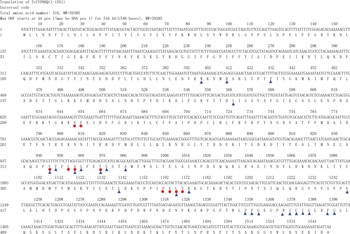
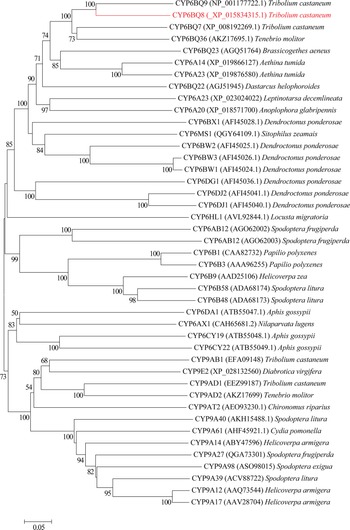
To investigate the physiological functions of TcCYP6BQ8 in the catabolism of terpinen-4-ol, the cDNA of TcCYP6BQ8 was cloned and analyzed. The coding region of TcCYP6BQ8 is 1554 bp and encodes 526 amino acids in T. castaneum (GenBank accession number XP_015834315.1) (fig. 1). TcCYP6BQ8's amino acid sequence was compared to that of other members of the CYP6 gene family and revealed that it included 25 heme-binding sites and ten substrate-binding pockets (fig. 1). Using 43 amino acid sequences from the evolutionary branches of CYP6 and CYP9 in Hymenoptera and Lepidoptera, a systematic phylogenetic tree was created (fig. 2). The phylogenetic tree revealed that the 43 amino acid sequences were divided into two evolutionary branches, with the CYP6BQ8 gene of T. castaneum being significantly similar to the CYP6BQ9 gene of the same strain of T. castaneum.
Isolation of the TcCYP6BQ8 nucleotide sequence and predicted amino acid sequence in T. castaneum. ORF, open reading frame; MW, molecular weight; AA, amino acid; *, stop codon. The ORF sequence of the TcCYP6BQ8 transcript was obtained after translation with DNAMAN. ‘▴’ indicates the heme-binding site. ‘●’ indicates the chemical substrate-binding pocket.

Phylogenetic tree constructed from the amino acid sequence of TcCYP6BQ8 and other insect-associated P450s. Bootstrap percentage values for 1000 replications are indicated at the nodes; to remove values below 50% from the tree species. TcCYP6BQ8 is highlighted in red. Distances are expressed on a scale. Gene name, GenBank accession number, and insect species are displayed on each branch of the tree.

Terpinen-4-ol induces TcCYP6BQ8 expression
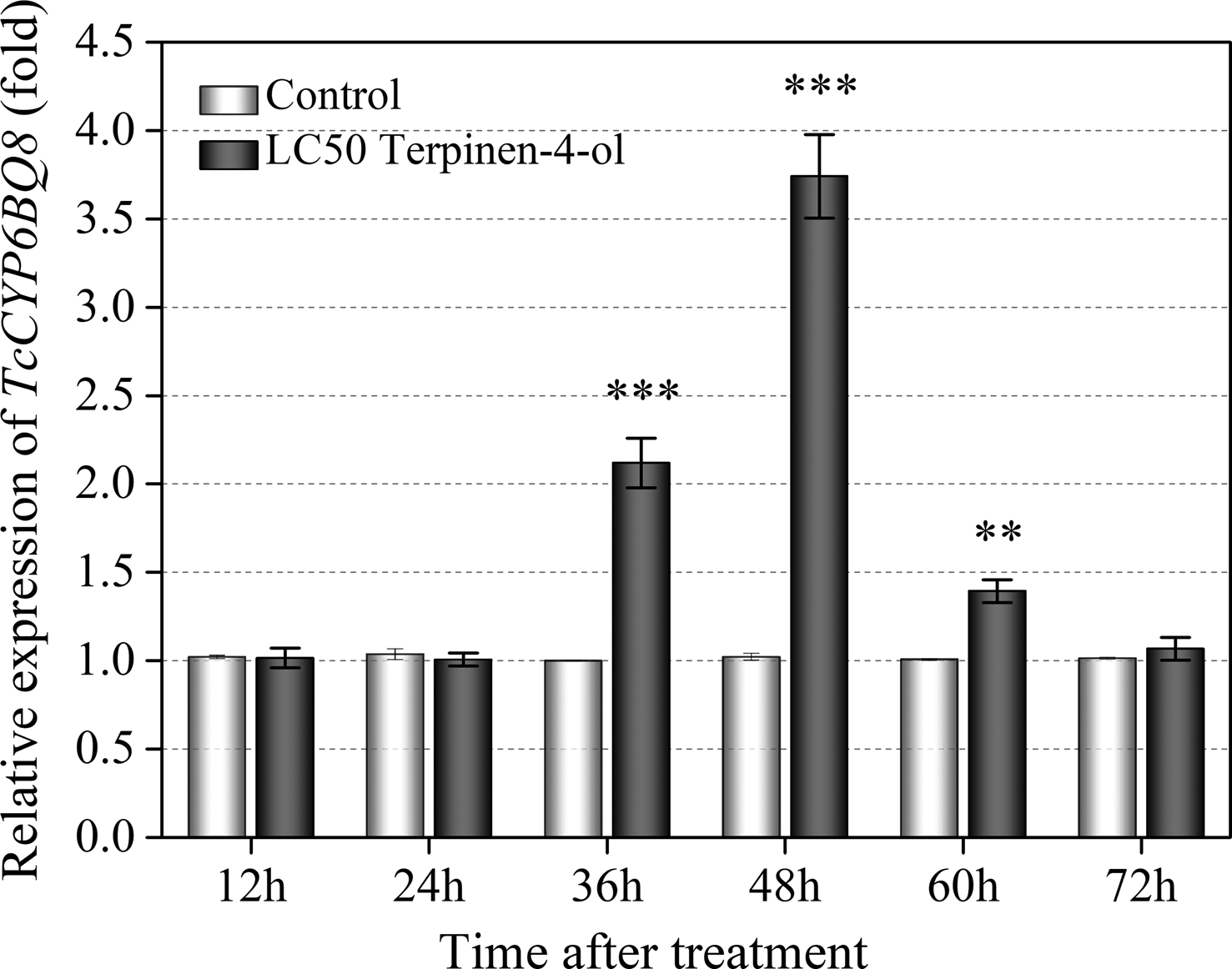
The expression of TcCYP6BQ8 in the terpinen-4-ol (LC50 = 62.5 mg ml−1) treatment group and the acetone control group were measured by qRT-PCR at 12–72 h after treatment. Expression of TcCYP6BQ8 was significantly higher after 36–60 h of terpinen-4-ol treatment compared with the control group (fig. 3). After treatment with the LC50 of terpinen-4-ol, the expression of TcCYP6BQ8 gradually increased from 24 to 48 h, and then declined at 60 h but still showed a significant increase compared with the control group (fig. 3). The findings indicate that terpinen-4-ol may have the capacity to induce TcCYP6BQ8 gene expression.
Transcriptional expression of TcCYP6BQ8 after exposure to terpinen-4-ol. T. castaneum larvae (15 days old) were treated with 62.5 mg ml−1 (LC50) terpinen-4-ol or equal parts acetone (The control group is arbitrarily assigned a value of 1.) for 12, 24, 36, 48, 60, and 72 h. LC50, median lethal concentration. SEs (n = 3) are indicated by the mean of the error bars and the presence of significant differences between the control and experimental groups is indicated by an asterisk (**P < 0.01, ***P < 0.001).

Expression profiles of TcCYP6BQ8 in different developmental stages and tissues
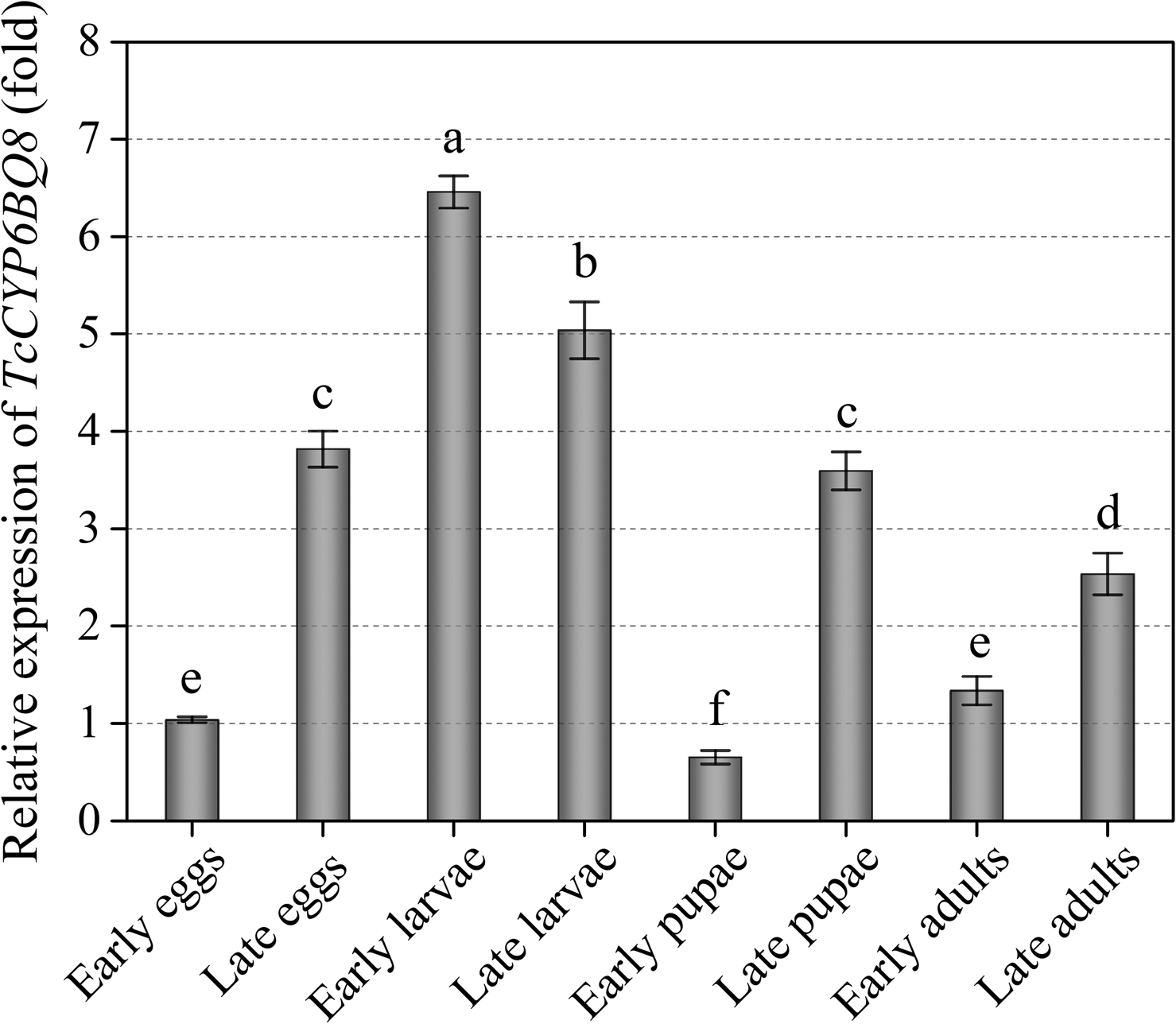
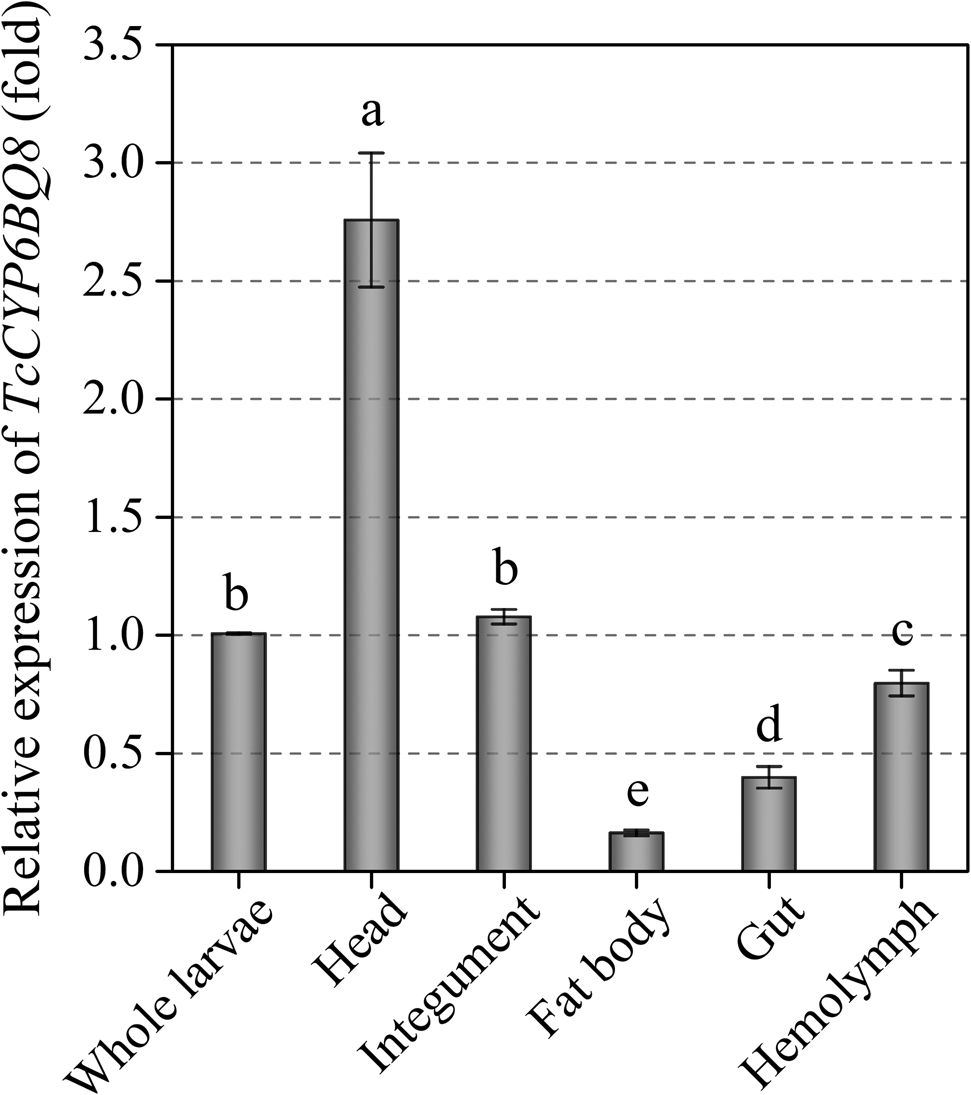
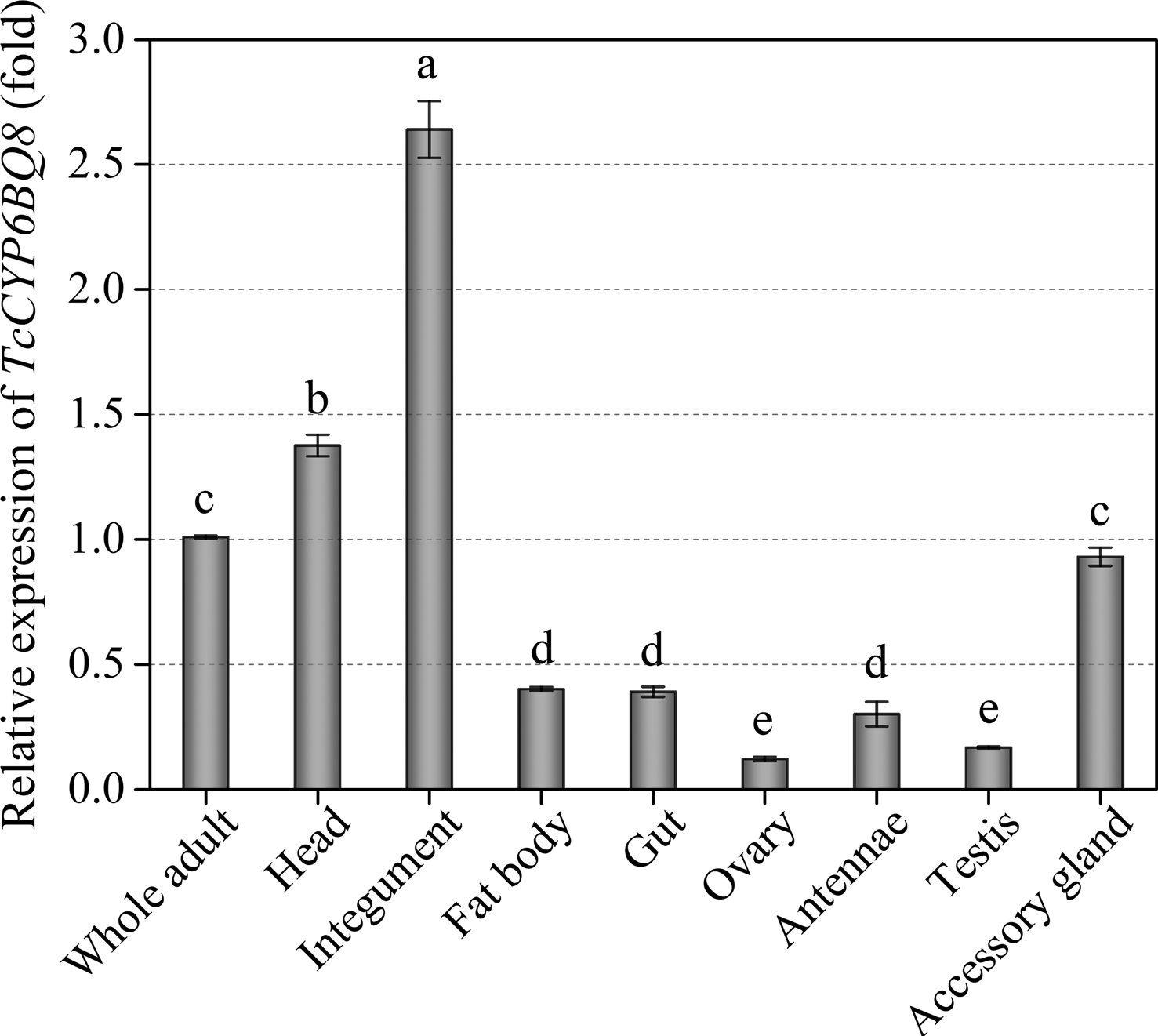
The qRT-PCR analysis showed that the relative expression of TcCYP6BQ8 at different developmental stages of T. castaneum differed significantly (fig. 4). TcCYP6BQ8 expression was highest in the larval stage followed by the late egg and late pupal stages and lowest in the other developmental stages (fig. 4). The expression of TcCYP6BQ8 was further investigated utilizing a variety of T. castaneum tissues (late larvae and early adults). TcCYP6BQ8 was significantly expressed in larval tissues, particularly the head and epidermis, with the greatest level of expression in the head and the lowest level in the fat body (fig. 5). TcCYP6BQ8 expression in adult tissues was comparable to that in larvae, with the greatest levels detected in the head and epidermis, followed by the accessory gland and, to a lesser degree, other tissues (fig. 6). Thus, the TcCYP6BQ8 gene is expressed in various tissues and may be involved in various physiological functions in T. castaneum.
Expression profiles of TcCYP6BQ8 at eight developmental stages in T. castaneum. Early eggs (1 day eggs), late eggs (3 days eggs), early larvae (1 day larvae), late larvae (20 days larvae), early pupae (1 day pupae), late pupae (5 days pupae), early adults (1 day adults), and late adults (10 days adults). The expression of the Tcrps3 (Tribolium ribosomal protein S3) gene was used as a reference point for tissue-specific expression profiles. SEs (n = 3) are indicated by the mean of the error bars, and significant differences between the means of gene expression at different developmental periods at the P < 0.05 level are indicated by the different letters on the error bars.

Expression of TcCYP6BQ8 in T. castaneum larval tissues. Larval tissues include whole larvae (15 days old), head, integument, fat body, gut, and hemolymph. The expression of the Tcrps3 (Tribolium ribosomal protein S3) gene was used as a reference point for tissue-specific expression profiles. SEs (n = 3) are indicated by the mean of the error bars, and significant differences between tissue gene expression means at the P < 0.05 level are indicated by the different letters on the error bars.

Expression of TcCYP6BQ8 in T. castaneum adult tissues. Adult tissues include whole adult, head, integument, fat body, gut, ovary, antennae, testis, and accessory gland. The expression of the Tcrps3 (Tribolium ribosomal protein S3) gene was used as a reference point for tissue-specific expression profiles. SEs (n = 3) are indicated by the mean of the error bars, and significant differences between tissue gene expression means at the P < 0.05 level are indicated by the different letters on the error bars.

Effect of TcCYP6BQ8 RNAi on T. castaneum response to terpinen-4-ol
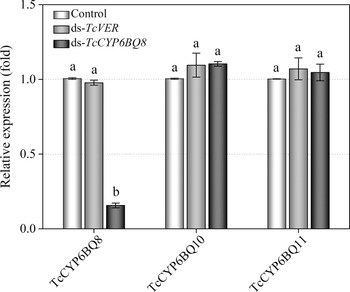
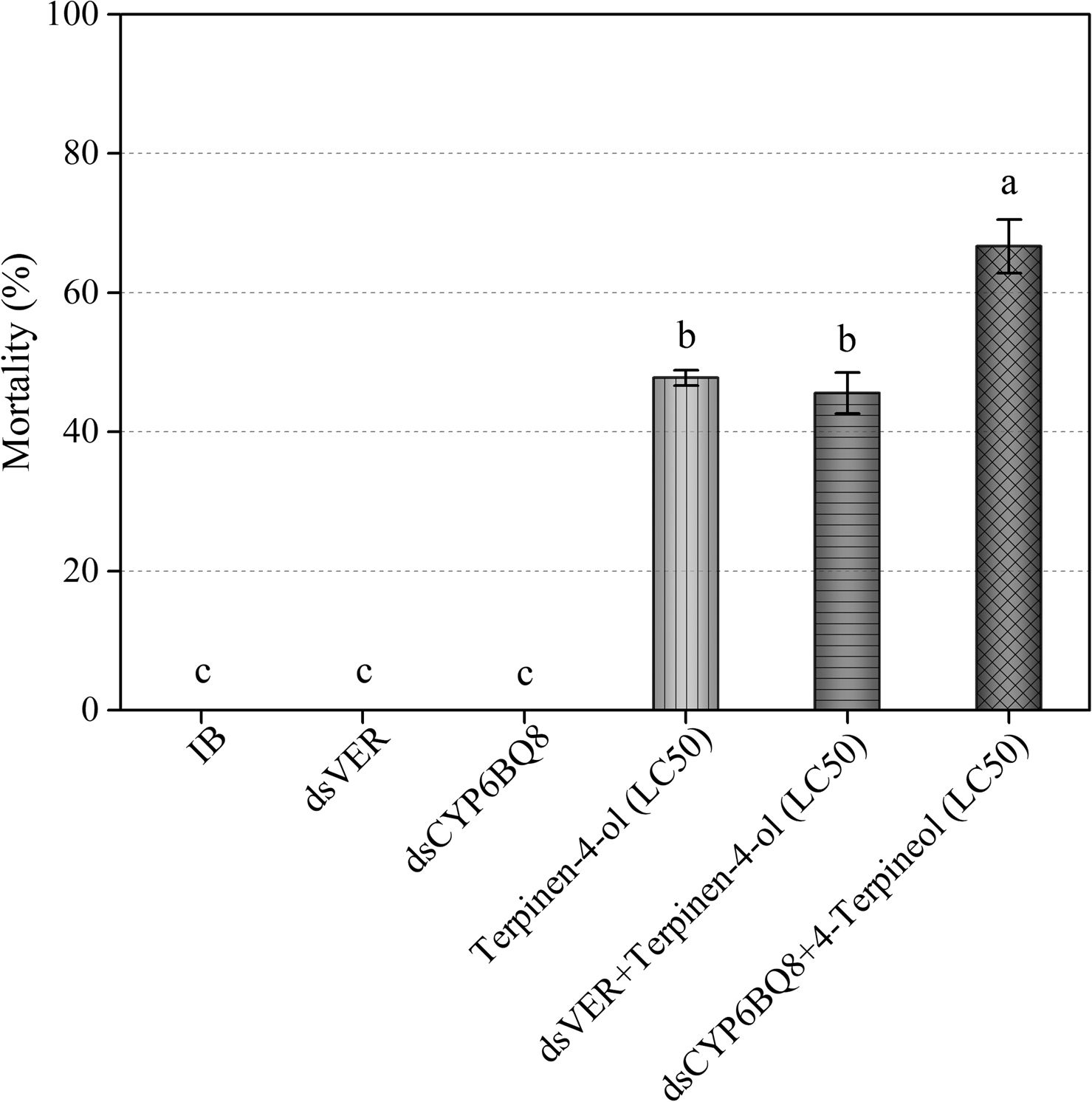
To further analyze and understand the detoxification of terpinen-4-ol by TcCYP6BQ8, RNAi silencing technology was utilized. RNA silencing of T. castaneum larvae (20 days old) significantly reduced the expression of TcCYP6BQ8 but had no effect on the expression of the non-target genes TcCYP6BQ10 and TcCYP6BQ11 (fig. 7). This indicates that RNAi experiments with TcCYP6BQ8 successfully silenced the gene. The mortality of T. castaneum larvae was the same at day 5 post-injection for IB, ds-TcCYP6BQ8, and ds-TcVER (fig. 8), suggesting that dsCYP6BQ8 injection had no effect on the physiological health of the larvae. The bioassay of T. castaneum larvae with terpinen-4-ol was therefore conducted on the fifth day after injection of dsCYP6BQ8 or appropriate control. There was a cumulative increase in mortality in all groups after terpinen-4-ol treatment, but late larval mortality was significantly higher following dsCYP6BQ8 injection compared with the IB and ds-TcVER groups (fig. 8). Mortality rates in the IB, ds-TcVER, and ds-TcCYP6BQ8 groups were 47.78, 45.56 and 66.67%, respectively (fig. 8). Analysis of the combined results indicated that the increased mortality after terpinen-4-ol treatment was mainly due to silencing of the TcCYP6BQ8 gene. TcCYP6BQ8 is thought to be required for the detoxification of terpinen-4-ol.
To detect the expression of related genes after ds-TcCYP6BQ8 injection. IB and ds-VER are controls injected with the same amount of agent as the experimental group. Tcrps3 (Tribolium ribosomal protein S3) gene expression in the IB injection group was taken as a point of reference. SEs (n = 3) are indicated by the mean of the error bars, and significant differences between gene means are indicated by different letters on the error bars at the P < 0.05 level.

Effect of ds-TcCYP6BQ8 injection on the toxicity of terpinen-4-ol to T. castaneum larvae. Where LC50 is the median lethal concentration of the experimental group of terpinen-4-ol and IB and dsVER are controls injected with the same amount of agent as the experimental group. Larvae are reared in an incubator under standard conditions after being microinjected. On day 5 post-injection, larvae were exposed to the LC50 of terpinen-4-ol to test their susceptibility to the compound. Mortality was assessed 72 h after treatment. SEs (n = 3) are indicated by the mean of the error bars, and significant differences between gene means are indicated by different letters on the error bars at the P < 0.05 level.

Discussion
The CYP genes of insects are widely differentially expressed in different developmental stages and tissues, which may provide a basis for their physiological functions (Zhang et al., Reference Zhang, Kang, Wu, Silver, Zhang, Ma and Zhu2018, Reference Zhang, Dong, Wu, Zhang, Zhang and Ma2019, Reference Zhang, Gao, Xue, An and Zhang2021). The developmental expression profile of TcCYP6BQ8 was investigated in the present research utilizing qRT-PCR. Expression of CYP6BQ8 occurs at all developmental stages of T. castaneum (fig. 4), suggesting that various physiological processes in T. castaneum may be impacted by CYP6BQ8. TcCYP6BQ8 expression was dramatically increased in the late egg, larval, and late pupal stages compared to other developmental stages. High expression of genes during the active feeding phase of insect larvae may indicate an involvement in the detoxification of exogenous compounds. For example, CYP6FV12 in Bradysia odoriphaga (Yang et Zhang), and CYP6B50 and CYP6AB60 in Spodoptera. Litura (Fabricius) (Chen et al., Reference Chen, Shan, Liu, Wang, Shi and Gao2019; Lu et al., Reference Lu, Li, Cheng, Ni, Chen, Li, Tang, Sun, Li, Liu, Qin, Chen, Zeng and Song2019; Sun et al., Reference Sun, Shi, Li, Wang, Xu, Wang, Ran, Song and Zeng2019).
The high expression of TcCYP6BQ8 in late-stage pupae is reminiscent of genes that may be involved in pupae development, but the CYP6 gene family is a currently known family of genes involved in the metabolism of exogenous substances (Bergé et al., Reference Bergé, Feyereisen and Amichot1998). It has been speculated that because insecticides enter the insects predominantly through the respiratory system and integument, the late pupae are extraordinarily sensitive to insecticides (Dai et al., Reference Dai, Wang, Zhang, Yu, Zhang and Chen2014). Therefore, high expression of TcCYP6BQ8 in late pupae may help protect T. castaneum from the damaging effects of endogenous siderophore metabolites and toxic substances (Xiong et al., Reference Xiong, Gao, Mao, Wei, Xie, Liu, Bi, Song and Li2019). The expression of TcCYP6BQ8 was also high in late-stage eggs, which was congruent with the expression of CYP358B1 in Liposcelis entomophila (Enderlein) (Li et al., Reference Li, Liu, Wei, Shang, Smagghe, Dou, Wang and Smagghe2016). In summary, CYP6BQ8 may be critical in the detoxification of exogenous toxic substances for T. castaneum but may also be related to other physiological activities in T. castaneum.
To gain further clues about the physiological function of TcCYP6BQ8, tissue expression profiling of TcCYP6BQ8 was performed (figs 5 and 6). TcCYP6BQ8 expression was significantly increased in the head and integument of larvae and adults as compared to other tissues. The high expression of insect CYPs in the brain reduces the concentration of insecticides around nerve cells, thereby reducing the toxic effects of these compounds on neural tissue. It has been reported that TcCYP6BQ9 is expressed mostly in the brain of T. castaneum and plays a critical role in deltamethrin resistance and degradation (Zhu et al., Reference Zhu, Parthasarathy, Bai, Woithe, Kaussmann, Nauen, Harrison and Palli2010). The CYP367 gene of Plutella xylostella (Linnaeus) is also expressed at high levels in the head and is able to detoxify exogenous toxins (Yu et al., Reference Yu, Tang, He, Ma, Vasseur, Baxter, Yang, Huang, Song and You2015). Similarly, the elevated expression of TcCYP6BQ8 in the head of T. castaneum shows that this gene may be involved in exogenous hazardous chemical detoxification. The integument is crucial for adaptation of insects to the terrestrial environment (Boevé et al., Reference Boevé, Ducarme, Mertens, Bouillard and Angeli2004). CYPs in the insect integument are the first active barrier to insecticides that enter the insect's body (Dulbecco et al., Reference Dulbecco, Moriconi, Calderón-Fernández, Lynn, McCarthy, Roca-Acevedo, Salamanca-Moreno, Juárez and Pedrini2018). In the integument of P. xylostella, CYP6BG1 expression occurs during the first detoxification of foreign toxins (Bautista et al., Reference Bautista, Miyata, Miura and Tanaka2009). Furthermore, it has been suggested that overexpression of P450s is the main cause of resistance to insecticides (Zhu et al., Reference Zhu, Li, Zhang and Liu2008). Based on the expression level of TcCYP6BQ8 in tissues, it is postulated that this gene is required for exogenous toxin detoxification in T. castaneum.
In our earlier studies, we found that stimulation of T. castaneum by terpinen-4-ol resulted in altered expression of four classical enzymes: acetylcholinesterase, glutathione S-transferase, cytochrome P450 monooxygenases, and carboxylesterase, with a significant increase in cytochrome oxidase P450 activity (Gao et al., Reference Gao, Zhang, Zhang, Wang, Tang and Zhang2022a). In this investigation, the expression of TcCYP6BQ8 was similarly dramatically elevated under the stimulation of terpinen-4-ol (fig. 3). To further verify the function of TcCYP6BQ8, we used RNAi technology. RNAi, a powerful knockout technique (Kaplanoglu et al., Reference Kaplanoglu, Chapman, Scott and Donly2017; Ma et al., Reference Ma, He, Xu, Xu and Zhang2020), was used to explore the potential physiological functions of the CYP6BQ8 gene on the degradation of exogenous toxins by T. castaneum. In the RNAi experiments, the TcCYP6BQ8 gene was first silenced using dsRNA and the beetles were then treated with terpinen-4-ol (fig. 8). TcCYP6BQ8 had a silencing efficiency of almost 85%. In the subsequent terpinen-4-ol treatment, the absence of TcCYP6BQ8 resulted to a significant higher in the mortality of T. castaneum larvae compared with the control treatment. This is a direct indication that TcCYP6BQ8 may be involved in the metabolic detoxification of toxic substances from plants. Similarly, mortality was significantly higher in Nilaparvata lugens (Stål) treated with β-asarone after silencing CYP6AX1 compared with the control group (Xu et al., Reference Xu, Li, Liu, Wang, Fan, Wu and Yao2021). Silencing of CYP4PR1 in Triatoma infestans (Klug) followed by treatment with two different doses of deltamethrin significantly increased mortality compared with the control treatment (Dulbecco et al., Reference Dulbecco, Moriconi and Pedrini2021). These experimental results provide valuable evidence to further guide the study of CYPs mediating the detoxification mechanism of phytotoxins in T. castaneum.
This study analyzed CYP6BQ8 of the CYP6 subgene family of T. castaneum. TcCYP6BQ8 expression was significantly induced by terpinen-4-ol. The spatiotemporal phenotype of TcCYP6BQ8 demonstrated that expression of this gene at various developmental stages and tissues is critical for T. castaneum's detoxifying capabilities. Silencing of TcCYP6BQ8 using RNAi significantly increased the sensitivity of T. castaneum to terpinen-4-ol, suggesting that TcCYP6BQ8 may be involved in the detoxification of phytotoxins. The combined findings established that terpinen-4-ol was deadly to T. castaneum larvae and established a theoretical foundation for its use for T. castaneum control. This research may provide the basis for global control of grain storage pests.
Acknowledgements
This research was supported by the Staring Foundation for Doctors at Anyang Institute of Technology (BSJ2019009, BSJ2021040, and BSJ2021041), the Staring Foundation for Innovation and Practice Bases for Postdoctoral Researchers at Anyang Institute of Technology (BHJ2020008), and the Henan Provincial Scientific and Technological Project (grant number 212102110444).
Conflict of interest
The authors declare no conflicts of interest.