Introduction
The elderly population in developed countries is growing rapidly relative to younger age groups. Furthermore, whereas the family was once the main source of care and assistance for its elders, it seems that it can no longer meet these demands alone. These two social trends have obliged governments to develop policies and networks of programs and services for the elderly. These must also consider whether the best place for the elderly is at home and in familiar surroundings (Tinker, Reference Tinker1997; McDonald, Reference McDonald1998). Large financial resources have been allocated to develop community services that will allow the elderly to continue living within the community, even in times of severe disability or dependence. This approach was adopted in Israel with the implementation of the Long-Term Care Insurance Law of 1988, which aims to encourage the elderly to lead independent lives and to remain in the community as long as possible before being institutionalized (Lowenstein, Reference Lowenstein2000). Various services are offered to the elderly within the scope of the law, whether in their homes or at day-care centers, which help the elderly to remain in familiar surroundings.
Day centers are defined as a community service focused on the elderly (Krout, Reference Krout1966). The elderly go there to receive services and participate in activities that reinforce positive experiences, emphasize their capabilities, and which are adjusted to their needs. Such centers also reinforce their sense of identity, support their independence, and encourage their involvement (Brandsher et al., Reference Brandsher, Estes and Stuart1995). Brandsher et al. argued that the day centers have become an increasingly central component of basic long-term care in the community, serving many purposes and clients of many kinds. In recent years these day centers have been tailored to serve disabled elderly by supplying hot meals, transport services, a well-trained staff, and a modified organizational framework (Dill, Reference Dill1993; Sabin, Reference Sabin1993).
The home-care service is also provided under the Long-Term Care Insurance Law and offers a cluster of services, including personal care and observation, and assistance with housework. Home care is provided through a professional caregiver and is focused on helping the elderly and his/her family to undertake daily tasks. It also constitutes a possible basis for establishing a unique relationship between the caregiver, the elderly individual, and the immediate family, and it affects their quality of life (Eustis and Fischer, Reference Eustis and Fischer1991; Schmid, Reference Schmid1993).
The object of providing services to disabled elderly is to contribute to their sense of general well-being and security, and to prevent the sense of social detachment (Butler, Reference Butler1994; Antonelli et al., Reference Antonelli, Rubini and Fassone2000). Various research studies have examined the correlation between a general sense of well-being and the type of service rendered. Thus, for example, Schmid (Reference Schmid1993) found that 76% of the elderly people who were being cared for at home reported that the caregivers visited their home according to the treatment program, adjusted and adapted themselves to the elderly, and generally had a strong sense of satisfaction with the service. Another study compared the services provided at home with those provided in institutions (Lagergen, Reference Lagergen1994). Lagergen found a consistent decrease in the physical and mental capacities of institutionalized elderly people, compared with the same capacities of those living at home. Other studies referred to the feelings of the elderly and their satisfaction with the various programs offered to them in the form of various services. The elderly reported higher rates of satisfaction with services that allowed them to participate in decision-making, establish social ties, and maintain their home life (Chang, Reference Chang1993; Butler, Reference Butler1994; Barnes and Bennett, Reference Barnes and Bennett1998).
There are some interpersonal and intrapersonal factors that affect self-esteem among the elderly. The “Self” constitutes a key term in understanding human behavior. Rogers (Reference Rogers and Koch1959) argued that the Self is constructed from the experiences of the individual and refers to the total of the concepts, positions and feelings that the individual ascribes to himself or herself. The self concept includes the individual's opinions of himself or herself, including his or her body, strengths, weaknesses, traits, virtues, shortcomings, and ability to cope with problems. These concepts are derived from the individual's own perspective, which is then compared to that of others, and also incorporate how one wishes to be perceived by others (Festinger, Reference Festinger1957; Heider, Reference Heider1958). Much significance is attributed to the way a person perceives and esteems himself/herself in the aging process; thus, the elderly individual's self-perception can help us understand the psychological aging process and the behavioral terms stemming from it (Coleman et al., Reference Coleman, Chalian and Robinson1993; Antonelli et al., Reference Antonelli, Rubini and Fassone2000).
Support from social networks such as the family is one of the interpersonal factors that affect the elderly individual's self-image. Social support is defined as information that causes an individual to feel important, loved and respected and can impart a sense of belonging and of mutual commitment to that social network (Antonucci, Reference Antonucci, Binstock and Shanas1985; Fehr, Reference Fehr1996). The social support network is particularly significant during old age, which is characterized by various losses – personal, material and physical. It is precisely during this period that the individual needs a support system, and specifically that of the family, which provides instrumental as well as mental assistance in time of need (Frestenberg, Reference Frestenberg1985; Krause and Borawski-Clark, Reference Krause and Borawski-Clark1995). The intrapersonal factors that may affect the self-image of the elderly include the individual's state of health and activities of daily living (ADL), as well as his or her subjective view of their self-esteem, a sense of having control over one's life, religiosity, spirituality, and so on.
Adler (Reference Adler1972) emphasized the significance of physical inferiority in causing low self-esteem. Other studies have found that a decrease or loss in functional, physiological and cognitive capacities – and the consequent need for assistance – affects the elderly person's self-image (Ben-Sira, Reference Ben-Sira1991; Krause and Borawski-Clark, Reference Krause and Borawski-Clark1995). In fact, most of the studies on the subject refer to the aging process in general as affecting the person's quality of life and self-esteem (Stevens, Reference Stevens1993).
Pearlin et al. (Reference Pearlin, Liberman, Mengehan and Mullan1981) indicated that two intrapersonal aspects are connected to self-esteem: self-evaluation and mastery. The term “self-evaluation” was defined as a positive or negative attitude toward the “Self” (Rosenberg, Reference Rosenberg1965). Mastery relates to many spheres, such as situation, time, significant others, and behavior. The sense of mastery can shift on a scale ranging from total control in a certain situation to total lack of control in which events control the individual (McKay and Fanning, Reference McKay and Fanning1990). It may be assumed that the various losses related to age and aging affect the elderly person's sense of mastery over his or her life and circumstances, including finances, deteriorating capacities, dependence on others, and so on.
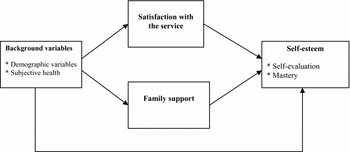
The aim of the current study is to compare two groups of elderly women – one group who received care insurance services at home and the other at day centers, and to assess carefully which of the two groups demonstrated higher self-esteem. The study is based on the model in Figure 1, which describes the background variables, the moderators (service satisfaction, rate of family support), and the dependent variable (self-image).
The research model.

Method
Population and sample
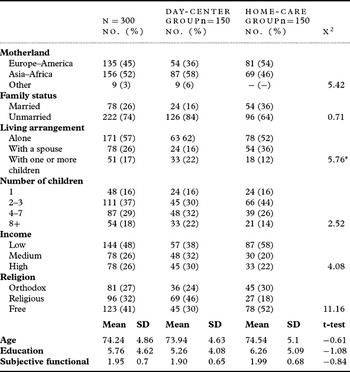
The research population comprised elderly women from a number of towns in northern Israel. The selection of female participants in this present study was based on the fact that women constitute a high percentage (88%) of the total number of care insurance beneficiaries. A total of 300 women were sampled, 150 of whom received their care service at home and the other 150 at day centers. Participants of both groups were characterized by 100% ADL dependence, as defined by the National Insurance Institute. To avoid predetermined differences, it was decided that the age of the sampling group would be similar (70–80 years). The sampling method integrated class sampling and convenience sampling. The background characteristics of the participants are presented in Table 1.
Background characteristics of the study participants (N = 300)

*p < 0.05.
As indicated in Table 1, 52% of the research participants were of Afro-Asian descent, 74% were not married (most were widowed), 57% lived at home alone, and most had low incomes and a limited education.
The sampling method was arranged so that it would generate equal presentation of the various characteristics existing in the elderly population, while at the same time trying to maintain a similar relation between the two sampling groups. Thus, the average age of the two groups was similar: 73.94 (SD =4.63) for those attending day centers and 74.54 (SD = 5.1) for those receiving care at home. The average number of years of schooling was 5.25 (SD = 4.08) among the day-center group and 6.26 years (SD = 5.09) among the home-care group. Subjective perception of functional abilities was also quite similar in both groups: 1.9 (SD = 0.65) among the day-center attendees and 1.99 (SD = 0.65) among the home-care recipients.
The differences between the groups were tested by X2 and t-tests, as presented in Table 1. No significant differences were found in the background variable distributions of the two groups, except for the living arrangement variable (p < 0.05). Thus, while participant selection was not conducted randomly, it is apparent that the sampling method did create two similar groups with regard to background variables. This enabled comparison between the two groups in relation to other research variables.
Research tools
The research was undertaken using several questionnaires. The demographic questionnaire was formulated specifically for this study, while the subjective functional perception questionnaire was taken from “SELF – Self Evaluation of Life Function” (Linn and Linn, Reference Linn and Linn1984). This comprises 10 items relating to the physical and cognitive aspects self-evaluation, rated on a scale ranging from “totally unable” to “no need for any help” (Cronbach's α = 0.83). A third questionnaire – in Hebrew, developed by Falck (Reference Falck2000)– measures the extent of participants’ satisfaction with the service. It is composed of 13 statements, the first seven of which relate to satisfaction with the service and the other six to satisfaction with the caregivers. The extent of satisfaction was measured on two levels: expressive and instrumental. Each item was rated from 1 (lowest) to 3 (highest) (Cronbach's α = 0.73). The questionnaire for assessing family support comprised two tools which examine the sources of support in daily life (Shuval et al., Reference Shuval, Flieshman and Shmueli1982). For each of 14 items, participants were required to state the primary source of support or help that they had requested over the past two weeks. The sources of support were divided into three categories: family support, professional caregiver support (at home or at the day center), and general support. The final questionnaire examined the self-esteem variable using two tools: the sense of mastery (of life and circumstances) self-report tool (Pearlin et al., Reference Pearlin, Liberman, Mengehan and Mullan1981) and a self-evaluation questionnaire. The first tool lists seven statements and each participant was required to indicate on a Likert scale her degree of agreement/disagreement with the statement. The higher the mark, the higher the participant's self-esteem. The tool was validated through factor analysis and its internal credibility ranged between 0.47 and 1.0 according to Cronbach's α. The second component of the self-esteem variable is self evaluation (Rosenberg Reference Rosenberg1965). This tool lists 10 items rated on a Likert-like scale, with four answering options, and credibility reaching 0.76 according to Cronbach's α. All participants were personally interviewed, with each interview lasting about an hour on average.
Results
The basic hypothesis of this study postulated that a difference would be found in the levels of self-esteem between elderly women who visit the day-care centers and those receiving home care. The self-esteem variable was examined both as an independent variable and according to its two components: mastery and self evaluation.
Our findings show that the self-esteem of the participants who attended the day-care centers was higher than the self-esteem of the those who received help at home (t = 136.16; p < 0.001). Significant differences were also found in the comparison between the two groups in both the sense of mastery over life and circumstances (t = 92.34; p < 0.001) and the self-evaluation measure (t = 18.8; p < 0.001). Participants who received help at the day centers reported a higher sense of mastery and their self-evaluation was higher than that of participants receiving help at home.
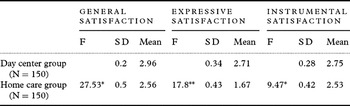
The second hypothesis postulated that a positive correlation would be found between the moderating variables of the research model and the self-esteem of the participants in both groups. The moderating variables included the elderly person's satisfaction with the care offered in each type of service, and the level of family and social support that they enjoyed. To examine the correlation between satisfaction with the service and the self-esteem of the participants, a MONOVA type statistical analysis was applied, which related to each of the three aspects of satisfaction with the service: the instrumental aspect, the expressive aspect, and general satisfaction. Table 2 shows that significant differences are evident between the day-care center group and the home-care group in terms of the level of satisfaction from the service, in all aspects. The former was more satisfied with the care than the latter in all three aspects – instrumental, expressive, and general.
MANOVA: Participant's satisfaction in the two separate groups (N = 300)

*p < 0.05; **p < 0.01.
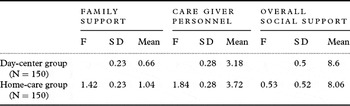
To examine the correlation between the level of family/social support received by participants in both groups and their self-esteem, a MONOVA type statistical analysis was performed. The findings are presented in Table 3, which shows that no significant differences were found between the day-care center group and the home-care group.
MANOVA: Participant's social support in the two separate groups (N = 300)

*P < 0.05; **P < 0.01.
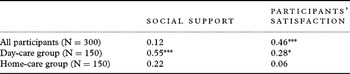
At this stage the correlation between the moderating variables and participants’ level of self-esteem in both groups was examined by Pearson correlation. The findings (Table 4) indicate a strong, positive and significant correlation between satisfaction with the service and the level of self-esteem of all the research participants (p < 0.001). Among the day-center participants, a weak positive correlation was noted between satisfaction with the service and self-esteem (p < 0.05), whereas among the home-care participants no correlation was found between satisfaction with the service and their self-esteem. On the general level, no correlation was found between the level of family social support and self-esteem. However, a strong positive correlation was found between the level of family social support and self-esteem among the day-care participants (p > 0.001).
Pearson correlation between the moderating variable and the participants’ level of self esteem (N = 300)

*p < 0.05; **p < 0.01; *** p <0.001.
To summarize our findings relating to this hypothesis, the moderating variables were found to be positively and significantly correlated with the dependent variable, self-esteem, especially among the day-center group. Regarding the home-care group, it seems that their self-esteem was not correlated with either satisfaction with the service variable or the family social support variable.
Finally, in an attempt to locate any background variables that may correlate with the self-esteem of the participants in both groups, a t-test statistical analysis was carried out on the sequenced variables such as age, education, and subjective functional perception. No significant differences were found between the two research groups. This was followed by analysis using Spearman's rank correlation coefficient to examine the correlation between these variables and the dependent variable. A strong positive correlation was found between subjective functional perception and the self-esteem of the participants. The more functionally competent the participants perceived themselves to be, the higher their self-esteem. No correlation was found between the age and education variables and the self-esteem variable.
An ANOVA analysis was carried out to measure the correlation between the nominal and ordinal background variables such as family status, income level, number of children, place of origin, and religiosity, and the self-esteem of the study participants. Findings show that only the family status variable was positively, significantly and strongly correlated to the level of self-esteem of the research participants (p < 0.001). Hence, when the research subject was either married or living with a permanent partner, her self-esteem was higher than that of a participant who was neither married nor living with a partner.
To investigate the research variables and the moderating variables and their degree of correlation with the self-esteem variable, a hierarchical regression statistical procedure was carried out to predict the level of self-esteem (Table 5).
Hierarchical regression to predict by the various research variables affecting the level of self-esteem (N = 300)

*p < 0.05; **p < 0.01; ***p < 0.001.
Our findings show that all three variables explain about 70% of the variance in the level of self-esteem. Participants’ subjective perception of their function in daily activities explains about 10% of the variance, participants’ family status as either married or living with a permanent partner explains about 13% of the variance, and the remainder of the variance is explained by the type of service (day-center or home-care service).
Discussion
The study focused on two types of services offered to elderly women through the care insurance law and which are considered part of the community service network: home-based care and support and adult day-center-based care and support. In general, the study examined the correlation between the type of service offered and the self-esteem of the participants. Research findings showed that the self-esteem of the elderly women who attended the day-care centers was significantly higher than that of the women who received home-based care.
This finding may be explained in several ways. First, one must assume that getting out of the house in the morning, maintaining an organized schedule, and being part of a group of people contributes to one's sense of importance and increases the self-esteem of the individual. Ranzijn et al. (Reference Ranzijn, Keeves, Luszcz and Feather1998) have added the term “usefulness/competence” in this context, and concepts of usefulness, capability, achievement and productive activity, which are recognized as objectives in day centers for the elderly, contribute greatly to the self-esteem of the elderly women who attend them. Some attendees receive verbal and financial rewards by selling their artistic creations produced at the day centers. Finally, it seems that the sense of belonging, involvement and social ties with other members at the center, and especially the relationships established with the staff at the center (both professional and paraprofessional) also contribute to the increase in self-esteem of the attendees at the day center.
A significant difference was found between the averages of the two groups when examining the two components of self-esteem: mastery over life and circumstances, and self-evaluation. In both sampling groups, the average of mastery was lower than the average of self-evaluation. One explanation for this involves relating mastery to other factors such as state of mind, time, other people, and behavior (McKay and Fanning, Reference McKay and Fanning1990). A common notion in modern developed societies is that when a productive, active individual becomes dependent on services, a useful individual has become useless. The emotions that ensue include rejection, pain and loss. One's self-confidence – as well as the meaning of one's life – changes, which also affects one's senses (Minkler and Estes, Reference Minkler and Estes1991). Old age is characterized as a period of significant change and a decrease in the individual's mastery of life. Physiological changes and a decrease in functional capabilities cause difficulties in mobility and hence dependence on others every time one wants to go out or even carry out some basic functions within the home. The senses become limited and the mental capacities deteriorate, causing possible memory loss, slower reflexes, poor generalization and abstraction. This can cause elderly people to question their ability to control their own lives through decision-making, problem-solving, executing plans, and carrying out routine tasks.
Another hypothesis in this study was that there would be a correlation between the level of satisfaction with the care provided and the women's level of self-esteem in both sample groups. It was also postulated that the level of satisfaction of the women receiving care at the day center would be higher than that of the women receiving home care. Research findings showed a significant difference in the levels of satisfaction with the care workers between the day-center group and the home-care group. This included expressive satisfaction with the care provided; the ability to consult with the care workers; empathy on the part of the care workers; respect towards the clients; immediate help when required; and ties that extend beyond work hours. The satisfaction of the day-care center clients with the expressive aspect of the care was significantly higher than that of the home-care clients. This indicates a positive difference in the emotional support available to the day-center clients compared to the home-care clients.
The best way to explain the differences in the level of satisfaction with the service provided to the women in both sample groups is through the style and character of the service provided. While home care is usually provided by a single worker on a regular basis, the day-center care is provided by professional and paraprofessional staff. Furthermore, whereas home care focuses on instrumental-personal care, environmental-functional care, and social activity and interaction between the care worker and the client, the day-center care focuses on instrumental-personal care while emphasizing intensive, socially involved activities. The interaction at the center is not only between the staff and the clients, but also among the staff members themselves, and the center constitutes a type of support group (Korazim, Reference Korazim1994; Shatz, Reference Shatz1996).
In addition, home-care workers receive cases about which they know very little. They have to decide independently what the client's needs are and what should be done to meet these. Usually the home-care worker lacks any professional training and most of the worker's relationships involve the client's family members, who may regard him or her as “the help.” If the client reports that she is satisfied with her care worker it is because she gained a caring and dedicated worker (Feldman et al., Reference Feldman, Sapienza and Kane1990; Eustis and Fischer, Reference Eustis and Fischer1991). The day-center staff takes care of a large group of elderly people on a daily basis. The staff is responsible for implementing the service and the general program and none can pay full attention to a single client at a particular time. Nevertheless, many discussions take place between the staff members and the clients, and interest is shown in their personal lives as well as the lives of the family members who are highly involved in the daily activities carried out at the center. The atmosphere at the center provides a sense of belonging and connection. The clients do not feel constricted by time, and close contact with the clients is strictly maintained even when they are absent from the center for one reason or another. This explanation raises additional questions regarding the difference between home care and the services provided at the day centers, such as trained versus untrained personnel who care for the clients, and the effects of team work compared to individualized home care.
To what extent do other variables contribute to the level of self-esteem of the two research groups in the two different services? The family support variable of each group of participants and its effect on the level of self-esteem was tested for this purpose. The research hypothesis was that self-esteem would increase when family support was higher. Family support is defined as information that causes an individual to feel important, loved and appreciated, and gives that individual a sense of belonging and mutual commitment to the specific social network (Krause and Borawski-Clark, Reference Krause and Borawski-Clark1995). The importance of family support in old age is emphasized in the literature (Antonucci, Reference Antonucci, Binstock and Shanas1985; Fehr, Reference Fehr1996). Present research findings do not indicate any significant difference between the two sampling groups in the level of family support. In both groups the family was found to be a very significant supporting factor.
The final question investigated in this study was which of the personal background variables of the elderly may have contributed to increased self-esteem. Of all the background variables, two were found to be significant in this regard: the subjective functional perception and the family status variable. Research studies show that when a person reaches the stage of loss of physical capacities and a deterioration in mental capacity, the need for assistance grows; any way in which a person can maintain their roles, or find alternative ones, enables them to preserve their level of self-esteem and sense of status and place in the family and wider society (Rosenbaum, Reference Rosenbaum, Eifert and Evans1990; Ben-Sira, Reference Ben-Sira1991; Krause and Borawski, Reference Krause and Borawski-Clark1995). The research hypothesis was that day centers offer numerous possibilities for acquiring alternative roles, a sense of belonging, and opportunities for self evaluation, and that therefore the level of self-esteem among the day-center attendees would be higher than that of the home-care group. This hypothesis was supported by the findings. A significant difference was found in the subjective functional perception between the two research groups. One explanation for this is that despite the fact that the ADL level was similar in both groups, it appears that it was the type of service that made the difference. In itself this finding may raise questions about the quality of the ADL assessment carried out by the National Insurance Institute in order to determine the right to receive the care insurance law benefit. Another explanation could involve the quality of the measurement tools. The self-report on functional state may be unreliable and could be affected by a participant's wish to arouse pity or perhaps acquire further benefits from the authorities.
Conclusions
Our findings indicate that regular attendance at day centers contributes to the level of self-esteem among elderly women who are functionally limited both in their sense of mastery of life and situation, as well as in their self-evaluation. Why, then, is the attendance among those eligible for care insurance so low? Why do most elderly people prefer to receive their care at home? The main reason seems to be financial. The payment required of the elderly, although subsidized, is relatively high for those whose financial status is below average. Other explanations could be connected to the personality and circumstances of those who prefer to stay in the secure surroundings of their home: poor health, difficulty in getting up in the morning, difficulty being among other elderly people, and so on. It should be noted that the research participants who attended the day centers reported that, since they had joined, they felt less lonely, enjoyed the company, and their general well-being had greatly improved. A further explanation could be the relative ease of home care. Undoubtedly, in this framework the unique demands of the care insurance law beneficiaries are closely and frequently met. Perhaps the importance of the term “home” in its deeper meaning of personal security is what tips the scale in favor of home care.
Conflict of interest
None.