Introduction
Biodiversity and complexity are considered to be essential for the stability and the equilibrium of the living component of ecosystems, including rural landscapes (Pimentel, Reference Pimentel1961). Habitat management techniques that change structural and vegetational complexity in agro-ecosystems may affect the density of the herbivores and contribute to the conservation or improvement of natural enemy communities (Landis et al., Reference Landis, Wratten and Gurr2000). According to these criteria, crop diversification is an agricultural strategy that can be used to manage insect populations (Altieri et al., Reference Altieri, Nicholls, Ponti, Radcliffe, Hutchison and Cancelado2008; Lin, Reference Lin2011). This strategy is consistent with the resource concentration hypothesis, which predicts that specialist herbivorous insects are more abundant in large patches of host plants (Root, Reference Root1973; Grez and González, Reference Grez and González1995; Bryant et al., Reference Bryant, Brainard, Haramoto and Szendrei2013); later, these theories have been expanded generating the ‘associational resistance’ concept (Barbosa et al., Reference Barbosa, Hines, Kaplan, Martinson, Szczepaniec and Szendrei2009). These ecological principles explain why in most cases the crops in a condition of higher plant diversity, including intercropping and living mulch (LM), can prevent or reduce pest infestations (Andow, Reference Andow1991). It must be emphasized, however, that besides this general trend, there are also discordant cases.
Many studies showed that intercropping and LM can have positive impact on plant pests and diseases as well as weed control (Sans and Altieri, Reference Sans and Altieri2005; Jones and Sieving, Reference Jones and Sieving2006), although this trend cannot be considered a general rule, but evaluated on a case-by-case approach (Masiunas, Reference Masiunas1998). Indeed, the results can be affected by a number of variables, including the crop systems and the arthropod species, which are taken into account in the experiments.
This study was developed under a project (InterVeg http://www.coreorganic2.org/) aimed at verifying if the introduction and the proper management of intercropping in vegetable production systems allow comparable yields and product quality in comparison with the sole cropping systems, reducing the use of auxiliary, off-farm inputs and non-renewable energy consumption. The aim of our study was to evaluate the effect of a ‘cover crop–vegetable cash crop’ intercropping on arthropod dynamics and biodiversity, including an evaluation on pest abundance and an assessment of ecosystem services (i.e., biological control). In order to have an ecological comparative overview of fields cropped in different areas of European countries characterized by various arthropod assemblages, it was decided to use the soil arthropod fauna as bioindicator, with the aim to compare living mulched systems with sole crop ones.
Materials and Methods
Study sites and experimental design
In a 2 year study, large-scale experiments (Perry, Reference Perry, McEwen, Wyatt, Reynolds, Riley, Armes, Cooter, Tucker, Colvin, Eigenbrode, Bernays, Perry, Mumford, Knight, Corbet, Osborne, Matthews, Mills, Symondson, Hemingway, Holt and Cheke1997) were carried out in Italy, Denmark, Germany, and Slovenia on cauliflower (Brassica oleracea L. var. botrytis). The experiments were managed according to the national guidelines for organic management in each country, complying with the European regulation of organic production (Council Regulation (EC) No. 834/2007), which does not allow the use of inorganic fertilizers and synthetic pesticides. The field trials were carried out within the InterVeg Project: Enhancing multifunctional benefits of cover crops-vegetable intercropping (Core Organic-ERA NET). The plant species included in the LMs were selected according to the agronomic practices and the climate conditions in each country. In general all the partners followed the same experimental plan. Each country included some variation because of different climatic conditions, farm characteristics and agronomic practices (species composition of the mulch, size of the farm). In Italy a living mulched cauliflower system, where burr medic (Medicago polimorpha L.) was used as LM (Canali et al., Reference Canali, Campanelli, Ciaccia, Diacono, Leteo, Fiore and Montemurro2015), was compared with the sole cauliflower crop (control) in an organic farm located in Spoltore (42°28′N, 14°09′E) (Pescara), approximately 10 km from the Adriatic coast of Central Italy. The treatments were applied to two plots of 800 m2 each; being at a distance of approximately 100 m apart in order to reduce the cross effect between the treatments. The experiments were carried out in 2012–13.
In Denmark, the experiment was located in Årslev on the island of Funen (55°30′N, 10°43′E). The LM consisted of white clover (Trifolium repens L.) and ryegrass (Lolium perenne L.), which were transplanted at the same time of the cauliflower. The size of each plot was 600 m2 and the distance between them was approximately 50 m.
In Germany, the experiment was located in Northrhine-Westfalia at two different sites: Böhlenhof in Grosseneder, (51°33′N, 9°9′E) and Kilianihof in Lichtenau (51°37′N, 8°54′E), in 2013 and 2014, respectively. The LM consisted of white clover (Trifolium repens L.). It was undersown in cauliflower between 4 and 6 weeks after planting. The size of each plot was 1008 m2, the sole crop and LM plots were 100 m apart.
In Slovenia, the experiment was located in the organic pilot farm Berden, NE Slovenia – Hrastje Mota (46°36′N, 16°4′E). The LM consisted of white clover undersown in cauliflower. The size of each plot was 1000 m2, and the sole crop and LM plots were approximately 2000 m apart. In Denmark, Germany and Slovenia, the experiments were carried out in 2013–14.
Key pest infestation
Cover crop mulches were assessed for their effects on insect pests of vegetables (Masiunas, Reference Masiunas1998). The level of infestation of key pests was evaluated only in the experiments carried out in Italy and in the Denmark.
In Germany and Slovenia, during the 2-year experiment the crop displayed very low levels of infestation; therefore the pest populations were not quantitatively sampled. In Italy, a total of 100 plant organs per treatment were randomly selected and checked at every sampling both in the LM and in the sole crop treatment. Presence/absence of the key pest (Pieris spp.) was recorded. By this planning, one sampling every 2 weeks was carried out during the cultivation season, checking 5 plant organs (leaf or flower) per plant, on a total of 20 plants per treatment.
In Italy, in order to evaluate the level of ecosystem service on the key-pest, the percentage of parasitization was determined collecting a minimum of 15/20 caterpillars per treatment in each sampling. Each larva was dissected to check the presence of parasitoid larvae. Given the infestation of aphids on the crop grown in Denmark, the abundance of lacewings (Crisopidae) was selected as indication of ecosystem service.
Soil arthropod fauna
In all the experiments pit fall traps were used to investigate the soil arthropod fauna following standard practices available in the literature (Lovei and Sunderland, Reference Lovei and Sunderland1996; Kromp, Reference Kromp1999; Döring and Kromp, Reference Döring and Kromp2003). In Italy, a minimum of four traps were placed in each treatment, in order to reach a density of one trap per 200 m2. The traps were active for approximately 2 weeks per sampling. Carabids (Coleoptera: Carabidae) were identified to species level, while other soil arthropods were identified to the family (Staphylinids), to the order (Araneae, Opiliones, Collembola, Isopoda) or the sub-phylum level (Miriapoda). In Denmark, four pit fall traps per plot (one trap per 150 m2) were placed in the field twice during the cauliflower cropping cycle, in a period of 2 weeks with a stop of 2 weeks in between. In Germany, four pitfall traps were used (one trap per 250 m2). The sampling period was between 5 and 12 days. In Slovenia, the monitoring was carried out by four pitfall traps per plot. The traps were active 14 days for each sampling. In the Danish, German and Slovenian experiments the number of Carabidae, Staphylinidae and Aracnidae caught in each trap was recorded, and Carabidae were identified to genus level.
Data analysis
The abundances of soil arthropods were expressed as activity density, which is obtained dividing the number of collected individuals by the number of days of trap activity; the obtained value was multiplied by 7, in order to scale the captures to a week (Kromp, Reference Kromp1999). The indexes of Shannon and Berger-Parker and the Evenness (Magurran, Reference Magurran1988) were calculated for Carabidae.
Nested ANOVA was employed for the analysis of biodiversity of soil arthropods; each sub-plot, represented by one trap, was nested into treatment factor (LM and sole crop), also the year was included as a factor in the model.
Log linear analysis was performed to analyze frequency data of insect infestation and percentage of parasitization. By this approach, response variables (pest infestation and caterpillar parasitization) and design variables (treatments–years–sampling date) are analyzed in a way similar to a factorial analysis of variance (ANOVA) (Steel et al., Reference Steel, Torrie and Dickey1997).
Results
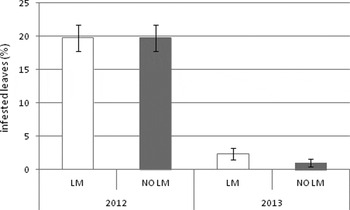
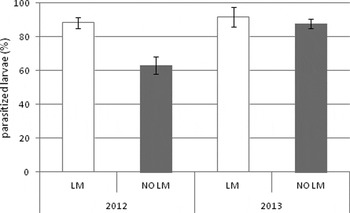
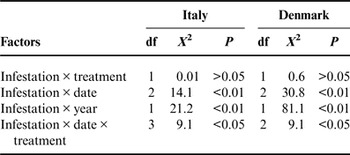
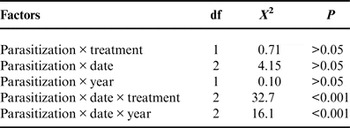
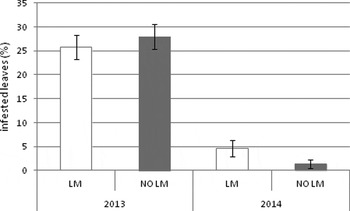
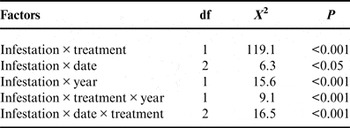
In Italy, the infestations of Pieris brassicae (L.), the key pest in the Italian scenario, did not show any difference between the LM and the sole crop treatment in both years (Log linear analysis, P > 0.05) (Table 1; Fig. 1). Also, the percentage of parasitized larvae, pooling all the data together, did not show any statistical difference between the treatments. In spite of this general finding, the parasitization in 2012 was higher in LM in comparison with the sole crop control treatment (Fig. 2). The positive interaction (P < 0.01) among ‘infestation × sampling date × treatment’ (Log linear analysis, P > 0.05) (Table 2) seems to support this seasonal trend. All the parasitized larvae were attacked by Cotesia spp. (Hymenoptera: Braconidae), gregarious parasitoids, which are a common biological control agent of Pieris pest.
Pieris brassicae infestation (% of infested leaves) in the Italian experiment. Bars indicate standard errors of binomial distribution.

Pieris brassicae parasitization (%) in the Italian experiment. Bars indicate standard errors of binomial distribution.

Log linear analysis of Pieris brassicae infestation in the Italian and Danish experiment.

Log linear analysis of Pieris brassicae parasitization in the Italian experiment.

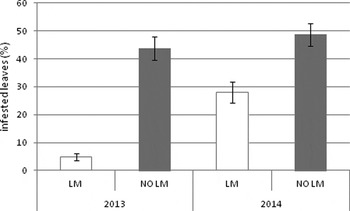
In Denmark, the cabbage caterpillars (Pieris spp.) and aphids were considered the key pests: In the first case, no differences were detected between LM and sole crop (Fig. 3; Table 1), whereas aphid infestation was significantly higher in the sole crop system (Fig. 4; Table 3). The high occurrence of lacewing in both treatments (27.3% LM –33.6% NO LM) is remarkable, in particular in the sole crop, which was characterized by higher aphid infestation.
Caterpillar infestation (% of infested leaves) in the Danish experiment. Bars indicate standard errors of binomial distribution.

Aphid infestation (% of infested leaves) in the Danish experiment. Bars indicate standard errors of binomial distribution.

Log linear analysis of aphid infestation in the Danish experiment.

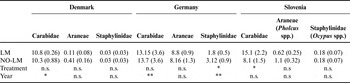
In Table 4, the soil arthropod taxa collected in the Italian experiment are reported. In general, all the taxa showed similar activity densities in the two treatments with no statistical difference (nested ANOVA). Five out of six macro-groups showed significant differences of activity density between the two seasons.
Soil arthropods in the Italian experiment.

Numbers indicate the activity densities (standard error) of each taxon. n.s., P > 0.05; *P < 0.05; **P < 0.01 (nested design ANOVA).
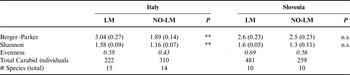
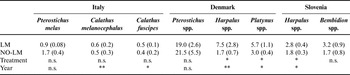
In Italy, Carabid biodiversity indexes were higher in the LM treatment in comparison with the sole crop (Table 5). The most abundant species were the zoophagous species Pterostichus melas (Creutzer), Calathus melanocephalus (L.), and Calathus fuscipes (Goeze). The activity density of these species did not show any statistical difference (ANOVA P > 0.05) between the treatments (Table 7). The higher evenness (0.58) of LM in comparison with sole crop (0.43) could explain why biodiversity indexes were higher in this system.
Biodiversity indexes (standard error) calculated on Carabidae in the Italian and Slovenian experiments.

**P < 0.01 (nested design ANOVA).
In the Danish experiment no differences between the treatments were detected among the activity densities of all the groups considered (Table 6). The activity density of Harpalus spp., a Carabid genus, which includes omnivorous species, was significantly higher in living mulched plots (Table 7). In Germany, Staphylinidae density was higher in NO-LM than in LM, whereas Carabidae and Araneae did not show any difference (Table 6).
Soil arthropods in the Danish, German and Slovenian experiments.

Numbers indicate the activity densities (standard error) of each taxon. n.s., P > 0.05; *P < 0.05; **P < 0.01 (nested design ANOVA).
In Slovenia, Carabidae showed an activity density significantly higher in LM (15.1) than sole crop (8.1), while Araneae and Staphylinidae activity were quite similar in both treatments (Table 6). In this country, the most abundant Carabid genera were Platynus, Harpalus, and Bembidion (Table 7). Activity densities of Platynus and Harpalus were significantly higher in LM in comparison with sole crop system. The dominance measure (Berger–Parker index) was quite similar between the treatments, while Shannon was higher in LM, even if this difference was only marginally significant (P = 0.06). Also in Slovenia, evenness of Carabid assemblages was higher in LM (0.69) in comparison with sole crop (0.56), confirming the results obtained in Italy (Table 5). A small number of Araneae was collected; Folcus was the dominant genus within this taxon. The few specimens of Staphylinidae collected belonged to the genus Ocypus.
Activity densities (standard error) of the most abundant Carabidae in the Italian, Danish and Slovenian experiments.

n.s., P > 0.05; *P < 0.05; **P < 0.01 (nested design ANOVA on square root transformed data).
Discussion
Considering that interaction of LM on arthropod dynamics and biodiversity is still poorly known, our study provides the first results for some European countries. Moreover, this study offers a comparative analysis of biodiversity trends and arthropod dynamics in a wide range of environmental conditions, focusing on the effects that an additional living component of agro-ecosystems can induce in areas characterized by relevant geographic and climatic differences.
Both in Italy and in Denmark, the LM did not affect the infestation of cabbage caterpillars (Pieris spp.), demonstrating that no augmentation of the abundances infestation of these key-pests is caused by this technique. In Italy, a very high level of larval parasitization was detected in both treatments and in 1 year the percentage of parasitization was higher in LM (88%) than in the sole crop (63%). In Denmark, in both seasons, aphid populations were higher in sole crop system than LM; this interesting result is consistent with the resource concentration hypothesis and associational resistance concept arguing that pest infestation is usually higher in monoculture than polyculture systems (Andow, Reference Andow1991; Barbosa et al., Reference Barbosa, Hines, Kaplan, Martinson, Szczepaniec and Szendrei2009). In North America, soybean grown with alfalfa LM had an increase of natural enemies and showed a delay in Aphis glycines Matsumura establishment (Schmidt et al., Reference Schmidt, O'NEAL and Singer2007). A study on the population dynamics of Bemisia argentifolii Bellows & Perring and aphids, and their associated natural enemies, which was carried out in Cucurbita pepo L., to compare the living and the synthetic mulch, showed that LM had consistently fewer adult whiteflies and aphids in comparison with the synthetic mulch. LM treatments had also higher natural enemy populations than synthetic mulch and bare-ground treatments (Frank and Liburd, Reference Frank and Liburd2005). Experiments carried out by Hinds and Hooks (Reference Hinds and Hooks2013) in North-eastern United States showed that the number of striped cucumber beetle (Acalymma vittatum F.), found on leaves of zucchini plants, was significantly lower in sunn hemp (Crotalaria juncea L.) interplanted plots with respect to bare-ground treatment plots.
Previous investigations demonstrated that soil arthropods, and in particular Carabidae, were suitable to compare the biodiversity dynamics between organic vegetable crops and conventional ones (Burgio et al., Reference Burgio, Campanelli, Leteo, Ramilli, Depalo, Fabbri and Sgolastra2014), providing an interpretation of the conservation of biodiversity in a 4-year period. Besides the positive features (for example soil monitoring is easily standardized), also controversial aspects have been detected using such an approach, for the interaction of many factors, which can make the comparisons of soil arthropods in organic systems very complex (Hole et al., Reference Hole, Perkins, Wilson, Alexander, Grice and Evans2005). For example positive responses of these groups, and in particular Carabidae, were recorded in many cases, but the mechanism of response of some groups can vary according to crop, rotation, site, and endpoint used (Kromp, Reference Kromp1999; Andersen and Eltun, Reference Andersen and Eltun2000; Hole et al., Reference Hole, Perkins, Wilson, Alexander, Grice and Evans2005). This can explain why, besides a general common trend, some differences were detected in our study. Soil arthropods can be positively influenced by LM, due to the increase of diversity of vegetation; for example, the presence of predators, in particular the Carabidae, in mulches in a corn–soybean–forage rotation was higher compared with a no-mulch control (Prasifka et al., Reference Prasifka, Schmidt, Kohler, O'NEAL, Hellmich and Singer2006).
In this study, LM positively affected the activity density of Carabidae, both increasing diversity and evenness of species (Italy and Slovenia) and activity density of some groups (Slovenia and Denmark). Overall, it is remarkable that in Italy and Slovenia, the Carabid evenness was higher in LM in comparison with the sole crop system; considering that evenness quantifies how equal a community is numerical (Magurran, Reference Magurran1988), this finding could suggest that the intercropping system with LM provided a more stable colonization of carabid populations, leading to a higher uniformity of the species abundances. In some cases, the activity density of Harpalus spp. (Slovenia and Denmark), a genus which includes omnivorous and seed-feeder species, was higher in LM plots. Furthermore, it is remarkable that some zoophagous species (i.e., Platynus spp. in Slovenia) showed an increased activity density in the LM treatment.
In Germany, rove beetles activity density was higher in the sole crop system although the other soil arthropod taxa showed similar activity in the treatments. Conversely, in Italy the activity density of the rove beetles showed a general increase in LM, and the difference between these two countries is puzzling. Given that rove beetles include species with very different ecological niches, identification at species level could help to clarify these aspects and provide a better interpretation. The rove beetles have been far less investigated than other groups like the Carabidae; for this reason a faunistic analysis of this group is needed. Discrepancies involving rove beetles were reported from other studies focused on the soil arthropod biodiversity in organic farming. For example Andersen and Eltun (Reference Andersen and Eltun2000) found a general reduction in the diversity of the rove beetles during conversion from conventional to organic farming, whereas positive effects were detected on carabid diversity.
In conclusion, an interesting result of our study is that LM in cauliflower did not increase pest infestation, showing the lack of detrimental effects of this technique. In one country (Denmark), LM reduced aphid infestations. Some positive effects on ecosystem services and on soil arthropod diversity were detected in LM systems, although the response was affected by the end-point used. In particular, caterpillar parasitization in the Italy experiment was very high, and a consistent controlling capacity of the organic farm itself was detected. It is remarkable that parasitization in 1 year (2012) was higher in LM in comparison with sole crop.
The Carabidae was the group that most benefited by the LM; the identification of Carabidae to species or genus level contributed to a better interpretation of the results, providing an ecological analysis of the species sampled. This taxon showed higher diversity indexes or higher activity density of some dominant species, in the different countries.
Our results indicate a general positive influence of the LM technique on plant/soil systems, as shown by a high level of soil biodiversity and a general lack of negative effects on the abundance of pests.
Acknowledgements
This study has been carried out in the frame of the InterVeg research project: Enhancing multifunctional benefits of cover crops – vegetables intercropping (Core Organic II ERA-NET).