Introduction
Explosions and shootings comprise almost all of the terrorist events against civilian populations.Reference Ashkenazi, Einav, Olsha, Turegano-Fuentes, Krausz and Alfici 1 Many of these events result in multiple-casualty incidents (MCIs) which could overwhelm a single receiving medical institution. The injuries incurred by terrorist attacks typically have a higher Injury Severity Score (ISS) and require greater resource utilization compared to other trauma scenarios. 2 Contingency planning is intended to prepare an organization to respond well to a random emergency, such as a MCI. Developing a contingency plan requires advanced decisions based on previous experience in order to optimize the medical response while conserving human and financial resources.
The Hillel Yaffe Medical Center (HYMC; Hadera, Israel) activated its contingency plan in 23 terror-related MCIs from 1994 through 2005.Reference Peleg, Aharonson-Daniel and Stein 3 The HYMC is a Level II trauma center without neurosurgical capacity on-site. One-sixth of the victims admitted were in the extremes of age. Trauma patients in the extremes of age have unique requirements. The aim of this study was to examine the type of injuries encountered in children and elders and the implications of these injuries in terms of resource consumption. The hypothesis evaluated in this study was whether children and/or elders required more resources compared to adults who served as controls.
Methods
Study Design
This was a retrospective, single hospital site, medical record review. The study was authorized by the HYMC’s institutional ethical committee for studies on humans.
Study Setting and Population
All medical files of patients admitted to the HYMC’s emergency department (ED) following injury in a terror-related MCI, all of which occurred from 1994 through 2005, were screened.
Study Protocol
Patients admitted to the ED following a terror-related MCI are assigned unique reception numbers. The HYMC maintains a MCI registry in which the clinical data of patients admitted to the ED are recorded retrospectively. The registry includes: demographic data (eg, age and gender); details of the injury (ie, mechanism, ISS, and number of areas injured according to the Abbreviated Injury Scale classification); administrative data (eg, hospital length-of-stay [LOS] and intensive care unit length-of-stay [ICU LOS]); treatment requirements (ie, intubation, mechanical ventilation, surgery, angiography, transfusion, recombinant factor VIIa, and secondary transfer); and outcome (ie, in-hospital death).Reference Ashkenazi, Kessel and Olsha 4 , Reference Gennarelli and Wodzin 5 Patients were excluded if data were severely lacking. Most of those excluded were evacuated from the site of the attack but declined workup.
Measures
For study purposes, the patients were grouped into three age groups: children (12 years and younger); adults (13-64 years); and elderly (65 years and older).
Data Analysis
Data were analyzed with the help of dedicated statistical software (GraphPad InStat - version 3.06 and Prism - version 6.0; GraphPad Software Inc.; San Diego, California USA). The proportion of patients within each age group was compared to that of the general population in 1999.Reference Baker, O’Neill, Haddon and Long 6 Between-group comparisons for categorical and ordinal variables (eg, mechanism of injury, injury severity, number of areas injured, proportion requiring intubation, proportion requiring blood products, proportion requiring computed tomography imaging, proportion requiring surgery, and mortality) were performed using Chi-Square or Fisher's exact probability test dependent on variable distribution. Continuous variables (eg, LOS and ICU LOS) were compared using the t-test or the Mann-Whitney U test. Probabilities of survival (P) were calculated for late deaths (those occurring >24 hours after admission) using the Trauma ISS methodology, ISS, Revised Trauma Score, and age. 7 , Reference Boyd, Tolson and Copes 8
Results
Overall, five hundred thirty-four patients were included. Of these, 270 (50.6%) were female and 264 (49.4%) were male. Four MCIs resulted from active shooter incidents and 19 were incurred by a domestic bombing event. One hundred twelve victims were admitted following the shooting events while 422 were admitted following bombings. Thirty-one (5.8%) patients were children, 449 (84.1%) were adults, and 54 (10.1%) were elders. The age of children ranged between seven months and 12 years: there were no newborns; five were infants (1-12 months); six were toddlers (1-3 years); six were preschool children (4-6 years); and 15 were school-aged children (7-12 years). The proportion of injured children was considerably smaller than the proportion of children in the general Israeli population. The proportion of injured elders, on the other hand, was similar to that observed in the general population (Table 1).
Proportion of each Age Group within the Injured Patient Population and within the General Population

Severity of Injury
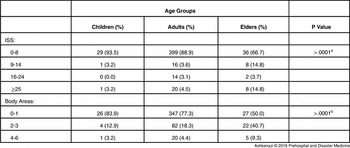
Elderly patients incurred more moderate and severe injuries (ISS≥9) than pediatric and adult patients (P<.001; Table 2). Elderly patients had a greater number of injured body areas (P<.0001). This finding corresponds to the higher ISS observed in the elderly patients.
ISS and Body Areas Injured in Children, Adults, and Elders Admitted in 23 MCIs

Abbreviations: ISS, Injury Severity Score; MCI, mass-casualty incident.
a Mildly injured (0-8) vs the rest.
b Few body areas (0-1) vs the rest.
Treatment Characteristics and Resource Consumption
The number of patients in need of secondary transfer to another hospital was two (6.5%) in children, 31 (6.9%) in adults, and six (11.1%) in elders (P=.5). One child was transferred due to severe burns and the other due to an open fracture of the mandible. In the adult population, 11 were in need of neurosurgical observation or intervention, three were in need of orthopedic surgery, two were in need of plastic surgery, two were in need of maxillofacial surgery, two were in need of eye surgery, and one patient suffered a severe laceration of the tracheal cartilage. Eight adults were transferred non-urgently upon their request or for rehabilitation. Five of six elders were transferred urgently for neurosurgical observation and treatment. One elder was transferred non-urgently for rehabilitation.
The number of patients in need of ICU was one (3.2%) in children, 19 (4.2%) in adults, and four (7.4%) in elders (P=.5). The average LOS in the ICU was 0.2 days (SD=0.9 days) for children (median=0 days; IQR=0-0 days; range=0-5 days), 0.3 days (SD=2.0 days) for adults (median=0 days; IQR=0-0 days; range=0-31 days), and 1.2 days (SD=5.8 days) for elders (median=0; IQR=0-0 days; range=0-39 days; P=.5). The average LOS was 1.9 days (SD=4.9 days) for children (median=1 day; IQR=0-1 days; range=0-11 days), 3.5 days (SD=13.7) days for adults (median=0 days; IQR=0-2 days; range=0-136 days), and 6.5 days (SD=13.1 days) for elders (median=2 days; IQR=0-6.5 days; range=0-74 days; P=.0003).
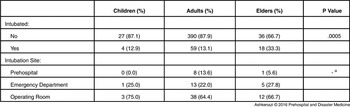
Mechanical ventilation was required in 67 (12.5%) of the 534 patients studied (Table 3). Of these, 64 (95.5%) underwent oral intubation while three (4.5%) underwent urgent coniotomies. All coniotomies were performed in the prehospital setting in patients with severe facial injuries following failure to intubate orally. None of the injured children underwent prehospital intubation or coniotomy. In all three patient groups, two-thirds or more of the intubations were performed in the operating room. The proportion of elderly patients who underwent intubation exceeded that of adults and children considerably (P=.0005).
Frequency and Location of Intubation (Oral and Coniotomy)

a Too few cases to perform statistical analysis.
The proportion of elderly patients who received a blood transfusion was greater than that of adults and children: 10 (18.5%) elderly vs 22 (4.9%) adults and one (3.2%) child (P=.0007). Use of computed tomography imaging was also greater in the elderly: 14 (25.9%) of elders vs 36 (8.0%) of adults and three (9.7%) of children (P=.0003).
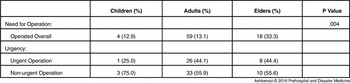
One out of three elderly patients was in need of an operative intervention (Table 4). One elderly patient underwent a negative exploratory laparotomy. Exclusion of this patient’s operation from the analysis did not changed the observation that the proportion of elderly patients in need of operation far exceeded that of the other age groups (P=.004). None of the patients were treated with angiography. One patient, aged 66, was treated with factor VIIa without untoward effects.
Need for and Urgency of Operation

Outcomes
All the 31 children survived their injuries. In contrast, nine (2.0%) of the adults and seven (13.0%) of the elderly patients did not survive (P<.0001). All nine adults died within the first 24 hours of their admission. Among the elderly patients, three died within the first 24 hours following their admission and four died after more than 24 hours. One of these patients died after seven days from her head injury while three others died of secondary complications within 10-39 days. Only one of these patients was considered to have suffered mortality without opportunity for improvement (P<.25).
Differences between Shooting and Explosion Events
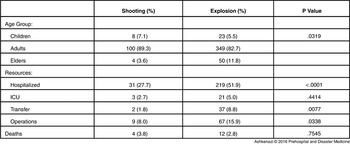
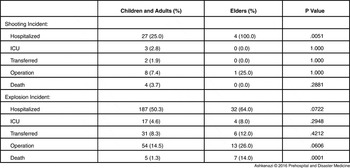
The distribution of the three age groups between shooting and explosion events reveals that elderly were more commonly encountered following explosions (P=.0319). Table 5 describes differences in resource utilization between the two types of events. Table 6 details differences in resource utilization and outcome between elders and the other two age groups.
Difference in Age Groups, Resources, and Outcomes between Shooting and Explosion Incidents

Differences in Resources and Outcome between Elders and Other Age Groups Stratified According to Mechanism of Trauma

Discussion
The aim of this study was to assess the scope of the challenge posed by children and elders during a terror-related MCI. Studies that discuss the effect of patient age concentrate on the needs and outcome of the pediatric population.Reference Cayten, Stahl, Agarwal and Murphy 9 , Reference Aharonson-Daniel, Waisman, Dannon and Peleg 10 The main finding here, however, is that elderly victims are the major resource consumers in this setting.
Difficulties in treating injured children may arise from staff inexperience with this population, the need for specialized equipment, and unique care protocols. The elderly population suffers from increased prevalence of comorbidities and lower physiological reserves. These require familiarity, fine-tuning of treatment, and increased resource consumption. Ultimately, both extremes of age may suffer worse outcomes should their requirements remain unmet.
In this study, children were less severely injured than adults and elders. This finding differs from prior reports published by the Israeli National Trauma Registry.Reference Cayten, Stahl, Agarwal and Murphy 9 , Reference Aharonson-Daniel, Waisman, Dannon and Peleg 10 This seeming discrepancy stems from a difference in inclusion criteria. In the current study, all ED referrals were included, whereas the Israeli National Trauma Registry includes only patients admitted from the ED to the wards. Patients discharged directly from the ED are not included in this registry. Furthermore, there is a national policy advocating for primary and secondary transfer of severely injured children to Level I trauma centers in Israel. Among the nine hospitals included in the Israeli National Trauma Registry at the time Aharonson-Daniel (et al) and Jaffe (et al) performed their studies, six were Level I trauma centers (comprising all Level I trauma centers in Israel).Reference Cayten, Stahl, Agarwal and Murphy 9 , Reference Aharonson-Daniel, Waisman, Dannon and Peleg 10 This may create a selection bias towards more severely injured patients in the pediatric population. This study presents a snapshot of the patients referred to the ED of any hospital following a terror attack. It is important to note that in one-half of the MCIs described in this paper, the HYMC was the only receiving hospital due to proximity of this hospital to the site of the event.
One out of ten injured was an elder, similar to their frequency in the general population. Injured elders were more commonly severely injured when compared to the other age groups. They were hospitalized longer. One out of four elders was in need of intubation and artificial ventilation, significantly more compared to the rest of the patients. One out of four elders was in need of surgery, twice the proportion of younger victims. Thirteen percent of the elders died of their wounds, well above the percentage of patients who died in the other age groups.
Older age is a predictor of mortality and the need for hospitalization in the ICU.Reference Jaffe and Peleg 11 - Reference Taylor, Tracy, Meyer, Pasquale and Napolitano 16 In this study, all nine patients younger than 65 years of age who died in-hospital suffered from early mortality within hours of being admitted to the hospital. In comparison, three of seven elders suffered from early mortality, while four others died days after admission from secondary complications. Older age is a risk factor for developing multiple organ failure following trauma, which proved to be the major cause of death in this group of patients.Reference Taylor, Tracy, Meyer, Pasquale and Napolitano 16
Explosion events may be a confounder variable in this study. Following explosions, more patients were in need of hospitalization, in need of transfer, and in need of operations. Relatively more elderly were wounded following explosions compared to shooting incidents, while the ratio of children and adults between the two types of events was similar. Whether discrepancy in resource utilization and outcome between the two types of events explains the differences observed between elder and the other age groups is questionable. When only bombing events are taken into consideration, the proportion of elders in need of hospitalization, ICU, transfer, and operations was similar to those of the other age groups. Still, mortality was much higher in this age group.
Limitations
The data presented in this study are based on the experiences accumulated in one medical center and may not be representative of experiences gained elsewhere. Nevertheless, the study is based on multiple events, each occurring in a different setting. As alluded above, in one-half of the MCIs described in this paper, the HYMC was the only receiving hospital due to proximity of this hospital to the site of the event. This probably decreased the possibility for bias in patient referral to the hospital.
The number of patients included in this study limits the analysis concerning several of the outcomes observed. Following explosions, a greater percentage of elders was in need of hospitalization, ICU, transfer, and operation following explosion events. However, differences in resource utilization observed between elders and the other age groups did not reach statistical significance. Only four elders were admitted in shooting events, and any comparison between resource utilization and outcome between this age group and the other age groups is meaningless.
Patients transferred to other hospitals may have been a confounding factor for the results. Overall, 39 patients were transferred to other hospitals, most whom were transferred from the ED following their admission. The HYMC’s contingency plan encourages secondary transfer of patients to other hospitals in order to decrease severity load. Patients in need of neurosurgical interventions and observation are transferred first, followed by a selected group of moderately injured patients who will need surgery. Whether this policy of secondary transfer may have led to the wrong conclusions concerning resource utilization and outcome in the elderly group is not supported by the data. Eleven percent of the elders were transferred, compared to 6.5% and 6.9% in the children and adult groups, respectively. In all, except one of the elders, the reason for transfer was the need for neurosurgical intervention and/or observation.
Conclusions
Despite the complexities needed to be able to deal with a MCI in which most of the victims are children, this has not been the challenge to date. Beyond the need of hospitals to organize for the possibility of treating children within the context of a MCI, it is necessary to think about how to improve the management of injured aged 65 and above in order to reduce mortality and morbidity among this age group.