INTRODUCTION
The name of Luigi Palma di Cesnola (1832–1904) is associated with the island of Cyprus and with The Metropolitan Museum of Art, in New York. Arriving in Cyprus in 1865 as the American consul, he amassed a huge collection of antiquities by purchasing casual finds and paying villagers to dig at archaeological sites. In the face of mounting criticism, he wrote that his excavations had been systematic, while conceding ‘That they were perhaps not conducted in all their details according to the usual manner adopted and advocated by most archaeologists, I am unwilling to dispute’.Footnote 1 In 1872 he sold a large proportion of his collection (at least 30,000 items, packed into 275 crates) to The Metropolitan Museum, which had opened two years earlier in New York. After another spell of collecting antiquities in Cyprus, in 1877 he negotiated a position as the museum’s secretary and, in 1879, became its first director, a post he held until his death.Footnote 2
Luigi Palma di Cesnola’s antiquities, and his own lively account of how he acquired them, have been extensively studied.Footnote 3 His possible motivations, other than avowedly commercial, have also been analysed.Footnote 4
His younger brother, Alessandro Palma di Cesnola (1839–1914), has received much less attention. He first visited Cyprus in 1873 at Luigi’s invitation to help him with his excavations. Drawing on this experience, Alessandro assembled his own collection of antiquities in 1876–8 while Luigi remained at The Metropolitan Museum. But the younger brother’s digging career is important for other reasons, stemming from the event that brought it to a halt: the British occupation of Cyprus in 1878, which led to his arrest for illicit excavation.
His arrest and subsequent trial have a political and legal significance. The political interest is due to Great Britain having recently assumed the administration of part of the Ottoman empire. The case is significant within cultural heritage law for its very early date. The trial took place within three months of the first British high commissioner’s arrival on the island; the defendant was a foreign national whose claim to a diplomatic status led to an international démarche; the verdict was delivered by a British military officer unfamiliar with local law and language; and the offence – illicit excavation – had rarely been the subject of proceedings in a law court anywhere.Footnote 5 For these reasons, the case of Regina v. Cesnola (1878) merits attention.
In his magisterial history of Cyprus, Sir George Hill cited as a source for the trial a volume of confidential letters exchanged among members of the British administration in Cyprus and with the Foreign Secretary, the Marquis of Salisbury, in London.Footnote 6 The Foreign Office volume is a rare one and the pertinent documents are listed as missing in the comprehensive State Archives of the Government of Cyprus.Footnote 7
Here, the author first identifies the Ottoman law under which Alessandro Palma di Cesnola (often abbreviated hereafter as ‘Alessandro’) was charged in October 1878. The evidence of trial witnesses reveals the circumstances of his excavations and his arrest. After detention overnight, he was released without penalty, save for confiscation of the excavated antiquities. A day later he contested vehemently the legality of his arrest and lodged a complaint with the American consul in Beirut, thereby provoking the British to summon him formally for trial. He was found guilty of breaking the antiquities law. Four months later, in February 1879, he left Cyprus for good.
In concluding, two questions are considered here: why, with much more urgent tasks of administration before him, did the high commissioner proclaim a ban on excavations within a month of his arrival, and why did Alessandro Palma di Cesnola ignore explicit instructions to observe this prohibition?
THE LAW UNDER WHICH ALESSANDRO PALMA DI CESNOLA WAS CHARGED
Under the terms of the Convention of Defensive Alliance (4 June 1878), Great Britain provisionally took over from Turkey the ‘occupation and administration’ of the island of Cyprus. An oversight in the Convention’s text was rectified when, on 14 August 1878, the Supplementary Agreement transferred ‘to Her Majesty the Queen’ the powers to make laws and conventions. An order of 14 September 1878 then established a legislative council and empowered the high commissioner to enact laws.Footnote 8 The inaugural high commissioner, Sir Garnet Wolseley (1833–1913), had arrived at the port of Larnaca on 23 July that year. Renowned for his military career, he was a household name in Britain after his campaign in the third Anglo–Ashanti war in the Gold Coast, for which he was knighted. He brought with him Sir Adrian Dingli (1817–1900), the Crown Advocate of Malta, to advise him on immediate legal issues. Like other colonial administrators, Wolseley initially planned to treat his new territory as an extension of Britain and to anglicise its institutions and inhabitants, but he soon came to appreciate the sound basis of the Ottoman legal code, based as it was on the Code Napoléon.Footnote 9 His eventual reform of the court system in Cyprus post-dates the events described here and is not considered (that is, The High Court of Justice Ordinance of 1878 and The Cyprus Courts of Justice Order, 1882).Footnote 10
At the time, the current Ottoman law on antiquities was the Règlement sur les antiquités (le 20 Séfer 1291 – 24 Mars 1874).Footnote 11 Foreign scholars and amateurs wishing to search for antiquities had to obtain an annual firman (permit) issued by the Sublime Porte in Constantinople. Their country’s diplomatic legation in the city could facilitate their applications. The terms of a firman were generous in allowing excavated finds to be exported. But, in the late 1860s, a change of policy coincided with the development of the Imperial Ottoman Museum in Constantinople and a growing national interest in antiquities. The core of the museum’s holdings was the sultan’s private collection of arms and military equipment. In 1869, in order to build up an antiquities collection, the minister of public education, Safvet Pasha, issued a decree forbidding the export of finds (other than coins) from excavations.Footnote 12 The decree came as a shock to excavators. Work at Ephesus, sponsored for eleven years by the British Museum, was suspended in spring 1874 over difficulties in renewing the annual firman.Footnote 13 Independent excavators, such as Heinrich Schliemann at Troy and Luigi Palma di Cesnola in Cyprus, had to resort to various stratagems to circumvent the new regulations.Footnote 14 Diplomatic intervention could still obtain a firman in case of difficulties. For instance, George Henry Boker (1823–90), minister to the American legation in Constantinople, obtained a firman for Luigi Palma di Cesnola’s digging in Cyprus and helped him export his finds. The latter gratefully gave Boker gold trinkets from his collection and invited him and his wife for a vacation on the island.Footnote 15 Luigi Palma di Cesnola was not alone in excavating there: Robert Lang, manager of the Imperial Ottoman Bank at Larnaca, spent eleven years amassing an antiquities collection without bothering with a firman, and other foreign consuls also indulged.Footnote 16 But it was Luigi Palma di Cesnola’s mass export of antiquities that provoked Constantinople by directly challenging the 1869 decree.Footnote 17
New, more detailed rules followed. The law of 1874 extended considerably the decree of 1869, its thirty-six articles replacing the seven of 1869. Article 7 forbade:
the carrying-out of all excavation undertaken especially for finding antiquities and treasures, without official authorisation and without the consent of the landowner. The antiquities found by those who contravene this ban will be seized in their entirety, and they will themselves be condemned to a fine of from one to five Turkish pounds, or to imprisonment for from three days to one week.
Of the finds made during authorised excavations, Article 3 stated that:
one-third will belong to the Government, another third to the finder and the remainder to the owner of the land where the antiquities were found. If the finder found the antiquities on his own land, two-thirds will go to him and one-third to the Government.
The enterprising excavator purchased or leased the land to be explored so as to retain two-thirds while sending, in principle, only one-third to the museum in Constantinople. Crucially, the 1874 law allowed the excavator to export his share unless the Imperial Museum particularly requested any object (Art. 32). This loophole was blocked by a new Ottoman law of 1884, which strictly forbade all export of antiquities except ‘duplicates’.Footnote 18 But the 1884 law was not applied in Cyprus because it was introduced after the British occupation.Footnote 19
With the 1874 law in force in Cyprus, the high commissioner, within a month of his arrival, issued a proclamation banning all excavations.Footnote 20 According to Perrot, Wolseley announced the ban in August 1878 following orders received from England. British visitors’ memoirs confirm its enforcement.Footnote 21 It was this ban that Alessandro Palma di Cesnola decided to ignore.
ALESSANDRO PALMA DI CESNOLA’S ILLICIT EXCAVATIONS
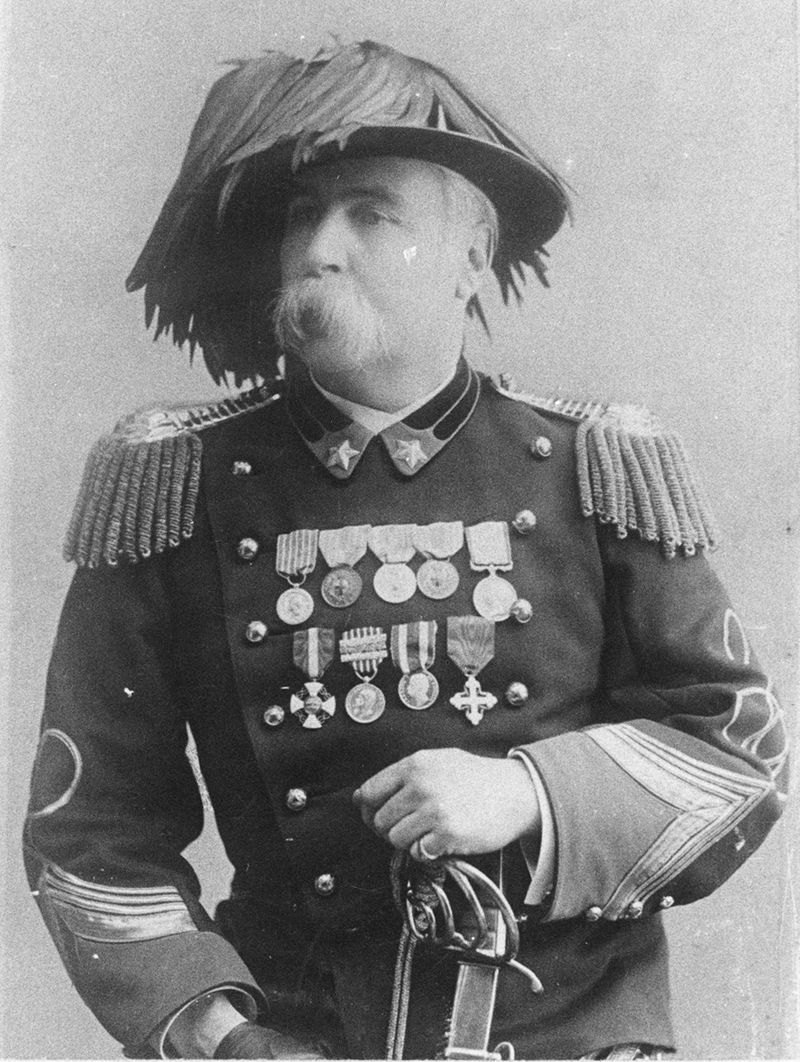
Alessandro Palma di Cesnola was born the youngest of seven children in Rivarolo Canavese in the Piedmont region of northern Italy (fig 1).Footnote 22 Like his elder brother Luigi, Alessandro combined a military career with extensive travel that brought him to the New World.Footnote 23 In April 1873, he travelled from South America to New York, where Luigi was on leave working on his collection in The Metropolitan Museum. Three months later, the two of them left for Cyprus, where Luigi resumed control of the digs that had continued in his absence. He instructed his brother in his methods and how to manage workmen and local Turkish officials. For undisclosed reasons, Alessandro Palma di Cesnola left Cyprus against his will in either late 1874 or late 1875, returning only in July 1876.Footnote 24 The intervening months he spent at the British Museum studying the Oriental collections. In London he found a wealthy stockbroker and collector, Edwin H Lawrence FSA (1819–91), to sponsor him, and he returned to Cyprus to acquire antiquities for him.
Alessandro Palma di Cesnola. Photograph: Giacomo Brogi, Florence; courtesy of Dartmouth College Library.

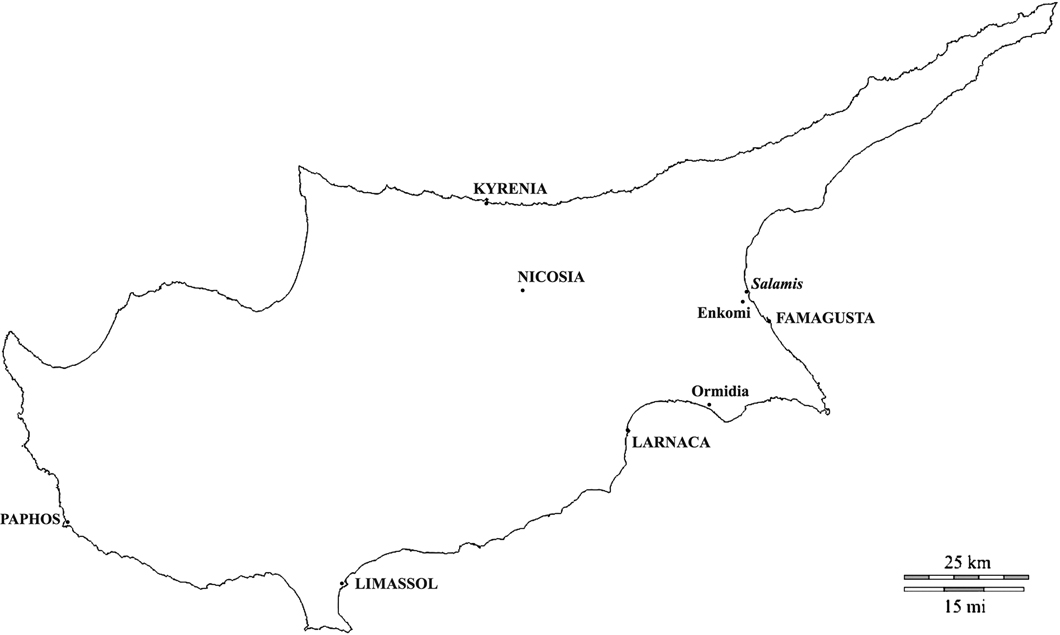
Adopting his brother’s strategies, Alessandro purchased antiquities and organised excavations.Footnote 25 In November 1877, after one of his workmen brought him some promising finds, he re-directed all his workforce to the ancient site of the city of Salamis (fig 2).Footnote 26 His excavations there produced the greater part of the future Lawrence–Cesnola collection.
Cyprus, with places mentioned in the text. Drawn by Pier Matteo Barone.

Alessandro Palma di Cesnola voluntarily identified himself (his brother Luigi’s reputation had preceded him, of course) by going to the British headquarters camp at Nicosia.
A Mr Cesnola called upon me some six weeks or two months ago and requested permission to dig. I did not see him myself but the Secretary to the Government, Colonel Greaves, did & told him that all excavating at present was positively forbidden and that anyone breaking the law on this point would be punished according to law.Footnote 27
A date of ‘six weeks or two months ago’ (that is, the second half of August 1878) suggests that Alessandro had heard of the excavation ban and had hurried to Nicosia to request a permit. He decided to ignore the ban, just as earlier he had worked without a firman. ‘I had indeed applied to Constantinople for a firman but I never received a positive answer so I continued digging without it’.Footnote 28
The duration, though not the locations, of Alessandro’s recent work at or near Salamis can be reconstructed from the testimony of his workmen. Three men (Christophi Andrea, Constantini Hadji Tochi and Christodoulo/Christobulo Georgi) from the village of Ninkomi (Enkomi) near the ancient site were sent to Larnaca to make sworn depositions. Two of them (Christophi and Christobulo) also testified at the trial, as did a third Enkomi villager, Johannes Kyriaki.Footnote 29 Two residents of Scala (the port area of Larnaca) also gave sworn depositions. One of them, Alessandro Koukomo, had worked previously for the Cesnola brothers at Larnaca and Enkomi. Re-engaged by Alessandro Palma di Cesnola about six months ago, he dug for him at Enkomi until two months ago and was then employed to fill up excavation pits (a common practice to avoid paying compensation to the landowner). The other Larnaca man, Georgi Zoneno, also had been engaged six months ago and worked until the previous Wednesday (that is, 2 October 1878).
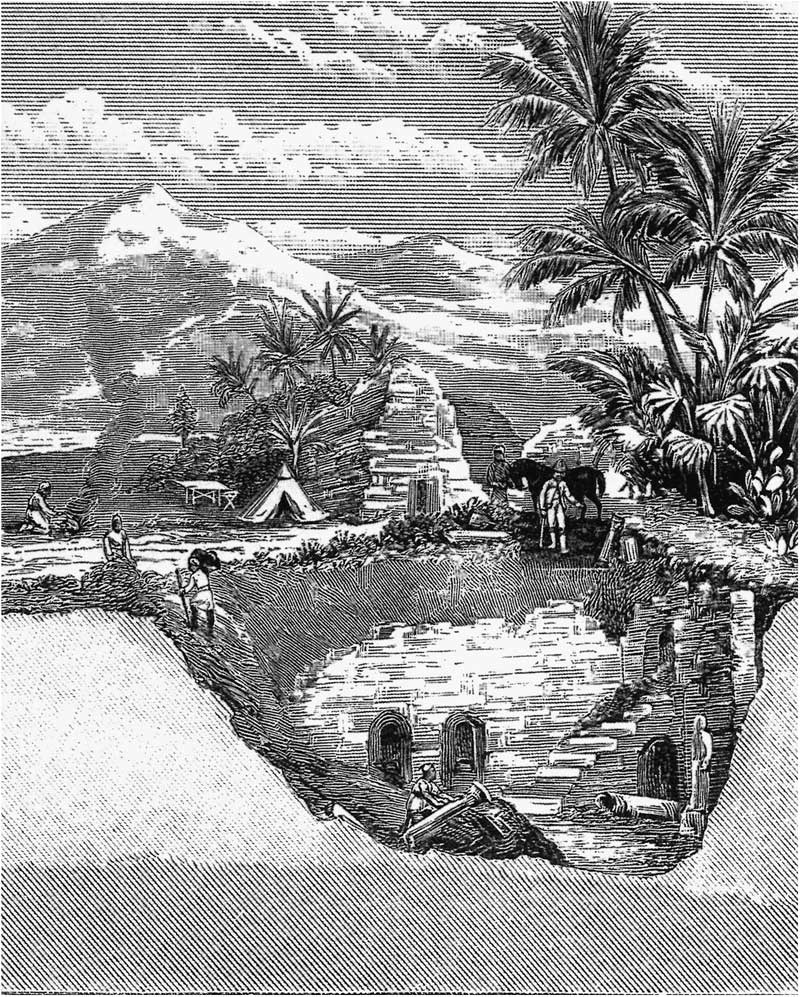
The Enkomi workmen confirmed this date. All five gave consistent statements about working for some six months (initially, there were about sixty men digging). All were employed by Lazaris Philippi, the servant of Alessandro Palma di Cesnola, and it was he, Lazaris, who stopped the excavations on 2 October. The ‘American’ (that is, Alessandro) visited the site several times, his last visit having been two months previously (that is, early August 1878) (fig 3).Footnote 30 Lazaris stored the finds in a ruined house in Enkomi to which Panagia Hadji Cristofi lent him the keys.
Alessandro Palma di Cesnola visiting excavations near Salamis. Source: Cesnola A P di 1884, opp. p xiv, detail.

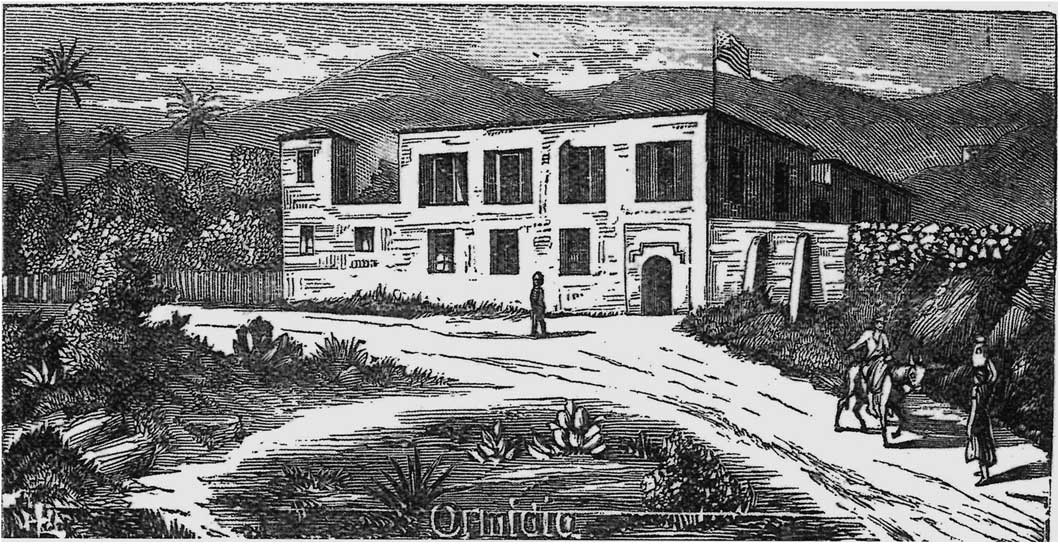
Alessandro divided his time between Larnaca and a summer-house in Ormidia, near the coast, a few hours’ ride to the north-east (see fig 2). Thanks to the onshore breezes, this small village became the preferred summer resort for merchants of the English Levant Company based in Larnaca.Footnote 31 The tradition continued among the foreign consuls, including Luigi Palma di Cesnola, when American consul, who rented a house there in 1873 and used it regularly with his family. Alessandro took over the lease on his brother’s departure.Footnote 32 The house was a stout building in stone and mudbrick of two floors, with a large internal courtyard and garden (fig 4).Footnote 33 It belonged to Nicolaos Vondiziano, member of a leading Cypriot family mainly resident in Ormidia. Marked on the Cadastral Survey maps of the island (1922) as ‘Cesnola’s Summer Residence’, it was demolished around 1970.Footnote 34
The Ormidia house (an American flag is visible). Source: Cesnola A P di 1884, p xi.

Achilleus Vondiziano (1845–98), the eldest of three sons of Nicolaos VondizianoFootnote 35 and resident in Ormidia, attested at Alessandro’s trial that he was familiar with the house and the servant Lazaris.Footnote 36 It was he who first informed the authorities about the Italian’s work at Salamis/Enkomi. On 2 October 1878, he reported to a police captain that, about a fortnight previously, Alessandro had been excavating at Enkomi and that he, Vondiziano, had ‘tried to induce the workmen to discontinue the excavations, saying to them that it was prohibited’. Vondiziano must have known of the high commissioner’s recent ban and visited the excavations to urge that they be stopped. The villagers of Ormidia told a policeman (zaptieh) that the work at Enkomi was continuing, and that the finds were stored in the house of Panagia. The commissioner in Larnaca, Colonel Henry G White, forwarded the two reports to the government chief secretary in Nicosia, Colonel George Greaves, and asked what action to take.Footnote 37
Greaves ordered the local commandant of police in Larnaca, Lieutenant E Spencer, to proceed with three policemen to Enkomi. If Alessandro Palma di Cesnola was or had recently been excavating, he should be charged under the Turkish antiquities law and the finds brought to Larnaca. The following day (4 October 1878) Spencer went first to Ormidia to ask a former servant of Alessandro’s to accompany him to Enkomi so as to be sure of finding the site. At a cemetery, with most of the emptied tombs already backfilled, the workmen at Enkomi admitted that they were working for Lazaris. Convinced of Alessandro’s culpability, Spencer sent to Larnaca some of the men to give sworn depositions, and he seized the pottery and glass objects that he found in Panagia’s house.Footnote 38
ARREST OF ALESSANDRO PALMA DI CESNOLA AND HIS REACTION
After one night at Enkomi, on his return to Larnaca, Spencer submitted his report to Commissioner White, who immediately forwarded it to Greaves in Nicosia. His cover note, timed 10pm, observed that Alessandro Palma di Cesnola, while ‘not caught in the act’, had undoubtedly directed researches up to the past few days and, under Article 7 of the antiquities law, was liable to punishment. Would Greaves authorise his summary arrest?
Greaves replied for the high commissioner that White should inform the Italian that he had broken the law and contravened the orders of the high commissioner. ‘Should he again be guilty of such conduct, his Excellency will have him imprisoned as the law directs.’ White should seize all the excavated objects.Footnote 39 Before this reply reached him, White telegraphed (a method used sparingly because of the cost) that the Italian had surrendered himself in Larnaca, had offered bail and was being detained in a large room at the konak (a building that housed the courts, the district offices and the jail).
Leniency was the high commissioner’s preferred policy. He wished to avoid bringing Alessandro Palma di Cesnola to trial, but he was extremely irritated to find that ‘a man calling himself Major Cesnola, brother to the man who called himself General Cesnola’, had been excavating despite being told distinctly not to. ‘Infernal Italian!’Footnote 40 The matter might have ended there had not Alessandro, after a day’s reflection, decided to contest vehemently the legality of his arrest.
Alessandro first protested when presenting himself at the house of Commissioner White, around midday on Sunday 6 October. He had arrived from Ormidia, accompanied by Lieutenant Richard L Hippisley (1853–1936) of the Royal Engineers. The lieutenant had landed at Larnaca by ship from Alexandria on the night of 29–30 September, together with his fellow lieutenant H H Kitchener (1850–1916), to undertake for the government a trigonometrical survey of Cyprus.Footnote 41 Other passengers on the ship included the writer and traveller William Hepworth Dixon (1821–79), who was writing a book about Cyprus, and Esmé Scott-Stevenson, whose husband Andrew (1847–92) was shortly to be appointed assistant commissioner in Kyrenia.Footnote 42
Dixon knew Cyprus well, having first visited fifteen years previously; he also knew Alessandro Palma di Cesnola. Soon after Dixon’s arrival from Alexandria, he was invited by his friend to stay in the Cesnola country house at Ormidia.Footnote 43 He was at the house with Alessandro when Spencer stopped there on his way back from Enkomi in order to seal a room containing antiquities. He is said on that occasion to have ‘interfered with Lieutenant Spencer by words generally’.Footnote 44 Had he not fallen from his mule and broken his collar-bone while they were riding together to Ormidia,Footnote 45 Dixon would probably have gone with Alessandro to the commissioner’s house the following day. Since he was incapacitated, he apparently asked his fellow-passenger from the ship, Lieutenant Hippisley, to accompany his Italian friend instead. Within a few days, however, Dixon was to intervene more actively.
After his formal arrest at White’s house, with bail refused,Footnote 46 Alessandro Palma di Cesnola walked freely to the konak building, where he stayed overnight in a large room prepared for him in the offices (not in the jail) and provided with various comforts, for which he repeatedly and warmly thanked White.Footnote 47 No charges had been preferred, but the antiquities in the room sealed by Spencer would be confiscated. Wanting ‘to save the danger of breakage’, the detainee offered to bring in the antiquities himself (they numbered about thirty-six, he claimed) rather than a police officer having to go there. Giving his word of honour, he requested a permit to break the seal. A few hours later the permit was returned to White. On the same day, Alessandro Palma di Cesnola submitted a complaint to the American consul in Beirut as follows:Footnote 48
Dear Sir,
I have to inform you, for your guidance as protector of American citizens in this island, that I have been unlawfully arrested, in a manner involving great personal indemnity locked up in the konak, the common Turkish prison of this place, refused enlargement on bail and interview with any person whatever, even my own legal adviser. The charge alleged against me, and which I entirely deny, is a civil charge, that of having continued to carry on the series of excavations, so long conducted by my brother and myself, in this island. Without a word of apology, I am simply allowed to leave the konak; but the seals are still on my door, and I am given to understand that my property is sequestrated. I venture to pray for your prompt assistance in procuring justice and redress.
I am, &c
(Signed) A.P. DI CESNOLA
Late Vice-Consul at Papho, and Acting Consul in Cyprus
for the United States
The hand of William Hepworth Dixon, a qualified barrister who never practised,Footnote 49 can be discerned in the legal phrasing composed for an Italian friend whose English was poor. Wolseley was sure that it was Dixon, in his view a ‘pompous ass’ and a ‘busybody’, who persuaded his friend that he had been disgracefully treated, advising him to break his promise to bring in the antiquities and instead to complain to Beirut.Footnote 50
This challenge to the British authorities, who hitherto had treated Alessandro leniently, provoked them into summoning him for trial. Remarkably, it was Chief Secretary Greaves who seems to have taken the decision:
Referring to the case of M. Cesnola, accused of having excavated for antiquities in violation of the Turkish law, and in spite of the refusal of his Excellency the High Commissioner to sanction the proceeding [emphasis added], be so good as to proceed against this gentleman in strict accordance with Turkish law. Have him summoned to appear before the Medjliss Davi court in Larnaca; but before any sentence passed upon him, if found to be guilty, is carried out, refer the matter to me for his Excellency’s orders.Footnote 51
THE TRIAL OF ALESSANDRO PALMA DI CESNOLA
Court procedure and verdict
The ‘Medjliss Davi’ (or Mejlis i–Daavi) was a district court in Larnaca.Footnote 52 The order of 14 September 1878 establishing the legislative council confirmed that the Ottoman court system would continue in the six administrative districts of the island. Alessandro Palma di Cesnola was principally a resident of Larnaca, although Ormidia and Enkomi were in the Famagusta district. The jurisdiction of the Daavi courts was limited to penalties of either 1,000 or 5,000 piastres (10 or 50 Turkish lira; sources differ on the upper limit) in civil cases, and three months’ imprisonment in criminal cases (that is, higher than the penalties for illicit excavation established by the 1874 antiquities law). In Ottoman Cyprus, a kadi (judge) presided over a Daavi court with the assistance of four members, two Muslim and two Christian, who were elected by their communities. The significant change introduced by the British was the figure of an assessor, usually the British commissioner or assistant commissioner of the district. Lieutenant Seager, sitting in a Nicosia court, described how it functioned, with no role for counsel for prosecution or defence. He, as assessor, heard the pleas, sifted the evidence and signed the judgment if convinced that the law had been fairly applied. ‘In practice, Lieutenant Seager is the court.’Footnote 53
The condescending anecdotal accounts by Britons of these Daavi courts in 1878–9 make entertaining reading. The barrister Dixon and the wife of Kyrenia’s assistant commissioner both described how hearings proceeded, stressing the influential role played by interpreters switching between different languages and the associated (in their view) rampant bribery.Footnote 54 But they fail to acknowledge the lack of qualification, legal or linguistic, of the military officers who were administering Cyprus and who acted as assessors. Looking back to 1878, when he first arrived, Falkland Warren wrote: ‘We who came to assist in the Government were to a man ignorant of the laws, languages, and customs of the people’.Footnote 55 ‘No officers understood either the language, or laws, of the people they had to govern; they were for the most part specially educated for the military profession’.Footnote 56 Lieutenant Kitchener’s first impressions were similar, writing to his sister about the absurd laws that the British make that they then have to counter-order: ‘All is in fact chaos’.Footnote 57
Wolseley’s policy of appointing military officers rather than civil servants, while replacing local officials, was already controversial at the time.Footnote 58 He had brought to Cyprus several members of the ‘Wolseley Ring’, military officers who had served with him in Ashanti or elsewhere and whom he trusted. Chief Secretary Colonel George Greaves (1831–1922) was one of the Ring, as was Lieutenant-Colonel Henry Brackenbury (1837–1914) of the Royal Artillery. Wolseley appointed Brackenbury, whom he considered the cleverest man in the British army, Chief Commandant of Military Police and Inspector of Prisons.Footnote 59 Among the military officials, Lieutenant M B Seager, sitting as Assessor in Nicosia, was unusual – perhaps unique – in being trained in the law (albeit English law), having been called to the bar in England.Footnote 60 The lack of British legal expertise was remedied in late August with the arrival of Charles Alfred Cookson, appointed Chief Justice and Attorney-General. In December, Cookson recommended retaining the Ottoman civil law code.Footnote 61
For Alessandro Palma di Cesnola to receive a fair trial without access to counsel, he had to understand the proceedings. The British had expected to conduct official business in English, but found their language little used in Cyprus. Ottoman government business was conducted in Turkish; Cypriot Greek (Kypriaka) was the language of a majority of the population, but knowledge of both Turkish and Greek (in their spoken, colloquial forms, not the written languages) was widespread among Cypriots.Footnote 62 The British brought in interpreters from Turkey and Malta. Wolseley’s successor estimated that in 1878 fewer than ten resident Cypriots understood English,Footnote 63 but this assertion is hard to credit, given that other interpreters were recruited from the local Turkish Cypriot, Greek Cypriot and Armenian communities. In the court at Larnaca, a town of cosmopolitan population, interpreters translated among languages that might include Turkish, Greek, Italian, French, English and Arabic. Their long experience of court business also enabled them to correct the kadi or the assessor when points of law were in doubt or legal precedents needed.Footnote 64
Alessandro Palma di Cesnola’s native language was Italian, widely spoken as a lingua franca in the East Mediterranean until its replacement in the 1860s by French.Footnote 65 Consuls in Cyprus during the late Ottoman period usually wrote in Italian, sometimes in French;Footnote 66 in fact, several consuls and merchants were of Italian descent. Alessandro learnt French during his childhood in the Italian Piedmont (his mother was fluent in it) and picked up some English during his three months in New York and his longer stay in London in 1875–6. Nevertheless, at the trial his spoken English was so poor that he asked for the trial to be conducted in Italian.Footnote 67 He was fortunate to have as his interpreter Claude Delaval Cobham, the assistant commissioner of Larnaca. Cobham (1842–1915) had been an unusual appointment, a civilian with no military background and holding a legal qualification, a Bachelor of Civil Law from Oxford University. Augustus Hare met him at Oxford when Cobham was preparing to be ordained and later recommended him to Wolseley as an astonishing polyglot who, like the renowned Cardinal Mezzofanti, acquired a new language in a few weeks.Footnote 68 Promoted to commissioner at Larnaca in 1879, Cobham retained this post until retirement, by then one of the great scholars of Cyprus.Footnote 69
The assessor at the trial was Commissioner White, but Cobham’s interpreting was crucial in enabling Alessandro to defend himself. It was Cobham who, as assistant commissioner, had translated into English the sworn depositions from Alessandro’s workmen and who formally summoned the Italian to appear before the Civil Court of Larnaca.Footnote 70
Fundamental to the case was the previous refusal of Alessandro Palma di Cesnola’s request for permission to excavate. Wolseley therefore sent Brackenbury, the police commandant, to attend the court not as a witness but as prosecutor.Footnote 71 Opening proceedings at the trial, Brackenbury referred to the 1874 antiquities law and the charge of conducting unauthorised excavations. He then called seven witnesses: the three workmen from Enkomi, who confirmed that excavations were supervised by Lazaris on the defendant’s behalf; Panagia Hadji Cristofi, as the owner of the house there; Achilleus Vondiziano of Ormidia, who identified in court Alessandro Palma di Cesnola and his servant Lazaris; Lieutenant Spencer, who described his investigations at Enkomi and Ormidia; and, finally, Lazaris Philippi, who maintained that he had not engaged workmen – they had come of their own accord. The presiding kadi asked him why so much was spent excavating on lands that were rented (that is, not purchased): Lazaris confirmed only that he rented the lands and his employer reimbursed him the costs. Brackenbury summarised the case for the prosecution and asked that the penalties stipulated in the 1874 law be applied if the accused could not show the necessary firman.
In his defence, Alessandro did not deny having conducted excavations, claimed to have suspended them once the English arrived, and acknowledged his request for a permit. But the main thrust of his defence, ‘as an American and a man’, was a protest against the competence of the court to hear the case. It was not a Turkish court nor yet an English one. He protested against being arrested illegally in his house (at Ormidia – Spencer had already testified that he had warned him there, but did not arrest him) and having possessions sequestrated. Moreover, in nearly every house in Larnaca there were antiquities owned and for sale and he was one among many, including Commissioner White himself, who purchased them. He reserved the right to protest the proceedings and decision of the court.
The assessor found Alessandro Palma di Cesnola guilty and sentenced him, under the 1874 law, to a fine of four liras (which Wolseley immediately remitted) and the confiscation of the antiquities seized at Enkomi and Ormidia.Footnote 72
ALESSANDRO PALMA DI CESNOLA’S DEFENCE
The Capitulations and diplomatic status
Alessandro’s protest stressed his status as a foreigner, specifically an American, and his right to diplomatic titles. On neither basis were his claims justified.
Under Ottoman law, a foreigner accused of a crime by a Cypriot was entitled to have his consul present in court. If foreign nationals alone were involved, the Ottoman Capitulations enabled them to be tried according to the laws of their own countries in special consular courts. The terms of the Cyprus Convention of 1878 did not invalidate the Capitulations, but the Supplementary Agreement of 14 August had transferred all substantive powers from the Sultan to Queen Victoria, ‘including the regulation of its commercial and consular relations and affairs free from the Porte’s control’. The Capitulations had, therefore, ceased to be effective.Footnote 73
Wolseley certainly thought so. The foreign consuls at Larnaca wrote to him officially, but he replied to them as private individuals: they were accredited to the Porte, not to England.Footnote 74 To settle the matter, on 11 October he issued a proclamation that consular jurisdiction under Sublime Porte regulations no longer had any effect in Cyprus.Footnote 75 It cannot be coincidence that Wolseley had the very same day received a letter from Alessandro Palma di Cesnola, using diplomatic titles, announcing his appeal to the American consul in Beirut. The next day, Greaves ordered the Italian to be brought to trial.
Alessandro signed his appeal to Beirut as ‘Late Vice-Consul at Papho, and Acting Consul in Cyprus for the United States’. Most published accounts refer to him as the American vice-consul in Paphos, but this is incorrect. In New York, in July 1873, his brother Luigi, still the American consul in Cyprus, had asked the State Department to appoint Alessandro the United States consular agent at Paphos. The request was approved within two days.Footnote 76 The position of consular agent was of low rank, often held by a foreign national in a place that lacked a consular service. In US State Department records, the staff list for Cyprus for 1873 has Alessandro Palma di Cesnola’s name as consular agent in Paphos but, it notes, without as yet an exequatur (that is, a formal document issued by the Turks recognising his status).Footnote 77 Consular staff lists for the following years mention neither his name nor a US consular agency at Paphos (only at Larnaca and Limassol). Since at least 1870, the US State Department had been thinking of abolishing the consulate on Cyprus and in 1876 it did so, for financial reasons, along with a number of other missions abroad. Luigi, the consul, had already left for another period of leave in New York when the news came through, so Alessandro, whom Luigi had hoped could deputise for him, had the dispiriting task of lowering the American flag on the consulate building.Footnote 78 His offer of honorary services for the US State Department was declined. The ‘diplomatic status’ that had never been granted him was, from 1876, definitively excluded, as Alessandro later admitted.Footnote 79
Was ‘the American’ even an American citizen? In his request to the US State Department, Luigi wrote that Alessandro ‘has declared his intention to become an American citizen; is learning very fast the English language’. The following month the brothers left the United States of America for Europe.Footnote 80 When first arrested in Cyprus, Alessandro did not claim American citizenship. But after his release, in casual conversation with Commissioner White the following evening, he mentioned that his claim to US citizenship was due not to taking out naturalisation papers, but to having been in the United States of America on a certain date, which ‘gave him and all others in the country their citizen’s rights’.Footnote 81 To the improbability of this claim there were soon added further doubts. In December, the captain of an American man-of-war that called at Larnaca suggested that Alessandro Palma di Cesnola’s papers claiming US citizenship should be examined. He was not acting for the United States of America in Cyprus and had never been vice-consul at Paphos.Footnote 82 Alessandro’s complaint to Beirut as an American citizen was forwarded to the US minister in Constantinople, Horace Maynard, and thence to the State Department. It also went to the British ambassador, A H Layard, who sent it to the Marquis of Salisbury in London.Footnote 83 Diplomatic exchanges on this case soon ceased. Three months later, in the House of Commons, Sir Charles Dilke denounced the treatment of Alessandro, referring to him as an American citizen.Footnote 84 But it was never proven: Alessandro Palma di Cesnola’s claims of American citizenship and diplomatic titles were wishful thinking.
DISPOSAL OF ALESSANDRO PALMA DI CESNOLA’S ANTIQUITIES
The number of antiquities purchased or excavated by Alessandro Palma di Cesnola is unknown. When he first moved his team to Salamis in late 1877 or early 1878, his collection was ‘not a third of what it afterwards became, in consequence of this discovery in Salamis’.Footnote 85 The relatively small quantity (‘four big baskets, one small, and one pair of panniers’) seized from the Enkomi house by Lieutenant Spencer was perhaps only what had been found since the ban was imposed. The Ormidia house, in contrast, contained large quantities of antiquities. In the corners of the courtyard were ‘some thousands of broken terra-cottas; vases and lamps of ancient workmanship’.Footnote 86 Spencer, on his second visit there on 11 October, opened the sealed upstairs room and removed six basketsful of antiquities, but found another room downstairs full of pottery and other finds. After the trial, while the Italian was absent, the police removed from the house over 1,500 items, which they listed by type. On his return (from a visit to Beirut), Alessandro objected that his brother, not he, had excavated them fourteen years previously.Footnote 87 This claim, together with that of ‘about thirty-six’ finds that he had offered to surrender to the commissioner, suggest attempts to minimise the number of finds subject to confiscation.
In the second edition of Salaminia (but not the first), Alessandro reported that in three years of purchases and digging he had found 14,000 objects, comprising the collection sent to Lawrence in London. The first shipment (‘six large cases’) left in the winter of 1876–7 and a second one at an unknown date.Footnote 88 That date is likely to have been before the ban on excavation announced in August 1878, after which Alessandro’s activities were progressively circumscribed: he applied unsuccessfully for an excavation permit; his excavations at Salamis continued, but he no longer visited them; and the finds, rather than being taken to Ormidia, were stored in Panagia’s house at Enkomi. Two months later these and whatever antiquities remained in store at the Ormidia house were seized by the British. The finds from Salamis that trebled (as he claimed) the size of his collection must already have been shipped to England. As he himself wrote later, his success in ‘gleaning the Lawrence–Cesnola collection from Cyprus’ was due to the kindness of Turkish officials to whom he was most obliged, whereas with the arrival of the British his excavations ceased.Footnote 89 Whether, as seems likely, the second shipment had preceded the British occupation or whether it was a precautionary measure that Alessandro took in mid-1878 in view of the unexpected change of government is not known.
An album with sixty-two plates illustrated a selection of objects from the Lawrence–Cesnola collection and was immediately reprinted.Footnote 90 But the British Museum and the Victoria and Albert Museum showed little interest, these antiquities comparing poorly with those exhibited in London by Luigi Palma di Cesnola ten years earlier. Lawrence decided to send his collection to auction. The four sales, held between 1883 and 1892, totalled 3,463 lots; the first sale alone saw 3,000 objects sold at modest prices.Footnote 91 How many objects (from Salamis and other sites) Alessandro shipped to London is unknown – some of Lawrence’s collection had been bought from Luigi Palma di Cesnola. Alessandro claimed never to have sold antiquities, but to have made gifts to visitors. He certainly donated some to the Società Piemontese di Archeologia e Belle Arti and to members of his family in Italy.Footnote 92
The seized antiquities stored in Commissioner White’s house became a visitor attraction.Footnote 93 In 1882 they could have gone to the new Cyprus Museum in Nicosia,Footnote 94 but ten years later they were still in Cobham’s house in Larnaca.Footnote 95 Eventually, some of them went to the museum.Footnote 96
After Wolseley’s ban had lapsed, the museum in principle received one-third of the finds from the many licensed digs conducted by private individuals, a scene of intense competition and disputes that landed even the government chief secretary in court.Footnote 97 A year after this episode, a new high commissioner, dismayed at the commercial goals of private excavations, decided to grant permits only to foreign museums or similar institutions, still on the favourable terms that excavators enjoyed. These terms were abolished by a new antiquities law approved in 1896 under which only ‘duplicates’ could be exported, but, following opposition from the British Museum (see further below), the law was disallowed by the Crown ‘to the astonishment and regret of all Cypriots’.Footnote 98 A liberal market climate therefore prevailed, and accidental discoveries and illicit excavations led to outstanding objects leaving the island. The first Lambousa silver treasure was illegally exported, with the British Museum acquiring a significant part of it.Footnote 99 When the second Lambousa treasure was accidentally found in 1902, most of it too was smuggled out of Cyprus. The small part of it seized by the authorities prompted an appeal against their right of confiscation under the 1874 antiquities law.Footnote 100 Finally, a new law in 1905 declared all antiquities the property of the government; none could be exported without permission.
REVIEW: THE 1878 BAN ON EXCAVATIONS
There remain two questions: why did Wolseley, a military man of no known antiquarian interests, announce a ban on excavation in August 1878, and why did Alessandro Palma di Cesnola deliberately flout this ban?
The answer to the first question owes much, apparently, to the British Museum. In July, with the news of Britain’s occupation of Cyprus still fresh, C T Newton, Keeper of Greek and Roman antiquities at the British Museum, sent a report to the trustees about the archaeological potential of the island. The government might reserve the right to explore all ancient sites, just as Greece had done after the end of Ottoman rule. It was preferable to have government control of archaeology, and it was cheaper to excavate than to buy antiquities. His remarks were conveyed to the Foreign Office, which passed them on to Wolseley.Footnote 101 In August, Wolseley issued his proclamation (which Perrot stated was made on orders from England). Two months later, he wrote of wanting to give priority to British researchers, hoping that the British Museum would send a qualified man to direct excavations.Footnote 102
In May 1880, still smarting from the trial and confiscation of his antiquities, Alessandro Palma di Cesnola applied to Newton to direct excavations in Cyprus for the British Museum. Reporting to the trustees, Newton was sympathetic to Alessandro’s version that he had been badly treated, but strongly doubted whether the Foreign Office would overlook his previous arrest. In the end, the museum declined the Italian’s offer, less because of his record than for the elevated salary that he sought.Footnote 103 Instead, starting in 1880, it helped to fund work by the German antiquarian, Max Ohnefalsch-Richter, and later, in the 1890s, sponsored a series of excavations that greatly enriched its collections, to the dismay of Cypriots.Footnote 104 Despite being rebuffed, Alessandro continued to enjoy support from the museum’s curators. Samuel Birch, Keeper of Oriental Antiquities at the British Museum, had helped him in his earlier studies in London. Birch wrote a note for the album of 1880Footnote 105 and a flattering introduction to Salaminia, and he joined Newton in successfully nominating Alessandro for election as a Fellow of the Society of Antiquaries.Footnote 106
Alessandro’s situation had been more tenuous on his return to Cyprus in 1876. With the American consulate abolished, he could not expect even a small income from diplomatic service, such as his brother Luigi had had. He depended on Edwin Lawrence’s funding to search for antiquities for him, and one of Lawrence’s principal interests was stone sculpture. The Salamis tombs produced abundant pottery, glass, metal and small stone finds, but, Alessandro admitted, his lack of a firman made it risky to retrieve, transport and export large objects. He was, therefore, unable to fulfil all his sponsor’s wishes.Footnote 107 His acquisition of the ‘Larnaca tympanum’, a sculpture of dubious antiquity and provenance, also suggests a certain gullibility, if not desperation, on the part of Alessandro to come up with a ‘treasure’ for his sponsor.Footnote 108 Under moral and financial pressure, he could not afford to respect the ban and so decided to continue digging. He maintained a low profile by keeping the finds at Enkomi and by not himself visiting the site, but the rumour of him continuing with illicit excavations was bound to spread via Ormidia to Larnaca and led inevitably to his demise.
ACKNOWLEDGMENTS
My thanks to the staff of the archives that I consulted in 1997–9 at the British Library (in London), the British Museum (in London), Hove Central Library (in East Sussex), the Royal Artillery Institution (at Woolwich, London), NARA at College Park (in Maryland, USA) and the State Archives of Cyprus (in Nicosia). Research in Cyprus in 1997–8 was through a National Endowment for the Humanities fellowship held at the Cyprus American Archaeological Research Institute (CAARI) in Nicosia, Cyprus, which I also gratefully acknowledge. Pier Matteo Barone drew the map (fig 2).
ABBREVIATIONS AND BIBLIOGRAPHY
Abbreviations
- BL
British Library, London
- FO
Foreign Office, London
- HCL
Hove Central Library, Sussex, UK
- NARA National
Archives and Records Administration, Maryland, USA
- SA
State Archives, Nicosia, Cyprus