Introduction
Hemorrhage is the leading cause of preventable death in combat setting.Reference Champion, Holcomb and Lawnick1 – Reference Eastridge, Mabry and Seguin3 A major clinical problem facing physicians on the battlefield is the identification of combat casualties at-risk for continued hemorrhage and the potential for subsequent mortality. Furthermore, the military environment is often characterized by lack of supplies and equipment, delayed or prolonged evacuation times and distances, devastating injuries, provider low experience, and dangerous tactical situations. According to the “Sauvetage au Combat” (Forward Combat Casualty Care) French Military doctrine, combat life-savers have to check the presence or absence of radial pulse, absence of radial pulse being considered as a clinical sign of shock state in bleeding combat casualty.Reference Pasquier, Dubost and Boutonnet4 Then, for medical teams, current trauma triage relies on abnormal physiological criteria to determine the patient’s mode of transport, priority of treatment, destination for treatment, injury severity, mortality, and need for possible life-saving interventions. Still, standard clinical hemodynamic signs (tachycardia and hypotension) are poorly and lately associated with the severity of hemorrhage.Reference Sinert and Spektor5 – Reference Pacagnella, Souza and Durocher8 Calculation of shock index (SI), defined as the ratio of heart rate (HR) to systolic blood pressure (SBP), may be more useful for caregivers than HR and blood pressure (BP) measurement for the identification of combat casualties (ie, young soldiers) in the compensatory phase of shock. The SI, an easily calculable and inexpensive score, has been demonstrated to be a pragmatic and useful guide for diagnosing hypovolemia in the presence of normal HR and BP. The SI normally ranges from 0.5 to 0.7 in healthy adults and is associated with worse outcomes in trauma patients when >0.9.Reference Cannon, Braxton and Kling-Smith9 The SI is useful for the triage of casualties at surgical treatment facilities (ROLE 2 and ROLE 3 in the North Atlantic Treaty Organization [NATO; Brussels, Belgium] classification).Reference Morrison, Dickson, Jansen and Midwinter10 – Reference Vassallo, Horne, Ball and Smith12 However, the usefulness of SI calculation on the battlefield during the tactical field care stage for early recognition of hemorrhage in bleeding combat casualty remains unknown. Thus, such a benefit could allow the physicians deployed on the field to perform an early triage of combat casualties, including the changes or not of SI.Reference Falzone, Pasquier and Hoffmann13 Blood donation has been considered previously as a suitable model of simulated early acute hypovolemia.Reference Baraff and Schriger14 – Reference Campbell, Ardagh and Than16 During blood donation, blood removal ranges from 450mL to 500mL. The hypothesis made was that SI is superior to SBP and HR in the early recognition of hemorrhage in French military population. Although reference ranges have been published by several investigators, assessment in healthy volunteers matching the military population in which SI would be useful on the battlefield, and controlling potential bias, are still lacking.
The objective of this study was to describe HR, SBP, and SI in healthy military volunteers for blood donation and to measure their variation during a controlled blood loss, simulating the early stage of hemorrhage, based on a well-controlled study design.
Methods
Research Design
A prospective, monocentric, observational study of active duty soldiers presenting for blood donation was conducted. Volunteers were recruited during blood donation sessions organized by the French Military Blood Institute (Clamart, France) among military active duty at different military bases. The enrollment period spanned from November 2014 through April 2015. Subjects eligible for blood donation, according to the French law, were approached by the investigators and received an oral and written explanation concerning the study.17 Subjects completed a medical questionnaire, according to the procedure for blood collection by the French Military Blood Institute, before undergoing blood donation. The inclusion criteria for enrollment in the study were the following: healthy military subjects and volunteers for blood donation. Exclusion criteria included: contraindications to blood collection (known transmissible diseases, infection risk factors, pregnancy, blood disorders, and anemia); and active use of any prescription medications that could affect HR and BP (antihypertensive or antiarrhythmic drugs). No changes were made to the standard blood donation protocol. The HR and BP were collected by the investigator using an automated measurement of vital signs device (OSZ 4; Welch Allyn; Skaneateles Falls, New York USA). The HR and BP were first measured after a two-minute rest in the half-sitting position (supine position 45°), prior to intravenous catheter insertion. Blood removal was performed via a 16-gauge catheter. Two minutes after the end of blood removal, HR and BP were finally measured in the half-sitting position (supine position 45°). For each time measurement, the SI was determined using the definition of SI = HR/SBP.Reference Rady, Nightingale, Little and Edwards18 Each subject was assigned a personal standardized data sheet on which all data were recorded, including demographic information (age, sex, size, weight, and temperature) and clinical information (past-medical history, pre-donation hemoglobin, enteral volume replacement [EVR] during blood donation, and blood bag volume and weight). Data were collected retrospectively onto a computerized spreadsheet using the Epi Info 3.5.8. software (Centers for Disease Control and Prevention; Atlanta, Georgia USA).
Number of Subjects Needed
Based on the results of previously published studies about the SI, the number of subjects needed was calculated to be able to show a SI variation of 20% with an 80% power.Reference Birkhahn, Gaeta, Terry, Bove and Tloczkowski19 , Reference Nadler, Convertino and Gendler20 Assuming an approximate SI difference of 20% and a precision of four percent, a sample size of 378 would be needed. This assumes a two-sided alpha of five percent.
Statistical Analysis
Continuous variables were presented using their mean (standard deviation [SD]) in case of normal distribution, or using their median (inter-quartile range [IQR]) when required (non-normal distribution; small numbers). For categorical variables, a Chi-2 test was used when the conditions of application were met, and otherwise Fisher exact test was used. For continuous variables, Student t-test was used and, when the assumptions were not verified, Mann Whitney test was performed. A P value equal or less than five percent was considered statistically significant.
Finally, associations were searched for between SI variations and the following factors: age, sex, body mass index (BMI), sport activities, blood donation volume, and EVR. A multivariate analysis was performed, based on the results of the univariate stage, including in the multivariate model all the variables for which the P value would be less than 0.2%. All analyses were performed using GraphPad Prism 5 (GraphPad Software; La Jolla, California USA) and STATA 12 (StataCorp LP; College Station, Texas USA).
Ethics
The French Military Blood Institute Scientific Board agreement identified this project as a service routine observation and approved it (2014/09).
Results
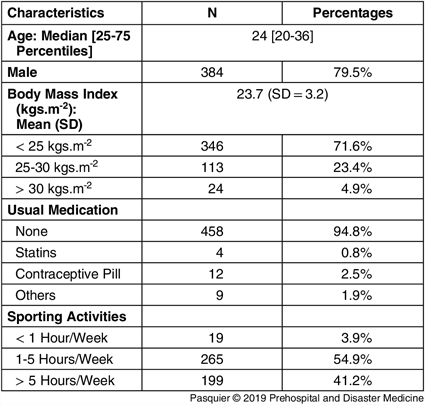
A total of 483 participants were included in the study. Their demographics and status at the time of study are presented in Table 1. The median age of study participants was 24 (25%-75%: 20-36 years). A total of 79.5% of them were male (n = 384). The mean BMI was 23.7kgs.m-2 (SD = 3.2kgs.m-2). Fifty-five percent (n = 265) reported between one to five hours sporting activities per week. Four hundred and fifty-eight reported no usual medication, four statins, 12 contraceptive pills, and nine various medications, excluding those affecting HR and BP.
Demographics and Status of Study Participants

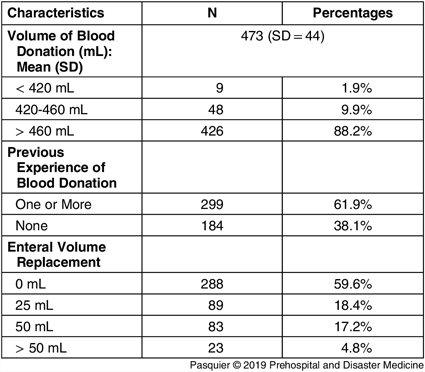
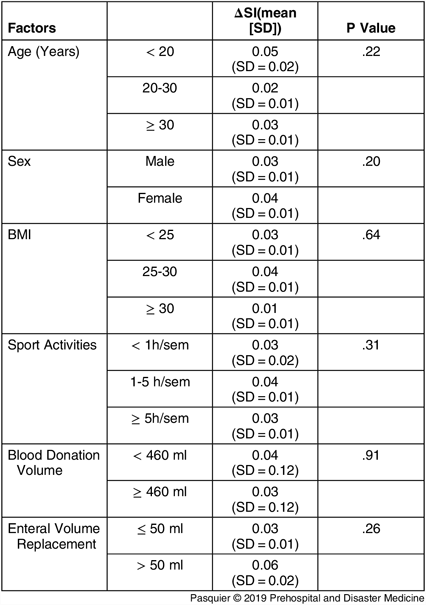
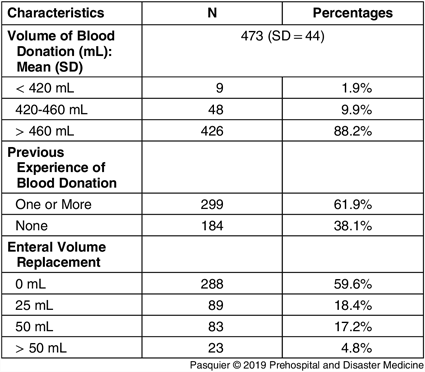
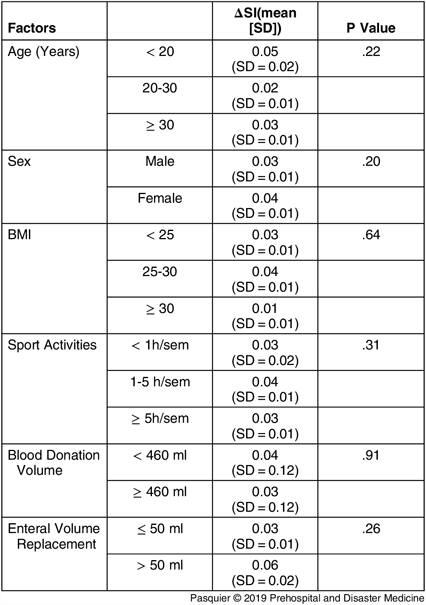
The mean blood donation volume was 473ML (SD = 44mL). Blood donors reported no complaints. Two hundred and ninety-nine study participants (61.6%) reported at least one previous experience of blood donation. During blood donation, 288 subjects (59.6%) did not receive any EVR, while 195 received at least 25mL (Table 2). The median pre- and post-blood donation SI (SI-pre and SI-post) were significantly different: 0.54 (IQR = 0.48-0.63) and 0.57 (IQR = 0.49-0.66), respectively (P = .002). The median absolute difference between SI-pre and SI-post was 0.06 (IQR = 0.03-0.1), representing a 10.4% change (Table 3). The analysis showed no significant association between SI variations and age, sex, BMI, sport activities, blood donation volume (<420mL and 420mL-460mL were grouped for statistical convenience), and EVR (grouped in ≤ or >50mL for statistical convenience; Table 4).
Blood Donations Characteristics
Hemodynamic Measurements Before and After Blood Donation

Abbreviations: BP, blood pressure; HR, heart rate; SI, shock index.
Shock Index Variations According to Relevant Factors
Discussion
In this study, healthy military blood donors presented with a normal range of median pre-donation SI. Changes in pre-/post-donation BP, HR, and SI were significantly different but presented as clinically poorly relevant. Surprisingly, median HR decreased from 71 (IQR = 63-80) to 69 (IQR = 61-77) bpm. The HR can change in response to numerous internal and external stimuli, but increased HR is generally considered as an early warning sign of hypovolemia.Reference Cooper, Schriger, Flaherty, Lin and Hubbell21 Blood donors in this study were, however, young and healthy servicemen, leading to a lower HR threshold. Blood donation was proposed previously as a reliable model for analyzing the effect of mild hemorrhage on hemodynamics parameters, including SI. Campbell, et al reported a prospective serial observational study where blood donors received BP and pulse rate (PR) recordings, immediately before and after donating one unit (470mL) of blood over 20 minutes, while in the supine position.Reference Campbell, Ardagh and Than16 This study analyzed whether or not the calculation of PR divided by pulse pressure (PR over pressure evaluation [ROPE] index) changed significantly as a result of routine blood donation in healthy blood donors, and compared it specifically with the SI. The SI ranges were normal and comparable to those described in the present study: SI mean; median before and after blood donation of 0.58; 0.57 (IQR = 0.35-0.86) and 0.62; 0.60 (IQR = 0.37-0.92), respectively. In comparison, a two-year (2011-2012) retrospective analysis of all trauma patients ≥18 years of age in the US National Trauma Database (American College of Surgeons; Chicago, Illinois USA) determined the impact of substituting SBP <90mmHg with SI on triage performance of the National Trauma Triage Protocol, an algorithm that guides Emergency Medical Service providers through four decision steps to identify the patients that would benefit from trauma center care.Reference Haider, Azim and Rhee22 Among a total of 505,296 patients included, substituting the existing criteria of SBP <90mmHg with SI >1.0 in the physiologic triage criteria of the National Trauma Triage Protocol, resulted in significant reduction in under-triage rate, without causing large increase in over-triage. In another prehospital study of 485 trauma patients, SI measured before any resuscitation was an independent predictor of trauma-induced coagulopathy (112 patients) and massive transfusion (22 patients).Reference David, Voiglio and Cesareo23 The SI cut-off value of 0.9 had accurate performance for the diagnosis of Trauma-Induced Coagulopathy (TIC) and Massive Transfusion (MT). These prehospital studies implied more advanced stage of hemorrhage than the 473mL (SD = 44mL) mean blood donation volume of this study. Indeed, the SI threshold applied was higher than the SI ranges observed in this study.
Limitations/Strengths
The findings of this study should be considered in terms of their limitations and strengths. Limitations include the inherent limits of hemodynamics measurement using a non-invasive standard vital signs machine, and no randomization of blood drive locations. Moreover, this model of mild hemorrhage implies young healthy volunteers in almost stress- and pain-free conditions, largely different from those experienced by a soldier injured in combat setting. However, strengths of this study include the study of healthy military blood donors, a dedicated population, and the recording of hemodynamic parameters, in a 45° supine position both before and after blood donation, achieving an early blood loss simulation, under strict and controlled conditions. Moreover, the application of a robust methodology including sample sizing and a multivariate analysis of the relevant confounding factors highlight the meaningful analysis.
Besides, humans are able to compensate for low-volume blood loss with minimal change in traditional vital signs. Indeed, a novel algorithm, analyzing photoplethysmogram waveforms, can estimate the compensatory reserve index and was compared to the SI for detection of mild hemorrhage.Reference Stewart, Mulligan, Grudic, Convertino and Moulton24 Other methods such as imaging techniques, including use of ultrasounds, demonstrated insufficient reliability for early detection of hemorrhagic shock.Reference Juhl-Olsen, Vistisen and Christiansen25 But application of these methods remains challenging on the battlefield, especially at the point of injury. Furthermore, the usefulness of SI has been previously demonstrated in military setting, mainly at the admission to a combat surgical facility.Reference Vassallo, Horne, Ball and Smith12 , Reference Cancio, Wade, West and Holcomb26
Conclusion
In this model of mild hemorrhage, SI exhibited significant variations, but failed to reach clinical relevance. Further studies are needed to prove benefits of SI calculation as a possible parameter for very early recognition of hemorrhage in combat casualties at the point of injury.
Acknowledgments
The authors warmly thank Dr. Marine Chueca, responsible for blood donation sites; all medical staffs involved in military blood donation; and finally, blood donors, for their devotion to support soldiers injured during military overseas operations.
Conflicts of interest
none