Disaster literacy is a new concept put forward by Lisa M. Brown et al. in 2014,Reference Brown, Haun and Peterson1 which is derived from health literacy and refers to individuals having the ability to acquire, understand, and fully use disaster information to make informed decisions in the process of disaster mitigation, preparation, response, and recovery. College students are a special group and the main force of the future social construction and their disaster education is directly related to the level of the future national public security risk literacy. However, there is no scientific tool to evaluate the disaster literacy of this group currently. This study is guided by the knowledge-attitude-belief-practice model (KABP model) and Brown et al.’s literacy model. A self-made questionnaire was used to understand the disaster situation and education needs of college students in central China, to analyze its affecting factors, and to provide scientific evidence for the government and relevant departments to develop disaster rescue plans.
METHODS
This was a cross-sectional study. A convenient sampling method was used to conduct a self-report questionnaire survey. The population of this study consisted of 7200 college students who were from 10 universities in 5 provinces in China, including Shanxi, Henan, Anhui, Hunan, and Jiangxi. From the 7200 questionnaires sent to all college students, 7020 completed surveys were received, giving an effective response rate of 98.00%.
Socio-demographic characteristics consisted of 12 variables, including age, gender, major, grade, parental education, parental occupation, the place of residence, the experience of disaster, disaster training experience, and family disaster preparedness.
Questionnaire items for disaster education needs of college students consisted of 11 questions, which were prepared by the researchers according to the literature.Reference Tan, Liao and Su2-Reference Lim, Lim and Vasu4 Questions 1-5 investigated the extent of college students’ needs for disaster education. Students responded to the statements using 4 choices, including very necessary, necessary, hardly necessary, and not necessary, respectively. The questions were described in terms of frequency and percentage. Questions 6-10 investigated the source of disaster knowledge and the current situation of preparation. The 11th question was open, which examined the students’ understanding of disaster education at present and the main difficulties of carrying out related education from their own perspective.
The disaster literacy questionnaire for college students was designed and compiled by them. The specific process was as follows: 5 disaster medical experts were invited to make “very irrelevant,”“irrelevant,”“relevant,” and “very relevant” evaluations for each entry, and assign 1, 2, 3, and 4 points in turn. After forming several items in each dimension, 2 rounds of expert consultations were conducted, and finally 40 items in 4 dimensions were formed. At the same time, each item was set to “completely understand,”“understand,”“understand a little,” and “not understand.” They were assigned 4, 3, 2, 1 in turn. The higher the score, the higher the disaster literacy of college students. Five more disaster medical experts were invited to conduct a surface validity test on the questionnaire, and the results showed that the questionnaire had a good surface validity. One hundred college students were randomly selected for reliability tests, and the results showed that the Cronbach’s alpha coefficient of the questionnaire was 0.896, indicating the questionnaire Good internal consistency.
Knowledge literacy in each dimension contained 10 items, which referred to the cognitive literacy of the classification of disasters, the principle of self-rescue and mutual rescue at the disaster scene, the type of disasters that were prioritized and relevant policies and regulations. Belief literacy contains 5 items, which referred to the feelings and attitudes of university students on disaster scene self-rescue and mutual rescue awareness, attention to domestic and foreign disaster events. Discriminative literacy included 10 items, which referred to the precursory signs corresponding to various disasters, the identification, acquisition, and use of effective information when disasters occurred. Behavioral literacy contained 15 items, which referred to how to quickly judge the wounded person’s respiratory and cardiac arrest, how to choose an emergency shelter when an earthquake occurred, and the correct use of fire extinguishers.
The questionnaire issued by this institute was a self-filled questionnaire, which was distributed through on-site and online. The research team trained investigators on project design schemes, survey forms, and field survey methods and techniques. When the questionnaire was distributed, the researcher explained the research purpose, meaning, and filling method in detail. With this informed consent and good cooperation, the investigator distributed the questionnaire to the respondent.
Data from the questionnaire were optically scanned and entered into IBM SPSS version 19.0. Frequencies, percentages, the mean score, and standard deviation(SD)of the questionnaires were analyzed. Pearson correlation, independent t-tests were used in 2 groups, which had continuous variables and 1-way analysis of variance (ANOVA) for more than 2 groups. Multiple linear stepwise regression analysis was conducted using college students’ disaster literacy as the variable of interest. The significance threshold was P < 0.05 for each outcome and testing was 2-sided.
RESULTS
Socio-demographic Characteristics of College Students
The sample of college students was made up of 4217 (60%) males and 2803 females (40%). All participants in this study came from 5 different subjects, 1633 (23%) in medical, 3885 (55%) in engineering, 707 (10%) in science, 251 (4%) in the arts, and 544 (8%) in management. The college student group comprised 950 (14%) in the first year, 3649 (52%) in the second year, 1221 (17%) in the third year, and 1200 (17%) in the fourth year and above, with an average age of (20.29 ± 1.37) years old.
Disaster Education Needs of College Students in Central China
A survey of education needs and preparedness showed that 96.27% of college students thought it was necessary to carry out public education related to disaster literacy. A total of 98.44% thought that medical students should have more relevant skills, and 79.43% thought that their families were not ready for disaster prevention items. A total of 96.36%believed that the campus should establish emergency rescue teams and response plans as soon as possible; 87.20% believed that schools should take elective courses for disaster-related courses; 88.64% of college students obtained relevant knowledge and information through television or the Internet. Only 13.61% of college students had opened schools’ relevant courses. A total of 12.89% of college students had offered relevant courses in their disciplines. In the open question answer, college students generally hoped to provide disaster education-related courses, and hoped to diversify the ways to receive disaster education, such as disaster prevention exercises, expert lectures, group activities, and design of publicity boards.
Scores of Disaster Literacy Among College Students in Central China
The scores of college students’ disaster literacy were depicted in Table 1. The total scores were 87.85 ± 19.8, with an average score of 2.20 for each item, which indicated that the overall disaster literacy of college students in central China was at a low level. And in all dimensions, the knowledge literacy was the highest, while behavior literacy was the lowest.
Scores of College Students’ Disaster Literacy (N = 7020)

Abbreviations: CI, confidence interval; SD, standard deviation.
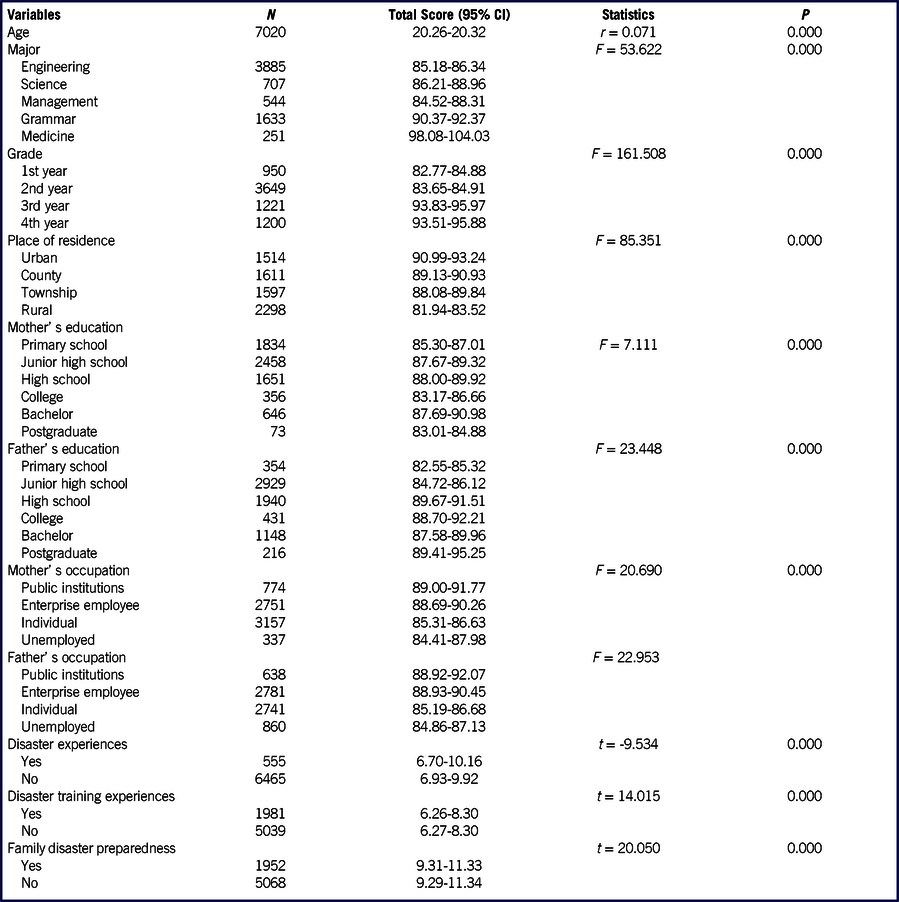
The total disaster literacy scores of college students, according to the socio-demographic characteristics, were illustrated in Table 2. It was found that age, major, grade, the place of residence, parental education, and occupation identified as increasing the likelihood total disaster literacy score (P < 0.05). Also, the experience of disaster, disaster training experience, and family disaster preparedness were found to influence the total scores (P < 0.05). However, gender did not show such an effect (P = 0.164).
Total Disaster Literacy Questionnaire Scores of College Students According to the Socio-demographic Characteristics

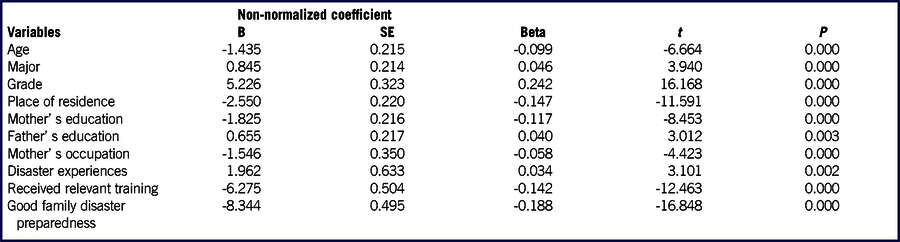
As shown in Table 3, statistically significant variables in univariate analysis were included in the multiple linear regression equation. Namely age (X1), professional category (X2), grade (X3), place of residence (X4), mother education (X5), father education (X6), mother occupation (X7), father occupation (X8), whether you have experienced disasters (X9), whether they had received training (X10), whether the family was prepared for disaster prevention (X11) as independent variables, and total disaster literacy scores as dependent variables (Y).
Multiple Regression Analysis of Disaster Literacy of College Students

Abbreviation: SE, standard error.
R = 0.390, R 2 = 0.152, F = 113.998, P = 0.000.
Stepwise regression analysis showed that age, major category, grade, place of residence, mother’s education, father’s education, mother’s occupation, disaster experience, disaster training experience, and family disaster preparedness were the factors that affected Chinese college students’ disaster literacy. Stepwise regression equation is Y = 137.369-1.435 X1 + 0.845X2 + 5.226 X3-2.550X4-1.825 X5 + 0.655 X6-1.546 X7 +1.962 X9-6.275 X10-8.344 X11. It could be seen from the standardized regression coefficients that grade, family disaster preparedness and residence were the main influencing factors.
DISCUSSION
Basic Situation and Education Needs of Disaster Literacy of College Students
College students are a special group of people with strong thinking and reasoning flexibility.Reference Niu, Zhang and Yang5 They can adapt to challenging situations and analyze and handle multiple problems at the same time. However, compared with the general public, college students have a weaker ability to cope with disasters and are often overlooked in disaster preparedness.
The study indicates that disaster literacy of college students is generallyata low level. Disaster literacy scores in this study are ranked from highest to lowest, knowledge literacy is highest, behavioral literacy is lowest, and belief literacy and discriminative literacy are ranked in the middle. This finding is consistent with the relevant research results of the KABP model.Reference Bagheri Amiri, Doosti-Irani and Sedaghat6,Reference Goh and Chua7
In the training of talents, the change of knowledge is easier to achieve, but the change of attitude is more difficult and takes longer. Moreover, the change of personal behavior is more difficult and time-consuming than the other 2. It takes the longest time, and this is the goal of our higher education. Therefore, the results of this study should attract the attention of families, universities, governments, and society, and strive to build a disaster literacy cognitive structure system for college students, create a more scientific, reasonable, safe, and stable learning environment, and thereby reduce potential risks to public safety.
In the context of this study, the disaster literacy education of college students in central China is urgently needed, especially for medical students. The way for college students to obtain disaster knowledge and information is a single one, and most of them have not received a systematic disaster literacy education. Compared with foreign drone simulation of large-scale casualty education,Reference Jain, Sibley and Stryhn8 interdisciplinary collaborative disaster education,Reference Jasper, Wanner and Berg9 etc., China’s disaster education resources are scarce and the education approach is single. Related courses offered by schools are also limited to knowledge transfer, with lack of disaster prevention and relief exercises, lack of simulation experience of disaster scene scenarios, and lack of corresponding content in continuing medical education.Reference Li, Li and Chen10-Reference Li, Turale and Stone12
At the same time, affective domain ability considerations related to the educational goals emerged. One of the characteristics of disaster emotional education is the application of communication, empathy, and caring ability in the rescue practice. The decisive factor of disaster literacy is the inner belief of individual scare for life and respect for life, that is, caring for life is regarded as a guide to all actions, and sublimation as a stable inner quality of the individual. However, emotional education is often overlooked.Reference Evans and Allen13 Both domestic colleges and universities and governments share responsibility for influencing the levels of students toward disaster literacy. This can be achieved by establishing a scientific and standardized system of disaster literacy education and providing informed integration, diversified educational approaches, and stratified implementation.
Socio-demographic Features Affect Disaster Literacy Level of College Students in Central China
The results of this study show that as the age and grade increase, the total disaster literacy of college students increases. First-year freshmen have just entered the university gates and are exposed to basic courses. The knowledge and access to information are narrow. Usually when entering the third year of university, students begin to learn the professional courses, and the cross-disciplinary and social coordination of disaster rescue is very strong. Therefore, with the increase of the ratio of professional courses to social practice, the disaster literacy of college students increases. Even so, the overall level is still low. Among all dimensions, the third grade has the highest knowledge and belief literacy, the fourth grade has the highest discriminative and behavioral literacy, and the first grade has the lowest total scores and scores in each dimension. Therefore, it is suggested that colleges and universities establish a disaster literacy education system based on the actual curriculum arrangements of college students, and implement it in different levels.
In this survey, the total scores of disaster literacy of medical students are higher than that of nonmedical students, but their discriminative and behavioral literacy are low, reflecting the lack of disaster literacy education in colleges and universities. In all dimensions, medical students have higher knowledge and behavioral literacy scores than nonmedical students. This is due to the systematic learning of disaster-related knowledge and skills such as cardiopulmonary resuscitation, bleeding, and fracture first aid by most medical students during their studies. This is especially difficult for nonmedical students. However, nonmedical students are the main group of university campuses and the main force to participate in self-rescue and mutual rescue when disasters occur in the future. Medical students are an important force to disseminate disaster rescue knowledge and skills in the future. Therefore, schools should strengthen in-depth education that attaches great importance to emergency rescue and emergency escape skills for medical students, and help nonmedical students to understand disasters in a comprehensive manner, establish awareness of public safety risks, and cultivate disaster self-rescue and mutual rescue capabilities.
This study finds that the total disaster literacy scores and scores of urban students are higher than those of rural students, which may be related to the fact that urban community services and publicity are far better than rural conditions. The low level of education of rural people in China,Reference Liu, Li and Jin14 the lack of access to information resources,Reference Li and Yeung15 and the lack of education for left-behind children in family education have all hindered the formation of disaster literacy among rural students in rural China.Reference Pan16 At the same time, this study finds that mothers are better able to improve their children’s disaster literacy than their father’s education and career.
In all dimensions, college students whose mothers are public officials and civil servants have the highest scores in intellectual and discriminatory literacy, while college students whose mothers are enterprise workers have the highest scores in belief and behavioral literacy. Therefore, it is recommended that the Chinese government and universities strengthen public education for disaster literacy of rural students and extend public education to the positive education of students’ families, especially mothers and children, so as to raise the whole society’s awareness of public safety risks and strengthen disaster response guidance for college students to create a good atmosphere for college students and their families to scientifically respond to sudden public safety risks.
In addition to the place of residence mentioned above, parental education and maternal occupation affected the disaster literacy level of college students. The mother is more able to improve the child’s disaster literacy in comparison to the father’s education and occupation in a correct way. In all the dimensions involved, college students whose mothers are engaged in public institution and civil servant occupations get the highest score in knowledge and discriminative literacy, while college students whose mothers are employed by the enterprises have the highest score in belief and behavioral literacy. Therefore, the government and universities are advised that inclusion of extended family education and positive education for mothers enhances public education in disaster literacy of rural college students, and comprehensively raise the social awareness of public safety risks. Equally important are the disaster response skills, which should be a component of the public education, and should be emphasized during the study year.
In this study, students who have experienced disasters and received relevant training have significantly higher total scores in disaster literacy and scores in various dimensions than those who have not, especially in discriminative and behavioral literacy. This shows that the deeper the mastery of knowledge, the more it is conducive to the realization of discriminative and behavioral changes.Reference Černe, Hernaus and Dysvik17,Reference Tkachuck, Schulenberg and Lair18 Therefore, Chinese university student managers should pay attention to their academic planning, make correct curriculum arrangements, and provide a variety of learning forms to achieve zero-distance integration and transformation of knowledge and skills. The total disaster literacy scores of Chinese university students’ families in disaster prevention work are higher than those in the unsuccessful. This suggests that China’s colleges and universities should not only focus on the cultivation of university students’ ability, but also extend to the family and transform into families.
The research team designs this research and obtains the research results based on the previous research, but there are some limitations. This study uses convenient sampling, which is limited in the representativeness of the sample. At the same time, because there is no unified and standard disaster literacy assessment questionnaire at home and abroad, the questionnaire in this study is designed by the Delphi method based on the relevant model. The content of the questionnaire and the setting of the question may have limitations. In the future, the research team will expand the sample and continue the in-depth research related to the disaster literacy scale.
CONCLUSIONS
The study reports the disaster literacy level and affecting factors of college students. It concludes that factors questioned, such as the age, major, grade, place of residence, parental education, mother’s occupation, disaster experience, the disaster training experience, and family preparedness affect the college students’ disaster literacy level. In light of our results, it is thought that school education, family education, as well as community education is indispensable in the disaster literacy education. A comprehensive and systemic disaster education system, including family-community-university integration, ought to be established, where college students have access to a wide range of educational options to continuously improve the overall disaster rescue level and reduce the occurrence of potential public security risks.
Author Contributions
Authors Zhang and Zhu contributed equally to this work.
Acknowledgments
We thank the leaders, staffs, and college students from the universities and colleges for taking part in the project and for valuable support.
Funding
This study was supported by Humanity and Social Science Youth Foundation of Ministry of Education of China (16YJC880098), Project of Chinese Society of Academic Degrees and Graduate Education (B-2017Y0902-157), Medical education project of Chinese Medical Association and Chinese Higher Education Association (2018B-N18055), Project of the 13th Five-Year Plan for Education Science of Jiangsu Province of China (C-c/2018/01/10), Project of Research on Education Informatization of Jiangsu Province of China (20172223), Project of Chinese Medical Association 2018 Annual Medical Education.
Ethical Considerations
The study was accessed by Ethics Commission of the university and approved by the person responsible for the colleges and universities. The college students who participated in this study were obtained after reading an informed consent form and were assured to be that participation was voluntary. Questionnaires were completed anonymously, and the information was only used for the statistical analysis of this study.