




No CrossRef data available.
Article contents
Oregon hospice nurses and social workers' assessment of physician progress in palliative care over the past 5 years
Published online by Cambridge University Press: 26 February 2004
Abstract
Background: The 1997 enactment of the Oregon Death with Dignity Act intensified interest in improving physician education and skills in caring for patients at the end of life.
Objective: To obtain hospice nurse and social workers' collateral ratings of efforts made by Oregon physicians to improve their palliative care skills over the previous 5 years.
Design: A descriptive survey of nurses and social workers from all 50 Oregon outpatient hospice agencies.
Measurement and Results: Oregon hospice nurse (N = 185) and social worker (N = 52) respondents, who had worked in hospice for at least 5 years, rated changes they observed over the past 5 years in physicians' approach to caring for their hospice clients. Six characteristics, including willingness to refer patients to hospice, willingness to prescribe sufficient pain medications, knowledge about using pain medications in hospice patients, interest in caring for hospice patients, competence in caring for hospice patients, and fearfulness of prescribing sufficient opioid medications were evaluated. Positive changes were endorsed by the majority of respondents on all but the scale measuring fearfulness of prescribing opioid medications; on the latter, 47% of nurses rated doctors as less fearful, whereas 53% rated them as about the same or more fearful than they were 5 years earlier.
Conclusions: Most respondents rated Oregon physicians as showing improvements in knowledge and willingness to refer and care for hospice patients.
Information
- Type
- Research Article
- Information
- Copyright
- © 2003 Cambridge University Press
INTRODUCTION
The state of Oregon enacted the Death with Dignity Act (ODDA) in 1997, legalizing physician-assisted suicide (PAS) for terminally ill patients. In the context of numerous ongoing initiatives to improve education and delivery of palliative care nationwide (Tolle & Tilden, 2002), the availability of this option has stirred continued debate and required adjustments among physicians and hospice practitioners who serve as the nexus to patients at the end of life. At the same time, there have been concerns that actions by the Drug Enforcement Agency would have a chilling effect on physician willingness to prescribe adequate amounts of narcotic analgesics for fear of being accused of performing euthanasia. A recent survey (Ganzini et al., 2001) completed by over 2,600 Oregon physicians suggests that these health care providers have attempted to improve their ability to care for patients at the end of life since the passage of the Oregon law. Thirty percent of Oregon physicians reported they had increased their referrals to hospice and three quarters had made efforts to improve their knowledge about pain medications since passage of the Act, somewhat allaying earlier published concerns that legalization of PAS would erode efforts to improve palliative care at the end of life (Drane, 1995; Foley, 1997; Sobel & Layton, 1997; Faber-Langendoen, 1998; Hendin et al., 1998). The positive clinician self-appraisals were not confirmed by any tests of physician knowledge or skill in end-of-life care.
Oregon hospice nurses and social workers, who work routinely with their patients' physicians, offer a separate source of appraisal of these purported changes in medical care provided by physicians over the past 5 years. We report the results of a survey of Oregon hospice nurses and social workers conducted in 2001, in which respondents provided their impressions of changes over the last 5 years made by their physician colleagues who care for hospice patients.
METHODS
The data were embedded in a survey of Oregon hospice nurses' and social workers' views on assisted suicide. The methods of this study are described in detail elsewhere (Ganzini et al., 2002). Between July and September of 2001, surveys were mailed to all nurses and social workers employed by all 50 hospices in Oregon, and an additional 2 out-of-state agencies that served clients within Oregon. Hospices supplied either the names of all eligible employees (554 total) or arranged to deliver surveys to eligible employees who wished to remain anonymous (19 total). Each potential respondent received a copy of the survey with a $10.00 check (or an offer of $10.00 to those who remained anonymous). Complete anonymity for all participants was assured by the study protocol; the surveys themselves contained no identifying information and all returned surveys were separated from the envelope upon receipt and assigned a new identification number. Envelopes were tracked separately solely for follow-up purposes. Follow-up included a reminder postcard, a second copy of the survey, and a personalized reminder letter. This study was reviewed by the institutional review board at the Portland VA Medical Center and exempted from the requirement for obtaining informed consent because the survey was anonymous.
The survey collected basic demographic information about each respondent. Respondents ranked their support for or opposition to ODDA on a five-point scale ranging from “strongly support,” to “neither support nor oppose,” to “strongly oppose.” Hospice nurses and social workers were also asked to provide their “overall impressions” about how the Oregon physicians who serve as primary providers for their hospice patients have changed over the last 5 years. The respondents provided ratings on six characteristics including: willingness to refer patients to hospice, willingness to prescribe sufficient pain medications, knowledge about using pain medications in hospice patients, interest in caring for hospice patients, competence in caring for hospice patients, and fearfulness of prescribing sufficient opioid medications. Respondents rated change on a seven-point scale ranging from 1 (much less) to 7 (much more) with a midpoint of 4 (about the same).
Categorical data are described with frequencies and proportions. The hospice workers' ratings of physician attributes on an ordinal seven-point scale were collapsed to less, about the same, and more, and are presented as frequencies and proportions. Correlations were calculated with the Spearman correlation coefficient.
RESULTS
Of 573 names submitted by Oregon hospices, 28 were eliminated because they no longer worked in an eligible organization or they did not care for Oregon patients. Surveys were returned by 397 (73%) of the remaining 545 possible respondents. Individual hospices were represented at rates ranging from 25% to 100%. Of 429 eligible nurses, 307 (72%) returned surveys, as did 90 (78%) of 116 eligible social workers (this category included 7 other licensed counselors). Because the questions focused on perceptions of change over a 5-year period, those professionals who worked in hospice 4 years or less were excluded. This final group was comprised of 237 hospice professionals including 185 nurses and 52 social workers.
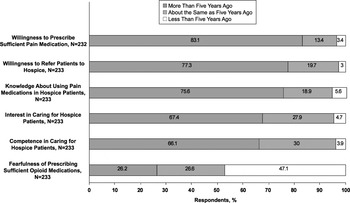
Hospice nurses and social workers are typically concerned with different aspects of hospice care. However, because there was no statistically significant difference in their views of physician improvement, the responses of the two groups were combined. Hospice professionals generally characterized Oregon physicians as having more interest and greater competence in caring for hospice patients than they had 5 years earlier (Fig. 1); 67% of respondents ranked physicians as more interested in caring for hospice patients, whereas 5% viewed them as less interested; and 66% viewed physicians as more competent in their care of hospice patients, whereas only 4% rated them as less competent. Seventy-seven percent said physicians were more willing to refer to hospice whereas only 3% of professionals assessed physicians as less willing to refer to hospice over the previous 5 years. Eighty-three percent of Oregon hospice nurses and social workers described their physician colleagues as more willing to prescribe sufficient pain medications for hospice patients relative to 5 years earlier and 76% viewed Oregon physicians as more knowledgeable about using pain medications in hospice patients. When asked whether Oregon physicians had changed over the last 5 years in their fearfulness of prescribing sufficient opioid medications, 47% of the respondents indicated that they viewed physicians as less fearful today. However, 26% of the respondents marked that they viewed physicians as more fearful than they were 5 years earlier.

Hospice workers' views of how Oregon physicians have changed over the last 5 years.
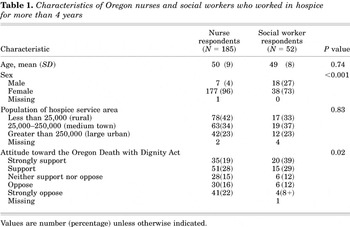
Overall, 51% supported or strongly supported the ODDA, 14% neither supported nor opposed the Act, and 34% opposed the ODDA (Table 1). Factors such as the population size of the hospice catchment area or individual ratings of support or opposition to the ODDA were not associated with differences in ratings of physicians' performance.
Characteristics of Oregon nurses and social workers who worked in hospice for more than 4 years

DISCUSSION
The initial 1994 voter approval and enactment of the ODDA in 1997 led to speculation that the option of PAS would erode efforts to encourage physicians to learn about and to improve palliative interventions for terminally ill patients (Drane, 1995; Foley, 1997; Sobel & Layton, 1997; Faber-Langendoen, 1998; Hendin et al., 1998). In 1999, Oregon physicians as a majority described themselves as having improved their knowledge about palliative care and the use of pain medications since passage of the act, and they endorsed feeling more confident about prescribing pain medications (Ganzini et al., 2001). These findings were especially important given that provision of comfort care interventions such as these has been significantly associated with patients changing their minds about assisted suicide (Ganzini et al., 2000). Physicians, however, may not be the best sole judges of their own progress, and their actual skill and knowledge in end-of-life care was not assessed. Hospice organizations provide support to approximately 37% of those who die in Oregon (Ann Jackson, Oregon Hospice Association, pers. commun.), and 83% of those who have chosen physician-assisted suicide have been enrolled in hospice. In some Oregon hospices, the hospice medical director cares for enrolled patients, but for the majority of hospice patients, their own primary care provider continues to care for them throughout the hospice course. The nurses and social workers of Oregon hospice organizations are in a unique position to independently evaluate the strides made by their physician colleagues over the past 5 years.
In this study, the majority of Oregon hospice workers reported their opinion that physicians had made positive strides towards improving their ability to care for hospice patients. Three quarters of respondents positively rated physician progress in learning about pain medications; the same self-appraisal was endorsed by 76% of the physician respondents on the earlier study. Hospice workers also rated physicians as showing gains in their willingness to refer and care for hospice patients, and viewed them as increasingly competent in caring for their hospice patients over the past 5 years. Similarly, only 3% of Oregon physicians reported that they had made fewer referrals to hospice in the span between 1994 and 1999; 30% reported they had increased the number of hospice referrals. In Oregon, the number of patients who died in hospice care increased from 22% in 1994 (the year the ODDA passed) to 37% in 2002.
Taken together, these views offer further support for the encouraging conclusion that palliative care in Oregon has improved in the span from 1997 to 2001 when our survey was conducted. Our data do not allow attribution of this positive change directly to the ODDA. Nationwide there have been extensive efforts to improve end-of-life care, and there are no data that allow us to compare progress made by physicians in other states. Since passage of the ODDA, however, many attempts have been made to improve palliative care. Educators at Oregon Health & Science University enhanced the medical school curriculum in end-of-life care beginning in 1995 (Lee & Tolle, 1996). Palliative care teams have been instituted at hospitals, conferences throughout the state have centered on end-of-life care, and efforts are underway to identify and remove barriers to hospice access (Tolle et al., 2000).
These findings were consistent across variables that theoretically might have influenced the opinions expressed. For example, hospice professionals endorsed improvements in physician willingness to refer to hospice uniformly across rural, medium city, and large urban settings, even though it may be more difficult to negotiate hospice referrals in sparsely populated regions and physicians in these areas may lack opportunities for education about end-of-life care. Support for or opposition to the ODDA did not have significant influence on nurses or social workers' overall positive appraisals of progress made by physicians over the last 5 years.
The prescribing of opioid pain medications poses a precarious balancing act for Oregon physicians. On the one hand, there have been extensive efforts to overcome physician resistance to treating pain in terminally ill patients. The Oregon Board of Medical Examiners (www.bme.state.or.us) has sanctioned a physician who consistently failed to adequately treat pain. On the other hand, physicians face questions from their state licensing board for opioid treatment that may result in a hastened death. Moreover, some may feel that the ODDA has resulted in increased scrutiny of their prescribing practices. The United States Department of Justice is actively pursuing efforts to overturn the ODDA and to punish physicians who prescribe lethal medications with the intent to hasten death. Physicians may anticipate being second-guessed as to their intentions. To some degree, this ambivalence is reflected in hospice professionals' rating of physician changes over the past 5 years regarding their fearfulness of prescribing sufficient opioid medications. While 47% of hospice workers rated physicians as “much less” to “a little less” fearful of prescribing opioids to sufficiently control pain, 27% ranked them as “about the same” as 5 years ago, and 26% ranked physicians as more fearful. Interestingly, physicians appear to remain fearful of consequences related to their prescribing practices, and yet they are providing better care despite their fears. A recent rating of end-of-life care in all 50 states by Last Acts (2002) advocates for more explicit state guidelines to address undertreatment of pain. In Oregon, there is currently no statewide policy on pain management. Given that adequate palliative care presents a critical alternative to physician-assisted suicide, these results suggest that physicians may continue to need clearly delineated guidelines and legal safeguards that prioritize pain management in order to prescribe for pain control with confidence.
There are several limitations to this study. We did not precede this survey with qualitative studies. As such, we may not have included items of importance that would have emerged in qualitative interviews. Not all hospice workers responded to this survey, and not all who responded completed every question. These data represent hospice workers' impressions, and the precision and validity of these impressions cannot be verified. As previously noted, across the United States similar efforts are being made to improve physician abilities to care for patients at the end of life. Because we did not survey hospice professionals in states other than Oregon, we cannot determine whether our findings are specific to Oregon or representative of secular changes across the nation.
ACKNOWLEDGMENTS
Supported by a grant from The Greenwall Foundation. The views expressed in this article are those of the authors and do not necessarily represent the views of the Department of Veterans Affairs, the U.S. Government, Oregon Health & Science University, the Oregon Hospice Association, or The Greenwall Foundation.
References
REFERENCES
Drane, J.F.
(1995).
Physician assisted suicide & voluntary active euthanasia:
Social ethics and the role of hospice.
The American Journal of Hospice & Palliative Care,
12,
3–11.Google Scholar
Faber-Langendoen, K.
(1998).
Death by request: Assisted suicide and the oncologist.
Cancer,
82,
35–41.Google Scholar
Foley, K.M.
(1997).
Competent care for the dying instead of physician-assisted suicide.
The New England Journal of Medicine,
336,
54–58.Google Scholar
Ganzini, L.,
Harvath, T.A.,
Jackson, & A.,
et al.
(2002).
Experiences of Oregon nurses and social workers with hospice
patients who requested assistance with suicide.
New England Journal of Medicine,
347,
582–588.Google Scholar
Ganzini, L.,
Nelson, H.D.,
Lee, & M.A.,
et al.
(2001).
Oregon physicians' attitudes about and experiences with
end-of-life care since passage of the Oregon Death with Dignity
Act.
Journal of the American Medical Association,
285,
2363–2369.CrossRefGoogle Scholar
Ganzini, L.,
Nelson, H.D.,
Schmidt, & T.A.,
et al.
(2000).
Physicians' experiences with the Oregon Death with Dignity Act.
New England Journal of Medicine,
342,
557–563.Google Scholar
Hendin, H.,
Foley, K., &
White, M.
(1998).
Physician-assisted suicide: Reflections on Oregon's first case.
Issues in Law and Medicine,
14,
243–270.Google Scholar
Last Acts.
(2002).
Means to a better end: A report on dying in America today.
www.lastacts.org/files/misc/meansfull.pdf.
Washington, D.C.
Lee, M.A. &
Tolle, S.W.
(1996).
Oregon's assisted suicide vote: The silver lining.
Annals of Internal Medicine,
124,
267–269.Google Scholar
Sobel, R.M. &
Layton, A.J.
(1997).
Physician assisted suicide: Compassionate care or brave new world?
Archives of Internal Medicine,
157,
1638–1640.Google Scholar
Tolle, S.W. &
Tilden, V.P.
(2002).
Changing end-of-life planning: The Oregon experience.
Journal of Palliative Medicine,
5,
311–317.Google Scholar
Tolle, S.W.,
Tilden, V.P.,
Rosenfeld, & A.G.,
et al.
(2000).
Family reports of barriers to optimal care of the dying.
Nurse Researcher,
49,
310–317.Google Scholar
Hospice workers' views of how Oregon physicians have changed over the last 5 years.
Characteristics of Oregon nurses and social workers who worked in hospice for more than 4 years
 You have
Access
- 9
- Cited by