On a warm November afternoon in Minoo, Osaka in 2010, Shiomi Mieko appears, riding an old mamachari bicycle and wearing a pink cap, to meet me at Sakurai station. The experimental musician and Fluxus artist guides me through the quiet residential neighbourhood surrounded by hills still lush in the late fall. A path paved with large stones leads to her front door. The parlour, where she invites me to sit, is furnished with a coffee table, a plush sofa, and a TV. The afternoon light seeps in through lacy curtains. On my first visit to Shiomi's house, I’m struck by an encounter with these scenes of domestic life. It is a typical upper-middle class Japanese home, except for the works and objects from Shiomi's Fluxus years that adorn the shelves and walls of that room: neatly framed versions of Shiomi's Balance Poems; a collection of tiny bottles with small objects and words inside from her Bottled Music series. Then, pointing out a shadow on the sofa next to my hand, Shiomi tells me to look closely at the line of the shadow. Look at the boundary, she says. If you look closely enough, you can't tell exactly where the shadow ends. The light bouncing off the textured sofa looks like tiny dots. There is a zone (not a clear line) where light fades into shadow. That's intermedia, she says.Footnote 1
It was that simple. We had just performed a version of Shiomi's Shadow Piece II, whose text invites each beholder not just to look, but also to experience the piece by doing.Footnote 2
Everyday sounds, spaces, and technologies were subjects for artistic examination for Shiomi and a handful of other Japanese musicians and artists working in the 1960s. On the surface, performances based on everyday gestures and sounds, like hammering a nail or turning on an electric fan, might just seem absurd. Such works deviated from what most concertgoers expected of a musical performance in a recital hall. They also differed decisively from the overtly political images found in avant-garde art and film of the time in Japan.Footnote 3 I suggest, however, that the existing parameters used to discuss political engagement in Japanese art of this period were born of the visual arts, and do not work for the experimental musical practices that are the focus of this article. My intention here is to examine how musical experiments stood in contrast to visual representations of the protest and violence playing out in public squares and in the streets.
In particular, I pursue an inquiry into the sonic practices surrounding intermedia art in Japan as a means to rethink the dominant discourse about cultural politics in the 1960s, which continues to be framed in terms of what I call the narrative of growth and conflict: the story of miraculous economic growth, on the one hand, and the radical politics of resistance, on the other. What can experimental sound tell us about forms of political engagement? What do experimental musical practices say about the kinds of attitudes and bodies that may be part of a political process? Were musicians merely apathetic to the pursuit of freedom and democracy compared to their artistic contemporaries? Certainly, there are reasons to believe such a hypothesis. Broadly speaking, experimental musicians tended to come from wealthier families who could afford music lessons, record players, and perhaps even a piano in the home. One might then conclude that from a standpoint of social privilege, musicians could afford to assume an elite disavowal of the political situation.
I argue otherwise. Simone de Beauvoir's notion of the ‘ethics of ambiguity’ offers an entry point to considering another kind of political engagement, operating on a principle that accepts ambiguity. Writing in the immediate aftermath of the Second World War, de Beauvoir argued that to that date, philosophers had concerned themselves too much with the impossible task of eliminating ambiguity, when in fact it is the condition of our existence in a world where ‘[men] are masters of the atomic bomb, yet it is created only to destroy them’.Footnote 4 Resistance and protest are often structured around the achievement of a final outcome of overturning existing structures of power. Yet, these movements fail when they are unable to achieve the expected outcomes. Flipping this outcome-oriented model, in The Ethics of Ambiguity de Beauvoir argues that, ‘the means, it is said, will be justified by the end, but it is the means which define it’.Footnote 5 For her, the danger in seeing only the end is that violent means used in radical protest ‘in the name of political necessity’ only result in perpetuating more violence.Footnote 6 Moreover, such an absolutist focus on the end jeopardizes the conditions for freedom in the present, and thereby a freedom to continue to shape an open-ended future. By contrast, de Beauvoir's ‘ethics of ambiguity’ begins by acceptance of this condition of unresolvable paradox. Stating that ‘man must not attempt to dispel the ambiguity of his being but, on the contrary, accept the task of realizing it’, de Beauvoir makes the case that ambiguity is in fact the condition of our existence and a part of the political process.Footnote 7 Acceptance of this paradox has critical political implications. Asserting that the means may not be justified by the end, de Beauvoir's ‘ethics of ambiguity’ offer an entry point to considering a kind of political engagement that places an emphasis on the process of political participation played out in the interactions and relations that shape the lived, embodied experiences of everyday life. As I highlighted in Shiomi's example above, doing is the operative term in understanding the relationship between everyday actions in intermedia and political action. The politics of the intermedia practices that I discuss here are not so much stated through their final outcomes, but articulated through performative tactics alive to ambiguity.
Focusing on the experimental form known as intermedia art – a practice that cross-cuts and combines realms such as experimental music, multimedia performance, and conceptual art – I take to task the discourse of ‘art and the politics of resistance’ that dominates writing about the cultural politics of the 1960s. The stylistic flexibility of intermedia makes it a particularly suitable analytic vehicle for navigating the relations of power that make certain bodies and certain modes of being more visible, more audible, more powerful, more prominent, or more normal – that is, deemed more suitable for political participation. Turning to specific examples from the practices of Shiomi, Kosugi Takehisa, and Yuasa Jōji, I analyse what kinds of relations to modes of being and forms of presence intermedia could articulate anew. These modes of being are assessed in terms of the ‘ambiguous’ positions occupied by each artist: in terms of gender identity and a de facto exclusion from the frontlines of radical politics; in terms of the borders of sonic and visual media and their possible meanings; in terms of the tensions between the perceived incommensurability of aesthetics and politics; and in terms of their affiliations as artists with transnational careers. In the analyses, I investigate the workings of the technologies of everyday life articulated through the musical and sonic practices of experimental musicians. I depart from discourses of resistance and instead argue that the spaces and sounds of everyday life in experimental music tuned into a sense of both deep ambivalence and ambiguity that is, in fact, at the core of everyday experience.
An additional motivation for the story that I wish to tell concerns attitudes of ambivalence among the musicians concerned. Over the course of several interviews with experimental musicians associated with 1960s intermedia, I heard a resistance to identifying their work as political in spite of what I, and other scholars, have identified as unmistakably political. What is the source of this gap in understanding the very idea of politics, and what is at stake in claiming a position of being not-political?Footnote 8 In the story of celebration or resistance to growth, there is no space for ambivalence. Missing, too, are the bodies and voices of those who could not or did not participate in the spectacles of heroic nation building or radical protest. By way of seeking an understanding of the layered meanings of intermedia, I argue that through an extension of ways of sensing, and by attempting to make sense of changing material and social conditions during a volatile decade in post-war Japan, intermedia's forays into the everyday treated its material and sonic objects as a set of relations that were both productive and problematic. The questioning of the boundaries between art and the everyday are oriented on an emphasis on the means of interrogating those very boundaries, rather than pursuing total transformation as an end-goal.
My present project aims to add to critical scholarship on the intersection of art and politics in 1960s Japan by scholars such as Miryam Sas, Bruce Baird, Yuriko Furuhata, and William Marotti.Footnote 9 From Sas, I have inherited an interest in the role of what she terms ‘moments of encounter and engagement’ as a way to focus upon the relations between artists and their everyday social and material realities.Footnote 10 My emphasis on the unresolved tensions and ambiguities in intermedia connect to the work of Baird, who frames his analysis of the butoh dancer and choreographer Hijikata Tatsumi in terms of ‘oppositions and juxtaposition’.Footnote 11 Furuhata's work characterizes the mediatized cultural politics of the 1960s as the season of ‘image politics’, prompting the question of how to make sense of other artistic practices (such as music) which do not deal primarily with images.Footnote 12 Finally, my work is indebted to Marotti's investigations of artistic interventions and investigations of everyday life in an attempt to ‘repoliticize’ the ‘depoliticized’ everyday.Footnote 13 Of this group, Marotti is the scholar who deals the most with musicians. However, his work focuses primarily on the analysis of the written and visual documentation surrounding the activities of musicians such as Tone Yasunao and the ensemble Group Ongaku. While my subject matter is closely related to Marotti’s, my work foregrounds the sonic aspect of their musical practices in order to question the productive tensions between artistic statement and practice. More generally, whereas the existing scholarship focuses on the idea of politics in relation to visual and performance art, this article is concerned in particular with the acoustics of intermedia, approached as a means to illuminate and reconfigure the sensory relations at work in everyday life.
I base my argument on a notion of intermedia that is not simply a style or particular form. Intermedia enacts a shift from object to practice, emphasizing social space and interaction rather than autonomous works as the foundation of artistic community and practice. Through interviews with musicians such as Shiomi, Yuasa Jōji, and Tone Yasunao, I have come to understand intermedia as a critical approach rooted in the sensory environment articulated through everyday objects, media, and events. As we will see, this critical approach was not without its tensions, for the practice of intermedia often relied directly on contemporary technologies and corporations linked directly to those in power. Yuriko Furuhata has highlighted the way in which radical artists’ ‘claims for the sensory and political emancipation made possible by participatory and multimedia art forms such as expanded cinema, happenings, installation art, and performance art [as well as intermedia] are troubled by their reliance upon the very military technologies and political techniques from which those same artists sought escape’.Footnote 14 But instead of too quickly dismissing the absence of a clear declaration of a political goal as utopian detachment, closer analysis of intermedia reveals a concern with the ambiguity attendant upon both existing sensory categories and the material conditions of everyday life that are shaped by larger structures of power. An ethics of ambiguity in artistic practice accepts ambiguity within the political process and claims a mode of freedom located in an ethical obligation to envision an open-ended future. The resulting shifts in perception may be subtle, yet they amount to no less than an reassessment of who and what counts in art and in political processes.
A Story of Growth and Conflict
The narrative of ‘growth and conflict’ against which I write in this article is nonetheless compelling. Briefly, the story of the 1960s as a decade of growth and conflict following a decade of ‘emerging from the ashes’ of the devastating effects of the Second World War focuses on large-scale organized protests based on dissatisfaction with the Japanese government, and the drastic increase in national wealth that was evidenced by doubled average incomes and GDP. Artists and musicians were among the participants in the mass protests staged at both ends of the 1960s in opposition to the renewal of the Treaty of Mutual Cooperation and Security Between the United States and Japan. The original version of the Treaty dates back to 1951. Popularly referred to as Anpo, the treaty is a security arrangement between the United States and Japan that still exists today.Footnote 15 Most problematically, it permits the US armed forces to maintain bases in Japan in the name of ‘security’ and ‘mutual cooperation’. Under the treaty, Japan implicitly and knowingly participated in the Korean and Vietnam wars, despite the fact that Article IX in the post-war Japanese constitution explicitly rejects war. A revised treaty was signed in 1960 and renewed in 1970.Footnote 16 In the years leading up to both of these events, strong oppositional movements formed across the nation, and especially in urban centres such as Tokyo and Kyoto.Footnote 17 In both instances, artists and intellectuals participated in oppositional movements in large numbers, although the form of participation and engagement varied widely between individuals. However, despite the widespread participation of citizens acting out their support of a democratic political process, the movement ultimately did not prevent the security treaty from passing. Moreover, to the disappointment of the opposition, a political elite that included many powerful figures from wartime Japan (most prominently, Prime Minister Kishi Nobusuke, a Class A war criminal) remained firmly in control. Following the Anpo protests, Kishi himself resigned in response to popular demand, taking responsibility for the unrest and mismanagement within his own cabinet that threatened to spin out of control. However, his party, the conservative Liberal Democratic Party (LDP), retained the power that it had held since 1955. The result, in historian Yumiko Iida's words, was a climate of ‘serious intellectual confusion, loss of direction in political movements, loss of belief in post-war democracy and a distrust of abstract political principles and institutions in favour of direct action’.Footnote 18
At the same time, the quality of life was changing dramatically, and the coining of phrases such as ‘economic miracle’ and ‘income doubling’ amplified the public's perception of the impact of these changes. This new-found affluence manifested in the form of a sharp increase in the production and consumption of home electronics, as well as the redefining of the ideals of domestic life. Homemakers came to consider equipment such as the vacuum cleaner, washing machine, and rice cookers as essential. Ownership of these objects marked middle-class achievement. In the sound-, media-, and techno-scapes of urban Japan, a sharp rise in recorded and live sound in the form of radio, TV, telephones, and stereos in the home and workplace marked these profound changes. Remarkable increases in TV ownership also attests to this shift. The number of Japanese households with televisions sets in the home multiplied by more than 1,100 times between 1953 and 1963, with the household penetration rate rising from 0.1 per cent to 88.7 per cent.Footnote 19 Such changes did not simply occur as a natural part of ‘progress’ though. As historian Simon Partner notes, the rate of televisions sold far exceeded the rate of rising per capita income between 1950 and 1960.Footnote 20 The steady supply of new electrical goods was important. But technologies of production and marketing also played a major role in producing demand by replacing public scepticism or confusion with a sense of need for the new technologies of consumer goods.Footnote 21
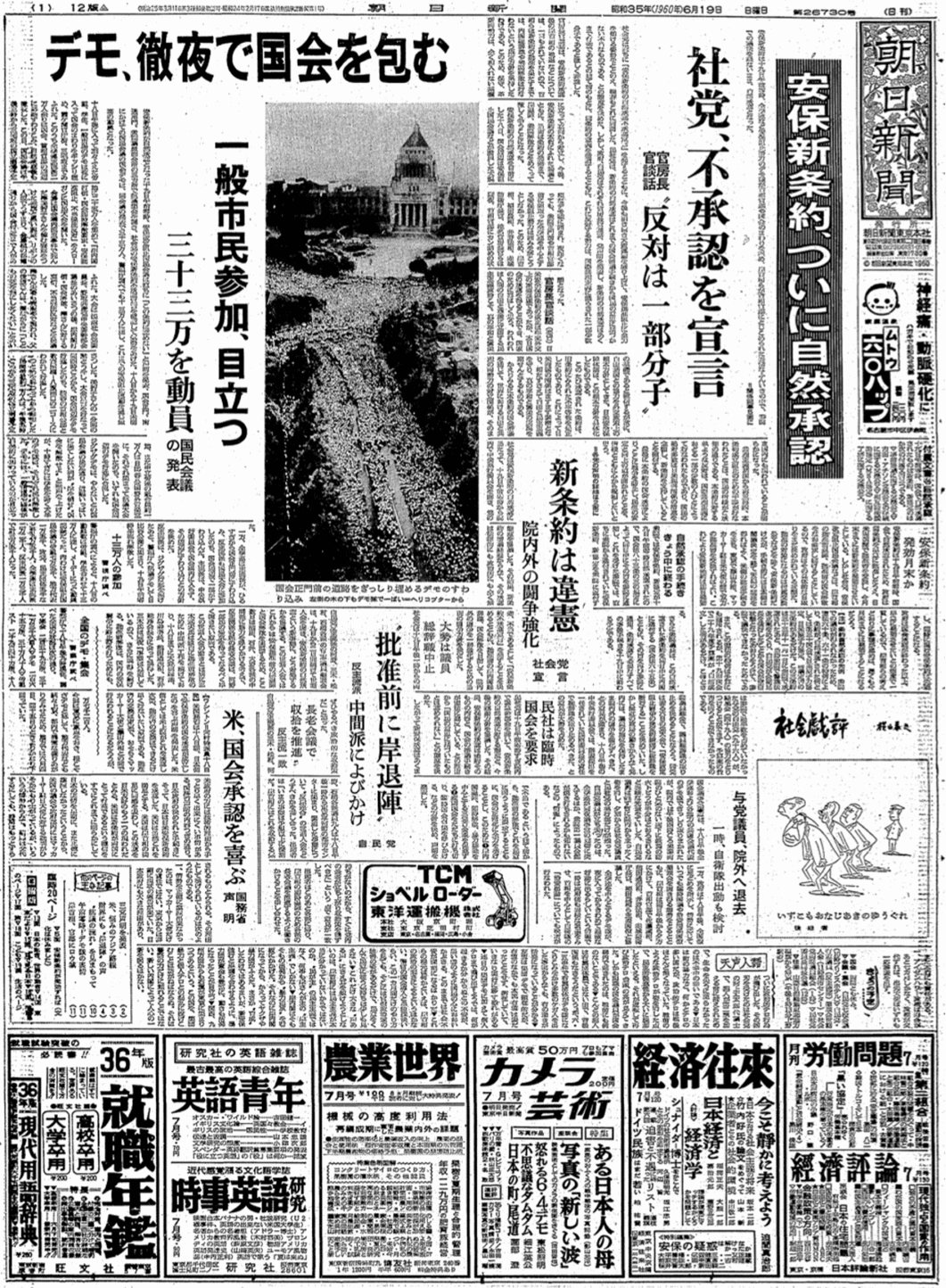
The new media technologies also amplified the national mood of growth and conflict with their repetitive display of spectacle events. Disseminated through television, radio, and print media, iconic media events including the 1964 Tokyo Olympics and the 1970 Osaka World's Fair symbolized crowning achievements of a new national identity pairing advancement in product technology with cultural richness. The message affirming Japan's rising position on an international level had a nationwide reach. Yet if the cost of this growth rested on the terms of the Anpo, it essentially made Japan's decade of miraculous economic growth contingent on cooperation with the US and the continued presence of US armed forces in Japan.Footnote 22 Disseminated through the very same technologies, images of workers and student groups forming a dense snaking line of protestors leading up to the National Diet building in 1960 (Figure 1) and images of violent protest on the Tokyo University campus and Shinjuku Station have become iconic of the decade. Through publications, exhibitions and the internet, their circulation continues today.
The iconic aerial image of protestors outside the National Diet Building appeared on the cover of the 19 June 1960 morning of edition of Asahi Shimbun. According to the opposition leaders, an estimated number of up to 330,000 protestors gathered in front of the Diet. They were unwilling to accept the ‘automatic diet approval’ (shizen seiritsu) of the Anpo treaty and called for the resignation of Prime Minister Kishi and dissolution of the Diet. Used by permission of Asahi Shimbun.

Intermedia artists noted both the language and the technologies of this complex mediascape that celebrated explosive economic growth and political conflict side by side. The awareness of this shifting environment was made sensible not only in finished works but also in what it meant to be an artist. Rather than ‘expressing cultural values’, intermedia artists were in the business of what Marshall McLuhan described as ‘the retraining and updating of sensibility’.Footnote 23
From the Post-war Years to Intermedia
Paralleling this narrative of drastic social change, historians of art have described the transformations in the art world as no less than ‘seismic’.Footnote 24 Over the course of approximately two decades after 1945, major tendencies in art included the emergence of forums for artistic collaboration within the framework of autonomous collectives (e.g., Jikken Kōbō, the Gutai group, and Hi Red Center), and closer attention to the psychological and material conditions of everyday life (as in the ‘reportage’ painting in the 1950s, and the ‘happenings’ and ‘events’ of the 1960s). Innovations in avant-garde music in the post-war decades shared similarities with those in the art world. Musicians, too, turned to collectives and non-traditional institutions to collaborate, and showed a renewed interest in traditional Japanese performing arts. There were also more specifically musical trends. In a major shift from the pre-war era, international alignments moved to a heavily American, and to a lesser degree French, allegiance (as opposed to German). This was aided in no small part by the availability of resources related to contemporary American music at places such as the American Cultural Center, formed as part of the cultural diplomacy project during the immediate post-war years of the Allied occupation of Japan.Footnote 25 Experiments in electronic music and the use of recording devices as musical instruments introduced a new sonic vocabulary to music, and put the sounds of everyday life into direct encounter with avant-garde and experimental practices. Finally, between 1960 and 1964 the Sogetsu Art Center (SAC) brought together a group of loosely connected musicians that included figures such as Yoko Ono, Ichiyanagi Toshi, Takemitsu Tōru, and Akiyama Kuniharu. This group led the effort to explore ideas related to improvisatory elements of jazz, ‘happenings’ and ‘chance’ imported from the US, while combining them with new interpretations that privileged action, ephemerality, and the integration of everyday technologies into performance. The events at the SAC drew an audience that consisted not just of musicians but artists from across genres, making these events a crucial precursor to the embrace of elements of performance by visual artists as well.Footnote 26
Intermedia art was a continuation of some of these trends, in particular the post-war interest in new aesthetic possibilities based on collective artistic practice, and aesthetic and politically motivated attention to the everyday. By nature of its inclusiveness and unwillingness to be fixed in definition, scholars and artists have used the term loosely to designate practices that do not belong to any single artistic practice.Footnote 27 This also means that as a form, it has a tendency to evade full treatment under traditional institutional divisions. American artist and poet Dick Higgins is considered to have initiated the term to denote an artistic practice in his 1965 essay ‘Intermedia Art’.Footnote 28 Soon after, Japanese artists adopted the term. While the term itself was new, the concept of combining artistic methods and genres in the avant-garde was not. In this context, the particular stylistic and conceptual significance of intermedia was in charting a general shift in focus from ‘objects’ to ‘media’, and in particular the movement of things across physical and social space.
Intermedia also proliferated as a result of collaborations between art and technology, artists and corporations. The most prominent (and contentious) examples of intermedia as a style showcase a literal hybrid of industrial capital with cultural capital, where major corporations supported the projects of high-profile avant-garde artists, or in the words of its critics, the ‘corporate co-optation of avant-garde arts’.Footnote 29 Thus, intermedia's dependency on the technologies of the post-war Japanese economic engine positioned the movement in an ambiguous allegiance with the utopian visions harboured both by the capitalist ideals of growth and prosperity through economic and technological superiority and by the politics of resistance that sought to reject the new prosperity supported by the alliance of the Japanese government and economy with the American diplomatic efforts. In the years between the two periods of anti-Anpo struggles, a handful of major events in Japan bearing the name ‘intermedia’ appeared, including Cross Talk Intermedia, a spectacular transnational effort sponsored by the American Cultural Center, which took place in the Yoyogi National Gymnasium.Footnote 30 The iteration of the event in 1969 drew approximately ten thousand visitors over three days – a remarkable number by 1960s standards.Footnote 31 In contrast to more politically radical forms of experimentalism, intermedia-themed events welcomed both international collaboration and corporate and government sponsorship, perhaps in order to enable large productions using lots of high-end audio-visual systems. New alliances between artists and the people, spaces, and tools of the rising technology and communications industry afforded opportunities for artists such as Takemitsu Tōru and Yuasa Jōji in music, Matsumoto Toshio in film, and many others who were not affiliated with traditional institutions of musical or artistic training, to develop their own experimental practices.
EXPO ’70, the World's Fair in Osaka in 1970, became a climax of sorts for intermedia, for both its supporters and its critics. To produce the structure and programming for the corporate pavilions at the exposition, architects, designers, musicians, and artists collaborated under the lavish sponsorship of corporations whose logos emblazoned the structures. While participants in these events embraced the rare opportunity to take their experiments to a new level, for others, intermedia corroborated suspicions about growing artistic complicity with the national agenda of economic growth at all costs. As a result, EXPO ’70 was an ideal target for critique, and groups of filmmakers and artists staged a series of loosely organized protests, based on a critique of artistic complicity with the project of capitalism. Those who did take part in the expo in turn accused the protestors of being bitter about not being invited to participate.Footnote 32
The three artists that I discuss in this article – Shiomi, Kosugi, and Yuasa – all took part in the largest of intermedia productions, including the Cross Talk Intermedia festival and EXPO ’70, sometimes playing leading roles in the artistic direction of the events. Yet, to discuss the politics of intermedia purely on the basis of scale and style can be misleading. As useful as it is to chart the development of intermedia in stylistic terms, when speaking with musicians about their thoughts on intermedia, it became clear to me that the possibilities of thinking intermedially have had a much longer-range significance for experimental musical and artistic practices than any particular intervention in style and form. In musician and writer Tone Yasunao's words:
The word ‘intermedia’, meaning the space where two mediums intersect, has nothing to do with the problem of an already realized art but instead with its foundation – our bodies and perceptions . . . Instead of being seen as a single movement, this trend should perhaps be understood as a new horizon in a burgeoning awareness that underlies a variety of styles.Footnote 33
Elsewhere, Tone has described the shift from ‘happenings’ in the early to mid-1960s to ‘intermedia’ in the later part of the decade as a change in focus from the visible to the invisible: ‘what signalled the stylistic change from happening to intermedia was when [people] began strongly to shift their awareness from the visible environment to the invisible one. More important than the fact that the contemporary technological environment is invisible, it is crucial to understand environment as a lived, active process’.Footnote 34 For Tone and his peers, thinking intermedially was a way to make sense of the inherently mediated environment of everyday life.
Working with intermedia as an approach invites a study of musical performance situated in the everyday through an investigation of the boundaries of the audible, visible, and knowable. Intermedia is an active assemblage of people, spaces, ideas, and technologies.Footnote 35 That is, intermedia networks negotiate a messy collective of values, aesthetics, and ethics that produce certain aesthetic and social effects while at the same time suppressing or weakening others. In the following sections of this article, I analyse a set of musical practices around intermedia to show how their work makes these negotiations audible and visible. While the examples appear roughly in chronological order, my aim is to present a range of sonic engagements with the idea of intermedia through the ideas of motion (Kosugi), voice (Yuasa), and gendered space (Shiomi). In each case, I draw attention to the acoustics of intermedia as a site of encounters between art, the everyday, and politics, a site produced through the sensation of sound as a means to negotiate the senses of ambiguity encountered in everyday life.
Acoustics of Motion (Kosugi Takehisa)
Sounds speeding on lights, light speeding on sounds
Music between riddles and solutions.
Kosugi Takehisa
Kosugi came to intermedia by way of his ethnomusicological studies at the Tokyo University of the Arts. Liminal boundaries and overlaps between sound, vision, movement, and the contingency of time and space weave through Kosugi Takehisa's music and thought. Through his study of improvisation in Indian classical music and bebop, he became fascinated with musical processes that exceed just sound. Further, the instruments that he and his peers in the infamous experimental improvisational unit Group Ongaku gained access to through ethnomusicology professor Koizumi Fumio's collection opened up a world of sonic possibilities that were not confined to the structures of Western Classical music in which he had originally been trained as a violinist.Footnote 36 He continued to explore these ideas about cross-sensory experience in his solo work in the 1960s, in his work with the ensemble Taj Mahal Travellers in the 1970s, and later, in his work as composer and music director for the Merce Cunningham Dance Company.
Waves – including sound waves, visualized wave forms, and ocean waves – are the medium of choice for Kosugi's explorations of the acoustics of intermedia. As he explains, ‘wave means audio wave as well as supersonic or light wave’.Footnote 37 They serve as central elements in many of Kosugi's works, such as his Catch-Wave series (1967–) and the related Mano-Dharma, electronic (1966).Footnote 38 They are also crucial to Piano/Wave-Mix (1973) and the choice of accompaniment for the Taj Mahal Travellers film On Tour (dir. Ohno Matsuo, 1973), S.E. Wave/E.W. Song (1976), and Obscure Sea (1986). A 2002 solo exhibition at the Museum of Modern Art at Kamakura also bears the name Waves.
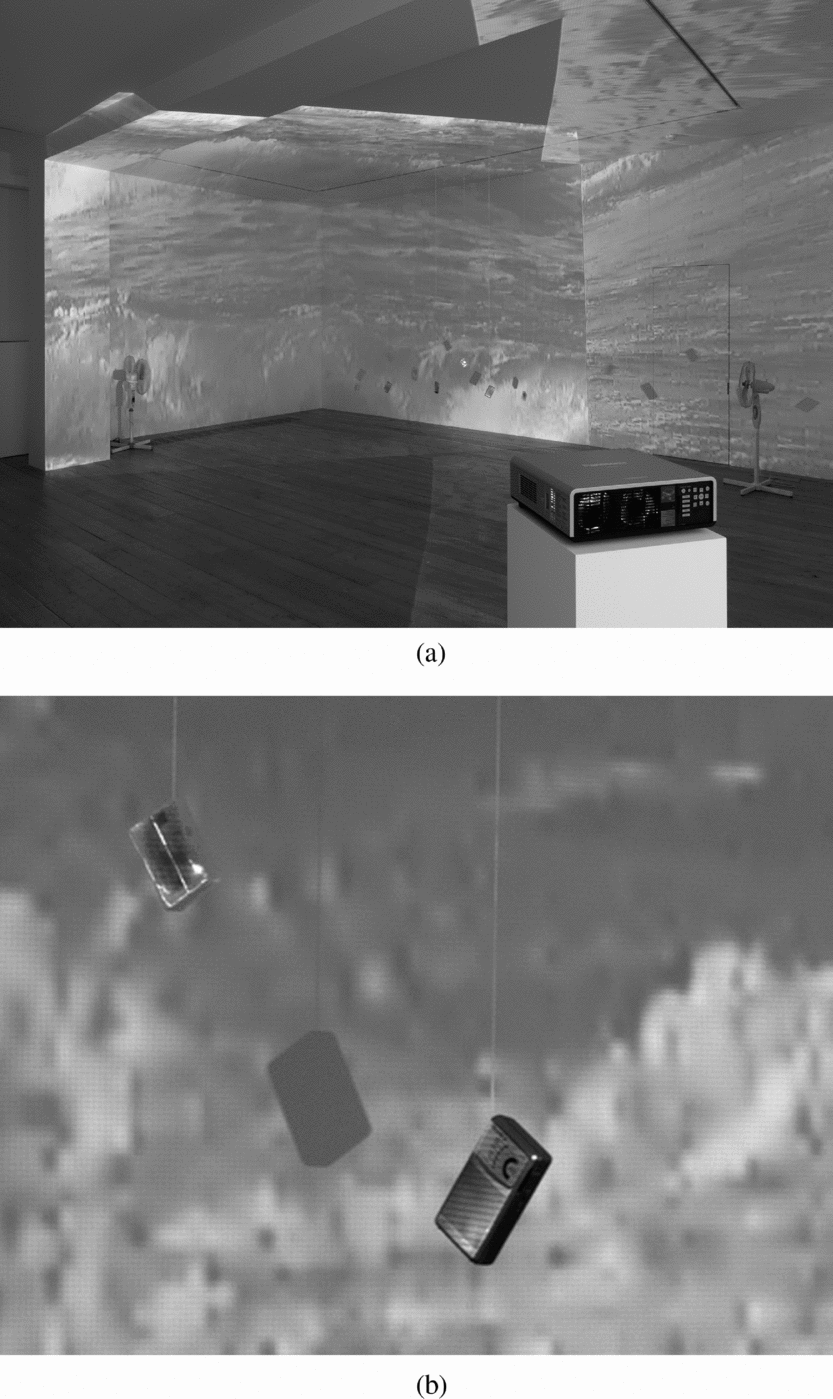
Based on the idea that waves bring sound and image closer together through movement, Kosugi's intermedia performances and sound installations draw on a combination of the senses. For the 1997 performance of his Catch-Wave that took place at the Art Tower Mito, multiple kinds of waves overlapped in the ‘environment’ of the museum: a video of ocean waves, itself projected via light waves; the ocean-like noise produced from the interference between radio transmitters and receivers suspended from the ceiling; and four different kinds of sound waves, including the inaudible – but nonetheless sensible – super-low frequency sound waves produced by a low frequency oscillator (LFO).Footnote 39 On headphones, the experience of Catch-Wave naturally privileges the work's shifting drones, with Karnatak-inspired amplified violin melodies gradually changing over time. But as an installation in a gallery space, the directionality of the sound, as well as the sensation of vibrations on the skin, produce a much more robust physical experience. Into this environment, the ebb and flow of museum visitors and personnel shifted the flow of air in the room that made the suspended radios sway and produce different noise signals.Footnote 40 In a 2011 installation at Raven Row Gallery in London, electric fans positioned near the speakers helped the circulation of air to encourage the speakers to sway (Figures 2a and 2b).
Kosugi Takehisa Mano-Dharma, electronic, 1967/2011. Radio receivers, radio frequency transmitters, strings, electric fans and DVD projectors. Figure 2a shows an installation view. Figure 2b shows a closeup of suspended radios. Photo by Marcus J. Leith, used by permission of Raven Row Gallery.
Kosugi's concept of intermedia situates the mediated environment of the everyday at the centre of his acoustics of intermedia. In an essay on intermedia describing his piece Mano-Dharma, electronic, he writes:
Elements such as the spatial transmission and reception of radio waves based on things like wind, unstable performance, and time-space settings that are free in relation to its situation, are ‘live processes’ that we cannot predict beforehand with our visual and aural senses; beyond our imaginations (in the internalized sense) they exist in the realm of events. The external world, so to speak, consists of everyday things that surround us, and make up our environment . . . By understanding . . . everyday things as media (baitai) – as part of a total experience of elements that surround us in our everyday environments – we can begin to reintegrate them through our senses. The message from things and environments of the everyday come to us through multiple media, through their mutually interdependent mediated nature. Intermedia is a form that lets us come face to face with these relations between media through our senses. Already, boundaries between genres such as ‘music’ and ‘painting’ are disappearing. This is because everyday things and the environmental are also compound.Footnote 41
Kosugi's ‘everyday things’ are fundamentally in relation, ‘as part of a total experience of elements that surround us in our everyday environments’; an unexpected assemblage of Kosugi, waves, gallery visitors, or wind in the building in constant motion. In Kosugi's terms, the elements in the gallery space are media rather than objects. The experience of his installations occurs only as an inter-mediated one in the environment filled with objects, sounds, and movements of everyday life. Equally important as the objects, however, is the acknowledgement of the everyday as a space of contingency. People, waves, radio stations, noise, and home electronics collide and produce noise because of their unexpected or indeterminate encounters in movement and in time. That they collide is central to Kosugi's framework of the experience of the everyday. The focus here is on the engagement of mundane, everyday electronics and media. Mediated bodies and technologies enter into an environment, or an assemblage (or agencement, a term that Kosugi himself preferred) in the sense that these are contingent parts in motion, and shift relations of power with their arrangements. If there is any expression in his work, it is an expression that perpetually navigates across a sea of ambiguity. The resulting assemblage and its movements encourage noise that is playful, but neither tuned into messages of harmony and progress, nor directed in any sort of purposeful opposition.
Voice (Yuasa Jōji)
In music and art history Yuasa Jōji's name often appears in connection to the mixed media collective Jikken Kōbō, an avant-garde collective active primarily between 1951 and 1958, of which he was part. Comprising visual artists, designers, and musicians, the group aimed to create new forms of expression that exceeded the limits of each discrete art form.Footnote 42 For this reason, both scholars and intermedia artists point to Jikken Kōbō as an important precursor to intermedia in Japan. Notably, since the resurgence of interest in the experimental arts in Japan in the 1950s and 1960s over the past decade, Yuasa has emerged as one of the leading voices to link the foundations of intermedia in the activities and experimental ethos of Jikken Kōbō. However, while Yuasa's ideas about the intersections of music and other forms of art can be traced to the 1950s, his post-Jikken Kōbō electronic compositions of the 1960s broach another intermedial zone that sonically reconfigures the boundaries between music and everyday life.
Where for Kosugi, the liminal boundaries were physical and sensory, Yuasa Jōji's acoustics of intermedia focuses on the spaces of the social production of privileged and non-privileged voices and modes of speech in relation to conflicting ideas about the political. Liminal boundaries occur in the space of meaning and message articulated through the voice. To work through the question of the role of the voice in producing political bodies, I will discuss a section from his electroacoustic piece for tape Voices Coming (1969).Footnote 43
The political nature of the piece itself is at best ambiguous. Purposeful ambivalence, rather than dissent, characterizes the treatment of the sonic materials, which in 1969 would have had strong political resonances for many of his listeners: the piece includes sound bites from assassinated political leaders Martin Luther King, Jr and head of the Japanese Socialist Party Asanuma Inejirō, and snippets from conversations about hot-button topics such as euthanasia. The work's three parts may be played as autonomous pieces or as a suite. The first section is titled ‘Telephonopathy’, the second ‘Interview’, and the third ‘A Memorial for Two Men of Peace, Murdered’. Each uses materials based on the recorded snippets of speech and vocal communication. Yuasa manipulates his source material in order to navigate the zone between voice, sound, and noise within contemporary society.
The first section, titled ‘Telephonopathy’, uses the recorded voice and sounds of telephone and switchboard operators as the main source material to explore the acoustic space of gendered vocal labour. The piece uses voices of telephone operators talking about everything but correct phone numbers and names. Yuasa focuses on the chatter, the pleasantries, and the emotional tone of the telephone operators’ speech-work, between dial tone sounds that morph into noise. In the piece, the listener hears telephone operators dealing with confused customers, lost numbers, absent receivers, and busy networks. The repeated greetings, ‘Hello, moshi-moshi’ (a Japanese greeting used on the telephone), which morph into noise through increasingly distorting reverb in the first part of the piece, may be a stylized treatment of the distortion and echo of early international phone lines, but also conveys a sense of searching for nothing.
When I asked Yuasa about the piece, the composer told me a story about his visit to the Dendenkōsha (Nippon Telegraph and Telephone Public Corporation) to make recordings of the voices of operators and the noises of the switchboard. According to standard practice for the occupation, all the voices of telephone operators in ‘Telephonopathy’ belong to women. During this visit, Yuasa became highly conscious of the physical and vocal labour that the technology of the telephone masks.Footnote 44 In everyday business life, the telephone operator's voice does crucial work in facilitating international and long-distance phone calls, connecting lines from one switch board in city A to another in city B and from there, to city C in another country. But in terms of the telephone as a service, the operators are nothing more than attendants of the telephone system; the ‘content’ of the call is the caller's message, and his words. By bringing the content (the telephone conversations) and medium (the voices of the operators) together, however, Voices Coming reveals that human voices are central to the life of the system of the telephone network itself. As sound, the operators and the callers are on the same sonic plane in Yuasa's music.
The role of the voice in Voices Coming brings to mind Roland Barthes's concept of ‘The Grain of the Voice’. In Barthes's words, ‘The grain of the voice is not – or is not merely – its timbre; the significance it opens cannot better be defined, indeed, than by the very friction between the music and something else, which something else is the particular language (and nowise the message).’Footnote 45 Yuasa describes the echoes and excesses of speech in the telephone network as existing ‘between words and pronunciation (gengo to hassei), voice and acoustics (koe to gengo), sound and music (oto to ongaku), meaning and non-meaning (imi to mu-imi), physical space and psychological space (bashoteki kūkan to shinri-teki kūkan)’.Footnote 46 But through its very failure to convey a message, it brings to stark relief what is normally privileged in both the telephonic speech of efficiency and the language of the politics of high economic growth; it does so by focusing only on the voices of the operators, as voices that communicate through speech as sound and feeling, rather than speech as syntax. In Yuasa's words, the musical experience of his piece is an acoustics of lived communication (ikita onkyōteki comyunikēshon).Footnote 47 The treatment of the voice in ‘Telephonopathy’ highlights the perceived difference between semantic meaning and the materiality of language, while suggesting that, as sound, they are not so different after all. It suggests that what is essential to conversation is not the words that ‘represent’ meaning but rather the vocalizations, or traces of signification that can only be conveyed through the voice.
What does this have to do with politics? In conversation, Yuasa rejects the organized state politics and mass protests that proliferated in the 1960s. He insists that there is no overt ‘message’ of critique or subversion in his work:
I think it's very dangerous when music is directly concerned with politics. That is, in order to be political, you need a message. Words. I came of age during the war, and I saw how dangerous things can be when you make all these voices come together as one. We had to do that stuff all the time, and I hated it . . . music has the power to multiply the power of words many times over.Footnote 48
Born in 1929, Yuasa experienced the war years as a teenager, at a time when the choreographed performances of ‘mass mobilization’ resonated with national power and the strategies of an imperialist state. Yuasa continues to regard such large-scale movements as a threat to individual creative freedom. Both figuratively and physically, his music amplifies this perception.
Specifically, he makes the point that those in power abuse the power of music just as easily as those contesting power can use music to bring voices together. Yuasa's sonic politics takes note of the precariousness of using the same musical techniques deployed by the military government of his childhood. As an alternative, Yuasa sets out on an investigation of the sonic environment of everyday life with a focus on the means of communication rather than the delivered message, which he associates with the techniques of the military government's use of music as a tool of producing an affectively enhanced sense of national unity. What emerges in Yuasa's music is a careful exploration of the material conditions and contexts that make the delivery of a message possible in the first place. By purposefully obscuring the message sonically, the productive ambiguity of Voices Coming leaves open the possibility of a configuration of new meanings without the imposition of a final message.
But there is also a limit to the interventions that Voices Coming is able to make. While ‘Telephonopathy’ succeeds in bringing out the voices literally behind the wall – ‘inside’ technologies of the everyday, sonically drawing out an imbalanced hierarchy of vocal labour and gendered speech in the workplace – the power to do so remains in the hands of the composer who selects and manipulates the voices of the women, who, in the end, remain anonymous. Yuasa's treatment and manipulation of these sounds further increases the depth of his authorial stamp on the piece. While the voices of the telephone operators emerge in the foreground within the boundaries of the piece, they disappear from audition shortly after. These limitations, I suggest, reflect less of a failure on Yuasa's part in pushing his work to the boundaries of the possible than the ethos or values of avant-garde and experimental musical practice in which the authorial power of the composer and the dispensability of women's voices frequently remain unchallenged.
Nonetheless, Voices Coming offers an example of how an absence of fixed meaning claims a productive ambiguity for meaning. Yuasa's deliberate ambiguity takes the form not of a critique of the message of the state, but rather a rejection of failed strategies of political engagement, or the forms of protest and conflict that had disappointed him. Instead of conveying a message, his sonic strategy purposefully obfuscates words, which occupy an intermediary space between sound, music, and meaning.
Domestic Life/Gendered Acoustics (Shiomi Mieko)
Shiomi's musical and artistic practice presents another set of alignments that contrast with those of Kosugi and Yuasa. Here, I focus on her Spatial Poem series, a multi-year project consisting of a group of instruction-based works. My discussion of Spatial Poem is primarily concerned with how the materials, the space of production, and the space of performance all articulate elements from her everyday life.
Shiomi's engagement with intermedia began around the same time as Kosugi, with whom she attended university. Along with Kosugi, she gained notoriety among experimental musicians and artists through her work with Group Ongaku. However, Shiomi's own work is most closely tied to ideas surrounding the Fluxus-based events, happenings, and instruction-based pieces first introduced to Japanese artists by Yoko Ono and Ichiyanagi Toshi upon their return to Japan from New York in the early 1960s. Shiomi herself joined the circle of the New York Fluxus scene when she moved to New York in 1964.Footnote 49
Shiomi's Spatial Poem is a project that began during Shiomi's time in New York. In this sense, it is rooted in her US experience. Yet the work took on an even richer significance during the 1970s when, back in Japan after marriage and in her new role as mother and homemaker, Shiomi chose it as the first project to return to after the hiatus in her public work as an artist and musician. In 1973, in an issue of Art and Artists devoted to women's art, she wrote:
I have been lucky to have the opportunity of collaborating with many excellent artists, and never felt conscious of being a woman artist when I was single . . . After marriage, however, in 1970, the problems of being a woman did confront me. Like most married women, the trifling jobs of being a housewife and mother began to restrain my activities. My husband is sympathetic to my work, but frequent meetings, rehearsals, concerts, and discussions throughout the night would cause great problems in running a home. And so, for now, my work is limited to the kind I can do at home, and I submit to the inconvenience of the situation.Footnote 50
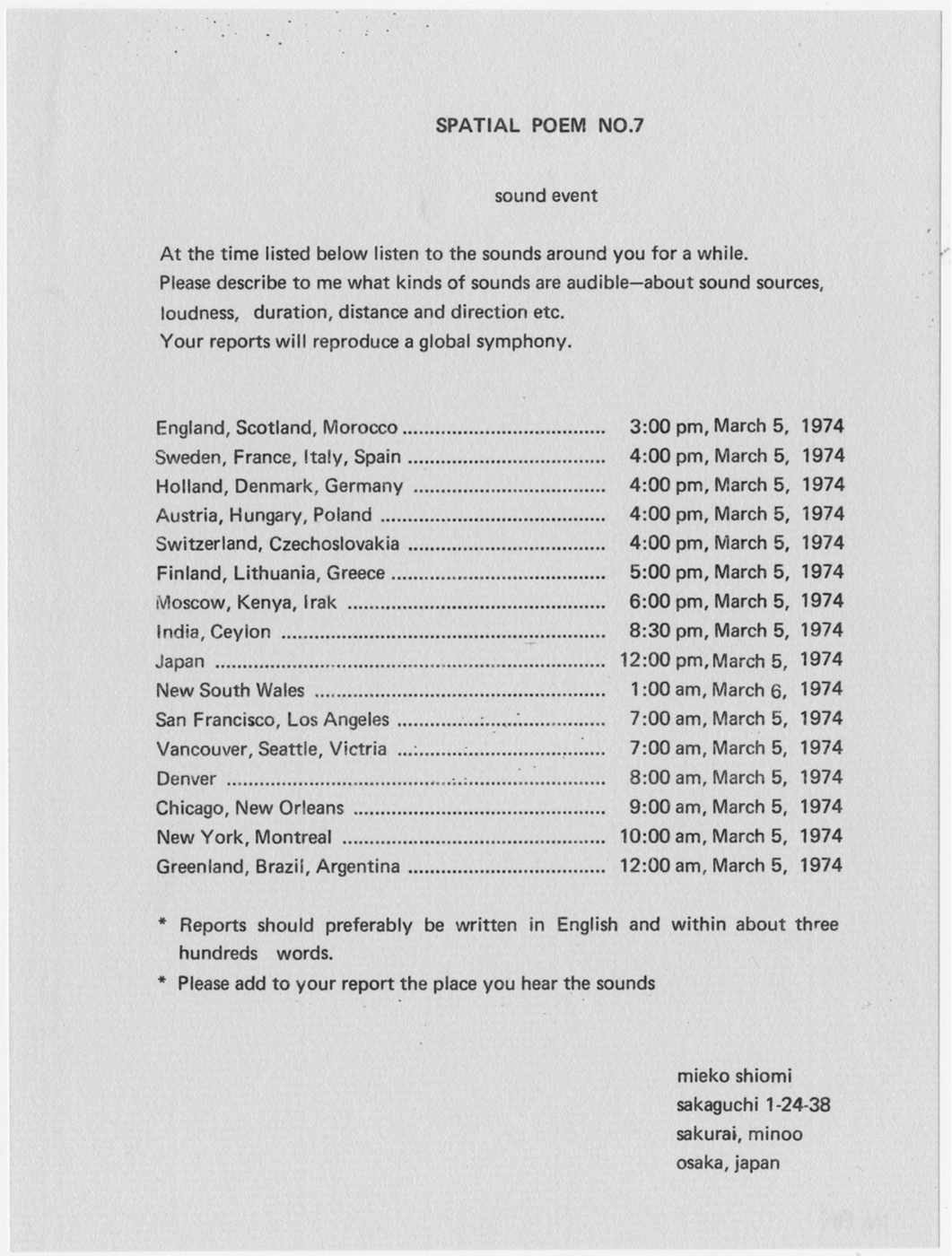
Shiomi's choice to ‘submit to the inconvenience of the situation’ in order to prioritize her ‘trifling jobs of being a housewife and mother’ over her artistic activities shows the limits of her willingness to challenge deeply rooted social structures and expectations about a middle-class Japanese woman's career. Yet, though her activities changed, her output barely halted and she completed Spatial Poem, one of her most well-known projects during the 1970s. The project consists of a series of events that involved corresponding with a large network of friends. Shiomi explained the origin of her Spatial Poem as arising from residing in New York and not being able go to all the exhibitions and concerts she wanted to attend at the same time: ‘it was frustrating to be physically restrained to one place at a time . . . and I felt that art should be alive everywhere all the time, and at any time anybody wanted it. And so I came up with the idea of the Spatial Poem’. Footnote 51 Between 1965 and 1975, she produced a total of nine Spatial Poems.Footnote 52 Each event consisted of a set of instructions or ‘intimate action poem’ that Shiomi mailed out to an international network of artists (Figure 3).Footnote 53 The recipients of her letters would then perform an action or create a piece based on her instructions and report back on their activity by mail.Footnote 54
Typed invitation to participate in Spatial Poem No. 7. Part of a set of invitation letters for Spatial Poems 4–9. Printed on tan, green, red, and yellow papers. Issued in an envelope. One of seven folded sheets, 17.7 × 23.8 cm. The Museum of Modern Art Library. Used by permission of Shiomi Mieko.
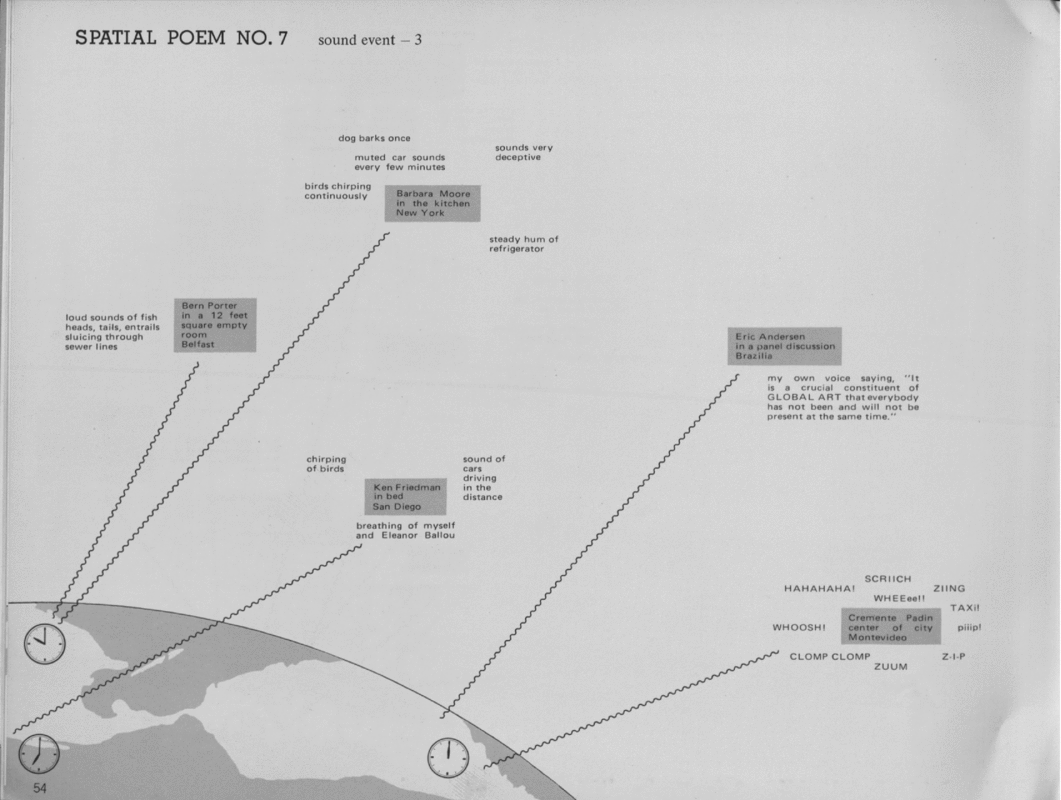
After nine events, in 1976, she self-published a booklet titled Spatial Poem compiling over 400 responses she received for the nine Spatial Poems (Figure 4).Footnote 55 The book lists well over 230 participants from twenty-six countries. In addition to an A-list cast of Fluxus associates such as the artists Ay-O and Kosugi Takehisa, poet and critic Akiyama Kuniharu, Dick Higgins and Benjamin Patterson in the US, and Robert Filliou and Jarosław Kozłowski in Europe, participants included a wide range of other prominent figures including Takiguchi Shūzō, György Ligeti and Allen Ginsberg. These names testify to the remarkable diversity of the network of artists to which Shiomi belonged.Footnote 56 At the same time, with participation solicited by invitation, and by limiting the range of invitees to recognized names in the arts, the range of responses still rested on expectations about who and what was included in the realm of Spatial Poem's aesthetic practice. Reflecting back on the project, one participant observed that this network was a product of a time when it was still possible to have a closed network or ‘aristocracy in the art where the artists only communicate with other artists’.Footnote 57
Page 54 of Spatial Poem by Shiomi Mieko, showing reports about responses to Spatial Poem No. 7 – Sound Event. The Museum of Modern Art Library. Used by permission of Shiomi Mieko.
In the case of Spatial Poem, intermedia is not just the result of a combination of several media, but also an assemblage of multiple spaces and times. Integrating performances as well as narrative, travelling across time and geography as it passes through the international postal system, it also takes a cue from musical forms. Shiomi's poems work like a musical score where the ‘piece’ requires a performer to interpret the instructions written by Shiomi as artist-composer. According to Shiomi, the name ‘Spatial Poem’ comes from the idea that the piece is ‘an assemblage of words and places, born of the imagination of so many people, brilliantly colouring the Earth; a literally, collaborative spatial poem . . . a poem that is born of the co-resonance made of a layering of fragments of the everyday from the lives of many people’.Footnote 58 It is a set of material objects but also a dialogue. As an object, Spatial Poem is simultaneously small enough to fit inside the slot of a mailbox, and at the same time, the size of the Earth in scale.
Making full use of the space of her domestic life in Minoo, Osaka, and the postal system that was one of the technologies of that life, Shiomi's Spatial Poems are a ‘submission to the inconvenience of the situation’, but also a performative intervention into the ‘distribution of the sensible’ of her immediate surroundings. As she fully performs her role as a ‘housewife and mother’, Spatial Poems do not alter the existing conditions and boundaries of her everyday. However, the conditions of possibility of those boundaries are open to full re-examination. Spatial Poem integrated the facts of geographic distance separating Shiomi from her artistic network, combined with what could be done with the technologies of domestic life. Shiomi's example does not justify social expectations for women to accept domestic labour as a condition of being a woman. Rather, Shiomi's case is one specific to her alone, in which a particular set of conditions of possibility meets her own resolve to remain active despite mounting pressures that accompanied her double roles as artist and homemaker. In the particular case of Spatial Poem, the everyday became a place of both limits and possibility by forging new and perhaps unexpected encounters with the experimental.
Both in the case of Spatial Poem and the impromptu performance of Shadow Piece II, which I introduced at the beginning of this article, Shiomi's house is a place of mingling – of the boundaries of everyday sounds, sights, and smells, subjected to the experimental testing of perception. In Shiomi's space of intermedia, the sofa is not just parlour room furniture, but also the screen onto which light is projected and shadows are made – an unexpected mise-en-scène of Shadow Piece II. Spatial Poem takes place as an assemblage, that is, a negotiation of the various forces at play inside Shiomi's home, which she actively produces as her own domestic and experimental sphere. ‘Home is . . . not a pre-existing space; it is not the house. It is the continual attempt to create a space of comfort for one-self, through the arrangement of objects, practices, feelings and affects’, writes J. Macgregor Wise.Footnote 59 In part as an antidote to the formalized structure of the art world, in part structured by the conditions of her domestic life, Shiomi's events may take place anywhere, anytime.
Everyday Life and its Technologies of Ambiguity
In the context of 1960s Japan, I have argued that intermedia – as a sensory assemblage of new ways of sensing through objects and media of the everyday – reconfigured the boundaries of the sensible and its perceptible arrangements. And yet, the starting point for such shifts for Kosugi, Yuasa and Shiomi are all rooted in various senses of ambiguity. The ambiguity stems not just from their work as artists working with concepts and technologies of intermedia art, but also as international artists whose careers were based on intimate personal connection with an international avant-garde scene where all three had vested stakes in being part of a US-based network. Sceptical of the mechanization of labour, but drawn to the emancipatory possibilities of new technologies of communication; sympathetic with the goals of the protest movements, but resistant to its strategies of collective unity over individual voice; desiring to move with the forefront of artistic innovations, yet also committed to the duties of a woman in a nuclear household: such multiple contradictions of aesthetic and political allegiances unite the three artists I have discussed. But rather than denying this state of ambiguity, their sonic performances emerge from the conditions of paradox. Where the story of resistance and growth seeks to eliminate all senses of ambiguity, absent too are the bodies and voices of those who could not or did not participate in the spectacles of heroic nation building or radical protest.
The story of intermedia I have tried to tell is not an alternative to the story of growth and conflict, nor is it a story of radical difference and departure. It too is embedded within the story of growth and conflict, but in a way that proposes to understand this story in a different light – ambivalence, ambiguity, contradictions and all. The practices by Kosugi, Yuasa, and Shiomi presented here suggest that artistic practice need not violently intervene into the domain of everyday life in order to instigate change. Instead, these examples of intermedia highlight an engagement with the rituals of everyday life and productive rearrangements of already-existing technologies and practices. Intermedia and its acoustics may not be ‘radical’ in the sense of the historic practices of radical politics. But the tactics of intermedia are about making visible and audible those bodies and voices that did not align with the collective identity of the radical heroes of the 1960s. Such tactics employed by the acoustic practices of Kosugi, Yuasa and Shiomi – often rooted in senses of ambiguity and ambivalence – suggest that the acoustics of intermedia can alert us to relations of power embedded in the technologies of everyday life, at the same time as they show that those relations of power need not be fixed.