I. Introduction
Aristotle winds up his convoluted discussion of the virtue of a good man and the virtue of an upright citizen with this confident conclusion: “As to whether the virtue by which a man is good (agathos) and a citizen upright (spoudaios) is to be regarded as different or the same, it is clear from what has been said that in one sort of city [i.e., the ideal city] he [who is an upright citizen] is the same [as the good man] whereas in another sort [he is] different [from the good man], and the former [i.e., he who is a good man as well as an upright citizen] is not every citizen but only the one who is a statesman (politikos) and has authority or is able to exercise authority, either alone or in concert with others, over the superintendence of communal matters” (Pol. III.5.1278a40–b51
All translations are my own.
Robert Develin finds significance in the fact that Aristotle usually uses the epithet agathos when speaking of a virtuous man and the epithet spoudaios when speaking of a virtuous citizen. See Develin, “The Good Man and the Good Citizen in Aristotle's ‘Politics’,” Phronesis 18 (1973): 71–79. It should be noted, however, that Aristotle easily switches from one epithet to the other, even within Politics III.4 itself. He speaks of agathoi as well as of spoudaioi citizens (1277b5, 13–14) and of spoudaioi as well as agathoi men (1276b35, 1277a14). When he alludes to the doctrine of Politics III.4 at Nicomachean Ethics V.2.1130b29, he includes both man and citizen under the same epithet—agathos. It seems difficult, then, to draw any weighty conclusion from the fact that Aristotle usually applies the epithet spoudaios to citizens and the epithet agathos to men. Within the context of Politics III.4, the two epithets seem to be little more than stylistic variants. There seems no reason, then, not to treat them as synonyms. But since agathoi and spoudaioi are sometimes conjoined (Pol. VII.13.1332a39; Rhet. II.9.1387b8), we need an English word for spoudaios that does not make the conjunction too blatantly redundant; hence, the choice of “upright” rather than “excellent.” In English, “good and upright men” sounds less redundant than “good and excellent men.”
His silence has led some scholars to think that it is not an issue for him. In his note on Politics III.4, Richard Robinson, for example, remarks that “Aristotle's difficulty [in this chapter] appears to be different from any of ours. We often worry whether the State's orders conflict with our conscience, or whether our duty to the State conflicts with our duty to our family, or whether a politician can be an honest man. None of these questions occurs to Aristotle.”3
Richard Robinson, Aristotle, Politics: Books III and IV, with a Supplementary Essay by David Keyt (Oxford: Clarendon Press, 1995), 14.
There are several hypotheses for why Aristotle never discusses this situation. First of all, it might be that Aristotelian principles do not allow for the existence of good men in non-ideal cities. This seems to be the view of Terence Irwin, who writes that “[w]ithout the ideal city there will be no good men.”4
Terence Irwin, Aristotle's First Principles (Oxford: Clarendon Press, 1988), 410.
Richard Kraut, Aristotle: Political Philosophy (Oxford: Oxford University Press, 2002), 380.
This idea is broached, though not endorsed, by Sarah Broadie. See her essay “Aristotle and Contemporary Ethics,” in Richard Kraut, ed., The Blackwell Guide to Aristotle's Nicomachean Ethics (Oxford: Blackwell, 2006), 350–57.
This essay reconsiders the issues raised by these hypotheses.7
Andrés Rosler considers similar issues in his recent monograph Political Authority and Obligation in Aristotle (Oxford: Clarendon Press, 2005), and reaches, by a different route, conclusions similar to those of this essay.
II. Citizens of the Ideal City
The adult male citizens of the ideal city described in Politics VII divide into three groups according to age. Aristotle refers to them as the younger, the older, and “those worn out by time” (Pol. VII.9.1329a33, VIII.7.1342b21).8
For the three ages of life, see Aristotle, Rhet. II.12–14.
These three divisions of the citizen body correspond to the three types of citizens distinguished in Politics III. The older men, being rulers, are “full” citizens;9
Literally, citizens without qualification (politai haplôs) (Pol. III.1.1275a19, 5.1278a4–5).
All the citizens of Aristotle's ideal city are, of course, good citizens (Pol. III.4.1277a1–3); otherwise, it would not be an ideal city. But what is a good citizen? Aristotle answers this question by referring to the function of a citizen (1276b29) and appealing implicitly to his functional theory of virtue. The theory turns upon three concepts: function (ergon), good (agathos), and virtue (aretê). According to the theory, a thing is good of its kind if it performs the function of its kind well (EN I.7.1098a8–12). The function of the eyes is to see; the function of a knife is to cut; thus, good eyes are eyes that see well and good knives are knives that cut well. The virtue of a thing that has a function is that which makes it perform its function well (EN II.6.1106a15–24; Pol. III.4.1276b39). The virtues of a knife blade are the qualities that make it cut well, such as sharpness and hardness.10
It should be noted that the virtues of an object of a kind are the same as the virtues of a good object of that kind. The qualities that make a knife blade good are the same as the qualities that make a good knife blade good. It is redundant, then, to speak, as Aristotle does, of the virtue of a good man or of a good citizen rather than simply of the virtue of a man or of a citizen. The reason for the redundancy apparently is that it allows Aristotle to emphasize that he is speaking of the virtue of a man qua man or of a citizen qua citizen rather than of a man qua citizen or of a citizen qua man.
To apply this functional theory of virtue to citizens of the ideal city, one must first determine their function in the ideal city. Aristotle finds it helpful here to employ a nautical analogy. Citizens of a city, he says, are like sailors on a ship. Each sailor has his own special function as captain, bowman, or rower, and in addition a common function that he shares with all of his shipmates—the safety of the voyage (Pol. III.4.1276b21–27). Similarly, each citizen has both a common function and his own special function. The common function of all citizens is “the safety of the community,” where the community is identified with the constitution (1276b27–29). The special function of a citizen without qualification—a “full” citizen—is to deliberate and adjudicate (III.1.1275a22–33, b13–21). The special function of an immature citizen serving as a hoplite in the ideal city is to enforce obedience within the city walls and to defend against aggressors beyond the walls (VII.8.1328b7–10). The special function of a superannuated citizen acting as a priest is to honor the gods by serving them (VII.9.1329a27–34).
The account just given of the special functions of the citizens of Aristotle's ideal city is based primarily on Politics VII. We expect such an account in Politics III.4 to flesh out the analogy of citizen and sailor. What we get instead is a distinction between just two types of citizen—the citizen as ruler and the citizen as subject,11
For “the citizen who is ruled,” see Pol. III.4.1277a21–22, 5.1278a16–17.
The virtues of rulers and subjects, which make them perform their functions well, are both intellectual and moral. Practical wisdom (phronêsis) is the intellectual virtue of a ruler in the ideal city (Pol. III.4.1277a14, b25), whereas “the [intellectual] virtue of one who is ruled is not practical wisdom, but true belief (doxa alêthês)” (1277b28–29). Even though rulers and subjects differ in their intellectual virtues, Aristotle says that the other virtues (i.e., the moral virtues) must be common to both (1277b25–29): “If he who rules is not temperate and just,12
In the Politics, Aristotle's focus is narrowed to the three moral virtues of bravery, temperance, and justice (see, for example, VII.1.1323a27–34), though a wider panoply of moral virtues hovers in the background. Liberality (eleuthepiotês) is mentioned at II.5.1263b11, and magnificence (megaloprepeia) and greatness of soul (megalopsuchia) are alluded to at VI.7.1321a35–36 and VII.7.1328a9, respectively. Endurance, which Aristotle may have regarded as a virtue when he wrote the Politics—it is listed among the virtues at Eudemian Ethics II.3.1221a9—is mentioned at Politics II.9.1269b20 and VII.15.1334a20, 22. In the Nicomachean Ethics, endurance is not counted as a virtue due to its association with strength of will, or egkrateia (VII.1.1145a36, b8).
It is natural to suppose that the moral virtue of a subject is simply an inferior grade of that of a ruler. Aristotle says, for example, that the virtue of a ruler differs from that of a subject as the temperance and bravery of a man differ from the temperance and bravery of a woman, and remarks that “a man would seem cowardly if he were only as brave as a brave woman, and a woman gabby if she were only as decorous as the good man” (Pol. III.4.1277b21–23). Aristotle seems here to be attributing a higher degree of bravery to a brave man than to a brave woman and a higher degree of decorum to a talkative man than to a talkative woman. But this is, nevertheless, not Aristotle's view. Aristotle insists that the moral virtues of a subject differ, not in degree (“more or less”), but in kind from those of a ruler (Pol. I.13.1259b36–38,13
Trevor J. Saunders has a helpful comment on these lines; see Saunders, Aristotle, Politics: Books I and II (Oxford: Clarendon Press, 1995), 98–99.
His second attempt in the same passage is more successful. After claiming that “the [intellectual] virtue of one who is ruled is not practical wisdom, but true belief,” Aristotle continues: “for the one who is ruled is like a maker of a flute, whereas the ruler is like a flutist who uses it” (Pol. III.4.1277b28–30). This is a good analogy for Aristotle when interpreted in the light of Republic X.601d4–602a1, where Plato attributes knowledge of the good and bad qualities of flutes to the flute-player and true beliefs about such qualities to the flute-maker, and subordinates the beliefs of the maker to the knowledge of the player. It shows how the differing intellectual virtues of ruler and subject differentiate their shared moral virtues. Consider the two kinds of bravery that Aristotle distinguishes: the bravery of a ruler (archikê andreia) and the bravery of a subordinate (hupêretikê andreia) (Pol. I.13.1260a23). Aristotle does not attempt to define these two species of bravery, but we can provide definitions for him by following the analogy. The analogue of the flute would be the things that are truly fearful. The brave ruler has knowledge of these things; the brave subject, true beliefs only. The two species of bravery would thus share the elaborate definition offered at Nicomachean Ethics III.7.1115b17–20 as long as the crucial concept in the definition—reason—is understood generically: in situations inspiring fear, the brave man (be he ruler or subject) “feels and acts as reason14
For this rendering of logos, see Pol. VII.14.1333a16–25.
Before we take leave of the ideal city, we need to resolve an apparent inconsistency in Aristotle's account of its citizens.15
This apparent inconsistency was pointed out by Franz Susemihl and R. D. Hicks in The Politics of Aristotle, Books I–V [I–III, VII–VIII] (London: Macmillan, 1894), 368–69; and by W. L. Newman in The Politics of Aristotle, 4 vols. (Oxford: Clarendon Press, 1887–1901), I, 236 n. 2; III, 158.
“[T]he body of citizens (to politikon) has been divided into two parts, the hoplite and the deliberative” (Pol. VII.9.1329a30–31). For politikos meaning of or relating to citizens, see Pol. V.10.1311a7, 11.1314a11; VII.7.1327b18. Note also that Aristotle's ideal city is to have the institution of common meals (sussitia) (Pol. VII.10.1330a3–8). Since hoplites would be members of such eating clubs (VII.12.1331a19–23) and since these clubs are composed of citizens (1331a19–20), Aristotle, in prescribing such clubs, implicitly counts hoplites as citizens.
“That the land must belong [i] to those who possess arms and [ii] to those who share in the constitution was said earlier” (Pol. VII.10.1329b36–38).
Newman offers the following disjunction: either a discrepancy between Politics III and Politics VII or different senses of “citizen” (Newman, Politics of Aristotle, III, 158). The interpretative maxim to preserve consistency whenever possible rules out the first alternative. For this maxim and its pitfalls, see S. Marc Cohen and David Keyt, “Analysing Plato's Arguments: Plato and Platonism,” in James C. Klagge and Nicholas D. Smith, eds., Methods of Interpreting Plato and His Dialogues, supplementary volume of Oxford Studies in Ancient Philosophy (Oxford: Clarendon Press, 1992), 173–200.
This interpretation is not original. It is to be found, for example, in Peter L. Phillips Simpson, A Philosophical Commentary on the Politics of Aristotle (Chapel Hill: University of North Carolina Press, 1998), 142.
To round out our discussion of the virtue of a good citizen of the ideal city, we need to recall Aristotle's thesis that it is the same as the virtue of a good man when, and only when, the citizen is a full citizen. Within the context of the ideal city, this is easily understood. The virtue of a good man is practical wisdom, which brings with it all the moral virtues (EN VI.13.1144b30–1145a6). In the ideal city, practical wisdom is the virtue exclusively of a full citizen, since an immature citizen (i.e., a warrior), whose character and intellect are not yet fully formed, has yet to acquire it and a superannuated citizen (i.e., a priest) does not need it in order to perform his priestly function.
III. Citizen Virtue in Non-Ideal Cities
In Aristotle's view, the virtue of a full citizen of a non-ideal city is never the same as the virtue of a good man. Aristotle does not argue for this central idea directly, but it falls out of the argument with which Politics III.4 begins when that argument is combined with the other leading idea of III.4 regarding the identity of the virtue of a good man and the virtue of a full citizen of the ideal city:
(1) The common function of the citizens of a city is the safety of their city's constitution.
(2) The virtue of a citizen is that which makes him perform the function of a citizen well.
(3) Thus, the virtue of a good citizen is relative to his city's constitution.
(4) Constitutions are of different forms.
(5) Therefore, the virtue of a good citizen under one form of constitution is not the same as the virtue of a good citizen under another form of constitution.
(6) Hence, the virtue of a good citizen is not one virtue.
(7) But the virtue of a good man is one virtue.
(8) “It is clear, therefore, that it is possible for an upright citizen not to possess the virtue by which a man is good” (Pol. III.4.1276b34–35).
(9) [The virtue of a good man is the same as the virtue of a full citizen of the ideal city.]
(10) [Thus, the virtue of a full citizen of a non-ideal city is not the same as the virtue of a good man.]
Aristotle's explicit argument ends with statement (8)—hence the square brackets around the last two sentences. Statement (10) is not a corollary of statement (8). It follows instead from statements (5), (7), and (9). Statement (10), it is important to note, does not follow without the aid of statement (7) on the oneness of the virtue of a good man; it would be possible without that premise for the virtue of a good man to be identical with the virtue of a full citizen under more than one constitution. I will return to this premise later.
Aristotle repeats one of the key steps in his argument, the inference of statement (5) from statements (3) and (4), later in the Politics when he discusses the desirable qualities of high officials. One such quality, he says, is “virtue and justice—in each constitution the kind pertaining to that constitution. (For if what is just is not the same in relation to all constitutions, there must also be differences [in the virtue] of justice)” (V.9.1309a36–39). This passage is helpful because it indicates that Aristotle has justice especially in mind in the above argument. It is easy to understand why. The connection between a constitution and distributive justice is direct. As the structure of the political offices of a political community (III.1.1274b38, 6.1278b8–11; IV.1.1289a15–18), a constitution is basically just a kind of distributive justice. By defining the qualifications for full citizenship, it determines the distribution of full citizenship among the native population and defines the political rights that go along with citizenship. The virtue of distributive justice, then, is the disposition, or hexis, to believe and to act in conformity with the distributive principles of the constitution under which one lives.20
Taking distributive justice to be a specific instance of the general idea that the virtue of justice (dikaiosunê) is “that [disposition, or hexis] owing to which the just (ho dikaios) [citizen] is said to be a doer by choice of what is just (tou dikaiou)” (EN V.5.1134a1–2).
The reference to virtue as well as justice in the passage quoted above (“virtue and justice”)21
The “and” joins whole and part and is intensive or heightening: “virtue and especially justice.” See Herbert Weir Smyth, Greek Grammar, revised by Gordon M. Messing (Cambridge, MA: Harvard University Press, 1956), sec. 2869.
Newman, Politics of Aristotle, IV, 403.
In the opening pages of Nicomachean Ethics V (= Eudemian Ethics IV), Aristotle distinguishes universal from particular justice, and then divides particular justice into two species—distributive justice and corrective justice.
The true statesman, Aristotle says, “wishes to make the citizens good and obedient to the laws” (EN I.13.1102a9–10).
Not only must the moral virtue of a good citizen vary with the constitution, but so too apparently must his intellectual virtue. A good citizen's deliberation—in particular, as a member of the assembly (ekklêsia)—accords with the end, or goal, of the constitution he lives under. Since such deliberation must have a correct end, or goal, to be an expression of practical wisdom (EN VI.5.1140a28–30) and since no constitution aside from the ideal constitution has a correct end, or goal, the intellectual virtue of a full citizen living under a non-ideal constitution cannot be practical wisdom. This raises the question whether the faculty of practical reason (dianoia praktikê)25
On practical reason, see Pol. VII.14.1333a25; Anim. III.10.433a13–18; and EN VI.2.1139a26–27.
In particular, true belief is not a candidate. It is the intellectual virtue of a subject, not a ruler.
The word dunamis marks it off from a true virtue.
The plurality of the virtue of a good citizen stands in contrast to the singularity of the virtue of a good man: “[I]t is not possible,” Aristotle asserts, “for there to be one virtue of the upright citizen, namely, complete virtue;28
Teleia aretê. Newman, citing Pol. IV.7.1293b3, suggests that this phrase means “virtue that is not relative” (Newman, Politics of Aristotle, III, 157).
(1) The virtue of a good man is the same as the virtue of a full citizen under the best constitution.
(2) Only one constitution is by nature the best.29
On why this one constitution, the constitution of the ideal city, is natural, see my article “Aristotle's Political Philosophy,” in Mary Louise Gill and Pierre Pellegrin, eds., A Companion to Ancient Philosophy (Oxford: Blackwell, 2006), 404–5.
(3) Therefore, the virtue of a good man is one virtue (i.e., invariant).
If our account of citizen virtue is correct, the virtue of a citizen of a non-ideal city is not only different from, but incompatible with, the virtue of a man. The virtue of the one and the virtue of the other are like dullness and sharpness, which cannot both characterize a knife blade simultaneously. A good man being a man who possesses the virtue of a man (Pol. III.4.1276b33–35) and a good citizen being a citizen who possesses the virtue of a citizen, a good citizen of a non-ideal city cannot be a good man.
IV. Politikoi
The incompatibility of the virtue of a good man and the virtue of a good citizen of a non-ideal city brings with it the prospect of conflict. The stage is set, for example, whenever positive law conflicts with natural law. A good citizen is law-abiding and obedient to the positive law of his city, whereas the allegiance of a good man is to natural law. There could be no such conflict, of course, if there were no good men in non-ideal cities. That this is precisely what Aristotle thinks seems to be the view of Terence Irwin:
[a] [Aristotle's] claims about the good man and the good citizen [in Politics III.4] do not imply30
It is well to remember, however, that the fact that p does not imply q does not mean that p implies not-q (unless the implication in question is material implication).
Irwin, Aristotle's First Principles, 410.
This passage is not as clear as one might wish. Irwin does not say explicitly that in Aristotle's view there are no good men in non-ideal cities. But he does imply it. He thinks that Aristotle regards the ideal city as a mere possibility—not a fantasy, but not something actually existing or immediately feasible either32
Ibid., 618 n. 1.
(1) “Someone cannot be a good man without being a good citizen.”
(2) [A good citizen of a non-ideal city cannot be a good man.]
(3) Therefore, a good man cannot be a citizen of a non-ideal city.
(4) But he cannot be a good citizen without being a citizen of some city.
(5) Hence, “[w]ithout the ideal city there will be no good men.”
We need to consider whether Aristotle thinks that there are any good men. If he does think that there are, and if he also thinks that the ideal city is a mere possibility that does not exist anywhere, then he must think that the conclusion of the foregoing argument is false. In that case, since the argument is valid, we would expect him to deny at least one of its premises; and the premise we would expect him to reject, given that we have already argued that he accepts premise (2), is premise (1). The very writing of the Politics suggests that Aristotle does think that there are good men. The Politics is a political manual with a practical aim. For whom was it written if not for good men? The treatise is addressed to “the good lawgiver and the true politikos” (IV.1.1288b27). If Aristotle thinks there are no good men, he must think either that there are no true politikoi33
Politikoi is the plural of politikos.
The adjective politikos used substantively for anêr politikos (“political man”) is not easily rendered in English. “Statesman” is too grand; “politician” too pejorative. The Athenian statesmen Pericles, Aristides, and Themistocles were politikoi (Plato, Meno 93b6–100a2), but so too was the infamous Meletus, Socrates' chief accuser (Plato, Euthphr. 2c8). At the same time, not every Athenian citizen would be labeled a politikos. Socrates denies that he is a politikos (Plato, Gorg. 473e6);34
But see also Gorg. 521d6–8.
Plato famously distinguished the “true” politikos from the politikoi of fifth- and fourth-century Athens (Rep. IV.426d5; Plt. 300c9–10). He regarded none of the politikoi listed above as “true” politikoi. Aristotle follows Plato in distinguishing true politikoi from untrue, though he appears to allow that at least a few of the politikoi of history were true politikoi: “But the majority (hoi polloi)35
“The many” as distinguished from “the few” (hoi oligoi).
Politikê, the feminine of politikos, is short for politikê technê (political art).
V. Politikê
Now that we know that Aristotle does think there are good men in non-ideal cities, we want to know his view of the life of such a man. We can begin with Aristotle's account of politikê, the intellectual virtue of the true politikos. There are two important passages on this virtue, one in the Ethics and one in the Politics. In Nicomachean Ethics VI.8, Aristotle offers an elaborate taxonomy of politikê, part of which can only be understood as the delineation of the intellectual virtue of a citizen of the ideal city. In Politics IV.1, in contrast, he focuses on a species of politikê that is tied neither to citizenship nor to the ideal city.
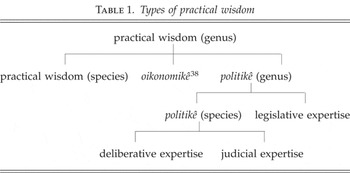
In Aristotle's taxonomy, politikê has both a broad and a narrow sense. In the broad sense, it is a genus with species and subspecies within a wider genus. (See table 1.)37
Table 1 is based on J. A. Stewart, Notes on the Nicomachean Ethics of Aristotle, 2 vols. (Oxford: Clarendon Press, 1892), II, 64.
Types of practical wisdomOikonomikê is expertise in household management.

The three species of practical wisdom deal with the individual, the family, and the city. Aristotle divides politikê in the broad, or generic, sense into two species: politikê in the narrow, or specific, sense and legislative expertise (nomothetikê). Narrow politikê is the intellectual virtue of a full citizen of the ideal city, as we can see by examining its two subspecies: deliberative expertise (bouleutikê) and judicial expertise (dikastikê), the virtues of an assemblyman (ekklêsiastês) and of a juror (dikastês), respectively. Since juror and assemblyman are the offices definitive of full citizenship (Pol. III.1.1275b17–21), their respective virtues must be virtues of a citizen. Furthermore, they must be virtues of a citizen of the ideal city; for they are kinds of practical wisdom, which in Aristotle's view is the virtue exclusively of a full citizen of the ideal city.39
In describing the ideal city, Aristotle does not mention the offices of juror and assemblyman explicitly, though he does allude to them at Politics VII.4.1326b12–18.
Legislative expertise (nomothetikê), the virtue coordinate with narrow politikê, deals with laws and constitutions. It differs from narrow politikê in two respects. First of all, it deals with universals, whereas narrow politikê is concerned with particulars (EN VI.8.1141b25–30). A constitution is a universal in that it is the form of a city (Pol. III.3.1276a17–b13)—two cities can both be democracies as Callias and Cebes can both be human—and a law, in contrast to a decree (psêphisma), which addresses particular issues, applies universally (EN V.10.1137b26–29). The second respect in which legislative expertise differs from narrow politikê is in being architectonic: its possessor, the lawgiver, stands to the politikos in the narrow sense—the juror and the assemblyman—as an architect stands to his manual workers. The lawgiver designs the structure, the constitution and the laws, within which the juror and the assemblyman function in their everyday political activities, passing decrees in the assembly and deciding individual lawsuits. It is important to note that in ancient Greece lawgivers were often invited to foreign cities to advise on constitutional issues (Pol. II.12.1273b27–34, quoted below), which means that a lawgiver could exercise his legislative expertise as an alien. Legislative expertise, unlike narrow politikê, is a virtue untethered to citizenship.
Politics IV.1 is devoted to this virtue. “The good lawgiver and the true politikos” (1288b27), Aristotle tells us, must know not only (i) which constitution is best without qualification (haplôs) and (ii) which is best in given circumstances, but also (iii) which is best given certain assumptions and (iv) which is the most suitable for all cities; and in addition he must know (v) how to preserve an existing constitution and (vi) which laws are best and which are suitable for each constitution. The fifth item on this list is particularly noteworthy in that it introduces political stability as one concern of legislative expertise. The importance of political stability in Aristotle's eyes can be gauged from the fact that an entire book of the Politics, Book V, is devoted to an analysis of the things that destroy constitutions and the methods by which they can be preserved. The only item on the list that relates directly to the ideal city is the first, though some of the others may relate to it indirectly, depending upon the extent to which the ideal city is the beacon, if not the goal, of political reform.
Aristotle does not envisage the good lawgiver and true politikos living in an ivory tower—the Academy or the Lyceum—spinning out utopias; he pictures him instead playing the role of elder statesman and lawgiver in the political life of Greece. We get an idea of what Aristotle has in mind from his description of the activities of some actual lawgivers: “Of those who have expressed some view about a constitution, some took no part in political actions of any sort, but always lived a private life…. Others have become lawgivers, engaging in politics themselves, some in their own cities, others in certain foreign ones as well. Some of these were craftsmen of laws only, others, like Lycurgus and Solon, of a constitution as well, for these established both laws and constitutions” (Pol. II.12.1273b27–34). Aristotle does not tell us how he ranks the aforementioned lawgivers, whether he regarded any of them as “good” lawgivers and hence as practically wise.40
The epithet that Aristotle uses with “lawgiver” is “good” rather than “true” (Pol. IV.1.1288b27; VII.14.1333b23), which seems to indicate that “false,” “fraudulent,” and “fake” did not go as naturally with “lawgiver” as with politikos in ancient Greece. Aristotle's language suggests that lawgivers were never regarded as less than genuine, though some were better than others.
What conclusions can we draw from these passages from the Ethics and the Politics? First of all, Aristotle takes it for granted that there are good men engaging in political activities in non-ideal cities. Secondly, Aristotle envisages the true politikos as a reformer (rather than a revolutionary) who seeks to preserve, repair, and improve existing political structures. As a craftsman of laws and constitutions, the true politikos does the best he can in the given circumstances “just as a good general uses the army currently available in the most militarily effective way, and a cobbler makes the finest sandal from the leather given him; and similarly with all the other craftsmen” (EN I.10.1101a3–6). The third point is that the true politikos, when serving as a lawgiver in an alien city, is exercising the virtue of a good man, not the virtue of a good citizen. And the final point is that this also holds for a true politikos when he exercises his politikê in a non-ideal city of which he is a citizen: the virtue he exercises is the virtue of a good man, not the virtue of a good citizen of his native city. One would thus expect that situations would arise where a true politikos (i.e., a good man) would act differently from a good citizen of a non-ideal city. But this has been denied. Richard Kraut claims that “[n]othing [Aristotle] says in [Pol. III.4] or elsewhere suggests that one [i.e., a good man] should deviate from the requirements of good citizenship.”41
Kraut, Aristotle: Political Philosophy, 380.
The issue is difficult due to Aristotle's disinclination to discuss the moral and political problems of everyday life in his ethical and political treatises, a disinclination that stems from the thoroughly architectonic nature of these works. They are written from the perspective of a master craftsman, or architect (architektôn), not a manual craftsman (cheirotechnês), and have little to say to the politikos in the narrow sense, the politikos who attends the assembly and serves on juries. Aristotle's account of politikê seems, in fact, to be modeled on his account of the knowledge of a master craftsman:
Men of experience know the fact; but do not know why; the others [i.e., men of knowledge] know the reason why and the cause. That is why we are accustomed to think that the master craftsmen (architektones) in each craft are more honorable and more truly know and are wiser than the manual craftsmen (cheirotechnai), because the former know the causes of the things that are done (whereas the latter act, just as some inanimate things act but act without knowing what they do, as fire burns—but whereas the inanimate things do each of these things somehow by nature, the manual craftsmen do them through habit), so that they are [regarded as] wiser, not in respect of being active, but in respect of having the formula themselves and knowing the causes. And in general a sign of the man who knows is the ability to teach, and because of this we think art (technê) to be more truly knowledge than experience (empeiria); for the former [i.e., those who possess art] are able to teach, whereas the latter [i.e., men of experience only] are not. (Metaph. I.1.981a28–b10)
This passage provides the very template for Aristotle's account of politikê. Aristotle signals the connection himself when he says in the Nicomachean Ethics that politikê is the most architectonic (architektonikê) of the sciences (EN I.2.1094a27–28) and when he refers in the Politics to rulers as master craftsmen: “the ruler must have moral virtue that is complete; for the function [of a ruler] is without qualification that of a master craftsman, and reason is a master craftsman” (Pol. I.13.1260a17–19). Aristotle's account of politikê sometimes mirrors his account of a master art or craft and sometimes uses it as a metaphor. First, his distinction in the political realm between practical wisdom (of which politikê is one species) and true opinion mirrors his distinction in the sphere of production between knowledge (epistemê) and experience (empeiria). Second, it is a point of doctrine that true politikoi, like master craftsmen, can teach their skill to others. Third, Aristotle associates lawgivers with master craftsmen, and politikoi in the narrow sense (jurors and assemblymen) with manual craftsmen (EN VI.8.1141b24–29). Finally, he claims that ordinary (untrue) politikoi, like manual craftsmen, rely on experience rather than reason, and, consequently, are as incapable of teaching their craft as manual craftsmen are of teaching theirs (EN X.9.1181a1–12).
VI. Conflict
The lofty standpoint of the Ethics and the Politics makes it difficult to determine whether Aristotle ever envisaged the possibility that the requirements on a man qua citizen might be at variance with those on him qua man. But whether or not he ever envisaged the possibility, his conceptualization seems to lead directly to it. We can see this if we imagine two ancient Athenian citizens during a period when Athens was a democracy. One, whom we shall call “Democrates,” has the virtues of a democratic Athenian citizen. Let us suppose that he is the best citizen that an education in harmony with the Athenian constitution can produce. Being a good citizen of a non-ideal city, Democrates is not, without qualification, a good man. The most he can aspire to in the way of intellectual virtue is cleverness; and his bravery, temperance, and justice are all relative to the imperfect Athenian constitution. His justice, in particular, is the disposition to obey democratic Athenian laws. Since Aristotle thinks that democracy is a mistaken and deviant constitution, resting as it does on a false conception of freedom and equality,43
Pol. III.9.1280a7–25; V.1.1301a25–b1, 9.1310a25–36.
Richard Kraut claims that nothing in Politics III.4 or elsewhere in Aristotle suggests that a good man should deviate from the requirements of good citizenship. W. L. Newman, the great Victorian commentator on the Politics, follows a similar line. Though he concedes that Aristotle's conceptualization allows for such a conflict, Newman suggests, at least rhetorically, that Aristotle would resolve the conflict in favor of good citizenship: “If the virtue of a citizen is relative to the preservation of the constitution … a good citizen must apparently do what tends to preserve the constitution, however bad the constitution may be, but what would Aristotle say that a good man ought do in such a case? Subordinate his conscience to the maintenance of the constitution?”44
Newman, Politics of Aristotle, III, 502.
What reasons could there be for attributing to Aristotle the belief that good men, in their actions at least, are indistinguishable from good citizens—that they obey the law and never conspire to overturn the constitution of their city? There are at least three reasons. First of all, Aristotle places a high value on political stability, as is evident from the fact that he devotes an entire book of the Politics to the preservation of constitutions, including even repressive tyranny. Secondly, he believes that for good men to act other than as good citizens in any politically significant way would be fruitless due to the paucity of their numbers. He remarks, in discussing faction, that “those who excel in virtue [i.e., the good] would form a faction with the most justice of anyone (though they do this least of all), for it is most reasonable to regard as unequal without qualification these alone” (Pol. V.1.1301a39–b1), and he later gives as the reason for their inaction their cognizance that “they are few against many” (V.4.1304b4–5). Thirdly, Aristotle appears to think that for a good man to act other than as a good citizen sets a bad example that could encourage lawlessness. This, at any rate, is a moral that is easily drawn from Aristotle's advice to exercise great caution in changing the law: “For when the improvement is small, and [when we take into account that] habituating men to lightheartedly annul the law is bad, it becomes clear that some mistakes of lawgivers and of rulers should be tolerated; for [a city] will not be benefited as much in making a change as it will be harmed in being habituated to disobey its rulers…. For the law has no strength to secure obedience apart from habit, and this is not generated except over a length of time” (Pol. II.8.1269a14–22). If Aristotle thinks that great caution is advised in changing the law, it is reasonable to suppose that he also thinks that similar caution is advised in disobeying the law. Were the good man to disobey the law, his disobedience—supposing he is held in esteem in his native city and regarded as an exemplar of moral and intellectual virtue—might encourage casual disobedience in others and lead ultimately to the breakdown of law and order.45
Rosler, Political Authority and Obligation in Aristotle, 250–52.
For the distinction, see EN II.4.
Does Aristotle think, then, that the good man's obedience to law and to the ruler or rulers of his city should be absolute? Does he think that a good man should be a supine slave to political authority? We can infer a negative answer from the one passage in the Nicomachean Ethics where Aristotle considers a moral dilemma. In illustrating the difference between coercion (a “mixed action”) and compulsion, or brute force, Aristotle says it would be a mixed action (a case of coercion rather than compulsion) “if a tyrant were to order a man to do something shameful, having his parents and children in his power, and if he did the thing, they would be saved, but if he did not, they would be killed” (EN III.1.1110a5–7). What is important to note is that the man is in a difficult spot, not because the tyrant ordered him to do something shameful, but because his parents and children are in the tyrant's power. The implication is that a good man would disobey the tyrant if his parents and children were not in the tyrant's power. Thus, if good citizens always obey their rulers, we have evidence that Aristotle believes that the action of a good man sometimes differs from that of a good citizen. But the situation envisaged is unusual. With a bit of moral luck, Ariston will never find himself in it. We need to ask whether there is a situation regularly occurring in ordinary life where Ariston's actions are bound to differ from those of a good citizen. Aristotle suggests such a situation himself.
Let us suppose that Ariston has a son (call him “Aristides”). Like all good fathers, Ariston is interested in the moral education of his son. As Aristotle says, “A father is responsible for his son's existence … and for his nurture and education” (EN VIII.11.1161a16–17). What sort of education should Ariston provide—one that will produce a good man or one that will produce a good Athenian citizen? These are different in Aristotle's view. The education of a good Athenian citizen is relative to the Athenian constitution. Thus, Aristotle says that “people should be educated in harmony with each [particular] constitution” (Pol. VIII.1.1337a14). “There is no benefit in the most beneficial laws,” he claims, “unless people are habituated and educated in the constitution—democratically if the laws are democratic, oligarchically if they are oligarchic” (Pol. V.9.1310a14–18).47
The people Aristotle has in mind are not just the adult males; he thinks that every member of the household—wife as well as husband, children as well as parents—should be so educated (Pol. I.13.1260b8–20).
For what can be gleaned from the few comments that he does make, see my translation and commentary Aristotle, Politics: Books V and VI (Oxford: Clarendon Press, 1999), 140.
Aristotle naturally distinguishes such an education from the education of a good citizen of a non-ideal city: “With respect to the education of the individual, by which a man is good without qualification, whether this belongs to politikê or to another [art],49
What this other art could be is a mystery; see Stewart, Notes on the Nicomachean Ethics, I, 412–14. Aristotle does mention another source, though not another art, from which perfect virtue might arise—spontaneity (automaton) (EN X.9.1181b11). He has need of a second source if he is to explain how a good man sometimes arises without the benefit of a teacher, the premier example of such a man being Socrates. Plato has the notion of divine dispensation (theia moira) to handle such a case (Meno 99e4–100b3).
If Ariston is to make a true politikos of his son Aristides, he must teach him to be just without qualification rather than just relative to the Athenian constitution. The justice that Ariston will cultivate in Aristides is the aristocratic justice of the ideal city which distributes offices and honors on the basis of virtue. Aristides will be taught, in particular, that it would be just to deprive Athenian artisans and laborers of their full citizenship. As Aristotle says, “in some constitution [e.g., Athenian democracy] the artisan and the laborer must be citizens; in others that is impossible—for example, in any that is called ‘aristocratic’ and in which honors are given on the basis of virtue and worth. For it is not possible to engage in virtuous activities while living the life of an artisan or laborer” (Pol. III.5.1278a17–21; see also VII.9.1328b39–41). This brings us to the central question: Will Ariston in teaching this to Aristides be acting as a good Athenian citizen? The matter is complex. Although Athenian democracy of the fourth century awarded full citizenship to artisans and laborers, Aristotle describes another type of democracy, agricultural democracy, that awards full citizenship to farmers but not to artisans, traders, and laborers (Pol. VI.4.1318b6–1319a19). One might infer, then, that Ariston could advocate reform of Athenian democracy in the direction of agricultural democracy while remaining a good Athenian citizen. But this seems wrong. A good Athenian citizen must be an exponent of democratic justice, which distributes offices and honors to native Athenians on the basis of free status. The only ground that he could have for depriving artisans and laborers of full citizenship is some defect in their status as free and native born, such as descent from slaves (III.5.1278a6–7, 26–34). A staunch democrat like our imagined citizen Democrates will favor the extension, rather than the contraction, of citizenship—a point borne out by the actual direction of democratic reform in both Athenian and American history. Aristides will be taught to favor reform in the opposite, aristocratic, direction. Since that is something no good Athenian citizen would teach his sons, the actions of Ariston, in educating Aristides, will be at variance from those of a good Athenian citizen.
VII. Conclusion
I have attempted to give a global interpretation of Aristotle's account in Politics III.4 of the virtue of a man and the virtue of a citizen by relating the chapter to other sections in the Politics and to passages in the Ethics and the Metaphysics. I hope to have shown that Aristotle's views about the good man and the good citizen can be interpreted without invoking a developmental hypothesis to explain apparent discrepancies.
After discussing the identity of the virtue of a man and the virtue of a full citizen in Aristotle's ideal city, I tried to determine Aristotle's views about the quandary faced by a good man living in a non-ideal city. My first step was to rebut the notion that Aristotle thinks that good men do not exist in non-ideal cities. Having identified a few men whom Aristotle regards as good and who live in non-ideal cities, I then argued that it is Aristotle's view that a good man living in a non-ideal city and valuing political stability will play the part of a good citizen as best he can, given that his allegiance to the laws and the constitution of his city is not unconditional. His actions, if not his motives, will usually be those of a good citizen. I then searched for a case in ordinary life where the actions of a good man living in a non-ideal city would, in Aristotle's view, be bound to differ from those of a good citizen; and I argued that such a case arises whenever a good man educates his sons. A good Athenian citizen will educate his sons in harmony with the Athenian constitution; a good man will educate his sons in harmony with the ideal constitution.
On the interpretation offered in this essay, Aristotle's views about a good man living in a non-ideal city are exactly what a modern political philosopher would hope they would be. His views about the ideal city itself are another and more controversial matter.