Introduction
Alzheimer's disease (AD) is a primary degenerative disease of the brain. It is characterized by a progressive decline in cognitive functions such as memory, thinking, comprehension, calculation, language, learning capacity and judgment. Dementia is diagnosed when these declines are sufficient to impair personal activities of daily living. AD shows insidious onset with slow but progressive deterioration. The onset of AD is usually after 65 years of age, though an earlier onset is not uncommon (World Health Organization, 2002). Prevalence rates of AD double approximately every five years up to the age of around 95 (Jorm et al., Reference Jorm, Korten and Henderson1987). Therefore, aging of the population will cause a dramatic increase in the total number of older people with AD. About 29.3 million people in the world were estimated to have AD in 2005 – 14.2 million people in Asia, 8.0 million in Europe, and 3.4 million in North America – at a cost worldwide of US$315 billion (Wimo et al., Reference Wimo, Jönsson and Winblad2007). The costs of AD to society is already massive and will continue to increase.
The World Health Organization has reported that one-third of the global population lacks reliable access to needed drugs, and up to 50% of the population in the poorest countries of Africa and Asia are unable to obtain any necessary drugs (World Health Organization, 2000; World Health Organization/World Trade Organization, 2001). In low- and middle-income countries, most drugs are paid for directly by individual patients rather than being subsidized through social insurance. Large proportions of the world's population have limited access to drugs, either because of poor availability or because patients must pay for their prescriptions and are not able to do so.
Several studies have examined the price, availability and affordability of essential drugs for chronic diseases (Danzon and Furukawa, Reference Danzon and Furukawa2006; Mendis et al., Reference Mendis2007), and the affordability gap has received greatest attention in relation to drugs to treat the human immunodeficiency virus (HIV) (Steinbrook, Reference Steinbrook2007). However, no study has focused specifically on drugs to treat AD and no data exist on whether patients have access to affordable Alzheimer's drugs. The hypothesis of this study is that Alzheimer's drugs have limited availability and may not be affordable in low- and middle-income countries compared to high-income countries.
Methods
During 2007, members of the Mental Health Economics Task Force of the International Psychogeriatric Association (IPA) voluntarily conducted a medicine price survey across 21 countries covering six continents. These 21 countries (Argentina, Australia, Brazil, the Dominican Republic, France, India, Japan, Macedonia, Mexico, New Zealand, Nigeria, the Philippines, Portugal, Serbia, South Korea, Switzerland, Taiwan, Thailand, Uganda, the U.K., and the U.S.A.) were selected based on the logistic feasibility of the survey and commitment of the investigators. The survey collected information on 19 drugs used to treat specific neuropsychiatric conditions such as Alzheimer's disease, depression and psychosis, which were selected based on their potential impact on the burden of disease and their availability in standard formulations. This paper reports on the findings relating to Alzheimer's drugs only.
Data collection
The success of the medicine price survey was dependent on the collection and recording of accurate and reliable data by the investigators. In order to standardize the method for collecting data of drug prices, web pages were designed on which the investigators could enter their data. These then served as the basis of the reports from the 21 investigators in 21 countries around the world.
Quality control
A predetermined ID and password were issued to each investigator to allow exclusive access to the survey contents on the website. Detailed instruction, including precise explanation for the completion of each item was provided. In countries where web access was difficult, a model Medicine Price Data Collection Form, completed after preliminary tests, was provided for the investigator. All data collection was conducted by the volunteer medical doctors who had a basic knowledge of the pharmaceutical products concerned, most of whom had used them in their clinical practice. They were therefore familiar with the different dosage forms and pack sizes in order to be able to extract the required information from health professionals and from written material, and to record it accurately during observations. To ensure that data were standardized and of high quality, two research assistants continuously checked any missing or erroneous entries in the database throughout the survey. At the final stage, data from each country were sent back to the original investigators who had completed them, so that all investigators could have a second chance to check and verify their own data.
Finding the final price of a drug
Investigators were asked to provide the branded originator price of each Alzheimer's drug. A drug may be available in different dosage forms, including tablets and capsules (which are considered equivalent). Before investigation, we determined the strengths of each drug that should be examined. The pack size should be identical to the recommended size. If this was not available, the investigator could include the closest pack size available on the market. Finally, investigators entered the price of the whole pack actually found in the national currency. When two or more unit prices of a drug were collected because of different pack sizes, the middle value of minimum and maximum prices were chosen as the representative unit price of that drug in that country. The final price of a drug paid by a government, a health insurer or the patient reflects the manufacturer's selling price (MSP), plus all intervening price additions. Data on mark-ups, taxes and other costs that contributed to the final price of a drug were not collected in this study. Even if part of the price was paid by health insurance or by other bodiess, investigators were required to record the final full price of the drug. For instance, if 60% of the drug cost was reimbursed and the patients’ share was 40%, investigators recorded the final full price (100%). It was not possible to consider various reimbursement conditions in different countries for price comparison since these varied by country, by age groups in a country, type of health insurance, and so on.
New index to compare affordability
In order to compare value for money across countries, the International Monetary Fund (IMF) annually publishes the latest purchasing power parity (PPP) conversion rates (International Monetary Fund, 2008). This is the number of units of a country's currency required to buy the same amounts of goods and services in the domestic market that U.S. dollars would buy in the U.S.A. The PPP conversion rate is very different from the currency exchange rate. The PPP converted price (US$) is the value obtained when a drug price in a particular country is divided by the PPP conversion rate. The IMF provides the 2007 estimates of the PPP GDP per capita of each country, designed to identify daily income (= PPP GDP per capita/365). The Affordability Index (AI) is a new concept that we defined operationally to measure affordability as the total number of units (i.e. tablets or capsules) purchasable with one's daily income. In this study, the AI was calculated by dividing the PPP daily income by the PPP converted price of each drug.
Current Alzheimer's drugs
Four cholinesterase inhibitors (ChEIs) – donepezil, rivastigmine, galantamine, tacrine – and one N-methyl-D-aspartate (NMDA) receptor antagonist – memantine – have been approved and are available for pharmacological treatment of AD. Tacrine, the first ChEI, is rarely prescribed because of serious side effects, including possible liver damage. Donepezil, the second ChEI, is the most widely prescribed AD drug worldwide since its first approval in 1997. Donepezil is available in 5 and 10 mg tablets. Rivastigmine, the third ChEI, has been available in the European Union (EU) since 1997 and in the U.S.A. since 2000. It is available as capsules containing 0.5, 1, 1.5, 3, 4.5, or 6 mg of the active compound. Galantamine, the most recent drug on the market, was first approved in most European countries in 2000. It is available in 4, 8, and 12 mg tablets and, like rivastigmine, is to be used as a twice-a-day regimen. However, since 2005, a once-daily formulation of galantamine (galantamine prolonged-release capsule; PRC) has been available. Galantamine PRC is available as capsules containing 8, 16, or 24 mg of the active compound. Memantine is the first in a new class of Alzheimer's drugs which act on the glutamatergic system by blocking NMDA receptors. Memantine was first synthesized in 1968 and is available in 5 and 10 mg tablets.
Results
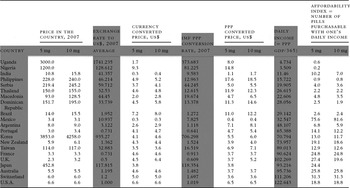
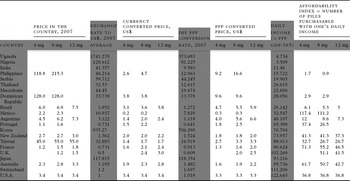
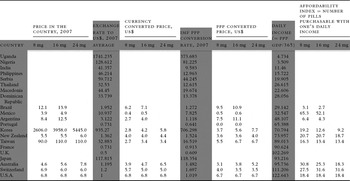
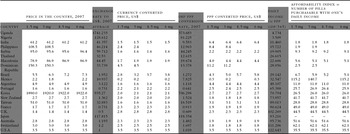
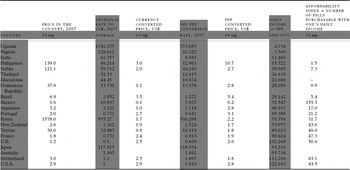
Tables 1–5 show the raw prices of Alzheimer's drugs, the currency converted prices (US$), the PPP converted prices (US$), and the affordability indices for the 21 countries.
Donepezil

Note: PPP = purchasing power parity, IMF = International Monetary Fund, GDP = Gross Domestic Product.
Galantamine

Note: PPP = purchasing power parity, IMF = International Monetary Fund, GDP = Gross Domestic Product.
Galantamine PRC (prolonged release capsule)

Note: PPP = purchasing power parity, IMF = International Monetary Fund, GDP = Gross Domestic Product.
Rivastigmine

Note: PPP = purchasing power parity, IMF = International Monetary Fund, GDP = Gross Domestic Product.
Memantine

Note: PPP = purchasing power parity, IMF = International Monetary Fund, GDP = Gross Domestic Product.
Donepezil (Table 1)
■ Donepezil was available in all the 21 countries.
■ For 5 mg tablet of donepezil, currency converted prices were lowest in India (US$0.30) and Mexico (US$0.30), and highest in Nigeria (US$9.30).
■ For 5 mg tablet of donepezil, the PPP converted price ranged from US$0.40 (Mexico) to US$17.60 (the Philippines), while the Affordability Index ranged between 0.2 tablets per daily income (Uganda, Nigeria) and 75.6 tablets per daily income (Mexico).
■ For 10 mg tablet of donepezil, of the PPP converted price ranged from US$0.40 (Mexico) to US$18.50 (Philippines), and the Affordability Index ranged between 0.8 tablets per daily income (Philippines) and 81.6 tablets per daily income (Mexico).
■ PPP GDP per capita of Mexico was US$11,800, while the PPP converted prices of both 5 mg and 10 mg tablets of donepezil were the lowest of all the 21 countries.
Galantamine (Table 2) and Galantamine PRC (Table 3)
■ Galantamine or galantamine PRC was available in most countries, but not in India, Japan, Macedonia, Nigeria, Serbia, Thailand and Uganda.
■ For 8 mg tablet of galantamine, currency converted prices were lowest in Mexico (US$0.20), and highest in Brazil (US$4.70).
■ For 4 mg tablet of galantamine, the PPP converted price ranged from US$0.30 (Mexico) to US$9.60 (the Dominican Republic), while the Affordability Index ranged between 1.7 tablets per daily income (Philippines) and 117.4 tablets per daily income (Mexico).
■ For 8 mg tablet of galantamine, the PPP converted price ranged from US$0.30 (Mexico) to US$16.6 (Philippines), while the Affordability Index ranged between 0.9 tablets per daily income (the Philippines) and 111.2 tablets per daily income (Mexico).
■ PPP converted prices of both 4 mg and 8 mg tablet of galantamine in Mexico were the lowest of all the 21 countries.
■ Prices of three different doses of galantamine appear to show small differentials, but in the Philippines an 8 mg tablet of galantamine costs twice as much as a 4 mg tablet of galantamine.
■ Galantamine PRC was not yet available in some high-income countries like France, Japan, Portugal and the U.K., as well as in somelow-income countries. The price differential of three different doses of galantamine PRC varies across countries with identical prices in the U.S.A., identical prices at higher strengths in Switzerland and Taiwan) identical prices at lower strengths in New Zealand, and an ascending linear slope of prices in Argentina, Australia, Brazil, Mexico and South Korea.
Rivastigmine (Table 4)
■ Rivastigmine was available in most countries, but not in Japan, Nigeria, Thailand and Uganda.
■ For 3 mg capsule of rivastigmine, currency converted prices were lowest in Mexico (US$0.20) and highest in the Dominican Republic (US$4.50).
■ Prices of the four different doses of rivastigmine do not vary across countries.
■ For 1.5 mg capsule of rivastigmine, the PPP converted price ranged from US$0.30 (Mexico) to US$11.20 (the Dominican Republic), while the Affordability Index ranged between 1.8 capsules per daily income (India) and 115.2 capsules per daily income (Mexico).
■ For 4.5 mg capsule of rivastigmine, the PPP converted price ranged from US$1.80 (New Zealand) to US$6.40 (India), while the Affordability Index ranged between 1.8 capsules per daily income (India) and 62.1 capsules per daily income (Switzerland).
Memantine (Table 5)
■ Memantine was also available in most countries, but not in India, Japan, Macedonia, Nigeria, Thailand and Uganda. Memantine was available in Australia, but not reimbursed.
■ For 10 mg tablet of memantine, currency converted prices were lowest in Mexico (US$0.10) and highest in Brazil (US$3.50).
■ For 10 mg tablet of memantine, the PPP converted price ranged from US$0.21 (Mexico) to US$10.72 (Philippines), while the Affordability Index ranged between 1.5 tablets per daily income (the Philippines) and 155.3 tablets per daily income (Mexico).
Discussion
To our knowledge, this is the first international study to compare prices, availability and affordability of Alzheimer's drugs across 21 countries in six continents across the world. The results support our hypothesis that Alzheimer's drugs have limited availability and may not be affordable in low- and middle-income countries compared to high-income countries. The results highlight the need to improve the availability of these drugs and to ensure that they are affordable.
Among neuropsychiatric conditions causing morbidity and premature mortality, dementia accounts for one-sixth of all disability adjusted life years (DALYs) in the aged population (Murray and Lopez, Reference Murray and Lopez1996). In 2005, it was estimated that 4.6 million new dementia cases would occur annually in the world (i.e. one new case every seven seconds). The number of people affected by dementia is estimated to double every 20 years, reaching 81.1 million by 2040. Those people with dementia, most of them living in low- to middle-income countries, are projected to account for 71% of the entire population with dementia in the world by 2040, up from 60% in 2001. Rates of increase are not uniform: patient numbers are forecast to increase by 100% in high-income countries between 2001 and 2040, but by more than 300% in China, India and their South Asian and Western Pacific neighbors (Ferri et al., Reference Ferri2005). In high-income countries, most of the available drugs are subsidized through health insurance, while in low- and middle-income countries the costs of prescribed drugs are paid out-of-pocket by individual patients. Large proportions of patients, however, are not able to do so. It is obvious that very scarce health resources, coupled with a relatively greater surge in the number of AD patients, make it impossible for poorer countries to afford Alzheimer's drugs for their people. One way to help them is through “equitable differential pricing”– selling the same drugs at different prices in different countries in accordance with people's purchasing power. During the period of this study, we found a good example of equitable pricing. The 5 mg tablet of branded originator “donepezil” manufactured by multinational companies costs just 10.8 Rupees in India and 3.37 Pesos in Mexico (equivalent to US$0.26 and US$0.31 respectively), whereas it costs US$6.64 in the U.S.A. However, except in India and Mexico, prices of donepezil in other low- and middle-income countries were greater than in the high-income countries. Some doctors in India said that, despite the fact that prices of originator Alzeimer's drugs were the lowest in the world and that even Indian pharmaceutical companies were producing cheaper generic Alzheimer's drugs, most of the AD patients in India were not able to use Alzheimer's drugs for more than two or three months. Although there is wide support for equitable pricing for HIV, malaria and tuberculosis medication, disagreement exists over how to apply this mechanism to other drugs, how to determine which countries qualify, how to set price differentials, and how to prevent price spillovers to wealthier countries (Steinbrook, Reference Steinbrook2007). Meanwhile, the generic drug manufacturing industry is expanding in some low- and middle-income countries (Brazil, China, India and Mexico) with companies legally selling drugs that were patent-protected in high-income countries. These companies have grown considerably in recent years and have a substantial effect on health care delivery. At present, prices of branded originators in such countries are likely to be lower because of competition from generic drugs derived from the same active compounds.
Governments and regulators in high-income countries are taking a series of initiatives to determine whether the newer treatments are cost-effective. Several countries such as Australia, Canada, Sweden and the U.K. have conducted cost-effectiveness analyses to create a basis on which to make reimbursement decisions. South Korea is the first Asian country officially to adopt economic evaluation as a tool for resource allocation in health care (Yang et al., Reference Yang, Bae and Kim2008). In South Korea, the new policy of using economic data in drug reimbursement decisions was made public in May 2006 under the title”Positive List System (PLS)”, which began in January 2008. Macedonia also recently adopted PLS in drug reimbursement decisions. In May 2008, the Philippines government enacted the “New Cheap Medicines Act” to allow local pharmaceutical companies to produce generic drugs of some branded originators of multinational companies against patent protection, and to allow parallel importation if drug prices in other countries are cheaper than those in the Philippines.
The Affordability Index (AI) is a new concept for comparing the affordability of goods. Previous studies calculated affordability in terms of the number of days’ wages required to purchase a one-month course of treatment, using median medicine prices and the average salary of the lowest-paid government worker (World Health Organization, 2000). However, the cost of a one-month course of treatment changes in accordance with disease severity and individual patient characteristics and such variations should therefore be excluded in the comparison. The AI is defined as the total number of units purchasable with one's daily income; it is derived by dividing the PPP daily income of a country by the PPP converted price of a certain drug. In Table 1, the AI of Mexico for the 5 mg tablet of branded originator donepezil was more than 350 times that of Nigeria. This great differential may be caused by two factors: (1) generic forms of Alzheimer's drugs are available in Mexico but not in Nigeria, and competition from these generics in Mexico might have lowered the prices of the branded originators; (2) the PPP GDP of Mexico was about nine times higher than that of Nigeria. For better between-country comparison of AIs, reimbursement rates of different countries should be considered to reflect the true financial burden on those individuals who must pay for the drug.
In conclusion, Alzheimer's drugs, albeit available, are often unaffordable for those who need them most. It is hoped that, in the foreseeable future, equitable differential pricing will be applied to Alzheimer's drugs.
Conflict of interest
None.
Description of authors’ roles
G. H. Suh designed the study, supervised the data collection and wrote the paper. A. Wimo, S. Gauthier, A. Homma and B. M. Yang helped develop the study concept, reviewed the paper, and provided critical ideas for revision. D. O'Connor, M. Ikeda and J. Dominguez, collected data, reviewed the paper, and provided critical ideas for revision.
Acknowledgments
Members of the Mental Health Economics Task Force of International Psychogeriatric Association are as follows: Guk-Hee Suh (Chair, Korea), Ricardo Allegri, Raul Arizaga (Argentina), Daniel O'Connor, Adrienne Withall, David Ames, G. Jamieson, Janine Stevenson, John Snowdon (Australia), Carlos Auguso de Mendonça Lima (Brazil), Joel Sadavoy, Serge Gauthier (Canada), Linda C. W. Lam, Huali Wang, Yu Xin (China), Danilo Hodoba (Croatia), Eva Topinkova (the Czech Republic), Rose Nina (The Dominican Republic), Sirkka-Liisa Kivela (Finland), Ennio Cocco (France), Kostas N. Fountoulakis (Greece), Samajdar Jyotirmoy, K. S. Shaji (India), Paulus Anam Ong (Indonesia), Manabu Ikeda, Akira Homma (Japan), Seoung Ho Ryu, Bong-Min Yang (Korea), Roza Krsteska (Macedonia), Suraya Yusoff (Malaysia), Victor FDO Villa Esteves (Mexico), Frans Verhey (Netherlands), Chris Collins (New Zealand), Olusola Ephraim-Oluwanuga, Olusegun Baiyewu (Nigeria), Jacqueline Dominguez (the Philippines), Horácio Firmino (Portugal), Nicoleta Tataru (Romania), Aleksandra Milicevic-Kalasic (Serbia), Ng Li-ling (Singapore), Manuel Franco (Spain), H Asita de Silva (Sri Lanca), Anders Wimo (Sweden), Yung-Jen Yang (Taiwan), Vorapun Senanarong (Thailand), Engin Eker (Turkey), Noeline Kakasujja (Uganda), Ajit Shah (U.K.), and Jay Luxenberg (U.S.A.).