Introduction
Chronic sleep deprivation has become pervasive among adolescents in Western societies (Loessl et al., Reference Loessl, Valerius, Kopasz, Hornyak, Riemann and Voderholzer2008; National Sleep Foundation, 2006). In a recent meta-analysis of 41 international studies sampling adolescents from five continents, 53% of the surveys showed teens were not getting sufficient sleep (<8 hr on school nights) (Gradisar, Gardner, & Dohnt, Reference Gradisar, Gardner and Dohnt2011). This estimate may be even higher if the recommended 9 hr of sleep per night was set as the cutoff criteria (Carskadon & Acebo, Reference Carskadon and Acebo2002; Carskadon et al., Reference Carskadon, Harvey, Duke, Anders, Litt and Dement1980). Longitudinal and cross-sectional data indicate increasing age and later bedtimes coupled with stable wake times are the main contributors to the rapid drop in sleep duration during adolescence, with sleep times evidencing a gradual decline in the last several decades (Iglowstein, Jenni, Molinari, & Largo, Reference Iglowstein, Jenni, Molinari and Largo2003; Leger, Beck, Richard, & Godeau, Reference Leger, Beck, Richard and Godeau2012).
It is well known that sleep-wake neurobiological regulatory processes continue to mature from prenatal stages to late adolescence (Brand & Kirov, Reference Brand and Kirov2011; Feinberg & Campbell, Reference Feinberg and Campbell2010). Examples of maturational changes include alterations in electroencephalographic activity, temporal distribution of sleep stages, and the ratio of sleep/wake amounts. Although the precise function of sleep remains unknown, these observed universal changes in youth suggest that sleep likely serves vital neurobiological and developmental functions. It is, therefore, not surprising that a growing body of evidence suggests insufficient or inadequate sleep poses adverse consequences on physiological, behavioral, emotional, and academic functioning of adolescents (Beebe, Reference Beebe2011; Shochat, Cohen-Zion, & Tzischinsky, Reference Shochat, Cohen-Zion and Tzischinsky2014).
A limited number of investigations have examined the effects of sleep loss on specific cognitive abilities among adolescents. Although the majority of these published studies are descriptive or cross-sectional in nature, available findings suggest that acute and/or chronic sleep insufficiency are related to subjectively and objectively measured performance deficits in a range of cognitive areas, including memory (Carskadon, Harvey, & Dement, Reference Carskadon, Harvey and Dement1981), verbal fluency and flexibility (Randazzo, Muehlbach, Schweitzer, & Walsh, Reference Randazzo, Muehlbach, Schweitzer and Walsh1998), logical reasoning (Ortega et al., Reference Ortega, Ruiz, Castillo, Chillon, Labayen, Martinez-Gomez and Moreno2010), and executive functioning (Anderson, Storfer-Isser, Taylor, Rosen, & Redline, Reference Anderson, Storfer-Isser, Taylor, Rosen and Redline2009; Randazzo et al., Reference Randazzo, Muehlbach, Schweitzer and Walsh1998), whereas sleep satiation is related to improvements in visuospatial processing (Dewald-Kaufmann, Oort, & Meijer, Reference Dewald-Kaufmann, Oort and Meijer2013). At the same time, methodological limitations, such as small sample sizes and non-objective assessment of sleep, restrict the interpretability of the data; while the lack of sufficient experimental studies make causal inferences difficult to attain.
Information processing speed (IPS) is a measure of cognitive proficiency. It involves the ability to perform relatively simple or over-learned mental tasks (e.g., simple arithmetic problems) in an automatic or fluent manner, especially when high mental efficiency is required (e.g., in timed tasks). In other words, it is the ability to process information automatically and, therefore, speedily, with limited if any intentional thinking. As a considerable amount of human cognitive activity involves some degree of information processing, IPS ability is likely interlinked with almost every form of cognitive processing and accordingly has an impact on much of what we think and do (Kail & Salthouse, Reference Kail and Salthouse1994). Informational input that is collected or interpreted incorrectly has, therefore, the potential of adversely influencing our decisions or actions.
Information processing changes in a predetermined pattern from childhood to adulthood, with IPS ability rising quickly throughout childhood, peaking in young adulthood, and gradually declining from then on (Salthouse & Kail, Reference Salthouse and Kail1983). IPS has been found to be correlated with measures of general intelligence and may be even causally linked to various aspects of intelligence (e.g., memory and reasoning) (Kail, Reference Kail2000). One study of almost 7000 adolescents (ages 13–17 years) found that IPS almost completely mediates the observed increase in intelligence with age (Coyle, Pillow, Snyder, & Kochunov, Reference Coyle, Pillow, Snyder and Kochunov2011).
Despite the relevance and importance of IPS and sleep among developing youth, we found no published studies examining chronic partial sleep deprivation and IPS ability in adolescents. However, one study examining IPS following 24-hr of total sleep deprivation did find lowered accuracy in adolescents (14–18 years) (Louca & Short, Reference Louca and Short2014), and two studies in young adults found partial sleep deprivation (PSD) to be linked to decrements in IPS performance as well. The first, in college students (19–26 years), found PSD (4 hr/night) for three nights led to mild decrements in IPS accuracy when compared to well-rested controls (Blagrove, Alexander, & Horne, Reference Blagrove, Alexander and Horne1995). The authors attributed the deficits to lack of concentration and/or sleepiness and not to motivational issues, as the task was described by the study sample as more interesting than other administered tasks, for which no sleep-related performance deficits were observed. The second, a larger study of adults (21–39 years) undergoing 14 days of PSD (4 and 6 hr), showed a dose-response relationship between sleep and IPS, with accumulating sleep loss associated with progressive reductions in IPS accuracy (not found in the well-rested group) (Van Dongen, Maislin, Mullington, & Dinges, Reference Van Dongen, Maislin, Mullington and Dinges2003). Notably, all of the above studies examined IPS accuracy measures only; reaction times (RT) were either not available or not provided. Finally, one study in school-aged children found that self-reported longer sleep duration for 1 week was related to higher perceptual processing speed; however, specific accuracy and RT indices were not provided (Buckhalt, El-Sheikh, & Keller, Reference Buckhalt, El-Sheikh and Keller2007).
Given the above-mentioned gaps in the literature, we were interested in objectively modeling chronic partial sleep deprivation present in the adolescent population, that is, accumulated sleep debt across weeknights. Furthermore, to strengthen our IPS construct, we chose a computerized task with a range of cognitive loads and both accuracy and reaction time indices, thereby allowing us to better elucidate the possible effects of sleep loss on IPS ability. The main objectives of this study were, therefore, to investigate (1) the potential causal impact of continuous partial sleep deprivation on IPS accuracy and RT in adolescence, (2) whether varying IPS “cognitive loads” differentially affect this relationship, and lastly (3) whether sleep-related changes in IPS (if found) are related to deficits in other cognitive abilities.
Methods
Participants
Fifty healthy adolescents (age range: 15 to 18 years) from the greater Tel Aviv/Central Israel areas participated in the study. Teens were recruited via ads posted at local high schools and community centers, youth scout organizations, and social media websites to. Of the 50 participants who were eligible and consented to participate, 45 completed the full protocol (2 dropped out before starting the protocol and 3 were excluded for not adhering to the sleep restriction protocol).
Protocol
Interested adolescents and their parents were initially briefly screened by phone to make sure adolescents met basic inclusion criteria and to rule out any major exclusions (e.g., age, medication use, and any known learning/cognitive difficulties). If eligible after the initial phone screen, an interview was scheduled with the adolescent and his/her parents at their home. During the home visit, trained research assistants interviewed teens and parents using a demographic and background questionnaire designed for the purposes of this study. The questionnaire reviewed study exclusions, including significant emotional or behavioral symptomatology (specifically for depression, anxiety, inattention, and hyperactivity), learning disabilities, chronic medical conditions, head trauma or loss of consciousness, sleep disorders, irregular or extreme sleep patterns, and use of any medications (current or past) which may affect sleep or the central nervous system (e.g., hypnotics or psychostimulants).
Teens and parents were also asked whether the participant drinks caffeine, smokes cigarettes, drinks alcohol, or uses drugs regularly. None of the teens or parents indicated any significant use other than caffeine, one teen endorsed infrequent nicotine use, and none reported regular alcohol use or any other substance use. To corroborate portions of the above information, teens were also asked to fill out three self-report screening questionnaires consisting of the Beck Depression Inventory, the State-Trait Anxiety Inventory-State Scale and the Connors Rating Scale-Self Report (CRS-SR) (Beck, Ward, Mendelson, Mock, & Erbaugh, Reference Beck, Ward, Mendelson, Mock and Erbaugh1961; Conners et al., Reference Conners, Wells, Parker, Sitarenios, Diamond and Powell1997; Spielberger, Reference Spielberger1968) and two sleep questionnaires, the School Sleep Habits Questionnaire and the Sleep Disorder Symptoms Checklist (Perlis, Jungquist, Smith, & Posner, Reference Perlis, Jungquist, Smith and Posner2005; Wolfson et al., Reference Wolfson, Carskadon, Acebo, Seifer, Fallone, Labyak and Martin2003). The study procedures and protocol were then explained in detail and informed consent was obtained from both parents and assent from the minor.
The vast majority of assessments were conducted during the summer holidays or other school breaks. Each participant underwent two experimental conditions, “sleep restriction” and “sleep extension,” in counterbalanced order. In the restriction condition, the teens were asked to be in bed 6–6.5 hr per night, from approximately 1:00 a.m. to 7:00 a.m., for four consecutive nights. In the extension condition, teens were asked to spend 10–10.5 hr in bed per night, approximately 11:00 p.m. to 9:00 a.m., for four consecutive nights. We choose the length of the “extended” period in order maximize the chances that teens achieved optimal age-appropriate sleep amounts (approximately 9 hr/night). Additionally, these schedules were chosen to approximate the natural midphase of sleep in adolescents (Crowley, Acebo, & Carskadon, Reference Crowley, Acebo and Carskadon2007; Roenneberg et al., Reference Roenneberg, Kuehnle, Pramstaller, Ricken, Havel, Guth and Merrow2004); however, to accommodate individual circadian rhythmicity (based on self-report) and avoid unintentional phase shifts or sleep-onset insomnia associated with assigning the same sleep/wake schedule to all participants, teens were allowed to shift their bedtimes and accordingly wake times by up to 1 hr (in the same direction), but were requested and monitored to make sure this schedule was kept constant for the duration of the study. We choose four consecutive nights for each condition to emulate as close as possible the teen’s natural environment, that is, the accrued sleep debt during a typical school week (Monday–Friday), without the “catch-up” sleep common on weekends.
In addition, to neutralize possible carryover effects, there was a 1–3 week washout period between the sleep conditions, and teens were asked to maintain their regular sleep schedule before each experimental condition. So as to make sure teens adhered to the prescribed sleep schedule, all participants wore actigraphs (Ambulatory Monitoring, Inc., Ardsley, NY; details below) and kept detailed sleep diaries during experimental conditions. Furthermore, research assistants called participants and/or sent text messages to teens to make sure they were following the sleep guidelines. Before each sleep condition, all participants were also requested, verbally and in writing, to refrain from napping and caffeine, nicotine, alcohol and illicit drug use for the duration of the study. To monitor for any use, specific questions for each of the above were included in the daily sleep diaries as well as a question about any daily/nightly medication use. They were also requested to sleep alone and only in their bed for all study nights. All actigraphic and subjective data were immediately reviewed following each condition. If a teen over- or underslept during a particular sleep condition or used any of the above substances, they were given the opportunity to redo the relevant sleep condition, after an additional washout period. If they were unwilling to do so, they were unable to continue participating in the study.
Each participant underwent a computerized neuropsychological test battery (NeuroTrax™, Houston, TX) at three time points, that is, at baseline and following each sleep condition. Each of the three testing sessions included different versions of all tasks, designed to reduce possible learning effects. The initial baseline condition served as an introduction to the testing procedure. All batteries were conducted on a laptop computer and commenced between 8:30 a.m. and 9:30 a.m. This time range was chosen to specifically examine possible effects of sleep on cognition during the early morning school hours, which tend to be the most difficult for high school students. During these visits, teens also completed questionnaires asking about their mood, sleep, sleepiness, and behavior.
All aspects of the study were conducted in the teens’ homes (including neuropsychological assessments). The study was approved by the Institutional Review Board of the Academic College of Tel Aviv-Jaffa and the Helsinki Committee of the Assuta Hospital. The participants received monetary compensation (in the form of vouchers) for their time and effort.
Actigraphy
An actigraph is a small non-invasive wrist-worn device (similar to a wrist watch) which allows for the continuous objective evaluation of sleep/wake patterns and circadian rhythms in the natural environment. Actigraphs sample motoric movements several times per second and store these data in larger epochs (e.g., 1 min). Specific algorithms are used to analyze the activity data to compute a range of sleep/wake parameters, including sleep and wake duration, percent time spent asleep and awake, and number and duration of awakenings. Actigraphy has been well-validated against the gold-standard polysomnographic approach in an adolescent population (Johnson et al., Reference Johnson, Kirchner, Rosen, Storfer-Isser, Cartar, Ancoli-Israel and Redline2007).
Cognitive Assessment
The NeuroTrax computerized assessment is a user-friendly interactive platform of tasks used for both clinical and research purposes. Tasks included encompass multiple cognitive domains, including attention, visual-spatial skills, verbal function, memory (verbal and non-verbal), executive function, information processing, and motor skills. The Neurotrax battery has been used extensively in both child and adolescent populations (Chiou, Jang, Liao, & Yang, Reference Chiou, Jang, Liao and Yang2010; Leitner, Doniger, Barak, Simon, & Hausdorff, Reference Leitner, Doniger, Barak, Simon and Hausdorff2007), task instructions are very simple, and norms are available in children aged nine and over (NeuroTrax Corporation, 2013).
Outcome parameters for each individual test include both raw and normed accuracy and RT data (per trial). The age and education normed data (relative to a large NeuroTrax normative database of healthy individuals) have a distribution with a mean of 100 and a standard deviation of 15, with higher scores reflecting better performance (i.e., higher accuracy and shorter RTs) (NeuroTrax Corporation, 2013). To examine performance by cognitive domain, software generated cognitive domain index scores were used. The index scores summarize performance on a particular cognitive domain and are computed by the software program from normalized outcome parameters from a range of tasks relevant to that domain. The NeuroTrax battery has been shown to have good validity and reliability (Dwolatzky et al., Reference Dwolatzky, Whitehead, Doniger, Simon, Schweiger, Jaffe and Chertkow2003; Schweiger, Abramovitch, Doniger, & Simon, Reference Schweiger, Abramovitch, Doniger and Simon2007), and the different versions of the tasks have been shown to have a high test–retest reliability (Melton, Reference Melton2006; Schweiger, Doniger, Dwolatzky, & Jaffe, Reference Schweiger, Doniger, Dwolatzky and Jaffe2003).
The complete battery includes a Verbal and a Non-verbal Memory Test (immediate and delayed portions), a Verbal Function Test, Problem Solving Test, Visual Spatial Processing Test, Go-NoGo, Stroop, Finger Tapping, Catch Game, and the Staged Information Processing Test and takes approximately 45 min to complete. All tasks were administered in a fixed order by trained research assistants and all responses were provided using the mouse or keyboard only. Participants in this study were administered the complete Hebrew-version of the battery with the exclusion of the Verbal Function task, due to an observed ceiling effect in the performance during the early phases of the study.
This report focuses primarily on data from Staged Information Processing Test, which is a timed processing speed test requiring a binary decision based on a single digit or solution to a simple two- or three-digit arithmetic problem (e.g., 5 – 3 or 9 – 5 + 2). The trials include three levels of cognitive load, that is, light (one-digit problem), medium (two-digit problem), and heavy (three-digit problem) loads and three rates of presentation, that is, slow (2000 ms), medium (1300 ms), and fast (600 ms), for each processing load. For each trial, participants were instructed to press the left or right mouse button as fast as possible to indicate if the correct response is ≤4 or >4, respectively. Before the onset of each trial, two practice items were performed. Individual outcome parameters (raw and normed) are provided for accuracy and RT (for correct responses only) for each load at each presentation pace.
Statistical Analysis
Data were analyzed using a two-way repeated-measures (RM) analysis of variance (ANOVA), with load and pace as within-subjects factors. This analysis was done separately for RT and AC, for the restricted and the extended sleep conditions. To have a clearer understanding of the interaction terms in this model, each of these analyses was followed by three one-way RM ANOVA analyses; one for each load level, and each comparing the effects of the different pace levels. This comparison was done both by testing for general differences in performance means at the three pace levels and by testing for linear and quadratic trends. Post hoc Bonferroni corrections for multiple comparisons were applied when testing for performance differences between the pace levels.
The NeuroTrax software computes a series of index scores, each reflecting overall normed performance within a particular cognitive domain (Leitner et al., Reference Leitner, Doniger, Barak, Simon and Hausdorff2007). These index scores were used to compare overall performance differences between the sleep conditions using paired samples t tests. No gender differences were found in any of the main cognitive variables, therefore, all the subjects were examined together. Observations considered to be outliers by the boxplot criterion (that differ from the upper and lower quartiles by at least 1.5 times the Interquartile range) were candidates for potential exclusion from the study. The final decision was to exclude study participants that showed extreme results on at least half of the tests (n = 4).
Finally, we examined possible repeated administration effects. We were unable to measure test–retest reliability due to the presence of an experimental manipulation between administrations. Therefore, we conducted nine independent-samples t tests to examine performance accuracy following the extension condition between subjects who took the test for the first time (extension before restriction condition) and subjects took the test for the second time (restriction before extension condition). This was repeated for the restriction condition and for all RT measures for both sleep conditions. After applying the Bonferroni correction for multiple comparisons, only one of the 36 comparisons remained significant. This finding supports the assumption that there was no practice effect, as otherwise we would expect to see better performance on second administrations of the test.
Results
Participant Characteristics and Sleep Profiles
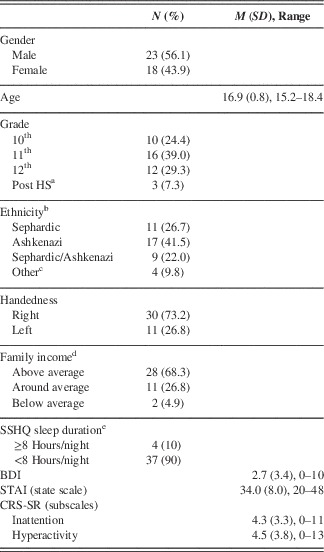
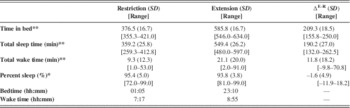
The final sample consisted of 41 adolescents (19 female and 23 male) with a mean age of 16.9 (±0.8) years. See Table 1 for sample descriptives. Examination of the actigraphic data showed all teens significantly shortened their sleep amounts during the restricted compared to the extended sleep condition. See Table 2 for sleep summary statistics.
Sample descriptives

a Graduated in past 6 months.
b Israeli/Jewish ethnic classifications.
c Sabra or combination Sabra/Other Ethnicity.
d Based on parental-reported financial status and income information classified by the Israeli Central Bureau of Statistics.
e Past month.
SSHQ = School Sleep Health Questionnaire; BDI = Beck Depression Inventory; STAI = State-Trait Anxiety Inventory; CRS-SR = Connors Rating Scales-Self Report (for all measures, higher scores represent increased symptoms).
Means, SDs, and ranges for actigraphic sleep/wake variables

*p < .05 in paired-sample t-tests comparing restricted vs. extended sleep conditions.
**p < .001 in paired-sample t-tests comparing restricted vs. extended sleep conditions.
Information Processing Speed: Overall Performance
Results show a significant difference in IPS performance index between restricted and extended sleep conditions (p = .037; Table 3).
Mean scores and SDs of Cognition Domain Index Scores by Sleep Condition

*p < .05.
**p < .01
Information Processing Speed: Accuracy
In the extension condition, a two-way RM ANOVA (pace × load) showed significant effects of task load on performance accuracy (F
(2,80) = 8.90; p < .001;
 $$\eta _{p}^{2} $$
= .18), with Bonferroni post hoc comparisons indicating lower accuracy on easy compared to medium load tasks (p < .01). A main effect of pace was also found (F
(2,80) = 7.80; p < .001;
$$\eta _{p}^{2} $$
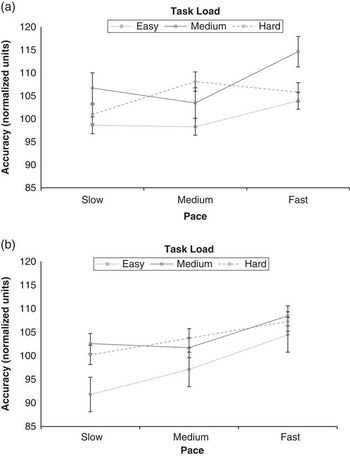
= .16), with Bonferroni post hoc comparisons indicating lower accuracy on medium (p < .05) and slow tasks (p < .01), compared to fast-paced tasks. In other words, in general the teens performed better and responded faster on harder and faster-paced tasks (Figure 1a). In addition, we found a significant pace by load interaction effect (F
(4,160 = 3.06; p < .05;
$$\eta _{p}^{2} $$
= .07).
Information processing speed task accuracies by load and pace per sleep condition. The plotted lines indicate normalized accuracy scores by task load (easy, medium, hard) and pace (slow, medium, fast) for the extension condition. Significant effects of pace and load and a pace × load interaction effect were found for the extension conditions (a), while significant effects of pace and load were found but no interaction effect for the restriction condition (b).

To interpret the interaction, follow-up one-way RM ANOVAs were conducted for each individual task load (easy, medium, hard), comparing accuracies among the three pace levels (slow, medium, fast). On the easy task load, no significant effect of pace on accuracy was found (F
(2,80) = 1.53; p = ns), while at the medium load, a significant effect of pace was found (F
(2,80) = 11.44; p < .001;
$$\eta _{p}^{2} $$
= .22), displaying a quadratic trend (F
(1,40) = 13.42; p < .001;
$$\eta _{p}^{2} $$
= 25). Post hoc Bonferroni comparisons revealed no differences in accuracy between slow and medium paced tasks (p = ns), while significantly higher accuracies were found in fast compared to medium (p < .001) and slow paced tasks (p < .01). Similarly, on the hard load, a significant effect of pace was found (F
(2,80) = 4.58; p < .05;
$$\eta _{p}^{2} $$
= .10), showing a quadratic trend (F
(1,40) = 9.92; p < .01;
$$\eta _{p}^{2} $$
= .20). However, Bonferroni comparisons showed significantly better performance accuracy on medium compared to slow paced tasks (p < .01), but no significant differences between medium and fast paced tasks (p = ns) (Figure 1a).
In the restriction condition, a two-way RM ANOVA (pace × load) showed significant effects of task load on performance accuracy (F
(2,78) = 7.85; p < .001;
$$\eta _{p}^{2} $$
= .17), with Bonferroni post hoc comparisons indicating lower accuracy on easy compared to medium (p < .01) and hard load tasks (p < .05). We also found a main effect of pace (F
(2,78) = 10.26; p < .001;
$$\eta _{p}^{2} $$
= .21), with Bonferroni post hoc comparisons indicating lower accuracy on slow (p < .01) and medium tasks (p < .01), compared to fast-paced tasks (Figure 1b). No interaction effect was found (F
(4,156) = .90; p = ns). Follow-up RM ANOVAs showed a significant linear effect of pace on accuracy at each pace level (slow: F
(1,40) = 10.85; p < .01; partial η2 = .21; medium F
(1,40) = 3.99; p = .05;
$$\eta _{p}^{2} $$
= .09; fast: F
(1,39) = 4.46; p < .05;
$$\eta _{p}^{2} $$
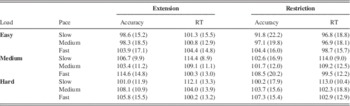
= .10), reflecting an increase in accuracy with increasing task load within each pace level (Figure 1b). Mean accuracy indices and standard deviations are presented in Table 4.
Means and SDs of Accuracies and RTs for IPS task per sleep condition

Information Processing Speed: Reaction Time
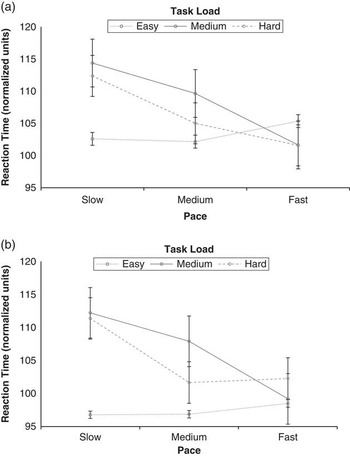
In the extension condition, a two-way RM ANOVA (pace × load) showed significant effects of task load on IPS reaction times (F
(2,80) = 7.74; p < .001;
$$\eta _{p}^{2} $$
= .16), with Bonferroni post hoc comparisons indicating slower RT on easy compared to medium load tasks (p < .01). A main effect of pace was also found (F
(2,80) = 28.16; p < .001;
$$\eta _{p}^{2} $$
= .41), with Bonferroni post hoc comparisons indicating slower RT on medium (p < .01) and fast-paced tasks (p < .05) compared to slow tasks, and on fast compared to medium-paced tasks (p < .01). In other words, the teens responded faster on the harder but slower-paced tasks (Figure 2a). In addition, a significant pace by load interaction effect was found (F
(4,160) = 15.23; p < .001;
$$\eta _{p}^{2} $$
= .28) Once again, to interpret the interaction, follow-up one-way RM ANOVAs were conducted for each individual task load comparing RTs among the three pace levels.
Information processing speed task reaction times by load and pace per sleep condition. The plotted lines indicate reaction time scores by task load (easy, medium, hard) and pace (slow, medium, fast) for the extension condition. Significant effects of pace and load and a pace × load interaction effect were found for both the extension (a) and restriction (b) conditions.

The results indicate that at the easy load, pace had no effect on RTs (F
(2,80) = 2.60; p = ns), while at the medium and hard loads, a significant effect of pace was found (F
(2,80) = 47.86; p < .001;
$$\eta _{p}^{2} $$
= .55; F
(2,80) = 16.96; p < .001;
$$\eta _{p}^{2} $$
= .30, respectively), showing a linear trend (i.e., RTs were slower with increasing pace of stimuli presentation) (F
(1,40) = 72.29; p < .001;
$$\eta _{p}^{2} $$
= .64; F
(1,40) = 27.61; p < .001;
$$\eta _{p}^{2} $$
= .41, respectively; Figure 2a).
Similar results were found in the restriction condition. A RM ANOVA (pace × load) showed significant effects of task load on IPS reaction times (F
(2,78) = 16.57; p < .001;
$$\eta _{p}^{2} $$
= .30), with Bonferroni post hoc comparisons indicating slower RT on easy compared to medium (p < .01) and high load tasks (p < .01). We also found a main effect of pace (F
(2,78) = 18.42; p < .001;
$$\eta _{p}^{2} $$
= .32), with Bonferroni post hoc comparisons indicating slower RT on medium (p < .01) and fast tasks (p < .01) compared to slow-paced tasks (Figure 2b). In addition, a significant pace by load interaction effect was found (F
(4,156) = 10.19; p < .001;
$$\eta _{p}^{2} $$
= .21)
Follow-up one-way RM ANOVAs showed that at the easy level pace had no effect on RTs (F
(2,80) = 1.00; p = ns), while at the medium and hard loads, a significant effect of pace was found (F
(2,80) = 36.98; p < .001;
$$\eta _{p}^{2} $$
= .48; F
(2,78) = 9.65; p < .001;
$$\eta _{p}^{2} $$
= .20, respectively). At the medium load this effect showed a linear trend, with RTs being slower with increasing pace (F
(1,40) = 66.75; p < .001;
$$\eta _{p}^{2} $$
= .63); while at the hard load this effect showed a quadratic trend (F
(1,39) = 5.04; p < .05;
$$\eta _{p}^{2} $$
= .12). For the hard load, post hoc Bonferroni comparisons showed significantly faster RTs on slow compared to medium (p < .01), and fast paced tasks (p < .001), but no difference in RTs between medium and fast pace tasks (p = ns) (Figure 2b). Mean RT indices and standard deviations are presented in Table 4.
Relationships between Changes in IPS and Changes in other Cognitive Abilities
Paired-samples t tests were conducted to examine sleep-related differences in overall performance indices per cognitive domain. Significant, albeit small, effects were found showing poorer performance in the restriction compared to the extension condition for IPS (p < .05), executive function (p < .01), motor skills (p < .05), and attention (p < .01), but not for memory (p = ns) or visuospatial skills (p = ns; Table 3).
For those cognitive domains found to be significantly different between the sleep conditions, Pearson correlations were conducted to examine whether sleep-related changes in IPS were related to changes in other cognitive domains. Results indicate the delta in IPS performance indices (∆ = extension - restriction) was positively correlated with the delta in executive function (rp = .55; p < .001), motor skills (rp = .39; p < .05), and attention indices (rp = .52; p < .001).
Discussion
This within-subjects study evaluated the cognitive effects of objectively monitored continuous partial sleep restriction to a well-rested condition in healthy adolescents. Findings from this study indicate that when compared to a well-rested condition, partial sleep restriction (6 hr sleep/night) for four consecutive nights had significant effects on overall information processing speed in our adolescent sample. Our results are in line with a well-controlled study of the effects of long-term PSD on cognition in young adults (Van Dongen et al., Reference Van Dongen, Maislin, Mullington and Dinges2003), but to the best of our knowledge, this is the first published study of the effect of chronic sleep restriction on information processing speed in adolescents.
The multidimensional format of the chosen IPS task allowed us to examine accuracy and speed indices separately and at different levels of cognitive challenge. In regards to accuracy, we found that irrespective of sleep condition, task difficulty affected processing speed accuracy, with teens generally performing better on difficult compared to easy tasks. As our IPS task also included three increasing pace levels, we were also able to examine the effects of pace on accuracy and again found a significant relationship, that is, increasing pace was associated with better performance, irrespective of sleep condition.
When examining the sleep conditions separately, we discovered that in the extension condition, pace moderated the relationship between task difficulty and accuracy for medium and hard tasks but not for easy tasks. These results indicate that when the teens were given medium to hard tasks, they seemed to perform much better if these tasks were presented at a faster rather than a slower pace. Specifically, for hard tasks, a medium pace was sufficiently challenging to improve performance (an additional increase in pace maxed out their performance ability), while for medium tasks a fast pace was needed to show the same effect. Predictably, pace did not pose any additional challenge to the easy tasks, which were already not sufficiently difficult (observed ceiling effect), and thus did not seem to improve processing accuracy. In contrast to the above findings, in the restriction condition, pace did not moderate the relationship between task difficulty and processing speed accuracy, that is, increasing pace improved performance accuracy equally across levels of task difficulty.
In other words, the above findings suggest that when well-rested, teens perform optimally (reach the upper end of their cognitive capacity), when they are simultaneously challenged by the increasing difficulty and increasing pace of the task. These findings are consistent with published theories suggesting recruitment of compensatory strategies and increasing arousal levels or attentional control, allows for maintenance or even improved performance on challenging processing speed tasks, when compared to simple or monotonous tasks which require more “top-down” control (Lim & Dinges, Reference Lim and Dinges2010; Pilcher, Band, Odle-Dusseau, & Muth, Reference Pilcher, Band, Odle-Dusseau and Muth2007).
Furthermore, in line with these theories, one possible interpretation of these findings is that the “double challenge” posed by the IPS task may motivate teens to rise to the occasion, leading to increasing cognitive effort and optimizing processing speed accuracy. In contrast, when sleep deprived, pace added a constant degree of challenge, irrespective of task difficulty. Thus, it seems that when teens were already significantly challenged by their sleep loss (and possibly excessive sleepiness), task pace and difficulty independently added challenge to the teens’ performance, but they did not show interactive or additive effects, which may have limited the teens’ ability to arrive at optimal performance.
Even though our small sample size limited our ability to test for the presence of a three-way interaction (pace by load by sleep condition), these findings suggest that when teens suffer from chronic sleep loss, they may be less able to recognize or respond (insufficient cognitive resources) to multiple overlapping cognitive challenges, which consequentially may affect the motivation and/or effort they are willing to invest in accurately processing the available information. From an operational perspective, these data clearly suggest that we need to attempt to increase sleep durations among youth as rapidly as possible, however, this has proven not to be an easy task. Therefore, in addition to this long-term goal, a more immediately applicable yet temporary alternative may be to recommend high schools reserve the harder or faster paced classes (or teaching techniques) to later in the day, thus avoiding considerably challenging instruction during the teens’ “sleepy hours” and increasing the likelihood of optimal learning or cognitive performance. Both our understanding of these data as well as other potential explanations of these findings need to be further explored and researched.
Similarly, task difficulty also affected processing speed RTs, with teens’ overall RTs being faster on the harder compared to the easier tasks, irrespective of sleep condition. Of interest, we also found that for both sleep conditions pace of presentation moderated this relationship, with increasing task pace resulting in incrementally slower RTs, but only for medium and hard tasks. RTs on easy tasks were not affected by increasing pace, possibly because of the lack of cognitive challenge associated with these tasks. Thus, our data suggest that among teens, sleep insufficiency does not seem to differentially affect processing speed RTs when compared to sleep satiation.
Our speed/accuracy findings are somewhat different to a recent meta-analysis of adult studies showing acute TSD associated with no differences in processing speed accuracies but with slower RT (Lim & Dinges, Reference Lim and Dinges2010). The differences in our findings may be a function of the type of IPS task used, as the majority of sleep studies use self-paced tasks (performed at subject’s pace) to assess processing speed, as opposed to our work-paced task (performed at forced speed) (De Gennaro, Ferrara, Curcio, & Bertini, Reference De Gennaro, Ferrara, Curcio and Bertini2001; Lim & Dinges, Reference Lim and Dinges2010).
Several researchers have suggested that the observed response pattern may be a function of the speed-accuracy tradeoff common to self-paced tasks, that is, in the self-paced task, the testee can sacrifice RT to preserve accuracy, which cannot be done in the work paced task (Wilkinson, Reference Wilkinson1969). Therefore, it is possible that when our sample of “sleepy” teens were challenged by the imposed time limitation, we saw differences in their approach to accurate responding, but no differences in RT, in reference to their well-rested state. Additionally, it also possible that these RT differences reflect cultural changes, that is, teens today have increased experience with technology, both in duration and complexity of activities (e.g., computer games, mobile phone texting programs), and this exposure to technology started at a much younger age when compared to their adults counterparts. Therefore, their familiarity and comfort with computerized tasks may reduce the effects of sleep loss on RT, more commonly seen in adults.
Alternatively, it is possible that the TSD poses a different challenge to that of PSD and thus in general initiates a different speed/accuracy response style. A meta-analysis examining this issue found differential cognitive effects as function of the type of sleep restriction, with partial sleep deprivation having a more profound effects on cognitive performance when compared to both acute short-term and long-term sleep deprivation (Pilcher & Huffcutt, Reference Pilcher and Huffcutt1996). Hence, additional experimental studies examining the effects of PSD on IPS performance are sorely needed, particularly in children and adolescents, and specifically using tasks which allow for a multifaceted investigation of information processing ability. Finally, this difference in response style may also be in part a function of the younger age of our population and their still developing sleep/wake regulatory systems (Brand & Kirov, Reference Brand and Kirov2011) and processing speed ability (Kail, Reference Kail2000; Kail & Salthouse, Reference Kail and Salthouse1994), possibly making them more susceptible to sleep restriction challenges.
Adolescence is a critical period for developing and refining a range of cognitive skills. In addition to the above findings, we also observed sleep loss-induced reductions in certain cognitive abilities, namely, attention, motor skills, and executive functions, but not in others, that is, memory and visuospatial skills. Moreover, poorer information processing was associated with deficits in the above-mentioned cognitive abilities also affected by the sleep loss. In other words, our data suggest sleep may play a critical role in adolescents’ processing speed ability and that sleep induced deficits in processing speed may be linked to decrements in other cognitive abilities.
This is a particularly interesting finding given theories suggesting processing speed may be a crucial marker for the development of general intelligence (g) in adolescence (Coyle et al., Reference Coyle, Pillow, Snyder and Kochunov2011). Moreover, tests which measure g have previously been shown to be related to academic and professional success (Jensen, Reference Jensen1998; Jensen & Weng Li-Jen, Reference Jensen and Weng1994). Given this knowledge, future research should examine whether under conditions of sleep insufficiency, information processing may mediate underperformance in other cognitive areas, and if true, which aspects of this performance are affected. Additionally, developmental and longitudinal research are sorely needed to examine whether chronic sleep loss, omnipresent in our youth, may progressively affect intellectual and cognitive development.
There were several limitations to our study which should be addressed. Our sample was relatively small which precluded our ability to examine our data using a three-way ANOVA, due to possible Type I error inflation. Therefore, we were unable to test for a three-way interaction (task load × task pace × sleep condition) which should be examined, ideally within a larger replication study. In addition, two sleep-related phenomena could have influenced cognitive performance in one or both of the sleep conditions. First, earlier wake times in the restriction protocol led to more time awake before the neuropsychological testing in comparison to the extension condition. This additional awake time combined with the accumulated sleep debt may have been associated with increased homeostatic sleep pressure (i.e., need for sleep) before testing in the restriction condition, and may have exerted a differential effect on cognitive performance.
Second, the presence and magnitude of morning sleep inertia (i.e., transitional state of lowered arousal occurring after awakening) which was likely present but different in both sleep conditions, may have also differentially affected the task performance. In regards to the IPS task itself, although we used a valid, reliable, and informative measure of IPS, we only included one assessment measure, thus increasing the chances that our findings are reflective of task-specific response style rather than measurement of the true IPS construct. Given the range of approaches to the measurement of IPS, future studies should examine this issue using at least two instruments concurrently.
Furthermore, we did not collect a measure of general intelligence, and thus its potential contribution to the study findings could unfortunately not be assessed and should be examined in future studies. Finally, our teens were placed on a strict sleep restriction protocol, however, it is more likely that in “real-world” conditions teens sleep schedule is more erratic and may involve daytime and weekends sleep compensation. Thus, although we attempted to emulate real-life conditions as much as possible, this could not be unequivocally achieved.
In conclusion, this study suggests that, under conditions of continuous sleep loss, teens show performance deficits in information processing. Furthermore, sleep satiation, seemed to allow for optimal performance on components of the task that required heightened effort or motivation. Given data showing the pervasiveness and chronic nature of sleep loss among teens today, these data would not only have implications for how teens absorb, interpret, and respond to day-to-day informational input, but given that most cognitive processes require some type of initial informational processing, it may also influence a wide-range of daily cognitive problems and trials.
These findings pose multiple operational questions and concerns for teens today. For example, given that high school students spend over half their waking time in settings which require ongoing cognitive processing often of multiple overlapping stimuli (e.g., in the classroom, after-school activities/homework), how would limited or inefficient information processing affect their academic performance and more importantly their actual learning capacity? Are teens susceptible to any other long-term functional consequences of sleep and suboptimal information processing, such as excessive risk taking behavior, impaired decision making, or poor judgment? Future studies should address these important questions.
Acknowledgments
This research was partially supported by a Marie Curie Grant [M.C.Z., EU FP7 (PIRG05-GA-2009-248169)]. The authors received no other funding for this study and have no conflict of interest to report. Special thanks to Maya Kessler, Moran Avdar, and Zohar Hagan for their help with data collection.