Introduction
For patients with locally advanced laryngeal cancer, two main treatment options are either up-front surgery [total laryngectomy (TL)] followed by post-operative adjuvant radiation therapy (PORT) or definitive concurrent chemoradiation (CCRT) with surgery retained as salvage. Reference Forastiere, Goepfert and Maor1–Reference Forastiere, Zhang and Weber3 While upfront surgery with/without adjuvant radiation therapy (PORT) can achieve excellent loco-regional control, the functional consequence (e.g., permanent tracheostoma and loss of voice) of laryngectomy may be frustrating to the patient and affect quality of life (QoL). CCRT is also associated with significant acute toxicities requiring treatment breaks, Reference Fung, Lyden and Lee4 and late effects can also significantly impact patients’ QoL.
The landmark trials done with induction chemotherapy followed by radiation therapy (I+RT) 5 and CCRT Reference Forastiere, Maor and Weber2,Reference Forastiere, Zhang and Weber3 showed effectiveness of chemotherapy and radiation in preserving laryngeal function and improving disease-free survival rate.
In these older trials, Reference Forastiere, Maor and Weber2,Reference Fung, Lyden and Lee4,5 older radiation techniques were used. Studies have shown that the use of intensity-modulated radiation therapy (IMRT) might lead to a lower incidence of late toxicities, Reference Mendenhall, Amdur and Palta6,Reference Vergeer, Doornaert, Rietveld, Leemans, Slotman and Langendijk7 and consequently, CCRT with IMRT appears to be a reasonable approach to preserve the larynx in patients with advanced laryngeal cancer. Reference Vokes8,Reference Lee, O’Mearu and Chan9
Our retrospective study endeavoured to show the feasibility of definitive CCRT using IMRT for T3 and T4a laryngeal squamous cell cancer for the Indian patients, particularly for the Eastern Indian subset, in the context of tolerance to toxicities, response to treatment, and QoL. Comparison with patients treated with total laryngectomy followed by post-operative radiation therapy (RT) was done.
In our hospital, CCRT with weekly cisplatin (40 mg/m2) was used as the preferred regimen. Although CCRT with injection cisplatin (100 mg/m2) on days 1, 22, and 43 of RT is considered standard, Reference Forastiere, Goepfert and Maor1,Reference Adelstein, Li and Adams10–Reference Al-Sarraf, LeBlanc and Giri12 it may induce systemic toxicities requiring intensive premedication and supportive care. The available data also show that nearly one-third of patients do not receive all cycles and subset analyses suggest that two cycles are as effective as three. Reference Forastiere, Goepfert and Maor1,Reference Bensadoun, Benezery and Dassonville13–Reference Loong, Ma and Mo17 Smaller individual doses of drug may lead to less chemotherapy-induced morbidity without compromising efficacy. Reference Nagai and Ogata18,Reference Kurihara, Kubota and Hoshiya19
Materials and Methods
Participants
We undertook this study at the Chittaranjan National Cancer Institute, Kolkata. The records of 48 patients with locally advanced laryngeal cancer (T3/T4a/N0-2), registered between years 2014 and 2017, treated with IMRT (either definitive or adjuvant postoperative IMRT), were analysed from the hospital database. Due approval of the institutional ethical committee was obtained, and informed consent was taken from all the eligible patients before analysing their data. All the patients had baseline Eastern Cooperative Oncology Group performance status Reference Oken, Creech and Tormey20 1 or 2, Karnofsky performance score 60 and above, normal renal function, liver function and blood counts, and the patients receiving CCRT also had baseline audiometry limited to mild sensory neural deficits. The patients received RT either as definitive CCRT or as adjuvant treatment after total laryngectomy. All the laryngectomy patients received post-operative IMRT. RT in all patients was delivered with IMRT-SIB (simultaneous integrated boost) technique and concurrent chemotherapy with weekly cisplatin 40 mg/m2. The response was assessed at 12 weeks. Toxicities and QoL were assessed and compared between patients receiving definitive CCRT and adjuvant RT.
Patients were staged (TNM stage, American Joint Committee on Cancer 7th Edition Reference Edge, Byrd, Compton, Fritz, Greene and Trotti21 ) with clinical examination, fibre-optic laryngoscope and computed tomography (CT) scans of the head and neck and chest with ultrasonography of abdomen.
Surgical treatment for laryngectomy patients included total laryngectomy, neck dissection as per nodal status, with or without tracheo-esophageal prosthesis insertion.
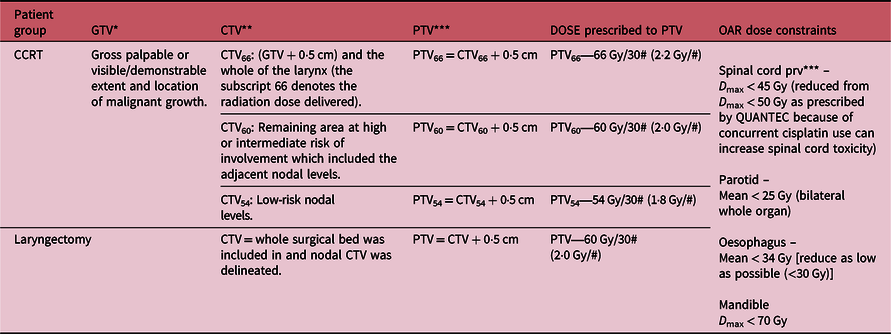
For RT, patients had CT simulation (with contrast) followed by delineation of different volumes and organs at risk (OARs), and doses were prescribed (Table 1). Delineation of the nodal areas (nodal contouring) was done based on the guidelines by Gregoire et al. Reference Grégoire, Levendag and Ang22,Reference Grégoire, Eisbruch, Hamoir and Levendag23
Target volumes and dose prescription and Organ At Risk (OAR) dose constraints

* GTV = Gross tumor volume.
** CTV = Clinical target volume.
*** PTV = planning target volume.
# PRV = planning organ at risk volume.
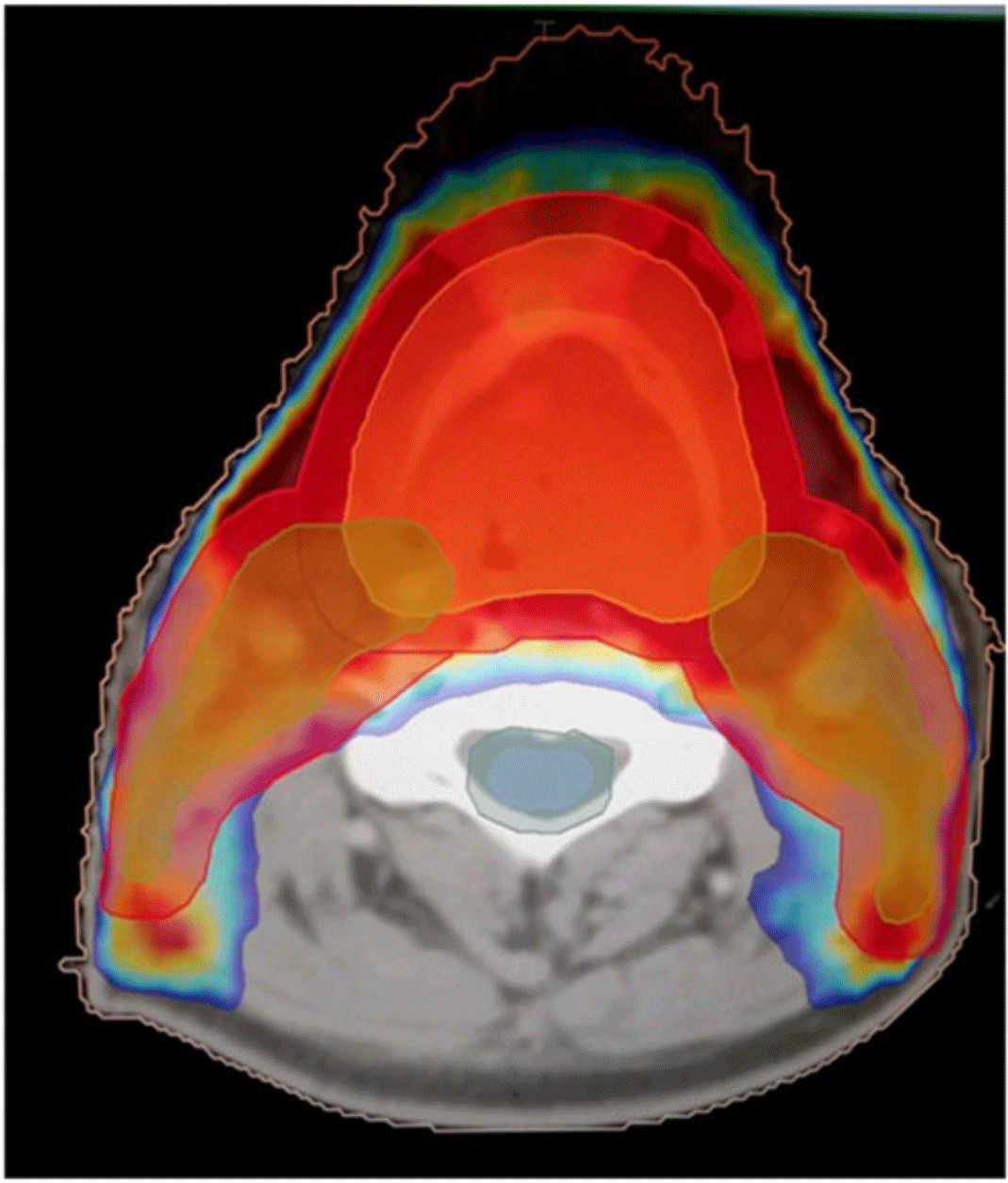
Inverse treatment planning was performed using step and shoot IMRT technique by Monte Carlo algorithm, CMS MONACO treatment planning system (V.3.30.01; Elekta, Stockholm, Sweden) using 7–9 coplanar beams (6-MV photon). Particular plan was approved if the 95% of prescribed dose covered the target volume (Figure 1) and maintaining normal tissue dose volume within 5% of the constraints prescribed. Dose-volume histograms and each single slice were evaluated carefully before final approval of plan.
Colour wash on axial view. 95% of target dose (blue hue) has covered the PTV.

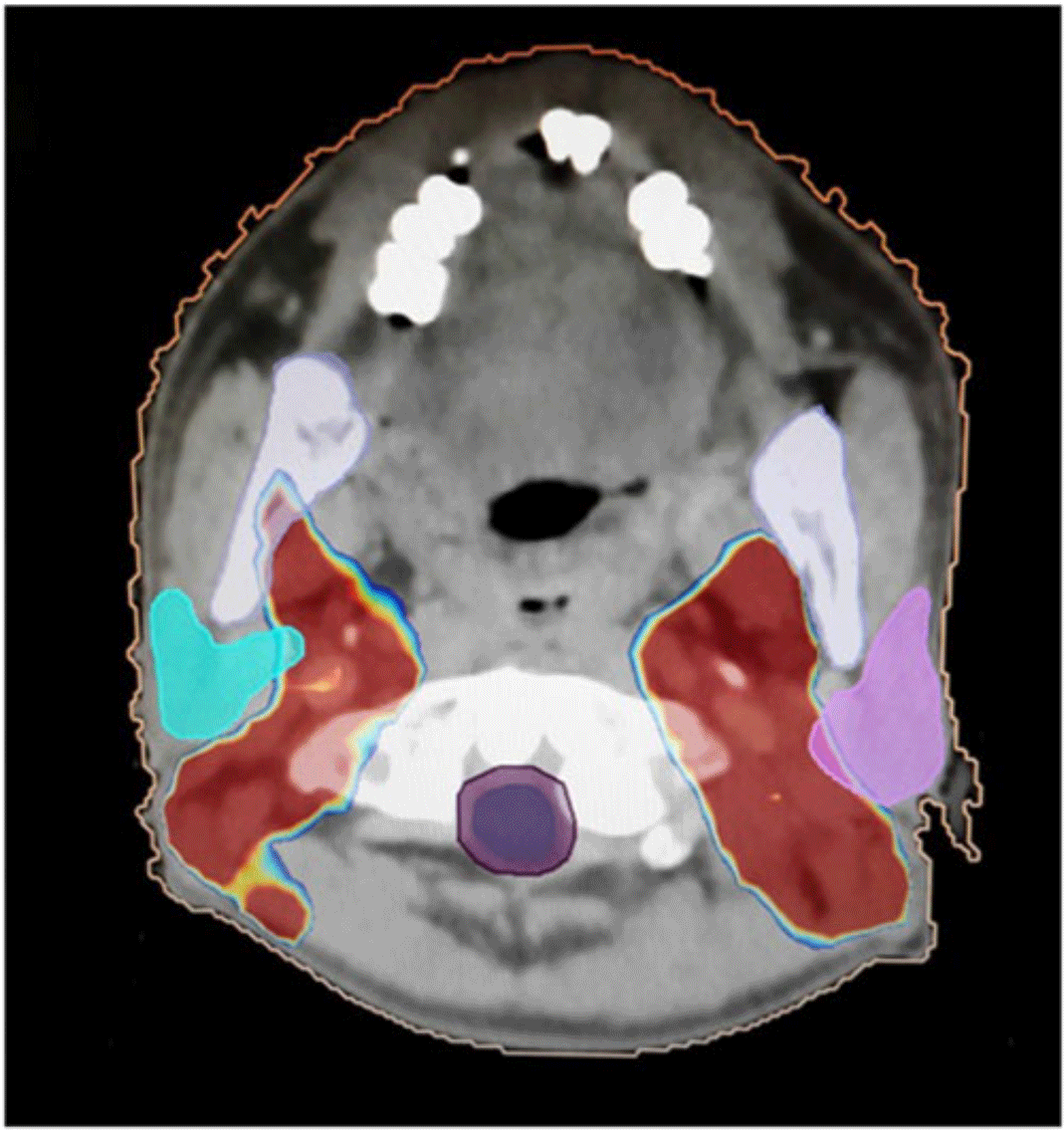
Colour wash showing sparing of parotid glands. Left parotid (purple), right parotid (sky blue).

Patient’s position verification was done with X-ray volumetric imaging/cone beam CT on first 3 days of RT and then weekly.
RT was delivered with one fraction daily, 5 fractions per week on Elekta Synergy Linear Accelerator (Elekta). All patients requiring CCRT received cisplatin injection (40 mg/m2) weekly by intravenous infusion, on the first day of each week during RT.
During RT/CCRT, weekly blood investigations were done.
After treatment, patients were regularly followed up at 2, 4, 6 weeks, then once a month for first 1 year and then every 3 months.
At 12 weeks after the completion of CCRT, the patients were assessed with clinical examination, fibre optic laryngoscopy and CT scan of the face and neck to evaluate the tumour response and categorised as per Response Evaluation Criteria in Solid Tumors (RECIST version 1.1). Reference Eisenhauer, Therasse and Bogaerts24 Suspected partial responders underwent confirmatory tissue biopsy and metastatic workup. After confirmation of PR, they proceeded for salvage laryngectomy.
Severities of early and late toxicities were graded using the Common Terminology Criteria of Adverse Events (CTCAE), version 4.0. Toxicities occurring during radiotherapy and till 90 days beyond completion were defined as acute toxicities. Toxicities beyond 90 days were defined as late toxicities.
QoL score was taken at the end of 2 years of follow-up of each patient who was free of disease. CCRT patients who had salvage laryngectomy were not included for the QoL assessment analysis. QoL scoring was done with help of European Organisation for Research and Treatment of Cancer (EORTC) QLQ-C30 in tandem with QLQ-H&N35 questionnaire. All EORTC scales were scored and transferred to 0–100 point scales.
Statistics
Statistical analysis was performed with help of Epi Info™ 3.5.3 which is a trademark of the Centers for Disease Control and Prevention.
Basic cross-tabulation and frequency distributions were prepared with this software. χ 2 test was used to test the association between different study variables under study. Corrected χ 2 test was used in case of any one of cell frequency was found less than 5 in the bivariate frequency distribution. The t-test was used to test the significant difference between means. p < 0·05 was considered statistically significant.
Results
A total of 48 patients were treated with either definitive CCRT (26 patients) or TL+PORT (22 patients).
All 48 patients of the two groups received full course of treatment. All 26 patients of the CCRT group received all six cycles of chemotherapy. All 22 patients of the Laryngectomy group received PORT within 6 weeks of TL. All 48 patients completed the IMRT within proposed 6-week duration (mean ± SD is 39·32 ± 0·48 days in the CCRT group, 39·50 ± 0·51 days in the Laryngectomy group).
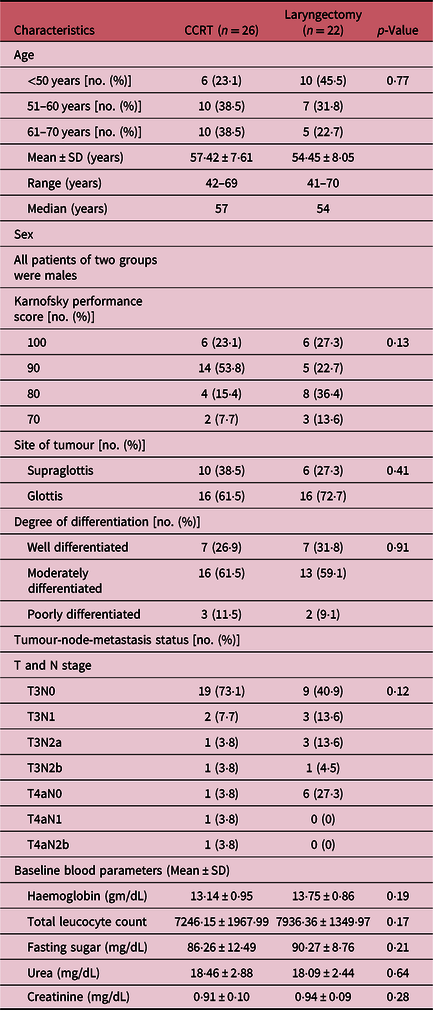
The patients of two groups were matched for all the baseline parameters (Table 2).
Characteristics of the patients according to the treatment groups

Treatment Response
Among total 26 patients of CCRT arm, 24 patients (92·3%) achieved complete response (CR) in terms of both local and nodal diseases. Two patients showed partial response (PR). One among them (stage T4aN2b) had persistent local disease and two persistent lymph nodes (level II and level III). The other patient (stage T3N2a) had persistent local disease. Those two patients with PR underwent salvage laryngectomy.
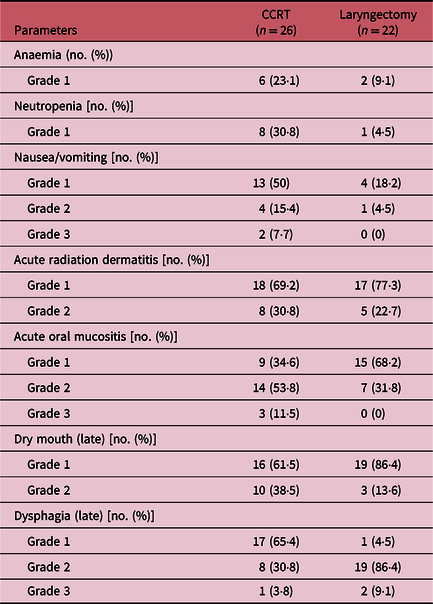
Toxicity Profile (Table 3)
Toxicity profile of two groups

Acute grade 3 toxicities were observed mostly in the form of nausea/vomiting and acute oral mucositis in CCRT patients who received concurrent cisplatin infusion. Grade 2 acute oral mucositis was higher in CCRT patients than Laryngectomy patients.
Grade 1 anaemia and neutropenia occurred more in CCRT group patients than the Laryngectomy group.
Till the last follow-up, maximum grade of late toxicities was mostly of grade 2 in nature. Incidence of grade 3 late toxicity was observed in the form of late dysphagia in one patient (3·8%) of CCRT group and two patients (9·1%) of the Laryngecomy group. However, grade 2 late dysphagia and dry mouth (late) were observed in quite a good percentage of patients of the Laryngecomy group compared with those of the CCRT group.
Decanulation of Tracheostomy Tubes in CCRT Patients
Among the 26 patients of the CCRT group, 8 patients had tracheostomy tubes in situ before the initiation of treatment. After completion of treatment, seven patients had been decannulated. One patient still was tracheostomy tube dependant at the time of last follow-up.
Quality of Life
QoL of patients who were disease-free at 2 years after treatment was analysed. Two patients of the CCRT group who were found to have partial response (PR) were not included in the analysis of the QoL results.
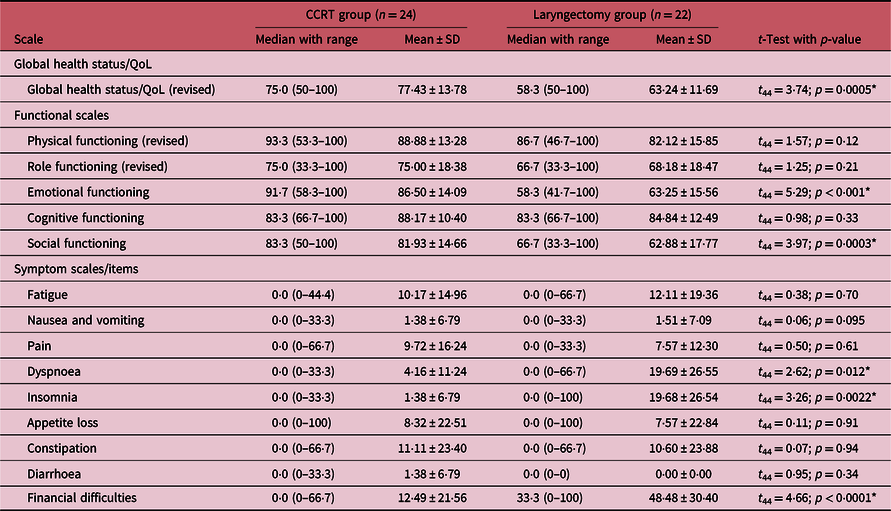
EORTC QLQ-C30 scores (Table 4): In functional scales, the patients of the CCRT group had significantly better emotional and social functioning than those of the Laryngectomy group. In symptom scales, dyspnoea, insomnia and financial difficulties were reported to be significantly more in laryngectomy patients than that of CCRT patients. Global health status is reported to be better in CCRT arm patients.
Comparison of quality of life on the basis of QLQ- C 30

* Statistically significant.
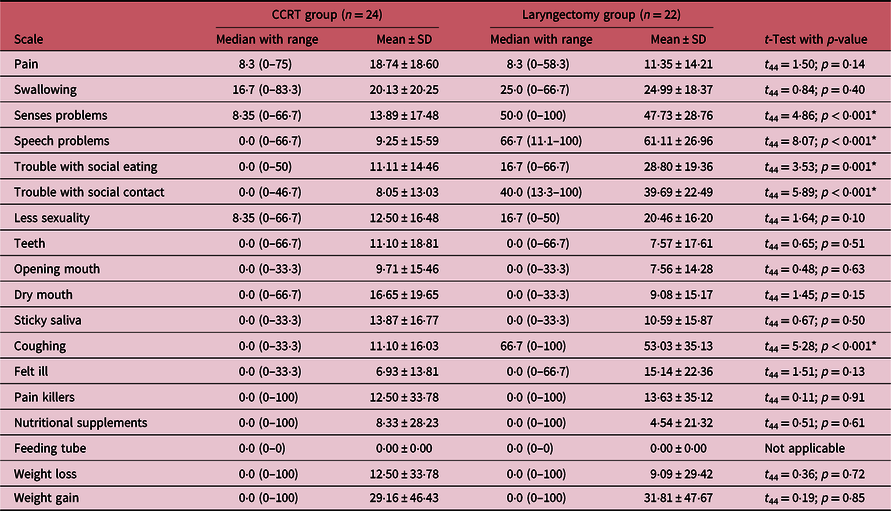
EORTC QLQ-H&N35 scores (Table 5): Laryngectomy patients were more troubled with cough, social eating, social contact, sense problem and speech problem. Some of the results of some important scales, for example, swallowing difficulty, dry mouth and sticky saliva, were found to be not significantly different.
Comparison of quality of life on the basis of QLQ-H & N 35

* Statistically significant.
Discussion
The use of IMRT yielded proper dose conformity and dose delivery to the target volumes and sparing of OARs. SIB technique reduced the overall treatment time. The planning target volume (PTV) margins around the clinical target volume were taken as 0·5 cm. Appropriate and regular verification of patients’ set-up position with the help of once a week imaging helped in proper positioning of the patient. This small PTV margin helped in reduction of treatment volumes hence better OARs sparing.
The CR rate with CCRT (IMRT with SIB) was 92·3%, which is comparable to the literature. Franchin et al. Reference Franchin, Vaccher and Talamini25 achieved 88·5% CR with IMRT-SIB with more toxicities and treatment interruption. The differences may be due to exclusion of patients with N3 (nodes ≥ 6 cm) patients and use of weekly low dose of cisplatin in our study.
Along with the higher CR rate, successful decannulation could also be achieved in seven out of eight patients who had tracheostomy tubes in situ before the start of treatment.
In the era of conventional radiation, patients of locally advanced laryngeal cancer were treated by conventional RT with concurrent chemotherapy. Forastiere et al. Reference Forastiere, Goepfert and Maor1 treated primary tumour with clinically positive nodes with 70 Gy, rest of whole neck with minimum 50 Gy in standard 2 Gy/# schedule with three weekly cisplatin (100 mg/m2) for CCRT arm. They reported high rates of grade 3 and grade 4 haematological, mucosal, dermatological toxicities and nausea/vomiting.
The utility of IMRT-SIB to reduce the toxicities can be supported from the results of a retrospective analysis done by Lee et al. Reference Lee, O’Mearu and Chan9 of patients of laryngeal and hypopharyngeal cancer showing only one grade 3 acute skin toxicity and seven acute oral mucositis. Also, late complications like grade 3 dysphagia were 19·3% (6 out of 31 patients).
In our study, there was no incidence of CTCAE acute grade 4 toxicity. The grade 3 acute toxicities were seen only in a few CCRT patients. The use of smaller dose of cisplatin (40 mg/m2) may be attributable to lower incidence of acute haematological toxicities and nausea/vomiting. The incidence of radiation dermatitis was also of lower grade. Grade 3 late dysphagia was seen only in one CCRT patient (3·84%). But it must be kept in mind that Lee et al. Reference Lee, O’Mearu and Chan9 included hypopharyngeal cancer patients (11 out of 31 patients) also. This might have affected the dysphagia profile of the patients.
Also, the patients of the Laryngectomy group (treated with IMRT technique) developed only low-grade acute toxicities. Only 9·1% patients suffered grade 3 dysphagia.
The ultimate outcome of a treatment modality not only depends on acceptable response rate but also on QoL outcomes. Hanna et al. Reference Hanna, Sherman and Cash26 and Boscolo–Rizzo et al. Reference Boscolo-Rizzo, Maronato, Marchiori, Gava and Mosto27 compared QoL of laryngeal cancer patients treated with organ preserving CCRT and total laryngectomy. Hanna et al. showed that CCRT patients had better social functioning but had more dry mouth. Total laryngectomy patients had more smell and taste disturbances, pain killer use and cough. Boscolo–Rizzo et al. found better scores of physical, role and social scales in CCRT patients. Patients of laryngectomy suffered from more sleep disturbances, dyspnoea and pain.
In our study, the QoL assessment results reflect the status of patients at 2 years after completion of treatment of each patient. There was worse emotional functioning and social functioning in total laryngectomy patients which can be attributed to the loss of larynx (an important organ for voice production). There were more incidences of dyspnoea and insomnia in laryngectomy patients. These could have resulted in relatively low global QoL scores in these patients.
In our study, the Global QoL was better in patients receiving definitive CCRT. Boscolo–Rizzo Reference Boscolo-Rizzo, Maronato, Marchiori, Gava and Mosto27 et al. also found better global QoL in CCRT patients. On the contrary, Hanna et al. Reference Hanna, Sherman and Cash26 did not find any significant difference of global QoL between the two groups. However, Terrel et al. Reference Terrell, Fisher and Wolf28 who did assessment of QoL of long-term survivors of the Veterans Affairs Laryngeal Cancer study patients showed that CCRT patients had better QoL with respect to emotional function, depression and pain.
Financial difficulties were found to be significantly more in laryngectomy patients. It could have also affected the Global QoL of laryngectomy patients.
In the results of data analysis of questionnaire (QLQ-H&N35), it was seen that sense problems (taste and smell) were significantly more in total laryngectomy patients. Although the speech problems in total laryngectomy patients were significantly higher than that of definitive CCRT patients, it must be kept in consideration that only 1 patient out of 22 patients who had laryngectomy underwent voice prosthesis insertion.
Dry mouth scores in our study were not significantly different between two groups. Hanna et al. Reference Hanna, Sherman and Cash26 and Boscolo–Rizzo et al. Reference Boscolo-Rizzo, Maronato, Marchiori, Gava and Mosto27 found that dry mouth was more problematic in patients of CCRT arm. This difference in findings may be due to the use of IMRT as RT modality in our study. IMRT was used in all patients thus reducing the problem of dry mouth (at 2 years of follow-up). The use of IMRT as the RT technique allows sparing the parotid glands from receiving higher dosage of radiation (Figure 2). This parotid sparing effect of IMRT attributed to the lesser incidence of dry mouth and sticky saliva in the patients. Sticky saliva was found to be more problematic in CCRT arm patients by one Reference Boscolo-Rizzo, Maronato, Marchiori, Gava and Mosto27 of the above two studies. In our study, though the incidence of grade 2 dry mouth (late) was more in definitive CCRT patients (38·5% of patients) than that of laryngectomy patients (13·6% of patients), over a time period there was recovery of the salivary function. So, at 2 years of follow-up, the lower scores of dry mouth and sticky saliva in symptom scales in all the patients and no significant difference of these scales between the two groups can be attributed to the use of IMRT.
The main limitation of our study is that although it shows IMRT-SIB as a feasible option for these patients with respect to response, toxicity and QoL, it is primarily a retrospective study. From the perspective of QoL comparison among these two groups, a prospective randomised study would be the best option to draw definite conclusion with QoL at baseline and 1 and 2 years. Out of the three T4a patients in the CCRT group, two patients had a CR and were disease-free at the last follow-up. The Laryngectomy group had six T4a patients who continue to be disease-free. We need to undertake a prospective randomised preferably a multi-institutional study with a large sample size including T4a patients to establish the role of IMRT in this setting, and a longer follow-up would be required to comment upon disease-free and overall survival. The standard of care for T4a patients continues to be TL and PORT.
Conclusion
Hence, definitive CCRT with IMRT-SIB is a feasible option for the patients of locally advanced laryngeal cancer with an acceptable response rate. CCRT patients score better in terms of several QoL parameters than laryngectomy patients. IMRT also yields better toxicity outcomes with sparing of OARs.
Considering these findings and the very manageable toxicity profile of our patients, we can consider offering CCRT with IMRT to the patients of locally advanced laryngeal cancer to preserve an important organ of our body—the larynx.
Acknowledgements
The authors thank all the patients, resident doctors, medical physicists, radiotherapy technologists and the nursing officers of Department of Radiation Oncology and Head and Neck Oncology, Chittaranjan National Cancer Institute, Kolkata, India.