Introduction
The current trend of demographic ageing in developed countries is expected to put pressure on pension systems, particularly in countries where reproduction rates are low. This has led to policy reforms aimed at increasing the labour-force participation of older workers (Cooke Reference Cooke2006). Early retirement schemes have been made financially less attractive in order to increase the age at retirement. It is still unknown whether retirement and the age at which persons retire affect health. This is relevant for the employees themselves but also for policy makers, since the health consequences may aggravate or alleviate pressures on the health-care system.
The Retirement Adjustment theory (Atchley Reference Atchley1976) has often been used to explain the effect of retirement on various aspects of health (e.g. Bossé et al. Reference Bossé, Aldwin, Levenson and Ekerdt1987; Haynes, McMichael and Tyroler Reference Haynes, McMichael and Tyroler1978; Kim and Moen Reference Kim and Moen2002; Reitzes, Mutran and Fernandez Reference Reitzes, Mutran and Fernandez1996). According to this theory, retirees need to adjust to retirement, which essentially entails adjusting to the loss of a job and income. If difficulties in adjustment arise, health may be influenced negatively. For instance, difficulties in adjustment may cause psychological stress or lead to unhealthy behaviours. Conversely, if adjustment is easy, retirement potentially has a positive influence on health. Retirement often increases leisure time enabling retirees to pursue their own interests. Moreover, it is postulated that retirees are better able to adhere to medical advice, such as taking sufficient rest, maintaining a healthy diet, and taking exercise (Ekerdt, Bossé and LoCastro Reference Ekerdt, Bossé and LoCastro1983; Tsai et al. Reference Tsai, Wendt, Donnelly, De Jong and Ahmed2005).
The level of adjustment difficulties experienced by retirees, if any, is affected by various individual and contextual characteristics. For instance, adjustment may be more difficult for persons who worked more hours per week, because their job occupied a large part of their lives (Van Solinge and Henkens Reference Van Solinge and Henkens2005). In addition, Reitzes and Mutran (Reference Reitzes and Mutran2004) showed that persons with high self-esteem before retirement are more likely to have a positive attitude toward retirement. Moreover, the age at which retirement takes place might complicate or foster adjustment. Retirement is subject to ‘social timing’ (Settersten and Hagestad Reference Settersten and Hagestad1996). The age at which persons most often retire is perceived as ‘on time’ retirement. Retirement that is ‘off time’ might give rise to perceptions of involuntary retirement (Szinovacz and Davey Reference Szinovacz and Davey2005), because it may create unfavourable social comparisons with age peers who continued employment (Van Solinge and Henkens Reference Van Solinge and Henkens2007).
The national context in part determines the age at which retirement is perceived ‘on time’. In the Netherlands, retirement is mandatory at the age of 65. However, early retirement schemes were very common in the 1980s and 1990s. From the mid-1990s, efforts were made to decrease the number of early retirees. Still, retirement after the age of 60 was very uncommon, for instance because early retirement remained fiscally supported up to 2006. Between 1990 and 2002, the lowest average age at retirement for Dutch men was reported in 1993 of 60.3 years and the highest in 1998 of 61.6 years (Van Nimwegen and Beets Reference Van Nimwegen and Beets2006). The majority still retire before the mandatory age of retirement. The average age at retirement has increased to 62.1 in 2007 for Dutch men (Otten et al. Reference Otten, Arts, Siermann, Ybema, Sanders, Lautenbach, Smulders and Dirven2010). Since the majority of Dutch employees retire around the age of 60, persons perceive this retirement age as ‘on time’ (Van Solinge and Henkens Reference Van Solinge and Henkens2007). Retirement before the age of 60 might give rise to perceptions of involuntary retirement (Van Solinge and Henkens Reference Van Solinge and Henkens2007). This might lead to adjustment problems (Van Solinge and Henkens Reference Van Solinge and Henkens2008). In sum, the Retirement Adjustment theory (Atchley Reference Atchley1976) suggests that retirement might have an effect on health, but it depends on the level of adjustment difficulties. In addition, the age at retirement might be predictive of the level of adjustment difficulties that may arise.
To explore the effect of retirement and age at retirement on health in general, self-perceived health is a suitable measure because it provides a summary of the diverse components of health. It shows to be a subjective measure of health and closely linked to quality of life (Deeg and Bath Reference Deeg and Bath2003; Jylha Reference Jylha2009). In addition, self-perceived health predicts objective health measures, such as mortality (DeSalvo et al. Reference DeSalvo, Bloser, Reynolds, He and Muntner2006; Idler and Benyamini Reference Idler and Benyamini1997), physical disability (Idler and Kasl Reference Idler and Kasl1995), and health-care utilisation (DeSalvo et al. Reference DeSalvo, Fan, McDonell and Fihn2005; Wolinsky et al. Reference Wolinsky, Culler, Callahan and Johnson1994). Various studies have addressed the general effect of retirement on self-perceived health, showing either no effect (Ekerdt and Bossé Reference Ekerdt and Bossé1982; Ekerdt, Bossé and LoCastro Reference Ekerdt, Bossé and LoCastro1983; Mojon-Azzi, Sousa-Poza and Widmer Reference Mojon-Azzi, Sousa-Poza and Widmer2007) or a positive effect (Gall, Evans and Howard Reference Gall, Evans and Howard1997; Van Solinge Reference Van Solinge and Henkens2007). Studies aimed specifically at the effect of age at retirement on self-perceived health are scarce and also show conflicting results. Mojon-Azzi, Sousa-Poza and Widmer (Reference Mojon-Azzi, Sousa-Poza and Widmer2007) compared retirees with persons who continued employment in Switzerland between the age of 55 and 75 years and found no effect of age at retirement on self-perceived health. In a French study, Westerlund et al. (Reference Westerlund, Kivimaki, Singh-Manoux, Melchior, Ferrie, Pentti, Jokela, Leineweber, Goldberg, Zins and Vahtera2009) investigated age at retirement, excluding persons who retired for health reasons. They showed that persons who retired at the age of 55 or higher benefited less from retirement regarding their self-perceived health compared to retirement before the age of 55. These studies were performed in different countries. The age at which retirement is considered to be ‘on time’ therefore differs, which may clarify the conflicting results. In addition, various individual and contextual characteristics have been shown to be of importance to isolate the effect of retirement (e.g. Gall, Evans and Howard Reference Gall, Evans and Howard1997; Reitzes and Mutran Reference Reitzes and Mutran2004; Van Solinge Reference Van Solinge and Henkens2007; Wang Reference Wang2007), some studies have either not taken these characteristics into account (e.g. Mojon-Azzi, Sousa-Poza and Widmer Reference Mojon-Azzi, Sousa-Poza and Widmer2007) or studied a different selection of characteristics (e.g. Ekerdt, Bossé and LoCastro Reference Ekerdt, Bossé and LoCastro1983; Westerlund et al. Reference Westerlund, Kivimaki, Singh-Manoux, Melchior, Ferrie, Pentti, Jokela, Leineweber, Goldberg, Zins and Vahtera2009), consequently leading to conflicting results.
The aim of the present study is to examine the effect of retirement and age at retirement on self-perceived health. This is done by first exploring the influence of individual and contextual characteristics on retirement in order to isolate the true effect of retirement. Second, the effect of age at retirement is examined, adjusted for the characteristics that may influence retirement and self-perceived health. The study sample consists of participants of the Longitudinal Aging Study Amsterdam (LASA) who retire between the ages 55 and 64 years and a control group of age peers who continue employment.
Individual and contextual characteristics
Various individual and contextual characteristics are studied that may influence retirement or self-perceived health. Four groups of characteristics can be identified from the literature: demographic, health, psychological, and job/retirement characteristics.
It is suggested that men and women experience different levels of adjustment difficulties. Retirement may be experienced differently by men and women because of different work histories and opportunities (Kim and Moen Reference Kim and Moen2002; Reitzes and Mutran Reference Reitzes and Mutran2004). Having a partner during the retirement transition may determine how the time after retirement will be spent. Hilbourne (Reference Hilbourne1999) shows that although retirement provides the prospect of spending more time together, persons fear a lack of personal space and independence. Such pre-retirement fears about the relationship with the partner have shown to predict adjustment difficulties (Van Solinge and Henkens Reference Van Solinge and Henkens2007). It is furthermore suggested that being a parent could provide social support, which aids adjustment to retirement (Reitzes and Mutran Reference Reitzes and Mutran2004). A higher education might aid in retirement adjustment, because it may ‘provide individuals with the social skills and self-direction to appreciate the opportunities in retirement’ (Reitzes and Mutran Reference Reitzes and Mutran2004). The average age at which retirement takes place is influenced by retirement policies, which in turn are influenced by economic developments. Because of fluctuations in the average age at retirement, the period in which retirement takes place needs to be considered when age at retirement is studied.
An essential characteristic in evaluating directions and magnitudes of health change during the retirement transition is the health status prior to retirement (Ekerdt and Bossé Reference Ekerdt and Bossé1982). Self-perceived health, chronic diseases, mobility problems, and instrumental limitations in daily activities may lead to early retirement (e.g. Van den Berg et al. Reference Van den Berg, Elders and Burdorf2010). As a consequence, poor health may be present after retirement. In contrast, poor baseline health may lead to an improvement in health by the relief from work stress (Mojon-Azzi, Sousa-Poza and Widmer Reference Mojon-Azzi, Sousa-Poza and Widmer2007).
Psychological characteristics possibly act as a resource in retirement adjustment. Persons with a high self-esteem before retirement are more likely to have a positive attitude toward retirement, which could help them in adjustment (Reitzes and Mutran Reference Reitzes and Mutran2004). In addition, those who feel they are in control over their life (i.e. those with high mastery) are thought to be better able to adjust to any life event because they have the confidence to manage the life event (Gall, Evans and Howard Reference Gall, Evans and Howard1997; Krause and Stryker Reference Krause and Stryker1984). Coinciding life events tend to amplify the distress experienced and thus enhance a negative influence on health (Van Solinge Reference Van Solinge and Henkens2007). To isolate the effect of retirement on health, self-esteem, mastery, and coinciding life events thus need to be considered.
Regarding job and retirement characteristics, it is first of all important to consider the different pathways into retirement, besides mandatory retirement. After job loss, registration at an unemployment office may, on the one hand, indicate that the person is searching for a job and did not intend to retire. On the other hand, it may be utilised as an early pathway into retirement. Some persons retire due to health reasons and receive disability pensions. Therefore, receiving a disability pension before or after retirement might be an indicator for health selection into retirement (Brockmann, Müller and Helmert Reference Brockmann, Müller and Helmert2009). Additional job and retirement characteristics that should be explored are number of hours worked, occupational prestige, retirement planning, duration of retirement, and level of income. When persons worked more hours a week, employment occupied a large part of their lives, which is thought to make adjustment to retirement more difficult (Van Solinge and Henkens Reference Van Solinge and Henkens2005). Jobs offer a certain prestige. Retirement from a high-prestige job might be experienced as a great loss, which may cause adjustment difficulties (Van Solinge Reference Van Solinge and Henkens2007). Before retirement takes place, carefully planning activities and goals for retirement could help the retiree adjust by decreasing possible negative expectations and fears about retirement (Wang Reference Wang2007). The time that has passed since retirement may be relevant, because the ability to adjust to retirement varies over time (Atchley Reference Atchley1976). Finally, adjustment difficulties may be limited by a high income, because it may enable retirees to participate in more social and leisure activities (Reitzes and Mutran Reference Reitzes and Mutran2004).
Method
Sample
The LASA study is a continuing cohort study focusing on predictors and consequences of changes in autonomy and wellbeing in the ageing population in the Netherlands (Deeg, Knipscheer and Van Tilburg Reference Deeg, Knipscheer and Van Tilburg1993). In short, a sample of older men and women, aged 55–85 years, stratified by age and sex according to expected five-year mortality, was drawn from population registries in 11 municipalities in three geographical regions of the Netherlands. Respondents had given their informed consent and underwent face-to-face interviews at home. In total, 3,107 predominantly Caucasian (>99%) respondents were enrolled in the baseline examination in 1992–93. Follow-up measurements took place in 1995–96, 1998–99, 2001–02, 2005–06, and 2008–09. A second birth cohort of 1,002 respondents was added in 2002 (aged 55–64) from the same sampling frame as the original birth cohort from 1992. Data collection for this cohort took place in 2002–03 and 2005–06. The sampling, data collection procedures and non-response have been described in detail elsewhere (Huisman et al. Reference Huisman, Poppelaars, Van der Horst, Beekman, Brug, Van Tilburg and Deeg2011).
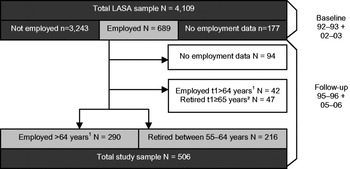
For our study, data from the first (N=3,107) and second (N=1,002) birth cohort were pooled (N=4,109). Data of 1992–93 and 2002–03 were considered baseline data (t1). Data from 1995–96 and 2005–06 were considered as follow-up data (t2). In the Netherlands, being employed is often defined as having a paid job of eight hours or more weekly. Accordingly, respondents who had a paid job of eight hours or more weekly were considered to be employed. At baseline, 689 of the 4,109 respondents enrolled in LASA had a paid job of eight hours or more per week, 3,243 were not employed, and 177 had no employment data, as illustrated in Figure 1. At follow-up, 94 of the 689 employed respondents had no employment data. Because 65 is the mandatory retirement age in the Netherlands, the group that does not retire by this age is not representative of older workers. For this reason, we included those who retired at follow-up before the age of 65 years (N=216), thereby excluding 47 respondents. As a control group, we included age-peers who continued employment at follow-up. By doing so, we were able to disentangle age and retirement effects. The control group was matched on age at baseline (range 55–63 years) with the respondents who retired before the age of 65 years (N=290). This procedure resulted in exclusion of 42 respondents who continued employment. In all, our analytic sample included 506 respondents.
LASA respondents who retired or continued to be employed between t1 and t2.
Notes: t1: baseline. t2: follow-up. Employed: had a paid job of eight hours or more per week at t1 and t2. Retired: no paid job of eight hours or more per week at t2. 1. Respondents who were employed at t1 and t2 were matched on age at t1 with respondents who retired before the age of 65 years. 2. Respondents who retired before the age of 65 were studied.

Dependent variable
Self-perceived health was measured with the question ‘How do you rate your health in general?’ and was coded as excellent (1), good (2), fair (3), sometimes good/sometimes poor (4) and poor (5). Because of the low number of respondents who scored fair, sometimes good/sometimes poor, and poor, baseline and follow-up self-perceived health were categorised into excellent (0), good (1) and less than good (2).
Independent variables
Retirement status
Retirement was defined as having a paid job of eight hours or more weekly at baseline and not having a paid job of eight hours or more weekly after three years of follow-up. Employed respondents had a paid job of eight hours or more per week at baseline and follow-up. Retirement status was categorised into retired (0) and employed (1).
Age at retirement
Age at retirement was calculated by using month and year of birth and month and year of retirement. The exact day of retirement was not assessed in LASA. For 37 respondents who retired, data on the month and/or year of retirement were missing. However, dates of the interviews were known and approximately three years separated two waves of data collection. Therefore, one and a half years before the date of the last interview was imputed for the missing value of the date of retirement (age at follow-up −1.5). Similar to imputation for missing data for age at retirement, age at employment was determined as: age at follow-up −1.5 years. The association between age at retirement/employment and self-perceived health at follow-up appeared to be non-linear. Age at retirement was categorised into three age-groups. On the one hand, the categories were based on the age at which retirement was considered to be on time (i.e. around the age of 60). On the other hand, the categories were based on approximate frequency tertiles to include as much information as possible and avoid potential power-issues caused by the small study sample. The categories were ‘early’ (55–58), ‘modal’ (59–60) and ‘late’ (61–64). Note that respondents who retired at the mandatory age at retirement, that is the day before turning 65 years, were also included in the ‘late’ age group.
Control variables
To test for a spurious effect of retirement on self-perceived health at follow-up, various individual and contextual characteristics were explored as control variables. If a control variable was not linearly associated with self-perceived health at follow-up they were divided into frequency tertiles.
Demographic characteristics
Gender, baseline and follow-up partner status (partner/no partner), and parenthood (children/no children) were included. Level of education was categorised into low (i.e. elementary school or less), medium (i.e. lower vocational, general intermediate, intermediate vocational and general secondary education), and high (i.e. higher vocational education, college and university). Since data of subjects who retired between 1992–93 and 1995–96 (period 1) or 2002–03 and 2005–06 (period 2) were pooled, a variable was included to indicate period of retirement.
Health characteristics
Baseline self-perceived health, number of chronic diseases and physical performance were explored as baseline health indicators. The presence of seven self-reported major chronic diseases was ascertained based on their prevalence (>5%) in the 55+ age group in the Netherlands (Kriegsman et al. Reference Kriegsman, Penninx, Van Eijk, Boeke and Deeg1996): chronic obstructive pulmonary disease, cardiac disease, peripheral arterial disease, stroke, diabetes mellitus, rheumatoid arthritis/osteoarthritis and cancer. The number of chronic diseases was categorised into 0, 1 and 2–4 chronic diseases. Physical performance consisted of a summed score of measures of walking speed, ability to rise from a chair, and putting on and taking off a cardigan (Penninx et al. Reference Penninx, Deeg, Van Eijk, Beekman and Guralnik2000), and ranged from 3 (low) to 15 (high) in our sample.
Psychological characteristics
Self-esteem was assessed based on the statement ‘I am satisfied with myself’. Response categories ranged from strongly disagree (1) to strongly agree (5). Mastery is the extent to which a person has the feeling of being in control of his or her life and was assessed by using a shortened version of the Pearlin and Schooler Mastery scale (1978), which consisted of five items. Response categories for each item ranged from strongly agree (1) to strongly disagree (5). Baseline mastery ranged from 8 (low feelings of mastery) to 25 (high feelings of mastery). Life events that occurred between baseline and follow-up were examined. The composite score for distress caused by life events was composed by differentially weighting life events. Weights for stressfulness were derived from Tennant and Andrews (Reference Tennant and Andrews1976). Examples of life events and the coinciding distress score are widowhood (+83) and victim of crime (+9). Based on frequency tertiles, the life events distress score was categorised into 0 (no life events), 5–16 (some distress) and 17–143 (high distress).
Job and retirement characteristics
At baseline and at follow-up, respondents were asked if they received a disability pension (no/yes). To study the influence of receipt of a disability pension, a variable was computed which distinguished between receipt of a disability pension at either baseline or follow-up (yes) or no disability pension at baseline and follow-up (no). At follow-up, respondents were asked if they were registered at the unemployment office as unemployed or looking for a job (no/yes). At baseline, respondents were asked how many hours they worked per week (range 8–100). Occupational prestige was determined according to a scale developed by Sixma and Ultee (Reference Sixma, Ultee, Bakker, Dronkers and Ganzeboom1984) and respondents scored 13 (low) to 78 (high). Retirement planning was asked using the question ‘Are you anticipating in the things you do that you will retire within some time?’ (no/yes). The time that has passed since retirement was calculated by using the date of retirement and of the interview at follow-up. It was categorised into 0–15, 16–23 and 24–47 months, based on frequency tertiles. According to frequency tertiles, baseline income was categorised into low (233–1,584 euros), medium (1,585–2,450 euros) and high (2,451–4,763 euros). Follow-up income ranged from 510 to 4,276 euros. To compare baseline and follow-up income, follow-up income was categorised according to the baseline categories. Household income in 1992–93 and 1995–96 was converted from guilders to euros by dividing income by 2.2. To adjust for inflation, income was increased by 3 per cent for every year earlier in the study. For participants with a partner living in the household, household income was multiplied by 0.7 to be able to compare their income with a one-person household income (Koster et al. Reference Koster, Bosma, Broese van Groenou, Kempen, Penninx, van Eijk and Deeg2006).
Missing values for baseline income (N=56) were imputed by the median value of income at baseline, determined for men and women separately. When data were missing for one of the other covariates, the category missing was assigned and excluded from the analysis.
Data analyses
Differences in control variables between retired and employed respondents were tested by applying t-tests for continuous variables and Chi-square tests for categorical variables. Between age groups for retired and employed respondents, differences were tested by applying one-way analysis of variance (ANOVA) for continuous variables and Chi-square tests for categorical variables.
To examine the effect of retirement compared to continued employment on self-perceived health at follow-up, multinomial logistic regression analysis was applied. The outcome category ‘less than good’ self-perceived health was the reference category. The effect of age at retirement was examined by testing for an effect-modifying influence of age at retirement. For an improved interpretation of the effect of retirement and age at retirement, baseline self-perceived health and period of retirement were first controlled for (Model 1). Baseline self-perceived health may influence the direction and magnitude of self-perceived health at follow-up. Period of retirement was controlled for because the average age at retirement has changed in the last decades.
Subsequently, control variables were tested. Because little was known about the influence of these characteristics, they were tested for effect-modifying as well as confounding or suppressing influence. Confounding and suppressing influence was tested according to the three following criteria. First, by applying logistic regression analysis, control variables were tested for an association with retirement status (criterion: p<0.20). Second, confounding influence was determined if an association (p<0.20) with self-perceived health at follow-up was found, which was tested by applying multinomial logistic regression. Third, after including the covariate into Model 1, the regression coefficient of retirement status had to increase (suppressing) or decrease (confounding) by at least 10 per cent. The control variable that showed the largest percentage of change was then added to the model first and the remaining control variables were then tested again according to the three criteria until all relevant confounders and suppressors were included in Model 2.
Age at retirement and the control variables were tested for effect-modifying influence by adding an interaction term with retirement status to Model 2. Continuous covariates were first centred around the mean and added as a centred variable to the interaction term. If the interaction term was (borderline) significantly (p<0.10) associated with self-perceived health at follow-up, the results of Model 2 were shown in strata of the effect modifier for both retirement and age at retirement. If a continuous covariate showed to be an effect modifier, the covariate was stratified in frequency tertiles.
The confounding, suppressing or effect-modifying influence of registration at an unemployment office and time since retirement could not be tested in the full sample, because there were no data on these characteristics among the employed respondents. Therefore, as a sensitivity analysis, we excluded respondents who were registered at an unemployment office (N=22) and tested the effect of retirement and age at retirement again. For the same reason, respondents who were retired for 0–15 months were excluded (N=85) and the effect of retirement and age at retirement was tested again.
Although we adjusted for baseline self-perceived health, regression to the mean may have influenced our results. Therefore, as an additional sensitivity analysis we applied ANCOVA, which is a longitudinal technique and accounts for regression to the mean (Barnett, Van der Pols and Dobson Reference Barnett, Van der Pols and Dobson2005). Finally, a sensitivity analysis was performed to examine whether our results were distorted by imputing data for age at retirement. We examined whether health, job and retirement characteristics differed between retirees with and without missing data on date of retirement.
Results
Sample characteristics
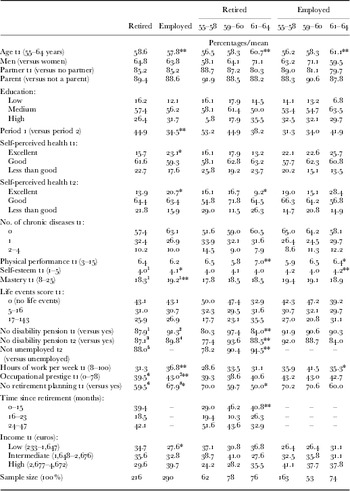
Whether retired (N=216) and continuously employed (N=290) respondents differed regarding demographic, health, psychological, job and retirement characteristics (Table 1) are first discussed. Second, differences between the three age groups early (55–58), modal (59–60) and late (61–64) are discussed within retired respondents and finally within employed respondents.
Dependent, independent and control variables for retired and employed persons and according to age groups

Notes: t1: baseline. t2: follow-up. Period 1: 1992–93, 1995–96. Period 2: 2002–03, 2005–06. Column percentages are shown. The range of continuous variables is given in parentheses. Data were missing for: 1. N=2; 2. N=4; 3. N=15; 4. N=24; 5. N=33; 6. N=11; 7. N=30; 8. N=13 respondents.
Significance levels: * p < 0.10, ** p < 0.05.
Compared to respondents who continued employment, retirees were on average significantly older at baseline (t1). The majority of both retired and employed respondents were male, had a partner at baseline, had children and had attained a medium level of education. Between 1992 and 1996, significantly fewer respondents continued employment, which reflects the generally lower employment rates in this period compared to the period between 2002 and 2006. Regarding health and psychological characteristics, the results demonstrate that retirees were slightly less healthy and had lower scores on psychological characteristics. Retirees had significantly poorer self-perceived health at baseline and follow-up (t2), significantly lower levels of self-esteem, and borderline significantly lower levels of mastery. Besides retirement, retirees and employed respondents experienced on average the same number of life events. Moreover, a larger part of retired respondents received a disability pension at baseline, although not significantly larger compared to employed respondents. Retirees worked fewer hours per week, had a job with a lower occupational prestige, more often planned to retire at baseline, and more often received a low income compared to employed respondents. Note that among the continuously employed, by definition no unemployment registration and no time since retirement is available.
Mean age at baseline differed between the three age groups of retirees, which can be expected. Compared to the other age groups, modal retirees had significantly lower mean physical performance scores at baseline, but borderline significantly better self-perceived health scores at follow-up. Results further show that early retirees more often received a disability pension at baseline and follow-up and most often were registered at an unemployment office. This indicates that if retirement through disability and unemployment schemes occurred, it most often took place at an early age. Moreover, early retirees were borderline significantly less often planning to retire within the next three years and early retirees have been retired the longest at follow-up, namely 24–47 months.
Besides age at baseline, no differences are found for demographic characteristics between the age groups for employed respondents. Respondents who remained employed at an early age had lower physical performance scores than the other age groups, although borderline significant. Those who continued employment at modal age had a significantly lower self-esteem and worked more hours per week compared to early and late employed respondents (borderline significantly). Finally, late employed respondents more often received lower income, whilst early employed more often received a high income.
Effect of retirement and age at retirement on self-perceived health at follow-up
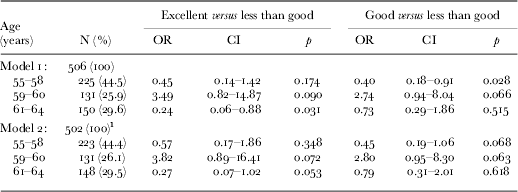
The multinomial logistic regression analyses show odds ratios which indicate the effect of retirement compared to continued employment on self-perceived health. Moreover, two comparisons are made: ‘excellent’ compared to ‘less than good’ self-perceived health and ‘good’ compared to ‘less than good’ self-perceived health. No significant effect of retirement on self-perceived health is found, adjusted for baseline self-perceived health, period of retirement and age at retirement (Model 1; Table 2). Only baseline mastery proves to be a confounder. After including baseline mastery, the effect of retirement status on self-perceived health remains non-significant (Model 2; Table 2).
Effect of retirement compared to continued employment on self-perceived health at follow-up

Notes: Model 1 is adjusted for baseline self-perceived health, period of retirement and age at retirement. Model 2 is additionally adjusted for baseline mastery. 1. Data were missing for baseline mastery (N=4). OR: odds ratio. CI: confidence interval.
Age at retirement proves to be an effect modifier. We therefore stratified according to age groups and adjusted for baseline self-perceived health and period of retirement. The results show that age at retirement has significant but disparate effects on self-perceived health (Model 1; Table 3). Respondents who retired early compared to age peers who continued employment have a lower odds of attaining a good as opposed to less than good self-perceived health. Respondents who retired late have a lower odds of attaining an excellent self-perceived health. On the other hand, respondents who retired at the modal age have a higher odds of attaining both excellent and good self-perceived health, although these effects were only borderline significant. After adjusting for baseline mastery, the effect for early and late retirement is borderline significant and the odds ratios are somewhat weaker (Model 2; Table 3). This indicates that mastery in part explains the unfavourable effect of retirement in these age groups. However, the favourable effect of retirement at modal age remains borderline significant.
Effect of age at retirement compared to age peers who continued employment on self-perceived health at follow-up
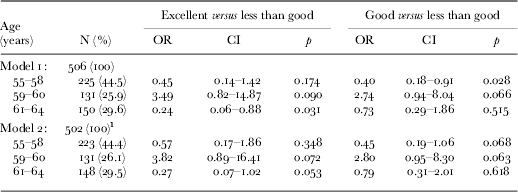
Notes: Model 1 is adjusted for baseline self-perceived health and period of retirement. Model 2 is additionally adjusted for baseline mastery. 1. Data were missing for baseline mastery (N=4). OR: odds ratio. CI: confidence interval.
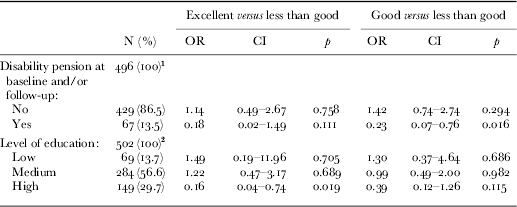
Two additional effect modifiers are identified: receipt of a disability pension and attained level of education (Table 4). We only present results adjusted for baseline mastery, since the results without adjustment reveals similar and also significant results. Compared to respondents who continued to work, retired respondents who received a disability pension at baseline and/or follow-up have a significantly lower odds of experiencing excellent or good self-perceived health compared to a less than good self-perceived health at follow-up, even after adjusting for baseline self-perceived health. Higher-educated respondents also have a significantly lower odds of experiencing excellent self-perceived health after retirement compared to respondents who continued to work.
Effect of retirement compared to continued employment on self-perceived health at follow-up stratified according to receipt of disability pension and level of education
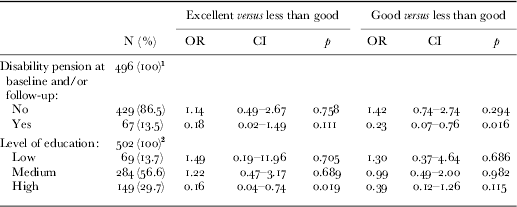
Notes: Results are adjusted for baseline self-perceived health, period of retirement, age at retirement and baseline mastery score. 1. Data were missing for baseline mastery (N=4) and disability pension (N=6). 2. Data were missing for baseline mastery (N=4). OR: odds ratio. CI: confidence interval.
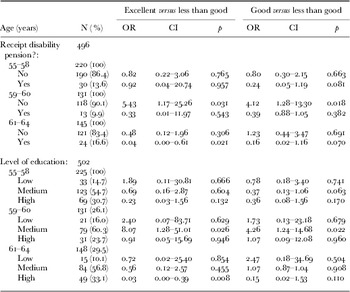
Table 5 reveals that the effect we find for early and late retirement is explained by receipt of a disability pension. Compared to age peers who continued employment, respondents who retired early or late only have a borderline significantly lower odds of attaining a good self-perceived health if they received a disability pension at baseline and/or follow-up. In addition, persons who retired at a late age have a significantly lower odds to attain an excellent self-perceived health. In contrast, stratifying for receipt of a disability pension does not explain the results we find for respondents who retired at modal age. Furthermore, stratification for education shows that respondents who retired early have a borderline significantly lower odds of a good self-perceived health, only if they had a medium level of education. Similarly, the effect we found for modal retirees is apparent only in respondents with a medium level of education. For respondents who retired at a late age, the effect is now only significant for higher educated.
Effect of age at retirement compared to age peers who continued employment on self-perceived health at follow-up, stratified according to receipt of disability pension and level of education

Notes: Results shown are adjusted for baseline self-perceived health, period of retirement, age at retirement and baseline mastery score. 1. Data were missing for baseline mastery (N=4) and disability pension at baseline or follow-up (N=6). If respondents were aged 65 or higher at follow-up, their follow-up disability status was coded according to baseline disability status. 2. Data were missing for baseline mastery (N=4). OR: odds ratio. CI: confidence interval.
After excluding respondents who were registered at an unemployment office, the effect of retirement and of age at retirement on self-perceived health shows similar odds ratios and significance levels. Similar odds ratios are also seen after excluding respondents who retired recently (0–15 months), although the effect is no longer significant. However, a large group of respondents was excluded (N=85), so a lack of power most likely explains why no effect is seen. Therefore, we conclude that registration at an unemployment office and the time that has passed since retirement does not influence the results.
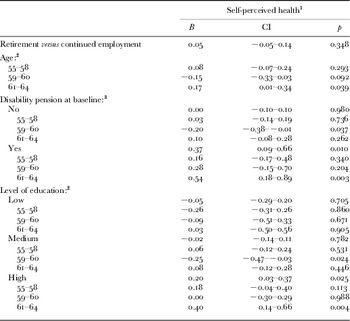
The ANCOVA analysis shows similar effects for retirement, receipt of a disability pension and level of education (Table 6). The effect found for early retirees with a medium level of education, however, is no longer significant. For age at retirement, similar results are seen as well. Respondents who retired at early and late ages had a worse self-perceived health at follow-up, whilst respondents who retired at modal ages had a better self-perceived health at follow-up compared to respondents who continued employment. However, only the effect for late retirees is significant and the effect for modal-aged retirees is borderline significant. Thus, when using a longitudinal analysis method that adjusts for regression to the mean, the self-perceived health of early retirees does not differ significantly from employed respondents. From the sample characteristics, it can furthermore be inferred that the same number of early retirees have excellent, good and less than good self-perceived health at baseline and follow-up. Although individual change in self-perceived health might still have occurred, no evidence is provided for regression to the mean for retirees. However, for employed respondents we did find more respondents at baseline with excellent and less than good self-perceived health compared to at follow-up. Since some respondents with excellent self-perceived health appear to have moved to good self-perceived health, this suggests regression to the mean, which may explain why we did not find an effect for early retirement by applying ANCOVA analysis.
Effect of retirement compared to continued employment on self-perceived health at follow-up for the age groups, level of education and disability pension at baseline

Notes: Results are adjusted for baseline self-perceived health, period of retirement and baseline mastery score. Results for retirement, disability pension and level of education are additionally adjusted for age at retirement. 1. 1=excellent to 3=less than good. 2. Data were missing for baseline mastery (N=4). 3. Data were missing for baseline mastery (N=4) and baseline disability pension (N=3). CI: confidence interval.
Persons with missing data for date of retirement were older and worked fewer hours before retirement (not tabulated). However, health status (baseline physical performance, baseline number of chronic diseases, self-perceived health at baseline and follow-up) did not differ between respondents with and without data of the date of retirement, so we conclude that imputing the date of retirement does not influence our results.
Discussion
Our aim was to study the effect of retirement and age at retirement on self-perceived health after up to three years. First, the influence of individual and contextual characteristics on retirement compared to continued employment is examined, to isolate the effect of retirement. Our results reveal that, although no main effect is found for retirement on self-perceived health, mastery before retirement, level of education and receipt of a disability pension influences the effect. Second, we examined the effect of age at retirement. The results demonstrate that early (age 55–58) retirees are less likely to have a good self-perceived health and late retirees (age 61–64) are less likely to have an excellent self-perceived health, although this effect is explained by receipt of a disability pension. Conversely, persons who retire at modal ages (59–60 years) are more likely to have an excellent and a good self-perceived health compared to age peers who continue employment.
The effect of age at retirement is first discussed, followed by the discussion of individual and contextual characteristics, and finally the limitations and strengths. Our results reveal that only persons who retire at modal ages are more likely to experience a good or an excellent self-perceived health after retirement. This may be explained by the fact that a small number of the modal retirees received a disability pension at baseline or follow-up compared to early and late retirees, suggesting it is likely that modal-aged retirees have retired in good health. Nevertheless, of those who did not receive a disability pension, only persons who retired at modal age improved after retirement. This result substantiates the idea that retirement around the age of 60 may be considered as ‘on time’ in the Netherlands (Settersten and Hagestad Reference Settersten and Hagestad1996; Szinovacz and Davey Reference Szinovacz and Davey2005; Van Solinge and Henkens Reference Van Solinge and Henkens2007).
Our results further show that early retirees are less likely to have a good self-perceived health compared to age peers who continued employment. This effect is, however, explained by receipt of a disability pension. Early retirees who did not receive a disability pension are not affected by retirement, whilst a borderline significant effect is found for respondents who received a disability pension. Moreover, early retirees have relatively poor health compared to age peers who continue employment; a larger part of early retirees have a less than good self-perceived health before and after retirement and have two to four chronic diseases. In line with our finding, Szinovacz and Davey (Reference Szinovacz and Davey2005) demonstrated that early retirees (i.e. before the age of 60) were more likely to experience retirement as involuntary, which was explained by the primary predictors of perceptions of involuntary retirement health factors and job loss. Although we find that early retirees were more often registered at an unemployment office, excluding persons registered at an unemployment office does not influence our results importantly. Therefore, retirement due to health limitations is possibly a key explanation for the effect of retirement for early retirees. Although studies have shown that early retirement increases mortality rates (Haynes, McMichael and Tyroler Reference Haynes, McMichael and Tyroler1978; Tsai et al. Reference Tsai, Wendt, Donnelly, De Jong and Ahmed2005; Bamia, Trichopoulou and Trichopoulos Reference Bamia, Trichopoulou and Trichopoulos2007), recent studies revealed that excluding retirees with ill health before retirement shows either lower mortality rates (Brockmann, Müller and Helmert Reference Brockmann, Müller and Helmert2009) or no effect of early retirement on mortality (Litwin Reference Litwin2007). Westerlund et al. (Reference Westerlund, Kivimaki, Singh-Manoux, Melchior, Ferrie, Pentti, Jokela, Leineweber, Goldberg, Zins and Vahtera2009) studied the effect of age at retirement on self-perceived health. They too revealed that early retirees were only more likely to have sub-optimum self-perceived health one year after retirement if they retired early on health grounds. Although the age at which retirement is considered to be ‘on time’ differs between countries, these studies underpin that health selection into retirement might indeed be a key explanation for a possible negative effect of early retirement. It should be noted that evidence is found that regression to the mean may influence our results in early retirees but not for modal-aged and late retirees. Retirement at an early age no longer shows an effect after adjusting for regression to the mean, so some caution is needed in interpreting this finding.
Like early retirees, late retirees experience a poorer self-perceived health status compared to age peers who continued employment, but this effect is explained by receipt of a disability pension. Again, health selection might explain a large part of these results. However, for persons who retire at 61–64 years, social timing (on or off time) does not provide an explanation. An individual who continues employment after the age of 60 might experience unfavourable social comparisons with age peers who have retired. When retirement finally takes place it seems more likely that a sense of relief is experienced which is not reflected in our results. Therefore, an additional hypothesis is needed to explain why late retirees may or may not experience adjustment difficulties. To our knowledge, no other studies have investigated the effect of retirement after the ‘on time’ age on adjustment or health. Taking into account that early retirement schemes were widespread during the 1980s and the 1990s and almost ‘an offer you can not refuse’ (Van Dalen and Henkens Reference Van Dalen and Henkens2002), there are two plausible explanations for persons to have continued employment after ‘on time’ retirement. First, a lack of sufficient financial resources could force a person to continue employment (Proper, Deeg and Van der Beek Reference Proper, Deeg and Van der Beek2009). Indeed, our results show that a high income was more often earned by respondents who retired or continued employment at early and modal age. Second, Proper, Deeg and Van der Beek (Reference Proper, Deeg and Van der Beek2009) showed that challenging work is an important reason to continue employment. Based on the fact that late retirees may have good reason not to take retirement, it can be argued that they were forced to retire, for instance because of their health status.
Besides receipt of a disability pension, several individual and contextual characteristics are of importance. Our results reveal that the feeling of being in control of your own life, that is, those with high mastery, diminishes the effect of retirement on self-perceived health. Persons with greater feelings of mastery therefore seem to be better able to manage the life event of retirement, which corroborate the results of Gall, Evans and Howard (Reference Gall, Evans and Howard1997). The effect of retirement on self-perceived health also differs according to level of education. Only higher-educated persons are affected by retirement; they are less likely to attain excellent or good self-perceived health, especially after late retirement. This finding is consistent with the results reported by Westerlund et al. (Reference Westerlund, Kivimaki, Singh-Manoux, Melchior, Ferrie, Pentti, Jokela, Leineweber, Goldberg, Zins and Vahtera2009). In their study, persons with low employment grade occupations seemed unaffected after retirement, whilst persons with an intermediate and high employment grade were more likely to experience a sub-optimum self-perceived health (Westerlund et al. Reference Westerlund, Kivimaki, Singh-Manoux, Melchior, Ferrie, Pentti, Jokela, Leineweber, Goldberg, Zins and Vahtera2009). The authors explained that this possibly reflects a relief from the health burden of low-grade occupations. However, we feel that caution is needed when interpreting the results of level of education, because it is unknown whether health selection into retirement is of influence in our findings.
It is important to note that hours of work does not influence the effect of retirement on self-perceived health. In the Netherlands, retirement often takes place by the cessation of work from a ‘main’ job and receipt of a pension. Persons may also bridge the working phase into full retirement by, for instance, working fewer hours (i.e. ‘bridge employment’), thereby easing into retirement. However, due to the generous social system in the Netherlands, full retirement may be as stressful as part-time retirement. In addition, occupational prestige and income do not appear to be important job characteristics. Gueorguieva et al. (Reference Gueorguieva, Sindelar, Falba, Fletcher, Keenan, Wu and Gallo2009) demonstrate that self-perceived health disparities between types of occupations do exist, but they do not widen over time, even after retirement. This suggests that the health effects retirement might have over time is indeed not influenced by job characteristics.
Note also that gender does not appear to be an important characteristic, whilst studies have shown evidence for the opposite (Gallo et al. Reference Gallo, Brand, Teng, Leo-Summers and Byers2009; Kim and Moen Reference Kim and Moen2002). Gallo et al. (Reference Gallo, Brand, Teng, Leo-Summers and Byers2009) argue that for women, job loss often entails economic deprivation, whilst for men job loss mainly entails the loss of a role. The number of employed women in the Netherlands is rising, as in many other western countries. A fairly large proportion of the women in our sample are employed, even at higher ages (i.e. 40.5% of late-employed persons). It is possible that men and women experience retirement in an increasingly similar manner, namely as the loss of a role, which may explain why gender did not show to be an important characteristic.
A number of limitations and strengths of the current study need to be considered. First, as with all observational studies, it is difficult to determine causal relationships. Evidence shows that poor self-perceived health predicts early retirement (Mein et al. Reference Mein, Martikainen, Stansfeld, Brunner, Fuhrer and Marmot2000). Although we adjusted for baseline self-perceived health status, there are no data available on the reason for retirement or on acute health events between baseline and follow-up, nor do we know if such events preceded or followed retirement. Second, we studied two measurement moments, whilst the trajectory of health before and after retirement may be important to study a causal relationship between retirement and health, as argued by Westerlund et al. (Reference Westerlund, Kivimaki, Singh-Manoux, Melchior, Ferrie, Pentti, Jokela, Leineweber, Goldberg, Zins and Vahtera2009). A third limitation is the lack of a good measure of voluntariness of retirement. Retirement planning might be considered as a proxy for voluntariness of retirement, which has been reported to affect adjustment after retirement (Van Solinge and Henkens Reference Van Solinge and Henkens2008). However, it does not influence our results, which suggests it may not suffice as a proxy for voluntariness. Fourth, a fairly small sample was studied, which might have led to insufficient power. This may especially be the case for the effect of retirement and for the effect after stratification for level of education, as large odds ratios but no significant results may suggest a power issue. The lack of power may additionally explain the borderline effects for age at retirement and the small number of contextual characteristics that added to our model. Conversely, one may argue that the effects and contextual characteristics we find seem to be all the more important.
An important strength of our study is that we aimed to capture the true effect of retirement and age at retirement on self-perceived health, by taking several measures. First, because circumstances of retirement might differ over time, we studied the effect independent of the period of retirement. Second, we included a control group of persons who continued employment. As a person ages, health normally deteriorates. This ‘normal’ ageing could confound the effect of age at retirement. Although it may be questioned if those who continue working should be considered ‘normal’ in a context where the majority of age peers has retired already, a better control group does not seem to exist. Third, we studied various individual and contextual characteristics. Accounting for these characteristics made it possible to shed some light on influences of social, economical and political developments in the Netherlands. Fourth, we performed ANCOVA as a sensitivity analysis, which provided us with more information on the possible influence of regression to the mean. However, it should be kept in mind that ANCOVA examines self-perceived health as a continuous measure, so comparison with the multinomial analysis should be made with caution.
Some implications of our study should be addressed. Because of the pressure on the pension system, increasing the labour-force participation of older workers seems inevitable. Increasing the retirement age might entail that some persons are being forced to work longer. It is conceivable that forcing people to work until a higher age potentially has an equally negative effect on health as forcing people to retire, which is something future studies should explore. Our study suggests that persons who retired at an age at which retirement is considered as ‘on time’ might be better off when self-perceived health is considered. It can be argued that the age at which retirement is considered to be socially ‘on time’ shifts over time due to retirement policies (Westerhof Reference Westerhof2001). This gives hope for policy makers. As a consequence of recent policies, one expects higher ages to be considered ‘on time’ in the future. This might be stimulated by ensuring that working longer is made more attractive. Employers are able to influence attractive aspects of work. Besides a challenging job, financial advantages (Proper, Deeg and Van der Beek Reference Proper, Deeg and Van der Beek2009) and appreciative leadership style (Van den Berg, Elders and Burdorf Reference Van den Berg, Elders and Burdorf2010) are aspects of work that may discourage early retirement, whilst for instance stress, lack of support and physical demands may encourage early retirement (Fraser et al. Reference Fraser, McKenna, Turpin, Allen and Liddle2009). In addition, the attitude of employers may be relevant. For instance, employers consider the decision to retire is up to the employee (Henkens, Van Solinge and Cozijnsen Reference Henkens, Van Solinge and Cozijnsen2009), whilst employees would often work longer if their employers had asked them to (Henkens and Van Solinge Reference Henkens and Van Solinge2003). This indicates that some individuals wish to continue employment but that the influence and support of their employer may determine whether they actually do.
In conclusion, we show that retirement may affect health only for certain groups of persons. Future studies should further confirm the influence of individual and contextual characteristics, since such characteristics may be useful for future policies and interventions. Moreover, we find some evidence that age at retirement affects self-perceived health. Our results suggest that examining retirement as early, modal and late provides better insights into disparate health effects. Even though it goes beyond this study to draw conclusions on why age at retirement has an effect on self-perceived health, several hypotheses could be put forward. An essential next step then is to explore further the reason why age at retirement has an effect on self-perceived health.
Acknowledgements
The data were collected in the context of the Longitudinal Aging Study Amsterdam (LASA), which is largely funded by the Dutch Ministry of Health, Welfare and Sports. This study was conducted at the EMGO Institute for Health and Care Research, VU University Medical Centre.