Introduction
A satisfied citizenry is crucial for the operation of all contemporary political systems because citizens’ sense of satisfaction is an important reflection of their approval of the government (Bok, Reference Bok2001; Sims, Reference Sims2001; Van Ryzin, Reference Van Ryzin2007). Given the importance of public satisfaction, related issues have motivated extensive research across many fields of social science. However, most academic studies have focused on satisfaction toward a single object within political systems, such as central (i.e., national) or local governments (Cusack, Reference Cusack1999; Glaser and Hildreth, Reference Glaser and Bartley Hildreth1999; Kelly and Swindell, Reference Kelly and Swindell2002; Van Ryzin Reference Van Ryzin2005), certain government departments or institutions (Gibson et al., Reference Gibson, Caldeira and Spence2003; Skogan, Reference Skogan2005), and even entire political systems for cross-national comparison (e.g., satisfaction with democracy; see Anderson and Guillory, Reference Anderson and Guillory1997; Bratton and Mattes, Reference Bratton and Mattes2001; Dalton, Reference Dalton2004; Fuchs et al., Reference Fuchs, Guidorossi, Svensson, Klingemann and Fuchs1995). Little is known about how citizens evaluate various levels of government.
This paper addresses hierarchical government satisfaction, which is defined as the difference between central and local governments with respect to public satisfaction. In essence, public attitudes toward different political objects can vary, and this realization has been widely applied in research on political support (Easton, Reference Easton1975; Norris, Reference Norris1999; Dalton, Reference Dalton2004). Likewise, citizens’ satisfaction with the government may well exhibit specific hierarchical patterns in accordance with a country's administrative framework. Based on a binary distinction between central and local government, two possible modes of satisfaction can be recognized, namely that the central government enjoys more public satisfaction than its local counterparts or, conversely, that citizens are more satisfied with local than central governments. Investigating the hierarchical patterns of government satisfaction can answer following important questions: Do citizens tend to attribute credit or blame for problems to different administrative objects; and, if so, how do they develop these various perceptions or judgments?
This study investigated these questions by comparing two culturally Chinese societies, namely China and Taiwan. The two nations are arguably similar with respect to their cultural heritage, but differ in terms of their political regimes and institutions.Footnote 1 In recent years, China has undergone a dramatic economic transition, but nevertheless continues to be an authoritarian regime ruled by the Chinese Communist Party (CCP). In contrast, Taiwan is a new democracy characterized by intense party competition. Analyzing the topic of hierarchical government satisfaction can reveal the consequences of the different political environments on the two sides of the Taiwan Strait. In line with the perspective of responsibility attribution, this paper suggests that, in the two societies, citizens’ perceptions of responsibility attribution, which are shaped by different information flows, lead hierarchical government satisfaction in separate directions. In China, citizens exhibit lower satisfaction toward local than central governments because they tend to ascribe greater blame to local governments when things go wrong. Conversely, Taiwanese citizens are more inclined to criticize the central government, with the result that public satisfaction toward the central government is much lower than toward local administrations.
The empirical analysis in this study was based on a battery of survey questions from the sixth wave of the World Values Survey that were designed specifically to identify government satisfaction at both central and local levels. Our empirical analysis provides at least three contributions. First, I moved beyond the conventional focus on satisfaction toward a single object, highlighting differences in popular satisfaction toward central and local governments and bringing new insights to the field. Second, this study extended the traditional attribution approach to explaining people's evaluations of multiple objects within a public administration and elaborated on how individuals’ perceptions of attribution can be shaped by the information flows they receive being embedded within a specific political environment. Finally, given their common cultural background, a comparison between China and Taiwan regarding government satisfaction is particularly meaningful. The present study revealed how the two citizenries evaluate their central and local governments differently.
Government satisfaction, perceptions of attribution, and hierarchical patterns
The sense of ‘satisfaction’ can be defined as gratification or happiness toward an experience or outcome on the part of the individual, indicating that an outcome has been evaluated as being adequate or sufficient (Morgeson III, Reference Morgeson III2014: 4). The concept began to attract increasing interest from scholars working on public administration and political behavior in the 1960s and 1970s, as Western democracies suffered from weakening popular support (Fuchs and Klingemann, Reference Fuchs, Klingemann, Klingemann and Fuchs1995; Kaase and Newton, Reference Kaase and Newton1995). To address this challenge, it is necessary to improve the quality of public service delivery and thereby increase citizens’ satisfaction with the public sector, which, in turn, will ultimately lead to their approval of the government (Bok, Reference Bok2001; Sims, Reference Sims2001; Van Ryzin, Reference Van Ryzin2007).
To explain the drivers of public satisfaction toward the government, many studies have employed attribution theory, which seeks to understand how individuals combine their various memories and perceptions into an overall judgment about an administration.Footnote 2 In this approach, an individual's cognitive components are regarded as a store of received and gathered information. If the information is relatively positive, a person will express greater satisfaction toward the government, and vice versa.Footnote 3 However, these perceptions are not solely derived from that person's own experience with the government. Several studies have stressed that satisfaction can be driven by perceptions of public service delivery and public agents (e.g., Serra, Reference Serra1995; Nigro and Buenos Aires, Reference Nigro and de Buenos Aires2012; Morgeson III, Reference Morgeson III2014); others have focused their attention on pre-existing factors such as partisanship, arguing that the predisposition of individuals determines how they assess the performance of the government (Kampen et al., Reference Kampen, Van de Walle and Bouckaert2006; Forgette et al., Reference Forgette, King and Dettrey2008).
Regardless of whether they are related to a government's actual performance, perceptions of attribution act as a channel through which responsibility is assigned once linked to a specific evaluation object. Therefore, the assignment of responsibility can determine people's evaluations of multiple administration objects. It is plausible that people will express different levels of satisfaction with evaluation objects depending on which objects they feel deserve more credit or less blame. In electoral democracies, citizens’ attribution of responsibility has long been regarded as an important mediator of issue perceptions and voting behavior (Key, Reference Key1966; Powell, Reference Powell2000).Footnote 4 In bringing attention to how citizens assign responsibility in multilevel systems of government, recent studies have argued that multiple levels of government hinder voters’ ability to assign responsibility for policy outcomes; likewise, both institutional contexts and individual partisanship can determine citizens’ responsibility judgments (Arceneaux, Reference Arceneaux2006; Cutler, Reference Cutler2008).
Perception of responsibility attribution provides a useful foundation for explaining people's varied evaluations of the different levels of governments, indicating hierarchical government satisfaction. In other words, hierarchical government satisfaction is the result of individuals’ distinctive perceptions of responsibility attribution. If individuals assign more credit to the central government or attribute more blame to local administrations, it follows that they are more satisfied with the central government than with local governments. Conversely, individuals feel greater satisfaction with local governments when local administrations are perceived as deserving of more credit or less blame. To date, few studies have investigated citizens’ perceptions of responsibility attribution in new democracies or in non-democracies. The following section examines this idea in a comparative context, by contrasting Chinese citizens with Taiwanese citizens.
Shaping attribution perceptions: information flows in China and Taiwan
In this section, I elaborate on how the citizens of China and Taiwan have developed different perceptions of responsibility attribution in their respective political environments. I address how these perceptions affect their satisfaction with their governments, focusing on the differences between the central and local levels. Although few studies have addressed these issues, the idea that people may view central and local governments differently has started to be recognized by scholars investigating political trust.Footnote 5 Studies have shown that citizens in different political environments exhibit distinct patterns of hierarchical political trust in their governments.Footnote 6 However, it is necessary to develop a systematic analysis for comparison.
Citizens’ exposure to information flows is one of the most significant factors to consider when analyzing how their environments or contexts can shape distinctive perceptions and evaluations. In theory, the information individuals receive and access is embedded in their surrounding environment. People encounter different information depending on their particular environment (Huckfeldt and Sprague, Reference Huckfeldt and Sprague1987). As a result of the features of the information flows embedded within political environments of China and Taiwan, the two citizeneries could develop different perceptions of responsibility attribution, which, in turn, would produce different patterns of hierarchical government satisfaction.
First, China's public information flows may shape the belief among its citizens that local governments should be blamed more than the central government. Regulations imposed by the communist regime are one of the most significant features of China's information environment. To justify its non-democratic rule, the CCP delivers specific messages through its party structure and propaganda system that involve highlighting the government's achievements, framing negative events in a way that portrays the government's intentions and capacity to achieve good governance, censoring news coverage that may damage the government's image, and promoting certain political discourses and ideologies (Lu et al., Reference Lu, Aldrich and Shi2014: 256). Notably, while there has been extensive coverage of corruption and poor governance in the media, most of the messages originate from the CCP itself and place the blame for these problems on local governments and individual officials, rarely blaming or challenging the CCP central leadership (Zhu et al., Reference Zhu, Lu and Shi2013). Thus, the public information received and accessed by citizens is undoubtedly unfavorable to local governments when compared to the central government.
The popular belief that local administrations should take more of the blame when problems occur is reinforced by the existence of an important formal institution in China, namely the petitioning system. This involves visiting higher levels of government to demand sanctions against subordinates for violating laws or central policies. Regardless of its actual effectiveness, this institutional arrangement encourages people to express their unfavorable opinions of local authorities and to expect fair treatment and policy responses from the central government when these complaints are made (Li, Reference Li2008). Overall, the information flows affecting the Chinese public are embedded within its political environment and petitioning system and may well shape the perception among its citizens that compared to the central government, local authorities should take more responsibility and accept greater blame for political or socioeconomic issues. This specific perception of responsibility attribution tends to lead people to be less satisfied with local administrations than the central government. Here we propose the following two hypotheses to represent hierarchical government satisfaction for Chinese citizens, including the patterns (H1a) and citizens’ perception of responsibility attribution (H2a).
H1a: In China, citizens’ satisfaction with local governments is generally lower than citizens’ satisfaction with central government.
H2a: Chinese citizens tend to attribute greater blame to local governments than to the central government.
The information flows embedded in Taiwan's political environment cause the central government to be faced with significantly more criticism and require that it assumes more responsibility than local governments when compared with China. First, as a democratic society, Taiwan has a media environment that has become considerably more open since the late 1980s, when martial law was rescinded. Because the mass media in democratic societies usually plays a supervisory role in uncovering scandals, malfeasance, and corruption in public life, most citizens are accustomed to receiving negative news about the government and politicians (Newton, Reference Newton1999; Norris, Reference Norris2011). The citizenry in Taiwan is no exception. Moreover, the mass mobilization involved in Taiwan's electoral politics might well be a trigger for more complaints to be directed toward the central government. Over the last two decades, a period that witnessed three rounds of power alternation, the president, who is the actual head of the central government, has often attracted the most public attention and criticism. To garner votes, the party in opposition, whether it was the Kuomintang (KMT), from 2000 to 2008, or the Democratic Progressive Party (DPP), from 2008 to 2016, has frequently criticized the president's personal integrity, leadership, or performance (e.g., Chen Shui-bian's family scandals or Ma Ying-jeou's incompetence and poor leadership). Although criticism of the head of the central government may be a political strategy for winning elections, it also helps reinforce the belief among citizens that the central government should be blamed and take more responsibility for issues in different domains of public policy. These popular perceptions may result in lower public satisfaction with the central government than with local administrations, the exact opposite of China's pattern of hierarchical government satisfaction. Therefore, we suggest the following two hypotheses for Taiwanese citizens:
H1b: In Taiwan, citizens’ satisfaction with central government is generally lower than citizens’ satisfaction with local governments.
H2b: Taiwanese citizens tend to attribute greater blame to the central government than to local governments.
This paper anticipates that hierarchical government satisfaction in China and Taiwan is oriented in different directions (H1a and H1b), with their respective publics having different perceptions of responsibility attribution (H2a and H2b). The final hypothesis was developed for comparison and states that in both societies, citizens’ perceptions of responsibility attribution can determine their hierarchical government satisfaction (H3).
H3: In both China and Taiwan, citizens’ perceptions of responsibility attribution can determine their hierarchical government satisfaction.
Data, measurements, and methods of analysis
Research data and measurements
To explore how Chinese and Taiwanese citizens evaluate their governments, this study designed a battery of questions that measures citizens’ satisfaction with government at different levels. Data were acquired from parallel surveys in the sixth wave of the World Values Survey in China and Taiwan.Footnote 7 The targets of questions cover central government, city governments, and village committees (in China)/village offices (in Taiwan), by asking respondents to rate their satisfaction score on a scale ranging from 0 (extremely dissatisfied) to 10 (extremely satisfied). Despite the essential difference between the two administrative hierarchies, hierarchical government satisfaction is still comparable when using a binary distinction between central and local government. Further, for survey research in China, one of the most common concerns is political fear, whereby respondents tend to hide their true opinions because of the political environment (Shi, Reference Shi, Delli Carpini, Leonie and Greenwich1996). Despite the existence of mass political fear in China, reliability of the present study on hierarchical government satisfaction should not have been affected.Footnote 8
The dependent variables in this study are from the satisfaction questions. Two variables were created to measure the degree to which respondents are satisfied with central and local governments.Footnote 9 For hierarchical government satisfaction, we also constructed a measurement ‘net central government satisfaction score’ – that is, ‘central government satisfaction’ minus ‘local government satisfaction’ – because this study was interested in capturing the relative level of respondents’ evaluations of the central and local governments. This runs from –10 to +10, representing the degree to which respondents are more satisfied with the central government than with local levels of government. As hypothesized, Chinese and Taiwanese citizens differ with respect to hierarchical government satisfaction (H1a and H1b). We expect to find that the average of net central government satisfaction is positive among respondents in China but negative among those in Taiwan.
This paper suggests that hierarchical government satisfaction, both in China and Taiwan, results from citizens’ distinctive perceptions of responsibility attribution being shaped by the information flows embedded in their respective political contexts. To test the second pair of hypotheses (H2a and H2b), three variables about personal evaluation were applied as a battery of proxy measures, including respondents’ satisfaction with their household economic condition, evaluation of democratic practice, and confidence in public services. These variables cover a wide range of personal evaluations, from political, economic, to general public conditions. More importantly, when asked these questions, respondents could associate them with either the central or local governments, or even with both. If the two hypotheses are correct, the variables in the two samples should exert different effects on government satisfaction. We expect that the variables have greater influences on local government satisfaction than on central government satisfaction in the Chinese sample, indicating that these citizens tend to attribute more blame for various problems to local governments than to the central government. By contrast, in the Taiwanese sample, the full set of the variables should have a stronger impact on central government satisfaction than on local government satisfaction because the citizens tend to perceive that the central government should be blamed more than local governments. Finally, the variables in the two samples should affect net central government satisfaction in different directions, indicating that in both societies, citizens’ perceptions of responsibility attribution can determine their hierarchical government satisfaction (H3).
Several variables that may affect government satisfaction were considered in further analysis. First, regional differences in China's economic development may cause citizens to evaluate central and local governments differently, particularly in less-developed areas. Over past decades, unbalanced development has led to a very large population of migrant workers, who were born in less-developed areas but have moved to coastal, well-developed areas in search of improved work opportunities (Shi, L., Reference Shi2008).Footnote 10 Because these citizens are clearly aware of these regional differences, their life experiences, such as growing up in their hometowns and suffering from unequal treatment in migration destinations, may generate more dissatisfaction with local governments. Equally, because they can nevertheless improve their lives through migration, they may appreciate the central government's efforts to pursue economic prosperity. Such citizens are more likely to be satisfied with the central government than with local administrations.Footnote 11 For the purpose of comparison, we set up three regional indicator variables in both samples. The reference category is the area where the central administration is located.
Second, media use could be vital in determining government satisfaction. Considering the different political regimes in our study, this study measured the usage frequency of two types of information sources: TV and new media (e.g., mobile phones, e-mail, and the Internet). In democracies such as Taiwan, the information carried by TV and new media shares certain characteristics such as openness and rapid dissemination. However, in China, it is reasonable to expect that there are significant differences between TV and new media regarding the information citizens can access. Studies have revealed the varying effectiveness of the Chinese government's ability to control different media outlets (Shirk, Reference Shirk2011); and citizens’ political attitudes such as democratic perceptions may be guided by their consumption of different media sources (Lu et al., Reference Lu, Aldrich and Shi2014). Unlike the monitored and censored coverage on TV channels, more diverse and transparent information can be accessed from new media, especially by using VPNs to connect to foreign media. In this sense, different effects on government satisfaction in China may be produced by citizens’ use of TV and new media. Moreover, political interest, which entails people's willingness to engage in politics, is one of the important causes of increases in people's political capacity and knowledge (Neuman, Reference Neuman1986), and therefore may affect individuals’ satisfaction with government. Finally, demographic variables, including sex, age, education level, and income, should be held constant. All the details about measurements and coding processes for the variables can be found in the Appendix.
Analytic strategy
To test the proposed hypotheses, our empirical analysis was divided into three parts. The first part entailed the descriptive analysis of government satisfaction at various levels as well as the hierarchical patterns. In the second part, the effects of personal evaluations on central government satisfaction and local government satisfaction were examined in the two samples so as to identify the respective perceptions of responsibility attribution of the two publics. The final step involved conducting a comparison between Chinese and Taiwanese respondents with respect to hierarchical government satisfaction. Differences in the effects of the evaluation variables on net central government satisfaction between the two samples were tested to determine whether they are able to account for hierarchical government satisfaction across the two countries. Methodologically, the conventional approach to testing different effects of variables between samples is to estimate their interaction terms in multiple regressions. However, the estimated models underlying this approach are cumbersome and complicated when too many variables are simultaneously considered. Therefore, this study employed multi-group analysis to test whether the coefficients of interest should be held constant across the samples.Footnote 12
Empirical results
Government satisfaction at different levels and hierarchical patterns
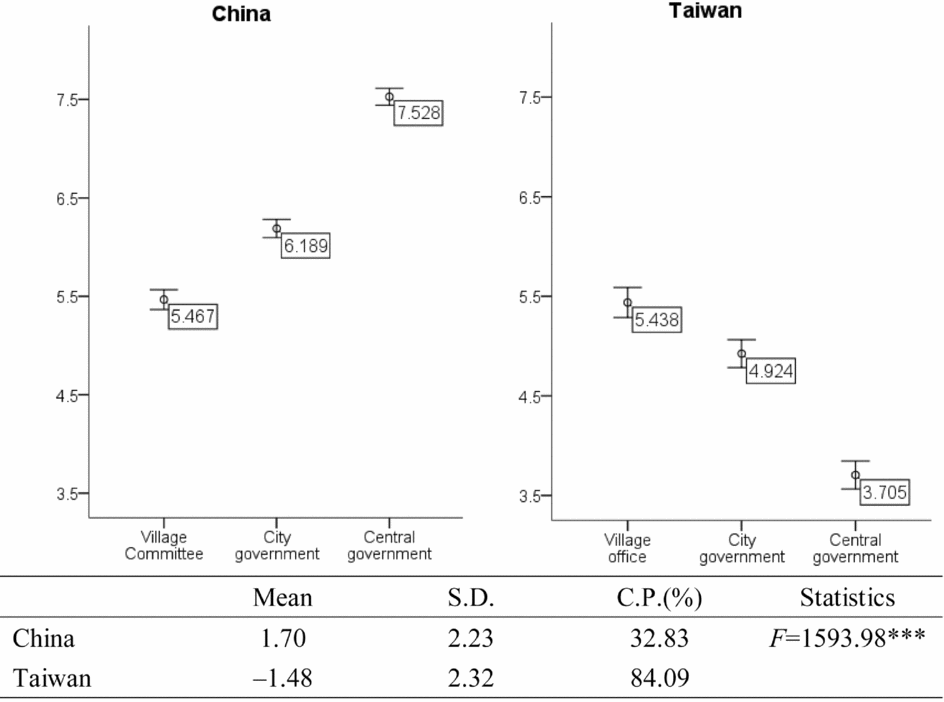
First, we present the descriptive statistics for public satisfaction with three levels of government in China and Taiwan. As illustrated in Figure 1 (with 95% confidence intervals), in the Chinese sample the three levels of government form a ladder of increasing public satisfaction from the lowest level to the highest level. The average satisfaction scores for village committees, city governments, and the central government were 5.467, 6.189, and 7.528, respectively. In the Taiwanese sample, conversely, a ladder of decreasing public satisfaction is evident from the lowest to the highest rank of the administration. The average satisfaction scores for village offices, city governments, and the central government were 5.438, 4.924, and 3.705, respectively. At least two clear differences are evident between the two societies regarding government satisfaction. First, Chinese citizens tend to evaluate their governments more positively than Taiwanese citizens. On the common measuring scale, all the average scores for satisfaction in the Chinese sample were over 5, whereas, in the Taiwanese sample, only one satisfaction score was over 5 (for village offices). Furthermore, two contrasting patterns of hierarchical government satisfaction emerge. In the Chinese sample, higher levels of government enjoyed higher satisfaction scores than lower levels of government; however, in the Taiwanese sample, the higher the level of government, the lower the level of respondents’ satisfaction.
Public satisfaction with different levels of government and net central government satisfaction: China and Taiwan

The rest of Figure 1 provides a description of net central government satisfaction for the two samples. The average score for Chinese respondents was approximately 1.70, which is significantly higher than that for Taiwanese counterparts (–1.48). Moreover, approximately 30% of Chinese respondents provided a higher satisfaction score for local governments than for the central government (the cumulative percentage adding up to 0 was 32.83%), but the equivalent figure in the Taiwanese sample was over 80% (84.09%). These results are in line with our two hypotheses on hierarchical government satisfaction in China (H1a) and Taiwan (H1b). In China, local government satisfaction is lower than central government satisfaction, whereas the opposite pattern is evident in Taiwan.
Chinese and Taiwanese citizens’ perceptions of responsibility attribution
This section addresses the question of how citizens attribute credit or blame to different administrative objects. As hypothesized, given the specific information flows in the two societies, Chinese citizens tend to attribute more blame to local governments than to the central government (H2a), whereas Taiwanese citizens tend to assign more blame to the central government than to local government (H2b). To test the two hypotheses, we conducted four multiple regression models for each dataset: two for central government satisfaction and two for local government satisfaction. Each pair of the models was specified as nested. All factors were identical except for the three variables of personal evaluation, namely household economic satisfaction, democratic evaluation, and public service confidence. Comparing the nested (unrestricted and restricted) models allows us to examine how the personal evaluations affect the two dependent variables – central government satisfaction and local government satisfaction – differently.
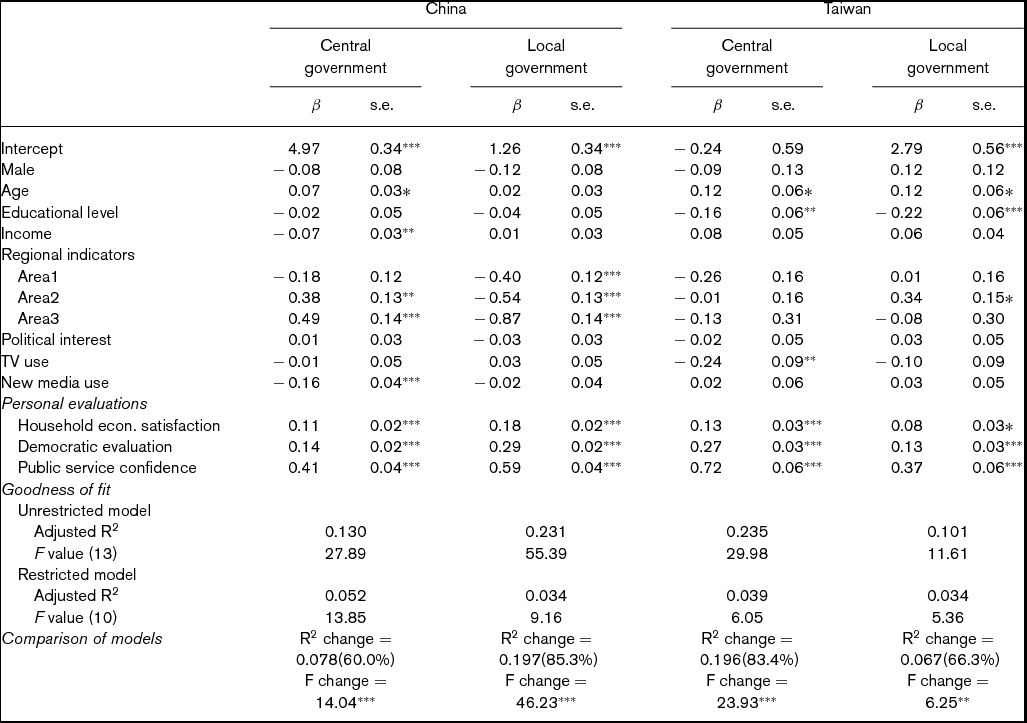
Table 1 lists the estimated results for central government satisfaction and local government satisfaction in the Chinese and Taiwanese samples (only the complete/unrestricted models are shown here due to limited space). As shown in the left part of the table, the three coefficients representing personal evaluations were all in a positive direction and significant for predicting both central government satisfaction and local government satisfaction in China. Nonetheless, the coefficients in the local model (β = 0.18, 0.29, 0.59) were found to be higher than those in the central model (β = 0.11, 0.14, 0.41), meaning that these variables can have a stronger association with local government satisfaction when compared to central government satisfaction. This is also supported by the comparison of the nested models in which the loss of explained variance was checked. The R2 values in the unrestricted and restricted models for predicting central government satisfaction were 0.130 and 0.052, respectively, demonstrating that the explanatory power decreased by about 60% when our variables were excluded from the model. However, for predicting local government satisfaction, the R2 values of the two nested models were 0.231 and 0.034, indicating that when the variables were excluded from the model, the explanatory power decreased by about 85.3%. In other words, the three personal evaluations can explain more variance in local government satisfaction than in central government satisfaction in the Chinese sample. These findings confirm H2a, namely that Chinese citizens tend to attribute more blame for problems to local governments than to the central government.
Central government satisfaction and local government satisfaction: an explanation using perceived responsibility attribution

Notes: A total of 2,348 observations were made in China and 1,153 in Taiwan. All missing values have been imputed on the basis of the mean values of items. Due to space limitations, only the complete estimated coefficients of the unrestricted models are listed. ***p < .001; **p < .01; *p < .05.
The results for the Taiwanese sample are shown in the right part of Table 1. First, all of the personal evaluations were also found to have significantly positive effects on both central government satisfaction and local government satisfaction. Nevertheless, the coefficients in the central model (β = 0.13, 0.27, 0.72) were higher than those in the local model (β = 0.08, 0.13, 0.37). Moreover, the percentages of R2 change in the central and local models were 83.4 and 66.3, respectively, indicating that, if these variables were not included in the model, the explanatory power would decrease further for predicting central government satisfaction than for predicting local government satisfaction. These results clearly indicate that personal evaluations play a more important role in explaining local government satisfaction than in explaining central government satisfaction in the Taiwanese sample. As expected, Taiwanese citizens are inclined to attribute more blame to the central government than to local governments (H2b).Footnote 13
Comparing hierarchical government satisfaction: using multi-group analysis
Having confirmed that Chinese and Taiwanese citizens differ in how they attribute responsibility, we examined whether citizens’ perceptions can influence hierarchical government satisfaction in the two societies (H3). Net central government satisfaction is defined as the degree to which respondents are more satisfied with the central government than local levels of government. Our hypothesis suggests that effects of the evaluation variables on net central government satisfaction in the two samples should differ in their direction. In China, public perceptions attributing greater blame to local governments result in personal evaluations having a stronger effect on local government satisfaction. A negative association between personal evaluations and net central government satisfaction should be found. However, in Taiwan, a tendency to attribute more blame to the central government indicates that personal evaluations should have a greater effect on central government satisfaction. As a result, personal evaluation variables are expected to be positively associated with net central government satisfaction.
Multi-group analysis is appropriate for assessing whether or not coefficients for personal evaluations are substantially different between the two samples. Simply stated, multi-group analysis is used to test factorial invariance across groups (two groups in this study). The unconstrained (baseline) model allows all estimated coefficients to vary, while the constrained model fixed certain parameters of interest as being equal across groups. Comparing the unconstrained model with the unconstrained model enables us to test the null hypothesis that the parameters are invariant across groups (Wang and Wang, Reference Wang and Wang2012: 268–88).
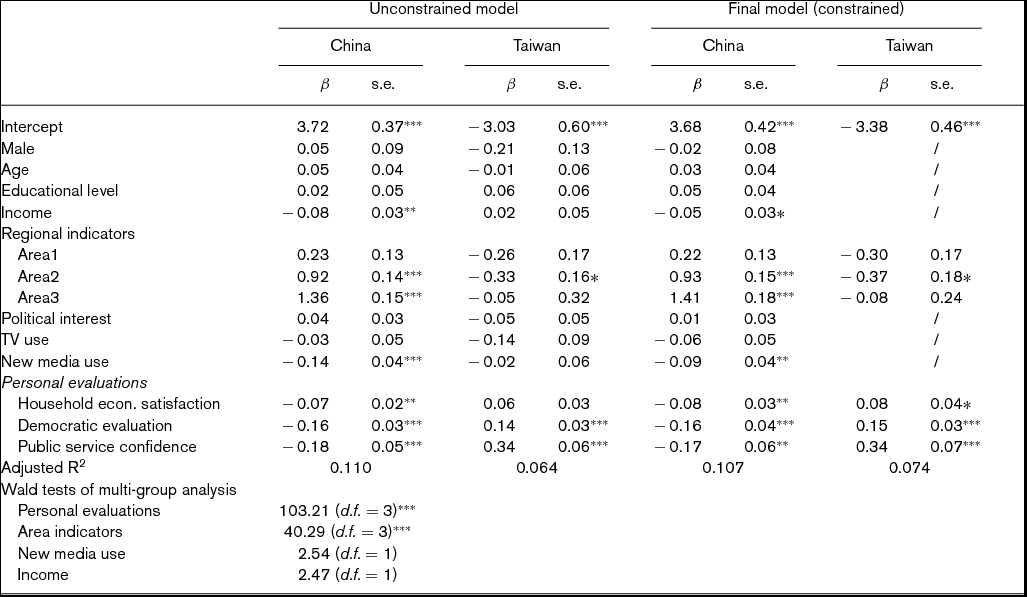
Estimated results from the multi-group analysis are listed in Table 2. In the unconstrained model, there appeared to be several variables that could affect net central government satisfaction in each of the two societies.Footnote 14 Here, for cross-national comparison, multi-group analysis can provide more credible and rigorous tests. By comparing the baseline model with the constrained model that restricts the three personal evaluations to being invariant, a Wald test rejected the null hypothesis that the coefficients are set as equal across the two samples (x 2 = 103.21, d.f. = 3, p < 0.001). This indicates that the effects of personal evaluations are significantly different between the samples for China and Taiwan. We also examined the remaining variables, including area, new media use, and personal income, using the same procedure. The results show that the variables measuring respondents’ areas differ across the two samples (x 2 = 40.29, d.f. = 3, p < 0.001), but that both new media use and personal income should remain constant in the two groups.
Comparing hierarchical government satisfaction: China and Taiwan

Note: The observations are identical to those in Table 2. All resulted were generated in Mplus v7. using the MLMV estimator. ***p < .001; **p < .01; *p < .05.
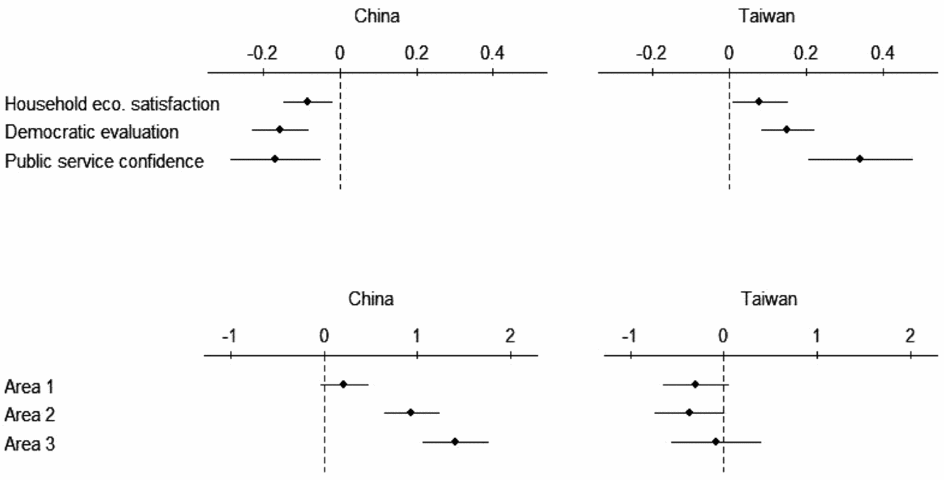
Regarding the series of tests, the final model that compares net central government satisfaction across the two samples is shown in the right side of Table 2. This model is more parsimonious because it only allows variables that measure personal evaluations and area to vary while setting the remaining variables to be equal across the two samples. To more precisely demonstrate the varying influences, we illustrated the estimated effects of the variables in Figure 2 (based on the final model), including point estimates and 95% confidence intervals.
Estimated effects and 95% CI for personal evaluations and area indicators in China and Taiwan

The upper two charts clearly indicate how the three personal evaluations in the two samples could affect net central government satisfaction differently. The effects of personal evaluations differed in their direction. They reduced net central government satisfaction in the Chinese sample but increased it in the Taiwanese sample. In China, citizens tend to attribute more blame for problems to local governments. This responsibility perception can lead to a negative association between personal evaluations and net central government satisfaction in the sample because they drive local government satisfaction more than central government satisfaction. By contrast, Taiwanese citizens are inclined to criticize the central government more than local governments. As a result, these variables increased net central government satisfaction in the Taiwanese sample because they were more strongly associated with central government satisfaction. The results support our hypothesis that, in both societies, citizens’ perceptions of responsibility attribution can influence their hierarchical government satisfaction.
The other two charts in Figure 2 present regional differences in net central government satisfaction within the two samples. In the Chinese sample, compared to those coming from the northern provinces, respondents whose places of birth are in the central and northeast provinces (Area 2) and the southwest and northwest provinces (Area 3) had a significantly higher level of net central government satisfaction. As mentioned, these respondents are more likely to have lower local government satisfaction and higher central government satisfaction because of their life experiences. Chinese citizens who originate from less-developed areas are more likely than others to evaluate central and local governments differently. For Taiwan, respondents from southern cities and counties (Area 2) had a significantly lower level of net central government satisfaction than those from the north, corresponding to the previous findings (Table 1) that they have higher local government satisfaction. This outcome is probably driven by partisanship. The DPP enjoys an electoral advantage in the south of Taiwan and has held control over local governments for a long period. As a result, party identification may well produce higher local government satisfaction in the region.
For the control variables, the results in Table 2 indicate that new media use and personal income had significantly negative impacts on net central government satisfaction in both samples, demonstrating that the two effects are common across China and Taiwan. First, as mentioned, in China the ruling CCP has less influence over new media outlets than it does over the traditional media. As a result, citizens can be exposed to more uncensored information through new media. Moreover, in general, consumption of new media is not restricted by borders or where individuals are located; thus, consumption of new media leads to discussion of important national issues, including commentaries and criticisms, which are circulated and disseminated. Therefore, both in China and Taiwan, individuals’ usage of new media has eroded central government satisfaction, thereby decreasing net central government satisfaction. Second, in terms of personal income, the range of public issues that people pay attention to is usually dependent on their socioeconomic resources. In both democratic and non-democratic societies, people with a higher level of income pay more attention to nationwide issues, leading to increasing criticism of the central government. Personal income accordingly produced a decrease in net central government satisfaction.
Conclusion
This study explored hierarchical government satisfaction by comparing China and Taiwan, which have similar cultural heritage but are governed by very different types of political regimes. Applying the perspective of responsibility attribution, we proposed that, due to the two publics’ distinctive perceptions being shaped by different information flows, hierarchical government satisfaction in the two societies has been led in different directions. The empirical evidence consistently demonstrated that personal evaluations, including household economic satisfaction, democratic evaluation, and public service confidence, exert more influence over local government satisfaction in the Chinese sample but have more impact on central government satisfaction in the Taiwanese sample. Furthermore, the empirical evidence confirms that personal evaluations affect net central government satisfaction in the two samples differently. Overall, the two citizenries attribute greater blame for problems to different administrative objects. Chinese citizens tend to blame local governments, whereas Taiwanese citizens are inclined to blame the central government.
Our findings have important implications for understanding Chinese and Taiwanese citizens’ attitudes toward their governments. In China, previous studies have revealed that the CCP enjoys a high level of political support and trust (Chen, Reference Chen2004; Gilley, Reference Gilley2008; Shi, T., Reference Shi, Chu, Diamond, Nathan and Shin2008; Wang, Reference Wang2005; Reference Wang2006; Yang and Tang, Reference Yang and Tang2010); however, the frequent occurrence of mass movements and social protests against local governments has also been widely reported. We demonstrated the marked difference between Chinese citizens’ attitudes toward the central and local governments and provided a possible explanation. The information-flow perspective indicates that the CCP may well direct dissatisfaction toward local governments, deliberately drawing citizens’ attention to local governance failures so as to alleviate discontent with the central government. Regarding regional variations, our findings imply that the current unbalanced development between regions may not necessarily erode the CCP's legitimacy in the short term, because people who come from less-developed areas still tend to be more satisfied with the central government. However, we also demonstrated that citizens’ socioeconomic resources and consumption of new media may provide them opportunities to receive more diverse and transparent information, as well as increase their interest in nationwide issues, both of which can erode central government satisfaction. In this regard, it can be expected that the CCP's central leadership will attract more criticism as China's socioeconomic development continues to progress.
For Taiwan, as with other democracies, in theory, clarity regarding responsibility is vital for voters to hold governments to account. However, in practice, politicians often engage in blame shifting or credit taking that undermines clear responsibility linkages. The evidence that Taiwanese citizens tend to attribute more blame to their central government suggests that local politicians are less likely to be sanctioned in this new and vibrant democracy. This phenomenon is quite unhealthy for the practice of democracy. Evidently, the question of how perceived responsibility attribution affect vote choice is beyond the scope of this study. However, our findings have clearly shown important patterns in the attitudinal orientation of Taiwanese citizens.
From a comparative viewpoint, questions about hierarchical government satisfaction at the country level nevertheless remain. Because there are only two cases in the present study, we adopted an individual-level approach that elaborates how citizens develop different perceptions of responsibility attributions in their respective political environments. Future studies can include higher numbers of cases to provide a deeper understanding of the role of institutional differences in hierarchical government satisfaction.
About the author
Hsin-Hao Huang is a professor of Department of Civic Education and Leadership, National Taiwan Normal University, Taiwan. His research focuses on cross-national public opinion research, political methodology, elite studies, Chinese politics.
Appendix: Measurements and Variable Coding
1. Satisfaction with three levels of governments
We would like to know how you rate the performance of various levels of government. Please reply on a scale ranging from 0 (extremely dissatisfied) to 10 (extremely satisfied), how satisfied are you with (1) the central government; (2) city government in your area; (3) village committee in your area (in China) / village office in your area (in Taiwan)? (Each variable ranges from 0 to 10)
(1) Central government satisfaction = (1)
(2) Local government satisfaction = ((2) + (3)) / 2
(3) Net central government satisfaction = Central government satisfaction – Local government satisfaction
2. Personal evaluations (the following questions are shared in the WVS)
(1) Satisfaction with household economic condition (household economic satisfaction)
V59. ‘How satisfied are you with the financial situation of your household? Using a scale from 1 to 10, where 1 means ‘completely dissatisfied’ and 10 means ‘completely satisfied’, what position would you choose?’ (This variable ranges from 1 to 10)
(2) Evaluation of democratic practice (democratic evaluation)
V141. ‘How democratically is this country being governed today? Using a scale from 1 to 10, where 1 means that it is ‘not at all democratic’ and 10 means that it is ‘completely democratic’, what position would you choose?’ (This variable ranges from 1 to 10)
(3) Confidence in Public Service (public service confidence)
V118. ‘Could you tell me how much confidence you have in the Civil Service? (5) a great deal of confidence; (4) quiet a lot of confidence; (2) not very much confident; (1) none at all; (3) others.
3. Political interest
V84. ‘How interested would you say you are in politics? Are you. . .’ (5) very interested; (4) somewhat interested; (2) not very interested; (1) not at all interested; (3) others.
4. Media exposure
People learn what is going on in this country and the world from various sources. For each of the following sources, please indicate whether you used it to obtain information (5) daily; (4) weekly; (3) monthly; (2) less than monthly; (1) never.
V219. TV news; V221. Mobile phone; V222. E-mail; V223. Internet.
Respondents’ use of mobile phone, e-mail, and the Internet were averaged to create a ‘new media use’ scale (Cronbach's alpha values are 0.823 in the Chinese sample and 0.768 in the Taiwanese sample).
5. Demographic characteristics
(1) Sex (1) male; (0) female.
(2) Age (1) 29 and below; (2) 30–39; (3) 40–49; (4) 50–59; (5) 60 and up.
(3) Educational level
V248. ‘What is the highest educational level that you have attained?’ (1) no formal education; (2) primary school; (2) secondary school; (3) senior high school; (5) university, college and above.
(4) Income
V239. ‘On this card is a scale of incomes on which 1 indicates the ‘lowest income decile’ and 10 the ‘highest income decile’ in your country. We would like to know what group your household is. Please, specify the appropriate number, counting all wages, salaries, pensions and other incomes that come in.’ (This variable ranges from 1 to 10)
(5) Regional indicators
China: (0) northern provinces; (1) eastern and southern provinces; (2) central and northeast provinces; (3) southwest and northwest provinces.
Taiwan: (0) northern cities/counties; (1) central cities/counties; (2) southern cities/counties; (3) eastern counties.