Introduction
Painful conditions are common in elderly people (Horgas and Elliott, Reference Horgas and Elliott2004) and the experience of pain is related to several factors, such as etiology and comorbidity. More recently, attention has been directed towards cognitive factors. Because both pain and cognitive processes demand attention (Eccleston and Crombez, Reference Eccleston and Crombez1999), it may be surmised that the co-occurrence of these two elements induces competition between attentional resources. Indeed, it has been reported that the experience of pain is reduced when subjects engage in demanding cognitive tasks (Valet et al., Reference Valet2004). One possible explanation is that the resources dedicated to the cognitive task are no longer available for the processing of pain. On the other hand, chronic pain patients have been shown to demonstrate reduced cognitive abilities: they have fewer resources available for cognitive processing as attention is committed to the continuous perception of pain. Studies have revealed decreased cognitive performance in chronic pain patients (Harman and Ruyak, Reference Harman and Ruyak2005) and an improvement in cognitive functions following pain relief (Tassain et al., Reference Tassain2003). Cognitive domains known to be associated with pain include speed of processing (Harman and Ruyak, Reference Harman and Ruyak2005), executive function (e.g. Karp et al., Reference Karp2006), and memory (Grisart et al., Reference Grisart, van der Linden and Bastin2007). An implication might be that as the level of clinical pain increases, a decrease in cognitive functions is observed. This suggestion is supported by the study of Weiner et al. (Reference Weiner, Rudy, Morrow, Slaboda and Lieber2006), who showed an inverse relationship between pain severity and several cognitive functions, including attention, visuospatial skills, mental flexibility and manual dexterity.
However, studies of the relationship between cognition and pain are limited in that they included middle-aged or relatively young older adults, but not very old people aged 85 years or more. This latter population is characterised by more pronounced changes in brain structure, such as atrophy of the prefrontal cortex and the medial temporal lobe, which are part of the aging process (Jack et al., Reference Jack1998; Raz et al., Reference Raz1997). As these brain structures are involved in both pain experience and cognitive functions (Scherder et al., Reference Scherder, Sergeant and Swaab2003), an altered relationship between pain and cognitive functioning as a result of these changes can be anticipated. For example, a previous animal experimental study indicated that memory impairment in mice related to a decrease in pain sensitivity (Pickering et al., Reference Pickering, Chapuy, Eschalier and Dubray2004). Based on this observation, a positive relationship between cognitive functions and pain experience is to be expected.
Finally, when examining pain experience, it is important to note the difference between the sensorydiscriminative and the affective-motivational components of pain. Theoretically, these different aspects are processed by two systems, the lateral and medial pathways respectively (Vogt and Sikes, Reference Vogt and Sikes2000). The lateral pathway processes the sensory-discriminative aspects, whereas the medial pathway processes, among others, the affective- motivational components. Key brain structures involved in processes of the medial pathway include the prefrontal cortex and anterior cingulate cortex, areas that are also known to be involved in cognitive processes such as executive function (Nebel et al., Reference Nebel, Wiese, Stude, de Greiff, Diener and Keidel2005; Lie et al., Reference Lie, Specht, Marshall and Fink2006). These brain structures are much less involved in processes of the lateral pathway. As such, the relationship between cognitive functions and pain experience may be strongest for the affective-motivational components of pain.
The aim of the present study is to explore the relationship between cognitive performance and pain experience in residents of homes for the elderly with a chronic painful condition. Neuropsychological tests measuring memory, processing speed and executive function were administered and both pain intensity, hypothesized to reflect the lateral pain pathway, and pain affect, representing the medial pathway, were measured. If pain reduces attentional resources, a negative relationship between pain and cognition is to be expected. However, if cognitive performance is viewed as an indicator of brain functioning, a positive relationship with pain may be noted.
Methods
Subjects
Recruitment of participants was accomplished through collaboration with homes for the elderly in Amsterdam, the Netherlands. The selection procedure of subjects was as follows: medical records from residents were screened to select subjects suffering from arthrosis or arthritis. Exclusion criteria were: a history of neurodegenerative disease (e.g. dementia, Parkinson's disease), stroke, transient ischemic attack, alcohol or other substance abuse, thyroid disease, and psychiatric disease. Use of nonsteroidal anti-inflammatory drugs and/or other analgesic medication was deduced from medical records. The Mini-mental State Examination (MMSE) (Folstein et al., Reference Folstein, Folstein and McHugh1975) was used as a screening instrument to exclude residents with severe cognitive impairment: a score of ≥ 24 was required for participation. Education was measured with an ordinal scale ranging from 1 (incomplete primary school) to 7 (university) (Heslinga et al., Reference Heslinga, Van Den Burg and Saan1983). The Symptom Checklist-90 (SCL-90) (Arrindell and Ettema, Reference Arrindell and Ettema1986) was applied to assess depressive symptoms.
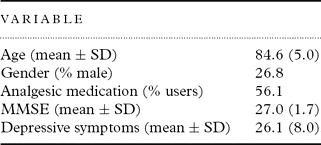
The chronic pain group comprised 43 residents suffering from arthrosis/arthritis. One subject did not complete the questionnaire regarding depressive symptoms, and an additional subject did not complete a major part of the cognitive tests. Both subjects were therefore excluded from further analyses. In cases of occasional missing data with regard to cognitive tests (n = 7), the tests that were completed were used to calculate the specific cognitive domain. Subject characteristics are presented in Table 1. This study was approved by the local medical ethics committee. All subjects gave informed consent.
Subject characteristics (N = 41)

MMSE: Mini-mental State Examination.
Pain assessment
Both pain intensity and pain unpleasantness (i.e. pain affect) were measured. Two visual rating scales, the Colored Analogue Scale (CAS) (McGrath et al., Reference McGrath, Seifert, Speechley, Booth, Stitt and Gibson1996) and the Faces Pain Scale (FPS) (Bieri et al., Reference Bieri, Reeve, Champion, Addicoat and Ziegler1990), were administered to assess the sensory-discriminative aspects of pain. The CAS and the Number of Words Chosen-Affective (NWC-A) (van der Kloot et al., Reference van der Kloot, Oostendorp, van der Meij and van den Heuvel1995) were applied to measure the affective-motivational aspects of pain. Previous investigations showed full comprehension of these visual analogue scales by elderly patients without dementia (Scherder and Bouma, Reference Scherder and Bouma2000), implying that they are very suitable for pain assessment in this population.
Patients were instructed to rate both the pain intensity and the unpleasantness of the pain from which they suffered. To obtain a more reliable indication of pain experience, and to reduce the possibility that a short moment of acute pain skewed the ratings, pain was measured twice, with an approximately four-week interval between both assessments. An average pain score was calculated from these ratings for each pain scale. Using standardized z-scores, separate pain intensity and pain unpleasantness domain scores were calculated. By calculating z-scores, a composite score consisting of separate pain ratings can be created.
Cognitive tests
The participants performed tests measuring memory, processing speed and executive functions. Memory tests included the 15-word list test (Saan and Deelman, Reference Saan, Deelman, Bauma, Mulder and Lindeboom1986), which is a Dutch version of the Auditory Verbal Learning Test, and the Digit Span Forward Test (Wechsler, Reference Wechsler1987), both measuring verbal episodic memory. In addition, the Pattern Recognition Memory of the Cambridge Neuropsychological Test Automated Battery (CANTAB) was administered, as a test of visual recognition memory.
Processing speed tests consisted of the Stroop (Stroop, Reference Stroop1935) Word (W) and Color (C) cards, measuring reading and color naming speed. The Trail Making Test (TMT) (Reitan, Reference Reitan1958) part A was also undertaken as a measure of processing speed.
Finally, the following executive function tests were administered: the Spatial Working Memory test (CANTAB), measuring spatial working memory, the TMT part B (Reitan, Reference Reitan1958), reflecting flexibility performance, and the Stroop (Stroop, Reference Stroop1935) C/W card as a measure of inhibition performance. With regard to the TMT B, completion time of part B corrected for part A (TMT-B/TMT-A) was measured. For the Stroop test, an interference score was calculated using the following formula: interference = Stroop C/W – [(C*W)/(C+W)].
For each cognitive domain, a single domain score was calculated by means of standardized z-scores (mean/standard deviation), resulting in three variables (executive function, memory and speed of processing). By calculating z-scores, a composite score consisting of separate cognitive tests can be created. Scores were adjusted so that a higher value always represented better performance.
Statistical analysis
All analyses were performed using SPSS version 14.0 (SPSS, Inc., Chicago, IL). Blom transformations were used to ascertain normality of all variables. Correlations were calculated to examine possible confounding effects of age, education and depressive symptoms on the relationship between pain and cognition. Possible confounding effects of gender and use of analgesics were examined using Mann-Whitney U tests.
In order to examine the hypothesis that an increase in pain experience demands more attention and therefore relates to poorer performance on tests of memory, processing speed and executive functions, correlations were calculated between the pain and cognitive outcome variables. Secondly, multiple linear regression analyses with a stepwise selection criterion were performed to examine possible unique relationships between the cognitive domains and pain experience. Significance for entry was set at p < 0.05. These analyses were run separately for the pain intensity and the pain unpleasantness scores.
Results
Pain intensity
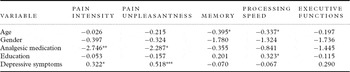
A significant positive correlation was observed between pain intensity and depressive symptoms (r = 0.322, p < 0.05) (Table 2). Furthermore, use of analgesics was a positive predictor of pain intensity (Z = −2.746, p < 0.01). However, as neither use of analgesics nor depressive symptoms was related to any of the cognitive domains, these factors are unlikely to mediate (part of) the relationship between pain and cognition. Similarly, age correlated with processing speed (r = −0.337, p < 0.05) and memory (r = −0.395, p < 0.05), but not with pain intensity. An equal observation was made with regard to education, which was related to processing speed (r = 0.323, p < 0.05), but not to pain. Finally, type of analgesic medication was classified as either opioids or non-opioids as the former may disrupt cognitive functions; again, however, no association with cognitive functions was observed. On account of this, none of these variables was controlled for.
Associations between cognition, pain experience and possible confounders

Correlations were calculated to examine whether age, education and depressive symptoms related to pain and cognition. Mann-Whitney U tests were performed to examine possible associations of gender and analgesic medication with pain and cognition. Higher scores on the cognitive domains represent better performance. Gender was coded as follows: score 0 = male, score 1 = female.
*: p < 0.05; **: p < 0.01; ***: p < 0.001
In considering pain as demanding attention, we expected higher levels of pain intensity to relate inversely to performance on all cognitive domains. This was not observed: the only significant correlation that emerged was a positive relationship between pain intensity and executive functions (r = 0.474, p < 0.01). The correlations between pain intensity and memory (r = −0.101, p = 0.53) and between pain intensity and processing speed (r = −0.160, p = 0.32) were not significant. This unique relationship was confirmed with the regression analyses: executive function entered as the only significant predictor of pain intensity (R 2 = 0.225, β = 0.474, p < 0.01). These results indicate that better executive function performance relates to an increasing level of self-reported pain. None of the other cognitive domains significantly predicted pain experience.
The results mentioned above were based on an average pain rating, collected on two different time moments. A pain rating at the time of testing might be necessary if one wishes to examine whether higher levels of pain, by demanding attention, reduce cognitive test performance. Therefore, the analyses were repeated with the primary pain ratings, which were obtained at the end of the testing session. Results, however, were completely comparable to previous findings: a single positive relationship was noted between pain intensity and executive functions.
Pain unpleasantness
With regard to pain unpleasantness, significant associations were found with depressive symptoms (r = 0.518, p < 0.001) and use of analgesics (Z = −2.287, p < 0.05). These two confounders, however, were not controlled for as they did not significantly relate to any of the cognitive domains. None of the other variables – age, gender or education – related to the affective-motivational components of pain.
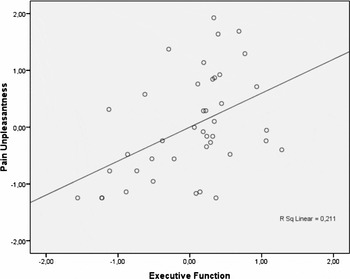
A single significant correlation emerged between pain unpleasantness and executive functions (r = 0.459, p < 0.01), implying that better executive function performance is related to a higher level of self-reported pain unpleasantness. Again, memory (r = −0.198, p = 0.22) and processing speed (r = −0.240, p = 0.13) were not significantly related to pain unpleasantness. Executive function entered as the only significant predictor of pain unpleasantness (R 2 = 0.211, β = 0.459, p < 0.01) (see Figure 1). None of the other cognitive domains entered the analysis.
The relationship between executive functions and pain unpleasantness

Similar observations were made when the analyses were restricted to the pain assessments obtained during the testing session.
Discussion
The present study focuses on the relationship between cognitive functioning and the experience of self-reported pain in residents of homes for the elderly with chronic pain. The results indicate that executive function performance predicted both pain intensity and pain unpleasantness ratings, implying that better executive function performance positively related to the reported severity of pain experience.
Executive function and pain experience
A priori two different mechanisms were postulated that could account for a possible relationship between pain experience and cognition. One focused on pain as a distracter which should theoretically result in an inverse relationship between pain experience and cognition (Karp et al., Reference Karp2006). The positive association that was observed between executive function and reported pain experience contradicts this prediction. However, this observation is in agreement with the second hypothesis, namely, that cognition as an indicator of changes in brain function positively predicts pain experience. Why should executive function but not memory or processing speed predict pain experience? An answer might be found by considering the profound role of the frontal lobes in both executive function tasks and pain processing. In patients with frontotemporal dementia, who suffer from severe frontal lobe degeneration, a decrease in awareness of painful stimuli has been reported (Bathgate et al., Reference Bathgate, Snowden, Varma, Blackshaw and Neary2001). Studies furthermore reveal a positive association between chronic pain experience and activation in the prefrontal lobes (Baliki et al., Reference Baliki2006). This indicates that intact frontal lobe functioning might be extremely important for the conscious experience of pain. From this perspective, it seems likely that intact executive function performance positively relates to the severity of self-reported pain, as it reflects intact frontal lobe function and thereby awareness of pain. Also, considering the high sensitivity of executive functions to the effects of age-related changes in the brain, tasks measuring these functions may be the most sensitive indicators of these changes.
However, one point that warrants caution is the possibility that executive functions are not related to the experience of pain but actually relate to the ability to report pain or to use pain scales. If that is the case, a decrease in executive functions might result in under-reporting of pain compared to the actual pain experience. This suggestion is supported by a near significant positive correlation (p = 0.066) between reported depressive symptoms and executive functions (Table 2), implying that better executive functions relate to higher levels of reported depressive symptoms. This possibility is extremely important when one considers the high prevalence of painful conditions in the elderly and the reported reduction in pain treatment that parallels the level of cognitive decline (e.g. Won et al., Reference Won, Lapane, Gambassi, Bernabei, Mor and Lipsitz1999).
Another point of caution concerns the presumed relationship between the prefrontal cortex and experience of pain in the present study. As no neuroimaging was performed, this relationship remains speculative. Other factors might actually mediate the relationship between pain experience and executive functions in the current study, such as the level of physical activity. A positive relationship between level of physical activity and executive functions has been reported (Bixby et al., Reference Bixby2007). More physical activity might induce more pain and therefore mediate the relationship between better executive function performance and an increase in pain experience.
Pain intensity versus pain unpleasantness
The expected difference between the two different aspects of pain in relation to cognition was not confirmed; executive functions predicted both pain intensity and pain unpleasantness to a similar degree. A possible explanation for this observation brings into question the separability of the sensory-discriminative and affective-motivational components of pain assessed with pain scales such as employed in the present study. It can be argued that when using scales of pain intensity, such as the FPS, an affective component cannot be ruled out (Herr et al., Reference Herr, Mobily, Kohout and Wagenaar1998). Specifically in chronic pain patients, the long duration of pain might result in a strong association between aspects of intensity and unpleasantness. In other words, it can be argued that the intensity of chronic pain becomes intertwined with the affective experience of pain. Alternatively, these results could also be due to a decrease in the ability to report pain, as a result of diminished executive function.
Strengths and limitations
Strengths of the present study include taking into account several factors known to influence both cognitive performance and pain experience, such as age and depressive symptoms. Secondly, the assessment of pain ratings was accomplished twice, reducing the risk of distorted pain measurements as a result of instantaneous pain.
One potential limitation of the present study is that no experimental pain stimulus was applied. This might provide more insight into whether either the experience or the reporting of pain is related to cognition. Also, the study sample was relatively small; this could account for not finding a significant association between pain and memory and between pain and processing speed. Nonetheless, the significant effects noted for executive function imply that it is unlikely that the small sample sizes are fully responsible for the current observations.
Conclusion
The present study indicates that executive function positively relates to self-reported pain experience in residents with chronic pain, which may reflect a positive relationship between brain functioning and conscious experience of pain. However, alternative explanations, such as a reduced ability to report pain or a mediating role of physical activity, cannot be ruled out. Further research should be undertaken in order to clarify the relationship between pain and cognition.
Conflict of interest
None.
Description of authors' roles
Joukje M. Oosterman was involved in study concept and design, subject and data acquisition, analysis and interpretation of the data, and preparation of the manuscript. Kerst de Vries was involved in subject acquisition and preparation of the manuscript. Chris Dijkerman and Edward de Haan were involved in preparation of the manuscript. Erik J.A. Scherder was involved in study concept and design, and preparation of the manuscript.
Acknowledgments
We thank the staff and the residents for their participation in the study.