Introduction
The field of congenital cardiac electrophysiology is rapidly expanding due to the increased survival rates following CHD surgeries. Chronic arrhythmias remain one of the greatest challenges in this patient population. Projections indicate that 50% of 20-year-old adult CHD subjects will experience at least one atrial tachyarrhythmia during their lifespan, Reference Bouchardy, Therrien and Pilote1 and sudden cardiac death remains an important mode of death in this specific population. Reference Diller, Kempny and Alonso-Gonzalez2
Antiarrhythmic drugs are the mainstay of therapy for managing tachyarrhythmias. Nevertheless, their use in patients with CHD is limited by moderate efficacy and side effects, including potentially severe pro-arrhythmic consequences. As a result, catheter ablation plays a prominent role in managing a gamut of arrhythmias in this population. Reference Le Bloa, Abadir, Nair, Mondésert and Khairy3
There are numerous challenges to catheter ablation in patients with CHD, including access to cardiac chambers, distorted anatomies, displaced conduction systems, multiple and/or complex arrhythmia substrates, and excessively thickened walls or interposed material. Reference Le Bloa, Abadir, Nair, Mondésert and Khairy3 This study aims to evaluate the characteristics, challenges, and outcomes of transcatheter ablation in CHD patients managed at a tertiary care centre.
Methods
Study design and data collection
This retrospective observational study included all consecutive patients with CHD undergoing attempted catheter ablation between November 2013 and November 2023. Data on patient demographics, arrhythmia mechanisms, ablation techniques, and procedural outcomes were analysed.
Electrophysiology study
All patients and/or their legal guardians consented to the procedure. Antiarrhythmic medications were discontinued for at least five half-lives before the electrophysiological studies. The three-dimensional surface electrode-based navigation system EnSite™ (St Jude Medical Inc., St Paul, MN, USA) was used in all patients. Depending on the patient’s age, an electrophysiological study was performed either under local anaesthesia with mild sedation or under general anaesthesia. Vascular access was via the femoral vein, with additional or alternative access through the subclavian or internal jugular veins in case of femoral vein occlusion, interrupted inferior caval vein, or unknown reasons. Preprocedural transoesophageal echocardiography was performed systematically to rule out thrombus before catheter ablations of IART.
Standard diagnostic manoeuvres were applied at discretion to determine the underlying arrhythmia mechanism and included atrial and ventricular programmed stimulation techniques and diagnostic use of isoproterenol and adenosine. Arrhythmias were defined according to recognised diagnostic criteria. Reference Page, Joglar and Caldwell4
Ablation was performed using conventional temperature or irrigated-tip radiofrequency energy or cryotherapy at the discretion of the operatör.
Cryoablation was performed using 7 F 6-mm-tip or 9 F 8-mm-tip catheters (Medtronic, Minneapolis, MN, United States of America) in patients with foci close to the atrioventricular node and phrenic nerve.
Procedural and long-term outcome
Ablation of intra-atrial re-entrant tachycardia (IART) or ventricular tachycardia (VT) was deemed successful if acute termination of the arrhythmia occurred during lesion application, followed by subsequent noninducibility of the targeted arrhythmia or confirmation of bidirectional conduction block. Ablation of atrial or ventricular ectopy was considered successful with complete elimination of ectopic beats, partially successful with a significant reduction, or empirical when P-wave morphology or pace mapping guided the procedure in the absence of spontaneous or inducible ectopy. Successful ablation of atrioventricular nodal reentrant tachycardia (AVNRT) was defined as noninducibility of the arrhythmia and achieved through either slow pathway ablation (no residual slow pathway conduction) or modification (persistence of an AH jump or single atrial echo beat). Ablation of an accessory pathway was classified as successful when a conduction block across the pathway was demonstrated, with no inducible atrioventricular reentrant tachycardia (AVRT). Reference Houck, Chandler and Bogers5
Procedural success was complete with the successful ablation of all targeted arrhythmias and partial when not all targeted arrhythmias were successfully ablated.
Follow-up
As per standard practice, all patients underwent continuous telemetry monitoring, 12-lead electrocardiogram, 24-hour ambulatory electrocardiogram (if necessary), and echocardiography before discharge. All patients were hospitalised following the ablation procedure as required by standard practice. They were examined at the outpatient clinic for symptoms suggestive of arrhythmia after 1, 3, and 6 months of the procedure and then every 12 months. At each visit, a 12-lead ECG and, if necessary, 24-hour ambulatory electrocardiogram monitoring were performed. Recurrence was the relapse of clinical symptoms consistent with episodes before the ablation and documented tachycardia with an ECG, a 24-hour ambulatory electrocardiogram, or an event recorder.
Results
Patient and procedural characteristics
During the study period, 166 patients (189 substrates) underwent electrophysiological studies. Patients with patent foramen ovale (PFO), small atrial septal defect (ASD) or ventricular septal defect (VSD), small patent ductus arteriosus (PDA), mild valvular pathologies, cardiomyopathies, or those undergoing isolated electrophysiological studies were excluded from the study.
The mean age of the patients was 14.8 ± 7.9 years (range: 2.9–43 years), with 94 patients (56.6%) being male. A total of 37 patients (22.3%) were older than 18 years. The patients’ mean weight was 47.1 ± 19.6 kg (range: 11–98 kg). Arrhythmia was observed in 95 patients in the postoperative period and seven patients during or after the transcatheter procedure.
Ebstein anomaly (n: 40, 24%), tetralogy of Fallot (TOF, n: 31, 18.6%), ASD (n: 25/15%), VSD (n: 22, 13.2%), great artery transposition (D/L TGA, n: 12, 7.2%), and complex CHD in single ventricle physiology (n: 9, 5.4%) were the most frequent underlying CHDs.
The most common arrhythmia mechanisms were Wolf-Parkinson-White syndrome (WPW, n: 50, 26.4%), intra-atrial re-entrant tachycardia (IART, n: 39, 20.6%), typical AVNRT (n: 37, 19.5%), and ventricular tachycardia-ventricular extrasystoles (VT/VES, n: 23, 12.1%) (Figure 1). There was more than one arrhythmia in 23 patients and multiple manifest accessory pathways in 10 patients.
Distribution of arrhythmia mechanisms.

Arrhythmia substrates
Atrioventricular accessory pathways (APs)
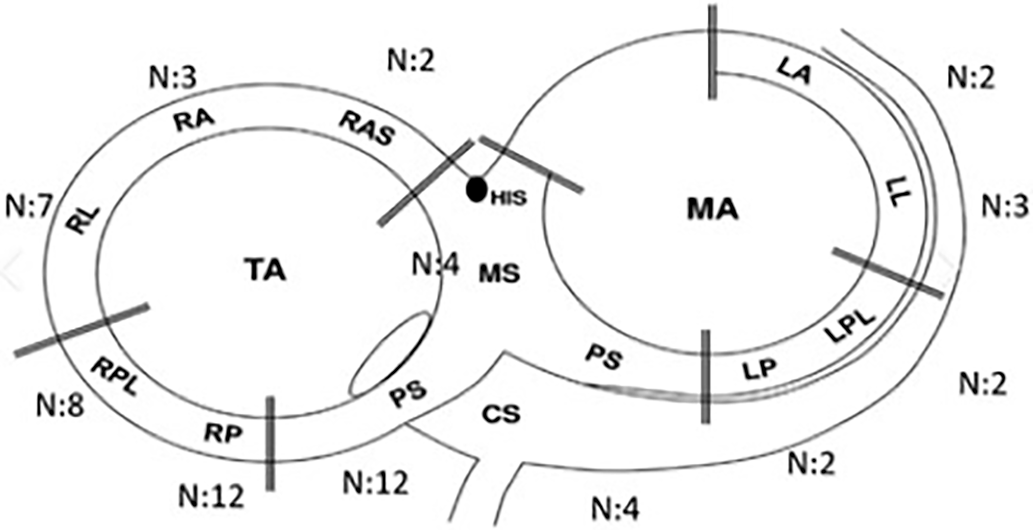
A total of 67 patients were found to have APs, which included 50 WPW, 13 AVRT and concealed Aps, and 4 Mahaim tachycardias. Among the 50 patients diagnosed with WPW syndrome, multiple accessory pathways were present in 10 (20%) cases. In 78% of cases, manifest accessory pathways were located on the right side (most commonly right posteroseptal [26%], right posterior [26%], and right posterolateral [17%]) (Figure 2). The acute ablation success rate was 96%, while recurrence was observed in four patients during follow-up. The presence of a Mahaim pathway was identified in four patients, two of whom also had Ebstein anomaly.
Manifest Accessory Pathway Localisations.

Atrioventricular nodal re-entrant tachycardia
Forty-one cases of AVNRT were observed, including 37 typical and four atypical cases. Acute success was achieved in all patients except one (40/41, 97.5%), a 20-year-old patient with a history of Glenn operation, right atrial isomerism, unbalanced complete atrioventricular septal defect (AVSD), and both typical and atypical atrioventricular nodal re-entrant tachycardia (AVNRT). No recurrences were observed during follow-up.
Ventricular tachyarrhythmias
Ventricular tachyarrhythmias were observed in 23 patients. Of these patients, 20 underwent ablation for PVC, and seven underwent VT ablation (5 of whom had VT originating from the right ventricular outflow tract [RVOT]). Concomitant PVC ablation was also performed in 4 patients undergoing VT ablation. Of the 20 patients who underwent VES ablation, the origin was the RVOT in 11 cases, the left ventricle in seven cases, and both the left and right ventricles in two cases (some patients had multiple arrhythmogenic foci).
Intra-atrial re-entrant tachycardia (IART) was observed in 39 patients. The underlying congenital heart defect was operated TOF in 12 patients, VSD in 7 patients, D-TGA with Senning-type atrial switch operation in 4 patients, atrioventricular septal defect (AVSD) in 4 patients, Ebstein’s anomaly in 4 patients, ASD in 5 patients, and operated single ventricular physiology (Fontan procedure) in 3 patients. Most circuits (n: 25/39, 64%) were CTI-dependent. Two of these circuits were dual-loop IART, using both cavotricuspid isthmus (CTI) and scar tissue. The remaining 14 IARTs: right atrium in ten patients, systemic venous atrium (SVA) in three, and pulmonary venous atrium (PVA) in one patient. All circuits in the SVA and right atrium involved scar tissue.
Focal atrial tachycardia
Focal atrial tachycardias were observed in 16 patients. FATs were located in the right atrium Reference Kato, Suzuki and Yoshida14 and left atrium. Reference Diller, Kempny and Alonso-Gonzalez2 Ablation was successful in 15 (94%) and unsuccessful in one (6%). Recurrence was seen in one patient during follow-up.
Targeted arrhythmias in different CHDs
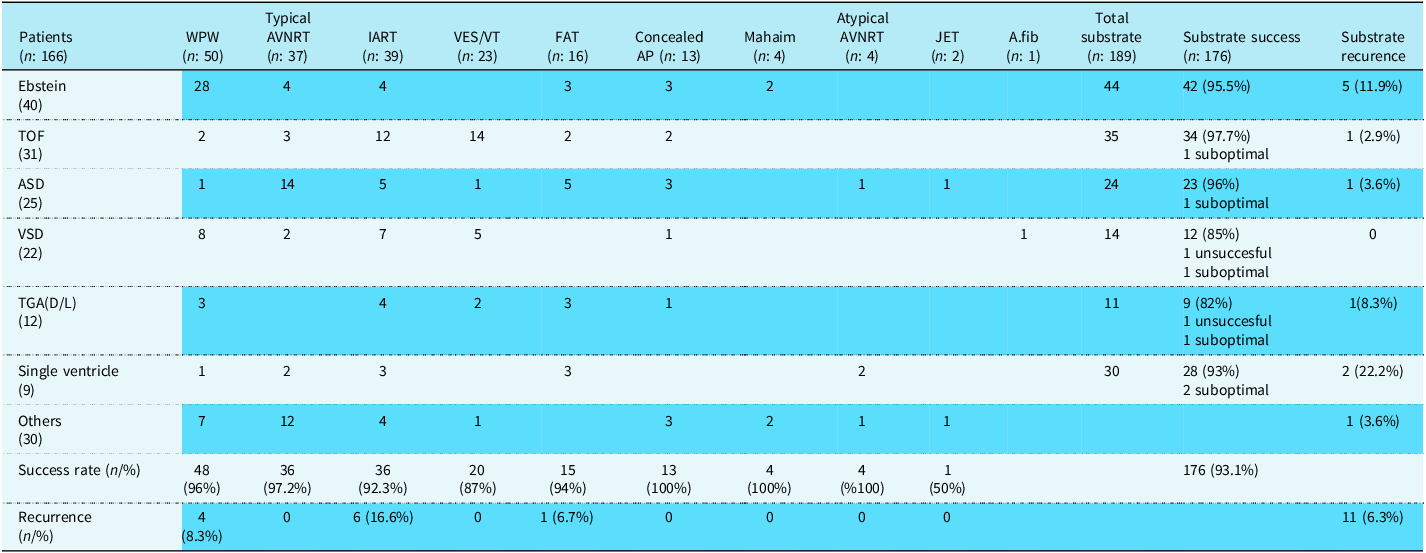
The types of arrhythmias observed and their outcomes according to CHD diagnoses are summarised in Table 1 and Figure 3.
Arrhythmia mechanisms and success rates according to CHD diagnoses

A.fib = Atrial fibrillation; AP = Accessory pathway; ASD = Atrial septal defect; AVNRT = Atrioventricular nodal reentrant tachycardia; FAT = Focal atrial tachycardia; IART = Intraatrial reentrant tachycardia; JET = Junctional ectopic tachycardia; TGA = Transposition of the great arteries; TOF = Tetralogy of Fallot; VES = Ventricular ekstra systole; VSD = Ventricular septal defect; VT = Ventricular tachycardia; WPW = Wolf Parkinson White syndrome.
Ablation success rates according to CHD diagnoses.

Among the 40 patients with Ebstein’s anomaly, 44 different arrhythmias were observed, and the most common arrhythmia mechanism was WPW syndrome, identified in 28 patients. Other notable arrhythmia substrates included typical AVNRT in four patients, IART in four, and Mahaim fibres in two. The overall acute success rate for substrate ablation in this group was 95.5%, with a recurrence (n: 5) rate of 11.9%.
Nine patients with single-ventricle physiology, including Fontan and similar surgical repairs, were treated. Arrhythmia mechanisms included IART in three patients, FAT in three, and WPW syndrome in one. The acute success rate was 82%, though one case was categorised as suboptimal, and one procedure was unsuccessful. Recurrence was observed in 22.2% of these patients, the highest among all subgroups.
In the 31 patients with TOF, 35 different arrhythmias were identified. Ventricular arrhythmias, including PVC and VT, were the most common, occurring in 14 patients, followed by IART in 12. The acute success rate was 97%. However, one patient experienced a recurrence during follow-up after IART ablation.
In total, 25 patients with ASD had 31 arrhythmia substrates. Patients with large or moderate ASD (n = 20): Successful ablation was achieved in 18 patients. One patient had a suboptimal successful ablation. Another patient had two separate arrhythmia substrates, one successfully ablated, and the other suboptimally ablated. Of the 18 successfully ablated patients, eight underwent ASD closure within 2 years, six are awaiting closure and four are still being followed. Two of these patients experienced arrhythmia recurrence and were successfully treated with repeat ablation. Two patients with suboptimal results remain in clinical follow-up. Patients with surgically or transcatheter-closed ASDs (n = 5): Successful ablation was achieved in two patients. Two patients had two separate arrhythmia substrates, one successfully ablated and the other unsuccessfully ablated. One patient had an unsuccessful ablation but achieved success after a repeat procedure during follow-up.
Ablation energy sources
While irrigated radiofrequency ablation (RFA) (n: 59, 35.5%) was the most commonly used energy source, standard RFA was used in 46 (27.2%) patients, and cryoablation in 33 (19.9%) (21 of 6 mm). The combination of RFA ± irrigated-RFA ± cryoablation was used in 28 (16.9%) patients. The mean duration of the procedure was 174 ± 69.3 minutes. In the 96 patients (58%) in whom fluoroscopy was used, the mean fluoroscopy time was 8.3 minutes.
Procedural outcome
The overall acute success rate for all arrhythmia substrates was 93.1% (176/189). The procedure was unsuccessful in five patients and suboptimal in eight. A recurrence was observed in 11 patients (6.4%) during a mean follow-up of 49.2 ± 30.1 months. A second ablation was performed in 13 cases. Three repeat procedures were performed for different arrhythmias. In two cases, multiple types of arrhythmias were present. Three patients with WPW syndrome had multiple accessory pathways, two of which were epicardial. In two patients with IART, distinct arrhythmogenic foci were identified. In two WPW patients and one patient with a concealed accessory pathway, suboptimal results were attributed to inadequate catheter contact. The procedure was successful in all patients except an 8.5-year-old male with significant aortic regurgitation and aortic stenosis at follow-up, who had Wolff-Parkinson-White (WPW) syndrome originating from the epicardial coronary sinus. Eleven patients with a history of failed or suboptimally successful ablation are still being followed on medical therapy.
WPW syndrome and AVNRT showed the highest acute success rates of 96% and 97.2%, respectively, while IART had a recurrence rate of 16.6%. Suboptimal results were observed in a limited number of cases, primarily in patients with single-ventricle physiology and complex anatomical substrates.
In a patient with left lateral WPW syndrome, stenosis of the left circumflex artery was observed after RF ablation, and successful balloon angioplasty was performed. Additionally, a superficial skin burn developed in another patient due to radiofrequency (RF).
Discussion
This study provides a comprehensive overview of the mechanisms, challenges, and outcomes associated with transcatheter ablation in patients with CHD, emphasising its pivotal role in managing complex arrhythmias in this unique population. Despite advancements in medical therapies, antiarrhythmic drugs have shown limited efficacy and significant side effects in CHD patients, underscoring the necessity for catheter ablation as a definitive therapeutic option. Our findings highlight the procedural intricacies, acute success rates, and recurrence patterns that define this challenging domain of paediatric electrophysiology.
Arrhythmia mechanisms and outcomes
Patients with CHD exhibited a broad spectrum of arrhythmia mechanisms, ranging from congenital substrates such as accessory pathways (APs) to acquired arrhythmias like macro-reentrant atrial tachycardia (IART). Reference Houck, Chandler and Bogers5 In the current study, 67 patients were identified with accessory pathways, including 50 with WPW syndrome, 13 with AVRT or concealed accessory pathways, and 4 with Mahaim tachycardia. Additionally, 41 patients had AVNRT, with 37 classified as typical AVNRT. The acute success rates for atrioventricular nodal reentrant tachycardia (AVNRT, 97.2%) and Wolff-Parkinson-White (WPW) syndrome (96%) were notably high, reflecting the well-defined substrates and established ablation techniques for these arrhythmias. However, arrhythmias like IART (16.6% recurrence rate) and ventricular tachycardias (13% recurrence rate) were more challenging, especially in complex postoperative substrates. These findings align with previous studies emphasising the impact of surgical scarring and altered conduction pathways on procedural outcomes.
Complex substrates and procedural challenges
The anatomical and procedural complexities inherent in CHD significantly influence ablation outcomes. The presence of surgical baffles, conduits, and prosthetic materials often necessitates alternative access routes, advanced imaging techniques, and meticulous pre-procedural planning. Reference Le Bloa, Abadir, Nair, Mondésert and Khairy3,Reference Sherwin and Abrams6 Patients with Ebstein’s anomaly exhibit a high prevalence of Wolff-Parkinson-White syndrome (WPW) and concealed accessory pathways, often involving multiple pathways. Reference Walsh and Cecchin7 The distinctive anatomy of these patients, including the atrialized right ventricle, presents significant challenges for achieving stable catheter contact and interpreting electrograms due to prominent signal fractionation. Reference Sherwin and Abrams6 In the present study, Ebstein’s anomaly accounted for a significant proportion of arrhythmias, with 28 of the 40 patients diagnosed with WPW and 10 presenting with multiple accessory pathways. Acute success rates for WPW ablation were high (95.5%), but recurrence (11.9%) remains a notable concern, consistent with existing literature. Reference Sherwin and Abrams6 Notably, two cases of WPW syndrome required epicardial ablation due to the epicardial location of the accessory pathways, underscoring the importance of recognising alternative substrate locations in this population.
Single-ventricle physiology and fontan patients
Patients with single-ventricle physiology or Fontan circulation represented the most challenging subgroup, with the highest recurrence rate (22.2%) and a lower acute success rate (82%). These outcomes reflect the intricate arrhythmic substrates and extensive surgical scarring typical of this population. Further advancements in mapping technologies and catheter designs are crucial for improving outcomes in these high-risk patients.
Technological advancements and safety
The incorporation of advanced technologies, including three-dimensional navigation systems, has significantly improved the safety and efficacy of the procedure, as evidenced by a high overall acute success rate (92%) and a low complication rate. Creating safe and effective catheter ablation lesions in patients with CHD presents numerous challenges. Factors such as myocardial thickening and dilation, reduced blood flow in markedly enlarged cardiac chambers, and the presence of prosthetic materials (e.g., stents, annular rings, prosthetic valves, patches) can hinder energy delivery between the catheter tip and the target tissue. Reference Le Bloa, Abadir, Nair, Mondésert and Khairy3,Reference Mondésert, Nair, McLeod and Khairy8 Irrigated radiofrequency (RF) ablation and contact force-guided techniques have demonstrated significantly improved energy delivery compared to conventional RF ablation. In addition, irrigated RF ablation has the potential to reduce thromboembolic complications, particularly when ablating within the pulmonary venous atrium, subaortic ventricle or in the presence of an intracardiac shunt. Reference Le Bloa, Abadir, Nair, Mondésert and Khairy3 We have increasingly used irrigated RF and contact force catheters in recent years, mainly to avoid these complications and to achieve better contact. In our cases, irrigated RF was used in 47.5% of patients (35.5% with irrigated RF alone and 12.5% with a combination of standard RF ± cryoablation ± irrigated RF). Cryoablation is reserved for arrhythmias in proximity to critical structures such as the atrioventricular node and phrenic nerve. Procedural outcomes were comparable across different energy modalities, highlighting the importance of individualised energy source selection based on arrhythmia substrate and patient anatomy.
The use of electroanatomical systems with high-density and ultra-high-density mapping enhances the understanding of arrhythmia circuits and facilitates the precise identification of optimal ablation targets. This is particularly beneficial in cases of complex CHD characterised by significant myocardial remodelling, extensive scar areas, and regions of pre-existing conduction block. Reference Martin, Yue and Martin9,Reference Ergül, Kafalı and Özturk10
Since 2019, our centre has widely adopted the use of HD Grid mapping catheters for IART ablations. This approach has led to a significant reduction in mapping and procedural durations without any observed complications. Moreover, we have observed improved acute success rates and reduced recurrence rates.
Challenges in recurrence
Recurrence remains a significant limitation, with 7.8% of patients requiring repeat ablation. Factors contributing to recurrence include complex anatomical substrates, suboptimal catheter contact, and progressive myocardial remodelling. Notably, recurrences often involved new or alternative arrhythmia mechanisms, highlighting the dynamic nature of arrhythmogenesis in CHD patients. Reference de Groot, Atary, Blom and Schalij11,Reference Roca-Luque, Rivas-Gándara and Dos Subirà12 Of the 13 patients who underwent a second ablation procedure, five had different arrhythmia substrates (two of which had multiple types of arrhythmias). In the three patients diagnosed with Wolff-Parkinson-White (WPW) syndrome, multiple accessory pathways were identified, with epicardial localisation in two cases. Two patients with intra-atrial reentrant tachycardia (IART) had distinct foci. In two patients with WPW and one patient with tachycardia due to a concealed accessory pathway, the initial ablation was considered unsuccessful due to insufficient contact during the procedure. This finding highlights the need for continued innovation in mapping and ablation techniques.
Clinical implications
Our results reinforce the importance of individualised procedural planning and a multidisciplinary approach to managing arrhythmias in CHD patients. Tailored strategies, incorporating advanced mapping systems and energy modalities, are critical for optimising outcomes. Routine pre-procedural electrophysiological evaluations, particularly in patients scheduled for surgical or percutaneous interventions, can identify and address arrhythmogenic substrates early, potentially reducing perioperative and long-term complications. The increasing utilisation of transcatheter pulmonary valves (e.g., Melody, Sapien), particularly in native right ventricular outflow tracts, has raised concerns about the potential challenges in accessing this region for future ablation procedures. Reference Van Hare13 To address this issue, an electrophysiological study (EPS) ± ablation was performed in 10 patients prior to surgical or transcatheter percutaneous pulmonary valve implantation (PPVI). In our clinic, all patients are routinely assessed for EPS-ablation and implantable cardioverter defibrillator (ICD) indications before undergoing surgical or transcatheter PPVI. This evaluation is based on a comprehensive clinical assessment, including findings from ECG, Holter monitoring, and exercise testing.
Complications
No deaths occurred because of catheter ablation. Serious complications occurred at a rate of 1.2%, which is similar to those of paediatric, congenital, or adult ablation previously reported. Reference Kato, Suzuki and Yoshida14 Although our population included patients with complex native and postoperative anatomy, often with an abnormal course of the intrinsic conduction system, there were no cases of permanent atrioventricular block. To avoid potential injury to the conduction system or coronary arteries, cryoablation was used in 33 (19.9%) cases. Cryoablation was particularly effective in substrates near critical structures such as the atrioventricular node and phrenic nerve, ensuring precision while minimising risks. Reference Drago, Tamborrino and Cazzoli15 The mean fluoroscopy time of 8.3 minutes demonstrates a commitment to reducing radiation exposure, especially in paediatric patients.
Study limitations
This study is limited by its retrospective and single-centre design, which may restrict the generalisability of the findings. Additionally, the relatively small sample size in specific CHD subgroups, such as Fontan patients, limits the statistical power to detect nuanced differences in outcomes. Prospective, multicentre studies are needed to validate our findings and explore the impact of new technologies in this population.
Conclusions
Paediatric patients with CHD presenting for ablation demonstrated a broad spectrum of arrhythmia mechanisms that were both typical for their age (congenital substrates) and also related to their underlying heart disease (acquired substrates). Transcatheter ablation in CHD patients is both feasible and effective, with high acute success rates, especially for WPW and AVNRT. However, recurrence remains a significant challenge, particularly in patients with complex substrates, single-ventricle physiology, or extensive surgical histories. Tailored procedural planning, advanced technologies, and multidisciplinary expertise are crucial for optimising outcomes in this growing patient population.