


Introduction
By the age of 18, up to one in four adolescents will have experienced a depressive episode (Kessler, Avenevoli and Merikangas, Reference Kessler, Avenevoli and Merikangas2001; Lewinsohn, Hops, Roberts, Seeley and Andrews, Reference Lewinsohn, Hops, Roberts, Seeley and Andrews1993). While early treatment of depression is considered to be one of the most effective ways of reducing its burden, up to 80% of adolescents with mental health needs do not receive any professional help (Burns et al., Reference Burns, Costello, Angold, Tweed, Stangl and Farmer1995; Fergusson, Horwood and Lynskey, Reference Fergusson, Horwood and Lynskey1993; Kataoka, Zhang and Wells, Reference Kataoka, Zhang and Wells2002). Schools are a logical place for providing early intervention, especially for those suffering from the milder spectrum of symptoms (Adelman and Taylor, Reference Adelman and Taylor1991; Levy and Land, Reference Levy and Land1994). In New Zealand, young people with mental health problems are frequently seen by school counsellors trained to offer brief interventions. However, treatment resources are sparse and many school counsellors do not have advanced psychotherapy training (Bulkeley, Reference Bulkeley2007). Young people are also reluctant to seek help because of concerns about confidentiality and discomfort in disclosing private issues to a “stranger”. For many, particularly for males, the fear of perceived stigma associated with seeing a mental health professional is a main significant barrier (Le Surf and Lynch, Reference Le Surf and Lynch1999).
One potential strategy for improving access to psychotherapy is to deliver it using computers. Over the last decade, computerized cognitive behavioural therapy (cCBT) approaches have received considerable interest. Studies of cCBT have generally reported modest reductions in depressive symptoms in adults with depression (National Institute for Clinical Excellence, 2002, 2004) and this mode of delivering therapy is endorsed by the National Institute for Health and Clinical Excellence (2006) for use in adults in the United Kingdom's public health services.
Given that adolescents are frequent and enthusiastic users of modern technologies (Lenhart, Smith and Zickhur, Reference Lenhart, Smith and Zickhur2010) computer-administered interventions for this target group seem a reasonable idea. However, there is little research with this age group. At the time of the design of this intervention, all cCBT programs for depression appeared to have been designed for use by adults and their evaluations excluded participants under 18 years of age. Since 2010, eight studies describing four cCBT interventions for depression and anxiety in children and adolescents have been systematically reviewed, with a conclusion that the emerging evidence is encouraging (Calear and Christensen, Reference Calear and Christensen2010; Richardson, Stallard and Velleman, Reference Richardson, Stallard and Velleman2010). The papers were either depression prevention or case studies; none of the studies was a randomized controlled trial of a cCBT treatment for depression.
Our aim was to develop and test The JourneyFootnote 1 , a unique program tailored to the developmental needs of adolescents. We set out to design it as a pure self-help intervention that would require no clinical support or oversight. The program was designed using Flash software so that, in the future, it could be made available online to reach a maximum number of young people. The Journey was designed to appeal to adolescents by using animation, reducing text and presenting material in a developmentally appropriate language.
Our objectives were: 1) to assess whether it is feasible to deliver the program in a school counselling setting; 2) to assess whether the treatment is acceptable to adolescents with depression and identify areas for improvement based on participant feedback; 3) to investigate the feasibility and acceptability of obtaining consent to participate in an RCT and the acceptability of the outcome measures to adolescents; 4) to investigate the efficacy of the program.
Method
Participants
Participants were students aged 13 to 18 years who had referred themselves for help with low mood to school counsellors in eight urban high schools in Auckland over a period of one school year.
Determining eligibility
Participants were invited to the study if they had a raw score of 30 or more on Depression Rating Scale Revised (CDRS-R) (Poznanski and Mokros, Reference Poznanski and Mokros1996) or if they scored 76 or above on Reynolds’ Adolescent Depression Scale-2nd Edition (RADS-2) (Reynolds, Reference Reynolds2002). A score of 30 or more on CDRS suggests that it is “possible that a depressive disorder might be confirmed in a comprehensive diagnostic interview” (Poznanski and Mokros, Reference Poznanski and Mokros1996) and similarly, a cut of 76 on RADS-2 is suggestive of the risk for major depressive symptoms (Reynolds, Reference Reynolds2002). Participants were excluded if they had moderate or high suicide risk, were currently receiving psychological therapy, had a moderate or severe learning disability, limited English language skills, or were unable to use a computer. Ineligible participants were offered usual care in accordance with the treatment protocol for a given school guidance counselling service. General Practitioners were not informed of participation. Written parental informed consent was obtained from those under 16 and individuals were able to consent for themselves if they were 16 or over. The study was approved by the regional Ethics Committee (NTX/04/12/001). The trial was registered with the Australian New Zealand Clinical Trials Registry (ACTRN12606000142538).
Trial design
We conducted a double blind randomized placebo controlled trial (RCT) in which a cCBT program was compared with a computerized program with a brief psycho-educational content (CPE). Measures of feasibility included the uptake of the program and completion rates. To assess acceptability, we asked the participants to complete a satisfaction questionnaire and to be interviewed at the end of the study. To assess efficacy we carried out a blind assessment of depressive symptoms, coping style and quality of life.
Procedure
School counsellors screened adolescents to determine the eligibility for the study. Participants were informed that they would complete one of two computer programs: one with practical strategies that can “teach them ways to deal with depression” or a comparison programme where the emphasis was on “healthy living and having fun which may also decrease depression”. Eligible and consenting participants were randomized using computer generated numbers. The computer software had two built-in passwords, which activated one or the other program ensuring allocation concealment. The passwords consisted of “meaningless” words that could not indicate whether the program was active or placebo. The randomized passwords were sealed (by a colleague not involved in the project) in opaque envelopes and handed out to the participants in order of entry to the study. School counsellors were blind to the assignment of treatment and were instructed not to investigate which intervention the participants received. The researcher (KS) was also blind to the treatment allocation. The success of the blinding process was assessed at the end of the study by asking the participants to guess which treatment they had completed. The blindness of school counsellors (who carried out the assessments) was not formally assessed.
Participants were asked to complete the program one module at a time in no less than 4 and no more than 10 weeks time (allowing for flexibility around school holidays and examinations). The program was available on a dedicated stand-alone computer within the counselling department at each school. Participants used the program with minimal oversight from the school counsellors i.e. the counsellors were instructed to make appointments for the participants to use the computer, to ensure that the young person was settled but not to provide counselling support unless the young person requested more help. The program has built-in mood monitoring questions including risk of self-harm questions, which, if endorsed, resulted in a prompt on the computer suggesting that the young person see their counsellor for more help.
At the end of the treatment and at a 1-month follow-up participants were assessed again by the counsellors. All participants received a $NZ50 voucher in recognition of their time and effort in completing the questionnaires. The school counsellors were not paid for their contribution to the study.
Interventions
We created two programs – an active program with CBT content (cCBT) and a control attention placebo program based on psycho-educational content (computerized psycho-education i.e. CPE). Both programs (called The Journey) are delivered on a CD-ROM and are multimedia Flash-based programs that incorporate animation, text, sound, videos, interactive exercises and mini games (Stasiak, Reference Stasiak2008). Both programs looked the same, were matched for module length, and had the same basic structure but different content.
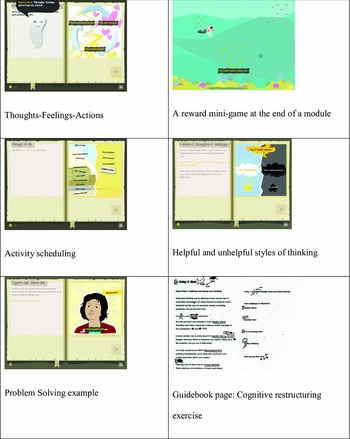
The Journey is embedded in a fantasy game-like environment i.e. the user selects and names an avatar, follows a narrative of a quest through magical lands where the content is linked to a theme (e.g. cognitive restructuring techniques are progressively covered in Sky and Star Cities respectively), earns points for completing modules and is rewarded with a simple mini-game at the end of each module. The Journey comprises seven modules, each with a different topic. Each module takes approximately 25–30 minutes to complete and begins with a mood monitor, followed by a quiz to recap the messages of the previous module, agenda setting, and a number of interactive exercises, animations and illustrative video clips. Modules end with a summary of content and challenge (homework) setting.
Both programs were accompanied by a paper Guidebook, which had a summary of each module and a space for the young person to write down her or his goals, answer questions and complete weekly challenges (e.g. thought diary in the cCBT condition or a personal organizer in the CPE group).
cCBT program
Our cCBT program covers well-established core cognitive behavioural therapy (CBT) techniques. To make the content more developmentally appropriate we used simple colloquial terminology (e.g. relaxation was referred to as “chilling” and problem solving was called “figuring things out”), used examples pertinent to young people's lives (e.g. school work, negotiating curfew time with parents) and minimized text in favour of imagery and interactive exercises.
Computerized Psychoeducation (CPE) program
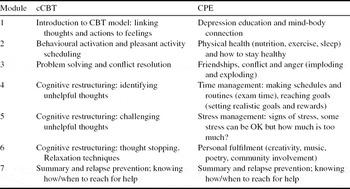
Our control computer program (CPE) contained simple psycho-educational content. Psychoeducation (PE) can be used to assist clients with gaining an understanding of their disorder, its causes and manifestation as well as the available treatment options. It is a didactic intervention to promote knowledge, with a focus on instruction rather than therapy. Being a form of psychotherapy, CBT is focused on the acquisition of new skills, while PE is primarily concerned with information transfer. The CPE program served as an attention placebo control and was void of any CBT content. In the first module of the CPE program, the focus was on educating the young person about depression and presenting a “mind-body” model, which was then explored in more detail. Subsequently the remaining sessions included simple mental health hygiene (e.g. healthy nutrition and getting a good night's sleep), stress-reduction topics (e.g. how to prepare for an exam or avoid fighting with friends) and other topics such as creativity (e.g. making poems) and setting personal goals. Table 1 summarizes the topics in each program. Figure 1 presents a sample of screenshots from the programme.
Content of the active cCBT and control CPE programmes

A sample of screenshots from The Journey program.

Measures
Acceptability was assessed using a brief satisfaction questionnaire specifically developed for this study. Feedback was sought on perceived appeal, likes, dislikes as well as ratings of usefulness of specific features and topics of the program. Qualitative feedback on the use of computers in treating depression was also collected but is not reported in this paper.
The primary outcome measure for efficacy was the CDRS-R, which is a treatment sensitive clinical semi-structured interview tool that covers 17 symptom areas. It has good psychometric properties including sensitivity to change. Remission (score equal or below 29) and response rates (reduction in scores by 30% or more using a formula corrected for a non zero minimum score of 17) on this measure were calculated and compared between groups. Secondary outcome measures included: RADS-2, a 30-item well-validated self-report measure of depressive symptoms (Reynolds, Reference Reynolds2002); the Pediatric Quality of Life Inventory (PedsQL) (Varni, Burwinkle and Katz, Reference Varni, Burwinkle and Katz2004), a 23-item measure designed for use both with healthy children and adolescents and those with acute and chronic health conditions; the General Short Form of the Adolescent Coping Scale (ACS) (Frydeberg and Lewis, Reference Frydeberg and Lewis1993), which comprises 18 behaviours that adolescents use to deal with their concerns (e.g. “work at solving the problem to the best of my ability” or “worry what will happen to me”). Items are endorsed on a 5-point response scale (doesn't apply or don't do it; used very little; used sometimes; used often; used a great deal). It generates three subscales: Problem Solving, Reference to Others, and Non-Productive Coping. High scores on the Solving the Problem and Reference to Others subscales indicate positive coping strategies, whereas high scores on the Non-Productive Coping subscale indicate a less productive style of coping.
All measures were conducted at baseline, post-intervention and at 1-month follow-up (i.e. one month after the end of the intervention). School counsellors were trained in the use of CDRS-R by the researchers (KS and SM).
Data analysis
Statistical analyses were performed using the SPSS for Windows Statistical Software package (Version 15). All analyses were conducted using intent-to-treat principle with missing responses replaced using the last observation carried forward (LOCF) method. The analyses of the primary and secondary treatment efficacy measures were conducted by comparing the changes in scores at posttreatment using ANCOVA, with baseline level as the covariate. The ANCOVA model also included gender and age recoded into two age groups (younger adolescents aged 13–15 and older aged 16–18) as fixed factors as these demographic features may impact on the changes and on the relative response to the two treatments. A further analysis was conducted to compare the changes in scores from posttreatment to 1-month follow-up between the two randomized groups.
Effect sizes (ES) for the comparison between the cCBT and CPE changes were calculated using the formula: d = (mean change cCBT – mean change CPE)/√(error mean square)
Results
Participant flow and completion rates
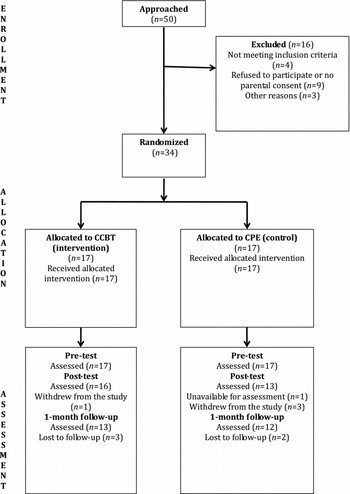
Of the 50 screened participants, 16 were excluded (see Figure 2 for details) and 34 were randomized; 17 participants were assigned to each group. In the cCBT group, all but one of the participants (94%) completed the full program and posttreatment assessment. Three cCBT participants did not return for the 1-month-follow-up. In the CPE group, 14 participants (82%) completed the intervention. Participant flow is outlined in Figure 2.
Trial flow diagram (cCBT = computerized cognitive behavioural therapy; CPE = computerized psycho-education).

Baseline characteristics
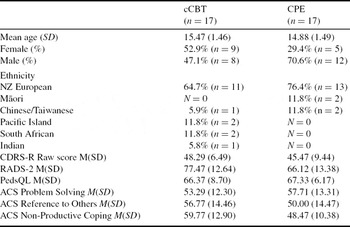
The mean age of participants was 15.2 years of age (SD = 1.5); 41% of respondents were female. The majority (71%) of participants identified themselves as New Zealand European (see Table 2).
Baseline demographic characteristics of the sample
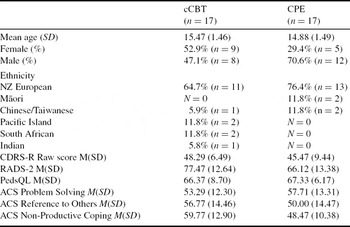
Notes: cCBT – computerized cognitive behavioural therapy; CPE – computerized psycho-education; M = Mean, SD = Standard Deviation
Acceptability and treatment satisfaction
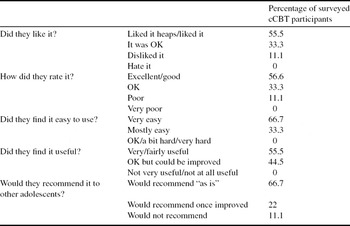
The satisfaction questionnaires were collected by KS on a different occasion to the postintervention assessment. Unfortunately, this meant that not all of the participants were able to complete it. Twenty-two questionnaires were returned; 10 by participants from cCBT group and 12 from the CPE group (one cCBT participant did not complete the whole questionnaire so some of the figures are based on a sample of 9). All participants were invited to in-depth interviews. These took place in the last term, which meant that many participants were not available to attend the interviews due to exams or because they had already left school. Fourteen interviews were conducted; six of those participants were assigned to cCBT and eight were from the CPE group. There was an overlap between those who completed the questionnaire and those who also agreed to the interview. The results are summarized in Table 3.
User feedback about cCBT programme

The participants identified the following five features of the program as their favourite: “it was computer-based”; “showed me things I didn't know about”; “I could use it at school”; “it was made for adolescents” and “it talked about mental health”. The main identified weaknesses of the program were technical glitches, excessive amounts of reading and perceived developmental inappropriateness (the program was thought to be more appealing to younger adolescents). Most participants took between 4 and 6 weeks to complete the intervention (we allowed for flexibility around term break and exam time).
Effect of the intervention
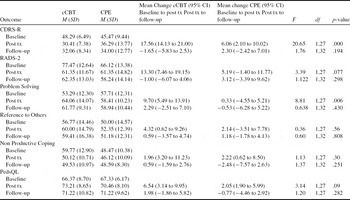
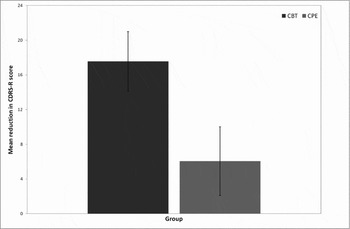
There was a significant difference in the mean reduction from baseline score on the CDRS-R and on the ACS Problem Solving scale (Table 4). Although there was an improvement in depression scores on RADS-2 and in quality of life on the PQL that was greater for cCBT than for CPE, this fell just short of statistical significance. Figure 3 shows the mean post-treatment improvements on CDRS-R.
Outcome variables by group across three time points

Notes: cCBT – computerized cognitive behavioural therapy; CPE – computerized psycho-education
M = Mean, CI = 95% confidence interval.
Mean improvement in CDRS-R scores by treatment group Key: Vertical bars represent 95% confidence intervals Note: For ease of presentation, improvements (i.e. a decrease in depression scores) have been presented as a positive change.

There was a significant difference (F(1,27) = 20.6, p<.001) in the mean reduction from baseline score on the CDRS-R (17.6 for cCBT and 6.1 for CPE). The between group ES for CDRS-R was 1.7. Males improved more than females regardless of group allocation (F(1,27) = 14.45, p<.001). There was a significant difference (F(1,27) = 8.81, p = .006) in the mean change (negative scores indicate improvement) on ACS Problem Solving scale between the treatment groups (−9.7 for cCBT and -0.33 for CPE). The ES was 1.1. However, this difference was dependent on age and the effect of cCBT was larger (F(1,27) = 5.21, p = .031) in the older group (−2.20 for the younger cohort and -14.708 for the older participants).
The mean reduction from baseline on RADS-2 was 13.3 for cCBT and 5.18 for CPE. While there was some indication of change, the difference did not reach statistical significance (F(1,27) = 3.39, p = .077). The ES of The Journey compared to the control program was 0.7. The mean reduction from baseline on PQL was -6.54 for cCBT and -2.05 for CPE. While there was some indication of change, the difference did not reach statistical significance (F(1,27) = 3.14, p = .088). The ES was 0.66.
No statistically significant program or interaction effects were found on ACS Reference to Others or ACS Non-Productive coping measures. Females improved more (−8.11 vs. 1.65) on the Reference to Others scale than their male counterparts (F(1,27) = 6.83, p = .015) regardless of group allocation.
No significant changes between the end of treatment and follow-up were detected on any of the outcome measures.
Response and remission rates
At the end of treatment 88.2% of those who had received cCBT had a response rate (30% or greater reduction in CDRS-R score) compared with 47.1% of those on CPE (Fisher's exact text p = .025). At 1-month follow-up there was still a difference between groups (76.5% in those on cCBT and 52.9% of those on CPE) but the difference was no longer statistically significant. Remission was defined as a CDRS-R total score of ≤ 29. Remission rate after treatment with cCBT was 47.1%, and 35.3% after CPE; at 1-month follow-up the rate for cCBT was 47.1%, and 41.2% for CPE. None of these rates were significantly different between groups.
Safety
As this was a feasibility study, no formal data on safety were recorded. However, there were no adverse events such as increase in suicidality reported. We did not record how many young people requested additional help from the counsellor.
Blinding
When asked which group they were in, 9.5% of participants guessed correctly, 28.6% guessed incorrectly, and 61.9% said they did not know. In the cCBT group, 22.2% guessed correctly, 11.1% guessed incorrectly and 66.7% did not know; in the CPE group, none guessed correctly, 41.7% guessed incorrectly and 58.3% did not know.
Discussion
We successfully piloted a purpose-developed adolescent-specific computer-based CBT program and showed it was feasible to deliver this as part of a school counselling service, acceptable to young people and significantly more effective in reducing clinician-rated depressive symptoms and in improving participants’ problem-solving skills than a placebo psycho-education program. Improvements were maintained 1-month after the end of the intervention. Two other measures of depression and quality of life approached statistical significance in group differences in the expected direction. The uptake of the program was satisfactory. Out of 50 screened participants, only 9 did not consent to participate (in some cases there was no parental consent for those under 16 years of age). Based on a high completion rate (94% in cCBT group) we demonstrated that it is feasible to deliver this type of intervention to adolescents with depression and that they find it engaging. Our completion rate compares favourably with adult cCBT studies (between 65% and 78% for a package called Beating the Blues (Proudfoot et al., Reference Proudfoot, Goldberg, Mann, Everitt, Marks and Gray2003, Reference Proudfoot, Ryden, Everitt, Shapiro, Goldberg and Mann2004)). A comparison with a study of high school students receiving internet-delivered cCBT (MoodGYM) where only 40% completed half or more of the modules (O'Kearney, Gibson and Christensen, Reference O'Kearney, Gibson and Christensen2006) suggests the need to tailor interventions for their intended audience. We believe that our program benefited from being purpose-developed to meet adolescents’ needs in terms of its perceived attractiveness, appropriate language and difficulty level. Our results are particularly encouraging given that our program was a pure self-help intervention (unguided or unsupported self-help) and there was no clinical input from the counsellors.
A trial comparing an internet-based cCBT (MoodGYM), a psycho-educational website and an attention control group showed that MoodGYM and psycho-education were equally effective in reducing symptoms of depression, and both were better than the attention control group (Christensen, Griffiths and Jorm, Reference Christensen, Griffiths and Jorm2004). Our study provides preliminary evidence that cCBT may be more effective than a program that contains some psycho-educational content, although remission rates were not statistically different between the groups. The qualitative feedback from young people suggested that psychoeducation is helpful.
We found moderate effect sizes for the cCBT group on CDRS-R and ACS-Problem Solving. Our effect sizes compare favourably with findings from cCBT for adults, which range from 0.64 to 2.22 (Cavanagh et al., Reference Cavanagh, Shapiro, Van Den Berg, Swain, Barkham and Proudfoot2006). The MoodGYM study showed a moderate pre-post effect sizes (ES = 0.6 for cCBT and ES = 0.5 for the psychoeducational website) (Christensen et al., Reference Christensen, Griffiths and Jorm2004) while the Beating the Blues program gave an effect size of 0.65 compared with routine care (Proudfoot et al., Reference Proudfoot, Ryden, Everitt, Shapiro, Goldberg and Mann2004).
While the easy-to-use interface was one of the perceived strengths of the program, we still had a number of technical problems. Although we attended to all these quickly to prevent any of the participants from discontinuing, participants viewed these difficulties negatively. When designing future programs, a considerable testing time is needed to ensure a stable software platform.
In line with advice given by young people, we tried to reduce the reading material as much as possible. On average, each module contained 20 screens with approximately 60–80 words of per screen. In almost all instances, written text was supported by interactive features, multimedia, animations or illustrations. Nevertheless, user feedback suggests that even this was too much. In the future we suggest limiting the reading material to a minimum or giving the user the option to choose audio and/or video presentation of content.
Some of the trial participants felt that the visual design of the program as well as the underlying storyline lacked desired maturity and was more suitable for younger adolescents. Interestingly, a cCBT anxiety program designed for adolescents, Cool Teens, has also been criticized by its users as being “for younger ages” (Cunningham, Rapee and Lyneham, Reference Cunningham, Rapee and Lyneham2006). A young media-savvy audience presents a challenge for the developers of therapeutic computer programs and the inter-face will need to compare favourably with other computer resources in the marketplace.
Depression has been ranked as the fifth most important issue of concern to young people between 11 and 24 (suicide and self-harm were ranked as number one) yet most adolescents with depression do not receive intervention (Kataoka et al., Reference Kataoka, Zhang and Wells2002). Adolescents are more likely to seek help from the internet than from a counsellor, a doctor, a teacher or a youth worker (Mission Australia, 2005). A UK survey of adolescents showed that 73% favoured self-help for mild to moderate mental health difficulties, with 39% preferring a computer-based format (Farrand, Perry, Lee and Parker, Reference Farrand, Perry, Lee and Parker2006). However, the majority preferred to use self-help at home rather than at school, suggesting that future studies should investigate internet and home-based computerized therapy in response to the needs of young people. The Journey uses Flash technology and thus can be easily converted for online delivery.
Strengths and weaknesses
Our program was specifically designed for adolescent use to ensure developmentally-appropriate content, language and presentation style. These factors may have contributed to the high rate of program completion. Several features of the research design support the integrity of the results, in particular the random assignment to treatment group with allocation concealment and the use of clinician ratings of depressive symptomatology. Our trial was designed to be double-blind. Assessment showed that blinding was successful with study participants; however, while school counsellors were not informed which program participants were assigned to, we did not assess whether the counsellors stayed blind during the course of the study. Our follow-up rates were good. Finally, the inclusion of a placebo-control intervention that was matched for duration, intensity and other non-specific factors adds to the strengths of this project as most of previous cCBT research has relied on “wait-list” or “treatment as usual” interventions provided by a clinician (Kaltenthaler, Parry, Beverley and Ferriter, Reference Kaltenthaler, Parry, Beverley and Ferriter2008).
This study had several limitations. It was a small pilot trial and as such we are only able to provide preliminary data on efficacy of the intervention. Although school counsellors were trained in using CDRS-R, an independent assessor did not validate their ratings. We have recruited self-selecting individuals and we have no data on those who refused to participate. Our follow-up interval was one month and while it would have been desirable to extend it, this was a preliminary study. We were not able to survey and interview all the participants who had completed the intervention regarding their satisfaction with the treatment.
Conclusions and areas for further research
The potential of the computer as a tool for delivering therapeutic interventions is yet to be fully realized. Increasingly sophisticated computerized resources have the potential to enrich the array of available therapeutic tools. However, we need to ensure that progress in this field leads to improved access to evidence-based treatments for those who would otherwise miss out. This needs to include provision for developmentally appropriate programs for children and adolescents. It is encouraging to see tailored programs (such as The Coping CAT CD-ROM and BRAVE-ONLINE) being successfully applied with anxious children and adolescents (Khanna and Kendall, Reference Khanna and Kendall2008; March, Spence and Donovan, Reference March, Spence and Donovan2009). Our group has since developed a program called SPARX, which delivers cCBT using a platform of an interactive fantasy game. We have shown this to be as effective as treatment as usual for help-seeking adolescents (Merry et al., Reference Merry, Stasiak, Frampton, Shepherd, Fleming and Lucassen2012), more effective than a wait-list (Fleming, Dixon, Frampton and Merry, Reference Fleming, Dixon, Frampton and Merry2011) and acceptable to young people (Fleming, Dixon and Merry, Reference Fleming, Dixon and Merry2012).
To our knowledge, this is the first randomized placebo controlled trial of a computerized intervention developed specifically as an intervention for adolescents with depression. As such, the present study contributes useful information highlighting the potential of this innovative treatment modality in the treatment of adolescents experiencing mild to moderate depression.



Comments
No Comments have been published for this article.