INTRODUCTION
Habitat fragmentation and subsequent isolation of plant populations reduces fecundity of many plant species (Aguilar & Galetto Reference AGUILAR and GALETTO2004, Aizen & Feinsinger Reference AIZEN and FEINSINGER1994, Fuchs et al. Reference FUCHS, LOBO and QUESADA2003, Rocha & Aguilar Reference ROCHA and AGUILAR2001, Valdivia et al. Reference VALDIVIA, SIMONETTI and HENRIQUEZ2005). Pollination failure is likely the main cause of plant reproductive decline following fragmentation (reviewed by Aguilar et al. Reference AGUILAR, ASHWORTH, GALETTO and AIZEN2006).
Important drivers are reduced pollinator numbers (Jennersten Reference JENNERSTEN1988, Steffan-Dewenter & Tscharntke Reference STEFFAN-DEWENTER and TSCHARNTKE1999), and reproductive isolation of small populations through decreasing pollen flow (Aguilar et al. Reference AGUILAR, QUESADA, ASHWORTH, HERRERIO-DIEGO and LOBO2008, Eckert et al. Reference ECKERT, KALISZ, GEBER, SARGENT, ELLE, CHEPTOU, GOODWILLIE, JOHNSTON, KELLY, MOELLER, PORCHER, REE, VALLEJO-MARIN and WINN2010, Ghazoul & McLeish Reference GHAZOUL and McLEISH2001, Goverde et al. Reference GOVERDE, SCHWEIZER, BAUR and ERHARDT2002). Eventually, plant populations may suffer from a significant decrease in fruit and seed set (Aguilar et al. Reference AGUILAR, ASHWORTH, GALETTO and AIZEN2006, Ghazoul Reference GHAZOUL2005).
Pollinator visitation rates usually correlate with floral display size of individual plants (Lehtilä & Strauss Reference LEHTILÄ and STRAUSS1997, Somanathan & Borges Reference SOMANATHAN and BORGES2001). Fruit set often increases with floral display size as well (Muñoz et al. Reference MUÑOZ, CELEDON-NEGHME, CAVIERES and ARROYO2005, Somanathan & Borges Reference SOMANATHAN and BORGES2000). Similar processes may apply to plant neighbourhoods: pollinators are most attracted to groups or patches of trees during times of intense flowering, effecting many flower visits among close-standing individuals to exploit resources (Augspurger Reference AUGSPURGER1980, Marquis Reference MARQUIS1988). There are, however, few published data on the effect of local flowering densities on fruit and seed set. Seed production on a local scale should increase with local flower density, if the following premises are met: (1) seed set is not resource-limited, (2) pollinator abundance and activity responds to an increase in floral resources, and (3) pollen transfer among trees in a patch or local population normally leads to successful fertilization.
In a previous study in fragmented Atlantic rain forest, the understorey tree Paypayrola blanchetiana (Violaceae) was found to have remarkably low fruit set (1%) and seed set (0.6%). The study confirmed that about 90% of flowers were not fertilized, despite common flower visitors. Of those flowers that initiated a fruit, c. 90% were aborted during the first 2–3 wk of development. Trees flowered continuously, with few but variable numbers of flowers present (Braun et al. Reference BRAUN, DÖTTERL, SCHLINDWEIN and GOTTSBERGER2012).
The present study addresses the following research hypotheses: (1) Total fruit set and seed set are higher in large than in small fragments, and higher in more recently created fragments. (2) Flower numbers are proportionate to resulting fruit numbers in patches, and relative fruit set does not change significantly in response to variation in patch flower density.
The study subject is a tree from tropical forest understorey, a life-form little represented in the context of fragmentation and plant reproduction (Aguilar et al. Reference AGUILAR, ASHWORTH, GALETTO and AIZEN2006, Ghazoul Reference GHAZOUL2005, Ward et al. Reference WARD, DICK, GRIBEL and LOWE2005).
MATERIALS AND METHODS
Study site and species
The study was carried out at the sugarcane plantation Usina São José (USJ) within the municipality of Igarassu, Pernambuco State, Brazil. The USJ property covers 247 km2 and contains 106 forest fragments with a combined forest cover of 24% (total area 66 km2). Surrounding areas are used for sugarcane production. Forest clearance took place during various waves, the latest in the 1970s and 1980s, when the Brazilian government's ‘Proálcool’ programme was launched to develop ethanol-based biofuel production (Kimmel et al. Reference KIMMEL, PIECHOWSKI and GOTTSBERGER2008). In 1975, forest cover was still at 45.6% with a total of 153 fragments. Since then, forest has been lost at a rate of 2.14% y−1, and the average distance between fragments has increased from 397 to 695 m (Trindade et al. Reference TRINDADE, LINS-E-SILVA, DA SILVA, FIGUEIRA and SCHESSL2008). Most of the older fragments were probably created in the 1950s, in response to the availability of chemical fertilizers, which raised productivity on soils previously too nutrient-poor for sugarcane production (Kimmel et al. Reference KIMMEL, PIECHOWSKI and GOTTSBERGER2008). Climate in the area is tropical, with a mean temperature of 25.1°C and a mean annual precipitation of 1688 mm (meteorological data collected at USJ station between 1998 and 2006). Vegetation in the area is lowland rain forest with transition to semideciduous forest (Veloso et al. Reference VELOSO, RANGEL FILHO and LIMA1991).
Paypayrola blanchetiana Tul. (Violaceae) is a small tree of the forest understorey. The species is endemic to the Atlantic Forest region of East Brazil (Martini et al. Reference MARTINI, FIASCHI, AMORIM and DA PAIXÃO2007), an imperiled hotspot of biodiversity (Myers et al. Reference MYERS, MITTERMEIER, MITTERMEIER, DA FONSECA and KENT2000). At the study site, trees occur in different forest microhabitats such as streamside, slopes and upland plateau forest. They grow in distinct clusters or patches, well-separated from neighbouring patches, with a few solitary individuals elsewhere. The distribution pattern is comparable to Rinorea sylvatica (Figure 3 in Condit et al. Reference CONDIT, ASHTON, BAKER, BUNJAVEJCHEVIN, GUNATILLEKE, GUNATILLEKE, HUBBELL, FORSTER, ITOH, LaFRANKIE, LEE, LOSOS, MANOKARAN, SUKUMAR and YAMAKURA2000). Inflorescences containing 5–20 flowers are produced continuously throughout the year, in highly variable numbers. Plants are self-incompatible, and flowers are visited by diverse generalist-foraging insects. Ovaries contain 8–16 ovules (for details, see Braun et al. Reference BRAUN, DÖTTERL, SCHLINDWEIN and GOTTSBERGER2012). Propagation is mediated by seeds, and we found no evidence for clonal growth. Fruits are smooth, three-valved capsules (Melchior Reference MELCHIOR, Engler and Prantl1925). They start growing c. 4–6 d after flowering and become ripe c. 5–7 wk after flowering. Dispersal is autochorous, and seeds are ejected explosively from the drying capsules.
Fragment size and fragment age
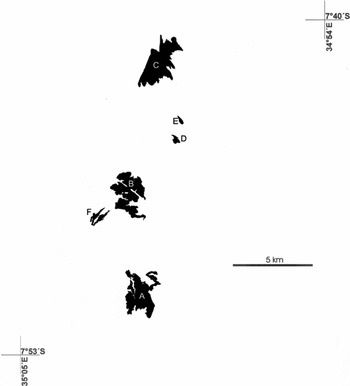
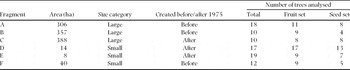
Six forest fragments (A–F), ranging in size from 8 to 388 ha, were chosen for the study (Figure 1). Fragments were selected to represent different combinations of size (three large vs. three small) and age, i.e., the time elapsed since they became isolated by deforestation: three fragments were created before, and three after 1975 (Table 1). Fragment areas were calculated with GPS Utility 4.20, based on satellite images dating from 2005. An aerial photograph from 1975 and the satellite image from 2005 were compared to determine which fragments were created before and after 1975.
Location of forest fragments A–F on Usina São José where patches of Paypayrola blanchetiana were studied.

Number of Paypayrola blanchetiana trees analysed for flower and fruit production (total), fruit set and seed set in six forest fragments at Usina São José. Twenty-three of the monitored trees produced less than 200 flowers and were excluded from fruit-set analysis. Eighteen trees produced less than five fruits and were excluded from seed-set calculation.

Flower, fruit and seed sampling
Eighty-six reproductive P. blanchetiana trees were tagged in the six fragments. Sample size ranged from 10 to 19 trees per fragment, each representing a sampling of a single patch of close-standing trees. Flowering inflorescences and fruits were counted once per month on every tagged individual. A tree was considered ‘in flower’ during a given month, if it had at least one flowering inflorescence. Inflorescences produced an average of about 1 flower d−1 (Braun et al. Reference BRAUN, DÖTTERL, SCHLINDWEIN and GOTTSBERGER2012). The number of inflorescences was therefore multiplied by 30 for an estimate of the total flower number during that month. Calculation of fruit/flower ratio was based on this estimate. Only fruits at least 20 mm long (c. 2–3 wk old) were considered, since most of the smaller fruits were aborted (M. Braun, pers. obs.). Seed number was determined for all accessible fruits (c. 85%). Phenological surveys were performed during 11 consecutive months, from February to December 2008, except in fragment C where sampling started in March (10 mo), and fragment E where sampling started in April 2008 (9 mo). Observations were carried out from the ground using Leica Trinovid BA (10 × 42) binoculars (Leica Camera Corporation, Germany).
Calculation of fruit and seed set of individual trees
Total fruit set of individual trees was defined as the ratio of cumulative fruit production to cumulative estimated flower production. Fruits produced during the first sampling month and inflorescences produced during the last sampling month were omitted, to adjust for the time difference between flower and fruit production. Only plant individuals with a minimum of seven inflorescences (corresponding to at least c. 200 flowers produced over the study period) were included in the analysis. Seed set per tree was calculated by multiplying fruit set with the ratio of seed numbers to mean ovule number. It is thus a relative measure of the proportion of fertilized ovules out of the available ones. Seed set was calculated only for trees with a minimum of five seed counts, while remaining plants were excluded from seed set analysis (Table 2).
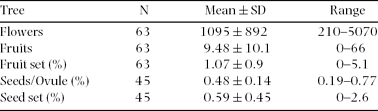
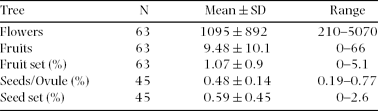
Total mean (± SD) flower and fruit production, fruit set (fruits per flower), seeds per mean ovule number, and seed set (fruit set × seeds/ovule) of 63 Paypayrola blanchetiana trees over the duration of the study period in six forest fragments at Usina São José.
Measurement of patch reproductive success over time
Data for monthly inflorescence, fruit and seed numbers were pooled for all tagged trees of a given patch to analyse combined fruit set within patches over time. Fruit set and seed set were calculated in the above way, except that the combined fruit and seed counts were related to the combined inflorescence counts of the previous month to adjust for the time lapse between flowering and fruiting. When patches produced very few fruits, i.e. less than five seed counts (17 out of 57 sample months), the respective seeds/ovule data were replaced with the mean value of the dataset, for a conservative analysis.
Statistical analysis
In compliance with the unbalanced sampling design, a single linear mixed-effect model, fitted by maximum likelihood, with a post hoc ANOVA (Pinheiro & Bates Reference PINHEIRO and BATES2000) was run to test for (1) differences in fruit and seed set among trees in large and small fragments (fragment size); (2) fruit set and seed set differences among trees in fragments isolated before and after 1975 (fragment age); and (3) a combined fragment size and age effect on fruit set and seed set. In the model, fragment size and fragment age were fixed factors, and fragment was a random factor. To match parametric assumptions, fruit set was square root- and seed set was arcsine + log-transformed. Analyses were carried out with the free software R (version 2.12.1; R Foundation for Statistical Computing, Vienna, Austria).
Repeated-measures ANOVAs were performed to test for independence of data from different months (number of inflorescences, number of fruits, and fruits per flower ratios of combined trees in large and small fragments). Spearman Rank correlation tests were used to test if total flower number in a given patch was positively correlated to the number of flowering trees. Monthly flowering intensity and resulting fruit set and seed set in patches was measured by simple linear regressions, separately for each patch. Monthly seed set in patches was analysed using Statistica Version 8.0 (StatSoft Inc, Tulsa, USA).
RESULTS
Combined individual fruit set and seed set
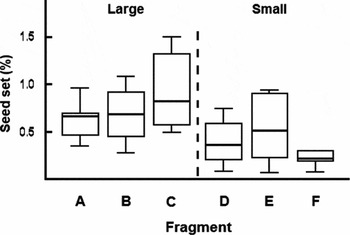
Twenty-three out of 86 trees produced too few flowers (less than seven inflorescences counted) to estimate fruit set. They were excluded from analysis of individual reproductive success. Reproductive output of individual trees was generally low, but with considerable variability among trees. Fruit set ranged from 0% to 5.1%, and seed set from 0% to 2.6% (Table 2). Both fruit set and seed set were significantly higher in the large fragments (fruit set: F (57, 3) = 15.3, P < 0.05; seed set: F (39, 3) = 24.9, P < 0.05; Figure 2). Fragment age affected neither fruit set (F (57, 3) = 6.02, P = 0.09), nor seed set (F (39, 3) = 4.91, P = 0.11) significantly. Also, there was no interaction effect of fragment size and fragment age (fruit set: F (57, 2) = 3.17, P = 0.17; seed set: F (39, 2) = 0.258, P = 0.66).
Cumulative seed set (% seeds/ovule ratio) of Paypayrola blanchetiana trees in three large (> 300 ha) and three small (< 50 ha) fragments. Box plot shows means, 25% and 75% percentiles, and ranges (outliers removed).

Population flower production and resulting fruit set
Repeated-measures ANOVA revealed that both the category month and the interaction of month and fragment size had a significant effect on the number of inflorescences produced within a patch (F1,10 = 4.04, P < 0.001; and F1,10 = 5.02, P < 0.001, respectively). However, there was no significant effect of month or the interaction of month and fragment size on fruit set within a patch (F1, 7 = 0.97, P = 0.47, and F1, 7 = 1.36, P = 0.26, respectively). Fruit-set data from different months are therefore treated as independent.
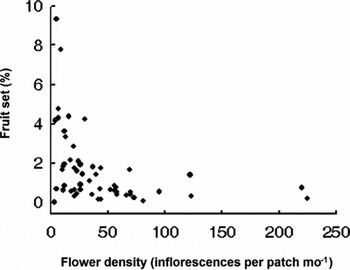
Both flower density and resulting fruit and seed set varied greatly among patches and months. The number (mean ± SD) of flowers per patch and month (1247 ± 1341) ranged from 180 to 6750. Fruit set (1.62% ± 1.8%) ranged from 0–9.3%, and seed set (0.97% ± 1.0%) from 0–5.2%. The proportion of flowering trees per patch and month was 58% ± 23% (range 20–100%). In all fragments, the number of inflorescences was correlated with the number of trees producing flowers during that month. Spearman rank correlations ranged from R = 0.73 (t(N−2) = 2.83, P < 0.05) in Fragment C to R = 0.87 (t(N−2) = 4.5, P < 0.01) in Fragment E. Measurements performed over consecutive months indicate that fruit set was inversely related to flower density (Figure 3). Transformed data analysed separately for all fragments resulted in correlations with negative r-values in all fragments (large fragments A: r = −0.59, B: r = −0.43, C: r = −0.47; small fragments D: r = −0.77, E: r = −0.61, F: r = −0.76). The correlation was significant in fragments D (P < 0.05) and F (P < 0.05). Seed-set regressions were very similar (data not shown), except for Fragment F which had a slightly higher r-value (r = −0.83; F = 17.8; P < 0.05).
Fruit set as a function of local flower density in patches of Paypayrola blanchetiana. Each data point represents one month and one patch.

DISCUSSION
Paypayrola blanchetiana relies on outcross pollination for successful reproduction. The present study confirmed a very low seed set, as measured in a previous pollination study (Braun et al. Reference BRAUN, DÖTTERL, SCHLINDWEIN and GOTTSBERGER2012). Moreover, reproductive success was higher in the large fragments, and there was an inverse relationship between local flower density and resulting fruit and seed set. On the other hand, fragment age did not have a clear influence on tree reproduction.
Low seed set can be caused by several ecological factors unrelated to a plant's reproductive biology, such as resource limitation due to low nutrient availability or competition with neighbouring plants (including invasive species), or herbivore damage (Stephenson Reference STEPHENSON1981). While P. blanchetiana fruits and seeds did not suffer significant insect herbivory (M. Braun pers. obs.), the presence of resource limitation is more difficult to assess. However, Braun et al. (Reference BRAUN, DÖTTERL, SCHLINDWEIN and GOTTSBERGER2012) found that pollen supplementation resulted in a much higher (8%) than natural fruit set. We conclude that low fruit set was probably related to pollination failure, i.e. insufficient delivery of suitable pollen to stigmas.
Pollination failure can result from a number of different biological processes, including reduced pollinator activity (leading to deposition of too little or no pollen on stigmas), or transfer of non-viable, incompatible or otherwise unsuitable pollen (Wilcock & Neiland Reference WILCOCK and NEILAND2002). In the case of P. blanchetiana, at USJ, only a low proportion of flowers showed signs of successful fertilization. This was probably due to a peculiar form of pre-dispersal pollination failure, where pollen frequently contacted floral nectar and lost its capacity to germinate (Braun et al. Reference BRAUN, DÖTTERL, SCHLINDWEIN and GOTTSBERGER2012). Out of the remaining fertilized flowers, most developing fruits were lost to abortions.
Without comparative quantitative data on number of pollen grains deposited on stigmas or pollen tubes in recipient styles, it is difficult to assess with certainty which process was responsible for the seed set differences between the small and large fragments. Possible mechanisms are (1) declining pollinator numbers in small fragments and consequently lower visitation rates and pollen deposition and (2) changes in pollinator movement patterns, so that flowers in small fragments received pollen that was less suitable for seed set (Ghazoul Reference GHAZOUL2005 and references therein). Noctuid and geometrid moths were probably the most effective pollinators of P. blanchetiana at USJ (Braun et al. Reference BRAUN, DÖTTERL, SCHLINDWEIN and GOTTSBERGER2012). In one of the small fragments, their combined visitation rate was 0.9 visits per flower per night, and their abundance and visitation rates may have been higher in the large fragments. But perhaps restrictions of their movements, imposed by fragmentation, were just as important. Perching moths are rather weak fliers (Oliveira et al. Reference OLIVEIRA, GIBBS and BARBOSA2004), and their foraging ranges may have been effectively limited by fragment boundaries. This is consistent with a study by Milet-Pinheiro & Schlindwein (Reference MILET-PINHEIRO and SCHLINDWEIN2005), who demonstrated that, at USJ, fragment boundaries mostly restricted the movements of euglossine bees, a strong-flying forest-based pollinator group. If pollen flow is thus limited to within fragment borders, the result is a smaller effective population size restricted to patches within a fragment. This may explain why a smaller fragment area has a negative effect on seed set: although the population size in the large patches is not exactly known, it is certainly very small (< 40 adult trees) in each of the small fragments studied (M. Braun pers. obs.). The observed fruit abortions may be a consequence of inbreeding among close neighbours. Reduction of pollen flow by fragmentation should increase inbreeding. Early inbreeding depression may be a negative function of distance between parent plants (Levin Reference LEVIN1984, Gigord et al. Reference GIGORD, LAVIGNE and SHYKOFF1998), and seed abortion rates have been shown to increase with relatedness of the parents (Krebs & Hancock Reference KREBS and HANCOCK1990).
The result that high flower density was not followed by a marked increase in fruit numbers was interesting, especially since more flowers usually also meant more flowering trees present in a patch. This is also consistent with inbreeding- and paternity-related seed abortions. Perhaps as a function of their autochorous dispersal, trees within a patch may be too closely related for successful mating. Another possible explanation is that the pollinators, i.e. moths, were generally so scarce that visitation rates dropped sharply in response to more intense flowering, leaving many flowers unpollinated. Assuming this, however, we must also conclude that the moths were always less common in the small fragments. The hypothesis of inbred seeds can explain the fruit abortions, the fragment-size effect, and the inverse relationship between flower density and fruit set. It would be interesting to test this hypothesis using molecular markers to determine genetic diversity, genetic differentiation and gene flow among a set of patches of P. blanchetiana trees in the present highly fragmented environment.
ACKNOWLEDGEMENTS
This paper is a contribution to the project Sustainability of Remnants of the Atlantic Rainforest in Pernambuco and its Implications for Conservation and Local Development, a Brazilian–German scientific cooperation within the program Science and Technology for the Atlantic Rainforest, funded by Brazilian Research Council CNPq (590039/2006–7) and German Ministry of Research and Development BMBF (01 LB 0203 A1). We thank Usina São José S.A./Grupo Cavalcanti Petribú for permission to carry out fieldwork and for logistical support, and Dr Kirsten Jung (Institute of Experimental Ecology, University of Ulm) for help with statistical analyses.