

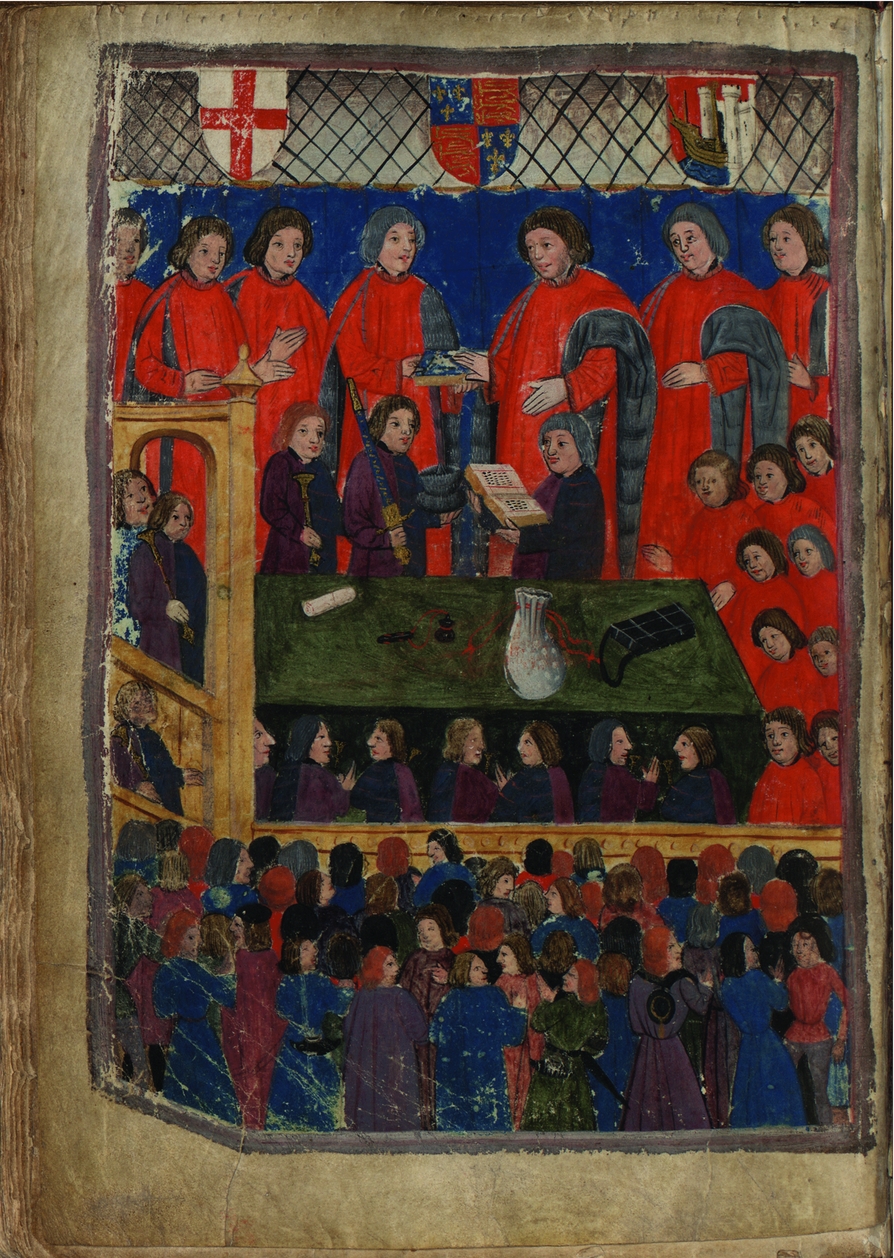
In the Maire of Bristowe is Kalendar, a civic register from c. 1478 containing, among other items, a collection of customary law for the English port town of Bristol, a colourful illustration of a ceremony lights up the page with images of borough officials and the commons, dressed in garments of vibrant reds, greens and blues. The scene depicts the new mayor, likely William Spencer, in a scarlet robe lined with fur, being sworn in at the Guildhall by the previous mayor, flanked by the sheriff and aldermen, who wear similar regalia. In the background is a shield with the cross of St George, as well as the coats of arms of the city and the realm. The figures are arranged hierarchically to show the commonalty, or citizens, in the foreground celebrating and observing a peaceful transfer of power (see Figure 1). While the central focus of the picture is the mayor laying his hand on a Bible, the rendering of the elfin figure beside him is of the town clerk – most likely Robert Ricart, the author of the Kalendar, himself – administering the mayoral oath, presumably reading it aloud from a book in his hands.Footnote 1 This book was likely the fourteenth-century Little Red Book, which preserved one of the oldest collections of customs belonging to Bristol.Footnote 2 In the Kalendar, Ricart emphasized the importance of this mayoral induction ceremony, and described in loving detail how such a scene should proceed, noting that officials ought to refer to the ‘Rede boke’, or the Little Red Book, for their oaths.Footnote 3 The inclusion of this illustration in his Kalendar highlights not only the centrality of the town clerk and his custumal, which regularized civic ceremonies according to custom, but also forges an explicit connection between the Kalendar and the older traditions of the Little Red Book. This type of referencing demonstrates both that clerks like Ricart were responsible for transmitting knowledge and at the same time acted as civic administrators familiar with the borough's laws, well versed in its traditions and customs.Footnote 4 That clerks could cross-reference and copy content from older custumals also raises larger questions about the possible interventions and changes they could make to the customs of their towns.
Bristol's town clerk administering the mayoral oath, c. 1478–79 (Bristol Archives CC/2/7, fol. 152v).
This article explores the medieval town clerks’ roles in the creation, organization and preservation of custumals, the town's collections of written customs. My goal here is to draw critical insights about the relationship between town clerks’ authorship and expertise, and the circulation of knowledge that helped shape customary law in medieval English towns. Customary law, both borough and manorial, formed a crucial ‘third’ framework of medieval law in England – besides canon and common law – whose purview extended to a diverse range of social, political and economic activities. Borough (or town) customs, which could over time acquire the force of law, varied in scope and subject, from regulating trade and office-holding to controlling prostitution and eliminating public nuisance. The earliest borough custumals were found in royal or seigniorial charters, which granted mercantile and jurisdictional privileges to the town's citizens. The expansion of urban government in the twelfth and thirteenth centuries, however, coincided with a burgeoning ‘civic literacy’, in which a professionalized class of officials began to produce an increasing number of distinct records and archives for their towns.Footnote 5 Among such personnel were salaried officers, like lay clerks, who produced newer compilations of customs, as well as standalone custumals, for personal use, general reference and posterity. Far from being antiquated and static bodies of works, custumals could be edited, deleted, annotated and expanded by future town clerks and other officials over time.Footnote 6 Beyond simply illuminating the evolution of bureaucratic practices, an exploration of how town clerks adapted, arranged or created custumals, with the goal of highlighting the implications and meanings of clerical authorship, also offers the possibility of reshaping our understanding about the provenance of customary law, one that places the town clerk at the intersection of increasingly administrative and literate cultures in medieval English towns.
What complicates any discussion of medieval authorship of custumals is the uncertainty surrounding town clerks’ contributions to the written law. Were clerks scriptores, or scribes, who merely copied previous works without adding anything of their own? Were they compilatores, or compilers, arranging and stitching together documents, including customary law, to form compilations of important records without explaining their methods or reasoning? Were they commentatores, or commentators, who attempted to explain the work of others? Or were they auctores, or authors, who were considered authorities on their subjects, about which they drew from the works of past authorities to support their own views on customary law?Footnote 7 The clerk, depending on his status and the duties entrusted to him in particular towns, could fulfil one or all of these roles, and thus clerical authorship, understood in this broad sense, could reveal the various ways in which urban law could be copied, composed and transmitted.
Urban historians have been more interested in elected officials such as mayors and aldermen than in salaried employees like the town clerk (usually called the ‘common clerk’, or clericus communis). The existing and modest scholarship on town clerks typically framed the question of their authorship within strict parameters, given that most clerks were anonymous and custumals were works of corporate authorship; on the rare occasions when more well-known clerks signed their work, their custumals were typically understood as a reflection of their administrative concerns. Mary Bateson, the author of the century-old, but seminal, two-volume Borough Customs, tended to downplay the legal knowledge of these clerks – not surprising, given that the development of English common law and constitutionalism were of particular scholarly interest to her and many of her contemporaries.Footnote 8 Bateson suggested that town clerks were wholly unconcerned with ‘legal science’, and were ultimately inconsequential to the making of borough customs, though in other places she qualified this statement, imagining a hypothetical clerk's process of composing and compiling custumals to be one filled with important, independent decisions about how to deal with recurring legal problems in the borough.Footnote 9 Since Bateson, what has been written about town clerks and their authorship of custumals has come from historians concerned with the scribal cultures of particular towns.Footnote 10 Literary scholars have been more engaged by the figure of the professional scribe, acknowledging these scribes’ roles in copying and transmitting literary works, especially in London.Footnote 11 Individual careers of certain town clerks, especially that of London's fifteenth-century clerk John Carpenter (d. 1442), have been discussed because of their well-known roles as authors of their own custumals.Footnote 12 Justin Croft, in particular, has contributed a great deal to our knowledge about the civic personnel, including the town clerks, and the cultural and political forces that shaped the custumals of the Cinque Ports.Footnote 13 In the same vein, Kitrina Bevan, in her work on provincial scriveners (who were usually professionals with some legal training) in medieval England, argued that town clerks could be custodians of local memory and custom.Footnote 14
This article builds on this previous scholarship to bring into focus two interconnected aspects of clerical authorship. The first examines the types of legal and administrative expertise that were not only expected of men appointed to clerkships, but also allowed them to copy, compose and arrange the content of the town custumal – mainly, their roles as scribes and compilers. The second, and an equally crucial, aspect of the clerkship was the role it played in the transmission of this expertise about customary law to future clerks, an act which also drew on their talents as commentators and legal authorities. Because town clerks could be responsible for the preservation, expansion or creation of custumals – including selectively drawing content from previous custumals to forge new ones – it is argued here that they were instrumental to an oral tradition that became written and codified in custumals, thus fundamentally shaping the creation and maintenance of customary law in medieval English towns.
Legal and administrative expertise
Clerks were responsible for a large number of procedural and bureaucratic activities, including testaments, property transactions and recording proceedings in the town's courts, along with preserving records of the town's privileges in charters, letters and custumals.Footnote 15 Even though few civic officials in the Middle Ages signed or indicated their authorship or maintenance of civic registers such as custumals, most who did were town clerks, and indications of their individual authorship could often be found in preambles (see Table 1). Some striking cases underscore this practice. For example, John son of Eustace, Northampton's clerk in the 1260s, stated that he caused the laws to be written down for the benefit of ‘younger men and to record past events’, casting himself as both scribe and compiler of his town's customs.Footnote 16 John Bell of New Romney, on the other hand, indicated his authorship in a closing statement, in which he wrote in Latin that the town's English customs had been ‘explained by me’, though this statement seemingly obfuscates his expansive role in adapting, altering and translating the town's older French custumals, one of which had been compiled by another self-identified clerk of the previous century, Daniel Rough.Footnote 17 John Carpenter, who self-identified as a compilator and wrote about himself in the third person, lamented in a preamble to Book IV of his Liber Albus the monumental task of putting together a custumal that referenced all of the relevant documents about the city's customs, stating that ‘viewing the immense mass of matter to be written out, an inextricable labyrinth, . . . he felt apprehensive lest he might be pronounced rash or presumptuous, for entering upon so vast a chaos’.Footnote 18 London common clerks like Carpenter and William Dunthorn (d. 1490) seemed to have put together their custumals, in part, out of frustration at having to find and reference the city's increasing number of legal and financial records, which were born out of the expansion of civic bureaucracies in the later Middle Ages.Footnote 19 Stephen Alsford has noted that town clerks in Colchester, for example, had to wear many occupational hats, one of which was akin to ‘archivist’, because of the paperwork generated from the borough's administrative and legal needs.Footnote 20
Names and offices of known authors of medieval borough custumals, c. 1260 – c. 1500

Sources: a J.H. Williams, Town and Crown: The Governance of Later Thirteenth-Century Northampton (Northampton, 2014), 229; b N. Ker, Medieval Manuscripts in British Libraries, vol. I (Oxford, 1969), 22–7; c J. Croft, ‘The custumals of the Cinque Ports, c. 1290 – c. 1500: studies in the cultural production of an urban record’, University of Kent Ph.D. thesis, 1997, 324–38; d C.M. Barron, London in the Later Middle Ages: Government and People, 1200–1500 (Oxford, 2004), 329, 364, and D. Cannon (née O'Brien), ‘London pride: citizenship and the fourteenth-century custumals of the city of London’, in S.R. Jones (ed.), Learning and Literacy in Medieval England and Abroad (Turnhout, 2003), 179–98; e D.H. Allen, Ipswich Borough Archives, 1255–1835 (Woodbridge, 2000), 414; f R.H. Britnell, Growth and Decline in Colchester, 1300–1525 (Cambridge, 1986), 122–3; g S.R. Jones, ‘York's civic administration, 1354–1464’, in The Government of Medieval York, Borthwick Studies in History, 3 (York, 1997), 108–40; h D.M. Owen (ed.), William Asshebourne's Book: King's Lynn Corporation Archives 10/2 (Norwich, 1981); i P. Fleming (ed.), The Maire of Bristowe is Kalendar, Bristol Record Office, 67 (Bristol, 2015), 2–3; j D. O'Brien, ‘“The veray registre of all trouthe”: the content, function, and character of the civic registers of London and York, c. 1274 – c. 1482’, University of York Ph.D. thesis, 1999, 314.
The town clerks’ responsibilities as scribes and compilers of custumals raise questions about their legal background and education. At Westminster, the employment of underclerks was vital to the smooth and timely operation of law courts and the production of records.Footnote 21 The underclerkship in medieval towns, which may have required the same type of labour, likely allowed clerks to obtain the type of training and expertise they needed for making custumals. Even in small towns such as Colchester, clerks likely had a staff of underclerks, to whom they delegated the duty of recording the proceedings of the borough court.Footnote 22 In York, William Chester, who was clerk from 1379 to 1405, had an underclerk assisting him in the keeping of the city's register.Footnote 23 Underclerks in London worked and presumably trained under a more experienced clerk, in an arrangement similar to the system of apprenticeship, until the senior clerk retired or died. Carpenter himself had been an underclerk during the tenure of his predecessor John Marchaunt before assuming the common clerkship in 1417.Footnote 24 If town clerks were mainly drawn from a pool of underclerks already employed in recording the quotidian business of the borough courts, wills, property transfers, correspondences and financial accounts, then it is likely that many such underclerks were well acquainted and knowledgeable about the borough's customs before their elevation to the common clerkship.
As men able to occupy positions that relied on their legal and administrative literacy, the education of these town clerks could have mirrored the clerks who were educated at university and destined for careers in ecclesiastical or royal administration.Footnote 25 Evidence for university-trained clerks, however, is spotty or anecdotal at best. Even for a famous clerk like Carpenter, it is unknown whether he received a more formal education at a university before he began his career.Footnote 26 Penny Tucker has found little evidence that medieval London clerks were educated at university, save for William Dunthorn, who went to Cambridge, where he had been senior proctor in 1457–58 before being called to take up the clerkship in 1461, and his predecessor Richard Barnett, who was clerk from 1438 to 1446 and also educated at Cambridge.Footnote 27 At the insistence of King Richard III, the Cambridge-educated John Harrington was appointed to York's common clerkship in 1484, but before that he had been the clerk of the king's council and the registrar of the archbishop of York.Footnote 28 Barrie Dobson notes, however, that common clerks in York tended to be the sons of elite moneyed families rather than university-trained men who had taken holy orders (though Dobson admitted where most York clerks obtained their professional training remained a mystery).Footnote 29
Other evidence illuminates not only the type of training clerks received but also how it may have influenced their composition of civic registers such as custumals. William Asshebourne, who compiled his own civic register of town ordinances and other legal memoranda, was likely formally educated, as he had been a clerk in the service of Henry Despenser, the bishop of Norwich (r. 1370–1406), before assuming the clerkship of King's Lynn. It was in this same register that Asshebourne recorded his departure from the service of Bishop Despenser, whose contentious relations with the town prompted Asshebourne's erstwhile colleague, William Castleacre, to declare: ‘once you were Paul, now you are Saul’.Footnote 30 Adam Champneys, who was Sandwich's town clerk in the early fourteenth century, was also the rector of a local church at the time he compiled his custumal. The content and layout of his custumal indicated Champneys’ considerable learning, which he deployed in a preamble defending Sandwich's customs, the writing of which was undertaken after Champneys and other officials had physically assaulted royal officials who presumably wanted to challenge or strip away the town's privileges.Footnote 31 It was only years after the making of this custumal that Champneys took a leave of absence to complete his university education, which facilitated his later career as a king's clerk and an appointment to the archdeaconry of Worcester. It appears, however, that Champneys and other common clerks were able to handle the legal demands of their position without a university education.Footnote 32
Civic oaths provide further insights into the legal and administrative expertise of town clerks. Borough administrators usually took oaths in front of other officials and citizens, and these oaths, usually recorded by town clerks in custumals and civic registers, may offer clues about the clerks’ own scribal duties and legal obligations. While one must exercise caution in taking prescriptive sources at face value for what they say about the realities of civic office-holding and its requirements, oaths can reveal valuable details about what, at the very least, civic officials expected clerks to do.Footnote 33 In the fourteenth-century French oath in the Little Red Book, the clerk's duties entailed significant responsibilities:
Hear you this, Mayor and good people, that I will be faithful and loyal to our lord the King and to the Mayor and commonalty of Bristol, and I will keep secret the counsel of our lord the King and of the town, and I will faithfully enter the pleas pleaded in the guildhall of the said town before the said Mayor and Bailiffs by the advice of the Recorder, and I will neither maintain any false quarrel nor knowingly impede any other right, and I will protect and defend the franchise, the peace, the customs and ordinances and all other writs, commissions, and remembrances established concerning the said commune, and will safely keep them as far as I am able, and other things pertaining to my office I will faithfully perform according to my knowledge, so help me God et cetera. Footnote 34
This oath shows not only the qualities that the mayor and the commonalty expected of a common clerk – loyalty, secrecy and fairness – but also what the clerk's responsibilities entailed, including recording court pleas, taking the advice of the recorder (who was the town's lawyer) and protecting and keeping the town's customs. The characteristics of this and other oaths are evident in a sample of 11 late medieval oaths (see Table 2), categorized according to the duties and personal qualities expected of town clerks.
Duties and expectations of the town, or common, clerk, in 11 civic oaths from 9 towns, c. 1327 – c. 1490

Sources: a L.B. Larking, ‘The custumal of Pevensey, as delivered to the Lord Warden at Dover Castle, in 1356’, Sussex Archaeological Collections, 4 (1851), 211; b Bristol Archives CC/2/1, fols. 18r–19v; c W.G. Benham (ed., trans.), The Red Paper Book of Colchester (Colchester, 1902), 5, and W.G. Benham (ed., trans.), The Oath Book or Red Parchment Book of Colchester (Colchester, 1907), 36–7, 259; d S. Alsford (ed.), ‘Appendix 2: oaths of officers and burgesses’, last modified 9 May 2007, http://users.trytel.com/~tristan/towns/lynn3.html, and Norfolk Record Office KL/C 9/1, fol. 4r; e H.T. Riley (ed.), Munimenta Gildhallæ Londoniensis: Liber Albus, Liber Custumarum, et Liber Horn, Rolls Series 12, vol. III (London, 1862), 123–4; f Kent History and Library Centre Te/C1, fol. 27r; g W.H. and G.H. Hills (eds.), ‘Hereford municipal records and customs of Hereford’, Journal of the British Archaeological Association, 27 (1871), 463–5; h W. Hudson and J.C. Tingey (eds.), The Records of the City of Norwich, vol. I (Norwich and London, 1906), 122; i O'Brien, ‘“The veray registre of all trouthe”: the content, function, and character of the civic registers of London and York’, 246–7.
Oaths mainly reinforced codes of conduct, particularly in terms of swearing loyalty to either the mayor or the town, though promising loyalty was fairly standard in oaths for many types of civic offices. The clerk's oath to remain objective in recording borough court proceedings, however, reflects the particularities of his office, while his mandatory attendance at court likely gave him some legal knowledge allowing him to dispense counsel and record custumals.Footnote 35 The directives to provide good counsel and record court pleas may have encouraged these clerks to put together collections of ordinances and customs, an activity that entailed organizing and archiving legal memoranda and customs for clerks in the future.
The formulaic injunctions in oaths to preserve and defend the city's customs perhaps indicated an expectation that the common clerk maintain the town's custumal. While only appearing in 4 of the 11 oaths in the sample, this requirement may have referred to clerical tasks that involved their talents as scribes and compilers of custumals. This prescription could involve, as it did in London, clerks preserving (and defending) the city's ‘laws, usages, and franchises’ or making ‘trewe’ records, as in King's Lynn, which allowed them to provide equally ‘trewe’, or learned, counsel to other officials.Footnote 36 In general, common clerks rarely referenced directly the custumals they kept, though one of these exceptions can be found in the (post-medieval) town clerk's oath for Carlisle. The oath demanded that clerks ‘observe fulfill and kep all such orders and constitutions as is contened in this book concernyng [their] office’, thus reinforcing the primacy of the custumal, with clerks swearing to keep ‘[a]ll thes poynts and articles and other thyngs contened in thys book concernyng [their] office [they] shall well and trewly kepe according to the lawes and customes of this citie’.Footnote 37 The reference to ‘this book’ was the town's Dormont Book, a manuscript first composed in the mid-seventeenth century to record oaths and bylaws, which claimed to be renewals of laws from 1561.Footnote 38 The manuscript was said to be dormont because it was ‘sleeping’, meant to be kept resting in one place, presumably in the possession of the clerks whose responsibility for preserving and keeping the town's books was also referenced in this oath.Footnote 39 The oath specifically limited the circumstances under which clerks could take court books outside the moothall, and required they deliver ‘trew’ financial accounts to the auditors. Oaths like these illustrate the ideal standards placed upon clerks and other civic officials, but they also reveal incidental details about the ordinary and likely quotidian obligations they had, such as recording and maintaining civic registers.
The town clerk's preservation and recording of civic records like custumals elevated him to a position of legal authority, which in turn may have engendered a sort of wariness about his intimate knowledge and handling of such records. The injunction to conceal secrets or counsel to which they were privy, a feature in all oaths in the sample, demonstrated the precarious balance civic officials needed to strike between the desire to keep certain information privileged and the need to delegate the recording of such information to clerks. The clerks’ sworn duties to keep the town's ‘secrets’ and to be loyal to the mayor or commons were undoubtedly inextricably linked, revealing anxieties about the access they were granted to information and dealings considered sensitive and confidential. The oaths of clerks in Colchester and King's Lynn demonstrate the different ways in which these anxieties could manifest. The Colchester oaths succinctly demanded that the clerk not reveal the counsel of the bailiffs, but the oath from King's Lynn was a relatively lengthy exaltation of the clerk's duty to be circumspect, fair and able to keep confidences, probably a reflection of the political factionalism during that fraught time.Footnote 40 The oaths of clerks embodied their dual roles as agents responsible for recording the public business of the town and as secretaries (literally, those entrusted with secrets) who had certain clerical obligations. These obligations included providing counsel to the town, or keeping the counsel of top officials, in confidence.Footnote 41
The transmission of custumals
Clerks may have been tasked with the maintenance of civic registers like custumals, but they also added to them, and passed them on to new generations of officials over the course of decades and even centuries. The key to understanding clerical practices of transmission lies in a critical feature of the broader historical development of urban customary law in Europe. Customs from older towns provided models of customary law from which newer towns drew for their own custumals, though the practice of borrowing urban customs originated with charters, which were often copied from older towns and granted to newer ones.Footnote 42 The phenomenon of generating customs for ‘daughter’ towns from ‘mother’ towns shows that borough customary law was not always a reflection of urban practice rooted in specific places, but could be a copy of traditions from older, more prominent towns.Footnote 43 This process of transmission was widespread in towns throughout France and Germany.Footnote 44 Alan Watson thought the practice reflected towns’ curious lack of interest in establishing their own customs.Footnote 45 But his critique downplays the ideological imperatives behind the borrowing of customs – that customary law itself, as collection of legal traditions, gained more legitimacy if it were associated with high status, ‘ancient’ towns.
As such, London influenced the customary law of many cities and towns in medieval England. The compiler of the Red Parchment Book of King's Lynn, for example, drew heavily on London's Liber Albus and the mid-fourteenth-century Liber Custumarum for ordinances on pleading and trade.Footnote 46 Ricart explicitly acknowledged London's customs in his Kalendar, citing the (now lost) custumal written by London's erstwhile mayor Henry Darci, while also liberally copying from the Liber Albus and the thirteenth-century Liber de Antiquis Legibus.Footnote 47 Did Ricart travel over 100 miles to read these custumals in person at London's Guildhall? Were copies of London's custumals circulating like works of literature and poetry among men accustomed to copying or repurposing ancient and respected works? Lucy Toulmin Smith conjectured that Ricart might have taken on the expense of travelling to London for the sake of making his own custumal.Footnote 48 Bevan carefully reconstructed Exeter mayor John Shillingford's journey to London, custumal in hand, to commission a clerk at the Guildhall to copy a chronicle for the city's use in a lawsuit that challenged its privileges.Footnote 49 Here, we might point to the distinctions between well-paid common clerks, such as Carpenter, and men like underclerks or scriveners, who seem to have regularly supplemented their income with copying literary and other works for paying customers.Footnote 50 The clerk's duties in the making of the custumal appear as varied as they were particular to circumstance, ranging from the known initiatives of relatively famous clerks to the anonymous toiling of municipal underclerks, all of whom were instrumental in the circulation of their custumals across a variety of urban communities.
The common clerks’ transmission of urban customs operated not only between towns, but also within towns across temporal boundaries, from clerk to clerk, and from older to newer manuscripts. The sheer number of codices that various officials produced for some towns – London being the most notable – up through the sixteenth century and beyond demonstrates that the transmission and institutionalization of clerical knowledge were linked, and that distinctions between scribe, compiler, commentator and author could be blurred during this process of transmission.Footnote 51 When he composed the Liber Albus, for example, Carpenter was not starting from a tabula rasa as a compilator but had examples of many such custumals within his reach. His deep knowledge of the Guildhall's collection of manuscripts, especially registers containing legal and administrative memoranda such as the Letter-Books, is evident in his copious references to, and copying of, a variety of sources for London's customs.Footnote 52 By drawing on and selectively adapting past sources, Carpenter consciously shaped the contents of the Liber Albus to highlight the city's ancient legal heritage and further an ‘agenda’ that sought to protect its privileges.Footnote 53
Clerks like Carpenter may have also felt obligated to perpetuate a clerical tradition that relied on adapting and referencing custumals and other civic registers, a practice that was crucial to the transmission of customary law. In his 1442 testament, he provided the tools with which other clerks could produce custumals by bequeathing a variety of political, moralizing and theological texts from his personal library to one of his underclerks. Robert Blount became the beneficiary of Carpenter's
little books or quartos of the modes of entry and engrossing of the acts and records as well according to the common law of the realm as the custom of the city of London, so that, after the decease of the same Robert, they may remain to the chamber of the Guildhall of London, for the information of the clerks there.Footnote 54
Carpenter's will suggests that his ‘little’ books may have allowed men like Blount and his successors embarking on clerical careers to maintain London's many custumals and, perhaps, draw on the traditions of older works to create new ones.Footnote 55 The practice of bequeathing books of customs and laws to the city, however, did not begin with Carpenter. Nearly a century earlier, the chamberlain Andrew Horn had also willed his books to the Guildhall, including one containing the ‘statutes of the English, with many liberties and other matters relating to the city’.Footnote 56 Clerks and other civic officials, especially those who signed their work like some of them did in London, may have exercised a heavy editorial hand in choosing the content adapted from older custumals – a practice which demonstrated how they envisioned their roles as legal authorities, commenters, compilers and scribes as they made newer recensions of older custumals. Carpenter chose to adapt the sections on the law merchant and the duties of civic officials that were found in Horn's custumal.Footnote 57 William Dunthorn, in turn, consulted Carpenter's work, basing his Liber Dunthorn (for which he was paid the princely sum of £115 3s 3d) in part on the Liber Albus but also on earlier custumals and civic registers available to him at the Guildhall.Footnote 58 Horn, Carpenter and Dunthorn were thus links in a chain that connected London's legal tradition to a long and storied lineage, which legitimized its practice and enforcement in the city.
In this respect, adoption and adaptation were simultaneous processes, the former producing new customs and the latter revising old ones, and clerks sometimes made these processes transparent within the custumals themselves, when they signalled their borrowing from older traditions by either copying material wholesale or referencing the contents of an older custumal. Ricart, for example, also had a hand in composing parts of Bristol's older custumals, the Great Red Book and the Little Red Book. Begun in the fourteenth century by his predecessors, the Little Red Book seemed to be the principal register and was the oldest manuscript of customs for Bristol.Footnote 59 Ricart, and those who succeeded him, continued to add material to this custumal until the mid-sixteenth century, and Ricart even appended his signature to the book's colophon to mark his contribution to its pages.Footnote 60
Each custumal in the borough's collection served a particular purpose and, as such, never became fully obsolete, as clerks and other officials drew information from these manuscripts for custumals in production or simply for contemporary matters they needed to address. Though it drew various ordinances concerning the conduct of certain trades from the Little Red Book, the main purpose of Bristol's Great Red Book was to preserve deeds and transactions that touched on a particular clause in Edward III's 1373 charter, which empowered the mayor to enroll documents concerning the holding of lands and tenements within the borough.Footnote 61 Ricart's contributions to the Great Red Book, another municipal register begun about a century before his time, showed how clerks could shape and contribute content to custumals that pre-dated their terms. Ricart wrote and appended his signature to a set of ordinances on folia 27v–30r, and also wrote the ones appearing on folia 30v–31r, both of which were issued under mayor William Spencer (1478–79). He also signed the ordinances on folia 31r–32r, issued during the mayoralty of Robert Strange (1482–83).Footnote 62 Spencer, under whose auspices the Kalendar was first composed, not only commissioned the Kalendar to record ‘a grete parte of the auncient vsages and laudable custumes of the saide worshipfull Towne’, but also used the Kalendar as a showcase for illustrating, in prose, annals and pictures, the history of both the town and crown spanning centuries.Footnote 63 Bristol's growing collection of custumals and municipal registers indicated that works such as the Great Red Book, the Little Red Book and Ricart's Kalendar could be complementary and their contents organized in discrete manuscripts according to administrative needs.
The practice of compiling multiple municipal registers to meet different administrative needs also helped clerks in identifying items from older custumals that needed to be updated. For example, the town clerk of Colchester, Michael Aunger, who was in office between 1380 and 1398, drew on the town's older custumal, the Red Paper Book, when he drafted a particular set of fishing and mercantile customs in the newer custumal known as the Oath Book.Footnote 64 Aunger, however, chose to elaborate upon the earlier customs, which dated to 1256, and even placed them nearer to the front of the Oath Book following the town chronicles (as opposed to keeping them with the obscure back-end folia of the Red Paper Book and its unrelated memoranda). Using the original and incomplete customs as a starting point, he moved them ‘forward in time’ to 1382 when he recorded them in the Oath Book, possibly for the purpose of making them seem relevant and authentic to his own time.Footnote 65
At the time Aunger was making his contributions to the Oath Book, he not only had the Red Paper Book within his reach, but also other custumals, now lost, that likely influenced the content of the Oath Book, named for the large number of civic oaths it contained. According to R.H. Britnell, neither the Red Paper Book nor the Oath Book were the main repositories of Colchester's customs, but rather working copies which clerks used to draft certain documents, record contemporary memoranda or, in the case of the Oath Book, keep a large and detailed list of the men entering the franchise.Footnote 66 They were, as Britnell contended, ‘subordinate textual’ authorities, manuscripts that were presumably deemed of lesser authority than the custumal containing the borough's bylaws and constitution.Footnote 67 This categorization of ‘subordinate’ texts highlights the textual hierarchies created by clerks, who organized, arranged and decided on the content of these custumals. Clerks drawing from older custumals not only did so to provide addenda to newer custumals but to expand and even comment on how they could be better integrated as part of the traditions of their towns. Their newer custumals could also be seen as the result of clerical contributions to a gradually expanding and circulating system of knowledge that originated in older textual authorities (including previous common clerks). The overall effect of this circulation was the production of a ‘family’ of custumals, whose genealogy may not only be discerned through references to older works, but also through close examination of clerical hands, signatures and other notations.Footnote 68
This circulation of information across manuscripts, facilitated by common clerks, occurred over centuries, and, in some cases, adaptations and placement of certain items found in newer custumals may provide clues as to how clerks made administrative decisions about the content of their registers. The story of Ipswich's common clerk, Johannes (John) le Blake, who in 1272 absconded with the town's custumal and fled the borough, is recounted in three subsequent memoranda found in custumals produced after the theft.Footnote 69 Le Blake's theft established and justified the reasons for reconstituting a roll of the town's custumal in 1291 and in subsequent codices, beginning with the Black Domesday.Footnote 70 The clerks responsible for copying this story may have selected this moment in history to live on in collective memory as a reminder of the dangers that could arise when important documents were entrusted to unworthy individuals. The placement of the le Blake story in all three custumals is similar – either next to an account or an ordinance on the admission of foreigners to the town's freedom. But in the White Domesday, it is preceded by a series of civic oaths, the last of which was the oath of the common clerk. This English oath was a later interpolation written in an untidy sixteenth-century hand, in which the clerk was required to make a true record of all pleas, and to comport himself honestly during his tenure in office.Footnote 71 It is unlikely that the placement of this oath next to the le Blake memorandum was a coincidence. That the unworthy individual in question had been le Blake, a common clerk and administrative ‘ancestor’ of the clerk who compiled the manuscript in which this account appeared, perhaps made the story more worthy of remembrance. Juxtaposing the story of Ipswich's infamous clerk with the oath of a common clerk, who promised to perpetuate good practice and governance in the town, was in fact a political statement about the history of his office in Ipswich and the crucial importance of his responsibilities.
Conclusions
This article focused on the expertise of town clerks and their authorship of borough custumals to explore how they shaped and transmitted customary law over time. Their uneven footprint on the evidentiary record, however, poses challenges until the late fourteenth and fifteenth centuries, when we begin to get a clearer picture of their responsibility to keep and record custumals due to the increasing survival rate of borough records and need to codify customary law. The clerks’ oaths of office also began to appear more often in urban registers of the later Middle Ages, and patterns of authorship, including the chain of custody of such works, became especially apparent in the fifteenth century. These oaths, while prescriptive, articulated civic expectations and attitudes about their clerical duties. In this idealized framework, they were to be circumspect, fair and scrupulous in their roles as scribes and officers of the borough courts. As most town clerks were anonymous, their voices can be heard, in one sense, in oaths alluding to their roles as keepers of custom and recorders of pleas.
The role of the town clerk in the making, maintenance and organization of town custom comes into sharper focus when examining the custumals of clerks who not only signed their work, but left distinctive traces of their civic pride and knowledge of custom throughout its pages. The works of John Carpenter of London, Robert Ricart of Bristol and Michael Aunger of Colchester, for example, provide clues about how clerks recorded, arranged and created content for their custumals. These clerks did not work in a vacuum, but rather within a broad network of clerks and civic officials, in compilations of their towns’ histories, customs and traditions. The clerks’ task of committing information to parchment and their contribution to the circulation of knowledge point to their crucial role in the creation of customary law. Town clerks shaped institutional memory by borrowing and copying customs from outside sources – an act rooted in a complex process of knowledge circulation that cut across time and space. The extensive borrowing of custom practised by clerks, as well as their selection of material for later compilations, underscore their substantive responsibility for shaping what was included in town custumals.



